

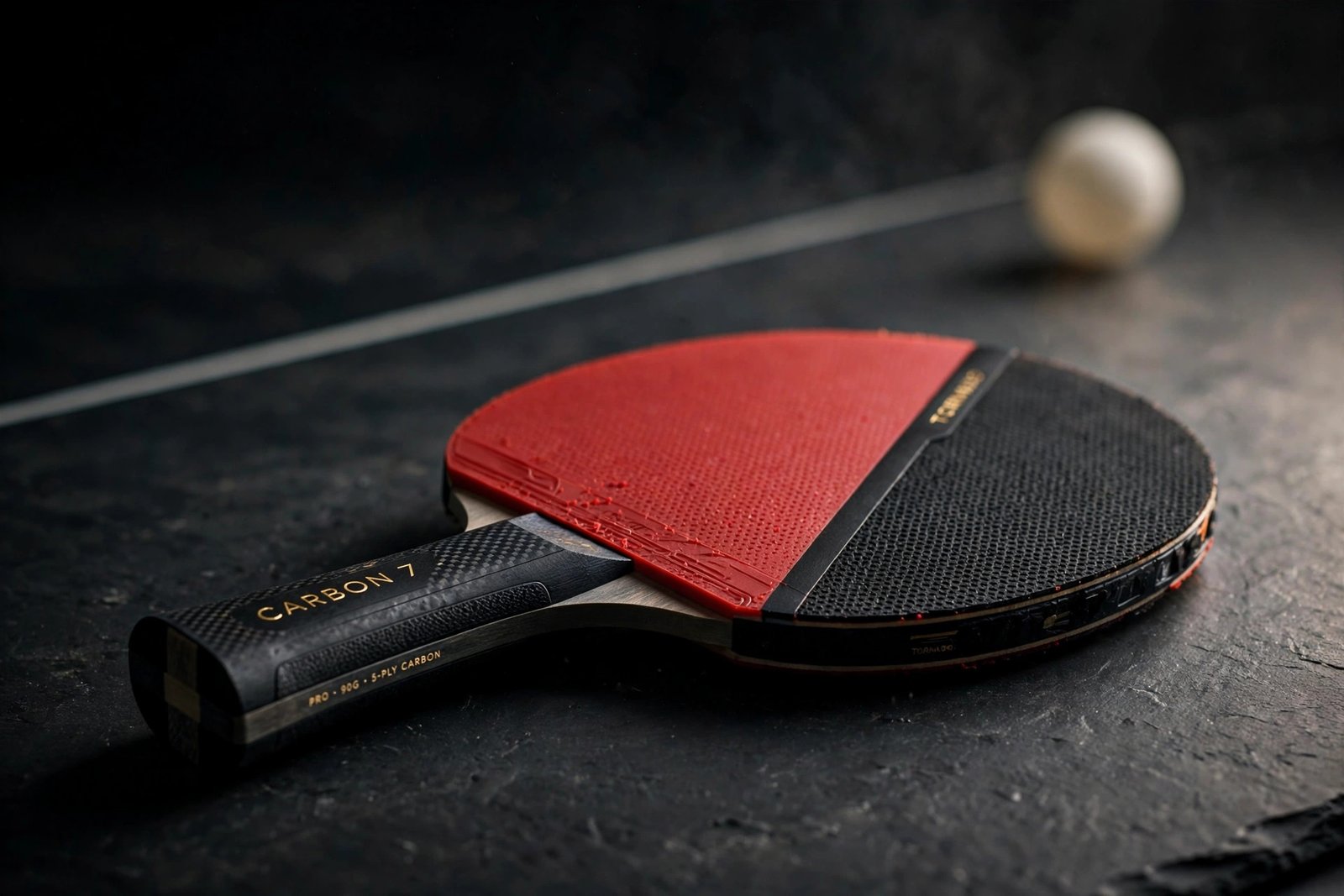
Finding the best table tennis bat for your game can feel overwhelming. Walk into any sports shop or browse online and you will face dozens of options — different blades, rubbers, sponge thicknesses, and grip styles, with prices ranging from $15 to over $300. Buy the wrong bat and you will fight your equipment instead of your opponent. Buy the right one and every stroke feels natural.
This guide cuts through the confusion. We break down exactly how table tennis bats work, what matters at each skill level, and which setups give you the best value in 2026 — whether you are picking up your first paddle or upgrading to a professional-grade weapon.
⚡ Quick Verdict
Beginners should buy a pre-assembled all-round bat ($30–$50) from STIGA or JOOLA and focus on technique, not equipment. Intermediate players get the biggest jump by switching to a custom blade-and-rubber combo ($80–$150). Advanced players need carbon composite blades with professional rubbers ($150+) — but only after their strokes are consistent enough to benefit.
📋 In This Guide
- Top Picks for 2026
- Bat Anatomy Explained
- Blade Types Deep Dive
- Rubber Types Deep Dive
- Best Bats for Beginners
- Best Bats for Intermediate Players
- Best Bats for Advanced Players
- Grip Styles: Shakehand vs Penhold
- Essential Gear Beyond the Bat
- Bat Care & Maintenance
- Head-to-Head Comparison
- Table Tennis vs Other Racket Sports
- FAQs
Top Picks for 2026
Short on time? These are the standout choices across skill levels this year:
STIGA Pro Carbon Performance Bat
- Pre-assembled with ITTF-approved rubbers
- Balanced all-round blade — easy control
- Flared handle fits most hand sizes
- Ready to play out of the box
Butterfly 401 Series Custom Combo
- 5-ply all-wood blade, excellent feel
- Pair with Sriver or Rozena rubbers
- Massive control upgrade over starter bats
- Lasts years as you improve
Butterfly Viscaria + Dignics 09C
- Arylate-carbon blade used by world champions
- Dignics 09C — ultimate spin rubber
- Explosive power for advanced loopers
- The professional standard
Bat Anatomy Explained
A table tennis bat — also called a paddle or racket depending on where you are in the world — has two fundamental components. Understanding how they work together is the key to choosing wisely.
The Blade: Your Bat’s Engine
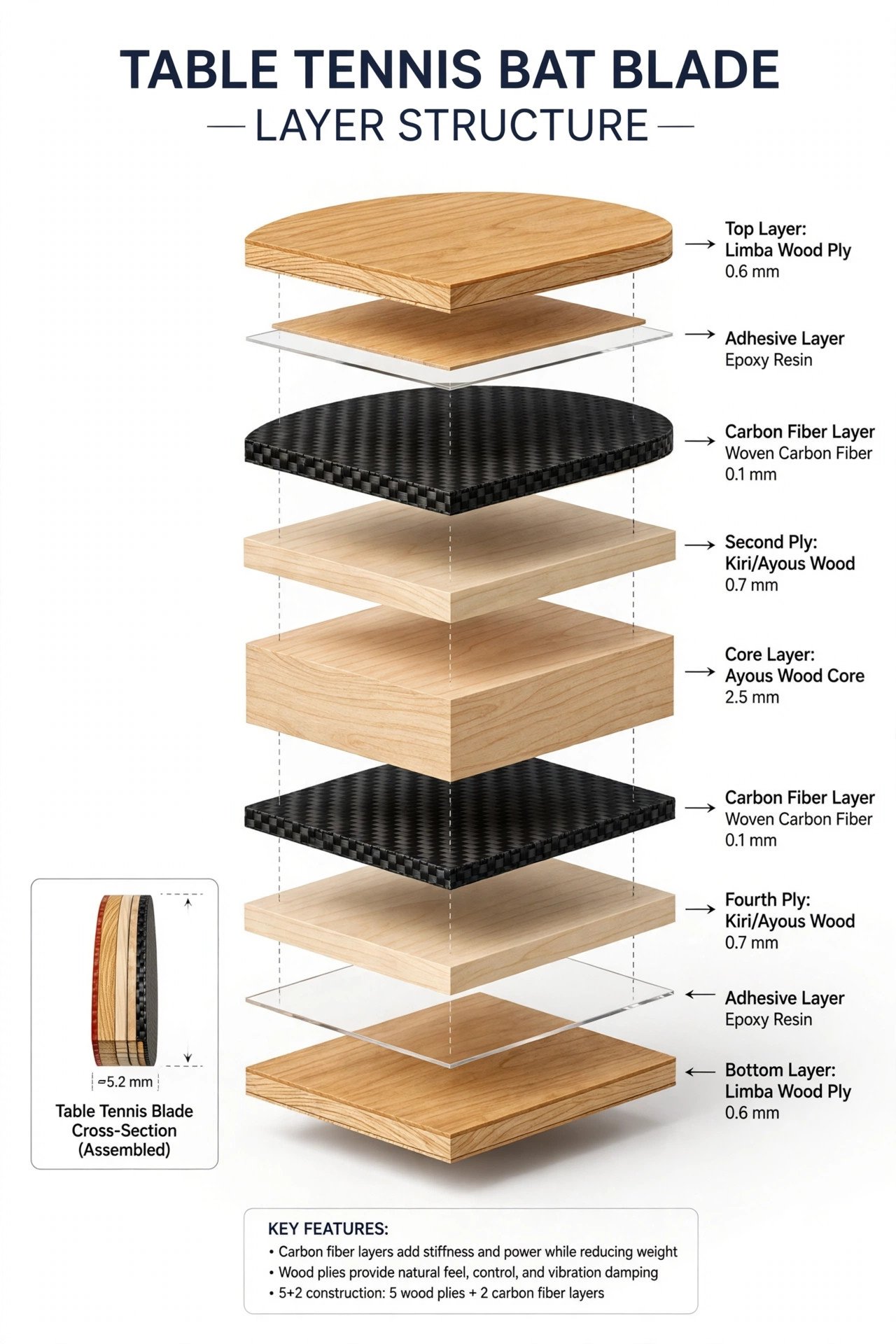
The blade is the wooden core of the bat. It is typically built from 5 to 9 thin plies of wood glued together, sometimes with carbon, arylate, or other composite fibers sandwiched between the wood layers. The blade determines roughly 40% of your bat’s playing characteristics.
- Outer plies (usually limba, koto, or hinoki wood) affect touch and feel on ball contact. Softer outer plies like limba give a dwell sensation that spin players love; harder koto plies produce a crisper, faster rebound.
- Core ply (often kiri, ayous, or balsa) is the thickest layer and the primary driver of overall speed. Thicker cores generally mean faster blades.
- Composite layers (carbon, arylate-carbon, zylon) add stiffness without much weight. They enlarge the sweet spot and add power, but reduce the “wooden feel” that helps developing players learn touch shots.
The Rubbers: Where Spin Is Born
Rubbers are the coverings glued to each side of the blade. Under ITTF rules, one side must be red and the other black. The rubber accounts for roughly 60% of playing characteristics — it is where spin, speed, and control are truly decided.
Every rubber has two parts: the top sheet (the outer surface that contacts the ball) and the sponge (the foam layer underneath). The top sheet’s grip determines spin potential; the sponge’s thickness and hardness determine speed and feel.
Blade Types Deep Dive
5-Ply All-Wood Blades
The classic choice. Five plies of wood with no composites deliver maximum feedback — you feel exactly where the ball contacts the blade, which accelerates learning. Speed ratings typically fall in the ALL (all-round) to ALL+ range. These blades are forgiving on off-center hits in the sense that they do not punish you with wild rebounds, making them ideal for players still building consistent strokes.
Legendary 5-ply blades include the Butterfly Primorac, Stiga Allround Classic, and Yasaka Sweden Extra. If you are buying your first custom setup, a 5-ply all-wood blade is almost always the right call.
7-Ply All-Wood Blades
Adding two more plies increases stiffness and speed into the OFF- (offensive minus) range while retaining the natural wood feel. Seven-ply blades suit aggressive all-round players who attack frequently but still value control on blocks and pushes. The Stiga Clipper Wood is the most famous example — a 7-ply icon used by countless professionals over decades.
Carbon Composite Blades
Carbon layers (usually in a 5+2 or 7+2 configuration, meaning 5 or 7 wood plies plus 2 composite layers) create a larger sweet spot and significantly more power. The trade-off is reduced dwell time — the ball leaves the bat faster, giving you less time to impart spin through brushing contact.
Not all carbon is equal. Arylate-carbon (used in the Butterfly Viscaria) offers a softer, more controlled carbon feel. Zylon-carbon is stiffer and faster. Inner carbon (composite layers near the core) preserves more wood feel than outer carbon (composite directly under the outer ply), making inner-carbon blades like the Butterfly Innerforce series a popular middle ground.
Rubber Types Deep Dive
By Sponge Hardness
Sponge hardness is measured in degrees. Softer sponges compress more on impact, gripping the ball longer for extra spin and control. Harder sponges rebound faster for more speed but demand precise technique.
- Soft (32–38°): Maximum control and feel. Ideal for beginners, young players, and defensive choppers who need the ball to stay on the rubber.
- Medium (39–45°): The versatile sweet spot. Good spin, good speed, forgiving enough for intermediate players. Most all-round rubbers live here.
- Medium-hard (45–48°): For advanced offensive players. Excellent for powerful loops when paired with proper technique.
- Hard (49°+): Professional territory. Maximum speed and spin potential, but brutally unforgiving of imperfect strokes.
By Top Sheet Style
- Tacky Chinese rubbers (DHS Hurricane 3, Friendship 729): The top sheet is literally sticky — a ball will cling briefly if you press it on. Unmatched for heavy spin serves and slow spinny loops. Require frequent cleaning and a protective sheet.
- Grippy European/Japanese rubbers (Butterfly Tenergy, Dignics, Andro Rasanter): High-tension “tensor” rubbers with built-in speed glue effect. Easier to play with than tacky rubbers and more durable. The modern professional standard outside China.
- Short pips: Small outward pimples. Less spin-sensitive, great for flat hitting and blocking close to the table. Popular among older players and penhold attackers.
- Long pips: Tall thin pimples that reverse incoming spin. A defensive weapon for choppers — extremely disruptive but difficult to attack with.
- Anti-spin: Slick, dead surface that kills spin. Niche defensive rubber for a very specific playing style.
By Sponge Thickness
Thicker sponge (2.1mm “max”) means more speed and spin but less control on short game. Thinner sponge (1.5–1.8mm) gives better touch for blocking, pushing, and defensive play. Most offensive players use max thickness on the forehand and slightly thinner on the backhand.
Best Bats for Beginners
As a beginner, your single priority is control. You are building muscle memory for forehand drives, backhand pushes, and basic footwork. A slow, forgiving bat lets you feel the ball and develop clean strokes. A fast bat masks errors and teaches you to slap at the ball instead of stroking through it.
What to Look For
- Speed rating: ALL or ALL+ (all-round). Avoid anything rated OFF- or faster.
- Rubbers: Medium-soft (38–42°), ITTF-approved, pre-assembled by a reputable brand.
- Handle: Flared is the most popular and suits most hands. Try anatomic if you have wrist issues.
- Weight: 170–185g assembled. Heavier bats tire beginners quickly.
- Price: $30–$50. This is the sweet spot where quality meets value.
Beginner Bat Recommendations
STIGA Pro Carbon Performer
- ITTF-approved 2mm premium rubbers
- 7-ply extra-light blade for control
- Concave pro handle — comfortable grip
- Includes bat case
JOOLA Spirit Pre-Assembled Bat
- Great first bat under $35
- All-round speed with decent spin
- Durable for club and home use
- Ergonomic flared handle
Best Bats for Intermediate Players
You can loop consistently, your serves have variation, and you are starting to play matches. Now equipment starts mattering. The single biggest upgrade at this stage is moving from a pre-assembled bat to a custom blade-and-rubber combination.
The Custom Advantage
Buying blade and rubbers separately lets you mix and match to your playing style. A typical intermediate setup: a 5-ply all-wood OFF- blade ($40–$60) with medium-hard European rubbers ($35–$50 per sheet). Total investment $110–$160 — and it will outperform any pre-assembled bat under $200.
Recommended Intermediate Setups
Yasaka Sweden Extra + Mark V
- Legendary 5-ply control blade
- Yasaka Mark V — the classic all-round rubber
- Unbeatable feel for developing loopers
- Used by coaches worldwide for students
Butterfly Primorac + Rozena
- Butterfly’s iconic 5-ply blade
- Rozena — Tenergy technology, friendlier price
- Excellent for spin-oriented attackers
- Huge upgrade from any starter bat
Best Bats for Advanced Players
At the advanced level, you know your game. You need equipment that rewards precise technique with maximum performance. This is where carbon composite blades and professional-grade rubbers earn their price.
What Advanced Players Need
- Blade: Inner or outer carbon composite (Viscaria, Zhang Jike ALC, Harimoto ALC). The enlarged sweet spot and added stiffness convert your swing speed into devastating power.
- Forehand rubber: Hard, spinny rubber — Dignics 09C, Tenergy 05 Hard, or DHS Hurricane 3 National. Maximum grip for heavy topspin loops.
- Backhand rubber: Slightly softer and bouncier — Dignics 05, Tenergy 05, or Rasanter R50. Optimized for quick backhand flicks and counter-loops.
Butterfly Viscaria + Dignics 09C / 05
- The most-used blade on the pro tour
- Arylate-carbon — power with control
- Dignics 09C forehand: unmatched spin
- Dignics 05 backhand: explosive counters
DHS Hurricane Long 5 + Hurricane 3
- Ma Long’s actual blade composition
- Arylate-carbon with limba outer
- Hurricane 3 Neo — the spin king
- For powerful forehand-dominant players
Grip Styles: Shakehand vs Penhold
Shakehand Grip
Hold the handle as if shaking hands — thumb and index finger on the blade face, remaining fingers wrapped around the handle. This is the dominant grip globally (roughly 90% of players) because it offers balanced forehand and backhand play with no significant weakness. If you are starting out, learn shakehand first.
Penhold Grip
Grip the handle like holding a pen, with the blade face perpendicular to the forearm. Traditional Chinese penhold uses only one rubber (forehand side), while modern reverse penhold backhand (RPB) adds a backhand rubber for two-winged attack. Penhold favors explosive forehand play and superb short-game touch, but the backhand requires more specialized training.
Essential Gear Beyond the Bat
Table Tennis Balls
Since 2014, the sport uses 40+mm plastic (poly) balls instead of celluloid. Always buy 3-star ITTF-approved balls for serious play — they have consistent bounce, roundness, and durability. Two-star balls are fine for practice; one-star balls are barely better than toys.
Top brands: Nittaku Premium 40+, Butterfly A40+, DHS D40+. Buy in bulk (12–24 packs) — you will lose them.
Nittaku Premium 40+ 3-Star Balls
- ITTF-approved for competition
- Consistent bounce and roundness
- Preferred at major tournaments
- 12-pack for regular players
Table Tennis Tables
For home use, the two specs that matter most are thickness (18mm+ for decent bounce; 25mm for competition feel) and undercarriage stability (look for locking wheels and a sturdy frame). A playback mode — where one half folds up for solo practice — is worth every penny if you train alone.
STIGA, JOOLA, and Butterfly dominate the home table market. Expect $300–$500 for a solid indoor table, $800+ for competition-grade.
JOOLA Inside 15mm Table
- 15mm playfield — good home bounce
- Compact folding with playback mode
- Locking caster wheels
- Quick 10-minute assembly
Table Tennis Shoes
Court shoes with non-marking soles and strong lateral support are essential — table tennis involves explosive side-to-side movement that running shoes cannot handle safely. Many players use volleyball or badminton court shoes, which share the same movement patterns.
ASICS Gel-Renma, Mizuno Wave Drive, and Yonex Power Cushion series are popular choices. Budget $60–$120 for quality court shoes.
ASICS Gel-Renma Court Shoes
- Excellent lateral stability
- Gel cushioning for hard courts
- Non-marking outsole
- True to size, wide options
Bat Care & Maintenance
A well-maintained bat lasts years; a neglected one dies in months. Follow these rules:
- Clean after every session: Wipe rubbers with a damp sponge or dedicated rubber cleaner. Never use household cleaners — they destroy the top sheet.
- Use protective sheets: Apply non-tacky protective films after cleaning to prevent oxidation. This alone doubles rubber life.
- Store in a case: Keep your bat in a padded case away from heat and sunlight. Car trunks in summer kill rubbers fast.
- Protect the edge: Apply edge tape to prevent chips when you clip the table. A $3 roll saves a $150 blade.
- Know when to replace: When rubbers lose grip (ball slides instead of gripping) or the sponge feels dead, it is time. Competitive players replace every 3–6 months; casual players every 1–2 years.
Head-to-Head Comparison
| Feature | Beginner Bat | Intermediate Setup | Advanced Setup |
|---|---|---|---|
| Blade type | Pre-assembled all-round | 5-ply all-wood (custom) | Carbon composite (custom) |
| Rubber hardness | Soft (35–40°) | Medium (42–46°) | Hard (47–52°) |
| Speed rating | ALL / ALL+ | OFF- / OFF | OFF / OFF+ |
| Typical price | $30–$50 | $90–$160 | $200–$350 |
| Best for | Learning fundamentals | Developing spin & attack | Competitive match play |
| Upgrade when… | You loop consistently | You need more power | Rubbers wear out |
Table Tennis vs Other Racket Sports
As a racket sports site, we get asked how table tennis compares. Here is the honest breakdown:
- vs Badminton: Both demand lightning reflexes, but badminton is a full-body athletic sport played across a large court, while table tennis is a compact precision game. Table tennis is easier on the knees; badminton builds more cardiovascular fitness. Many skills transfer — especially reading spin and reacting quickly.
- vs Tennis: Table tennis is essentially tennis compressed into a 9×5-foot table. The spin principles are identical (topspin, backspin, sidespin), just executed with wrist and forearm instead of full arm swings. Great cross-training for hand-eye coordination.
- vs Pickleball: Both are paddle sports with booming recreational communities. Pickleball is more social and beginner-friendly with a lower technical ceiling. Table tennis has a steeper learning curve but deeper competitive infrastructure worldwide.
- vs Padel: Padel is a doubles-centric power game played in an enclosed court; table tennis is predominantly singles with finesse. Completely different athletic demands, but both reward tactical thinking.
- vs Squash: Squash is the most physically brutal of all racket sports — constant sprinting in a confined box. Table tennis is its cerebral opposite: minimal movement, maximum precision. They complement each other well as cross-training.
Frequently Asked Questions
$30–$50 gets you a quality beginner bat from STIGA or JOOLA with real ITTF-approved rubbers that will last through your first year of proper training. Avoid $10–$15 department-store bats — their dead rubbers have no grip, which means you physically cannot learn to generate spin. That $20 savings costs you months of bad habits.
Shakehand grip (holding the handle like a handshake) is used by about 90% of players worldwide and offers balanced forehand and backhand play. Penhold grip (holding like a pen) is traditional in China and Korea, favoring explosive forehand attacks. Modern reverse penhold backhand (RPB) has closed the backhand gap. Beginners should start with shakehand — it is more versatile and has vastly more coaching resources available.
Competitive players who train 4+ times per week replace rubbers every 3–6 months. Serious club players (2–3 times per week) every 6–12 months. Casual players can go 1–2 years. Signs it is time: the ball slides instead of gripping on serves, your spin shots land shorter than usual, or the sponge feels mushy and unresponsive. Using protective sheets and cleaning after every session significantly extends rubber life.
Only when your technique is ready to benefit. A $300 carbon setup amplifies everything — including your mistakes. If you cannot loop 50 balls in a row without missing on a $40 bat, a $300 bat will make you worse, not better. The right time to upgrade is when you can consistently feel the difference: your current bat feels “slow” on power shots, or you are losing spin because the rubber cannot grip the ball at your swing speed.
Yes, and most beginners and intermediates should. Using identical rubbers simplifies learning — you develop one feel instead of two. Advanced players often differentiate: a harder, spinnier rubber on the forehand for maximum attack, and a slightly softer, bouncier rubber on the backhand for quick counters and flicks. But this is a refinement, not a requirement.
Chinese rubbers (DHS Hurricane, Friendship 729) have tacky top sheets that physically grip the ball — unmatched for heavy spin on slow loops and serves, but they require more effort to generate speed and need frequent maintenance. European/Japanese rubbers (Butterfly Tenergy/Dignics, Andro Rasanter) use high-tension “tensor” sponges with built-in speed — easier to play with, more durable, and the standard for most professional players outside China. Neither is objectively better; they suit different playing styles.
As an Amazon Associate, AliShuttler earns from qualifying purchases. Product prices and availability are accurate as of the date of publication and are subject to change. We recommend products based on research and community feedback; we have not physically tested every item listed.