
Your paddle is the expensive, fragile thing in your kit; the bag is what protects it, organises everything around it, and hangs it all off the fence within reach. We compared the carry styles that actually exist in pickleball — sling, backpack, duffel and tour — and picked seven bags whose capacities and features are stated by their manufacturers, not invented by a product table. Every spec below comes from the brand’s own product copy.
⚡ TL;DR — The Short Version
For most players, the Selkirk Core Line Tour Bag is the bag to beat: a proper tour backpack with a ventilated shoe compartment, an insulated pouch, a padded paddle section and a fence clip in Selkirk’s toughest material. Carry light? The Franklin Sling Bag is the minimal, grab-and-go option — and it still swallows up to six paddles. Travelling to tournaments, the ProLite Tour XL fits up to 10 paddles with a thermally insulated compartment, and the JOOLA Tour Elite converts between backpack and duffel. On a budget of space rather than money, the Selkirk Day Bag is the compact daily driver.
Quick Picks
Selkirk Core Line Tour Bag
The full tour backpack: ventilated shoe compartment, insulated thermal pouch, hard protective top shell, fence clip and a 15-inch laptop sleeve, in +V11 Max Polyfiber.
Franklin Pickleball Sling Bag
The official bag of the US Open Pickleball Championships. One strap, up to six paddles, six balls, a felt-lined device pocket and a fence hook.
ProLite Tour XL Bag
The biggest verified capacity here — up to 10 paddles across two main compartments, one thermally insulated, plus a ventilated shoe compartment.
In This Guide
Why Your Bag Choice Actually Matters
A paddle left loose in a car boot or a gym tote picks up edge-guard dings, face scratches and heat exposure it never needed — and a modern composite paddle is not a cheap thing to abuse (our best pickleball paddles pillar is where those live). A proper pickleball bag solves four problems at once: paddle protection (padded or thermal-lined compartments), separation (shoes and sweaty kit away from everything else), organisation (balls, grips, tape, phone and water each with a home), and court-side access (a fence hook that puts the bag at hand height instead of in the dust). The seven bags below cover every carry style and every realistic paddle count, from the two-paddle weeknight player to the ten-paddle tournament traveller.
The 7 Bags at a Glance
| Bag | Style | Paddle Capacity* | Shoe Storage | Dimensions |
|---|---|---|---|---|
| Selkirk Core Line Tour | Tour backpack | 2 in paddle pouch + main | Ventilated compartment | 14″ × 11″ × 20.5″ |
| Franklin Sling Bag | Sling | Up to 6 | — | 18.5″ × 13″ × 8″ |
| Selkirk Core Line Day | Compact backpack | Up to 6 | — | 13″ × 5″ × 16″ |
| ONIX Pro Team Backpack | Backpack | Padded compartment | Shoe/wet compartment | 19″ × 14″ × 9″ |
| Vulcan VPRO Backpack | Backpack | 2 (padded compartment) | Vented pocket | 10″ × 14″ × 19″ |
| ProLite Tour XL | Duffel / convertible | Up to 10 | Ventilated compartment | 24″ × 12″ × 12″ |
| JOOLA Tour Elite | Convertible duffel-backpack | Up to 4 (thermal pockets) | Interior shoe bag | 15″ × 22″ × 10″ |
*Capacities are the manufacturers’ own stated figures, in the form each brand states them — a dedicated padded compartment for two is a different promise from a main compartment that fits six, and the reviews below treat them differently. By design, this table carries no prices and no star ratings: prices move and ratings on retail listings are unverifiable, so neither helps you choose.
Best Pickleball Bags Reviewed
1. Selkirk Core Line Tour Bag
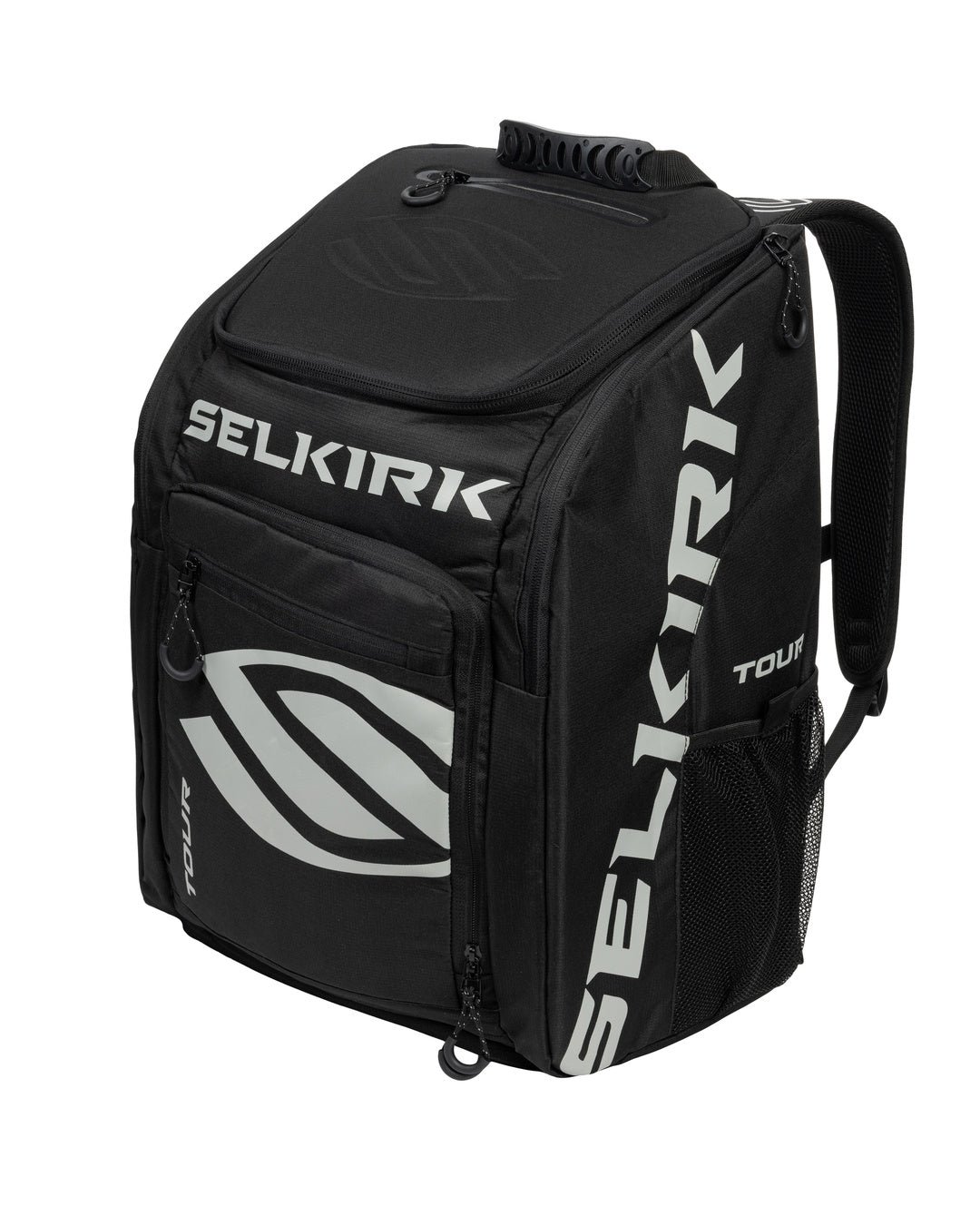
Selkirk positions the Tour Bag at the top of its Core Line, and the feature list backs that up. The primary paddle pouch holds two paddles; the large main compartment (reached from the top or the front) handles the rest of your rotation, clothing and towels. A ventilated shoe compartment keeps court shoes — ours would be the pair from our best pickleball shoes guide — sealed away from clean kit, and an insulated thermal pouch keeps a drink or snack cold through a long session. The details are the tour-grade kind: a hard EVA top section with its own zippered cellphone pocket, a clip that hangs the bag off the court fence, a thermal-formed back panel, and a protected sleeve that swallows a 15-inch laptop for players travelling straight from work to a tournament.
It is built from the same +V11 Max Polyfiber as the rest of the Core Line — Selkirk’s durable performance shell — with patterned lining inside. At 20.5 inches tall it is the biggest backpack in this roundup, which is precisely the point: this is the bag for league players and tournament regulars who carry multiple paddles, a change of clothes, shoes, balls and a laptop, and want each in its own place.
- Ventilated shoe compartment and insulated thermal pouch
- Hard EVA top with separate phone pocket
- Fence clip and 15″ laptop sleeve
- Top and front loading into a genuinely large main compartment
- The biggest, heaviest carry here when fully loaded
- Dedicated paddle pouch holds 2 — extra paddles share the main space
- Overkill for a two-paddle weeknight session
2. Franklin Pickleball Sling Bag
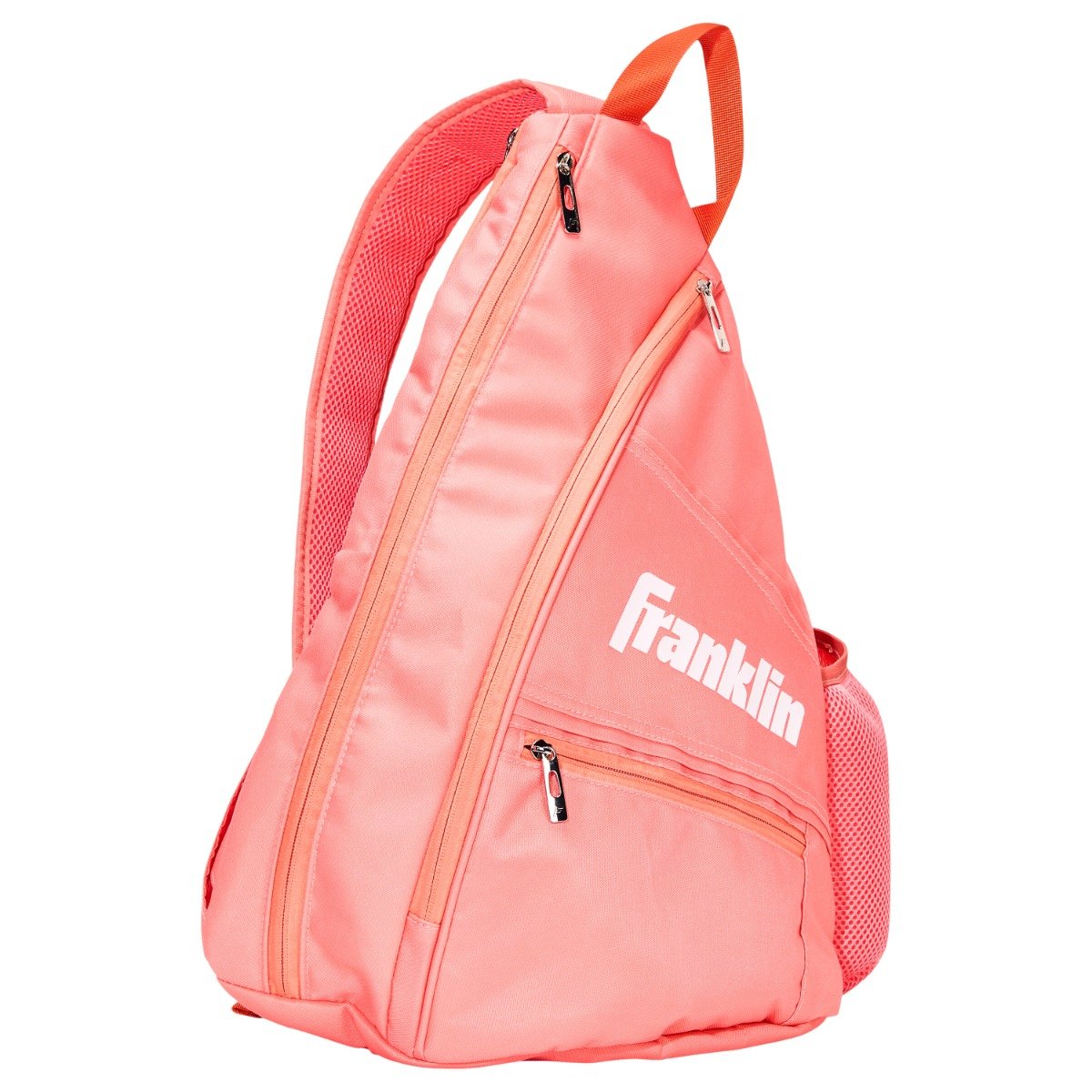
The sling is pickleball’s original carry format, and Franklin’s is the reference version — it is the official bag of the US Open Pickleball Championships. The surprise is how much it holds for a single-strap bag: Franklin rates it for up to six paddles plus six X-40 balls, which covers most players’ entire collection, let alone their session kit. A felt-lined pocket protects a phone or tablet from paddle-edge scratches, there is a dedicated place for a water bottle, and an integrated fence hook keeps the bag off the ground and at hand height — the small feature you miss most on bags that lack it.
Everything rides on one adjustable strap, cross-body or over one shoulder, which makes this the fastest bag in the roundup to grab, ride with, and stow in a locker. What it does not have: a shoe compartment, laptop storage, or the structured protection of the backpacks — this is a courts-and-home bag, not a travel bag. For the large share of players whose whole kit is a couple of paddles, balls, a towel and a bottle, it is the right amount of bag, from the brand that also makes the X-40 — the ball our best pickleball balls guide leads with.
- Holds up to 6 paddles despite the minimal format
- Felt-lined pocket protects a phone or tablet
- Fence hook and bottle carry included
- Fastest on/off of any bag here
- No shoe compartment or laptop storage
- Single strap carries heavy loads less comfortably than a backpack
- Less structured paddle protection than the tour bags
3. Selkirk Core Line Day Bag
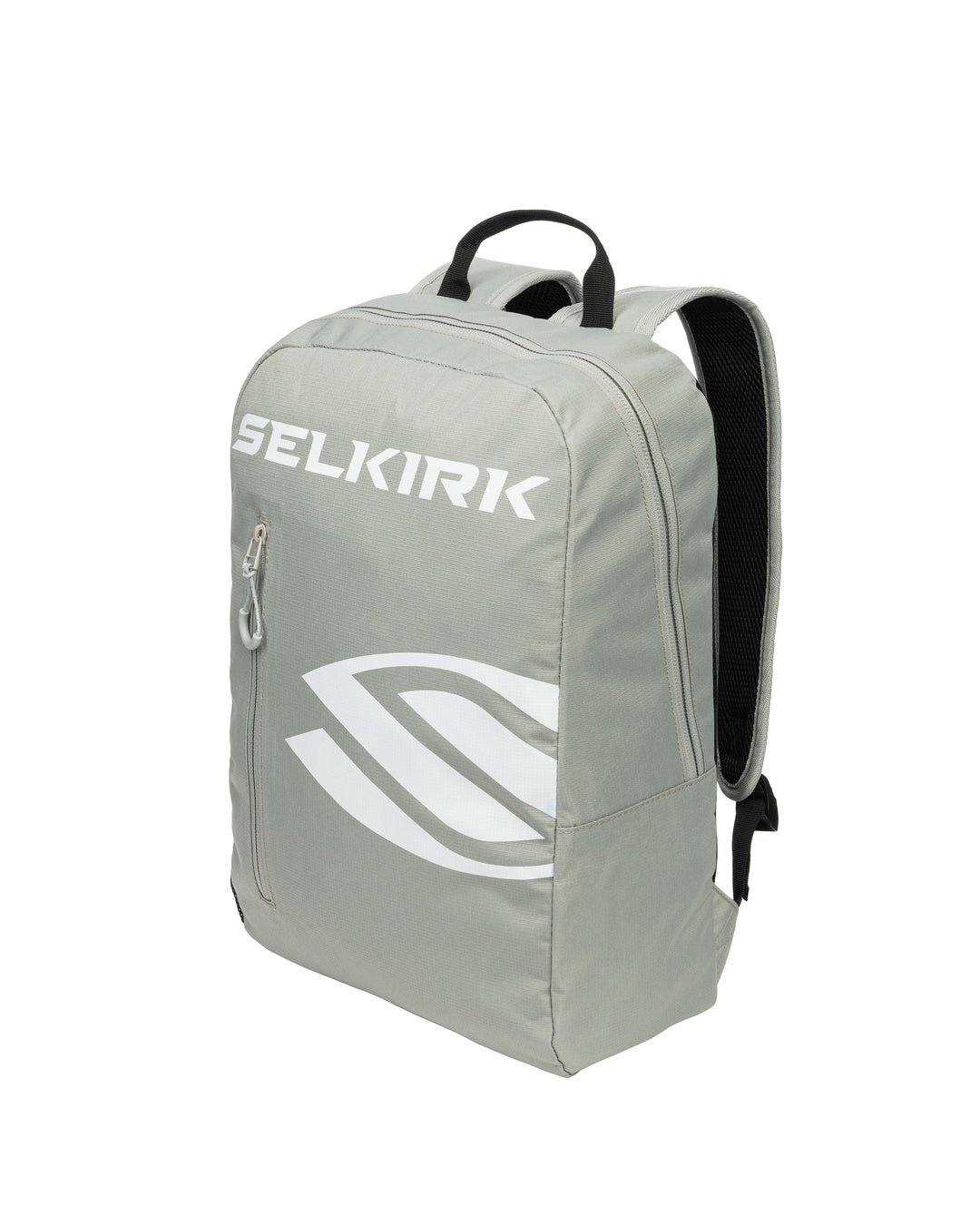
Think of the Day Bag as the Core Line’s everyday answer: the same +V11 Max Polyfiber shell as the Tour Bag, in a slim 13 × 5 × 16-inch profile that slides into a locker or under a bench without a fight. Inside, Selkirk rates the main compartment at up to six paddles, an internal organiser pocket keeps grips, tape and keys findable, and a protected laptop sleeve fits a 15-inch machine — the work-to-court commute is clearly a design brief here. A padded front pocket takes a phone or sunglasses, and the mesh side pocket handles a water bottle.
The trade-offs against its bigger sibling are honest ones: no shoe compartment, no insulated pouch, and a front pocket rather than the Tour’s hard EVA top. What you get instead is the bag you will actually carry every day. For recreational and league players whose sessions need paddles, balls, a towel and a change of shirt — not a full tournament load-out — the Day Bag is the sweet spot of this Selkirk pair, and the pair with our greatest pickleball accessories picks (grips, tape, eyewear) better than any closet-sized duffel does.
- Slim profile, still rated for up to 6 paddles
- Protected 15″ laptop sleeve for commuters
- Same +V11 Max Polyfiber as the Tour Bag
- Internal organiser and padded front pocket
- No shoe compartment or insulated pouch
- 5-inch depth limits bulky clothing loads
- Less court-side structure than the Tour Bag
4. ONIX Pro Team Backpack
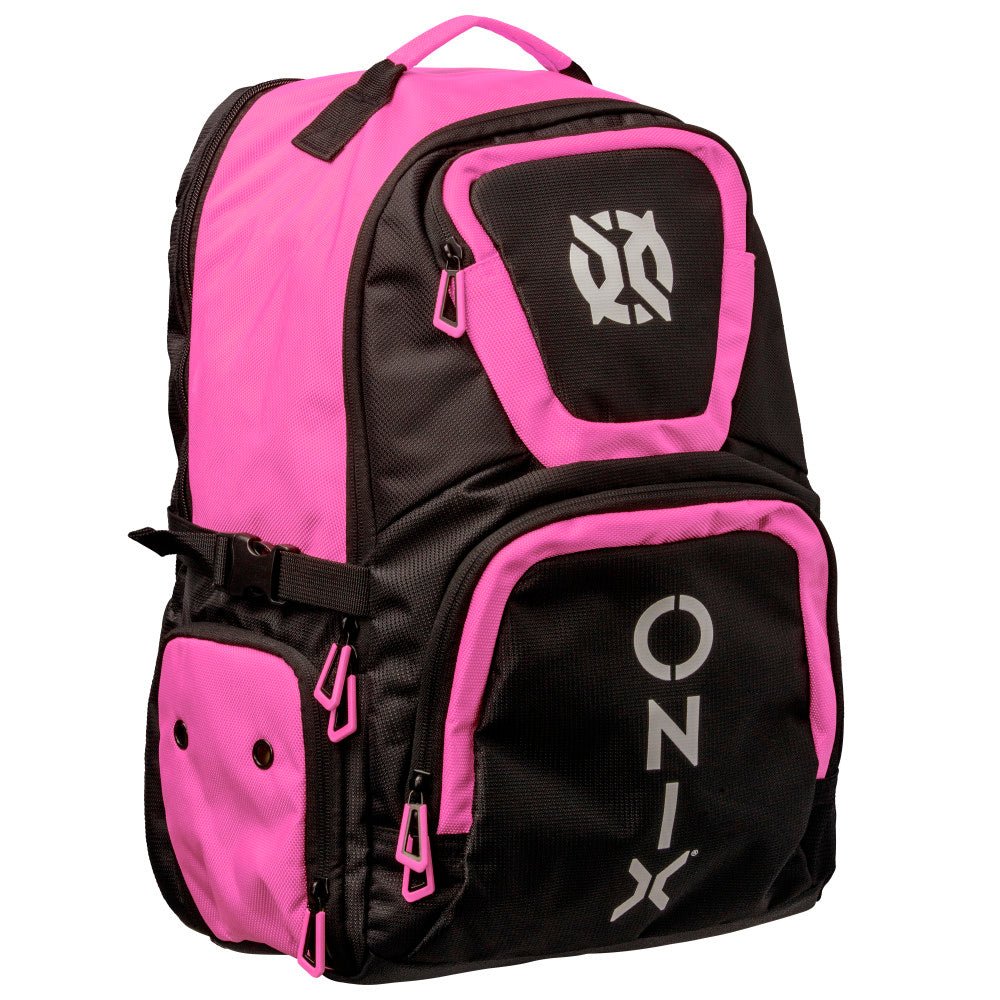
ONIX built the Pro Team Backpack for players who carry for more than themselves — coaches, league captains and the friend who always has the spare paddle. The layout is four zippered compartments: a padded compartment for paddles, a main space for clothing and balls, a dedicated shoe and wet storage compartment that quarantines the post-match smell, and accessory space for the small stuff. Padded shoulder straps keep a full load civilised on the walk in.
At 19 × 14 × 9 inches it sits between the Day Bag and the tour bags for size, and its organisation-per-inch is the best argument for it: everything opens with a zip, everything has a section. It gives up the premium materials story of the Selkirks (plain durable polyester rather than a branded performance shell) and has no thermal lining, so heat-sensitive storage is not its pitch — capacity and order are. Team-day players hauling demo paddles, spare balls and a first-aid roll will not miss the insulation.
- Four zippered compartments keep a full kit organised
- Dedicated shoe/wet storage compartment
- Padded paddle compartment and shoulder straps
- Generous 19-inch main body without tour-bag bulk
- No thermal-lined storage
- Plain polyester shell, no premium material story
- No laptop-specific sleeve called out by ONIX
5. Vulcan VPRO Backpack
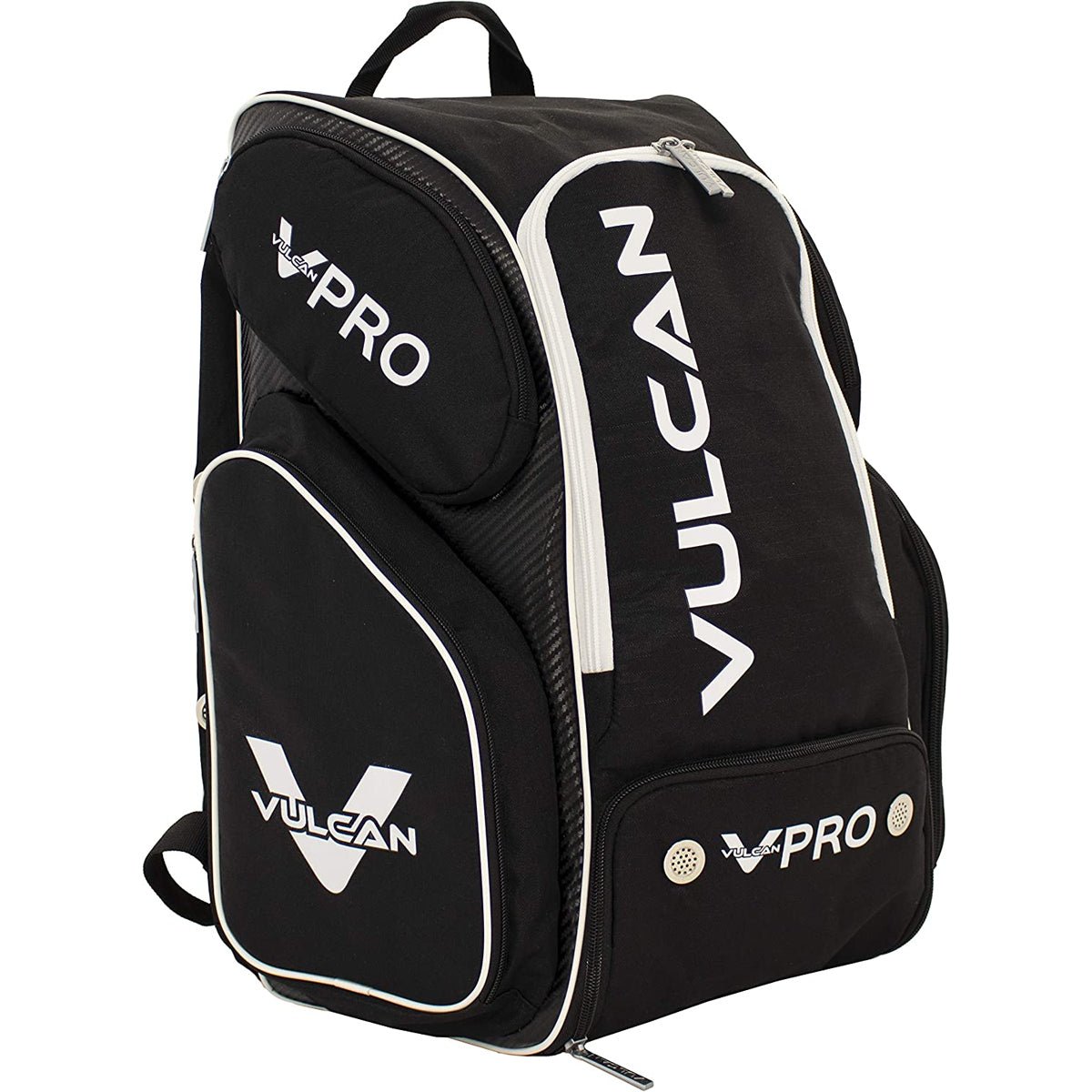
The VPRO is the organiser’s backpack. Vulcan builds it from heavy-duty ripstop material with water resistance — the bag most likely here to shrug off a wet court, a dusty car park or a season of being thrown in the boot — and then fills it with more dedicated storage than anything else in the roundup: a padded compartment for two paddles, a main compartment, a vented shoe pocket, four accessory pockets for balls, grips and tape, and an insulated pocket that keeps a snack or drink cold. A fence hook tucks under the grab handle, ready when you reach the court.
The honest limitation is paddle capacity: the protected compartment is a two-paddle promise, so this is a bag for players with a settled two-paddle rotation, not collectors. In exchange, everything those players carry gets its own zip, mesh or lining — including, neatly, a place for the spare balls from our pickleball balls guide. Vulcan’s VPRO line is built to match its paddle range, so brand-loyal Vulcan players get a coordinated kit as a bonus.
- Water-resistant heavy-duty ripstop shell
- Insulated pocket plus four accessory pockets
- Vented shoe pocket and fence hook
- Padded two-paddle compartment
- Protected paddle storage capped at 2
- No laptop sleeve
- Utilitarian styling next to the Selkirks
6. ProLite Tour XL Bag
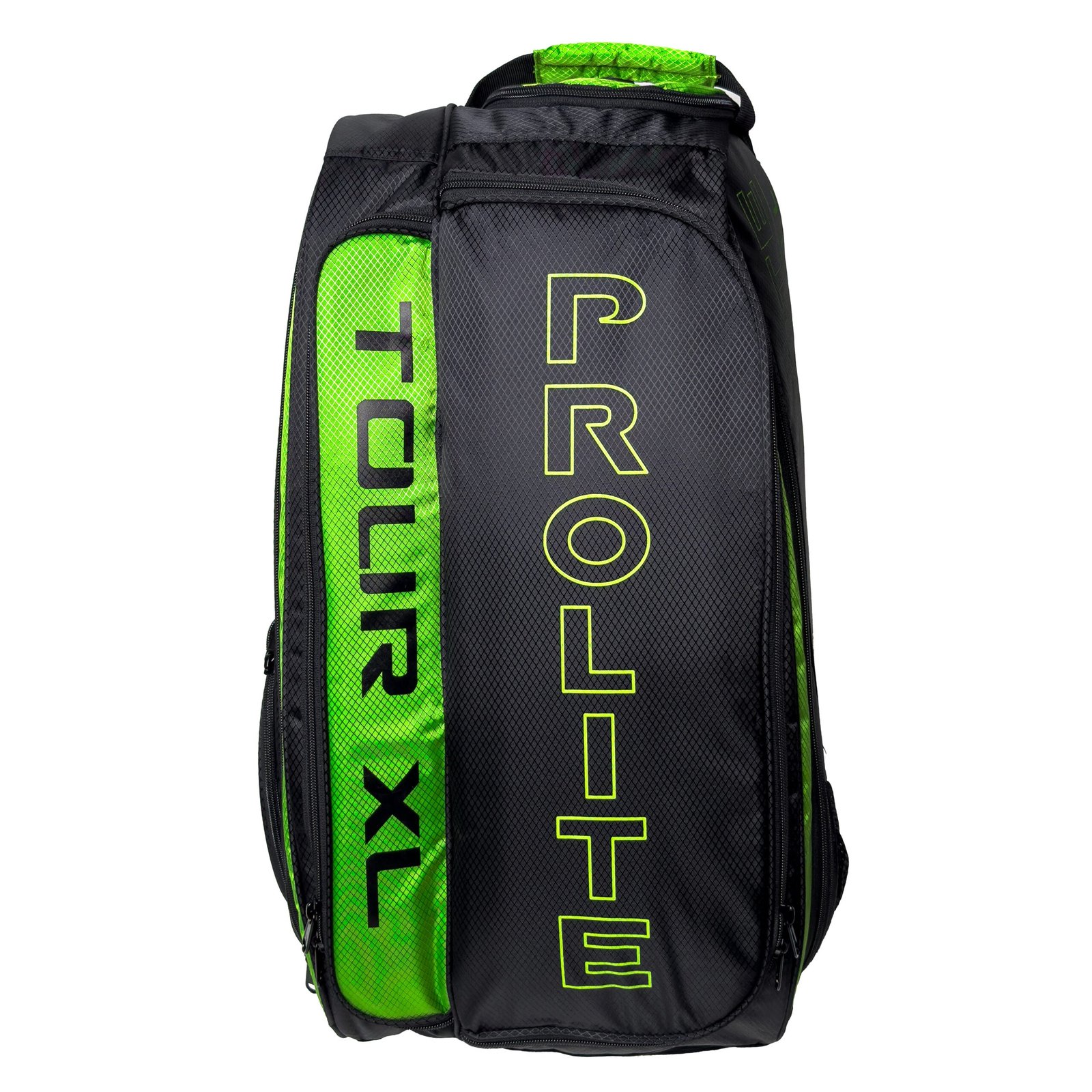
ProLite describes the Tour XL as its travel and tournament bag, and the headline number earns it: up to 10 paddles across two main compartments — the largest verified capacity in this roundup, and the only one that treats a paddle quiver as the packing problem it is for serious players. One of those compartments carries ProLite’s Climate Control Technology: thermal insulation designed to protect paddles from heat (or keep food and drinks cool) — a real consideration for anyone whose bag lives in a car between matches, as paddle faces and adhesives are not fans of a hot boot.
Around that core there is a ventilated shoe compartment, internal pouch pockets, an outside zippered accessory pocket, and two large elastic mesh side compartments for bottles and balls. Despite the volume, it weighs only 3.3 lbs, and the carry straps convert it into a backpack for the walk from the car park — with upgraded zippers throughout. At 24 inches long this is checked-bag or car-boot territory rather than cabin luggage; for road-trip tournaments, coaching weekends and team travel, nothing else here hauls as much, as organised.
- Largest verified capacity — up to 10 paddles
- Climate Control insulated compartment for paddles or food
- Ventilated shoe compartment and mesh side storage
- Only 3.3 lbs, converts to backpack carry
- 24″ length is too big for cabin-bag rules
- Duffel format is less structured for daily use
- More bag than a casual player will ever fill
7. JOOLA Tour Elite Pickleball Bag
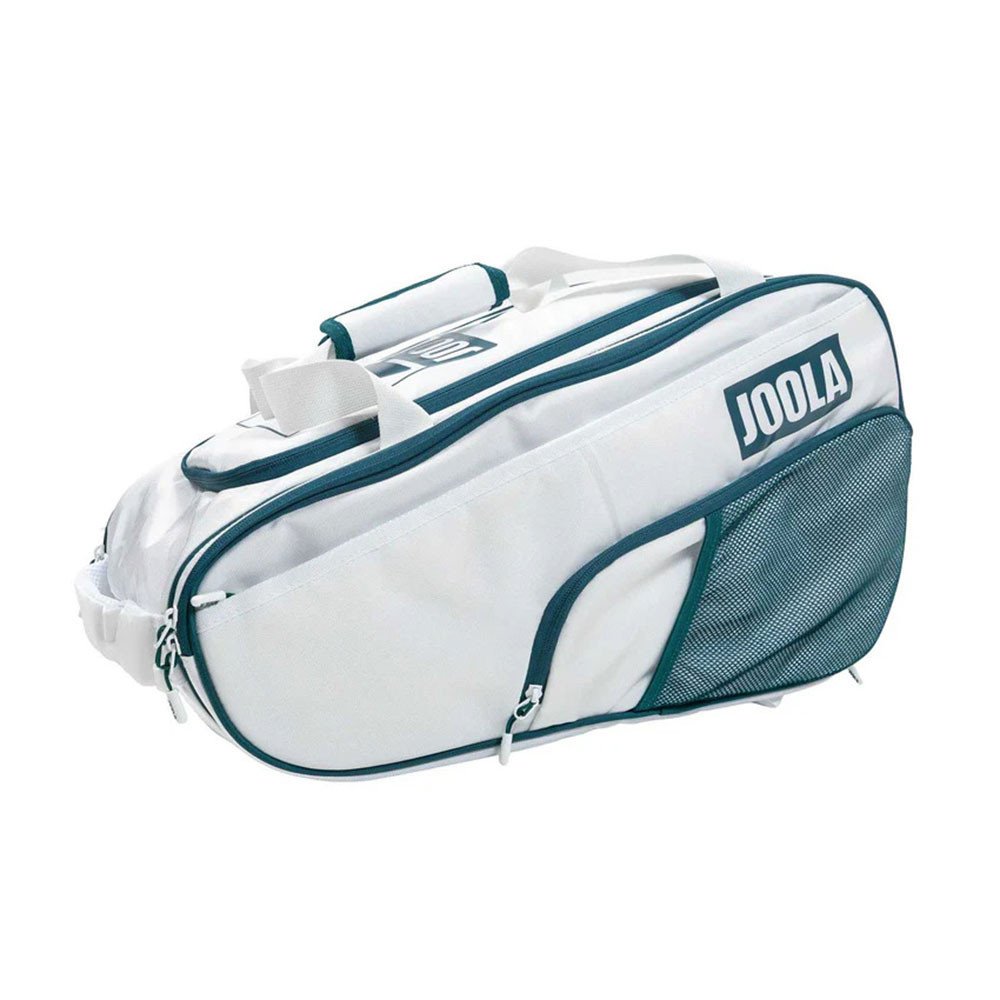
JOOLA’s Tour Elite is the bag for players whose pickleball involves airports. It converts from backpack to duffel — the shoulder straps tuck into a hideaway sleeve — and it is sized and sold as a carry-on, so your paddles stay with you in the cabin rather than in the hold. The protection story is thermal: two thermal-lined paddle pockets, each fitting two paddles, guard the faces against the temperature swings of travel and hot cars, and the interior fabric is water-resistant and wipeable for quick clean-ups.
Organisation runs to roughly a dozen storage areas, including a hidden valuables pocket, an interior snap-closure shoe bag that keeps footwear separate, and a fence hook that hides in its own pocket when not in use. Four paddles in protected pockets plus a main compartment’s worth of clothing is the realistic tournament-weekend load, and at 3 lbs empty it leaves your weight allowance for the gear itself. If your season mixes local league nights with fly-away events, this is the one-bag answer — and it pairs naturally with the travel-friendly advice in our Pickleball Rules 2026 guide for playing under tournament formats.
- Converts between backpack and duffel carry
- Two thermal-lined paddle pockets (4 paddles)
- Carry-on friendly size, just 3 lbs
- Hidden valuables pocket and hideaway fence hook
- Protected capacity is 4 paddles — less than the Tour XL
- Shoe storage is a bag insert, not a vented compartment
- No laptop sleeve for work-trip crossover
Sling vs Backpack vs Duffel: Which Carry Style?
Choose a sling if your session kit is minimal and your trip to court is short. The Franklin shows a sling can still swallow six paddles — but the format’s charm is what it leaves behind: no bulk, no structure, one strap and go. Ideal for social and weeknight players who keep their gear in the car.
Choose a backpack if you commute, cycle, or carry shoes and a change of clothes. Backpacks distribute weight across both shoulders, stand up by the fence, and host the organisation — laptop sleeves (both Selkirks), shoe garages (ONIX, Selkirk Tour, Vulcan’s vented pocket), insulated pouches (Selkirk Tour, Vulcan). Most regular players land here, and the Day Bag / VPRO / Pro Team tier is the competitive heart of the market.
Choose a duffel or tour bag if your problem is volume: tournaments, travel, coaching, or a genuine paddle quiver. The ProLite Tour XL’s 10-paddle capacity and the JOOLA Tour Elite’s cabin-friendly conversion are solutions to travel problems a backpack cannot solve. New to the sport entirely? Start with the bag that matches the player you already are, and learn the game itself in our How to Play Pickleball guide.
How to Choose a Pickleball Bag
Count paddles honestly — then read capacity claims properly
Brands state capacity two ways: a main compartment that “fits up to” a number of paddles (Franklin’s 6, ProLite’s 10) and a dedicated padded compartment sized for a specific count (Vulcan’s 2, JOOLA’s 2 + 2). The first is volume; the second is protection. If your paddles are premium, protected compartments matter more than raw count; if you carry demos and spares, volume wins.
Thermal lining is paddle care, not a gimmick
Composite faces, adhesives and grips all dislike sustained heat, and bags sit in cars. JOOLA’s thermal paddle pockets, ProLite’s Climate Control compartment and Selkirk’s insulated pouch are the manufacturers’ answers. If your bag lives in a vehicle, weight this feature heavily.
Shoes need their own space
A separate — ideally ventilated — shoe compartment keeps grit off paddle faces and smell off clothing. Four of these seven bags offer one; if yours does not, a simple shoe sack inside your bag does the same job for your court shoes.
The fence hook is the feature you will use most
Five of these seven bags include one (Franklin, both Selkirks, Vulcan, JOOLA). It keeps your bag off wet ground, out of the dust, and at hand height courtside. Once you have played with one, bags without it feel unfinished.
Match the bag to the trip, not the fantasy
Check dimensions against your reality: locker width, bike basket, airline cabin rules. The Tour XL’s 24 inches is a tournament asset and a daily liability; the Day Bag’s slim 5-inch depth is the opposite. The best bag is the one that fits your actual week.
Frequently Asked Questions
How many paddles should a pickleball bag hold?
For most players, two to four: your match paddle, a backup, and optionally a loaner. Bags in this guide state manufacturer capacities from a protected compartment for 2 (Vulcan VPRO) up to 10 across two main compartments (ProLite Tour XL). Match the bag to the number you actually carry — volume you never use is weight you always carry.
What is the difference between a sling bag and a backpack for pickleball?
A sling carries on one strap, cross-body, and suits light, short trips — the Franklin Sling Bag still holds up to six paddles and six balls. A backpack spreads weight across both shoulders and adds structure: shoe compartments, laptop sleeves and insulated pockets, as on the Selkirk Core Tour and ONIX Pro Team. Choose the sling for minimal sessions, the backpack for commuting and full kit.
Do I need a thermal-lined pickleball bag?
Thermal lining is designed to buffer paddles against temperature extremes — the manufacturers offering it (JOOLA’s thermal pockets, ProLite’s Climate Control compartment) aim it at bags left in hot cars and at travel. If your bag lives indoors and travels in an air-conditioned cabin, it is a nice-to-have; if it lives in a car boot, treat it as close to essential.
Can I take a pickleball bag as carry-on luggage?
Some are designed for it: the JOOLA Tour Elite converts to a duffel and is sold as carry-on friendly at 15″ × 22″ × 10″. At the other end, the 24-inch ProLite Tour XL exceeds typical cabin length limits and belongs in the car or the hold. Always check your airline’s current size rules — they, not the bag brand, have the final say.
Can I just use a tennis bag for pickleball?
You can, but it fits badly: tennis racket compartments are long and narrow for a 27-inch frame, while pickleball paddles are short and wide, so they slide and knock together. Pickleball bags are proportioned for paddles, add ball storage and fence hooks, and their shoe compartments suit court shoes. If you already own a small tennis duffel it will do for a while; a purpose bag is the better long-term home for your paddles.
What else should go in my pickleball bag?
Beyond paddles and balls: spare overgrips and tape, a towel, water bottle, sunscreen, basic first aid, and any protective eyewear. Our greatest pickleball accessories guide covers the extras worth their space, and our balls guide will keep the ball tube stocked with the right indoor or outdoor spec.
Final Verdict
Our Pick: Selkirk Core Line Tour Bag
The Selkirk Core Line Tour Bag takes the overall spot because it is the most complete carry here: ventilated shoe compartment, insulated pouch, padded paddle storage, hard EVA top, fence clip and a laptop sleeve, in the toughest shell Selkirk makes. Minimalists should take the Franklin Sling Bag; daily commuters the Selkirk Day Bag; organisers the Vulcan VPRO or ONIX Pro Team; and travellers the ProLite Tour XL for volume or the JOOLA Tour Elite for the cabin. Whichever you choose, keep the rest of the kit current in our shoes and balls guides — a great bag deserves gear worth organising.
Affiliate Disclosure: AliShuttler is reader-supported. When you buy through links on this page, we may earn an Amazon commission at no additional cost to you. Every specification in this guide is taken from the manufacturer’s own published product copy, checked at the time of writing; we do not publish prices (they change) or star ratings (retail listings cannot be verified), and no product here is described as tested by us.