Pickleball balls look identical in a product photo and play completely differently on court — because the first choice is never brand, it is surface. Outdoor balls are harder, with smaller, more numerous holes built for wind and abrasive asphalt. Indoor balls are softer, with larger, fewer holes tuned for wood and gym floors. Get that one decision right, then pick from the seven tournament-approved balls below.
⚡ TL;DR — The Short Answer
Playing outdoors? Buy the Franklin X-40 — the seamless, 40-hole ball that is approved for outdoor tournament play and serves as the official ball of the US Open Pickleball Championships. Want the fastest, hardest tournament ball, choose the Dura Fast 40. Playing indoors on wood or gym flooring? Start with the Onix Fuse Indoor, the seam-welded 26-hole ball built for exactly that surface, or the high-visibility Gamma Photon Indoor if your hall has tricky lighting. Every pick below is USA Pickleball approved, so any of them can walk into sanctioned play — the difference is surface, pace and how the ball is built.
Quick Picks — Best Pickleball Balls at a Glance
Franklin X-40
Seamless one-piece build, 40 holes, 26 g / 74 mm. The default outdoor ball, and the US Open’s official ball.
Dura Fast 40
The original pickleball: thick-walled, rotationally moulded, 40 holes in two sizes. Fast, true, uncompromising.
Selkirk Pro S1
A patented 38-hole pattern, seamless rotomoulding and a manufacturer-published 1-year no-crack warranty.
JOOLA Primo
One-piece polyethylene, 40 holes, 26 g / 74 mm — JOOLA’s tournament ball, also happy in a ball machine.
Onix Fuse Indoor
26 larger holes, seam-welded build, a slightly lower bounce tuned for gym and wood floors.
Gamma Photon Indoor
Optic-green, two-piece welded 26-hole ball that stands out against pale gym walls and floors.
Franklin X-26 Indoor
Franklin’s indoor counterpart to the X-40: 26 bevelled holes, EVA build, sold in club-sized bulk packs.
In This Guide
- Indoor vs Outdoor: The Only Decision That Comes First
- What USA Pickleball Approval Actually Guarantees
- Seamless vs Seam-Welded: How a Pickleball Is Built
- The 7 Best Pickleball Balls, Compared
- Side-by-Side Comparison Table
- Buying Guide: Surface, Holes, Pace and Ball Life
- Frequently Asked Questions
- The Verdict
Indoor vs Outdoor: The Only Decision That Comes First
Every other piece of pickleball gear rewards research. Balls reward one simple question: what surface do you play on? An outdoor ball and an indoor ball are both hollow plastic spheres drilled with holes, built to the same USA Pickleball size and weight window — but they are tuned in opposite directions, and each one feels wrong on the other surface.
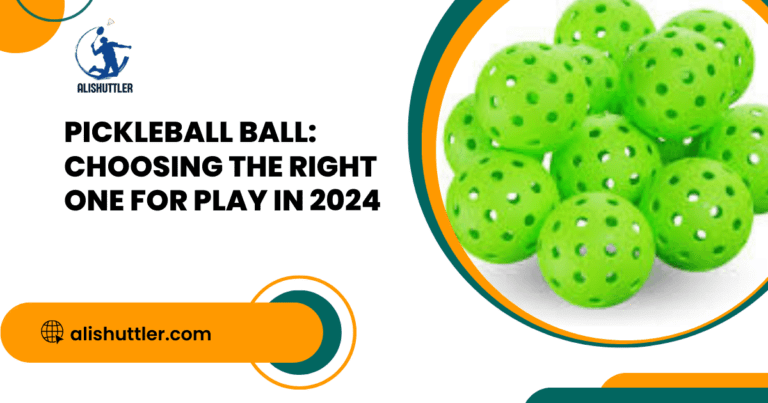
Outdoor balls are made from harder plastic with thicker walls, because asphalt and outdoor acrylic courts chew through soft plastic and because a ball that deforms in the wind cannot fly straight. Their holes are smaller and more numerous — 38 to 40 of them on every ball in this guide — which keeps the flight stable when a breeze crosses the court and produces the faster, lower, harder game outdoor players expect. The trade-off is honest: hard balls on rough surfaces are consumables. They crack, they go out of round, and they get replaced.
Indoor balls are softer, because a gym or wood floor is smooth, flat and grippy in a completely different way. Their holes are larger and fewer — 26 on all three indoor picks here — which slows the flight a touch, lifts the bounce and gives you a longer, more controllable rally indoors. Play an indoor ball outside and the wind pushes it around while the asphalt eats it; play an outdoor ball on a polished gym floor and it skids, rushes and feels harsh off the paddle. Neither mistake is dangerous — both are just worse pickleball.
Two neighbouring guides keep this one in its lane. The full rulebook treatment of ball specifications in play lives in our Pickleball Rules 2026 guide — read it there rather than here. And if you want a second opinion on ball rankings, our earlier Top Pickleball Ball roundup covers its own shortlist from a single-winner angle; this page instead splits the field by surface, which is the way the purchase is actually made. Round out the kit bag with our guides to the best pickleball paddles and the best pickleball shoes — balls are simply the item you will buy most often.
What USA Pickleball Approval Actually Guarantees
Every ball carded below carries USA Pickleball approval, and that phrase means something specific. USA Pickleball publishes an equipment specification for tournament balls: a diameter between 2.87 and 2.97 inches, a weight between 0.78 and 0.935 ounces, and between 26 and 40 holes, alongside bounce, hardness and flight requirements a ball must meet to appear on the approved list. An approved ball is one the manufacturer has submitted and had certified against that specification — which is why it can be used in sanctioned tournament play.
Approval matters for two practical reasons. First, it is your quality floor: a ball on the list has demonstrated consistent size, weight and bounce rather than merely claiming them on the packaging. Second, it is your insurance policy as a player: if you ever enter a local sanctioned event, nobody can question your ball. Recreational-only balls absolutely exist and are fine for casual hitting, but when approved balls cost no more effort to buy, there is little reason to stock your bag with anything else.
One nuance worth knowing: approval attaches to the exact model, so the indoor and outdoor versions of a family — Franklin’s X-40 outside and X-26 inside, for example — are separately listed. When you shop, match the model name on the pack to the surface on the label, not just the brand.
Seamless vs Seam-Welded: How a Pickleball Is Built
Under the paint, there are two ways to make a pickleball, and the construction explains most of the personality differences between the picks below.
One-piece rotational moulding forms the ball as a single seamless shell: liquid plastic is rotated inside a mould until it sets evenly, and the holes are drilled afterwards. With no seam, there is no weak line to split — which is why the outdoor tournament balls from Franklin, Pickle-Ball Inc. (Dura), Selkirk and JOOLA are all built this way. The classic failure mode is different instead: the shell eventually cracks through a hole or goes out of round after repeated hard impacts on rough courts.
Two-piece seam-welded construction moulds two halves and welds them together, the standard method for indoor balls from Onix and Gamma. A good modern weld — Onix calls its process exceptional seam welding, designed to resist splitting — is far stronger than the glued seams of early indoor balls, and the two-piece method suits the softer plastics indoor play wants. The failure mode to watch is the seam itself: once a welded ball starts to split along its equator, retire it, because flight and bounce go uneven quickly.
Neither method is “better” in the abstract. Seamless suits hard outdoor plastic and maximum crack resistance; welded suits softer indoor compounds and a calmer bounce. Buy the construction that matches your surface, then judge individual models on their hole pattern, pace and published specifications — which is exactly how the seven cards below are organised.
The 7 Best Pickleball Balls, Compared
Four outdoor balls first, then three indoor balls — because that is the order the decision is made. Every specification quoted is the manufacturer’s own published figure, and every ball is a current model approved by USA Pickleball for tournament play on its surface.
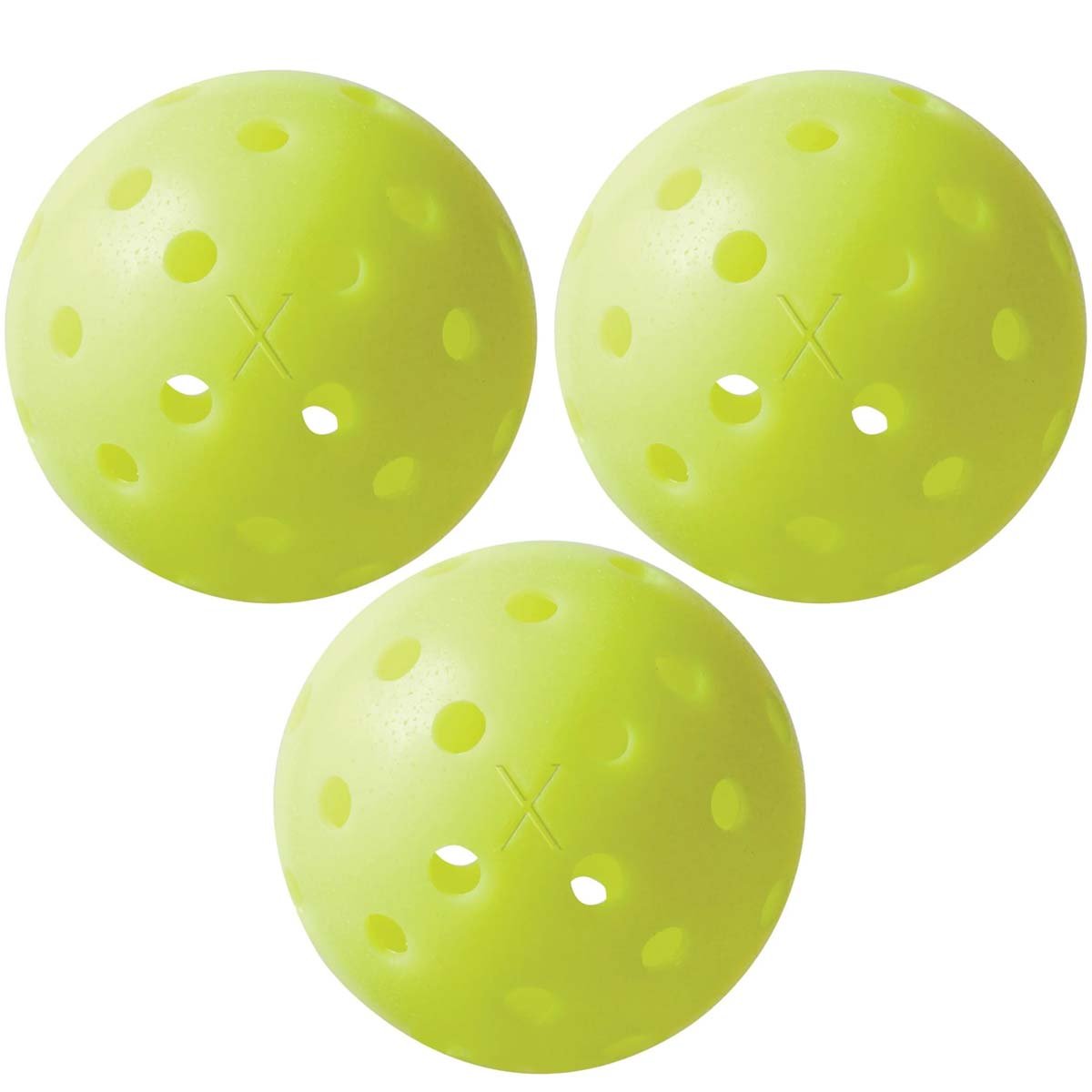
Franklin X-40
Outdoor · One-piece seamless · USA Pickleball approved
The default outdoor ball — seamless, precisely drilled, and trusted with the US Open.
If a ball can be called the standard, it is this one. Franklin builds the X-40 as a single seamless piece of polyethylene, then machine-drills 40 holes into it — Franklin’s published figures put it at 26 grams and 74 mm, squarely inside the official specification. The seamless shell is the durability story: with no welded joint, there is no seam line to split when the ball meets asphalt, fence posts and hard drives all afternoon.
The credentials are the strongest in outdoor pickleball. The X-40 is approved by USA Pickleball for outdoor tournament play and is the official ball of the US Open Pickleball Championships — which means the same ball you buy for a Tuesday club session is the one used at one of the sport’s flagship events. Flight is the balanced, predictable kind: neither the fastest nor the slowest outdoor ball here, which is precisely why it suits the widest range of players, from improvers who need a ball that behaves to competitors who need a ball they already know.
What we like
- Seamless one-piece build removes the split-at-the-seam failure mode entirely
- Official ball of the US Open Pickleball Championships — proven at the top level
- Balanced pace suits mixed-ability groups better than the fastest balls
- Sold everywhere in every pack size, so restocking is never a project
Worth knowing
- Like every hard outdoor ball, it will eventually crack on rough asphalt — buy it as the consumable it is
- Players who love a genuinely fast ball may find it a touch calm next to the Dura
As an Amazon Associate we earn from qualifying purchases.
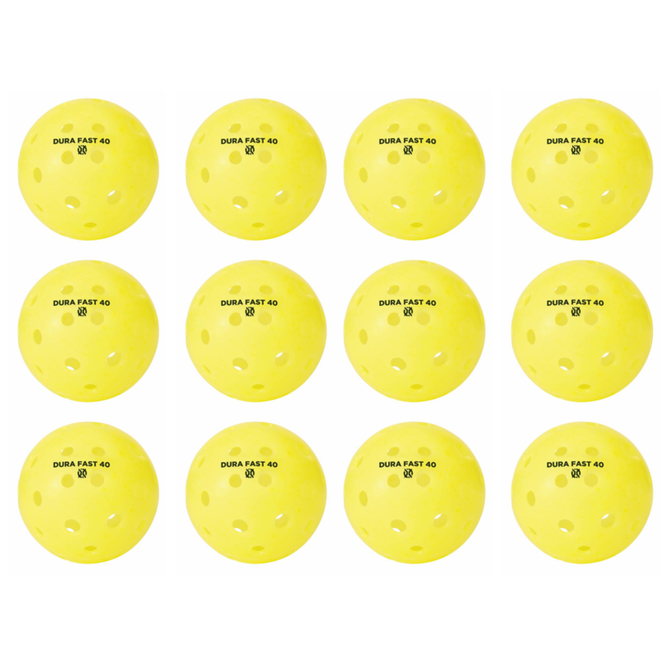
Dura Fast 40
Outdoor · Rotationally moulded one-piece · USAPA approved
The original pickleball — thick-walled, fast and built for players who hit hard.
The Dura Fast 40 is where pickleball balls began: a seamless plastic ball designed for the game by Pickle-Ball Inc., the company founded by the sport’s inventors. It is still made the deliberate way — hot plastic rotated inside a mould to form thick, even walls in a single piece, then 40 holes in two sizes drilled into the shell. Pickle-Ball Inc. publishes a weight of 0.92 ounces, a diameter of 2.9375 inches and an average bounce of 32 inches, and describes the two-size hole pattern as engineered for strength as much as flight.
On court, the Dura is the pace-setter of this roundup: a hard, fast, lively ball that rewards drives and punishes hesitation, and the long-standing choice of tournament players who want the game at full speed. The manufacturer’s own guidance is refreshingly blunt about ball life — expect a performance ball to last a limited number of games in harsh conditions. Treat the Dura as the pros do: buy it for how it plays, in multiples, and rotate fresh balls in for matches that matter.
What we like
- The fastest, hardest ball here — the tournament player’s reference pace
- Thick-walled one-piece moulding flies true even in wind, per the manufacturer
- Two-size hole pattern is a patented design unique to this ball
- Decades of top-level tournament history behind the model
Worth knowing
- Shortest working life of the outdoor picks in rough conditions — its maker says so itself
- The hard, fast feel is unforgiving for beginners still finding control
As an Amazon Associate we earn from qualifying purchases.
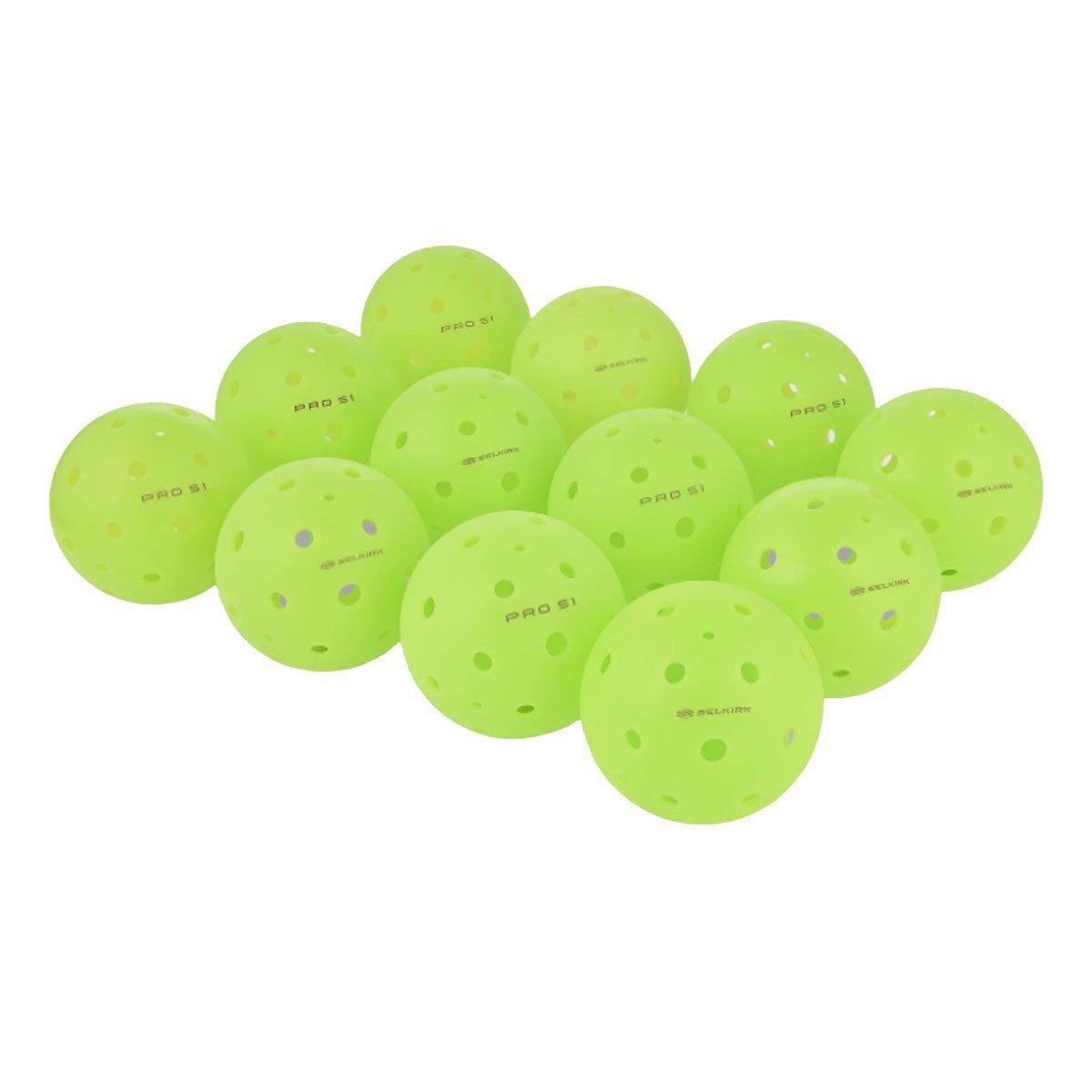
Selkirk Pro S1
Outdoor · Seamless rotomoulded · USAP approved
The durability play — a patented 38-hole design backed by a 1-year no-crack warranty.
Selkirk approached the outdoor ball’s oldest problem — cracking — as an engineering brief. The Pro S1 uses a patented 38-hole aerodynamic pattern rather than the usual 40, produced by seamless rotomoulding so the shell comes out round and balanced with no joint to fail. Selkirk’s published specifications list 38 holes, a weight of 26.36 g (0.93 oz) and a 2.8-inch diameter, and the model is USAP approved for competitive play.
The headline, though, is the warranty: Selkirk publishes a 1-year no-crack warranty on the Pro S1 — a manufacturer putting a time frame on the one failure every outdoor player knows. No ball is immortal, and a ball can still lose its roundness before it cracks, but as a statement of design intent it separates the S1 from the field. It plays at the faster end of the outdoor range with confident spin response, suiting advancing players who drill and drive a lot — exactly the usage that kills ordinary balls.
What we like
- Manufacturer-published 1-year no-crack warranty — unique in this roundup
- Patented 38-hole pattern designed for consistent flight and bounce
- Seamless rotomoulded shell stays round and balanced
- Fast, spin-friendly play character for advancing players
Worth knowing
- The warranty covers cracking — a ball that goes out of round is a judgement call, so keep your proof of purchase
- Slightly livelier feel may be more ball than a first-month beginner needs
As an Amazon Associate we earn from qualifying purchases.
JOOLA Primo
Outdoor · Rotationally moulded one-piece · USAP approved
JOOLA’s tournament ball — polyethylene built to behave in heat and cold alike.
JOOLA publishes the Primo’s brief plainly on its own store: an official outdoor ball at 74 mm and 26 grams, USAP approved, with 40 precision-drilled holes and a rotationally moulded one-piece polyethylene shell. The balance is deliberate — JOOLA highlights that the ball is weighted to minimise wobble in flight, which also makes it a sensible choice for ball-machine drilling, where an unbalanced ball sprays.
The Primo’s character is all-weather steadiness. JOOLA’s material note is that its polyethylene compound performs consistently in warm conditions and hardens naturally as temperatures drop, resisting cracking and deformation — the two ways cold mornings kill outdoor balls. In the hand and off the paddle it sits between the X-40’s calm and the Dura’s fire: a honest mid-pace tournament ball from a brand whose pickleball line is built around professional play, at the friendliest point in this outdoor group.
What we like
- Clean, complete manufacturer spec sheet — holes, weight, size, approval all published by JOOLA itself
- Anti-wobble balance makes it the drilling and ball-machine pick
- All-weather polyethylene formulation aimed squarely at cracking and warping
- One-piece seamless build, like the other outdoor picks
Worth knowing
- Less of a household name in balls than Franklin or Dura — some clubs default to those for matches
- Mid-pace character: power players chasing maximum speed will still reach for the Dura
As an Amazon Associate we earn from qualifying purchases.
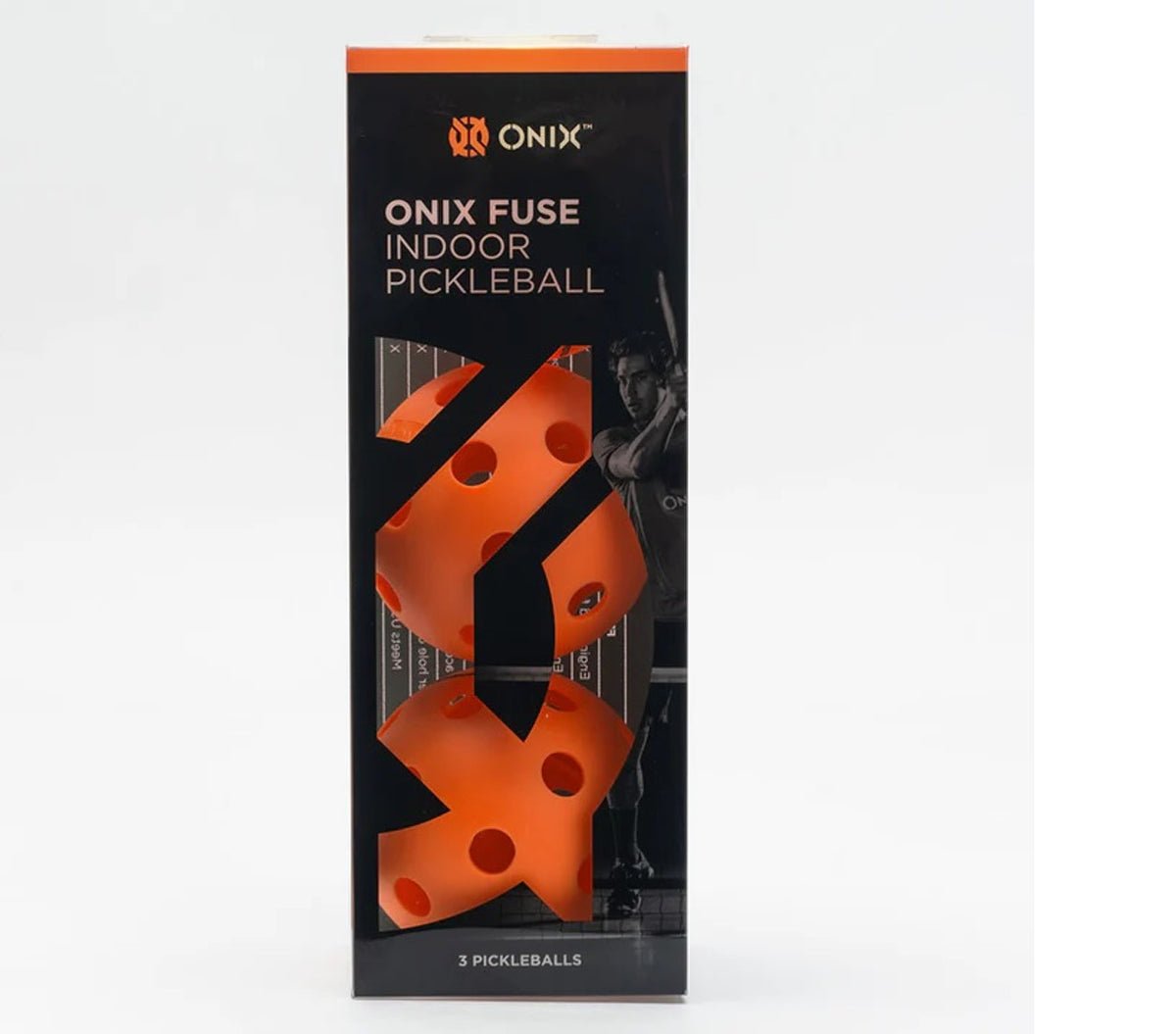
Onix Fuse Indoor
Indoor · Seam-welded two-piece · USAPA approved
The gym-floor specialist — 26 larger holes and a calmer bounce for wood courts.
Onix built its indoor reputation on soft-feel balls, and the Fuse Indoor is the tournament-legal evolution of that line: Onix presents it as the approved successor to its popular Pure 2 indoor ball, re-tuned with a slightly lower bounce so it qualifies for sanctioned play. The published specifications are a 2.90-inch diameter and a 26.2 g weight, with 26 larger holes drilled for indoor pace and a seam-welded, injection-moulded build.
That lower, calmer bounce is the whole point indoors. On wood and gym floors an outdoor-style bounce skids and rushes the net game; the Fuse Indoor’s softer touch and larger-hole flight keep rallies at a pace where dinking and resets actually work. It is ready straight out of the pack with no conditioning ritual, and the seam welding is there to answer the classic indoor-ball complaint — halves splitting along the joint. If your pickleball life happens in a sports hall, this is the first indoor ball to buy.
What we like
- Purpose-built indoor bounce — slightly lower, per Onix, for gym and wood floors
- Tournament-approved evolution of a very popular recreational ball
- Seam welding targets the split-at-the-joint weakness of two-piece balls
- Soft touch makes touch shots and resets easier indoors
Worth knowing
- Strictly an indoor ball — wind and asphalt will ruin both its flight and its shell outdoors
- Players moving down from outdoor balls need a session to adjust to the calmer pace
As an Amazon Associate we earn from qualifying purchases.
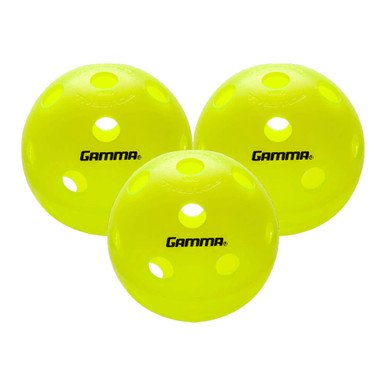
Gamma Photon Indoor
Indoor · Two-piece welded · USAPA approved
The one you can always see — optic green, lively bounce, honest all-round indoor play.
Gamma’s Photon Indoor makes its case the moment the hall lights come on: the optic-green colour is chosen to stand out against the pale walls, wooden floors and mixed backgrounds of multi-sport halls, where a yellow ball can vanish for a split second at exactly the wrong moment. Under the colour it is a conventional, well-specced indoor ball — Gamma publishes a 0.85 oz weight, a 2.9-inch diameter, 26 evenly drilled holes and a two-piece welded construction, and lists it as USAPA approved for sanctioned tournament play.
Gamma also publishes its bounce figure — 33 inches from a 78-inch drop onto concrete — which places the Photon at the livelier end of indoor balls: a touch more spring than the Fuse Indoor, in a slightly thicker-feeling shell that Gamma positions as easier to control while still flying true. For recreational indoor groups, school and community halls, and anyone whose home venue has challenging light, it is the pragmatic visibility-first choice.
What we like
- Optic-green colour solves the lost-against-the-wall problem in multi-sport halls
- Manufacturer publishes full specs including its bounce figure — easy to compare honestly
- Lively bounce keeps recreational games energetic
- Balanced two-piece build bounces evenly on varied indoor surfaces
Worth knowing
- The liveliest bounce here — touch players may prefer the calmer Fuse Indoor
- The bright colour is a love-it-or-leave-it look for traditionalists
As an Amazon Associate we earn from qualifying purchases.
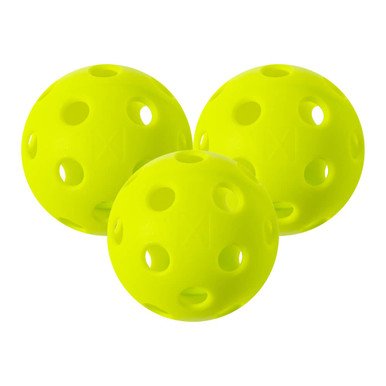
Franklin X-26 Indoor
Indoor · EVA construction · USA Pickleball approved
The X-40’s indoor sibling — same Franklin formula, tuned for gym floors and club stock.
Franklin mirrors its outdoor formula indoors: where the X-40 carries 40 holes for asphalt, the X-26 carries 26 precision-drilled, bevelled holes for the gym, at the same published 26 g weight and 74 mm diameter, in an EVA construction Franklin describes as built for hours of play. It is approved by USA Pickleball for indoor tournament play, so a club can stock one ball for both its social sessions and its sanctioned events.
The X-26’s natural home is the high-volume bag: it is sold in everything from small packs up to bulk club quantities, in several bright colours that help coaches and venues colour-code courts and sessions. The bevelled hole edges are Franklin’s flight detail — the brand credits them with helping the ball fly true and stay balanced — and the indoor game it produces is a familiar, middle-of-the-road one: not as soft as the Onix, not as lively as the Gamma, and all the better as a shared club ball for it.
What we like
- The indoor half of the Franklin system — same sizes and feel language as the X-40 outdoors
- Bulk pack options make it the economical club and coaching stock ball
- Several bright colours for visibility and court organisation
- Fully approved for indoor tournament play
Worth knowing
- Middle-of-the-road character: specialists will prefer the Onix’s touch or the Gamma’s visibility
- Retailer listings describe its construction inconsistently — buy it on its approved status and specs, which are consistent everywhere
As an Amazon Associate we earn from qualifying purchases.
Side-by-Side Comparison Table
| Model | Type | Holes | Weight | Diameter | Construction | Approval |
|---|---|---|---|---|---|---|
| Franklin X-40 | Outdoor | 40 | 26 g | 74 mm | One-piece seamless polyethylene | USA Pickleball — outdoor tournament |
| Dura Fast 40 | Outdoor | 40 (two sizes) | 0.92 oz | 2.9375 in | Rotationally moulded one-piece | Sanctioned tournament play |
| Selkirk Pro S1 | Outdoor | 38 | 0.93 oz (26.36 g) | 2.8 in | Seamless rotomoulding | USAP — competitive play |
| JOOLA Primo | Outdoor | 40 | 26 g | 74 mm | Rotationally moulded one-piece PE | USAP — official outdoor ball |
| Onix Fuse Indoor | Indoor | 26 | 26.2 g | 2.90 in | Injection moulded, seam-welded | Meets USAPA requirements |
| Gamma Photon Indoor | Indoor | 26 | 0.85 oz (24 g) | 2.9 in | Two-piece welded | USAPA — sanctioned play |
| Franklin X-26 Indoor | Indoor | 26 | 26 g | 74 mm | EVA | USA Pickleball — indoor tournament |
Read the table the way you should shop: type first, construction second, and the numbers last — because inside the approved specification window, the figures differ by millimetres while the surfaces differ completely.
Buying Guide: Surface, Holes, Pace and Ball Life
Frequently Asked Questions
What is the difference between indoor and outdoor pickleball balls?
Outdoor balls are harder, with thicker walls and 38–40 smaller holes, built to fly straight in wind and survive asphalt. Indoor balls are softer, with 26 larger holes, giving a calmer bounce and slower, more controllable flight on wood and gym floors. Both sit inside the same USA Pickleball size and weight specification — it is the tuning that differs.
Can I use an outdoor pickleball ball indoors?
On an indoor hard court with a tennis-style surface, yes — that surface plays like an outdoor court. On wood or gym flooring, an outdoor ball skids, plays harshly fast and wears the floor relationship badly; a proper 26-hole indoor ball such as the Onix Fuse Indoor or Franklin X-26 will play far better.
Can I use an indoor pickleball ball outdoors?
You can, but it is the worst of both worlds: the larger holes let the wind push the ball around, and the softer plastic wears and cracks quickly on asphalt. Keep indoor balls indoors and they will last far longer.
What does USA Pickleball approved mean for a ball?
It means the exact model has been certified against USA Pickleball’s published equipment specification — including a diameter of 2.87–2.97 inches, a weight of 0.78–0.935 ounces and 26–40 holes — and can be used in sanctioned tournament play. Every ball in this guide carries that approval for its surface.
How long does a pickleball last?
It depends on surface, temperature and how hard your group hits. Manufacturers describe performance outdoor balls as lasting a limited number of games in harsh conditions; cold weather and rough asphalt shorten life further. Indoor balls last much longer. Retire any ball that cracks, splits at the seam or flies with a visible wobble. Selkirk publishes a 1-year no-crack warranty on the Pro S1.
Why do outdoor pickleballs crack in cold weather?
The hard plastics used in outdoor balls stiffen as temperatures fall, so impacts that would flex the shell in summer can crack it in winter. JOOLA formulates the Primo’s polyethylene to harden in a controlled way that resists cracking and deformation, but no hard outdoor ball is immune — keeping balls at room temperature until you play helps every model.
How many pickleballs should I buy?
For outdoor play, think in dozens: keep a rotation for practice and set aside fresh balls for matches, because balls are a consumable at every level. For indoor play, a smaller stock lasts much longer. Clubs and coaches should look at the bulk options on balls like the Franklin X-26, which is sold in club-sized quantities.
The Verdict
The balls to stock your bag with
Start where almost every outdoor player should: the Franklin X-40 — seamless, approved, the US Open’s own ball, and calm enough for every level of club play. Add the Dura Fast 40 when you want the fastest game in the sport, the Selkirk Pro S1 if cracked balls are your running cost, and the JOOLA Primo for all-weather drilling value. Indoors, the Onix Fuse Indoor is the touch player’s ball, the Gamma Photon Indoor wins on visibility, and the Franklin X-26 keeps whole clubs stocked. Pair them with the right paddle and shoes, replace balls before they start lying to you about the bounce — and the cheapest piece of gear in your bag will quietly be the one that improves your game most often.
Affiliate disclosure: AliShuttler is reader-supported. When you buy through links on this page we may earn an Amazon commission at no extra cost to you. Specifications are taken from manufacturers’ published product information and USA Pickleball’s published equipment specification, verified at the time of writing. Approved-ball lists are maintained by USA Pickleball and can change — if you are entering a sanctioned event, a quick check of the current list is always worthwhile.