Your first squash racket has one job: keep the ball playable while your swing, footwork and wall judgement catch up. These seven beginner rackets — big heads, sensible weights, frames that survive your learning curve — are the ones worth buying, with every spec translated into plain English.
TL;DR — The short answer
Best overall beginner racket: HEAD Speed 135. A 135 g frame with the biggest head class in squash (500 cm²), a head-light balance and an open string pattern — forgiving on off-centre hits, quick in your hand, and good enough to play league squash in later. On the tightest budget, the Wilson Blade Team is the heavy, near-unbreakable starter Wilson builds for new players. Ready to buy once and grow? The Tecnifibre Carboflex X-Top V2 130 is the tour-proven frame at the end of the list. Scroll for the plain-English buying guide, full reviews and comparison table.
HEAD Speed 135
135 g, 500 cm² teardrop head, head-light. The easiest first racket to rally with.
Harrow Vapor 115
Head-heavy 380 mm balance does the hitting work while your technique forms.
Dunlop Sonic Core Revelation Pro Lite
125 g of premium carbon with vibration-eating Sonic Core. Kind to new arms.
Prince Phoenix Pro 750 2.0
Power Ring power plus a hoop reinforced to survive beginner wall contact.
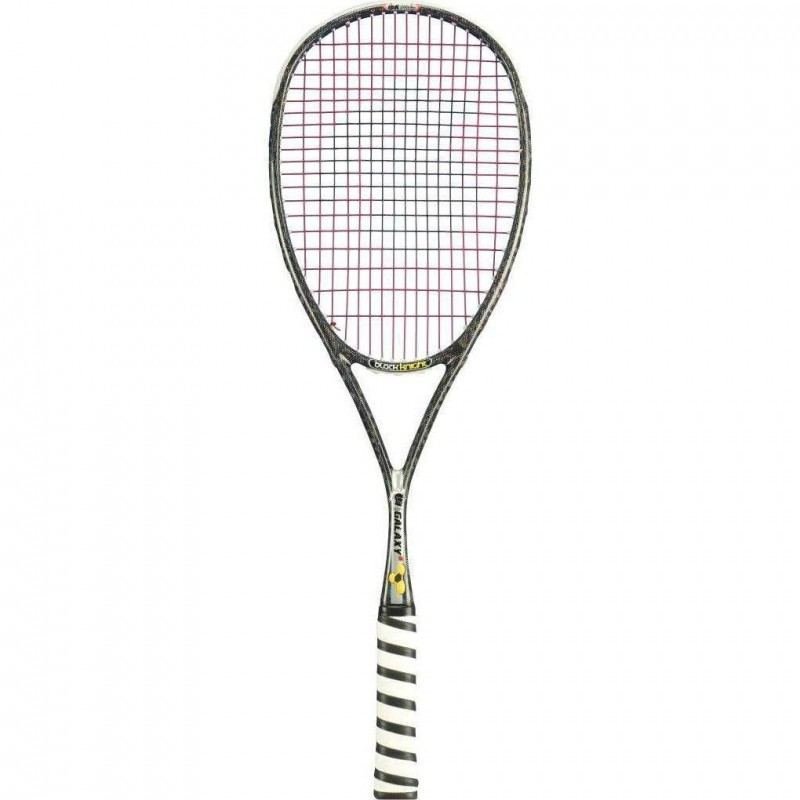
Black Knight Ion Galaxy PS
Closed-throat control frame with a 500 cm² head — the doubles player’s pick.
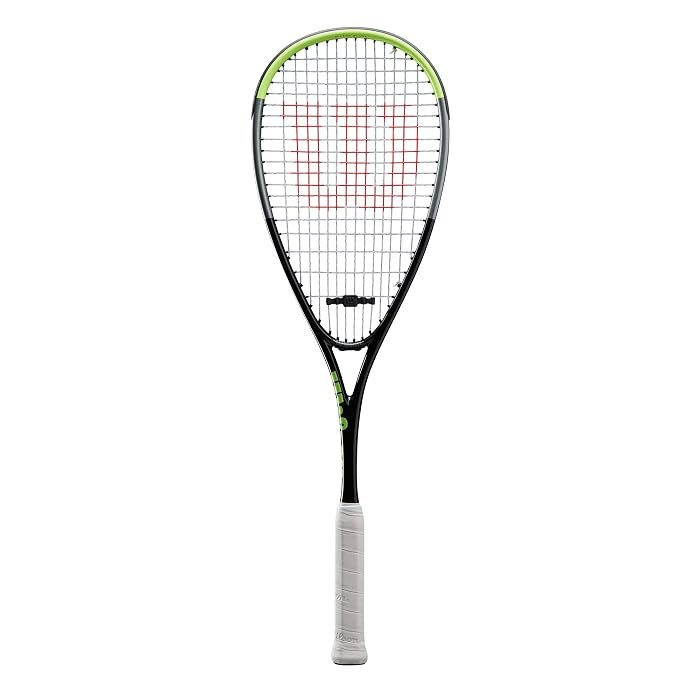
Wilson Blade Team
Fused graphite/aluminium, 197 g all-in. The starter that shrugs off abuse.
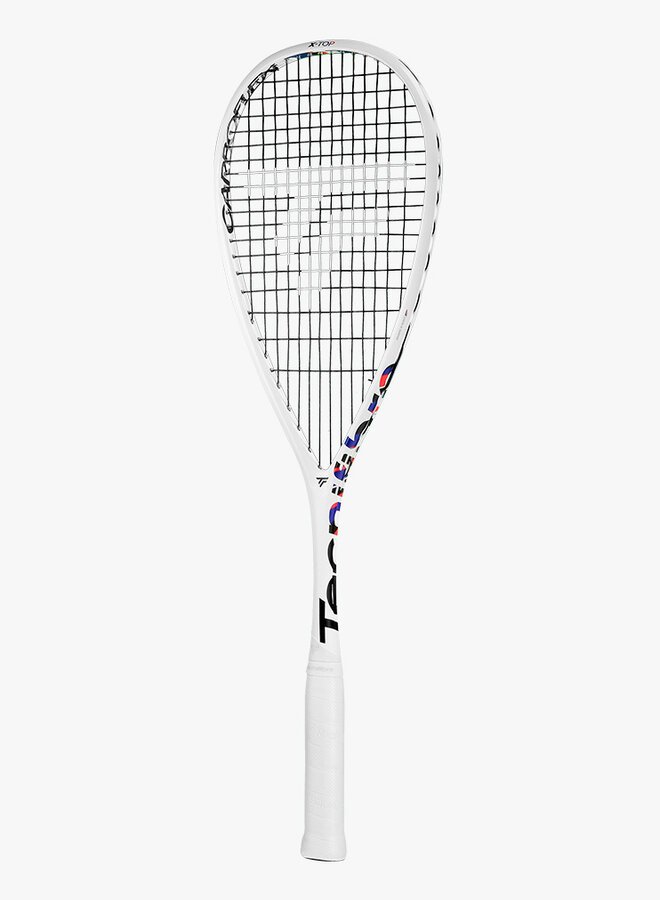
Tecnifibre Carboflex X-Top V2 130
The tour frame of El Shorbagy and El Sherbini — unusually playable at 130 g.
On this page
- The beginner buying guide (plain English)
- 1. HEAD Speed 135 — Best Overall
- 2. Harrow Vapor 115 — Best for Power
- 3. Dunlop Sonic Core Revelation Pro Lite — Best Lightweight
- 4. Prince Phoenix Pro 750 2.0 — Best Reinforced
- 5. Black Knight Ion Galaxy PS — Best Traditional
- 6. Wilson Blade Team — Best Budget Starter
- 7. Tecnifibre Carboflex X-Top V2 130 — Best to Grow Into
- Comparison table
- What to buy with it
- Care basics & when to upgrade
- FAQs
New to squash? Avoid the two mistakes everyone makes
Almost every beginner buys the wrong first racket, and it is wrong in one of two directions. Mistake one: buying the pro’s control frame. The ultralight 120 g rackets with small 470 cm² heads and dense string patterns that advanced players love are precision tools. They assume a grooved swing and centre contact; in a beginner’s hand they produce weak shots, a tiny margin for error, and a frame that meets the wall far more often than it should. Mistake two: buying the anonymous heavy set — the unbranded steel or thick aluminium racket sold in a bundle with a ball. It survives, but at 200 g or more it teaches your wrist to muscle the ball, and its strings and grommets were never meant to be replaced or restrung.
The sweet spot between those extremes is a genuine recipe, and it is not expensive: a frame weight around 130–140 g, a head of 490–500 cm², a head-light or even balance, and full graphite construction from a brand that also sells replacement grommets and grips. That is exactly what the first five rackets below deliver, followed by one honest budget exception and one tour frame that breaks the “no pro rackets” rule more gracefully than most. If you are still deciding which wall sport is yours, our squash vs racquetball comparison explains how differently the two games treat beginners — and their rackets.
The beginner buying guide — every spec in plain English
HEAD Speed 135
The biggest head, the easiest rallies
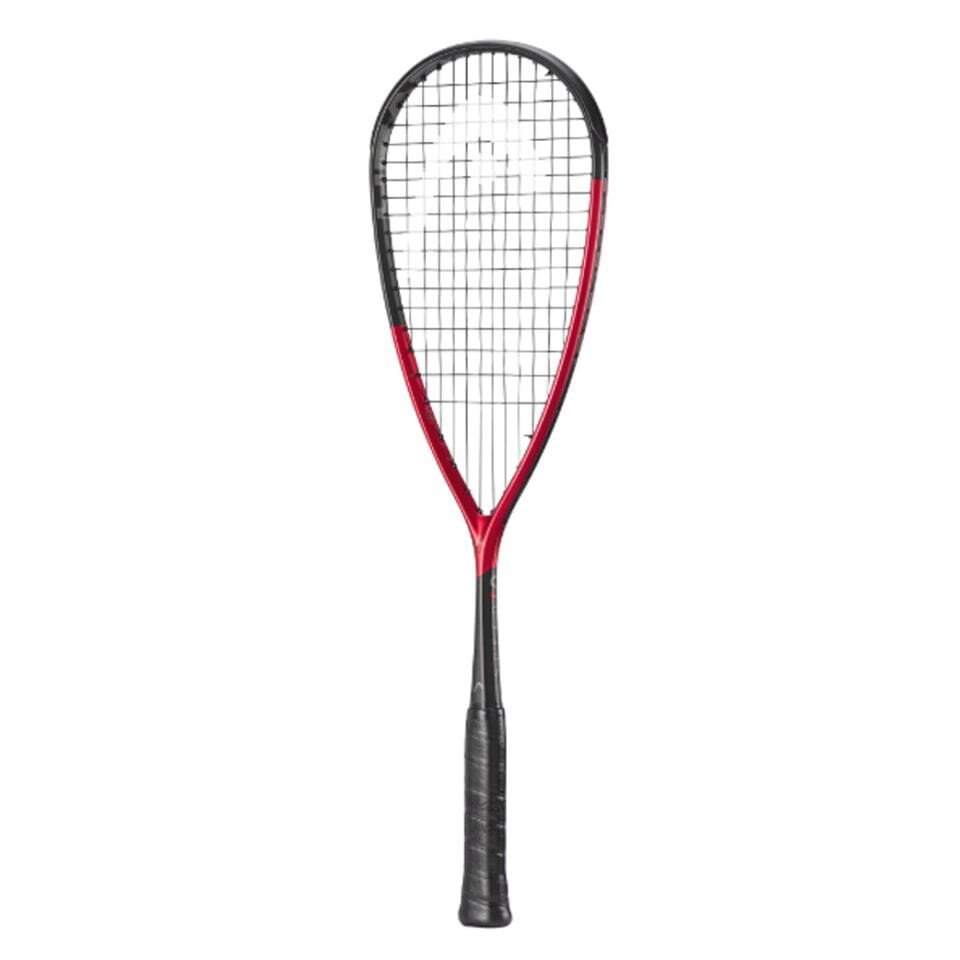
If a coach could hand every new player one racket, it would look like this: HEAD’s 2025 Speed 135 puts a full-size 500 cm² teardrop head on a 135 g frame with a head-light balance. Nothing about the spec asks you to be good already — the size, weight and balance are all working in the beginner’s favour from the first session.
Three design choices make it the default pick. First, the head: 500 cm² is the largest string bed on this page, and the open 12 × 17 pattern lets those strings move, so off-centre contact still produces a ball that reaches the front wall with something on it. Second, the head-light balance keeps the racket quick in your hand — you will be late to balls for months, and a head-light frame forgives late swings instead of punishing them. Third, HEAD’s Auxetic 2.0 material in the frame is there to take the harsh edge off mishits, widening and stiffening on impact to give a cleaner, less jarring feel than a basic graphite frame.
Then there is the party trick: the Adaptive Fan Pattern. The Speed 135 can be strung in its standard open pattern now, and re-strung later in the denser 16 × 17 fan pattern when your contact improves and you want control instead of help. That makes this the rare beginner racket with a built-in second life, and it is factory-strung with HEAD’s own Reflex 18 string, which is a perfectly sensible starting point. The honest caveats: at 135 g it is the mid-weight option rather than the lightest, and HEAD does not include a cover. Buy it if you want one racket that is easy now and still relevant in your third season.
Pros
- Largest 500 cm² head and open pattern — maximum forgiveness
- Head-light balance keeps a learning wrist quick and fresh
- AFP lets a stringer convert it to a control pattern later
- Current 2025 model from HEAD’s flagship squash line
Cons
- Mid-weight at 135 g — ultralight seekers should look at the Dunlop
- No racket cover included
As an Amazon Associate we earn from qualifying purchases.
Harrow Vapor 115
Head-heavy momentum for developing swings
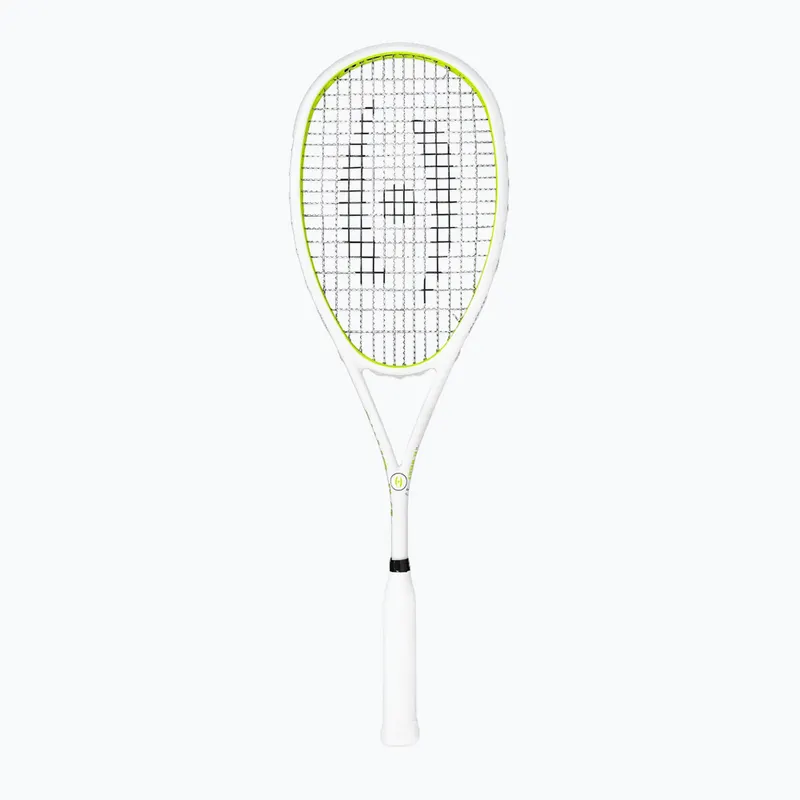
Harrow is the American squash brand — the rackets you see all over US college and club squash — and the Vapor is its best-selling frame. The 115 pairs a featherweight 115 g frame with a strongly head-heavy 380 mm balance, so the finished racket (about 140 g strung) swings light but lands heavy.
The beginner problem this solves is depth. New players under-hit: drives die halfway to the back wall because a slow, wristy swing cannot generate pace. The Vapor’s head-heavy balance is a mechanical workaround — the mass sits behind the ball, so even a compact swing punches drives deep and gives volleys real authority. The open throat lengthens the main strings for extra trampoline, and Harrow strings it with its own Barrage Pro, a livelier factory string than most. The frame is carbon/graphite, and the Vapor shape has been Harrow’s signature for years because it blends that power with enough control to place the ball once you can reach it.
Now the honesty. At 470 cm² this is one of the smaller heads on the page, so your margin for sloppy contact is thinner than the HEAD’s — and the head-heavy feel that powers your drives will feel slower when you are scrambling at the front of the court. This is the pick for the beginner who is athletic, hits a lot of balls into the tin or the side wall trying to generate pace, and wants the racket to supply the power while technique catches up. Players who value quick hands above all should take the Dunlop or the HEAD instead.
Pros
- Head-heavy momentum gives beginners real drive depth
- Featherweight 115 g frame — finished weight still only ~140 g
- Quality factory stringing (Barrage Pro) out of the box
- The best-selling frame of the US squash specialist brand
Cons
- 470 cm² head is less forgiving of off-centre hits
- Head-heavy feel is slower in front-court scrambles
As an Amazon Associate we earn from qualifying purchases.
Dunlop Sonic Core Revelation Pro Lite
125 grams of premium carbon, kind to new arms
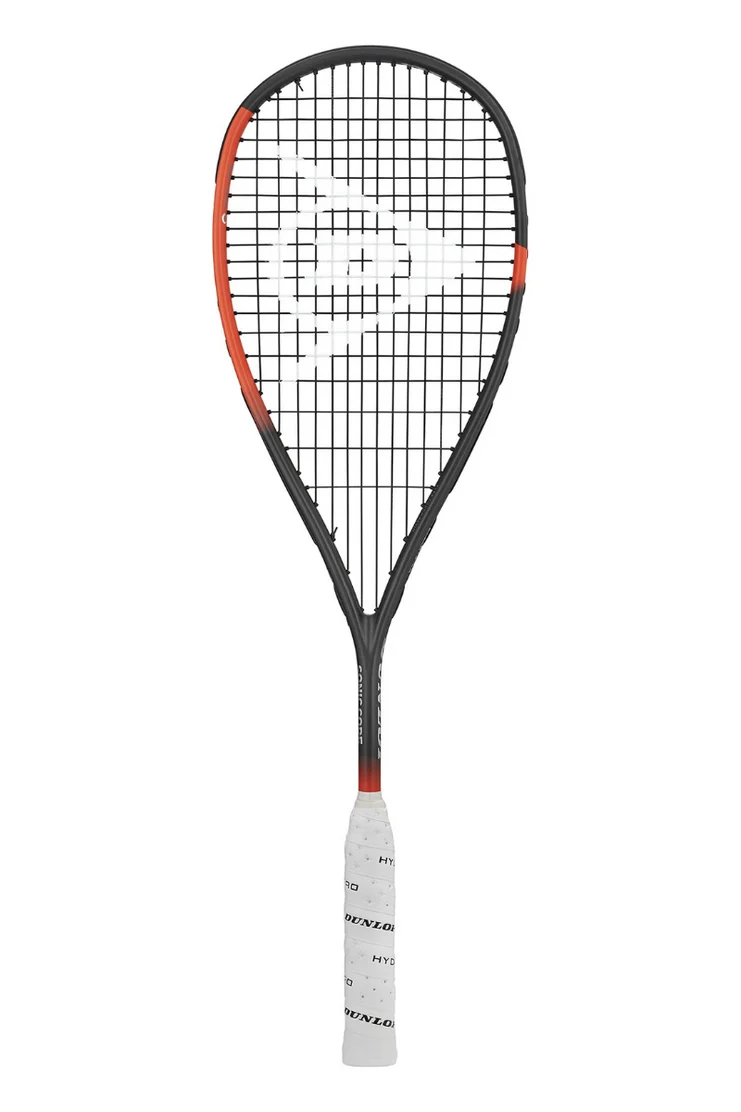
Dunlop is squash’s most decorated name — the brand behind the official ball of the pro tour — and the Revelation Pro Lite is the lighter sibling of its flagship Revelation Pro. At 125 g with a head-light balance, it is the lightest mainstream racket on this page, and its Sonic Core damping makes it the comfort pick too.
Two technologies earn this racket its place. Sonic Core places Infinergy® — a super-elastic foam developed by BASF — at the 2 and 10 o’clock positions in the head, where it absorbs impact shock before it reaches your arm; Dunlop rates it as cutting frame vibration substantially versus a standard carbon frame, and for a beginner whose contact is scattered all over the string bed, that damping is the difference between a comfortable hour and a buzzing elbow. The PowerMax pattern fans the main strings through the throat, lengthening them for extra power and a livelier response, which quietly compensates for the smaller head.
Be clear-eyed about the trade: at 490 cm² the head is smaller than the HEAD’s and the Black Knight’s, and Dunlop designs this frame with improving and advanced players in mind. It makes this list because the weight, balance and damping are so beginner-friendly — but it suits the newer player with some racket-sport background, or the lighter-framed player who values manoeuvrability and arm comfort over a giant sweet spot. If your contact is still very raw, the HEAD Speed 135 will flatter you more; if your swing is basically sound and you want the lightest quality frame here, this is it. It arrives strung with Dunlop’s Iconic Pro AF string.
Pros
- Lightest mainstream pick at 125 g, head-light and fast
- Sonic Core Infinergy damping protects a learning arm
- PowerMax fan pattern adds power back to the smaller head
- Premium carbon build from squash’s heritage brand
Cons
- 490 cm² head punishes very raw contact more than the 500 cm² picks
- Premium pricing tier — the con of flagship materials
As an Amazon Associate we earn from qualifying purchases.
Prince Phoenix Pro 750 2.0
Power engineering, reinforced to survive you
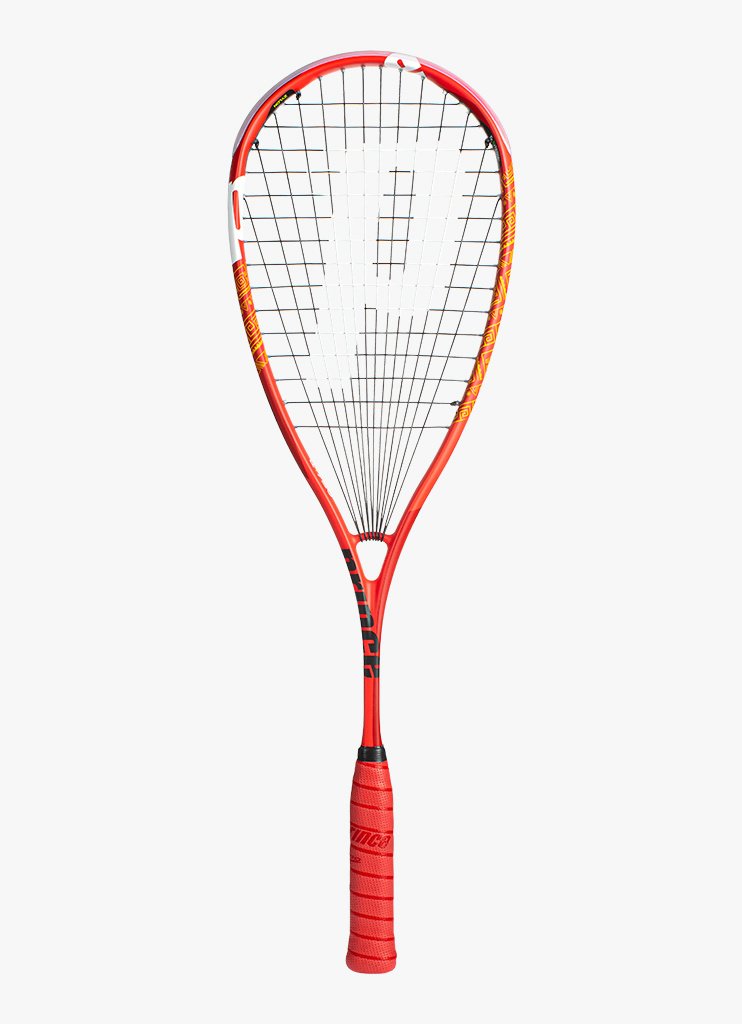
Prince rebuilt the Phoenix Pro 750 for 2025, and the 2.0’s design brief reads like a beginner wish list written by an engineer: a stronger hoop, a handle that eats vibration, and Prince’s signature Power Ring throat for the longest, liveliest main strings in the game. It is a 130 g graphite frame that expects to be scraped along walls — and is built for exactly that.
Start with the Power Ring: an inverted ring in the throat that removes the usual bridge, so the main strings run longer and more uniform in length. Longer mains mean a bigger trampoline and power that stays consistent higher up the string bed — exactly where beginners actually make contact. The very open 14 × 15 pattern adds to that effect and puts bite on the ball. Then the durability story: the 2.0’s hoop is reinforced with TeXtreme Gen Z carbon (with Zylon fibres), and Prince rates the updated frame’s impact strength well above the previous generation’s — the spec that matters when the head meets the side wall twice a rally. The Air Handle, with air quadrants built into the handle, damps the shock that does get through, and the grommetless throat design removes a common failure point entirely.
Who is it for? The beginner who plays hard and hits things — the athlete learning squash at full speed, who wants power without buying a frame that feels fragile. The balance is head light on paper (335 mm), which keeps it manoeuvrable despite the power engineering. The caveats: the 484 cm² head is mid-sized rather than maximum, Prince’s distribution runs through its own store and squash specialists rather than every marketplace, and this is a performance frame at a performance price. If your game is touch and control rather than force, the Black Knight below will suit you better.
Pros
- Power Ring throat and open 14 × 15 pattern — power high on the string bed
- Reinforced TeXtreme Gen Z hoop built for wall contact
- Air Handle damps vibration before it reaches your arm
- Head-light balance keeps the power manoeuvrable
Cons
- 484 cm² head is mid-sized, not the most forgiving here
- Sold mainly via Prince’s store and specialists
As an Amazon Associate we earn from qualifying purchases.
Black Knight Ion Galaxy PS
The traditional control frame, in a full-size head
Black Knight is Canada’s squash institution, and the Ion Galaxy PS is its thinking player’s frame: a traditional head shape with a closed throat, a dense 16 × 19 control pattern — and, unusually for a control racket, a full 500 cm² head and a head-light balance, so beginners get the discipline of a traditional frame without the tiny sweet spot.
Most of this list chases power and forgiveness; the Galaxy PS is here for the other kind of beginner. The closed throat (a bridge across the top of the shaft) shortens the main strings, which flattens the trampoline effect and makes the ball go where the face points — a stricter teacher, but an honest one, and the 500 cm² head keeps the sweet spot generous enough that the lessons are encouraging rather than brutal. Black Knight builds the frame with its Thermal Core process (the frame is pressurised with superheated air during curing for a more uniform, durable layup) and Nano Crystalline Technology in the carbon to bind fibres and cut vibration, then strings it with Ashaway’s SuperNick XL Micro — a proper performance string, not a placeholder. The Galaxy line was re-engineered with a thicker bridge and throat plus a Power Surge shaft, and it is a favourite of doubles players, whose game rewards exactly this stiffness and control.
The trade-offs are the mirror image of the Harrow’s: a dense pattern and stiff frame give you less free power, so your drives rely on your swing, and at 140 g it is the heaviest full-graphite frame here. Choose it if you come from tennis or badminton with a grooved swing, if you play (or plan to play) doubles, or if you simply prefer a racket that rewards placement over pace. Everyone else will find the HEAD easier to start with.
Pros
- Traditional closed-throat control in a full 500 cm² head
- Dense 16 × 19 pattern and stiff frame reward clean placement
- Thermal Core build and quality Ashaway factory string
- A proven doubles and control player’s frame
Cons
- Least free power on this page — your swing does the work
- Distribution is Canada-led; US stock via specialists and marketplace
As an Amazon Associate we earn from qualifying purchases.
Wilson Blade Team
The near-unbreakable starter Wilson aims at new players
Every guide needs its reality pick, and this is ours: Wilson builds the Blade Team specifically for players new to the game, fusing graphite and aluminium into a frame that trades lightness for survival. At 197 g all-in it is the heavyweight of this list by a distance — and for a certain kind of beginner, that trade is exactly right.
Let’s be precise about what you’re buying. The fused construction means aluminium carries the frame’s structure with graphite blended in — the result bends where carbon would crack, which is why rackets like this run school programmes, rental fleets and club starter kits. Wilson adds genuinely thoughtful beginner touches: Power Strings lengthen the string bed’s working length for extra power and depth, the mid-plus head keeps a large central sweet spot, and the Exact Tack grip is tacky and comfortable out of the box. It is factory-strung with Wilson Sensation Strike, and it is sold widely — including in Amazon bundles with balls — because it is the default “first racket” in much of the recreational game.
And the limits, stated plainly: 197 g will tire a new wrist over a long session and slows your recovery between shots; the 472 cm² head is one of the smaller here; and metal-fused frames cannot match graphite for feel on touch shots. Serious learners will outgrow it within a season or two. But if the choice is between a Blade Team that gets played and a delicate frame you’re afraid to swing near a wall, buy the Wilson, play fearlessly, and let your second racket be an informed upgrade from the top of this page. It remains in Wilson’s current line-up with US retail availability; one UK retailer has flagged it as discontinued, so if the price is right, don’t wait around.
Pros
- Fused frame survives the beginner experience — walls, floors, clashes
- Designed by Wilson specifically for new and recreational players
- Power Strings and a big central sweet spot help depth
- The lowest-cost genuine brand-name way into the game
Cons
- 197 g all-in — heavy, and it will slow a developing wrist
- Metal-fused feel can’t match full graphite on touch shots
As an Amazon Associate we earn from qualifying purchases.
Tecnifibre Carboflex X-Top V2 130
The tour frame that breaks the beginner rules — carefully
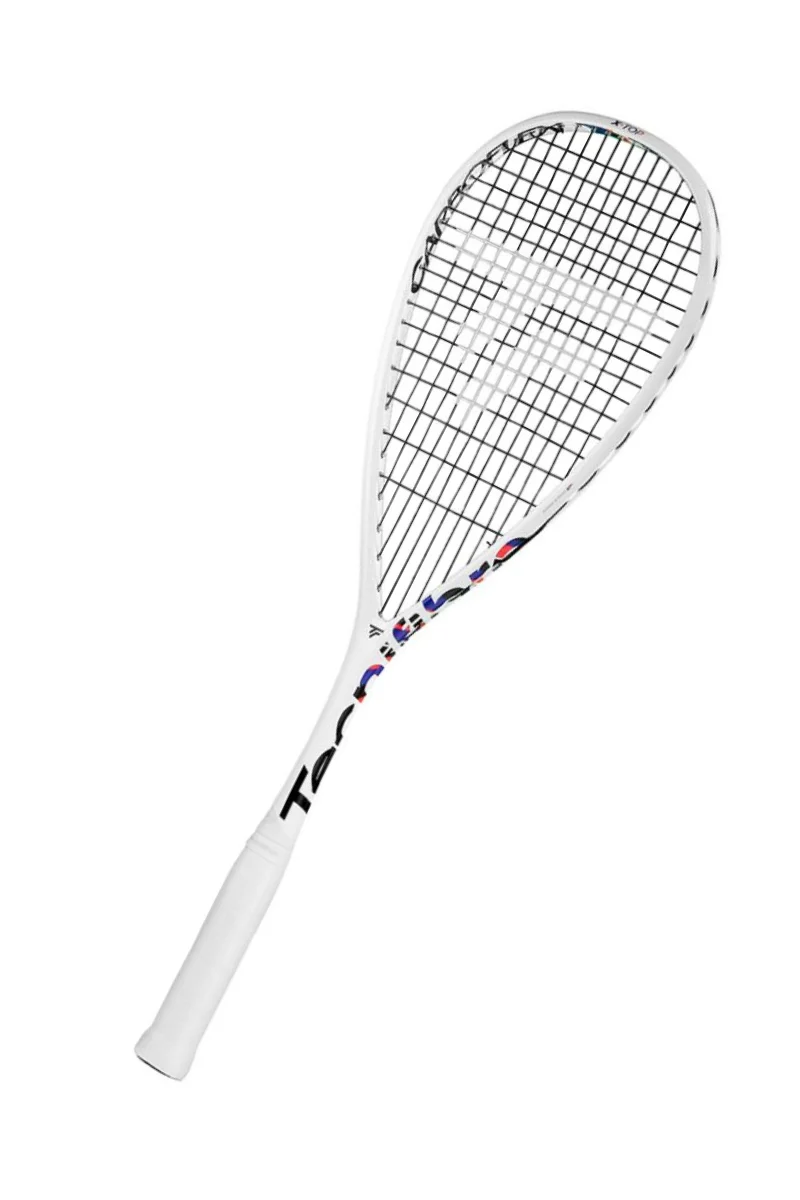
The Carboflex is the most successful racket family in modern squash — the frame in the hands of Mohamed El Shorbagy, Nour El Sherbini and Nouran Gohar. The X-TOP V2 130 earns its place on a beginner list for one reason: at 130 g with a full 500 cm² head and an even balance, it is the rare tour frame whose spec sheet does not punish a developing player.
The V2 was engineered around swing speed — Tecnifibre’s lab work found that better players simply accelerate the racket faster, so the whole frame is built to be swung quickly: an Airshaft shaft profile for aerodynamics, a Jumbo Shaft monoshaft reinforced with X-Arms to stay stable at impact, and the X-TOP head, which deletes the plastic bumper and protects the frame with aramid fibres and a PTFE treatment instead — less air resistance, less vibration, and the best wall-scrape protection on this page. Extended String Hole technology enlarges 12 grommet holes at 3, 9 and 12 o’clock so the strings breathe and stretch more, which is where its off-centre tolerance and spin come from. It arrives strung with Dynamix VP, Tecnifibre’s most responsive multifilament, inside a recommended 20–30 lbs window.
So why is it seventh and not first? Because everything that makes it brilliant assumes your swing is on its way. The even balance feels less instantly manoeuvrable than a head-light frame, the response is honest rather than flattering, and it sits in the premium tier of the market. The beginner who should buy it anyway: the committed improver playing several times a week, or the racket-sport convert who wants to buy once. For everyone else, the HEAD gives you more help today — and this is the racket you graduate to, which is why it anchors the end of the list rather than the top.
Pros
- Tour-proven frame with a beginner-tolerable spec: 130 g, 500 cm², even balance
- X-TOP aramid head protection — the best wall durability here
- Extended String Holes add off-centre forgiveness and spin
- Premium Dynamix VP factory stringing
Cons
- Premium tier pricing
- Even balance and honest response flatter raw beginners less than the HEAD
As an Amazon Associate we earn from qualifying purchases.
Beginner squash rackets compared
| Racket | Frame weight | Head size | Balance | String pattern | Best for |
|---|---|---|---|---|---|
| HEAD Speed 135 | 135 g | 500 cm² | Head light | 12 × 17 (AFP option) | Best overall first racket |
| Harrow Vapor 115 | 115 g (~140 g strung) | 470 cm² | Head heavy, 380 mm | 14 × 19 | Power and drive depth |
| Dunlop Sonic Core Revelation Pro Lite | 125 g | 490 cm² | Head light | 14 × 19 PowerMax | Lightweight comfort |
| Prince Phoenix Pro 750 2.0 | 130 g | 484 cm² | Head light, 335 mm | 14 × 15 | Reinforced power |
| Black Knight Ion Galaxy PS | 140 g | 500 cm² | Head light | 16 × 19 | Traditional control, doubles |
| Wilson Blade Team | 197 g all-in | 472 cm² | Head light, 325 mm | 14 × 19 | Budget durability |
| Tecnifibre Carboflex X-Top V2 130 | 130 g | 500 cm² | Even, 355 mm | 14 × 18 | Growing into a tour frame |
What to buy with it
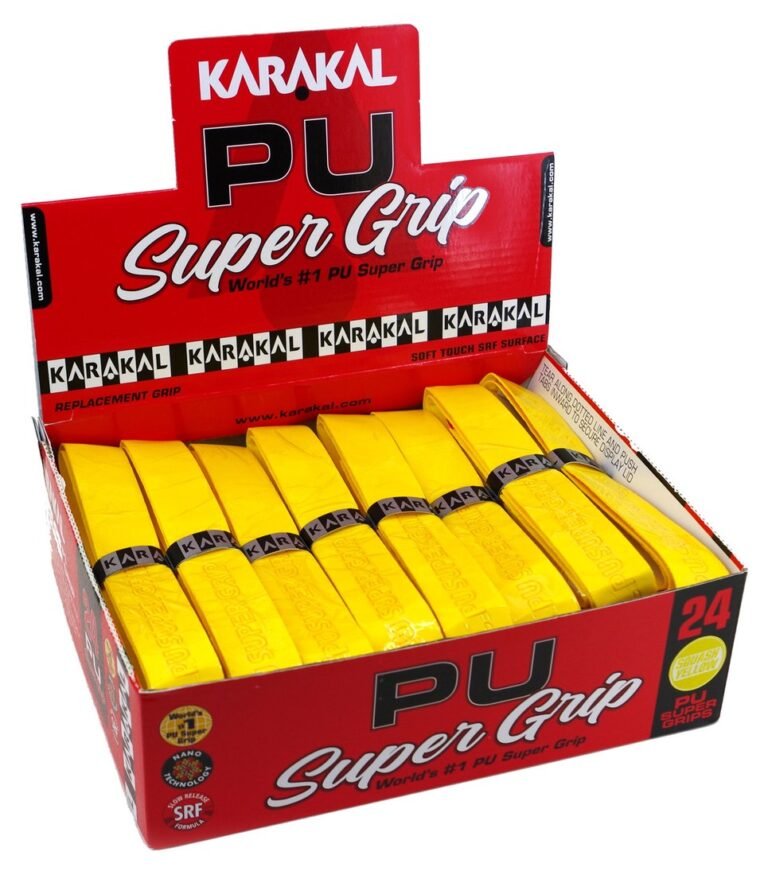
Three extras complete a beginner setup, and one of them is not optional if your club follows federation rules. Balls first: buy bouncier than the pros use. The double yellow dot ball on TV barely bounces until it is fully warm and expertly struck — beginners playing with one learn nothing except frustration. Start with a high-bounce beginner ball (Dunlop’s Intro ball, or a red-dot progression ball), which stays lively at beginner pace, then graduate to the standard single yellow dot as your rallies lengthen. Eyewear second: a squash ball is small, hard and fast, and protective eyewear is mandatory for juniors in many federations and required by plenty of clubs — buy it before your first match, not after a scare. Finally, grips wear out faster than any other part of your setup; a multi-pack of overgrips keeps your hold tacky and your wrist relaxed.
High-Bounce Beginner Squash Balls
Start with an intro or red-dot ball that bounces at beginner pace — Dunlop’s Intro is the benchmark. Move to single yellow dot as you improve. Check on Amazon →
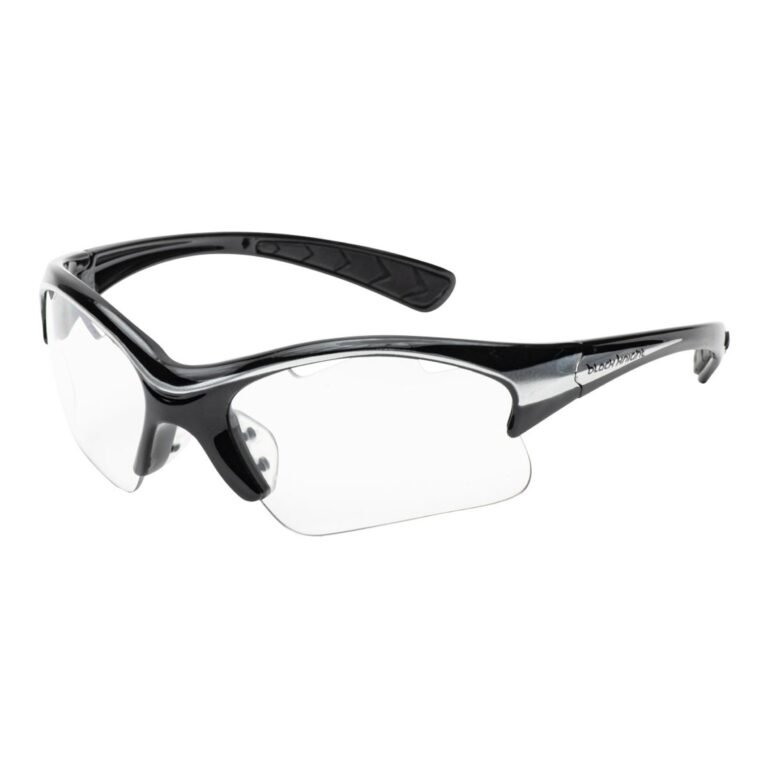
Protective Squash Eyewear
Mandatory for juniors in many federations and required by many clubs. Anti-fog, full-coverage — the most important extra on this page. Check on Amazon →
Overgrips (Multi-Pack)
Restores tack, tunes grip thickness and costs pennies per change. Swap the moment your grip starts to slip. Check on Amazon →
Care basics — and when to upgrade
Four habits will double your racket’s lifespan. One: use the cover. Most frame damage happens in kit bags and car boots, not on court. Two: respect heat. Never leave a strung racket in a hot car — heat sags string tension and stresses the frame’s resins. Three: inspect after wall contact. Scrapes that remove paint are cosmetic; any crack, creak or new vibration means the frame is done, and playing on with it risks a mid-rally collapse. Four: maintain the consumables. Replace the grip when it slips, and restring when the strings fray, notch deeply or feel dead — a common working rule is as many restrings a year as you play times a week. When you restring, ask for the bumper and grommet strip to be checked and replaced if worn; it is the cheapest frame insurance in the sport.
And when is it time for a new racket? Not when the marketing says so — when the frame starts answering your shots wrong. If your contact is consistently central and the racket still feels vague, if you are playing competitive league squash several times a week, or if you have simply worn out two sets of grommets learning the game, you have outgrown a beginner frame. That is the moment the bottom of this list becomes the top of your shopping list — and if you’re weighing squash against its closest cousin before committing further, our squash vs racquetball breakdown covers how the two sports develop players differently.
Beginner squash racket FAQs
What makes a squash racket good for beginners?
Four things: a frame weight around 130–140 g, a large head (490–500 cm²) for a forgiving sweet spot, a head-light or even balance that keeps the racket manoeuvrable, and full graphite construction from a brand that sells replacement grips and grommets. An open or standard string pattern adds free power. The HEAD Speed 135 at the top of this page ticks every box; the other picks trade one element for a speciality — power, lightness, control, durability or price.
How heavy should a beginner squash racket be?
Aim for a frame weight of 130–140 g, which plays at roughly 155–170 g once strung and gripped. Beware comparing numbers directly: most brands quote bare frame weight, while a few (like Wilson’s 197 g for the Blade Team) quote the all-in strung weight. Ultralight 120–125 g frames are tour tools that punish beginners; genuinely heavy rackets slow your wrist and tire your arm.
Teardrop or traditional head shape — which is better for a beginner?
For most beginners, teardrop. The open throat lengthens the main strings, which means more power and a bigger effective sweet spot. Traditional closed-throat frames (like the Black Knight Ion Galaxy PS) shorten the strings for control and a stiffer response — the better choice only if your contact is already consistent or you play a placement game, ideally in a full-size 500 cm² head.
Does head size really matter in squash?
Yes — it is your margin for error. Heads run from about 460 cm² to 500 cm². A 500 cm² head gives you the largest string bed and sweet spot, so mishits still reach the front wall; smaller heads reward the clean contact that advanced players have and beginners don’t. Until your contact is reliable, bigger is better.
Can a beginner use a professional squash racket?
Mostly no — pro frames pair ultralight weights with small heads and dense patterns that assume a fast, grooved swing. The exception on this page is the Tecnifibre Carboflex X-Top V2 130: it is a genuine tour frame, but at 130 g with a 500 cm² head and even balance it is unusually playable for a committed improver. Buy it to grow into, not to learn the basics with.
How much should a beginner spend on a first squash racket?
Spend on a real brand, not on a spec sheet. Every racket on this page — from the budget Wilson Blade Team to the premium Tecnifibre — comes from a genuine squash brand with replaceable parts, and any of them will teach you more than an unbranded bundle racket. A sensible approach: buy the best frame on this list that fits your budget, and put what you save towards court time, a high-bounce beginner ball and protective eyewear.
Which squash ball should a beginner use?
A high-bounce one — an intro ball or red-dot progression ball, not the double yellow dot the pros use. Double yellow balls barely bounce until fully warm and struck by an advanced swing, which makes rallies impossible to learn from. Start bouncy, move to the standard single yellow dot once your rallies run long and your ball stays warm through a game.
How often should I restring a squash racket?
When the strings fray or notch deeply, when the bed feels dead and trampoliny in the wrong way, or as a working rule: about as many times per year as you play sessions per week. Factory strings are fine for your first season — don’t restring a new racket on day one. At each restring, have the bumper and grommet strip inspected; replacing it is cheap protection for the frame.
The verdict
Buy the HEAD Speed 135 if you want the easiest, most forgiving start in squash. Buy the Harrow Vapor 115 if your drives keep dying before the back wall. Buy the Dunlop Revelation Pro Lite if you want the lightest, kindest frame for your arm. Buy the Prince Phoenix Pro 750 2.0 if you play hard and your racket will meet the walls. Buy the Black Knight Ion Galaxy PS if control and doubles are your game. Buy the Wilson Blade Team if budget and survival come first. Buy the Tecnifibre Carboflex X-Top V2 130 if you’d rather grow into a tour frame than out of a starter. Whatever you choose: 130–140 g, a big head, a balance that suits your swing — and spend the money you saved on court time and a bouncier ball.
Affiliate disclosure: Alishuttler.com is a participant in the Amazon Services LLC Associates Program. The Amazon buttons on this page use our affiliate tag — if you buy through them, we may earn a commission at no extra cost to you. Prices shown on Amazon are live and may differ from any figures mentioned here.