A tennis shoe is not one purchase — it is three different purchases wearing the same name. Hard courts eat outsoles and reward durability, clay rewards a herringbone tread that grips and releases, and every surface rewards lateral support the moment you plant and cut. These seven current models are organised by exactly those decisions: surface first, then support, cushioning and fit.
⚡ TL;DR — The Short Answer
Play mostly on hard courts and want one shoe that lasts? Start with the ASICS Gel-Resolution X (Hardcourt) — the support-and-durability benchmark. Live on clay? The adidas Adizero Ubersonic 5 Clay pairs a full herringbone outsole with the lightest-feeling ride here. The outright lightest shoe is the ASICS Solution Speed FF 3, built for all-court players who win on speed. The Nike Vapor Pro 3 is the lockdown-and-court-feel pick, the New Balance FuelCell 996v7 is the wide-fit answer with a manufacturer-backed outsole warranty, the K-Swiss Hypercourt Express 2 is the comfort-first generous fit, and aggressive baseliners who slide into shots should look at the HEAD Revolt Pro 5.0.
Quick Picks — Best Tennis Shoes at a Glance
AHARPLUS rubber, a reinforced toe and the most support in this guide — the hard-court default.
A full herringbone Adiwear outsole and a race-day fit, built for sliding into the ball.
The lightest shoe here on the scale, tuned for all-court speed and quick cuts.
A midfoot fit band, low court feel and a forefoot Zoom Air unit for players who play on their toes.
A genuine 2E width on the maker’s own listing, plus New Balance’s own 6-month outsole warranty.
A generous, no-break-in fit with wide versions — the club player’s comfort shoe.
HEAD builds it for aggressive baseliners: lockdown straps and a TPU control frame.
In This Guide
Start With Your Surface, Not the Brand
Ask a room of club players what shoe they wear and most will name a brand. Ask what surface they play on and the room goes quiet — yet the surface is the decision that wears out, grips or slides underneath every point you play. A hard court is abrasive tarmac under a thin acrylic skin: it grinds outsoles at the toe and under the ball of the foot, and it punishes thin cushioning over a long match. Clay is the opposite problem — the surface itself moves, so the shoe needs a tread that bites for the first step and then lets you slide into the stop. Grass is rare enough that most players meet it a few times a year, on shoes borrowed from their all-court rotation. Buy for the surface you actually play on, in the proportions you actually play it, and most of this guide reads itself.
Every shoe below is a current model from its maker’s main tennis line, with features taken from the manufacturers’ published product information. One warning before the cards: tennis brands almost never publish a shoe weight, so where a weight appears in this guide it is a retailer measurement at men’s US 10.5, labelled as such — useful for comparing these seven against each other, not a specification. If you are building the rest of the kit at the same time, pair this guide with our best tennis rackets roundup and the best tennis strings guide — footwear is the third leg of the same setup.
The Four Things That Actually Decide It
Outsole pattern and rubber is the surface decision in physical form. Clay shoes run a full herringbone tread — deep, zig-zag grooves that channel loose top-dressing away and keep biting — while hard-court shoes use modified herringbone or multi-directional patterns in harder rubber compounds that resist abrasion. The same shoe family often sells in both versions, and the versions are not interchangeable: a clay outsole on hard courts wears fast and grips inconsistently, a hard-court outsole on clay skates. Lateral support is the second decision, because tennis movement is mostly sideways: stability walls, midfoot shanks and lockdown lacing exist to keep your foot centred over the sole when you plant, cut and recover.
Cushioning decides how the shoe feels in the second hour. Hard courts return impact rather than absorbing it, so baseline players who log long sessions should weight the cushioned, stable end of this list; lighter speed shoes trade some of that protection for court feel and agility. Fit and width is the decision most buyers skip and most regret: a performance shoe should hold the heel and midfoot with a thumb’s width at the toes, and if your forefoot is genuinely wide, a true wide last — two models below offer one — beats sizing up a standard shoe and swimming in the extra length.
The 7 Best Tennis Shoes, Compared
Seven shoes, four decisions. The order runs from the hard-court benchmark through the surface specialists to the fit and support picks — read the card that matches your courts first.
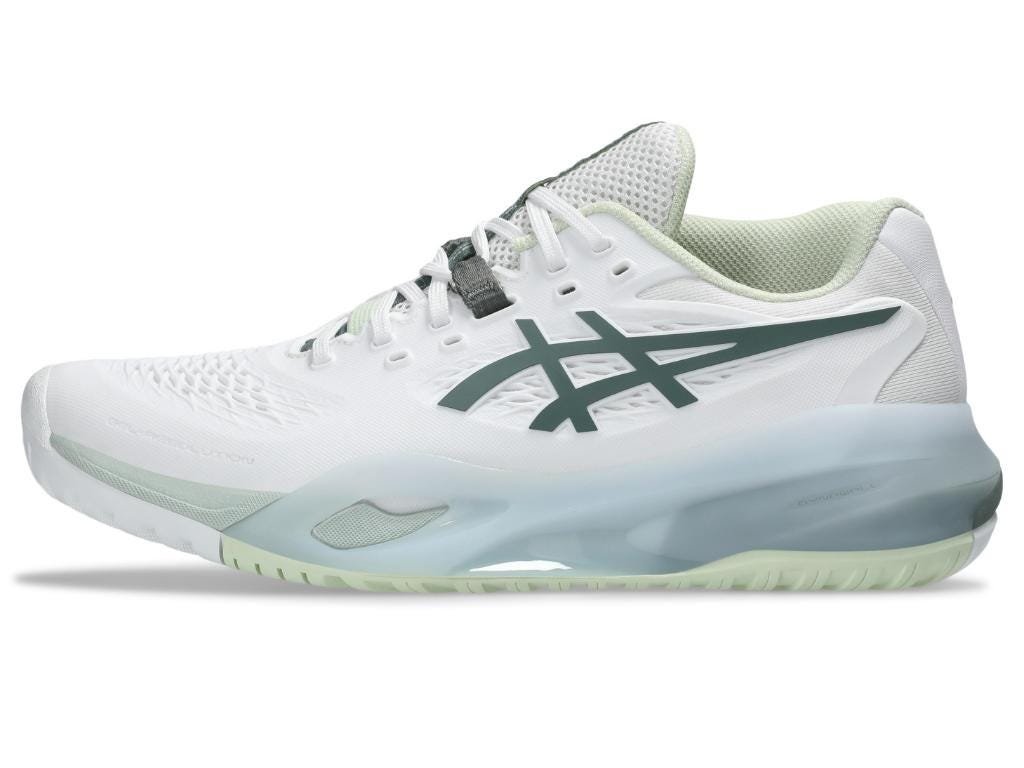
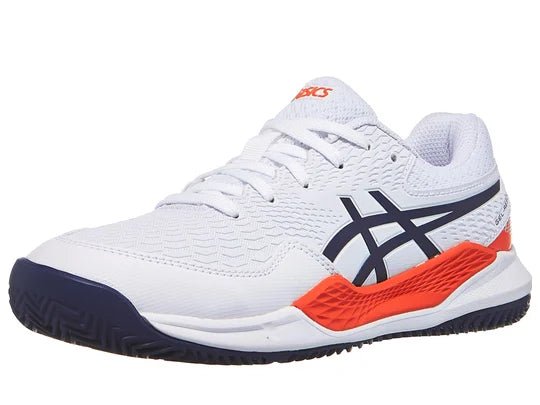
ASICS Gel-Resolution X (Hardcourt)
The support-and-durability benchmark — the shoe hard-court regulars measure everything else against.
The Gel-Resolution line has been the hard-court answer for a decade, and the X — the tenth generation — keeps the formula that built the reputation: a stability-first chassis, serious rubber underneath, and protection exactly where hard courts do their damage. ASICS builds the outsole from its AHARPLUS rubber, which ASICS says improves durability, and adds PGUARD protection across the forefoot of the upper, the panel your toe drags through the court on serves and low volleys. For a player who logs three or four hard-court sessions a week, those two features are the shoe.
The support package is just as deliberate. DYNAWALL runs through the midsole and into the heel to resist the foot rolling outward on hard lateral plants, DYNALACING is designed to hold the foot when support is needed most — ASICS’ words for the locked-in feel on quick transitions — and a two-piece midsole with forefoot GEL keeps landings stable and cushioned rather than mushy. ASICS also sells the X in a dedicated clay version and a wide version, which makes it the easiest recommendation in this guide: pick your surface, pick your width, and the shoe underneath is the same proven design. It is the heaviest-feeling shoe here on retailer measurement, and players who live on their toes should read the speed cards first — but for hard-court seasons, nothing below outlasts its brief.
What we like
- AHARPLUS outsole rubber and PGUARD toe protection target hard-court wear directly
- The strongest lateral-support package in this guide
- Sold in hardcourt, clay and wide versions of the same design
- Forefoot GEL and a two-piece midsole keep a stable shoe comfortable
Worth knowing
- The most substantial shoe here — speed-first players will prefer the Solution Speed FF 3
- Supportive fit runs structured at first; it is not a slipper out of the box
As an Amazon Associate we earn from qualifying purchases.
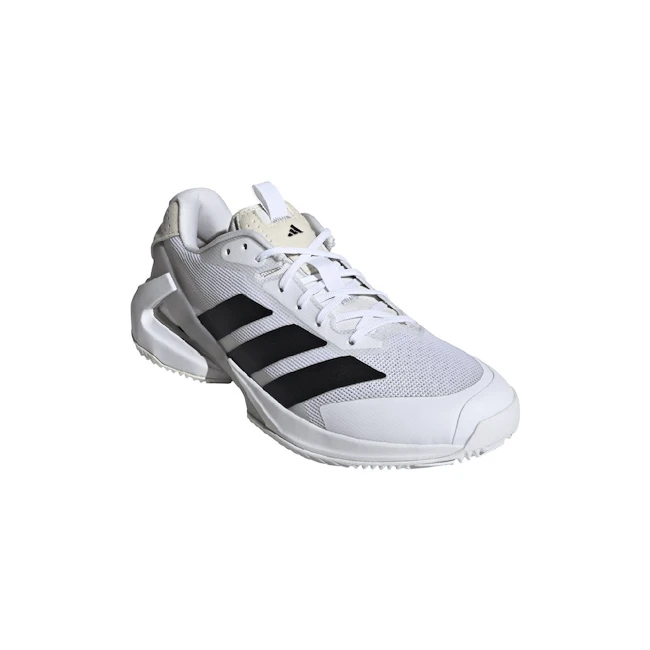
adidas Adizero Ubersonic 5 Clay
The clay specialist — a full herringbone outsole and a race-fit upper for players who slide into the ball.
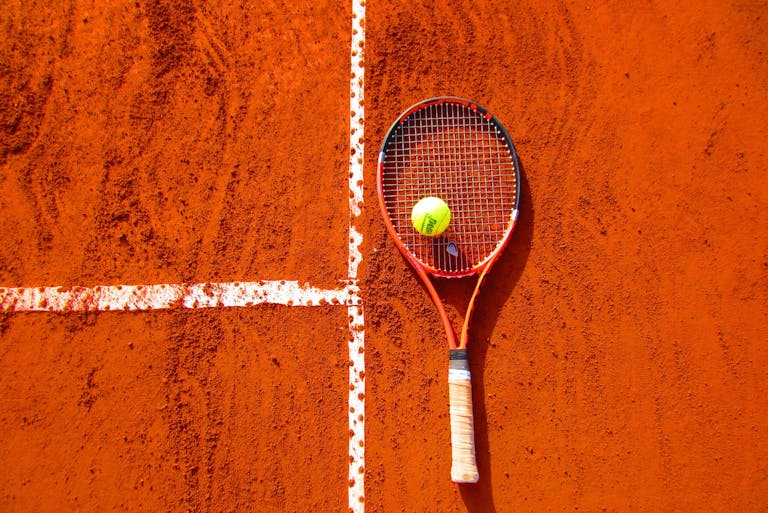
Clay asks a shoe to do two contradictory things — grip hard enough for the first explosive step, then release into a controlled slide — and the tool for the job is tread geometry. The clay version of the Ubersonic 5 runs an Adiwear rubber outsole in a full, sharp herringbone pattern: the deep zig-zag grooves dig through loose top-dressing to the compacted surface beneath, then channel the grit away so the tread keeps biting as you load it into a slide. If your club season is on clay, this pattern — not the brand on the heel — is what you are buying.
Above the outsole, the Ubersonic is adidas’ speed franchise doing speed things: a minimalist mesh upper over a half-bootie sleeve for a sock-like fit, Lightstrike cushioning that keeps the shoe low and responsive rather than pillowy, a Speedframe for torsional stability when you plant on a surface that wants to move, and Adituff reinforcement over the toe for the drag of clay-court defence. One honest caveat: the clay version is a separate SKU from the hard-court Ubersonic 5, it is most widely stocked in Europe, and no wide version is offered. Clay players who want the wide or hard-court alternatives in the same spirit should start with the Gel-Resolution X’s clay version above.
What we like
- Full herringbone Adiwear outsole is the correct tool for clay, full stop
- Light, low and responsive — a genuine speed-shoe feel
- Half-bootie fit keeps the foot centred when sliding
- Adituff toe reinforcement for clay-court drag
Worth knowing
- Clay SKU only — do not buy the hard-court version expecting this tread
- No wide fit, and the race fit suits narrower feet best
As an Amazon Associate we earn from qualifying purchases.
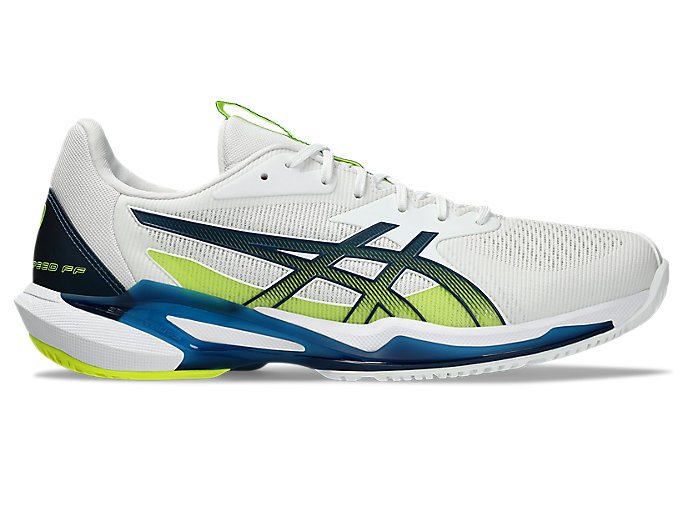
ASICS Solution Speed FF 3
The lightest shoe in this guide — all-court speed with enough structure to survive real matches.
ASICS describes the Solution Speed FF 3 as its shoe for “the all-court tennis player who’s seeking a fast and lightweight shoe” — and on the scale it earns the description, coming in as the lightest model in this guide on retailer measurement. The design brief shows in every layer: an engineered mesh and film upper that keeps structure where the foot needs holding and drops material everywhere else, FLYTEFOAM cushioning chosen for lightness, and a PRECISION-SOLE outsole that ASICS says was generated algorithmically to balance grip with the flexibility a fast shoe needs to bend through a split-step.
The support story is SPEEDTRUSS, a truss structure ASICS credits with improving quickness and cutting motions — the change-of-direction work that a featherweight shoe historically does badly. Honesty about the trade: the FF 3’s outsole is optimised for hard courts, so clay players should take the dedicated clay shoes here instead, and there is no wide version — the fit is a snug medium. But for the all-court player whose game is built on getting there first — drop-shot chasers, counter-punchers, doubles players living at the net — this is the shoe in the guide that disappears on your foot.
What we like
- The lightest shoe in this guide, by a clear margin
- SPEEDTRUSS keeps cuts and direction changes sharp at speed-shoe weight
- Algorithmically generated PRECISION-SOLE balances grip and flexibility
- AHARPLUS rubber keeps durability respectable for a light shoe
Worth knowing
- Hard-court-optimised outsole — not the clay answer
- Snug medium fit only; wide feet should look at the 996v7 or Gel-Resolution X Wide
As an Amazon Associate we earn from qualifying purchases.
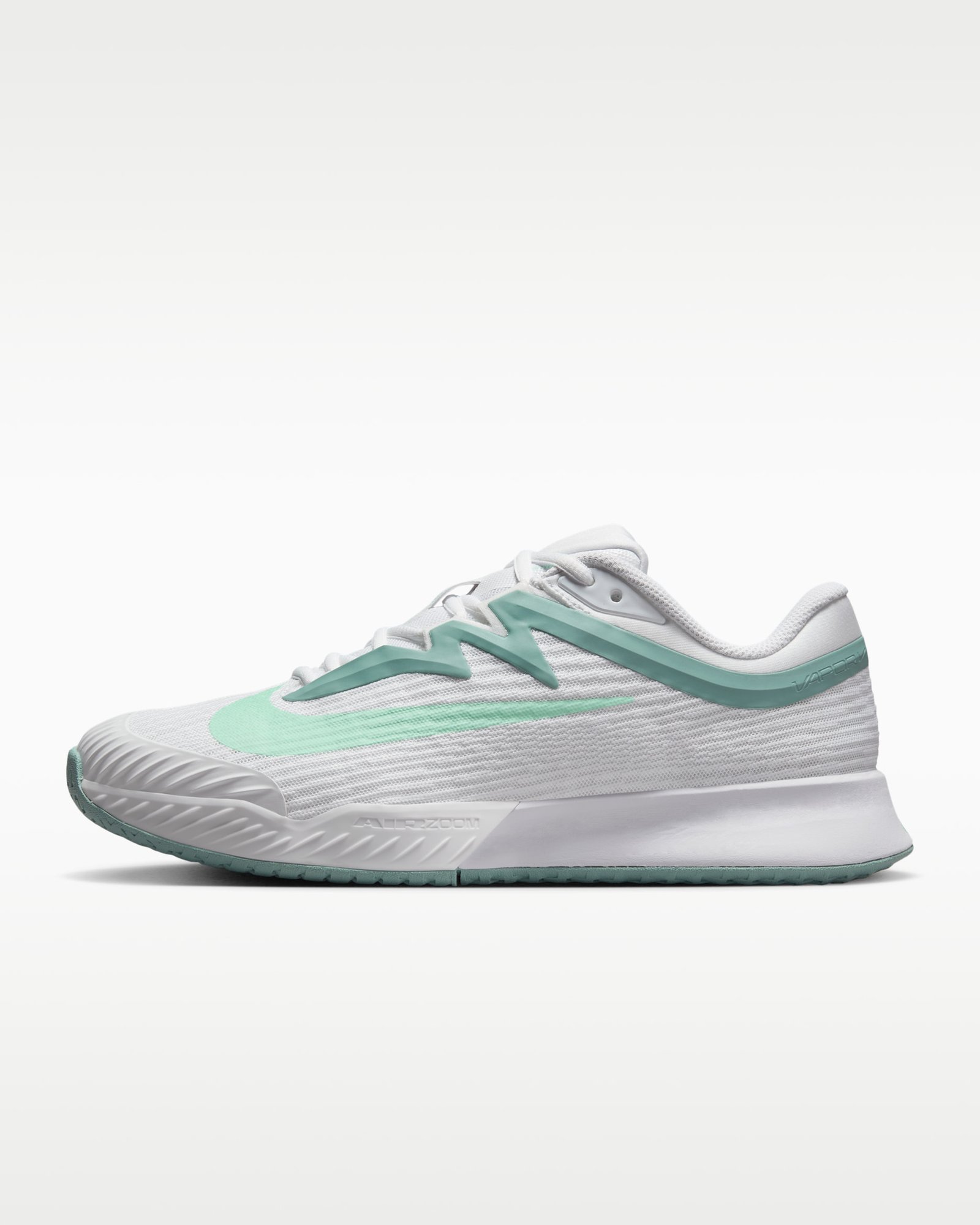
Nike Vapor Pro 3
Court feel and lockdown — the Vapor recipe, tuned for players who play up on their toes.
The Vapor line has always sold the same feeling: low to the ground, foot locked in, nothing between you and the court but a thin layer of rubber and intent. The Pro 3 — the current Vapor Pro on Nike’s own shelves — builds that feeling with a full midfoot fit band that wraps and holds the midfoot, a durable breathable mesh upper with a rubber toe tip for drag protection, and a forefoot Air Zoom unit that Nike made smaller than the previous generation’s specifically so the forefoot flexes more naturally through the stride. Nike also moved to a new outsole rubber compound that it says is lighter than the rubber on past Vapors, in the same tread pattern as the Vapor 2.
Two pieces of buying honesty matter here. First, Nike designates this shoe for hard-court surfaces — a separate clay version exists — so clay players should not treat it as a dual-surface answer. Second, Nike’s own fit guidance says the Pro 3 fits large and suggests ordering half a size down; do that, because a lockdown shoe bought a half-size big is neither locked down nor fast. There is no wide version. What you get instead is the most connected, agile-feeling ride among the support-leaning shoes in this guide — the pick for attacking players who change direction on their forefoot and want the shoe to answer instantly.
What we like
- Midfoot fit band gives the most locked-in feel in this guide
- Smaller forefoot Zoom Air unit flexes more naturally than before
- Low, connected court feel for forefoot-driven movement
- Rubber toe tip guards the classic Vapor wear point
Worth knowing
- Hard-court designation — clay needs the separate clay version
- No wide option, and Nike advises sizing down half a size
As an Amazon Associate we earn from qualifying purchases.
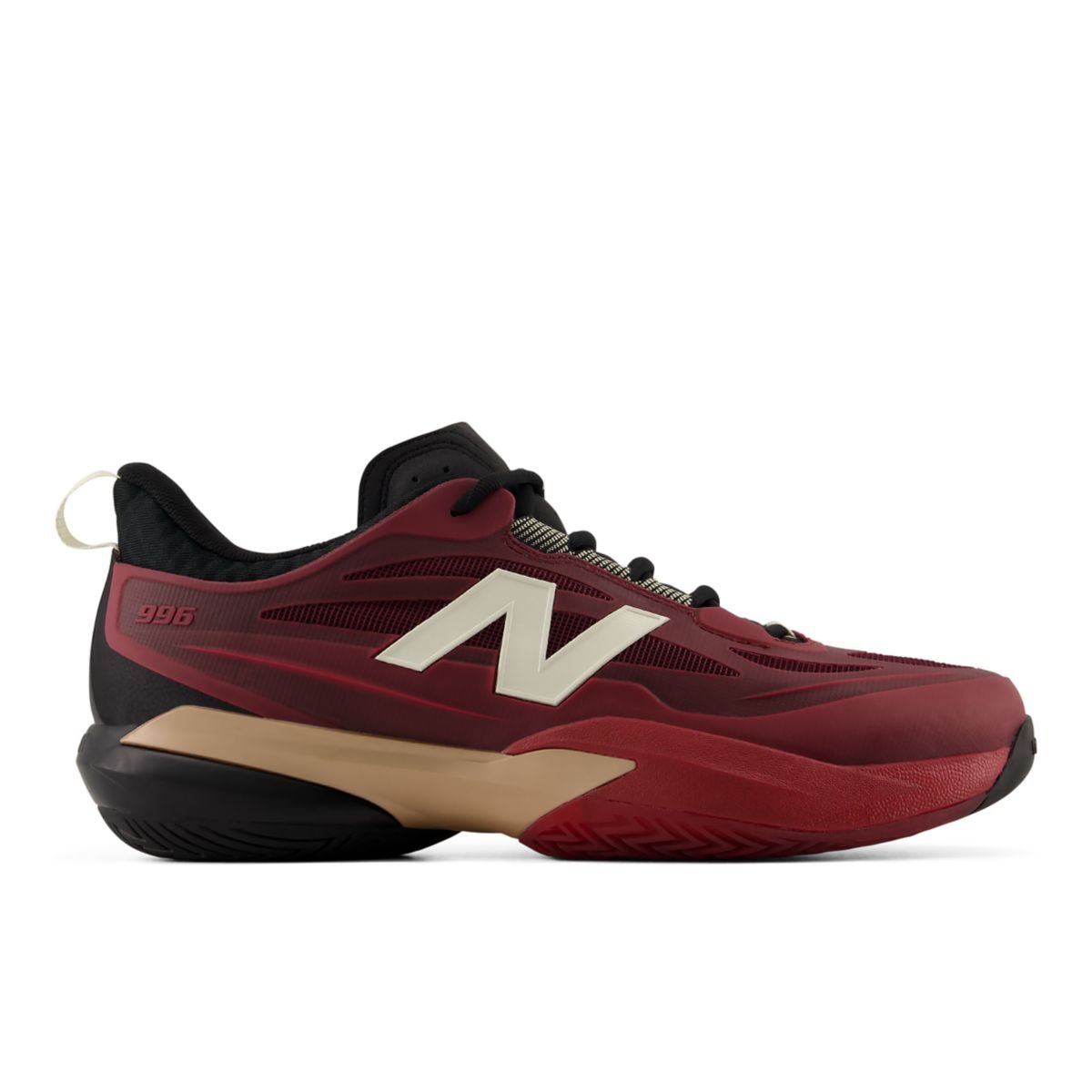
New Balance FuelCell 996v7
A real wide last, a lively midsole — and the only manufacturer-backed outsole warranty in this guide.
Most “wide fit” tennis advice is a workaround — size up, lace loosely, hope. The 996v7 is the genuine article: New Balance’s own product listing sells the shoe in both D (standard) and 2E (wide) widths across its colourways, which means the wide version is built on a wide last rather than stretched over a standard one. If your forefoot spreads under load, your toes splay on the plant, or standard performance shoes leave the outside of your foot aching by the second set, this is the card in the guide written for you.
The shoe around that fit is no consolation prize. The full-length FuelCell midsole gives the 996v7 a responsive, propulsive ride that livelier-feeling than the durability shoes above, the NDure reinforcement toughens the engineered-mesh upper where it wears, and the NDurance rubber outsole — in a dual-density modified herringbone — is backed by New Balance’s own 6-Month NDurance Rubber Outsole Limited Warranty, published on New Balance’s warranty page with US purchase conditions. That last point matters: outsole guarantees from retailers come and go, but this one is the manufacturer’s own commitment, and it is the only one in this guide we can state as such.
What we like
- A genuine 2E last on the manufacturer’s own listing — not a sizing workaround
- New Balance’s own 6-month NDurance outsole warranty (US conditions apply)
- FuelCell midsole feels livelier than most durability shoes
- Modified herringbone outsole suits hard courts and occasional all-court use
Worth knowing
- Hard-court shoe — dedicated clay players still need a clay outsole
- The wide 2E is a men’s width story first; check the women’s listing for its width options
As an Amazon Associate we earn from qualifying purchases.
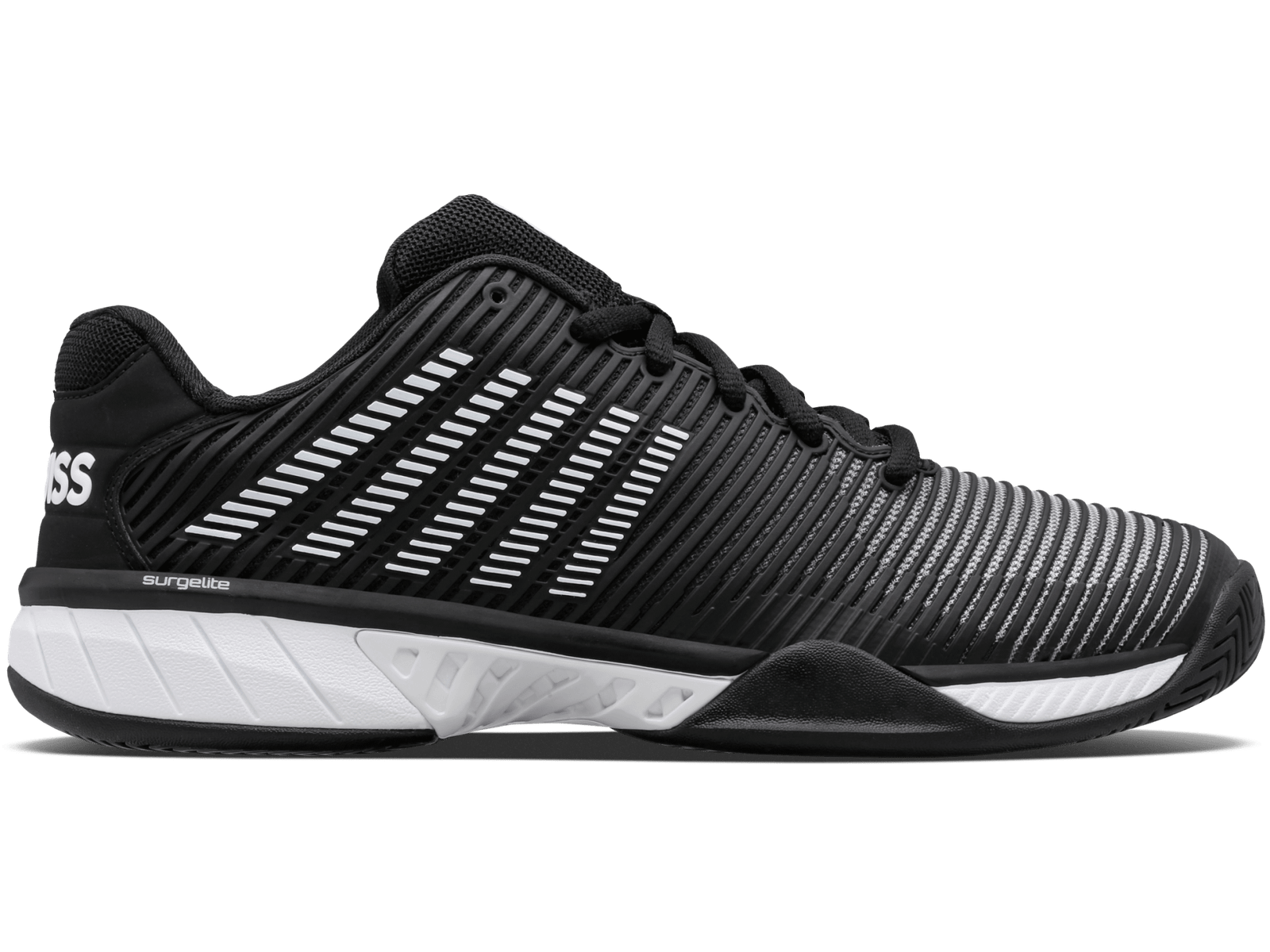
K-Swiss Hypercourt Express 2
The generous, no-break-in comfort shoe — K-Swiss’ best-seller, with wide versions of its own.
K-Swiss describes the Hypercourt Express 2 in unfashionably honest terms — light, comfortable, breathable, with a generous fit — and that is exactly why it sells. Where the performance shoes in this guide ask your foot to adapt to the shoe, the Express 2 meets the foot where it is: Durawrap Flex support that K-Swiss says needs no break-in period, a Surgelite midsole tuned for all-day comfort, and a moulded Ortholite x40 sockliner underfoot. For club players whose sessions are social, long and frequent — and whose feet file complaints about race-fit shoes — this is the pair that simply stops being a problem.
The comfort does not come at the cost of the tennis basics. The Aösta 7.0 high-density rubber outsole runs a modified herringbone pattern with DragGuard reinforcement in the toe and heel wear zones, and a midfoot chassis keeps the shoe honest through lateral movement. K-Swiss also sells dedicated wide versions — a men’s 2E and a women’s Wide sit alongside the standard fit on its own store — making this the second genuine wide option in the guide. One generational note, stated plainly: a Hypercourt Express 3 now sits alongside the 2 in K-Swiss’ range, so compare the two if current-generation matters to you; the 2 remains on sale from K-Swiss itself and remains the comfort benchmark its reputation was built on.
What we like
- Generous fit with no break-in — comfortable from the first session
- Dedicated wide versions for men (2E) and women
- All-day cushioning package: Surgelite midsole plus Ortholite sockliner
- DragGuard reinforcement protects the high-wear zones
Worth knowing
- A newer Express 3 now sits alongside it in the range
- Aggressive sliders will find the support shoes above more secure
As an Amazon Associate we earn from qualifying purchases.
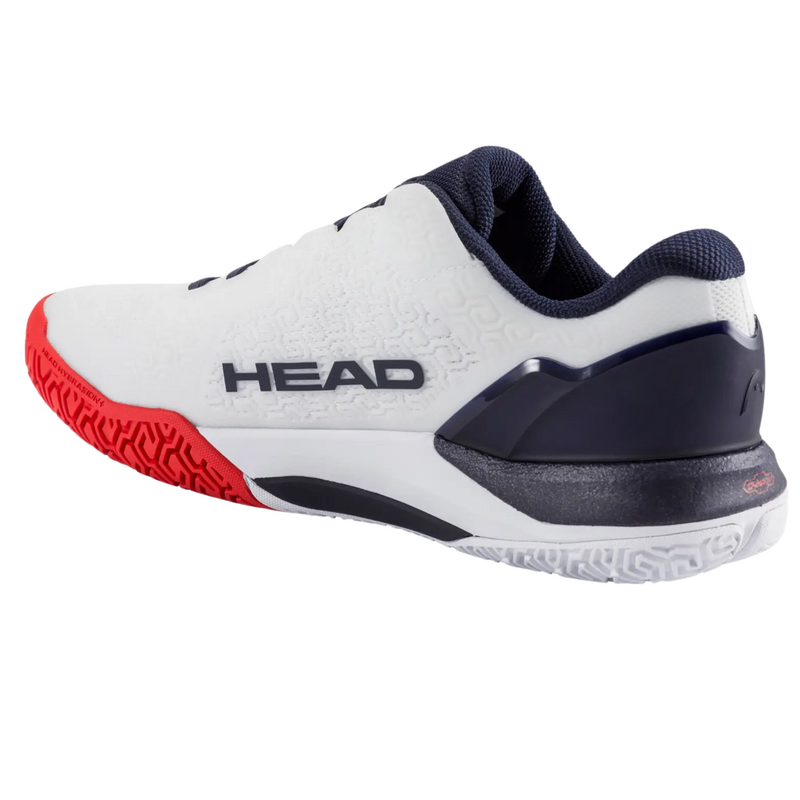
HEAD Revolt Pro 5.0
Built for aggressive baseliners — lockdown straps, a TPU control frame and slide-ready stability.
HEAD is unusually direct about who this shoe is for: its own product page classifies the Revolt Pro 5.0 for the baseline player, names stability as its main benefit, and describes it as made for aggressive baseliners. The construction backs the label. Lockdown Straps integrated into the lacing pull the midfoot down and in, a CORE-CONTROL TPU frame runs from the midfoot to the lateral forefoot to resist the shoe twisting under load, and HEAD adds material in the slide-protection zones of the PU-moulded upper while cutting it where the foot does not need armour — a shoe designed around sliding into shots and recovering, repeatedly, for three sets.
Underfoot, a triple-density EVA stack puts DynaFoam in the heel for shock absorption, responsive EVA in the forefoot and a softer EVA through the midfoot, and the Hybrasion+ outsole rubber is HEAD’s durability compound in a modified herringbone. If the Gel-Resolution X is the support benchmark for durability-first players, the Revolt Pro 5.0 is the support pick for players who generate their stability problem themselves — big hitters who plant hard, slide late and need the shoe to stay composed when they do. The trade is fit: HEAD offers a medium fit only, so genuinely wide feet belong in the 996v7 above.
What we like
- Lockdown Straps and a TPU control frame give true midfoot security
- Upper reinforced exactly in the slide-protection zones
- Triple-density midsole balances heel cushioning with forefoot response
- HEAD classifies it plainly: baseline player, stability, all court
Worth knowing
- Medium fit only — no wide version
- A substantial shoe; touch-and-finesse players may find it more than they need
As an Amazon Associate we earn from qualifying purchases.
Side-by-Side Comparison Table
| Model | Best For | Maker’s Surface Call | Outsole | Widths | Weight (US 10.5)* |
|---|---|---|---|---|---|
| ASICS Gel-Resolution X | Hard-court durability | Hard court (clay version sold) | AHARPLUS rubber | Standard + Wide | 16.1 oz |
| adidas Adizero Ubersonic 5 Clay | Clay courts | Clay | Adiwear, full herringbone | Standard only | 391 g |
| ASICS Solution Speed FF 3 | Lightweight all-court | All-court player, hard-optimised | PRECISION-SOLE, AHARPLUS | Standard only | 11.8 oz |
| Nike Vapor Pro 3 | Speed & lockdown | Hard court | Nike rubber compound, Vapor 2 pattern | Standard only | 15.0 oz |
| New Balance FuelCell 996v7 | Wide fit | Hard court | NDurance, modified herringbone | D + 2E | 15.1 oz (2E) |
| K-Swiss Hypercourt Express 2 | Comfort | All-court | Aösta 7.0, modified herringbone | Standard + Wide SKUs | 13.0 oz |
| HEAD Revolt Pro 5.0 | Support & stability | All court | Hybrasion+ | Medium fit only | 15.8 oz |
*Weights are Tennis Warehouse measurements at men’s US 10.5 (the Ubersonic figure is Tennis Warehouse Europe’s). The manufacturers do not publish shoe weights; use these figures to compare the seven against each other, not as specifications.
Buying Guide: Surface, Fit, Support and Cushioning
1. Match the outsole to the surface — in your real proportions
Write down your actual season: if eight of your ten sessions are on hard courts, buy the hard-court shoe and accept the compromise on clay days. Own one pair per surface only when a surface genuinely dominates a block of your year — a clay-court swing, a hard-court winter. The version trap cuts both ways: clay outsoles wear quickly and grip unpredictably on hard courts, while hard-court outsoles skate on clay. Our older hardcourt tennis shoes guide goes deeper on the hard-court lane specifically, and women playing a clay season will find the dedicated angle in our women’s clay court tennis shoes roundup.
2. Grass: the surface most players rent, not buy
Grass-court shoes use short, pimples-and-nubs outsoles rather than herringbone, because the tread has to grip a slick natural surface without tearing it — many grass clubs will not allow anything else on their courts. Genuine grass models are a small, seasonal corner of the market, and none of the seven all-rounders above is one. If you play grass a handful of times a year, your all-court shoe is the pragmatic answer where the club allows it; if you play a full grass season, buy the surface-specific version of a line you already trust and treat it as a specialist tool, exactly as you would a clay shoe.
3. Fit: heel locked, toes free, width honest
A tennis shoe should hold like a handshake at the heel and midfoot and leave roughly a thumb’s width beyond your longest toe — your feet swell during a match, and every hard stop drives the foot forward. Buy on length first, then width: if the forefoot is cramped in your correct length, the answer is a wide last (the 996v7’s 2E, the Gel-Resolution X Wide, the K-Swiss wide versions), not a longer shoe that lets the foot slide and blister. Respect maker fit notes where they exist — Nike, for example, states the Vapor Pro 3 fits large and advises half a size down.
4. Lateral support: match it to how you move
Baseline defenders and aggressive sliders load a shoe sideways harder in one rally than runners load theirs in a mile. If you plant and cut at full stretch, prioritise the support end of this guide — the Gel-Resolution X’s DYNAWALL package or the Revolt Pro 5.0’s lockdown straps and TPU frame. If your game is linear speed and net approaches, the lighter shoes’ simpler support is a fair trade. Ankles with a history of rolling deserve the structured end of the list and, if problems persist, a professional opinion rather than a product page.
5. Cushioning: protect the second hour
Hard courts return impact; they do not absorb it. Players logging long hard-court sessions should weight the cushioned stability shoes here, while lighter builds suit shorter sessions, faster movers and softer surfaces. Cushioning also dies before the shoe looks dead: when the midsole stops springing back and post-match leg fatigue arrives earlier than it used to, the shoe is done protecting you — replace on feel and mileage, not on the outsole alone. When the outsole itself goes smooth in the wear zones or the upper starts tearing at the toe-drag panel, that pair’s season is over whichever comes first.
Frequently Asked Questions
Can I use clay court shoes on hard courts?
Occasionally, without disaster — but not as a habit. A clay shoe’s deep herringbone tread is cut in a softer compound for a loose surface; on abrasive hard courts it wears quickly and can feel unstable on hard lateral plants. The reverse trip is worse: a hard-court outsole has no tread depth to bite through clay’s loose top layer, so it skates. Match the shoe to the surface you play most.
What is the difference between hard court and all-court tennis shoes?
Hard-court shoes are built for abrasion: harder outsole rubber, reinforced toe panels and more cushioning against an unforgiving surface. All-court shoes split the difference — a modified herringbone pattern and a general-purpose compound that grips acceptably on hard courts and artificial surfaces but is neither a clay specialist nor a hard-court durability shoe. The HEAD Revolt Pro 5.0 and K-Swiss Hypercourt Express 2 in this guide are the all-court designs.
Which tennis shoes are best for wide feet?
Start with the New Balance FuelCell 996v7: New Balance’s own listing sells it in D (standard) and 2E (wide) widths. The ASICS Gel-Resolution X also comes in a dedicated wide version, and the K-Swiss Hypercourt Express 2 is sold in wide versions alongside its standard generous fit. A true wide last beats sizing up a standard shoe, which adds length your foot will slide in.
How long do tennis shoes last?
There is no honest universal number — it depends on your surface, hours and how hard you drag and slide, and manufacturers in this guide do not publish lifespan figures. Replace on evidence instead: an outsole worn smooth in the ball-of-foot or toe zones, an upper tearing at the drag panel, or cushioning that no longer feels alive after a session. New Balance is the exception that proves the rule — its 996 line carries New Balance’s own 6-month NDurance outsole warranty for US purchases.
Are running shoes OK for tennis?
No. Running shoes are built for straight-line movement: soft, tall midsoles, minimal lateral structure and uppers that are not reinforced for toe drag. Tennis movement is lateral — plants, cuts, slides and recoveries — and a running shoe can roll under that load and will wear through at the drag zones quickly. Every shoe in this guide is built for court movement; that is the entire point of the category.
Nike Vapor Pro 3 or ASICS Solution Speed FF 3 — which is faster?
They are fast in different ways. The Solution Speed FF 3 is the lighter shoe on retailer measurement (about 11.8 oz at US 10.5 versus about 15.0 oz for the Vapor Pro 3), so it wins the scale and suits all-court movers. The Vapor Pro 3 answers with the most locked-in fit here — a full midfoot fit band and low court feel — and Nike designates it for hard courts. Choose the ASICS for lightness, the Nike for lockdown on hard courts.
Do I need different shoes for grass courts?
If your club enforces it, yes: grass courts typically require shoes with short pimpled outsoles that grip without damaging the surface, and herringbone patterns are often banned. Grass models are a small seasonal category and none of the seven all-rounders in this guide is a grass shoe. For occasional grass play where the club allows it, an all-court shoe is the pragmatic choice; for a full grass season, buy the surface-specific shoe.
The Verdict
Buy by surface and the rest resolves itself. The ASICS Gel-Resolution X is the hard-court shoe — the durability and support benchmark with clay and wide versions of the same design behind it. The adidas Adizero Ubersonic 5 Clay owns the clay season, the ASICS Solution Speed FF 3 is the lightweight for all-court movers, and the Nike Vapor Pro 3 is the hard-court lockdown pick. Wide feet finally get two honest answers — the New Balance FuelCell 996v7 with its real 2E last and manufacturer-backed outsole warranty, and the comfort-first K-Swiss Hypercourt Express 2 — while aggressive baseliners should close with the HEAD Revolt Pro 5.0. Seven shoes, three surfaces, no wrong doors: match the tread to your courts and the fit to your feet.
Affiliate disclosure: AliShuttler is reader-supported. When you buy through links on this page we may earn an Amazon commission at no extra cost to you. Product features are taken from manufacturers’ published product information and were verified at the time of writing; shoe weights are retailer measurements as labelled, because the manufacturers do not publish them. Manufacturers revise models and cosmetics between generations, so confirm the exact specification — and the surface version — on the product page before ordering.