Balls are the one piece of tennis kit you buy forever — and the decision is simpler than the shelf makes it look. Pressurised balls are the match standard: lively, spin-friendly, and slowly dying from the moment the can opens. Pressureless balls trade that liveliness for a practice life measured in seasons, not sets. These seven picks cover both sides of the line, plus the engineered middle path between them.
⚡ TL;DR — The Short Answer
For matches, open a can of Wilson US Open Extra Duty — the US Open’s own ball, with premium woven felt built for hard courts; the Penn Tour Extra Duty is its closest rival and the Penn Championship Extra Duty is the value route to the same pressurised format. Dunlop Fort All Court TS is the premium all-surface option across hard, clay and grass. If you hate how fast match balls fade, Wilson Triniti is the engineered answer — Wilson says its core keeps a fresher feel four times longer. For coaching baskets and ball machines, buy Dunlop Training pressureless balls by the box. And for one ball that plays everywhere, Babolat Gold All Court is the all-surface alternative.
Quick Picks — Best Tennis Balls at a Glance
The US Open’s official ball — premium woven felt, extra-duty build for hard courts.
Tournament-level, woven felt, one ball for hard, clay and grass per Dunlop.
LongPlay felt and high-visibility Smart Optik treatment, USTA and ITF approved.
An integrated-core design that skips the pressurised can — built to stay lively longer.
The league staple: pressurised, natural rubber, interlocked wool fibre felt.
Pressureless construction for coaching and intensive practice, sold by the 72-ball box.
Pressurised, woven felt adapted for all courts, ITF/USTA homologated per Babolat.
In This Guide
The One Decision: Pressure or No Pressure
Every tennis ball in this guide is one of two constructions. A pressurised ball is a hollow rubber core filled with gas above atmospheric pressure, sealed in the can to keep it that way. That internal pressure is what makes a match ball feel alive — it drives the bounce, keeps the ball light on the strings and lets the felt bite for spin. It is also a countdown: from the moment the seal breaks, gas escapes through the rubber, and the ball drifts from crisp to tired to dead. A pressureless ball gets its bounce from the thickness and compound of its rubber core instead of gas, so there is nothing to leak. It starts firmer and deader than a fresh match ball — and stays that way, which is precisely why coaches feed thousands of them through ball machines.
Neither construction is “better”; they are answers to different sessions. Matches and league play belong to pressurised balls — every tournament pick below is one. High-volume practice belongs to pressureless balls, where consistency across a basket matters more than match liveliness. And one product in this guide, Wilson’s Triniti, deliberately blurs the line with an integrated-core design that keeps match-ball manners without a pressurised can. Choose your construction by session type first; the cards then narrow the brand. If you are stocking the rest of the kit alongside, the companion guides are our best tennis rackets and best tennis strings roundups.
Felt: The Second Decision (Extra Duty vs Regular Duty)
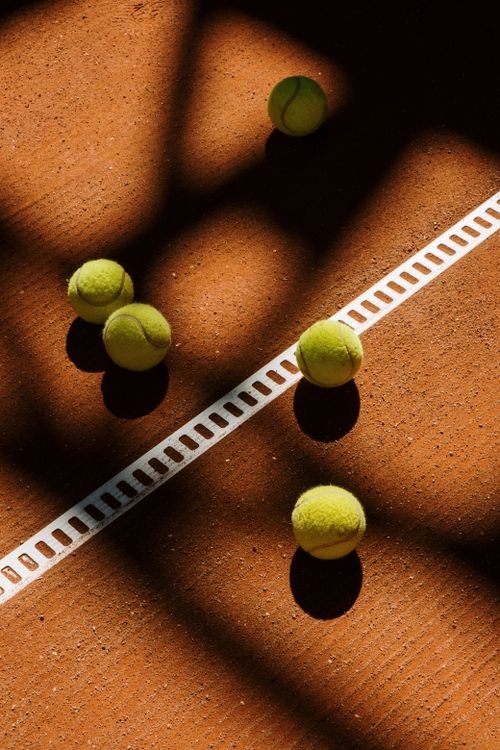
The core decides how a ball bounces; the felt decides how it survives. Extra-duty felt is a denser, more tightly woven cover built for hard, abrasive courts — it resists the fuzzing and tearing that tarmac inflicts. Regular-duty felt is softer and thinner, made for clay and indoor surfaces where the court does less damage and a heavier cover would pick up grit and moisture. Wilson states the split plainly for its US Open ball — Extra Duty for hard courts, Regular Duty for clay and indoor — and Penn and Dunlop organise their ranges the same way. Buying extra-duty for a clay season does not ruin your tennis, but it is the wrong tool: the ball plays heavier, wears its nap unevenly and gives up the soft-surface feel you chose clay for. Match the felt to your dominant surface, exactly as you would a shoe’s outsole.
The 7 Best Tennis Balls, Compared
Four pressurised match balls, one engineered longer-life ball, one pressureless trainer and one all-surface alternative. Read the card that matches your sessions first.
Wilson US Open Extra Duty
The tournament standard — the ball the US Open is played with, in its hard-court build.
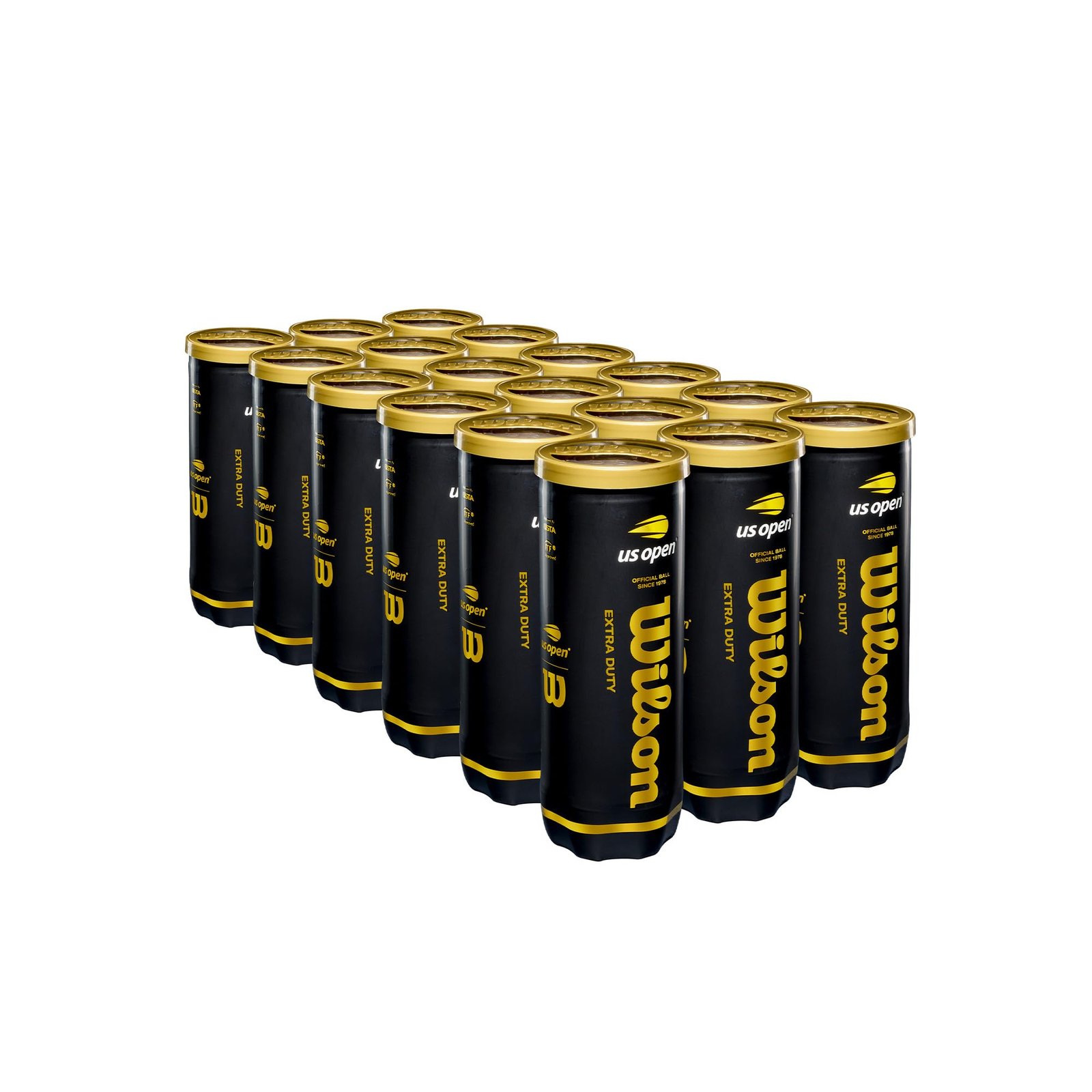
Some recommendations need an argument; this one needs a fact. Wilson’s US Open ball is the official ball of the US Open, and Wilson notes that every point at the tournament for more than forty years has been played with it. That pedigree is not marketing fluff — a Slam played on abrasive hard courts, over two weeks, in front of the sport’s fastest hitters, is the most demanding quality audit a tennis ball can pass, and this ball passes it annually. For club and league players on hard courts, it is the default against which everything else in this guide is measured.
The build is a premium woven felt over a pressurised core, in the Extra Duty specification Wilson intends for hard, abrasive courts. The same ball exists in a Regular Duty version for softer surfaces — clay and indoor — and a High Altitude version for play above 3,000 feet, so match the variant to your venue rather than assuming the name alone does it. What you are buying, beyond the felt, is consistency: can to can, the US Open plays like the US Open, which is why it anchors match-day recommendations everywhere. Open a fresh can for matches that matter and let yesterday’s can feed the practice basket.
What we like
- The US Open’s official ball — tournament-proven at the highest level
- Premium woven felt in a proper extra-duty hard-court build
- USTA and ITF approved for competitive play, per Wilson
- Regular Duty and High Altitude variants cover other venues honestly
Worth knowing
- Like every pressurised ball, it fades once the can opens — buy for matches, not for the season
- The Extra Duty felt is the wrong choice for a clay-first schedule
As an Amazon Associate we earn from qualifying purchases.
Dunlop Fort All Court TS
The one-ball answer — Dunlop builds the Fort for elite play on hard, clay and grass alike.
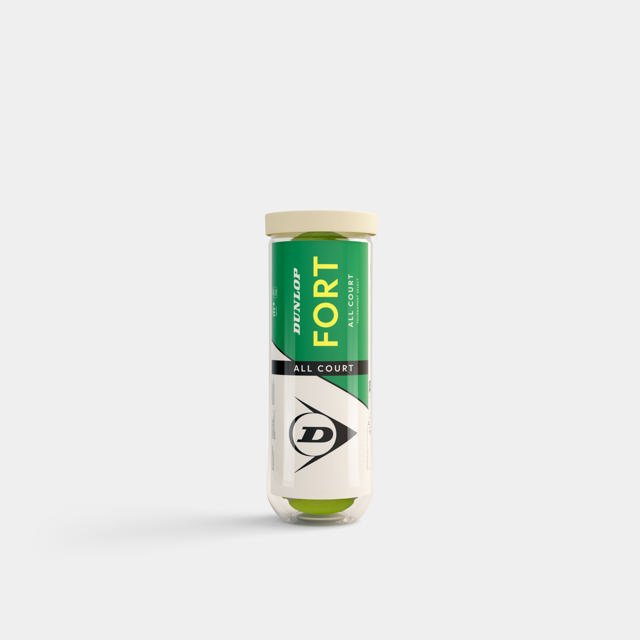
The Fort is one of the oldest names in tennis balls, and the current Fort All Court TS is Dunlop’s tournament-level entry: a premium rubber core under a woven felt, positioned by Dunlop itself for elite-level performance with all-court versatility across hard, clay and grass. That surface spread is the card’s whole argument. Where the specialists in this guide ask you to match a variant to a venue, the Fort is the ball for the player whose season genuinely moves — hard courts in winter, a clay swing in spring, a grass social in summer — and who would rather carry one trusted tube than three half-right ones.
Dunlop sells it in a 3-ball tube, a 4-ball tube and a 2×4 cartonette, which suits both the single-match buyer and the club player stocking a bag for a month. A note on claims, because this guide checks them: older retailer copy attaches extra technology names and approvals to the Fort that do not appear on Dunlop’s current product page, so this card sticks to what Dunlop states today — core, felt, level and surfaces. On those stated merits alone, it earns its place as the premium all-court pick.
What we like
- Dunlop positions it for elite, tournament-level play
- One ball honestly specified for hard, clay and grass
- Premium rubber core and woven felt
- Three pack formats, from a single tube to the 2×4 cartonette
Worth knowing
- A pressurised match ball — it will not outlast the practice trainers below
- Players who live on one surface may still prefer a surface-specific ball
As an Amazon Associate we earn from qualifying purchases.
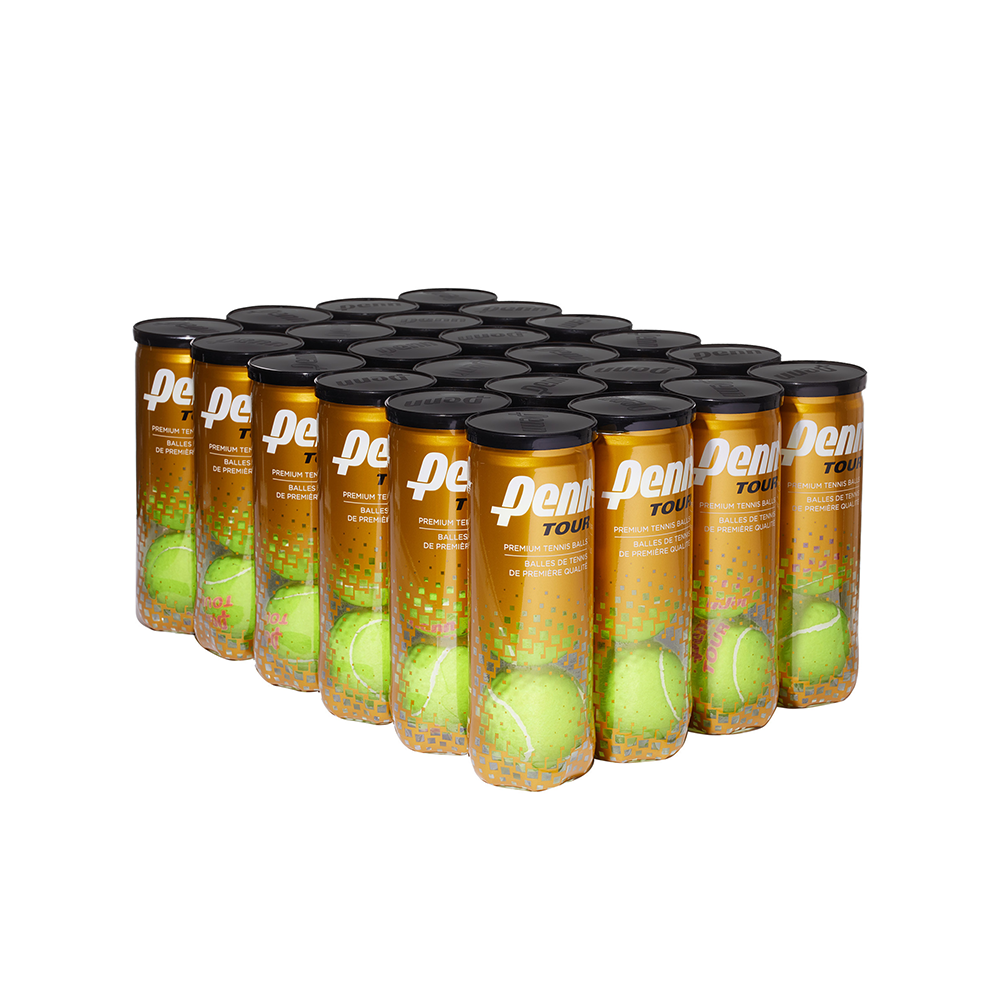
Penn Tour Extra Duty
The other tournament ball — LongPlay felt and high-visibility treatment, approved on both sides of the Atlantic.
If the Wilson is the tournament default, the Penn Tour is the connoisseur’s alternative — the flagship of the Penn range under HEAD, built around two named felt technologies. LongPlay is Penn’s felt formulated for extended wear, aimed squarely at the extra-duty ball’s weak point: the nap that hard courts shred first. Smart Optik is Penn’s high-visibility felt treatment, which Penn says makes the ball 19% more visible than a standard ball — a manufacturer claim, stated as such, but a plausible one for anyone who has squinted at a dusk league match.
The credentials behind the felt are real: the Tour is USTA and ITF approved, and Penn states it is used in four of the five largest tournaments in North America. In play terms, players who find the US Open’s feel a touch firm often land here, and vice versa — the honest advice is that these two balls bracket the premium tier and the choice between them is feel, not quality. It sells in 3-ball cans and 24-can cases, with Regular Duty and High Altitude siblings for other venues.
What we like
- LongPlay felt targets hard-court wear directly
- Smart Optik high-visibility treatment (Penn’s claim: 19% more visible)
- USTA and ITF approved; used at major North American tournaments per Penn
- A genuine feel alternative to the Wilson at the same tier
Worth knowing
- Pressurised match ball economics: fresh cans for matches, always
- Extra Duty build only suits hard courts; clay players need the Regular Duty sibling
As an Amazon Associate we earn from qualifying purchases.
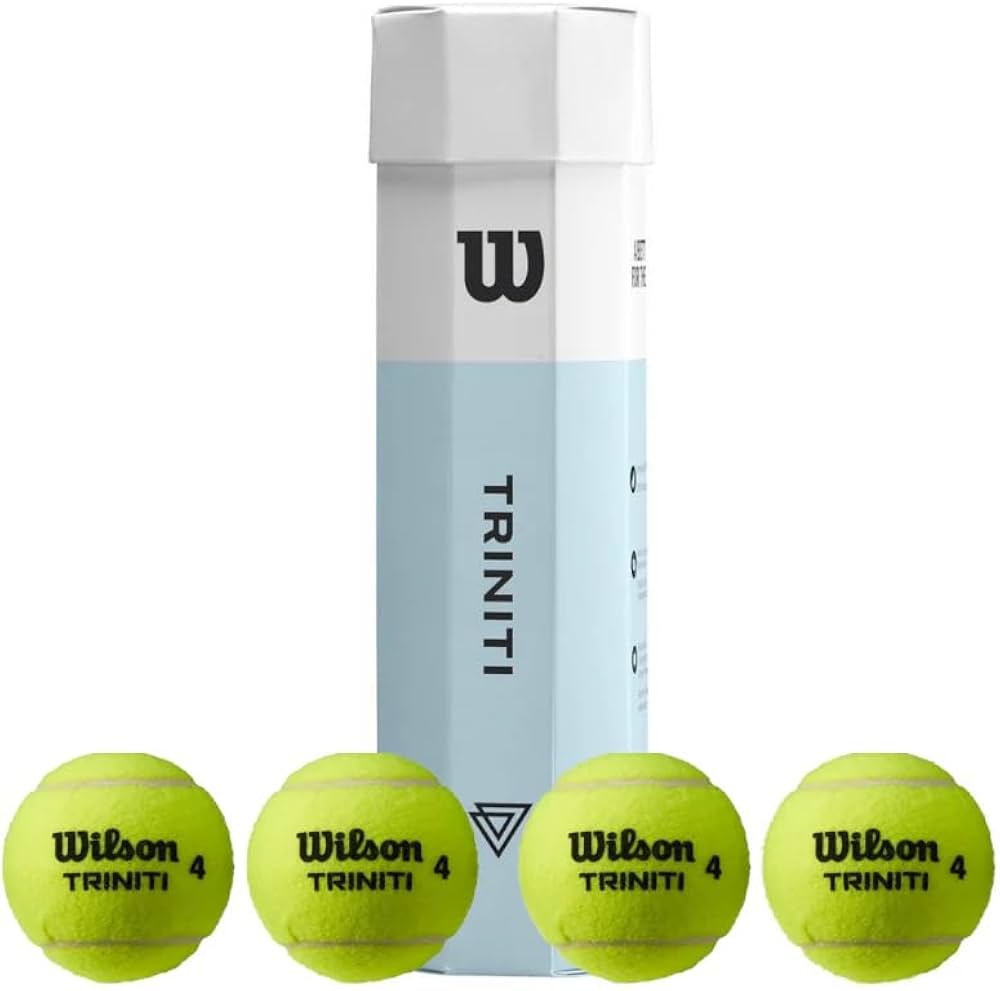
Wilson Triniti
The engineered middle path — an integrated core that keeps its liveliness without a pressurised can.
Triniti exists because Wilson asked a heretical question: what if the ball kept its pressure instead of borrowing it from a can? The answer is the Engage Core — a plastomer material integrated into the core itself — paired with STR Felt, which Wilson states is 50% more flexible than standard felt. The headline claim, in Wilson’s own words, is that Triniti balls maintain “a fresher feel four times longer than a standard core”; Wilson’s launch material footnotes that figure to its own lab testing, and we repeat it as Wilson’s claim, not as our measurement. The packaging tells the same story: Triniti ships in a distinctive octagonal, recyclable sleeve rather than a sealed pressurised can, because there is no can-pressure to preserve — and Wilson states that 5% of Triniti profits support worldwide sustainability efforts.
Who is it for? The player who plays twice a week and resents opening a fresh can every fortnight, and the practice-heavy player who wants one ball to behave the same in week three as week one. Two honest caveats. First, Triniti is its own category — not a standard pressurised match ball, and sources conflict on its approval status, so this guide does not present it as an ITF-approved tournament ball; for sanctioned matches, take the approved cans above. Second, a club sibling, Triniti Club, is sold in bulk cartons for academies and baskets — buy the original sleeve for personal play, the Club box for volume.
What we like
- Engage Core design holds liveliness far beyond a standard can’s arc (Wilson’s 4× claim)
- No pressurised can — the octagonal sleeve is recyclable
- STR Felt stated by Wilson as 50% more flexible than standard felt
- Wilson states 5% of profits support sustainability efforts
Worth knowing
- Its own category: not the sanctioned-match choice — take an approved can for tournaments
- Costs more per ball than the value cans; the saving is in longevity, per Wilson’s claim
As an Amazon Associate we earn from qualifying purchases.
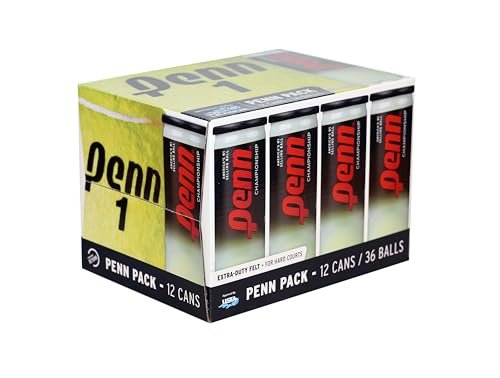
Penn Championship Extra Duty
The league staple — America’s best-selling ball (Penn’s claim), built to be bought by the case.
Not every match ball needs a Slam pedigree. The Penn Championship is the ball American league tennis actually runs on — Penn calls it America’s #1 selling tennis ball and the official ball of USTA Leagues, and both claims are Penn’s own, repeated here with attribution because they match what anyone who has played league tennis already knows: this is the can that comes out of the bag. The construction is honest mid-market engineering: a pressurised natural-rubber core, interlocked wool fibre felt for longer wear, controlled fibre release for a consistent nap, and deep-elastic seams Penn credits with reduced cracking.
The Extra Duty version is specified for hard courts, though Penn’s own copy notes it can be played across indoor and outdoor surfaces; Regular Duty and High Altitude variants fill out the range. The buying logic is volume: where the premium cans above are for matches that matter most, the Championship is the ball you stock for the weekly league fixture, the club ladder and the social set — a proper approved match ball at a working-ball budget, bought by the multi-pack or the case. Rotate it exactly like the premium cans: fresh for fixtures, retired cans to the practice basket.
What we like
- A genuine approved match ball at a volume-buy price point
- Interlocked wool fibre felt and controlled fibre release for consistent nap
- Natural rubber core and deep-elastic seams
- Multi-pack and case formats suit league and club buying
Worth knowing
- Fades on the same pressurised arc as every can here — rotation still applies
- Premium-tier felt (cards #1 and #3) survives hard courts more gracefully
As an Amazon Associate we earn from qualifying purchases.
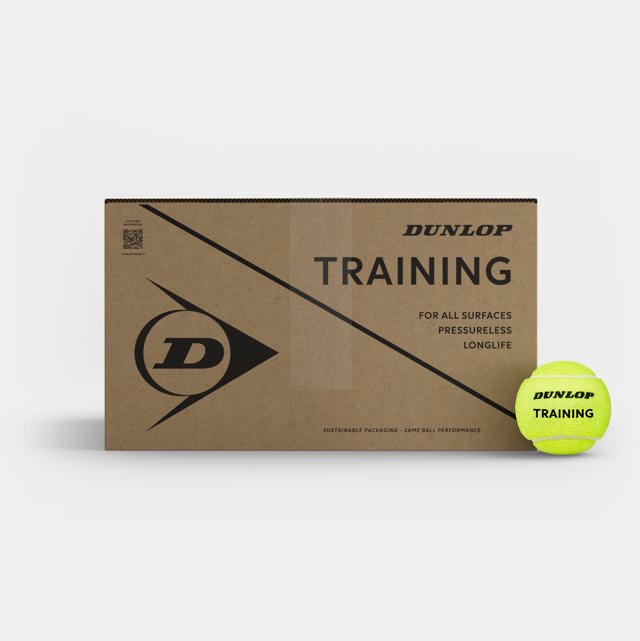
Dunlop Training (72-Ball Box)
The workhorse — Dunlop states it plainly: pressureless, built for coaching and intensive practice.
Practice changes the maths completely. A coach feeding drills or a player grooving a serve with a ball machine cycles through more balls in a week than a match player opens in a season — and pressurised cans in that role are money evaporating on schedule, every ball in the basket dying at the same rate whether it is hit or not. The pressureless construction exists for exactly this economy, and Dunlop’s Training ball is the cleanest-verified example in the category: on Dunlop’s own product page it is described as a pressureless ball designed for coaching and intensive practice, with a rubber core, needle felt and durability across all court surfaces.
Specialist retailers sell this ball for training and ball-machine use, in bulk formats like the 72-ball box — the format that makes sense, because the point of a pressureless ball is a basket that behaves the same in month three as in week one. Set expectations correctly and it never disappoints: a pressureless ball plays firmer and deader than a fresh match ball, and that is a feature for drilling — consistent feed, honest bounce, no rotation schedule. It is not a match ball and does not pretend to be. Buy it by the box, keep it in the hopper, and let the cans above do match day.
What we like
- Manufacturer-stated pressureless construction — no gas, nothing to leak
- Built by Dunlop for coaching and intensive practice
- Needle felt and rubber core specified for durability on all surfaces
- 72-ball box format matches how training balls are actually bought
Worth knowing
- Firmer, deader feel than a match ball — by design, not by defect
- Not a match ball; keep sanctioned play to the approved cans
As an Amazon Associate we earn from qualifying purchases.
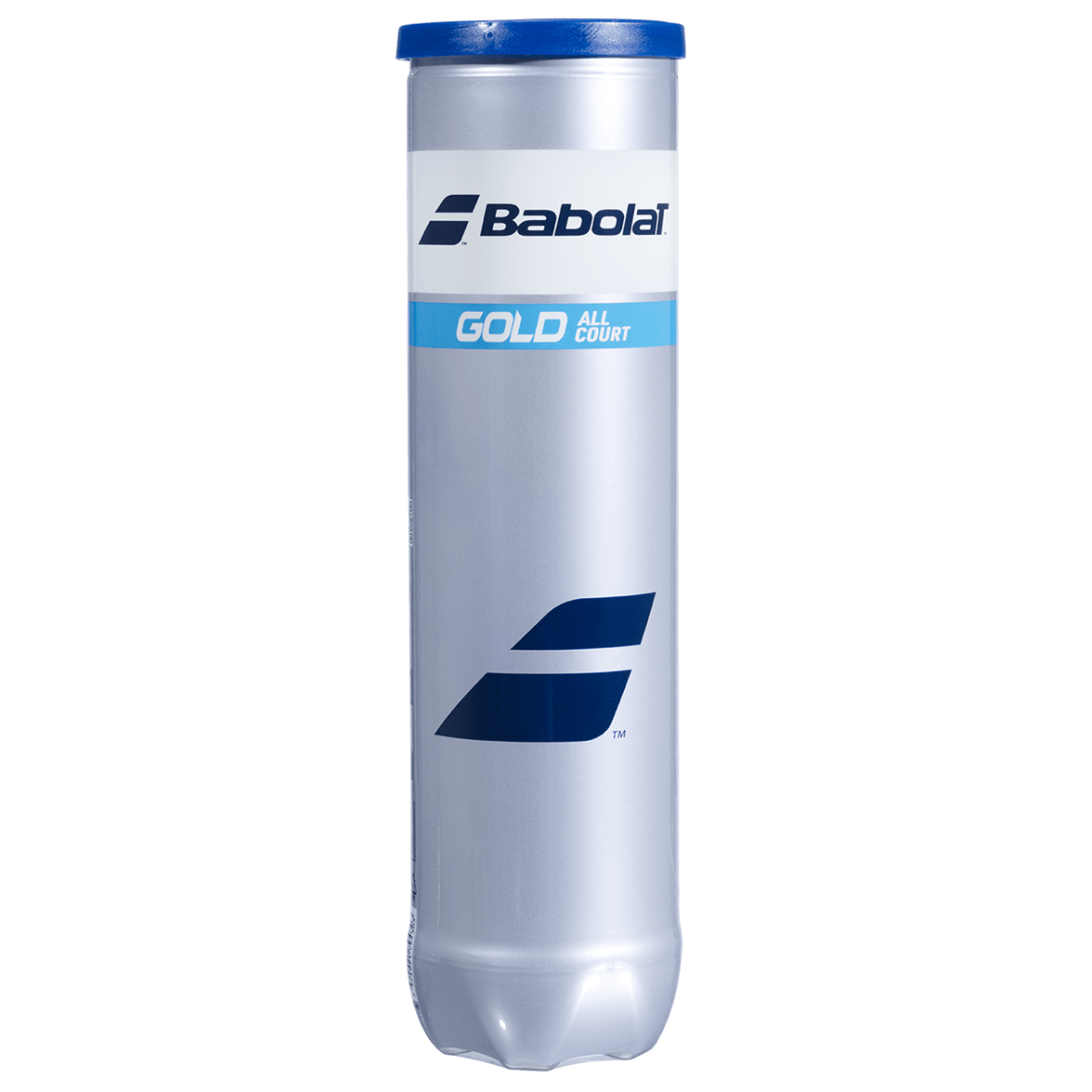
Babolat Gold All Court
The comfortable all-rounder — Babolat’s pressurised all-court ball for the intermediate game.
Babolat positions the Gold All Court with unusual precision: a pressurised ball with a woven felt adapted to play on all courts, a rubber-and-core build Babolat describes as giving comfort at impact, and a target player it names outright — the intermediate looking for playability. That honesty makes it the easiest alternative recommendation in this guide. It is not pretending to be a Slam ball; it is a well-specified all-surface ball for the club player whose tennis is mixed-surface, mixed-level and played for the love of the rally.
The formalities are in order — Babolat states ITF/USTA homologation for the Gold All Court, and it sells in x3 and x4 packs. Where does it sit against the Fort, the other all-court pick here? The Fort is Dunlop’s tournament-level entry; the Gold is the comfort-leaning intermediate ball, and the choice is the level of your game rather than the quality of the ball. Players building a full Babolat setup alongside the rackets in our rackets guide will find it the natural match; everyone else should choose by the session split in the buying guide below.
What we like
- Babolat states the brief plainly: all courts, intermediate playability, comfort at impact
- ITF/USTA homologation stated by the manufacturer
- Woven felt adapted for all surfaces
- x3 and x4 pack options
Worth knowing
- Positioned for intermediate play — advanced hitters have the tournament tier above
- Pressurised arc applies: fresh packs play best
As an Amazon Associate we earn from qualifying purchases.
Side-by-Side Comparison Table
| Ball | Best For | Construction | Felt | Approval (as stated) | Pack |
|---|---|---|---|---|---|
| Wilson US Open Extra Duty | Tournament / match play | Pressurised can | Premium woven, extra duty | USTA + ITF (Wilson) | 3-ball can |
| Dunlop Fort All Court TS | All-court premium | Pressurised | Woven | Not stated on Dunlop’s current page | 3, 4, 2×4 |
| Penn Tour Extra Duty | Premium match alternative | Pressurised can | LongPlay + Smart Optik | USTA + ITF (Penn) | 3-ball can |
| Wilson Triniti | Longer life | Engage Core — no pressurised can | STR Felt | Not claimed (sources conflict) | 4-ball sleeve |
| Penn Championship Extra Duty | Value match ball | Pressurised | Extra duty, interlocked wool fibre | USTA + ITF (Penn) | 3-ball cans, multi-packs |
| Dunlop Training | Training / ball machines | Pressureless (Dunlop) | Needle felt | Not stated | 72-ball box |
| Babolat Gold All Court | All-surface alternative | Pressurised (Babolat) | Woven, all-court | ITF / USTA (Babolat) | x3, x4 |
Buying Guide: Approval, Rotation and Knowing When a Ball Is Dead
1. Buy by session, not by habit
Split your buying the way you split your week. Match play and league fixtures: pressurised cans — the Wilson, the Penn Tour or the Penn Championship depending on tier. Multi-surface seasons: the Fort or the Babolat Gold. High-volume drilling and ball-machine work: the Dunlop Training box. The single most common ball-buying mistake is using one ball for all three jobs — match cans wasted on drills, or tired practice balls smuggled into matches. The second most common is the reverse snobbery of feeding drills with pressureless balls and then wondering why match day feels strangely lively. It is supposed to.
2. What “ITF approved” actually means
A ball carrying ITF approval has been tested against the specifications in the Laws of Tennis — size, weight, bounce and deformation windows — and is legal for sanctioned competition; USTA approval is the American equivalent. Where a maker states approval, this guide says so with attribution (Wilson, Penn and Babolat do, for the balls carded). Where a maker’s own page does not state it — the current Dunlop Fort page, the Dunlop Training — the guide says that instead, and where sources conflict, as with Triniti, it claims nothing. For club play approval rarely matters; for sanctioned matches, take a ball whose approval is stated and current.
3. Rotation: the two-can system
Pressurised balls begin losing pressure the moment the seal breaks, whether or not they are hit — an opened can left in a bag is dying on the shelf. Work a two-can system: a fresh can reserved for matches, and last match’s can demoted to practice, where its remaining life is honestly spent. Mark the demotion (a dot of marker on the felt is the classic) so tired balls never drift back into a match by accident. Players who open a can for every session and finish it across three weekends are playing the third weekend with a different, worse ball than the first — the two-can system is the whole fix.
4. Knowing when a ball is dead
No maker in this guide publishes a session count, and any guide that gives you one is inventing it. Judge by evidence instead: a pressurised ball is done when the bounce no longer matches a fresh ball dropped beside it, when the felt has worn bald or fluffy enough to change flight, and when the ball feels soft and unresponsive off the strings. Pressureless balls die differently — the felt goes first while the core keeps bouncing — and a basket of them should be retired when the nap is gone and the balls start skidding rather than gripping. Either way, balls are a consumable: budget them like string, not like rackets.
5. Felt, altitude and the fine print
Three smaller decisions close the guide. Felt: extra duty for hard courts, regular duty for clay and indoor — the makers organise their variants this way for a reason. Altitude: if you play regularly above roughly 3,000 feet, Wilson and Penn both sell high-altitude variants of their match balls, built so the thinner air does not turn every rally into a home-run contest. Storage: unopened cans keep their pressure for a long time in a cool bag; opened cans and loose balls do not — one more argument for buying the pack size you will actually rotate through.
Frequently Asked Questions
What is the difference between pressurised and pressureless tennis balls?
A pressurised ball is a hollow core filled with gas above atmospheric pressure and sealed in a can; the gas drives its bounce and liveliness, and it escapes gradually once the can opens, so the ball softens over time. A pressureless ball takes its bounce from a thicker rubber core instead of gas, so there is nothing to leak: it plays firmer from day one and keeps that feel far longer, which is why coaches and ball machines run on them. Matches belong to pressurised balls; high-volume practice belongs to pressureless.
Extra duty or regular duty — which felt should I buy?
Match the felt to your surface. Extra-duty felt is a denser weave built to survive abrasive hard courts. Regular-duty felt is softer and thinner, made for clay and indoor courts where a heavy cover would pick up grit and wear unevenly. Wilson states the split for its US Open ball — Extra Duty for hard courts, Regular Duty for clay and indoor — and the other makers organise their ranges the same way.
How long do pressurised tennis balls last?
Manufacturers do not publish a session count, and honest guides should not invent one. What is certain is the mechanism: pressure escapes from the moment the can opens, hit or not, so a ball’s peak is early and its decline is continuous. Serious players open a fresh can for matches and rotate the previous can into practice; a ball is finished when its bounce no longer matches a fresh ball and the felt is worn. If longevity is your priority, Wilson’s Triniti is the engineered exception — Wilson claims its core keeps a fresher feel four times longer than a standard core.
Are pressureless balls good enough for matches?
They are not built for it. Dunlop describes its Training ball as designed for coaching and intensive practice, and pressureless balls play firmer and deader than match balls by design. For casual hitting they are entirely usable; for league or sanctioned play, use a pressurised ball whose maker states ITF or USTA approval — the Wilson US Open, Penn Tour, Penn Championship and Babolat Gold in this guide all carry stated approvals.
Which ball is used at the US Open?
Wilson’s US Open ball — Wilson states it is the tournament’s official ball and that every US Open point for more than forty years has been played with it. The Extra Duty version carded here is the hard-court specification, which is what the tournament’s courts call for.
Can I use the same balls on clay and hard courts?
You can, with a compromise either way. All-court balls like the Dunlop Fort All Court TS and Babolat Gold All Court are specified by their makers for every surface and are the honest one-ball answer. Surface-specific balls are the refined answer: extra-duty felt lasts on hard courts, regular-duty felt plays properly on clay. What you should not do is expect a hard-court extra-duty ball to feel right through a clay season, or a soft regular-duty ball to survive hard courts for long.
What makes Wilson Triniti different from other balls?
The construction. Instead of a hollow core kept lively by can pressure, Triniti integrates a plastomer material — Wilson’s Engage Core — into the core itself, paired with STR Felt that Wilson states is 50% more flexible than standard felt. That is why it ships in a recyclable octagonal sleeve rather than a pressurised can, and why Wilson claims it holds a fresher feel four times longer than a standard core. It is best understood as its own category between match balls and pressureless trainers.
The Verdict
Decide by pressure and the rest is taste. For matches, the Wilson US Open Extra Duty is the standard — the tournament’s own ball, in the correct hard-court build — with the Penn Tour Extra Duty as its premium rival and the Penn Championship Extra Duty as the value can that still carries stated approvals. The Dunlop Fort All Court TS covers every surface at tournament level, the Babolat Gold All Court covers them at club level, the Wilson Triniti is the longer-life answer for players tired of the can cycle, and the Dunlop Training box is where practice volume belongs. Stock two categories — match cans and a practice supply — and you will never play a fixture with a dead ball or waste a fresh can on drills again.
Affiliate disclosure: AliShuttler is reader-supported. When you buy through links on this page we may earn an Amazon commission at no extra cost to you. Product details are taken from manufacturers’ published product information as verified at the time of writing; where a claim is a manufacturer’s own (for example Wilson’s Triniti longevity figure or Penn’s visibility and best-seller claims) it is attributed in the text. Manufacturers revise products and packaging, so confirm the exact specification — and the duty variant — before ordering.