Buying badminton shoes for a child is not buying a smaller adult shoe. Junior ranges stop and start at different sizes in every brand, closures change with age, and most makers publish far less information for kids’ models than for adult ones. This guide sticks to what the manufacturers actually publish — real junior size ranges, real closures, real specs — across the seven junior court shoes worth a parent’s money.
⚡ TL;DR — The Short Answer
For a child playing club or school badminton in a proper junior badminton shoe, start with the Yonex Power Cushion 65 Junior — the junior version of Yonex’s all-round court line, published in sizes from 18.0 to 25.0 cm. The Yonex Aerus Junior is the lightweight-design pick from the same range. For younger children who cannot yet tie laces reliably on court, the Yonex Strider Flow Junior (Belt) fastens with a velcro strap; its lace sibling, the Strider Flow Junior (Lace), is the first-pair pick for older juniors. On a school-hall budget, the ASICS Upcourt 6 GS and Mizuno Cyclone Speed 4 JR are honest junior indoor-court shoes (both labelled as such below), and the Victor A362JR is the support-leaning option where Victor retailers stock it.
Quick Picks — Best Badminton Shoes for Kids at a Glance
The dedicated junior badminton shoe: Power Cushion, sizes 18.0–25.0 cm from Yonex itself.
The junior Aerus — Yonex’s lightweight family, with Durable Skin Light construction.
A velcro belt instead of laces, in the smallest junior sizes (US 1–3).
Yonex’s entry junior model with laces, sized US 1–7 for growing players.
ASICS’ published kids indoor-court shoe — lightweight, flexible, widely stocked.
The only junior shoe here with a maker-published weight (235 g) and size range.
A nylon-sheet midsole build for support — sold through Victor’s regional retailers.
In This Guide
Why Junior Shoes Are Their Own Category
Adult badminton shoes assume an adult game: full-speed lunges, jump smashes, and a foot that has stopped growing. A junior player’s week looks different — school-hall sessions, club coaching, multi-sport PE — and their feet change size on a schedule no adult has to think about. The footwear market reflects that reality unevenly. Yonex publishes a dedicated junior badminton range; ASICS and Mizuno publish junior indoor-court shoes that badminton retailers sell for the sport; Victor and Li-Ning junior models exist mainly through regional retailers, sometimes with incomplete information. A useful guide has to work with that landscape honestly rather than pretend every brand publishes an equivalent junior line — so every card below states where its information comes from, and the buying guide names the gaps (including one famous feature almost nobody states for juniors) instead of papering over them.
One more boundary before the cards: this guide covers junior fit only. Parents buying for themselves should use our adult best badminton shoes guide, and new junior players will get more from our how to play badminton guide than from any shoe on this page — footwear is the second purchase, after the habit.
The Four Things Parents Actually Decide
The sole comes first, because it decides where the shoe is allowed to play. Badminton is played on indoor hall floors, and court shoes use rubber outsoles designed to grip those floors; many school and club halls additionally require non-marking soles. Here is the honest complication this guide will not hide: for junior models, manufacturers rarely state a non-marking claim on their own product pages — none of the maker pages checked for this guide states one — so the buying guide below explains how to confirm it for the exact shoe you are buying. Sizing is the second decision, and it is messier than it should be: Yonex publishes its junior range in centimetres, ASICS in its GS (grade school) scale, Mizuno in US kids’ sizes — the comparison table keeps each maker’s own system rather than inventing conversions.
Closure is the third decision, and it is really about age: a strap a six-year-old can fasten alone beats laces that come undone mid-rally, while an older junior needs the adjustability laces give. This guide cards both, deliberately. Support and cushioning close the list: badminton movement is lateral — lunges, recoveries, changes of direction — so a junior court shoe’s job is a stable base and a grippy rubber sole, with cushioning systems (Yonex’s Power Cushion is the named example here) scaled from the maker’s adult lines. What this guide does not do is make claims about growing feet, development or injury prevention: the manufacturers do not publish such claims for these models, and neither do we.
The 7 Best Badminton Shoes for Kids, Compared
Three dedicated junior badminton lines, two junior indoor-court shoes honestly labelled, one strap-closure model for the youngest players, and one retailer-verified support pick. Read by your child’s size and stage first.
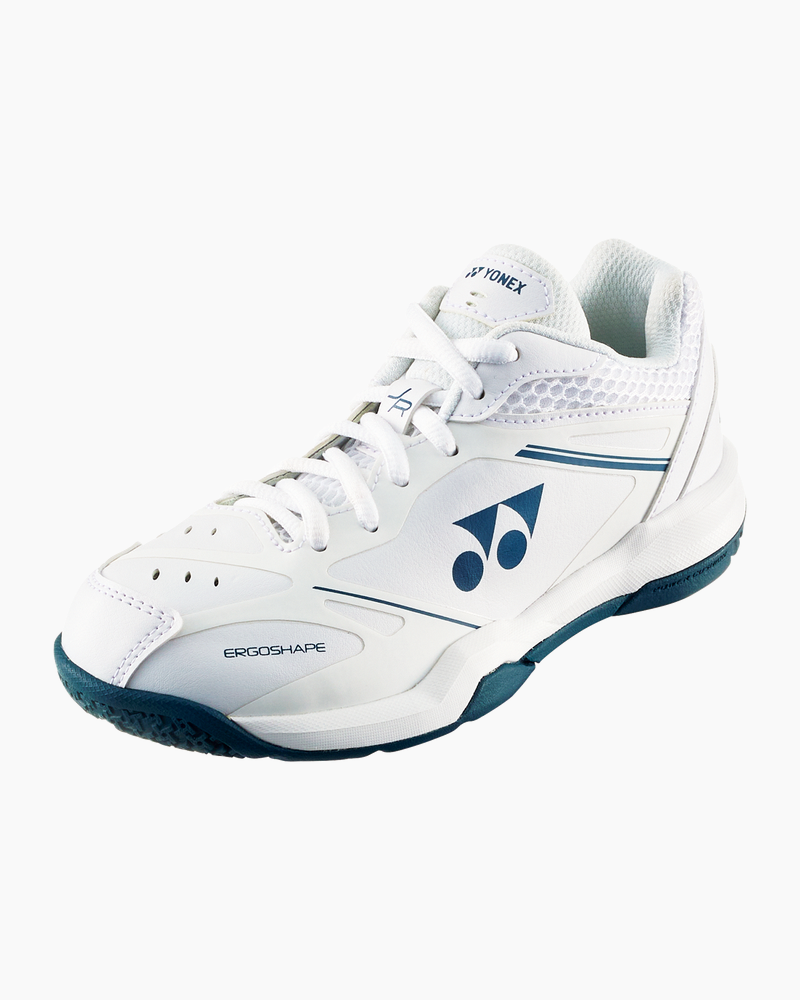
Yonex Power Cushion 65 Junior (SHB65JR4)
The dedicated junior badminton shoe — Yonex’s all-round court line, built and sized for juniors.
The 65 Junior is the safest recommendation in this guide for a simple reason: it is a real junior badminton shoe, published by the sport’s biggest footwear maker in its official junior category, as the junior version of the 65 line adults play in. Yonex builds it with a synthetic leather upper, a synthetic resin midsole carrying its Power Cushion cushioning, Double Raschel Mesh for breathability, and a rubber outsole. Crucially, Yonex publishes the junior size range itself — 18.0, 18.5, 19.0 and 20.0 through 25.0 cm — so a parent can measure a foot in centimetres and order against the maker’s own scale instead of guessing across size systems.
That 25.0 cm ceiling matters as much as the range itself: it is where this guide’s junior story hands over to adult models, and Yonex publishing it plainly is exactly the honesty the rest of the category needs. Two things Yonex does not state for this model on its product page: a non-marking claim and a closure type — the buying guide explains how to handle the first, and the shoe is a conventional lace-up court shoe in its product photography. For a child playing regular club or school badminton who fits the range, this is the default pick.
What we like
- A genuine junior badminton shoe from the maker’s own junior range
- Manufacturer-published size range in centimetres (18.0–25.0 cm)
- Power Cushion and Double Raschel Mesh carried down from the adult 65 line
- The widest junior size span in this guide
Worth knowing
- Yonex does not state a non-marking claim for it — confirm with the retailer if your hall requires one
- Feet beyond 25.0 cm move into adult models
As an Amazon Associate we earn from qualifying purchases.
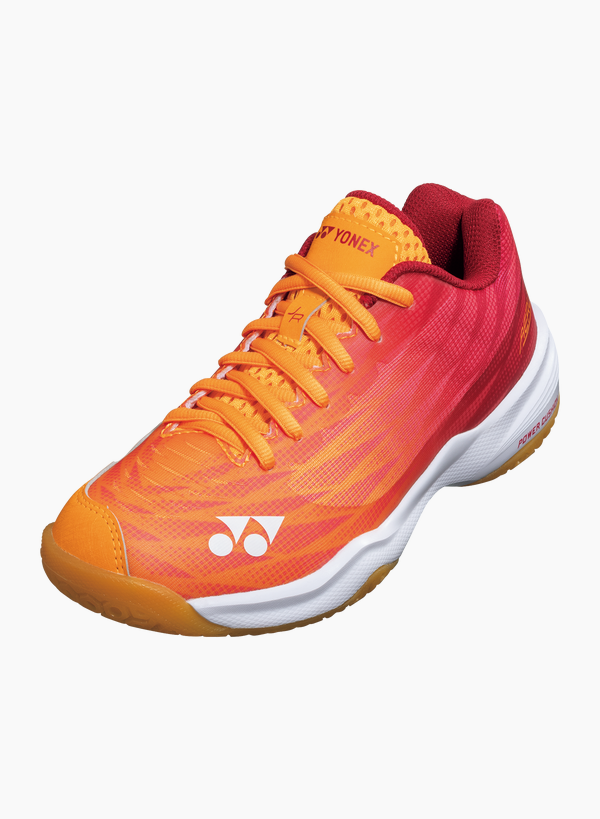
Yonex Power Cushion Aerus Junior (SHBA5JR)
The junior Aerus — Yonex’s lightweight family, scaled down with Durable Skin Light construction.
The Aerus name is Yonex’s lightweight flagship family in adult badminton, and the Aerus Junior brings the same design brief to the junior range: a synthetic fibre upper, Durable Skin Light construction to keep the shoe’s structure with less material, Power Cushion in the midsole and a rubber outsole. For a quick, light-on-their-feet junior player — the child whose game is already about court coverage and fast feet — this is the junior shoe designed around that style rather than around maximum structure.
One piece of honesty defines this card: Yonex publishes no weight for the Aerus Junior, so this guide will not give you a gram figure or claim it out-lightens rivals by a number. The lightweight case rests on the design — the Aerus line’s brief and the Durable Skin Light build — not on a scale. Note also the size ceiling: the junior Aerus runs 18.0 to 22.0 cm, a smaller window than the 65 Junior’s, so bigger juniors should take the 65 Junior above and treat this as the pick for younger, lighter players.
What we like
- The junior version of Yonex’s lightweight flagship family
- Durable Skin Light construction keeps structure with less material
- Power Cushion and Double Raschel Mesh as standard
- Manufacturer-published junior sizing in centimetres
Worth knowing
- No maker-published weight — judge it on design, not numbers
- Size range tops out at 22.0 cm, below the 65 Junior’s ceiling
As an Amazon Associate we earn from qualifying purchases.
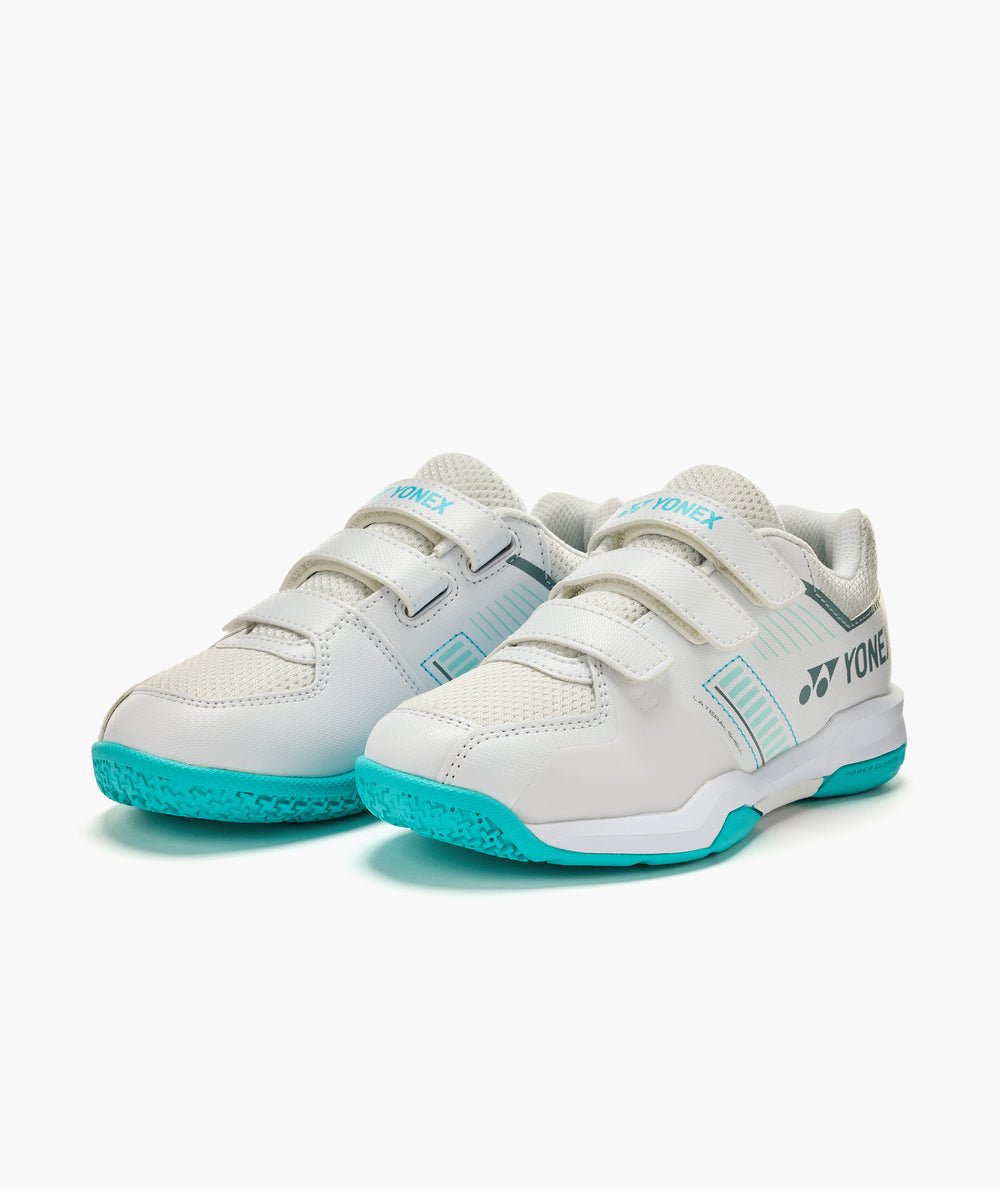
Yonex Power Cushion Strider Flow Junior (Belt)
The strap-closure junior — a velcro belt instead of laces, for players who can’t yet tie them courtside.
Every junior coach knows the real entry-level problem: not talent, but laces — undone at the baseline, re-tied at the net post, undone again by the second game. Yonex’s answer in its junior range is this version of the Strider Flow Junior, which swaps laces for a velcro belt the child can fasten alone, in seconds, between rallies. Yonex US describes it as built for growing casual players, with the belt there to keep the shoe secure through movement; underneath it is the same junior platform as its lace sibling — Power Cushion cushioning, a Lateral Shell, Yonex’s Ergoshape fit and the Radial Blade Sole.
The size run tells you exactly who it is for: US sizes 1 to 3 only — the youngest, smallest end of the junior game. One buying trap is flagged plainly by the listings themselves: Yonex US uses the same model number (SHBSF1J) for both the Belt and Lace versions, so check the word “Belt” in the product title before ordering, or the strap shoe you wanted arrives with laces. When a child outgrows the strap stage, the lace version below is the same shoe family one step up.
What we like
- Velcro belt closure a young child can fasten independently
- Built on the same Power Cushion junior platform as the lace version
- Sized for the youngest players (US 1–3)
- Lateral Shell and Ergoshape carry over from the junior line
Worth knowing
- Shares its model number with the lace version — check the title says “Belt”
- The 1–3 size run is outgrown quickly by design
As an Amazon Associate we earn from qualifying purchases.
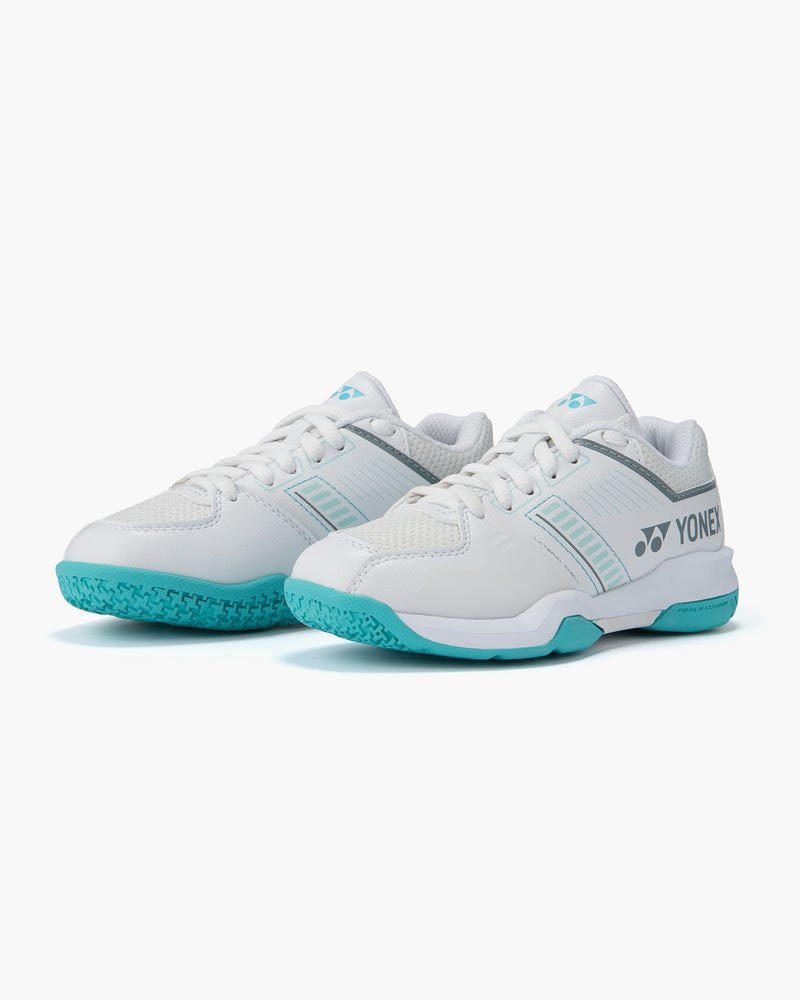
Yonex Power Cushion Strider Flow Junior (Lace)
The first proper pair — Yonex’s entry junior model, laced, in sizes that run to the top of the junior game.
If the Belt version is for the youngest starters, the lace-up Strider Flow Junior is the first-pair workhorse for everyone else: Yonex’s entry model in its junior badminton range, sold in US sizes 1 through 7 — the full span of junior sizes on the US scale — with a synthetic leather upper, a rubber sole built as a one-piece outsole, and a tech list (Power Cushion, Ergoshape, Lateral Shell, Round Sole, Radial Blade Sole) that is the junior line’s shared toolkit rather than a stripped-down toy version of it. Yonex’s global listing also carries a 3E fit designation for the model, worth knowing for juniors whose feet run wide.
Choose between this and the 65 Junior at the top of the guide by seriousness and budget tier rather than by quality: the Strider Flow Junior is Yonex’s all-round entry point for casual and developing players, the 65 Junior is the competition-leaning line. Either way, the child is in a shoe actually designed and sized for junior badminton — which, as the rest of this guide shows, is a shorter list than parents expect. Laces also make this the natural graduation from the Belt version: same family, same fit language, one less thing to outgrow emotionally.
What we like
- The widest US junior size span here (1–7) in a dedicated badminton shoe
- Full junior tech list — not a stripped-down toy version
- Synthetic leather upper and one-piece rubber outsole
- The natural step up from the Belt version in the same family
Worth knowing
- Yonex’s global page publishes no size field for it — US sizes come from Yonex US
- Competition-serious juniors should compare the 65 Junior
As an Amazon Associate we earn from qualifying purchases.
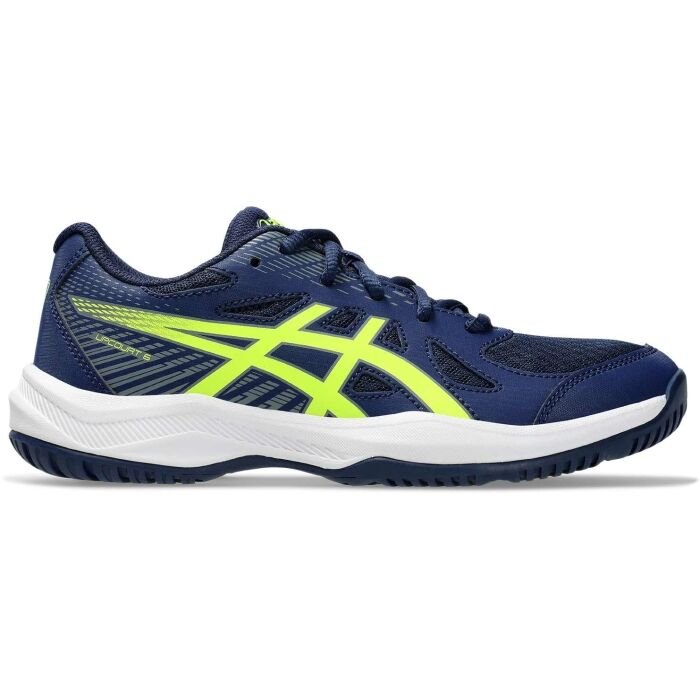
ASICS Upcourt 6 GS
The multi-sport hall shoe — ASICS’ published kids indoor model, and the pragmatic school-sport pick.
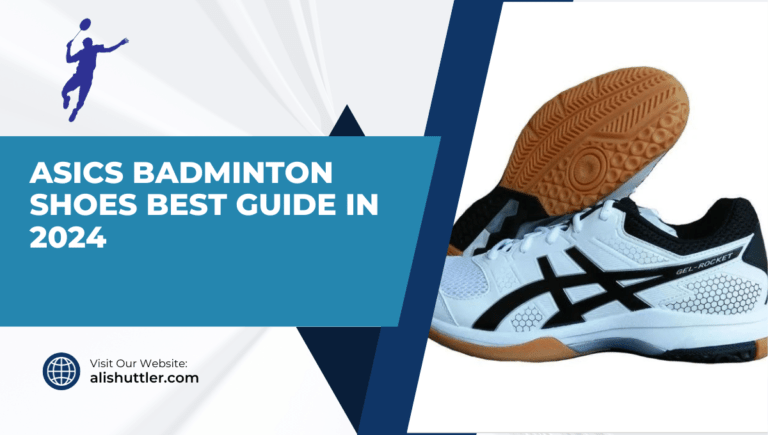
Start with the label, because this guide keeps its labels honest: ASICS publishes the Upcourt 6 GS as a kids’ indoor-court shoe — it sits in ASICS’ kids indoor and youth court categories — not as a badminton-specific model. Badminton retailers sell it for badminton (alongside squash, handball and volleyball) because the brief overlaps: a lightweight, flexible shoe with broad mesh paneling, an EVA midsole and a rubber outsole, in a grade-school size run that ASICS Singapore lists from K12H to 7. For the child whose week is PE, school hall sport and one badminton club night, that overlap is not a compromise — it is the correct shoe, bought once.
Two verification notes, stated the way parents deserve. Retailers list a non-marking outsole for this model; ASICS’ own product pages do not make that claim, so if your hall enforces non-marking soles, confirm the exact listing’s wording before buying. And ASICS publishes no weight for the GS — ignore marketplace “package weight” figures, which are the box, not the shoe. Within those honest limits, the Upcourt 6 GS is the most widely stocked, easiest-to-find junior court shoe in this guide, and for school-hall badminton it is the sensible default.
What we like
- A published kids model from a major maker — not an adult shoe in small sizes
- Lightweight, flexible design with broad mesh paneling (ASICS’ description)
- One shoe honestly covers school hall sport and club badminton
- Widely stocked in a full grade-school size run
Worth knowing
- An indoor-court shoe, not badminton-specific — dedicated players should take a Yonex junior
- Non-marking is a retailer claim for it, not an ASICS claim — verify per listing
As an Amazon Associate we earn from qualifying purchases.
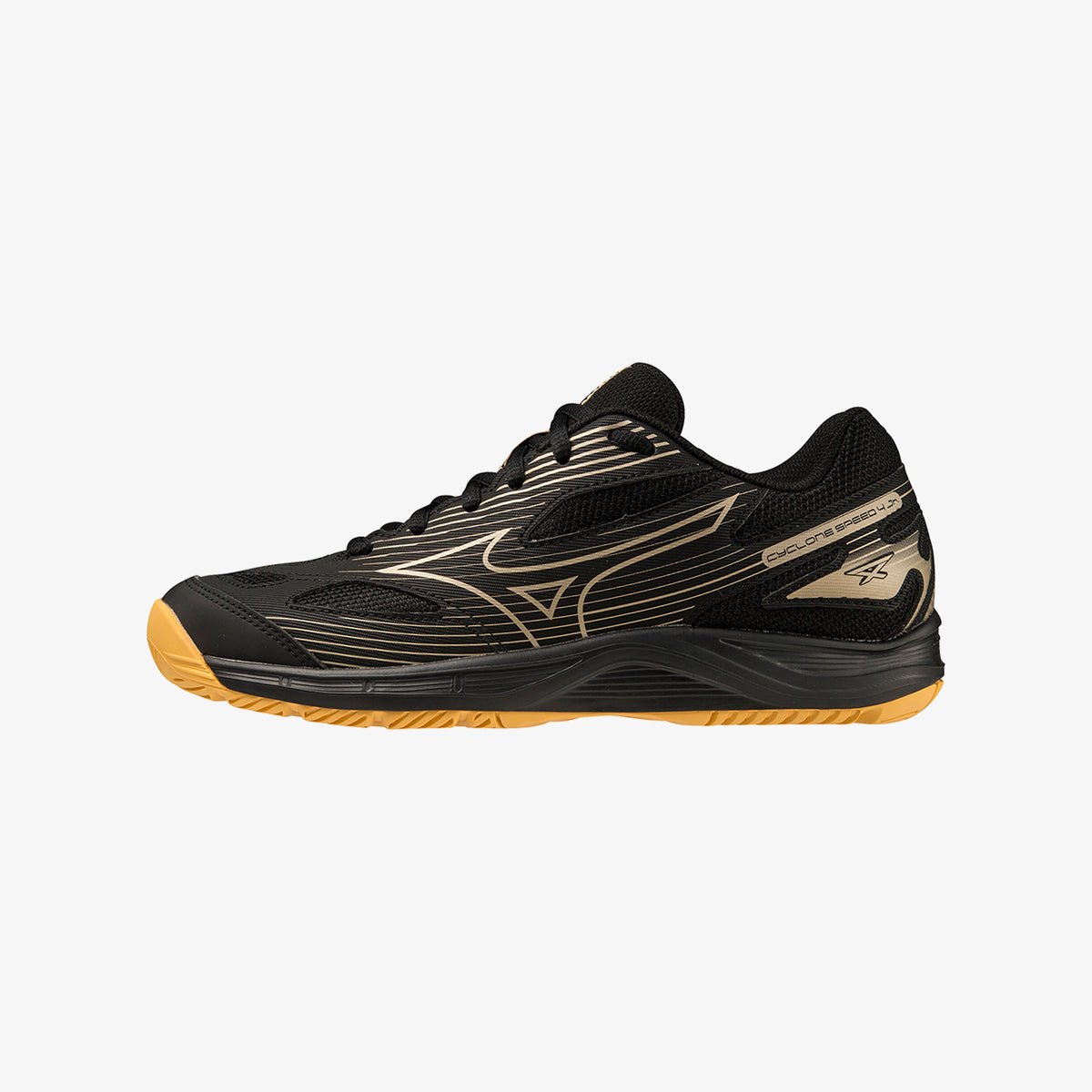
Mizuno Cyclone Speed 4 JR
The transparent one — the only junior shoe here whose maker publishes both its size range and its weight.
Mizuno describes the Cyclone Speed 4 JR as its junior all-rounder for indoor court sports — again, the honest label: Mizuno publishes junior indoor shoes, and does not publish a junior model as a badminton shoe; its kids’ badminton categories route to adult models. What earns this shoe its card anyway is Mizuno doing what almost no other maker in this guide does: publishing the numbers. Its Australian listing states the size range (US kids 2–7, full sizes) and a weight of 235 g — the only manufacturer-published junior shoe weight in this entire guide — alongside an XG Rubber outsole, an Air Mesh upper and a PoWnCe midsole.
For parents comparison-shopping across brands, that transparency is genuinely useful: 235 g gives the category a reference point the Yonex cards above cannot offer, and the published range makes sizing a lookup instead of a lottery. A Cyclone Speed 5 JR now exists in Mizuno’s range, but its full specification could not be verified at the time of writing, so this guide cards the 4 JR whose facts are published. If your child plays several indoor sports and badminton is one of them, this and the ASICS above are the two honest routes — pick on fit and local stock.
What we like
- Maker-published weight (235 g) — the only one in this guide
- Maker-published junior size range (US kids 2–7)
- XG Rubber outsole and Air Mesh upper, plainly specified
- A true multi-sport junior court shoe for mixed weeks
Worth knowing
- Published as an indoor-court shoe, not a badminton shoe
- A 5 JR successor exists, but its specs were not verifiable at build time
As an Amazon Associate we earn from qualifying purchases.
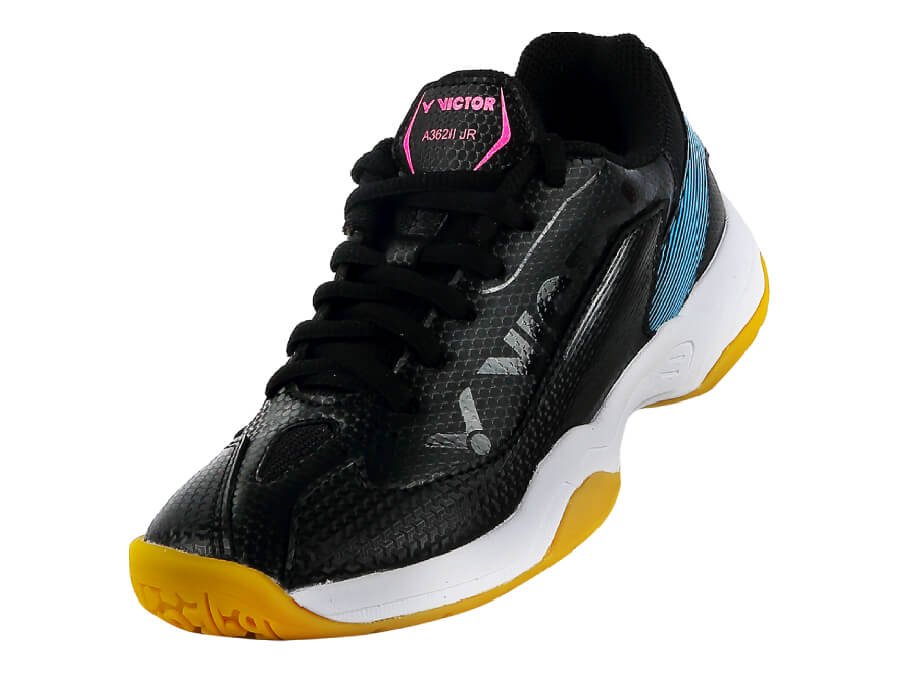
Victor A362JR
The support build — a nylon-sheet midsole under a junior frame, for players whose game is getting physical.
This card carries a sourcing label the others do not need: Victor does not publish a junior shoe range on its own global websites, so the A362JR is verified through the specialist badminton retailers who stock it — and this guide uses one consistent retailer specification rather than blending several. That specification describes a support-leaning build: an EVA midsole with Victor’s ENERGYMAX cushioning and a nylon sheet for structure, a PU leather and mesh upper, a rubber outsole, and Victor’s U-Shape 2.5 fit. Retailers list the junior size run at roughly US 1.5 to 4.5, though listed stock at the top and bottom of that run varies by store.
Why card it at all, given the sourcing? Because Victor is a first-rank badminton brand whose junior shoe is genuinely sold and played in across its Asian and specialist retail network, and the support construction — that nylon sheet in the midsole — is a real point of difference for an older junior whose game is getting faster and more physical. Buy it with the verification habit this guide keeps recommending: check the size run and the spec table on the exact retailer’s listing in front of you, because Victor’s junior information lives there, not on the brand’s own site.
What we like
- Nylon-sheet midsole construction is a genuine support feature at junior level
- ENERGYMAX cushioning from Victor’s adult technology set
- PU leather + mesh upper and rubber outsole, plainly specified
- A real Victor option for families in its retail network
Worth knowing
- Victor publishes no junior range on its own sites — specs are retailer-sourced
- Size-run stock varies by retailer; verify the exact listing
As an Amazon Associate we earn from qualifying purchases.
Side-by-Side Comparison Table
| Model | Best For | Type (as published) | Maker’s Size Range | Closure | Outsole |
|---|---|---|---|---|---|
| Yonex Power Cushion 65 Junior | Overall junior | Junior badminton (Yonex) | 18.0–25.0 cm | Not stated by Yonex | Rubber |
| Yonex Power Cushion Aerus Junior | Lightweight design | Junior badminton (Yonex) | 18.0–22.0 cm | Not stated by Yonex | Rubber |
| Yonex Strider Flow Junior (Belt) | Younger kids | Junior badminton (Yonex) | US 1–3 | Velcro belt | Rubber (Radial Blade) |
| Yonex Strider Flow Junior (Lace) | Best first pair | Junior badminton (Yonex) | US 1–7 | Laces | Rubber, one-piece |
| ASICS Upcourt 6 GS | School-hall all-rounder | Kids indoor court (ASICS) | K12H–7 (GS) | Laces (retailer listings) | Rubber |
| Mizuno Cyclone Speed 4 JR | Published specs | Junior indoor court (Mizuno) | US kids 2–7 | Not stated by Mizuno | XG Rubber |
| Victor A362JR | Support | Junior badminton (retailer-verified) | US 1.5–4.5 (retailer listings) | Not stated | Rubber |
Size ranges are shown in each maker’s own system, exactly as published — Yonex in centimetres, ASICS in its GS scale, Mizuno and the US Yonex listings in US kids’ sizes. Measure your child’s foot in centimetres and convert with the brand’s own size chart for the model you are buying.
Buying Guide: Sizing, Soles, Closures and Honest Gaps
1. Size by centimetres, not by age
There is no honest age-to-size chart for children’s shoes, and this guide will not print one: children of the same age routinely differ by several sizes. Measure instead — have the child stand on a sheet of paper in the socks they play in, mark heel to longest toe, and measure in centimetres. Then use the maker’s own range: Yonex’s junior badminton shoes are published directly in centimetres (18.0–25.0 cm across the 65 Junior), which makes them the easiest to size confidently; for ASICS GS and US kids’ sizes, convert with that brand’s chart for the specific model. Leave a small amount of growing room, but buy the size that fits now — a shoe bought two sizes up slides on the foot through every lunge, and a sliding shoe is worse than a short-lived one.
2. The non-marking question — ask it out loud
Most school and club halls require non-marking soles, and parents reasonably assume a court shoe states it. For junior models, it usually does not: none of the manufacturer pages checked for this guide states a non-marking claim for its junior shoe, and where the claim appears (some retailer listings for the ASICS Upcourt 6 GS, for instance) it is the retailer’s wording. The practical routine: check the exact product listing for the words “non-marking”, ask the retailer if they are absent, and prefer the light-coloured gum-rubber style outsoles halls are used to seeing. Do not let a child take outdoor trainers or dark-soled fashion shoes onto a hall floor and hope — that ends with the coach, not the shoe, saying no.
3. Closure follows the child, not the catalogue
For the youngest players, the shoe they can fasten alone wins: the Strider Flow Junior (Belt) exists precisely for that stage, in US sizes 1–3. Laces take over as soon as a child can tie them reliably — they adjust more precisely and they are what every shoe after this stage uses, which is why the lace Strider Flow Junior and the rest of the range are lace-ups. If you are between stages, buy the closure your child can manage at the far end of a tiring session, not the one they manage fresh in the shop.
4. Badminton-specific vs indoor-court: know which you bought
Two cards in this guide — the ASICS Upcourt 6 GS and the Mizuno Cyclone Speed 4 JR — are junior indoor-court shoes rather than badminton-specific models, and they are labelled that way on purpose. For multi-sport school weeks they are the right purchase. For a child specialising in badminton, the dedicated junior badminton shoes (the Yonex range, and Victor’s junior line where stocked) are built around the sport’s lateral movement and are the better long-term route. What not to buy for hall badminton: running shoes and outdoor trainers — their soles are made for roads and straight lines, not polished hall floors and sideways lunges.
5. The gaps, named: Victor, Li-Ning and weights
Three facts parents deserve plainly. Victor publishes no junior shoe range on its own websites — its junior models, like the A362JR carded here, are specified and sold by regional retailers, so verify the exact listing. Li-Ning sells junior badminton models (the Saga 3 JR and Thunder JR) through regional retailers too, but no source for them publishes a junior size range, weight or closure, so this guide does not card them — a shoe you cannot size from published information is not a recommendation. And almost nobody publishes a junior shoe weight: Mizuno’s 235 g for the Cyclone Speed 4 JR is the only maker-published figure in this guide. Where a number is missing, judge on design and fit, and distrust any page that fills the gap with a guess. When the shoes are sorted, the rest of the junior kit lives in our best badminton bags guide.
Frequently Asked Questions
What shoes do kids need for badminton?
A court shoe: a rubber outsole made for indoor hall floors, a stable base for lateral movement, and a fit that holds the foot through lunges and recoveries. Dedicated junior badminton shoes (Yonex publishes a full junior range) are the direct answer; junior indoor-court shoes from ASICS and Mizuno are the honest multi-sport alternative. Running shoes and outdoor trainers are the wrong tool — their soles are built for roads and straight lines, not hall floors and sideways movement.
Do kids’ badminton shoes need non-marking soles?
Most school and club halls require non-marking soles, so treat it as required unless your hall says otherwise. The complication is verification: manufacturers rarely state a non-marking claim for junior models — none of the maker pages checked for this guide states one — so check the exact retailer listing for the wording, and ask the retailer if it is absent, before the first session.
How do I choose the right size in kids’ badminton shoes?
Measure the foot in centimetres — standing, in playing socks, heel to longest toe — and order against the maker’s own published range. Yonex makes this easiest: its junior badminton shoes are listed in centimetres (the 65 Junior runs 18.0–25.0 cm). For US kids’ or ASICS GS sizes, convert with that brand’s size chart for the model. Avoid age-based sizing charts; children of the same age differ by several sizes.
Velcro or laces for a young badminton player?
The closure the child can fasten alone, reliably, at the end of a tiring session. For the youngest players that is a strap — Yonex’s Strider Flow Junior (Belt) uses a velcro belt in US sizes 1–3. Laces give a more precise fit and are the standard from the lace Strider Flow Junior upward. Buy for the stage your child is in now, not the one they will reach mid-season.
Can kids just wear adult badminton shoes in small sizes?
Sometimes they have to — every junior range has a ceiling (Yonex’s 65 Junior stops at 25.0 cm; Mizuno’s junior range at US kids 7), and beyond it adult models are the only option. Inside the junior ranges, though, a published junior model is the better buy: it is sized, priced and built for that stage. The mistake is the reverse — putting a young child in a cut-down adult shoe when a genuine junior model exists in their size.
Are indoor court shoes good enough for badminton?
For school sport and starting club players, yes — that is exactly the role of the ASICS Upcourt 6 GS and Mizuno Cyclone Speed 4 JR in this guide, and both are labelled as indoor-court shoes rather than badminton models. As a child specialises and plays more badminton per week, a dedicated junior badminton shoe — built around the sport’s lateral lunging — becomes the better purchase.
How often do kids’ badminton shoes need replacing?
On fit first: when the toes reach the end of the shoe, the shoe is done, whatever the sole looks like — junior feet set the replacement schedule, not wear. After fit, judge the outsole: a rubber sole worn smooth loses its grip on hall floors and should be retired. There is no honest fixed interval, because growth and hours vary too much between children for one to exist.
The Verdict
Buy the shoe that matches the child’s size, stage and hall — in that order. The Yonex Power Cushion 65 Junior is the default for real junior badminton, with a maker-published 18.0–25.0 cm range; the Aerus Junior is its lightweight sibling for smaller players. The youngest starters belong in the Strider Flow Junior (Belt), and everyone else starting out in the Strider Flow Junior (Lace). For mixed school-sport weeks, the ASICS Upcourt 6 GS and Mizuno Cyclone Speed 4 JR are honest junior indoor-court shoes — and the Mizuno is the one shoe here whose maker publishes its weight. The Victor A362JR is the support pick where Victor’s retailers stock it. Measure in centimetres, ask the non-marking question out loud, and every pick on this page will do its job.
Affiliate disclosure: AliShuttler is reader-supported. When you buy through links on this page we may earn an Amazon commission at no extra cost to you. Specifications and size ranges are taken from manufacturers’ published product information as verified at the time of writing; where a model’s information comes from specialist retailers rather than the manufacturer (the Victor A362JR), the card says so. Manufacturers revise models and size runs, so confirm the exact specification on the product page before ordering.