Everything a first-time player actually needs: how to hold the racket, where to stand, the shots that carry your first year, how a rally flows from the low serve to the winning point, and how rally scoring to 21 works — the game explained at the depth a beginner needs, with the clause-level detail linked to the guides that own it.
Badminton looks gentle from the doorway of a sports hall: a net lower than a tennis net’s reputation suggests, a feathered shuttle that flutters rather than flies, rallies played at conversational distance. Then you step on court and discover the game’s real shape — the shuttle must be served diagonally and struck from below a fixed height line, every single rally puts a point on somebody’s score whether they served or not, the court you defend in singles is a different size from the court you serve into in doubles, and the feather-light projectile in your hand can be struck harder, relative to its weight, than almost anything else in sport. None of it is complicated. All of it is specific. This page teaches the specifics in the order you will meet them on court.
Think of this guide as the front door of the sport. It covers the grip, the ready position, the starter shots, the flow of a rally and the scoring system at honest beginner depth — enough to play a legal, enjoyable game tonight. Where a topic has a dedicated home on this site, this page says so and links it instead of repeating it: the complete badminton rules for singles own the clause-level singles rulebook, the badminton rules in doubles own the pairs game, and our gear guides own the buying decisions. Read this page to start playing; read those to start winning the arguments.
One question to settle before the first serve, because it changes everything about your first month: badminton is not a garden game played indoors. The shuttlecock’s design — a skirt of feathers or nylon that creates enormous drag — means it decelerates faster than any ball in racket sport, rewards timing and touch over raw arm strength, and punishes the casual tennis swing you may be bringing with you. Leave the big swings in the cloakroom. The shots below are compact, wrist-led and precise, and they start, as everything in this sport starts, with how you hold the racket.
The whole game on one card
Badminton is played on a 13.40 × 6.10 metre court split by a net 1.55 metres high at the posts, with a shuttle of 16 feathers set in a cork base. Every rally starts with a serve: struck diagonally into the opposite service court, with the whole shuttle below 1.15 metres as the racket hits it. After the serve, each shot must cross the net and land inside the opponent’s court — in for singles means the narrower, longer court; the wider lines belong to doubles. The rally ends when the shuttle lands in, lands out, is faulted, or a player touches the net. Every rally scores a point for its winner, server or receiver. A game is won by the first side to 21 points (two clear at 20-all, capped at 30), and a match is the best of three games. That is badminton. Everything below is the detail that makes those sentences work on a real court.
Land it in their court
There is no second bounce and no let-off: the shuttle is in, out, or a fault the moment it lands or is touched. Every rally is worth a point to whoever wins it.
Shake hands, then use your thumb
Start with the basic handshake grip for forehands and clears; roll the thumb flat onto the bevel for backhands. Two grips, changed in a fraction of a second, cover the whole game.
Low, diagonal, below the line
The serve must land in the diagonal service court and the whole shuttle must be below 1.15 m when struck. The low backhand serve is the beginner’s default for a reason.
Twenty-one, best of three
First to 21 wins the game, two clear at 20-all, and at 29-all the next point wins it outright. Win two games and the match is yours.
In this guide
Badminton in 30 seconds
Strip the sport down and it is a duel of placement conducted at speed. The server starts each rally by striking the shuttle diagonally across the net into a marked service court. From there the players take turns: each shot must pass over the net and land inside the boundary lines of the opponent’s court. The rally continues until somebody fails — drives the shuttle into the net, floats it beyond the back line, lets it drop inside their own court, or breaks one of the handful of rules that govern a legal shot. The winner of the rally takes the point, and the score climbs towards twenty-one.
Three ideas do most of the work in that paragraph, and nearly every call on a badminton court comes back to them:
Notice what the game does not restrict once a rally is running: how hard you strike, how steeply you angle the shuttle down, whether you play from the net tape or from a metre behind the back line, or how much deception you build into your shots. That freedom on a court barely thirteen metres long is the sport’s engine. A feathered skirt that bleeds speed in the air means a shot struck flat-out at the rear court can be dropping almost vertically by the time it reaches the net — which is why your first rallies will feel hurried for twenty minutes and then, quite suddenly, start to flow. The sections below build the game in order: the court and equipment, your hand on the racket, your feet on the floor, the anatomy of a rally, the six shots, the scoring, the singles–doubles divide, and a complete first session you can copy.
The court, the net, the shuttle and the racket
You can knock a shuttle around almost anywhere with almost any racket and have a recognisable game — people do, in gardens and school halls, every day. But the sport’s dimensions are fixed by the BWF Laws, and knowing them explains much of how the game is played: why the shots are compact, why a court that looks small from the gallery feels enormous at full stretch, and why the shuttle seems to slow down just as it reaches the net.
The court and the net
The court is a rectangle 13.40 metres long by 6.10 metres wide, marked with lines 40 mm wide that are part of the areas they define — a shuttle landing on a line is in (Law 1). That full rectangle is the doubles court. For singles, a second pair of side lines narrows the playing width to 5.18 metres: the strip between the singles and doubles side lines is out for singles rallies, in for doubles. The net crosses the middle of the court, its top edge 1.55 metres above the floor at the posts and a touch lower, 1.524 metres, at the centre — high enough that a flat drive must be precise, low enough that the net game is played in centimetres. Two service lines complete the geometry every beginner must know: the short service line, 1.98 metres from the net, which a serve must cross; and the doubles long service line, 0.76 metres inside the back boundary, which a doubles serve must not pass. A singles serve, by contrast, runs all the way to the back boundary line — the first clue that singles and doubles are genuinely different games, a theme this guide returns to below.
| Feature | BWF specification | What it means for your game |
|---|---|---|
| Court size | 13.40m × 6.10m (doubles); singles width 5.18m | Long and narrow for one player; wide and shared for two |
| Net height | 1.55m at the posts, 1.524m at the centre | Tape-height shots skim it; a serve or net shot that clips the tape can still be good |
| Short service line | 1.98m from the net | The serve must land beyond it — short serves that die before it are faults |
| Doubles service line | 0.76m inside the back boundary | Doubles service courts are shorter and wider; singles courts longer and narrower |
| Shuttle | 16 feathers in a cork base, 25–28mm across | Huge drag — it starts fast and decelerates faster than any ball |
| Racket | Max 680mm long, 230mm wide | Light, long-levered and wrist-friendly; the swing is a flick, not a heave |
The shuttle
The shuttlecock is the strangest projectile in sport: 16 feathers (goose, traditionally, from one wing only) set into a hemispherical cork base 25 to 28 mm across, covered with white kid leather (Law 2). The open skirt acts as a parachute — the shuttle always rights itself cork-first, decelerates violently, and can be struck from the back of the court to drop almost straight down at the net. Synthetic nylon shuttles, built to mimic that flight, are permitted under the Laws and are the sensible beginner’s choice: they survive mishits, tumbles and racket-frame collisions that would strip a feather shuttle in an evening, and a tube of them costs a fraction of feather prices. Two beginner facts. First, feather and nylon shuttles of the same grade fly at comparable speeds, so nothing about your learning is compromised. Second, the shuttle alone among sporting projectiles cannot be volleyed, bounced or rolled back into play — it lands, and the rally is over, which is why badminton players develop the sharpest first-step reactions in racket sport.
The racket
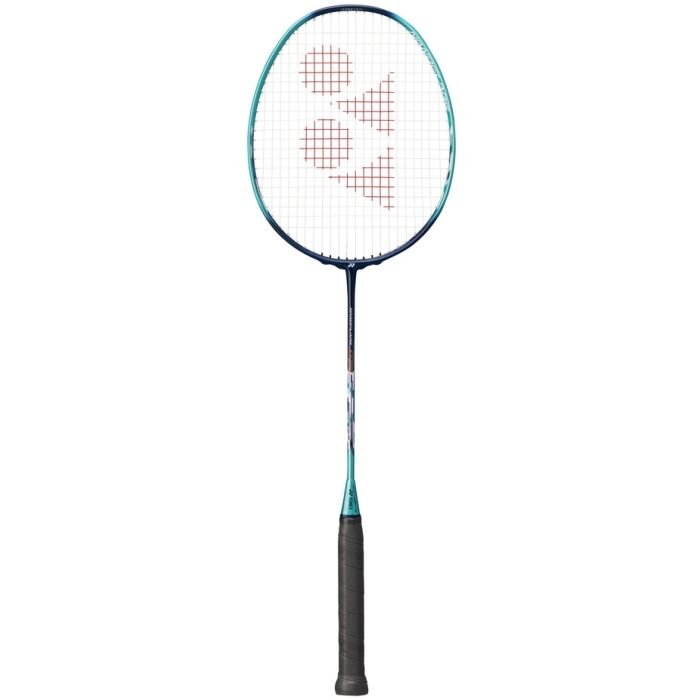
The Laws cap a racket’s frame at 680 mm in overall length and 230 mm in width (Law 4) — a long, light lever built to be moved by the wrist and fingers rather than swung by the shoulder. Beyond the law, a modern racket is a carbon-fibre frame, a shaft of varying stiffness and a bed of strings whose gauge and tension shape how the shuttle leaves it. Those are buying and tuning topics with their own homes on this site. The racket purchase itself — head shape, balance point, shaft flex, what a first racket should cost-conscious beginners actually look for — is owned by our guide to the best badminton rackets for beginners. The strings that fill the frame are owned by our guide to the best badminton strings, and the question of how tight they should be strung — and how to adjust a string bed that feels wrong — belongs entirely to our guide on how to adjust badminton string tension; this page deliberately teaches neither. The one decision that matters for your first sessions is simpler: a proper racket with an intact string bed and a grip that fits your hand, borrowed from a club or bought using the guide above. And one layer below the racket: the shoes. Badminton is a lunging, pivoting, side-to-side sport played on sprung or matted floors, and cushioned running shoes with high, soft heels are built to roll an ankle doing it — our guide to the best badminton shoes explains what court shoes do differently and is worth reading before your first competitive session.
The grip: the handshake and the thumb
Before stance, before shots, your hand goes on the handle — and badminton asks more of its grip than any other racket sport. Because the shuttle is so light, almost all of a shot’s power and all of its delicacy come from the fingers and forearm rather than the shoulder, and that only works if the racket is held so the fingers can move it. Two grips cover the whole game, and this section teaches both at the depth a beginner needs: the shape of each, when it is used, and the errors that ruin them.
The basic (forehand) grip: shake hands with the racket
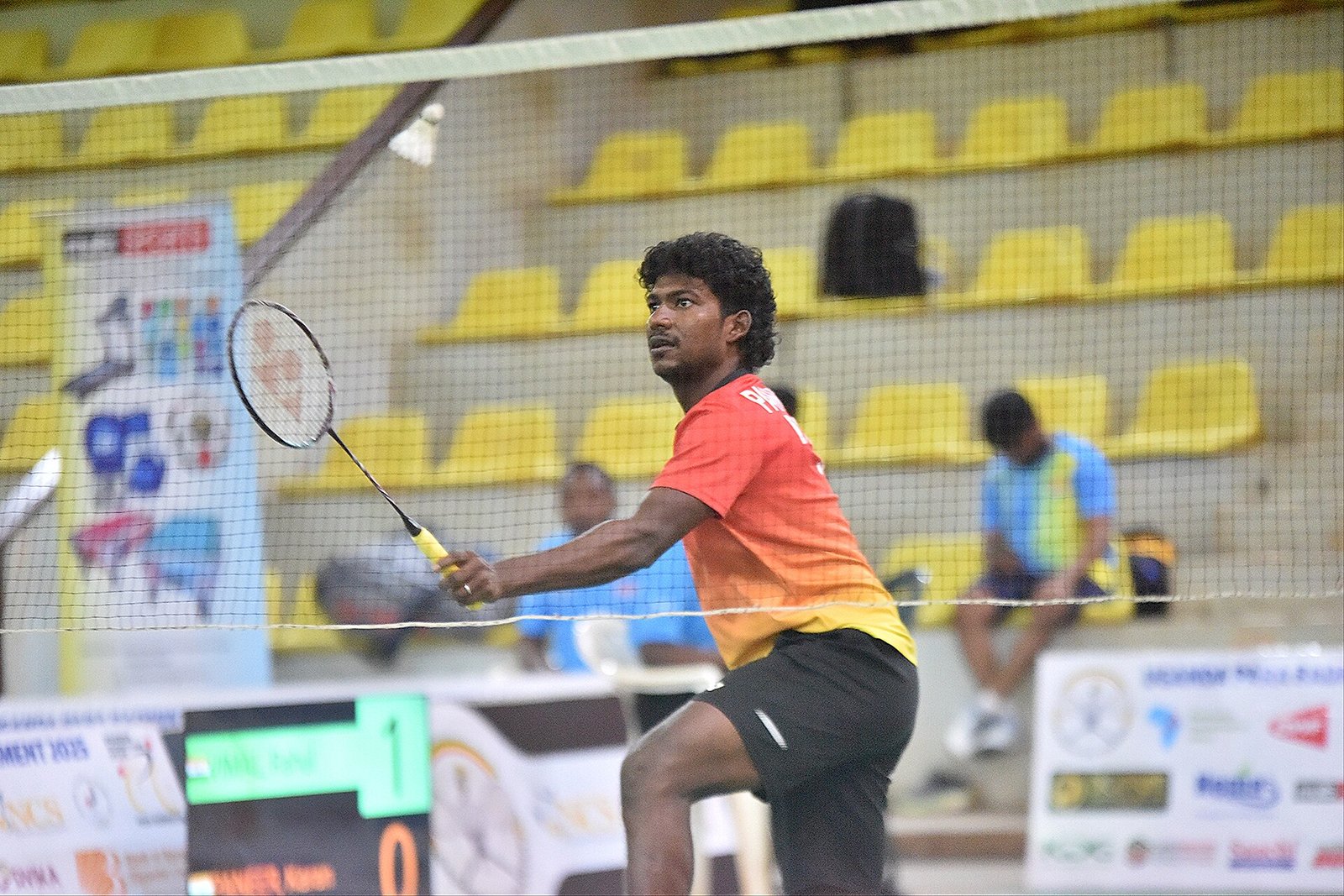
The basic grip — often called the forehand grip — holds the racket exactly as its nickname suggests: as if you were shaking hands with the handle. Hold the racket by its head in your free hand, strings facing sideways (perpendicular to the floor), and take the handle in your playing hand with a relaxed handshake. Done correctly, three things are true at once. Your thumb and index finger form a V along the top edge bevel of the handle — that V is the grip’s compass, and if it sits on the wide top bevel, the racket face points where your forearm points. Your index finger sits slightly higher up the handle than your thumb, hooked like a finger on a trigger, and it is this finger that steers the racket head through forehand swings. And your fingers are loose: the grip is held mainly in the fingers, not crushed in the palm, with a small gap between handle and palm that lets the fingers squeeze — “finger power”, coaches call it — at the moment of contact. That squeeze, timed at impact, is where a small swing produces a full-length clear.
Setting the basic grip
Step 1 — Present the racket sideways. Hold the racket out in your non-playing hand by the shaft, strings vertical, as if offering someone the edge of a book. The handle’s eight bevels are now fixed in space: the wide bevel under where your thumb will rest is the reference face.
Step 2 — Shake hands. Take the handle in your playing hand with an ordinary, relaxed handshake. Your palm meets one wide face of the handle; your fingers wrap the rest. Check the V: thumb and index finger should form a clear V-shape whose point aims up the shaft, the V itself sitting on the top edge bevel between the two wide faces.
Step 3 — Set the trigger finger. Let your index finger ride a little higher than the thumb and crook it slightly, like a finger resting on a trigger. In forehand strokes this finger pushes the racket head through; if it lies flat alongside the others, clears and smashes lose their snap.
Step 4 — Loosen, then learn the squeeze. Open your hand until the racket is held by the fingers alone, snug but not strangled — a white-knuckle grip locks the wrist and forearm and kills every shot in this guide. Practise the rhythm now: relaxed while you wait, a firm squeeze an instant before contact, relaxed again after. That pulsing grip, more than any swing change, is what experienced players mean by “a good hand”.
Two beginner errors to dodge from day one. Holding the racket in a fist, palm wrapped hard against the handle as if gripping a hammer, points the face at the ceiling on forehands and makes the backhand corner unreachable — the handshake, not the hammer, is the model. And gripping too far down the handle, with the little finger hanging off the butt, or too far up, choking the shaft: the butt cap should sit against the heel of your hand, no more, no less.
The thumb (backhand) grip: one roll of the hand
Shots on the backhand side — backhand lifts, drives, net shots, and the backhand serve that will start most of your rallies — are played with the thumb grip. It is not a new hold so much as a rotation of the old one: from the basic grip, roll the racket a quarter-turn in your fingers and lay your thumb flat and straight along the wide bevel that now faces the net, thumb pad pressing on the broad flat surface like pressing a lift button. Your thumb becomes the engine: backhand shots are pushed and flicked by the thumb driving the handle through at contact, with the forearm rotating to help. The remaining fingers stay curled loosely underneath for support.
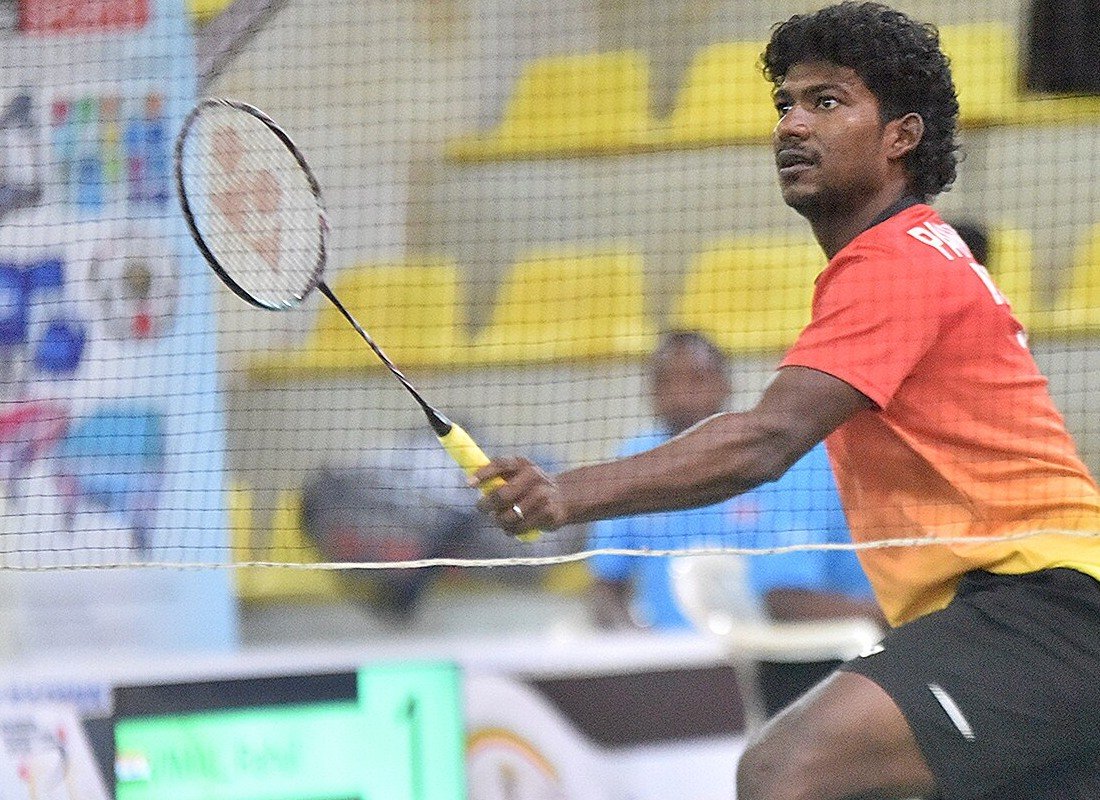
The skill is not holding either grip; it is changing between them in flight, in the fraction of a second while the shuttle travels. Elite players make dozens of these micro-changes per rally, often mid-movement, the racket turning in relaxed fingers. Beginners change grips as a deliberate act — forehand grip waiting for the serve, thumb grip as a backhand approaches — and that is fine: the change becomes automatic with hours on court, and it only ever becomes automatic if the two grips are correct and distinct from the start. What you cannot do is play the whole game from one grip. A beginner who holds the basic grip for a backhand serve will push the shuttle with a bent thumb and a cocked wrist, and spend the rally wondering why the shuttle arrives flat and hittable. Learn the roll now; it is a two-minute investment with a career-long dividend.
The ready position
Watch any competent player between shots and you will see the same photograph: knees soft, weight forward, racket up in front of the chest, eyes on the shuttle. That photograph is the ready position, and it matters because badminton’s court is small enough that a rally is largely won or lost by where you are standing — and facing — when the shuttle is struck. The position itself takes one session to learn:
Feet and legs. In singles you recover, after every shot, to a base position around the centre of the court, a half-step behind the very middle — close enough to reach the net with a lunge, deep enough that a clear to the back line is a turn and two strides rather than a desperate retreat. Feet roughly shoulder-width apart, knees bent, weight on the balls of your feet, heels barely kissing the floor. Most right-handed players angle slightly: racket-side foot a touch forward, body turned a fraction towards the forehand side, which opens both corners to a single first step. Nobody stands upright, square and flat-footed — that is a spectator, not a player.
The racket and free hand. Hold the racket up and in front of your chest, head around shoulder height, in the basic grip — not dangling by your thigh, not parked on your shoulder like a rifle. From this carriage, a forehand is a push forward and a backhand is one roll of the thumb; from a dangling carriage, both require a wind-up you do not have time for. Your free hand floats loosely in front of you for balance and, in doubles, for the small territorial negotiations that format involves.
Recover, every time. The habit that separates players from shuttle-hitters: after every shot, flow back towards base and rebuild the ready position, even — especially — when the rally seems won. Badminton rallies are lost in the two shots after a player admires their own smash. Hit, recover, be ready, then move again. The movement patterns themselves — the lunge, the scissor-kick recovery from the rear court, the cross-step — are a discipline of their own that this front-door guide deliberately keeps at this level: stance here, steps as your game grows.
How a rally flows: serve, receive, rally
Every rally in badminton has the same three-act structure, and learning it means learning which rules apply at which moment — because the serve is governed more tightly than anything that follows it, and the rally itself is governed by one simple definition of a fault.
Act one: the serve
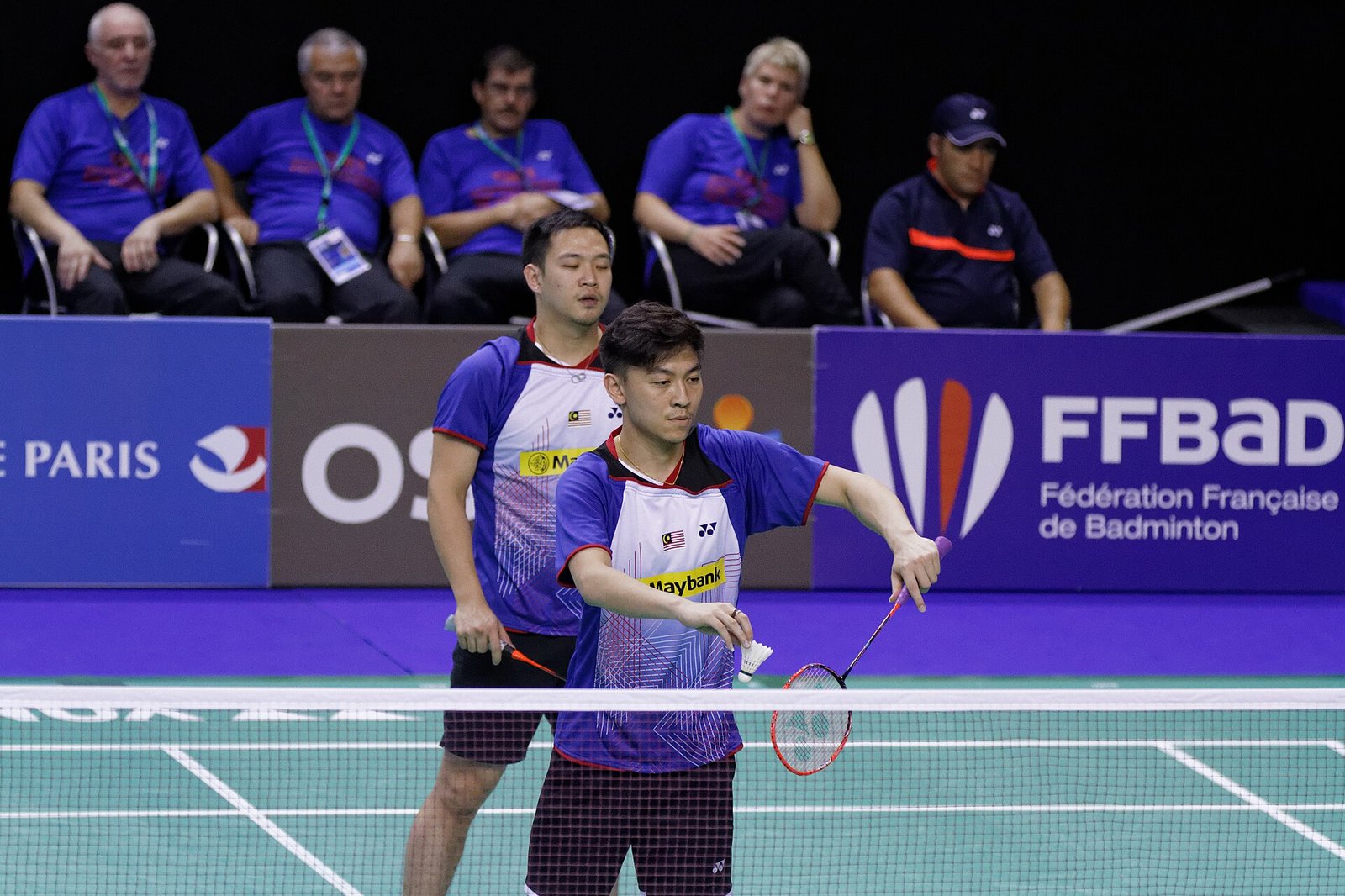
The serve starts every rally and is the most regulated shot in the game. Its legal shape, in the order the Laws give (Law 9): server and receiver stand in diagonally opposite service courts, without touching the boundary lines, some part of both feet staying in stationary contact with the court until the serve is struck. The racket initially hits the base — the cork — of the shuttle, and at the instant of contact the whole shuttle must be below 1.15 metres from the court surface (Law 9.1.6). From there the shuttle must travel upwards, pass over the net, and land inside the receiver’s service court: beyond the short service line, inside the correct side line, and — in doubles only — short of the doubles long service line at the back.
The height law is the one beginners meet first, usually as a called fault. It replaced the older “below the waist” wording at the top level because a tape measure is harder to argue with than a ribcage; in casual club play you will still hear the waist version quoted, and the practical coaching point survives both: a legal serve is struck low, out in front of the body, travelling up and over. Which serve to use is a simpler question than the law makes it sound. The beginner’s default is the low serve — in singles played with a forehand, high and deep as often as short; in doubles almost always the short, flat backhand low serve, struck with the thumb grip, skimming the tape and dropping into the front of the service court. Its attacking sibling, the flick serve — same action, suddenly wristed high and deep — belongs to your second month, not your first session.
Two serve faults to know on day one. Striking the shuttle before it has dropped below the height line — an overhead, tennis-style serve — is illegal at any level of organised play, however satisfying it feels. And a serve that lands in the wrong service court, wide of the side line or short of the short service line is not retaken: it is a fault, the rally is lost, and in rally scoring that is a point given away. Serve law in clause-level detail — the service-court errors, the receiver’s readiness, the lets — is owned by the dedicated rules posts: badminton rules for singles for the one-on-one game and badminton rules in doubles for the pairs format. This page’s summary is the version you need to serve legally tonight.
Act two: the receive
The receiver stands in the other diagonal service court, feet set, and may not move — legally, may not so much as lift a foot from the floor — until the serve is struck. Once it is, the rally begins, and the receiver’s first decision shapes it: a low serve is answered softly, pushed or lifted depending on its quality; a deep singles serve is met from the rear court with the same armoury as any other rally shot. The one receive-specific trap for beginners is the shuttle that clips the net tape on its way over and drops in. On a rally shot, that shuttle is simply in play — apologise for it if it was yours, play it if it was theirs. On the serve it is equally alive provided it lands in the service court: badminton has no tennis-style “let” for a net-cord serve that lands correctly. A serve that catches in the net, or passes under it, or lands outside the service court, is a fault and the point is over.
Act three: the rally
Once the serve is returned, the rally runs on alternation — in singles, you strike, they strike; in doubles, each pair alternates, though either partner may hit their side’s shot, which is why doubles formations matter and why two beginners both swinging at the same shuttle is a rite of passage rather than a fault. A rally ends in one of a short list of ways (Law 13, in summary). The shuttle lands outside the boundaries of the opponent’s court, or inside your own without being returned. It fails to pass over the net, passes through or under it, or touches the ceiling or side walls — indoor beginners lose more points to ceilings than to any opponent. It touches a player’s person or dress, is caught and held on the racket then slung, or is hit twice in succession by the same side. Or a player, while the shuttle is in play, touches the net or its posts with racket, body or clothing, or reaches so far over the net that the strike itself happens in the opponent’s court — following through over the net after a legal contact on your own side is fine, and net kills live in exactly that distinction. Every ending on that list, clause by clause, lives in the two rules posts linked above; the summary here is enough to umpire your own games fairly without either.
The six starter shots
You could fill a coaching library with badminton strokes. A beginner needs six — two serves are covered above, so what follows is the rallying set: three shots from the rear court, two from the front, and the one attacking stroke everyone arrives wanting to learn. Each is introduced at the depth an introduction should be: what it is for, the shape of it, and the error that ruins it. These are summaries to start rallies with; your shots will be refined by practice, not by any webpage.
1. The clear
The foundational rear-court shot and the first one to learn: an overhead stroke that sends the shuttle high and deep, from your back line to theirs. Played with the basic grip from a side-on stance behind the shuttle, you reach up to meet it at the highest point you can, turning the forearm through contact — the rotation, not the shoulder swing, is the power source — and the shuttle climbs steeply, then drops steeply into the rear tramlines of the opposite court. The clear is the shot that buys you time, pushes an opponent off their base, and resets any rally you are losing. The beginner error: hitting it with the wrist bent back and the body square to the net, like swatting a fly — the shuttle sails out or dies mid-court. Side-on, reach up, rotate the forearm, and let the racket head do the travelling.
2. The drop shot
The clear’s quiet sibling: the same overhead preparation, played from the same rear-court position, but the contact is cushioned and sliced so the shuttle crosses the net softly and tumbles down into the front court, close to the tape. The drop exists to move your opponent: after two clears have pushed them deep, the drop drags them the full length of the court to a shuttle that is falling below net height — and the disguise, the identical wind-up to the clear, is the point. The beginner error: telegraphing it with a slow, loopy swing. Same preparation, same speed of arm; only the contact changes, at the last fraction of a second.
3. The smash
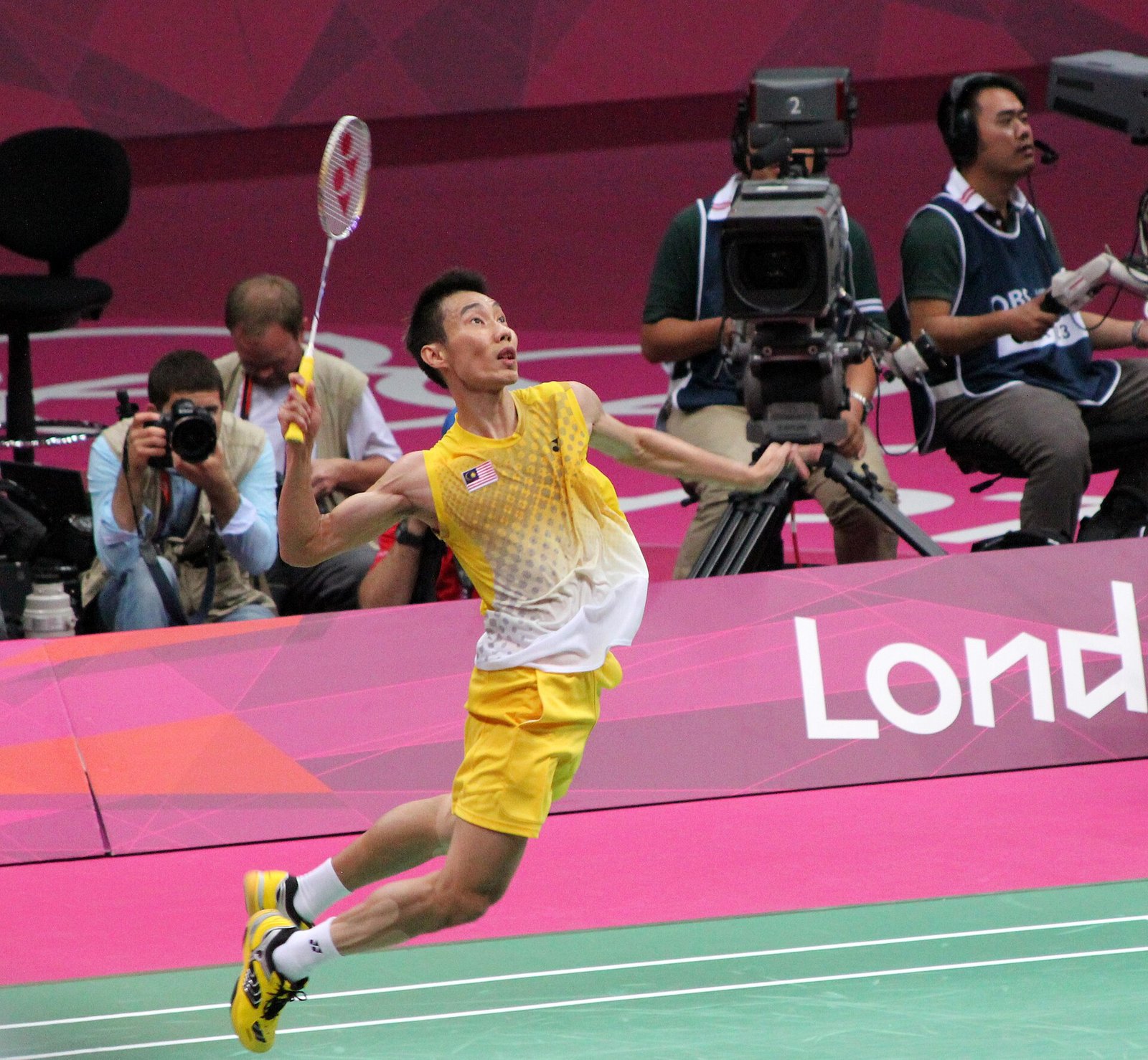
The headline stroke, and the one this guide deliberately introduces third rather than first. The smash is the clear’s preparation played downwards: same side-on stance, same reach and forearm rotation, but the shuttle is met further in front of the body and struck steeply down over the net, arriving faster than any other shot in the game. It is a rally-finisher against a weak lift, not a rally-starter, and it demands the clear’s technique first — a beginner who practises smashes before clears builds a hard, flat, hittable stroke that better players simply block back. The beginner error: swinging harder by tensing everything. The smash’s speed comes from the same relaxed forearm rotation, timed in front of the body; the moment you muscle it, it slows down and flattens out.
4. The lift
The defensive answer from the front court: an underarm stroke, forehand or backhand, that sends a shuttle dropping at the net high and deep to the back line. The lift is how you refuse a net exchange you are losing and buy the seconds to recover to base. It is played with a compact underarm swing, the shuttle taken as early as your lunge allows, and aimed for height and length — a lift that falls short of the back tramlines is not a defence, it is an invitation. The beginner error: lifting from a standing position, shuttle taken low beside the ankle. Lunge in, take it early and high in its fall, and the same swing reaches the back line.
5. The net shot
The most delicate stroke in the game: played from in front of the short service line, the shuttle is brushed, pushed or spun so it climbs barely over the tape and falls, tumbling, tight against the net on the other side. A good net shot cannot be attacked — it arrives below tape height, close to the net, and forces the opponent to lift or attempt a net shot of their own. It is played with the racket out in front, a soft hand, and either grip depending on the side; the spinning version, where the shuttle is sliced so it somersaults over, is the same stroke with seasoning. The beginner error: jabbing at the shuttle with a stiff arm, which pops it up to mid-court height. The net shot is a placement, not a hit: the racket presents, the shuttle is guided.
6. The drive
The flat, fast exchange shot of the mid-court: struck at around shoulder height, flat and hard past the opponent, skimming the tape, landing in the mid or rear court. Drives are the currency of doubles, where the pace rarely allows overhead strokes, and the pressure shot of singles when an opponent is caught turning. Forehand and backhand drives are both short, punchy strokes — forearm and fingers, no backswing worth the name. The beginner error: swinging at a drive like a tennis forehand, which sends it up on a hittable arc. Flat racket path, contact in front, shuttle kept on a clothesline.
Scoring and match format
Badminton rebuilt its scoring in 2006, replacing the old serve-only system with rally scoring, and the modern version is mercifully simple — simpler than tennis scoring, quicker to learn than padel’s tie-breaks, and over sooner than beginners expect. Three numbers run everything: 21, 2, and 3.
Twenty-one — the game. A game is won by the first side to score 21 points, and every rally is worth one point to its winner, whoever served it (Law 7). If the score reaches 20-all, the game continues until one side leads by two points: 22-20 ends it, 21-20 does not. And if the duel runs all the way to 29-all, the side scoring the 30th point wins the game outright — a hard cap, no exceptions, the closest finish the sport allows.
Where you serve from — the score tells you. Service courts are chosen by the server’s score: when it is even (including 0), the serve is delivered from the right service court; when odd, from the left (Law 10). Win the rally as the serving side in singles and you serve again from the other court — the same player serves to the same opponent from alternating sides as their score climbs. Lose a rally as the receiver and you simply concede a point; win it and you take the serve, from whichever court your new score dictates. In doubles the same parity rule applies, with partners rotating as the serving side’s rallies accumulate — the full rotation, with its service-court errors and corrections, is doubles-clause territory owned by badminton rules in doubles; the parity rule above is all a beginner pair needs to start legally.
Three — the match. A match is the best of three games (Law 7.1): win two and you are done. Players change ends after each game, and in the third game they change ends again when the leading side reaches 11 points (Law 8) — the halfway swap that stops one end’s drift, lighting or air-conditioning lean deciding a decider. Two pauses are built into the format: a 60-second interval when the leading score reaches 11 in each game, and two minutes between games (Law 16.2) — your moments for water, a towel, and whatever honest reassessment the score demands.
| Question | The rule | Beginner’s note |
|---|---|---|
| Points in a game | First to 21; two clear at 20-all; cap at 30 | Every rally scores — server and receiver alike |
| Service court | Even score = right court, odd = left | Your score, not your opponent’s, picks your court |
| Games in a match | Best of 3 games | First to 2 games; winner of a game serves first in the next |
| Changing ends | After each game; at 11 points in the third | Also your cue to reset, towel off and re-plan |
| Intervals | 60 seconds at 11 points; 2 minutes between games | Play is continuous otherwise — no wandering off mid-game |
| Who serves first | Decided by toss at the start | In casual play, one knock-up rally or a shuttle spin settles it |
Keeping score is the server’s courtesy job: call it before you serve, your score first — “14-9” — on every rally, without being asked. Half of all casual scoring disputes are really memory failures that a called score prevents, and in a rally-scored game where every exchange moves the number, the habit pays for itself within one session.
Singles vs doubles: two games, one court
Beginners often treat doubles as singles with help. It is not: the two formats share a court, a net and a shuttle, and diverge in almost everything else — the shape of the court in play, the serve that starts the rally, and the way the space is defended. This section gives the orientation; each format’s full rulebook lives in its own post.
The court changes shape. In singles, the playing court is long and narrow: serves run to the very back boundary line, and the wide tramlines between the singles and doubles side lines are out. In doubles, the court is short and wide: the full 6.10-metre width is in play, but the serve must land short of the doubles long service line, 0.76 metres inside the back boundary — after the serve, that strip comes back into play for the rally. One mnemonic covers it: singles is long and thin, doubles is short and fat — for the serve only.
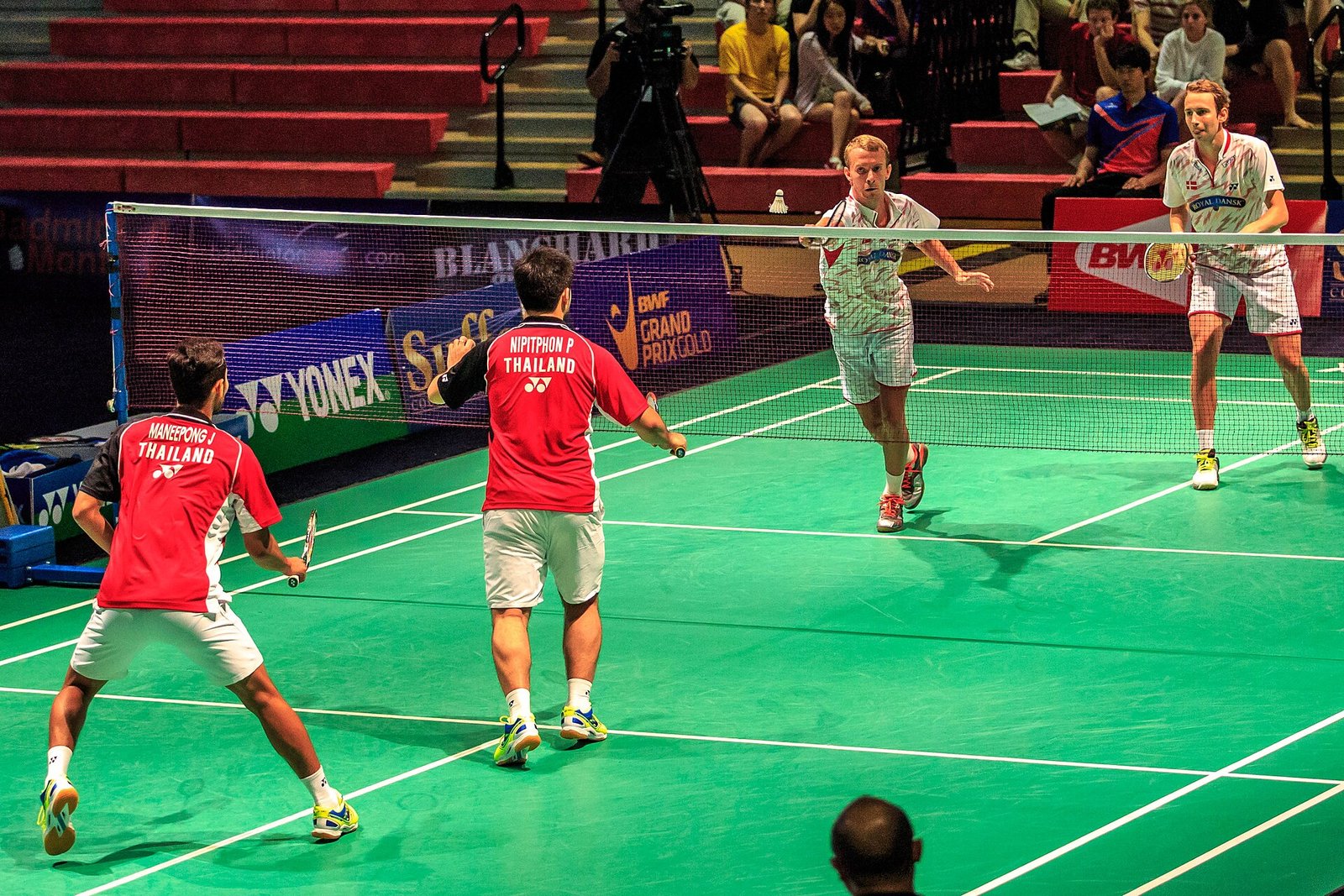
The rally changes shape too. Singles is a game of movement and patience: one player defends the whole narrow court, rallies are built with clears and drops that drag the opponent corner to corner, and the smash is deployed when the geometry has been earned. Doubles is a game of speed and territory: the front–back and side-by-side formations, the flat drive exchanges, the net player hunting interceptions. Two of you still cannot cover everything — the seams between partners, down the middle and into the body, are where doubles rallies are won. Positioning basics for a beginner pair: when attacking, form up front-and-back with the net player crouched and racket high; when defending, stand side by side, each taking a half; when in doubt, the shuttle down the middle belongs to whoever calls loudest — and somebody must call.
The serve changes hands differently. In singles the same player serves until they lose a rally, alternating courts by score. In doubles, a pair serves as a unit: while the serving pair keeps winning rallies, the same partner continues serving, swapping service courts after each point won; when the pair loses a rally, the serve passes to the opponents, whose serving court is set by their score’s parity and whose partners never swap positions until they win a point serving. It is the fiddliest paragraph in the Laws, and every beginner pair gets it wrong in week one — which is why the complete doubles rotation, worked examples included, lives in badminton rules in doubles, and the singles equivalent in badminton rules for singles. Start with parity and good humour; the rotation polishes itself with matches played.
Your first session: a walkthrough
You now know the game well enough to play it legally. This section turns that knowledge into one complete first session — what to bring, how to structure your first hour, and what to work on next, in the order you will actually do them.
What to bring. A racket — your own first racket if you have followed the beginner’s rackets guide, or a borrowed club racket, which every hall keeps. A tube of nylon shuttles: they will be lost under bleachers, trodden on, and clipped by frames, and a session chasing one surviving shuttle is a session of fetching. Court shoes or clean, flat, grippy indoor trainers — the lunging starts in minute one, whatever your intentions. Clothing you can reach, stretch and lunge in. And a small towel: grips sweat, and at 19-all a dry hand is worth a point a game.
Your first hour, step by step
Step 1 — Knock up with clears (5 minutes). Stand at opposite back lines and rally clears cooperatively — your partner is not an opponent yet. Aim for ten in a row landing beyond the doubles service line, at a pace you can both sustain. This is where the basic grip either feels natural or gets adjusted, so adjust it now, not in a game: V on the bevel, fingers loose, forearm rotating.
Step 2 — Drops, lifts and net shots (10 minutes). Move through the front-court family: one partner feeds drops from the rear court, the other lifts from the net; swap roles; then both to the net for gentle net-shot exchanges, shuttle kept tight to the tape. You have now used five of your six strokes before a single point has been scored, which is precisely the idea.
Step 3 — Practise the legal serve (5 minutes). Serve twenty shuttles with no receiver pressure: low backhand serves in the doubles court, forehand serves in the singles court, struck below the height line and landing past the short service line. Have your partner return them cooperatively. If a serve lands in the wrong court, it was a fault in a game — knowing what your faults look like is a first-session achievement, not an embarrassment.
Step 4 — Play games to 21 (30 minutes). Best of three games, real rally scoring, service courts by parity, the score called out loud before every serve. Use the lift the first time a net exchange goes against you; answer the deep serve with a clear rather than a hopeful smash. Change ends after each game, pause at 11, and take the two minutes between games exactly as the format demands — habits built in casual games are the ones that survive into competitive ones.
Step 5 — Finish with a doubles game if you have four players. Doubles is the sport’s social heart and its best pace teacher: shorter service courts, flat exchanges, formations to learn by collision. Expect the middle-of-the-court confusions; call loudly, forgive freely, and notice how the ready position and the grip change — this hour’s two quiet skills — are suddenly doing all the work.
Session etiquette — the layer the Laws assume. Call your own faults without being asked: the serve struck too high, the foot that crossed the service line early, the shuttle you know clipped your sleeve. Raise a hand for a lucky net cord — it changes nothing and buys goodwill everywhere. Never walk across the back of a neighbouring court mid-rally to retrieve a shuttle; wait for their rally to end, as they will wait for yours. And when the hour ends, the tap of rackets over the net is not optional theatre: it is the sport’s punctuation, from school halls to world finals.
What to learn next. Your second month has three obvious threads, each with its own home on this site. The singles rulebook first — service-court errors, lets, and the clauses behind every call in this guide — in badminton rules for singles. The pairs game second, if doubles has hooked you, in badminton rules in doubles. And the gear questions that start arriving around week three — which strings your racket should carry, and what tension actually does to your shots — in the badminton strings guide and the string tension guide. That is the whole beginner curriculum: this page to start, those to grow.
The beginner’s checklist
Pin this version to the inside of your head for your first month:
- Grip: shake hands with the handle, V of thumb and index finger on the top bevel, fingers loose — and roll the thumb flat onto the wide bevel for every backhand. Two grips, changed in flight.
- Stance: base a half-step behind centre court, knees bent, weight forward, racket carried high in front — and recover to it after every single shot.
- Serve: diagonal, struck low with the whole shuttle below 1.15 m, landing past the short service line in the correct court for the format. Plain and legal beats flashy and faulted.
- Rally: over the net and inside the lines; the lines are in, the ceiling is out, and the shuttle is dead the moment it lands. Never touch the net while the shuttle is live.
- Score: a game to 21, two clear at 20-all, decided at 30 if it reaches 29-all; matches are best of three games. Serve from the right court on even scores, the left on odd — and call the score before you serve, yours first.
- Honesty: your own faults are yours to call — the high serve, the wandering foot, the shuttle that brushed your shirt on its way out.
How to play badminton — FAQs
How does scoring work in badminton?
Badminton uses rally scoring: the winner of every rally adds a point, whether they served or not. A game is won by the first side to 21 points. At 20-all, play continues until one side leads by two points; if the score reaches 29-all, the side that scores the 30th point wins the game. A match is the best of three games, and the server’s score decides the service court — right court on even scores, left court on odd (BWF Laws, Law 7 and Law 10).
How do you hold a badminton racket?
Start with the basic (forehand) grip: hold the handle as if shaking hands with it, so your thumb and index finger form a V along the top bevel of the grip, your index finger rides slightly high like a trigger finger, and your fingers — not your palm — hold the racket snugly but loosely. For backhand shots, switch to the thumb grip: roll the racket a quarter-turn and lay your thumb flat and straight along the wide bevel, so the thumb can push the handle through at contact. Learning to change between the two grips mid-rally is one of the sport’s core skills.
What are the basic rules a beginner needs first?
Five cover almost everything. Serve diagonally into the opposite service court, struck with the whole shuttle below 1.15 metres. Land the shuttle inside the opponent’s court — the lines count as in. Do not touch the net with racket, body or clothing while the shuttle is in play. Do not strike the shuttle twice, carry it on the strings, or let it touch you or your clothing. And every rally scores a point: first to 21 wins the game, best of three games wins the match. The clause-level rulebooks live in our singles and doubles rules guides.
Can the shuttle hit the net and still be good?
Yes, in most cases. A rally shot that brushes the top of the net and crosses is in play and counts normally. A serve that clips the tape but still lands in the correct service court is also good — badminton has no let for a net-cord serve that lands in. What is a fault: a serve or shot that catches in the net, passes through or under it, or a shuttle that touches the net’s posts via your racket or body contact while it is in play — you may never touch the net yourself during a rally.
What is the difference between singles and doubles?
The court effectively changes shape. Singles is long and narrow: the 5.18 m singles side lines are in force and serves run to the back boundary line. Doubles is short and wide: the full 6.10 m width is used, but a serve must land before the doubles long service line, 0.76 m inside the back boundary (after the serve, that strip is in play). Doubles also has its own serving rotation — one partner serves while the pair keeps winning rallies — and is played in formations: front-and-back in attack, side-by-side in defence.
How high can you serve in badminton?
At the instant the racket strikes the shuttle, the whole shuttle must be below 1.15 metres from the surface of the court (BWF Laws, Law 9.1.6). The racket must hit the cork base first, and the shuttle must travel upwards and over the net into the diagonal service court. In older and casual descriptions you will hear the serve described as “below the waist” — the fixed 1.15 m height is the current Law at organised levels, and both versions make the same practical point: a legal serve is struck low, which is why the short backhand serve dominates doubles.
What happens at 20-all in badminton?
The game does not end at 21. From 20-all, the side that first gains a two-point lead wins the game — 22-20, 25-23, and so on. If neither side can open that gap, the game reaches a hard finish: at 29-all, the side that scores the next point, the 30th, wins the game outright (BWF Laws, Law 7.4 and Law 7.5). There is no scoring beyond 30 in a game.
What racket and shuttle should a beginner start with?
A racket built for beginners — manageable weight, a forgiving head shape and a medium-flex shaft — rather than the lightest or stiffest flagship in the shop; our guide to the best badminton rackets for beginners compares the current options and explains the specs. For shuttles, start with nylon (synthetic) shuttles: they fly close to feather speed, survive mishits and frame contact that would destroy feather shuttles, and cost far less per hour of play. Switch to feathers when your hitting is consistent enough to appreciate — and afford — the difference.
About this guide: The rules summarised here follow the Laws of Badminton (BWF Statutes, Section 4.1), stated at beginner depth; club and social games sometimes use house conventions, which take precedence on the day. Technique summaries reflect standard beginner coaching practice and are a starting point, not a substitute for a coach. This page links only to guides on Alishuttler.com — any affiliate relationships are disclosed on the pages concerned.