Past the step-up stage, the trade changes: you give away forgiveness on purpose and buy ball speed, a harder touch and a sweet spot that sits exactly where you strike. These seven diamond and hybrid rackets are the advanced segment’s current reference points — every weight, balance, face and core verified against manufacturer and retailer listings.
TL;DR — The short answer
Best overall power: Bullpadel Hack 04 2026 — Paquito Navarro’s diamond: 365–375 g, a high ≈26.4 cm balance, a TriCarbon 18K face and a MultiEVA core, with CustomWeight plates if you want even more head weight. Best power + control: Nox AT10 Genius 18K Alum 2026, Agustín Tapia’s teardrop with the harder 18K face and a medium-hard HR3 Black EVA touch. Hardest touch on the list: Oxdog Ultimate Pro+, a 370 g diamond with a hard EVA core and HES-Carbon throughout. Best defensive counter: Bullpadel Neuron, Fede Chingotto’s low-balance hybrid — proof that “advanced” does not have to mean “attacking”. Full breakdowns, a comparison table and an honest who-should-not-buy section below.
Bullpadel Hack 04 2026
Diamond, 365–375g, TriCarbon 18K. The reference power frame, built around swing speed.
Nox AT10 Genius 18K Alum
Teardrop, 360–375g, 18K carbon. Tapia’s harder-touch all-court weapon.
Oxdog Ultimate Pro+
Diamond, 370g, hard EVA. Maximum rigidity for players who generate their own pace.
Siux Diablo Sanyo Pro 4
Hybrid, 355–375g, 18K Textreme. Sanyo’s reactive, medium-balance attacker.
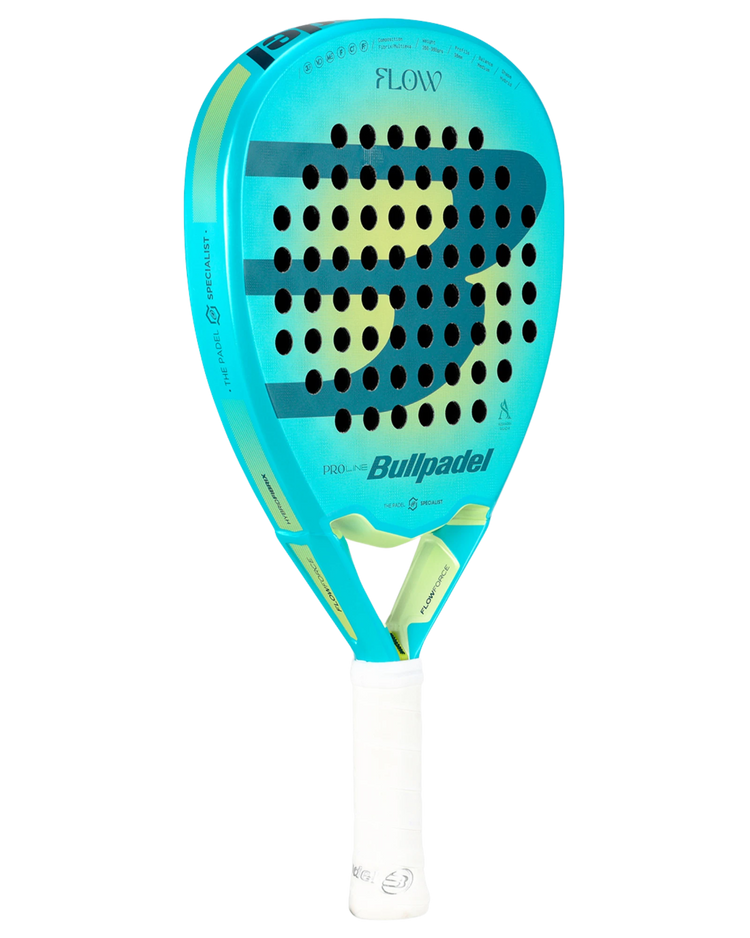
Bullpadel Neuron
Hybrid, ≈25cm balance, 3K carbon. Chingotto’s control frame for counter-punchers.
On this page
- What “advanced” actually demands from a racket
- What changes at advanced level
- 1. Bullpadel Hack 04 2026 — Best Overall Power
- 2. Nox AT10 Genius 18K Alum — Best Power + Control
- 3. Oxdog Ultimate Pro+ — Hardest Touch
- 4. Siux Diablo Sanyo Pro 4 — Best All-Court Attack
- 5. Wilson Blade Pro V3 — Best for Fast Hands
- 6. Bullpadel Neuron — Best Defensive Counter
- 7. Starvie Kenta Eternal Pro — Best Control
- Comparison table
- Who should NOT buy these yet
- Where this list sits in the ladder
- FAQs
What “advanced” actually demands from a racket
Every racket in this guide makes the same underlying bargain, and it is the opposite of the one a beginner racket makes. A beginner frame spends its design budget on forgiveness: a low balance, a soft face, a sweet spot the size of a grapefruit parked in the middle of the strings-that-aren’t. An advanced frame spends that budget on output. The sweet spot shrinks and moves up towards the top of the head, the balance climbs, the face stiffens, the core hardens — and in exchange, a clean strike leaves the racket noticeably faster, heavier and harder to read.
That bargain only pays out if your contact is already grooved. Advanced players don’t buy these rackets because the rackets make them better; they buy them because their technique has stopped needing protection and started needing headroom. The smash that a soft intermediate frame absorbs and returns politely, a diamond with a hard core turns into a ball that comes off the back glass at knee height. The vibora that a fibreglass face mushes into the net, an 18K carbon face bites and skids. The equipment stops editing your shots, for better and for worse.
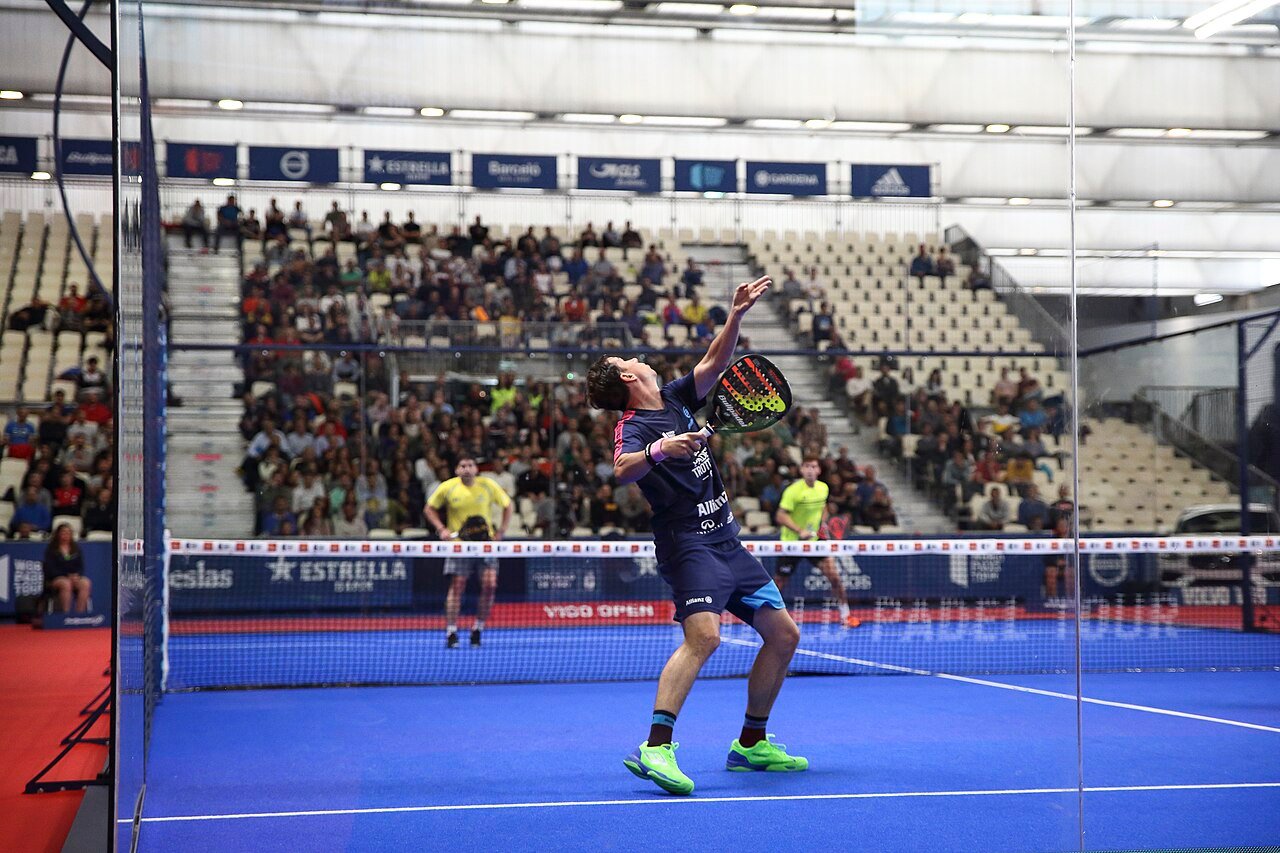
One more thing this segment is not: it is not a synonym for “attacking”. Two of the seven rackets below — the Bullpadel Neuron and the Starvie Kenta Eternal Pro — are control frames that advanced defenders and counter-punchers choose precisely because their placement game is already complete and they want a racket that never surprises them. Advanced describes the player’s contact and decision speed, not their position on the court. The picks are organised by playing brief — pure power first, then power with control, then the defensive counter — so read for your game, not for the ranking.
How the seven were chosen: current flagship and advanced-tier models only, each verified against the manufacturer’s or an authorised retailer’s live spec sheet at build time — weight, balance, shape, face material and core all confirmed, and any model whose specs couldn’t be verified was dropped rather than guessed. Equally deliberate is what’s missing. Nothing here is re-carded from the best padel rackets pillar or the intermediate guide: the Metalbone, the Bela Pro and the 12K AT10 already have their pages, and this segment has enough genuine depth — Oxdog, Siux and Starvie included — that repeating them would serve nobody. If a racket you expected isn’t here, it is either owned by another guide on this site or it didn’t verify.
What changes at advanced level
Four things move together when you step from the intermediate tier into this one, and it’s worth naming them briefly before the picks — the full mechanics live in our padel racket shapes guide and racket weight guide, which own this theory properly.
Shape: diamond and hybrid take over
Round disappears from serious consideration, not because round is bad but because its low, central sweet spot caps overhead output. Diamonds concentrate mass at the top of the head where smashes and viboras are struck; hybrids and teardrops keep a slightly lower, larger hitting zone for players who attack selectively rather than constantly.
Balance: the weight climbs — deliberately
Expect balance points around 26–27 cm on the power frames here, against the 25 cm of a control hybrid. That head weight is momentum you don’t have to manufacture with your arm, and it is also why these rackets punish late preparation: a head-heavy frame that arrives late stays late.
Face: carbon grades harden
The intermediate tier runs on 12K carbon and carbon-flex blends. This list runs on 18K weaves, aluminised carbon and HES-Carbon — stiffer faces that return more of your swing speed to the ball and feed back exactly where you struck it. Stiffness is information, if you’re good enough to read it.
Core: hard EVA replaces trampoline foam
Hard and firm EVA cores compress less, so low-speed shots get less free help and high-speed shots get more of your intent. It’s the single biggest feel change in the step up, and the one players either love immediately or need a month to trust.
Bullpadel Hack 04 2026
Paquito Navarro’s dynamic-power diamond
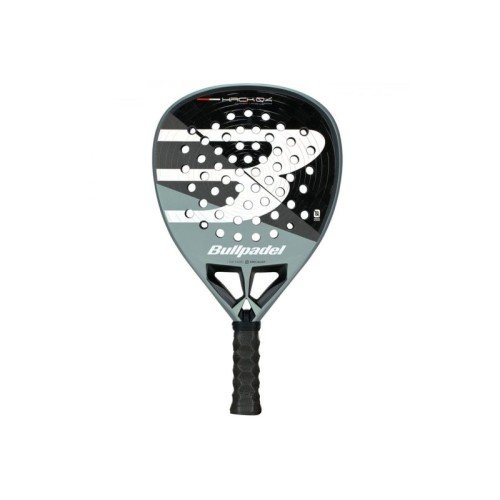
The Hack line is Bullpadel’s power flagship, and the 04 is its most complete expression yet: a diamond head on a high balance, a TriCarbon 18K face, and a frame engineered to swing faster than a 370 g racket has any right to. If your overhead game is your identity, this is the reference point.
What Bullpadel chased with the 04 is swing speed. The Total Channel perimeter and Air React Channel cut air resistance around the frame, the TriCore heart stiffens the bridge, and the result is a head-heavy racket that accelerates like a lighter one — “dynamic power”, in the brand’s phrase, meaning the pace arrives earlier in the swing rather than only at full extension. The MultiEVA core layers densities so defensive blocks keep some touch while full swings get the hard response, and the 3D Grain rough finish gives bandejas and viboras genuine bite.
The CustomWeight system deserves a mention because it changes the buying decision: plates can add up to roughly 12 g at the top of the frame, so the same racket can start at the manageable end of diamond ownership and take on more head weight as your timing earns it. The honest warning is the one Bullpadel itself prints — the level rating is Professional. The sweet spot is high and honest, and a Hack bought a season too early is a very expensive way to hit the side glass. Bought on time, it’s the power benchmark on this page.
Pros
- Explosive overhead output from the high balance and stiff 18K face
- Aerodynamic frame channels make it swing faster than its weight suggests
- CustomWeight plates let the balance grow with your game
- Layered MultiEVA core keeps defensive touch alive
Cons
- Small, high sweet spot punishes late or low contact
- Head-heavy load is real work for the forearm over three sets
As an Amazon Associate we earn from qualifying purchases.
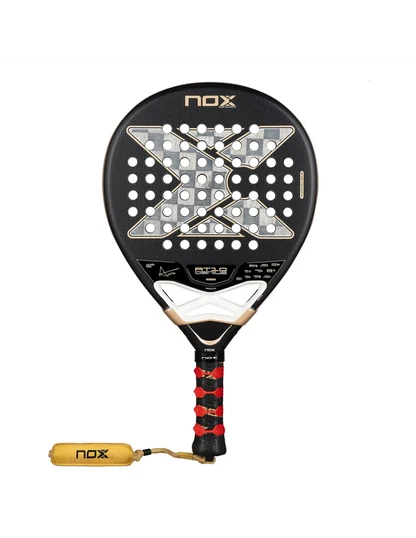
Nox AT10 Genius 18K Alum 2026
Tapia’s harder-touch teardrop
Not to be confused with the 12K version in our all-level and intermediate guides: the 18K Alum is the other AT10 — same teardrop mold, stiffer aluminised 18K faces and a medium-hard touch that trades a little comfort for a lot of authority. It’s the advanced player’s version of the most famous all-court racket in padel.
Nox’s own spec table tells the story cleanly: where the 12K Alum XTREM is rated medium-soft, the 18K is medium-hard, with the sweet spot still centred — the teardrop geometry doesn’t move, the response does. The aluminised fibres hold their rigidity as the racket heats up and cools down across a session, the rough sand finish grips sliced shots, and the EOS Flap, Pulse System and Weight Balance counterweights (2 g and 4 g pieces) carry over from the flagship spec. In practice this is the racket for the advanced player who plays all four phases — defends low, builds with chiquitas, volleys on the front foot and finishes — and wants one frame that never has to be swapped out of the hand.
Choose it over the Hack if your power comes from timing rather than muscle, and over the 12K if your contact is already centred and the softer touch has started to feel like a delay. If you’re still deciding between the two AT10s, that hesitation is itself the answer: the 12K is the step-up, the 18K is the destination.
Pros
- The complete all-court package at advanced spec: power, control, spin
- 18K aluminised face stays consistent across temperatures
- Centred sweet spot is the most forgiving on this list
- Adjustable balance via Weight Balance counterweights
Cons
- Medium-hard touch gives less free help on defensive blocks than the 12K
- Flagship pricing, and easy to confuse with the cheaper 12K at checkout — check the face marking
As an Amazon Associate we earn from qualifying purchases.
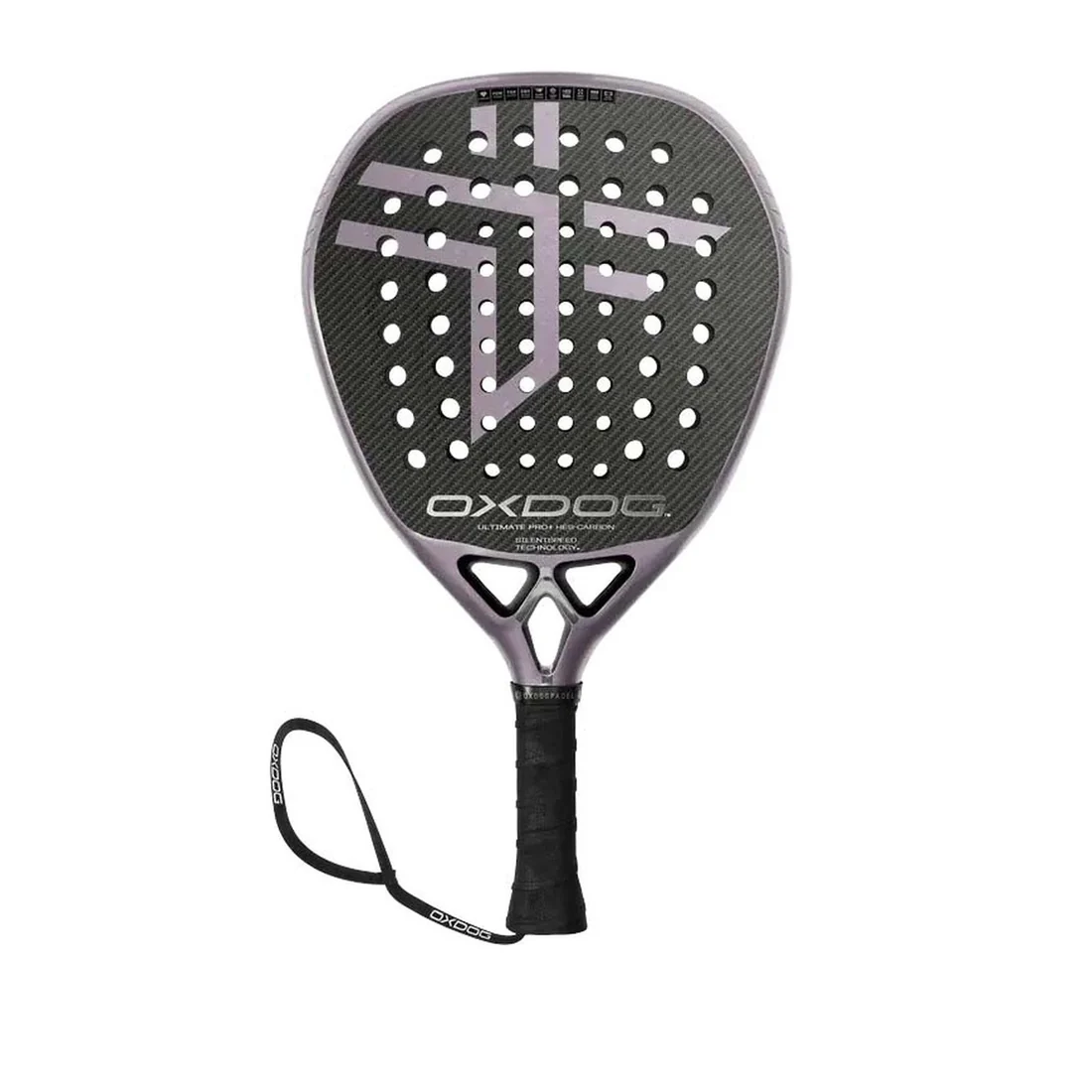
Oxdog Ultimate Pro+
Maximum rigidity, Swedish style
Oxdog builds the stiffest rackets in the sport and the Ultimate Pro+ is the top of that tree: a diamond head, a high balance, HES-Carbon in the face and frame, and a hard EVA core that gives back exactly what you put in — no more, no less, and nothing soft anywhere.
HES-Carbon is Oxdog’s high-energy-storage carbon: rigid, reactive, and noticeably dry on contact. Paired with the hard foam, it produces the fastest ball exit on this page when the strike is centred — and the least assistance when it isn’t. The engineering around that honesty is thoughtful: PowerRibs rails stiffen the frame edges, the DSH double-size hole pattern widens the usable hitting area beyond the true sweet spot, SilentSpeed damps the acoustic harshness, and the RBS system hides a removable 8 g weight in the butt cap, so you can drop the swing weight for a doubles match full of reflex volleys and restore it for singles-style hitting.
This is the specialist’s pick. Players who generate their own pace, defend with blocks rather than lifts, and want a racket that feels like a measuring instrument will rate it first on this list. Everyone else should read the touch rating on the tin — Oxdog says “hard” and means it — and try the Hack or the AT10 first.
Pros
- Fastest, driest ball exit here on centred contact
- RBS removable cap weight tunes swing weight in seconds
- PowerRibs and DSH holes add stability around the small sweet spot
- Rough sandy finish bites hard on sliced overheads
Cons
- Hard core offers almost no free power at low swing speeds
- The least forgiving frame on this page for tired third-set contact
As an Amazon Associate we earn from qualifying purchases.
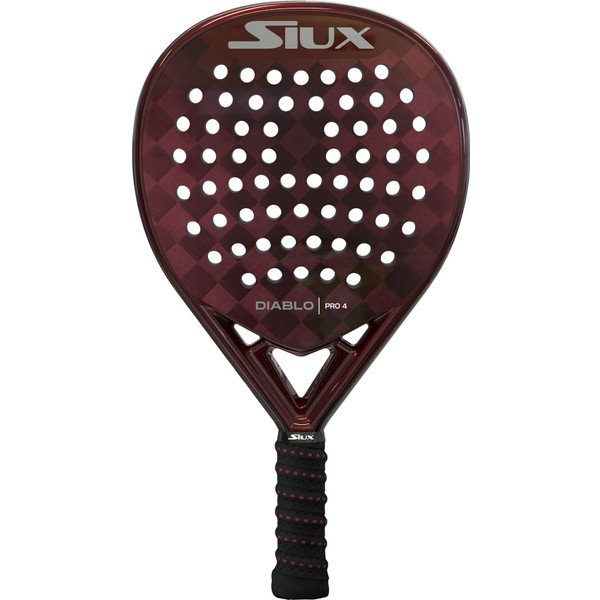
Siux Diablo Sanyo Pro 4
The magician’s reactive hybrid
Sanyo Gutiérrez built a career on touch at full pace, and his Diablo Pro 4 is specced for exactly that: a hybrid head at a medium 265 mm balance, 18K Textreme carbon faces and a hard Black EVA core — an attacker’s racket that still answers in defence.
The Diablo’s trick is reactivity. The Textreme spread-tow carbon keeps the face stiff without the dead weight of a heavier weave, the 3K carbon frame underneath keeps the whole head stable, and the medium balance means the racket changes direction as fast as you do — which is the entire Sanyo brief: wristy deflections at the net, sudden angles off the bandeja, counter-attacks struck from defensive positions. The sweet spot is more generous than the diamonds above it on this page, and the hard core keeps volleys honest rather than trampolining them long.
Pick it if your attacking game is built on speed of hand rather than size of swing. Pure baseline power players will find the Hack hits a heavier ball; players who win points by being early and inventive will find the Diablo disappears in the hand in the best way.
Pros
- Fastest handling of the attacking picks — medium balance, reactive face
- 18K Textreme stiffness without excess weight
- Hard core keeps fast volleys and blocks under control
- Generous sweet spot for a racket at this spec
Cons
- Less raw smash weight than the Hack 04 or Ultimate Pro+
- Siux distribution is thinner in some regions — check the listing is the Pro 4, not the standard Diablo
As an Amazon Associate we earn from qualifying purchases.
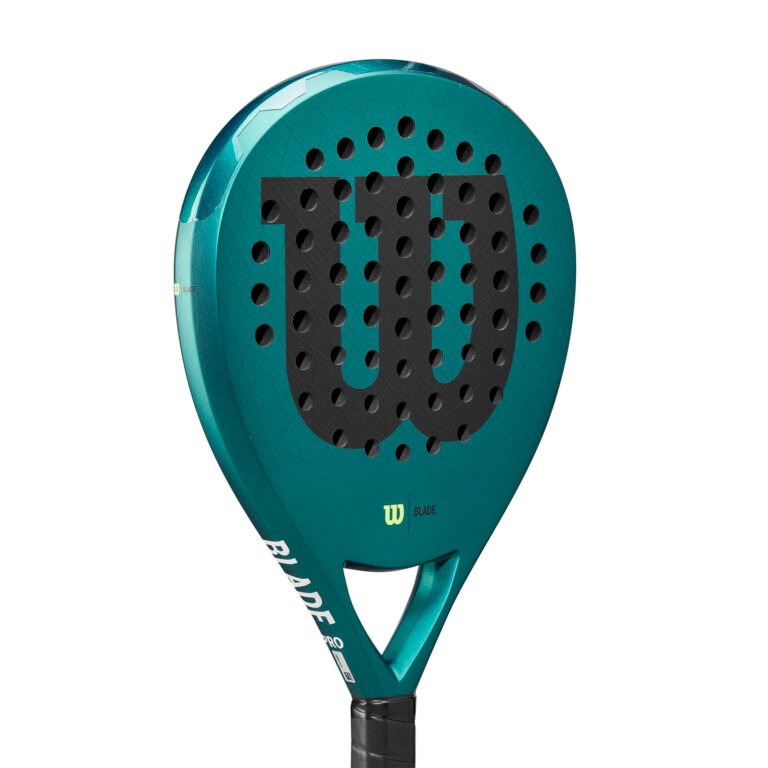
Wilson Blade Pro V3
The volley-first power teardrop
Wilson’s most offensive Blade pairs a head-high 270 mm balance with a full carbon face and a Firm EVA core, in a teardrop that stays stable when the exchange gets quick. It is the net player’s power racket: built for the first volley and the counter-volley, not just the smash.
Two Wilson details do the work here. The DuoGrid hole pattern drills larger holes towards the top of the head — where overheads are struck — and smaller ones lower down, so the face gives up its stiffness where you want power and keeps it where you want spin and control on volleys. And the C2 tubular carbon construction keeps the frame’s response uniform, which shows up as stability: off-centre blocks at the net hold their line instead of twisting away. The Spin Effect Texture adds the bite for viboras that dive at the fence.
At a fixed 365 g with a genuinely high balance, it plays heavier than the number suggests — deliberate, because Wilson is selling momentum for players who take the ball early. If your game is built around dominating the net cord and punching the first ball, this is your pick; baseliners who defend for a living should look at the two control frames below.
Pros
- DuoGrid drilling tunes power up top, control down low
- Very stable on fast, off-centre net exchanges
- Firm, crisp response rewards early, compact swings
- Spin Effect Texture for heavy viboras
Cons
- Fixed 365 g spec at a 270 mm balance plays heavier than it reads
- Firm EVA gives little help on passive defensive lobs
As an Amazon Associate we earn from qualifying purchases.
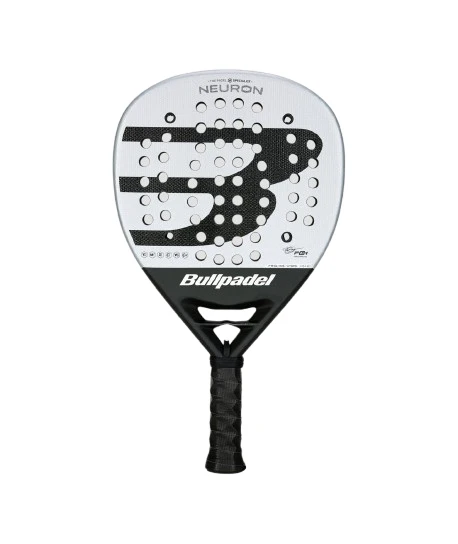
Bullpadel Neuron
Chingotto’s control hybrid
Fede Chingotto defends better than anyone in the modern game, and his Neuron is the anti-diamond: a hybrid head balanced at roughly 25 cm, an X-Tend Carbon 3K face and a MultiEVA core, tuned for the player whose weapon is the counter-punch. Bullpadel lists its playing type, without embarrassment, as Defense.
The Wave System frame is the Neuron’s signature: the frame’s sides are profiled to flex at set points, smoothing energy transfer so the ball leaves with control even when you’re stretched wide and late — the exact position Chingotto has made a career from. The large 535 cm² hitting surface and low balance make it the quickest defensive racket here, the MultiEVA core keeps touch on lobs and chiquitas, and the 3D Grain finish still bites when the counter-attack window opens. It will not hit the ball out of the court for you. It will let you be right, point after point, at a level where being right is what wins.
Choose it if you play the right side, build points from the back, and take your satisfaction in errors forced rather than winners hit. Pair it with the Kenta below if you’re choosing between the two control frames: the Neuron is the faster, lighter-feeling counter; the Kenta is the harder, more rigid metronome.
Pros
- Fastest defensive handling on this list — low balance, big hitting surface
- Wave System frame keeps stretched, late shots under control
- MultiEVA touch for lobs, chiquitas and resets
- Still bites on the counter-attack with its 3D Grain finish
Cons
- Overhead ceiling is the lowest here — smashes need full technique
- Power players will find it underwhelming by design
As an Amazon Associate we earn from qualifying purchases.
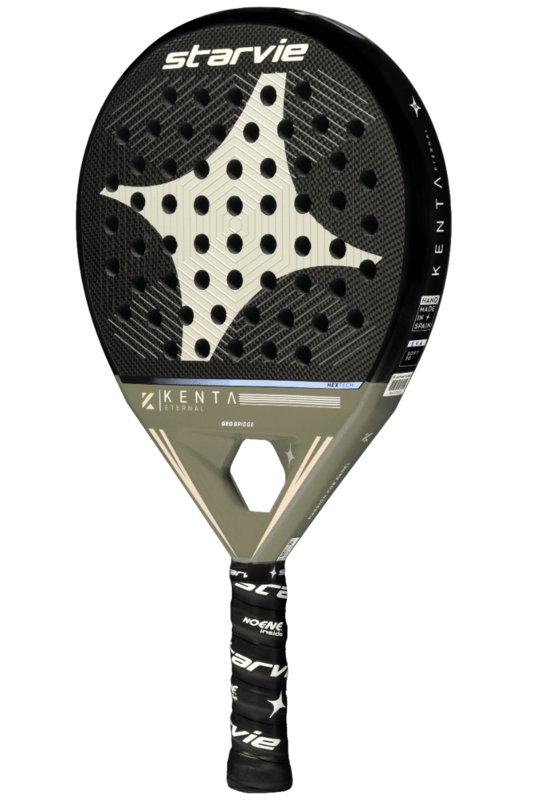
Starvie Kenta Eternal Pro
The round, hard-cored metronome
A round racket at advanced level sounds like a contradiction until you read the spec: two layers of 3K carbon over a hard EVA Pro core, a 265 mm balance and a Geo Bridge heart, handmade in Spain. The Kenta Eternal Pro is control with a hard centre — placement equipment for players who never miss on purpose.
Starvie’s Kenta line has always been the connoisseur’s control choice, and the Eternal Pro is its tournament build. The round mold centres the sweet spot where a defender actually strikes the ball, the hard EVA Pro core stops the face from absorbing your placement — the ball goes where the swing pointed, at the pace the swing made — and the hexagonal Geo Bridge stiffens the throat so the head doesn’t lag on fast exchanges. At 370 g it has enough mass to block heavy smashes without being pushed around, which is the quiet requirement of every elite defensive racket.
It is the narrowest brief on this page and, for the right player, the most satisfying: if your scorecard says your losses come from your own errors rather than a lack of winners, this is the frame that removes the last equipment excuse. Attackers, keep scrolling back up — there’s nothing here for you, and that’s the point.
Pros
- Centred sweet spot exactly where defensive contact happens
- Hard EVA Pro core makes output predictable — no surprises, ever
- Geo Bridge throat keeps the head stable in fast exchanges
- Handmade in Spain; Starvie’s build consistency is a genuine strength
Cons
- Round shape caps overhead power — finishing must come from placement
- Hard core and full weight make it a poor fit for tender elbows
As an Amazon Associate we earn from qualifying purchases.
Advanced padel rackets compared
Read the table by brief, not by rank. The first three rows are the power end in descending order of forgiveness — Hack, AT10, Oxdog — the middle two are the fast-handed attackers, and the last two are the control frames, where the numbers that matter are the low balance and the centred sweet spot rather than the carbon tier. Weight ranges are the manufacturers’ published bands; individual rackets vary within them, which is why several retailers offer a weighing service worth using at this level.
| Racket | Shape | Weight | Face / Core | Best for |
|---|---|---|---|---|
| Bullpadel Hack 04 2026 | Diamond | 365–375 g | TriCarbon 18K / MultiEVA | Best overall power |
| Nox AT10 Genius 18K Alum 2026 | Teardrop | 360–375 g | 18K aluminised carbon / HR3 Black EVA | Power + control |
| Oxdog Ultimate Pro+ | Diamond | 370 g | HES-Carbon / Hard EVA | Hardest touch |
| Siux Diablo Sanyo Pro 4 | Hybrid | 355–375 g | 18K Textreme carbon / Black EVA | All-court attack |
| Wilson Blade Pro V3 | Teardrop | 365 g | 3K carbon / Firm EVA | Fast hands at the net |
| Bullpadel Neuron | Hybrid | 355–375 g | X-Tend Carbon 3K / MultiEVA | Defensive counter |
| Starvie Kenta Eternal Pro | Round | 370 g | 3K carbon / EVA Pro | Pure control |
Who should NOT buy these yet
Honesty section, because this is the most expensive mistake in padel. Every racket above assumes centred contact under pressure. If your rallies still end with the ball finding the frame, the tape or the wrong glass more often than your intended target, none of these rackets will fix that — they will invoice you for it, one donated point at a time. A diamond’s sweet spot is small and sits high; a hard EVA core gives nothing back on a passive swing; a 270 mm balance turns late preparation into a shot that never arrives. The equipment stops forgiving at exactly the moment your technique still needs it to.
The reliable tests are practical, not aspirational. Can you hold a cross-court rally off the back glass without your contact drifting towards the throat? Do your bandejas land in the back third with your feet set, not while falling backwards? Do your volleys finish points against club-level pace, rather than restarting them? If the honest answer to any of those is “not yet”, the correct purchase is one tier down: our guide to the best padel rackets for intermediate players covers the step-up frames — including the 12K AT10 and the Vertex 05 Hybrid — that build exactly the contact these advanced rackets then reward. A season on the right intermediate racket is not a delay; it’s how you arrive here able to use what you buy.
Where this list sits in the ladder
This guide is the top rung of the site’s racket ladder, and each rung has a job. The best padel rackets pillar gives the all-level verdict if you want one ranking across every standard. The intermediate guide owns the step-up from beginner frames. This page owns the advanced segment only — which is why you won’t find the pillar’s overall winners re-carded here, and why brand depth lives elsewhere: if you play Head, the best Head padel rackets 2026 guide covers that range model by model, including its advanced flagships, and this page deliberately leaves them to it. Read the rung your game is actually on, and the ladder works the way it’s supposed to.
Advanced padel racket FAQs
What makes a padel racket “advanced”?
Spec, not marketing. Advanced rackets pair diamond or hybrid shapes with high balances (roughly 26–27 cm on power models), stiff carbon faces — 18K weaves, aluminised carbon or HES-Carbon at the top end — and hard or firm EVA cores. The trade is deliberate: a smaller, higher sweet spot and less free help on slow swings, in exchange for faster ball exit and clearer feedback on clean contact.
Diamond or teardrop for an advanced player?
Diamond if your game is built on overheads and you strike the top of the head consistently — it puts the sweet spot and the mass exactly there. Teardrop or hybrid if you attack selectively and still defend a lot: the hitting zone sits a little lower and larger. The Bullpadel Hack 04 and Nox AT10 18K on this page are the cleanest expression of each answer.
How heavy should an advanced player’s racket be?
Most advanced frames land between 360 g and 375 g, and the balance matters as much as the number: 365 g at a 270 mm balance (the Wilson Blade Pro V3) plays heavier than 370 g at 25 cm (the Bullpadel Neuron). Choose by how the racket swings in the third set, not by the spec sheet alone — our racket weight guide works through the method in full.
Is the Nox AT10 Genius 18K worth it over the 12K?
Only if your contact is already centred. The 18K Alum has a stiffer aluminised face and a medium-hard touch against the 12K’s medium-soft, so it returns more authority on full swings and less comfort on off-centre ones. If you’re still grooving your strokes, the 12K in our intermediate guide is the better buy — the 18K is the destination version of the same racket.
Can an intermediate player use an advanced racket?
They can hold one; whether it helps is another question. Strong intermediates with clean contact often grow into the control end of this list — the Neuron or the AT10 18K — without harm. The hard diamonds (Hack 04, Ultimate Pro+) are different: bought early, they typically cost points and confidence. If in doubt, buy the intermediate racket and upgrade when the racket, not the strike, becomes the limit.
Do head-heavy, stiff rackets strain the arm?
They ask more of it. A high balance and a hard core transmit more load and vibration than a soft, low-balance frame, which is why players who already manage elbow or shoulder discomfort usually choose the control end of this list — the Neuron’s lower balance, or a lighter spec — and why no racket choice substitutes for sound technique. If you have an existing injury, get it assessed before buying at this tier.
When should I replace an advanced racket?
When its response changes: a core that feels dead or inconsistent across the face, visible cracks in the frame or face, or a rough finish worn smooth where you strike most. Hard EVA cores and carbon faces hold their playing characteristics well, but no frame is permanent — and a tired advanced racket quietly deletes the exact feedback you bought it for.
The verdict
Buy the Bullpadel Hack 04 2026 if overheads are your identity and your contact is already clean — it’s the power benchmark. Buy the Nox AT10 Genius 18K Alum if you play every phase of the rally and want the hardest-touch version of the sport’s most complete teardrop. Buy the Oxdog Ultimate Pro+ if you generate your own pace and want the driest, fastest exit in padel. Buy the Neuron or the Kenta Eternal Pro if your advantage is that you never miss — and buy none of them yet if your errors, not your racket, still end your rallies. The right advanced racket is the one your technique has already earned.
Affiliate disclosure: Alishuttler.com is a participant in the Amazon Services LLC Associates Program. The Amazon buttons on this page use our affiliate tag — if you buy through them, we may earn a commission at no extra cost to you. Prices shown on Amazon are live and may differ from any figures mentioned here.