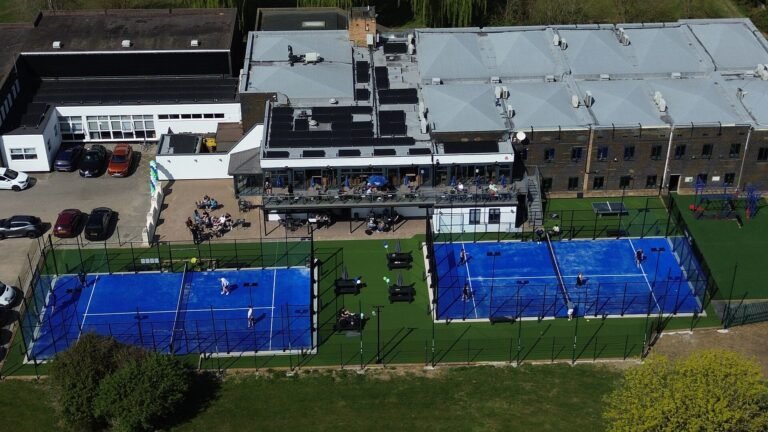
Head’s padel range turns over fast — a signature Coello line has arrived, the Radical has been rebuilt around a new mold, and yesterday’s comfort lines have quietly rotated out. Every racket below is in the current range and had its spec sheet — shape, weight, balance, face and core — verified against Head’s own product copy at build. No discontinued models, no specs from memory: just the seven Head rackets worth your money in 2026, mapped by the level they actually suit.
TL;DR — The short answer
Head organises its range by intent: Gravity is the round control line, Extreme and the new signature Coello line are the diamond power lines, and Radical and Speed are the teardrop all-court lines — Radical leaning control, Speed leaning power. The headline racket is the Coello Pro, built with world No.1 Arturo Coello: a 370 g diamond with the highest balance here. The most broadly recommendable flagship is the Gravity Pro (round, Control Foam, the biggest head on this page). Improving players should start at the light end — Gravity Motion at 355 g or the 340 g Gravity Team Light — and graduate up the weight ladder. Chasing an all-brand shortlist instead? Our best padel rackets pillar ranks the best of every brand side by side; this page is the deep dive for players who have already decided on Head.
Head Coello Pro
Arturo Coello’s signature diamond: 370 g, a 272 mm balance and red Power Foam. The most powerful racket Head sells.
Head Gravity Pro
The round flagship: a 498 cm² head, Control Foam and an even, predictable response built for rally control.
Head Radical Pro
A 370 g teardrop on a strikingly low 260 mm balance — heavyweight mass that moves like a light racket.
Head Extreme Pro
The heaviest Extreme: a UD carbon diamond with the biggest power head here, 494 cm² of it.
Head Speed Motion
Ari Sánchez’s endorsed model — the light, 355 g Speed Pro brief for players who accelerate the game.
Head Gravity Team Light
340 g, round and fiberglass-soft: the lightest racket in the Gravity range and the friendliest way in.
On this page
- How Head’s 2026 range is organised
- 1. Head Coello Pro — Arturo Coello
- 2. Head Gravity Pro — control flagship
- 3. Head Radical Pro — versatile control
- 4. Head Extreme Pro — pure power
- 5. Head Speed Motion — Ari Sánchez
- 6. Head Gravity Motion — improving players
- 7. Head Gravity Team Light — beginners moving up
- Comparison table
- Head shapes and weights, mapped
- Which Head matches your level?
- FAQs
How Head’s 2026 range is organised
Read Head’s catalogue as a map with two axes. The first axis is shape: round rackets (Gravity) put the sweet spot low and central and forgive off-centre contact; diamond rackets (Coello, Extreme) move the sweet spot up and out and pay for it with leverage on overheads; teardrops (Radical, Speed) split the difference. The second axis is foam: Head’s Power Foam cores are reactive and lively, built to return energy on fast, attacking swings, while its Control Foam cores are denser and calmer, built to hold the ball a fraction longer and place it. Nearly every buying mistake with this brand comes from reading one axis and ignoring the other — a diamond with a soft brief and a round racket with a lively core both exist in this range, and they play nothing alike.
The Coello line is the new headline. For 2026, Arturo Coello — the world No.1 whose name was previously attached to the Gravity story — has his own signature collection, built, in Head’s words, on the award-winning DELTA PRO platform: diamond molds, high balances, Power Foam, and his crown logo and signature on the face. Below the Pro sit the Coello Motion and Coello Team, lighter and softer rungs of the same power ladder. If you followed Coello expecting a control racket, update the mental map: his name now sits on the most attacking rackets Head makes.
Extreme remains the power line without a signature. Diamond shapes, Power Foam and unidirectional carbon faces, pitched at tournament attackers who want the power brief without paying for a player’s name — and, as the Extreme Pro card shows, with a usefully larger head than the Coello flagship. Speed is the versatile line that leans attacking: teardrops with Power Foam and hybrid woven faces, endorsed at the top by Ari Sánchez, for players who defend in lobs and finish at the net in the same rally. Radical is the versatile line that leans the other way — teardrops again, but Control Foam, double carbon faces and, in the 2026 Pro, the lowest balance on this page. Two teardrop lines that look interchangeable on a shelf are, on the spec sheet, opposite answers to the same question.
Gravity is the control line, and it is also the ladder. No other Head family spans the full journey from first serious racket to tour flagship: Team Light at 340 g for beginners moving up, Team at 360 g (from MisterPadel’s current listing), Motion at 355 g with a fiberglass face, and the Pro at the top. That makes Gravity the natural home for improvers — you can climb three rungs without ever changing shape, balance point or family feel. Below everything sit the entry lines (Vibe, Evo, Bolt): honest starter rackets, but not what this guide is for — a player choosing between brands at the serious end should compare this page with our brand-guide sibling, the Kuikma padel rackets review, which maps Decathlon’s range the same way.
Head Coello Pro
Played by: Arturo Coello — World No.1
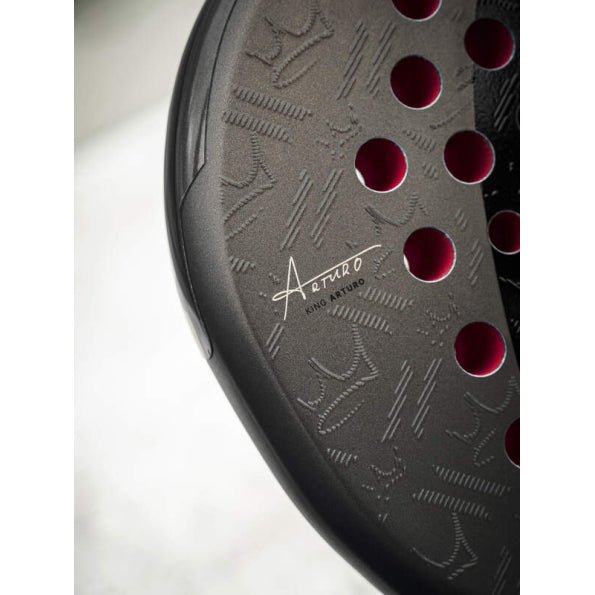
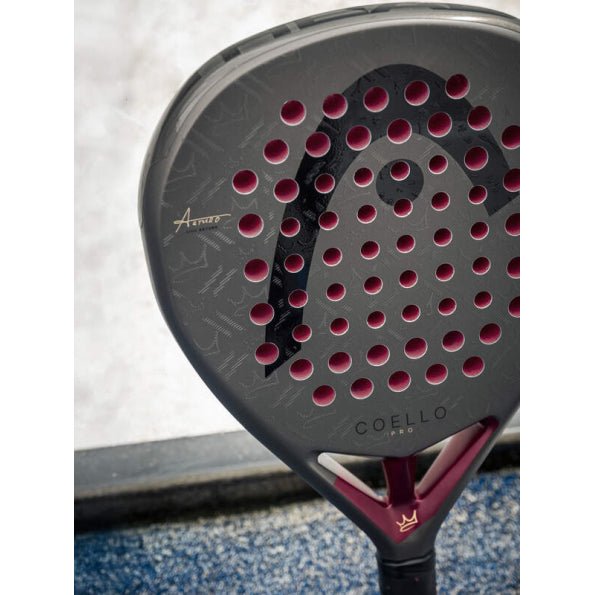
Head’s most powerful racket, designed in collaboration with the most powerful player in the sport. A 370 g diamond with a 272 mm balance — the highest on this page — a carbon hybrid face and a core of upgraded Power Foam that Head makes in red, because red is Coello’s colour. Everything about the spec points the same way: mass high, sweet spot high, response instant.
The lineage matters. Head is explicit that the Coello Pro is an evolution of its DELTA PRO, long the brand’s hardest-hitting mold, and the 2026 update trims 5 g from the previous generation while keeping the heavyweight brief intact. The engineering is aimed at one phase of the game: overheads and net pressure. A 272 mm balance moves mass towards the top of the frame, so a smash, víbora or x3 arrives with leverage the player did not have to manufacture; the Power Stabilizer in the throat keeps that mass from twisting the frame on off-centre smashes, and Auxetic 2.0 — Head’s responsive yoke-and-grip construction — feeds back feel that a frame this stiff would otherwise mute. The carbon hybrid face blends carbon’s pop with fiberglass’s give, and the Extreme Spin 3D decal texture is there to grip the ball on sliced overheads, not decorate it.
Read the one number that argues back: 475 cm² is the second-smallest head on this page. A diamond’s sweet spot is small and high by geometry, and Head has not cheated that geometry — it has optimised the drilling pattern around it and trusted the buyer. That is the honest deal this racket offers: in exchange for the most authoritative overhead game in the range, you accept the least margin for error in it. For an advanced left-side player whose technique is grooved and whose arm is strong, that trade is the entire point. For anyone still building a swing, it is a warning label — the Motion and Team versions lower in Coello’s own line exist precisely so the signature is not all-or-nothing, and the Gravity ladder below is a better school.
Why it tops the range
- Highest balance here (272 mm) = maximum overhead leverage
- Reactive Power Foam and carbon frame for instant response
- Extreme Spin texture grips sliced overheads and víboras
- Auxetic 2.0 keeps feel alive in a very stiff frame
The amateur catch
- 475 cm² head is the least forgiving in the power tier
- 370 g, head-heavy: punishes late preparation in defence
As an Amazon Associate we earn from qualifying purchases.
Head Gravity Pro
Played by: Bea González — the control flagship
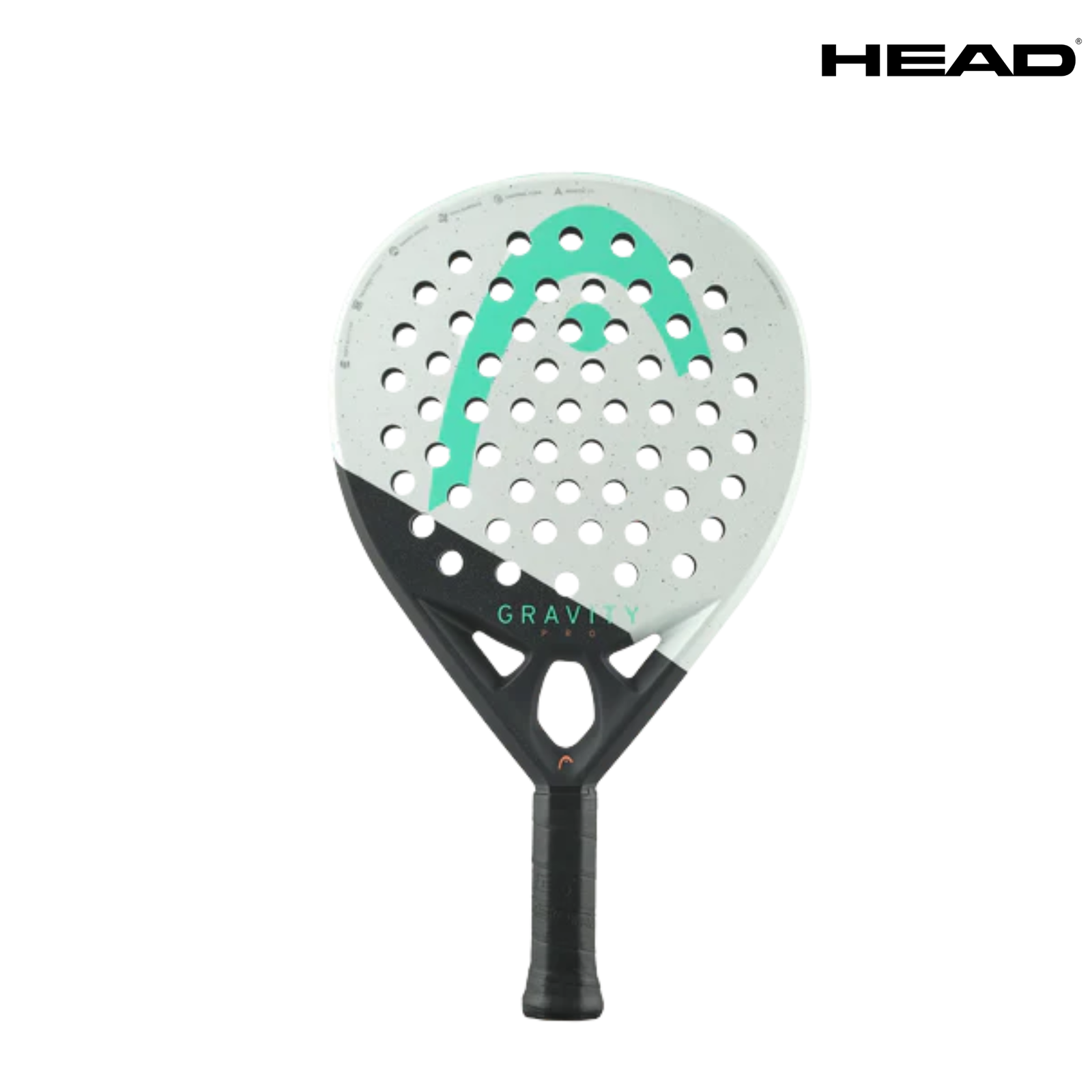
The round flagship of the control line — and the Head racket we would hand to the widest range of serious players. Its 498 cm² head is the biggest on this page, its Control Foam core is the calmest flagship brief Head sells, and its flip design (a different colourway on each face) has made it the most recognisable control racket on the women’s tour, where current listings name it as Bea González’s signature racket.
First, the generational warning from the verification note, because it changes what you should buy. The Gravity Pro has been refreshed: the original version (370 g, 270 mm balance, plain carbon face) still sits in some retailer stock alongside the current 2024 model carded here — 365 g, a 265 mm balance, a hybrid woven face and a Control Foam core. Same name, two spec sheets. The 2024 brief is the better control racket: the hybrid woven surface blends carbon’s accuracy with fiberglass’s dwell, the lower balance keeps the big head quick in defensive scrambles, and Control Foam — the core Head’s own foam guide assigns to this racket — lengthens contact so placement shots like the chiquita and the bandeja can be steered rather than merely struck. Check the listing’s weight and balance before you buy; if it says 370 g and 270 mm, you are looking at the older frame.
On court, the geometry is the argument. A round shape puts the sweet spot in the middle of the biggest face Head makes, so the defensive game — blocks off the glass, lobs under pressure, resets from the back corners — runs on margin rather than perfection, and the 265 mm balance means 365 g never feels like a burden at the net. What the Gravity Pro will not do is finish points for you: with no head-heavy leverage and a foam brief tuned for dwell, the smash is the shot you place rather than the shot you detonate. That is not a flaw; it is the definition of the control brief, and it is why this is the card we point right-side players and rally-builders at first. Players who outgrow it do not outgrow the family — they move sideways to the Radical Pro’s sharper teardrop, not out of the Gravity idea of the game.
Why control players choose it
- Biggest head here (498 cm²) = the flagship with real margin
- Control Foam dwell steers placement shots under pressure
- 265 mm balance keeps 365 g quick in defensive scrambles
- Hybrid woven face balances accuracy with comfort
The amateur catch
- Least free power of the flagship tier — smashes are placed, not detonated
- Two generations share the name: verify 365 g / 265 mm before buying
As an Amazon Associate we earn from qualifying purchases.
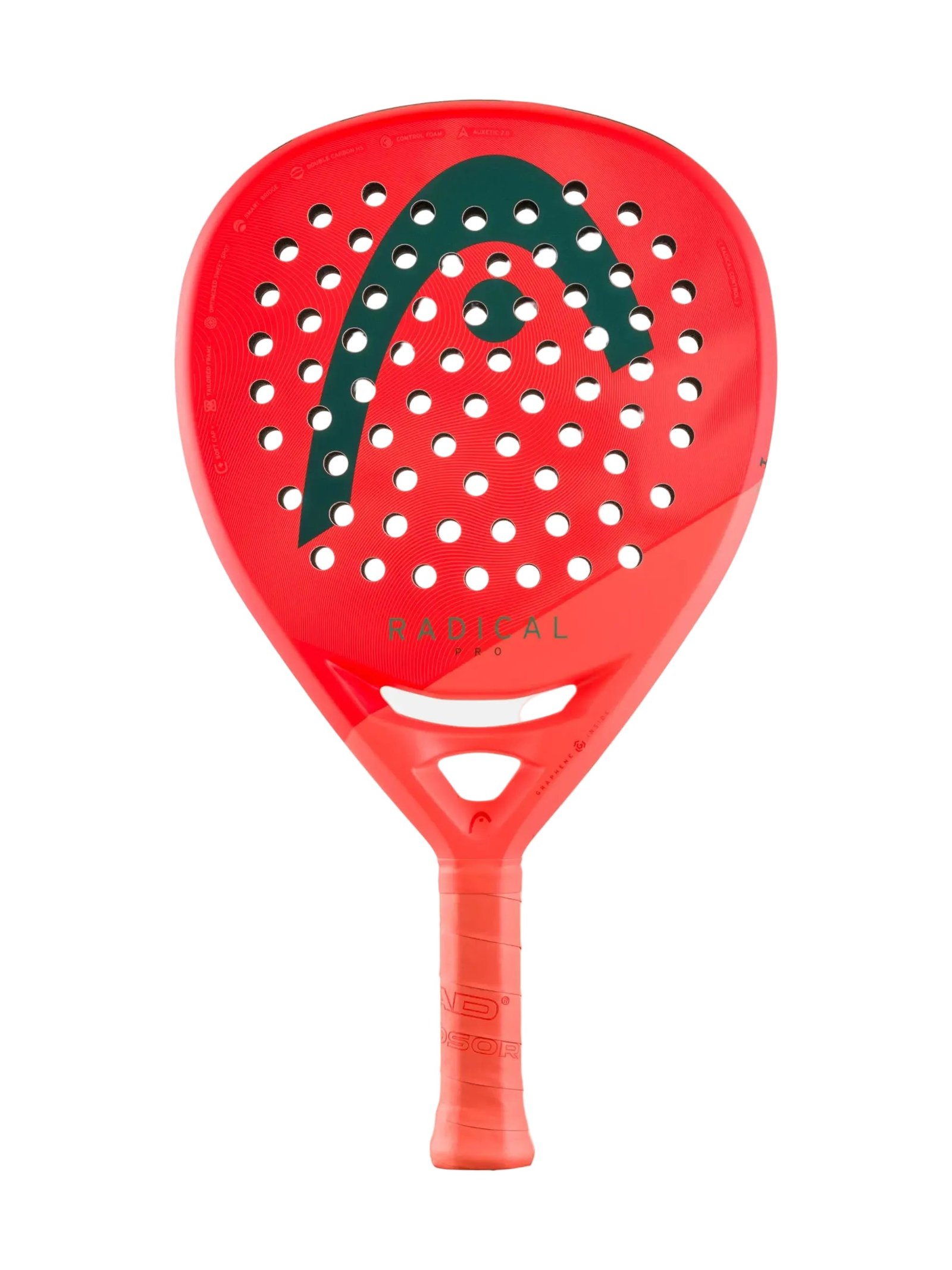
Head Radical Pro
For: tactical players who control the game’s timings
The most unusual spec sheet on this page. The Radical Pro carries a full 370 g — the heaviest tier Head sells — on a balance of just 260 mm, the lowest here by a clear margin. Mass without head-heaviness: a teardrop built for the player who wins by controlling rhythm, and the heaviest model in a Radical range rebuilt for 2026 around an entirely new mold.
The physics of that pairing is the whole review. Balance, not static weight, is what your forearm fights in fast exchanges — and at 260 mm the Radical Pro swings far lighter than its 370 g suggests, while still delivering a heavy racket’s stability and plough-through when you do commit to a drive or a block volley. Head pairs the geometry with a Double Carbon face for a firm, precise response and an improved Control Foam that Head describes as giving a drier, stiffer impact feel than the softer cores — this is a racket that tells you exactly what the ball did. A Smart Bridge stiffens the throat, a new drilling pattern stretches the sweet spot, and Auxetic 2.0 handles feel. Head’s own positioning is unusually specific: radical control, for tournament players with a tactical style who control the timings and rhythm of the ball. Both-sides players — the ones who defend the rally and then steal the net — are exactly who that sentence describes.
The costs are printed on the same spec sheet. At 461 cm², this is the smallest head in the guide — smaller even than the Coello Pro’s — so the forgiveness budget is spent entirely by the low balance, and sloppy contact is reported, not rescued. And the face is smooth: there is no Extreme Spin texture here, so sliced overheads get their bite from your technique and the double carbon’s response, not from the surface. Buy the Radical Pro if your game is already built on timing and your errors are tactical rather than technical. If your contact wanders, the Gravity Pro above gives you nearly the same control idea with 37 cm² more head to land it on.
Why tactical players choose it
- 260 mm balance makes 370 g move like a light racket
- Double Carbon face gives a firm, precise, honest response
- Mass delivers stability and plough-through on committed swings
- New drilling pattern stretches a small head’s sweet spot
The amateur catch
- 461 cm² is the smallest head here — contact must already be clean
- Smooth face: spin comes from technique, not texture
As an Amazon Associate we earn from qualifying purchases.
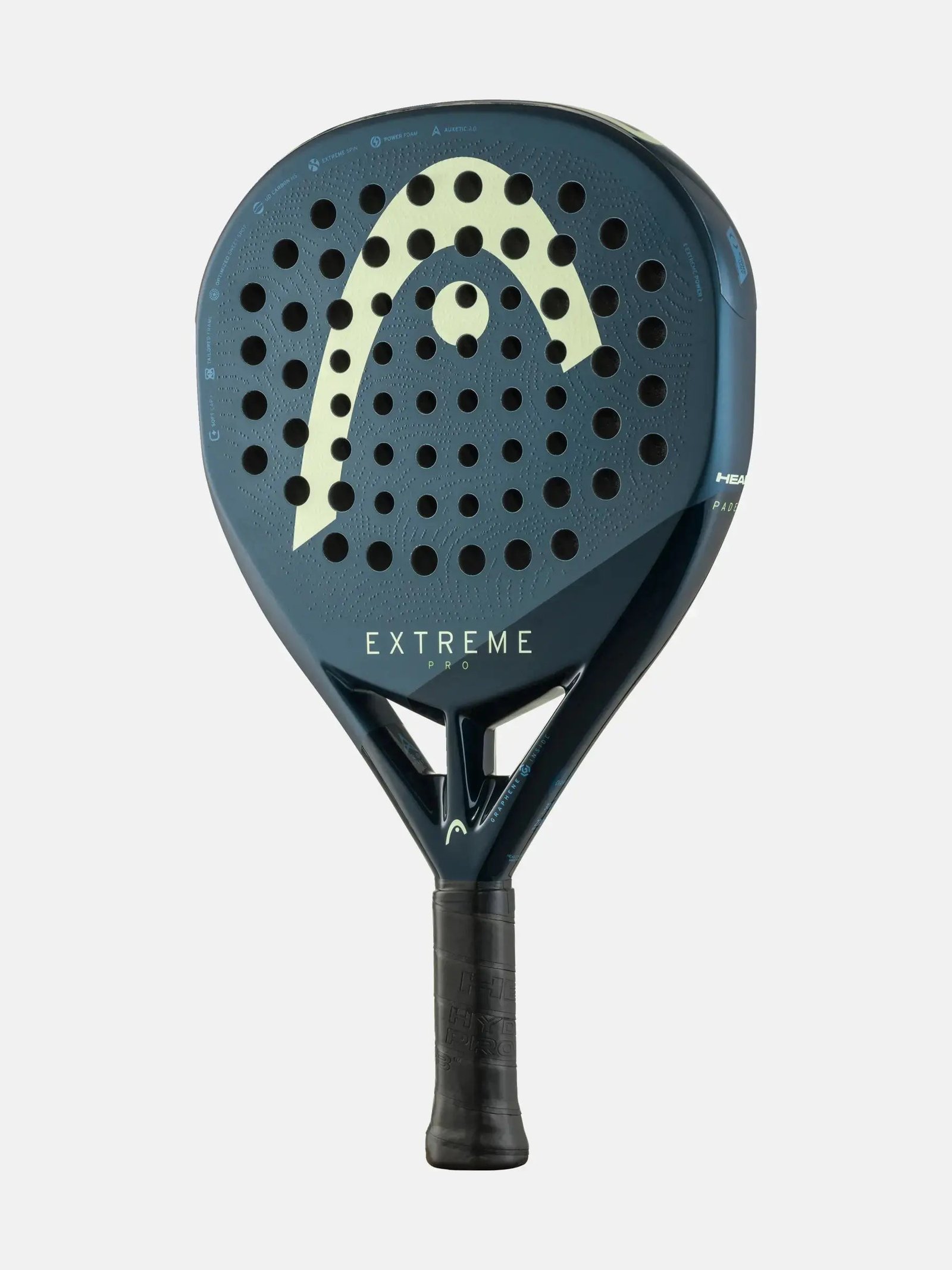
Head Extreme Pro
For: tournament attackers — the heaviest racquet in the Extreme series
The power brief without the signature tax. The Extreme Pro matches the Coello Pro gram for gram — 370 g, diamond mold, Power Foam — then quietly fixes the flagship’s biggest compromise: its head is 494 cm², a full 19 cm² larger, so the power comes with measurably more margin. Head calls it the heaviest racquet in the Extreme series, built to maximise the force a tournament player’s swing generates.
The face is the story. Where the Coello Pro uses a carbon hybrid, the Extreme Pro lays a unidirectional (UD) carbon layer on the hitting surface — fibres running one way to stiffen the face and convert swing into ball speed with minimal flex loss — over the same reactive Power Foam brief, with Auxetic 2.0 for feedback and the Extreme Spin texture for grip on the ball. A new drilling pattern redistributes the sweet spot for the bigger head, and the Soft Cap + butt cap with its exchangeable cord system handles comfort and customisation. The balance, 270 mm, sits a fraction below the Coello’s 272 mm — on paper a rounding difference, in the hand the second small mercy after the head size.
So why does it rank below the flagship it arguably out-thinks? Because the last few percent are real: the Coello’s carbon frame, Power Stabilizer and smaller, higher sweet spot make it the sharper instrument at the very top of the game, and players shopping this tier usually know which side of that trade they live on. The Extreme Pro is the recommendation for the larger group — advanced attackers who want Head’s full power brief in its most usable form. The cautions are the tier’s usual ones, and they are not small print: a stiff UD carbon face transmits more vibration than the hybrid faces on this page, so arm-sensitive players should look at the Motion models; and 370 g at a 270 mm balance will still expose slow preparation in defence, whatever the head size.
Why power players choose it
- 494 cm² head — the most margin in the power tier
- UD carbon face converts swing to ball speed with minimal flex loss
- Same 370 g / Power Foam brief as the flagship, no signature premium
- Extreme Spin texture and Auxetic 2.0 feel, as on the Coello
The amateur catch
- Stiff UD carbon transmits vibration — not the arm-sensitive choice
- Still a 370 g head-heavy diamond: defence exposes slow hands
As an Amazon Associate we earn from qualifying purchases.
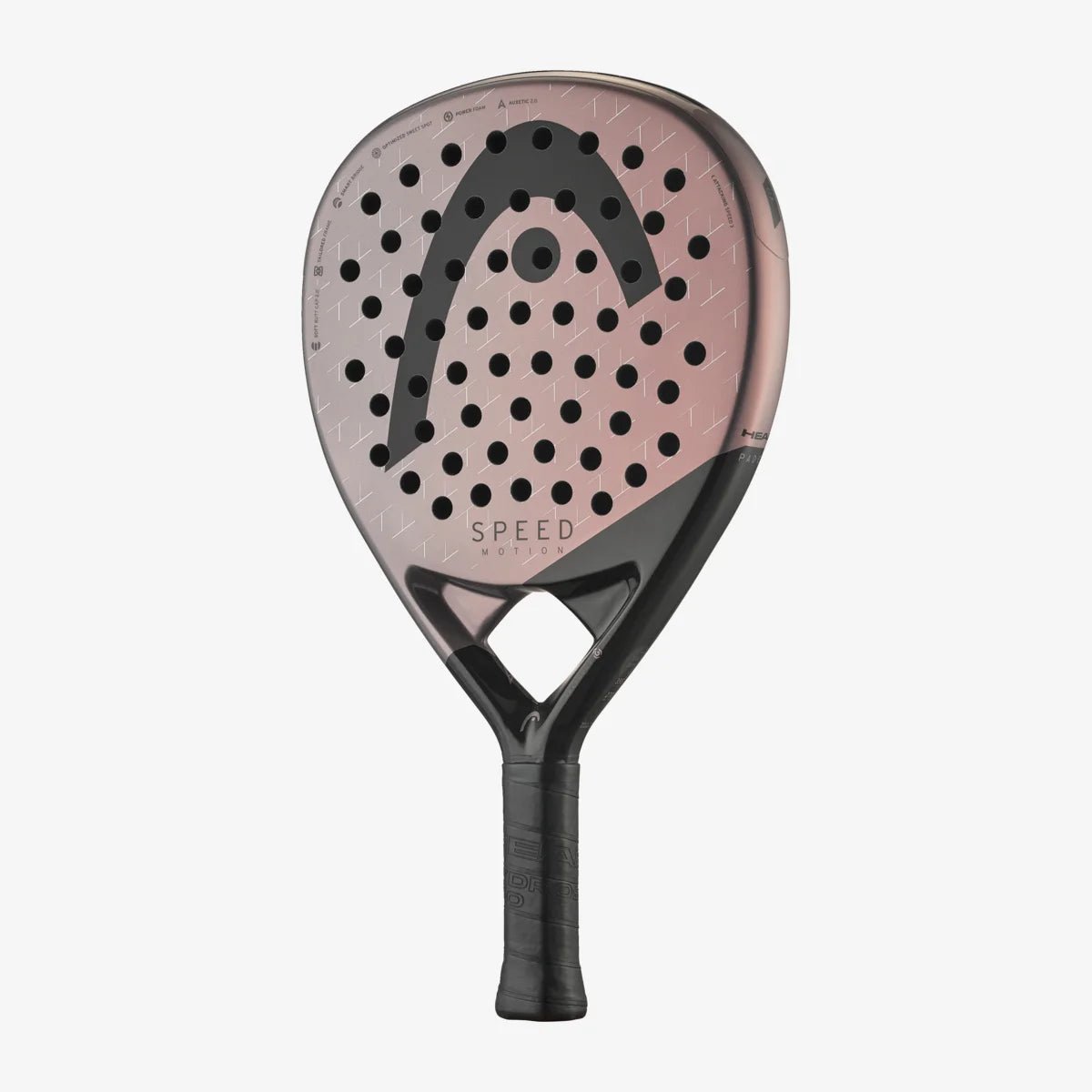
Head Speed Motion
Endorsed by: Ari Sánchez — the light version of the Speed Pro
Head’s own description is the review in one line: the Speed Motion is the light version of the Speed Pro, endorsed by Ari Sánchez, for advanced and tournament players who want to accelerate the game. It takes the Speed brief — teardrop, Power Foam, hybrid woven face — and cuts it to 355 g, the weight at which fast hands start beating heavy ones.
The engineering splits the difference intelligently. The hybrid woven face — carbon fibre and fiberglass woven together — keeps carbon’s pop for volleys and overheads while fiberglass takes the harsh edge off defensive contact, and Power Foam keeps the response lively at the 355 g weight, so the ball still leaves the face with pace on a shorter swing. Auxetic 2.0 runs in both the yoke and the grip’s middle bar, which is why a light racket can still feel connected rather than hollow. The 270 mm balance is the tell that this is not a control racket in disguise: the mass it does carry sits relatively high, so the Speed Motion defends by speed — getting the racket there early — rather than by absorption.
Who is it for? The all-court player whose game is transitions: lob, sprint, volley, bandeja, repeat — and who found the 370 g tier costing them the third and fourth shots of every exchange. Sánchez’s endorsement is not decoration here; her game is the template, built on anticipation and racket speed rather than mass. The honest limits follow from the same spec: 355 g ploughs through a heavy ball less authoritatively than the Pro tier, so block-defence against genuine power is work, and a Power Foam core at this weight can feel lively — almost jumpy — for players whose instinct is to slow a rally down. Those players are better served one card down the page, by the Gravity Motion’s calmer brief at the identical weight.
Why all-court players choose it
- 355 g with a 270 mm balance = the fastest hands in the advanced tier
- Hybrid woven face blends carbon pop with fiberglass comfort
- Power Foam keeps short swings producing pace
- Auxetic 2.0 in yoke and grip keeps a light frame feeling connected
The amateur catch
- Less plough-through: blocking genuine power is work at 355 g
- Lively core can feel jumpy for players who slow rallies down
As an Amazon Associate we earn from qualifying purchases.
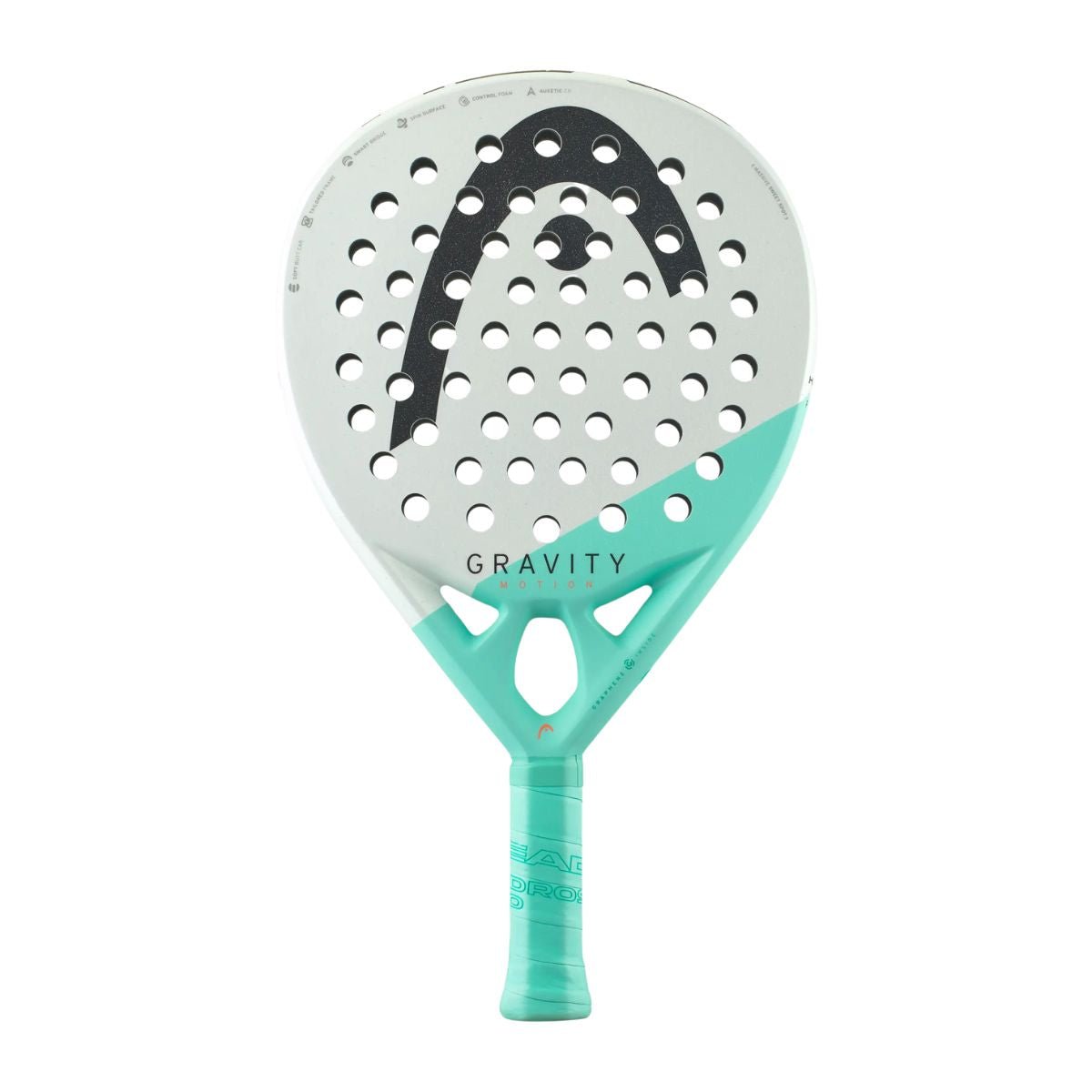
Head Gravity Motion
For: intermediate-to-advanced players who control the game
The Gravity brief translated for the climb: same 498 cm² round head and Control Foam core as the Pro, 10 g lighter, with a fiberglass face that trades the flagship’s crispness for comfort and easy power. This is the rung of the ladder where most improving players should actually stand.
Everything that makes the Gravity Pro recommendable survives the translation. The 498 cm² head is shared with the flagship, so the defensive margin — the thing an improving player uses most — is identical, and the Control Foam core keeps the dwell-and-place character intact. What changes is the face and the weight: fiberglass flexes more than the Pro’s hybrid woven surface, which returns easy power at the slower swing speeds of a developing game and takes sting out of off-centre contact, while 355 g on the same 265 mm balance makes the racket quicker to reposition between shots. Head adds a rough Spin Surface lacquer for ball grip — a genuinely useful inheritance at this level, where sliced bandejas are being learned — plus Auxetic 2.0 and the Soft Butt Cap for comfort. Retailer level labels for this model range from intermediate to advanced/tournament; the honest summary is that it serves the whole middle of the game.
The ceiling is the fiberglass itself. As swing speed and opposition pace rise, a flexible face stops returning what a stiffer one would: blocks start to float, and the extra dwell that felt like control starts to feel like delay. That is not a reason to skip this card — it is the definition of a stepping-stone racket, and Head has priced and specced the ladder so the step up to the Gravity Pro changes the face and the weight, not the shape, the balance or the feel you have grooved. Players who know they will play twice a month for years can stop here happily. Players on a steep improvement curve should treat the Motion as the two-season racket it is designed to be.
Why improving players choose it
- Flagship-size 498 cm² head and Control Foam brief, at 355 g
- Fiberglass face returns easy power at developing swing speeds
- Spin Surface texture helps while sliced shots are being learned
- Same shape and balance as the Pro — the step up changes nothing you grooved
The amateur catch
- Fiberglass ceiling: hard hitters outgrow the face’s response
- Blocks can float against genuine pace
As an Amazon Associate we earn from qualifying purchases.
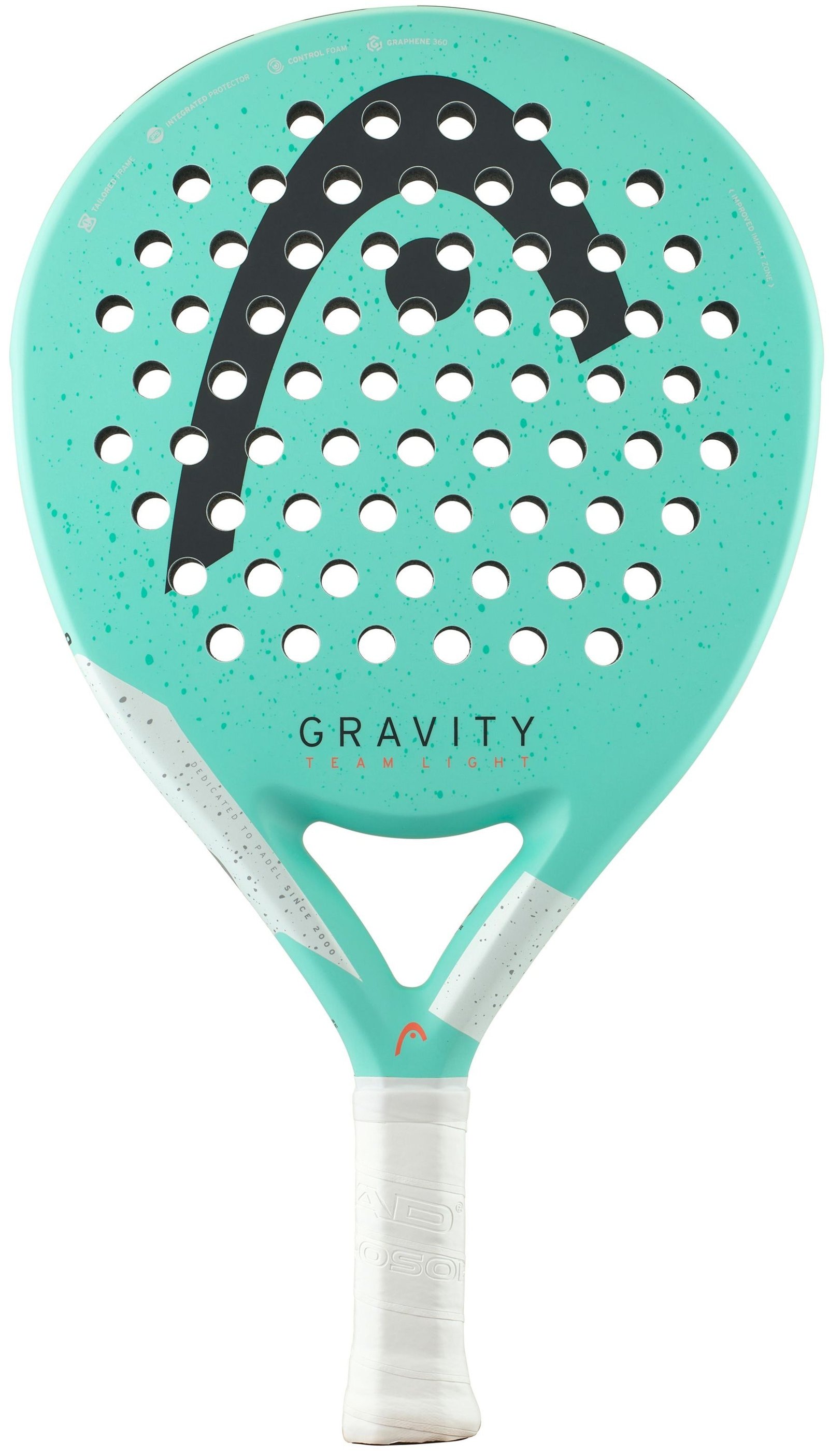
Head Gravity Team Light
For: beginners and casual players — the lightest racket in the Gravity range
At 340 g, this is one of the lightest adult padel rackets Head sells — a round, fiberglass-faced, Control Foam racket engineered so that a new player’s first serious purchase teaches technique instead of compensating for its absence. If your current racket is a holiday rental or a supermarket special, this is the step up.
The design logic is a beginner’s checklist, answered in order. Weight first: 340 g with a full-size 490 cm² round head means the racket gets into position at the speed a new player’s feet do, and long rallies teach footwork instead of forearm fatigue. Face second: fiberglass over Control Foam is the softest combination in the Gravity family — contact feels plush, off-centre hits still leave the face in a playable direction, and the ball stays on the strings long enough to aim. Survival third: the Integrated Protector System is a pre-moulded carbon bumper across the top of the frame, there because Head knows what a first season does to a racket’s edges — glass, mesh and partner clashes are tuition every beginner pays, and the bumper pays it in plastic rather than in frame. The frame runs on Head’s Graphene 360+ platform rather than the newer Auxetic 2.0 construction — an honest spec-sheet note that costs nothing in play at this level. One subtlety worth knowing: the 270 mm balance is relatively high for the weight, which quietly helps a new player’s overheads clear the net while the low total mass keeps everything else easy.
Its limits are the mirror of its kindnesses. A 340 g fiberglass racket gets pushed around as the pace rises — there is little mass to absorb a hard drive and little stiffness to redirect it — and the smooth face means spin is something your technique supplies unaided. Fast improvers will feel both within a season or two, which is why the card below it in the ladder (the Gravity Motion, or the 360 g Gravity Team between them) exists. But judged as the thing it is — the first Head racket a beginner moving up should buy — nothing else in the current range does the job as deliberately.
Why beginners moving up choose it
- 340 g: effortless handling that never tires a developing arm
- Softest combination in the range — fiberglass over Control Foam
- Carbon bumper (IPS) survives the first season’s clashes
- Full-size round head keeps the control family’s margin
The amateur catch
- Light and flexible: gets pushed around as opposition pace rises
- Earlier Graphene 360+ platform — no Auxetic 2.0 at this rung
As an Amazon Associate we earn from qualifying purchases.
The seven Head rackets, side by side
Every figure below is the manufacturer’s listing spec, verified at build. Read the table by columns: shape tells you where the sweet spot lives, balance tells you how the weight will feel, and the face-and-core pairing tells you how the ball will leave the racket.
| Model | Shape | Weight | Balance | Head size | Face | Core | Best for |
|---|---|---|---|---|---|---|---|
| Coello Pro | Diamond | 370 g | 272 mm | 475 cm² | Carbon Hybrid | Power Foam | Maximum power — Coello’s signature |
| Gravity Pro | Round | 365 g | 265 mm | 498 cm² | Hybrid Woven | Control Foam | Control — the flagship all-rounder |
| Radical Pro | Teardrop | 370 g | 260 mm | 461 cm² | Double Carbon | Control Foam | Versatile control — tactical players |
| Extreme Pro | Diamond | 370 g | 270 mm | 494 cm² | UD Carbon | Power Foam | Pure power with the most margin |
| Speed Motion | Teardrop | 355 g | 270 mm | 465 cm² | Hybrid Woven | Power Foam | Fast all-court play — Sánchez’s brief |
| Gravity Motion | Round | 355 g | 265 mm | 498 cm² | Fiberglass | Control Foam | Control for improving players |
| Gravity Team Light | Round | 340 g | 270 mm | 490 cm² | Fiberglass | Control Foam | Beginners moving up |
Head shapes and weights, mapped
Head’s range is the cleanest illustration in the sport of how shape and weight divide labour — which is why this page keeps sending you back to the two ideas. Shape sets the ceiling. The round Gravity rackets trade the last word in overhead power for the first word in defensive margin; the diamond Coello and Extreme rackets do the opposite trade; the teardrop Radical and Speed rackets are engineered compromises, separated by foam rather than geometry. Our padel racket shapes guide works through what each mold does to the sweet spot and the swing — read it alongside the table above and every Head family snaps into place.
Weight sets the timetable. Head’s ladder runs in unusually honest steps: 340 g (Team Light) for players still grooving a swing, 355 g (the two Motion rackets) for players whose technique is formed and whose hands are quick, 360–365 g in the middle rungs, and 370 g (the three remaining Pros) for players who can prepare early against real pace. The trap is buying a year ahead of your timetable — a 370 g diamond does not make a beginner powerful, it makes a beginner late. Our padel racket weight guide explains how to choose your step on that ladder, including how overgrips and protectors shift the number after purchase. Two Head-specific notes on top of it: balance can redeem weight (the Radical Pro’s 370 g swings light at 260 mm), and it can spend it (the Team Light’s 270 mm makes 340 g feel purposeful overhead). Weigh the racket, then read its balance before you judge either.
Head padel rackets — FAQs
What is the best Head padel racket overall?
For advanced players, the Coello Pro is Head’s flagship and its most powerful racket. For the widest range of serious players, the Gravity Pro is the better answer: a round 498 cm² head, Control Foam and an even response forgive more and control more. “Best” in this range is a level question — beginners moving up should start with the Gravity Team Light and climb.
Which Head padel racket does Arturo Coello play?
The Head Coello Pro, his signature model, designed in collaboration with him for the 2026 season. It is an evolution of Head’s DELTA PRO platform: a diamond shape, 370 g, a high 272 mm balance, a carbon hybrid face and a Power Foam core, with his crown logo and signature on the face. Lighter versions sit below it in his line — the Coello Motion and Coello Team.
Which Head padel racket is best for beginners?
The Gravity Team Light: at 340 g it is the lightest racket in the Gravity range, with a round shape, a soft fiberglass face over Control Foam and a carbon bumper to survive early clashes. Beginners arriving from other racket sports with an already-formed swing can start one rung up, with the 355 g Gravity Motion.
What is the difference between Head Gravity and Head Radical?
Gravity is the control line: round shapes, big heads (490–498 cm²) and Control Foam, built for defensive margin and placement. Radical is the versatile-control line: teardrop shapes with smaller heads (461 cm² on the Pro), Double Carbon faces and Control Foam, built for tactical players who defend and attack in the same rally. Radical is sharper and less forgiving; Gravity is calmer and more consistent.
Are Head’s Motion rackets worse than the Pro versions?
No — they are lighter, softer rungs of the same families, not cut-down copies. The Speed Motion (355 g) is the light version of the Speed Pro; the Gravity Motion keeps the Pro’s 498 cm² head and Control Foam with a fiberglass face. Choose a Motion if 370 g costs you racket speed or your arm prefers a softer face; choose a Pro if you can prepare early against real pace and want the stiffest response.
How heavy should a Head padel racket be?
Head’s ladder runs 340 g (Team Light, beginners), 355 g (Motion models, intermediates and fast advanced players), up to 365–370 g (Pro models, advanced players with early preparation). Balance modifies the number: the Radical Pro’s 370 g swings light on a 260 mm balance, while the Coello Pro’s 370 g at 272 mm is the heaviest-feeling racket here. When in doubt, buy the lighter racket — you can add an overgrip, not remove mass.
Gravity Pro or Extreme Pro — which should I choose?
They are opposite briefs at similar weights. The Gravity Pro (round, 365 g, Control Foam) maximises margin and placement for rally-builders and right-side players. The Extreme Pro (diamond, 370 g, Power Foam, UD carbon) maximises overhead power for left-side finishers, with a 494 cm² head that keeps it the most forgiving of Head’s power rackets. Choose by the side of the court you play and the shots that win your points.
Which Head padel racket is kindest to a sensitive arm?
The soft constructions: the Gravity Motion and Gravity Team Light pair fiberglass faces with Control Foam, the two most forgiving ingredients in the range, at light 355 g and 340 g weights, and every current Head racket carries a soft butt cap to damp the grip end. The stiff UD carbon of the Extreme Pro is the opposite end of the range. Comfort features help, but technique and string-care matter more — and persistent pain is a question for a professional, not a spec sheet.
The verdict
Buy the Gravity Pro if you want the one Head racket that flatters the most games — it is the flagship we would hand to a serious player without asking questions first. Buy the Coello Pro if your overhead game is your identity and your technique can cash what a 272 mm balance writes. Buy the Extreme Pro if you want that power brief with the margin left in. Buy the Radical Pro if you play both sides and win on timing — nothing else in the range feels like it. Buy the Speed Motion if rallies are won by your feet, the Gravity Motion if they are won by your patience, and the Gravity Team Light if you are buying the racket your game will grow out of — proudly, and on schedule. Head’s range rewards honesty about level more than any brand we cover: the right rung of this ladder will feel like it was built for you, and the wrong one will feel like it was built for someone better. Choose the rung you are actually standing on.
Affiliate disclosure: Alishuttler.com is a participant in the Amazon Services LLC Associates Program. The Amazon buttons on this page use our affiliate tag — if you buy through them, we may earn a commission at no extra cost to you. Prices shown on Amazon are live and may differ from any figures mentioned here.