
Decathlon’s in-house padel brand puts carbon faces, pro-co-developed designs, and lab-tested engineering into rackets priced around €100. Here is every model, every verified spec, and how to pick the right one — from the manufacturer’s own data.
TL;DR — The Short Version
- Kuikma is Decathlon’s padel brand, and its newest Dynamic collection (PR Control DYN, PR Hybrid DYN, PR Power DYN) sells for around €100 with carbon faces — a price point where fiberglass used to be the norm.
- All three Dynamic models weigh a light 355g and share Decathlon’s Dynamic Channel aerodynamic frame groove, which the brand says cuts swing effort by 7%.
- Control DYN (round) is built for defensive, control-oriented players. Hybrid DYN (hybrid shape) is the versatile all-rounder, co-developed with pro player Coki Nieto. Power DYN (diamond) is the attacking option.
- Beginners should start with the PR 190 (320g, fiberglass) — the cheapest, most forgiving entry point. Intermediates stepping up can look at the older PR 990 line or the Dynamic range.
- Kuikma rackets are sold through Decathlon — in stores and online — which is both the brand’s strength (price, warranty) and its main limitation (availability).
Quick Navigation
- Who Is Kuikma? The Brand Behind the Rackets
- The Dynamic Collection: Carbon for €100
- PR Control DYN — Specs & Who It’s For
- PR Hybrid DYN — Specs & Who It’s For
- PR Power DYN — Specs & Who It’s For
- The Rest of the Range: PR 190, PR 990 & Pro Models
- Buying Guide: Shape, Weight, Balance & Materials
- Kuikma vs Premium Brands: An Honest Materials Comparison
- Where to Buy Kuikma Padel Rackets
- FAQs
Something unusual happened in the padel equipment market recently: Decathlon started selling carbon-faced padel rackets for around €100. For context, carbon faces have traditionally been the dividing line between budget rackets (fiberglass, roughly €50–80) and serious intermediate frames (usually €150 and up). Kuikma — Decathlon’s dedicated padel brand — erased that line with its Dynamic collection, launched at the Madrid Premier Padel P1 tournament.
This guide is a spec-based review: every specification, player profile, and technology claim below comes from Decathlon’s published product data and the brand’s launch reporting. We have not personally play-tested these rackets, and nothing here pretends otherwise — what you get instead is the complete verified picture, so you can compare models on facts rather than marketing.
If you are new to padel entirely, start with our padel rules guide and our best padel rackets overview before choosing a specific frame.
Who Is Kuikma? The Brand Behind the Rackets
Kuikma is Decathlon’s in-house padel brand — the same way Artengo is Decathlon’s tennis brand. Being developed inside the world’s largest sporting goods retailer gives Kuikma two unusual advantages: enormous R&D resources, and a direct-to-player retail model with no middlemen inflating the price.
The brand has spent the last few years moving deliberately upmarket. Early Kuikma rackets were simple beginner frames; the current lineup spans genuine beginner rackets through tour-adjacent pro models. Three developments mark how serious the brand has become:
- Pro ambassadors. Spanish professional Coki Nieto — ranked inside the world’s top 10 — is Kuikma’s headline ambassador and plays the Kuikma Hybrid Pro. Other Kuikma players on the professional circuit include LucÃa Sainz, Clément Geens, and Dylan Guichard.
- Co-development with pros. The Hybrid Carbon was co-developed with Coki Nieto, and the PR 990 Hybrid Soft was developed with coach and former player Horacio Ãlvarez Clementi. This is the same playbook premium brands use — tour feedback shaping retail frames.
- Independent lab testing. Testea Sport Lab has laboratory-tested Kuikma’s racket range across power, control, sweet spot, maneuverability, and comfort metrics, producing player-profile recommendations for models like the Control Carbon, Hybrid Carbon, and Power Carbon. Few sub-€150 rackets get this level of third-party scrutiny.
The Dynamic Collection: Carbon for €100
The Dynamic collection is Kuikma’s headline range: three rackets — PR Control DYN, PR Hybrid DYN, and PR Power DYN — unveiled at the Madrid Premier Padel P1 as the embodiment of Decathlon’s “Accessible Premium” philosophy. The launch price was set at €100 (listed at £89.99 in the UK), deliberately positioned to disrupt a category where carbon construction typically starts much higher.
All three models share a common technical platform:
| Feature | Dynamic Collection Spec |
|---|---|
| Weight | 355 g (all three models) |
| Face material | Carbon 3K (visible carbon weave on the racket face) |
| Frame tech | Dynamic Channel — aerodynamic frame groove |
| Surface | Rough texture for spin |
| Core | Black EVA foam (density varies by model) |
| Launch price | €100 (UK: £89.99) — check current price |
Two of these technologies deserve explanation. Carbon 3K refers to a carbon fiber weave made of 3,000-filament bundles — the standard “visible weave” carbon you see on mid-range performance rackets. Its presence at this price is the collection’s headline: previously, sub-€100 rackets were almost exclusively fiberglass.
Dynamic Channel is Decathlon’s aerodynamic frame groove, designed to improve maneuverability. Decathlon states that it cuts swing effort by 7% — a manufacturer claim, not an independently verified figure, but the design intent (a faster-feeling frame at a light 355g weight) is consistent across all three models’ product pages, which emphasize handling and movement speed.
The three models differ in shape and playing character. Shape is the single most important choice you’ll make — so let’s take each one in turn.
PR Control DYN — Specs & Who It’s For
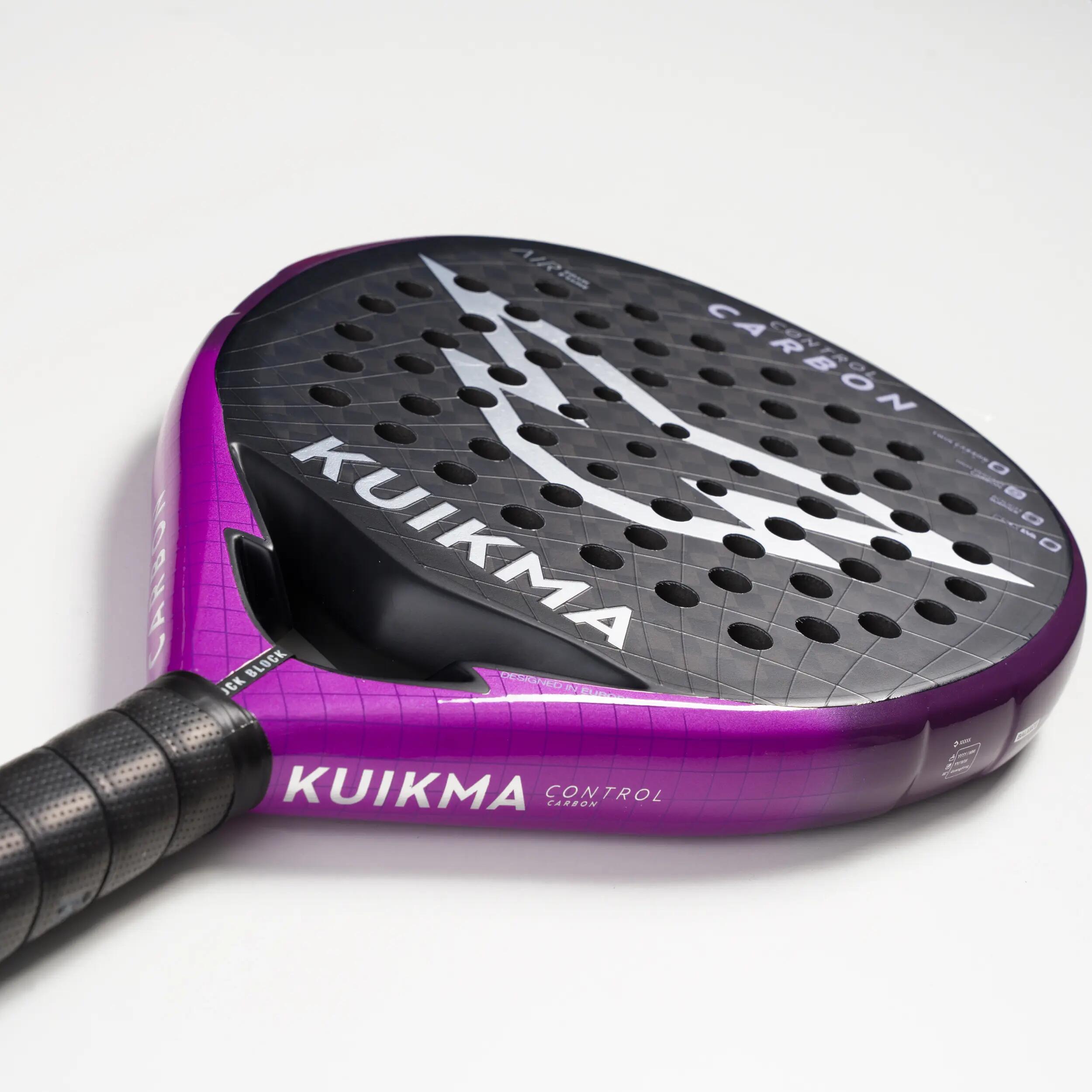
Kuikma PR Control Carbon Dynamic
Decathlon positions the Control DYN as “the ultimate precision weapon for expert defenders” — a round-shaped racket with a wide sweet spot, built for players who win points through placement and patience rather than raw power.
The round shape centers the sweet spot in the middle of the face, which makes off-center hits more forgiving — the defining trait of control rackets. Decathlon pairs this with a low-density EVA core and a “soft touch” layup the brand says absorbs vibrations, plus the Dynamic Channel frame for maneuverability. The result on paper is the most comfortable, easiest-handling racket of the three.
Round shape · 355 g · Carbon 3K face · low-density EVA — Decathlon’s control model in the Dynamic range.
Free returns · Prime shipping on eligible orders
PR Hybrid DYN — Specs & Who It’s For
Kuikma PR Hybrid Carbon Dynamic
The Hybrid DYN is the range’s all-rounder — and its most credentialed model. Decathlon describes it as the racket for players who refuse to choose: “Defend, build, and attack!” It was co-developed with Coki Nieto, whose name appears on the frame, and it sits between the forgiving Control and the aggressive Power in Kuikma’s lineup.
The hybrid (teardrop) shape moves the sweet spot slightly higher on the face than a round racket, adding attacking potential without the demanding head-heaviness of a diamond. Decathlon lists a centered balance for maneuverability and a Black EVA core for a firmer, more energetic response than the Control’s low-density foam. Independent press coverage of the range notes the Hybrid as the “chameleon” of the three — the model that adapts to the widest range of playing styles.
Hybrid shape · 355 g · Carbon 3K face · centered balance — co-developed with Coki Nieto, the range’s all-rounder.
Free returns · Prime shipping on eligible orders
PR Power DYN — Specs & Who It’s For
Kuikma PR Power Carbon Dynamic
The Power DYN is the attacking end of the range: a diamond shape with a Black EVA core, built for players who finish points at the net. Diamond rackets concentrate mass toward the top of the frame, which adds leverage to smashes and aggressive volleys — at the cost of a smaller, higher sweet spot that punishes mishits.
What makes the Power DYN unusual is the combination: diamond power geometry at only 355g with an aerodynamic frame. Traditional diamond rackets are among the heaviest, most demanding frames in padel; Kuikma’s light weight and Dynamic Channel groove are designed to keep this one maneuverable. That said, the physics of the shape don’t change — a diamond is still the least forgiving of the three shapes, and Decathlon’s own range positions it for attacking players rather than beginners.
Diamond shape · 355 g · Carbon 3K face · Black EVA — the attacking model in the Dynamic range.
Free returns · Prime shipping on eligible orders

The Rest of the Range: PR 190, PR 990 & Pro Models
The Dynamic collection is Kuikma’s headline act, but it’s not the whole catalog. Understanding the rest of the range helps you avoid the most common buying mistake: paying for carbon you don’t need yet, or buying a demanding frame as your first racket.
PR 190 — The True Beginner Racket
The Kuikma PR 190 is where most players should actually start. It’s a fiberglass (not carbon) racket, and that’s a feature at this level, not a flaw: fiberglass is softer and more forgiving than carbon, which helps when your technique is still developing.
| Spec | Kuikma PR 190 |
|---|---|
| Weight | 320 g (± 7 g) |
| Shape | Round |
| Balance | Low (head-light) — easy handling |
| Face material | Fiberglass |
| Construction | Full EVA — single-piece EVA foam core with composite surface (a Decathlon-exclusive construction) |
| Target player | Beginners (Decathlon’s stated design brief) |
At 320g it’s noticeably lighter than the 355g Dynamic models, and the round shape plus low balance make it the easiest Kuikma to swing. Decathlon’s “Full EVA” construction — a single piece of EVA foam covered with a composite fiber surface — is designed to enlarge the sweet spot and forgive off-center hits. If you’ve never held a padel racket, start here, not with carbon.
Round shape · 320 g · fiberglass face · Full EVA — Decathlon’s beginner racket, the right first purchase for new players.
Free returns · Prime shipping on eligible orders
PR 990 — The Established Intermediate Line
Before the Dynamic collection, the PR 990 was Kuikma’s core performance line — six rackets built on three shapes with two foam densities:
- Precision (round) — control-oriented
- Hybrid (teardrop) — all-round
- Power (diamond) — attacking
- Each shape in Hard (medium-high density EVA) or Soft (medium-low density EVA)
The best-documented model is the PR 990 Hybrid Soft, developed with Horacio Ãlvarez Clementi. Its published spec sheet: 362g, teardrop shape, 265mm balance, 38mm profile, a face of 3 fiberglass layers plus 1 layer of Carbon 12K, soft EVA core, twin-tube carbon frame, and a rough surface for spin. Decathlon positions it for advanced players wanting a powerful but forgiving frame.
Another reference point: the PR 990 Precision Hard (round, 375g, head-light balance, carbon-and-fiberglass face, medium-hard EVA) is consistently described by independent reviewers as a control racket for intermediate-and-up players — explicitly not a beginner frame despite the round shape, because the hard core demands clean technique.
Pro & Step-Up Models
Above the Dynamic range sit Kuikma’s premium models. The Hybrid Pro — the racket Coki Nieto actually plays — lists around £149.99 in the UK, with a separate Hybrid Carbon Coki Nieto edition around £109.99. There’s also a PR Power Carbon diamond frame (listed around £129.99 in the UK with a 12K carbon face, twin-tube carbon frame, and medium-density Black EVA) for advanced attackers who want more than the Dynamic range offers. At the budget end, the PR Comfort (around £44.99) covers the absolute entry level.
The practical takeaway: Kuikma now fields a genuine ladder — PR Comfort/PR 190 for beginners, Dynamic for intermediates, Carbon/Pro for advanced players. Buy the rung you’re actually on.
Buying Guide: Shape, Weight, Balance & Materials
Racket specs look like alphabet soup until you know what each one does to the ball. Here’s the plain-English version, using Kuikma’s own models as examples.
Shape: the biggest decision
| Shape | Sweet Spot | Character | Kuikma Example |
|---|---|---|---|
| Round | Large, centered — most forgiving | Control, consistency, defense | PR Control DYN, PR 190 |
| Teardrop / Hybrid | Medium, slightly high | Balanced — the versatile middle | PR Hybrid DYN, PR 990 Hybrid Soft |
| Diamond | Small, high — least forgiving | Power, attacking, smashes | PR Power DYN |
The rule of thumb: beginners should buy round, intermediates should buy hybrid, and only confident attackers should buy diamond. A diamond’s extra power is useless if you can’t find its small sweet spot consistently.
Weight: lighter is easier, heavier hits harder
Padel rackets generally run 340–390g. Kuikma’s range illustrates the spectrum well: the PR 190 at 320g is exceptionally light and easy to swing (ideal for beginners and players with less arm strength), the Dynamic trio at 355g sits in the comfortable middle, and the PR 990 Precision Hard at 375g is a deliberately hefty control frame. All else equal, more mass means more ball output — but also more effort and more stress on the arm over a long session.
Balance: where the weight sits
Balance is measured in millimeters from the handle base — for example, the PR 990 Hybrid Soft’s 265mm balance. Lower numbers mean head-light (weight toward your hand: easier to maneuver, better for defense and quick reactions); higher numbers mean head-heavy (weight toward the top: more power on smashes, harder to whip around). The Dynamic range spans this spectrum by design: Control DYN is head-light, Hybrid DYN is centered, Power DYN is head-heavy.
Core density: soft, medium, or hard EVA
The foam core determines feel and ball output. Soft/low-density EVA (PR Control DYN, PR 990 Soft models) absorbs more vibration and is more forgiving — the ball stays on the face slightly longer, which helps control. Hard/medium-high density EVA (PR 990 Hard models) returns more energy — more power, but a harsher, less forgiving response that demands clean contact. Medium-density Black EVA (Power DYN, PR Power Carbon) splits the difference.
Face materials: fiberglass vs carbon
Fiberglass (PR 190) is softer, cheaper, and more forgiving — the right material for learning. Carbon is stiffer and more responsive: 3K (Dynamic range) is the standard visible-weave carbon of mid-range performance rackets, while 12K (PR 990 Hybrid Soft, PR Power Carbon) uses thicker bundles for a firmer, more premium feel. Carbon gives you more precision and ball output; it also punishes poor technique more than fiberglass does. Don’t buy carbon for prestige — buy it when your technique is consistent enough to benefit.
Kuikma vs Premium Brands: An Honest Materials Comparison
How does a €100 Kuikma actually stack up against rackets costing two to three times more from brands like Adidas, Head, Bullpadel, Nox, or Wilson? Here’s what the spec sheets tell us — and what they don’t.
| Aspect | Kuikma Dynamic (€100) | Typical Premium (€200+) |
|---|---|---|
| Face material | Carbon 3K | Carbon 3K–24K (varies by model) |
| Core | Black / low-density EVA | Multi-density EVA, often layered |
| Frame technology | Dynamic Channel (aerodynamic groove) | Brand-specific systems (varies) |
| Weight | 355 g across the range | 340–390 g depending on model |
| Pro co-development | Yes (Coki Nieto — Hybrid; H. Ã. Clementi — 990) | Yes (standard practice) |
| Independent lab testing | Yes (Testea Sport Lab) | Occasional |
| Warranty | 2 years (Decathlon standard) | Varies by brand (often 1–2 years) |
| Distribution | Decathlon stores & online only | Global multi-retailer |
On materials alone, the gap is narrower than the price gap suggests: Carbon 3K faces, EVA cores, and pro co-development are genuinely comparable to what mid-tier premium rackets offer. Where premium brands typically differentiate is refinement — tighter manufacturing tolerances, more granular model ranges fitted to specific playing styles, tour-level customization, and broader availability with demo programs.
Where to Buy Kuikma Padel Rackets
Kuikma is a Decathlon brand, and Decathlon is its retailer: Kuikma rackets are sold through Decathlon stores and Decathlon’s online shops. You won’t find the current range in general sports retailers — this exclusive distribution is how the brand holds its prices down, but it does mean checking your country’s Decathlon site for availability.
- Europe/UK: Decathlon’s country sites list the full range (the Dynamic models are £89.99 in the UK, €100–110 in Eurozone markets — prices vary by country, so check your local store).
- UAE/Gulf: Kuikma rackets appear in Decathlon-partnered stores — for example, Azadea’s UAE and Lebanon stores have listed the PR 190 and PR 990 Hybrid Soft. Check local Decathlon and Azadea listings for current stock.
- Online marketplaces: Amazon and other marketplaces sometimes carry Kuikma models via third-party sellers — convenient, but verify the seller and compare against Decathlon’s own price first.
Decathlon’s standard 2-year warranty applies, which is straightforward to claim through their stores — a practical advantage over grey-market imports of premium brands.
Frequently Asked Questions
On specifications, yes — they’re unusually strong for the price. The Dynamic range offers carbon faces, a 355g playing weight, and pro co-development at around €100, where competitors typically offer fiberglass. The range has also been independently lab-tested by Testea Sport Lab, and the brand’s ambassador is world top-10 professional Coki Nieto. As with any racket, “good” ultimately depends on whether the shape and weight suit your game.
Through Decathlon — in their stores and on their country websites. Kuikma is Decathlon’s own brand, so the current range isn’t sold through general sports retailers. In the Gulf, Decathlon-partnered Azadea stores have stocked models like the PR 190 and PR 990 Hybrid Soft. Third-party sellers on marketplaces like Amazon sometimes carry Kuikma, but compare against Decathlon’s own price first.
The PR 190. At 320g with a round shape, low balance, and forgiving fiberglass face, it’s explicitly designed for beginners — lighter and more forgiving than the carbon Dynamic models. Don’t buy the Power DYN as a first racket: its diamond shape is the least forgiving in the range despite the friendly price.
Dynamic Channel is Decathlon’s aerodynamic frame groove used across the Dynamic collection, designed to improve maneuverability. Decathlon states it cuts swing effort by 7% — that’s the manufacturer’s claim rather than an independently verified figure. In practical terms, it contributes to the range’s light, fast-handling feel at 355g.
3K refers to the carbon fiber weave: each bundle in the weave contains 3,000 filaments. It’s the standard visible-weave carbon used in mid-range performance rackets — stiffer and more responsive than fiberglass, giving more precision and ball output. Kuikma’s higher-end models use 12K carbon (thicker bundles, firmer feel).
Yes — Decathlon’s standard 2-year warranty applies to Kuikma rackets, claimable through Decathlon stores. That’s one of the practical advantages of buying a Decathlon-owned brand over a grey-market import.
The range covers it: the Dynamic models are positioned for intermediate to expert players, the PR 990 line was designed with advanced players in mind (the Hybrid Soft was developed with coach Horacio Ãlvarez Clementi), and the Hybrid Pro is the racket Kuikma’s pro ambassador Coki Nieto actually plays. Advanced players should look past the PR 190 — it’s a genuine beginner frame.
Choose by shape: Control DYN (round) for defensive, consistency-first play; Hybrid DYN (hybrid/teardrop) as the versatile all-rounder — the safest default for most players; Power DYN (diamond) for aggressive attackers who strike the ball cleanly. All three share the same 355g weight, carbon faces, and price, so shape is the entire decision.
Compare with the wider market in our best padel rackets guide, and learn the rules of the game in our padel rules guide.