The senior player’s padel decision is a specifications decision. As the game becomes about placement, doubles craft and reading the glass rather than swinging harder, the rackets that fit are the ones their makers publish with lighter weights, round or hybrid shapes with larger stated sweet spots, softer cores and balances held low or even. This guide compares seven of them on exactly what their makers publish — stated weights, shapes, core materials, balance points and grip sizing — and nothing else. Just the spec sheets, read properly.
⚡ TL;DR — The Short Answer
For the best all-round senior pick, buy the HEAD Zephyr — a round, fibreglass-faced racket HEAD publishes at 350 grams with a Comfort Foam core and a 490 cm² head. The lightest published ranges here belong to the adidas Drive Light 3.4 and the Siux Astra Hybrid Air, both starting at 345 grams — the first round, the second the guide’s hybrid-shape option. The Wilson Bela LT V2.5 is the premium light teardrop at a published 355 grams, the Nox ML10 Pro Cup the classic round control racket, and the Bullpadel Indiga CTR the soft-core round pick. The Black Crown Piton 11 closes the list as the layered-construction option for experienced players who still want a round shape and a low balance.
Quick Picks — Best Padel Rackets for Seniors at a Glance
350 g, round, Comfort Foam core — HEAD’s lightest full-size brief, complete in one racket.
Published at 345–360 g with an EVA Soft Performance core and a fibreglass face.
345–355 g in a teardrop/hybrid outline — the shape step-up, kept light by Siux.
The lightest Bela, per Wilson: 355 g, a teardrop shape and a woven 3K carbon face.
Lamperti’s round classic: an HR3 core and Fiber Glass Silver faces at 360–375 g.
SoftEva core, Polyglass faces and a low balance — Bullpadel’s easy-handling round racket.
Round and low-balanced, with layered face and core construction for experienced players.
In This Guide
The Senior Decision: Weight First, As Makers State It
Every padel racket decision is a trade between mass, shape and balance, but the senior player’s version of that trade starts in one specific place: the published weight. Padel rackets as a whole span roughly 340 to 380 grams, and the makers build their lighter models deliberately — a “Light” name in the adidas Drive line, an LT suffix in Wilson’s Bela line, a Zephyr family that HEAD describes as one of its lightest models. Those are product decisions printed in catalogues, and they are the honest starting point for a player whose game is built on quick hands at the net, compact swings off the glass and long doubles rallies rather than full-blooded overhead swings. A lighter published build is simply easier to move into position, swing after swing, and the seven cards below are organised around that fact first.
Read the weight figures the way this guide prints them: exactly as each maker states them, as a single figure where the maker publishes one (HEAD’s 350 g for the Zephyr, Wilson’s 355 g for the Bela LT) and as a range where the maker publishes a range (345–360 g for the adidas Drive Light 3.4, 360–375 g for the Nox ML10 Pro Cup). A range is not vagueness — padel rackets are sold by ordered weight, and a range tells you the lightest example you can ask a retailer for. Where retailers’ tables differed at build time, the header notes at the top of this file record it and the card prints the consensus figure. For the full mechanics of how weight and balance interact across the whole market, our dedicated padel racket weight guide goes deeper than this page needs to.
One boundary before the picks. This page owns the senior lightweight decision only. The full all-player field belongs to our pillar guide to the best padel rackets, and the same lightweight logic in other racket sports is covered by our guide to the best tennis rackets for seniors and our guide to the best pickleball paddles for seniors — read those for their sports, and this page for padel. If you are new to the game itself rather than to this segment of it, our how to play padel guide covers the shots these rackets are built to play. None of the models carded in our other padel guides is re-carded here; every card below is a fresh model chosen for this decision.
Round vs Hybrid Shapes, Softer Cores and Grip Sizing
Shape is the second decision, and the makers describe it in consistent terms. A round racket carries its sweet spot low and central, and makers describe round models as offering the larger, more centred stated sweet spot — that is the language HEAD, Nox and Bullpadel all use for the round cards below, and it is reported here as maker description. A hybrid or teardrop outline moves the sweet spot higher up the face and the balance with it: Siux describes its Astra Hybrid Air as the balance point between control and power, and Wilson builds the teardrop Bela LT around an enlarged sweet spot of its own description. Neither shape is “better” in the abstract. Round is the shape of placement and defence off the back glass; hybrid is the shape for the player who still wants help finishing at the net, without moving to the diamond shapes this guide deliberately leaves out.
Core construction is the third decision, and “soft” is a maker’s word, printed as such. Five of the seven cards below are built on cores their makers name and market as soft: adidas’s EVA Soft Performance, Siux’s Soft EVA, Wilson’s Soft EVA Foam, Bullpadel’s SoftEva and HEAD’s Comfort Foam. Makers market those softer-core builds for easier handling and a softer ball exit — the ball leaves the face with less swing behind it, which is a handling description, and this guide uses it only as that. The two exceptions make the contrast useful: Nox’s HR3 core in the ML10 Pro Cup is a higher-density rubber that Nox describes in terms of recovery and ball output, and the Black Crown Piton 11 layers its core, with a softer inner layer under a firmer outer one in its retailers’ descriptions. If your shortlist comes down to two rackets of similar weight and shape, the core line on the spec sheet is usually the deciding difference you will actually feel.
Grip is a sizing decision, stated as sizing. Padel grips are not the long ladders tennis offers — most rackets are sold in one grip size, and the meaningful published figure is the one Wilson prints for the Bela LT V2.5: 4 1/4 inches. Where a maker publishes a single size, the practical adjustment is an overgrip: each overgrip you add builds the handle’s circumference up slightly, so a racket that feels a touch small in the hand is adjusted with an overgrip rather than replaced. Treat the grip the way you treat a shoe size — a fit measurement to get right at the listing, using the published figure where one exists and an overgrip to fine-tune it — and check the handle in your hand before a match, not after.
Balance ties the four decisions together. The round cards here publish low balances (the Indiga CTR, the ML10 Pro Cup and the Piton 11) or near-even ones (the Zephyr at a published 268 mm, the Drive Light listed as even), which keeps the mass close to the hand for quick repositioning in fast net exchanges. The two teardrop cards publish medium balances — Wilson states 265 mm for the Bela LT, Siux lists the Astra Hybrid Air as medium — a small step up the face that follows the higher sweet spot. Read the balance line together with the weight line: a 355-gram teardrop at a medium balance and a 355-gram round racket at a low balance are different tools that happen to share a number, and the cards below keep the two figures side by side so the comparison stays honest.
The 7 Best Padel Rackets for Seniors, Compared
Seven rackets, one shared brief — lighter as their makers publish it, round or hybrid in shape, and built on the softer cores makers market for easier handling. Read the card that matches your game first.
HEAD Zephyr
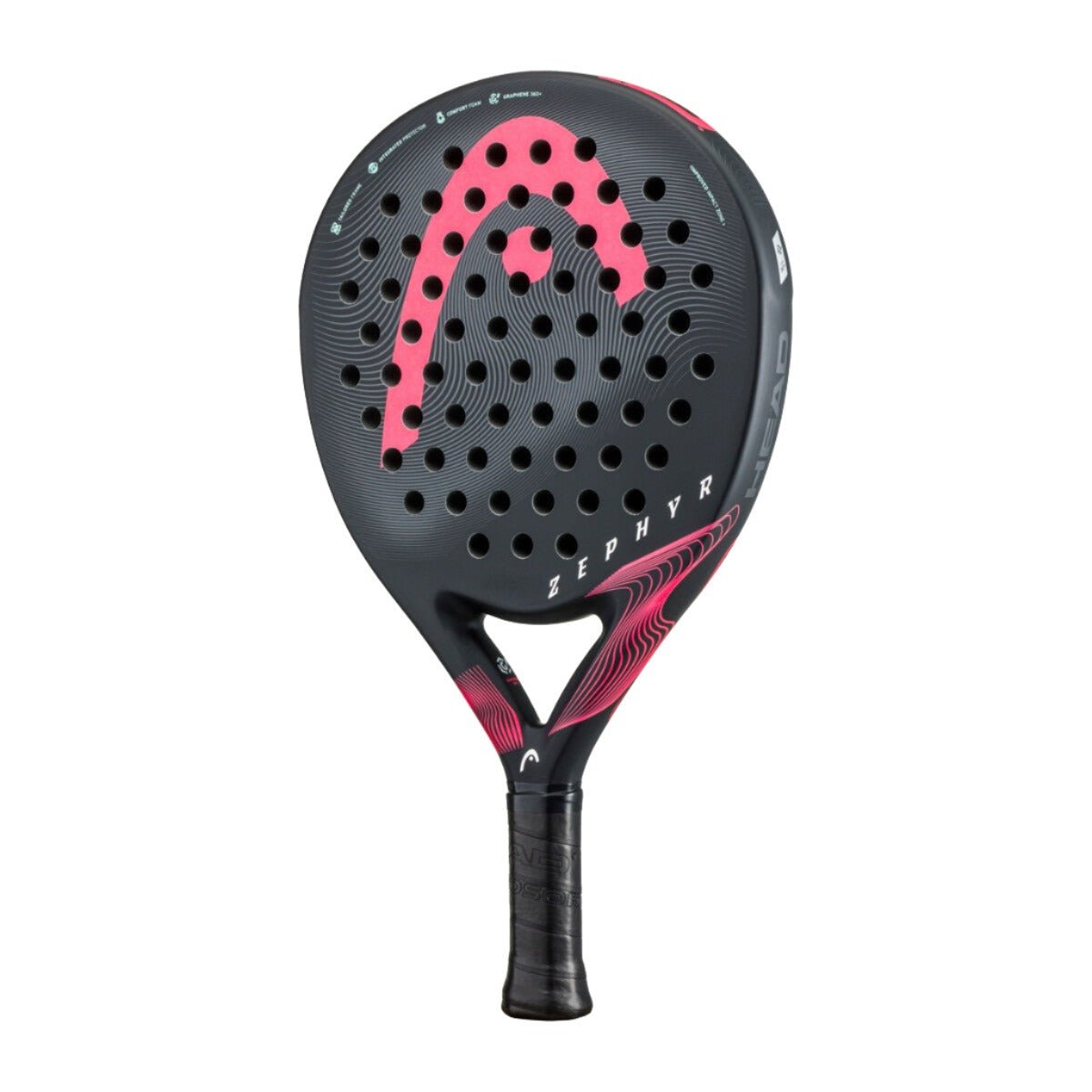
The complete senior specification in one racket — HEAD publishes it at 350 grams, round, with a Comfort Foam core and a fibreglass face.
Start with the number HEAD prints: 350 grams, which makes the base-model Zephyr one of HEAD’s lightest full-size rackets — HEAD itself describes the Zephyr as one of its lightest models, built for intermediate players, and the rest of the published sheet follows the same brief. The shape is round, the head size 490 cm², the balance 268 mm and the beam the standard 38 mm. Nothing in that list asks for a long, fast swing: the round outline keeps the stated sweet spot centred where HEAD places it, the balance keeps the mass close to the hand for net exchanges, and the weight keeps the racket easy to reposition between shots. It is the senior brief — light, round, low-balanced — answered by a single spec sheet without a compromise to explain.
The construction is HEAD’s published stack for this model. The core is Comfort Foam, which HEAD describes as its foam for this racket class, and the hitting surface is fibreglass for the softer ball exit fibreglass gives against carbon. Around them sit Graphene 360+, which HEAD describes as its frame technology for flex and feel; the Tailored Frame tubular construction; and the Integrated Protector System, a pre-moulded carbon bumper that HEAD fits to protect the frame’s edge. Two family distinctions matter at the listing: this is the base Zephyr, not the heavier Zephyr Pro carded in our women’s guide, and not the Zephyr UL carded in our kids guide — three different published weights under one family name, so check the exact model name before you order. If you want one racket that answers the whole decision, this is the card.
What we like
- The complete published brief: 350 g, round, 268 mm balance, soft foam core
- One of HEAD’s lightest models, in HEAD’s own description
- Integrated Protector System bumper fitted as standard
- A single published weight — no range to decode at the listing
Worth knowing
- Three Zephyr variants exist (base, Pro, UL) at different weights — check the exact name
- Fibreglass face: a softer exit than the carbon cards below, by design
- One grip size as sold; fine-tune the fit with an overgrip
As an Amazon Associate we earn from qualifying purchases.
adidas Drive Light 3.4
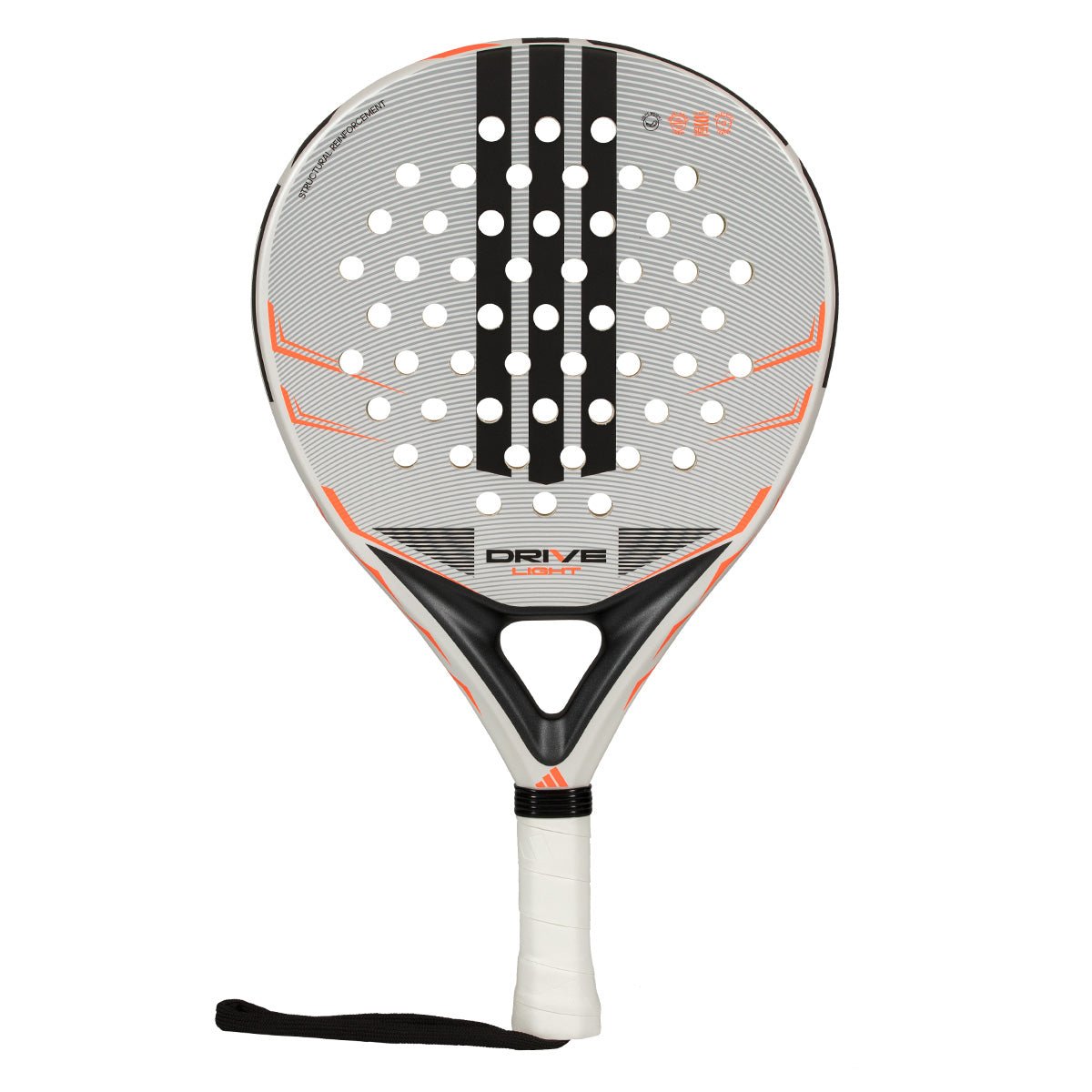
The Light member of adidas’s Drive line — published at 345–360 grams, round, on a low-density EVA Soft Performance core.
The Drive line is adidas’s starting range, and the Drive Light 3.4 is the version adidas builds lighter: its Light-specific listings publish a weight of 345 to 360 grams, against the standard Drive’s 360–375 grams, and that published gap is the whole point of the model. The shape is round, the balance listed as even, and the profile the standard 38 mm. For a senior player who wants the lightest round racket a major brand publishes — and wants to order toward the bottom of a stated range — this is the most direct route in the guide: ask for a 345–350 gram example when you buy, because the range is printed on the listing and retailers pick from stock by weight on request.
The materials follow the same easier-handling brief, in adidas’s own terms. The core is EVA Soft Performance, which adidas describes as its low-density EVA for soft ball output, and the face is fibreglass, which adidas describes as giving a softer touch and strong ball exit on slower shots. Two named systems complete the published construction: Structural Reinforcement, perimeter reinforcements adidas fits to resist torsion, and Smart Holes Lineal, an arrangement of equidistant holes in groups of three that adidas says strengthens the striking surface. The honest framing is level: adidas positions the Drive line for players starting out, so this card trades the premium materials of the Wilson and Nox cards below for the lightest published round build here — a trade many senior players will take happily.
What we like
- The lightest published round range here: 345–360 g
- Low-density EVA Soft Performance core, as adidas describes it
- You can order toward the light end of the stated range
- Structural Reinforcement around the perimeter, per adidas
Worth knowing
- adidas positions the Drive line at starting level — materials are fibreglass, not carbon
- One retailer’s table carries the standard Drive’s 360–375 g range; the Light tables agree on 345–360 g
- Balance is listed as even or low depending on the retailer
As an Amazon Associate we earn from qualifying purchases.

Siux Astra Hybrid Air
The shape step-up, kept light — Siux publishes the Hybrid Air at 345–355 grams in a teardrop/hybrid outline with a Soft EVA core.
Every other light card in this guide is round. The Astra Hybrid Air is the answer for the senior player who wants the next shape without the next weight class: Siux’s specification tables publish it at 345 to 355 grams — the lightest range here, shared only with the Drive Light — in a teardrop, or hybrid, shape with a medium balance. That combination is the hybrid bargain in one line: the sweet spot sits higher on the face than a round racket’s, in Siux’s description of the shape, while the published weight stays at the light end of the entire guide. Players who have spent seasons with a round racket and want more help on bandejas and finishing volleys, without accepting a heavier build, are this card’s audience.
The construction is Siux’s published set for the model. The faces are 3K fibreglass, the core is a Soft EVA — the softer-core construction Siux markets for easier handling, in its own terms — and the finish is a rough, sandy gloss surface that Siux fits for grip on the ball at contact. One naming note, because the Astra line is a family: Siux sells an Astra Control (round) and an Astra Hybrid alongside this Hybrid Air, and the three publish different shapes and weights. The carded model is the Hybrid Air, the lightest of the line — check those two words on the listing. A second retailer lists a wider 340–360 gram range for the same model; the card prints the narrower table, and the difference is recorded in this file’s header notes.
What we like
- A hybrid shape at a round racket’s weight: 345–355 g published
- Soft EVA core under 3K fibreglass faces, per Siux
- Medium balance follows the higher sweet spot, as Siux describes the shape
- Rough sandy finish for grip on cut shots
Worth knowing
- Three Astra variants exist — check for “Hybrid Air” on the listing
- Retailer weight ranges differ slightly (345–355 g vs 340–360 g)
- The higher sweet spot asks for cleaner contact than the round cards
As an Amazon Associate we earn from qualifying purchases.
Wilson Bela LT V2.5
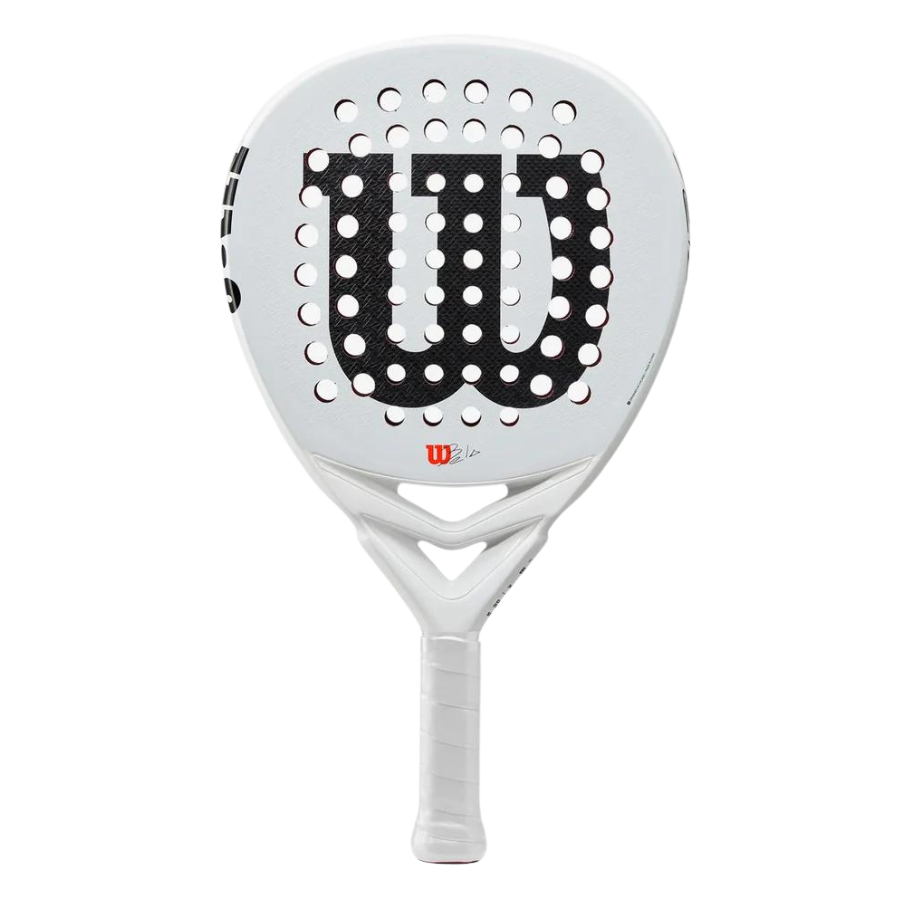
The lightest Bela, per Wilson — a 355-gram teardrop with a woven 3K carbon face, a Soft EVA core and the guide’s clearest published grip figure.
Wilson’s Bela line is Fernando Belasteguín’s signature family, and the LT is the model Wilson builds light: Wilson describes the Bela LT V2.5 as the lightest padel racket in the Bela line, published at 355 grams in a teardrop shape with a 265 mm balance. That is a different proposition from the round cards around it — a premium, carbon-faced racket whose lightness comes from the LT brief rather than from starter materials. The published dimensions complete the picture: a 455 mm length, a 38 mm beam and an 84 square-inch head, with a widened sweet spot that Wilson describes as its design for consistent responses across the face. Senior players who play a more attacking, net-first game and want the lightest version of a tour player’s line are this card’s audience.
The construction pairs the guide’s softest-named core category with its firmest face. The core is Soft EVA Foam, which Wilson describes as giving a cushioned feel and lightweight power; the face is a woven layer of 3K carbon fibre, which Wilson describes as its route to hitting with power from the face. Around them: a Spin Effect texture on the surface, Sharp Hole Technology drilling, throat notches Wilson added in this version for a second-hand grip on the throat, and a clear bumper. The grip deserves its own line, because Wilson is the one maker here to publish it plainly: a Shock Shield grip — Wilson’s name for its grip build, a blend of PU and Iso-Zorb materials — in a 4 1/4-inch size. That is a sizing fact to compare against your hand, exactly as the buying guide below explains. Distinct from the Bela Pro carded for intermediates and the Bela Elite carded for women — check for “LT” on the listing.
What we like
- The lightest Bela, in Wilson’s own description — 355 g published
- A carbon face at a light build’s weight: the premium end of this guide
- The clearest grip figure here: 4 1/4 in, published by Wilson
- Full Wilson spec table: weight, balance, head size and length all stated
Worth knowing
- A teardrop’s higher sweet spot rewards cleaner contact than the round cards
- Three Bela variants exist (LT, Elite, Pro) — check for “LT V2.5”
- One published grip size; adjust the fit with an overgrip
As an Amazon Associate we earn from qualifying purchases.
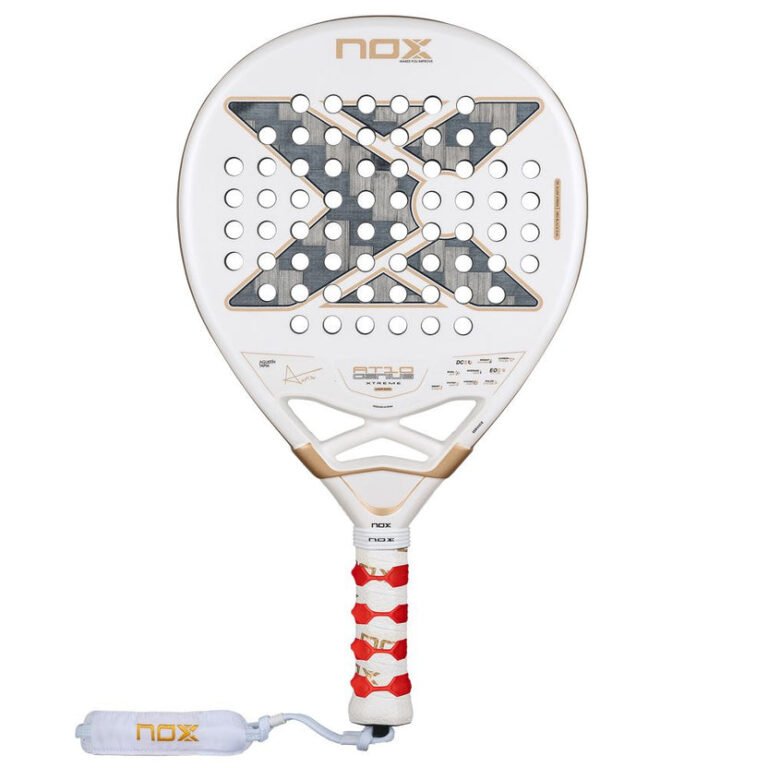
Nox ML10 Pro Cup
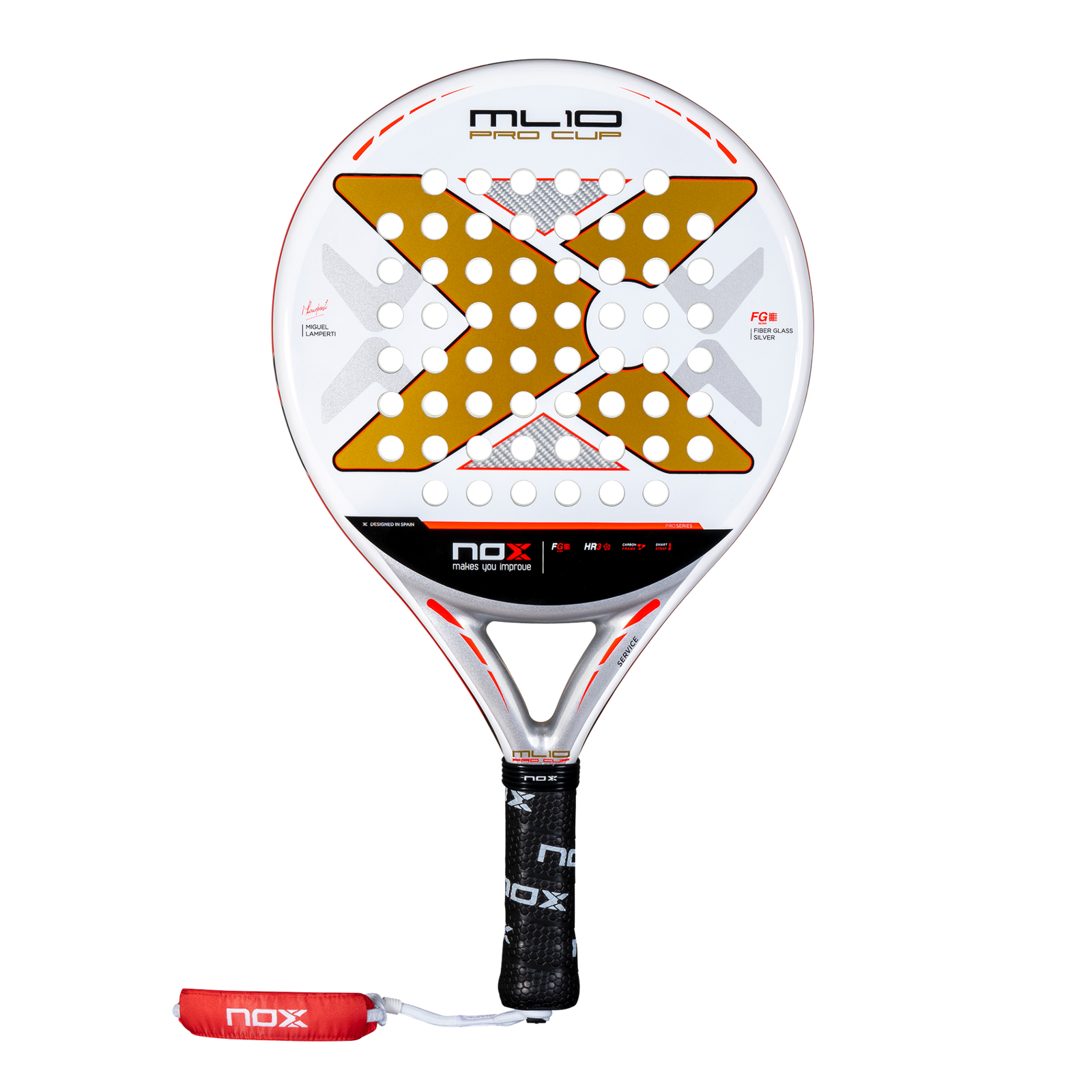
Miguel Lamperti’s long-running round classic — an HR3 core and Fiber Glass Silver faces at a published 360–375 grams, ordered light.
Some rackets earn their place by outlasting every trend in their category. The ML10 Pro Cup is Miguel Lamperti’s signature model and one of the longest-running designs in padel: a round shape with a low balance, published by Nox at 360 to 375 grams. That is the standard-weight end of this guide, and the card is honest about why it still belongs: the senior decision is not only about the lightest number, it is about matching the build to the game — and for a placement player who defends off the glass and builds points patiently, a round, low-balanced classic ordered at the 360-gram end of its stated range is a deliberate, defensible choice. Nox sells this model by weight, so the light end of the range is a real option at the listing, not a hope.
The construction explains the model’s longevity. The core is Nox’s HR3, a high-density rubber core that Nox describes in terms of memory effect and ball output — the firmest core description in this guide, and the contrast to the soft-EVA cards around it. The faces are Fiber Glass Silver, a fibreglass weave with a metallic finish that Nox describes as sitting in rigidity between standard fibreglass and carbon, over a carbon frame with Nox’s Dynamic Composit Structure. Practical details complete the card: the Smartstrap replaceable safety cord, which Nox fits so the cord can be swapped rather than the racket retired with it, and a smooth face finish. One family warning: the ML10 Pro Cup Luxury is a different, carbon-faced model carded in our women’s guide — the carded racket here is the standard Pro Cup, in its current Coorp edition finish.
What we like
- A proven round, low-balance formula with a long production history
- Orderable at 360 g — the light end of a stated range
- Fiber Glass Silver faces: Nox’s stated middle ground between fibreglass and carbon
- Smartstrap cord is replaceable, per Nox
Worth knowing
- The heaviest published range here — order the light end deliberately
- HR3 is a higher-density core than the soft-EVA cards; the feel is firmer
- Not the Luxury version — check the full model name
As an Amazon Associate we earn from qualifying purchases.
Bullpadel Indiga CTR
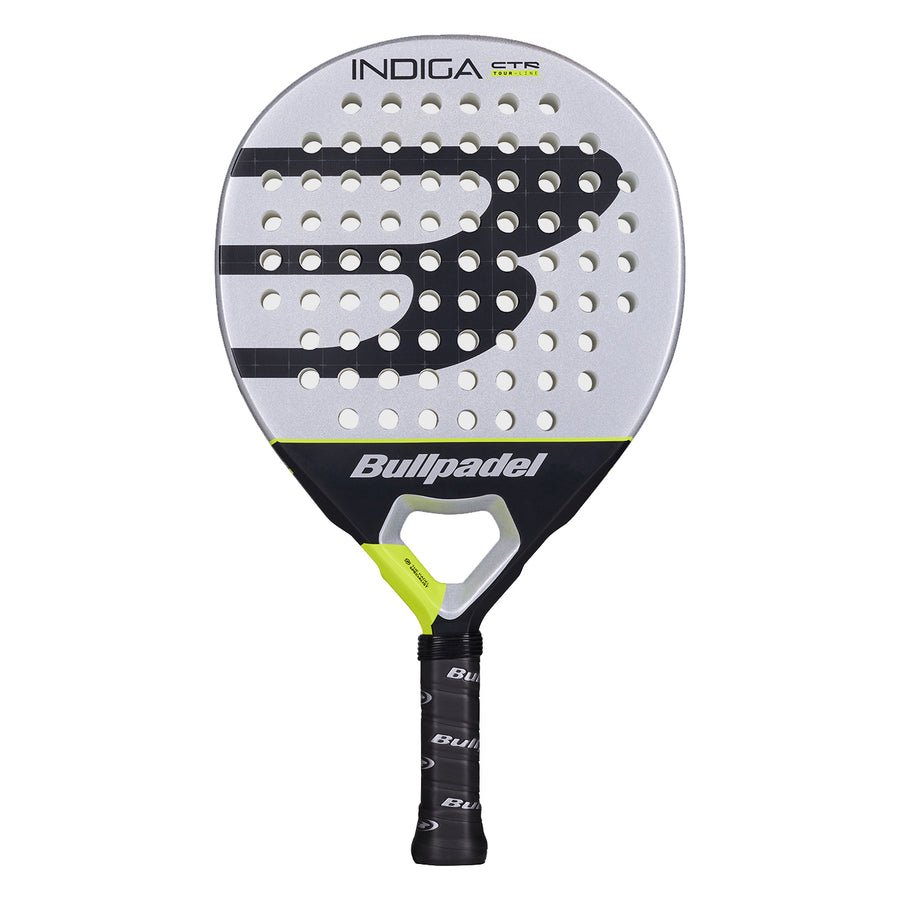
Bullpadel’s easy-handling round racket — a SoftEva core and Polyglass faces at 360–370 grams with the lowest balance brief in the guide.
The Indiga CTR is the control member of Bullpadel’s Indiga line, and Bullpadel builds the line around one idea: a round, low-balanced racket that is easy to handle from the first session. The published sheet reads 360 to 370 grams, a round shape, a low balance and a 38 mm profile. Bullpadel describes the model in its own listings as lightweight, comfortable and manageable with maximum control as its brief — maker language, reported as such — and the geometry backs the description in the terms this guide uses: a low balance keeps the mass toward the hand, which is what makes a standard-weight frame quick to reposition in defensive exchanges and at the net. Order toward 360 grams and this is a mid-weight racket with a light racket’s handling brief.
The materials are the softest-named set in the guide. The core is Bullpadel’s SoftEva rubber, the faces are Polyglass — Bullpadel’s name for its fibreglass surface material, which it describes as giving flexibility and a wide sweet spot — and the frame is CarbonTube, bidirectionally woven carbon that Bullpadel fits as the frame’s structural construction. The line’s signature detail is the Grip Zone: contact zones along the handle area that Bullpadel designs to help the non-hitting hand find its waiting position when receiving — a handling feature described here exactly as Bullpadel describes it. Against the Nox above it, the trade is catalogue position for softness: the Indiga is Bullpadel’s accessible line rather than a tour classic, with the softest core-and-face pairing on this page. Distinct from the Indiga W in our women’s guide — check for “CTR” on the listing.
What we like
- The softest-named construction here: SoftEva core, Polyglass faces
- Low balance for quick repositioning, as Bullpadel briefs the model
- CarbonTube frame construction in an accessible line
- Grip Zone handling feature, as Bullpadel describes it
Worth knowing
- A standard-weight range — order toward 360 g for this guide’s brief
- Bullpadel’s accessible line: fibreglass faces, not carbon
- Not the Indiga W — check for “CTR”
As an Amazon Associate we earn from qualifying purchases.

Black Crown Piton 11
The experienced player’s round option — layered face and core construction at a published 355–370 grams with a low balance.
Every guide needs its honest counterpoint, and the Piton 11 is this one’s: a round racket from Black Crown’s Piton line, published at 355 to 370 grams with a low balance, built for experienced players rather than for the lightest possible brief. It earns its card on the combination the senior decision actually weighs — a round shape and a low balance for placement and quick handling, at a weight range whose light end (355 g) sits with the Wilson card above it, from a maker whose Piton line is its long-running control family. For the experienced senior player who finds the softest cards here too muted and wants a round racket with more structure in its construction, this is the card written for them.
The construction is layered, and the card reports it the way Black Crown’s retailers describe it. The face combines fibreglass sheets with a 3K carbon sheet — Smashinn’s summary of Black Crown’s specification lists two fibreglass layers and one 3K carbon layer as the outer core — over an inner core its listings describe in layered terms: Padelshop describes a 3XPly EVA core with a firmer outer layer for power shots and a softer inner layer for touch in defence, while Smashinn names the inner core Super Soft EVA. Both descriptions agree on the architecture — a softer inner layer under firmer outer material — and that layered build, over an 80% carbon double tubular frame with a rough face finish, is the published substance of the card. Read it as the guide’s firmest round option: the racket for a player whose contact is already consistent and who is choosing construction, not forgiveness.
What we like
- Round shape and low balance with a layered, structured construction
- Light end of the range (355 g) matches the premium light cards
- 80% carbon double tubular frame, per Black Crown’s listings
- Rough finish for grip on cut shots
Worth knowing
- Briefed for experienced players — the least forgiving brief here
- Face and core wording differs between retailer listings; both are noted in this file’s header
- A separate Piton 11 Soft version exists — check the exact name
As an Amazon Associate we earn from qualifying purchases.
Side-by-Side Comparison Table
| Model | Best For | Weight (as maker states it) | Shape | Balance | Core |
|---|---|---|---|---|---|
| HEAD Zephyr | Best overall | 350 g | Round | 268 mm | Comfort Foam |
| adidas Drive Light 3.4 | Lightest round | 345–360 g | Round | Even | EVA Soft Performance |
| Siux Astra Hybrid Air | Best hybrid shape | 345–355 g | Teardrop / Hybrid | Medium | Soft EVA |
| Wilson Bela LT V2.5 | Best premium light | 355 g | Teardrop | 265 mm | Soft EVA Foam |
| Nox ML10 Pro Cup | Classic control | 360–375 g | Round | Low | HR3 |
| Bullpadel Indiga CTR | Best soft-core round | 360–370 g | Round | Low | SoftEva |
| Black Crown Piton 11 | Layered construction | 355–370 g | Round | Low | Layered EVA |
Read the weight column as the makers print it: two cards publish a single figure, five publish a range — and a range is an instruction, not an uncertainty, because padel rackets are picked from stock by weight. Ordered at their lightest published ends, the seven cards sort into a clear ladder: the two 345-gram starters (Drive Light 3.4, Astra Hybrid Air), the Zephyr’s single 350-gram figure and the Bela LT’s 355 grams in the middle, and the standard-weight round trio (Piton 11 from 355 g, Indiga CTR from 360 g, ML10 Pro Cup from 360 g) at the top. The balance column explains how each maker spends that mass: the round cards hold it low or even for repositioning speed, and the two teardrops publish medium balances that follow their higher sweet spots. Weight first, shape second, core third — the table is the whole guide in one view.
Buying Guide: Matching the Spec Sheet to Your Game
1. Start with the published weight — and order the light end of the range
The makers have done the first sort for you: models named Light, LT and Air, and families their makers describe as their lightest, exist precisely so this decision starts at the right end of the catalogue. Use the stated figures as printed — a single figure where one is published, a range where a range is published — and when you buy a range model, ask the retailer for an example at the light end. A 360-gram ML10 Pro Cup and a 375-gram ML10 Pro Cup are the same model on paper and noticeably different rackets in the hand by the third set. If your current racket feels like hard work late in a session, shop the 345–355 gram cards first.
2. Shape: round for placement, hybrid for the step up
Five of the seven cards are round, and that reflects where most senior padel is played: from the back, off the glass, with placement and patience, where makers describe the round shape’s sweet spot as larger and more centred. The two teardrop cards — the Siux Astra Hybrid Air and the Wilson Bela LT V2.5 — move the sweet spot higher, in their makers’ descriptions, for players whose game has shifted toward the net and who finish more points than they build. Neither is an upgrade on the other: the question is where your points are won. Contact misses say round; points that stall at the net say hybrid.
3. Core: read the maker’s own word for it
The core line is where this guide’s cards differ most in feel, and the makers name the difference plainly. Soft-named cores — adidas’s EVA Soft Performance, Siux’s and Wilson’s Soft EVA, Bullpadel’s SoftEva, HEAD’s Comfort Foam — are the constructions makers market for easier handling and softer ball exit, and they are the natural starting point for a shorter, compact swing. Nox’s HR3 is a higher-density core described in firmer terms, and the Piton 11 layers a softer inner core under firmer outer material. Choose the core the way you chose the weight: by the description the maker publishes, matched to how you actually strike the ball.
4. Grip size: a fit measurement, not a feature
Most padel rackets are sold in one grip size, so the published figure matters where it exists — Wilson states 4 1/4 inches for the Bela LT V2.5 — and the adjustment tool everywhere else is the overgrip. One overgrip builds the handle up slightly; two build it further. Measure your current handle before you order, compare it with any figure the maker publishes, and plan the overgrip as part of the fit rather than an accessory. The right grip is simply the right size of equipment: a handle that matches your hand is a sizing decision you make once, at the listing, and then stop thinking about.
5. Check the exact model name — this category runs on suffixes
Nearly every card in this guide has a sibling with a similar name and a different brief: Zephyr against Zephyr Pro and Zephyr UL; Drive Light against the standard Drive; Astra Hybrid Air against Astra Hybrid and Astra Control; Bela LT against Bela Elite and Bela Pro; ML10 Pro Cup against ML10 Pro Cup Luxury; Indiga CTR against Indiga W; Piton 11 against Piton 11 Soft. The suffix is the specification — it carries the weight, the shape or the face material that put the racket in this guide. Confirm all of it on the actual listing before you pay: the full model name, the weight or the light end of its range, and the shape. Thirty seconds on the listing is the difference between the racket this guide carded and its heavier namesake.
Frequently Asked Questions
What weight padel racket should a senior player use?
Shop the published band this guide is built on: rackets whose makers state weights from 345 grams up to the standard 360–375 gram ranges, ordered at the light end. The lightest published ranges here are the adidas Drive Light 3.4 and the Siux Astra Hybrid Air, both starting at 345 grams; the HEAD Zephyr publishes a single figure of 350 grams and the Wilson Bela LT V2.5 a single figure of 355 grams. Where a maker publishes a range, ask the retailer for a light example — the range is printed so you can choose within it.
Is a round or a teardrop padel racket better for seniors?
It depends on where your points are won, and the makers describe the shapes in consistent terms. Round rackets — five of the seven cards here — carry the sweet spot low and central, and makers describe that shape as offering the larger, more centred stated sweet spot, which suits placement and defence off the back glass. Teardrop or hybrid rackets — the Siux Astra Hybrid Air and the Wilson Bela LT V2.5 — move the sweet spot higher for players who finish more points at the net. Choose by your game, not by the shape’s reputation.
What does a soft core mean on a padel racket?
It is the maker’s own description of the core construction. adidas names its core EVA Soft Performance, Siux and Wilson name theirs Soft EVA, Bullpadel names its SoftEva and HEAD names its Comfort Foam, and the makers market those softer-core builds for easier handling and a softer ball exit — the ball leaves the face with less swing behind it. The contrast in this guide is Nox’s HR3, a higher-density core Nox describes in firmer terms, and the Black Crown Piton 11’s layered core, with a softer inner layer under firmer outer material.
How do I get the grip size right on a padel racket?
Treat it as a fit measurement. Most padel rackets are sold in one grip size, so use any figure the maker publishes — Wilson states 4 1/4 inches for the Bela LT V2.5 — and fine-tune the fit with overgrips, which build the handle’s circumference up slightly, one layer at a time. Measure the handle of the racket you play with now before you order, compare it with the published figure where one exists, and plan an overgrip as part of the fit rather than an afterthought.
What is the difference between the HEAD Zephyr, Zephyr Pro and Zephyr UL?
They are three different models under one family name, at three different published weights. This guide cards the base Zephyr, which HEAD publishes at 350 grams with a round shape and a Comfort Foam core. The Zephyr Pro is a heavier model carded in our women’s guide, and the Zephyr UL is the family’s lightest junior-crossover model, carded in our kids guide. Because the names are so close, check the exact model name on the listing before you order — the suffix carries the specification.
Is the Nox ML10 Pro Cup too heavy for a senior player?
Nox publishes it at 360 to 375 grams, which is the standard-weight end of this guide, and it is carded deliberately: Nox sells the model by weight, so a 360-gram example is a real option at the listing. Its case is its formula — a round shape, a low balance and Fiber Glass Silver faces, in a design with a long production history — matched to a placement game. If you want the lightest published build instead, the Drive Light 3.4 and the Astra Hybrid Air start at 345 grams. Order the ML10 at its light end if you choose it.
What is the difference between this guide and the all-player padel racket guide?
The all-player guide owns the full selection — the standard-weight performance rackets most club players use — and ranks them for every level. This guide narrows the same sport to one decision: the lighter builds, round and hybrid shapes and softer cores makers publish for the senior game, compared on stated weights, shapes, core materials, balances and grip sizing. No racket from the all-player, kids, budget, women, intermediate, advanced or HEAD-brand guides is re-ranked here — read those for their segments, and this page for the senior specification.
The Verdict
Buy the specification, not the story. The HEAD Zephyr is the complete senior answer — 350 grams as HEAD publishes it, round, with a Comfort Foam core. The adidas Drive Light 3.4 and the Siux Astra Hybrid Air publish the lightest ranges here, one round and one hybrid. The Wilson Bela LT V2.5 is the premium light teardrop with the guide’s clearest grip figure, the Nox ML10 Pro Cup the classic round control racket ordered at its light end, and the Bullpadel Indiga CTR the soft-core round pick. The Black Crown Piton 11 is the layered-construction option for experienced players. Seven rackets, four honest decisions — weight, shape, core and grip — every one of them printed as its maker states it.
Affiliate disclosure: AliShuttler is a participant in the Amazon Services LLC Associates Program. Links marked “Check Price on Amazon” are affiliate links — if you buy through them, we may earn a commission at no additional cost to you. Every specification in this guide is taken from the manufacturer’s own published listings, checked at build time in 2026; weights, shapes, cores and balances are printed exactly as their makers state them.