Ask five suppliers what a padel court costs and you will get five wildly different numbers — because each one is quietly pricing a different thing. This guide separates the court kit, the turnkey court and the full facility, then breaks down every component using real, dated figures: an actual Dubai supplier quotation, published UAE component ranges and a factory-direct benchmark.
TL;DR — The short answer
A padel court kit, supplied and installed in the UAE, can start at AED 50,000 + VAT. That is the exact figure on a July 2025 quotation from a Dubai supplier for a standard 10m × 20m panoramic court — 12mm tempered glass, steel cage, LED lighting, turf and net included, installed in 2–3 days. But that price assumes your ground is already prepared. Add site preparation, permits and the rest of a turnkey build and the same court climbs steeply: PadelGamePlan’s UAE breakdown puts site preparation alone at AED 18,000–55,000 and permits and legal at AED 7,500–18,000. And if what you actually mean is a club — multiple courts plus amenities — PadelGamePlan’s full-facility total runs to AED 335,000–1,130,000. Three different questions, three different numbers. This guide keeps them separate.
On this page
- The 3 cost layers (read this first)
- Court types: standard, panoramic, singles
- Component-by-component breakdown
- Groundworks and the base
- Shipping and installation in the UAE/GCC
- Indoor vs outdoor: what changes
- Permits and building in Dubai
- Maintenance and resurfacing
- Where to save without hurting play
- The club maths: what a court can earn
- FAQs
The three cost layers — why every quote looks different
Almost every confusing padel court price on the internet is a scope problem, not a dishonesty problem. Suppliers quote the layer they sell, and buyers compare them as if they were the same product. Before you compare a single number, fix which of these three layers you are actually buying.
The court kit, supplied + installed
The structure, glass, turf, lights and net — delivered and bolted together on a base that already exists. Dubai supplier quotation: AED 50,000 + 5% VAT for a panoramic court. Factory-direct kits: USD 8,000–11,000 before delivery and installation (GHCOURT).
The turnkey single court
Layer 1 plus everything the kit assumes away: groundworks and the concrete base, drainage, electrical supply, permits. PadelGamePlan’s UAE ranges put site preparation at AED 18,000–55,000 and permits & legal at AED 7,500–18,000 on top of the build.
The full facility
Multiple courts plus changing rooms, café, clubhouse and amenities. PadelGamePlan’s stated total of AED 335,000–1,130,000 — including amenities at AED 185,000–750,000 — is this layer. It is not, and must never be quoted as, the price of one court.
The Dubai quotation shows how clean layer 1 can be. Pro Shop Sport Fields & Halls Contracting Co. LLC, a DIFC-based supplier, quoted a farmhouse project in Fujairah in July 2025 for a panoramic court of the standard 10m × 20m footprint: AED 50,000 plus 5% VAT — AED 52,500 all-in — for supply and installation of the complete court kit. The scope was specific: 12mm tempered glass across 14 panels, the steel cage structure, eight 200W LED lights, 12mm artificial turf dressed with silica sand, and the net posts and net, with installation quoted at two to three days. What the quote does not include is just as specific: no groundworks, no civil base, no permits. The court lands on ground you prepare.
PadelGamePlan’s published UAE breakdown shows what happens when you price the whole job. Its component ranges — construction AED 75,000–185,000, fencing and glass AED 37,000–92,000, lighting AED 11,000–30,000, site preparation AED 18,000–55,000, permits and legal AED 7,500–18,000 — describe a turnkey layer-2 build with wide spreads, because “construction” on a flat serviced plot and construction on a sloping unserviced one are different jobs. Its headline total, AED 335,000–1,130,000, folds in amenities and clubhouse space at AED 185,000–750,000, which is why it belongs firmly in layer 3.
And the floor beneath layer 1 is the factory gate. GHCOURT, a Chinese manufacturer selling direct, prices a court kit at USD 8,000–11,000 per court, excluding delivery and installation. That number is real, but it buys you crates at a port — freight to Jebel Ali, customs, the base, and a crew who know how to tension glass are all still yours to arrange. The gap between USD 8,000 at the factory and AED 52,500 installed in Fujairah is not markup. It is everything this guide is about to itemise.
Court types: standard, panoramic and singles
The first decision that moves your budget is the format of the court itself. All regulation doubles courts share the same 20m × 10m playing footprint and the same basic anatomy — glass back walls, mesh sides, a net across the middle — which you can brush up on in our padel rules guide. What changes between formats is how much of the enclosure is structural glass and how much is steel, and that choice drives both the look and the price.
Standard (classic) courts
A standard court frames every glass panel with steel pillars: each sheet of glass sits in its own steel bay, with posts at the corners and along the back walls. It is the original format, the most forgiving to build, and the easiest to repair — a cracked panel is one bay, not a structural event. Because steel pillars do the structural work, the glass specification and the fitting hardware can be simpler, and standard courts sit at the lower end of any single supplier’s range. For private homes, schools and first courts at a growing club, this is the sensible default: it plays identically to any other format, because the ball does not know what is holding the glass up.
Panoramic courts
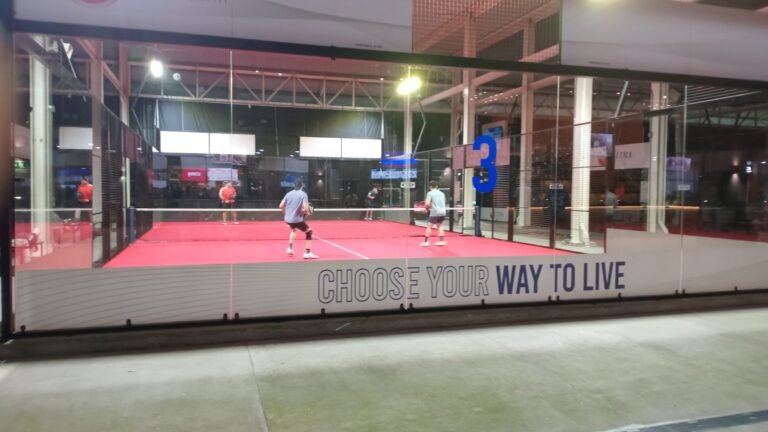
A panoramic court removes the steel pillars from the back walls and joins the glass panels directly to each other with discreet fittings, so spectators and cameras get an unobstructed view through the back of the court. It is the format you see on professional broadcasts, and it is what most commercial clubs in the UAE now install as their show courts. The glass becomes structural, which demands precise engineering, heavier-duty fittings and a more careful installation — and that is where its premium over a standard court comes from. Notably, the Dubai quotation anchoring this guide is for a panoramic court: AED 50,000 + VAT, supplied and installed. Panoramic is a premium format, but in the UAE market it is not an exotic one.
Super panoramic and singles courts
Above panoramic sits the super panoramic, which strips pillars from the side walls as well for a near-total glass box — a broadcast and flagship-club format priced above panoramic from the same supplier. At the other end of the scale, singles courts shrink the footprint to roughly 20m × 6m for one-versus-one play. A singles court uses less of everything — less glass, less turf, a smaller base — so it costs less than a doubles court from the same range, and it can make sense for homes with limited plots and clubs adding a coaching court. Just be clear-eyed: most demand in the UAE is for doubles, and a singles court cannot host it.
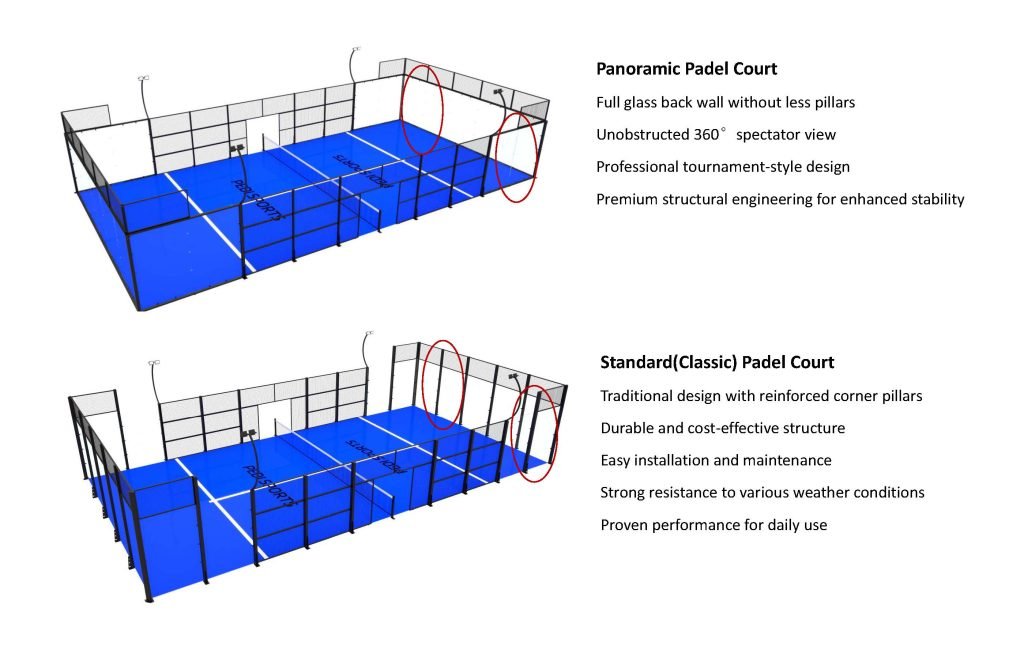
Whichever format you choose, the playing experience is governed by the same dimensions and the same glass-and-mesh rebound — format is a spectator and budget decision, not a gameplay one. If you are building in Dubai and want to see how the finished formats present in real venues, our guide to padel courts in Dubai walks through the city’s clubs court by court.
Component-by-component breakdown
A padel court is six systems bolted together, and your money divides between them unevenly. The table below uses PadelGamePlan’s published UAE component ranges where they exist, and the Dubai quotation’s scope where it is more specific. Read it as a map of where quotes can legitimately differ — a supplier who includes premium lighting and one who includes basic lighting are not quoting the same court.
| Component | What it covers | Sourced figure |
|---|---|---|
| Steel structure | Galvanised, powder-coated steel cage: corner posts, frames, roof-less uprights and the mesh fencing panels | Inside the Dubai quotation’s AED 50,000 + VAT installed total; PadelGamePlan construction range AED 75,000–185,000 covers the structure within a turnkey build |
| Tempered glass | 12mm tempered glass walls — 14 panels on the quoted court — plus fittings, gaskets and (on panoramic courts) structural glass-to-glass joints | Included in the Dubai quotation; PadelGamePlan fencing & glass range AED 37,000–92,000 |
| Artificial turf | 12mm padel turf on the quoted court, dressed with silica sand infill; mono-filament and texturised grades sit above fibrillated entry grades | Included in the Dubai quotation (12mm turf with silica sand) |
| Lighting | LED floodlights on posts — 8 × 200W units on the quoted court — plus cabling and controls | Included in the Dubai quotation; PadelGamePlan lighting range AED 11,000–30,000 |
| Net and posts | Net posts and the net itself — the smallest line item on any quote | Included in the Dubai quotation (net posts and net in scope) |
| Site preparation | Groundworks, levelling and the concrete base the court bolts onto | PadelGamePlan AED 18,000–55,000 — NOT in the Dubai quotation’s scope |
| Permits and legal | Approvals, drawings and legal costs for a commercial build | PadelGamePlan AED 7,500–18,000 |
Steel structure
The cage is the skeleton: galvanised steel posts and frames, powder-coated in your club colours, with electro-welded mesh forming the upper side walls. In the Gulf, the specification detail that matters is corrosion protection — galvanisation under the powder coat is what stands between your structure and coastal humidity and salt air. This is also where standard and panoramic formats diverge structurally: on a panoramic court the back-wall steel largely disappears, and the glass and its fittings inherit the load, which is why panoramic hardware is heavier-duty and its installation less forgiving of sloppy bases.
Tempered glass
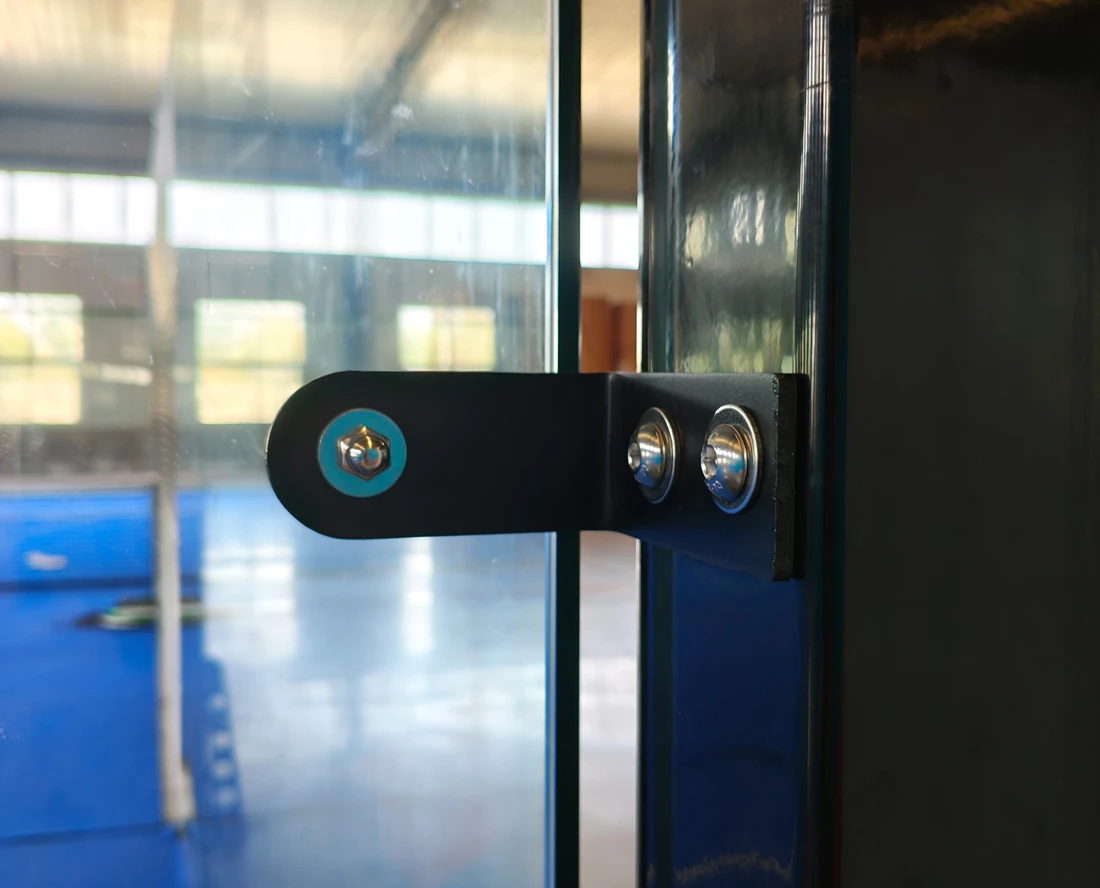
Padel glass is 12mm tempered (toughened) glass — the quoted Dubai court uses 14 panels of it — engineered to flex slightly under player impact and to break safely if it ever fails. Glass and its fencing package is one of the largest single lines in a turnkey build: PadelGamePlan puts fencing and glass at AED 37,000–92,000 in the UAE. The spread reflects panel count, format (panoramic glass-to-glass joints cost more than framed bays) and whether the price is for glass alone or glass plus mesh and fitting labour. When a quote looks suspiciously cheap, glass thickness and panel specification is one of the first places to check — it should say 12mm, tempered, in writing.
Artificial turf and sand
The playing surface is a short-pile artificial turf — 12mm pile on the quoted court — laid over the base and dressed with silica sand that is brushed into the pile. The sand is not filler in the dismissive sense: it weights the carpet, protects the fibres, and tunes how the ball bounces and how your shoes grip and slide. Turf comes in grades — fibrillated, monofilament and texturised monofilament — and the grade you choose decides both the upfront line and how the surface ages under heavy club use. The quoted scope includes the turf and its silica sand; on a factory kit, confirm sand is included or source it locally, because shipping sand across the world is paying freight on the one component every country has.
Lighting
Padel is an evening sport in the Gulf, so lighting is not an accessory — it is half your sellable hours. The Dubai quotation includes eight 200W LED floodlights, the typical configuration of two units on each of four posts. PadelGamePlan’s standalone lighting range for the UAE is AED 11,000–30,000, the spread covering post height, fixture quality and light levels: a private court needs honest, even light; a club hosting competition needs higher, more uniform levels with less glare, and pays for it. LEDs also keep the running cost and heat load down compared with older metal-halide fixtures — which matters when the lights burn every evening of the year.
Net, posts and the small print
The net and its posts are the smallest line on the quote — the Dubai scope lists them plainly — but the small print around them is where comparisons are won and lost. Before signing anything, confirm in writing: glass thickness and panel count, turf pile height and type, floodlight wattage and count, whether silica sand is included, whether the price includes VAT (the Dubai quote is explicit: AED 50,000 plus 5% VAT), and what warranty covers the structure, the glass and the turf. Two quotes AED 10,000 apart are often the same court with different answers to those questions.
Groundworks and the base — the cost the kit forgets
Every layer-1 price in this guide, the Dubai quotation included, assumes the court has something flat, level and strong to bolt onto. Creating that something is groundworks, and it is the most site-dependent cost in the entire project. PadelGamePlan’s UAE range for site preparation is AED 18,000–55,000, and the honest reason for a spread that wide is that no two plots are the same job.
The base itself is a reinforced concrete slab sized beyond the court’s 20m × 10m footprint, built dead level — panoramic glass, which has no pillars to absorb error, is especially unforgiving of a base that drifts out of tolerance, because the panels must meet each other, not a frame. Beneath and around the slab sit the unglamorous essentials: excavation and levelling, a compacted sub-base, and drainage that moves water away from the court rather than letting it sit under the turf — in a climate where rain is rare but violent, and where wash-down water needs somewhere to go, drainage is not optional detailing.
Three factors swing a groundworks quote between the bottom and top of that AED 18,000–55,000 range. First, the starting point: an existing flat concrete or asphalt surface in good condition can cut the job to preparation and minor correction, while raw or sloping land needs the full excavation-to-slab build. Second, access: a plot a concrete truck and a small crane can reach is cheaper than one materials must be carried into. Third, services: power for the floodlights has to arrive at the court, and trenching a supply across a finished property costs more than connecting to a nearby distribution board. This is why any supplier who quotes groundworks without a site visit is guessing — and why the site visit is the step serious buyers never skip.
Shipping and installation in the UAE and GCC
Unless you buy from a UAE supplier’s local stock, your court travels. The GHCOURT factory benchmark — USD 8,000–11,000 per kit, excluding delivery and installation — marks the start of that journey, not the end: sea freight for a court kit is a container-scale shipment of steel, glass crates and turf rolls, followed by port handling and customs into the UAE, then onward transport to site. Glass is the fragile freight: reputable manufacturers crate panels individually, and the difference between a kit that arrives complete and one that arrives with a cracked panel is usually packaging, not luck.
Installation, by contrast, is fast — when the base is ready. The Dubai quotation puts installation of the complete panoramic court at two to three days, which is realistic for a bolt-together system: steel frame up, glass panels hung and aligned, turf rolled, sand dressed and brushed, lights aimed, net tensioned. The schedule risk is almost never the court itself; it is everything upstream of it — shipping windows, customs clearance, and a base that must be poured, cured and verified level before the crew arrives. Sequence the project base-first and the court becomes the quick part.
Buying from a UAE-based supplier, as the Fujairah project did, collapses most of that risk into a single contract: one party responsible for the kit, the freight and the crew, at AED 50,000 + VAT installed. Buying factory-direct can undercut that figure, but only if you price your own time honestly — you become the importer, the logistics coordinator and the installation supervisor. For a single private court, the local route is usually the rational one. For a developer ordering several courts at once, the factory route’s per-court saving grows while the coordination cost is spread across all of them — which is why multi-court projects so often import, and single-court projects so often do not.
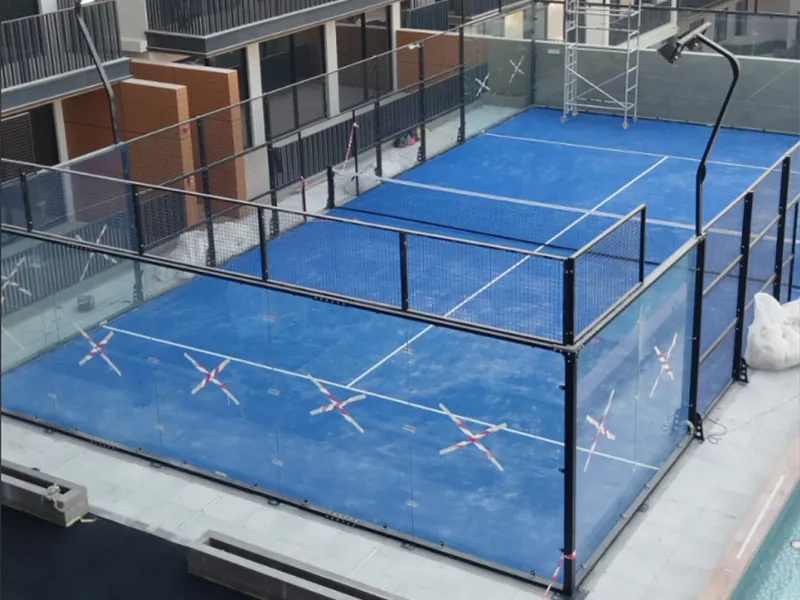
Indoor vs outdoor: what actually changes
The court kit itself barely changes indoors — a panoramic court is a panoramic court under a roof or under the sky. What changes is everything around it, and in the UAE that change is mostly about one thing: summer. Outdoor courts in the Gulf are evening infrastructure for a large part of the year, with floodlights doing the commercial heavy lifting after sunset. Indoor courts trade that constraint away, but the building that makes it possible dwarfs the cost of the courts inside it.
An indoor build needs clear height above the court’s 4-metre enclosure — lobs are part of the game, and the ceiling, lights and any ducting must stay out of their flight path — plus ventilation and air conditioning sized for athletes, not office workers, and lighting designed as part of the hall rather than bolted onto posts. None of those are court costs; they are building costs, and they are why indoor facilities sit in layer 3 of this guide’s framework, where PadelGamePlan’s amenities-inclusive totals of AED 335,000–1,130,000 for a full facility start to make sense. The realistic indoor routes in the UAE are converting an existing warehouse or industrial unit — where the shell, height and power already exist — or building within a larger sports development where the building cost is shared with other tenants.
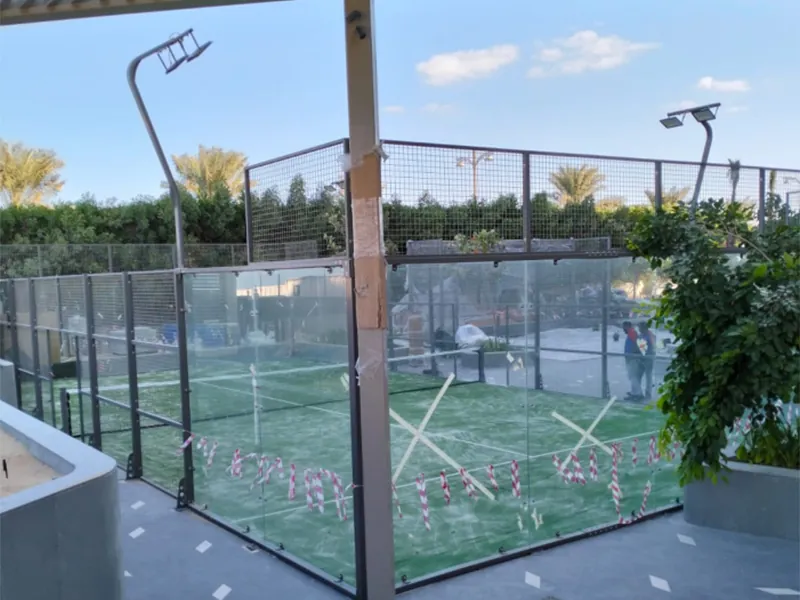
Outdoor builds avoid the building entirely and lean on specification instead: galvanised structure for the humidity, drainage detailed for sudden downpours, turf and sand chosen for extreme heat and UV, and lighting good enough to own the evening peak. There is also a middle route growing in the region — outdoor courts under a canopy or shade structure — which keeps the open-air cost base while taking the worst of the sun off the playing hours. Whichever route you choose, decide it before you price the courts: the same AED 52,500 installed kit sits inside wildly different projects depending on what stands around it.
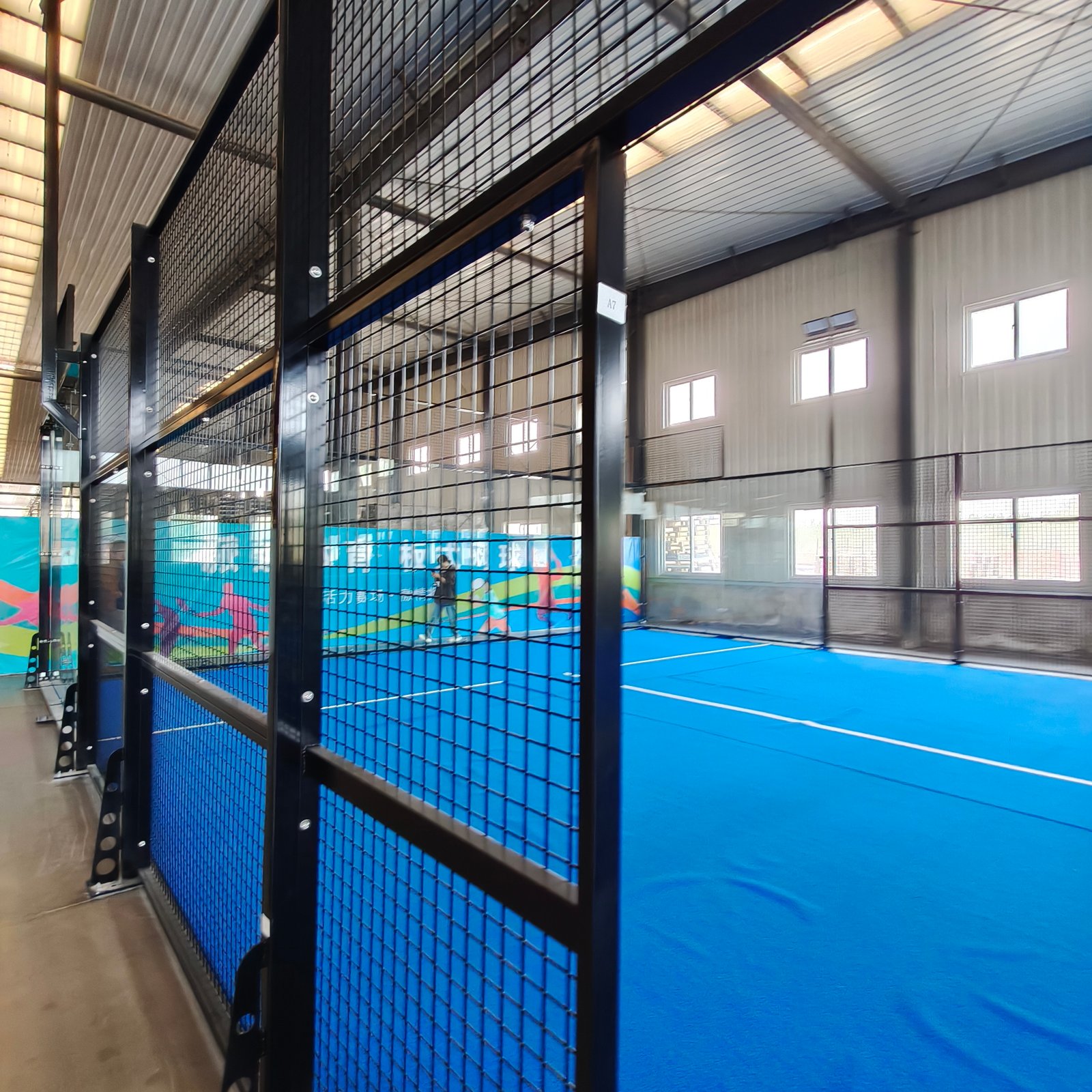
Permits and building a court in Dubai
A private court on your own land and a commercial court the public pays to use are different projects administratively, even when the hardware is identical. This section is deliberately general — approval routes depend on the plot, the landowner and the intended use, and any specific claim about your project should come from the authorities and consultants handling it, not from a guide. Treat what follows as the shape of the process, and take proper advice before committing money.
For a commercial facility in Dubai, expect the project to pass through the normal gates for building anything the public will use: land-use and planning consent for the activity, building approval for the structure and its base, and a trade licence covering sports activity under which the club operates. PadelGamePlan’s UAE breakdown budgets permits and legal at AED 7,500–18,000 — a useful planning figure that signals these costs are real but not, for a straightforward project, the budget-breaker. What catches first-time developers out is rarely the fees; it is sequencing. Approvals belong before the base is poured, not after, and a court installed ahead of its paperwork is an expensive problem rather than a head start.
Private and residential builds — a court at a home, a farmhouse like the Fujairah project behind this guide’s anchor quote, or an amenity court inside a residential development — typically run through the landowner or developer’s own approvals and community rules rather than a public-facing licensing route, and a good supplier will tell you early what documentation their installation needs from your side. If you are weighing locations as much as hardware, our Dubai padel courts guide shows the formats clubs across the city have actually built, from community courts to flagship indoor venues — a useful sense-check on what the market here expects.
Maintenance and resurfacing: the costs after opening day
Here is the section where this guide refuses to give you a tidy number — because there is no reliable published UAE maintenance tariff to quote, and any guide that prints one to the dirham is inventing it. What can be stated honestly is the shape of the obligation: a padel court is a low-maintenance asset, not a no-maintenance one, and the owners who budget for the routine work are the ones whose courts still play properly years later.
The recurring work is labour, not parts. The turf needs regular brushing to lift the pile and redistribute the silica sand, because sand migrates toward the high-traffic zones around the service line and the net; left alone, the court develops fast and slow patches and the bounce stops being honest. Sand levels need topping up as it compacts and escapes. Glass needs cleaning — in the Gulf, dust sees to that — and a periodic check of panel fittings and fixings. The net, its tension and its centre strap wear with use. Floodlights are fit-and-forget by LED standards, but drivers and fixtures eventually need attention, and a lighting failure in peak season is lost revenue, so clubs inspect rather than wait.
The one big-ticket cycle is the surface. Artificial turf is a consumable with a long life rather than a permanent installation: under club-level traffic it will eventually wear to the point where the right move is lifting and replacing the carpet — and re-dressing fresh sand — rather than nursing it. When that day comes you are buying turf again, not a new court: the steel, glass and base carry on. Smart buyers raise the resurfacing question at purchase time — what does this supplier charge to re-turf this court, and is the turf grade they are quoting the one that lasts? A cheaper fibrillated carpet that wears early can cost more across a decade than the better monofilament grade that was a modest step up on the original quote.
For a private court, the same logic applies at a gentler tempo: brushing, sand, glass cleaning and an annual once-over of fixings. None of it requires a specialist contract at home scale — it requires a calendar reminder and a brush. The courts that deteriorate are not the ones with small maintenance budgets; they are the ones with no maintenance habit at all.
Where to save money without hurting play
The honest savings list
- Choose a standard format for non-show courts. A club can run panoramic show courts and standard practice courts side by side — players get identical gameplay, and the budget goes where spectators actually look.
- Do the groundworks once, properly. The base is the worst place to save: correcting levels under a finished court means dismantling it. PadelGamePlan’s site-preparation range (AED 18,000–55,000) exists because plots differ — not because gold-plating is required.
- Price the kit and the install together. The Dubai quotation’s single-contract route (AED 50,000 + VAT, supply and installation together) removes the gap where freight, breakage and crew problems become your problem. Factory-direct only wins when you have the scale or the expertise to absorb that gap.
- Never ship sand. If you import a kit, source silica sand locally — it is heavy, cheap and available everywhere, and freight on sand is money burned.
- Spend on turf grade, save on cosmetics. Custom frame colours and branding are cheap joys; turf grade decides how the court plays in year four. Protect the surface budget first.
- Keep lighting honest, not theatrical. Meet the light levels your play actually needs — strong, even LED coverage like the quoted court’s eight 200W units — and skip competition-broadcast specifications a club court will never use.
Notice what is not on that list: glass thickness, steel galvanisation and base quality. Those three are the court’s structure, its safety and its lifespan, and every dirham “saved” on them is borrowed from your own future. The savings in a padel build live in format choices, procurement route and sequencing — not in thinner glass.
The club maths: what a finished court can earn
This guide will not give you a payback period, because payback depends on your rent, your staffing, your location and how full your booking sheet actually is — anyone quoting you a return without those numbers is selling, not informing. What can be grounded is the revenue unit every Dubai club trades in: the booked court-hour, at published local prices.
Published Dubai rates put a whole court at AED 300 for 60 minutes at Padel Park (Ripe Market, Academy Park), with other clubs in the same city listing comparable headline figures — Matcha Club, for example, lists 90-minute games at AED 400 for the court. Those are real, current, published rates from operating Dubai venues, and they frame the commercial logic honestly: a court that fills its evening peak hours is a serious revenue asset, and a court that sits empty at peak is an expensive ornament, whatever it cost to build. The build decisions that actually move the return are the unglamorous ones — lighting that makes evening slots sellable, turf that keeps the playing experience worth paying for, and a location players can reach after work.
That is also why the facility layer matters commercially, not just cosmetically. PadelGamePlan prices amenities and clubhouse space at AED 185,000–750,000 within its full-facility totals — changing rooms, a café, somewhere to wait between matches — because clubs consistently find that dwell time and repeat bookings are built off the court as much as on it. You do not need to build all of it on day one. You do need a plan in which the courts you can afford are installed properly, lit properly and maintained properly, in a place players already want to be. Get those right and the maths has a chance; get them wrong and no spreadsheet saves the project.
Building the court is half the project — the other half is playing on it
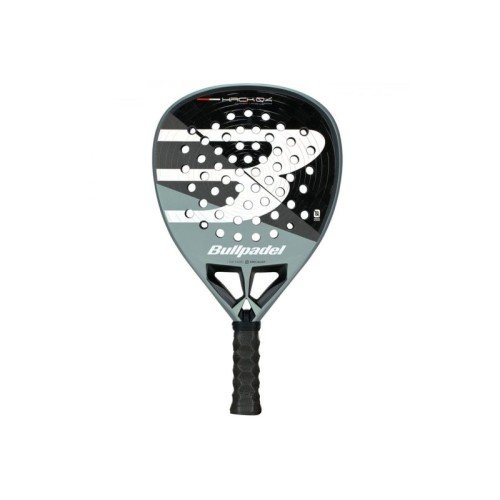
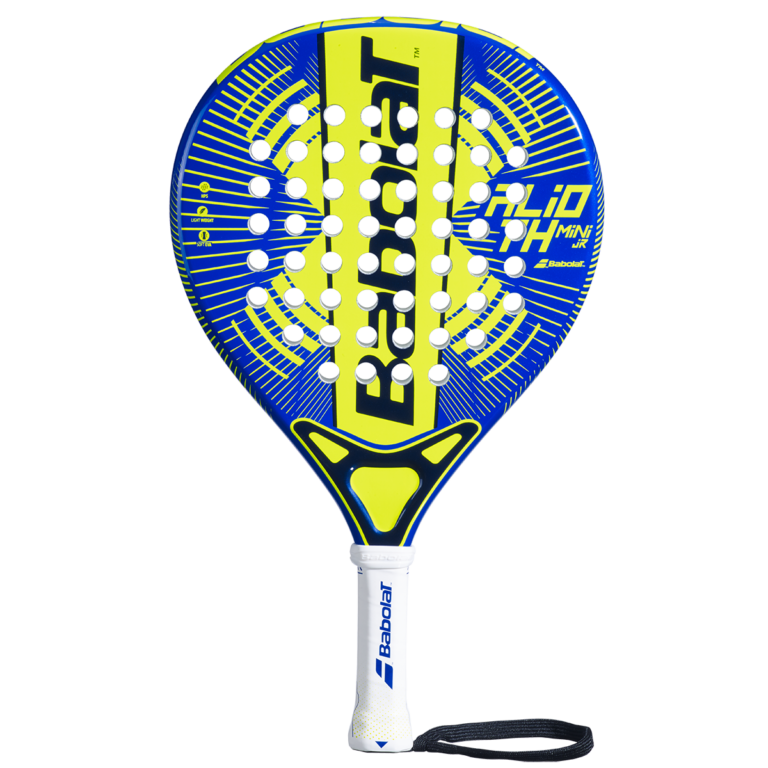
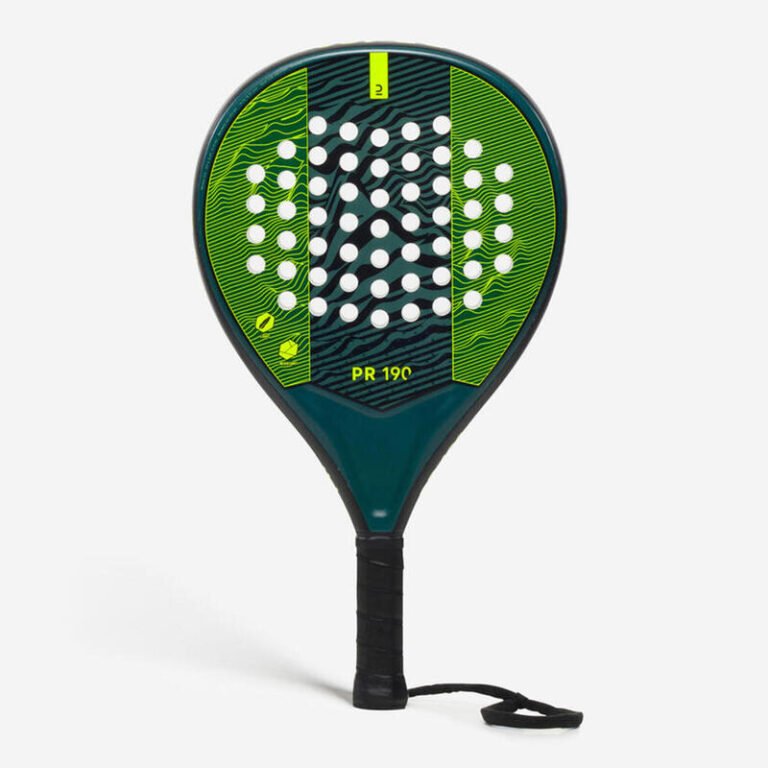
Once the glass is up, the costs that keep a court’s calendar full are refreshingly small: rackets and balls. If you are equipping a home court or a new club’s rental fleet, start with the frames your players will actually use — our best padel rackets guide covers the picks by level and budget.
Shop Padel Rackets on AmazonLive prices on Amazon — compare per model before you buy.
Padel court cost FAQs
How much does a padel court cost in Dubai?
For the court kit itself, supplied and installed, a real Dubai supplier quotation (Pro Shop Sport Fields & Halls Contracting, July 2025) priced a standard 10m × 20m panoramic court at AED 50,000 plus 5% VAT — AED 52,500 in total — including 12mm tempered glass, steel cage, eight 200W LED lights, 12mm turf with silica sand, and the net. That figure assumes a prepared base: PadelGamePlan’s UAE ranges add site preparation at AED 18,000–55,000 and permits and legal at AED 7,500–18,000 for a turnkey build, and a full facility with amenities runs far higher again.
How much is a panoramic padel court compared with a standard court?
Panoramic is the premium format — its back walls are structural glass joined panel-to-panel, with no steel pillars — so it prices above a standard court from the same supplier, where steel frames each glass bay. The clearest UAE reference point is the Dubai quotation used throughout this guide: a panoramic court, supplied and installed, at AED 50,000 + VAT. Standard courts sit below panoramic pricing because the steelwork does more of the structural work and the glass fittings are simpler — and on court, the two formats play identically.
What is included in a padel court kit?
On the Dubai quotation’s scope: the galvanised steel cage structure, 12mm tempered glass (14 panels), eight 200W LED floodlights, 12mm artificial turf dressed with silica sand infill, and the net posts and net — supplied and installed in two to three days. Not included, and easy to miss when comparing quotes: groundworks and the concrete base, drainage, electrical connection beyond the fixtures, and permits. Always compare the written scope, not the headline number.
How much do groundworks cost for a padel court?
PadelGamePlan’s published UAE range for site preparation is AED 18,000–55,000. The spread is driven by the plot: an existing flat surface in good condition sits at the low end, while sloping or unserviced land needing excavation, a reinforced concrete slab, drainage and a power run sits at the top. The base must be dead level — panoramic glass panels have to meet each other exactly — so this is the last place to economise. Any groundworks figure quoted without a site visit is a guess.
How long does it take to install a padel court?
The court itself is quick: the Dubai supplier quoted two to three days to install the complete panoramic court — steel frame, glass, turf, sand, lights and net — once it is on site. The longer timeline belongs to everything around it: manufacturing and shipping the kit, customs if it is imported, and pouring and curing the concrete base before the crew arrives. Sequence the base first and the installation is the fastest stage of the project.
Can I save money by importing a padel court kit directly?
Possibly — factory-direct pricing is genuinely lower. Manufacturer GHCOURT lists court kits at USD 8,000–11,000 per court, but that excludes delivery and installation: sea freight, port handling, customs, the base and an installation crew are all still yours to arrange and pay for. For a single court, a UAE supplier’s supply-and-install contract (AED 50,000 + VAT on the quoted example) is usually the rational route. Importing tends to win on multi-court projects, where the per-court saving grows and the coordination cost is shared. Never pay freight on silica sand — source it locally.
How much does it cost to maintain a padel court?
There is no reliable published UAE maintenance tariff, and this guide will not invent one. The honest picture: routine maintenance is mostly labour — brushing the turf and redistributing sand, topping sand up, cleaning glass, checking fixings and net tension — rather than parts. The one significant recurring investment is the surface itself: artificial turf is a long-life consumable, and under heavy club use it will eventually need lifting and replacing while the steel, glass and base carry on. Ask any supplier for their re-turfing price before you buy the court, not after.
Is it better value to build one court or several?
Several, per court — up to the point your bookings justify them. Groundworks mobilisation, approvals and site infrastructure are largely fixed costs that a second and third court share, and PadelGamePlan’s full-facility total of AED 335,000–1,130,000 includes amenities at AED 185,000–750,000 precisely because clubs build shared facilities around the courts. But a court only earns when it is booked: published Dubai rates of AED 300 per court-hour (Padel Park) reward filled peak slots, not empty extra courts. Build the number your local demand can fill at peak, in phases if needed.
The verdict
Budgeting a private or farmhouse court in the UAE? Anchor on the real number: AED 50,000 + VAT bought a panoramic court supplied and installed in Fujairah in 2025 — then add your base. Planning a turnkey club court? Work through PadelGamePlan’s components — construction, fencing and glass, lighting, site preparation, permits — and expect the total to be a multiple of the kit price. Planning a facility? You are in AED 335,000–1,130,000 territory, and the courts are no longer the biggest line — the amenities are. Whichever layer you are in: compare written scopes, protect the glass, steel and base, and never let anyone sell you a layer-3 facility at a layer-1 headline — or charge you layer-3 money for a layer-1 kit.
Affiliate disclosure: Alishuttler.com is a participant in the Amazon Services LLC Associates Program. The Amazon buttons on this page use our affiliate tag — if you buy through them, we may earn a commission at no extra cost to you. Court cost figures in this guide are quoted from the named suppliers and publications in the text and were correct as sourced at the time of writing; obtain a current written quotation for your own project.