No other racket sport asks you to choose how much your ball bounces — squash does, and the tiny coloured dot on the ball decides it. Pick the wrong dot and rallies die at your feet; pick the right one and the same two players suddenly play three times longer. This guide decodes the dot system properly, then matches the best ball to every level.
TL;DR — The short answer
New to squash? Start on the Dunlop Intro (blue dot) — it is bigger and far bouncier, and it will teach you the game instead of punishing you. Improving? The Dunlop Progress (red dot) is the step up. Playing club squash? The Dunlop Competition (single yellow dot) is your default — and the cold-court rescue when a double yellow will not come alive. Advanced or competing? The Dunlop Pro (double yellow dot) is the official ball of the WSF and PSA and the only ball used in international professional play. The full reasoning — hang time, warm-up, temperature and altitude — is below.
Dunlop Intro
Blue dot. 12% larger, 40% longer hang time — rallies survive while you learn.
Dunlop Progress
Red dot. 6% larger, 20% longer hang time — the bridge to standard-size balls.
Dunlop Competition
Single yellow dot. Standard size with 10% more hang time than the Pro.
Dunlop Pro
Double yellow dot. The official WSF & PSA ball — the competition standard.
Prince Rebel
Double yellow dot in Prince’s soft rubber formula, built to warm up fast.
Dunlop Pro High Altitude
Green dot. Built to the WSF’s separate high-altitude specification.
On this page
- Why the ball decides your rally before you start
- The dot system explained: blue, red, yellow, double yellow
- Why a squash ball starts dead: temperature and warm-up
- Cold courts and high altitude: when the dot chart changes
- 1. Dunlop Intro — Best for Beginners
- 2. Dunlop Progress — Best for Improvers
- 3. Dunlop Competition — Best for Club Players
- 4. Dunlop Pro — Best Overall, the Official Ball
- 5. Prince Rebel — Best Softer Double Yellow
- 6. Tecnifibre Double Yellow Dot — WSF-Approved Alternative
- 7. Dunlop Pro White — the Glass-Court Ball
- 8. Dunlop Pro High Altitude — Best for High Altitude
- Comparison table
- Warming up, spotting a dead ball, and how many to buy
- FAQs
Why the ball decides your rally before you start
Every other racket sport hands you a ball and expects you to get on with it. Squash hands you a choice, because a squash ball is not really a ball until it is warm. The rubber compound is engineered to be almost dead at room temperature and lively at playing temperature — which means the dot grade you choose sets a ceiling on how long your rallies can be. A beginner hitting a cold double yellow dot is not playing badly; they are playing a ball that was designed for professionals who strike it hard enough, often enough, to keep it hot. The ball dies in the front corners, the rallies last three shots, and both players conclude they are worse at squash than they are.
This is why ball selection is the highest-leverage purchase in the sport — more than the racket. If you are still choosing that as well, our best squash rackets for beginners guide covers the other half of a first kit. But get the ball right first: it is the cheapest item in your bag and the only one that changes the physics of every single rally. Choose the dot for the player and the court you actually have today — not the player you plan to be next year — and move up a grade when the rallies tell you to.
The dot system explained: blue, red, yellow, double yellow
The dots are a speed-and-bounce grading system printed on the ball itself. The rule of thumb runs in one direction: the further you go from blue toward double yellow, the slower the ball, the lower the bounce, and the harder you must hit it to keep it alive. Manufacturers express the steps in hang time — how long the ball stays in the air — because that is what you actually feel on court: more hang time means more time to reach the ball and a rally that survives imperfect shots. Dunlop’s own range table, the reference version of the system, looks like this:
| Dot | Dunlop grade | Size | Hang time (vs Pro) | Bounce | Who it is for |
|---|---|---|---|---|---|
| Blue dot | Intro | 12% larger than standard | 40% longer | High | Beginners and juniors |
| Red dot | Progress | 6% larger than standard | 20% longer | Medium | Improvers and recreational players |
| Single yellow dot | Competition | Standard (40 mm) | 10% longer | Low | Club and team players |
| Double yellow dot | Pro | Standard (40 mm) | Baseline — the shortest | Very low | Advanced, tournament and professional play |
| Green dot | Pro High Altitude | Standard (40 mm) | Built for thin air | Adjusted for altitude | Play at high-altitude venues |
Two things in that table deserve a second look. First, the beginner balls are bigger, not just bouncier: the Intro is 12% larger and the Progress 6% larger than the standard 40 mm ball, which makes them easier to see, easier to hit cleanly and slower through the air. Second, the standard the whole system hangs off is a real specification, not marketing. The World Squash Federation’s ball specification defines the standard ball at 40.0 ±0.5 mm in diameter and 24.0 ±1.0 g in weight, with stiffness and seam-strength minimums — so a double yellow dot from any serious maker is built to the same physical template, and what differs between brands is compound, feel and finish rather than size.
Two special cases complete the picture. On the all-glass show courts used for major professional events, players use a white version of the double yellow — the same competition ball in white so it stays visible against glass and under broadcast lights (there is a card for it below, and it is the ball you will see if you follow the tour through our PSA World Championship hub). And at altitude, a green dot high-altitude ball exists under its own WSF specification — more on that in the conditions section. Everything else in this guide is black rubber with coloured dots, and the colour is the whole decision.
Why a squash ball starts dead: temperature and warm-up
A squash ball’s bounce is a temperature gauge. The WSF specification makes this startlingly concrete: balls are tested by dropping them from 254 cm, and a double yellow dot must rebound at least 12% of that height at 23 °C — but 25–30% at 45 °C. Read that again: the same ball, from the same box, bounces roughly twice as high hot as it does cold. A single yellow dot’s window tells the same story (15% minimum cold, 30–35% warm). The ball in your bag at room temperature is, by design, about half a ball.
That is why every squash session starts with a warm-up that is really about the ball, not the players. Hitting drives hard and repeatedly flexes the rubber and raises its temperature until the bounce arrives; a ball that has been properly warmed stays lively as long as the rally pace keeps it hot, and goes quiet again if the game slows down or stops. The playing consequence is the part beginners miss: a slower ball demands more warmth, generated by harder hitting, sustained for longer. A double yellow in the hands of two beginners never gets hot enough to reach even its cold-spec bounce for more than a few shots at a time. The ball is not faulty and the players are not (necessarily) the problem — the pairing is.
Cold courts and high altitude: when the dot chart changes
The dot grades assume a normally heated court at something like sea level. Change either variable and the correct answer moves one step with it.
Court temperature. A cold court keeps a cold ball: in an unheated hall in winter, a double yellow dot may never reach its working temperature at club pace, and every rally shortens. The standard fix is not to warm up longer — it is to step down a grade. Retailers of the Dunlop Competition say it outright: the single yellow is the ball for colder months when you want longer rallies. The same logic works in reverse on a hot court or in summer, when a ball that plays perfectly in January can feel over-lively in July. Serious players carry both a single and a double yellow and choose on the day; the cost of the second ball is trivial next to a ruined session.
Altitude. Thin air changes the other half of the equation: with less air resistance, the ball flies faster and carries further than the same shot at sea level, so rallies speed up precisely when visiting players are least able to chase them. The WSF maintains a separate specification for a green-dot high-altitude ball, built slower to compensate, and Dunlop sells it as the Pro High Altitude (card 8 below). If you play regularly in a high-altitude city, it is not a gimmick — it is the ball your venue’s air was factored into. Travelling the other way matters too: a ball bought for altitude will feel dead at sea level, so treat it as venue equipment, not a travel ball.
One boundary before the picks: this guide is about choosing the ball. How the ball behaves once it is in play — what counts as up, down and out — lives in our how to play squash guide, and this page deliberately does not repeat it.
The 8 best squash balls, reviewed by level
Every pick below was checked against live manufacturer or specialist-retailer listings at build time: dot grade, size, hang time, approval status and pack formats all come from the brands’ own published figures, not roundup sites. The list runs in playing order — beginner grades first, competition balls in the middle, the two specialists (glass court and altitude) at the end.
Beginner & progression balls
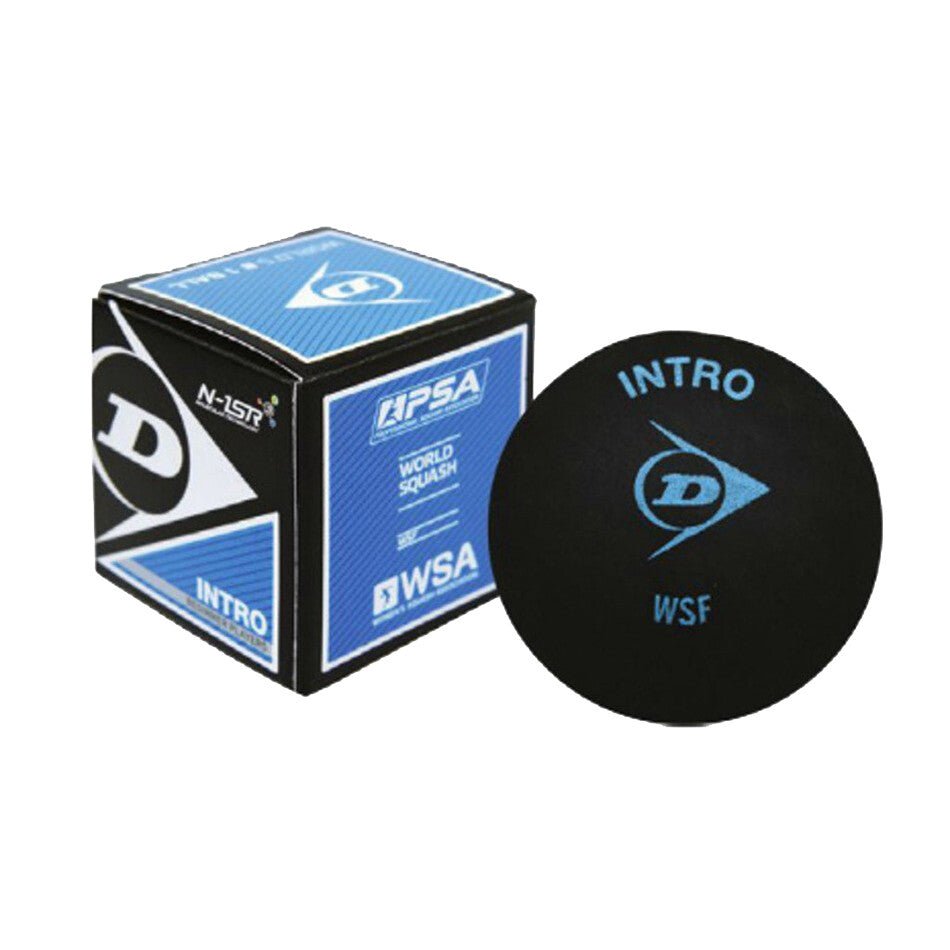
Dunlop Intro
The blue dot beginner ball — bigger, bouncier, forgiving
Dunlop builds the Intro 12% larger than a standard ball and gives it 40% longer hang time than the Pro. It is the ball that lets a first-month player have actual rallies — long, slow, readable ones — instead of a series of three-shot apologies.
Start with what the size does. A ball 12% larger is a bigger target for a beginner’s racket and a slower object through the air, and the extra hang time compounds it: the ball arrives later, bounces higher and stays playable off the back wall instead of dying in the corners. For a player still learning to watch the ball onto the strings, that is the difference between practising squash and practising picking a ball up. Coaches start juniors and adult beginners here for exactly that reason.
The Intro also forgives the warm-up problem completely. It does not need to be hot to bounce — its compound and size do the work your swing cannot yet — so a casual knockabout with a friend feels like squash from the first rally. Buy it singly to start; there is no case for a box of twelve until you know you are staying with the sport.
The honest limitation is built into the design: once you can sustain rallies and hit with any pace, the Intro starts to feel floaty and slow, and it will hold your development back by giving you time you would not get with a real ball. That is the graduation signal, not a flaw — when the blue dot feels easy, you have earned the red one below.
Pros
- 12% larger — easier to see and strike cleanly
- 40% longer hang time keeps beginner rallies alive
- Bounces without needing a hard warm-up
- Sold singly — no box commitment for a first ball
Cons
- Feels floaty once your hitting improves
- Not the standard size — habits must adjust when you move up
As an Amazon Associate we earn from qualifying purchases.
Dunlop Progress
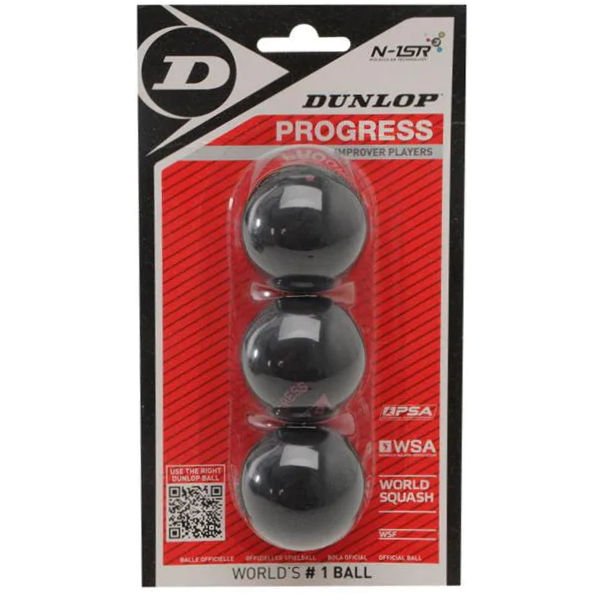
The red dot step between beginner balls and the real game
The Progress is Dunlop’s deliberate halfway house: 6% larger than standard, 20% longer hang time than the Pro. It plays recognisably like proper squash — drives, boasts and back-wall play all behave — while still giving an improving player time to execute them.
Dunlop positions the Progress at players “developing technique”, and the spec sheet shows why it works as a teaching ball. Because it is livelier than a standard ball, you do not have to hit it as hard to retain bounce — which means you can groove a full, controlled swing instead of learning the slappy, all-arm hit that beginners develop trying to keep a double yellow alive. The smaller size step (6% over standard, half the Intro’s margin) also means the adjustment when you graduate to a standard-size ball is a session, not a month.
It is also the right ball for a large, under-served group: recreational players who play once a week, hit socially and never intend to league-ify their squash. For them the red dot is not a stepping stone, it is the destination — the ball that maximises rally length and enjoyment at their pace of play, indefinitely. There is no rule that says the double yellow is the goal; the goal is a ball matched to the game in front of you.
Move on when the pattern flips: when you find yourself waiting for the ball, hitting winners too easily off loose shots, or playing partners who have stepped up to yellow. Until then, the Progress is the correct ball, and playing it is a sign you chose deliberately rather than defaulting to whatever was in the club shop.
Pros
- The designed bridge: 6% larger, 20% more hang time
- Lively enough to groove a full swing, not a slap
- Ideal permanent ball for weekly recreational players
- Small adjustment when graduating to standard size
Cons
- Strong improvers will outgrow it within a season
- Still not standard size — league play needs the next step
As an Amazon Associate we earn from qualifying purchases.
Club balls
Dunlop Competition
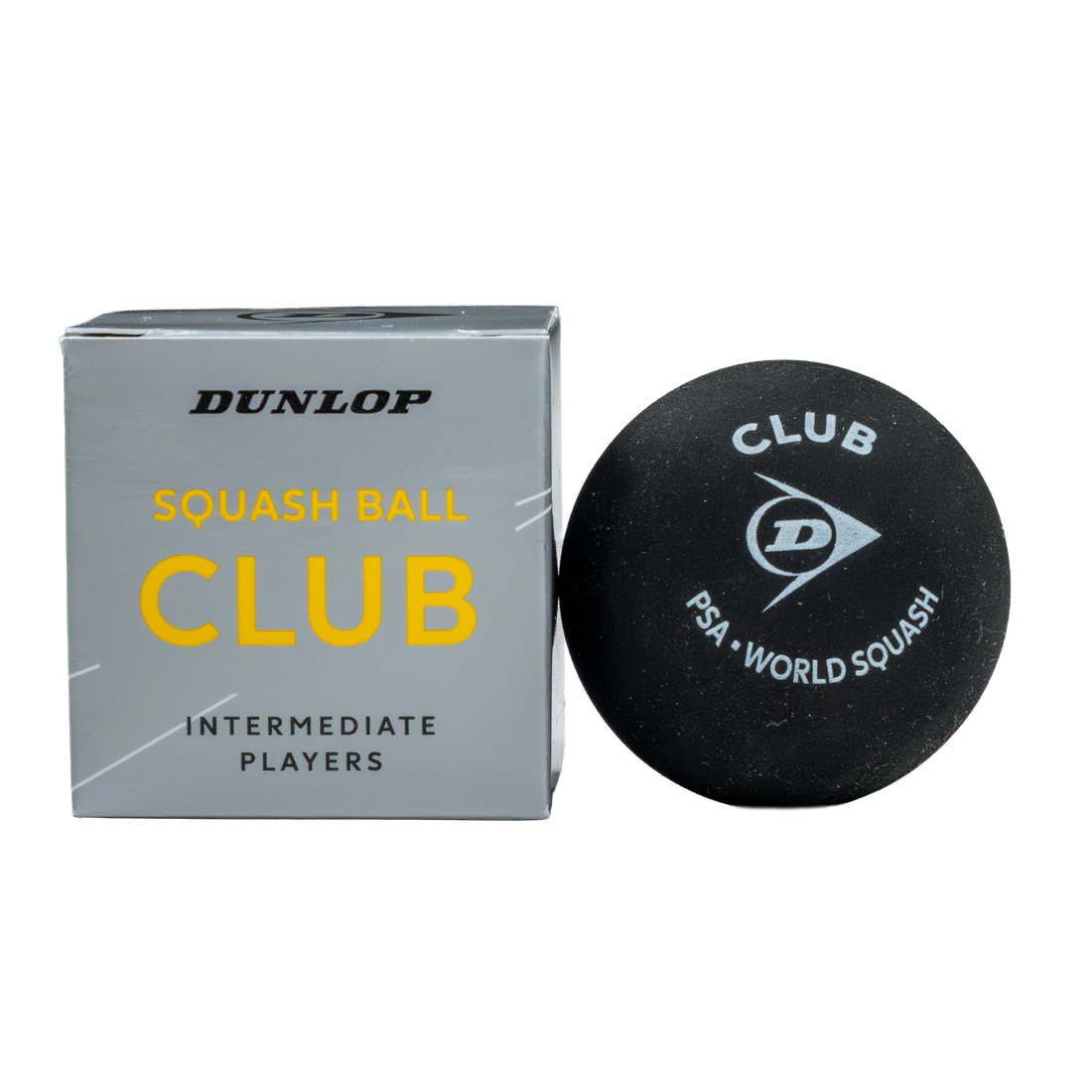
Single yellow dot — standard size, 10% more hang time than the Pro
This is the most under-bought ball in squash. The Competition is the full standard size — no training wheels — with a compound that hangs 10% longer than the double yellow. For the majority of club players, it produces better squash than the ball they feel they are supposed to use.
One naming note before the substance, because the listings are mid-change: Dunlop refreshed this ball’s packaging in 2026 and it is now also sold as the Dunlop CLUB — specialist retailers state plainly that the CLUB is the ball “previously the Dunlop Competition Ball”, with the same standard size and the same 10% longer hang time than the Pro. Competition and CLUB listings are the same purchase; buy whichever name your store stocks.
The playing case is the 10%. That margin is small enough that the ball still demands a proper warm-up and honest technique — it is a real ball, built to the WSF’s single yellow specification (its warm rebound window, 30–35%, is the liveliest of the standard-size grades) — and large enough to rescue the two situations that wreck club squash: the cold court and the slightly-too-strong opponent pairing. Rallies lengthen, the back corners come into play, and both players get to practise the full game instead of a front-court scramble.
Who should skip it? Players competing in events played with the double yellow should train with the double yellow — specificity wins at that level, and it is the next card. Everyone else at club level should at least own one: as a winter ball, a warm-up ball for the first games of a session, and the honest answer on any night the Pro refuses to come alive.
Pros
- Standard 40 mm size — no training-wheel compromise
- 10% more hang time rescues cold courts and club rallies
- Built to the WSF single yellow specification
- Singles, tubes and dozens for every buying pattern
Cons
- Dual naming (Competition / CLUB) confuses listings
- Not the competition ball — events use the double yellow
As an Amazon Associate we earn from qualifying purchases.
Competition balls
Dunlop Pro
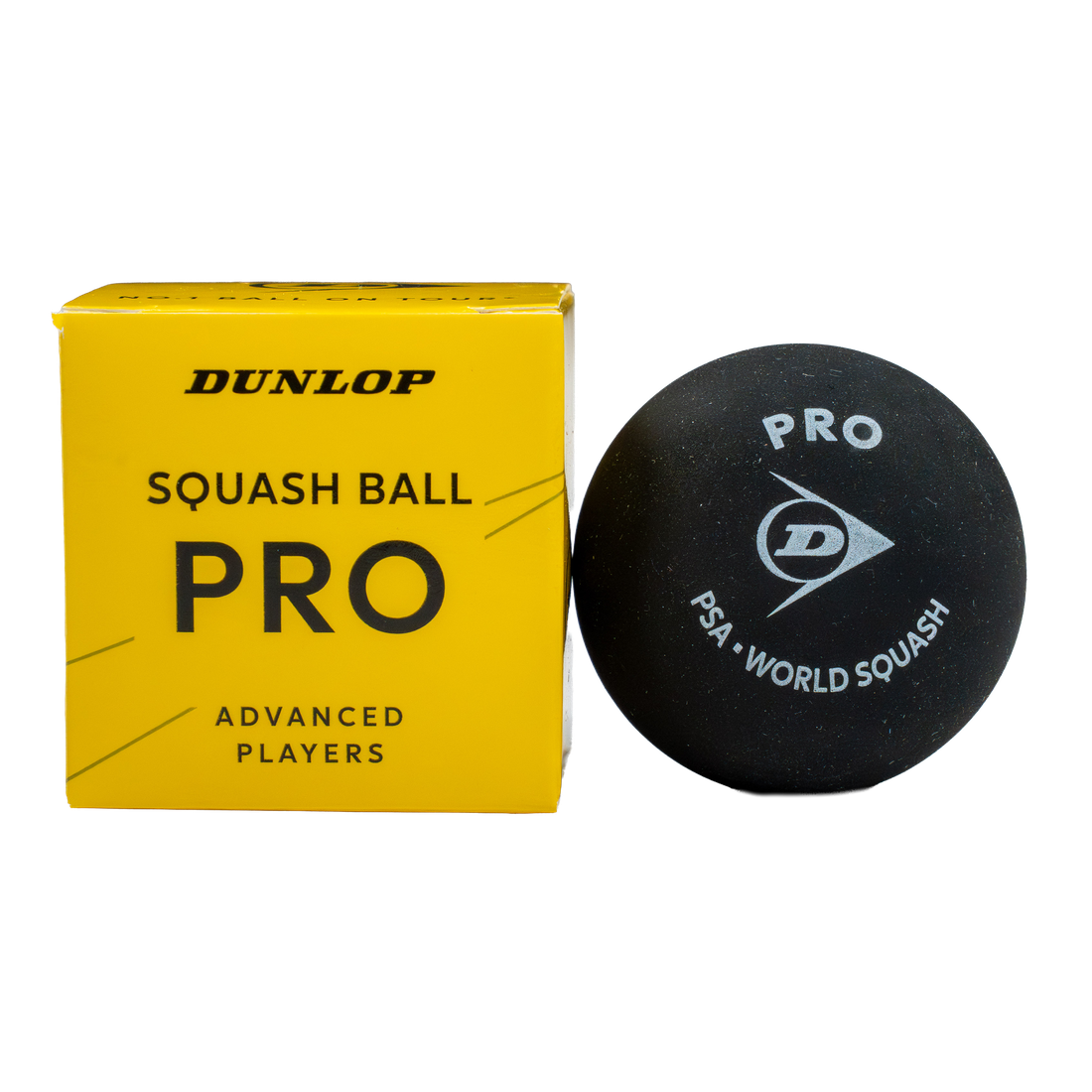
The double yellow dot — official ball of the WSF and PSA
There is no argument about the standard: the Dunlop Pro is the official ball of the World Squash Federation and the Professional Squash Association, described by Dunlop as the only ball used in international professional competition. When your game is ready for the real thing, this is the real thing.
Dunlop builds the Pro from an elastic hydrocarbon polymer it calls N-1SR³ — a compound of twelve constituents, by Dunlop’s own description — and it is the ball against which the WSF’s double yellow specification (40.0 ±0.5 mm, 24.0 ±1.0 g, rebound at least 12% cold and 25–30% warm) is effectively written. In some markets the identical ball is sold under the fuller name Dunlop Revelation Pro; listings under either name are the same product, which is worth knowing before you pay a premium for one label over the other.
On court, a warmed Pro is the complete test: the lowest bounce, the shortest hang time, no free time anywhere on the court. Length has to be earned with a full swing, the ball sits down in the front corners, and drop shots and volleys become precision instruments instead of percentage plays. For advanced players, tournament players and strong club players, nothing else in this guide is a substitute — league and competition squash is played with this ball, full stop. If you are building toward that level on a budget, our best budget squash rackets guide pairs with it as the other half of a serious setup.
The caveat is the whole thesis of this page: the Pro rewards only players who can keep it hot. If your rallies with it keep dying in the front third, the ball is giving you accurate information — step down to the Competition until they stop dying, then come back. Owned in dozens by every serious club, bought in tubes by everyone else, the Pro is the benchmark this list is measured against.
Pros
- The official WSF & PSA ball — the competition standard
- The benchmark double yellow every rival is compared to
- N-1SR³ compound, built to the WSF specification
- Available everywhere, in every pack format
Cons
- Unplayable-cold for players who cannot keep it warm
- Sold as both “Pro” and “Revelation Pro” — check you are not overpaying for the label
As an Amazon Associate we earn from qualifying purchases.
Prince Rebel Double Yellow Dot
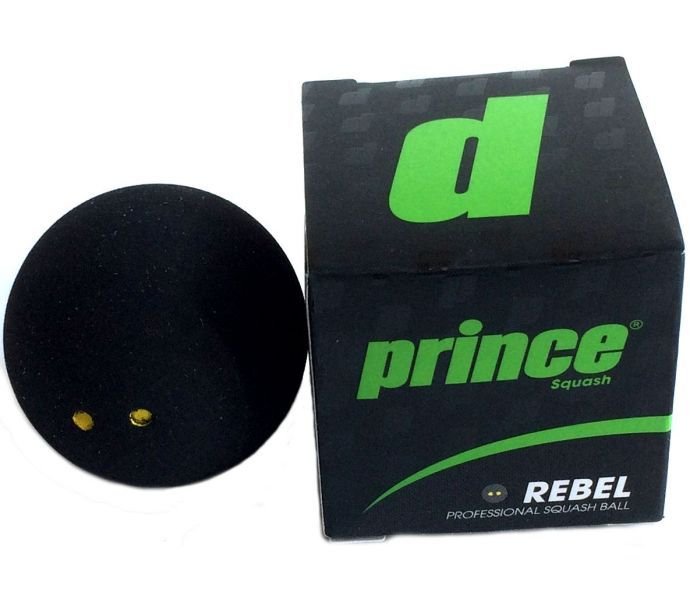
Prince’s soft-formula take on the competition ball
If the Dunlop Pro feels like a stone for the first two games, Prince built your ball: the Rebel is a full double yellow dot for advanced players, made with what Prince calls its ultimate soft rubber formula — positioned by retailers on faster warm-up, a softer feel and more grip on the strings.
Prince’s squash ball range is a three-step ladder — Rebel Blue Dot for beginners, a Single Yellow Dot for medium-skilled players and this Rebel Double Yellow at the top — and the Rebel’s identity within it is feel. Retailer listings for the ball repeat the same trio of claims from Prince’s copy: faster warm-up time, softer feel, more spin. In practice that makes it the double yellow of choice for players whose sessions are shorter or whose courts run cool: a ball that comes alive a game earlier is worth real points across a season of first games.
It is also the connoisseur’s swap. Because every serious double yellow is built to the same WSF template, brand differences live in the compound — and the Rebel’s softer compound is the most distinct alternative character to the Dunlop benchmark. Players who find the Pro skiddy on worn courts or harsh on touch shots tend to be the ones who convert. Players who love the Pro’s crispness tend to find the Rebel a fraction muted. Neither reaction is wrong; it is the one genuinely subjective choice in this guide.
Availability is the honest drawback: the Rebel is stocked by squash specialists rather than every general sports chain, and singles are easier to find than tubes. If your club shop carries it, it is a legitimate first-choice double yellow. If it does not, the Dunlop remains the ball the rest of the world will be playing with.
Pros
- Soft rubber formula — the distinct alternative feel
- Positioned on faster warm-up and more grip
- A true double yellow for high-level tournament players
- Part of a full Prince dot ladder for mixed households
Cons
- Specialist-shop availability; fewer pack formats
- Softer character will not suit players who love the Dunlop’s crispness
As an Amazon Associate we earn from qualifying purchases.
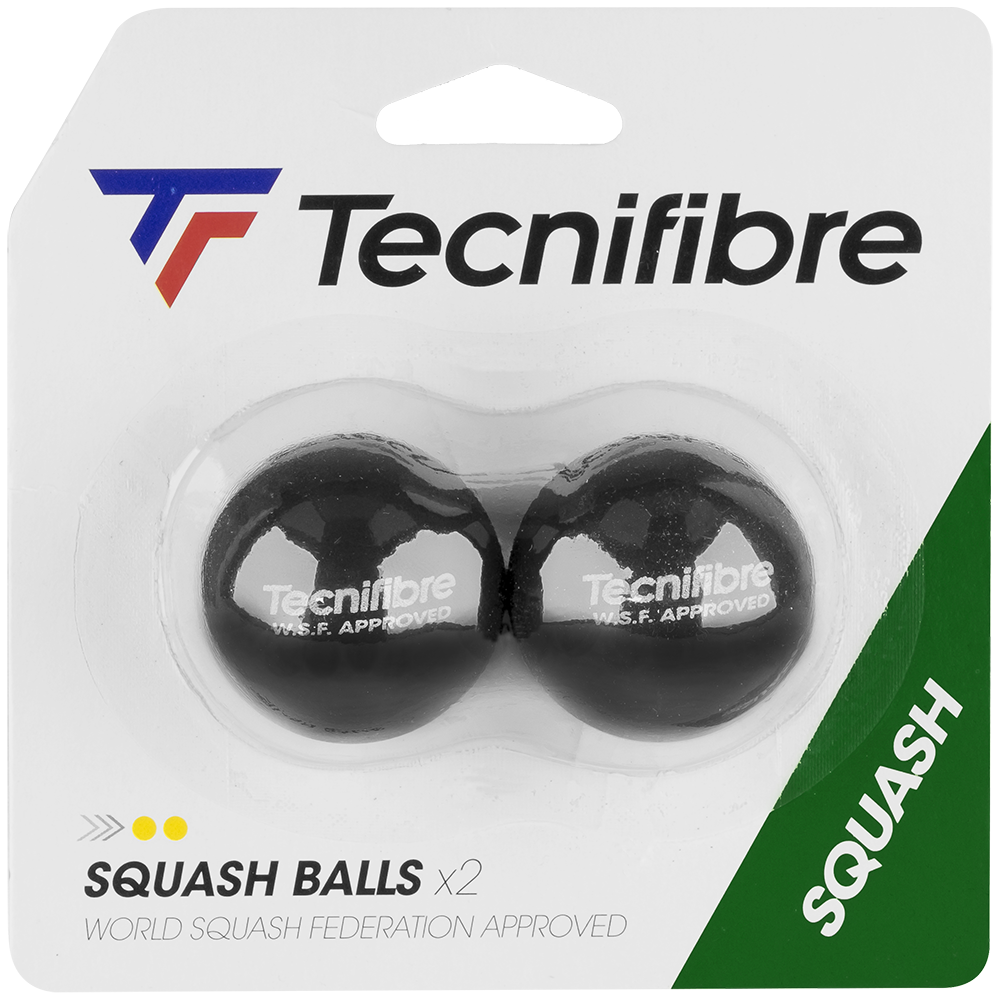
Tecnifibre Double Yellow Dot
The WSF-approved French alternative, sold as a two-pack
Tecnifibre’s double yellow is the lowest-bounce ball in a four-speed range, sold in a simple two-ball blister (model 54BASQDOUB) and carrying the credential that matters: approval by the World Squash Federation for tournament play.
Tecnifibre builds a full dot ladder of its own — double yellow, single yellow, red and blue — and aims the top rung squarely at “professional, tournament and club players”, in the words of its retailer listings. That matters for one practical reason: a household or club that standardises on Tecnifibre can walk a player up the same brand’s ladder from first ball to competition ball, with consistent feel at each step — the same ecosystem logic as Dunlop’s, from the sport’s other great racket-and-string house.
The two-pack format is the format story of this guide. Where Dunlop sells singles, tubes and dozens, Tecnifibre’s blister of two suits the player who rotates a match ball and a spare and replaces both together — a tidy, no-decision purchase. Specialist retailers (PDHSports among them) note both the WSF approval and England Squash approval on the listing, so there is no ambiguity about its competition legality.
Set expectations on character honestly: listings describe a conventional, consistent double yellow rather than a radical alternative feel, and that is the point of the card. If you already play Tecnifibre rackets and strings, or your local specialist stocks the brand deeply, this is a fully legitimate competition ball — not a novelty and not a compromise.
Pros
- WSF approved for tournament play
- Top of a full four-speed Tecnifibre ladder
- Two-pack suits a match-ball-plus-spare rotation
- Stocked by squash specialists internationally
Cons
- No tube or dozen format in most listings
- Conventional character — no distinct feel advantage
As an Amazon Associate we earn from qualifying purchases.
Specialist balls
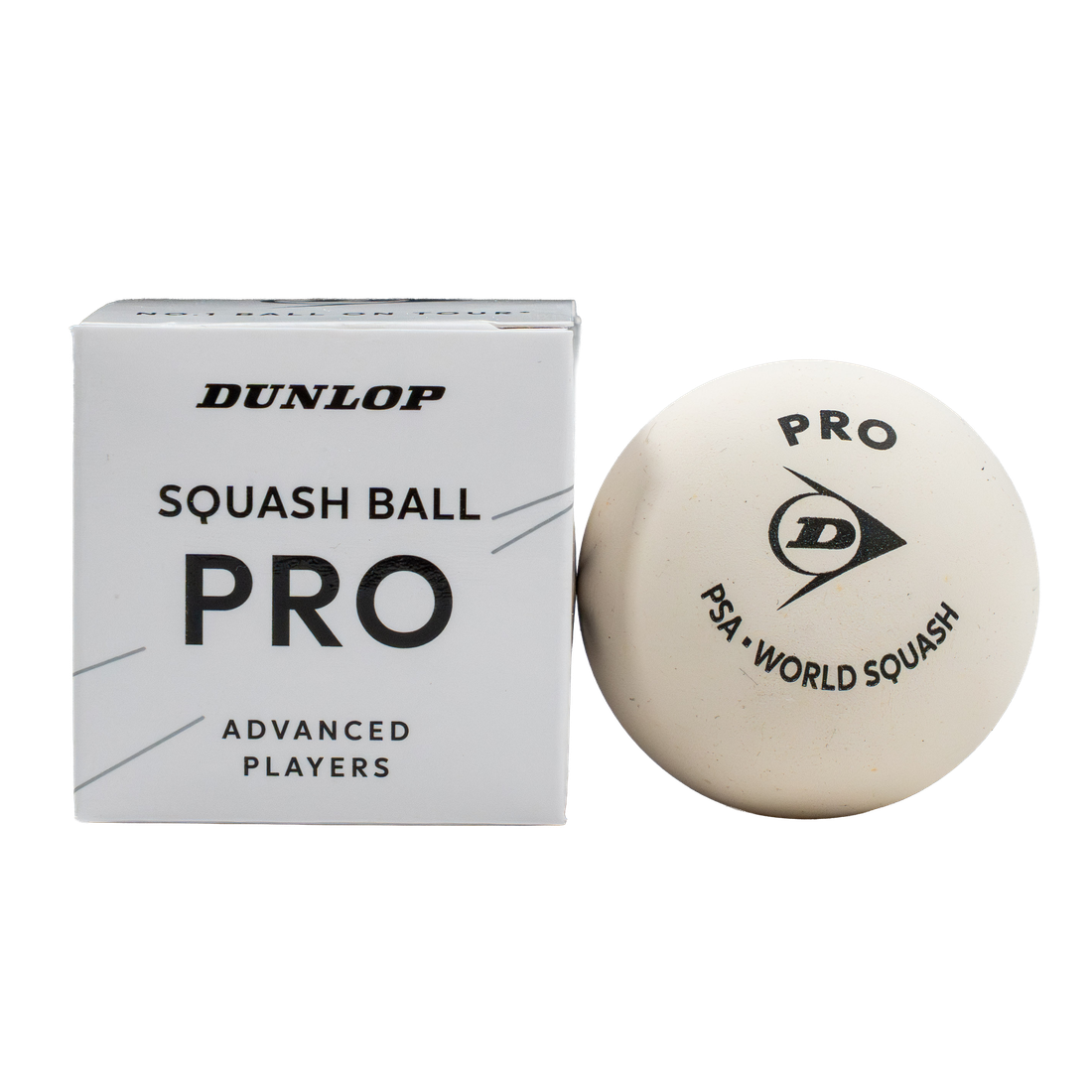
Dunlop Pro White
The double yellow in white — built for all-glass courts
Watch a major final on an all-glass show court and the ball is white. This is that ball: Dunlop’s Pro in a white compound, made — in the retailers’ words — for glass court use, so the ball stays visible against glass walls and under event lighting.
Most club players will never need this card — and should know it exists anyway, because it explains the one piece of squash-watching that confuses newcomers: why the ball changes colour at the biggest events. A black ball disappears against a glass back wall and dark arena seating; the white Pro solves the visibility problem for players, spectators and cameras at once. It is a colour variant of the competition ball, not a different grade: the double yellow playing character carries over.
There is one genuine club use case. If your club has a glass-back court — increasingly common, and the setting for the events covered in our PSA World Championship hub — a white ball is visibly easier to track from behind the glass for the watching player, and many glass-back venues stock it for exactly that reason. If you play on one regularly, a single white ball in the bag is a cheap experiment with a real chance of becoming your default.
On a conventional plaster court, though, the black ball remains easier to follow against pale walls, and the white ball shows every mark — buy it for glass, not as a novelty. Availability mirrors its specialism: singles and dozens from the same squash specialists who stock the rest of the Pro line.
Pros
- The ball used on all-glass show courts
- Same double yellow competition character
- Easier to track on glass-back club courts
- Singles and dozens from specialist retailers
Cons
- No advantage on a standard plaster court
- White compound shows scuffs and marks quickly
As an Amazon Associate we earn from qualifying purchases.
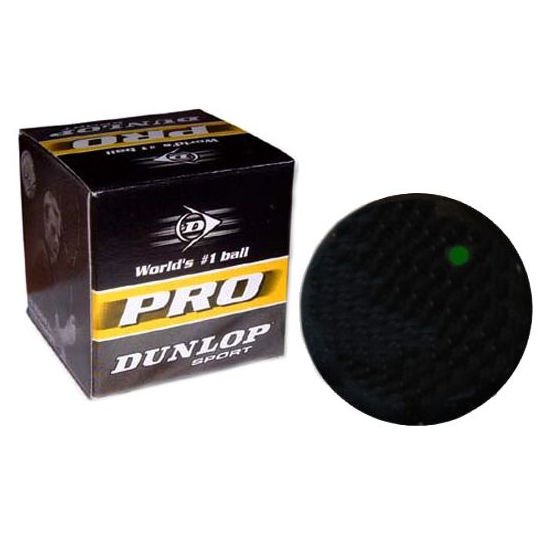
Dunlop Pro High Altitude
Green dot — the Pro, re-engineered for thin air
Above the plains, the air thins, drag drops and a standard ball flies through the court. Dunlop’s answer is the Pro High Altitude: a green-dot ball built slower for high venues, sitting under the WSF’s own separate high-altitude specification.
The physics, briefly: a squash ball’s flight is a negotiation between your racket and the air. At altitude there is less air to push against, so drives carry further and faster and the whole game speeds up — flattering for the first ten minutes, then exhausting and error-strewn as length after length sails long. A high-altitude ball is compounded to play slower, returning the rally geometry to something like its sea-level shape. The WSF takes the problem seriously enough to publish a dedicated specification for it — same 40.0 ±0.5 mm template, its own stiffness and rebound requirements, identified by the green dot.
Dunlop’s version is the established one, sold through the same channels as the rest of the Pro family in singles and boxes of twelve. If you live and play at altitude, this is not an exotic extra: it is the correct home ball, and the standard double yellow becomes your travel ball for trips down to sea level, where the green dot would feel dead and heavy by comparison.
For the sea-level majority, file this card under “understand it, don’t buy it” — with one exception. If you are travelling to play at altitude (a tournament trip, a club visit in a mountain city), packing one green dot will make you look like the best-prepared player at the venue, because you will be.
Pros
- Built to the WSF’s dedicated high-altitude specification
- Restores normal rally length and control in thin air
- Part of the Dunlop Pro family — singles and dozens
- The correct home ball for high-altitude players
Cons
- Feels dead at sea level — strictly venue equipment
- Niche availability outside altitude regions
As an Amazon Associate we earn from qualifying purchases.
Squash balls compared
| Ball | Dot | Size | Hang time / character | Best for |
|---|---|---|---|---|
| Dunlop Intro | Blue | 12% larger | 40% longer than Pro · high bounce | Beginners and juniors |
| Dunlop Progress | Red | 6% larger | 20% longer than Pro · medium bounce | Improvers and recreational players |
| Dunlop Competition | Single yellow | Standard 40 mm | 10% longer than Pro · low bounce | Club and team players, cold courts |
| Dunlop Pro | Double yellow | Standard 40 mm | Baseline · very low bounce | Competition — official WSF & PSA ball |
| Prince Rebel | Double yellow | Standard | Soft formula · faster warm-up positioning | Advanced players wanting a softer feel |
| Tecnifibre Double Yellow | Double yellow | Standard | Lowest bounce in Tecnifibre’s range | Tournament play — WSF approved, 2-pack |
| Dunlop Pro White | Double yellow | Standard | Pro character in white | All-glass show courts |
| Dunlop Pro High Altitude | Green | Standard 40 mm | Slower build for thin air | High-altitude venues |
Warming up, spotting a dead ball, and how many to buy
How to warm a squash ball up properly
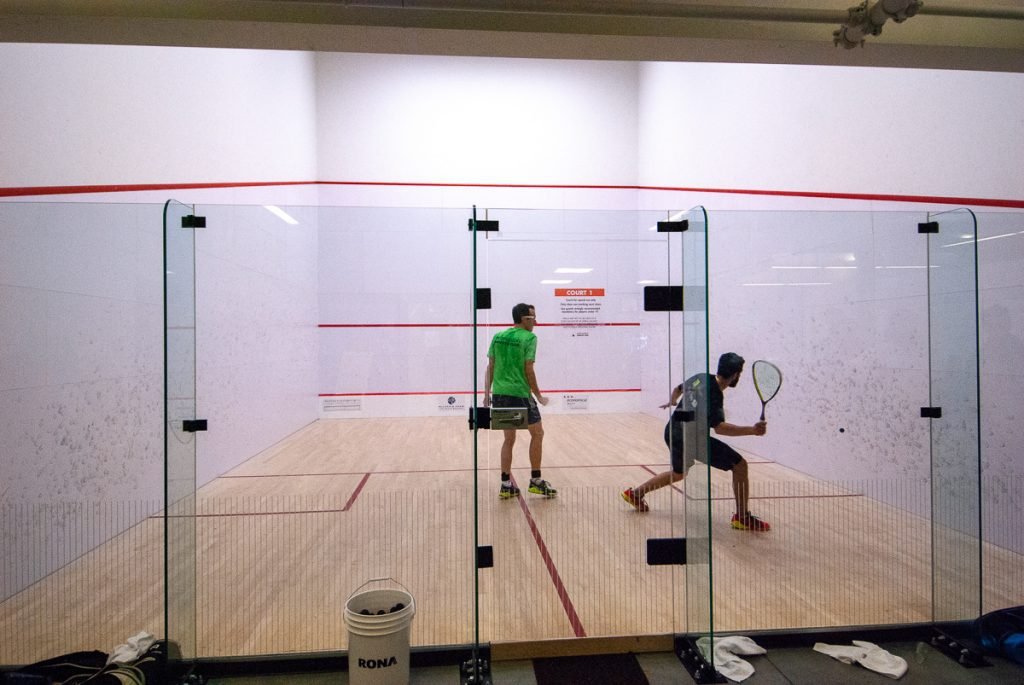
The warm-up is a procedure, not a knockabout. Give the ball several minutes of hard, purposeful hitting before the first game: drives up and down the walls, hit firmly and repeatedly, are the standard method — the flexing of the rubber under impact is what generates the heat. Cross-courts and boasts join in once the ball starts to respond. You are done when a normal drive, hit at your ordinary pace, carries to the back wall on one bounce and comes off it with life. Until that moment, you are not warming up your body — you are manufacturing your ball.
Then protect the investment. A ball cools during every break, so keep stoppages short, and if the session pauses — a long chat, a court change — expect the first rally back to feel dead and re-warm rather than re-judging the ball. Store balls at room temperature in their tube or box, not in a cold car boot or a hot bag by a radiator: a ball that starts the session at playing-room temperature reaches its bounce minutes sooner, and temperature extremes are the fastest way to age the compound.
When a ball is dead — and what “dead” actually looks like
There is no honest hour-count for a squash ball’s life; anyone who gives you one is guessing. Judge the ball in your hand by observable signs instead. The surface: a healthy ball is matte; as the skin wears it goes smooth and shiny, the printed logo and dot fade, and the ball starts to skid rather than grip. The bounce: warm it up properly, then test it — a ball that still will not carry and lift after a full warm-up has lost its resilience and no amount of hitting will restore it. The damage: splits along the seam, skin peeling or flaking, and any visible crack are instant retirement. And the subtlest sign: two balls from the same tube playing noticeably differently — keep the consistent one for matches and demote the other to warm-up duty.
Rotation stretches a stock further than any care routine: play the newest ball for matches, the run-in one for practice, and replace from the bottom. A box of twelve, rotated this way, is how clubs keep a match-standard ball available without waste.
How many to buy
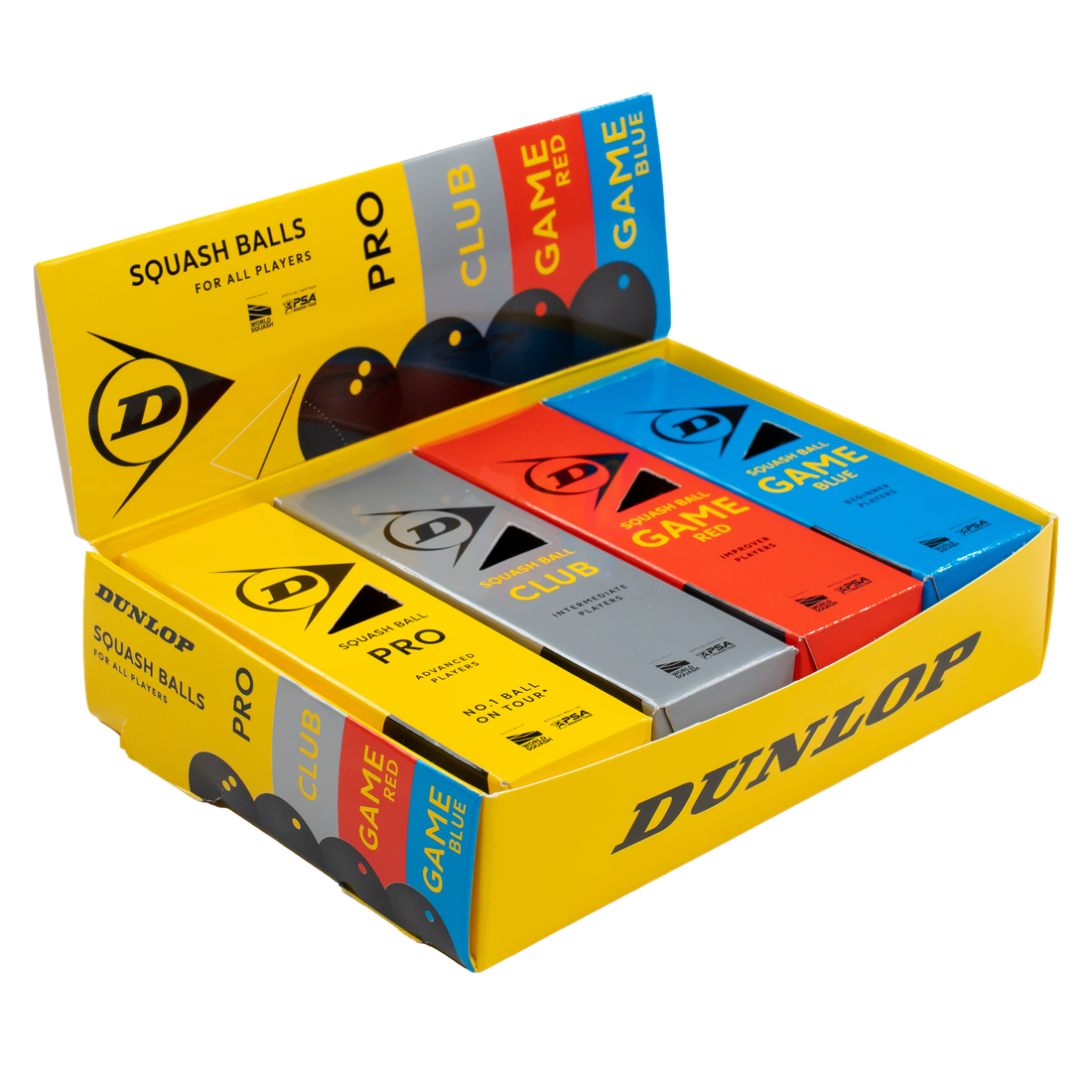
Your first ball: one. A single Intro or Progress, bought singly, until squash proves it is staying in your life. A regular club player: a tube of three of your grade — one in play, one warming in your pocket rotation, one spare — topped up as the rotation thins. A competing player: the box of twelve of your match ball, because matches and tournaments consume fresh balls and the per-ball price of a dozen is the honest way to buy them. A coach or club: dozens of the grade you teach with, plus one mixed pack — Dunlop sells a four-grade pack (Pro, Club, Game Red and Game Blue in current packaging) that is purpose-built for finding a new player’s correct dot in a single session.
Still setting up the rest of your kit? The racket you pair with the right ball matters almost as much — our beginner racket guide is written to be read alongside this one.
Squash ball FAQs
What do the dots on a squash ball mean?
The dot is a speed and bounce grade. Blue dot balls are the bounciest and largest — Dunlop’s blue Intro is 12% larger than standard with 40% longer hang time than the Pro — and each step (red, single yellow, double yellow) is slower and lower-bouncing. The double yellow dot is the slowest and is the competition standard. A green dot marks a high-altitude ball, built to a separate WSF specification for thin air.
Which squash ball should a beginner use?
A blue dot — the Dunlop Intro is the reference beginner ball. It is bigger, bounces higher and stays in the air 40% longer than a competition ball, so rallies survive while your technique is forming, and it does not need hard hitting to come alive. Move to the red dot Progress when the blue ball starts to feel slow and floaty.
What is the difference between a single yellow dot and a double yellow dot squash ball?
Both are standard size (40 mm) and built to WSF specifications, but the single yellow (Dunlop Competition) has about 10% longer hang time than the double yellow (Dunlop Pro) — it stays up longer and bounces a little more, which suits club players and cold courts. The double yellow is the slowest, lowest-bouncing ball and is the one used in competition, including all international professional play.
Why does a squash ball need to be warmed up?
Because its bounce roughly doubles with temperature. The WSF specification requires a double yellow dot to rebound at least 12% of a 254 cm drop at 23 °C, but 25–30% at 45 °C. Several minutes of hard hitting flexes the rubber and raises its temperature to the point where the ball plays as designed. A cold double yellow in beginner hands never gets there — which is why beginners should start with a bouncier dot, not a colder ball.
How long does a squash ball last, and when should I replace it?
There is no fixed lifespan — it depends on how hard and how often you play. Replace a ball when you can observe a fault: the surface has worn smooth and shiny so it skids instead of gripping, the bounce stays dead after a proper warm-up, or there is any split, crack or peeling — seam damage means instant retirement. Rotate a small stock (newest for matches, older for practice) and judge the ball in your hand, not the calendar.
Can a beginner play with a double yellow dot ball?
You can, but it is the classic beginner mistake. A double yellow only bounces properly when it is hot, and keeping it hot takes the hard, sustained hitting beginners cannot yet produce — so rallies die in the front corners, the session feels miserable, and players wrongly blame their technique. Start on blue, graduate through red and single yellow, and the double yellow will feel natural when you arrive at it.
What squash ball do professionals use?
The Dunlop Pro double yellow dot — the official ball of the WSF and PSA and, per Dunlop, the only ball used in international professional competition (in some markets it is labelled Dunlop Revelation Pro; it is the same ball). On all-glass show courts, the same ball is played in a white version, the Dunlop Pro White, for visibility against the glass.
Does court temperature or altitude change which ball I should buy?
Yes — both move the correct answer one step. On a cold court a ball may never reach playing temperature, so step down a grade (a single yellow instead of a double) for longer rallies; many players carry both. At altitude, thin air makes the ball fly faster, and a dedicated green-dot high-altitude ball exists under its own WSF specification to compensate — if you play regularly at a high-altitude venue, it is the correct home ball.
The verdict
Buy the Dunlop Intro if you are in your first months of squash — it is the ball that will actually teach you the game. Buy the Dunlop Progress if you are improving, or play weekly for fun and want the liveliest honest version of it. Buy the Dunlop Competition if you play club squash — and buy one even if you mainly play the Pro, for cold courts and first games. Buy the Dunlop Pro if you compete: it is the official ball, and there is no substitute at that level. Buy the Prince Rebel if you want your double yellow with a softer feel and a faster warm-up. Buy the Tecnifibre Double Yellow if you want a WSF-approved alternative in a tidy two-pack. Buy the Dunlop Pro White if your court is glass. Buy the Dunlop Pro High Altitude if your court is up a mountain. Whoever you are: match the dot to your level and your court, warm the ball like you mean it, and never let a cold double yellow tell you that you are bad at squash.
Affiliate disclosure: Alishuttler.com is a participant in the Amazon Services LLC Associates Program. The Amazon buttons on this page use our affiliate tag — if you buy through them, we may earn a commission at no extra cost to you. Prices shown on Amazon are live and may differ from any figures mentioned here.