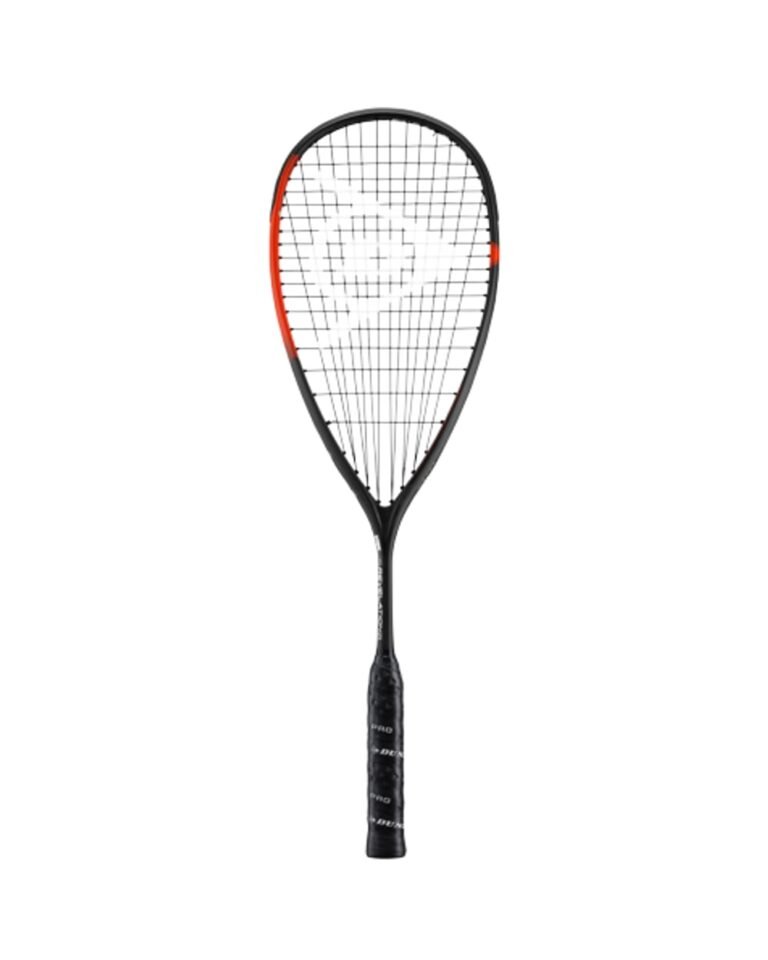
Squash courts have one non-negotiable footwear rule: the sole must not mark the floor. Adult court shoes meet it in adult sizes, which helps nobody shopping for a nine-year-old. Junior court shoes meet it in the sizes makers actually publish for kids — the grade-school, kids’ and youth ranges in this guide, every one of them a genuine junior model with a non-marking outsole as its maker describes it, sized and built the way parents actually buy them.
⚡ TL;DR — The Short Answer
Check the outsole first, the size range second, the badge third. Every shoe here is a maker-published junior model with a non-marking sole. The ASICS Upcourt 6 GS is the current grade-school all-rounder (junior 1 to 5.5), the Salming Falco Kids the squash-bred pick built on the Viper series, and the adidas Ligra 8 Kids adidas’s own juniors’ shoe, categorised by adidas for youth players. The Mizuno Cyclone Speed 5 Junior is the flat-soled beginner build, the adidas Speedcourt Kids the lightweight option with a strap version, the HEAD Sprint 3.0 Junior the lateral-support build, and the ASICS Gel-Upcourt GS the gum-rubber GEL classic. When junior sizes run out, the step up is an adult model in a small size — from the pillar guide below.
Quick Picks — Best Squash Shoes for Kids at a Glance
Current grade-school model: EVA midsole, non-marking rubber outsole, junior sizes 1 to 5.5.
Based on Salming’s Viper series, with C35 heel cushioning and a TGS 62/75 build.
adidas publishes it as a juniors’ shoe and categorises it for youth players, ages 8–16.
Flexible flat sole and removable cup insole; Mizuno aims it at beginner junior players.
Non-marking Adiwear outsole; the kids’ version adds a hook-and-loop strap over laces.
TPU toe cap and a lateral rubber outtrigger over a non-marking Hybrasion+ outsole.
Full-length gum rubber, Rearfoot GEL and half sizes across the junior range.
In This Guide
Why Kids Need a Junior Court Shoe, Not a Small Trainer
Squash is a lateral game played on a wooden floor that clubs protect fiercely. Players lunge, plant and drag a toe through hundreds of short movements, and the floor has to survive all of it — which is why courts require non-marking soles, and why a running trainer is the wrong shoe twice over: its outsole is not made for sideways load, and it is not sold as non-marking. A junior court shoe is built for exactly this job: dedicated kids’, grade-school and youth models with non-marking outsoles, flatter court profiles and size ranges that stop where adult ranges begin.
This guide owns the junior decision only. It does not re-rank adult shoes: our best squash shoes guide is the pillar for adult selection, and when a junior outgrows the shoes below, that guide is where the adult step-up is chosen. The shoe half of the kit pairs with the racket half: our guide to the best squash rackets for kids runs the junior frames with the same makers’-numbers-only rule. Where a maker publishes no weight for a junior model — most do not — the card says so instead of borrowing a figure from the adult version.
One practical point before the cards: junior labels are not a standard. ASICS uses GS, for grade school; adidas sells Kids lines; Salming splits Falco into Kid and Junior ranges. So the cards state the actual published size range for every model, in its source’s units, attributed. Learning the game itself is covered in our guide to how to play squash.
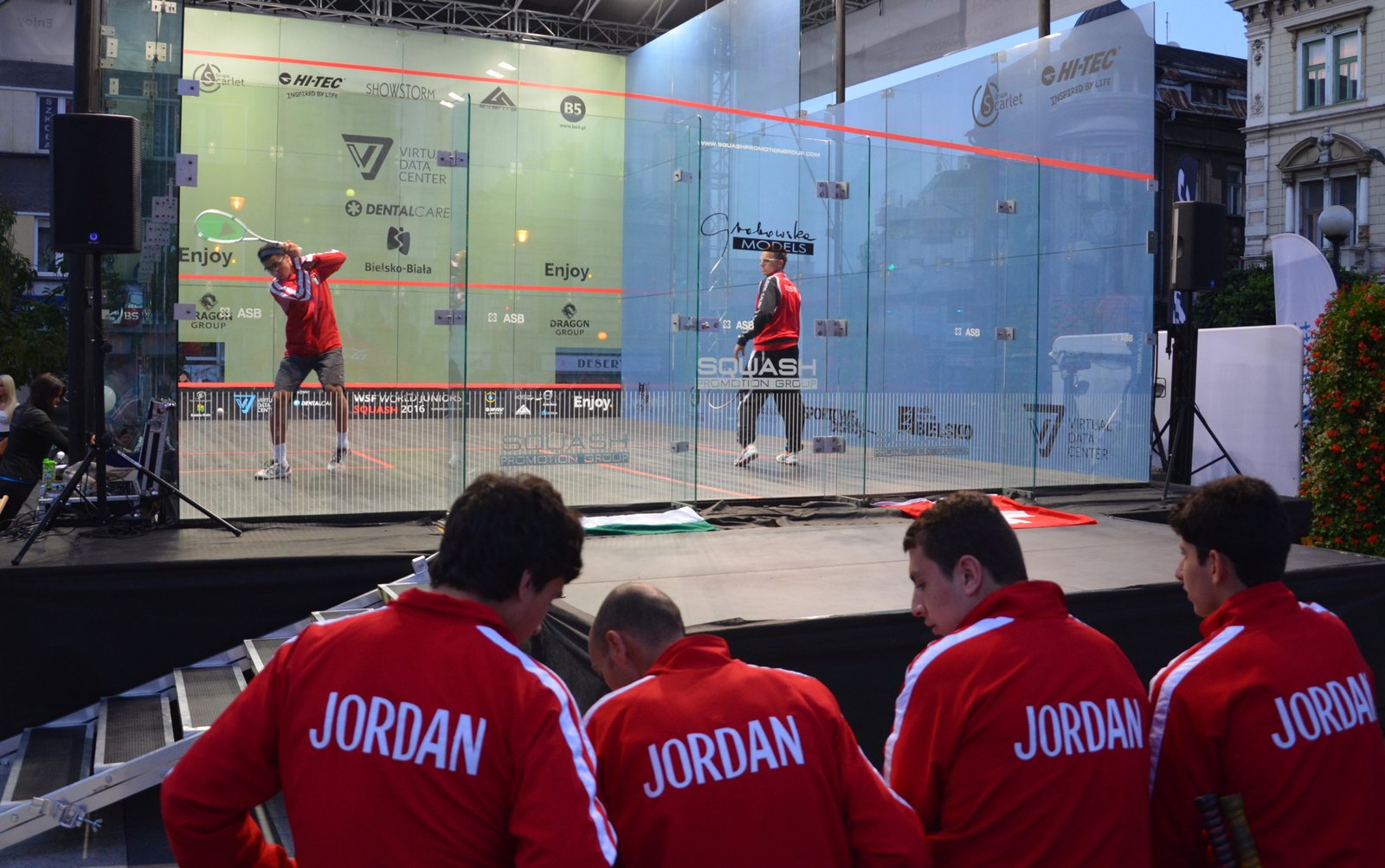
Kids’ vs Youth Ranges, Non-Marking Soles and Support Builds
Size ranges are the first decision, and they are not interchangeable. The youngest ranges here are Salming’s Falco Kid sizes (EU 33⅓ to 37⅓, as its retailer listings publish them) and the ASICS and adidas ranges starting at junior 13. The grade-school and youth ranges run higher: ASICS publishes junior 1 to 5.5 for both GS models here, adidas junior 1 to 5 plus 1.5 for the Ligra 8 Kids, HEAD US 2 to 6 for the Sprint 3.0 Junior, and Salming’s Falco Junior range EU 36⅔ to 40 — the top of the junior ladder. adidas also categorises the Ligra 8 Kids on its own site for youth players aged 8 to 16: adidas’s categorisation, and the only age band any maker publishes in this guide.
The non-marking outsole is a hard requirement, and every card meets it as its maker describes it. The descriptions differ because the compounds differ: a non-marking rubber outsole on the ASICS Upcourt 6 GS, both adidas models and the Mizuno; a full-length gum rubber outsole on the Gel-Upcourt GS, described as supplying non-marking grip; a rubber outsole on the Falco Kids, described as non-marking in junior listings; and HEAD’s Hybrasion+ on the Sprint 3.0 Junior, which HEAD describes as non-marking and super robust. If a listing does not say non-marking, do not assume it — that check is the difference between a shoe a club accepts and one it turns away.
Support builds split the guide in two. At one end are the lateral-support builds for the squash movement pattern: Salming’s Falco carries an ExoSkeleton Salming says stabilises the foot for lateral movements, an LMS+ unit it describes as an 11-degree design, and RollBar on the inner outsole edge — while HEAD adds a reinforced TPU toe cap and a lateral rubber outtrigger to the Sprint 3.0 Junior. At the other end are the lightweight, flexible builds: Mizuno describes the Cyclone Speed 5 Junior’s sole as highly flexible and beginner-friendly, and ASICS describes the Upcourt 6 GS as a lightweight design with broad mesh panelling. Neither build is “better” out of context: support builds suit juniors lunging hard in club sessions, flexible builds suit starters learning to move.
Weight is the specification junior ranges mostly do not publish. Only Mizuno publishes a weight anywhere near the junior line — 280 g for the Cyclone Speed 5 generally, with no separate junior weight. ASICS, Salming, adidas and HEAD publish none for the junior models here, so none is printed: that is the makers’ published position, and it is why the cards compare size range, outsole, midsole and build. When a junior should move to an adult model: when the published junior range tops out below the player’s size — Falco Junior ends at EU 40, the ASICS GS ranges at junior 5.5 — the next step is the smallest size of an adult court shoe from the pillar guide.
The 7 Best Squash Shoes for Kids, Compared
The order runs from the current all-rounders through the specialist builds — the squash-bred Salming, the flat-soled Mizuno, the lateral-support HEAD — to the gum-rubber ASICS classic that has started more junior players than any other shoe on this page. Five of the seven cards publish no weight, because their makers publish none; the cards say so openly rather than estimating. Every outsole claim is the maker’s own description, and every size range is stated in the units its source publishes it.
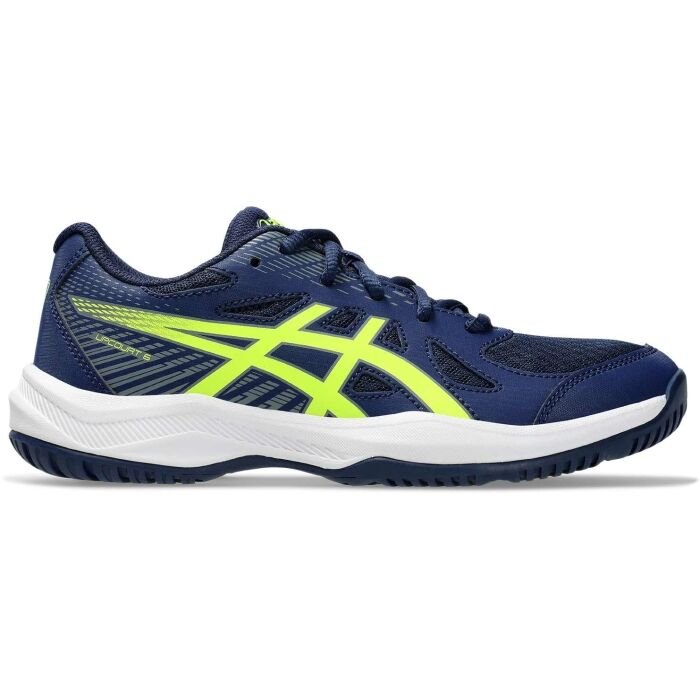
ASICS Upcourt 6 GS
The current grade-school all-rounder: a lightweight mesh build on an EVA midsole and a non-marking rubber outsole.
Start where the current ranges start. ASICS lists the Upcourt 6 GS on its own site as a kids’ youth court shoe — GS stands for grade school in ASICS’s naming — and ASICS UK describes it in its own words as a lightweight design offering flexibility and a comfortable fit, with broad mesh panelling that helps create a softer, more adaptable fit for smaller feet. That is the right brief for a junior squash shoe: flex through lunges and recoveries all session, built around a junior fit rather than a shrunk adult last.
The published specification is complete where it matters. Retailer listings reproducing ASICS data publish junior sizes 1 to 5.5 — a full grade-school run, EU 32.5 to 40 on one size table — a full-length EVA midsole, and a non-marking rubber outsole, the court requirement in plain terms. Synthetic overlays reinforce the mesh upper’s high-wear areas, and laces lock the midfoot. ASICS publishes no weight for the GS version, so none is claimed here. Buy this card for the junior who needs one shoe for the whole job — school sport, club coaching and weekend squash. Its only rival for the all-round brief is the older ASICS at card #7.
What we like
- Current GS model, listed by ASICS as a youth court shoe
- Non-marking rubber outsole and full-length EVA midsole, as published
- Broad mesh panelling ASICS says gives a softer, more adaptable fit
- Full grade-school size run: junior 1 to 5.5
Worth knowing
- ASICS publishes no weight for the GS version
- Laces only — younger children who need a strap should read card #5
As an Amazon Associate we earn from qualifying purchases.
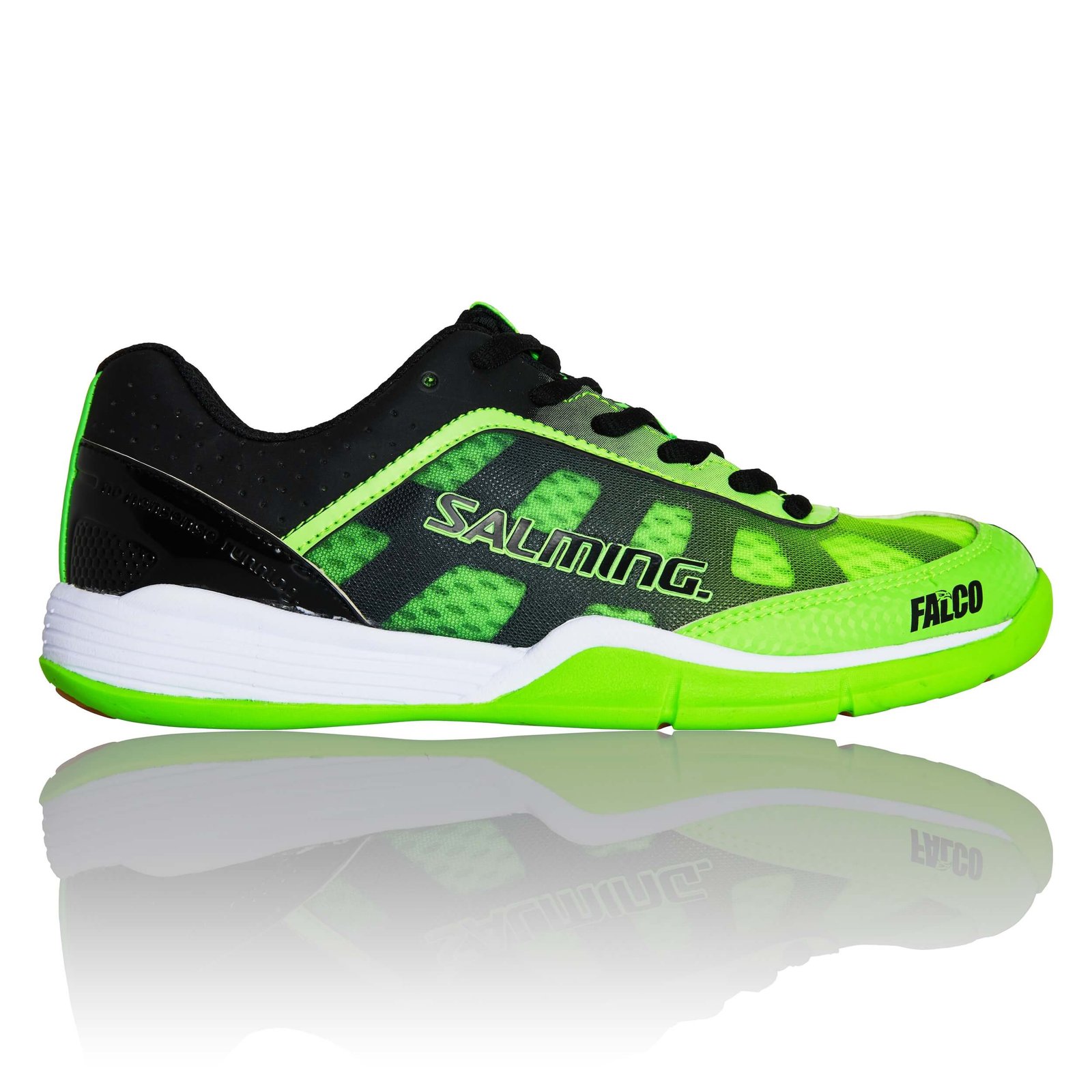
Salming Falco Kids
The junior shoe from a squash-first brand: Salming bases the kids’ Falco on its Viper series, in Kid and Junior ranges.
Most shoes here are indoor-court shoes squash shares with volleyball, handball and badminton. The Falco Kids comes from the other direction: Salming is a squash-first brand, and its junior copy — carried by its squash retailers — says the kids’ Falco is based on the popular Viper series, grants a low-to-the-ground feel, and is positioned for kids starting their sports journey and, in the retailer’s words, for the youngest squash players. Salming publishes two ranges: Falco Kid at EU 33⅓ to 37⅓, and Falco Junior at EU 36⅔ to 40 — together the widest junior span in this guide.
The build carries Salming’s lateral-movement systems down from its adult squash shoes, each described here as Salming describes it: an ExoSkeleton it says stabilises the foot for lateral movements; a Torsion Guide System 62/75 built with extra stability from heel to ball, ahead of which the shoe is given greater flexibility; C35 heel cushioning inserts; RollBar on the inner outsole edge; and LMS+, its lateral stabiliser design at an 11-degree angle. The outsole is rubber, described in junior listings as non-marking and extremely durable — the retailer’s description, not a test result from this guide. Salming publishes no weight for the kids’ version, and this card does not borrow the women’s Falco figure to fill the gap. Buy the Falco for the young squash player specifically, and size it by the Kid and Junior ranges above.
What we like
- Squash-first brand: junior Falco based on the Viper series, per Salming
- Two published ranges (Kid and Junior) span EU 33⅓ to 40
- Full Salming lateral systems carried into the junior build
- Low-to-the-ground profile Salming describes as responsive on court
Worth knowing
- Salming publishes no weight for the kids’ version
- Two overlapping ranges (Kid/Junior) — check which range a listing is selling
As an Amazon Associate we earn from qualifying purchases.
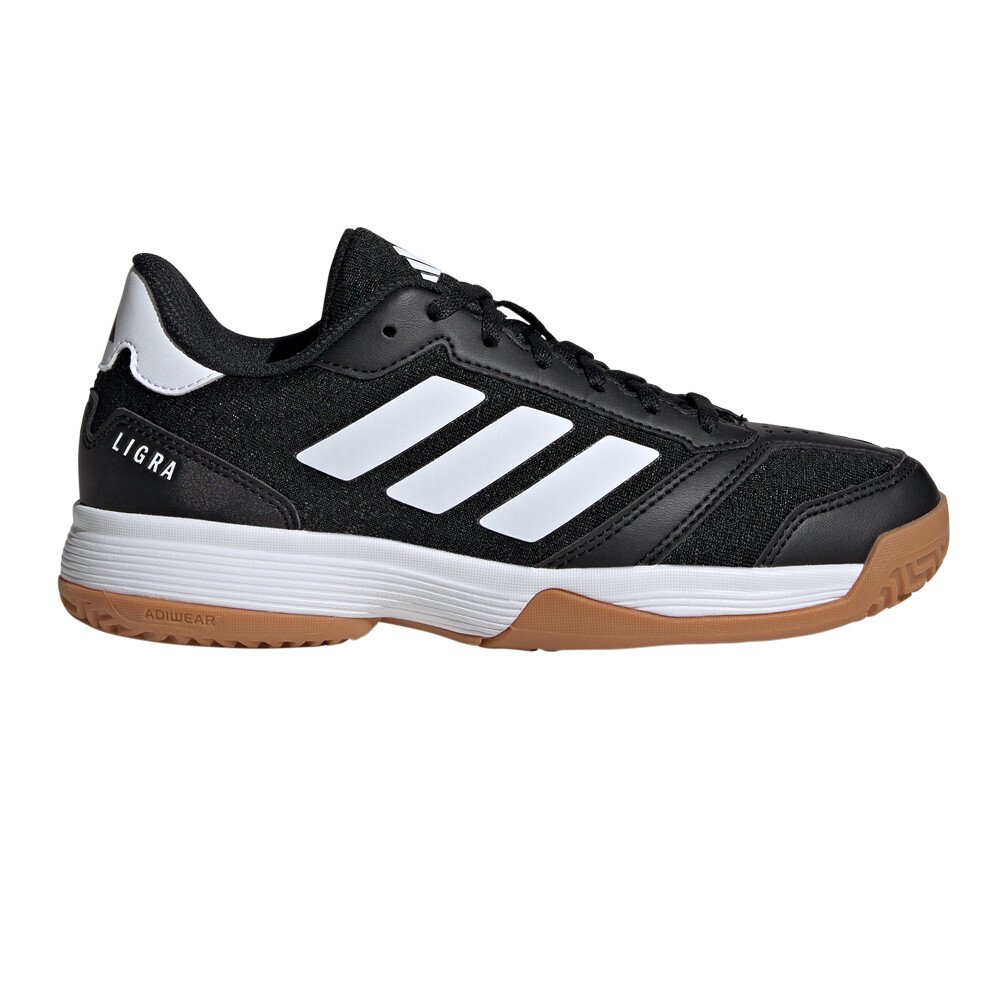
adidas Ligra 8 Kids
adidas’s own juniors’ indoor shoe: a breathable mesh build on a supportive midsole, categorised by adidas for youth players.
This is the card to read if you want a junior shoe documented the way junior shoes should be. On its own regional sites, adidas publishes the Ligra 8 Indoor Shoes Kids (IH8244) as a juniors’ indoor shoe: a breathable mesh upper reinforced with synthetic overlays, a supportive midsole adidas says cushions every move, and a rubber outsole for quick cuts and sudden stops. adidas also categorises it for youth players aged 8 to 16 — its own categorisation, and the only age band any maker publishes in this guide. This guide reports it as adidas states it and extends it to no other card.
Retailer listings add the squash details: junior sizes 1 to 5 plus a 1.5, a soft tongue and collar, midfoot-locking laces, and a non-marking rubber outsole — the court requirement, published explicitly. adidas publishes a regular fit, a textile and synthetic upper, at least 20% recycled content, and no weight for the kids’ version — so none is printed. The brief is support over outright lightness, suiting the junior playing several indoor sports a week. Families splitting court time across codes will find the same discipline in our best badminton shoes for kids guide.
What we like
- Published by adidas itself as a juniors’ shoe (IH8244), regular fit
- Only maker age categorisation in this guide: youth 8–16, per adidas
- Non-marking rubber outsole published in retailer specifications
- Supportive midsole brief, as adidas describes it
Worth knowing
- adidas publishes no weight for the kids’ version
- Published junior run (1 to 5) tops out below the Falco Junior’s EU 40
As an Amazon Associate we earn from qualifying purchases.
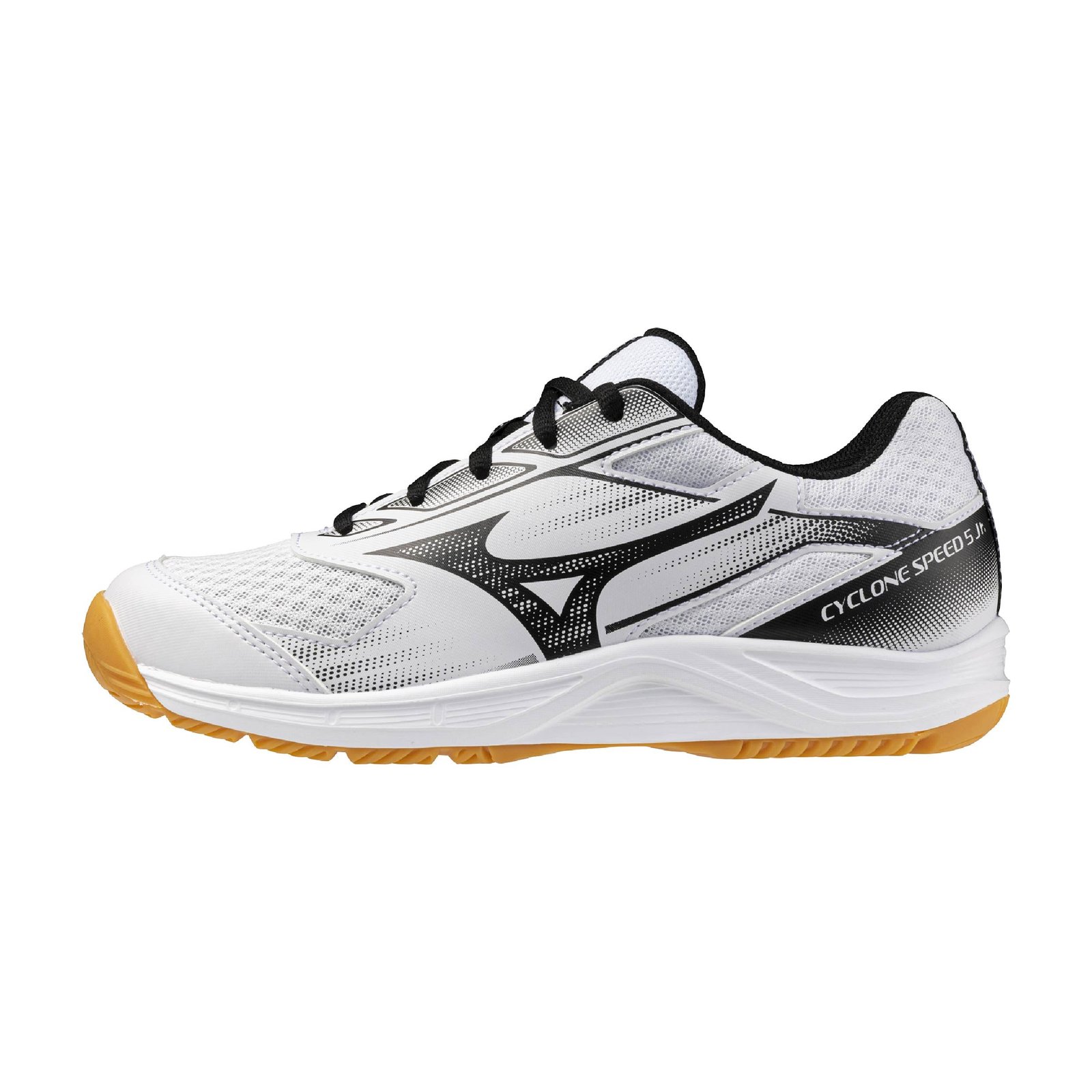
Mizuno Cyclone Speed 5 Junior
The beginner build done properly: a flexible, stable flat sole on a wider-fitting last, made for junior players.
Mizuno describes the Cyclone Speed 5 in its own copy as a shoe for beginner players, especially junior and senior high school players, and the junior listing carries that into a dedicated Junior model. The design logic is the opposite of this page’s support builds, stated openly by Mizuno: a light weight, a comfortable feel, a flat sole and excellent flexibility. The sole is the story — Mizuno describes it as highly flexible and junior-friendly, bending easily even for players still developing their physical strength, while remaining extremely stable and flat so a beginner feels the court through the whole foot.
The published junior details are specific. The junior listing at Mizuno’s Singapore retailer publishes EU sizes 34.5 to 36.5 in stock and lists squash among the shoe’s sports; Target’s junior listing publishes a US youth size chart (youth 2 to 5, with UK and EU equivalents), the material split — an upper of 85% synthetic and 15% textile over a sole of 95% rubber and 5% EVA — and a non-marking outsole in plain terms. A removable cup insole follows the shape of the foot. On weight, this guide prints exactly what Mizuno publishes: 280 g for the Cyclone Speed 5 model, with no separate junior weight — and no figure invented for the junior sizes here. Buy it for the beginner whose movement is still forming, in a shoe that bends with them while keeping them flat and stable.
What we like
- Mizuno positions it for beginner junior players, in its own copy
- Flat, highly flexible sole design — a distinct beginner brief
- Junior size charts published in both EU and US youth terms
- Non-marking outsole stated on the junior listing
Worth knowing
- No separate junior weight published; the 280 g figure is the model’s
- Junior sizes listed at build are narrower than the ASICS/adidas runs — check stock by size
As an Amazon Associate we earn from qualifying purchases.
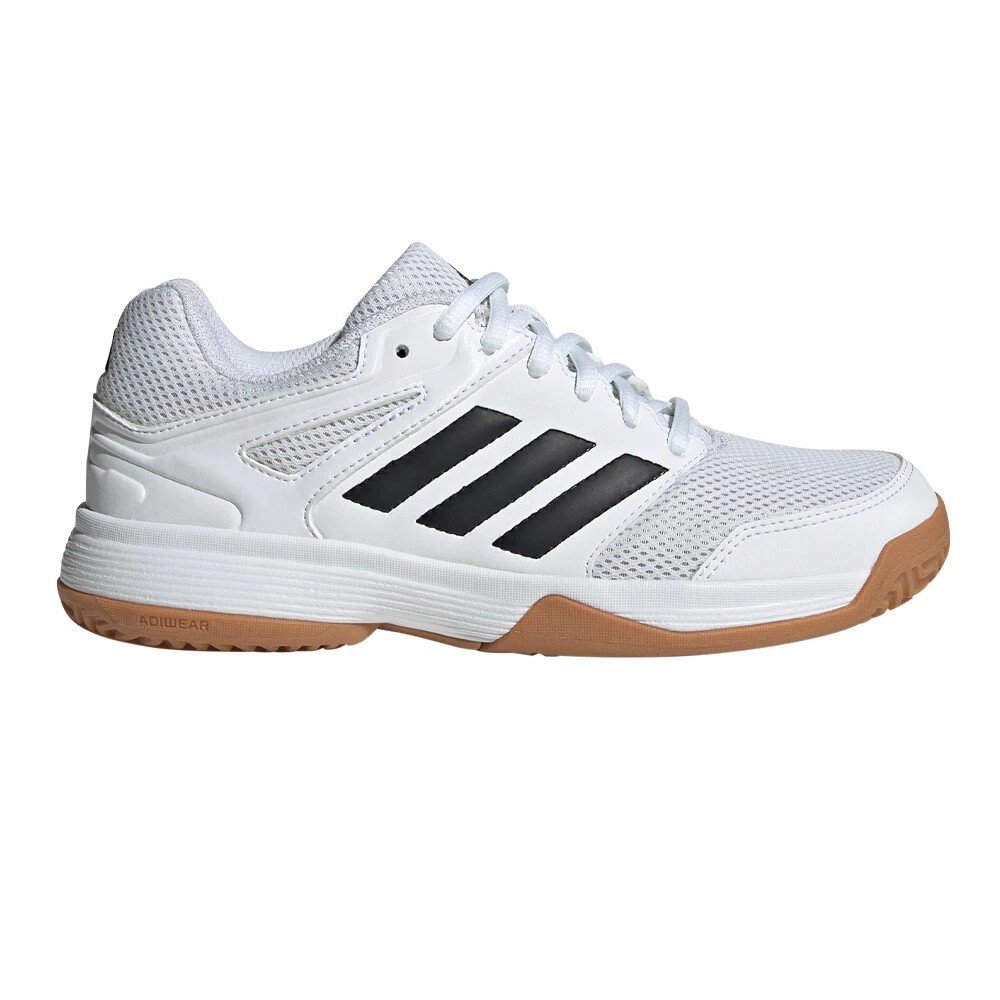
adidas Speedcourt Kids
The lightweight adidas: a ventilating mesh build on a non-marking Adiwear outsole, with a strap version for younger kids.
If the Ligra 8 Kids at card #3 is adidas’s supported build, the Speedcourt is its lightweight one. adidas’s copy for the kids’ Speedcourt, as carried by its retailers, describes a shoe for fast-moving young players: a grippy rubber outsole, a ventilating mesh upper, and soft EVA cushioning. Retailer specifications publish junior sizes 13 to 5.5 and credit the outsole as Adiwear rubber, non-marking, with gum colourways in the range. Synthetic overlays wrap the forefoot, where junior shoes take their drag wear in lunges.
Two honest notes belong here. First, the closure: the kids’ version (JR9617) adds a hook-and-loop strap over the laces — adidas describes the combination as delivering comfortable lockdown, and for younger children it is the practical difference on this page. Check your listing: junior lace-only versions and the kids’ strap version share the Speedcourt name. Second, the midsole credit varies by colourway listing — EVA on one SportsShoes colourway, ADIPRENE+ on another — so this card credits EVA and reports the variation rather than printing one as settled. adidas publishes no weight for the kids’ version. Buy the strap version, specifically, for the child still mastering laces under time pressure.
What we like
- Lightweight mesh brief, as adidas describes the kids’ model
- Non-marking Adiwear outsole published in specifications
- Kids’ version adds a hook-and-loop strap over laces
- Widest junior start on the page: sizes from junior 13
Worth knowing
- Midsole credit varies by colourway listing (EVA / ADIPRENE+) — check the exact listing
- adidas publishes no weight for the kids’ version
As an Amazon Associate we earn from qualifying purchases.
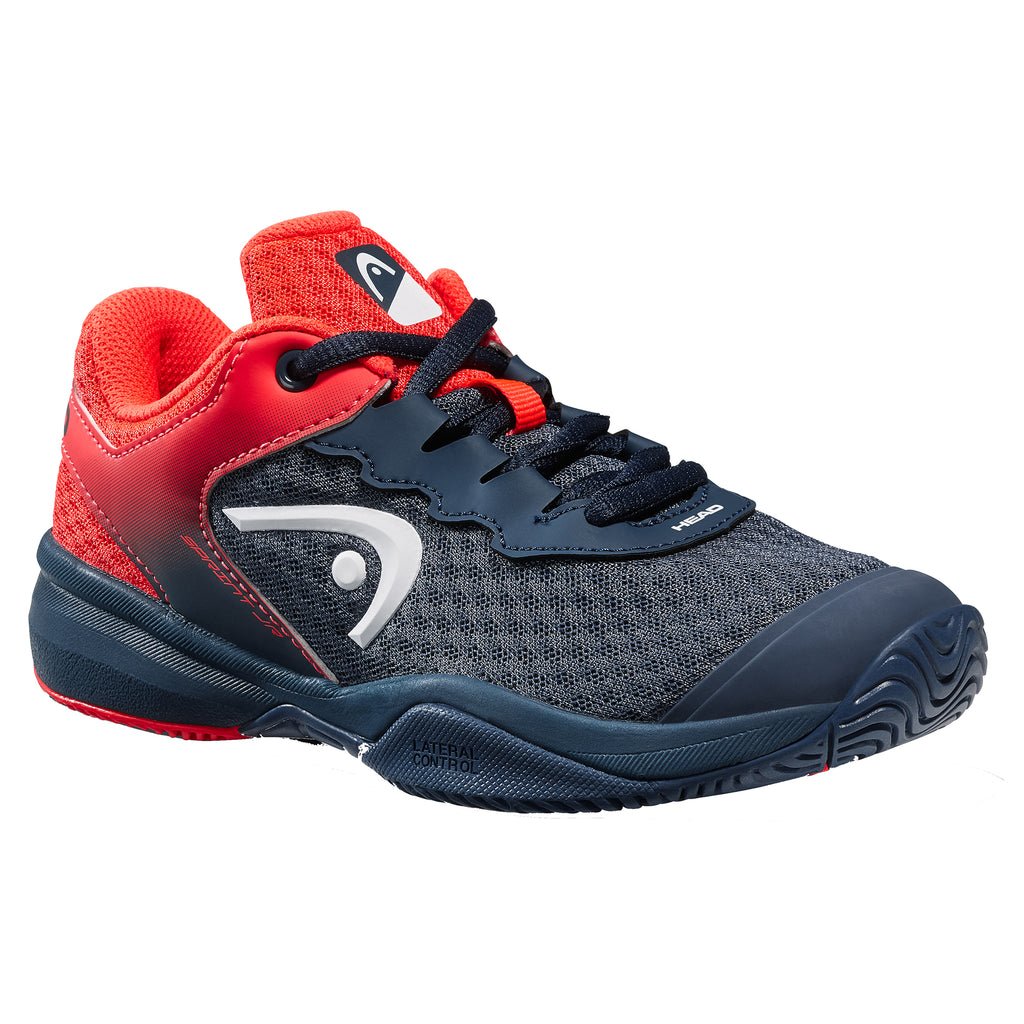
HEAD Sprint 3.0 Junior
The support build for hard lateral movers: a TPU toe cap and lateral outtrigger over HEAD’s non-marking Hybrasion+ outsole.
HEAD’s junior shoe is the most explicitly lateral build in this guide. HEAD’s published specification for the Sprint 3.0 Junior — carried in full by its retailer spec tables — describes light weight from a breathable air-mesh upper and stability from a reinforced TPU toe cap. Around that brief sit an angle strap and adaptive fit lace loops, a moulded EVA sockliner over an EVA midsole, and a hybrid outsole with flex grooves and a lateral rubber outtrigger — the edge HEAD builds out on the side squash players load hardest. RacquetDepot’s HEAD table adds an anti-torsion shank and Drift Defense toe protection. These are HEAD’s descriptions of its own shoe; this guide makes no injury-prevention claim for any of them.
The outsole is the headline: HEAD describes Hybrasion+ as super robust and non-marking, and its tables list non-marking rubber outright. Published junior sizes run US 2 to 6, at the older end of this guide. HEAD publishes no weight, so none is printed. One buying note: the Sprint 3.0 Junior is also sold through tennis channels — verify the Junior listing, not the adult Sprint. Buy it for the older junior who plays hard sideways and wants the most built-up junior shoe here.
What we like
- Full HEAD junior spec published: toe cap, outtrigger, flex grooves
- Hybrasion+ outsole HEAD describes as super robust and non-marking
- Lateral-support brief matches the squash movement pattern
- US junior sizes 2 to 6 — a true youth range
Worth knowing
- HEAD publishes no weight for this model
- Sold through tennis channels too — verify the Junior listing, not the adult Sprint
As an Amazon Associate we earn from qualifying purchases.
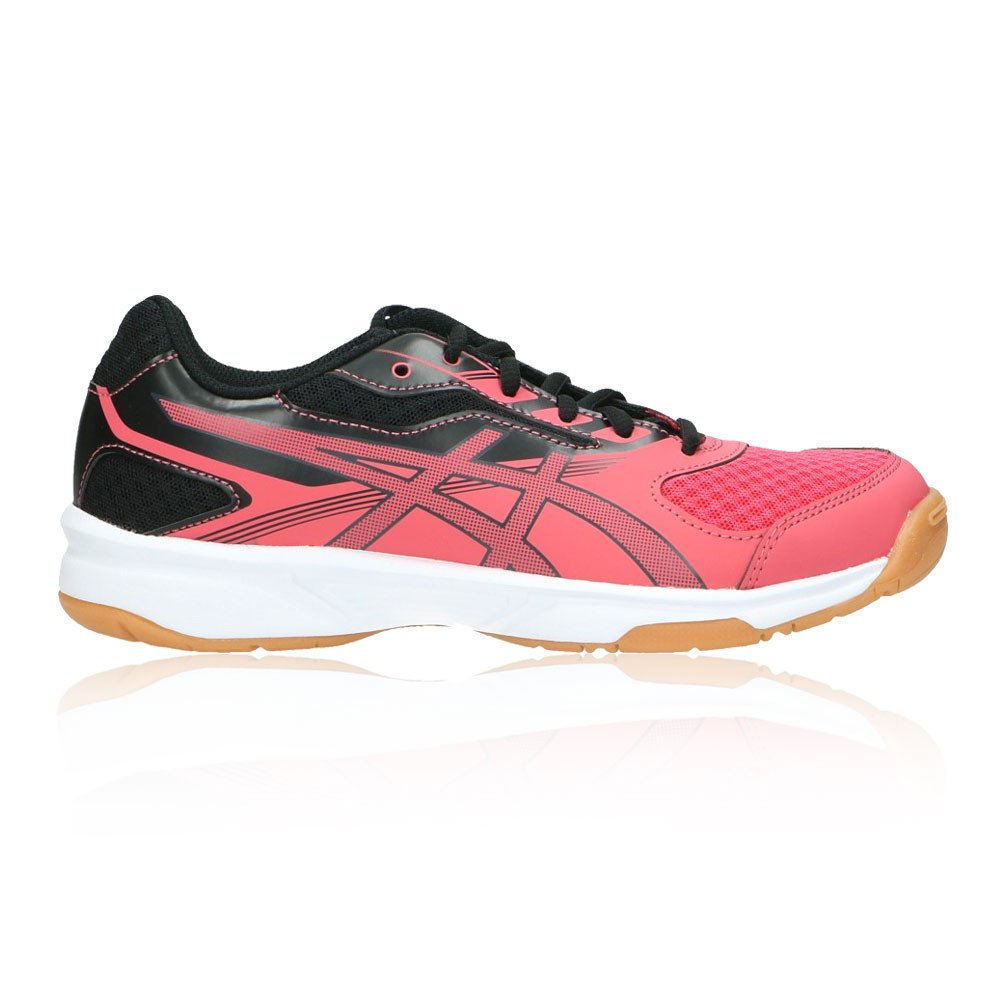
ASICS Gel-Upcourt GS
The GEL classic in grade-school sizes: a full-length gum rubber outsole and Rearfoot GEL, with half sizes throughout.
The Gel-Upcourt GS is the predecessor generation to card #1, and it earns its own card on two published differences — not nostalgia. First, the outsole: where the Upcourt 6 GS uses non-marking rubber, the Gel-Upcourt’s listings specify a full-length gum rubber outsole, with the 3 GS specification stating that the gum rubber supplies non-marking grip — the traditional squash-court compound, published here in those words. Second, the cushioning: the Gel-Upcourt retains Rearfoot GEL in its published specification, alongside California Slip Lasting and a removable EVA sockliner the listing notes can be removed to accommodate an orthotic.
The rest matches the all-round brief: a mesh upper with synthetic overlays, an EVA midsole, and the widest junior size run on this page — junior 13 to 5.5 with half sizes throughout, which matters more in growing feet than any technology name. ASICS publishes no weight for the GS version. The framing is generational: the Upcourt 6 GS is the current model and default buy; the Gel-Upcourt GS is the pick when gum rubber, GEL, or its half-size run is what you are shopping for.
What we like
- Full-length gum rubber outsole, published as non-marking grip
- Rearfoot GEL retained in the GS specification
- Widest junior size run here, half sizes included
- Removable EVA sockliner, per the published specification
Worth knowing
- Predecessor generation — the Upcourt 6 GS (card #1) is the current model
- ASICS publishes no weight for the GS version
As an Amazon Associate we earn from qualifying purchases.
Side-by-Side Comparison Table
| Model | Best For | Published Junior Sizes | Outsole (as maker describes it) | Midsole / Build | Weight |
|---|---|---|---|---|---|
| ASICS Upcourt 6 GS | Best overall junior | Junior 1 to 5.5 | Non-marking rubber | EVA · mesh panels | Not published |
| Salming Falco Kids | Squash-bred junior | Kid EU 33⅓–37⅓ · Junior EU 36⅔–40 | Rubber, non-marking per junior listings | EVA + C35 heel · TGS 62/75 | Not published |
| adidas Ligra 8 Kids | Maker-documented kids’ pick | Junior 1 to 5, plus 1.5 | Non-marking rubber | Supportive midsole · mesh | Not published |
| Mizuno Cyclone Speed 5 Junior | Flat-soled beginner build | EU 34.5–36.5 listed · US youth 2–5 | Non-marking rubber | Flat, flexible sole · cup insole | 280 g (model; no Jr figure) |
| adidas Speedcourt Kids | Lightweight · strap option | Junior 13 to 5.5 | Adiwear rubber, non-marking | EVA · mesh (see card note) | Not published |
| HEAD Sprint 3.0 Junior | Lateral-support build | US junior 2 to 6 | Hybrasion+ non-marking rubber | EVA · TPU toe cap, outtrigger | Not published |
| ASICS Gel-Upcourt GS | Gum-rubber classic | Junior 13 to 5.5, half sizes | Full-length gum rubber, non-marking | EVA · Rearfoot GEL | Not published |
The weight column is the one this guide refuses to tidy up. Only Mizuno publishes a weight for its model, and even that figure is published for the Cyclone Speed 5 generally, not for the junior sizes. The “not published” entries are not gaps in our research; they are the makers’ actual published position, printed as found. Buy on what the makers do publish: the size range that fits today, the non-marking outsole stated in plain terms, and the build — support or flexible — that matches the player’s stage.
Buying Guide: Choosing on the Maker’s Numbers
1. Check the outsole wording before anything else
Non-marking is the entry requirement on a squash court, and it is a published claim, not a colour. A pale sole is not automatically non-marking, and a dark sole is not automatically marking — the Ligra 8 Kids and Speedcourt Kids in this guide publish non-marking outsoles in dark colourways. Read the listing for the words “non-marking” attached to the specific junior model, as every card here does: non-marking rubber (ASICS, adidas, Mizuno), gum rubber described as non-marking grip (Gel-Upcourt GS), Hybrasion+ described as non-marking (HEAD), or a non-marking description on the junior listing (Salming Falco Kids). If the words are not there, the shoe does not clear the bar for this guide — and most clubs will take the same line at the court door.
2. Buy the published range, not the label on the box
Kids, GS, Junior and Youth are marketing labels, not a shared standard. ASICS’s GS ranges here run junior 13 or 1 up to 5.5. adidas’s Kids run sits alongside a youth categorisation adidas itself puts at ages 8 to 16 for the Ligra 8. Salming splits one shoe into a Kid range (EU 33⅓ to 37⅓) and a Junior range (EU 36⅔ to 40) that overlap by design. Mizuno’s junior listing is published in EU sizes with a US youth chart beside it. So ignore the label and read the range: measure the foot, match it to the published sizes for the specific model, and leave growing room in length — not in width or heel slip, which no amount of growing fixes. Half sizes, where a maker publishes them as ASICS does for the Gel-Upcourt GS, are worth using rather than jumping a full size.
3. Match the build to the movement, not the marketing
Squash movement is lateral: lunges to the front corners, plants at the T, toe drags on recovery. The support builds in this guide answer that pattern with structure — Salming’s ExoSkeleton and TGS systems and HEAD’s TPU toe cap and lateral outtrigger, each described by its maker for lateral movement. The flexible builds answer a different stage: Mizuno’s flat, easily bending sole for beginners, and ASICS’s soft mesh-panel fit on the Upcourt 6 GS. A starter does not need the most built-up shoe, and a competing junior should not be in the softest one. Match the build to how the player actually moves this season; the shoe will be outgrown before it is outworn in most junior cases, so the current stage — not the hoped-for one — is the right brief.
4. Plan the step up before you need it
Junior ranges end abruptly. The Falco Junior range tops out at EU 40, the ASICS GS ranges at junior 5.5, the HEAD Junior range at US 6. Past those points there is no bigger junior shoe — the next purchase is the smallest size of an adult court shoe, and that choice belongs to our adult pillar: the best squash shoes guide, which owns adult selection including the small-size step-up. Apply the same two checks there that this guide applies here: a non-marking outsole stated for the model, and the maker’s published specification over the marketing. And keep the rest of the junior kit on the same makers’-numbers rule — the racket half is covered by our junior racket guide linked in the introduction, and junior girls graduating into the women’s ranges will find that step covered in our best squash rackets for women guide.
Frequently Asked Questions
What shoes do kids need for squash?
A junior court shoe with a non-marking outsole, in a size range its maker publishes for kids or youth players. Every model in this guide meets both tests: non-marking rubber, gum rubber or Hybrasion+ outsoles as the makers describe them, and published junior ranges such as ASICS grade-school sizes, adidas kids sizes and Salming Kid and Junior EU sizes. A running trainer is not a substitute: it is not sold as non-marking and it is not built for lateral movement.
What is the difference between kids, GS and youth shoe sizes?
They are brand labels, not a shared standard. ASICS uses GS, for grade school, and publishes junior 13 or 1 to 5.5 for the GS models in this guide. adidas sells Kids models and categorises the Ligra 8 Kids on its own site for youth players aged 8 to 16. Salming splits the Falco into a Kid range (EU 33 1/3 to 37 1/3) and a Junior range (EU 36 2/3 to 40). Always buy by the published size range for the specific model, not by the label.
How do I check a squash shoe is non-marking?
Read the maker’s or retailer’s specification for the exact junior model and look for the words non-marking attached to the outsole. In this guide those claims are published as non-marking rubber (ASICS Upcourt 6 GS, adidas Ligra 8 Kids and Speedcourt Kids, Mizuno Cyclone Speed 5 Junior), full-length gum rubber described as supplying non-marking grip (ASICS Gel-Upcourt GS), a non-marking description on the junior listing (Salming Falco Kids) and HEAD’s Hybrasion+ outsole, which HEAD describes as non-marking. Sole colour alone proves nothing either way.
When should a junior move to adult squash shoes?
When the published junior ranges top out below the player’s size. The widest junior range in this guide, Salming’s Falco Junior, ends at EU 40; the ASICS GS ranges end at junior 5.5 and the HEAD Sprint 3.0 Junior at US 6. There is no junior size above those points, so the next step is the smallest size of an adult court shoe, chosen from the adult ranges: our best squash shoes pillar guide owns adult selection. Apply the same non-marking check there.
Should a junior squash player choose a lightweight shoe or a support shoe?
Match the build to the player’s stage, as the makers build them. The flexible, lightweight builds here — Mizuno’s flat, easily bending Cyclone Speed 5 Junior sole and the mesh-panelled ASICS Upcourt 6 GS — suit beginners learning to move on court. The lateral-support builds — Salming’s Falco Kids with its ExoSkeleton and TGS systems, and the HEAD Sprint 3.0 Junior with its TPU toe cap and lateral outtrigger — suit juniors already lunging hard in regular club play. The makers’ own descriptions, quoted on each card, state which brief each shoe was built for.
Why do most junior squash shoes have no published weight?
Because their makers do not publish one. Of the seven models in this guide, only Mizuno publishes a weight — 280 g for the Cyclone Speed 5 model generally, with no separate junior figure. ASICS, Salming, adidas and HEAD publish no weight for the junior models carded here. This guide prints that as found rather than borrowing adult-version weights, and compares the junior models on what their makers do publish: size range, outsole, midsole and build.
Can kids play squash in normal trainers?
Most clubs will not allow it, for the reason this guide leads with: squash courts require non-marking soles, and normal trainers are not sold as non-marking. They are also built for forward running rather than the lateral lunges and plants of squash movement. A junior court shoe from a maker-published kids or youth range — every card in this guide — clears the court’s entry rule and matches the movement. Check your club’s footwear rule before the first session if you are unsure.
The Verdict
Buy the junior shoe that matches the player in front of you, on the maker’s numbers. The ASICS Upcourt 6 GS is the current grade-school default: published junior sizes, an EVA midsole and a non-marking rubber outsole. The Salming Falco Kids is the squash-bred pick, spanning Kid and Junior ranges to EU 40. The adidas Ligra 8 Kids is the best-documented kids’ buy, published by adidas itself for youth players. The Mizuno Cyclone Speed 5 Junior is the flat-soled beginner build, the adidas Speedcourt Kids the lightweight option with a strap version for younger children, the HEAD Sprint 3.0 Junior the lateral-support build for hard movers, and the ASICS Gel-Upcourt GS the gum-rubber GEL classic with the widest half-size run. Beyond them, the step is an adult court shoe in a small size: our best squash shoes pillar owns that adult choice. Check the outsole wording, buy the published range, match the build to the stage — a junior in the right junior shoe learns squash movement; a junior in a borrowed trainer learns to argue with the court door.
Affiliate disclosure: AliShuttler is reader-supported. When you buy through links on this page we may earn an Amazon commission at no extra cost to you. Specifications and sizing positions are taken from manufacturers’ published product information and were verified at the time of writing; manufacturers revise models between seasons, so confirm the exact specification on the product page before ordering.