Table tennis footwork is sideways, short and fast — and it asks for a thin, grippy sole that stays close to the floor, not the thick cushioned sole of a running shoe. For a child, that shoe also has to come in a genuine junior size. This guide compares only the models their makers actually publish as junior or kids shoes, states every size range and weight exactly as the maker states it, and is upfront about the big table-tennis brands that publish no junior shoe at all.
⚡ TL;DR — The Short Answer
Start with a shoe made for the sport. The JOOLA Pro Junior is the clearest junior brief here: a table tennis shoe JOOLA presents as specially developed for children, in EU 30–36, on the classic non-slip sole the sport has used for years. Li-Ning publishes the deepest kids table-tennis range — the Velcro-strap Junior APTU010-1 for the smallest feet, the Eagle Eye 2.0 Kids and the cushioned Mage ESS Kids — and Decathlon’s Pongori TTS 500 Junior is built for junior regular players. Where a family would rather buy from a general indoor-court line, the ASICS Upcourt 6 GS and the Mizuno Cyclone Speed 5 Jr are honest junior indoor shoes — but understand what they are: cushioned court shoes in junior sizes, not thin-soled table-tennis shoes. Butterfly and Victas publish no junior table-tennis shoe, so no adult model from either brand is re-labelled as one here.
Quick Picks — Best Table Tennis Shoes for Kids at a Glance
Specially developed for children, per JOOLA — EU 30–36 on a classic non-slip rubber sole.
Velcro strap, mesh-and-leather upper; listed from US 0.5 (185 mm) on Pingpongshop.
The kids version Li-Ning introduced in fall 2024 — geometric tread, anti-turnover sole design.
Decathlon designs it for junior regular players, with a high-rubber non-slip sole.
From Li-Ning’s 2025 summer kids collection, with Li-Ning Cloud and Tuff OS in the sole.
ASICS’ Grade School indoor shoe — mesh, GEL and EVA cushioning, sizes to US 7.
Mizuno’s junior indoor shoe with a flat, highly flexible sole — Mizuno lists 240 g.
In This Guide
Why Kids Need a Table-Tennis Sole, Not a Trainer
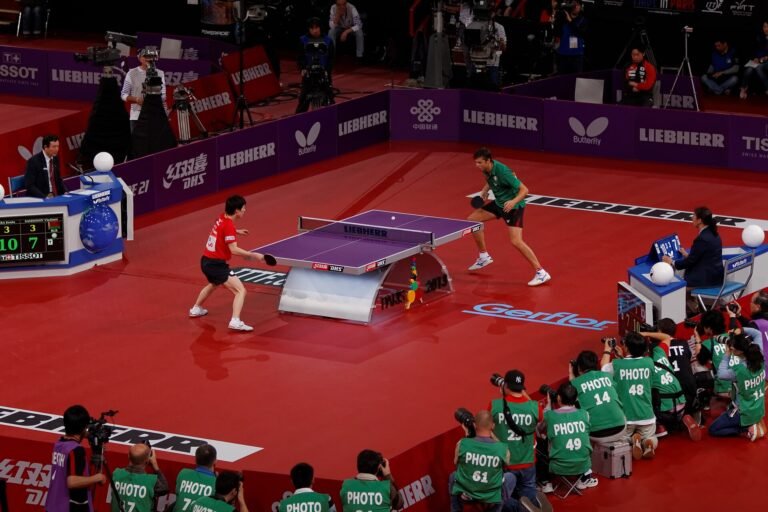
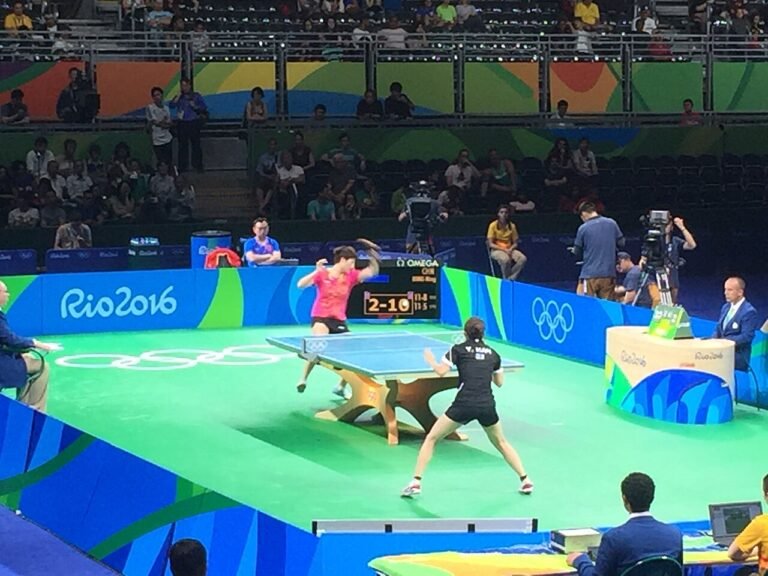
Watch a table-tennis rally from the feet up and the movement explains the shoe. Players shuffle sideways in short steps, pivot on the forefoot, lunge to one corner and recover — almost never running in a straight line. The shoes the sport’s makers build for that movement share a recognisable shape: a thin rubber sole that keeps the foot low and close to the floor, a tread made to grip a hall surface through those side steps, and a light, flexible build that bends where the foot bends. A child’s regular trainer is built for the opposite job — a thicker, cushioned, heel-first sole for running forward — and a school sports shoe sits somewhere in between. Neither is automatically unusable for a first lesson, but neither is the shoe the sport itself specifies.
This guide owns the junior decision only. It does not re-rank adult shoes: our best table tennis shoes guide owns adult and all-player selection — models such as the Butterfly Lezoline Rifones, Mizuno Wave Drive 9 and Victas V-Shoes 613 are compared there, for adult players — and when a junior outgrows the junior ranges below, that guide, not this one, is where the next pair is chosen. What this page does is lay out the junior options in the order a parent meets them: the table-tennis-specific junior shoes first, because they are the sport’s own answer, and the general indoor-court junior shoes last, honestly labelled as the alternative they are. Learning the game the shoes are for is covered in our guide to how to play table tennis.
One honesty point runs through every card below. The junior table-tennis market is thin, and it is unevenly documented. Some makers publish a full junior specification — sizes in three systems, materials, sole construction. Some publish a kids model name and a short spec table with no size range and no weight. And some of the sport’s biggest names publish no junior shoe at all. Where a maker publishes a size range, this guide prints it and attributes it. Where a maker publishes none, the card says so plainly, rather than borrowing a size run from a retailer’s drop-down menu or an adult model’s chart. That discipline matters more in kids’ shoes than anywhere else, because the size is the purchase.
The Junior Decision: TT-Specific vs General Indoor
First split: a table-tennis shoe, or an indoor-court shoe? Five of the seven cards here are table-tennis shoes published as junior or kids models — from JOOLA, Li-Ning and Decathlon’s Pongori. Their soles are the sport’s pattern: thin, rubber, grippy, flexible. The other two cards — from ASICS and Mizuno — are general indoor-court shoes in junior sizes, built for the school-hall sports mix of volleyball, handball and court games. They bring more cushioning underfoot and, in the ASICS case, a much wider junior size run. What they do not bring is the thin table-tennis sole. Neither route is a trick: the copy labels each card for what it is, and the right choice depends on whether your child is specialising in table tennis or playing it as one of several hall sports.
Sizes are stated three different ways — read the maker’s system, not a conversion chart. JOOLA sizes the Pro Junior in European sizes, EU 30 to 36, with Bribar’s listing adding UK and centimetre equivalents and warning that the sizes printed in the shoe come up very small. Li-Ning’s APTU010-1 is listed by Pingpongshop in US sizes keyed to millimetres, from US 0.5 at 185 mm. ASICS sizes the Upcourt 6 GS in its Grade School range, listed by ASICS Singapore from K12.5 up to US 7. There is no single junior standard underneath these: measure the foot, then buy against the specific maker’s stated system for the specific model, and treat any retailer’s “runs small, size up” note — Bribar publishes exactly that warning for the JOOLA — as part of the specification.
Weight is the least-published number in junior shoes. Of the seven cards here, only Mizuno publishes a weight — and Mizuno’s own page carries two figures, a 240 g spec-field weight and a feature-text note that the 27.0 cm size weighs about 275 g, reported openly on its card. JOOLA describes the Pro Junior as extra lightweight but publishes no number; Bribar lists its weight as N/A. Li-Ning and Decathlon publish no numeric weight for the junior models carded here, and ASICS publishes none for the Upcourt 6 GS. So this guide does not rank these shoes by grams. Where a maker describes a build as light, the description is attributed to the maker; the comparison you can actually make is construction — how thin the sole is, what it is made of, and how the upper is built.
Cushioning is the real fork inside the junior ranges. The table-tennis-specific cards keep cushioning thin and close to the floor: an EVA inner sole in the JOOLA, an ultra-light EVA midsole in Li-Ning’s APTU010-1. At the other end, Li-Ning’s Mage ESS Kids brings its Cloud cushioning material into a kids table-tennis shoe, and the two general indoor cards — ASICS with GEL and EVA, Mizuno with its flat but padded junior build — are the more cushioned options for longer training sessions and multi-sport weeks. More cushioning is not better or worse in itself; it is a different answer to how much hall time, and how many sports, the shoe has to cover. When a junior outgrows junior shoes: when the foot passes the top of the junior ranges — EU 36 in the JOOLA, US 7 in the ASICS — the next step is the adult table-tennis ranges, because most makers do not publish a youth line above them. That step-up is chosen from the adult guide linked above.
The 7 Best Table Tennis Shoes for Kids, Compared
The order runs from the sport’s own junior shoes to the general indoor alternatives: JOOLA’s made-for-children model first, then Li-Ning’s three distinct kids models and Decathlon’s junior Pongori, then the ASICS and Mizuno junior indoor shoes, each framed for exactly what it is. Every size statement is attributed to the source that publishes it; every model without a published weight is labelled as such on its card.
JOOLA Pro Junior
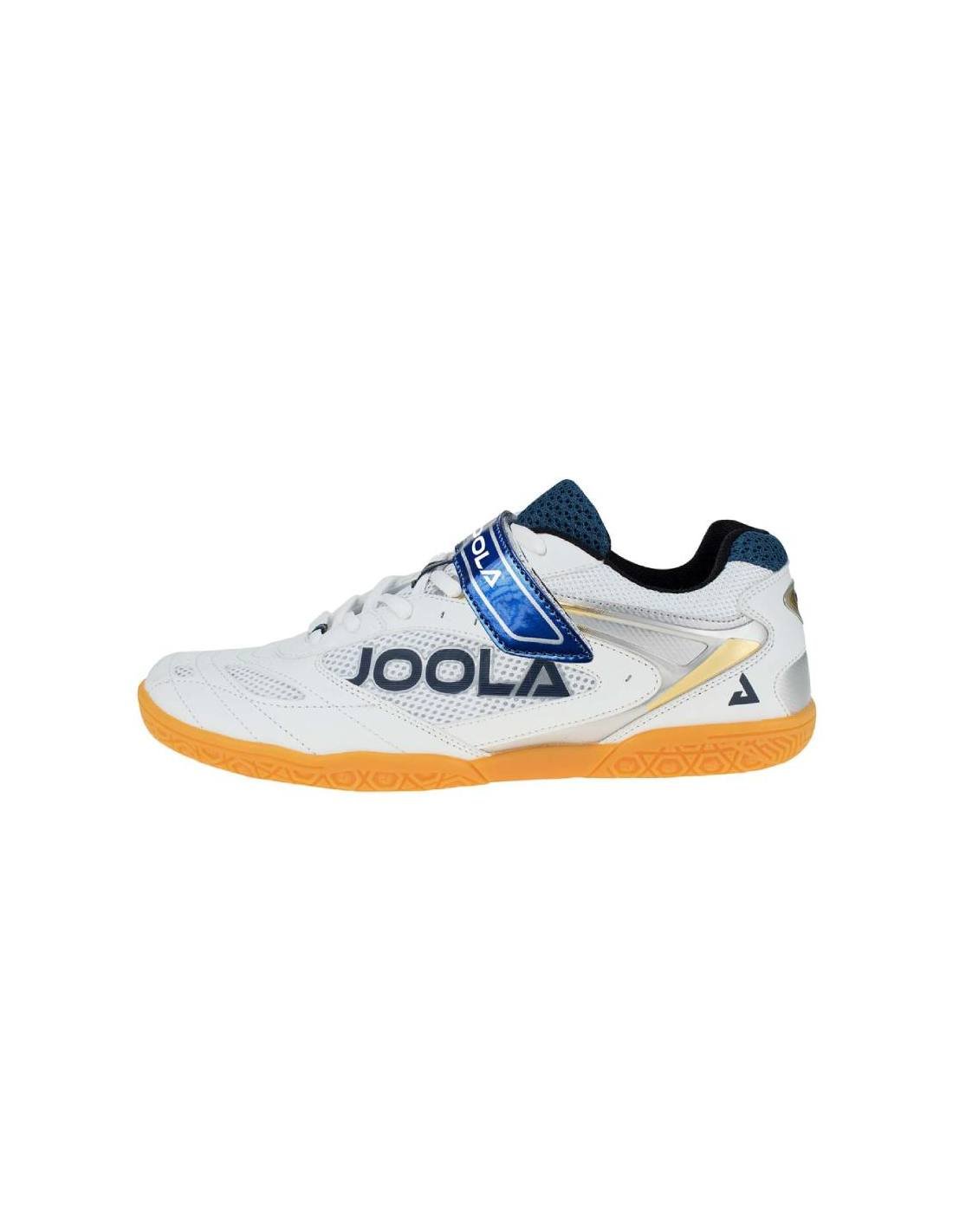
The junior brief done properly: a table tennis shoe JOOLA presents as specially developed for children, in EU 30–36.
Most junior sports shoes are adult designs shrunk down. The Pro Junior is the opposite starting point: JOOLA presents it as a table tennis shoe specially developed for children — the maker’s own positioning, carried by its retailers — and the specification supports the claim. The sole is the classic non-slip rubber sole JOOLA says has been used in table tennis for many years, which is exactly the thin, grippy pattern the sport’s footwork needs, and the upper is a breathable mesh, microfibre and PU build with an EVA inner sole. JOOLA says that EVA inner sole is there to protect children’s growing joints from extreme strains, and that the shoe is extra lightweight so it permits fast, sudden changes of direction — both are the maker’s claims, attributed here as JOOLA states them; this guide has not tested them, and no numeric weight is published to back the lightweight description.
The size run is the other reason this card leads the guide. Bribar lists the Pro Junior from UK 10 / EU 30 / 20 cm up to UK 3 / EU 36 / 25 cm — a genuinely child-sized range, not the bottom end of an adult chart. Read Bribar’s warning alongside it, because the retailer puts it in bold for a reason: the sizes stated in the shoe come up incredibly small, and Bribar directs buyers to its size guide rather than the printed size. So measure the foot in centimetres and order against the centimetre column, not against the EU size your child wears in school shoes. Buy this shoe for the child who is actually playing table tennis — lessons, club nights, school team — and wants the sport’s own shoe in a child’s size. It is not JOOLA’s adult Pro Blast shrunk down; that adult model is compared in the pillar guide, and this is a separate, junior-specific design.
What we like
- A junior-specific design, presented by JOOLA as developed for children
- True child size run: EU 30–36 with centimetre equivalents published
- The sport’s classic thin, non-slip rubber sole — not a trainer sole
- Full published material spec: outsole, upper, inner sole and lining
Worth knowing
- JOOLA publishes no numeric weight; Bribar lists it as N/A
- Sizes come up very small, per Bribar — order by centimetres, not EU size
As an Amazon Associate we earn from qualifying purchases.
Li-Ning Junior Table Tennis Shoes APTU010-1
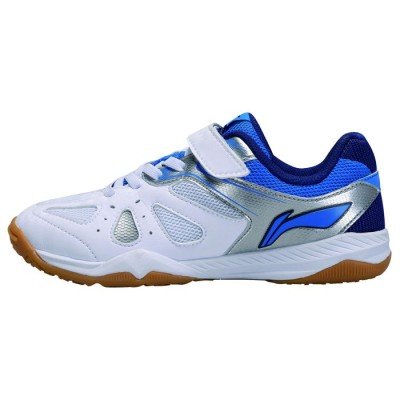
The youngest starter’s Li-Ning: a Velcro-strap junior shoe whose listed sizes start at 185 mm.
Li-Ning publishes more genuine junior table-tennis models than any other maker in this guide, and the APTU010-1 is its youngest-skewing design. The detail that gives it away is at the collar: a Velcro strap, which Li-Ning’s product description says is there for easy wear and removal by children. That is a design decision for a child who dresses for sport independently — or nearly — and it sits on a proper table-tennis build, not a fashion trainer: a mesh and leather upper Li-Ning describes as offering breathability and support with a good wrapping feel, in what it calls a parent-child style matching the adult version. The outsole is non-marking, slip-resistant rubber with cross-flex grooves in the forefoot, which Li-Ning says are there for better traction during movement, over an ultra-light EVA midsole, with a metal ventilation window in the midsection and TPU for added support in the sole.
Sizing needs the careful read this guide promised. Pingpongshop’s variant list for the APTU010-1 runs from US 0.5 at 185 mm up to US 5.5 at 230 mm — the smallest starting point of any card here, and the reason this shoe, not the JOOLA, is the pick for the smallest feet. The listed run has gaps, though: not every half size between those endpoints is listed, so check the exact millimetre size you need against the product page before ordering, and buy by the millimetre measurement rather than the US number. Li-Ning publishes no numeric weight for this model in the sources checked, so none is claimed. Pair it with the other half of a first proper kit — a junior bat sized for a child’s hand, covered in our best table tennis bats for kids guide — and a young player is equipped the way the sport intends, top to bottom.
What we like
- Smallest listed starting size here: US 0.5 / 185 mm
- Velcro collar strap Li-Ning designs for easy on and off by children
- Non-marking rubber outsole with cross-flex grooves in the forefoot
- A genuine junior model code, listed as Junior by its retailers
Worth knowing
- The listed size run has gaps — confirm your millimetre size is listed
- No numeric weight is published for this model
As an Amazon Associate we earn from qualifying purchases.
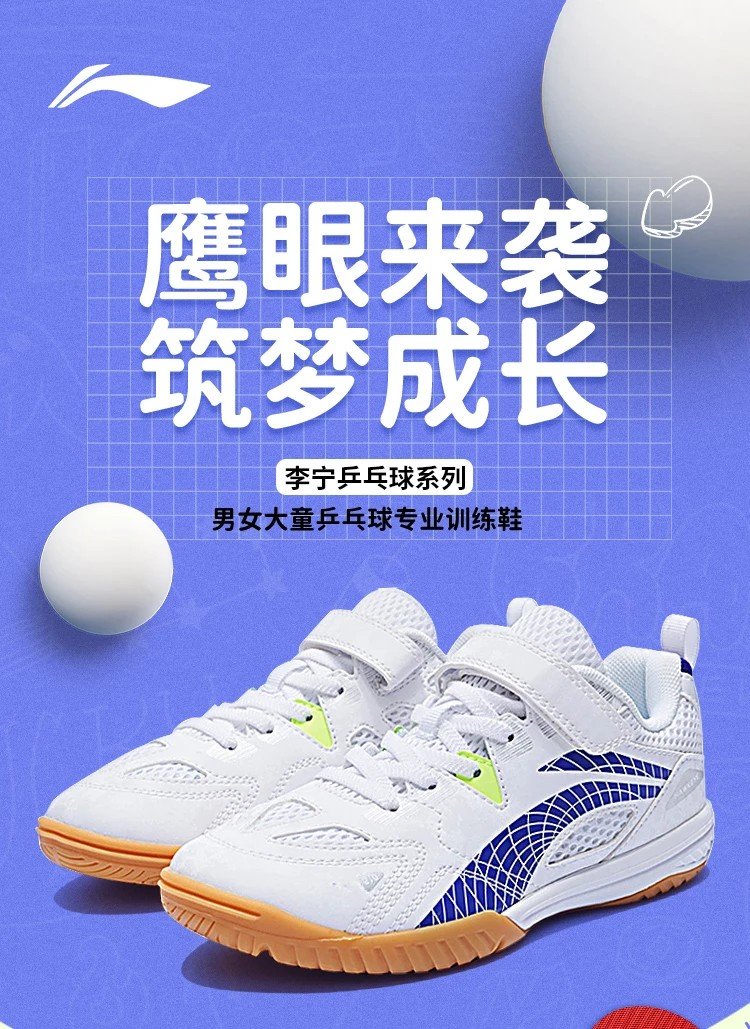
Li-Ning Eagle Eye 2.0 Kids
The kids version of Li-Ning’s best-known shoe family, introduced for children in fall 2024 — style code APTU015.
Where the APTU010-1 is Li-Ning’s starter junior, the Eagle Eye 2.0 Kids is its step-up: Shopnings’ Li-Ning listing records that Li-Ning introduced the kids version in fall 2024, after the Eagle Eye 2.0 became its most popular table tennis shoe, and describes it as tailor made for kids. TableTennis11 corroborates the junior status independently, listing the same APTU015 codes under its Li-Ning Junior Table Tennis Shoes. The build is a rung up from the starter card: an upper of synthetic leather and perforated mesh, which the listing says offers a snug fit with ventilation, a lightweight EVA midsole, and a durable rubber outsole with a geometric tread pattern. The sole design detail worth a parent’s attention is the triangular anti-turnover element, which the listing says is incorporated for lateral support — lateral movement being, as the opening section set out, most of what a table-tennis shoe actually does.
Two gaps belong on this card, stated plainly. Shopnings’ spec table for the Eagle Eye 2.0 Kids publishes no size range and no weight, so this guide prints neither: if you are ordering it, the size run has to be confirmed on the product page at the time, in the maker’s own sizing, and there is no published gram figure to compare against the JOOLA or the Pongori. That documentation gap is the honest difference between this card and card #1 — the JOOLA’s sizing is fully published, this one’s is not. What is fully published is the construction, and on construction this is the most complete table-tennis-specific step-up in the junior market: a named kids version of a proven shoe family, not an adult shoe in a small size. It suits the junior who has come through a starter pair, trains regularly, and is ready for a more structured upper and a sole built for harder lateral work.
What we like
- A named kids version of the Eagle Eye family, introduced in fall 2024
- Geometric rubber tread and a triangular anti-turnover sole design
- Junior code APTU015 corroborated by two specialist retailers
- Perforated mesh and synthetic leather upper for a snug, ventilated fit
Worth knowing
- No size range or weight is published in the spec table checked — confirm sizes on the product page
- A step-up build; a first-ever pair is better served by cards #1 and #2
As an Amazon Associate we earn from qualifying purchases.
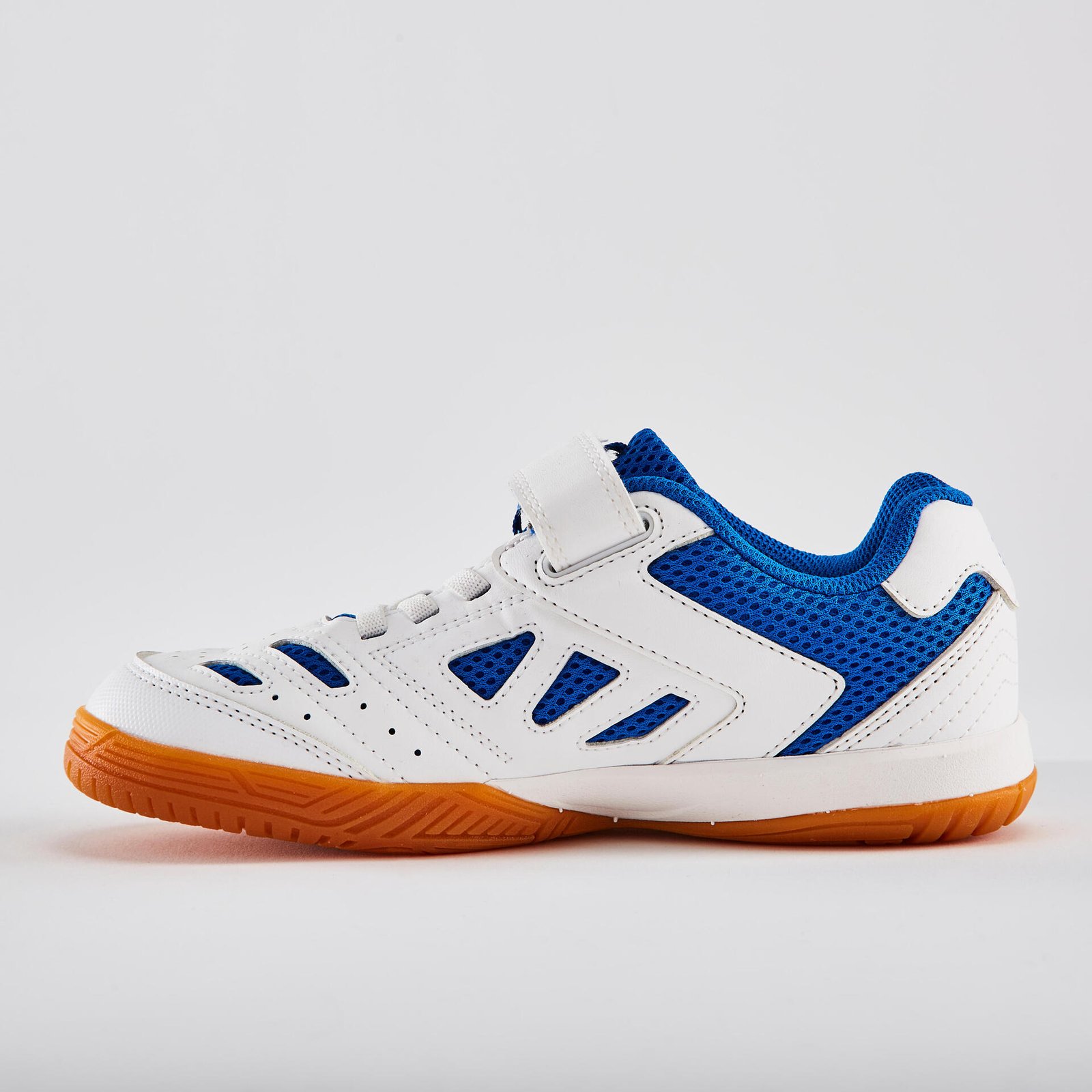
Pongori TTS 500 Junior
Decathlon’s junior table-tennis shoe: designed, in Decathlon’s words, for junior regular players who want light, good-grip shoes.
Decathlon’s Pongori is the table-tennis specialist brand inside the world’s biggest sports retailer, and the TTS 500 Junior is its junior table-tennis shoe — positioned by Decathlon itself for junior regular players looking for a light and good-grip table tennis shoe. That word “regular” is the positioning to read: this is not the first-lesson shoe in Decathlon’s thinking, it is the shoe for the junior who is already playing week in, week out. The published design description is short and functional: a non-slip sole made with a high percentage of rubber for better grip, a breathable upper, and side protection with stabilisation — the side of the shoe being where table tennis’s sideways footwork wears and pushes hardest. Two colourways carry two model codes, 8736235 in white and blue and 8736234 in white, so quote the code when you order or enquire.
The documentation caveat on this card is Decathlon’s own listing discipline. Decathlon’s Hong Kong store page for the junior model publishes no numeric weight and no size list in the product information shown, so this guide states neither — and, importantly, it does not borrow the weight Decathlon publishes for the adult TTS 500 New, because that is a different shoe for a different foot, and borrowing it would be exactly the kind of quiet substitution this guide exists to avoid. Confirm the junior size run on your regional Decathlon store page before ordering. What the Pongori offers in return for that extra click is accessibility: it is the one card here sold through a mainstream high-street sports retailer with stores juniors can actually try shoes in, which, for a growing foot and a size-sensitive purchase, is a genuine practical advantage over every import-only model on this page.
What we like
- Maker-positioned for junior regular players — a clear, honest brief
- High-rubber non-slip sole, breathable upper, side protection
- Sold through Decathlon stores — the try-on option no import model offers
- Two published colourways with distinct model codes
Worth knowing
- Decathlon’s junior listing publishes no weight and no size list — check your regional store page
- Positioned for regular players, not first-lesson beginners
As an Amazon Associate we earn from qualifying purchases.
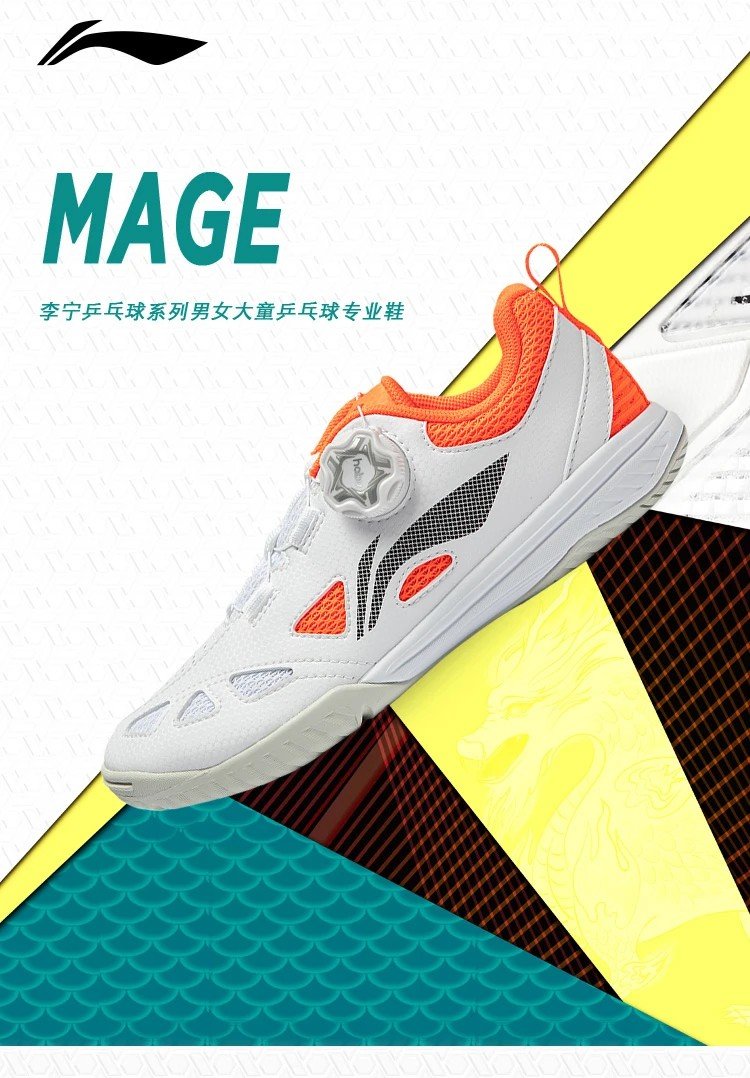
Li-Ning Mage ESS Kids
The cushioned end of junior table tennis: Li-Ning Cloud cushioning in a kids shoe from the 2025 summer collection.
Most junior table-tennis shoes keep cushioning minimal, in line with the sport’s thin-sole tradition. The Mage ESS Kids is the deliberate exception inside Li-Ning’s own range. Shopnings’ Li-Ning listing presents it as part of Li-Ning’s 2025 summer kids’ table tennis collection, following the launches of the adult Mage Pro and ESS — and the distinction matters, so it is stated here in full: this is a distinct kids model with its own style code, APTU017, not the adult Mage ESS and not the Li-Ning Ma Long shoe compared in the adult pillar guide. Its spec table lists the technologies that set it apart from the other Li-Ning cards: Li-Ning Cloud, the maker’s cushioning material, in the sole build alongside Tuff OS, with a rubber, PHYLON and TPU sole, a textile and synthetic upper, a non-marking rating and a soft stiffness rating — the softest, most cushioned specification of any table-tennis-specific card in this guide.
That makes this the card for a specific junior: the one whose table-tennis week is long. A child training several sessions a week, playing school and club fixtures on top, spends hours on hall floors, and a cushioned kids table-tennis shoe — rather than a general cushioned trainer that gives up the table-tennis sole entirely — is the considered middle path. The trade-offs are the familiar Li-Ning documentation gaps: Shopnings publishes no size range and no weight for the Mage ESS Kids, so both have to be confirmed on the product page at ordering, and there is no published gram figure to set against the Mizuno’s. Buy it by its construction and its collection positioning — the newest kids table-tennis shoe in this guide, and the one built for the junior playing the most table tennis.
What we like
- Li-Ning Cloud cushioning in a genuine kids table-tennis model
- A distinct kids style code (APTU017) — not a re-labelled adult shoe
- Tuff OS and a non-marking rating in the published spec table
- The newest junior model here, from the 2025 summer kids collection
Worth knowing
- No size range or weight is published in the listing checked — confirm both at ordering
- More cushioned than the sport’s thin-sole tradition — a deliberate choice, not a default
As an Amazon Associate we earn from qualifying purchases.
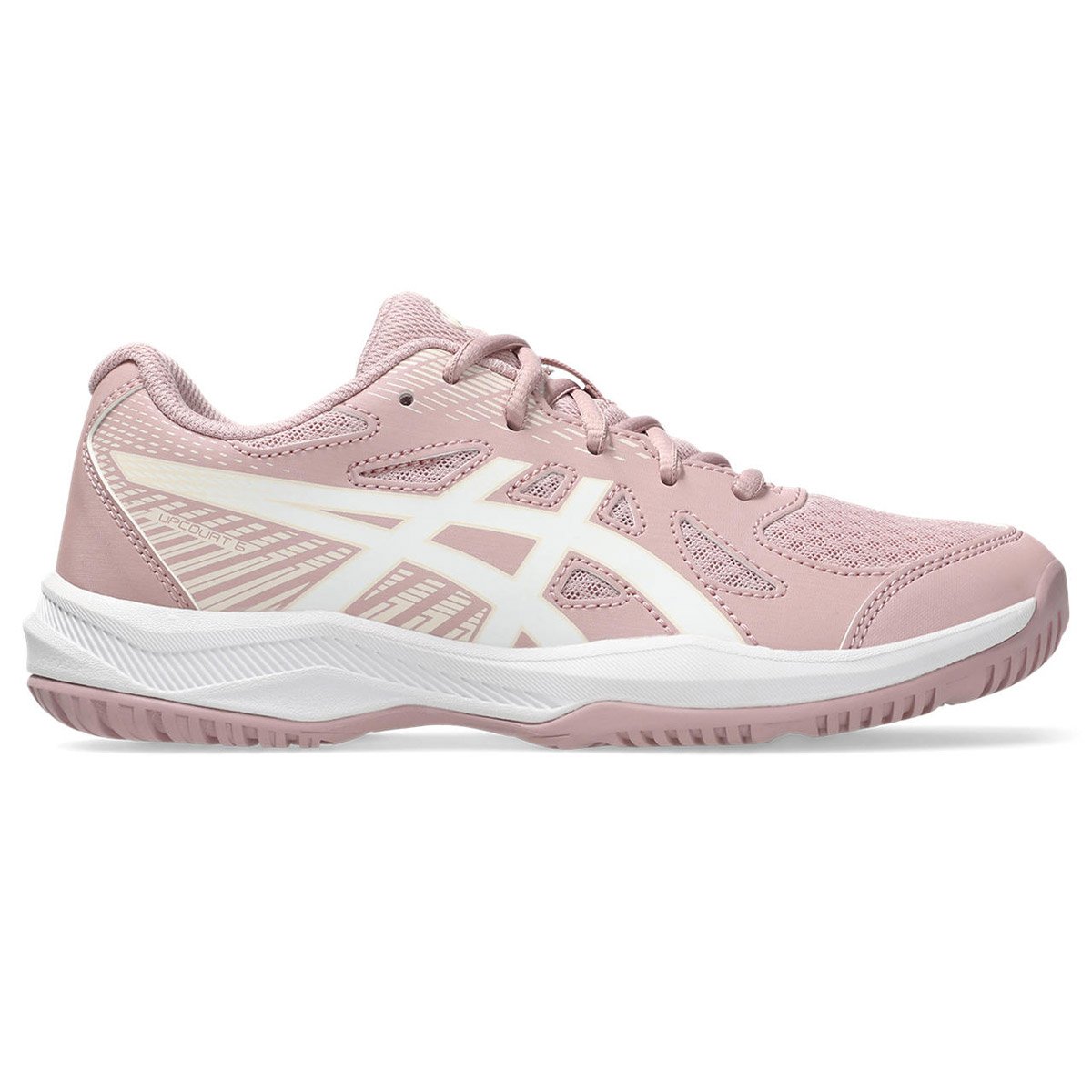
ASICS Upcourt 6 GS
The general-indoor route, honestly framed: ASICS’ Grade School court shoe, in sizes ASICS lists from K12.5 to US 7.
Read this card’s label before its specification: the Upcourt 6 GS is a general indoor-court shoe in junior sizes, not a table-tennis shoe. ASICS publishes no junior table-tennis shoe, and this guide does not pretend otherwise. What ASICS does publish — on its own site, under Kids’ Indoor Shoes — is a current Grade School court shoe it describes as a lightweight design offering flexibility and a comfortable fit, with a broad section of mesh paneling that helps create a softer, more adaptable fit, and breathable mesh underlays. ASICS Singapore lists the size run from K12.5 through to US 7 — the widest and longest junior run in this guide, reaching well past the EU 36 ceiling of the JOOLA. ASICS retailer Direct Badminton adds the court specification for the GS model: forefoot GEL cushioning, GEL and EVA cushioning through the shoe, a gum rubber outsole it describes as giving grip for changing direction, a removable sockliner and a non-marking sole.
So the honest case for the ASICS is a practical one. It is the shoe for the child whose hall time is split — table tennis on one day, volleyball, badminton or school court sport on others — or whose foot has already passed the junior table-tennis ranges and needs a junior court shoe that still fits, in a size run that goes to US 7. The gum rubber, non-marking outsole is hall-appropriate and the cushioning is the most substantial here alongside the Mizuno, which suits longer, mixed training days. What it is not is thin-soled or table-tennis-specific: a junior specialising in table tennis, training footwork patterns several times a week, belongs in cards #1 to #5. And if the same child’s other court sport is tennis outdoors, that is a different shoe again — our best tennis shoes for kids guide covers the junior tennis ranges. ASICS publishes no weight for the Upcourt 6 GS, so none is stated here.
What we like
- The longest junior size run here — ASICS lists K12.5 to US 7
- Gum rubber, non-marking outsole — hall-appropriate grip
- GEL and EVA cushioning for longer, mixed-sport training days
- A current model on ASICS’ own site, in its Kids’ Indoor range
Worth knowing
- Not a table-tennis shoe — a general indoor-court shoe, framed as such
- ASICS publishes no weight for the GS model
As an Amazon Associate we earn from qualifying purchases.
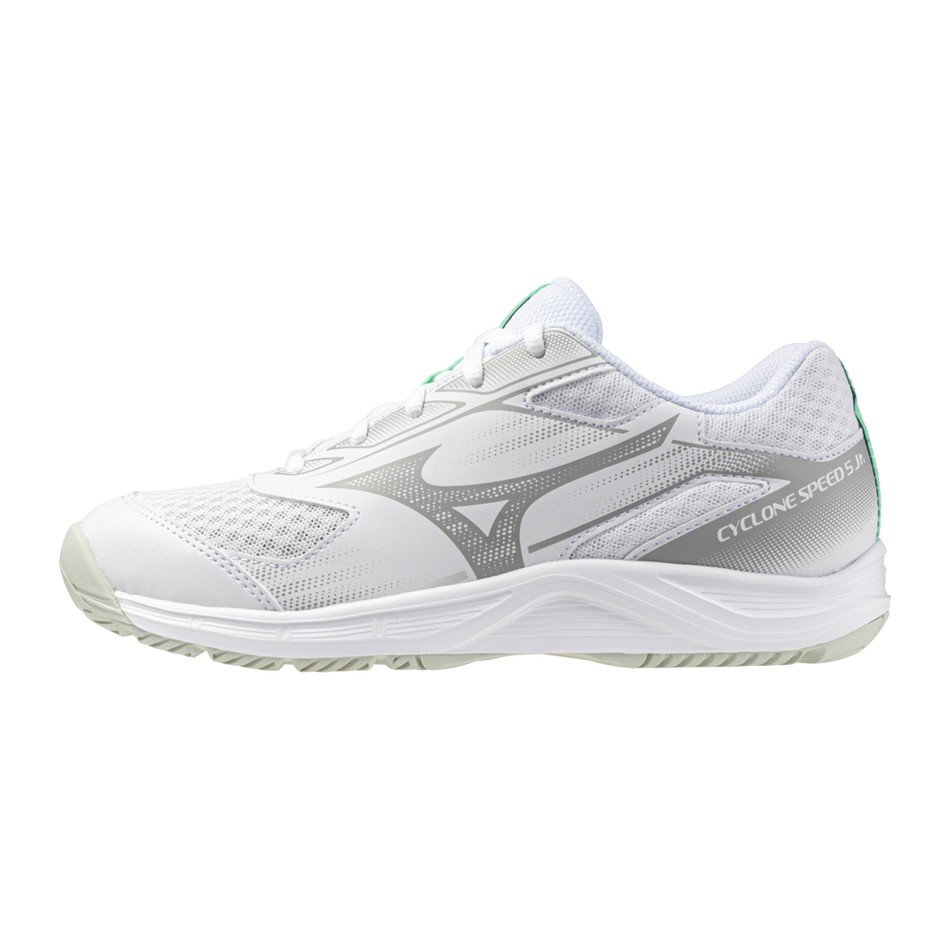
Mizuno Cyclone Speed 5 Jr
Mizuno’s junior indoor shoe with a flat, highly flexible sole — the closest a general court shoe here comes to a table-tennis feel.
Mizuno is a table-tennis giant whose table-tennis shoes are adult shoes — the Wave Drive range sits in the adult pillar guide, and Mizuno publishes no junior version of it. What Mizuno does publish, on its own UK and Singapore stores, is this: a junior indoor shoe it presents as perfectly crafted for junior players, with beginner-friendly features built around a flat sole. Mizuno’s description is unusually specific about why the sole is shaped the way it is — a highly flexible sole design it calls junior player-friendly because it bends easily even for players still developing their physical strength, an extremely stable flat sole that helps players feel the court through the entire foot, a last made to fit a variety of foot shapes comfortably, and a removable cup insole that follows the shape of the foot. Sportisimo’s Mizuno listing gives the size run as EU 34–39 with a rubber outsole. Of the two general-indoor cards, this is the one whose flat, low, flexible sole sits closest in spirit to a table-tennis shoe.
One figure on this card needs both its numbers, because Mizuno’s own page carries both. Mizuno UK’s specification field lists the weight as 240 g, while Mizuno’s feature text on the same page says the 27.0 cm size weighs about 275 g. Those do not reconcile, and this guide does not silently pick one: the chip above carries the spec-field figure, this paragraph carries both, and a buyer comparing grams should treat the model’s weight as “240 g in Mizuno’s spec field, about 275 g at 27.0 cm in Mizuno’s own text” until Mizuno settles it. Either way, it is the only card here with any maker-published weight at all. Buy the Cyclone Speed 5 Jr for the junior who plays table tennis as part of a wider indoor-sport week and wants a flat, flexible, court-feeling sole — and keep the kit together afterwards with a proper bag, compared in our best table tennis bags guide. A junior specialising purely in table tennis still belongs in the TT-specific cards above.
What we like
- Flat, highly flexible sole — the closest general-indoor feel to a TT shoe
- Mizuno’s junior-specific last and removable cup insole, per Mizuno
- The only maker-published weight in this guide (see the note on its card)
- Mizuno-published stack height: 11.5 mm — a genuinely low build
Worth knowing
- Mizuno’s page carries two weight figures (240 g spec field; about 275 g at 27.0 cm in its text)
- A volleyball-origin general indoor shoe — not a table-tennis model
As an Amazon Associate we earn from qualifying purchases.
Side-by-Side Comparison Table
| Model | Best For | Type | Sizes as Published | Outsole | Weight as Published |
|---|---|---|---|---|---|
| JOOLA Pro Junior | Best overall junior TT shoe | Table-tennis specific | EU 30–36 (Bribar) | Rubber, non-slip | Not published (JOOLA) |
| Li-Ning Junior APTU010-1 | Smallest feet · Velcro | Table-tennis specific | US 0.5 (185 mm)–5.5 (230 mm), listed with gaps | Non-marking rubber, cross-flex grooves | Not published (Li-Ning) |
| Li-Ning Eagle Eye 2.0 Kids | TT-specific step-up | Table-tennis specific | Not published in spec table | Rubber, geometric tread | Not published (Li-Ning) |
| Pongori TTS 500 Junior | Junior regular players | Table-tennis specific | Not published on junior listing | Non-slip, high % rubber | Not published for Junior (Decathlon) |
| Li-Ning Mage ESS Kids | Cushioned TT shoe | Table-tennis specific | Not published in spec table | Rubber / PHYLON / TPU, non-marking | Not published (Li-Ning) |
| ASICS Upcourt 6 GS | General indoor option | General indoor court | K12.5–US 7 (ASICS SG) | Gum rubber, non-marking (retailer) | Not published (ASICS) |
| Mizuno Cyclone Speed 5 Jr | Flat, flexible indoor | General indoor court | EU 34–39 (retailer) | Rubber, flat (retailer) | 240 g spec field; about 275 g at 27 cm in Mizuno text |
The two “not published” columns are the story of the junior market, printed as found rather than tidied away. Only one maker in seven publishes a weight, and that maker publishes two figures. Only three publish a complete size run for their junior model. None of that makes the other shoes bad buys — it makes the pre-order checks in the buying guide below non-optional. Where a maker publishes a full specification, buy by it. Where it does not, confirm the missing number on the product page, in writing, before the shoes are worn on a hall floor and cannot be exchanged.
Buying Guide: Sizing a Junior Table-Tennis Shoe
1. Decide the type first: TT-specific or general indoor
Everything else follows from this. A child specialising in table tennis — club sessions, coaching, footwork drills — gets the shoe the sport specifies: thin, grippy, low, from cards #1 to #5. A child whose week mixes table tennis with other hall sports, or whose foot is already beyond the junior table-tennis ranges, gets an honest general indoor-court shoe from cards #6 and #7. What not to do is split the difference with a running trainer: its raised, cushioned heel and forward-running tread are the opposite of what sideways footwork asks for, whatever the size chart says.
2. Measure the foot, then buy in the maker’s own system
Junior sizes are not one system. In this guide alone, makers state sizes in European sizes with centimetre equivalents (JOOLA), US sizes keyed to millimetres (Li-Ning’s APTU010-1), Grade School sizes from K12.5 (ASICS) and European sizes from a retailer listing (Mizuno). Measure both feet standing, in the socks the child plays in, and write the longer measurement down in centimetres and millimetres. Then match that measurement against the specific model’s stated system — and heed the warnings makers’ retailers publish: Bribar states plainly that the JOOLA Pro Junior’s printed sizes come up incredibly small, which is a specification, not a review opinion.
3. Check the sole against the floor the child actually plays on
Every card here is built for indoor hall floors, and the non-marking ratings — published for Li-Ning’s APTU010-1, Eagle Eye 2.0 Kids and Mage ESS Kids, and for the ASICS via its retailer — matter because many school and club halls require non-marking soles. If your child’s hall has such a rule, a non-marking published rating is the safe buy. Outdoors is a different matter: none of these junior models is published as an outdoor shoe, and thin table-tennis soles are hall soles. Keep them for the hall.
4. Treat missing numbers as a pre-order task, not a detail
Where a card says a size range or weight is not published, that is your instruction to confirm it on the product page before ordering — the exact size list for Li-Ning’s Eagle Eye 2.0 Kids and Mage ESS Kids and Decathlon’s Pongori TTS 500 Junior, in particular. Order from a listing that states the size you are buying in the maker’s own units, keep the packaging, and have the child try the shoes indoors on a clean floor: heel held, toes with room to spread for side steps, and no slipping at the collar when they shuffle sideways. A table-tennis shoe that fits like a school shoe — roomy everywhere — will move on the foot exactly when the footwork gets fast.
Frequently Asked Questions
What shoes should a child wear for table tennis?
A junior table tennis shoe with a thin, grippy rubber sole, sized in a genuine kids or youth range. The table-tennis-specific junior models in this guide are the JOOLA Pro Junior (EU 30–36), Li-Ning’s Junior APTU010-1, Eagle Eye 2.0 Kids and Mage ESS Kids, and Decathlon’s Pongori TTS 500 Junior, which Decathlon positions for junior regular players. General indoor-court shoes in junior sizes — the ASICS Upcourt 6 GS and Mizuno Cyclone Speed 5 Jr — are the alternative for children who split their hall time across sports. A running trainer, with its raised cushioned heel, is the wrong shape for sideways footwork.
Can kids just wear regular trainers for table tennis?
For a first taster session, most halls will accept clean indoor trainers. For regular play, a dedicated shoe is the better buy: table tennis footwork is short, sideways steps and pivots, and the sport’s shoes are built for it with thin, grippy soles that keep the foot low. Trainers are built for forward running, with thicker cushioning and a raised heel. Every model in this guide is a junior shoe with a hall sole; several carry a published non-marking rating, which many school and club halls require.
Which table tennis brands make proper kids shoes?
Of the table-tennis makers checked for this guide, JOOLA, Li-Ning and Decathlon’s Pongori publish genuine junior or kids table-tennis models, with specifications stated on their cards. Butterfly publishes no junior table-tennis shoe — its Lezoline range is an adult and unisex line — and Victas publishes no junior shoe either. Mizuno’s table-tennis shoes are adult models; its junior shoe in this guide is a general indoor-court model. This guide cards only models their makers publish as junior or kids shoes, and says so where a maker publishes none.
How do junior table tennis shoe sizes work?
Each maker states them differently, so buy in the maker’s own system. JOOLA sizes the Pro Junior in European sizes, EU 30–36, and its retailer Bribar adds UK and centimetre equivalents and warns the printed sizes come up very small. Li-Ning’s APTU010-1 is listed in US sizes keyed to millimetres, from US 0.5 at 185 mm. ASICS sizes the Upcourt 6 GS in Grade School sizes, listed from K12.5 to US 7. Measure the child’s foot in centimetres and match it to the specific model’s stated system, not to a generic conversion chart.
Table-tennis-specific or general indoor shoes — which are better for kids?
They suit different weeks. A table-tennis-specific junior shoe — the JOOLA, the three Li-Ning kids models and the Pongori in this guide — has the thin, grippy sole the sport’s lateral footwork needs, and suits a child specialising in table tennis. A general indoor-court junior shoe — ASICS’ Upcourt 6 GS and Mizuno’s Cyclone Speed 5 Jr — brings more cushioning and, in the ASICS case, a longer size run, and suits a child splitting hall time across several sports. Neither is a substitute for the other; each card in this guide is labelled for what it is.
Why do so few of these shoes publish a weight?
Because junior shoe documentation is uneven, and this guide reports it as found. Of the seven models here, only Mizuno publishes a weight for its Cyclone Speed 5 Jr — and its own page carries two figures, 240 g in the specification field and about 275 g for the 27.0 cm size in its feature text. JOOLA describes the Pro Junior as extra lightweight but publishes no number. Li-Ning, Decathlon and ASICS publish no numeric weight for the junior models carded here. Compare these shoes on construction and published sizes instead of grams.
When should a junior move up to adult table tennis shoes?
When the foot outgrows the junior ranges — the top of the runs in this guide is EU 36 in the JOOLA Pro Junior and US 7 in the ASICS Upcourt 6 GS, and most makers publish no youth line above their junior models. The next step is an adult table tennis shoe in the smallest adult sizes, chosen from the adult ranges: our best table tennis shoes guide owns adult and all-player selection, including the Butterfly, Mizuno and Victas models juniors graduate into. Do not skip the junior stage early to get there; a junior shoe is sized and built for a junior foot.
The Verdict
Buy the shoe that matches the week your child actually plays, on the maker’s numbers. The JOOLA Pro Junior is the junior table-tennis shoe done properly — developed for children, fully sized, on the sport’s classic sole. The Li-Ning Junior APTU010-1 starts the smallest feet with its Velcro strap and 185 mm starting size; the Li-Ning Eagle Eye 2.0 Kids steps a regular junior up; the Pongori TTS 500 Junior serves Decathlon’s junior regulars with a store to try it in; and the Li-Ning Mage ESS Kids cushions the longest training weeks. The ASICS Upcourt 6 GS and Mizuno Cyclone Speed 5 Jr are the honest general-indoor alternatives — more cushioning, longer or flatter builds, no pretence of being table-tennis shoes. Beyond the junior ranges, the step is an adult table-tennis shoe: our best table tennis shoes guide owns that choice. Size honestly, by the maker’s own published system — a child shuffling sideways in the right sole learns table-tennis footwork; a child in a runner’s heel learns to work around one.
Affiliate disclosure: AliShuttler is reader-supported. When you buy through links on this page we may earn an Amazon commission at no extra cost to you. Specifications and sizing positions are taken from manufacturers’ published product information and were verified at the time of writing; manufacturers revise models between seasons, so confirm the exact specification on the product page before ordering.