The advanced player’s bat decision is the last ready-to-play decision — and the first custom one. At the top of the pre-made ladder the questions change: not whether the blade is fast, but how its maker builds that speed (all-wood, wood-and-composite, or full carbon), which named rubber sits on which published sponge, whether a penhold variant exists at all, and whether the honest next step is a flagship pre-made or a blade and rubbers chosen separately. This guide compares seven complete bats on exactly what their makers publish — and marks the door to custom where the makers themselves draw it.
⚡ TL;DR — The Short Answer
For the best all-round advanced pre-made, buy the Killerspin Diamond TC RTG Premium — a 7-ply titanium-carbon blade with Fortissimo rubbers, a maker-published weight and the top speed figure on Killerspin’s own scale. The Butterfly Timo Boll ALC FL Pro-Line with Tenergy 05 is the bridge pick: a genuine pro blade-and-rubber combination that Butterfly itself sells fully assembled. The JOOLA Infinity Z Carbon carries the largest published figures in the set, in JOOLA’s scale for the model. The Cornilleau Excell 3000 Carbon is the OFF+ pre-made reference in Cornilleau’s terms, the Donic Carbotec 7000 the full-carbon build, the DHS H6002 the tacky-rubber looping bat with a penhold sibling, and the Yasaka Mark V Carbon the classic Swedish-blade option — the second published penhold route here.
Quick Picks — Best Table Tennis Bats for Advanced Players at a Glance
5 plywood plies plus 2 titanium-carbon layers, Fortissimo rubbers, and a maker-published weight.
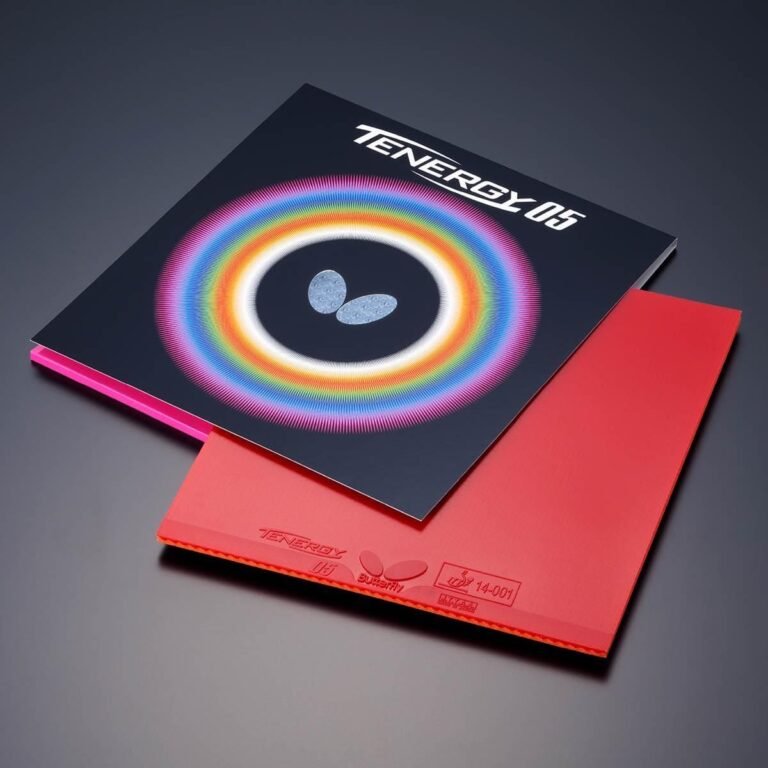
Butterfly sells this ALC blade with Tenergy 05 at 2.1 mm fully assembled, as one product.
Zyramid Carbon weave and Micron X, with JOOLA’s highest published figures for a pre-assembled racket.
OFF+ in Cornilleau’s terms, Performa 2 on a 2.0 mm Dynacell sponge, top of the Excell line.
A 100% carbon one-piece blade with Liga-QRC on a 2.3 mm sponge and Donic’s Attack+ brief.
Hurricane 8 and Tin Arc on a thick-core 5-ply wood blade — with the H6006 penhold sibling.
Mark V rubbers on a Swedish competition blade with a carbon layer — penhold listed among its handles.
In This Guide
- The Advanced Decision: The Top Rung — and the Door Beyond It
- Blade Builds, Rubber Types and Handles — As the Makers Describe Them
- The 7 Best Table Tennis Bats for Advanced Players, Compared
- Side-by-Side Comparison Table
- Buying Guide: Reading the Top Rung Like a Maker
- Frequently Asked Questions
- The Verdict
The Advanced Decision: The Top Rung — and the Door Beyond It
Every ladder in this sport ends the same way: the equipment stops being a ladder at all. An advanced player buys a construction — a specific answer to how a blade should be built and what should be glued to it. That is why the seven cards here are organised by build rather than by brand. Two are wood-and-composite shakehand flagships. One is a full-carbon bat with no wood in its blade at all. One is an all-wood Chinese offensive bat built around tacky rubbers. One is a Swedish competition blade carrying the most famous rubber name in the sport’s history. And one — deliberately, and labelled as such — is a professional blade-and-rubber combination its maker sells assembled, standing on the border between this page and the custom world.
The pre-made-versus-custom decision is the real subject of this page, so here it is plainly. A pre-made advanced bat is a maker’s finished judgement: blade recipe, rubber pairing and sponge chosen together, arriving ready to play, with one coherent published specification — every card below is exactly that. A custom setup separates the judgement: a blade chosen for its construction and class, then two rubbers chosen for type and thickness. Players cross that line when a fixed pairing stops matching a game that has become specific — one wing looping, the other driving; a penhold grip with a specialised backhand; a sponge thickness no pre-made line offers. Neither side is the “serious” one: the custom route simply exists for the games the finished instruments do not fit.
The boundaries of this page are strict, because this site keeps its rungs separated. First-bat selection belongs to our guide to the best table tennis bats for beginners. The step up from a beginner pre-made belongs to our guide to the best table tennis bats for intermediate players — read it if the bats below look like a jump of two rungs, because they are. All-player selection across every level belongs to our generic guide to the best table tennis bats. None of those guides’ models is re-carded here. And when you do cross to custom, the component decisions live on their own pages: our guide to the best table tennis blades owns blade selection and our guide to the best table tennis rubbers owns rubber selection — this page links them for that decision and does not duplicate their rankings. Technique, finally, is the multiplier on every specification below: our how to play table tennis guide covers the strokes these bats are built to serve.
Blade Builds, Rubber Types and Handles — As the Makers Describe Them
Blade construction is the first language of the advanced rung, and this set speaks it in three dialects. The all-wood builds — DHS’s 5-ply blade with its thicker core ply — put the pace in the wood layup itself, and their makers describe them in terms of core thickness and hitting area rather than composite content. The wood-and-composite builds are the majority here, and each maker names its own fibre: Killerspin layers titanium carbon into plywood, JOOLA weaves its Zyramid Carbon into a 7-ply, Butterfly sandwiches Arylate/Carbon — its ALC — into the Timo Boll blade, Cornilleau sets a Carbon Technology insert into a 5-ply, and Yasaka adds a carbon layer to a Swedish competition blade. The full-carbon build is Donic’s alone: the Carbotec 7000’s blade is 100% carbon in a one-piece construction, which Donic describes as harder and more twist-resistant than traditional wood bats. None of these descriptions is a test result, and this guide repeats them as what they are — the makers’ published accounts of their own constructions, which is the honest basis on which advanced players actually compare them.
Rubber is the second language, and it divides by type before it divides by thickness. The DHS card pairs two tacky Chinese rubbers — Hurricane 8 and Tin Arc — whose maker descriptions centre on tackiness, spin and the loop-and-quick-attack game. The European and American cards carry grippy tension-style rubbers under their makers’ own names — Tenergy 05, Micron X, Fortissimo, Performa 2, Liga-QRC — and the Yasaka card carries Mark V, the classic that predates the tension era. Thickness is printed only where a maker publishes it: 2.1 mm from Butterfly, 2.0 mm from Cornilleau, and 2.3 mm — the thickest published sponge here — from Donic. The other four makers publish none for their carded bats, and their cards say so. A sponge a maker describes without a number — DHS calls the Hurricane 8’s a high-elastic large-pore sponge — is reported as a description, never converted into a figure.
Handles split the set more honestly than marketing does. Five cards are shakehand-only as published, in the usual two vocabularies — flared and concave for the same family of shapes. Two add a genuine second shape: Killerspin offers the Diamond TC in a straight handle as well as flared, and Butterfly sells an anatomic Pro-Line version. And penhold — the grip the advanced rung so often forgets — is published on exactly two cards: DHS’s dedicated penhold model, the H6006, with its own rubber pairing; and Yasaka’s Mark V Carbon, which lists penhold among its handle options. Where a maker publishes no penhold variant, this guide does not imagine one.
Ratings close the spec sheet, under the rule this whole site runs on: a maker’s figures live inside that maker’s scale and travel nowhere else. Killerspin and Cornilleau rate out of 10 on different catalogues; Donic and JOOLA publish past 100; Butterfly rates blade and rubber on two separate property systems; Yasaka publishes its own three figures; and DHS publishes no ratings for the H6002 at all — the conflicting retailer numbers are recorded in this file’s build notes and printed nowhere in the cards. Read each card’s figures as a position inside one maker’s range.
The 7 Best Table Tennis Bats for Advanced Players, Compared
Seven complete bats, seven brands, three blade philosophies — and one maker-assembled professional combination, labelled as the bridge it is. Every rating stays inside its own maker’s scale, and every unpublished field is printed as unpublished. Read the card that matches your construction first.
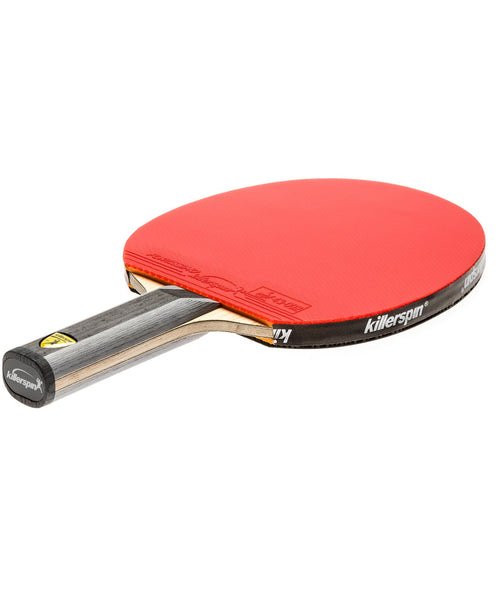
Killerspin Diamond TC RTG Premium
The complete pre-made flagship — titanium carbon layered into plywood, Fortissimo rubbers, two handle shapes and a maker-published weight.
Killerspin publishes this bat the way an advanced buyer wants a flagship published: the full recipe, on the maker’s own page. The blade is a 7-ply construction — five plywood plies plus two layers of Titanium Carbon — fitted with Killerspin’s Fortissimo rubber in red and black, and Killerspin describes the brief in its own words: an aggressive play style, built for serious competitors. Its ratings sit at the top of Killerspin’s /10 presentation — Speed 10, Spin 9, Control 6 — figures that place the Diamond TC inside Killerspin’s own range as its speed-led flagship, and that this card compares with nothing outside that range. Killerspin states the paddle is ITTF-approved for competition. It is, quite simply, the most completely specified pure pre-made in this guide, and it leads it for that reason.
Two further fields separate this card. Killerspin publishes a weight — 0.375 to 0.384 lb, approximately 170 to 174 grams — stated as a range because the maker states it as a range. And the handle choice is real: flared for the wider base Killerspin describes as suiting powerful forehand play, or straight, described as keeping a consistent width for quick transitions between wings. The one gap is printed as a gap: Killerspin publishes no sponge thickness for the Fortissimo fitment. An older generation of listings quoted different figures and a different rubber name for this model — superseded, and not used; the current maker page governs every field above. The bat ships in Killerspin’s Memory Book case.
What we like
- A fully published blade recipe — plywood and Titanium Carbon, layer counts stated
- A maker-published weight range, a rarity at any rung
- Two genuine handle shapes (flared and straight) from the maker
- ITTF-approved, per Killerspin’s own page, with the maker’s top speed figure
Worth knowing
- Sponge thickness is not published by the maker
- Control is the modest figure (6/10) in Killerspin’s own scale — an attacking brief, stated by the maker
- Older listings carry superseded figures for this model — check the listing against the current maker page
As an Amazon Associate we earn from qualifying purchases.
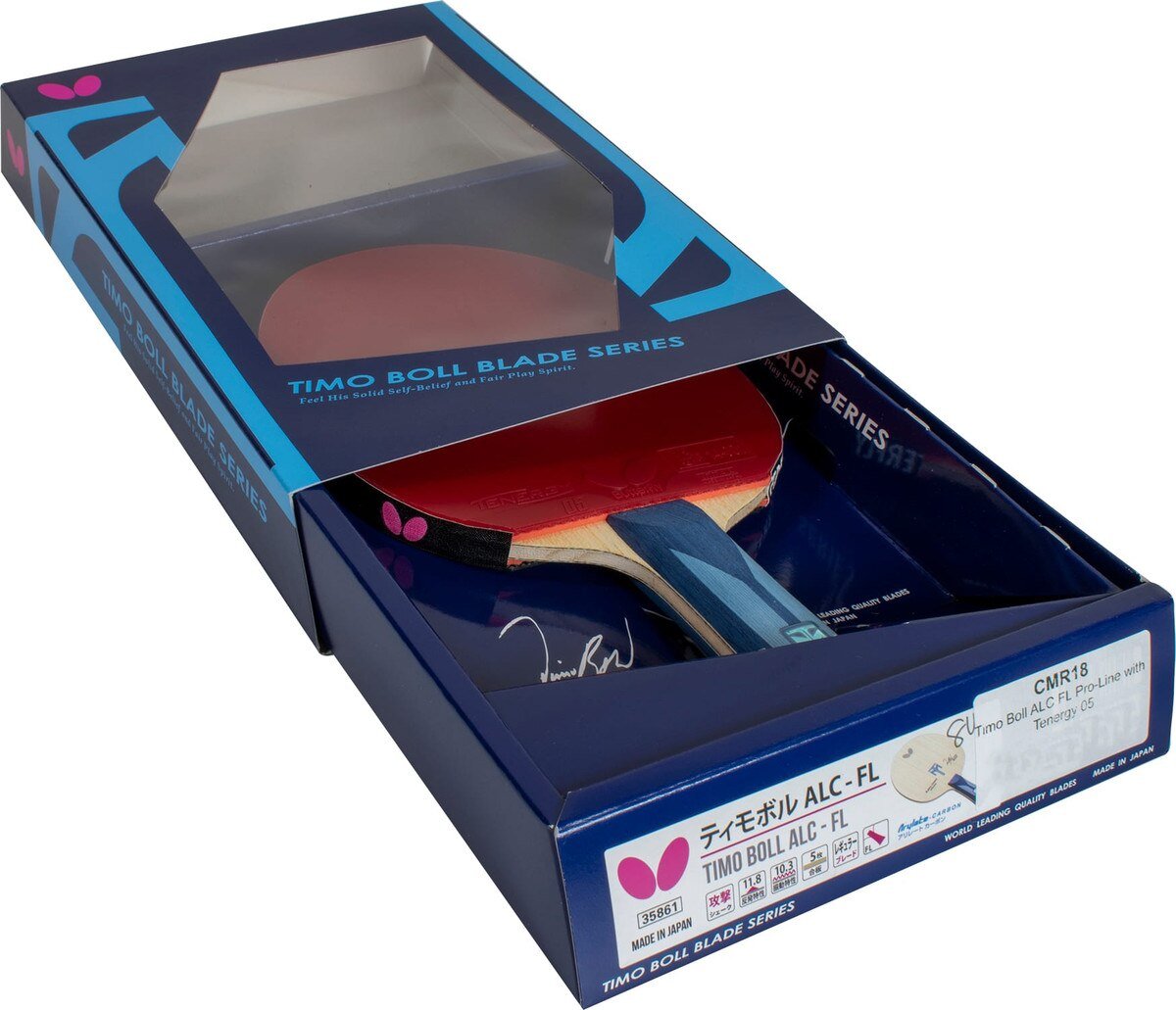
Butterfly Timo Boll ALC FL Pro-Line with Tenergy 05
The bridge pick — a professional ALC blade and Tenergy 05 combination that Butterfly itself sells fully assembled, as a single product.
This card is in the guide under an explicit rule, and the card states it: Butterfly sells the Pro-Line fully assembled, as one product, on its own store — a complete bat you buy, not a pair of components you assemble, and the point where the pre-made ladder meets the custom world. The blade is the Timo Boll ALC: five wood plies plus two Arylate/Carbon layers, which Butterfly describes as combining carbon’s power with arylate’s vibration-reducing properties. Butterfly rates the blade on its own property system — Reaction 11.8, Vibration 10.3 — and fits Tenergy 05 at 2.1 mm on both sides, rating the rubber on its own system: Speed 83, Spin 76, Arc 79, Hardness 36. Butterfly positions the combination for close-to-middle-distance two-winged attacking play, and lists it as ITTF Approved. No other card publishes this depth of maker data — because no other card is a maker’s professional combination sold whole.
Read the card with its nature in mind, because Butterfly is transparent about it: the Pro-Line’s own notes explain that the blade is the long-term part of the instrument, the rubber the replaceable part, and that the assembly glue lets the rubbers be removed and replaced when they wear. That is the custom philosophy arriving inside a pre-made purchase — the honest reason this card sits at #2. The handle carded is the flared version; an anatomic Pro-Line version is also sold. Butterfly publishes no assembled weight, so none is printed. And the distinction that matters at the listing: the Timo Boll ALC blade alone is a component — the product carded here is the assembled Pro-Line racket, model reference CMR18 on Butterfly’s store.
What we like
- The deepest maker spec sheet here — blade properties and full rubber figures, all Butterfly’s own
- A genuine professional combination (ALC blade, Tenergy 05 at 2.1 mm) bought as one product
- ITTF Approved per Butterfly, with flared and anatomic versions sold
- The natural bridge to custom: rubbers are replaceable by design, as Butterfly itself explains
Worth knowing
- It is a maker-assembled combination, not a sealed pre-made — that is its point, and its card says so
- No assembled weight is published by Butterfly
- Do not confuse it with the bare Timo Boll ALC blade — the carded product is the assembled Pro-Line
As an Amazon Associate we earn from qualifying purchases.
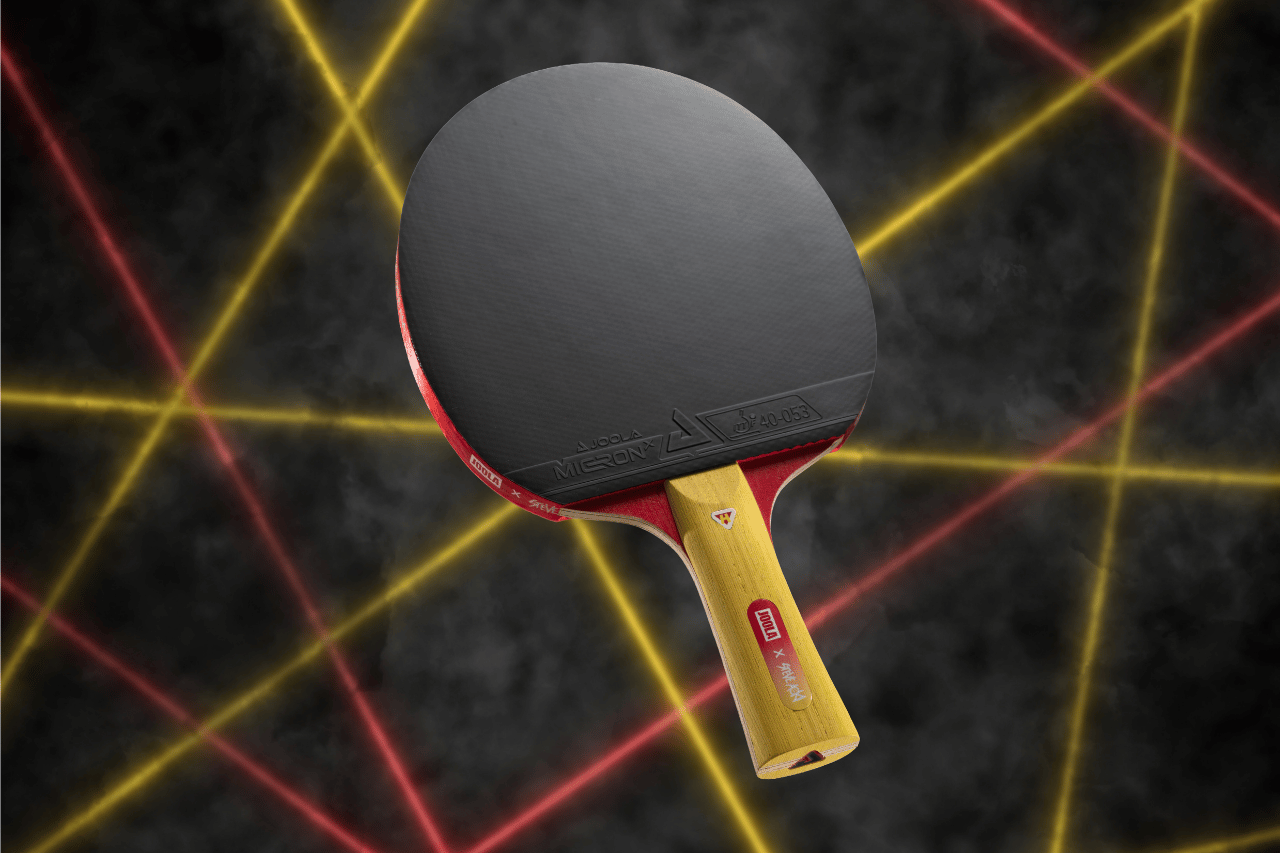
JOOLA Infinity Z Carbon
JOOLA’s top pre-assembled brief — a Zyramid Carbon weave blade and Micron X rubbers, with the largest figures JOOLA publishes for a ready-to-play racket.
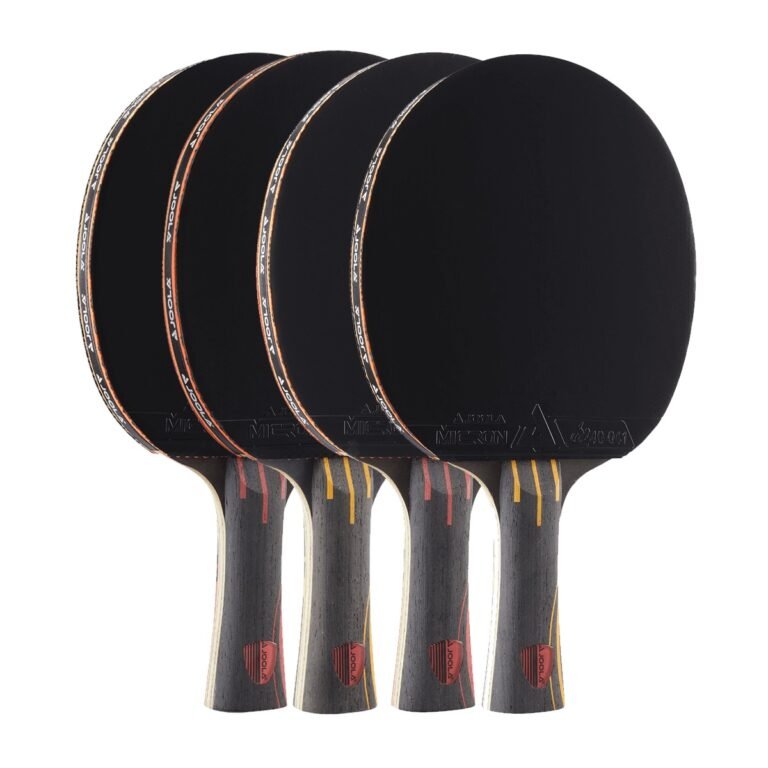
JOOLA places this bat at the top of its own pre-assembled range in its own words: on joola.com the Infinity Z Carbon is introduced as one of JOOLA’s highest-performing pre-assembled rackets, built on a Zyramid Carbon fibre blade and fitted with ITTF-approved Micron X rubber — the rubber JOOLA’s manufacturer copy describes as the top tier of its Micron series, reserved for its most advanced pre-assembled rackets. The construction, as JOOLA publishes it for the standard edition, is a 7-ply blade: five wood plies plus two layers of Zyramid Carbon weave, which JOOLA describes as adding stiffness to the blade composition for direct power and precision. The published performance figures are the largest in this guide — Speed 130, Spin 128, Control 116 — printed exactly as JOOLA publishes them for this model, in JOOLA’s scale, and compared with no other maker’s numbers, because no honest comparison exists.
The rest of the sheet is printed with the usual discipline. The handle is concave, the standard edition ships with a cover, and the part number — 54204 — is the identifier to match at the listing. JOOLA publishes no sponge thickness for the Micron X fitment and no weight; a 0.41 lb figure in one auction listing is a package figure and is not printed. One presentation note: the maker’s product photography used here shows the Z Carbon in its limited-edition colourway; the standard edition carded is the red version, with the same published construction and rubber.
What we like
- JOOLA’s own top-of-range pre-assembled brief, stated by the maker itself
- A named composite construction — Zyramid Carbon weave in a published 7-ply
- Micron X is JOOLA’s top Micron-series rubber, ITTF-approved per the maker
- A verifiable part number (54204) for checking the exact listing
Worth knowing
- Sponge thickness and weight are both unpublished by JOOLA for this model
- Its figures (130 / 128 / 116) belong to JOOLA’s scale for this model — they cannot be lined up against other brands
- Colourway editions exist; the construction and rubber are the specification
As an Amazon Associate we earn from qualifying purchases.
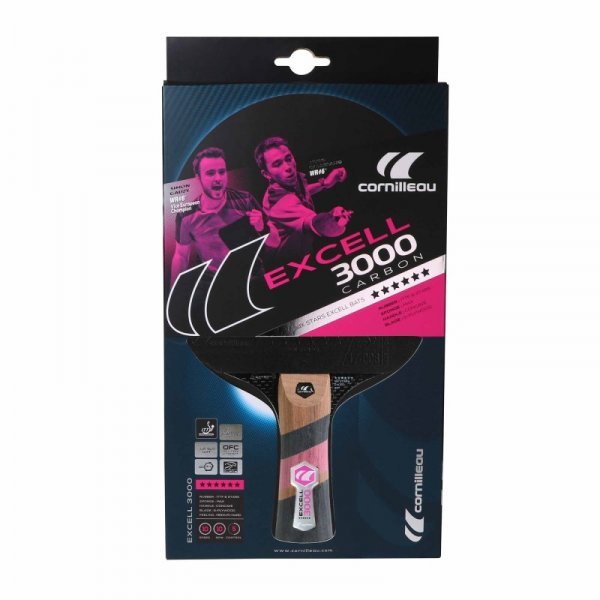
Cornilleau Excell 3000 Carbon
The top of Cornilleau’s Excell line — an OFF+ brief in the maker’s own class words, with a carbon insert and the maker’s full concept stack.
Cornilleau states this bat’s position without hedging: thanks to its Carbon Technology insert and Dynacell sponge, the Excell 3000 Carbon is described by its maker as a genuine reference for OFF+ players — the top offensive class in the vocabulary the sport shares. The construction is a 5-plywood blade with the carbon insert, fitted with Cornilleau’s Performa 2 rubber — the maker’s 6-star fitment, ITTF Approved — on a 2.0 mm Dynacell sponge, and a concave handle. Cornilleau names five concepts on the sheet — Carbon Technology, Aero Soft, OFC, Dynacell and Efficient Curve — reported here as the maker’s named technologies for this bat. Its own /10 ratings are the most attack-tilted in the set: Speed 10, Spin 10, Control 5, a published profile that tells you the trade in the maker’s own numbers before you buy it.
Context matters: the Excell 3000 is the top model of the line whose middle model, the Excell 2000 Carbon, is carded in our intermediate guide — a different, faster bat, not a re-card, and its OFF+ class against the 2000’s OFF/OFF+ rating is exactly the rung difference between the two guides. Two build-note disciplines apply. Cornilleau’s table publishes no weight — a 130 g marketplace figure repeats an outlier pattern recorded on the sibling model and is not printed. And one retailer lists a 2.2 mm sponge against the maker table’s 2.0 mm; the maker’s figure is the one carded. Check the product code 413000 at the listing — in this family, the number is the specification.
What we like
- A plainly stated top class — OFF+ — from the maker, at the head of its pre-made line
- The maker’s full concept stack is named on one spec sheet
- ITTF Approved top fitment (Performa 2, 6-star) at a stated 2.0 mm
- The maker’s own ratings state the control trade honestly (5/10)
Worth knowing
- No maker-published weight
- A 2.2 mm sponge figure circulates in one listing — the maker table says 2.0 mm
- Not the Excell 2000 of the intermediate guide — check for 3000 and code 413000
As an Amazon Associate we earn from qualifying purchases.
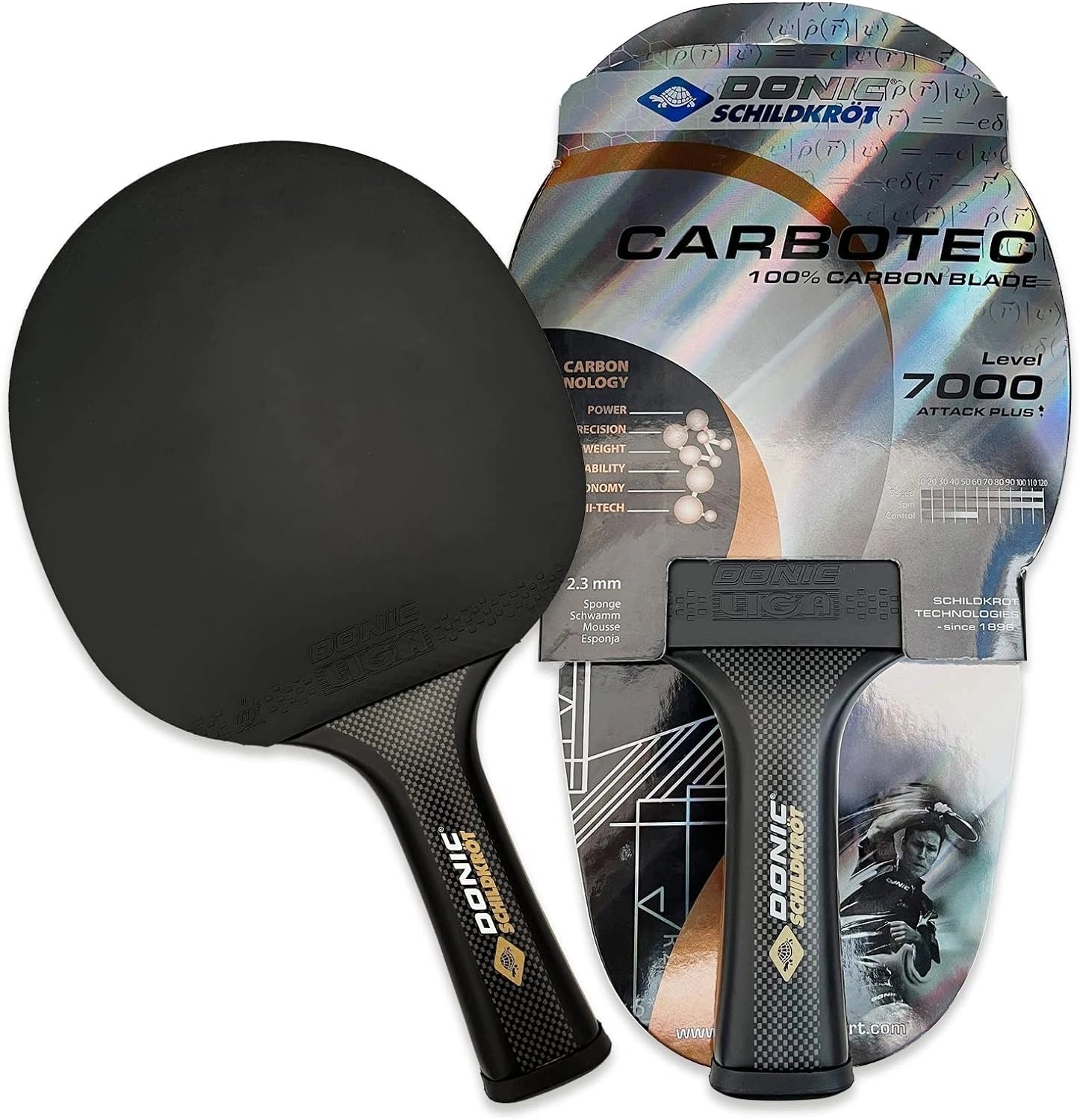
Donic Carbotec 7000
The construction outlier — a blade with no wood in it at all: 100% carbon in one piece, with a rubber system built to be changed in seconds.
Every other blade in this guide is a wood blade with something added. The Carbotec 7000 removes the wood: Donic’s published data describes a blade of 100% carbon in a one-piece construction, harder and more twist-resistant than traditional wood bats and relatively insensitive to weather, in the maker’s description. Donic classes the bat Attack+ in its own player-type terms and calls it the fastest model in its Carbotec line. The rubber is Liga-QRC on a 2.3 mm sponge — the thickest published sponge in this set — and QRC is Donic’s quick-rubber-change design, described as letting the rubber be replaced or upgraded in seconds. Donic’s own figures read Speed 120, Spin 120, Control 60. For a rigid, weather-proof, one-piece instrument, no other card here is built this way.
Two fields are printed as the maker leaves them. Donic states no ITTF status for this bat in the published data checked — a significant line if you play sanctioned competition, weighed against the five cards whose makers do state approval. And Donic publishes no weight; an 85 g figure in one trade listing is not presented by Donic as the bat’s weight and is not printed. The handle is concave, with an anatomic variant also in the maker’s data. Note what QRC means for this page’s central decision: a pre-made bat whose maker has built the custom world’s rubber swap into the product itself — a different answer to the same door the Butterfly card stands at.
What we like
- A genuinely different construction — 100% carbon, one piece, described by Donic in its own terms
- The thickest published sponge here (2.3 mm) on a named rubber system
- QRC quick rubber change is a real maker feature with a clear purpose
- The maker’s own figures (120 / 120 / 60) give a full published profile
Worth knowing
- Donic states no ITTF status for this bat — check that line first for sanctioned play
- No maker-published weight
- Control is the modest figure (60) in Donic’s own system — the brief is attack
As an Amazon Associate we earn from qualifying purchases.
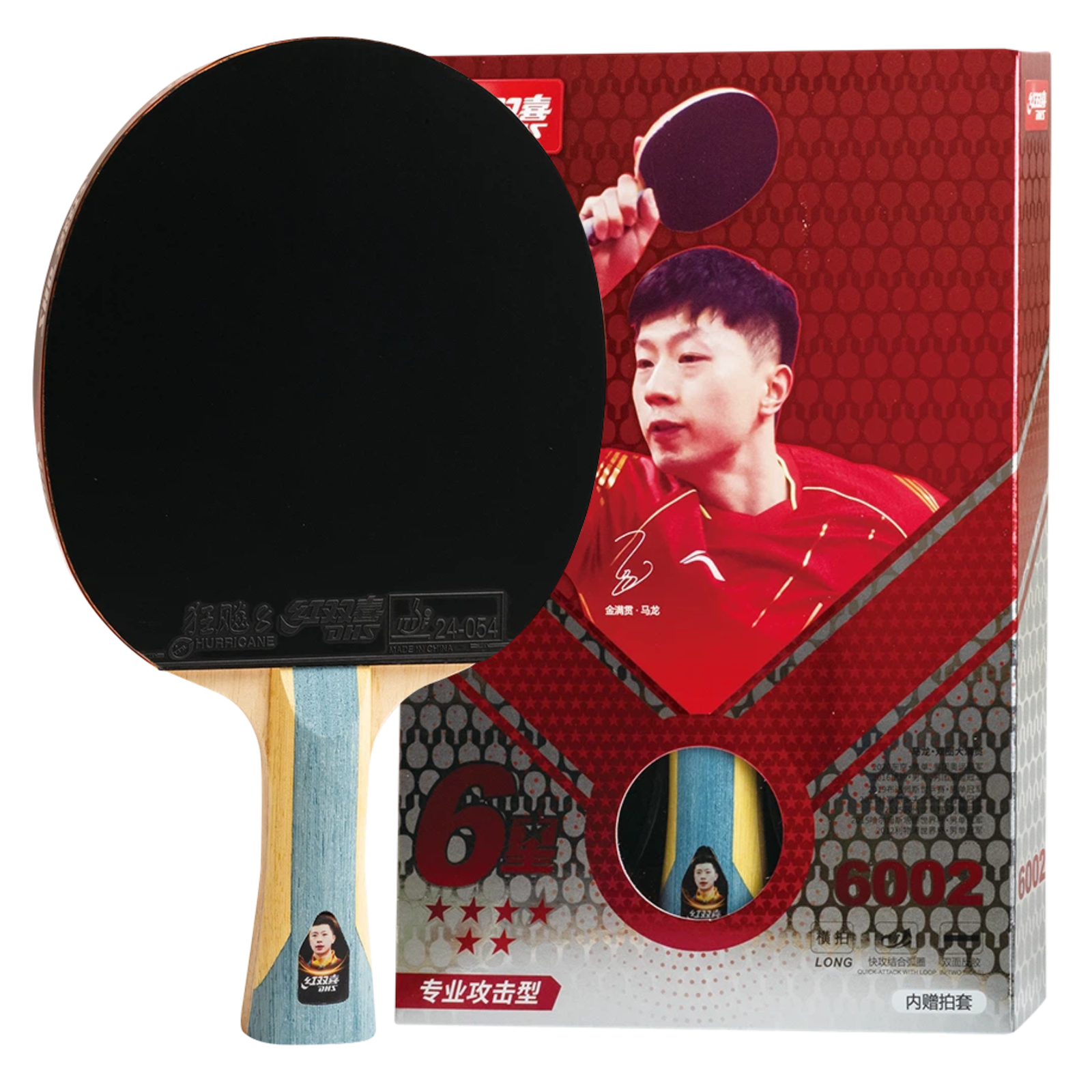
DHS H6002 (6-Star)
The Chinese-tradition flagship — a thick-core all-wood blade with Hurricane 8 and Tin Arc, and a dedicated penhold sibling in the same line.
DHS’s own US channel states this bat’s brief in the maker’s terms: the H6002 is designed for advanced players, specifically for offensive play, on a 5-ply wood blade with a thicker core ply and a wider hitting area, with fitted play described as fast-attack with loops or loop-driven fast attacks. There is no composite layer in this blade — the pace is built into the wood layup and the rubbers do the rest. The shakehand version carries Hurricane 8 and Tin Arc, both described by DHS as ITTF approved: the Hurricane 8 retaining the classic tackiness on a high-elastic large-pore sponge, the Tin Arc a semi-tacky, semi-grippy rubber built for speed and spin. For the spin-first Chinese style, this is the card written in that tradition’s own vocabulary.
The penhold line on this card is the most complete in the guide: DHS sells the same 6-Star line as the H6006 penhold model, with its pairing published too — Hurricane 3 with Tin Arc — so a penhold player chooses a stated specification, not a hoped-for variant. The rest of the sheet carries the guide’s strictest sourcing. DHS publishes no speed, spin or control ratings for the H6002; two conflicting retail rating sets circulate and neither is printed — the build notes record them so the omission is a decision, not an oversight. No sponge thickness is published (the large-pore description is a description, not a measurement) and no weight is published; an approximate 185 g figure in circulation is retailer-only.
What we like
- A maker-stated offensive brief on an all-wood, thick-core blade — the deliberate contrast to the composite cards
- Two named tacky rubbers, both described by DHS as ITTF approved
- A dedicated penhold sibling (H6006) with its own published rubber pairing
- Every gap in its record is printed as a gap, not filled in
Worth knowing
- No maker ratings exist — retailer figures for this bat conflict and are not DHS data
- Sponge thickness and weight are both unpublished
- Shakehand and penhold versions carry different forehand rubbers — check the model number (6002 vs 6006)
As an Amazon Associate we earn from qualifying purchases.
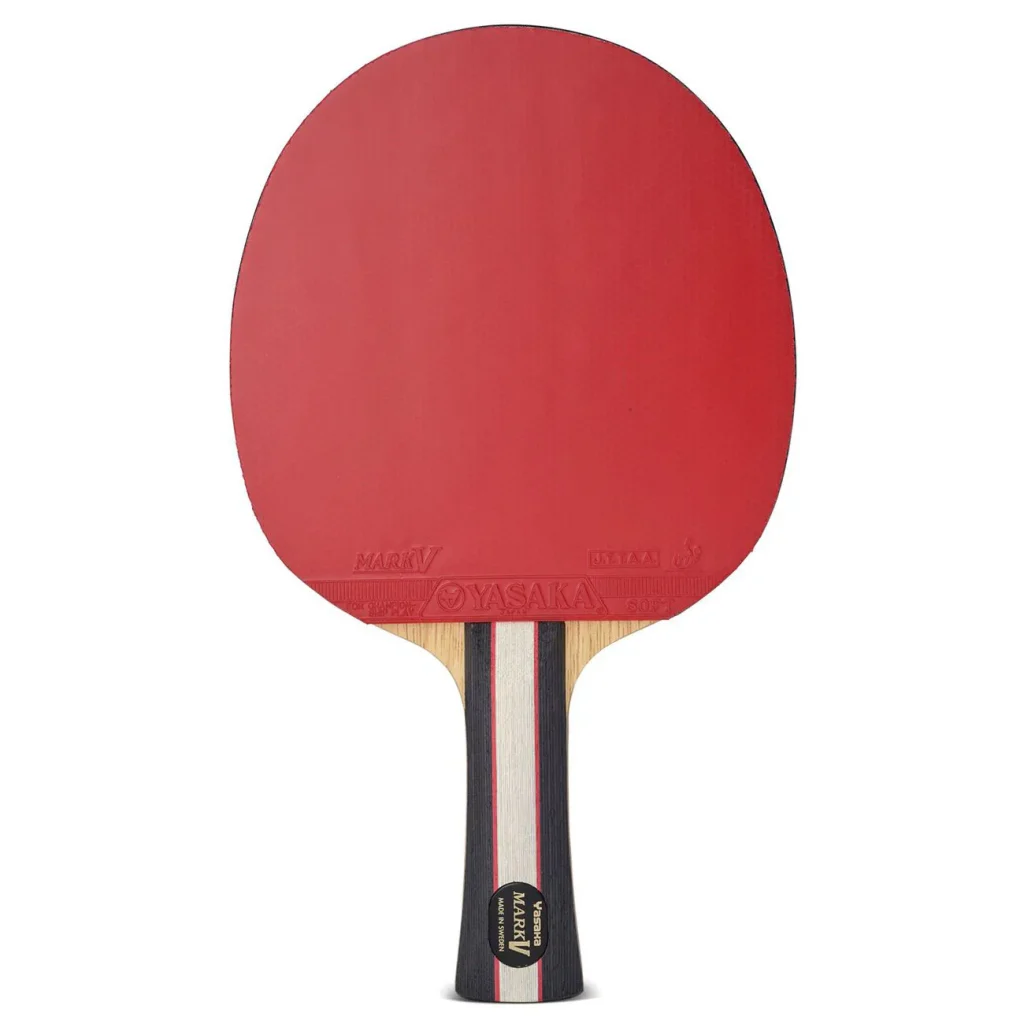
Yasaka Mark V Carbon
The classic, updated with carbon — Mark V rubbers on a Swedish-made competition blade, with the widest published handle choice in the set.
Some specifications are arguments; this one is a lineage. Yasaka’s published line data describes the Mark V Carbon as a complete tournament bat for advanced players: the Mark V rubber — the most established rubber name in the sport — on a Swedish-made competition blade with a carbon layer added for rigidity and power, in the maker’s description. Yasaka’s own figures read Speed 105, Spin 100, Control 65: a published profile tilted to speed and spin, control the stated trade, for an offensive game. Against the tension-era rubbers and woven composites around it, this card’s proposition is continuity — a classic rubber’s published character on a modernised Swedish blade, bought complete. It is the only card of its kind here.
The handle line is this card’s second distinction: the widest published choice in the set — flared, straight, anatomic and penhold — making the Mark V Carbon one of only two cards with a published penhold route. The remaining fields are printed exactly as published, which for this older line means several honest gaps: no ply count for the carbon blade, no sponge thickness for this model — the 2.0 mm figure attached to the standard, non-carbon Mark V bat belongs to that different model and is not transferred here — no ITTF status, and no weight. Read the card on what is published: a named classic rubber, a named blade origin, the maker’s own three figures and four handle shapes — a verifiable brief, thinner than the flagships above it and labelled as such rather than padded.
What we like
- The classic Mark V brief, published by Yasaka with its own figures (105 / 100 / 65)
- A Swedish competition blade with a carbon layer — a distinct construction story
- Four published handle options, including penhold — the widest choice here
- A complete tournament bat for players loyal to the traditional rubber character
Worth knowing
- Ply count, sponge thickness, ITTF status and weight are all unpublished for this model
- Do not transfer the standard Mark V bat’s 2.0 mm figure to the Carbon — a different model
- Its published sheet is thinner than the flagship cards — priced into its ranking
As an Amazon Associate we earn from qualifying purchases.
Side-by-Side Comparison Table
| Model | Best For | Blade (as maker states it) | Rubber / Sponge | Maker Ratings (own scale) | ITTF (as maker states it) |
|---|---|---|---|---|---|
| Killerspin Diamond TC RTG Premium | Best overall | 7-ply — 5 plywood + 2 Titanium Carbon | Fortissimo / not published | 10 · 9 · 6 (Killerspin /10) | Approved |
| Butterfly Timo Boll ALC Pro-Line | Best pro setup, assembled | 5-ply wood + 2 Arylate/Carbon (ALC) | Tenergy 05 / 2.1 mm | Blade 11.8 · 10.3; Rubber 83 · 76 · 79 (Butterfly) | Approved |
| JOOLA Infinity Z Carbon | Best published figures | 7-ply — 5 wood + 2 Zyramid Carbon | Micron X / not published | 130 · 128 · 116 (JOOLA) | Rubber approved |
| Cornilleau Excell 3000 Carbon | Best OFF+ pre-made | 5-plywood, carbon insert, OFF+ | Performa 2 / 2.0 mm | 10 · 10 · 5 (Cornilleau /10) | Rubber approved |
| Donic Carbotec 7000 | Best full-carbon build | 100% carbon, one-piece, Attack+ | Liga-QRC / 2.3 mm | 120 · 120 · 60 (Donic) | Not published |
| DHS H6002 (6-Star) | Best looping bat | 5-ply wood, thicker core | Hurricane 8 / Tin Arc · not published | None published | Rubbers approved |
| Yasaka Mark V Carbon | Best classic / penhold option | Swedish blade, carbon layer | Mark V / not published | 105 · 100 · 65 (Yasaka) | Not published |
Read the table the way the guide is built. The blade column is the real comparison — an all-wood thick-core build, four distinct wood-and-composite recipes, one full-carbon one-piece and one carbon-layered Swedish blade — because construction is the language the makers share even when their numbers are not. The ratings column is seven separate catalogues, not a league table. The ITTF column splits exactly as the makers state it: approved, approved for the rubbers, or not published. And the sponge column shows the rung’s honesty test — three published thicknesses (2.0, 2.1 and 2.3 mm) and four cards where the maker publishes none and this guide invents none.
Buying Guide: Reading the Top Rung Like a Maker
1. Decide first whether you are still a pre-made player
Before comparing any two cards, answer the question this page is organised around. Stay pre-made if a maker’s finished pairing matches your game — six of the seven cards are exactly that, and the seventh, Butterfly’s Pro-Line, is the maker’s own assembly of a professional pairing. Go custom when your game has become specific in a way no fixed pairing fits — different rubbers or thicknesses per wing, a blade class no pre-made line offers, a penhold build with a specialised backhand. That decision belongs to the blades and rubbers guides linked above; this guide shows the strongest complete bats on this side of the line, and makes the line itself visible.
2. Choose the blade build before the brand
The constructions in this set answer different games. All-wood, represented by the DHS thick-core 5-ply, builds its pace in the layup and pairs naturally with the tacky-rubber looping game. Wood-and-composite — titanium carbon, Zyramid Carbon, Arylate/Carbon, a carbon insert, a carbon layer — stiffens a wood core in five different maker recipes; choose among them by the rest of the sheet (rubber, handle, approval), not by the fibre’s name. Full carbon, Donic’s one-piece Carbotec, is the outlier brief: harder and more twist-resistant than wood in Donic’s description, with weather resistance in the design. There is no construction hierarchy here — only a match between a build and a game, made on published facts.
3. Read rubber type first, thickness second — and respect a missing figure
At this rung the rubber’s type is the bigger decision than its thickness: tacky Chinese rubbers (Hurricane 8, Tin Arc) for the brushing loop game, grippy tension-style rubbers (Tenergy 05, Micron X, Fortissimo, Performa 2, Liga-QRC) for the European and American attacking games, and Mark V for the classic character. Thickness then refines it — where it is published at all. The published range here runs 2.0 to 2.3 mm, and four makers publish no thickness for their carded bats. Treat a missing figure correctly: it is a fact about the maker’s spec sheet, not a gap for a retailer to fill. If a listing attaches a sponge figure the maker does not publish — or transfers one from a sibling model, as happens with the standard Mark V bat’s 2.0 mm — that figure is the retailer’s, and it should not drive your decision.
4. Handles: shakehand is the default, penhold is a shortlist of two
Shakehand players are served by every card, in flared or concave naming for the same family of shapes — with two variations worth choosing deliberately: Killerspin’s straight-handle Diamond TC for quick transitions between wings, and the anatomic versions Butterfly and Donic list. Penhold players should work from the published record, not from hope: exactly two cards publish a penhold route — DHS’s dedicated H6006, with its own stated pairing, and Yasaka’s Mark V Carbon. The other five makers publish no penhold variant of their carded models. A penhold player who falls for one of those five is starting the custom conversation, and should have it on the blades page instead.
5. Ratings inside their scale, ITTF per model, versions always
Close every shortlist with the three checks this guide applies to itself. Ratings: place each bat inside its own maker’s range and never average across brands. ITTF: if you play sanctioned competition, the approval line is a filter, not a footnote — five cards state approval for the bat or its rubbers, and two (Donic, Yasaka) publish none. Versions: the Diamond TC’s current maker figures supersede its older listings, the Excell 3000 is not the 2000, the H6002 is not the H6006, the Pro-Line is not the bare blade, and the Mark V Carbon is not the standard Mark V bat. At the advanced rung, the version is the specification — confirm the full model name on the listing against the card before you pay.
Frequently Asked Questions
When should an advanced player stop buying pre-made bats and build a custom setup?
When a fixed pairing stops fitting a specific game. A pre-made advanced bat is a maker’s finished judgement — blade recipe, rubber pairing and sponge chosen together, arriving ready to play, as six of the seven cards in this guide are. A custom setup separates that judgement into a blade chosen for its construction and two rubbers chosen for their type and thickness. Players usually cross the line when they need different rubbers or thicknesses on each wing, a blade class no pre-made line offers, or a specialised penhold build. The Butterfly Pro-Line card shows the border from the pre-made side: a professional combination Butterfly itself sells assembled, whose rubbers are designed to be replaceable when they wear. The component decisions themselves belong to the blades and rubbers guides, not this page.
Why can’t I compare the speed, spin and control ratings between these brands?
Because each maker publishes its figures on its own scale, for its own catalogue. Killerspin rates the Diamond TC at Speed 10, Spin 9 and Control 6 out of 10; Cornilleau rates the Excell 3000 Carbon at 10, 10 and 5 out of 10 on a different system; Donic publishes 120, 120 and 60 for the Carbotec 7000; JOOLA publishes 130, 128 and 116 for the Infinity Z Carbon; Yasaka publishes 105, 100 and 65 for the Mark V Carbon; and Butterfly rates its Pro-Line blade and rubber on two separate property systems of its own. Each set of figures places its bat inside its own maker’s range and nowhere else. DHS publishes no ratings for the H6002 at all — the figures attached to it in retail listings conflict with each other and are not DHS data.
Which of these advanced bats come in a penhold version?
Two of the seven publish one. DHS sells the 6-Star line in a dedicated penhold model, the H6006, with its own published rubber pairing of Hurricane 3 and Tin Arc, alongside the shakehand H6002 carded here. Yasaka’s listing for the Mark V Carbon includes penhold among the bat’s handle options, alongside flared, straight and anatomic. The other five makers publish no penhold variant of their carded models in the listings checked at build time — the Killerspin Diamond TC offers flared and straight shakehand handles, the Butterfly Pro-Line flared and anatomic, and the JOOLA, Cornilleau and Donic cards are shakehand-only as published. Penhold players should shortlist the two published routes or build deliberately through a custom blade.
What sponge thicknesses do these advanced bats publish?
Three of the seven makers publish a figure. Butterfly states 2.1 mm for the Tenergy 05 fitted to the Timo Boll ALC Pro-Line; Cornilleau states 2.0 mm of Dynacell sponge for the Excell 3000 Carbon; and Donic states 2.3 mm for the Carbotec 7000’s Liga-QRC — the thickest published sponge in the set. Killerspin, JOOLA, DHS and Yasaka publish no sponge thickness for the Diamond TC, the Infinity Z Carbon, the H6002 or the Mark V Carbon, and their cards print the field as not published. Where DHS describes the Hurricane 8’s sponge as a high-elastic large-pore sponge, that is a maker’s description, not a measurement, and no thickness should be inferred from it.
Which of these bats state ITTF approval?
Five of the seven, as their makers state it. Killerspin states the Diamond TC paddle is ITTF-approved; Butterfly lists the Timo Boll ALC Pro-Line as ITTF Approved; JOOLA describes the Infinity Z Carbon’s Micron X rubber as ITTF-approved; Cornilleau lists the Excell 3000 Carbon’s Performa 2 rubber as ITTF Approved; and DHS describes both of the H6002’s rubbers, Hurricane 8 and Tin Arc, as ITTF approved. Donic states no ITTF status for the Carbotec 7000 and Yasaka states none for the Mark V Carbon in the published data checked — their cards print not published, which describes the spec sheet rather than judging the bat. If you play sanctioned competition, check that line on the card first.
Should an advanced player choose an all-wood, a composite or a full-carbon blade?
The makers in this guide publish all three philosophies, and the choice is a match to your game rather than a hierarchy. The all-wood build — DHS’s 5-ply blade with a thicker core ply — builds its pace into the wood layup and pairs with the tacky-rubber looping game. The wood-and-composite builds stiffen a wood core with a named fibre, each in its maker’s own recipe: Titanium Carbon from Killerspin, Zyramid Carbon from JOOLA, Arylate/Carbon from Butterfly, a Carbon Technology insert from Cornilleau and a carbon layer in Yasaka’s Swedish blade. The full-carbon build is Donic’s alone — a 100 percent carbon, one-piece Carbotec blade that Donic describes as harder and more twist-resistant than traditional wood bats. Choose by construction and the rest of the published sheet — rubber, handle and approval — not by material fashion.
How does this guide differ from the beginners, intermediate and generic bat guides?
Each guide on this site owns one rung. The beginners guide owns first-bat selection, the intermediate guide owns the step-up from a beginner pre-made to a faster class, and the generic best table tennis bats guide owns all-player selection across every level. This guide owns the top rung only: complete advanced bats compared on blade construction, rubber type and published thickness, handle shapes including the penhold routes, and the decision about when to leave pre-made bats for a custom setup. No model from those guides is re-carded here — the Cornilleau Excell 3000, for example, is the top model of the line whose Excell 2000 is carded for intermediates, and the two are different bats. The blades and rubbers guides own the component decisions for the custom path this page points to.
The Verdict
At the top rung, buy the construction — not the catalogue number. The Killerspin Diamond TC RTG Premium is the complete pre-made flagship: a published titanium-carbon recipe, a published weight, and its maker’s top speed figure. The Butterfly Timo Boll ALC Pro-Line is the bridge — a professional combination its maker sells assembled, and the honest first step toward custom. The JOOLA Infinity Z Carbon is JOOLA’s own top pre-assembled brief, the Cornilleau Excell 3000 Carbon the plainly stated OFF+ reference, and the Donic Carbotec 7000 the full-carbon outlier with the thickest published sponge here. The DHS H6002 owns the tacky-rubber looping game and one of the two penhold routes; the Yasaka Mark V Carbon keeps the classic alive, with the other. Seven complete bats, three blade philosophies, and one clearly marked door — every specification printed as its maker states it, and every rating left inside its own scale.
Affiliate disclosure: AliShuttler is a participant in the Amazon Services LLC Associates Program. Links marked “Check Price on Amazon” are affiliate links — if you buy through them, we may earn a commission at no additional cost to you. Every specification in this guide is taken from the manufacturer’s own published listings, checked at build time in 2026; blade constructions, rubbers, sponge thicknesses and ratings are printed exactly as their makers state them, each rating in its own maker’s scale.