The intermediate player’s bat decision is a specifications decision. It arrives at a specific moment: the beginner pre-made that taught you the strokes now caps them, and the step up is a faster blade class, a named rubber on a published sponge, and a handle built for a full shakehand game. This guide compares seven step-up bats on exactly what their makers publish — blade compositions and speed classes in the makers’ own terms, rubber names and sponge thicknesses, handle styles, ITTF status as each maker states it, and each maker’s own rating figures in that maker’s own scale. Just the spec sheets, read properly.
⚡ TL;DR — The Short Answer
For the best all-round step-up, buy the JOOLA Infinity Overdrive — a 7-ply Kevlar-carbon blade with Micron 48 rubbers and the strongest figures in JOOLA’s own rating system. The Butterfly Ovtcharov Expert is the European-feel pick: a 5-ply wood blade Butterfly describes as medium-hard and offensive, with 2.0 mm Lagnus. The STIGA Pro Carbon (US version) is the only bat here whose maker publishes a weight — 159 grams. The Cornilleau Excell 2000 Carbon is the OFF-class carbon step-up, the Donic Schildkröt Waldner 1000 the adjustable-balance option, the DHS 4002 the tacky-rubber looping bat, and the Killerspin JET600 SPIN N2 the control-first choice on Killerspin’s own scale.
Quick Picks — Best Table Tennis Bats for Intermediate Players at a Glance
7-ply with Kevlar-carbon layers and Micron 48 rubbers — the top of JOOLA’s own rating scale.
5-ply wood, medium-hard and offensive in Butterfly’s terms, with 2.0 mm Lagnus both sides.
The only maker-published weight in the set: 159 g, on a balsa-and-carbon 7-ply blade.
OFF/OFF+ in Cornilleau’s terms, with a carbon insert and 2.0 mm Dynacell sponge.
ABP lets you shift the balance point; 2.1 mm Easy Slick on a carbon-layered 5-ply.
7-ply pure wood with tacky Hurricane 3 and G888 — the Chinese-rubber step-up.
Control leads Killerspin’s own ratings for the N2, on a 5-ply wood blade.
In This Guide
The Step-Up Decision: Outgrowing the Beginner Pre-Made
Every equipment ladder has a middle rung, and table tennis players usually meet it the same way: the beginner bat that made the strokes possible starts making them smaller. Drives that used to land start sailing or dying; the loop that works in practice will not hold against a heavier ball; the rubbers that forgave everything now add nothing. The makers describe that moment in their own vocabulary — blade speed classes that step from all-round to offensive, star ratings that climb, rubber names that replace anonymous fitments — and the seven bats below are the ones whose published sheets answer it: faster blade classes than the beginner rung, named rubbers on stated sponge thicknesses, and shakehand handles built for a full game. This guide compares them on those published terms only.
Read the step-up the way the makers structure it. Blade class first: the set runs from the DHS 4002’s all-round-plus 7-ply wood through Butterfly’s medium-hard offensive 5-ply and Cornilleau’s OFF/OFF+ rating to JOOLA’s Kevlar-carbon 7-ply — a ladder of pace classes, each stated in its maker’s own terms. Rubber second: six of the seven publish a sponge thickness (2.0 mm, with the Waldner 1000 at 2.1 mm), and one — JOOLA’s Micron 48 — publishes none, which its card states rather than fills in. Everything else exactly as published: ITTF status where the maker states it and “not published” where it does not, ratings inside each maker’s own scale, and weights only where a maker or a labelled measurement provides one. Where sources disagreed at build time, this file’s header notes record it.
One boundary before the picks. This page owns the intermediate step-up only. First-bat selection belongs to our guide to the best table tennis bats for beginners, the all-player field to our generic guide to the best table tennis bats, and junior selection to our guide to the best table tennis bats for kids — read those for their decisions, and this page for the step-up. None of the models carded in those guides is re-carded here; every card below is a fresh model chosen for this rung. When a bat here eventually becomes the thing you have outgrown, the next step is a custom assembly — and our guide to the best table tennis rubbers is where that decision starts. If you are still building the strokes themselves, our how to play table tennis guide covers the technique these bats are specced to support.
Maker Ratings, Sponge Thickness and Handle Styles
The rating figures in this guide are never compared across brands, because the makers do not publish them on a shared scale. JOOLA rates on a 0–100 system; STIGA US uses its own system; Cornilleau and Killerspin rate out of 10; Donic Schildkröt uses its own system again. A 99 from one maker and a 9 from another are not two points on one line — they are positions inside two different catalogues. So each card prints its maker’s figures with the scale named, and uses them the way they can honestly be used: to place the bat inside its own maker’s range. Two makers publish no ratings for their carded models at all — Butterfly for the Ovtcharov Expert, DHS for the 4002 — and their cards say so, rather than borrowing the normalised numbers retailers attach to those bats. The comparison table below therefore carries a “maker ratings” column that names each system instead of merging the figures.
Sponge thickness is the second language of the step-up, and the makers state it plainly. Six of the seven cards publish 2.0 mm or 2.1 mm sponge — the full-thickness end of pre-made fitments — with the Waldner 1000’s 2.1 mm the thickest here and its maker’s pack describing the thicker sponge in terms of the bat’s own acceleration. The exception is instructive: JOOLA names its rubber Micron 48 and publishes no sponge thickness for the Infinity Overdrive — the “48” is the rubber’s name, not a measurement, and the card prints the field as not published rather than converting a name into a number. Read every thickness in this guide as the maker’s stated figure for that bat’s factory fitment.
Handles: every card here is a shakehand bat, in the two namings the makers use. JOOLA, STIGA, DHS and Killerspin call their shape flared; Butterfly, Cornilleau and Donic Schildkröt call theirs concave — the same shakehand flare under two catalogue words. Penhold players should note what the listings actually publish: no penhold version of any of these seven models is published in the listings checked at build time, and DHS lists the 4002 in its flared version only. The step-up penhold decision is a different page’s work; this guide reports the seven as their makers sell them. One handle is genuinely different in kind: Donic Schildkröt’s ABP handle on the Waldner 1000 lets the player shift the bat’s balance point by adjusting the handle — a maker feature, described in its card in the maker’s terms.
ITTF status is printed per model, exactly as each maker states it — because the set genuinely splits. Butterfly Europa lists the Ovtcharov Expert as ITTF-approved; STIGA’s S5 rubber is ITTF-approved; Cornilleau lists the Excell 2000 Carbon as ITTF-approved; Donic Schildkröt’s maker pack describes the Waldner 1000’s rubber as ITTF-approved; Killerspin’s brand copy states ITTF approval for the JET600’s rubber. JOOLA does not state an ITTF status for the Infinity Overdrive, and DHS does not state one for the 4002 bat — so their cards print “not published,” which is a statement about the spec sheet, not a judgement on the bat. If you play in sanctioned competition, that line on the card is the one to check first.
The 7 Best Table Tennis Bats for Intermediate Players, Compared
Seven bats, one shared brief — a genuine step up from the beginner pre-made, specified by their makers in blade class, rubber and handle. Ratings stay inside each maker’s own scale throughout. Read the card that matches your game first.
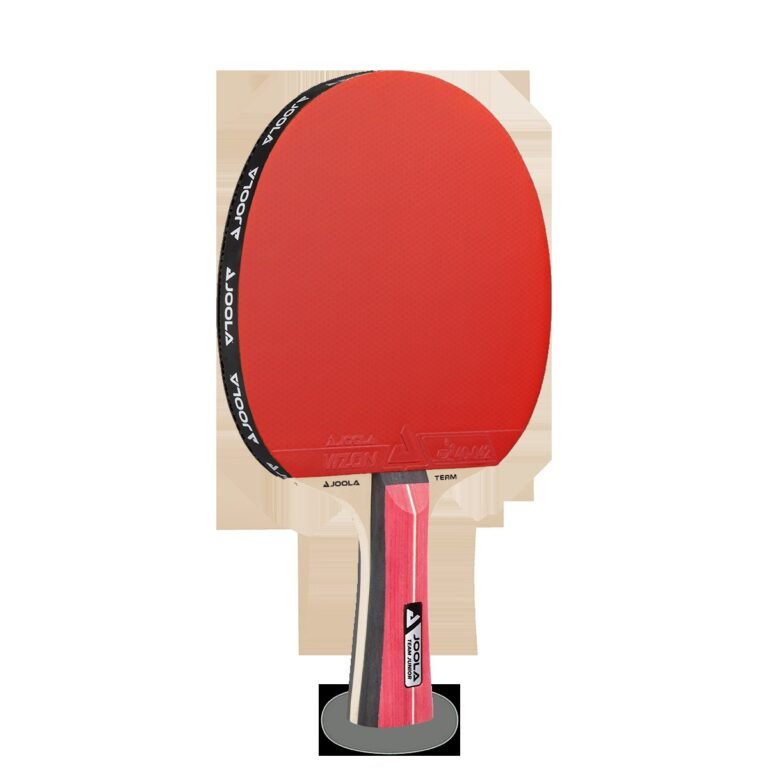
JOOLA Infinity Overdrive
The complete step-up — a 7-ply Kevlar-carbon blade, named performance rubbers, and the strongest figures in JOOLA’s own rating system.
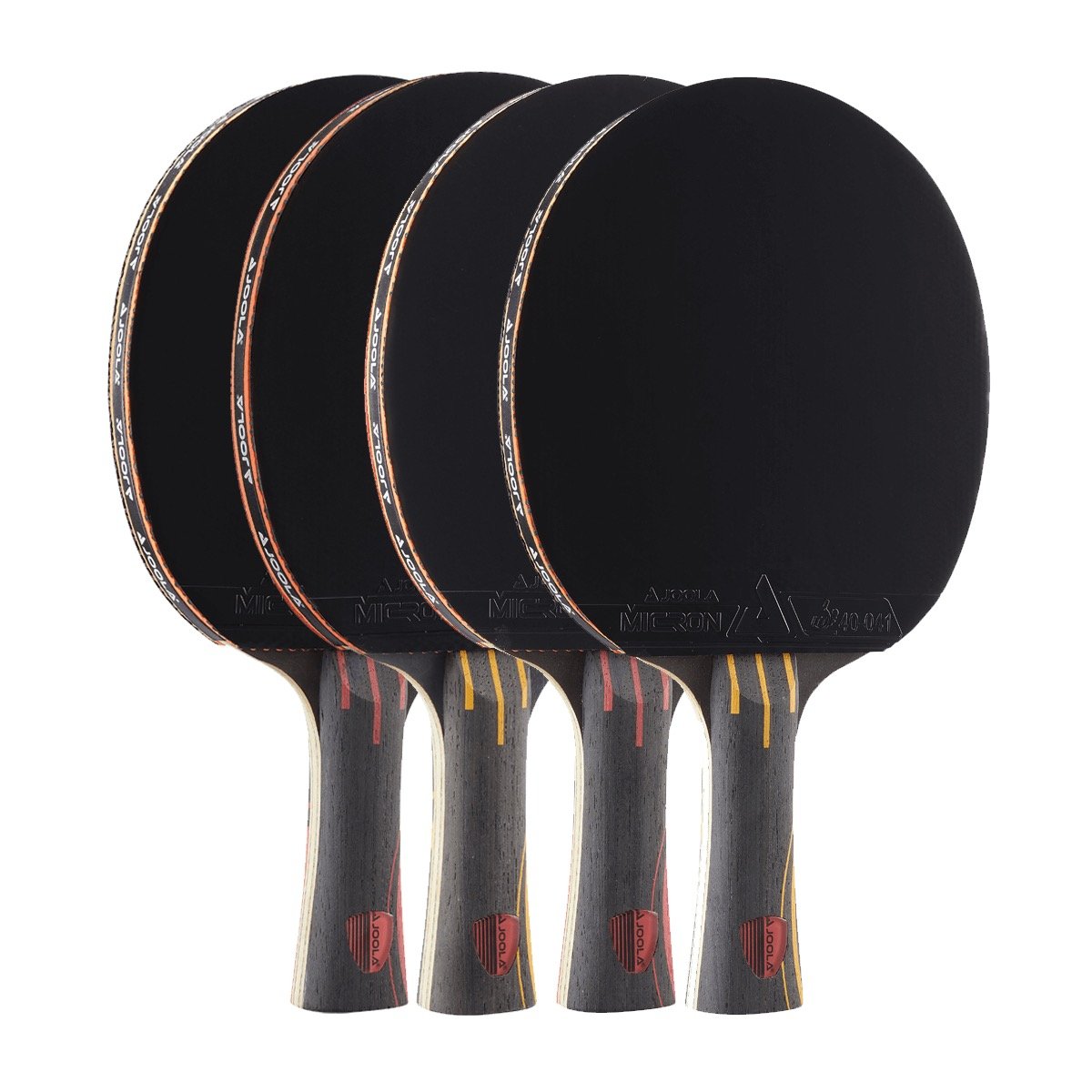
Start with the blade, because JOOLA publishes its full recipe: a 7-ply construction of five wood plies — Hinoki, Koto and Ayous named in the layup — plus two KL-C Kevlar-Carbon layers, at a 6.1 mm blade thickness. That is a composite step-up blade specified ply by ply, and it is why this card leads the guide: most pre-made bats publish a ply count and stop there. JOOLA’s own rating system places the model at the top of its pre-made range — Speed 100, Spin 99, Control 92 on JOOLA’s 0–100 scale — figures that mean what they can honestly mean: inside JOOLA’s catalogue, this is the Overdrive’s published position, the fastest brief the maker sells in this line. The rubbers are JOOLA’s Micron 48 on both sides.
Two fields are printed as gaps because JOOLA leaves them as gaps. The sponge thickness is not published — “48” is the rubber’s name, not a thickness, and this card will not convert a name into a measurement. And JOOLA does not state an ITTF status for this bat, so the card prints “not stated” rather than assuming one: if sanctioned competition is your destination, weigh that line. The handle is flared, and the model is sold in handle and rubber colour variants (red or yellow handles; red/black or black/black rubber combinations) — variants of presentation, not of specification. JOOLA publishes no weight for the bat. None of that dims the core case: the fullest published blade recipe in the set, a named rubber, and its maker’s own top-of-range ratings.
What we like
- The fullest blade recipe here — every ply and composite layer named by the maker
- Top-of-range figures in JOOLA’s own rating system (Speed 100 / Spin 99 / Control 92)
- A named performance rubber (Micron 48) on both sides
- Blade thickness published: 6.1 mm
Worth knowing
- Sponge thickness is not published — “48” is the rubber’s name, not a measurement
- JOOLA states no ITTF status for this bat in its published data
- No maker-published weight
As an Amazon Associate we earn from qualifying purchases.
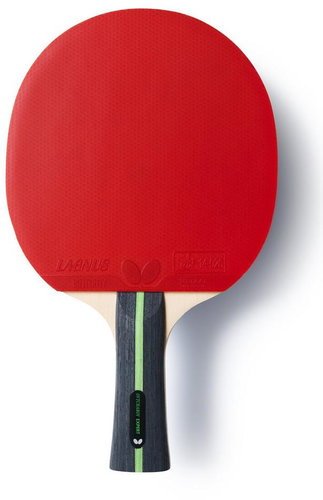
Butterfly Ovtcharov Expert
Butterfly’s named-pro step-up — a 5-ply wood blade the maker describes as medium-hard and offensive, with 2.0 mm Lagnus both sides.
Butterfly’s step-up brief is stated in the maker’s own vocabulary: the Ovtcharov Expert’s 5-ply wood blade is described by Butterfly Europa as medium-hard and offensive — the maker’s class words for a bat built to attack rather than to forgive — fitted with Lagnus rubber at 2.0 mm on both sides and a concave (flared) handle. Butterfly Europa lists the bat as ITTF-approved. It is named for Dimitrij Ovtcharov, and the Expert is the specification that carries the name in the pre-made line: an all-wood offensive blade with a full-thickness named rubber, from the maker whose catalogue defines the European style of the step-up game. For the intermediate player whose strokes are built on European looping and counter-driving, this is the most direct card in the set.
Two absences are printed as absences, and both matter to how you read this card. Butterfly publishes no speed, spin or control ratings for this model — the figures attached to it in some listings are retailers’ numbers, and this guide does not print retailer ratings as maker data, so the card’s ratings line reads “none published” and the bat is compared on its construction instead. Butterfly likewise publishes no weight (a marketplace figure of 180 g circulates; it is not Butterfly’s, and it is not printed). One model distinction: the Expert is not the Ovtcharov Striker, a different bat in the same name family fitted with 1.7 mm sponge — the Expert’s 2.0 mm fitment is part of its brief, so check the model name and SKU on the listing.
What we like
- A maker-stated offensive class on an all-wood 5-ply blade
- Full-thickness named rubber: Lagnus at 2.0 mm both sides
- ITTF-approved, per Butterfly Europa’s own listing
- A named-pro model with a verifiable SKU (6116700002)
Worth knowing
- Butterfly publishes no ratings for this model — retailer figures are not the maker’s
- No maker-published weight
- Not the Ovtcharov Striker (1.7 mm sponge) — check the exact model name
As an Amazon Associate we earn from qualifying purchases.
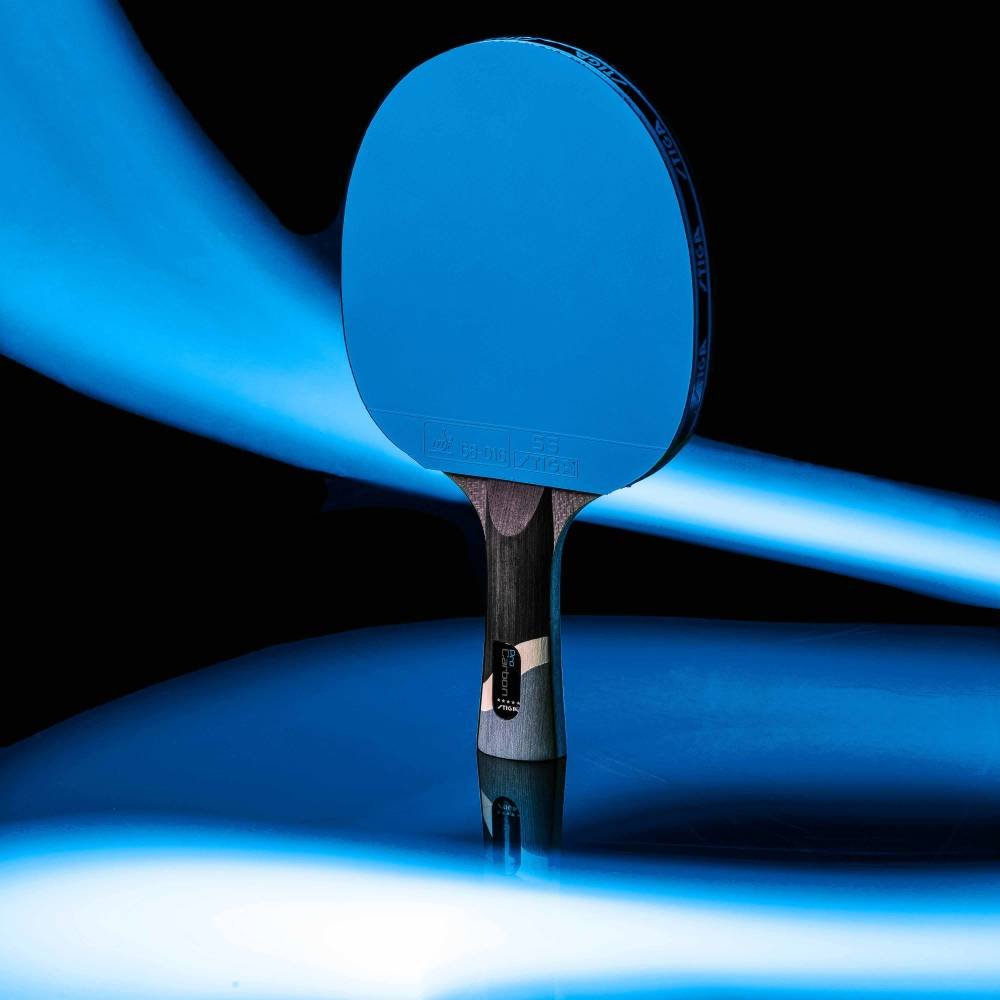
STIGA Pro Carbon (US Version)
The only maker-published weight in the set — 159 grams on a balsa-and-carbon 7-ply blade with STIGA’s WRB and Crystal technologies.
One line on this card exists nowhere else in the guide: a maker-published weight of 159 grams. STIGA US prints it, and that single figure makes the Pro Carbon the most completely specified bat here — a player who cares about the number can plan around a fact instead of a retailer’s estimate. The construction explains how the weight is reached: a 7-ply extra-light blade built from five balsa plies and two carbon layers, carrying STIGA’s WRB and Crystal technologies as the maker names them. The rubber is STIGA’s S5 at 2.0 mm, which STIGA lists as ITTF-approved, on a flared handle. In STIGA US’s own rating system the bat reads Speed 99, Spin 100, Control 80 — its position inside STIGA’s range, printed in STIGA’s scale and no one else’s.
The version warning on this card is absolute, because the same model name covers two different products: this is the US version (model T1290), and it is a different bat from the European Pro Carbon+ 5-star. Their spec sheets must never be mixed — the figures printed here are the US listing’s own, and a listing showing the EU model’s data is selling a different specification under a similar name. Check for the T1290 model reference where a listing provides one. Read on its own terms, the US Pro Carbon’s case is completeness: ply recipe, named technologies, named rubber at a stated thickness, an ITTF-approved rubber, the maker’s own ratings, and the set’s only published weight — the fullest single spec sheet in the guide alongside the JOOLA’s.
What we like
- The only maker-published bat weight in the set: 159 g
- A named ply recipe — balsa and carbon in a 7-ply extra-light build
- ITTF-approved S5 rubber at a stated 2.0 mm
- The maker’s own ratings printed in the maker’s own system
Worth knowing
- US version only (T1290) — the EU Pro Carbon+ is a different product with different specs
- Control is the lowest of its three maker figures (80) — the brief is pace and spin
- Colour variants exist; the specification is the US listing’s
As an Amazon Associate we earn from qualifying purchases.
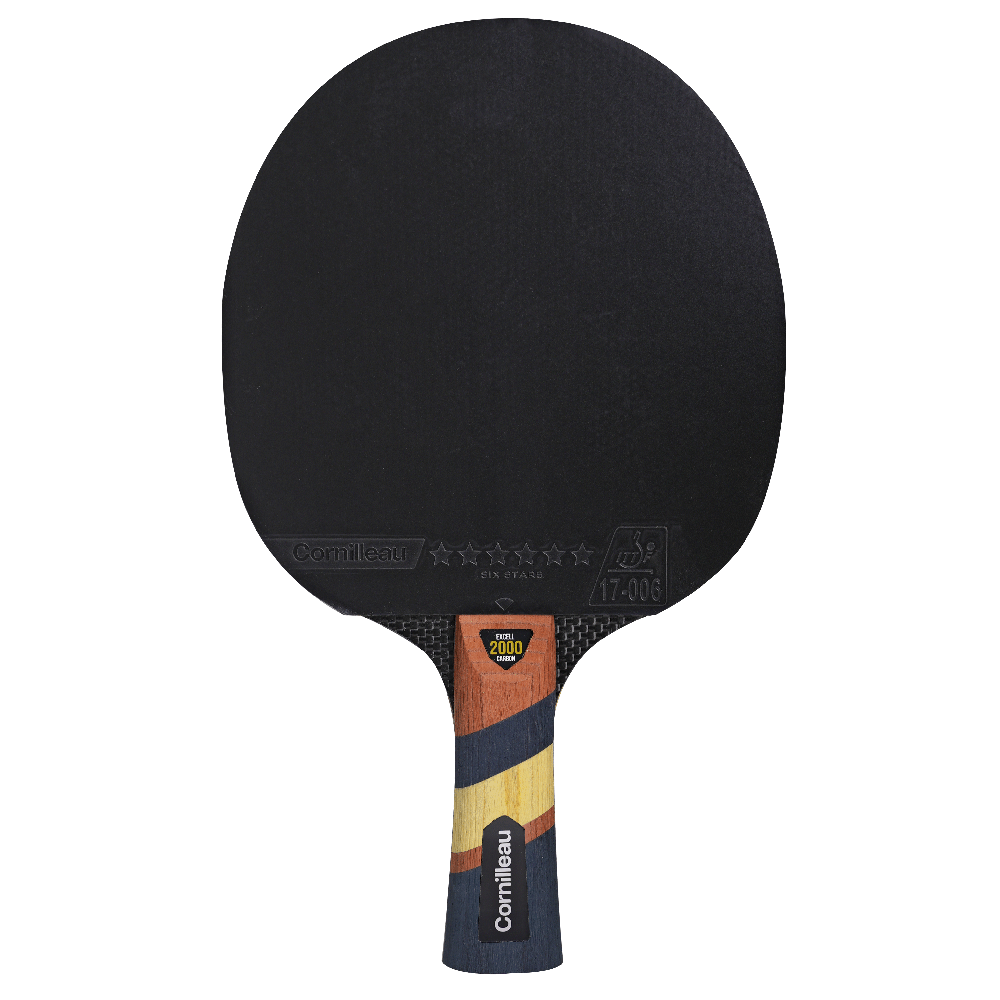
Cornilleau Excell 2000 Carbon
Cornilleau’s OFF-class carbon step-up — a 5-ply blade with a carbon insert, an Aero Soft handle and the maker’s 6-star rubber.
Cornilleau states this bat’s class in the vocabulary the whole sport recognises: the Excell 2000 Carbon’s 5-ply blade is rated OFF/OFF+ in the maker’s terms — the offensive classes — with a Carbon Technology insert in the blade and Cornilleau’s Performa 2 rubber, the maker’s 6-star fitment, on a 2.0 mm Dynacell sponge. Cornilleau lists the bat as ITTF-approved, and its own /10 ratings read Speed 9, Spin 9, Control 6 — a published profile that is honest about its trade: this is the pace-and-spin end of Cornilleau’s pre-made range, and the control figure says so in the maker’s own numbers. For the intermediate player whose game has outgrown all-round classes and who wants the step into a carbon-assisted offensive blade from a maker that states its classes plainly, this is the most direct card in the set.
The handle carries two named Cornilleau designs — the Aero Soft handle concept and Opti Feel, both reported here as the maker’s named features for this concave handle — and the rest of the sheet is printed with the usual discipline: Cornilleau publishes no weight for the model (a 130 g figure in circulation is an outlier and is not printed). The family distinctions matter at the listing: the Excell 2000 Carbon is distinct from the Excell 1000 below it and the Excell 3000 above it in Cornilleau’s line, and the carded specification — carbon insert, Performa 2, 2.0 mm Dynacell — belongs to the 2000. Check the number.
What we like
- A plainly stated offensive class (OFF/OFF+) from the maker
- Carbon insert in a 5-ply blade — the carbon step-up at this rung
- The maker’s top pre-made rubber fitment (Performa 2, 6-star) at 2.0 mm
- ITTF-approved, per Cornilleau’s own data
Worth knowing
- Control is rated 6/10 in Cornilleau’s own system — the trade is stated by the maker
- No maker-published weight
- Two sibling models (Excell 1000 / 3000) bracket it — check the number
As an Amazon Associate we earn from qualifying purchases.
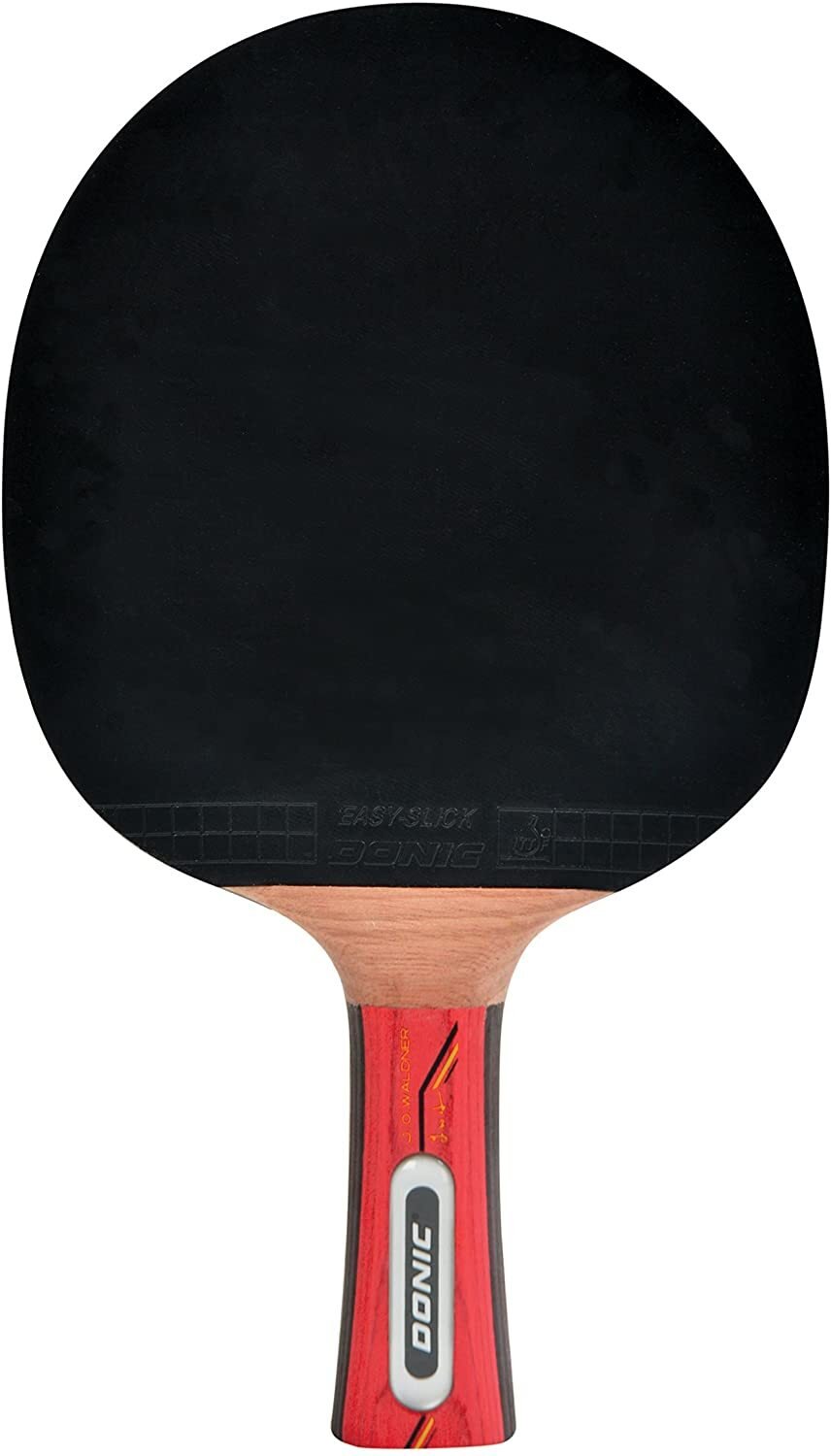
Donic Schildkröt Waldner 1000
The adjustable-balance card — ABP lets you shift the balance point in the handle, over 2.1 mm Easy Slick on a carbon-layered 5-ply.
One feature on this card exists nowhere else in the guide: ABP — an adjustable balance point. Donic Schildkröt’s system lets the player shift the bat’s balance between head-ward and handle-ward settings by adjusting the handle, which the maker’s pack describes as tuning the bat toward power or toward control — maker description, reported as such. Under it sits a specification built for the attacking step-up: a 5-ply blade with two carbon layers, Easy Slick rubber at 2.1 mm — the thickest sponge in this set — and a concave ERGO handle. The maker pack describes the rubber as ITTF-approved, and Donic Schildkröt’s own ratings read Speed 90, Spin 100, Control 60 — the system’s published profile for its Level 1000 bat, printed in its own scale. For the intermediate player who wants to experiment with balance without buying a second bat, this is the only card that offers the experiment.
Three disciplines apply to this card, all printed rather than buried. First, the brand line: Waldner 1000 comes from Donic Schildkröt, Donic’s leisure and pre-made arm — it is not a Donic competition assembly, and the card does not present it as one. Second, the weight: no bat weight is published — the 226–300 gram figures attached to listings are package weights, and this guide does not print a parcel as a bat. Third, the rubber name belongs to the current version: listings for the present model specify Easy Slick; the “Liga” rubber named in older material belongs to the previous version. A reseller’s Spin figure of 110 also circulates against the maker pack’s 100 — the pack figure is the one printed.
What we like
- ABP adjustable balance — unique in this set, and a genuine maker feature
- The thickest sponge here (2.1 mm) on a carbon-layered blade
- The maker’s own ratings give a full published profile (90 / 100 / 60)
- ITTF-approved rubber per the maker pack
Worth knowing
- From Donic’s leisure arm (Donic Schildkröt), not its competition assemblies
- No bat weight is published — listing weights are package weights
- Control is the modest figure in its own system (60) — an attacking brief
As an Amazon Associate we earn from qualifying purchases.
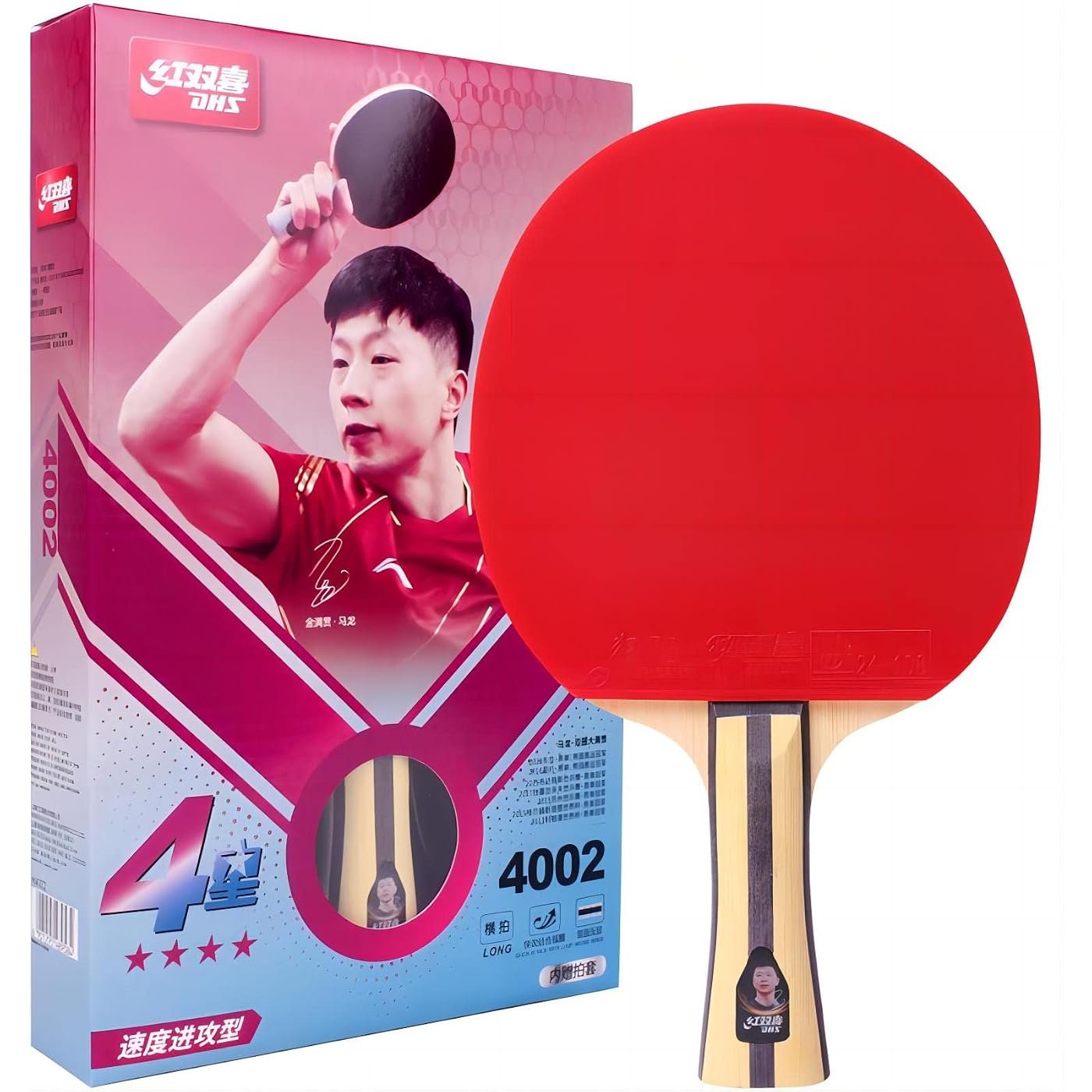
DHS 4002 (4-Star)
The Chinese-rubber step-up — a 7-ply pure-wood blade with tacky Hurricane 3 and G888, built for the loop-and-quick-attack game.
The DHS 4002 is the step-up in the Chinese tradition, and its published recipe is the tradition stated plainly: a 7-ply pure wood blade — no composite layers — classed Allround+ in the maker-derived listing, fitted with two established tacky rubbers, Hurricane 3 on the forehand and G888 on the backhand, both at 2.0 mm. The listing describes the combination’s game in its own terms: loop with quick attack, the topspin-first style those rubbers are built for. For the intermediate player developing a brushing, spin-led forehand — the technique path the European-feel cards do not teach — this is the card written for them, and its all-wood blade is the deliberate contrast to the carbon-assisted cards around it: the pace class is a rung lower, and the rubber does the attacking work.
This card carries the guide’s strictest sourcing, because the 4002’s published record is the thinnest here. DHS publishes no ratings for the bat — the speed/spin/control figures attached to it in some shops are one retailer’s normalised scale, and they are not printed as maker data. DHS likewise does not state an ITTF status for the bat in the listings checked, so the card prints “not stated” (a claim tying approval to a different DHS rubber belongs to a different model and was set aside at build time). The weight is printed as what it is: approximately 195 grams, retailer-measured — a substantial bat by this set’s standards, worth knowing before you choose it. The handle is flared only; no penhold version is published in the listings checked.
What we like
- Two named tacky rubbers (Hurricane 3 / G888) at a stated 2.0 mm
- An all-wood 7-ply blade — the deliberate contrast to the carbon cards
- The loop-and-quick-attack brief is stated in the maker-derived listing itself
- Every gap in its record is printed as a gap, not filled in
Worth knowing
- No maker ratings exist — retailer numbers for this bat are not DHS data
- ITTF status is not stated for the bat in the listings checked
- Approx. 195 g retailer-measured — the heaviest bat here, labelled as measured
As an Amazon Associate we earn from qualifying purchases.
Killerspin JET600 SPIN N2
The control-first step-up — Killerspin’s own ratings put control at the head of this bat’s profile, on a 5-ply wood blade with Nitrx-4Z.
Killerspin publishes this bat’s profile in its own /10 ratings, and the profile is the point: Control 7, Spin 8, Speed 7 — a control-led balance inside Killerspin’s range, on a 5-ply wood blade with the maker’s Nitrx-4Z rubber and a flared handle. Not every step-up needs to be a pace step: the intermediate player whose losses come from unforced errors rather than from a lack of finishing power is this card’s audience, and Killerspin is the maker here that publishes a step-up bat briefed that way. The weight is published in the maker’s listings as 0.362–0.371 lb — approximately 164–168 grams — one of only three weight figures in the guide with a stated source.
Two fields on this card carry an attribution the others do not need, and both are printed with it. The 2.0 mm sponge thickness and the ITTF-approved status of the rubber come from Killerspin’s Amazon brand copy rather than its specification table — maker-published, but in the brand’s store copy, so the card cites the source instead of presenting them as table data. And the version discipline is absolute: this is the current SPIN N2; the earlier N1 version carried different published figures, which are superseded and were not used anywhere in this card. Check for “N2” on the listing — with this model, the version suffix is the specification.
What we like
- A control-led published profile — the step-up for consistency-first players
- A sourced weight range (approx. 164–168 g) from the maker’s own listings
- A named rubber (Nitrx-4Z) on a 5-ply wood blade
- Current-version figures only — the superseded N1 data is excluded
Worth knowing
- Sponge and ITTF figures come from the maker’s brand copy, not its spec table — attributed in the card
- The N1 version’s figures differ and are superseded — check for “N2”
- The most modest pace figures in the set, by its maker’s own design
As an Amazon Associate we earn from qualifying purchases.
Side-by-Side Comparison Table
| Model | Best For | Blade (as maker states it) | Rubber / Sponge | Maker Ratings (own scale) | ITTF (as maker states it) |
|---|---|---|---|---|---|
| JOOLA Infinity Overdrive | Best overall | 7-ply, Kevlar-carbon layers | Micron 48 / not published | 100 · 99 · 92 (JOOLA 0–100) | Not stated |
| Butterfly Ovtcharov Expert | Best European feel | 5-ply wood, offensive | Lagnus / 2.0 mm | None published | Approved (Butterfly Europa) |
| STIGA Pro Carbon (US) | Best published weight | 7-ply balsa + carbon | S5 / 2.0 mm | 99 · 100 · 80 (STIGA US) | S5 approved |
| Cornilleau Excell 2000 Carbon | Best carbon step-up | 5-ply, carbon insert, OFF/OFF+ | Performa 2 / 2.0 mm | 9 · 9 · 6 (Cornilleau /10) | Approved |
| Donic Schildkröt Waldner 1000 | Best adjustable balance | 5-ply, 2 carbon layers, ABP | Easy Slick / 2.1 mm | 90 · 100 · 60 (Donic Schildkröt) | Rubber approved (maker pack) |
| DHS 4002 (4-Star) | Best looping bat | 7-ply pure wood, Allround+ | Hurricane 3 / G888 · 2.0 mm | None published | Not stated |
| Killerspin JET600 SPIN N2 | Best control-first | 5-ply wood | Nitrx-4Z / 2.0 mm (brand copy) | 7 · 8 · 7 (Killerspin /10) | Rubber approved (brand copy) |
Read the ratings column as five separate catalogues, not one league table: JOOLA’s 0–100 figures, STIGA US’s system, Cornilleau’s and Killerspin’s /10 scales and Donic Schildkröt’s system each place their bat inside their own maker’s range, and two makers — Butterfly and DHS — publish no ratings for their models at all, which the table states instead of filling in. The blade column shows the rung’s real spread: two 7-ply composite builds, a carbon-insert 5-ply, a carbon-layered 5-ply with an adjustable handle, and two all-wood blades at opposite pace classes. The ITTF column splits exactly as the makers state it — approved, approved for the rubber, or not stated — and “not stated” is a fact about a spec sheet, not a score. Blade class first, rubber and sponge second, ratings only inside their own scale — the table is the whole guide in one view.
Buying Guide: Matching the Spec Sheet to Your Game
1. Name your step-up: pace class, rubber, or control
The seven cards answer three different versions of outgrowing a beginner bat, and the right purchase starts with naming yours. If the beginner bat feels slow — drives dying, loops lacking carry — the step is a pace class: the OFF/OFF+ Cornilleau, the Kevlar-carbon JOOLA or STIGA’s carbon build. If the strokes are ready for real spin work, the step is the rubber: the DHS 4002’s tacky pair for a brushing loop game, or Butterfly’s Lagnus for the European version of the same idea. And if your losses are unforced errors rather than missing pace, the step is control with better materials — the Killerspin’s control-led profile, or the Waldner 1000’s adjustable balance to experiment with. Buy the step you actually need; the most powerful card is not automatically the right one.
2. Ratings: compare a bat only with its own maker’s range
The single most common mistake at this rung is lining up rating numbers from different brands as if they shared a scale. They do not: JOOLA’s 100, STIGA’s 99, Cornilleau’s 9 and Killerspin’s 7 are positions inside four different catalogues, on three different scales. Use each maker’s figures to place its bat within that maker’s own line — top of JOOLA’s pre-made range, control-led inside Killerspin’s — and compare bats across brands on construction instead: ply recipe, composite layers, rubber name, sponge thickness. Where a maker publishes no ratings (Butterfly, DHS), the construction is the whole comparison, and any rating a retailer attaches to those bats is that retailer’s invention.
3. Sponge thickness: 2.0 mm is this rung’s standard — read the exceptions
Six of the seven cards publish a sponge figure, and the standard is 2.0 mm — the full-thickness fitment of the step-up rung — with the Waldner 1000’s 2.1 mm the thickest and its control figure (60 in its maker’s system) the published price of that direction. The exception to learn from is JOOLA’s: the Infinity Overdrive publishes no sponge thickness, and its rubber’s name — Micron 48 — is not a measurement. If a listing for any bat in this guide states a sponge figure its maker does not publish, treat the figure as the retailer’s, not the bat’s. The makers’ stated thicknesses are the ones printed in the cards.
4. Handles: flared and concave are the same shakehand shape — and penhold is not published here
Four makers call the shakehand shape flared and three call it concave; it is one shape under two catalogue words, so do not let the vocabulary split your shortlist. The one functional difference is Donic Schildkröt’s ABP handle, which adjusts the balance point itself. Penhold players should read the listings as they are: none of these seven models publishes a penhold version in the listings checked, and DHS lists the 4002 as flared only. A penhold step-up is a different shortlist — better chosen deliberately than by assuming a variant exists.
5. Check the exact model — this rung runs on versions
Nearly every card here has a version trap: the STIGA Pro Carbon’s US (T1290) and EU versions are different products under one name; the Killerspin’s N2 supersedes the N1’s figures; the Waldner 1000’s current Easy Slick rubber replaced the previous version’s Liga; the Ovtcharov Expert is not the 1.7 mm Ovtcharov Striker; the Excell 2000 sits between the 1000 and the 3000; and the Cornilleau Perform 900 that some shoppers search for does not exist — the Perform line tops out at the 800. The version is the specification. Confirm the full model name and version on the actual listing before you pay, and match the ply recipe, rubber and sponge in the card against the listing’s own table.
Frequently Asked Questions
How do I know I have outgrown my beginner table tennis bat?
The makers describe the step in classes, and your game usually announces it first: drives and loops that were developing start to feel capped by the equipment — the beginner bat’s all-round blade class and basic rubber fitment stop adding anything to strokes that are now grooved. The published step-up looks like the cards in this guide: a faster blade class in the maker’s terms (an offensive 5-ply, an OFF/OFF+ rating, a carbon-assisted 7-ply), a named rubber on a stated 2.0 mm or 2.1 mm sponge, and a shakehand handle built for the full game. If your errors are still mostly technical, the honest move is the control-led end of this set — the Killerspin JET600 SPIN N2 — rather than the fastest card.
Why can’t I compare speed, spin and control ratings between brands?
Because the makers do not publish them on a shared scale. JOOLA rates the Infinity Overdrive at Speed 100, Spin 99 and Control 92 on its own 0–100 system; STIGA US rates the Pro Carbon 99, 100 and 80 in its system; Cornilleau rates the Excell 2000 Carbon 9, 9 and 6 out of 10; Donic Schildkröt rates the Waldner 1000 at 90, 100 and 60 in its system; and Killerspin rates the JET600 SPIN N2 at Control 7, Spin 8 and Speed 7 out of 10. Each set of figures places its bat inside its own maker’s range and nowhere else. Butterfly and DHS publish no ratings for the models carded here at all — the numbers attached to those bats in some shops are retailers’ figures, not the makers’.
What sponge thickness should an intermediate player choose — 2.0 mm or 2.1 mm?
The makers’ stated standard at this rung is 2.0 mm: the Butterfly Ovtcharov Expert, the STIGA Pro Carbon, the Cornilleau Excell 2000 Carbon, the DHS 4002 and — per Killerspin’s brand copy — the JET600 SPIN N2 all publish it. The one thicker fitment here is the Donic Schildkröt Waldner 1000 at 2.1 mm, and its maker’s own ratings show the direction of the trade, with the system’s highest spin figure (100) alongside its most modest control figure (60). One warning from this guide’s build: a rubber’s name is not a thickness. JOOLA publishes no sponge figure for the Infinity Overdrive — Micron 48 is the rubber’s name — so any thickness attached to that bat in a listing is not JOOLA data.
Do any of these intermediate bats come in a penhold version?
None of the seven publishes one in the listings checked at build time. All seven are shakehand bats — JOOLA, STIGA, DHS and Killerspin use the word flared for the shape, and Butterfly, Cornilleau and Donic Schildkröt use concave, for the same shakehand flare — and DHS lists the 4002 in its flared version only. That is a statement about these models’ published ranges, not about the brands’ wider catalogues. Penhold players stepping up should build a separate shortlist from models whose makers publish a penhold variant, rather than assuming one of these seven exists in that handle.
What does ITTF-approved mean on these bats, and which ones state it?
It means the rubber is on the ITTF’s approved list for sanctioned competition, as stated by the maker for that model — and this set genuinely splits, which is why the cards print it per model. Butterfly Europa lists the Ovtcharov Expert as ITTF-approved; STIGA’s S5 rubber is ITTF-approved; Cornilleau lists the Excell 2000 Carbon as ITTF-approved; Donic Schildkröt’s maker pack describes the Waldner 1000’s rubber as ITTF-approved; and Killerspin’s brand copy states approval for the JET600 SPIN N2’s rubber. JOOLA does not state an ITTF status for the Infinity Overdrive, and DHS does not state one for the 4002 — their cards print “not published,” which describes the spec sheet, not the bat’s quality. Check that line first if you play sanctioned events.
Should an intermediate player choose a carbon blade or an all-wood blade?
Both are carded here because both are genuine step-up paths, and the makers state the constructions plainly. The composite builds — JOOLA’s 7-ply with Kevlar-carbon layers, STIGA’s balsa-and-carbon 7-ply, Cornilleau’s carbon-insert 5-ply and Donic Schildkröt’s 5-ply with two carbon layers — are the pace-class step, each rated in its maker’s offensive terms. The all-wood builds answer differently: Butterfly’s 5-ply is described by its maker as medium-hard and offensive, and the DHS 4002’s 7-ply pure wood is classed Allround+, with its tacky Hurricane 3 and G888 rubbers doing the attacking work. Choose by what your game is missing — a faster blade class, or a rubber-led spin game on a wood blade — and read each maker’s class words rather than the material alone.
What is the difference between this guide and the beginners and all-player bat guides?
The beginners guide owns first-bat selection — the models a new player learns the strokes with — and the generic best table tennis bats guide owns all-player selection across every level. This guide owns the middle rung only: the step-up decision for a progressing club player, comparing faster blade classes, named rubbers on stated sponges and each maker’s own ratings for that specific move. The kids guide owns junior selection separately. No bat from those guides is re-ranked here, and none of this guide’s seven is carded there — read those pages for their decisions, and this page for the step-up.
The Verdict
Buy the specification, not the story. The JOOLA Infinity Overdrive is the complete step-up — a fully published Kevlar-carbon blade recipe and the top figures in JOOLA’s own system. The Butterfly Ovtcharov Expert is the European all-wood offensive pick, the STIGA Pro Carbon the only bat here with a maker-published weight, and the Cornilleau Excell 2000 Carbon the plainly stated OFF-class carbon step-up. The Donic Schildkröt Waldner 1000 offers the adjustable-balance experiment, the DHS 4002 the tacky-rubber looping path on an all-wood blade, and the Killerspin JET600 SPIN N2 the control-first step. Seven bats, three honest decisions — blade class, rubber and sponge, and ratings read only inside their own maker’s scale — every one of them printed as its maker states it.
Affiliate disclosure: AliShuttler is a participant in the Amazon Services LLC Associates Program. Links marked “Check Price on Amazon” are affiliate links — if you buy through them, we may earn a commission at no additional cost to you. Every specification in this guide is taken from the manufacturer’s own published listings, checked at build time in 2026; blade compositions, rubbers, sponge thicknesses and ratings are printed exactly as their makers state them, each rating in its own maker’s scale.