Best Table Tennis Blades: Top Picks by Playing Style
Rubbers wear out in months. A blade is the part of your bat you keep for years — and it decides your speed ceiling, your touch, and how every future rubber will feel. This guide compares seven verified blades by playing style: three all-wood classics and four carbon-composites, with the ply stacks, weights and maker ratings that actually separate them.
⚡ The Short Version
- Best overall: Butterfly Viscaria — the outer-ALC benchmark. Proven at the very top of the game, balanced for two-winged looping, and the blade almost every composite is measured against.
- Best for power looping: DHS Hurricane Long 5 — Ma Long’s inner-ALC design keeps a long, woody dwell for brush looping, then produces serious pace when you drive through the ball.
- Best all-wood power: Stiga Clipper Wood — the 7-ply classic from 1981. Stiff, direct and fast for a blade with no carbon in it.
- Best all-wood all-rounder: Butterfly Petr Korbel — the famous 5-ply feel blade, and the one coaches reach for when a developing looper needs feedback, not forgiveness.
- Best first custom blade: Yasaka Sweden Extra — Swedish-made control and honest vibration feedback at an ALL+ pace your technique can actually grow into.
- Best carbon with wood manners: Donic Waldner Senso Carbon — an all-round wood construction plus two carbon layers and a hollow “Senso” handle that keeps the ball talkative.
- Best modern ALC alternative: JOOLA Vyzaryz Freeze — Limba-outer, outer-ALC construction with low-temperature “cold-cured” bonding, for players who want the Viscaria blueprint with a softer first touch.
Still on a pre-assembled bat? If your current racket came ready-built with rubbers glued on, start with our guide to the best table tennis bats for beginners — it explains when a ready-made bat is the right buy. This blade guide is the next step: your first custom setup, where blade and rubbers are chosen separately. When you get there, our table tennis rubbers guide covers the rubber half of the decision — this page deliberately owns only the blade half.
Why the Blade Is the Decision That Outlives Every Rubber
Think of your bat as two purchases with two very different lifespans. Rubbers are consumables: the topsheet oxidises, the sponge tires, and most regular players replace them within a season or two. A blade is the opposite. Kept dry, stored in a case and protected at the edge, a good blade plays for years — often through four, five, six sets of rubbers. That is why experienced players obsess over the blade and treat rubbers as the adjustable part.
The blade also sets the boundaries everything else works inside. It decides the speed ceiling — how much pace is available when you swing fully — and the feel floor: how much information reaches your hand on soft touches, pushes and blocks. Rubbers can move you around inside those boundaries (a faster rubber on a slower blade is the classic example), but they cannot move the boundaries themselves. A very fast carbon blade with slow rubbers still snaps the ball out on passive blocks in a way a slow blade never will, and a soft all-wood blade will never produce carbon pace no matter how explosive the rubber on it is.
There is a second, practical consequence. Because the blade stays, your hands learn it. Timing, bat angle habits, the sound and vibration of a clean contact — that familiarity is a real part of your game, and it resets every time you change blades. The buying advice that follows from all of this is simple: choose the blade for the player you are becoming, choose rubbers for the player you are today, and then change one thing at a time. It is also why buying a bare blade only makes sense once you are past the pre-assembled stage — if you are not there yet, the beginner bats guide is the honest starting point.
All-Wood vs Carbon-Composite: The Two Families
Almost every serious blade is a sandwich of thin wood veneers, glued and pressed. The two families differ by one ingredient: whether two of those layers are a synthetic composite instead of wood.
All-wood blades are built entirely from veneers — usually five or seven. Wood flexes. On a looping stroke the blade bends a fraction and springs back, holding the ball on the rubber a moment longer (players call this dwell), which is spin-friendly and forgiving of slightly late timing. Wood also transmits vibration honestly: you feel exactly where on the blade face the ball landed. The cost of that character is a lower speed ceiling and a smaller sweet spot — mishits toward the edge lose pace quickly. Five-ply woods (Korbel, Sweden Extra) are the flexible, feel-first end; seven-ply woods (Clipper) add plies for stiffness and recover much of the pace without any composite.
Carbon-composite blades replace two veneers with a woven synthetic layer. Plain carbon is stiff, light and fast but can feel hard and muted, so the dominant modern weave is ALC — Arylate-Carbon — which blends carbon with a softer arylate fibre to add elasticity and damp the harshest vibration. Composites give you three things wood cannot: a higher speed ceiling at the same swing effort, a larger sweet spot (off-centre hits keep more of their pace), and stability when you are blocking or countering close to the table against heavy incoming spin. The trade-off is touch: the ball leaves faster, dwell is shorter, and the short game over the table demands softer hands. Other weaves exist — ZLC (Zylon-Carbon) blades are generally stiffer and more direct again — but all four composites in this guide use ALC or plain carbon, the two constructions most players actually buy.
Neither family is “better”. Professionals overwhelmingly play composites because their technique is grooved enough to handle the pace; developing players often improve faster on wood because the feedback corrects their strokes. The seven picks below are ordered as a map of that landscape, not a league table.
Reading a Blade: Plies, Outer Ply, Core and Thickness
A blade’s specification sheet looks cryptic until you know the four things that matter — and then every stack in this guide reads like a sentence.
1. The ply count and order, read from the face inward. “5+2” means five wood veneers plus two composite layers. The order matters as much as the count. In the Butterfly Viscaria the stack is Koto – ALC – Limba – Kiri – Limba – ALC – Koto: the composite sits directly under the outer ply. Players call this outer ALC, and it plays direct and crisp, because the stiff layer is the first thing the ball’s energy meets. In the DHS Hurricane Long 5 the stack is Limba – Ayous – ALC – Ayous – ALC – Ayous – Limba: the composite is buried as the third layer, with wood on both sides of it. That is inner ALC — the ball first meets soft wood, so dwell and touch feel woody, and the composite only takes over when you swing hard enough to flex the blade deeply. Same ingredient, opposite personalities, decided purely by position.
2. The outer ply (the “face” wood). This is the veneer your rubber is glued to, and it sets the first-touch character. Limba is soft and springy — the classic looping surface (Hurricane Long 5, Korbel, Vyzaryz Freeze). Koto is harder and crisper, pushing the ball out flatter and faster (Viscaria). Two blades with identical insides play noticeably differently just by swapping these two woods.
3. The core. The thick middle veneer is the engine room. Kiri is very light and slightly soft, keeping composite blades like the Viscaria and Freeze down near 85–88g while adding a muted, stable feel. Ayous cores and mid-plies (Clipper, Hurricane Long 5) are springier and livelier. A thick Ayous core is a big part of why the Clipper hits as hard as it does with no composite at all.
4. Thickness. Most modern blades sit between about 5.5mm and 6.0mm. As a rule of thumb, thinner blades flex more (more dwell, more spin feel) and thicker blades flex less (more direct pace and stability in blocks and counters). The Clipper’s roughly 6.6mm is the outlier in this guide — and you can feel exactly why when you block with it.
One habit worth building: when a retailer’s listing shows a full ply stack, read it before you read the marketing sentence. The stack is the one part of the description that cannot be spun.
Speed Classes and Ratings, Decoded Honestly
Every maker sorts blades into classes, slowest to fastest: DEF → ALL− → ALL → ALL+ → OFF− → OFF → OFF+. The class is the most useful single line on the spec sheet — DEF and ALL blades suit control and developing games, OFF blades are the attacking mainstream, and OFF+ is reserved for players whose technique is already consistent at full swing. Most adult improvers belong on ALL+ to OFF−, and most of the regret in blade buying comes from starting one class too high.
The numbers, however, need a warning label. There is no shared standard. Butterfly rates its blades on a Reaction (speed) and Vibration (hardness/feel) scale where the Viscaria scores 11.8/10.3 and the Korbel 10.6/8.2 — a comparison that is genuinely useful inside Butterfly’s range and meaningless outside it. Stiga prints Speed 88 / Control 68 for the Clipper; Yasaka prints Speed 70 / Control 77 for the Sweden Extra; JOOLA prints Speed 101 / Control 93 for the Vyzaryz Freeze on a scale where numbers simply run higher. Donic’s dealers quote yet another set of figures for the Waldner Senso Carbon (Speed 86, Control 70 in one major listing; 8+ and 8+ in Donic’s own short scale). None of these brands is lying — they are just each measuring against their own ruler. Use maker numbers only to compare blades from the same maker, and use the class plus ply stack to compare across brands. That is exactly how the reviews below use them.
Weight and Balance: The Assembled-Bat Maths
Blades in this guide weigh between roughly 85g and 91g bare. That number only becomes real when you finish the maths: add two rubbers (a modern sheet in max sponge thickness typically contributes around 45–50g once cut to the blade) plus glue and edge tape, and a finished bat lands somewhere around 175–195g. As a rough comfort zone, many adult players settle between about 180g and 190g complete; much lighter can feel insubstantial on full swings, much heavier loads the wrist over a long session.
Two practical points matter more than the bare number. First, balance: a blade that carries its weight toward the head (the Korbel, with its larger 158×152mm face, can feel this way with heavy rubbers) loops beautifully but asks more of your wrist on backhand flicks close to the table; a handle-balanced setup feels quicker in the hand. Second, variation: wood is a natural material and individual blades of the same model genuinely differ — makers and major retailers warn that weights can vary by several grams unit to unit. Serious retailers will weigh a blade and pick one near your target if you ask at ordering. For models like the Vyzaryz Freeze, where the maker’s listed weight and reviewer-weighed units have differed noticeably, asking is not fussiness — it is the difference between the bat you planned and a heavier one. Decide your target assembled weight first, work backwards to the blade weight you need, and order to it.
Handles: Flared, Straight, Anatomic (and Penhold)
The same blade is usually sold in several handle shapes, and the choice is about your grip, not your level. Flared (FL) — wider at the base, with a flare that stops the bat sliding in a sweaty hand — is the default for most shakehand players and the safest choice if you are unsure. Straight (ST) keeps a uniform thickness, which suits players who like to adjust their grip between forehand and backhand, and is traditionally favoured by backhand-oriented players and twiddlers. Anatomic (AN) is sculpted with a palm swell in the middle — a middle path that fills the hand more than a straight handle without the flared lock-in. Stiga uses its own names for the same three shapes on the Clipper: Master (flared), Classic (straight) and Winner (anatomic). Most models here also offer a Chinese penhold (CS) version — the Hurricane Long 5 and Viscaria among them — for penhold grip players. Handle thickness also varies a little between brands and models; if you have smaller hands, that detail is worth one line in an email to the retailer before you buy, because no specification sheet headline will mention it.
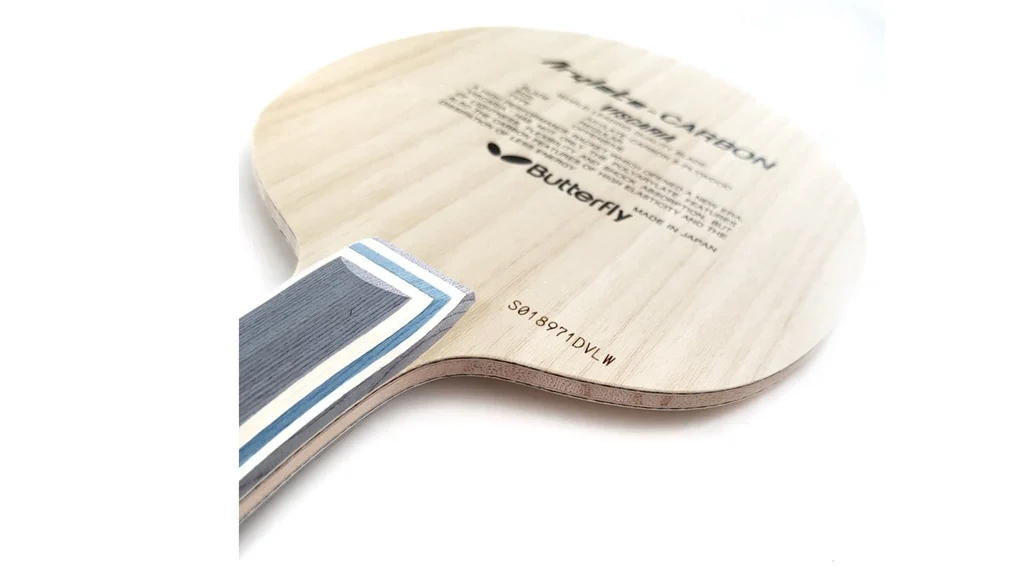
Butterfly Viscaria
The outer-ALC benchmark — Koto over Arylate-Carbon, made in Japan
“The very model Zhang Jike used to win his 2011 world title and 2012 Olympic gold — and still the template the whole composite market copies.”
If you only ever learn one composite construction, learn this one: Koto outer ply, Arylate-Carbon directly beneath it, Limba either side of a Kiri core. That arrangement — composite in the outer position, hard wood on the face — is why the Viscaria feels the way it does: direct and crisp on contact, with a notably large sweet spot for a fast blade, yet with enough of ALC’s arylate softness in the weave to keep blocks and counters from feeling harsh. Butterfly’s own numbers put it at Reaction 11.8 and Vibration 10.3, figures that only mean something next to other Butterfly blades — but inside that family they place it exactly where it plays: fast, and medium-hard rather than hard.
The pedigree is not marketing decoration. This is the model Zhang Jike used for his 2011 World Championship title and 2012 Olympic gold, and its construction went on to become the sport’s default pro template — Butterfly’s own Timo Boll ALC uses the same ply recipe with a different handle and wing shaping, which tells you how settled this formula is. For the club player, the practical translation is balance: it loops with a medium-high arc from mid-distance, drives flat when you close the angle, and stays stable when you are the one absorbing pace. Pair it with modern tension rubbers on both wings — the composition guidance for that is in our rubbers guide — and you have the setup half the sport is calibrated against.
Who should not buy it? A genuine beginner. OFF-class outer-ALC pace punishes half-formed strokes by ending rallies before your technique gets a vote. And it sits in Butterfly’s premium tier, so the budget has to be a deliberate decision, not an impulse. But for an established attacking player choosing one blade to build around for years, this is the reference answer for a reason.
✅ Pros
- The benchmark outer-ALC construction — huge sweet spot for its speed
- Balanced for forehand and backhand looping, close or mid-distance
- Proven at the very highest level; enormous knowledge base of setups
- Build quality and consistency typical of Butterfly’s Japan-made blades
⚠️ Cons
- Premium price tier
- Too fast to learn on — beginners should start with the wood picks below
- A popular model for counterfeits; buy from authorised dealers
Butterfly Viscaria · 5W+2ALC · OFF · ~87g · FL/ST/CS
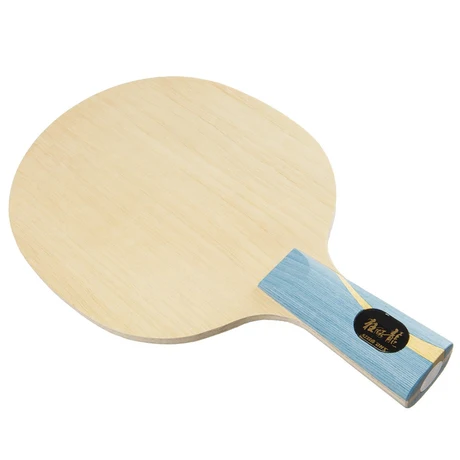
DHS Hurricane Long 5
Ma Long’s blade — inner ALC under a Limba face, built for the forehand loop
“The OFF+ flagship of the Chinese school: wood on the outside, composite buried inside, and the longest dwell of any fast blade here.”
Read this stack against the Viscaria’s and the whole inner/outer debate explains itself. The Hurricane Long 5 — the blade built for Ma Long, whose name it carries — puts Limba on the face, then Ayous, and only then the Arylate-Carbon, as the third layer, either side of an Ayous core (DHS calls the bonding approach its “Pith-Film” technology). On soft and medium contact the ball meets wood, so pushes, serves and opening loops feel woody and hold the ball a fraction longer. Commit to a full-body forehand loop, flex the blade properly, and the buried composite engages — which is where this blade’s famous power comes from. It is an OFF+ blade that asks to be swung, not tapped.
That character makes it the natural partner for the classic Chinese-style setup: a tacky, hard forehand rubber doing the brushing work the Limba face invites. (Which rubbers, and why tacky works here, is exactly the ground our rubbers guide covers — the blade decision is this page’s; we are not going to relitigate rubber selection here.) The backhand side typically wants a more conventional tension rubber to keep the away-from-table game balanced. At around 89g before rubbers it is the heaviest blade in this guide, and with two modern sheets the finished bat sits at the solid end of the comfort range — part of its stability in counter-looping rallies, and a load your wrist should be ready for.
Two honest cautions. First, the passivity tax: half-swings and lazy blocks get little help from the inner construction, so this blade rewards trained, committed strokes and exposes tentative ones. Second, DHS flagships are among the most counterfeited products in the sport — treat implausibly cheap listings as what they usually are, and buy through authorised channels.
✅ Pros
- Inner ALC keeps woody touch in the short game at OFF+ pace
- Exceptional power and arc on full forehand loops
- Limba face pairs naturally with tacky forehand rubbers
- The blade of Ma Long — a proven, constantly refined flagship
⚠️ Cons
- Heaviest pick here; total bat weight needs planning
- Unforgiving of passive, half-committed strokes
- Counterfeits are common — authorised dealers only
DHS Hurricane Long 5 · 5W+2ALC inner · OFF+ · ~89g · FL/ST/CS
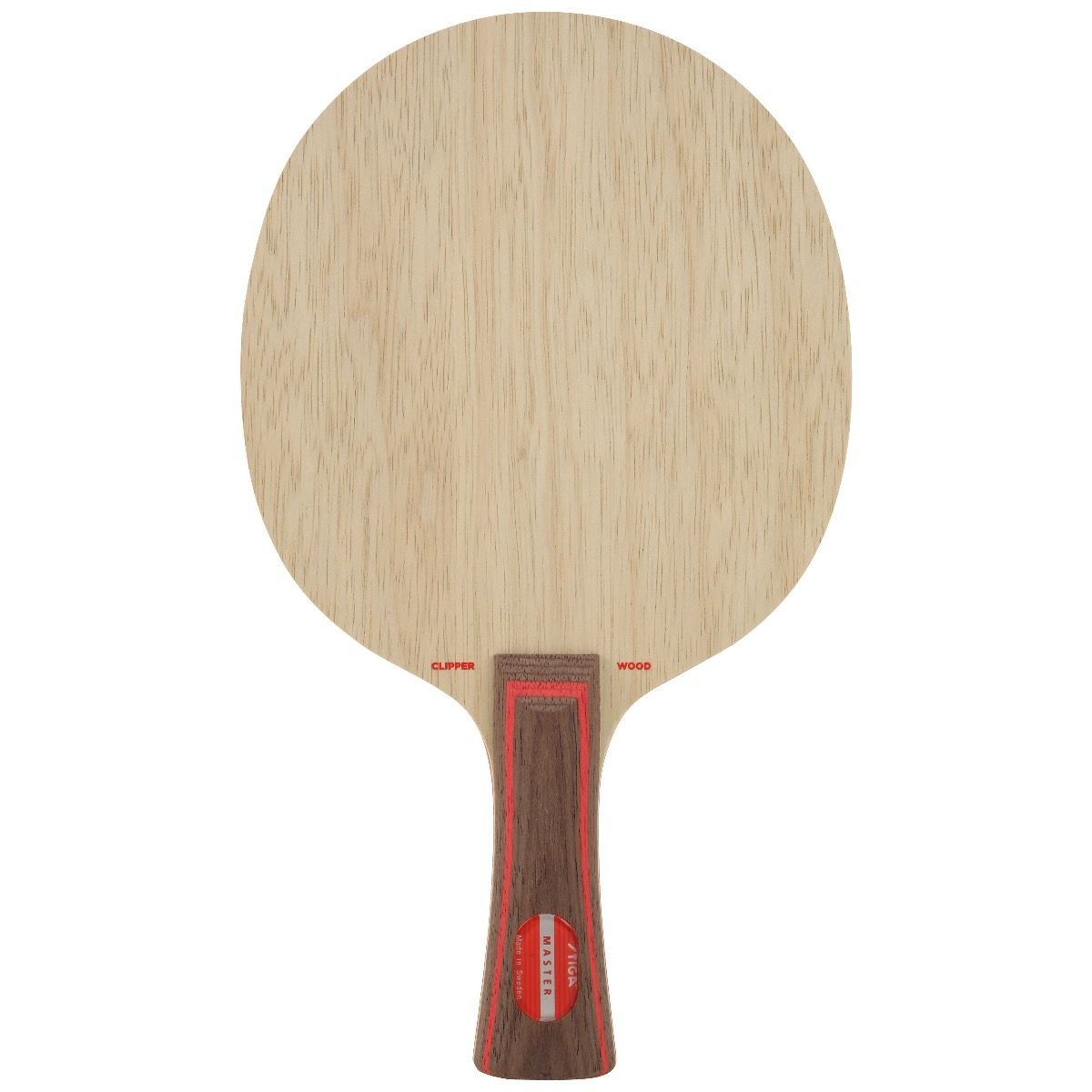
Stiga Clipper Wood
The 7-ply legend — on sale since 1981, and still the fastest way to play with no carbon at all
“Seven plies of Swedish wood, a 6.6mm build, and four decades of attackers — Liu Guoliang’s blade needs no composite to hit hard.”
The Clipper is the answer to a question every wood purist eventually asks: how fast can all-wood get? Stiga’s answer, unchanged in concept since 1981, is to stack seven plies — Limba faces over five Ayous veneers — and build the blade thick, around 6.6mm. The two extra plies and the extra depth remove most of the flex that makes 5-ply woods feel soft, replacing it with stiffness and a direct, driving trajectory. Stiga’s own ratings (Speed 88, Control 68 on its scale) describe a blade for close-to-mid-distance attackers, and the maker says well over a million have been sold — which, over four decades, is less a boast than a census. Liu Guoliang, one of the sport’s defining attackers, played the Clipper in his prime.
In the hand it feels like the missing link between the two families in this guide: composite-class directness on drives, blocks and smashes, with wood’s honest feedback and dwell just about intact on looped balls. It rewards players who take the ball early and drive through it rather than brushing from distance. The weight — Stiga quotes 90g ±5g — and the thick build make it the most substantial-feeling blade here, so smaller or younger players should weigh that, literally, before ordering. Stiga’s handle naming needs one translation the first time you shop for it: Master is flared, Classic is straight, Winner is anatomic, as covered in the handles section above.
Choose the Clipper if your game is built on pace and timing rather than heavy brush spin, or if you simply want attacking speed without giving up the all-wood feel. Spin-first loopers who live on dwell should look at the two 5-ply woods on either side of it in this list instead.
✅ Pros
- Near-composite pace with genuine all-wood feedback
- Superb for driving, blocking and countering close to the table
- Four decades in production; every retailer knows the model
- All three handle shapes, under Stiga’s Master/Classic/Winner names
⚠️ Cons
- Stiff and thick — the least dwell of the all-wood picks
- At ~90g ±5g it builds a heavy finished bat
- Stiga’s handle names confuse first-time buyers
Stiga Clipper Wood · 7-ply wood · OFF · ~90g · Master/Classic/Winner
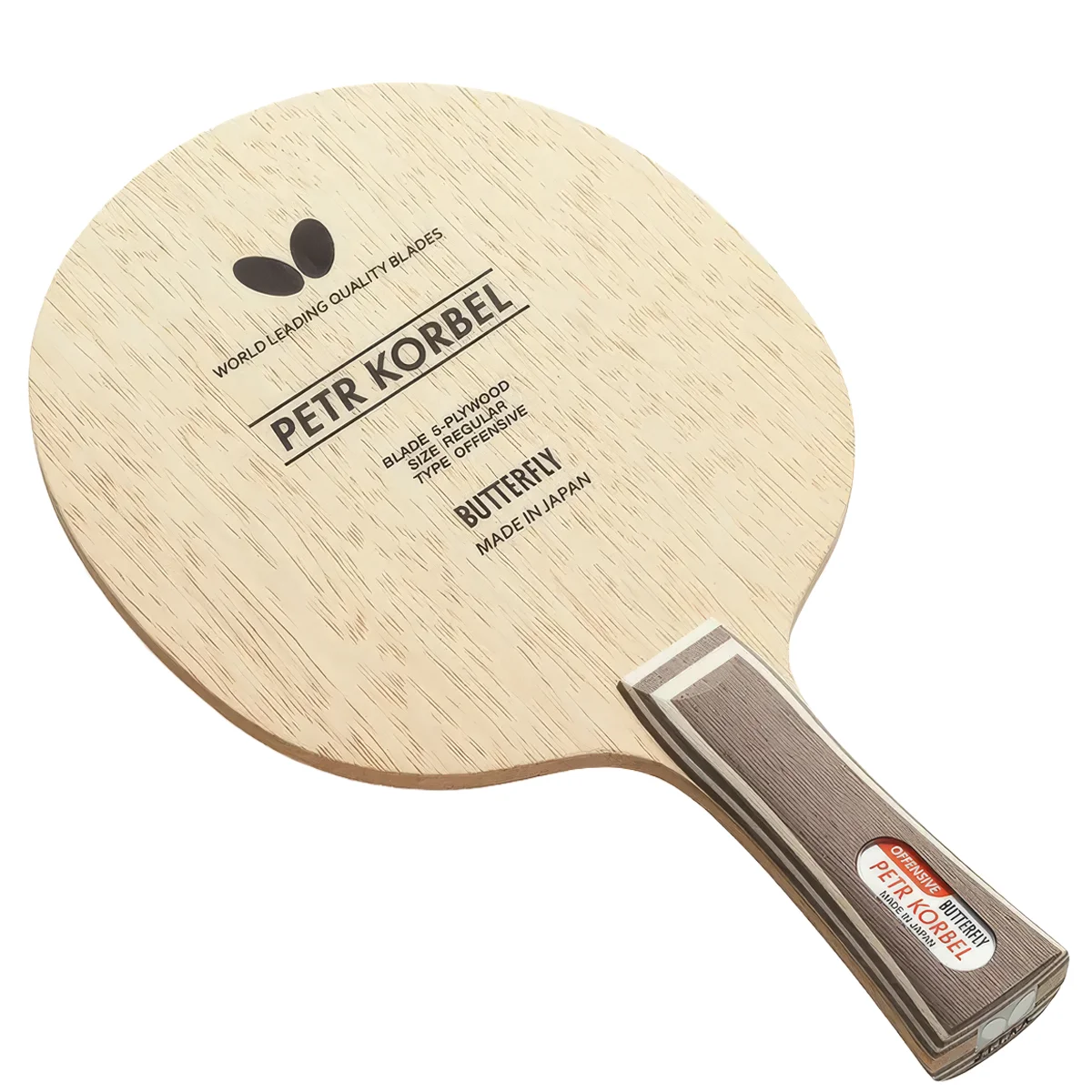
Butterfly Petr Korbel
The classic 5-ply feel blade — Butterfly literally calls it the synonym for the all-wood 5-ply
“Five plies, Limba faces, made in Japan — the blade generations of loopers learned the game on, and many never left.”
Butterfly’s own description of the Korbel is a single claim: this blade is the synonym for the all-wood 5-ply. It earns the title the honest way — Limba outer plies for a soft, spin-friendly first touch, a medium-hard overall feel, and vibration that tells your hand the truth about every contact. Butterfly rates it Reaction 10.6 / Vibration 8.2, a full class of feedback below the Viscaria’s numbers, and that is precisely the point: the Korbel is the blade as a teacher. Mishits buzz, clean loops sing, and your strokes improve because the equipment keeps reporting on them.
As a playing tool it is the archetypal two-winged all-rounder: a 158×152mm head, generous for a blade of its era, that loops comfortably from both sides and blocks with wood’s natural absorption rather than carbon’s rebound. Its one handling quirk follows from that head size — paired with two heavy modern rubbers it can feel a touch head-heavy, which loopers often like and backhand-flick specialists sometimes don’t. That is a balance preference, not a flaw, and it is manageable by choosing your blade weight at ordering (Butterfly lists about 91g; dealer listings run a few grams lighter, which is the usual wood variation). Like all bare Limba-faced blades it deserves a light seal before its first gluing — see the pairing section — to keep the face fibres safe through years of rubber changes.
Pick the Korbel if you are an improving attacker who wants one honest blade to grow with, or an experienced player who has tried composites and misses feeling the ball. It remains the most recommended 5-ply in the sport because it has never stopped deserving to be.
✅ Pros
- Superb feedback — the classic technique-building blade
- Balanced for looping from both wings
- Made in Japan, with Butterfly’s build consistency
- Works with almost any rubber style as your game evolves
⚠️ Cons
- Pace ceiling is a class below the ALC picks
- Can feel slightly head-heavy with two heavy rubbers
- Limba face should be sealed before first gluing
Butterfly Petr Korbel · 5-ply wood · OFF · ~91g · FL/ST
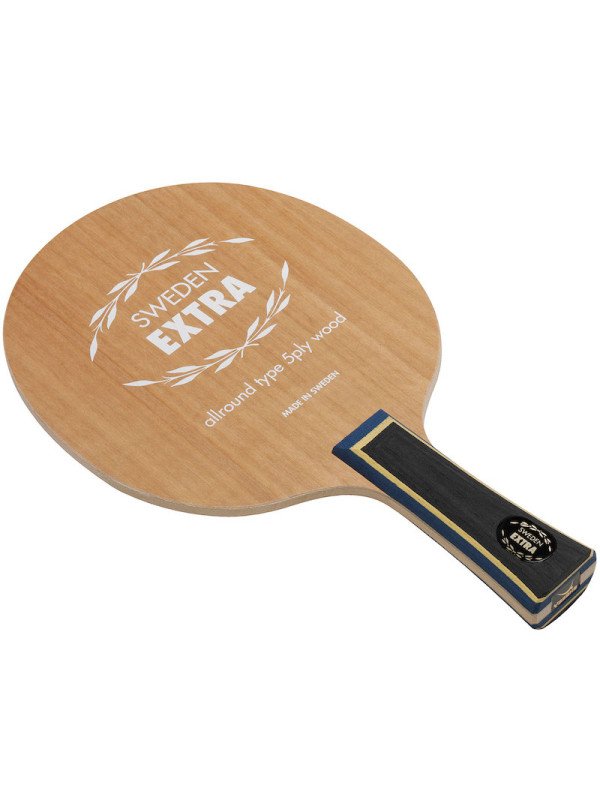
Yasaka Sweden Extra
Swedish-made control classic — the 5-ply coaches hand to players building real technique
“ALL+ pace, high honest vibration, and a pedigree that goes back to a world champion’s blade — the safest first step into custom setups.”
Every equipment guide has a blade it would hand to a friend starting out, and for custom setups this is ours. The Sweden Extra is a traditional Swedish-built 5-ply — the lineage runs back to Yasaka’s Gatien Extra, named for Jean-Philippe Gatien, the French star who won the 1993 World Championship with that class of Swedish wood — reissued under the Sweden name and still made in Sweden. Yasaka rates it Speed 70 / Control 77 on its own scale, an ALL+ profile that tells the story plainly: pace is present but modest, control is the product. Dealer spec sheets list its feedback/vibration as high, and on an all-wood blade that is a feature, not a warning — the buzz in your hand is a free lesson on every single shot.
At roughly 85g and 5.7mm it builds into the lightest finished bat in this guide, which suits juniors, returning players rebuilding timing, and anyone whose practice sessions run long. The medium outer ply holds the ball long enough to learn brushing contact properly — the skill every later blade in this list assumes you already have. Yasaka suggests its own Rakza 7 family as a partner, and that combination has become a small classic of its own; the reasoning behind rubber hardness pairings like that is covered in our rubbers guide. What the Sweden Extra will not do is flatter you: when your loop is late or your contact is thick, you will know. That honesty is why players who start here tend to develop clean strokes — and why many keep it as their training blade even after graduating to something faster.
If you are stepping up from a pre-assembled bat (the ones in our beginner bats guide) and want your first build-your-own setup, this is the lowest-risk door into that world. If you already own consistent, grooved attacking strokes, skip ahead — you will find its ceiling quickly.
✅ Pros
- Outstanding control and feedback for developing technique
- Light ~85g build suits juniors and long practice sessions
- Genuine Swedish-made 5-ply with a famous lineage
- The kindest price tier among the classic blades here
⚠️ Cons
- ALL+ ceiling — established attackers will outgrow it
- Flexy feel can seem vague to players coming from stiff blades
- Modest pace from distance; it is a near-table teacher
Yasaka Sweden Extra · 5-ply wood · ALL+ · ~85g · FL/ST/AN
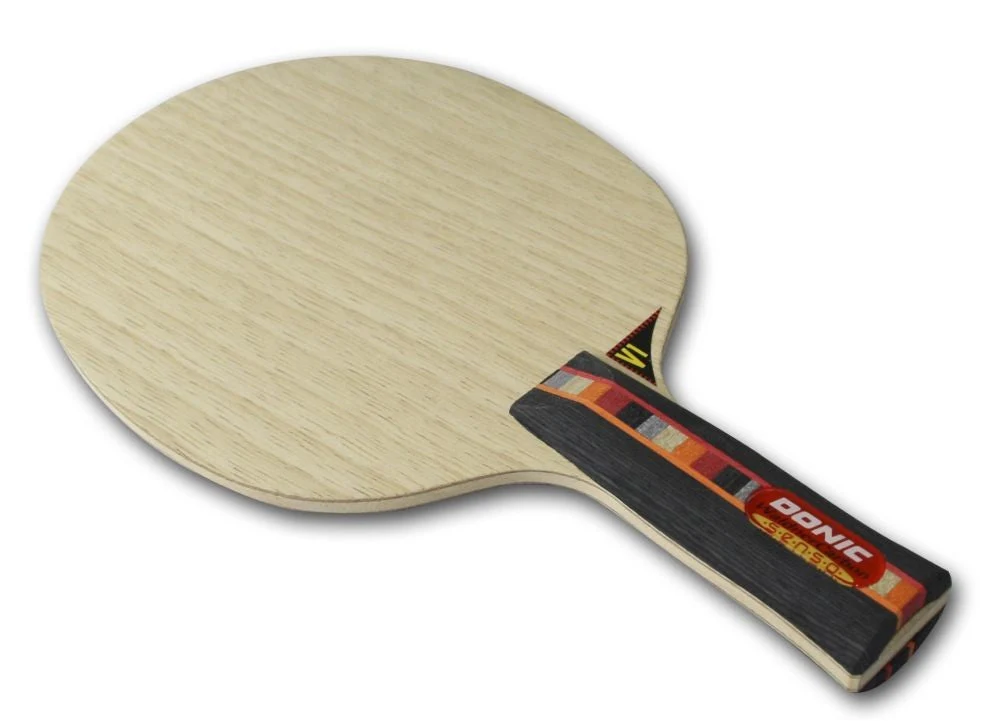
Donic Waldner Senso Carbon
The Allplay’s Swedish construction plus two carbon layers — and a hollow handle that keeps it talkative
“Built on one of the best-selling all-round blades ever made, with carbon added for pace and a Senso V1 handle that refuses to mute the ball.”
Donic started this blade from its own best answer: the Allplay, a Swedish-style all-round wood the maker describes as one of the best-selling blades in the world. The Waldner Senso Carbon keeps that proven construction and adds two carbon layers, landing at OFF− — the class for attacking all-rounders — with dealer listings of Donic’s figures at Speed 86 / Control 70 (you will also see 8+ and 8+ quoted from Donic’s short scale; same blade, different ruler, as the ratings section explains). Jan-Ove Waldner, the player whose name it carries, used this standard version for years, and the design brief shows it: this is carbon for players who think in wood.
The signature detail is the handle. Donic’s Senso V1 system hollows out a section of the handle, and the maker says the cavity is tuned to return clear feedback of the ball’s bounce — an attempt to solve composite blades’ oldest complaint, numbness, at the handle rather than the ply stack. In practice it makes this the most communicative carbon blade in this guide: touch shots and blocks report back in a way outer-ALC blades simply don’t attempt. The carbon layers still do their structural work — the sweet spot is wider than the all-wood Allplay’s, and counters carry noticeably more pace — but the step up from wood is a step, not a leap, which is exactly what an aggressive all-rounder moving up a class wants.
Choose it if you are a wood player curious about carbon, a blocker-counter who values information over raw speed, or a Waldner traditionalist. Pure power loopers will find the Viscaria and Hurricane Long 5 a class more urgent — that is by design.
✅ Pros
- The most feedback-rich carbon blade in this guide
- Proven all-round construction with a wider sweet spot than wood
- Light ~85g build; easy step up from all-wood
- Named for — and long used by — Jan-Ove Waldner
⚠️ Cons
- Speed gain over wood is real but modest — it is OFF−, not OFF+
- The hollow-handle feel divides opinion; some prefer a solid grip
- Donic’s ratings appear in several formats across dealers
Donic Waldner Senso Carbon · 5W+2C · OFF− · ~85g · FL/ST/AN
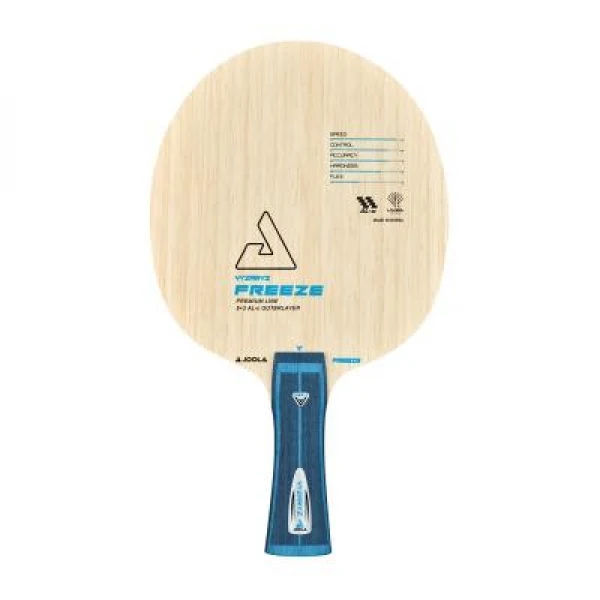
JOOLA Vyzaryz Freeze
Limba-faced outer ALC, “cold-cured” at low temperature — JOOLA’s premium answer to the Viscaria blueprint
“The highest-grade Arylate-Carbon JOOLA offers, bonded cold for touch, over a Kiri core — outer-ALC directness with a softer first contact.”
JOOLA’s Premium Line flagship takes the outer-ALC blueprint and changes the two things players most often wish were different. First, the face: where the Viscaria uses hard Koto, the Freeze puts Limba on the outside, over the ALC, a Kiri core construction. Limba holds the ball a touch longer and softens the first contact, which spin-oriented players feel immediately on opening loops. Second, the bonding: JOOLA cures the composite layers at low temperature — the “Freeze” name and its “cold-cured” claim — and says the process preserves more of the wood’s natural feel than conventional hot pressing. As always with maker technology claims we report it as JOOLA’s stated method rather than something a buyer can verify on a spec sheet; what can be verified is the construction itself, and it is squarely modern flagship spec. JOOLA’s own ratings (Speed 101, Control 93) run on its hotter house scale — compare them only with other JOOLA blades.
In play terms, this is the closest alternative in the guide to the Viscaria’s category — same class, same outer-ALC stability in blocks and counters — with the handshake changed in Limba’s favour. Two buying notes from the field are worth passing on. Weight: JOOLA lists 85g, but individual units weighed by reviewers have come in noticeably heavier, so this is the strongest case in the guide for asking your retailer to pick a blade at your target weight before shipping. Handle: reviewers have measured the Freeze’s handle as fuller than average at the neck and base, which many players love and smaller hands should try to preview first. Neither note is a defect; both are exactly what “ask before you buy” exists for.
Pick the Freeze if you want current-generation outer-ALC performance with a spin-friendlier face than the Koto standard, and you are happy outside the Butterfly ecosystem. If you want the reference itself, pick #1 — this guide is not going to pretend the original isn’t the original.
✅ Pros
- Limba outer ply adds dwell to outer-ALC directness
- Premium-grade ALC with low-temperature bonding
- Modern flagship alternative outside the Butterfly range
- Penhold version available alongside FL and ST
⚠️ Cons
- Unit weights can run above the listed 85g — order to a target
- Fuller handle may not suit smaller hands
- JOOLA’s rating scale runs hot; ignore cross-brand comparisons
JOOLA Vyzaryz Freeze · 5W+2ALC outer · OFF · ~85g · FL/ST/Pen
Side-by-Side: The Seven Blades Compared
All ratings below are the makers’ own published figures — and as the ratings section explains, they are only comparable within the same brand’s scale. The class, construction and weights are the honest cross-brand language.
| Blade | Construction | Class | Weight | Thickness | Face Ply | Best For |
|---|---|---|---|---|---|---|
| Butterfly Viscaria | 5W + 2 ALC (outer) | OFF | ~87g | ~5.7mm | Koto | Balanced two-wing attacking |
| DHS Hurricane Long 5 | 5W + 2 ALC (inner) | OFF+ | ~89g | ~5.9mm | Limba | Power looping, full swings |
| Stiga Clipper Wood | 7-ply all-wood | OFF | ~90g | ~6.6mm | Limba | Driving and countering, wood feel |
| Butterfly Petr Korbel | 5-ply all-wood | OFF | ~91g | ~5.9mm | Limba | Developing loopers, feel-first play |
| Yasaka Sweden Extra | 5-ply all-wood | ALL+ | ~85g | ~5.7mm | Medium wood | First custom blade, control |
| Donic Waldner Senso Carbon | 5W + 2C | OFF− | ~85g | ~5.8mm | Wood (Allplay build) | Attacking all-round, feedback |
| JOOLA Vyzaryz Freeze | 5W + 2 ALC (outer) | OFF | ~85g | ~5.9mm | Limba | Modern ALC with spin touch |
🔗 Pairing Your Blade With Rubbers
Decide in the right order. Blade first, rubbers second, one change at a time. The blade sets your speed class — so match the rubber plan to it loosely like this: an OFF or OFF+ blade (Viscaria, Hurricane Long 5, Freeze) is usually paired with modern tension rubbers in medium to medium-hard sponge; an ALL+ to OFF− blade (Sweden Extra, Waldner Senso Carbon, Korbel) often plays best with medium sponge that leaves the blade’s feedback audible. Going a class too hot on both halves at once is the most common custom-setup mistake.
Forehand and backhand are separate decisions. The Hurricane Long 5 tradition — a tacky forehand sheet for brush looping, a grippy tension sheet on the backhand — exists because the two wings do different jobs. Sponge thickness is the other lever: max thickness adds pace and spin, thinner sponge adds control and keeps total weight down. The full rubber-by-rubber comparison — hardness scales, tacky vs grippy, and the current models worth buying — lives in our dedicated best table tennis rubbers guide, and this page deliberately stops here: composition is the blade’s decision, rubber selection is that guide’s.
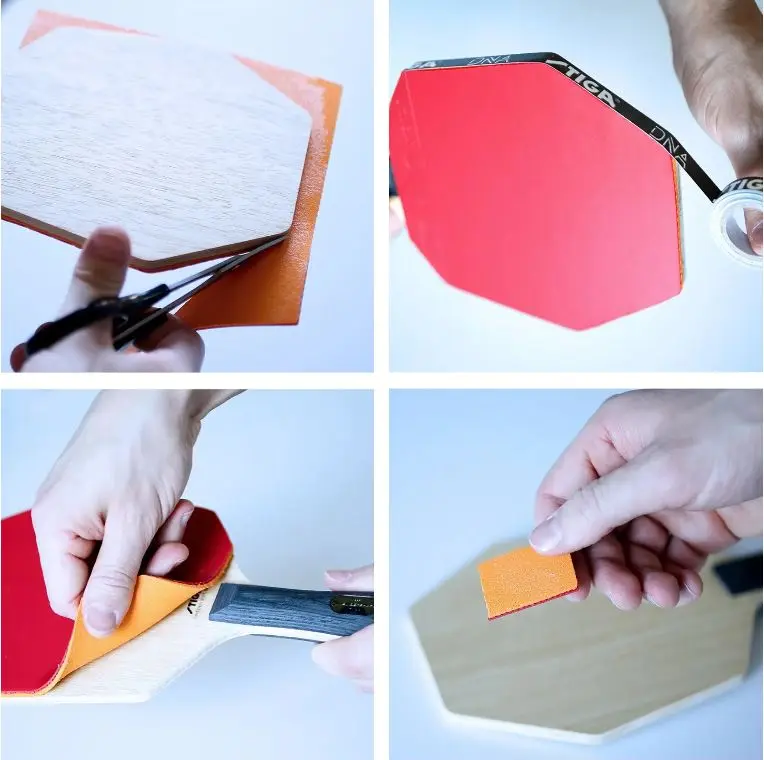
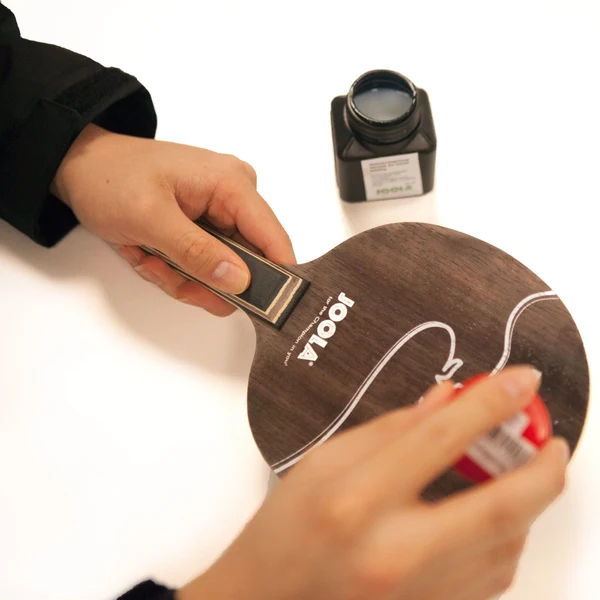
Protect the face before the first gluing. Bare blades — Limba faces especially — can shed wood fibres when an old rubber is peeled off. A single thin coat of blade sealant (lacquer) prevents that, and some makers pre-seal at the factory: Butterfly, for example, applies a protective lacquer to its blades before shipping, so they need no sealing at all. For unsealed blades, one thin coat, fully dried, changes nothing about how the blade plays and can add years to its life. Add edge tape to guard the rim against table knocks, and store the finished bat in a case, away from heat and damp.
- Order to a weight: decide your target finished-bat weight (most adults land near 180–190g), subtract roughly 90–100g for two rubbers, glue and tape, and ask the retailer to select a blade near the number that remains.
- Buy flagships from authorised dealers: the Viscaria and Hurricane Long 5 are among the most counterfeited blades in the sport. A suspiciously cheap flagship is a purchase you will make twice.
- Change one variable at a time: new blade, keep your rubbers if they are legal and alive — otherwise you will never know which half of the setup changed your game.
🏆 The Final Verdict
If you want one answer: the Butterfly Viscaria is the best table tennis blade for most established attacking players — the outer-ALC reference that everything else in its class is still compared against. Power loopers with full, committed swings should take the DHS Hurricane Long 5 and its inner-ALC dwell instead. Players who refuse to give up wood’s feel have three honest routes: the Stiga Clipper Wood for pace, the Butterfly Petr Korbel for all-round feedback, and the Yasaka Sweden Extra as the perfect first custom blade. The Donic Waldner Senso Carbon is the bridge between the families, and the JOOLA Vyzaryz Freeze is the modern outer-ALC alternative for spin-first players.
Whichever blade you build around, the setup only pays off with practice time on a decent surface — our guide to the best table tennis tables covers the home and club options — and with strokes that use it: our breakdown of table tennis serves for beginners is the fastest place to start turning new equipment into won points.
❓ Frequently Asked Questions
What does the blade do that the rubber doesn’t?
The blade sets your bat’s speed ceiling, the size of its sweet spot and how much feedback reaches your hand — and it lasts for years, through many sets of rubbers. Rubbers fine-tune spin, grip and pace inside the limits the blade sets, and they wear out within a season or two of regular play. That is why the blade is the long-term decision and rubber changes are the adjustment.
Should I choose an all-wood or a carbon-composite blade?
Choose all-wood if you are still building technique: wood flexes, holds the ball longer and reports every contact honestly, which teaches clean strokes — the Yasaka Sweden Extra (ALL+) and Butterfly Petr Korbel (OFF) are the classic stages. Choose a composite if your strokes are already consistent and you want a higher speed ceiling and a larger sweet spot for blocking and countering. Inner-ALC blades like the Hurricane Long 5 sit closest to wood in feel; outer-ALC blades like the Viscaria and Vyzaryz Freeze are the most direct.
What is the difference between inner and outer ALC?
It is the position of the Arylate-Carbon layer in the ply stack. Outer ALC sits directly under the face ply (Viscaria: Koto–ALC–Limba–Kiri), so the ball meets the composite almost immediately — the result is crisp, direct and fast, with a big sweet spot. Inner ALC is buried as the third layer (Hurricane Long 5: Limba–Ayous–ALC), so soft contact feels like an all-wood blade with more dwell, and the composite’s power only engages on full swings.
How heavy should my blade — and my finished bat — be?
The blades in this guide weigh about 85–91g bare. Add two cut rubbers (roughly 45–50g each in max sponge), glue and edge tape, and a finished bat typically lands between about 175g and 195g, with many adult players happiest around 180–190g. Because individual blades of the same model vary by several grams, ask the retailer to select one near your target weight — especially on models whose weighed units have run above the listed figure.
Flared, straight or anatomic — which handle should I pick?
Flared (FL) is the safe default: the widened base stops the bat slipping and locks the grip for looping. Straight (ST) suits players who adjust their grip between wings and many backhand-oriented players. Anatomic (AN) fills the palm with a sculpted swell — a middle path. Stiga sells the same three shapes as Master (flared), Classic (straight) and Winner (anatomic). Penhold players should choose the CS version where offered.
Can I put any rubber on any blade?
Physically, yes — rubbers are glued to the bare blade and cut to its outline, and any ITTF-authorised rubber can be fitted to any blade. The skill is in matching classes: a very fast blade with very fast rubbers magnifies errors, while a control blade can carry a livelier rubber comfortably. Our rubbers guide covers the rubber side of the pairing in full.
How long does a table tennis blade last?
Years, with basic care — far longer than the rubbers glued to it. Seal an unsealed outer ply before the first gluing (some makers, including Butterfly, pre-seal at the factory), add edge tape against table knocks, keep the bat in a case away from heat and damp, and peel old rubbers slowly. Replace a blade when it delaminates, takes a deep edge crack, or warps — not when a new model launches.