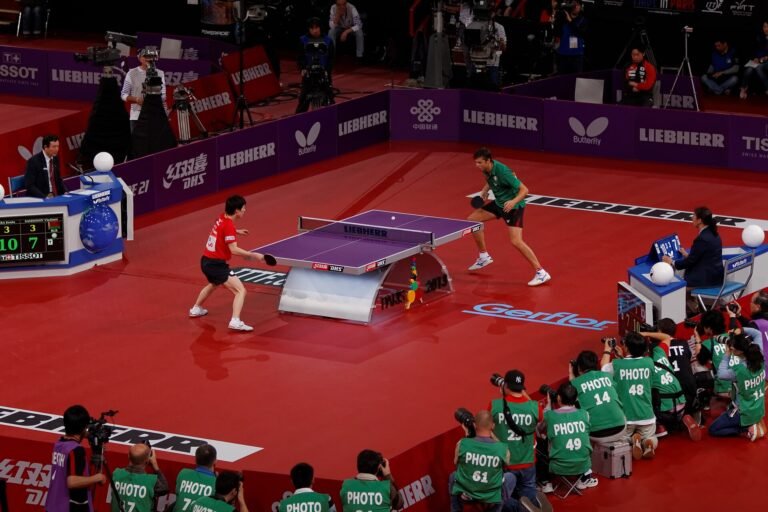
Same table, same bats, same two players — and the rallies still feel completely different depending on which ball comes out of the box. This guide decodes the star ratings, the ABS plastic era and the seam question, then ranks the seven table tennis balls worth your money.
TL;DR — The short answer
Best overall: Nittaku Premium 40+. The made-in-Japan 3-star is the ball serious players benchmark everything else against — round, hard, consistent. Chasing tournament pedigree on a tighter budget? The DHS D40+ is the World Championships ball in a box of ten. Want the current World Championships ball from Butterfly, it is the R40+. And if you mostly need a bucket of balls that survives home practice and multiball drills, the honest answer is a 1-star bulk pack like the Franklin Sports balls — training grade, priced like it, and exactly right for the job. Everything else — what the stars really mean, why celluloid is history, seamed vs seamless — is explained below.
Nittaku Premium 40+
3-star, made in Japan. The consistency benchmark for match play.
Butterfly R40+
3-star. The official World Championships ball, 2024–2026.
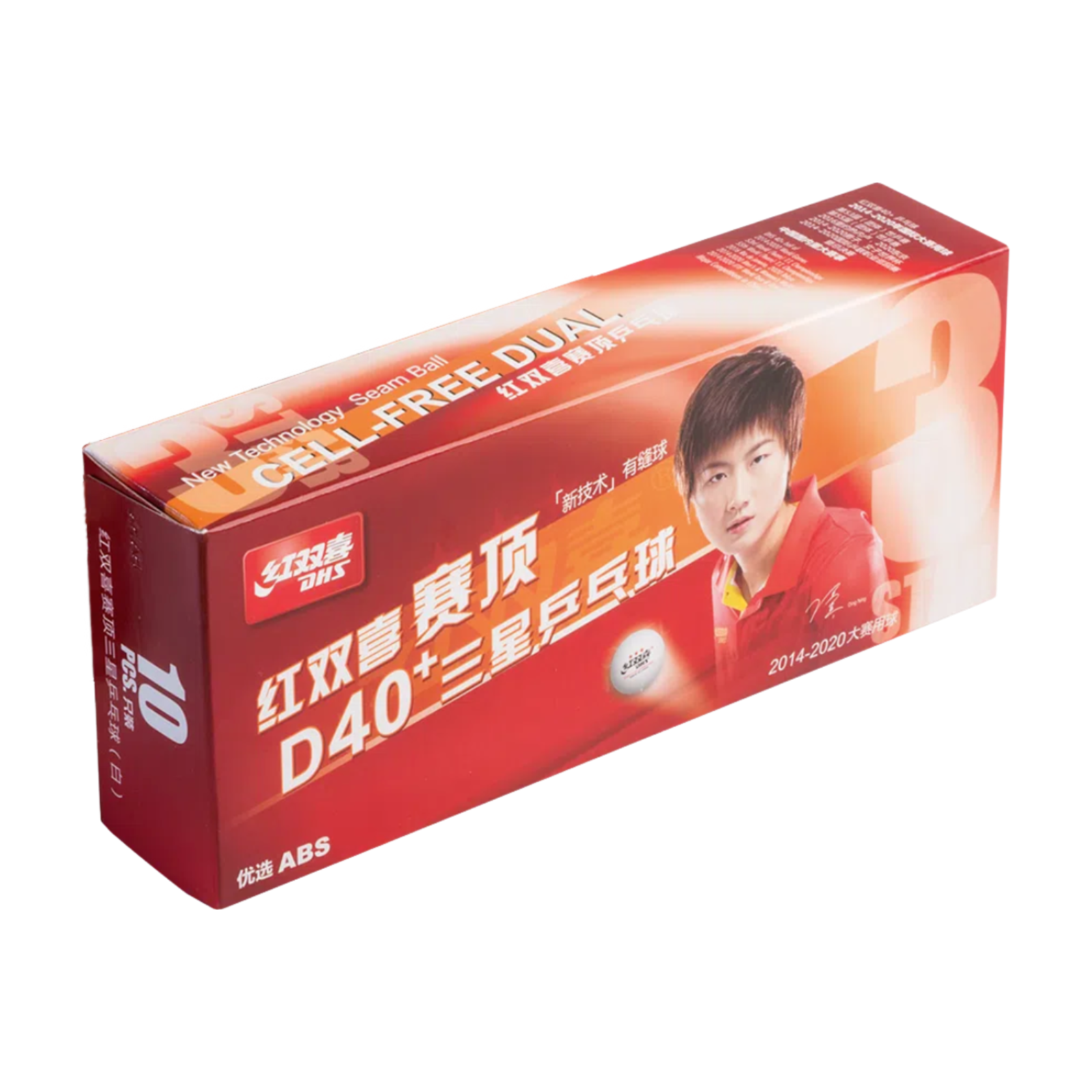
DHS D40+
3-star in boxes of 10. World Championships pedigree, club-friendly packs.
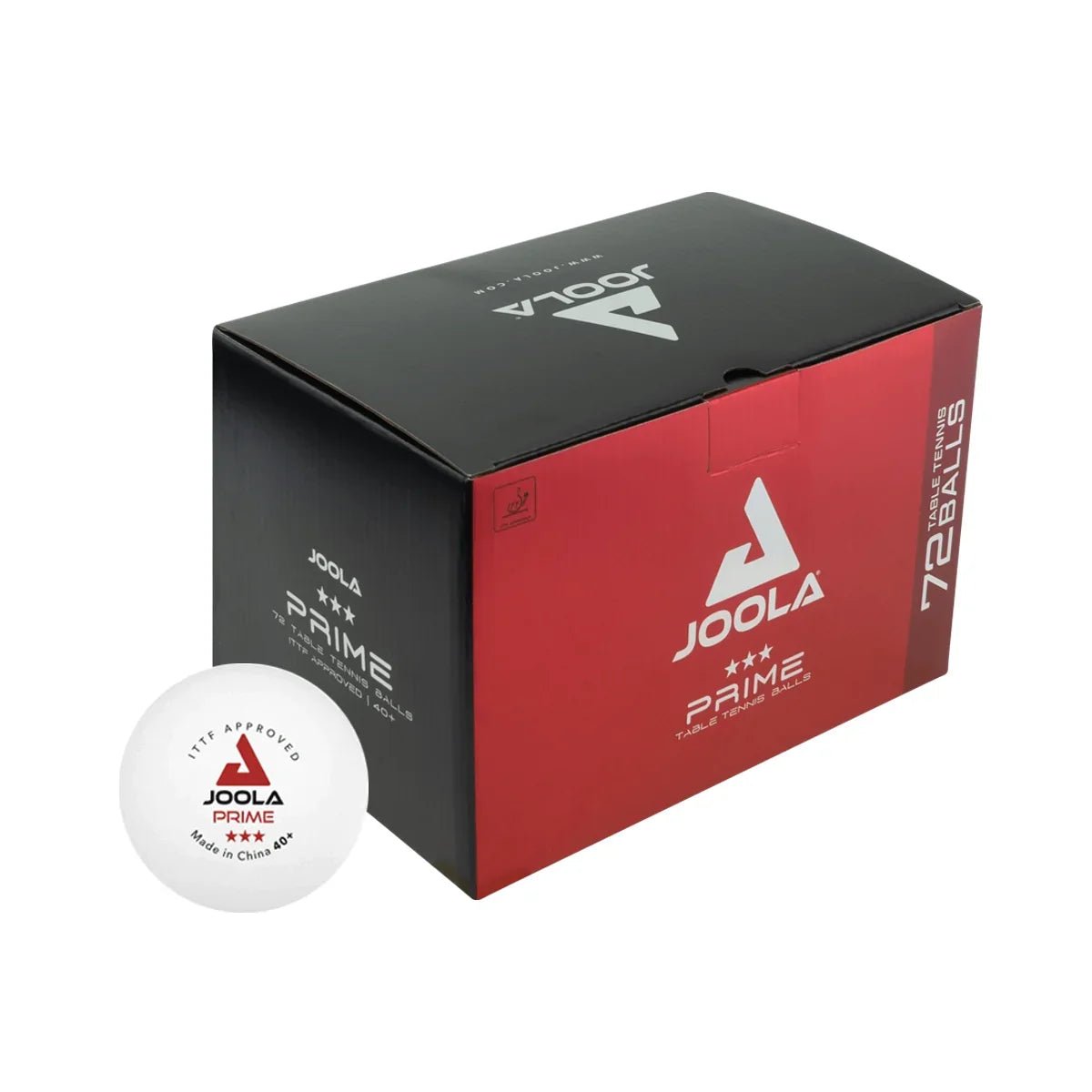
JOOLA Prime 40+
3-star ABS built for even hardness — and a 72-pack for heavy trainers.
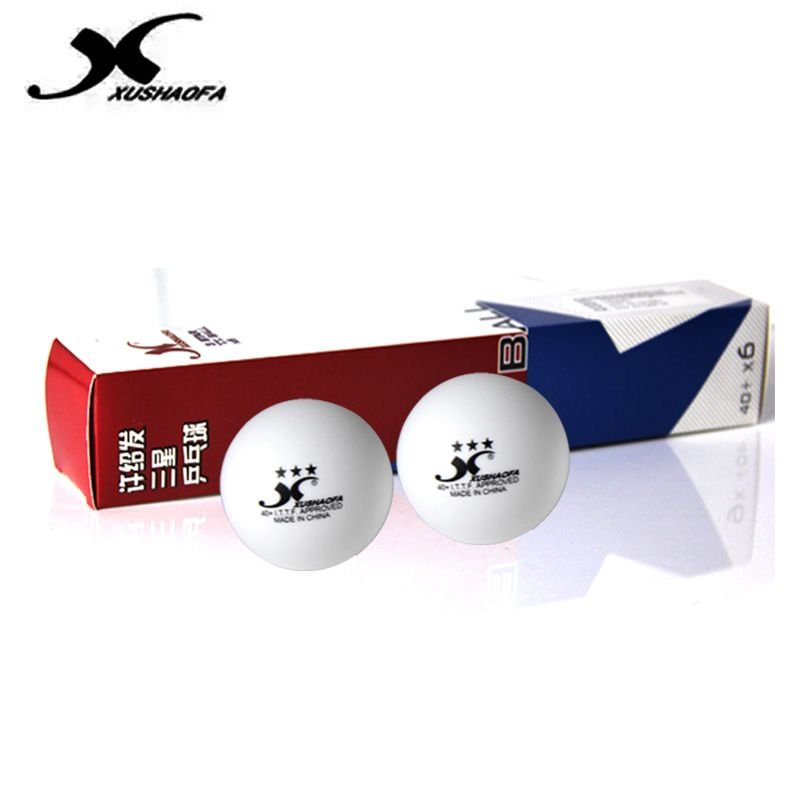
Xushaofa 40+
3-star, one-piece seamless. No seam line, nothing to split along one.
Franklin Sports 1-Star
Training grade, official size, packs up to 144. The home-practice workhorse.
On this page
- Star ratings explained: what 3-star really means
- The ABS era: celluloid is history, 40+ is the size
- Seamed vs seamless balls
- White, orange and two-tone: ball colour explained
- 1. Nittaku Premium 40+ — Best Overall
- 2. Butterfly R40+ — Best for Tournaments
- 3. DHS D40+ — Best Championship Value
- 4. JOOLA Prime 40+ — Best Durability
- 5. STIGA Perform 40+ — Best for Clubs
- 6. Xushaofa 40+ — Best Seamless
- 7. Franklin Sports 1-Star — Best Bulk Training
- Comparison table
- How many to buy, durability and care
- FAQs
The cheapest upgrade in the sport
Table tennis players will debate blades and rubbers for hours, then play the match with whatever ball rolls out of a coat pocket. That is backwards. The ball is the only piece of equipment both players share, it is replaced more often than everything else in your kit combined, and a poor one quietly sabotages good technique: an out-of-round ball wobbles in flight, a soft-spotted ball bounces unevenly, and a polished-smooth old ball slides off the rubber instead of gripping for spin. Your loops start missing and you blame your bat.
The fix costs less than a set of rubbers by an order of magnitude. A box of proper 3-star match balls is the cheapest consistency upgrade in the sport — pair it with a decent surface to play on (our best table tennis tables guide covers the other half of the bounce) and every rally you play is suddenly the same rally, decided by the players instead of the equipment lottery.
Star ratings explained: what 3-star really means
The star system looks simple — more stars, better ball — and it is, but only at the top. Here is the part the packaging rarely explains.
Two practical consequences follow. First, when you buy a match ball, the star count alone proves nothing — plenty of unapproved balls print three stars on the box as decoration. Check for the ITTF approval (the ball and box carry the approval mark, and the model appears on the ITTF’s approved-ball list). Every 3-star pick in this guide is a genuinely approved model, verified against the brands’ own listings. Second, do not let anyone shame you out of training balls. A club running multiball drills with 3-stars is burning money; a home player practising serves against a robot or a wall with 1-stars is being sensible. Match balls for matches, training balls for volume — the six-and-one split of this guide is deliberate.
Within the approved tier, what separates one 3-star from another is tolerance discipline: how round is round, how uniform the wall thickness is, how hard and consistent the bounce feels ball after ball. That is what the reviews below actually compare — not the stars, which are identical, but the manufacturing behind them.
The ABS era: celluloid is history, 40+ is the size
Every ball in this guide is plastic, and that is not a downgrade — it is the modern rules of the sport. Table tennis balls were celluloid for over a century, but celluloid is flammable, hazardous to manufacture and ship, and the supply chain for it collapsed. The ITTF moved the sport to plastic balls in 2014, and the old celluloid approvals were phased out entirely — the federation’s 2020 approved-ball list already marks every celluloid model “can be used until 31 December 2020.” If a listing today brags about celluloid, it is selling nostalgia or old stock, not a competition ball.
The standard material of the plastic era is ABS — the same tough polymer family used in LEGO bricks and crash helmets — and it changed how balls die. Celluloid balls dented, went egg-shaped and yellowed; ABS balls keep their shape far better, bounce with a crisper, higher-pitched crack, and usually fail suddenly by cracking rather than slowly by deforming. Brands formulate their ABS differently — Nittaku uses a proprietary poly material made only for its Japanese production, DHS calls its recipe Cell-Free Dual — which is why two approved balls can both be “ABS” and still feel distinct on the bat.
The ITTF’s bounce test is the other number worth knowing: a competition ball dropped from 30.5 cm onto a steel block must rebound within a set window. You do not need the lab version — the home version is in the buying guide below — but it is why approved balls feel interchangeable in bounce height while cheap balls vary from trampoline to dead within the same bag.
Seamed vs seamless: the construction question
Plastic balls are built two ways, and you will see both in the picks below. A seamed ball is moulded as two hemispheres and joined around the equator — the Nittaku, Butterfly, DHS, JOOLA and STIGA picks are all seamed. A seamless ball is formed as a single piece with no join at all — the Xushaofa pick is the famous example, built with a patented one-piece process.
The theory favours seamless: no seam means no seam line to create a hard or soft spot, no join to split, and perfectly uniform wall thickness. The practice is narrower than the theory. Modern seamed ABS balls are made so precisely — JOOLA specifies “identical thickness” and “even hardness” for its Prime, Butterfly markets the R40+ on the same even-wall claim — that the measurable gap between a good seamed ball and a seamless one is small, and several of the world’s biggest events are played with seamed balls. Seamless balls do tend to feel a little harder and sound a little higher-pitched, and the absence of a seam removes one specific failure mode: the split-along-the-join crack.
Our honest framing: construction is a preference, not a hierarchy. If you love the seamless feel and durability story, buy the Xushaofa. If you play in organised leagues, buy whichever approved ball your league and training partners standardise on — consistency with the balls you practise with beats theoretical superiority. What you should not do is pay a seamless premium for an unapproved ball with three decorative stars; the approval matters more than the join.
White, orange and two-tone: ball colour explained
Competition rules recognise exactly two ball colours: white and orange, both in a matte finish. White is the default almost everywhere; orange exists for visibility — against white walls, pale floors, bright lighting or on television, an orange ball can simply be easier to track. Which one you should buy is mostly about your room: if your playing space has light backgrounds, orange disappears less. Some models make the choice for you — the Nittaku Premium is white only (its orange sibling is the separate Nexcel line), while DHS sells the D40+ in both colours in the same box-of-ten format.
Then there are the balls that are neither: two-tone spin trainers, split half white and half orange (or other colour pairs). These are not competition-legal and are not trying to be — the split colour makes rotation visible, so you can watch the ball’s spin axis and speed during practice serves and loops. As a coaching and self-coaching aid they are genuinely useful, and as a match ball they are worthless; file them under training accessories alongside the 1-star bulk packs. Multicoloured novelty balls (the rainbow party packs) sit one step further down the same road: fine for the kids’ table, not a training tool at all.
The 7 best table tennis balls, reviewed
Every pick below was verified against a live brand or retailer listing at build time: star rating, ITTF approval status, material, construction and pack sizes all come from the manufacturers’ own product pages, not from roundup sites. Six are genuine ITTF-approved 3-star match balls with different strengths; the seventh is an honestly labelled training ball for the job match balls are wasted on.
Nittaku Premium 40+
The made-in-Japan 3-star every other ball is judged against
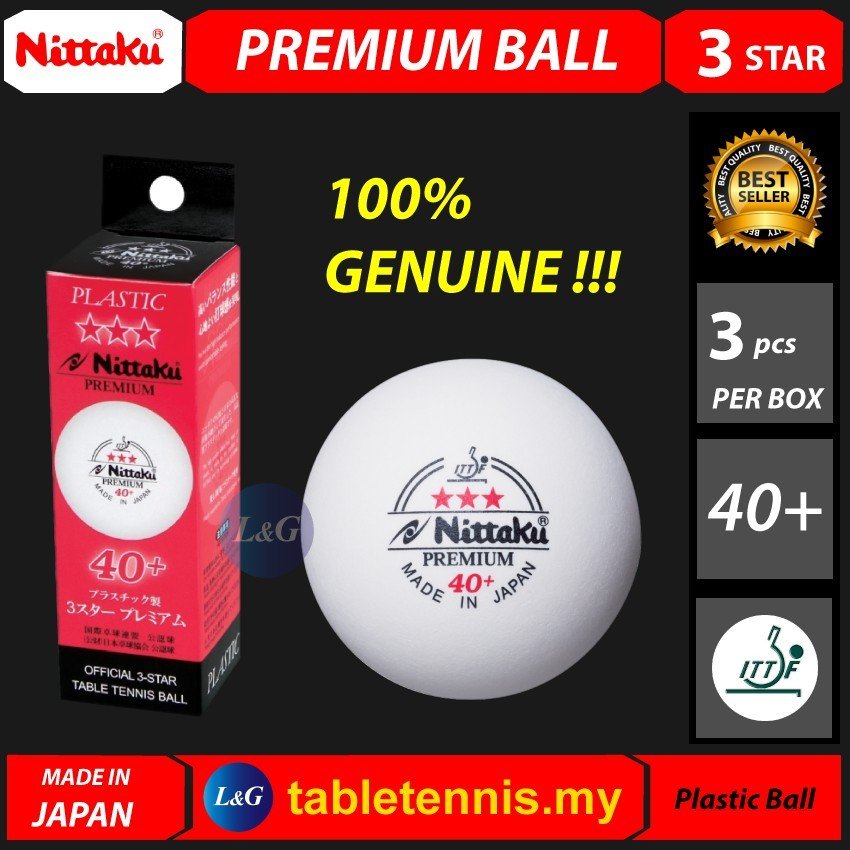
Nittaku makes this ball in Japan from a poly material it keeps to itself, and the result is the reference point of the plastic era: the 3-star that players, coaches and other manufacturers quietly use as the standard for roundness, hardness and consistency.
Start with the stamp: the ball itself is printed “Nittaku Premium 40+” and “Made in Japan” — the Japan part matters, because Nittaku’s cheaper SHA line is made in China and the Premium is the one built at home under the tightest control. Retailers and players consistently describe the same character: a hard, crisp ball with a clean, high bounce and very little ball-to-ball variation, which is exactly what you want when a match turns on two or three net-cord margins.
It has the résumé to match. The Premium was the official ball of the 2017 World Championships and has been used at World and Olympic championship level; it remains the ball a remarkable number of top players choose when the choice is theirs. The playing feel is at the firmer, livelier end of the approved range — players coming from softer balls notice the crack off the bat and the way the ball holds its line on fast drives.
Two honest caveats. White is the only colour — if you need orange, Nittaku sells that as the separate Nexcel 40+ line, not as a Premium variant. And the per-ball price sits at the top of this list; you are paying for the tolerance discipline. For matches and serious training, that is the right place to spend. For feeding a robot by the hundred, it is not — that is what pick seven is for.
Pros
- The consistency benchmark of the plastic era
- Made in Japan from Nittaku’s proprietary poly material
- Hard, crisp, lively match feel
- Championship pedigree — 2017 World Championships official ball
Cons
- White only — orange lives in the separate Nexcel line
- Premium per-ball price; wasteful for bulk drills
As an Amazon Associate we earn from qualifying purchases.
Butterfly R40+
The official World Championships ball, 2024–2026
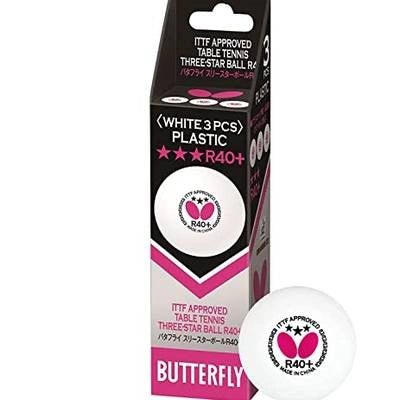
If you want to play with literally the ball the World Championships are played with, this is it: Butterfly’s R40+, now in its third generation, is the official competition ball of the World Table Tennis Championships for 2024–2026.
Butterfly’s design brief for the R40+ is uniformity: the ball is manufactured so the wall is the same thickness at every point, which is the physical basis for a consistent bounce and stable rotation. Players describe the result as a true, predictable ball — constant bounce, reliable trajectory — and Butterfly has kept refining it; the current version is the third generation of the R40+ line. It replaced the A40+ (the 2018 World Championships ball) as the flagship, which is why the card carries the R name: the A40+ is the previous generation, not the current one.
The practical argument is standardisation. Because the R40+ is the Worlds ball, an enormous share of serious clubs and events have standardised on it — train with it and the ball at your next tournament feels like the ball from your last practice. Butterfly sells it in 3s and 12s for individuals and a 72-ball bundle for clubs, all white.
Expect to pay the Butterfly premium: the per-ball cost runs above the DHS and STIGA picks below, and the ball’s feel — a fraction softer and rounder in flight than the Nittaku — is a preference some players love and others merely like. Neither is a reason to skip it; both are reasons to try a 3-pack before you buy the 72.
Pros
- Official World Championships ball 2024–2026
- Even wall thickness for a true, stable bounce
- Third-generation refinement of a proven line
- Club-friendly 72-ball bundle available
Cons
- Brand premium over DHS/STIGA equivalents
- White only in the standard range
As an Amazon Associate we earn from qualifying purchases.
DHS D40+
The World Championships ball in a box of ten
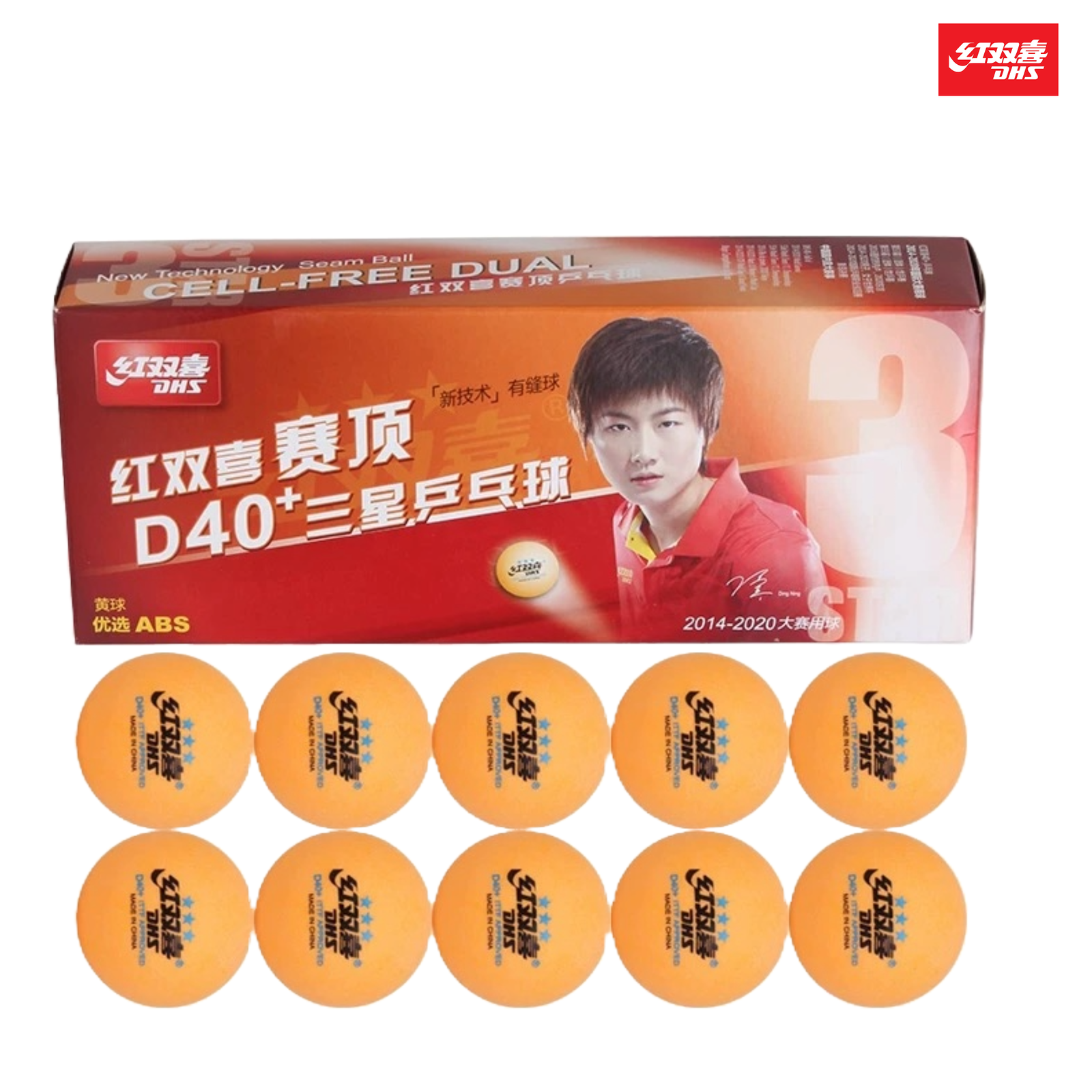
DHS’s D40+ is the ball major international events adopted from 2017 onwards — the World Championships, World Tour and World Cup have all been played with DHS’s Cell-Free Dual ABS formula — and it sells in boxes of ten at a per-ball price the Japanese and German brands do not match.
DHS publishes the numbers most brands keep vague: 40.0–40.55 mm diameter, 2.67–2.77 g weight, seamed ABS construction, with roundness, bounce, eccentricity, hardness and colour all certified to ITTF competition requirements. The playing character follows from the formula — DHS designed the D40+ to keep as much continuity with the old celluloid ball’s hitting sense, sound, rotation and trajectory as the plastic rules allow, and it plays with a solid, slightly weighty feel that a lot of loopers prefer.
The format is the other half of the appeal. Boxes of ten, in white or orange, at a per-ball price well under the Nittaku and Butterfly picks: for a club that wants one approved ball for both league nights and training, the D40+ is usually where the maths lands. DHS has since added the DJ40+ as its WTT World Tour ball — a step-up sibling worth knowing about — but the D40+ remains the volume championship ball in the range.
The watch-out is sourcing: the D40+ is one of the most counterfeited balls in the sport, and marketplace listings at implausible prices are often exactly what they look like. Buy from authorised table tennis retailers or the brand’s own stores, and check the printing and ITTF approval mark on the ball when it arrives.
Pros
- World Championships pedigree since 2017
- Published tolerances: 40.0–40.55 mm, 2.67–2.77 g
- Boxes of 10 in white and orange
- Best per-ball value among the championship balls
Cons
- Counterfeits are common — buy from authorised sellers
- Slightly weightier feel than the Nittaku
As an Amazon Associate we earn from qualifying purchases.
JOOLA Prime 40+
The hard-wearing 3-star with a 72-ball club pack
JOOLA builds the Prime around one promise: an ABS ball with a seam, manufactured for identical wall thickness and even hardness — and then sells it in a 72-pack, which tells you exactly who it is for: players and clubs who get through a lot of balls and are tired of them cracking.
Durability in an ABS ball is mostly about uniformity: a wall that varies in thickness has a thin spot, and the thin spot is where the crack starts. JOOLA’s Prime attacks that directly — the seamed ABS construction is controlled so thickness and hardness stay even all the way around the ball — and JOOLA’s own description leads with “exceptional durability” ahead of every other quality. The Prime has also served as the official ball at many JOOLA-sponsored tournaments in the US, so it is a known quantity in American club play.
The pack ladder is the practical joy here: a 3 or 6 to try, then a 72 that drops the per-ball cost sharply for a club or a home player with a robot and a training partner. Few approved balls are sold in a genuinely bulk format — the STIGA Perform’s cartons are the other honourable mention — and for high-volume training with real match balls, the Prime 72 is one of the easiest recommendations in this guide.
Feel-wise the Prime plays firm and honest, closer to the Nittaku end of the spectrum than the Butterfly. New balls can carry a light powdery coating from production — a quick wipe or rinse before first use is normal for ABS balls and worth doing before a match, not a defect.
Pros
- Even-thickness ABS build aimed squarely at durability
- 72-pack makes an approved ball affordable in bulk
- Firm, honest match feel
- Proven as a tournament ball in US club play
Cons
- White only
- New balls benefit from a wipe before first use
As an Amazon Associate we earn from qualifying purchases.
STIGA Perform 40+
The double-checked competition ball, sold up to 100 at a time
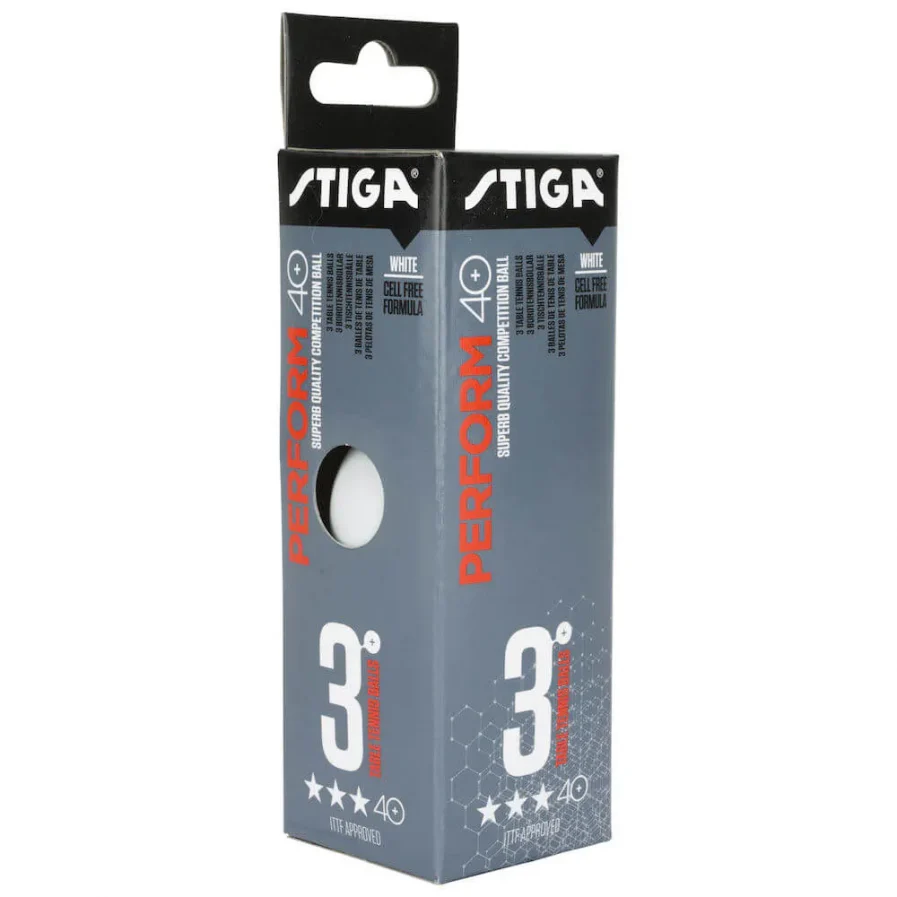
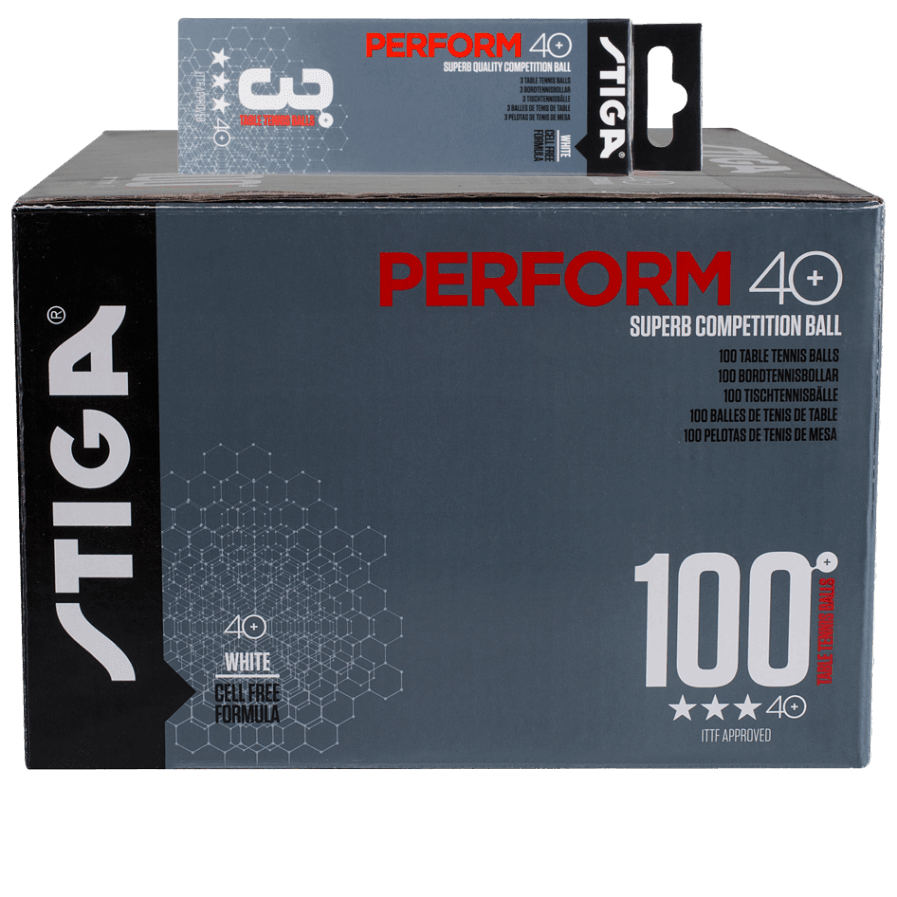
STIGA’s Perform is the club secretary’s favourite approved ball: an ITTF-approved ABS 3-star that passes through both automatic and manual selection for raw material, weight and roundness before it is packed — and it is packed in 3s, 72s and full 100-ball cartons.
Every brand claims consistency; STIGA is unusually specific about how it gets there. Perform balls are selected twice — automatically and then manually — with the checks covering the raw material itself as well as each ball’s weight and roundness. For a buyer, that process is the product: a carton of Performs should play like a carton of Performs, which is what a club running six tables and a weekly league actually needs.
The carton formats complete the club logic. The 100-pack exists so a venue can stock one approved ball for coaching, league and open play without paying match-ball 3-pack prices per ball, and STIGA’s range around it (training balls and outdoor balls under the same brand) lets a club keep a sensible two-tier stock: Perform for play that counts, cheaper balls for the multiball basket.
Against the top two picks, the Perform gives away a little of the Nittaku’s crispness and the Butterfly’s tournament ubiquity, and STIGA’s ball range can be confusingly named across regions — check you are buying the Perform 40+ 3-Star, ITTF approved, and not a same-brand training ball. Get the right box, though, and it is the rational club purchase.
Pros
- Double selection process for weight and roundness
- 72 and 100-ball cartons for genuine club volume
- Full ITTF approval at a working-club price
- Easy to build a two-tier club stock around it
Cons
- Similar names elsewhere in the range — check the box
- A touch less crisp than the Nittaku
As an Amazon Associate we earn from qualifying purchases.
Xushaofa 40+ Seamless
The ball that removed the seam entirely
Xushaofa pioneered the seamless plastic ball: instead of joining two hemispheres, its 40+ is formed as a single unit, so there is no seam line, no join to split, and no equator where thickness can drift. It is ITTF and USATT approved and sold in boxes of six.
The seamless argument is structural, and Xushaofa states it plainly: fusing two halves together is where unevenness in shape, weight and wall thickness creeps in, so building the ball as one piece removes those inconsistencies at the source — no soft spots, and a ball that is tougher and more consistent all around. In play, seamless balls have a recognisable character: a slightly harder feel and a higher, cleaner note off the bat, with a bounce that players often describe as very direct.
The durability story is the real-world half of the appeal. A seamed ball’s most characteristic death is a crack that starts at the join; a seamless ball has no join, so that failure mode is designed out. For players who train hard and crack balls at a rate that annoys them, a box of Xushaofas is the experiment worth running — six balls is a sensible trial size before committing further.
Balance the enthusiasm with two notes. Seamless feel is polarising: some players find the harder contact less forgiving on touch shots than the big seamed brands. And Xushaofa’s distribution outside specialist retailers can be patchy, with marketplace listings of varying vintage — buy from a table tennis retailer where you can, and confirm the ITTF approval stamp on the box.
Pros
- True one-piece construction — no seam to split
- ITTF and USATT approved 3-star
- Hard, direct, consistent bounce character
- Box of 6 is a low-risk way to try seamless
Cons
- Harder feel divides opinion on touch shots
- Distribution patchier than the big brands
As an Amazon Associate we earn from qualifying purchases.
Franklin Sports 1-Star
Official-size training balls in packs up to 144
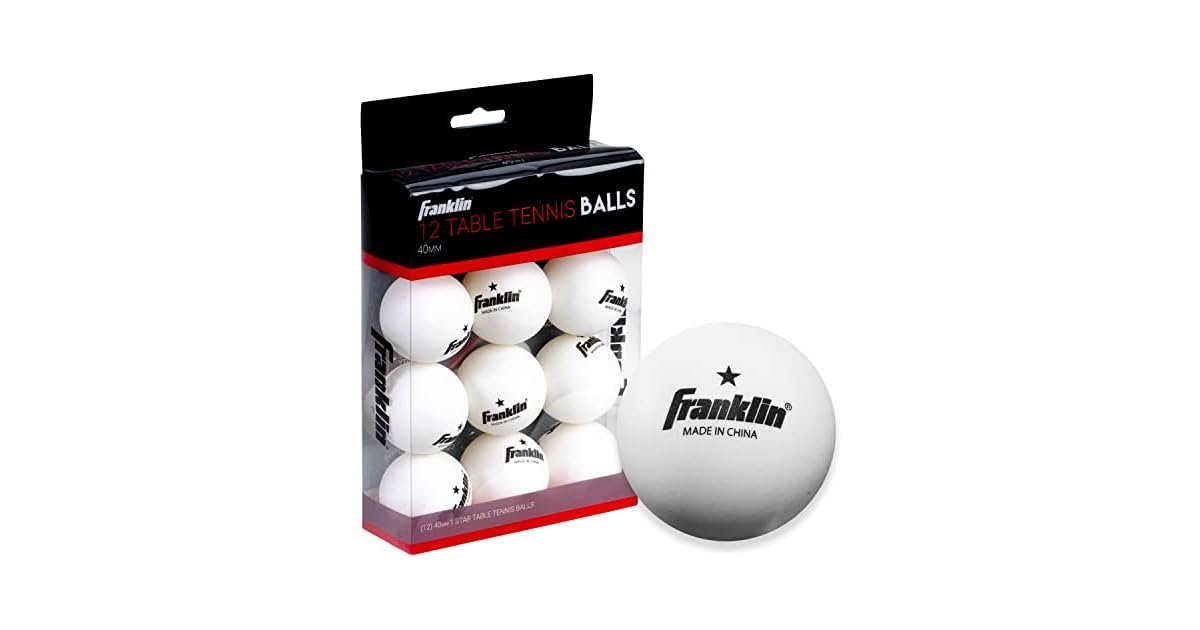
The one pick on this page that is not ITTF approved, included precisely because most balls in most homes should not be. Franklin’s 1-stars are built to official 40mm size and 2.7g weight in crack-resistant ABS, sold in packs of 6, 12, 18, 36 and a full 144 — the bucket-filler for practice, kids, robots and garage tables.
Read the label honestly and this ball makes complete sense. One star means training grade: no ITTF testing, looser tolerances than the six balls above, and a bounce that will vary a little more from ball to ball. What you get in exchange is the official size and weight, a crack-resistant ABS shell that shrugs off being stood on better than most, bright white and neon orange options — and a per-ball price low enough that a ball disappearing under the sofa is an errand, not an expense.
That trade is correct for a surprising amount of table tennis. Multiball drills burn through dozens of balls an hour. A robot hopper holds a hundred. Children’s first year of play involves more floor than table. Home practice against a return board needs volume, not pedigree. In all of those settings, the limiting factor is how many balls you own, and the Franklin bulk packs — up to 144 at a time — are the established answer from a mainstream US sports brand you can buy anywhere.
The boundary is equally clear: do not play your league matches with them and expect the top six picks’ consistency, and do not be confused by the word “professional” in marketplace titles — the 1-star grade on the box is the truth of the product. Keep a small box of real 3-stars for matches and let the Franklins do the heavy, hidden work of practice.
Pros
- Official 40mm size and 2.7g weight
- Crack-resistant ABS built for abuse
- Packs up to 144 — the cheapest way to fill a hopper
- White and orange options
Cons
- Not ITTF approved — not a match ball
- Bounce consistency varies more than the 3-stars
As an Amazon Associate we earn from qualifying purchases.
Table tennis balls compared
| Ball | Rating | ITTF approved | Construction | Packs | Best for |
|---|---|---|---|---|---|
| Nittaku Premium 40+ | 3-Star | Yes | Seamed ABS, made in Japan | 3 / 6 / 12 | Best overall match ball |
| Butterfly R40+ | 3-Star | Yes | Seamed ABS, even wall | 3 / 12 / 72 | Tournaments — Worlds ball 2024–2026 |
| DHS D40+ | 3-Star | Yes | Seamed Cell-Free Dual ABS | 10 | Championship value, white or orange |
| JOOLA Prime 40+ | 3-Star | Yes | Seamed ABS, even hardness | 3 / 6 / 72 | Durability, heavy trainers |
| STIGA Perform 40+ | 3-Star | Yes | Seamed ABS, double-selected | 3 / 72 / 100 | Clubs buying by the carton |
| Xushaofa 40+ | 3-Star | Yes (+ USATT) | Seamless one-piece | 6 | Seamless feel, no seam to split |
| Franklin Sports 1-Star | 1-Star | No | ABS training ball | 6–144 | Bulk practice, home and robots |
How many balls to buy — durability, clubs vs home, and care
How many do you actually need?
For home match play: one box of 3-star balls (a 3-pack is enough; a 6 or 12 if you lose balls to sofas and gardens) plus a training stock. Matches use one ball at a time, and a good ABS 3-star survives a lot of rallies — your match stock turns over slowly, so buy quality here and quantity elsewhere. And if the “table” is still a dining table with a clip-on net, start with our best table tennis tables guide — a ball can only bounce as truly as the surface under it lets it.
For home practice: volume is the point. Service practice, a return board or a robot eats balls by the dozen, and every ball you have to stop and collect is practice time lost. This is the 1-star bulk tier’s entire job: a 36 or 144 pack of Franklins costs less than a handful of match balls and removes the friction from drilling.
For clubs: think in two tiers and two formats. Match tier: an approved 3-star in bulk format — JOOLA Prime 72s, STIGA Perform 72/100 cartons, DHS D40+ boxes of ten stacked up. Training tier: a separate, visibly different stock (a different colour helps) for multiball and coaching baskets, so the match balls are not burned on drills. Mixing the tiers is how clubs end up playing league matches with the basket balls.
Durability: how balls actually die
Forget the marketing version — balls die in four observable ways. The crack: a hard edge-hit or a full-power smash into the table edge splits the shell, most characteristically along the seam of a seamed ball. The ball is finished instantly; there is no repair. The shoe: the number-one killer in clubs and homes is not play at all — it is being stepped on during ball collection. The wobble: a ball that takes a deforming impact can go subtly out of round; roll it across the table and watch it, or spin it and look for the wobble — a wobbling ball will never fly true again. The polish: over long use the matte surface smooths and picks up grime, grip drops, and spin behaviour changes; this is the slow death, and it is the one cleaning can delay.
That is the honest difference between club and home durability. Clubs do not wear balls out so much as destroy and lose them at volume — dozens of players, constant collection, hard floors — so clubs optimise for pack price and a two-tier stock. A home player with one table can keep a 3-star in match condition for a very long time; your enemies are the dog, the radiator and the one cupboard the ball always rolls behind. Buy accordingly: clubs buy cartons, home players buy a good box and a bulk practice bag.
Storage and care that actually helps
Keep balls in their box or a ball case, at room temperature, out of direct sunlight — ABS does not love being baked on a windowsill or frozen in a garage, and heat is the fastest way to age any plastic ball. Keep them clean: dust and floor grit on the surface change the grip, so a periodic rinse in plain water (a drop of mild soap for a genuinely grubby stock), then air-dry fully before boxing them. Wipe new balls once before first use to clear the light production coating. And separate your stock physically — match balls in their box, training balls in the bucket — because the fastest way to ruin a match ball is to let it live in the drill basket.
Shopping for the other racket sport’s balls? The same verified-first approach runs through our best padel balls guide, if your household plays both.
Table tennis ball FAQs
What does 3-star actually mean on a table tennis ball?
It means the ball has been tested and approved by the ITTF for competition — diameter, weight, roundness, bounce and hardness all certified. Only ITTF-approved balls are genuine 3-stars; the approval mark appears on the ball and box. One-star and two-star are manufacturers’ own labels for training-grade balls, with no official test behind them. Beware unapproved balls that print three stars as decoration — check for the ITTF approval, not the star count.
What is the difference between 40 and 40+ table tennis balls?
The 40+ is the modern plastic ball: 40.0–40.6 mm in diameter and about 2.7 g, made from ABS or similar plastic. The plain 40 was the older celluloid ball at a nominal 40.0 mm. Plastic replaced celluloid after 2014 because celluloid is flammable and hazardous to make, and celluloid approvals lapsed at the end of 2020 — so any ball worth buying today is a 40+. The “+” marks the tolerance band of the plastic generation; the two eras play slightly differently and should not be mixed in one box.
Seamed or seamless — which table tennis ball is better?
Neither, categorically. Seamless balls (like the Xushaofa 40+) are moulded in one piece, so there is no seam line, no thickness drift at a join and no seam to split — and they tend to feel harder with a higher-pitched sound. Modern seamed ABS balls (Nittaku, Butterfly, DHS, JOOLA, STIGA) are made to such tight tolerances that the practical gap is small, and most major events use seamed balls. Choose by feel and by what your league standardises on; the ITTF approval matters more than the construction.
Can I use 1-star training balls for matches?
For a friendly knockabout at home, of course — they are the same official size and weight. For any organised or sanctioned match, no: competition requires an ITTF-approved 3-star ball, and training balls vary too much in roundness and bounce to be fair equipment. The sensible setup most players land on is both: 1-stars in bulk for drills and practice volume, a small box of genuine 3-stars for matches.
White or orange table tennis balls — which should I buy?
Both are competition-legal colours in a matte finish. White is the default everywhere. Orange is a visibility tool: it tracks better against white walls, pale floors and bright or cluttered backgrounds, so look at your playing room and choose the colour that disappears less. Some balls force the choice — the Nittaku Premium is white only — while the DHS D40+ and Franklin training balls come in both colours.
What are two-tone table tennis balls for?
Two-tone balls — split half one colour, half another — are spin trainers. The split makes the ball’s rotation visible in flight and on the bounce, so you can see the axis and amount of spin on your serves and loops. They are a coaching and self-coaching aid, not competition-legal, and they belong in the training bag alongside bulk 1-star balls rather than in the match box.
How long does a table tennis ball last, and when should I replace it?
There is no honest fixed lifespan — it depends on how hard and how often you play, and on luck. Replace a ball when you can observe a fault: a crack (instant retirement), a wobble when you roll or spin it on the table (out of round), or a surface gone smooth and shiny so it stops gripping for spin. In clubs, most balls are lost to being stepped on rather than worn out; at home, a good 3-star kept in its box lasts a long time. Judge the ball in your hand, not the calendar.
How many table tennis balls should I buy?
For matches, a single box of 3-stars (3–12 balls) is plenty — you play with one at a time. For practice, buy volume in the training tier: a 36 or 144 pack of 1-stars for drills, robots and multiball. Clubs should run two tiers — approved balls in bulk formats (72 or 100 packs) for matches, and a separate, ideally different-coloured training stock for coaching — so match balls are never burned on basket work.
The verdict
Buy the Nittaku Premium 40+ if you want the benchmark match ball and the budget stretches. Buy the Butterfly R40+ if you play tournaments and want the current World Championships ball. Buy the DHS D40+ if you want championship pedigree per ball at the friendliest price — from an authorised seller. Buy the JOOLA Prime 40+ if you train hard, crack balls, and want the 72-pack maths. Buy the STIGA Perform 40+ if you stock a club and need approved balls by the carton. Buy the Xushaofa 40+ if you want to find out what seamless feels like. Buy the Franklin Sports 1-Star if you need a bucket of practice balls — and keep every one of them out of the match box. Whoever you are: approved balls for matches, bulk balls for volume, and never blame your bat for a wobbling ball again.
Affiliate disclosure: Alishuttler.com is a participant in the Amazon Services LLC Associates Program. The Amazon buttons on this page use our affiliate tag — if you buy through them, we may earn a commission at no extra cost to you. Prices shown on Amazon are live and may differ from any figures mentioned here.