Best Table Tennis Rubbers: Top Picks Compared
The rubber is the part of your bat that actually touches the ball, and it is the single biggest performance upgrade a custom-bat player can make. Two sheets of the right rubber can turn a decent blade into a spinning, controlled weapon — and the wrong sheets can fight your technique for years. This guide compares the seven rubbers worth gluing on in 2026, from the tacky Chinese classic to the hybrid that changed the game.
One thing first: this page is about rubber sheets for custom bats only. If you want a complete ready-to-play racket instead, our guide to the best table tennis bats covers those — here we stay with the rubbers you choose, glue and cut yourself.
TL;DR — The Short Answer
For most attacking players, Butterfly Tenergy 05 is still the benchmark tension rubber: high arc, huge spin and a forgiving feel on both wings. If you want the spin of a tacky Chinese rubber with Japanese build quality, Butterfly Dignics 09C is the hybrid to beat. On a traditional tacky forehand, DHS Hurricane 3 NEO remains the reference — demanding, spin-loaded and built for players who brush the ball with their whole body. The German-made tensors split the rest of the field: Yasaka Rakza 7 for balance, Donic Bluefire M2 for catapult and arc, Victas Ventus Extra for modern topspin at full commitment, and soft, controlled Xiom Vega Europe for developing players and backhands everywhere.
Pair any of them with the right surface to play on and the right ball — our best table tennis tables and best table tennis balls guides cover both.
Quick Picks — All 7 at a Glance
The benchmark tension rubber — high arc, heavy spin, proven on both wings at every level.
A tacky-topped hybrid with Butterfly’s highest spin rating; rewards strong, full strokes.
The classic Chinese forehand rubber: sticky surface, low throw, spin built by your stroke.
Natural-rubber grip, medium-hard sponge and no bad habits — the balanced upgrade.
Big-pore blue sponge, Formula FD3 catapult and a famously high, safe topspin trajectory.
The Ventus flagship: a 47.5° pink sponge and maximum spin-speed ratings in the series.
The softest Vega — a huge margin for error, easy spin and a backhand favourite for years.
In This Guide
- Rubber types: inverted, short pips and long pips
- Tacky Chinese vs grippy tension rubbers
- Sponge thickness and hardness explained
- The 7 best table tennis rubbers compared
- Side-by-side comparison table
- Forehand vs backhand: choosing for each wing
- Buying guide: how to choose your rubber
- Replacement and care: when rubber is worn out
- FAQs
- Our verdict
Rubber Types: Inverted, Short Pips and Long Pips
Every rubber in this guide is an inverted (pimples-in) sheet, and there is a reason for that: inverted rubber is what the overwhelming majority of attacking and all-round players use, and it is the only type built purely to generate heavy spin. On an inverted sheet the pimples face inwards, against the sponge, leaving a smooth, grippy outer surface. That smooth surface grabs the ball across a wide contact patch, so a brushing stroke can load it with topspin, backspin or sidespin. All seven picks below are inverted — if you play a looping or driving game, this is your category.
Short pips flip the construction around: the pimples face outwards, they are short and wide, and the ball contacts the tips of the pimples rather than a flat sheet. Short pips hit through spin instead of creating it — the ball comes off flatter and faster, incoming spin affects the shot less, and blocks and drives stay low and skiddy. They suit close-to-the-table hitters who take the ball early and punch through rallies rather than looping from distance. The trade-off is real: your own spin ceiling drops, and heavy topspin from mid-distance is much harder work.
Long pips use tall, thin, flexible pimples that bend on contact. That bending scrambles the ball’s spin — a long-pips return largely continues or reverses the spin your opponent put on the ball, which makes the return float, wobble and drop in ways that are awkward to attack. Long pips are a defensive and disruption tool, usually played on the backhand by choppers and blockers. They generate very little spin of their own, so they cannot drive a topspin game — if you want to attack with spin, stay inverted, which is exactly what this guide covers.
A quick reality check before you buy: if you currently play with a ready-made bat, its rubbers are almost certainly thin inverted sheets. Moving to any rubber below — on a bare blade you already own, or a new one — is a bigger jump than most players expect, because real sponge thickness and a fresh, grippy topsheet transform dwell time and spin.
Tacky Chinese vs Grippy Tension Rubbers
The deepest split in this guide is not by brand — it is by how the topsheet grips the ball. Understanding it will tell you which half of our list fits your stroke.
Tacky (Chinese-style) rubbers, represented here by the DHS Hurricane 3 NEO, have a topsheet that is literally sticky: press a clean ball against a fresh sheet and it can cling for a moment. Spin comes from that surface friction combined with a very hard, dense sponge, so the rubber rewards — honestly, demands — an active, brushing stroke with full body involvement. Played passively it feels dead; played properly it produces arguably the heaviest spin in the sport, with a low, penetrating trajectory that stays awkwardly short in the short game. Serves and receives are exceptional because the surface bites at low impact speeds too.
Grippy tension (European/Japanese) rubbers — Tenergy, Rakza, Bluefire, Ventus and Vega — grip the ball mechanically rather than by stickiness. Their topsheets are grippy but not tacky, and the sponge is built with internal tension (often called tensor-style or high-tension construction), which adds a catapult effect: the sponge compresses and rebounds, throwing the ball out in a higher arc with pace you did not fully supply yourself. The technique ask is lower — a compact stroke still produces a quality topspin — and the higher arc gives margin over the net. That forgiveness is why tension rubbers dominate club table tennis outside China.
Hybrids try to take both halves. Dignics 09C pairs a sticky, high-friction topsheet with a hard Japanese tension sponge (Spring Sponge X), so you get tacky-style grip and short-game control with more rebound than a traditional Chinese sheet. Rakza 7 leans the other way from the tension side: its natural-rubber-rich topsheet is noticeably grippier than most European sheets while its sponge keeps a familiar catapult. If you cannot decide which family you belong to, a hybrid is the honest answer — but read the technique notes on each card, because hybrids still reward committed strokes more than soft tension rubbers do.
One practical difference nobody mentions until it bites: tacky topsheets show dust instantly and lose their bite if left dirty or unprotected, while tension rubbers hide wear longer but quietly lose catapult as the sponge ages. The care section below covers both.
Sponge Thickness and Hardness: What the Numbers Mean
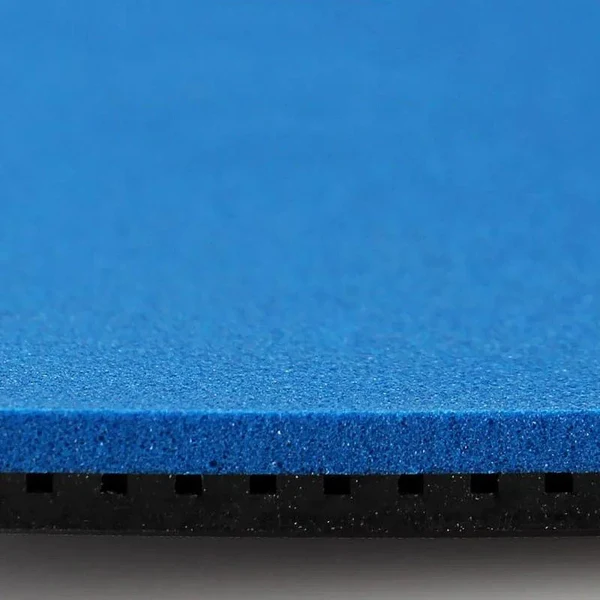
A rubber sheet is a sandwich. On top sits the topsheet — the surface you see and the part that grips the ball. Under it is the sponge, and the sponge’s two numbers, thickness and hardness, shape how the rubber plays more than any marketing label.
Thickness is simply how much sponge sits under the topsheet, and the total rubber (topsheet plus sponge) is capped at 4.0 mm under the rules. Thicker sponge (2.1 mm and “MAX”, which typically means roughly 2.1–2.3 mm depending on the brand) means more energy storage: more speed, more spin potential and a higher arc — but less direct feedback, more weight and less control in the short game. Thinner sponge (1.8–2.0 mm) keeps the ball closer to the blade’s feel, which helps touch play, blocking and chopping. Most attackers should start at 2.0–2.1 mm; MAX is for players whose loops are already consistent, because the extra catapult punishes loose technique.
Hardness is measured by pressing an indentor into the sponge and reading the degrees — but treat cross-brand comparisons with care, because Butterfly, DHS and the German makers do not all use the same scale, and a DHS degree does not equal a German degree. Within one brand’s range, though, the logic is simple. Softer sponges (roughly 35–43° on the European scale) deform easily, so they dwell longer on the ball, forgive off-centre contact and generate spin with modest technique — ideal for backhands and developing players. Medium sponges (44–48°) are the modern attacking default. Hard sponges (48° and up, plus the hard Chinese sheets) only wake up when you hit through them with real force; they repay that force with the highest spin and speed ceiling and the most stable blocking, and punish anything passive.
Match the two numbers to your wing and level, not your ambition. A very common, very effective pattern in this list: a harder, thicker rubber on the forehand where your swing is longest, and a step softer or thinner on the backhand where the stroke is shorter. The forehand/backhand section after the reviews breaks that down properly.
The 7 Best Table Tennis Rubbers Compared
Every rubber below is a current, ITTF-approved model sold as an individual sheet for custom bats — no complete rackets, no discontinued lines. Specs are the manufacturers’ and specialist retailers’ published figures, quoted in each brand’s own ratings so you can compare within a brand honestly.
Butterfly Tenergy 05
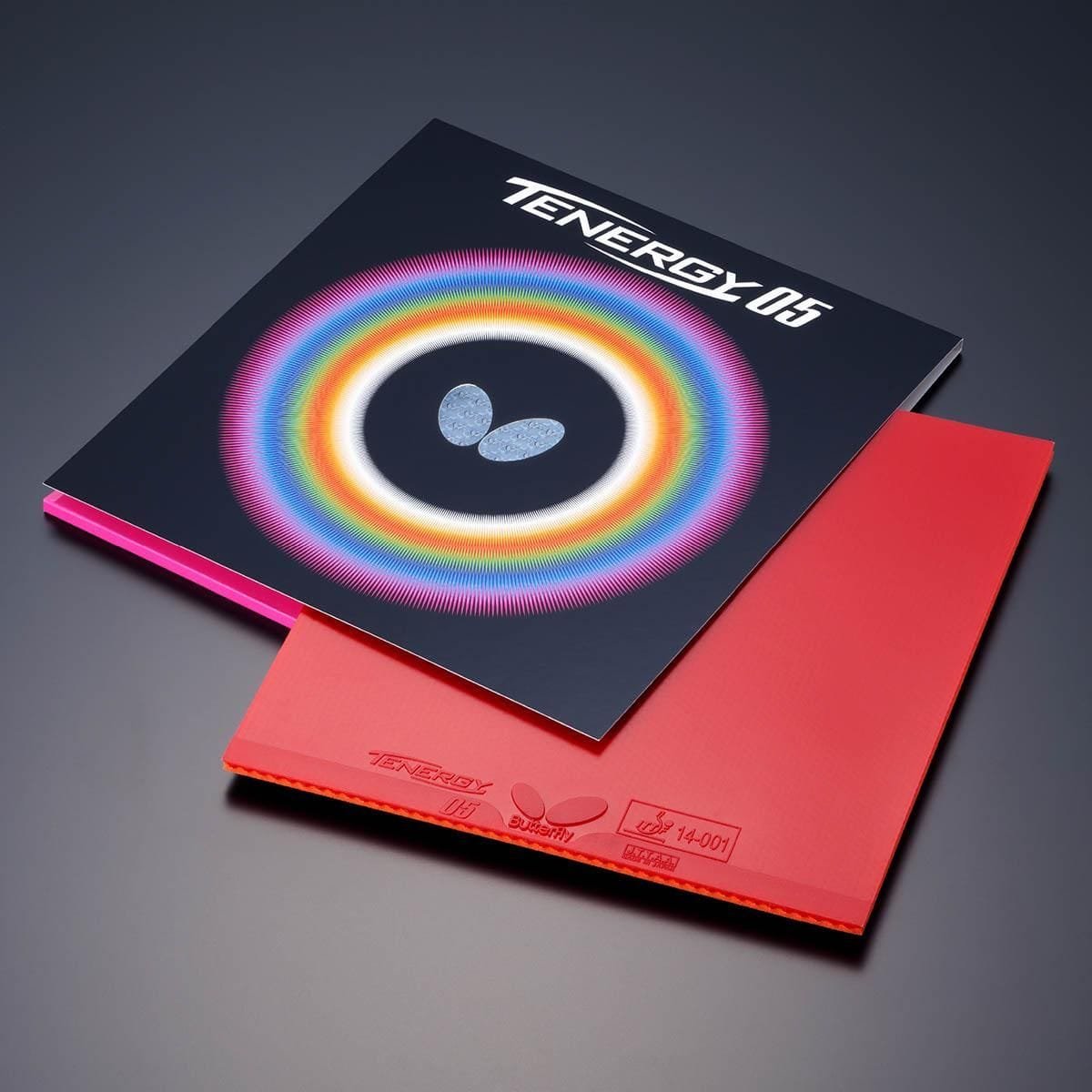
High Tension inverted rubber on Spring Sponge — the benchmark every modern tensor is measured against, for forehand and backhand loopers at or away from the table.
Tenergy 05 launched the modern tension-rubber era, and it is still the first sheet most advanced players reach for. The recipe is Butterfly’s Spring Sponge under a High Tension topsheet whose pimples geometry (the “05” is pimples code No. 5) is shaped for spin: wide enough contact to grip the ball on a brushing stroke, with a trajectory — Butterfly’s Arc rating of 79 is the giveaway — that lifts the ball high over the net and dips it down onto the table. That arc is Tenergy 05’s personality: your loops carry a bigger safety margin than with flatter rubbers, so you can swing with commitment from mid-distance and still land the ball.
At 36° the sponge sits at the medium point of Butterfly’s own scale, and it is the version to buy: the firmer Tenergy 05 Hard (43°, 2.1 mm only) exists for players who hit through everything, but standard 05 is the one that made the name. In 2.1 mm it works on both wings — it has been a world-class backhand as often as a forehand — while 1.9 mm is a sensible step for a first sheet on the side you trust less. Spin on serves and pushes is strong without tackiness, because the grippy surface and springy sponge do the work at low impact.
The honest costs: it is a premium-priced sheet, the grippy topsheet shows wear faster than harder rubbers if you play daily, and the catapult that makes it forgiving will launch loose blocks long until your touch adjusts. None of that stops it being the default recommendation. If you want one rubber that does everything an attacking game needs, this is it.
- Benchmark spin and high, safe arc
- Works on both forehand and backhand
- Huge thickness choice, including a Hard sibling
- Premium price, and it is a consumable
- Catapult needs a session or two of touch adjustment
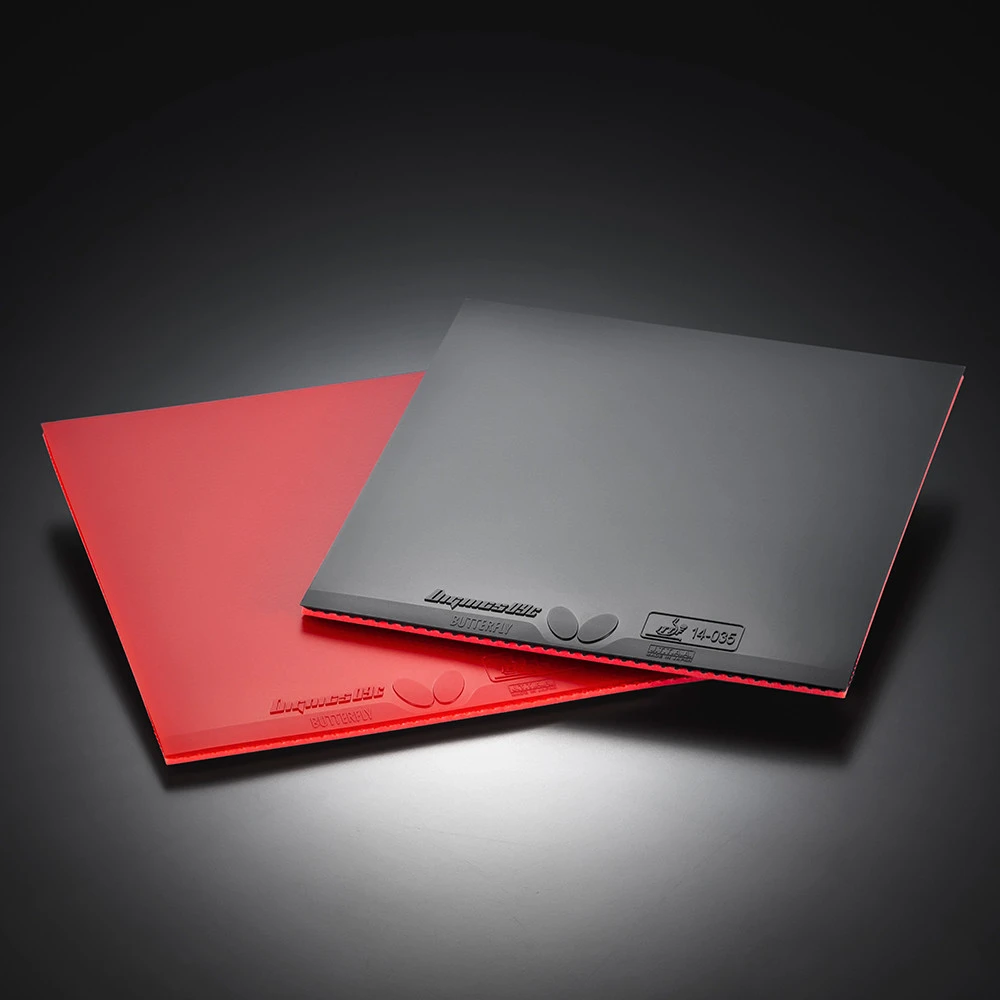
Butterfly Dignics 09C
A hybrid with a sticky, high-friction topsheet over 44° Spring Sponge X — Butterfly’s highest-rated spin rubber, built for advanced forehand-dominant loopers.
Dignics 09C is Butterfly’s answer to a question players had asked for years: what if a rubber had the sticky surface of a Chinese sheet and the engineering of a Japanese flagship? The topsheet is genuinely high-friction — press a ball to it and you feel the tack — and it sits over Spring Sponge X at a firm 44°. Butterfly rates its Spin and Arc at 96 each, the highest spin figures in its own range, and the playing character matches the numbers: a curved, dipping trajectory and spin that keeps loading as you swing harder.
This is a forehand rubber first. The tacky surface keeps serves short and receives controlled, and when you drive through the sponge with a full stroke it produces heavy, late-dipping topspin that is miserable to block. The trade is written into the design: with a Speed rating of 79 it is the slowest sheet in our top group, the hard sponge does little for you on passive contact, and Butterfly itself positions it for higher-level players who generate their own power. On the backhand it can work for strong players who flick and drive actively, but most will find it demanding there.
Two ownership notes. The tacky topsheet is delicate — use a protective sheet after every session and keep it clean, or the grip that you paid for fades. And because the surface grips so hard, incoming spin bites too: reading serves matters more with 09C than with a slicker rubber. For the advanced looper who wants Chinese-style spin without giving up Japanese consistency, nothing else in this list does the same job.
- Highest spin rating in Butterfly’s range
- Tacky grip transforms serves and the short game
- Heavy, dipping topspin on full strokes
- Demands power and technique — poor when passive
- Tacky surface needs protection and cleaning
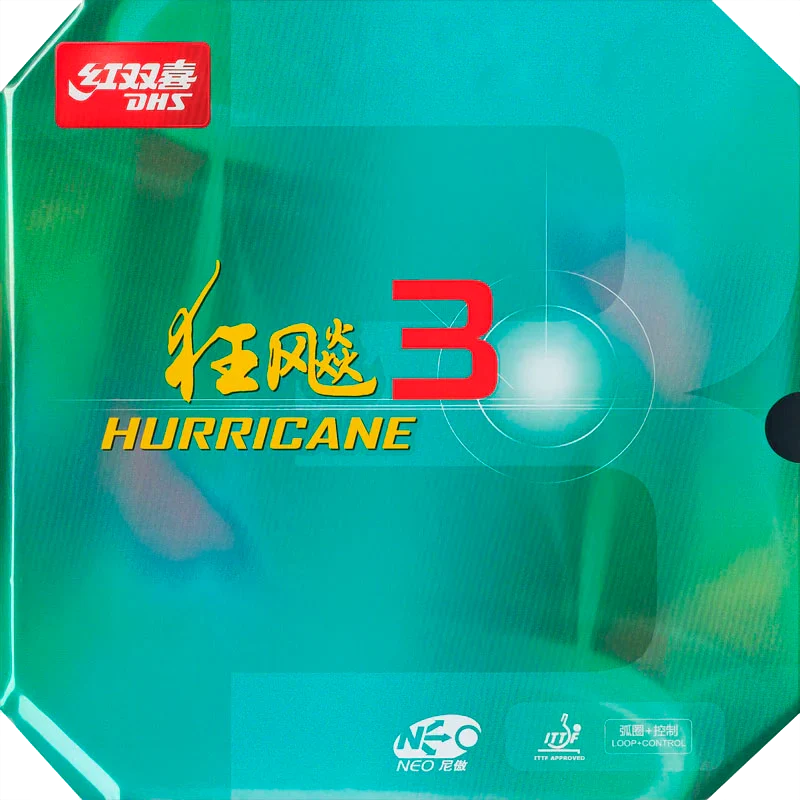
DHS Hurricane 3 NEO
The classic Chinese forehand rubber: a truly tacky topsheet over a hard, factory-tuned NEO sponge, for brush-looping players who build spin with the whole body.
Hurricane 3 is the rubber that defined the Chinese forehand, and the NEO version is the one to buy: its sponge is factory-tuned, DHS’s answer to the speed-glue ban, so it plays livelier than the original without any treatment from you. The topsheet is properly sticky — a clean ball will cling to it — and under that sits a hard sponge offered in 39, 40 and 41 degrees on DHS’s own scale (those degrees read firmer than the same numbers on a German sheet). The commercial version carded here uses the orange #20 sponge; Provincial and National tiers with tighter quality selection, including the firmer blue sponge, exist above it for players deep into the system.
The playing character is the opposite of a tension rubber. The throw is low and direct, the short game is superb because the surface grips without catapult, and spin is something you manufacture: brush the ball with a long, accelerating stroke and the tack plus hard sponge produce some of the heaviest topspin in the sport, with a trajectory that stays lower and kicks harder off the table than a European arc. Block or poke at the ball passively, though, and Hurricane gives you almost nothing — it is a technician’s rubber, and it will expose lazy feet and short strokes within one session.
Choose 39° if you are new to tacky rubbers, 40° as the all-round forehand default, and 2.15 mm as the standard thickness. Keep a protective sheet on it religiously: a tacky surface that collects dust loses the very grip you bought it for. For players raised on Chinese technique — or ready to learn it — this remains the reference forehand sheet, and it does it at a fraction of flagship Japanese prices.
- Heaviest spin potential on full brushing strokes
- Superb serves, receives and short game
- Costs far less than Japanese flagships
- Almost no help on passive shots
- Tacky surface dies quickly if left dirty or unprotected
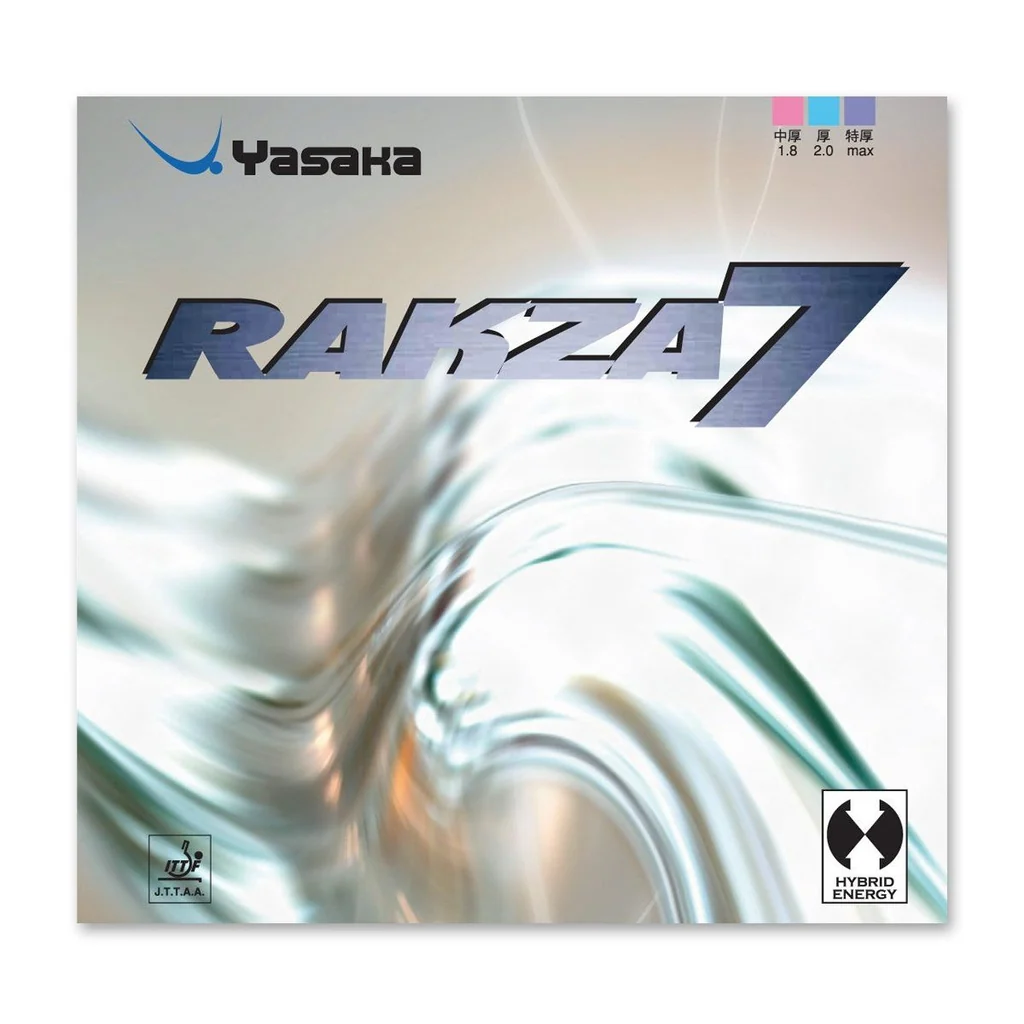
Yasaka Rakza 7
A German-made Hybrid Energy tensor with a natural-rubber-rich topsheet — grippier than most European rubbers, balanced on both wings, and famously easy to live with.
Rakza 7 has been the thinking player’s default upgrade for years, and the recipe explains why. Yasaka builds it in Germany around what it calls Hybrid Energy technology: a medium-hard Power Sponge (quoted as a 45–50° range rather than a single number) under a topsheet with an unusually high share of natural rubber. That natural rubber matters — it gives Rakza 7 a grip and a ball feel closer to a classic rubber than most high-tension sheets, so spin comes from surface contact as much as from catapult, and the rubber talks to you on touch shots instead of trampolining.
Yasaka’s own ratings tell the balance story: Spin 14 against Speed 11 and Control 9. This is not the fastest sheet in the guide and it never pretends to be. What it offers is a topspin game with no weak phase — serves stay spinny and short, the first loop opens reliably, counter-loops from mid-distance have enough arc to clear the net and enough pace to finish, and blocks sit down instead of floating. It plays honestly on both wings, which is why so many players run Rakza 7 forehand with its softer sibling Rakza 7 Soft (37–42°) on the backhand; if your backhand is the weaker wing, that pairing is one of the safest upgrades in this entire guide.
Choose 2.0 mm for a first sheet and MAX once your loop is grooved. If you are stepping up from a ready-made bat or an ageing classic rubber and want modern speed without the bouncy surprises, Rakza 7 is the least risky purchase on this page — and its durability has a strong reputation among club players who change rubbers less often than they should.
- Natural-rubber grip with genuine ball feel
- Balanced on both wings; pairs with Rakza 7 Soft
- Reputation for lasting longer than softer tensors
- Not the fastest sheet here at full power
- Hardness quoted as a range, so feel varies slightly by batch
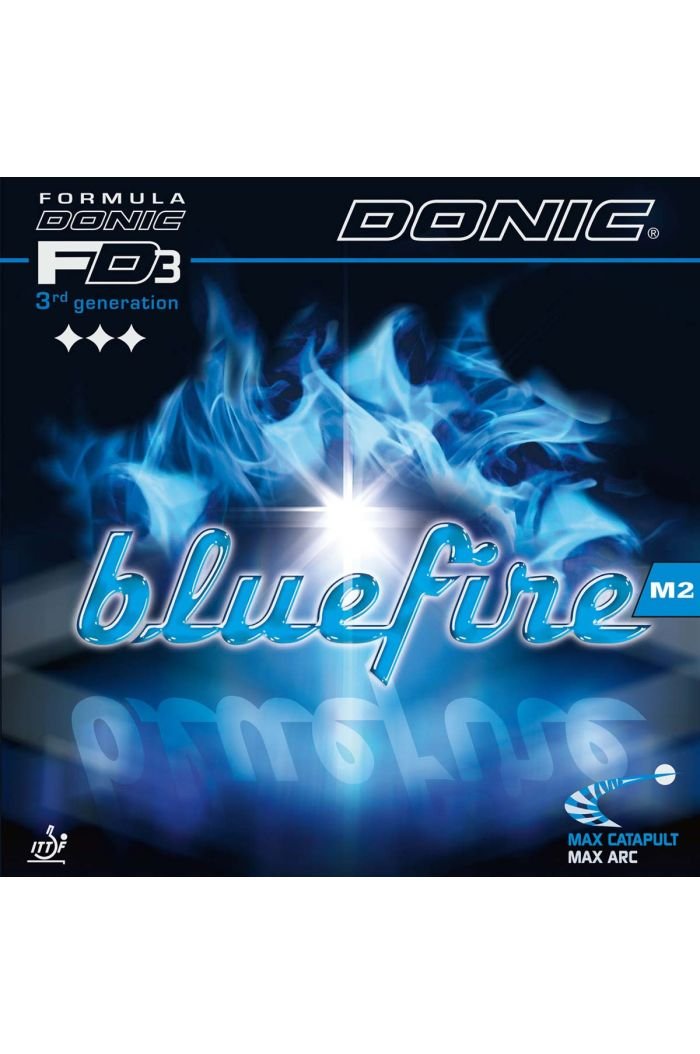
Donic Bluefire M2
Formula FD3 tension rubber with a large-pored blue sponge — the balanced middle of the Bluefire M family, famous for catapult, sound and a very high topspin arc.
The Bluefire family is Donic’s speed-and-spin line, and M2 is the one to buy from it: M1 and M1 Turbo go harder (47.5° and 50°) for players who supply everything themselves, M3 goes softer, and M2 sits at 45° with what Donic describes as the balance point of dynamics, catapult and ball feedback. The construction is the giveaway — a large-pored blue sponge under a topsheet built on a narrow, long pimples geometry, which flexes more at contact and throws the ball in the highest arc of any rubber in this guide.
That arc is the playing personality. Topspins leave the bat on a steep, confident trajectory, so looping from below table height or from distance stops being a percentage gamble, and Donic’s own ratings — Spin 10++, Speed 9++ — point at where the rubber is aimed. It is loud, too: Bluefire’s crisp contact sound is a small thing that players genuinely love, because it gives instant feedback on whether you caught the ball cleanly. On the backhand, the same catapult that powers the forehand can feel eager on passive blocks; players who punch and drive with an active wrist tend to get on with it better than pure blockers.
Take MAX on the forehand if looping is your game, 2.0 mm if you mix in drives and blocks. If your current rubber feels like it tops out — you swing well and the ball still sits up — Bluefire M2’s combination of catapult and arc is the most direct cure in this list.
- Highest, safest topspin arc in the guide
- Strong catapult without going overly hard
- Crisp sound gives clear contact feedback
- Catapult can rush passive backhand blocks
- Large-pore sponge drinks glue — coat evenly when gluing
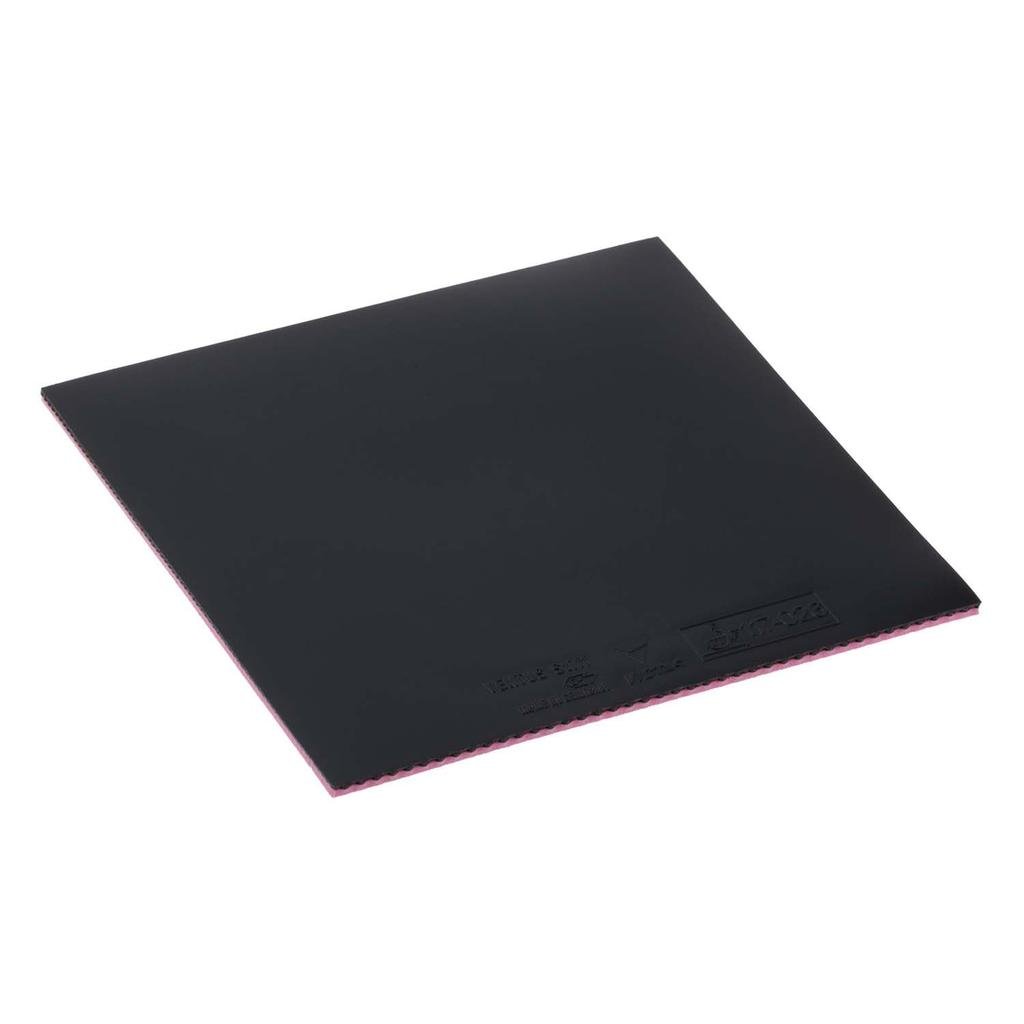
Victas Ventus Extra
The flagship of the Ventus series (formerly TSP Super Ventus): a 47.5° pink performance sponge under a high-energy topsheet, for committed modern topspin players.
Victas built its name in rubber with the Ventus series, and Ventus Extra — the sheet originally sold as TSP Super Ventus before TSP became Victas — is the top of that line. It carries the maximum spin and speed ratings in the series on Victas’s own scale (8.8 for both, with Control at 8.3), powered by a pink 47.5° sponge developed under the brand’s Optimised Rotation Concept: the design goal is a sponge that keeps supporting the topsheet as rotation increases, so heavy loops keep their shape and dip instead of sailing.
In play it is a purposeful, modern attacking rubber. At 47.5° the sponge is properly medium-hard, so it asks for a real stroke — but the topsheet is non-tacky and grippy in the European style, which makes it far more accessible than a Chinese sheet at similar hardness. Drives come off flat and fast, loops carry genuine weight, and counter-topspin at the table is where it feels most alive. Victas also sells it in pink and violet topsheet colours alongside the standard red and black, a legacy of the post-2021 colour rules — one side of your bat must still be black in competition, but the other can now be a colour, and Ventus Extra is one of the few flagships that offers the choice.
MAX thickness and a forehand slot is its natural home; strong backhands who drive and flick actively can run it there too, while the softer Ventus Limber (40°) and mid-hard Ventus Stiff (45°) exist in the same family if you like the feel but want less commitment. For players who find Butterfly prices hard to justify but want a genuine flagship tensor, this is the strongest alternative in the guide.
- Flagship spin-speed balance in the Ventus line
- Medium-hard sponge without a tacky learning curve
- Colour choice (pink/violet) under current rules
- 47.5° sponge is too much for passive strokes
- Less widely stocked than Butterfly or Donic
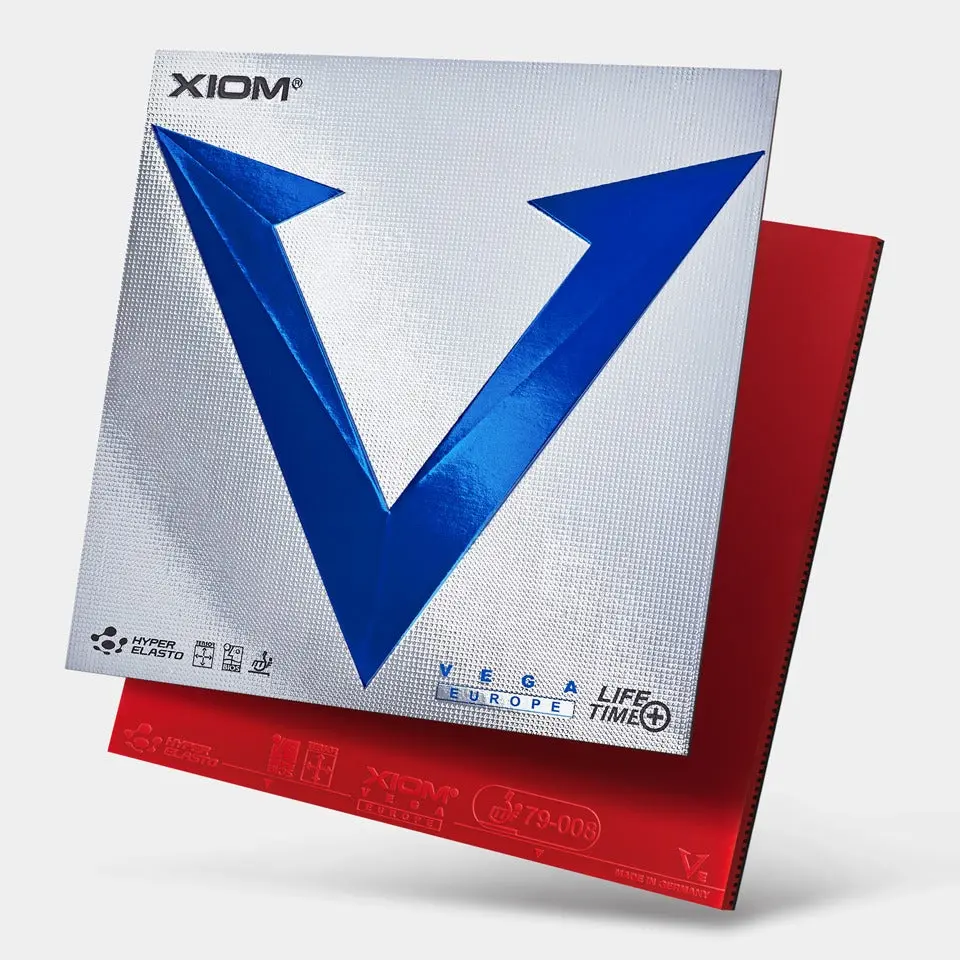
Xiom Vega Europe
The softest rubber in the Vega series: a soft Carbo Sponge and Hyper Elasto topsheet that produce easy spin and a huge margin for error — the backhand and improver’s favourite.
Every guide needs the rubber that makes players better instead of testing them, and in this one it is Vega Europe. It is the softest member of Xiom’s long-running Vega family — a soft version of the brand’s Carbo Sponge at 42.5°, under a Hyper Elasto topsheet, made in Germany with built-in tension. The design priority is the size of the hitting window: the soft sponge deforms easily, so the ball stays on the rubber longer, arcs higher and lands more often, even when your contact is a fraction late or off-centre.
That is precisely the profile a backhand wants. The backhand stroke is shorter, with less body behind it, so a rubber that generates spin and clearance without a full swing is worth real points — Vega Europe has been a default backhand recommendation for developing and intermediate players for years for exactly this reason. Blocks absorb pace instead of rebounding it long, flicks lift safely, and the first backhand topspin most players ever learn is usually learned on something like this. On the forehand it suits all-round and developing players who win with placement and consistency rather than power.
Start at 2.0 mm; 1.8 mm maximises control for a first custom bat, and MAX adds speed once your technique is ready for it. The ceiling is the trade: advanced loopers will outgrow its top-end pace, and very soft sponges show wear sooner under heavy daily use. But judged on what it is for — control, spin security and confidence on the wing that needs help — nothing else in this guide does the job as kindly.
- Most forgiving rubber in the guide
- Superb backhand control, blocking and flicks
- Easy spin for developing technique
- Advanced power loopers will hit its ceiling
- Soft sponge wears faster under heavy daily play
Side-by-Side Comparison
Use this table to shortlist by family and hardness, then read the full card before you buy. Hardness figures are each maker’s own scale — compare them within a brand, not across brands.
| Rubber | Family | Hardness | Thickness options | Best wing | Choose it if… |
|---|---|---|---|---|---|
| Butterfly Tenergy 05 | Grippy tension | 36° | 1.7 / 1.9 / 2.1 mm | Both | You want the benchmark all-round attacker |
| Butterfly Dignics 09C | Hybrid (tacky top) | 44° | 1.9 / 2.1 mm | Forehand | You swing fully and want maximum spin |
| DHS Hurricane 3 NEO | Tacky Chinese | 39–41° (DHS) | 2.1 / 2.15 / 2.2 mm | Forehand | You brush-loop with Chinese technique |
| Yasaka Rakza 7 | Grippy tension | 45–50° | 1.8 / 2.0 / MAX | Both | You want balance and natural-rubber feel |
| Donic Bluefire M2 | Grippy tension | 45° | 1.8 / 2.0 / MAX | Forehand | You loop from distance and love a high arc |
| Victas Ventus Extra | Grippy tension | 47.5° | 1.8 / 2.0 / MAX | Forehand | You want a flagship tensor beyond Butterfly |
| Xiom Vega Europe | Grippy tension (soft) | 42.5° | 1.8 / 2.0 / MAX | Backhand | Control and easy spin matter most |
All seven are inverted (pimples-in), ITTF-approved sheets sold individually for custom bats. Ratings quoted in each review are the makers’ own published figures.
Forehand vs Backhand: Choosing for Each Wing
Your two wings make different strokes, so they usually want different rubbers — and mixing sheets is not indecision, it is how most serious setups are built. The forehand stroke is long, uses the body’s rotation and finishes with real force, so the forehand side can handle — and reward — the harder, thicker, more demanding rubbers in this guide: Hurricane 3 NEO or Dignics 09C for maximum spin, Bluefire M2 or Ventus Extra in MAX for arc and power, Tenergy 05 in 2.1 mm for the high-arc all-round game.
The backhand is a shorter, wrist-and-forearm stroke played closer to the body, which changes the brief: dwell time and control matter more than the last percent of power. Softer, grippier sheets shine here — Vega Europe is the guide’s specialist, Rakza 7 and its softer Soft sibling are the balanced option, and Tenergy 05 in 1.9 or 2.1 mm is the premium pick for players whose backhand loop is already a weapon. A reliable rule of thumb: go one step softer or thinner on the backhand than the forehand, and only run a hard rubber on both sides once both strokes are genuinely grooved.
Weight is the hidden variable. Two MAX sheets on a heavy blade can push a setup past what your wrist wants for fast exchanges, which is another reason the thinner backhand option exists. And one rule is not optional in competition: one side must be black, the other a contrasting approved colour — standard red for most, or the newer approved colours some rubbers like Ventus Extra offer.
Buying Guide: How to Choose Your Rubber
1. Pick your family first. Decide how you actually play, not how you would like to. If you brush the ball with a long, full-body forehand and live on spin, start in the tacky and hybrid group (Hurricane 3 NEO, Dignics 09C). If your strokes are compact and you rely on timing, the grippy tension group (Tenergy 05, Rakza 7, Bluefire M2, Ventus Extra, Vega Europe) will give you more on every average shot.
2. Match hardness to your level, honestly. Softer and medium sponges generate spin with ordinary technique and forgive ordinary contact. Hard sponges (47.5° and above, and the hard Chinese sheets) only perform when you hit through them. Stepping up one hardness level too early is the most common buying mistake in table tennis — it feels powerful for a week and then quietly costs you consistency.
3. Take the middle thickness first. 2.0 or 2.1 mm is the right default for attacking players; go 1.8 mm for control-first and developing setups, and MAX only when your loop is already reliable, because MAX adds speed, spin and weight all at once.
4. Soften the backhand a step. Whatever you choose for the forehand, the backhand usually plays better one step softer or thinner. Vega Europe and Rakza 7 (or Rakza 7 Soft) exist in this guide largely for that side of the bat.
5. Think about the blade underneath. Rubber cannot fix a mismatched blade, and a very fast carbon blade under two hard MAX rubbers is a setup for advanced players only. If you are also choosing the wooden part of the bat, start with a controlled blade and let the rubbers provide the speed.
6. Buy approved sheets and budget for replacement. Every rubber in this guide is ITTF-approved, which you need for league and tournament play. And remember rubber is a consumable: two sheets a year is a normal rhythm for regular club players, so a slightly cheaper sheet you replace on time beats a flagship you nurse for two seasons. Finally, your rubber only performs on a decent surface with a proper ball — see our best table tennis tables and best table tennis balls guides if either of yours is holding you back.
Replacement and Care: When Is a Rubber Worn Out?
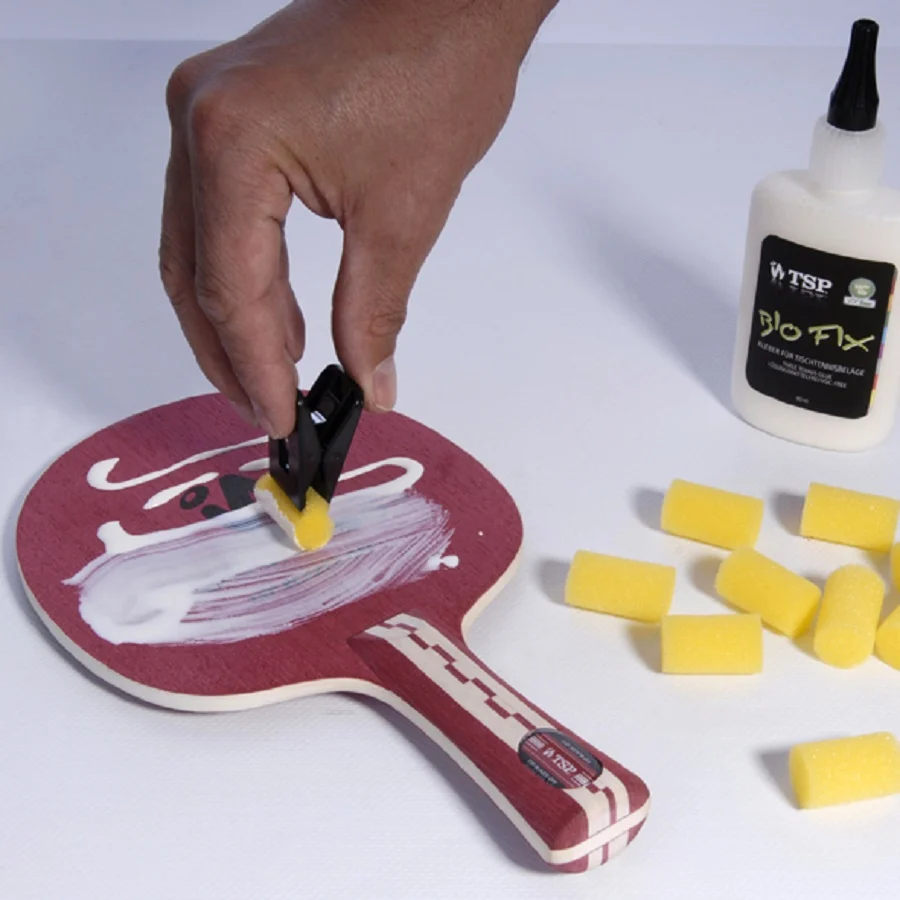
Rubber wears out gradually, which is exactly why players leave it too long — there is no single session where it fails, just a slow slide in grip and rebound that you adapt to without noticing. These are the signs that a sheet is done:
The grip test fails. Drag a clean ball across the surface or press and lift it: a healthy grippy or tacky sheet resists and grabs. If the ball skates across with a squeak of nothing, the topsheet’s friction is gone — and with it, your spin. Compare against the less-used area near the handle if you are unsure; the difference is usually obvious.
The surface looks tired. Dull, shiny or pale patches in the hitting zone, a topsheet that looks polished compared with its edges, or — on tacky rubbers — a surface that no longer picks up its protective sheet cleanly all mean the grip layer has worn through its best life.
The sponge feels flat. Tension rubbers lose catapult as the sponge ages. If balls that used to clear the net now clip it, and your loops have lost their dip, the sponge has likely faded — this is ageing, not a technique slump.
The edges crumble or the sheet lifts. Chunks missing at the edges, cracks, or a sheet peeling away from the blade are end-of-life signs, and a damaged sheet can also fall foul of equipment rules in competition.
How long a sheet lasts depends on playing hours, not the calendar: a rubber’s peak is measured in hours on the table, so a player training several times a week goes through sheets far faster than a once-a-week player. Judge yours by the signs above rather than a date. When you do replace, use water-based, VOC-free glue — it is what competition rules require — apply thin coats to blade and sponge, let them dry clear, roll the sheet on without stretching it, and trim the excess. Factory-tuned sponges like Hurricane’s NEO are legal because the tuning is built in by the manufacturer; adding your own VOC-based boosters or glues is not permitted in sanctioned play, so keep the chemistry to water-based glue and cleaner.
Between sessions, care is simple and it genuinely extends a sheet’s life: wipe dust off with a damp sponge or proper rubber cleaner after play (never household sprays), let it dry, and store the bat with protective plastic sheets on both rubbers, in a case, away from heat and sunlight. Tacky rubbers benefit most — their grip lives on the surface, and an uncovered tacky sheet in a dusty hall ages in days.
Frequently Asked Questions
What is the best table tennis rubber for a beginner building a custom bat?
Start with a soft, controlled tension rubber such as Xiom Vega Europe in 1.8 or 2.0 mm. Its soft sponge keeps the ball on the rubber longer, which makes learning topspin far easier, and it controls pace instead of adding it. Yasaka Rakza 7 in 2.0 mm is the step up once your strokes are consistent. Avoid hard flagships at the start — a 47.5° sponge or a tacky Chinese sheet will punish technique you have not built yet.
What is the difference between tacky and grippy rubbers?
Tacky rubbers, the Chinese style, have a sticky topsheet that grips the ball through surface friction, paired with a hard sponge. They produce very heavy spin on full, brushing strokes and keep the short game tight, but give little help on passive shots. Grippy tension rubbers, the European and Japanese style, use a non-sticky grippy topsheet and a springy, internally tensioned sponge that adds catapult and a higher arc, so they generate spin and pace with more compact strokes. Hybrids like Dignics 09C combine a sticky topsheet with a tension sponge.
Which sponge thickness should I choose: 1.8, 2.0 or MAX?
For most attacking players, 2.0 or 2.1 mm is the right default — it gives near-full speed and spin while keeping some touch. Choose 1.8 mm if control, blocking or a developing technique matters most, or for a first custom bat. Choose MAX only when your loop is already consistent: it maximises speed, spin and arc but adds weight and reduces short-game feel, and its extra catapult punishes loose contact.
Should my forehand and backhand rubbers be different?
Usually, yes. The forehand stroke is longer and stronger, so it can use a harder, thicker rubber; the backhand stroke is shorter, so it plays better with a softer or thinner sheet that offers more dwell and control. A common setup from this guide is a flagship on the forehand — Tenergy 05, Bluefire M2 or Hurricane 3 NEO — with Xiom Vega Europe or Yasaka Rakza 7 on the backhand. Identical rubbers on both sides also work, and many players do it; just avoid running a hard, demanding sheet on a backhand that is not ready for it.
How do I know when my table tennis rubber is worn out?
Run the grip test: press a clean ball to the surface and drag it. If it slides instead of grabbing, the topsheet’s friction is gone. Other signs are dull or shiny patches in the hitting zone, loops losing their dip and clearance as the sponge’s catapult fades, crumbling or cracked edges, and the sheet lifting from the blade. Judge by these signs rather than the calendar — playing hours wear a rubber out, not months on the shelf.
What is the difference between inverted, short pips and long pips?
Inverted rubber has its pimples facing inwards, leaving a smooth, grippy surface — it generates the most spin and is what almost all attacking and all-round players use, including every rubber in this guide. Short pips face outwards and hit through spin: flatter, faster shots with less spin of your own, for close-to-the-table hitters. Long pips use tall, flexible pimples that bend and reverse or scramble incoming spin, a defensive and disruptive tool that cannot drive a topspin game.
Do table tennis rubbers need to be ITTF approved?
For league and tournament play, yes — the rubber must be on the ITTF’s approved list and carry its logo, one side of the bat must be black, and the other side a contrasting approved colour. All seven rubbers in this guide are ITTF-approved sheets. For purely casual play approval does not matter, but approved rubbers are also simply the ones built to proper competition standards.
How long does a table tennis rubber last?
There is no single number, because wear follows playing hours and how well the sheet is protected between sessions. A rubber played on several times a week fades far sooner than one used weekly, and every sheet declines gradually rather than failing at once. Watch for the grip test failing, a polished hitting zone and lost arc on your loops — those signs, not a date, tell you it is time to re-sheet. Protective film and a bat case noticeably extend a sheet’s useful life.
Our Verdict
If you buy one rubber from this guide, make it the one that matches your strongest honest description of your game. All-round attackers: Tenergy 05. Spin obsessives with a full forehand: Dignics 09C for hybrid grip, Hurricane 3 NEO for the pure tacky school. Balanced upgraders: Rakza 7. Distance loopers: Bluefire M2. Committed modern topspin players looking beyond Butterfly: Ventus Extra. And for the backhand that needs help — or the player building their first custom bat — Vega Europe, every time.
Whatever you choose, glue it well, protect it after every session, and replace it when the grip test says so. Fresh rubber is the cheapest performance upgrade in table tennis — and it starts with the right sheet.
Affiliate disclosure: Alishuttler is reader-supported. The Amazon links in this guide are affiliate links with our tag, so if you buy through them we may earn a commission at no extra cost to you. It never changes which rubbers we pick — every sheet above earned its place on specs, playing character and current availability.