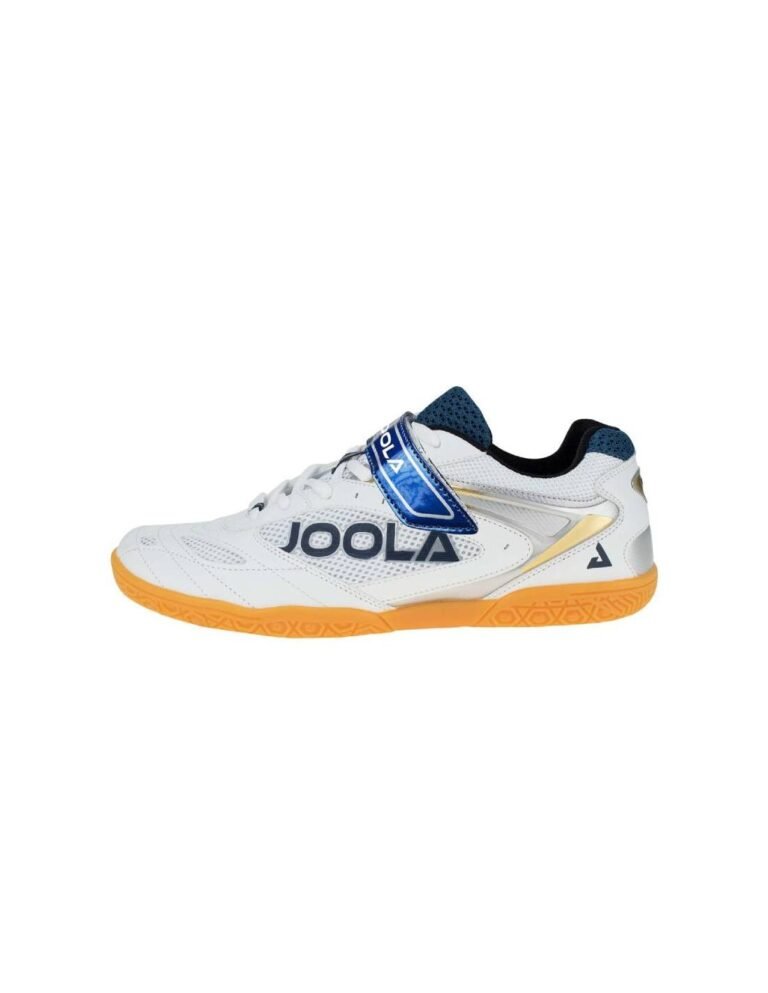

At advanced level the shoe stops being footwear and becomes part of the stroke: another fraction of a second bought on the recovery step, another wide ball reached in balance. The seven shoes below are the pro-tier models the brands themselves position for serious competition — each one read off its maker’s own specification sheet, with every named sole, foam and fit system checked, and every missing weight printed as missing.
Quick picks
- Best overall for advanced players — Mizuno Wave Medal 8 BOA: the current Medal flagship with a BOA dial, the first ENERZY NXT sole in table tennis and the only verified weight in this guide.
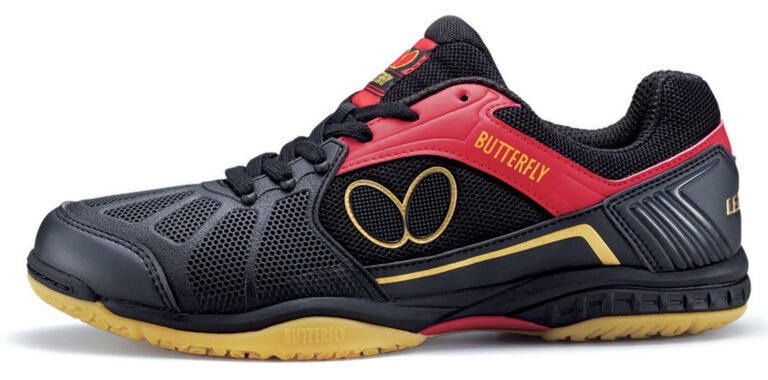
- Best tournament grip system — Butterfly Lezoline Mach: Wingrip outsole, B-Absorber forefoot sponge, B-Ridge bridge and STB anti-distortion in one pro shoe.
- Best rebound build — Li-Ning Hawk Eye 2.0 TT PRO: BOUNCE+ in the forefoot, PHYLON at the heel and a TUFF OS outsole, from Li-Ning’s professional line.
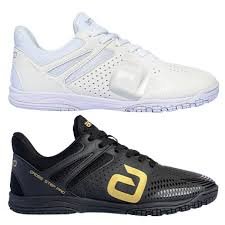
- Best heel lock and support — andro Cross Step PRO: the Cross Step evolved with the andro Pro Team, a foot-enclosing heel and the proven TPU+ midfoot insert.
- Best cushioned pro shoe — GEWO Flex Force Pro I: a Phylon midsole, a stated 16 mm heel drop and a spiral forefoot element from GEWO’s professional model.
- Best energy heel design — TIBHAR Blizzard Speed II: a split sole, the ENERGY CONVERTER heel concept and ScaleTex X-protectors.
- Best lightweight pro-line feel — VICTAS V-Shoes 612: an innovative upper, wide-spaced air inlets and an extra-soft padded heel in VICTAS’s performance line.
How we chose these seven — and what advanced actually buys you
Our pillar guide to the best table tennis shoes owns the all-rounders. Our women’s table tennis shoes and beginners’ table tennis shoes own their audiences, our seniors guide owns comfort-first play, and our intermediate guide owns the first step up. This page owns the top of the ladder: the shoes a brand builds for the player whose footwork is already trained, whose matches run long, and who can feel the difference between a generic trainer sole and a sole engineered for the slide, the lunge and the two-step recovery.
The rule for inclusion was evidence. A shoe made this list only if its maker publishes named technology or a professional positioning we could verify — a fit system, a named midsole material, a structured outsole, a pro-team development credit — and only if no sibling guide already cards it. That evidence rule cut real candidates: a current Xiom shoe whose only verifiable copy lived in a catalogue, and a Mizuno name that turns out not to exist in Mizuno Japan’s present lineup, both stayed out rather than be padded with second-hand description. What remains is seven shoes from seven brands, every specification below traceable to the maker’s own words.
What does the advanced tier actually add? Three things, on the spec sheets. First, fit systems: a BOA dial that adjusts in millimetres, heels reshaped to enclose the foot, lasts drawn from top-player feedback. Second, named engineering in the sole: rebound foams, bridge pieces, converters and plates with proper names and stated jobs, instead of an anonymous “EVA midsole”. Third, honesty problems — because at this level the spec sheets get quieter, not louder: of seven flagship shoes, exactly one maker states a weight. We print that gap on every card rather than filling it with retailer estimates.
The seven shoes at a glance
| Shoe | Best for | Signature technology (maker’s terms) | Sole build | Sizes | Stated weight |
|---|---|---|---|---|---|
| Mizuno Wave Medal 8 BOA | Best overall for advanced players | BOA dial fit; ENERZY NXT sole; MIZUNO WAVE | Synthetic sole, non-marking, XG Rubber | 22.5–28.5 cm · 2E | About 285 g (26.0 cm) |
| Butterfly Lezoline Mach | Tournament grip and sliding footwork | Wingrip; B-Absorber; B-Ridge; STB | Rubber + EVA sole | US men’s 5.0–12 | Not published |
| Li-Ning Hawk Eye 2.0 TT PRO | Rebound-driven attacking play | BOUNCE+ forefoot; TUFF OS outsole | Rubber outsole + PHYLON midsole + TPU | EU, incl. third sizes | Not published |
| andro Cross Step PRO | Heel lock and midfoot support | TPU+ midfoot insert; Pro Team development | Profiled sole (andro) | Not stated by maker | Not published |
| GEWO Flex Force Pro I | Cushioned professional play | Phylon midsole; spiral forefoot element | Non-marking solid rubber, wave + honeycomb | EU 36–46 | Not published |
| TIBHAR Blizzard Speed II | Energy-return heel design | ENERGY CONVERTER; MAXX TURN PROTECT; ScaleTex | Split sole, two-component Phylon | EU sizes listed | Not published |
| VICTAS V-Shoes 612 | Lightweight pro-line feel | Innovative upper material; padded heel | Non-marking outsole | EU sizes listed | Not published |
Read the weight column as the guide’s honesty test. One maker in seven states a figure. Wherever a card below says “not published”, that is the whole answer — we never substitute a retailer’s estimate or a parcel’s shipping weight, and neither should you when you compare.
1. Mizuno Wave Medal 8 BOA — the dial-fitted flagship
Mizuno’s current Medal flagship in its BOA variant: millimetre fit adjustment, the first ENERZY NXT sole in the sport, and the only honest weight on this page.
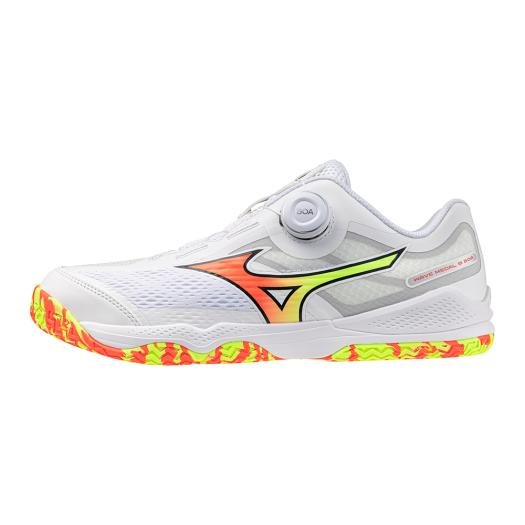
Start with the distinction, because Mizuno’s Medal family is crowded and this site already cards two of its relatives. The intermediate guide covers the Wave Medal Neo, the earlier Medal generation built around a Stepillar sole and FOAM WAVE. The seniors guide covers the Wave Medal 8 Wide, the 3E version of the current shoe. This card is neither: it is the Wave Medal 8 BOA, the dial-fitted variant of Mizuno’s current Medal 8, sold by Mizuno Japan under style 81GA2692 — and it earns the top spot here on the strength of the most complete specification sheet in the guide.
The headline is the sole. Mizuno says the Medal 8 generation is the first table tennis shoe to carry a sole built on MIZUNO ENERZY NXT, its midsole material described as softer, higher in rebound and lighter than the ENERZY foam it succeeds. Around it sits the rest of Mizuno’s named stack: the MIZUNO WAVE plate structure, credited with balancing cushioning and stability; PoWnCe, the midsole material Mizuno describes as matching its ap+ material for rebound at about ten percent less weight; a soft sponge layer in the midsole area for comfort; and XG Rubber on the outsole, Mizuno’s extra-grade rubber aimed at grip and durability through fast, violent movement — Mizuno’s phrasing for exactly the movement pattern of advanced footwork. The sole is non-marking, as tournament halls require.
Then there is the fit. The BOA fit system replaces laces with a dial: Mizuno credits it with fitting adjustment in millimetre units and with fast on-and-off — a small thing in the changing room and a real thing between matches, when a quarter-turn of dial is the difference between a heel that holds and a heel that swims. The upper pairs synthetic fibre with artificial leather, with engineered mesh across the outer forefoot for a softer feel, and the cup insole removes for airing or replacement. Two colourways are listed by Mizuno Japan: navy with galaxy silver, and white with orange and yellow.
And the number. Mizuno Japan states the weight plainly: about 285 grams for one shoe at 26.0 cm, in a 2E-equivalent normal last, across sizes 22.5 to 28.5 cm. At this level of the market, that single honest figure is rarer than any foam name — six of the seven brands in this guide publish no weight at all. If your buying decision runs on comparable numbers, this is the one card that gives you one.
- Fit system: BOA dial — millimetre-level adjustment and quick release, per Mizuno.
- Sole technology: ENERZY NXT (first use in a table tennis shoe, per Mizuno), MIZUNO WAVE, PoWnCe, XG Rubber outsole; non-marking.
- Upper: synthetic fibre and artificial leather; engineered mesh on the outer forefoot; removable cup insole.
- Sizes: 22.5–28.5 cm. Width: 2E equivalent (normal).
- Stated weight: about 285 g, one shoe at 26.0 cm (Mizuno Japan).
Why it leads
- The most complete published spec sheet in this guide
- Dial fit for between-match micro-adjustment
- Only card with a maker-stated weight and size basis
Know before you buy
- Sold through Mizuno Japan channels — check your region’s availability
- 2E is a normal last, not a wide fit
- Sizes are listed in centimetres — measure, don’t convert by habit
Check the current Medal 8 BOA listings, colours and your size before you order.
Check price on Amazon2. Butterfly Lezoline Mach — four named systems, one pro shoe
Butterfly’s high-performance shoe for the professional and serious player, built around Wingrip, B-Absorber, B-Ridge and STB.
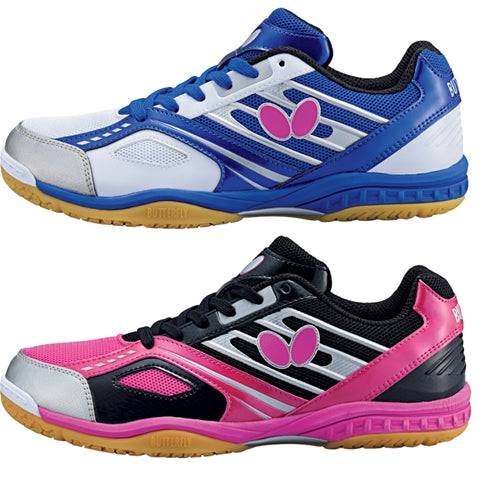
Butterfly positions the Lezoline Mach without hedging: a high-functioning shoe, in its words, to meet the needs of the professional and serious table tennis player. It is the flagship of the same Lezoline family that runs through this site’s other guides — the Rifones in the pillar, the Levalis and Nine in the women’s guide, the Unizes and Vilata in the beginners’ guide, the Gigu in the seniors guide and the Reiss in the intermediate guide — and the Mach is where the family’s technology list runs longest.
Four named systems, each with a stated job. B-Absorber is a special shock-absorbing sponge placed between the outer and middle sole of the forefoot, credited with cushioning and flexibility where the advanced player loads the shoe hardest — the push-off and the landing of the lunge. Wingrip is the specially formed outsole, credited with a high level of grip that assists correct movement; Butterfly describes the sole material as scuff resistant as well as grippy, which matters on hall floors that punish soft rubber. B-Ridge is the bridge-shaped middle sole, there to support the sliding motion that proper table tennis footwork uses instead of flat-footed steps. And STB works against distortion — the twisting the shoe suffers through the sport’s particular movement — to keep footwork stable.
Read together, that is a coherent engineering story rather than a badge collection: absorb at the forefoot, grip at the floor, bridge the slide, resist the twist. The construction underneath is conventional pro-shoe material — a synthetic-fibre upper, a sole of rubber and EVA — and the sizing is US men’s 5.0 to 12, with the shoe offered as unisex by Butterfly’s US retailer against its size chart. Blue is the standard colour; a black and pink version exists by special order. One honesty note, because it is the pattern of this whole guide: Butterfly publishes no weight for the Mach. A marketplace listing that appears to state one is quoting a shipping weight for the parcel, not the shoe — ignore it, as we have.
- Positioning: Butterfly’s high-performance shoe for professional and serious players.
- Systems: B-Absorber forefoot sponge; Wingrip outsole; B-Ridge bridge midsole; STB anti-distortion.
- Construction: synthetic-fibre upper; rubber and EVA sole.
- Sizes: US men’s 5.0–12 (unisex via Butterfly’s chart). Colours: blue; black/pink by special order.
- Stated weight: not published by Butterfly.
Why it is here
- Four named systems, each with a defined job
- Built explicitly for sliding, tournament footwork
- The flagship of a family this site tracks at every level
Know before you buy
- No published weight — compare on systems, not grams
- Black/pink is special-order through the US retailer
- Unisex sizing runs off the men’s chart — check it twice
See the Mach in blue, check the unisex size chart and confirm your US size.
Check price on Amazon3. Li-Ning Hawk Eye 2.0 TT PRO — the professional line, split by zones
Li-Ning’s premium unisex competition shoe: BOUNCE+ under the forefoot, PHYLON under the heel, and a TUFF OS outsole built to be scraped.
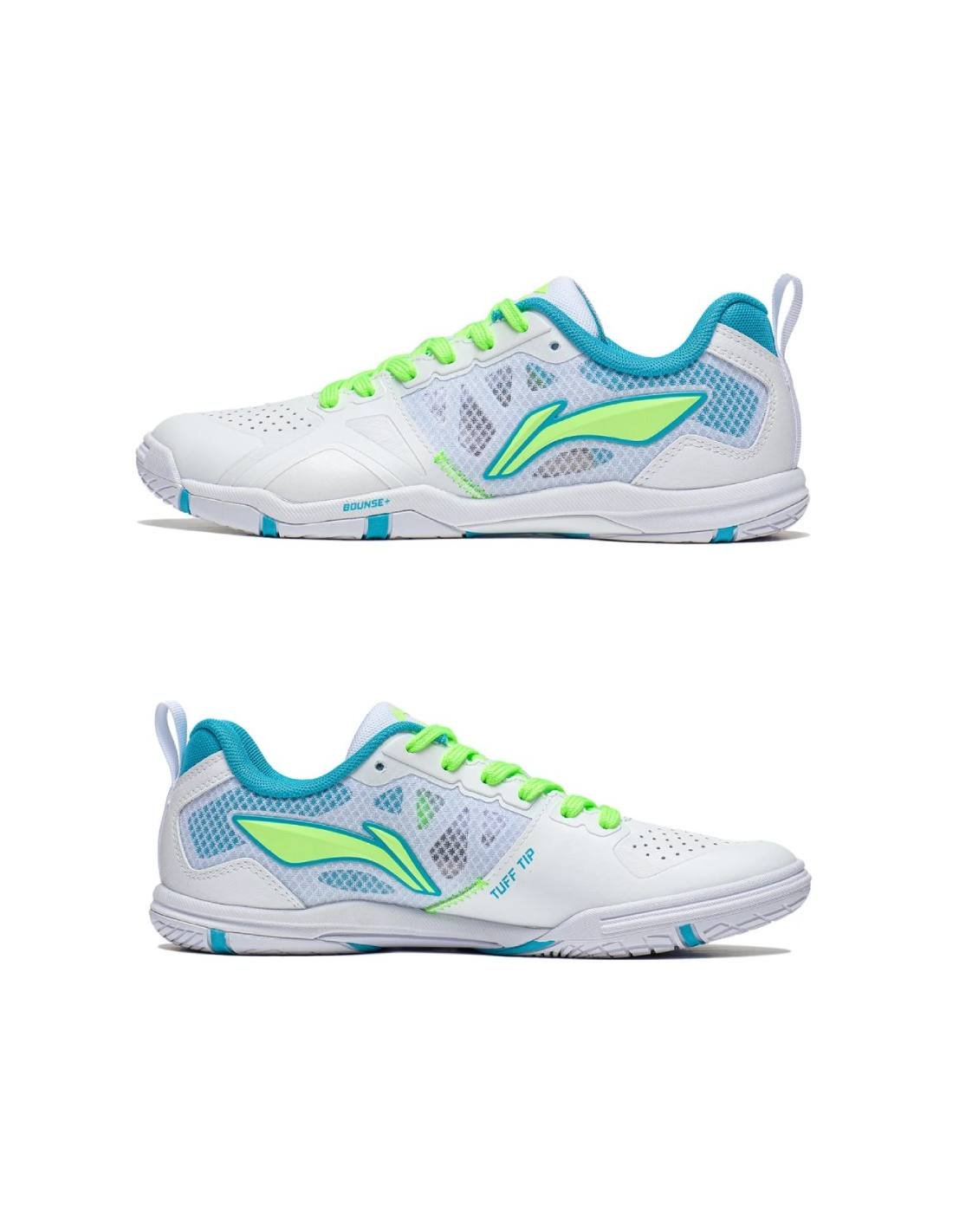
The pillar guide cards Li-Ning’s Ma Long shoe; the Hawk Eye 2.0 TT PRO is a different animal — the shoe Li-Ning’s listing describes as a premium unisex professional model for competition and training, and the most explicitly zoned construction in this guide. Where most shoes pick one midsole story, the Hawk Eye splits the shoe by function: rebound at the front, absorption at the back, abrasion resistance at the floor.
The forefoot runs BOUNCE+, which Li-Ning describes as a compression-resistant material with high rebound potential. Li-Ning supports it with a number — its stated testing, conducted by an international testing organisation, shows the material improving vertical rebound performance by 27 percent against conventional midsoles. That figure is Li-Ning’s, printed here as a maker’s claim and nothing more; what is verifiable is the design intent, a forefoot built to return energy rather than swallow it, for a game played on the front of the foot. The rearfoot takes the opposite job: a cushioned, shock-absorbing PHYLON midsole, so the heel strikes that end a wide recovery are absorbed instead of returned.
Underneath both sits the TUFF OS outsole — a synthetic rubber Li-Ning calls super abrasion resistant, stating abrasion resistance five times that of ordinary rubber, a figure again printed as the maker’s own claim. The design logic is easy to follow without endorsing any number: advanced players drag and pivot on the same few square centimetres of forefoot rubber for hours a week, and Li-Ning says this compound is borrowed from where wear demands are highest. The listing’s own summary of the sole build is rubber outsole, PHYLON midsole and TPU — the TPU element consistent with the midfoot structure a shoe at this level needs. Up top, the upper is a laser-perforated microfiber — synthetic leather and textile in the spec line — with a Cool Shell yarn at the inner and outer waistband for airflow, in white and blue. Li-Ning publishes no weight for the shoe, and EU sizing includes the brand’s third-size steps, so order against the centimetre column of its chart, not the EU number alone.
- Positioning: premium unisex professional shoe for competition and training.
- Forefoot: BOUNCE+ high-rebound material (Li-Ning’s stated test figure: 27% better vertical rebound than conventional midsoles).
- Heel and sole: cushioned PHYLON midsole at the rearfoot; TUFF OS rubber outsole (Li-Ning states five times the abrasion resistance of ordinary rubber); TPU in the sole build.
- Upper: laser-perforated microfiber with Cool Shell yarn panels; synthetic leather and textile.
- Stated weight: not published by Li-Ning.
Why it is here
- The clearest zoned construction in the guide
- A professional-line shoe from the sport’s biggest domestic market
- Outsole compound chosen explicitly for abrasion
Know before you buy
- Both headline figures are Li-Ning’s own stated claims
- No published weight
- Third-size EU steps make the cm column the one to trust
Check the Hawk Eye 2.0 TT PRO in white/blue and size it by centimetres.
Check price on Amazon4. andro Cross Step PRO — evolved with the Pro Team
The Cross Step taken up a level: a heel reshaped to enclose the foot, reinforcement where the force lands, and the proven TPU+ midfoot insert.
The intermediate guide cards the andro Cross Step 2 — the all-round talent of andro’s range, with its Air Ventilation Window and 3D Sole. The Cross Step PRO is the shoe above it, and andro is precise about the relationship: an evolution of the andro Cross Step, developed in collaboration with the andro Pro Team. That credit matters at this level. It is the difference between a shoe designed for the category and a shoe revised with the players who compete in it.
andro’s changes are concentrated where advanced footwork punishes a shoe. The newly shaped heel area encloses the foot and provides maximum support — andro’s words — because the heel is the anchor of every recovery: if it moves inside the shoe, the next step starts late. The front outer area carries material reinforcement, placed, as andro puts it, where the greatest force is exerted — the outside of the forefoot that takes the load of the lunge and the drag of the pivot. And through the midfoot runs the proven TPU+ insert, the same stabilising core the Cross Step line is known for, credited with stabilising the midfoot and preventing twisting in that area. Anti-twist structure is close to a definition of an advanced shoe: the movements that need it — the planted pivot, the one-foot landing off a wide forehand — barely exist in social play and define competitive play.
Two colourways are listed, Black/Gold and White/Silver, with what andro calls an elegant, sporty design. Two honesty notes belong on this card. First, andro’s PRO copy does not list the ventilation window or the cushioned 3D Sole that the Cross Step 2 carries, so we do not claim them for the PRO — evolution copy is specific, and the PRO’s story is heel, reinforcement and insert. Second, andro publishes no weight for the shoe and no verified size run reached us, so neither is printed; the comparison table shows both as the maker leaves them.
- Development: evolution of the Cross Step, developed with the andro Pro Team.
- Heel: newly shaped to enclose the foot for maximum support (andro).
- Forefoot: material reinforcement on the front outer area, where the greatest force is exerted.
- Midfoot: TPU+ insert — stabilises and prevents twisting.
- Stated weight: not published by andro; size run not stated.
Why it is here
- A pro-team development credit, not a marketing trim level
- Every change targets a known advanced-play wear point
- The anti-twist insert this site’s readers already know, one tier up
Know before you buy
- No published weight or verified size run
- Does not carry the Cross Step 2’s listed ventilation window
- Regional availability varies — it is a European-line shoe
See the Cross Step PRO in both colourways and check your region’s sizing.
Check price on Amazon5. GEWO Flex Force Pro I — the professional shoe with a stated drop
GEWO’s professional model: a Phylon midsole with a declared 16 mm heel drop, a spiral forefoot element and a quarter of the upper in heat-sealed TPU.
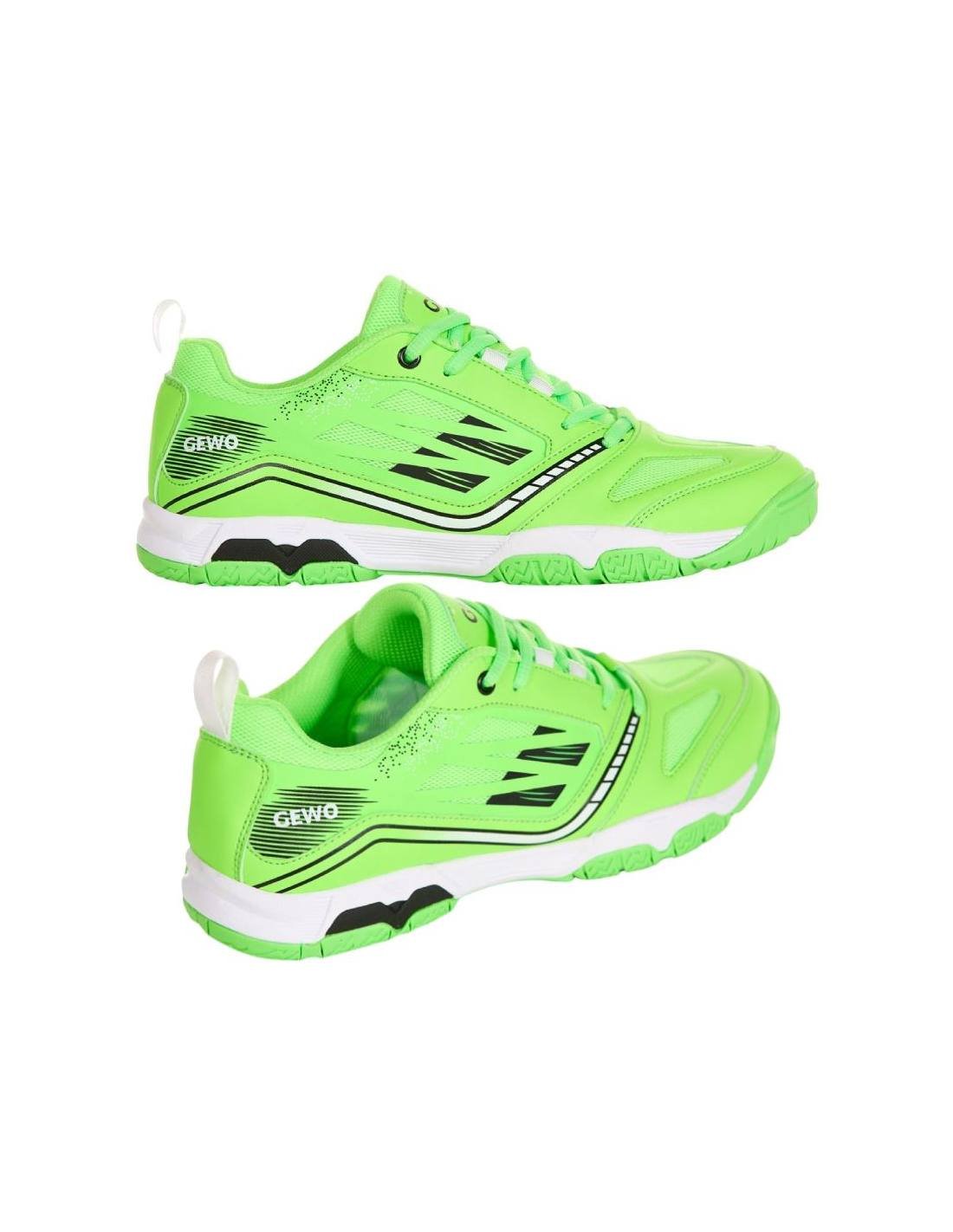
The intermediate guide cards GEWO’s Ultra Force Pro and its Flexxion midfoot element; the Flex Force Pro I is GEWO’s other professional answer, and GEWO positions it in plain language as a professional table tennis shoe built for quick direction changes, rapid sprints and dynamic stops. It is also the most completely described shoe in this guide after the Mizuno — GEWO publishes construction percentages, a drop figure and a full size run, which is the kind of spec-sheet confidence this guide exists to reward.
The upper is a three-material mix of PU, TPU and mesh, and GEWO quantifies it: about 25 percent of the exterior is reinforced with heat-sealed TPU, protecting the high-stress areas without adding weight, while the PU and mesh remainder handles durability, flexibility and moisture. Inside, a breathable mesh tongue, PU-reinforced lacing and a perforated EVA insole with a fleece covering keep the fit secure and the foot dry; GEWO notes the ergonomic fit needs no additional arch support. The midsole is Phylon, credited with shock absorption and elasticity, and GEWO states the geometry most brands in this guide leave blank: a 16 mm heel drop, there for shock absorption and rapid response, with an additional stabilising element in the heel transferring energy efficiently into the sole for ground contact and grip.
The outsole completes a coherent picture: non-marking solid rubber with wave and honeycomb structures for stability and flexibility, and a spiral element in the forefoot that GEWO says supports quick direction changes while its textured surface prevents slipping. Fit is stated as regular, sizes run EU 36 to 46, and the design is a sleek black. The one blank, again, is weight — GEWO publishes none for the Flex Force Pro I, and the card says so rather than borrowing the Ultra Force Pro’s numbers or a retailer’s guess.
- Positioning: GEWO’s professional table tennis shoe.
- Upper: PU, TPU and mesh; about 25% heat-sealed TPU reinforcement; mesh tongue; PU-reinforced lacing; perforated EVA insole with fleece covering.
- Midsole: Phylon; 16 mm heel drop as stated by GEWO; stabilising element in the heel.
- Outsole: non-marking solid rubber; wave and honeycomb structures; spiral forefoot element.
- Sizes: EU 36–46. Fit: regular. Stated weight: not published.
Why it is here
- The fullest construction disclosure in the guide after Mizuno
- A stated drop figure, where rivals print none
- Professional positioning with a regular, uncomplicated fit
Know before you buy
- No published weight
- 16 mm is a real drop — players who live in near-flat shoes should note it
- Single black colourway in the current listing
Check the Flex Force Pro I across the full EU 36–46 run.
Check price on Amazon
6. TIBHAR Blizzard Speed II — the converter concept, second generation
The Blizzard Speed developed: a split sole, an ENERGY CONVERTER in the heel, MAXX TURN PROTECT and ScaleTex X-protectors.
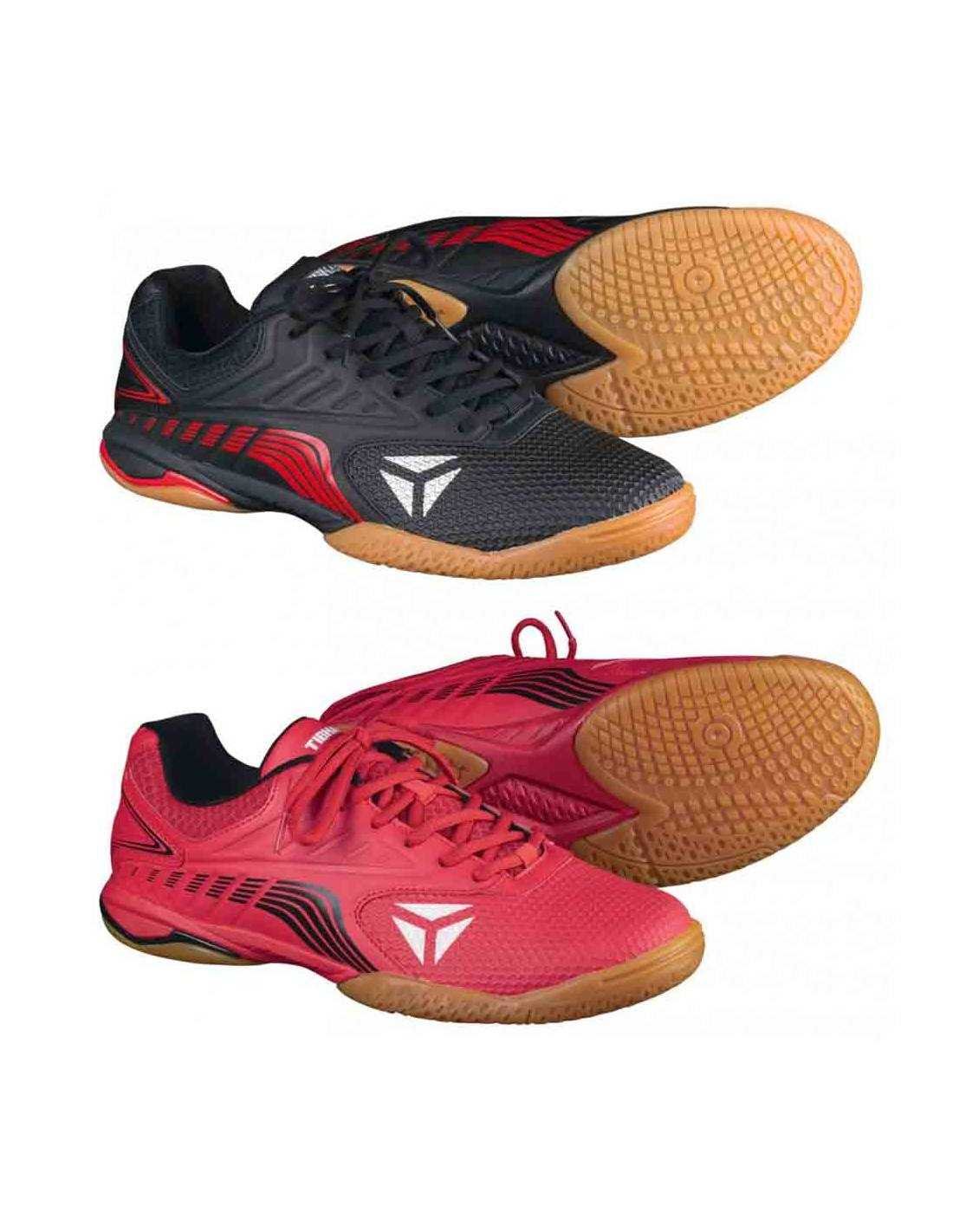
TIBHAR’s entry is a second generation — the Blizzard Speed II is, in TIBHAR’s own words, the development of the successful Blizzard Speed — and its spec sheet reads like a list of the first shoe’s lessons. This site’s other guides card no TIBHAR shoe, so the Blizzard Speed II also opens a new brand in the footwear cluster, and it opens it with the most concept-dense heel design in the guide.
The centrepiece is the ENERGY CONVERTER concept in the heel area, developed by TIBHAR: it absorbs the vibrations caused by fast movements and converts them into additional energy during acceleration — TIBHAR’s description of its own system, printed as such. Around it, the sole is split with a stabilised centre, and the two-component Phylon is credited with giving the front and back of the shoe their flexibility independently — the split-sole logic that lets a forefoot flex for the pivot while the heel stays a stable platform. The MAXX TURN PROTECT system, TIBHAR’s acceleration and turning protection carried across its shoe line, works with a reinforced heel area.
The upper carries the visual signature: large X-shaped PU protectors on the inside and outside, made from TIBHAR’s new ScaleTex material and credited with optimal freedom of movement and wearing comfort, over an inner combination of NovO2MAX fabric and SOFT SKIN microfiber that TIBHAR credits with breathability and comfort. Colours are black and red; EU sizes are listed across a 36–45 span. One editorial line we drew on this card: TIBHAR’s copy attaches joint-protection language to its heel systems, and that phrasing is not repeated here — medical claims are not ours to make, and a shoe’s spec sheet does not become one. And the familiar blank: TIBHAR publishes no weight for the Blizzard Speed II.
- Heel concept: ENERGY CONVERTER — absorbs vibration from fast movement, converts it to acceleration energy (TIBHAR).
- Sole: split sole with stabilised centre; two-component Phylon; MAXX TURN PROTECT; reinforced heel area.
- Upper: X-shaped PU protectors in ScaleTex; NovO2MAX fabric and SOFT SKIN microfiber inside.
- Colours: black and red. Sizes: EU sizes listed across 36–45.
- Stated weight: not published by TIBHAR.
Why it is here
- A named, explained heel-energy concept, unique in this guide
- Split-sole flexibility where the movement actually happens
- A second-generation shoe, revised rather than rebadged
Know before you buy
- No published weight
- The converter’s benefit is TIBHAR’s stated concept, not a measurement we can check
- Check the EU listing for your size — the run is not every size in every colour
See the Blizzard Speed II in black and red and confirm your EU size.
Check price on Amazon7. VICTAS V-Shoes 612 — the range-topper’s lighter sibling
VICTAS’s performance-line shoe: an innovative upper, air inlets spaced for breathability and an extra-soft padded heel over a non-marking sole.
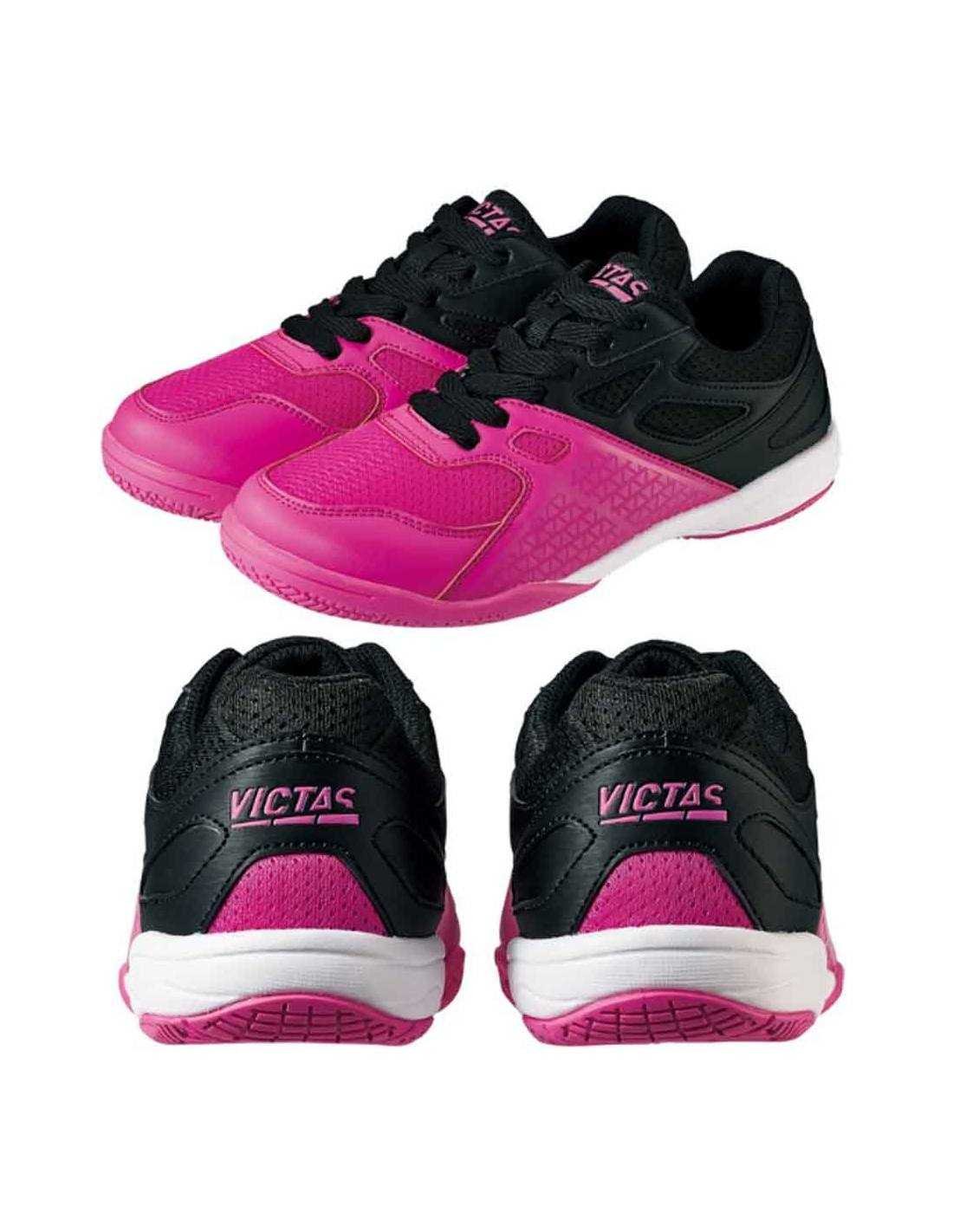
VICTAS’s V-Shoes line is the spine of this site’s table tennis footwear coverage: the pillar guide cards the V-Shoes 613, the intermediate guide the V-Shoes 614. The V-Shoes 612 completes the set here — a different model from both, and the one VICTAS’s copy aims at the player who wants the line’s modern, lightweight feel with the comfort turned up. It is the honest counterweight in this guide: not every advanced player wants a dial, a converter or a bridge, and the 612’s spec sheet is a reminder that at this level a well-executed simple shoe is still a pro-line shoe.
VICTAS describes the 612 as lightweight with a modern design, built on an innovative upper material credited with great comfort of use and with flexibility and stability even in extreme situations — the maker’s phrase for the positions advanced footwork ends in. Well-spaced air inlets run through the design, credited with optimum breathability and with keeping the shoe’s weight down, and the heel is extra-soft padded to optimise wearing comfort — the one place a low, hard court shoe can punish a player across a long tournament day. Underneath, the outsole is non-marking, with VICTAS crediting it with the grip needed even on slippery surfaces — a claim worth having in writing, because hall floors vary more than any other condition an advanced player meets.
What the 612 does not do is over-claim, and its card should not either. VICTAS publishes no weight for it — “lightweight” here is the maker’s description of the design, not a number, and it sits in this guide next to a Mizuno that states 285 grams precisely so the difference between a description and a measurement stays visible. Sizes are listed in EU through the usual retail channels. If your advanced game is built on volume — long training weeks, club nights stacked on league matches — the 612’s comfort-first take on the pro line is the card written for you.
- Design: lightweight, modern (VICTAS); innovative upper material for comfort, flexibility and stability.
- Ventilation: well-spaced air inlets for breathability and reduced weight.
- Heel: extra-soft padding for wearing comfort.
- Outsole: non-marking, credited with grip even on slippery surfaces.
- Stated weight: not published by VICTAS — “lightweight” is the maker’s description, not a figure.
Why it is here
- Completes the V-Shoes line this site tracks — 612, 613, 614, no repeats
- Comfort engineering for high-volume weeks
- Non-marking grip claim that covers poor hall floors
Know before you buy
- No published weight — “lightweight” is a description
- No named plate, foam or fit system — simpler engineering by design
- EU listing sizes vary by retailer
Check the V-Shoes 612 listings and your EU size.
Check price on AmazonThe technology names, translated
Advanced spec sheets are written in trademarks. Here is what each name in this guide actually refers to, in the maker’s own terms — because the name is only useful if you know which part of the shoe it describes.
- ENERZY NXT (Mizuno). The midsole material in the Medal 8 generation, described by Mizuno as softer, higher-rebounding and lighter than its ENERZY foam — and, per Mizuno, used in a table tennis shoe for the first time on this model.
- MIZUNO WAVE and PoWnCe (Mizuno). The WAVE is Mizuno’s plate structure, credited with holding cushioning and stability together; PoWnCe is the midsole material Mizuno describes as matching its ap+ rebound at about ten percent less weight. XG Rubber is the extra-grade outsole rubber over the top of both.
- BOA (Mizuno Medal 8 BOA). A dial-operated fit system: turn to tighten in millimetre increments, pull to release. It replaces the lace as the fit mechanism, which is why this shoe can be re-fitted between games in seconds.
- B-Absorber, Wingrip, B-Ridge, STB (Butterfly). A forefoot shock-absorbing sponge; a specially formed high-grip outsole; a bridge-shaped midsole that supports sliding; and an anti-distortion system against the twisting forces of table tennis movement. Four names, four different parts of the Mach.
- BOUNCE+ and TUFF OS (Li-Ning). The forefoot rebound material and the abrasion-resistant outsole compound of the Hawk Eye 2.0 TT PRO. Both carry Li-Ning stated test figures — 27 percent better vertical rebound, five times the abrasion resistance of ordinary rubber — which are maker claims, not measurements made for this guide.
- PHYLON (Li-Ning, GEWO, TIBHAR). The one material name shared across brands here: a moulded EVA foam used for cushioning — as the Hawk Eye’s rearfoot absorber, the Flex Force Pro I’s full midsole and half of the Blizzard Speed II’s two-component sole.
- TPU+ insert (andro). The Cross Step family’s midfoot core: a thermoplastic insert credited with stabilising the midfoot and preventing twisting — the anti-torsion job every advanced shoe in this guide addresses in one form or another.
- ENERGY CONVERTER and MAXX TURN PROTECT (TIBHAR). The Blizzard Speed II’s heel concept (absorb vibration, return it as acceleration energy, per TIBHAR) and its turning-protection system. ScaleTex is the material of its X-shaped protectors.
- Spiral element (GEWO). The forefoot feature of the Flex Force Pro I’s outsole, shaped to support quick direction changes, sitting inside a wave-and-honeycomb non-marking rubber sole.
The weight problem at the top of the market
It deserves its own section, because it is the single most useful thing this guide can tell an advanced buyer: the higher you climb in table tennis footwear, the less the brands will tell you about weight. Of the seven flagship and professional shoes above, exactly one publishes a weight — Mizuno, about 285 grams for one Medal 8 BOA at 26.0 cm. Butterfly, Li-Ning, andro, GEWO, TIBHAR and VICTAS publish none for these models. Our other guides found the same pattern at every level, but it is starkest here, where the products are at their most technical.
Three habits will keep you honest when you shop this tier. First, treat any unsourced gram figure — a marketplace field, a forum post, a roundup that will not name its source — as unknown, because it usually traces back to a shipping weight or a different size. Second, compare what is actually published: sole systems, fit systems, size bases and materials are all stated for these seven, and they separate the shoes more usefully than an invented gram ever will. Third, if weight decides your purchase, buy the shoe whose maker states it — that is part of why the Medal 8 BOA leads this page.
Fit and sizing at advanced level
These seven shoes are sold in three different sizing languages, and advanced players order across all of them. Mizuno lists the Medal 8 BOA in centimetres (22.5–28.5) on a 2E-equivalent normal last — 2E is Mizuno’s standard width here, not a wide fit, and no shoe in this guide is a wide-last model; if you need genuine width, the wide variant of the current Medal generation is the Medal 8 Wide, a different shoe covered in our seniors guide. Butterfly lists the Mach in US men’s sizes (5.0–12) and sells it as unisex against its chart. GEWO lists the Flex Force Pro I in EU 36–46 with a stated regular fit; TIBHAR and VICTAS list in EU through their retailers; Li-Ning’s EU sizing includes third sizes, which is why its centimetre column is the one to order from.
The fit details that matter at this level are stated, and they are worth weighing alongside the soles. The BOA dial gives the Mizuno millimetre adjustment that laces cannot match between games. The andro’s reshaped heel is built to enclose the foot — the anti-slip anchor for recovery steps. GEWO’s regular fit with PU-reinforced lacing is the conventional route, done completely. And on any of the seven: measure both feet in centimetres, in your playing socks, late in the day, and order against the maker’s own chart for that model. At advanced volume, a half-size error is not a comfort issue; it is a footwork issue.
Verdict: which advanced shoe should you buy?
Buy the Mizuno Wave Medal 8 BOA if you want the most complete advanced shoe on paper: a dial fit, the newest named sole technology in the sport and the only published weight in the tier. Buy the Butterfly Lezoline Mach if your game is built on sliding footwork and you want the deepest named grip-and-stability system. Buy the Li-Ning Hawk Eye 2.0 TT PRO if you play on the forefoot and want rebound zoned where you load the shoe. Buy the andro Cross Step PRO if heel slip has ever cost you a recovery step. Buy the GEWO Flex Force Pro I if you want professional construction with the fullest disclosure after Mizuno — drop, percentages, full size run. Buy the TIBHAR Blizzard Speed II if the heel-energy concept and split sole match how you move. Buy the VICTAS V-Shoes 612 if your advanced game runs on training volume and comfort is the performance feature. Still deciding where you sit on the ladder? The pillar guide compares the all-rounders, and our intermediate guide covers the step-up tier between these shoes and the all-rounders.
New to the sport’s footwork demands — or coaching someone who is? Start with how to play table tennis, where the stance and movement these shoes are built for are taught from the first step.
Frequently asked questions
What makes a table tennis shoe an “advanced” shoe?
Named, verifiable engineering aimed at trained footwork: fit systems such as Mizuno’s BOA dial, rebound foams such as ENERZY NXT and BOUNCE+, anti-twist structures such as andro’s TPU+ insert and Butterfly’s STB, and development credits such as the andro Pro Team’s work on the Cross Step PRO. Every shoe in this guide publishes at least one of those; shoes whose makers publish none were left out.
Which of these shoes has a published weight?
Only one. Mizuno Japan states about 285 grams for one Wave Medal 8 BOA at 26.0 cm. Butterfly, Li-Ning, andro, GEWO, TIBHAR and VICTAS publish no weight for the other six models, and this guide prints “not published” rather than substituting a retailer’s estimate or a shipping weight.
What is the BOA system on the Mizuno Wave Medal 8 BOA?
BOA is a dial-operated fit system. Per Mizuno, it gives fitting adjustment in millimetre units and makes the shoe quick to put on and take off — useful between matches, when a small adjustment to heel hold can be made in seconds instead of re-lacing.
Are any of these the same shoes as in your intermediate guide?
No — there is zero overlap. The closest relatives are deliberately different models: the Medal 8 BOA here is the dial variant of Mizuno’s current Medal 8, while the intermediate guide cards the earlier Wave Medal Neo; the Cross Step PRO here sits above the intermediate guide’s Cross Step 2; and the V-Shoes 612 here completes a line whose 613 is in the pillar guide and 614 is in the intermediate guide.
I have wide feet. Which shoe in this guide fits me?
None of the seven is a wide-last model. The Mizuno Wave Medal 8 BOA is built on a 2E-equivalent last, which Mizuno describes as its normal width. The wide version of the current Medal generation is the separate Wave Medal 8 Wide, and the widest lasts in Mizuno’s range sit in its Kaiserburg line — both covered elsewhere on this site rather than in this advanced seven.
Can a beginner use one of these advanced shoes?
Nothing stops you — the soles are non-marking, hall-legal and built for the same movements. But the shoes in our beginners’ guide are designed for first seasons, with fits and constructions aimed at players still learning the footwork, and they are the better place to start. Move up to this tier when your training volume and movement start asking questions a first shoe cannot answer.
Sources and method. Every specification in this guide comes from the maker’s own published material, read on the build date: Mizuno Japan’s product page for the Wave Medal 8 BOA (81GA2692), including its stated weight, width, sizes and materials; Butterfly’s Lezoline Mach specification via its US retailer (systems, materials, sizes); Li-Ning’s Hawk Eye 2.0 TT PRO listing copy (BOUNCE+, PHYLON, TUFF OS, materials — with Li-Ning’s two test figures printed only as Li-Ning’s stated claims); andro’s Cross Step PRO copy via its Australian pricelist; GEWO’s Flex Force Pro I copy via Contra and the full retailer listing (construction, 16 mm drop, EU 36–46); TIBHAR’s Blizzard Speed II copy via its retailer listing (ENERGY CONVERTER, split sole, ScaleTex — with TIBHAR’s joint-protection phrasing not adopted); and VICTAS’s V-Shoes 612 copy via its retailer listing. Where a maker publishes no weight, this guide says so; no figure from a marketplace, forum or parcel label is used anywhere. Nothing here is first-hand testing, and no prices are published — check the retailer listings for current figures.
Affiliate disclosure: some links on this page are Amazon affiliate links (tag alishuttler00-20). If you buy through them, the site may earn a commission at no extra cost to you. Rankings are editorial and are based on the published specifications described above, never on commission.
Similar Posts
Best Table Tennis Bats for Seniors: Lightweight Picks
Table Tennis Gear · Bats · 2026 Best Table Tennis Bats for Seniors: Lightweight Picks…
Table Tennis Footwork for Beginners: Move & Recover
Beginner Technique Guide Table Tennis Footwork for Beginners: Move & Recover Table tennis is not…
Table Tennis Rules: Complete Guide for Beginners
Beginner’s Rules Guide Table Tennis Rules: Complete Guide for Beginners Everything a first-time player actually…
Best Table Tennis Shoes: Top Picks for Grip & Speed
Buying Guide · 2026 Edition Best Table Tennis Shoes: Top Picks for Grip & Speed…
Best Table Tennis Shoes for Kids: Junior Court Picks
Table Tennis Gear · Junior Shoes · 2026 Best Table Tennis Shoes for Kids: Junior…
How to Play Table Tennis: Rules, Strokes & First Steps
Beginner’s Start Guide How to Play Table Tennis: Rules, Strokes & First Steps Everything a…