Your first proper table tennis shoe is a construction decision, not a brand decision. The game is played in short side-steps, split-steps and quick recoveries a metre or two from the table, on an indoor floor — so the shoes built for it are published with thin, grippy gum-rubber outsoles, low profiles that keep you close to the ground, flexible builds that bend with quick lateral footwork, and uppers made to hold the foot when the movement goes sideways. This guide compares seven starter shoes on exactly what their makers publish: the outsole and cushioning descriptions in the makers’ own words, the fit and width options they actually offer, and stated weights read with their size basis — including an honest account of how few beginner shoes publish a weight at all. No health claims, no prices, no invented numbers: just the spec sheets, read properly, for a first-time player.
⚡ TL;DR — The Short Answer
For the best first pair, buy the Butterfly Lezoline Unizes — the one shoe here whose maker publishes a complete starter specification: 273 grams in an EU 43 as Butterfly states it, a breathable mesh upper and sturdy EVA heel dampening. Wide feet start at the Butterfly Lezoline Vilata, the only card whose maker redesigned the shoe wider — a wider ball girth built for wide feet and high insteps. The closest-to-the-floor feel belongs to the Donic Draven GSX, published as light and flat with a grippy outsole for direct contact with the floor, and the most flexible sole to the JOOLA Court, which JOOLA’s own store pairs with a clear instruction to order one size up. The ASICS Upcourt 6 is the easy-to-find indoor court all-rounder, the Donic Panther the breathable mesh pick, and the Donic Saphir the stability-first build. One discipline runs through the guide: at this end of the market most makers publish no weight at all, so six of the seven cards compete on published construction — and say so, instead of inventing a number.
Quick Picks — Best Table Tennis Shoes for Beginners at a Glance
273 g in an EU 43 as Butterfly states it, with a breathable mesh upper and sturdy EVA heel dampening.
A wider ball girth redesigned for wide feet and high insteps, over a grippy sole and a light, flexible midsole.
Light and flat, with a grippy outsole Donic describes as giving direct contact with the floor.
An extremely light, flexible build for table-tennis movements — with JOOLA’s own advice to order a size up.
ASICS’s lightweight indoor court shoe: mesh underlays and supportive panels, stocked almost everywhere.
A breathable jacquard upper with seamless TPU, an EVA/Phylon midsole and a honeycomb insole.
A synthetic-leather build Donic positions for lateral stability, with a non-marking Phylon outsole.
In This Guide
The Beginner Decision: What a First Table Tennis Shoe Has to Do
Start with what the sport actually asks of your feet, because it is not what a running shoe is built for. A beginner’s first rallies are short, but the footwork pattern arrives immediately: a split-step as your opponent plays, one or two side-steps to reach the ball, a small lunge to a wide forehand, and a quick recovery back to the ready position. Almost none of it is forward running. It is lateral, close-range and repetitive, played on a wooden or synthetic hall floor. The specialist makers describe the answering construction the same way across their ranges: a low, flat shoe with a thin gum-rubber outsole that grips an indoor floor in every direction, and an upper built to hold the foot when the movement goes sideways. That published definition — flat base, grippy thin sole, lateral hold — is the filter every card in this guide passes, and it is the reason your everyday trainers feel vague around a table: their thick, curved soles are designed to roll forward, not to plant and push sideways.
The second part of the beginner decision is feel, and it surprises most first-time buyers. Table tennis shoes are deliberately thin-soled and low-profile: the makers describe outsoles built for direct contact with the floor and midsoles kept light and flexible, so your foot reads the surface and changes direction without a tall stack of foam moving underneath it. If you are coming from cushioned running shoes, a proper table tennis shoe will feel close to the ground and almost minimal at first. That is the design working as published, not a quality problem — the Draven GSX card below is the extreme example, a shoe its maker describes as light and flat with direct floor contact, while the Saphir sits at the other end of this guide with a more built-up, stability-led construction. Neither is wrong. They are two published answers to the same beginner question, and the cards separate them by exactly what their makers state.
Fit is the third part, and for beginners it is the one most likely to go wrong, because table tennis shoes are not sized or shaped like street shoes. Some makers sell their starter shoes in a single standard width and say little about it; one card here — the Vilata — exists precisely because Butterfly redesigned a shoe’s width for wide feet and high insteps. Sizing systems differ too: Donic publishes its shoes in EU sizes 36 to 46, Butterfly lists the Unizes across EU 34 to 47, and JOOLA’s own store warns Court buyers to order a size larger than usual. The practical rule runs through the whole guide: measure your feet, read the maker’s own size range and fit notes for the exact model, and treat any published size-up advice as part of the specification, not as a footnote.
One boundary before the picks. This page owns the adult beginner’s first-shoe decision only. The full all-player field belongs to our pillar guide to the best table tennis shoes, the women’s segment has its own guide to the best table tennis shoes for women, and players shopping on published wide lasts, stated senior weights and maximum-cushioning builds are served by our guide to the best table tennis shoes for seniors. None of their models is re-carded here — every shoe below is a different model, chosen because its maker publishes it in terms a beginner can act on. Completing a first kit alongside the shoes? Our guide to the best table tennis bats for beginners owns the bat decision, and our how to play table tennis guide covers the strokes and footwork these outsoles are patterned for.
Reading the Spec Sheet: Gum Rubber, Weight and Width
The outsole is the first line to read, and the makers describe it in their own terms. Table tennis shoes are indoor shoes: thin rubber outsoles that grip hall floors and, on the Donic cards, are published as non-marking. Butterfly describes the Vilata’s outer sole simply as grippy, Donic describes the Draven GSX’s as grippy with direct contact with the floor, and JOOLA describes the Court’s sole as grippy and flexible, made for best floor contact through dynamic movement. Read those descriptions as one shared spec — thin, grippy rubber, close to the ground — and read what is absent too: none of these shoes is published for outdoor concrete or asphalt, where a thin indoor sole wears fast and grips poorly. If a listing you are considering does not describe an indoor outsole at all, it is not answering the table tennis question.
Weight is the second line — and at beginner level, it is mostly a lesson in reading what is not there. Of the seven makers’ listings behind this guide, exactly one publishes a weight: Butterfly states the Lezoline Unizes at 273 grams in an EU size 43 — a figure printed here with its size basis, because a weight without a size is a number without a meaning. Butterfly publishes no weight for the Vilata, JOOLA none for the Court, Donic none for the Panther, Saphir or Draven GSX, and ASICS none for the Upcourt 6. That is not a gap this guide fills with estimates: it is the published state of the beginner market, where makers compete on flexibility, grip and fit descriptions rather than gram figures. JOOLA calls the Court “extremely light” without a number, and Donic calls the Panther and the Draven GSX lightweight without one — positioning language, reported on the cards as exactly that. The discipline matters more than any single figure: a stated weight with its basis can be compared; an adjective cannot.
Width is the third line, and it is published as design, not as grades, at this level. The senior and flagship end of the market sometimes publishes width grades; the beginner end mostly does not — and one card here is the exception that proves the rule. Butterfly states that the Vilata’s width, its ball girth, was redesigned to be wider, and positions the shoe for players with wide feet or high insteps: a fit promise made in the maker’s own words, on a specific model. The other six cards are standard-fit builds whose makers publish no width grade, so if your feet are wide, the honest shortlist starts with the Vilata and with careful size-chart checking on the rest — not with hoping a standard shoe runs roomy. Cushioning, finally, is read by name where a maker names it: Butterfly’s EVA heel dampening in the Unizes, Donic’s EVA and Phylon midsoles in the Panther and Saphir. A named material is a comparable spec; an unnamed promise of comfort is marketing, and the cards keep the two separate.
The 7 Best Table Tennis Shoes for Beginners, Compared
Seven starter shoes, one shared brief — built for indoor floors and lateral movement as their makers describe them, flexible and low-profile for quick side-steps, and fitted with the width and sizing options their makers actually publish. Read the card that matches your feet and your hall first.
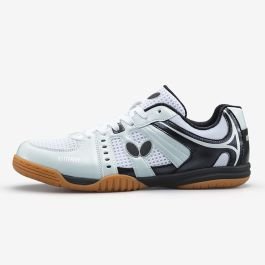
Butterfly Lezoline Unizes
The complete first pair — the only shoe here with a maker-stated weight: 273 g in an EU 43, as Butterfly publishes it, with a breathable mesh upper and sturdy EVA heel dampening.
The Unizes leads this guide for a simple reason: it is the most honestly specified beginner shoe in the sport. On Butterfly’s own store, its description is short and complete — a lightweight, modern shoe with a breathable mesh upper for foot comfort, sturdy EVA heel dampening that Butterfly describes as offering stability and comfort for players of average weight, and a published weight of 273 grams in an EU size 43. That last line is rarer than it should be. It is the only maker-stated weight on any card in this guide, printed with its size basis, and it tells a first-time buyer exactly what this guide keeps repeating: a gram figure you can check beats an adjective you cannot. In a market of “extremely light” claims with no numbers attached, Butterfly publishes the number.
The rest of the beginner brief is answered just as plainly. The size run is the widest published here — EU 34 to 47 — so smaller and larger adult feet are covered by the same model rather than a separate line. The mesh upper is the comfort story Butterfly itself tells: breathable material, in its words, for supreme foot comfort, which for a beginner means a shoe that feels like a trainer on day one while being built like a table tennis shoe underneath — an indoor outsole and a lateral-movement design rather than a runner’s roll. And the EVA dampening sits in the heel, where a new player’s footwork loads first as they learn to move. If you want one first pair from the sport’s most established footwear name, specified well enough to buy without guessing, this is the card.
What we like
- The only maker-stated weight in this guide — 273 g in an EU 43, with the basis printed
- Breathable mesh upper, described by Butterfly as built for foot comfort
- Sturdy EVA heel dampening, positioned by Butterfly for players of average weight
- The widest published size run here: EU 34–47
Worth knowing
- Standard fit — Butterfly publishes no wide version of the Unizes; wide feet start at the Vilata card
- Butterfly describes the dampening as a heel unit — players wanting a named full-length cushioning system should compare the Donic cards’ EVA/Phylon midsoles
As an Amazon Associate we earn from qualifying purchases.
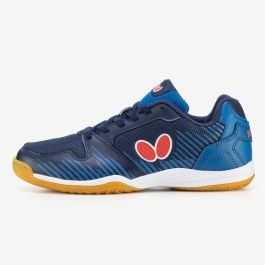
Butterfly Lezoline Vilata
The true wide-fit pick — Butterfly redesigned this shoe’s ball girth to be wider, for wide feet and high insteps, over a grippy sole and a light, flexible midsole.
Beginner shoes are almost never published in width options, which is what makes the Vilata the most useful card in this guide for a large group of first-time players. Butterfly’s own description states the design change directly: the shoe’s width — its ball girth — was redesigned to be wider, and the Vilata “gives players with wide feet or high insteps comfort” while keeping the model’s original concept of lightweight shoes for quick and precise movements. That is a fit promise in the maker’s own words, attached to a specific model — not a reviewer calling a standard shoe roomy. If standard trainers pinch across the forefoot or sit tight over a high instep, this is the one beginner card that starts from your feet rather than asking your feet to adapt.
The wide last is not bought with a clumsy shoe. Butterfly publishes the rest of the build as a grippy outer sole, a light and flexible midsole, and a vamp — the upper’s front section — that combines mesh with reinforcing materials to stay lightweight but tough. In other words, the same starter brief as the Unizes above, on a wider foundation: quick, precise movement, a sole that grips the hall floor, and an upper that breathes where it can and reinforces where lateral movement stresses it. Two honest notes belong on the card. Butterfly publishes no weight for the Vilata, so it competes on its fit and construction rather than grams — and the wider ball girth is a forefoot and instep answer, not a promise about heel width, which Butterfly does not specify. For the wide-footed beginner, it remains the clearest published answer in the category.
What we like
- A genuinely wider design, stated by Butterfly: redesigned ball girth for wide feet and high insteps
- Grippy outer sole and a light, flexible midsole — the standard starter brief, kept
- Mesh vamp with reinforcing materials: breathable where possible, tough where it matters
- The only width-led beginner card from a specialist maker
Worth knowing
- Butterfly publishes no weight for this shoe — compare it on fit and construction, not grams
- The published extra width is in the ball girth; heel width is not specified by Butterfly
As an Amazon Associate we earn from qualifying purchases.
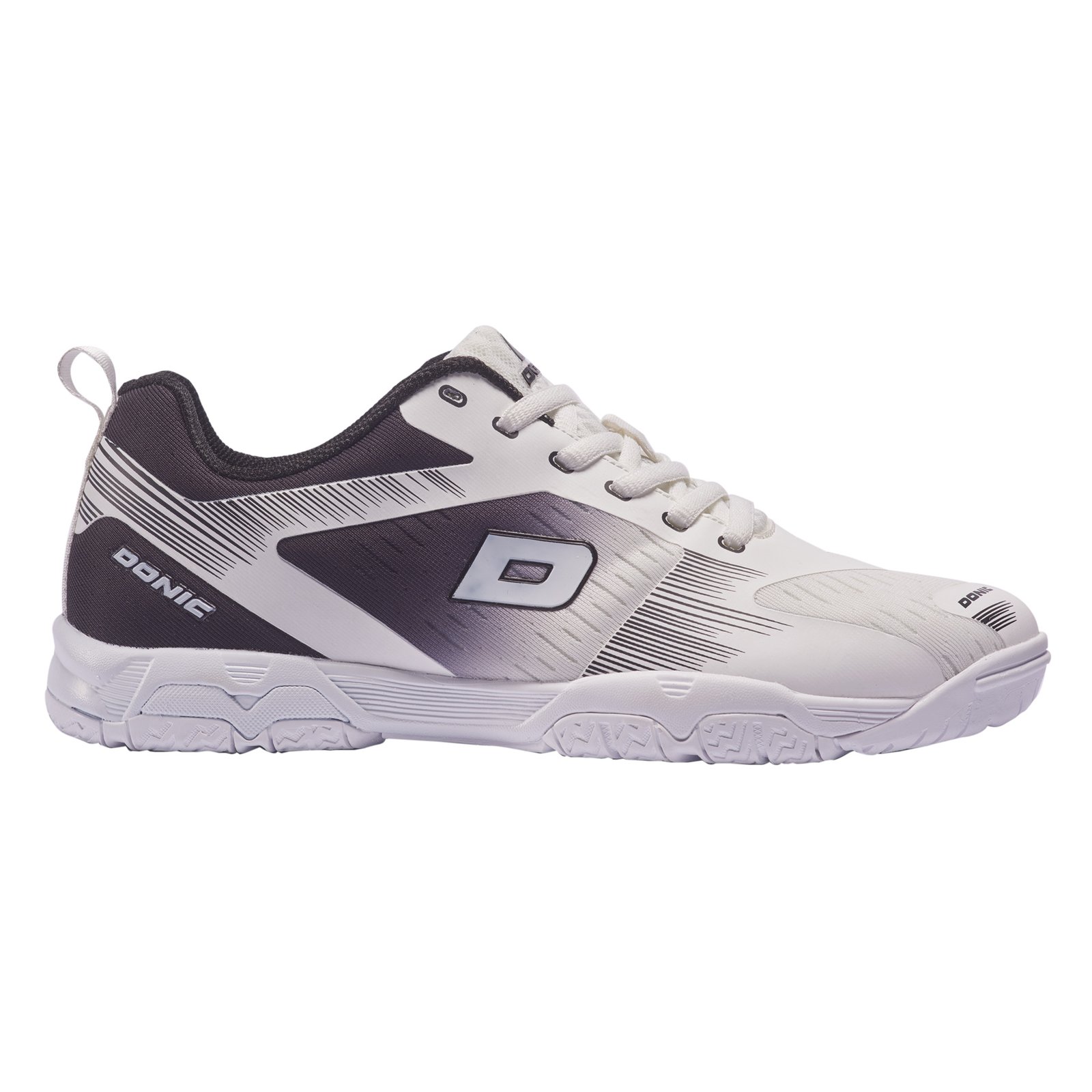
Donic Draven GSX
The closest-to-the-floor pick — light and flat, with a grippy outsole Donic describes as giving direct contact with the floor, in a jacquard and TPU build.
Every guide needs the shoe that teaches a beginner what table tennis footwear is actually about, and Donic publishes that lesson in one sentence: the Draven GSX is a “light and flat competition table tennis shoe with a grippy outer sole for direct contact with the floor.” Direct contact is the point of the category. A flat, thin-soled shoe lets your foot read the hall floor through every split-step and side-step, and Donic pairs that brief with high flexibility and, in its words, good stability when making swift lateral movements — the two halves of beginner footwork, planted grip and quick recovery, described on one listing. Players who try a shoe like this after months in running trainers usually describe the same discovery: the table feels closer, and their feet feel quicker, because less shoe is moving underneath them.
Donic publishes the materials as plainly as the brief. The upper is jacquard plus TPU — a woven textile body with synthetic reinforcement — and the sole is Phylon plus RB, Donic’s stated pairing of a Phylon midsole unit with a rubber outsole. The size run is EU 36 to 46, and the colourway is a clean white and black. The honest limits sit where they sit for most of this guide: Donic publishes no weight for the Draven GSX, so “light” is the maker’s positioning word, reported as such; and a floor-feel shoe is by design the least built-up card here, so beginners who know they want a more cushioned, structured ride should read the Panther and Saphir cards before choosing. For the player who wants to learn footwork on the closest thing to the floor the category offers, this is the pick.
What we like
- The purest beginner lesson in the guide: light, flat, direct floor contact, as Donic states it
- High flexibility with published lateral stability for swift sideways movement
- Materials stated plainly by Donic — jacquard plus TPU upper, Phylon plus RB sole
- A full adult size run: EU 36–46
Worth knowing
- Donic publishes no weight — its “light” brief is positioning, not a gram figure
- The flattest, least built-up ride here — a deliberate design, but the opposite of the Saphir’s stability build
As an Amazon Associate we earn from qualifying purchases.
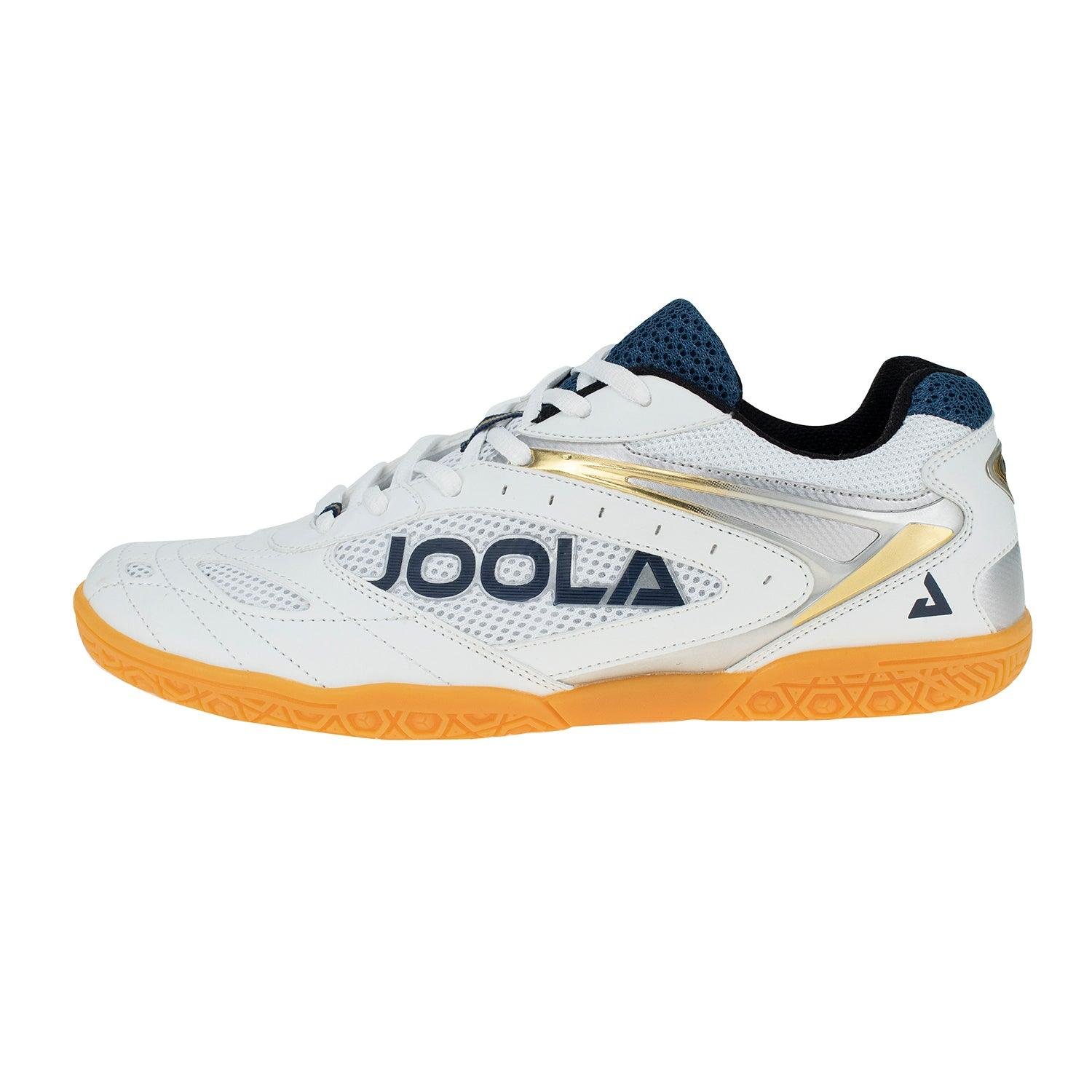
JOOLA Court
The flexibility pick — an extremely light build on a grippy, flexible sole, with a soft supportive insole and JOOLA’s own instruction to order one size larger.
The Court is JOOLA’s straightforward starter shoe, and its own store describes it with unusual directness. JOOLA’s published key facts run: extremely light, so quick and precise movements do not load the feet; optimal support for the table-tennis-specific movements — quick lunges and side-steps — with strong hold and stability; a flexible sole that is grippy and made for best contact with the floor through dynamic movement; and a soft, supportive insole with a comfortable fit that holds up through long training sessions and matches. Read together, that is the complete beginner checklist — light, grippy, flexible, supportive — stated by the maker in one place. For a first-time player who wants a shoe designed around the movements they are actually learning, rather than a general trainer adapted to them, the Court’s published brief is exactly on target.
Two published details decide whether it is your card. JOOLA publishes no gram weight for the Court — “extremely light” is its positioning, printed here as such, and this card makes no attempt to convert it into a number. And JOOLA’s own store carries the sizing instruction in plain text: order one size larger. That advice is part of the specification — a beginner who buys their street size in this shoe against the maker’s guidance is likely to find it snug, and the honest move is to follow the maker’s note and confirm the fit indoors, in playing socks, before the tags come off. JOOLA sells the Court in adult sizes alongside a separate junior model; this card covers the adult shoe only. Within its published brief — the flexible, grippy, floor-hugging starter — the Court is the most movement-led card in the guide.
What we like
- A flexible, grippy sole published for best floor contact in dynamic movement
- Support brief written for table tennis movements — lunges and side-steps, per JOOLA
- Soft, supportive insole and a comfortable fit for long sessions, per JOOLA
- The maker publishes its own sizing guidance: order one size larger
Worth knowing
- JOOLA publishes no weight — “extremely light” is positioning, not a specification
- The size-up advice is essential, not optional: follow JOOLA’s note rather than your street size
As an Amazon Associate we earn from qualifying purchases.
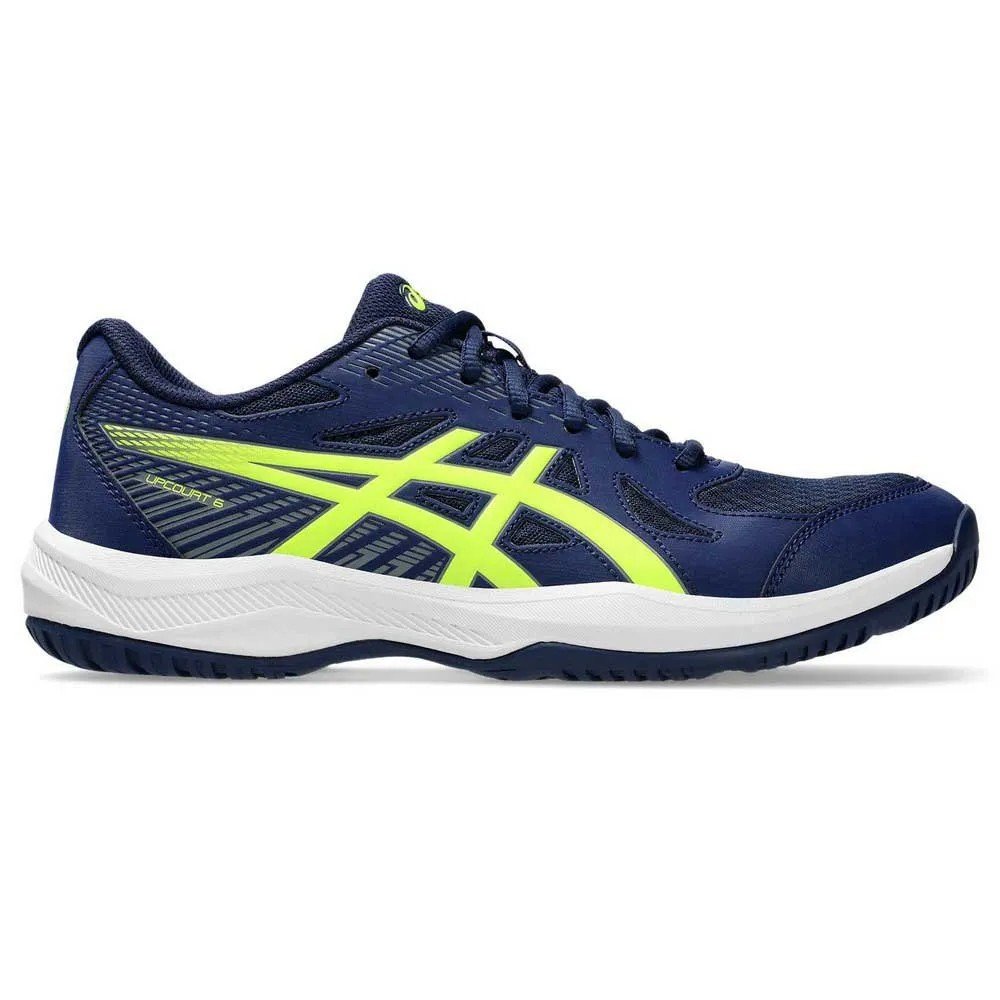
ASICS Upcourt 6
The easy-to-find all-rounder — ASICS’s lightweight indoor court shoe, with breathable mesh underlays and larger supportive panels, carded honestly as a court shoe rather than a table-tennis-specific model.
One honest distinction opens this card: the Upcourt 6 is not a table-tennis-specific shoe, and this guide does not pretend otherwise. It is ASICS’s entry indoor court shoe — published by ASICS as a lightweight design with a flexible fit, built for indoor court sports generally — and it earns its place here because a great many beginners learn table tennis in multi-sport halls, play more than one indoor game, and need a first court shoe they can actually find, try on and exchange locally. On ASICS’s published description, the construction answers the same physical brief the specialist cards answer: a mesh-panelled upper that creates a softer, more adaptable fit, so the foot can move freely through lateral play, and breathable mesh underlays to keep air moving through the upper during a session.
The support story is also ASICS’s own: the Upcourt 6 uses larger supportive panels than the model it replaced, which ASICS describes as delivering improved stability — the lateral hold a table tennis beginner needs when the movement goes sideways. Even the sockliner is a published detail: it is produced using a solution-dyeing process that ASICS states reduces water usage by about 33% and carbon emissions by about 45% compared with conventional dyeing. The limits are printed with the same clarity. ASICS publishes no weight for the Upcourt 6, so no gram figure appears here; and because it is a general court shoe rather than a table tennis design, players who know the sport is their one game should weigh the specialist cards first. As the widely stocked, locally tryable starter that still answers the indoor brief, it closes the guide’s practical end.
What we like
- Lightweight, flexible fit with a mesh upper that adapts to the foot, per ASICS
- Larger supportive panels for improved stability, as ASICS describes the update
- Breathable mesh underlays for airflow through long hall sessions
- The most widely stocked card here — the easiest first court shoe to try on locally
Worth knowing
- A general indoor court shoe, not a table-tennis-specific design — carded and labelled as such
- ASICS publishes no weight for this shoe — compare it on construction and fit, not grams
As an Amazon Associate we earn from qualifying purchases.
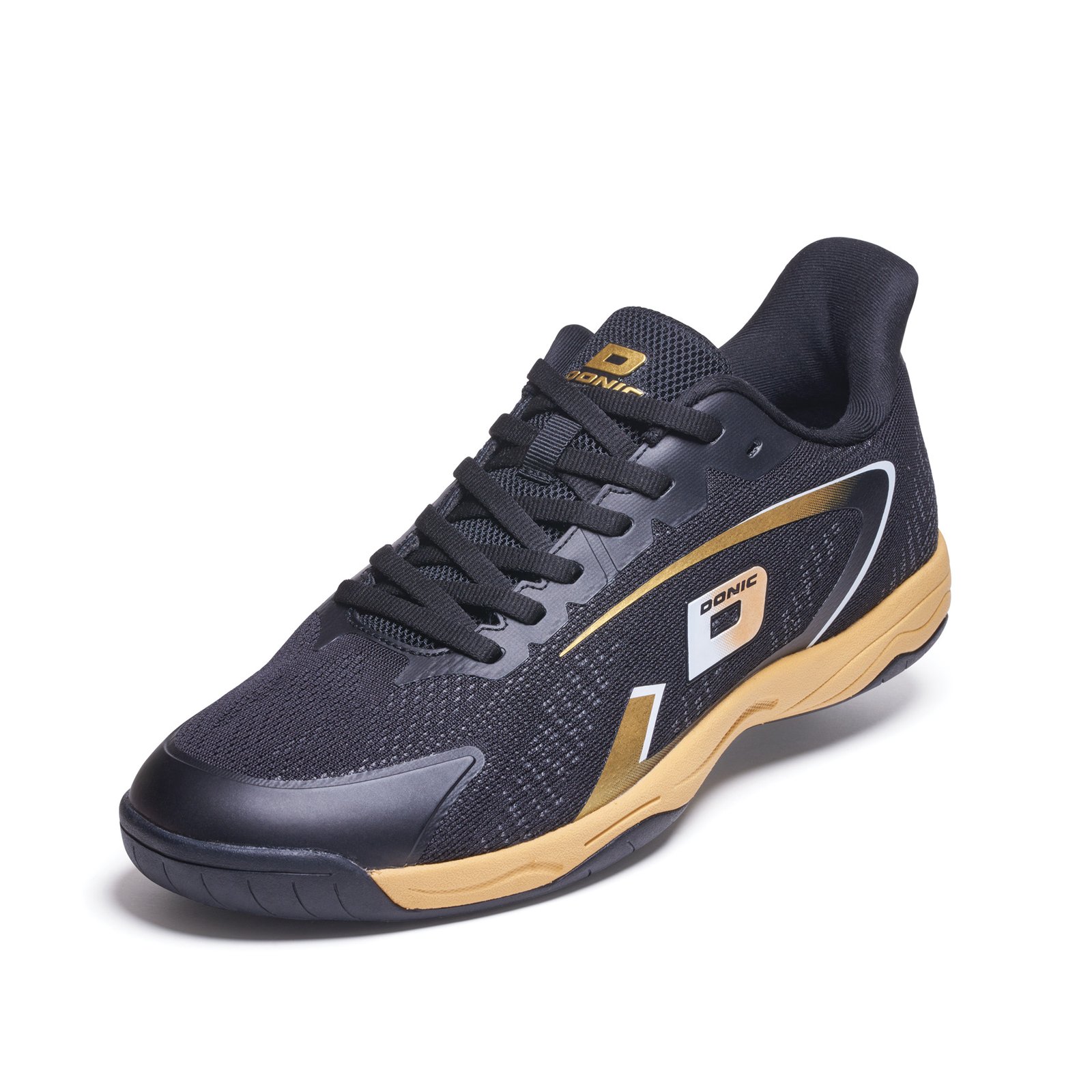
Donic Panther
The airflow pick — a breathable jacquard upper with seamless TPU, an EVA/Phylon midsole and a honeycomb insole, on a non-marking outsole.
The Panther is Donic’s comfort-led card, and its published brief leads with air. Donic describes a breathable jacquard upper — a woven textile — built for maximum airflow, with seamless TPU technology that Donic states reduces weight and keeps the fit secure. For a beginner, that pairing answers the two complaints a first indoor shoe usually earns: feet that run hot through a long club evening, and an upper that either pinches at its seams or lets the foot slide when the movement goes sideways. Underneath, a soft, breathable heel lining and a honeycomb insole complete the comfort story Donic tells — an insole structure Donic describes as distributing pressure evenly through training and matches.
The working parts are published just as plainly: an EVA/Phylon midsole, which Donic names as the shoe’s shock-absorption unit, and a non-marking outsole Donic describes as giving reliable grip on indoor courts — the hall-friendly half of the beginner brief, a shoe your sports centre will welcome. Donic positions the Panther for ambitious players and fast footwork, and lists it in EU sizes 36 to 46 in a black, gold and white design. The standing notes for this guide apply unchanged: Donic publishes no weight, so the Panther competes on its published construction; and this card reports the midsole in Donic’s own construction terms only — a named cushioning unit, not a health claim. If your first sessions run long and your priority is a cool, secure, breathable fit from a specialist maker, the Panther is the card.
What we like
- Breathable jacquard upper published for maximum airflow — the cool-shoe card
- Seamless TPU for a secure fit with reduced weight, per Donic
- Named cushioning build: EVA/Phylon midsole and a honeycomb insole
- Non-marking outsole with published indoor grip — hall-friendly by spec
Worth knowing
- Donic publishes no weight for this shoe — compare it on construction, not grams
- Positioned by Donic for ambitious players — beginners get a built-up shoe, not the flattest floor feel; contrast the Draven GSX card
As an Amazon Associate we earn from qualifying purchases.
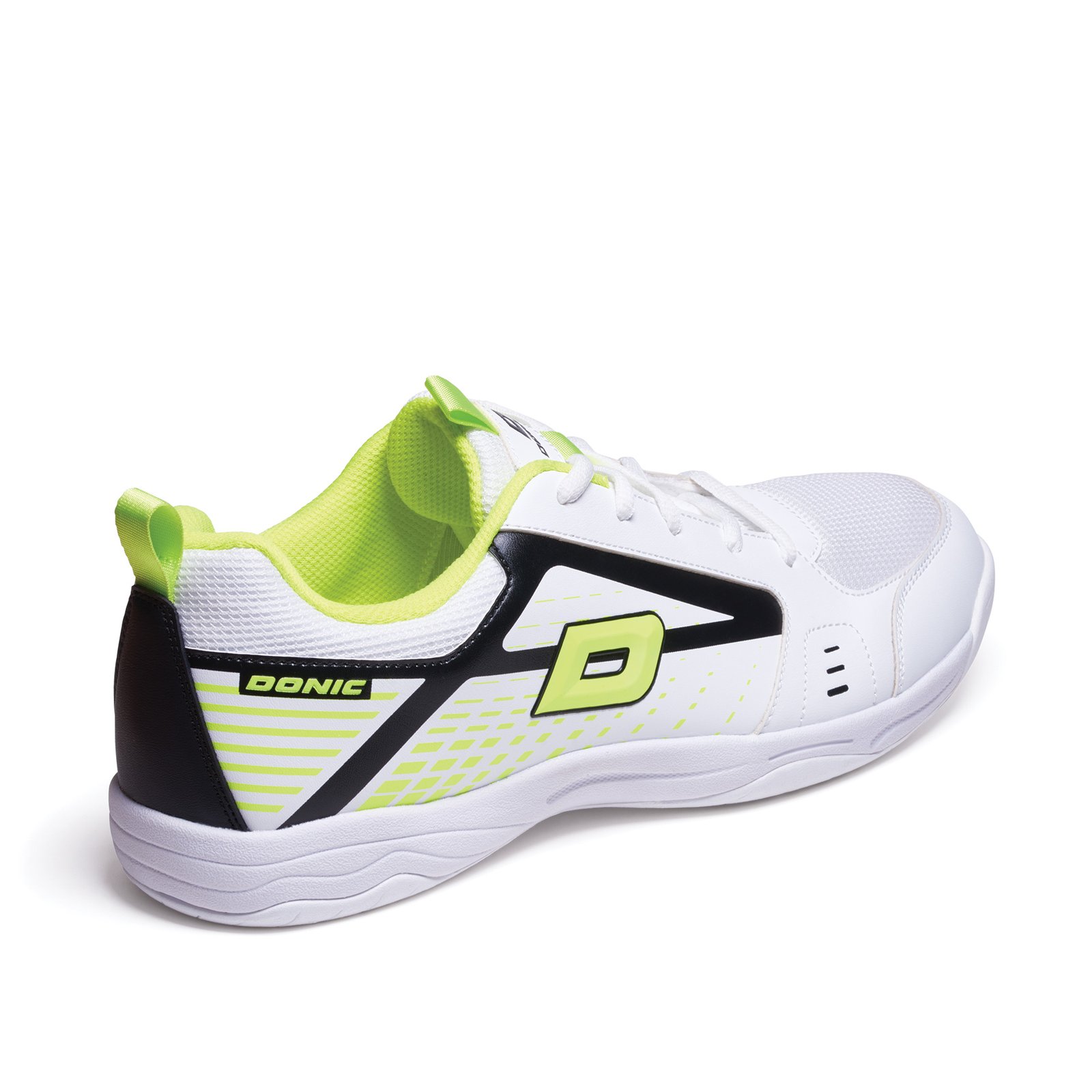
Donic Saphir
The stability-first pick — a durable synthetic-leather build Donic positions for excellent lateral stability, with an EVA midsole and a non-marking Phylon outsole.
The Saphir closes the guide at the opposite end of the beginner spectrum from the Draven GSX: where that shoe strips everything back to the floor, this one builds up. Donic’s published brief is stability in plain terms — high stability, excellent grip and reliable cushioning, designed for fast footwork and quick direction changes, with excellent lateral stability named as a headline feature. The construction follows the brief: a durable synthetic-leather upper Donic describes as giving secure support — a more structured hold than the mesh and jacquard cards — over a breathable textile and mesh lining, so the built-up exterior does not come with a sealed-in feel through a long session.
Underfoot, Donic names an EVA midsole for shock absorption and comfort, a honeycomb insole, and a non-marking Phylon outsole Donic describes as giving strong grip on indoor courts — note the difference from the Panther card, where Phylon sits in the midsole; here Donic assigns it to the outsole, and the cards print each model as its maker states it. The small practical details are published too: a heel loop for easy on and off, and a spare set of lime laces included with the white-and-lime design, across EU sizes 36 to 46. The guide’s standing honesty applies one last time: Donic publishes no weight for the Saphir, and a stability-led build is not the lightest brief on paper — it is the most structured one. For the beginner who plants hard, changes direction constantly and wants the shoe to feel planted back, this is the card.
What we like
- Lateral stability is the published headline — the planted-feel card for hard direction changes
- Synthetic-leather upper for secure support, with a breathable lining inside
- Named parts throughout: EVA midsole, honeycomb insole, non-marking Phylon outsole
- Practical published details: heel loop and a spare set of laces included
Worth knowing
- Donic publishes no weight — and a stability build is a construction choice, not a lightness claim
- The most built-up ride here — players wanting maximum floor feel should start at the Draven GSX card
As an Amazon Associate we earn from qualifying purchases.
Side-by-Side Comparison Table
| Model | Best For | Weight (as stated) | Fit / Width Options | Cushioning | Outsole (as maker states) |
|---|---|---|---|---|---|
| Butterfly Lezoline Unizes | Best overall first pair | 273 g (EU 43), stated by Butterfly | Standard fit · EU 34–47 | EVA heel dampening | Indoor rubber outsole (Butterfly) |
| Butterfly Lezoline Vilata | Wide fit | Not published by Butterfly | Wider ball girth — wide feet, high insteps | Light, flexible midsole | Grippy outer sole |
| Donic Draven GSX | Floor feel | Not published by Donic | Standard fit · EU 36–46 | Phylon midsole unit (Phylon plus RB sole) | Grippy — direct contact with the floor |
| JOOLA Court | Flexible sole | No figure published by JOOLA | Standard fit · order one size up (JOOLA) | Soft, supportive insole | Grippy and flexible |
| ASICS Upcourt 6 | Multi-court starter | Not published by ASICS | Standard fit · adaptable mesh upper | Lightweight court-shoe build | Non-marking indoor court outsole |
| Donic Panther | Breathable comfort | Not published by Donic | Standard fit · EU 36–46 | EVA/Phylon midsole · honeycomb insole | Non-marking, indoor grip |
| Donic Saphir | Stability | Not published by Donic | Standard fit · EU 36–46 | EVA midsole · honeycomb insole | Non-marking Phylon |
Read this table by its labels, because the labels are the lesson. Exactly one cell in the weight column carries a number — the Unizes at 273 g in an EU 43, stated by Butterfly with its size basis — and the other six carry an honest blank where no maker figure exists. That is not a failure of this guide; it is the published state of the beginner shoe market, and any comparison that fills those blanks with unsourced gram figures is inventing them. The fit column carries the second honest read: one genuinely wider design (the Vilata, in Butterfly’s own words), one published size-up instruction (the Court, from JOOLA’s own store), one shoe carded openly as a general court shoe rather than a table tennis model (the Upcourt 6), and a run of standard-fit specialist builds whose makers state their size ranges and stop there. Start from your feet, then the outsole descriptions, then the cushioning names, and the table lands you on the right card.
Buying Guide: Matching Your First Shoe to Your Feet and Your Hall
1. Start with construction: a low, flat, indoor shoe
The first filter is the type of shoe, not the brand on it. Six of the seven cards here are dedicated table tennis shoes — low, flat profiles with thin gum-rubber or rubber outsoles described by their makers for grip and floor contact on indoor surfaces — and the seventh, the Upcourt 6, is a general indoor court shoe carded openly as one. What none of them is: a running shoe. A runner’s thick, curved sole is published for forward motion and will feel tall and vague the first time you side-step to a wide ball. When you read any beginner listing, look for the indoor construction words — flat, grippy, non-marking, flexible, direct floor contact — in the maker’s own description. If a listing cannot describe its outsole’s job on a hall floor, it is not answering the table tennis question, whatever else it promises.
2. Fit first: width, insteps and honest size ranges
Fit decides more beginner purchases than any technology name, and this guide’s cards publish three different kinds of fit answer. A redesigned width: the Vilata, whose wider ball girth Butterfly states is for wide feet and high insteps — the starting card if standard shoes pinch across your forefoot. A published size range: Butterfly lists the Unizes across EU 34 to 47 and Donic lists its three shoes across EU 36 to 46, so check your EU size against the exact model rather than a brand average. And a published sizing warning: JOOLA’s own store tells Court buyers to order one size larger — advice worth more than any single spec, because a first shoe bought a size small teaches nothing except returns. Measure both feet in the socks you will play in, late in the day, and let the maker’s own fit statements make the final call.
3. Weight: how to read one number and six blanks
This guide prints one maker-stated weight — 273 g for the Unizes in an EU 43 — and six honest blanks, and the buying skill is knowing what to do with both. The number first: read it with its basis attached, as a reference point for what a mesh starter shoe from a specialist maker weighs in a stated size, not as a score the other cards failed to reach. The blanks second: where Butterfly, JOOLA, Donic and ASICS publish no weight, their cards compete on described construction — flexible soles, flat profiles, grippy outsoles — and words like “extremely light” are positioning, to be weighed as adjectives rather than compared as figures. Be suspicious of any retailer page that attaches a precise gram figure to these models without stating whose size was weighed; a weight without a basis is how invented specs enter a buying decision. The same discipline runs across the site: our guide to the best table tennis bats for beginners reads bat weights and compositions exactly the same way, maker figure first, marketing second.
4. Cushioning and feel: pick your end of the ladder
The seven cards form a feel ladder, and your first sessions will tell you where on it you belong. At the floor-feel end sits the Draven GSX — light and flat, published for direct contact with the floor — with the Court’s flexible sole and the Vilata’s light, flexible midsole close behind: the end for players who want the surface talking to their feet. In the middle sits the Unizes, its EVA dampening placed in the heel where a new player’s footwork loads first. At the built-up end sit the Panther and the Saphir, with named EVA and Phylon units and, on the Saphir, a stability brief Donic states outright. None of these positions is a health claim, and this guide makes none — they are construction descriptions, in the makers’ words, matched to preference: long sessions and hard floors argue for the built-up end; short, sharp club games and a love of feedback argue for the flat end. If you genuinely do not know, start in the middle with the Unizes and let your second pair be the correction.
5. Ordering: size charts, clean floors and returns
The last decision is practical, and beginner shoes make it easier to get wrong than most kit because sizing conventions differ by maker. Work from the exact model’s published size range and any model-specific advice — JOOLA’s size-up note for the Court is the standing example — rather than converting from your street size by habit. Order from a seller whose returns terms you have read first. When the shoes arrive, try them indoors on a clean floor, in your playing socks: walk, side-step both ways, and take a small lunge each side. The fit you are checking is a secure heel with room at the toes and no pinch across the ball of the foot — and on the Vilata, that the wider forefoot is doing the job Butterfly describes. Only take the tags off once the shoes pass on the floor they were bought for. Fit is the one published spec no guide can verify for you; the two minutes with a tape measure and a clean hall floor are the cheapest accuracy in this whole purchase.
Frequently Asked Questions
What makes a table tennis shoe different from a running shoe?
Construction, as the makers describe it. A running shoe is built for forward motion, with a thick, curved sole that rolls the foot from heel to toe. A table tennis shoe is built for lateral motion at close range: a low, flat profile, a thin gum-rubber outsole patterned for grip on indoor floors, flexible construction for quick side-steps, and an upper made to hold the foot through split-steps, lunges and recoveries around the table. Donic describes its Draven GSX as light and flat with direct contact with the floor, and JOOLA describes the Court’s sole as grippy and flexible for best floor contact — the opposite published design from a runner’s roll.
Can I just play in my regular trainers as a beginner?
You can stand at a table in them, but they will work against the footwork you are trying to learn. General trainers split the difference between sports: their soles are thicker and less grippy on a hall floor than the thin indoor outsoles the makers here describe, and their uppers are rarely built to hold a foot through constant sideways movement. Every card in this guide exists because the specialist makers publish a different construction for this game — flat, grippy, flexible and low. A first proper pair is the cheapest technique upgrade in the sport, and it is the purchase this guide is built to get right.
How much do beginner table tennis shoes weigh?
Mostly, their makers do not say — and this guide prints that honestly rather than filling the gap. Of the seven shoes carded here, exactly one carries a maker-stated weight: Butterfly publishes the Lezoline Unizes at 273 grams in an EU size 43, a figure to read with its size basis attached, because the same model weighs more in a larger size. Butterfly publishes no weight for the Vilata, JOOLA none for the Court, Donic none for the Panther, Saphir or Draven GSX, and ASICS none for the Upcourt 6. Where a maker writes “extremely light” without a number, treat it as positioning and compare the shoe on its published construction instead.
Which beginner table tennis shoe fits wide feet?
The Butterfly Lezoline Vilata is the published answer. Butterfly states that the Vilata’s width — its ball girth — was redesigned to be wider, and positions the shoe for players with wide feet or high insteps, over a grippy outer sole and a light, flexible midsole. The other six cards are standard-fit builds whose makers publish no width grade, so wide-footed beginners should start with the Vilata and check the remaining models’ size charts carefully rather than assuming a standard shoe runs roomy.
Do table tennis shoes work for other indoor sports?
The makers publish these as indoor shoes, and the shared construction — thin, grippy, non-marking outsoles and low, flexible profiles — is the indoor court pattern generally. One card here, the ASICS Upcourt 6, is published by ASICS as a general indoor court shoe rather than a table-tennis-specific model, and it is carded openly as the multi-court option. The specialist shoes are described by their makers for table tennis movement specifically; if you play several hall sports, the Upcourt 6 is the deliberate all-rounder, and if table tennis is your game, the six specialist cards are built for its footwork first.
How should my first table tennis shoes fit?
Follow the maker’s own published guidance for the exact model. JOOLA’s store advises ordering the Court one size larger than usual. Butterfly lists the Unizes across EU 34 to 47 and Donic lists its shoes across EU 36 to 46, so check your measured EU size against the model’s own range. In the shoe, you are looking for a secure heel, room to move at the toes and no pinch across the ball of the foot: try them indoors on a clean floor in your playing socks, side-step and lunge both ways, and order from a seller whose returns terms you have read first.
Can I use table tennis shoes outdoors?
These are indoor shoes, as their makers publish them. The outsoles are thin rubber — described as grippy, flexible and, on the Donic cards, non-marking — designed for wooden and synthetic hall floors. On outdoor concrete or asphalt a thin indoor sole wears quickly and grips poorly, and none of the makers here rates these models for outdoor use. If your table lives outdoors, buy an outdoor court shoe for it; if you play in a hall, club or sports centre, the seven cards here are built for exactly that floor.
The Verdict
Buy the construction, then the fit, then the name. The Butterfly Lezoline Unizes is the complete first pair — 273 g in an EU 43 as Butterfly states it, a breathable mesh upper and EVA heel dampening, specified well enough to buy without guessing. The Lezoline Vilata owns the wide fit, the one beginner card whose maker redesigned the shoe wider for wide feet and high insteps. The Donic Draven GSX owns floor feel, the JOOLA Court owns the flexible sole with the clearest sizing advice in the guide, the ASICS Upcourt 6 is the widely stocked multi-court starter, the Donic Panther the breathable long-session build, and the Donic Saphir the stability-first construction. Seven starter shoes, every specification printed as its maker states it — including the six honest blanks in the weight column, which tell their own story about how this end of the market is sold.
Affiliate disclosure: AliShuttler is a participant in the Amazon Services LLC Associates Program. Links marked “Check Price on Amazon” are affiliate links — if you buy through them, we may earn a commission at no additional cost to you. Every specification in this guide is taken from the manufacturer’s own published listings, checked at build time in 2026; the one weight printed is stated with the size basis its maker publishes it with, and where a maker publishes no weight, the guide says so.