Your second serious pair of tennis shoes is a different decision from your first. The beginner shoe did its job — it got you moving sideways safely while you learned the strokes — but an improving game exposes exactly where an entry-level build stops: the outsole smooths out under harder stops, the upper stretches where your movement has grown more aggressive, and the cushioning that felt plush at walking pace feels thin in the second hour of a real match. This guide compares seven step-up shoes on exactly what their makers publish — the outsole pattern and version as each maker states it, the cushioning system by the name each maker gives it, the durability features and outsole guarantees as each maker states them, the overall weight exactly as stated (or an honest note where a maker publishes none), and the fit as each maker labels it — and nothing else. No prices, no health claims, no invented numbers: just the spec sheets, read the way an improving player needs them.
⚡ TL;DR — The Short Answer
For the best all-round step up, buy the adidas Barricade 13 — the durability benchmark of the category, with a dual-density REPETITOR midsole, a Torsion System midfoot shank, Adituff abrasion protection in the drag zones and an Adiwear 2.0 split-herringbone outsole, in hard-court and clay versions. The Babolat Propulse Fury 3 AC is the support-and-durability pick: a Michelin Premium outsole, KPRS-X heel cushioning, a Power Belt upper and a six-month outsole durability guarantee. The Mizuno Wave Exceed Tour 6 AC is the lightweight step-up — ENERZY NXT cushioning over a Wave plate, with Mizuno’s own six-month outsole warranty. The Yonex Power Cushion Eclipsion 5 is the stability pick, and the only card here whose maker publishes a full weight table: 365 grams in a men’s 26.0 cm. The ASICS Court FF 3 is the premium all-court pick, with FLYTEFOAM, forefoot GEL and a MONO-SOCK build. The K-Swiss Ultrashot 4 is the heavy-duty pick — the most reinforced shoe here, with a six-month guarantee and the weight to prove its brief. And the Lacoste AG-LT Ultra is the speed-and-stability hybrid, with a Pebax-based LSR foam and a Linegrip herringbone sole.
Quick Picks — Best Tennis Shoes for Intermediate Players at a Glance
The category’s durability benchmark — REPETITOR cushioning, Torsion support and an Adiwear 2.0 split herringbone, in hard-court and clay versions.
A Michelin Premium outsole, KPRS-X heel cushioning and a Power Belt upper, backed by a six-month outsole guarantee.
ENERZY NXT over a Wave plate in the lightest build here — and Mizuno states a six-month outsole warranty in its own catalogue.
Power Cushion+, a graphite Drive sheet and a published weight: 365 g in a men’s 26.0 cm, on Yonex’s own spec table.
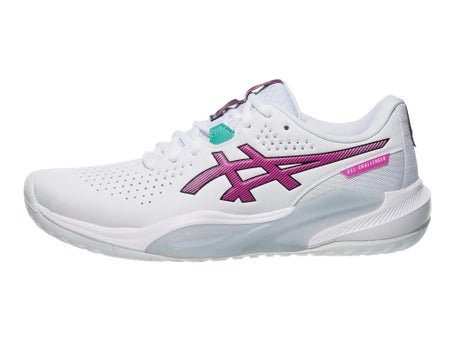
FLYTEFOAM and forefoot GEL in a MONO-SOCK build, with TWISTRUSS torsional support and an AHARPLUS outsole.
The most reinforced shoe here — DragGuard 7.0 rubber, a 360 chassis and a six-month guarantee, at a stated heavy build.
Pebax-based LSR foam, a caged leno-weave upper and a Linegrip herringbone — support that keeps a fast feel.
In This Guide
- The Step-Up Decision: Why Your Beginner Shoe Stops Being Enough
- How to Read a Step-Up Spec Sheet: Versions, Guarantees and Honest Weights
- The 7 Best Tennis Shoes for Intermediate Players, Compared
- Side-by-Side Comparison Table
- Buying Guide: Matching Your Step-Up to Your Game
- Frequently Asked Questions
- The Verdict
The Step-Up Decision: Why Your Beginner Shoe Stops Being Enough
Start with what has actually changed, because it is not your feet — it is your movement. An intermediate player stops the way a beginner never does: full-speed approaches to short balls, hard lateral plants behind the baseline, slides that start earlier and run longer, and split-steps landing with real force behind them. Three parts of an entry-level shoe run out first under that load. The outsole wears smooth in the forefoot and at the toe, because beginner outsoles are built for grip, not for months of abrasive hard-court stops. The upper gives way on the medial side, where an improving player drags a toe through groundstrokes and serve follow-throughs — the wear pattern every maker in this guide now reinforces with a named drag feature. And the midfoot starts to twist: a shoe with no shank or plate feels fine at rally pace and vague at match pace, which is why every card below publishes a torsional structure — a Torsion System, a Wave plate, a graphite sheet, a chassis — by name.
The second part of the step-up decision is the surface split, and it is the one most intermediates get wrong by buying a second copy of their first shoe. Makers build this tier in versions: a hard-court outsole with a modified or split herringbone cut for grip-and-glide on acrylic, and a clay version with a fuller, deeper herringbone that channels loose material and lets you slide without catching. The adidas, Babolat and Yonex cards below all publish both versions of the same shoe. If your club has moved you onto clay for the season — or your hard-court hours have doubled — the version question matters more than the brand question, and the cards state each version’s pattern in the maker’s own terms so you can buy the right one deliberately rather than by accident.
One boundary before the picks. This page owns the intermediate step-up only. The full all-player field belongs to our pillar guide to the best tennis shoes, the first-shoe decision belongs to our guide to the best tennis shoes for beginners, the women’s fit decision to our best tennis shoes for women, and players shopping on published wide lasts and senior-specific builds are served by our guide to the best tennis shoes for seniors. None of their models is re-carded here — every shoe below is a different model, chosen because its maker publishes a step-up specification an improving player can act on. And if your strokes are stepping up alongside your shoes, our how to play tennis guide covers the footwork patterns these outsoles are built around.
How to Read a Step-Up Spec Sheet: Versions, Guarantees and Honest Weights
The outsole line is really two lines: compound and version. The compound is the maker’s durability answer — adidas’s Adiwear 2.0, Babolat’s Michelin Premium rubber with denser zones in the high-wear areas, Yonex’s Endurance Rubber II, Mizuno’s DuRubber, ASICS’s AHARPLUS, K-Swiss’s Aosta 7.0 with DragGuard 7.0 layered into the wear zones. The version is the surface answer: the same shoe is sold with a hard-court tread (split or modified herringbone, cut to grip and still release into a slide) and, on three cards here, a clay tread with a full herringbone. Read both lines before you compare two shoes, because a clay version and a hard-court version of one model are effectively two different shoes for buying purposes — and a listing that does not state its version has not answered the first question.
The guarantee line is the step-up tier’s new fact, and it is printed as each source states it. Three of the seven shoes here carry a six-month outsole durability guarantee: if the outsole wears through within six months, it is replaced under the guarantee’s terms. Mizuno states its six-month outsole warranty for the Wave Exceed Tour 6 in its own US catalogue; the Babolat and K-Swiss guarantees run through Tennis Warehouse’s programme on those models, and the cards attribute them that way. A guarantee is not a durability measurement — it does not tell you a sole will last six months — but it is a published commitment a beginner shoe almost never carries, and for a hard-court player who burns through forefoot rubber it changes the real cost of a season. Read the terms on the listing you buy from; guarantees are honoured by the seller or maker who states them, not by this guide.
Weight is still the honesty test, and this tier fails it more often than it should. Of the seven makers here, exactly one publishes a complete weight with its basis on its own spec table: Yonex, at 365 grams for a men’s 26.0 cm (330 grams for a women’s 24.5 cm). adidas, ASICS, K-Swiss and Lacoste publish no weight for these models in the listings checked, and the syndicated figures for the Babolat and Mizuno conflict between regional sheets — so where this guide prints a weight for those shoes, it prints a retailer-measured figure with the retailer and the size named, labelled as such on the card. That discipline matters more at this tier, not less: step-up shoes are heavier-built than beginner shoes by design, the honest spread here runs from a retailer-measured 12.7 ounces to a retailer-measured 16.2 ounces in the same men’s size, and a buyer comparing invented gram figures would never see it.
Cushioning is read by name, and the names mark the tier. Beginner shoes cushion with generic EVA descriptions; this tier publishes systems — adidas’s dual-density REPETITOR, Babolat’s KPRS-X heel unit over an EVA midsole, Mizuno’s ENERZY NXT with PoWnCe, Yonex’s Power Cushion+ with Feather Bounce Foam, ASICS’s FLYTEFOAM with forefoot GEL, K-Swiss’s Surge 7.0, Lacoste’s Pebax-based LSR. A named system is a comparable spec with a maker’s description behind it; an unnamed promise of comfort is marketing. The cards keep the two separate, and describe each system the way its maker describes it — nothing here claims a cushioning system prevents anything.
The 7 Best Tennis Shoes for Intermediate Players, Compared
Seven step-up shoes, one shared brief — built for harder movement than a beginner shoe survives, published with named cushioning, a stated outsole version and the durability features an improving player’s wear patterns demand. Read the card that matches your surface and your wear pattern first.
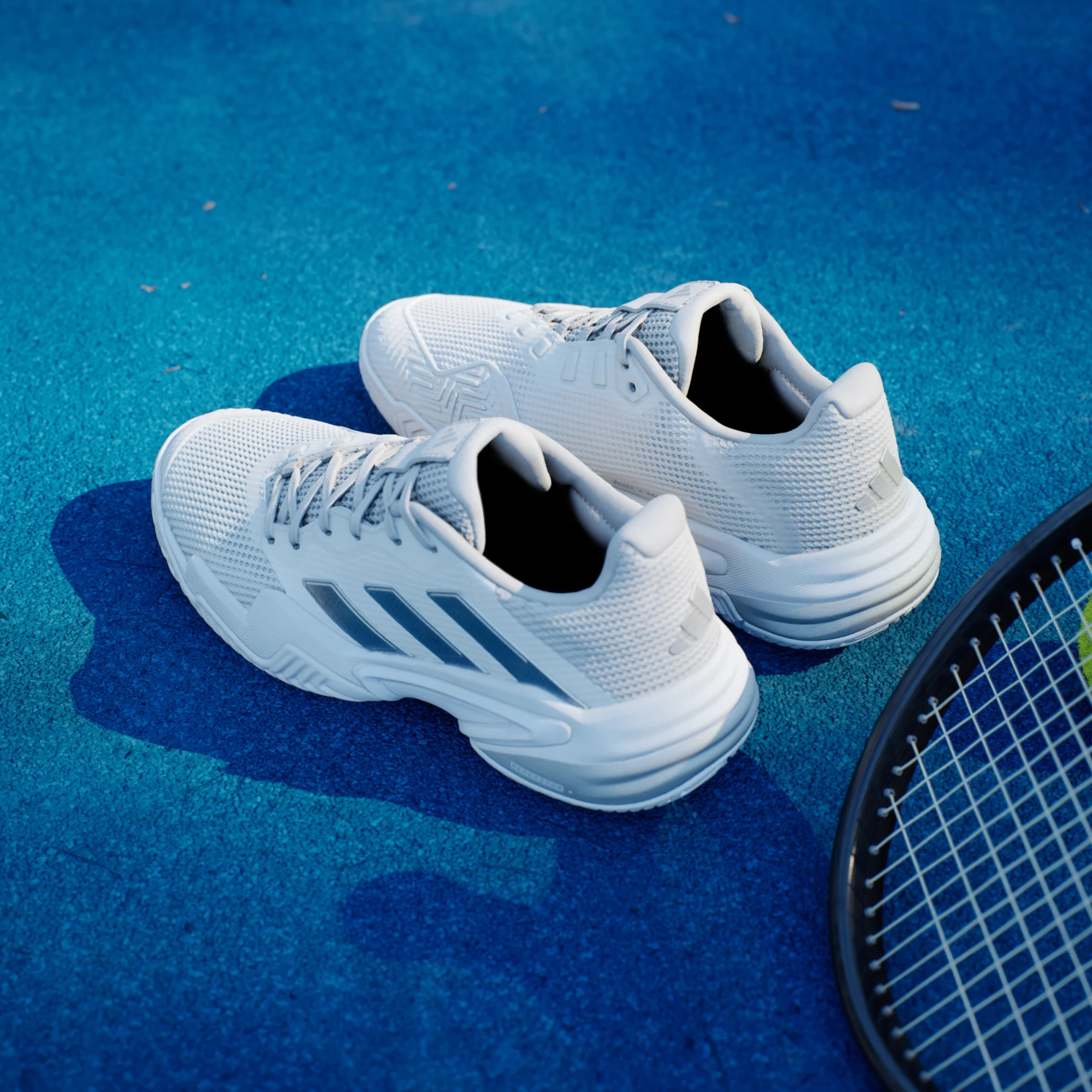
adidas Barricade 13
The category’s durability benchmark, refined — a dual-density REPETITOR midsole, a Torsion System shank and Adituff drag protection, in separate hard-court and clay versions.
The Barricade line is the shoe the step-up tier is measured against, and the 13 earns the #1 card on the completeness of its published answer to the intermediate brief. Start underneath: the outsole is Adiwear 2.0, adidas’s high-abrasion rubber, cut in a split herringbone on the hard-court version — a pattern adidas designs to grip on the plant and still release into a controlled slide, with the split placed to add abrasion resistance in the high-wear zones. Players whose club season runs on clay buy the same shoe as the Barricade 13 Clay, whose full herringbone is cut for loose-surface grip and longer slides. That two-version clarity is the first thing a beginner shoe never offered you, and adidas publishes it cleanly.
The structure above the sole is aimed at the two places intermediate movement attacks a shoe. The Torsion System is a TPU midfoot shank that resists twisting through the middle of the shoe when you plant and rotate — the stability half of the step-up brief. The upper is a breathable mesh reinforced with Adituff, adidas’s abrasion-resistant material made with recycled content, placed in the high-wear and drag zones where a toe-dragging improver destroys an entry-level upper first. An asymmetric lacing system with a neoprene tongue and laces hidden on the medial side keeps the drag zone smooth, and Geofit Sensepods — shaped pods inside the heel — fill the heel’s natural contours for the locked-in fit adidas describes.
Cushioning is the update adidas leads with on this generation: a dual-density REPETITOR midsole, which adidas describes as delivering a soft, energetic response — firmer support where the foot loads, softer cushioning where it lands. Two honest notes close the card. adidas publishes no weight for the Barricade 13, so none is printed here; the shoe’s reputation is a substantial, durable build, and it competes on construction rather than grams. And while Tennis Warehouse sells this model with a six-month outsole durability guarantee, that guarantee is the retailer’s programme, attributed as such — adidas’s own published durability case is the Adiwear compound and the Adituff zones, and it is a strong one.
What we like
- Two published versions — split herringbone for hard courts, full herringbone Clay — so the surface decision is deliberate
- Adituff abrasion material sits exactly where intermediate toe-drag wears a shoe out
- Torsion System shank plus Geofit heel pods: the support brief, named part by part
- Dual-density REPETITOR is a genuine tier step up from entry-level adidas cushioning
Worth knowing
- adidas publishes no weight for this model — compare it on construction, not grams
- A durability-first build: players chasing the lightest step-up should read the Mizuno card
- The six-month outsole guarantee on this model is a Tennis Warehouse programme, not an adidas promise
As an Amazon Associate we earn from qualifying purchases.
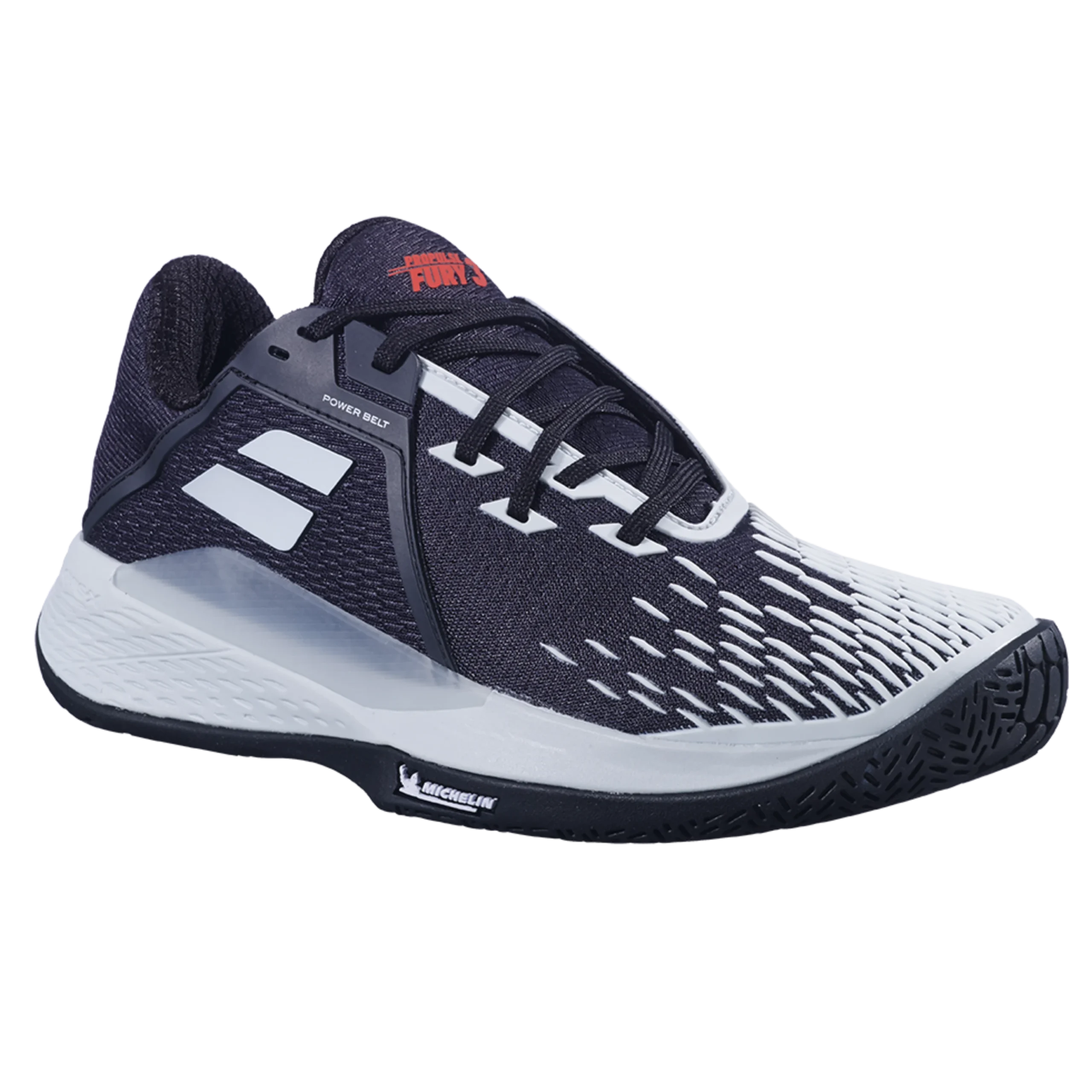
Babolat Propulse Fury 3 AC
Babolat’s support flagship — a Michelin Premium outsole, KPRS-X heel cushioning and a Power Belt upper, with a six-month outsole durability guarantee.
The Propulse Fury 3 is the card for the intermediate whose first shoe died the usual death — outsole worn through at the forefoot, upper split along the drag side — and who intends the second pair to be built against exactly that. The outsole is the headline: a Michelin Premium rubber compound, developed with Michelin’s tyre-rubber expertise, with denser rubber placed in the high-wear regions and lighter density where the shoe can afford it. The All Court tread is tuned for hard courts first, and Babolat publishes a separate Clay version with a full herringbone for clay players. The model is sold with a six-month outsole durability guarantee through Tennis Warehouse — a published commitment, attributed to the programme that honours it.
Support is built as a system rather than a single part. The Power Belt is an external shell that wraps the heel and midfoot to lock the foot down, the 360° Fit construction integrates the tongue into the shoe’s chassis for the sock-like fit Babolat describes, and a Lace-in system tucks the laces away from the drag zone, with added protection across the medial side of the upper. Underfoot, a reinforced plate in the shank adds torsional stability for powerful movements, and cushioning pairs an EVA midsole — increased in this generation, per Babolat’s copy — with the KPRS-X heel system, Babolat’s EVA cushioning insert for the heel zone, over an OrthoLite comfort insole.
The weight line is printed the way this guide always prints a contested figure: Babolat’s syndicated spec sheets conflict between versions, so the figure on this card is Tennis Warehouse’s measured 14.4 ounces in a men’s US 10.5, labelled as a retailer measurement. Read with that basis, the Fury 3 sits in the middle of this guide’s honest spread — substantial, as a support flagship should be, and lighter than the K-Swiss card below. Choose it if support and outsole life are your first two filters and you want both answered by named parts rather than adjectives.
What we like
- Michelin Premium outsole with density mapped to the wear zones — the durability brief, engineered visibly
- Power Belt, 360° Fit and a reinforced shank plate: support described as a system
- A six-month outsole durability guarantee stands behind the model’s core claim
- KPRS-X heel cushioning plus an OrthoLite insole over a fuller EVA midsole
Worth knowing
- No settled maker weight — the figure printed is a retailer’s measurement, labelled as such
- The structured build needs a slight break-in, per retailer fit notes
- Clay players must order the Clay version deliberately; the AC tread is hard-court first
As an Amazon Associate we earn from qualifying purchases.
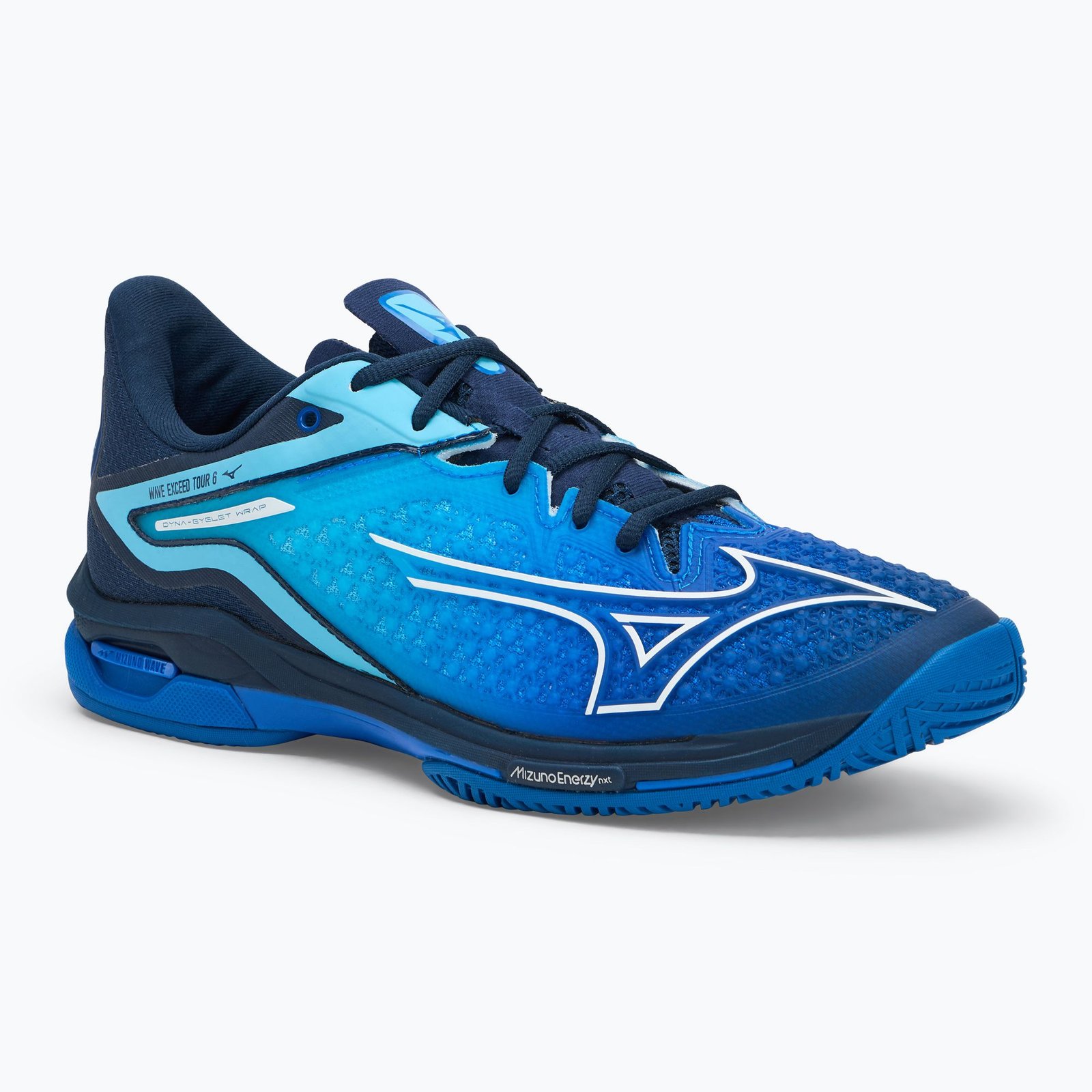
Mizuno Wave Exceed Tour 6 AC
The speed shoe of the tier, grown up — ENERZY NXT cushioning over an updated Wave plate, with a six-month outsole warranty stated in Mizuno’s own catalogue.
Every step-up guide needs the card for the player whose game is getting faster, not heavier — and Mizuno builds it. The Wave Exceed Tour 6 is the lightest shoe in this guide on the figures that can be printed honestly: Tennis Warehouse measures 12.7 ounces in a men’s US 10.5 (and 10.2 ounces in a women’s US 8.5). Mizuno’s own regional spec sheets conflict on this model’s gram figure, so no maker weight is claimed here — the retailer measurement, with its basis, is the comparable number, and it still places the Tour 6 clearly at the light end of the tier.
The speed is engineered, not just weighed. MIZUNO ENERZY NXT — Mizuno’s lightest, most responsive ENERZY material, per its own catalogue — sits in the forefoot for the first step and the push-off, paired with PoWnCe, Mizuno’s lightweight midsole cushioning, and an ENERZY insole. The updated Wave plate is the stability half of the brief: a rigid plate that Mizuno describes as converting power into speed while holding the midfoot through lateral movement, with a D-Flex Groove — a diagonal groove in the midfoot — engineered to let the shoe turn at full pace. The upper is Mizuno’s 3D-Solid material, soft on the foot with expanded coverage over the inner instep wear area, laced through a Dyna-Eyelet Wrap that wraps the whole foot for the secure fit Mizuno describes.
The outsole answers the durability question a speed shoe usually dodges. Mizuno’s DuRubber compound is reconfigured on this generation with a new tread designed, in Mizuno’s words, to let the player both slide and stop — and Mizuno USA’s own catalogue states a six-month outsole warranty for the model, the only maker-stated warranty among these seven cards. A lightweight shoe whose maker warranties the sole is a genuinely different buying proposition from a lightweight shoe alone, and it is why this card, not a heavier one, will suit the intermediate whose footwork — not their opponents — is doing the damage.
What we like
- The lightest honestly-figured shoe here — 12.7 oz measured in a men’s US 10.5
- ENERZY NXT in the forefoot plus a Wave plate: speed and stability from named parts
- Mizuno states a six-month outsole warranty in its own catalogue — rare on a speed shoe
- Dyna-Eyelet Wrap and expanded instep coverage answer the step-up fit brief
Worth knowing
- Mizuno’s regional sheets conflict on weight — the figure here is a retailer’s measurement, labelled
- The women’s version fits snug-medium per retailer notes — width-first shoppers should read the K-Swiss and Babolat cards
- A speed brief: heavy toe-draggers will still wear it faster than the durability cards
As an Amazon Associate we earn from qualifying purchases.
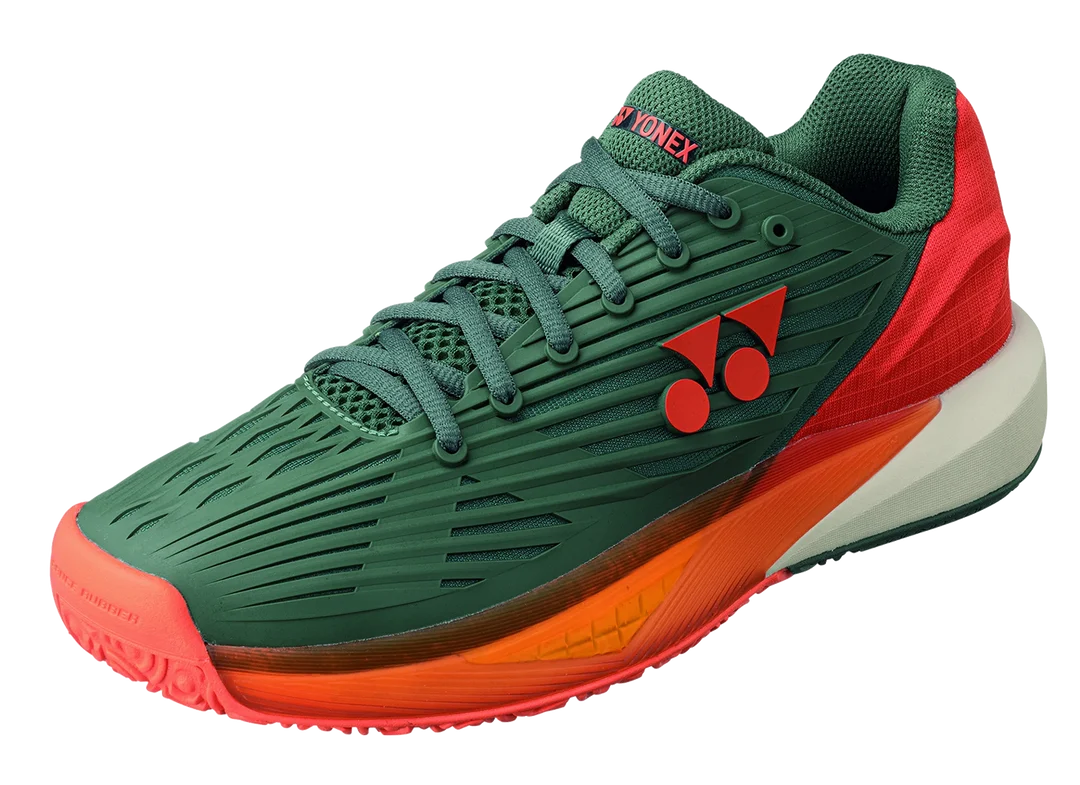
Yonex Power Cushion Eclipsion 5
Yonex’s stability flagship — Power Cushion+, a graphite Drive sheet and the only fully published weight table in this guide: 365 g in a men’s 26.0 cm.
The Eclipsion 5 is Yonex’s premium stability shoe, and it opens with the spec this whole tier should be judged by: Yonex publishes the weight — 365 grams for a men’s 26.0 cm, 330 grams for a women’s 24.5 cm — on its own specification table, with the size basis attached. In a guide where four makers publish no weight at all, that single act of transparency is worth stating plainly, and it makes the Eclipsion the easiest card here to compare honestly: a substantial stability build, weighed and admitted by its maker.
The stability is structural. A 3D Power Graphite Drive sheet — a graphite plate through the middle of the midsole — is Yonex’s torsional answer, described by Yonex as maximising lateral stability and helping propel the player forward out of the plant. A Heel Stabilizer at the rear of the shoe supports the landing, the Toe Assist Shape is Yonex’s forefoot shaping against lateral drift, and the Synchro-Fit Insole lifts the mid-to-heel area for the closer foot-to-shoe contact Yonex describes. The upper pairs Durable Skin — Yonex’s wear-resistant overlay, thickened in the high-wear zones for drag protection — over a breathable Double Russel Mesh.
Cushioning is Yonex’s flagship system: Power Cushion+, which Yonex describes as absorbing shock and reversing the energy into the next movement, layered with Feather Bounce Foam for lightweight bounce. Underneath, the one-piece Endurance Rubber II outsole runs a modified herringbone with denser rubber in the high-wear areas and perpendicular tread on the lateral edge for sliding, shaped on Yonex’s Round Sole for smooth transitions; a clay-tread variant covers clay players. Choose the Eclipsion 5 if your step-up brief is stability with receipts — every major claim on this card, including the weight, is one its maker prints.
What we like
- The only maker-published weight table here — 365 g with its size basis, straight from Yonex
- A graphite Drive sheet, Heel Stabilizer and Toe Assist Shape: stability as named structure
- Durable Skin thickened in the drag zones, over a breathable mesh base
- All Court and Clay tread variants of the same shoe
Worth knowing
- A substantial build by design — players chasing minimum weight should read the Mizuno card
- The women’s version fits snug-medium per retailer notes, with a slight break-in
- No outsole guarantee is published for this model in the listings checked
As an Amazon Associate we earn from qualifying purchases.
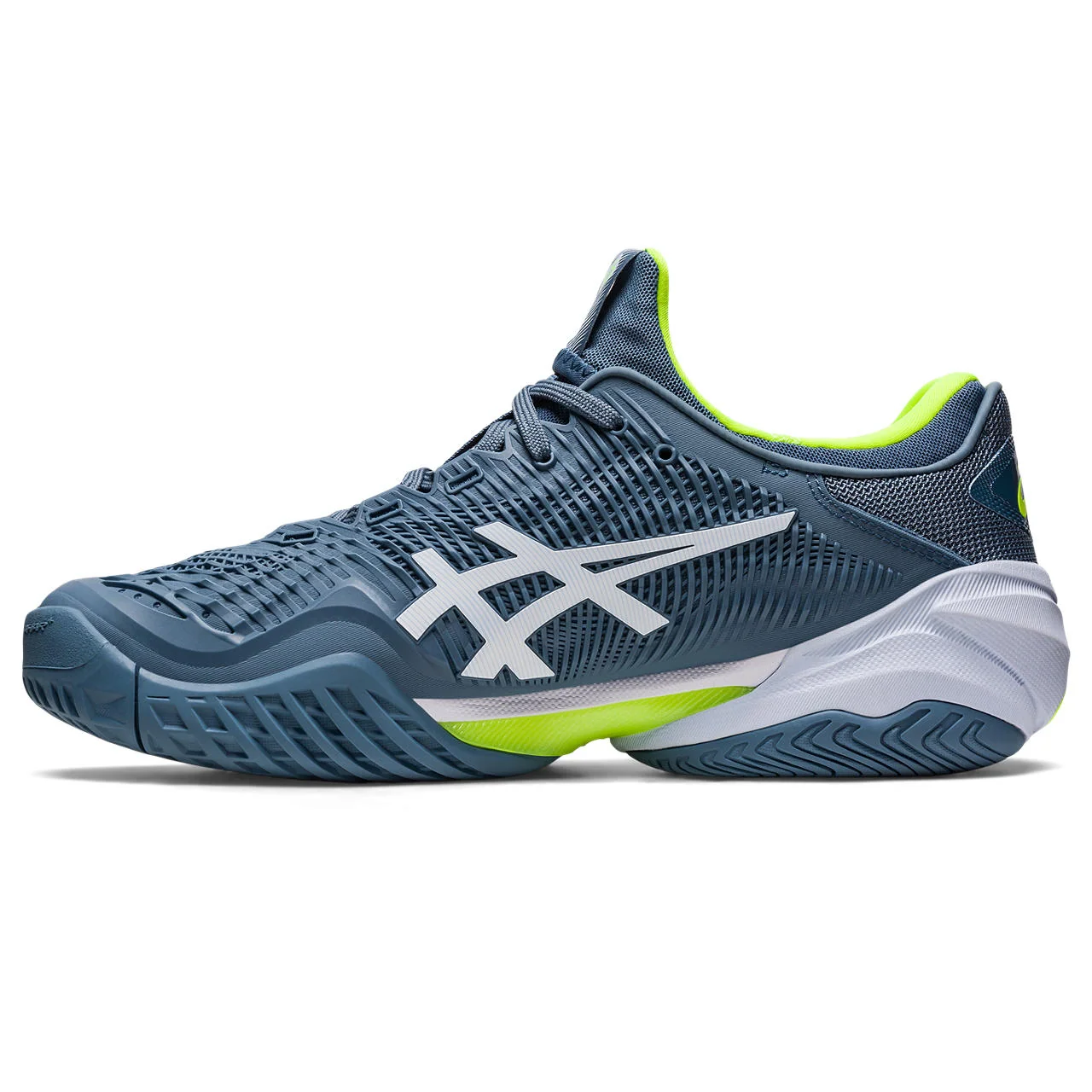
ASICS Court FF 3
ASICS’s premium all-court build — FLYTEFOAM with forefoot GEL, a TWISTRUSS system and a sock-like MONO-SOCK upper, designed around stable landings and fast recoveries.
The Court FF 3 is the premium card — the shoe ASICS builds for the advanced all-court game, and the natural step-up for an intermediate whose movement now mixes baseline grinding with net approaches. ASICS describes the design brief in landing terms: an increased outsole contact area creates a stable landing, so the player can put more energy into the swing and recover quicker between shots, and the three-piece outsole with its TWISTRUSS support system is built to help you push off the ground with more force through crossover steps and cuts. That is a step-up brief stated by the maker in movement language, and the construction underneath it is equally specific.
The upper is a MONO-SOCK construction — a sock-like fit system — with supportive PU material over it, which ASICS positions for stability: the foot is held by the structure of the shoe rather than by laces alone. PGUARD technology adds durability at the forefoot, where the toe-drag wear of an improving game concentrates. Cushioning pairs a FLYTEFOAM midsole — ASICS’s lightweight cushioning foam — with forefoot GEL technology, which ASICS describes as improving impact absorption and creating a softer feeling at footstrike.
The outsole is AHARPLUS, ASICS’s high-abrasion rubber, which ASICS rates at three times the abrasion resistance of conventional outsole material — printed here as ASICS’s own rating of its compound, which is the honest way to carry a maker’s comparative claim. The honest gap on this card is the same one ASICS leaves on most of its range: it publishes no weight for the Court FF 3, so none is printed, and the card competes on its construction — premium, structured and complete — rather than on a number. Choose it if you want the most integrated build in this guide and your buying decision runs on systems, not scales.
What we like
- MONO-SOCK plus PU support: the foot held by structure, not just lacing
- TWISTRUSS and a wider-contact three-piece outsole, described by ASICS in movement terms
- FLYTEFOAM with forefoot GEL — ASICS’s premium cushioning pairing
- PGUARD forefoot protection where intermediate drag wear lands
Worth knowing
- ASICS publishes no weight for this model — compare on construction
- The sock-like MONO-SOCK fit is a distinct feel; standard-lasted shoes elsewhere in this guide fit more conventionally
- No clay-specific version is published in the listings checked — clay-first players should read the adidas, Babolat or Yonex cards
As an Amazon Associate we earn from qualifying purchases.
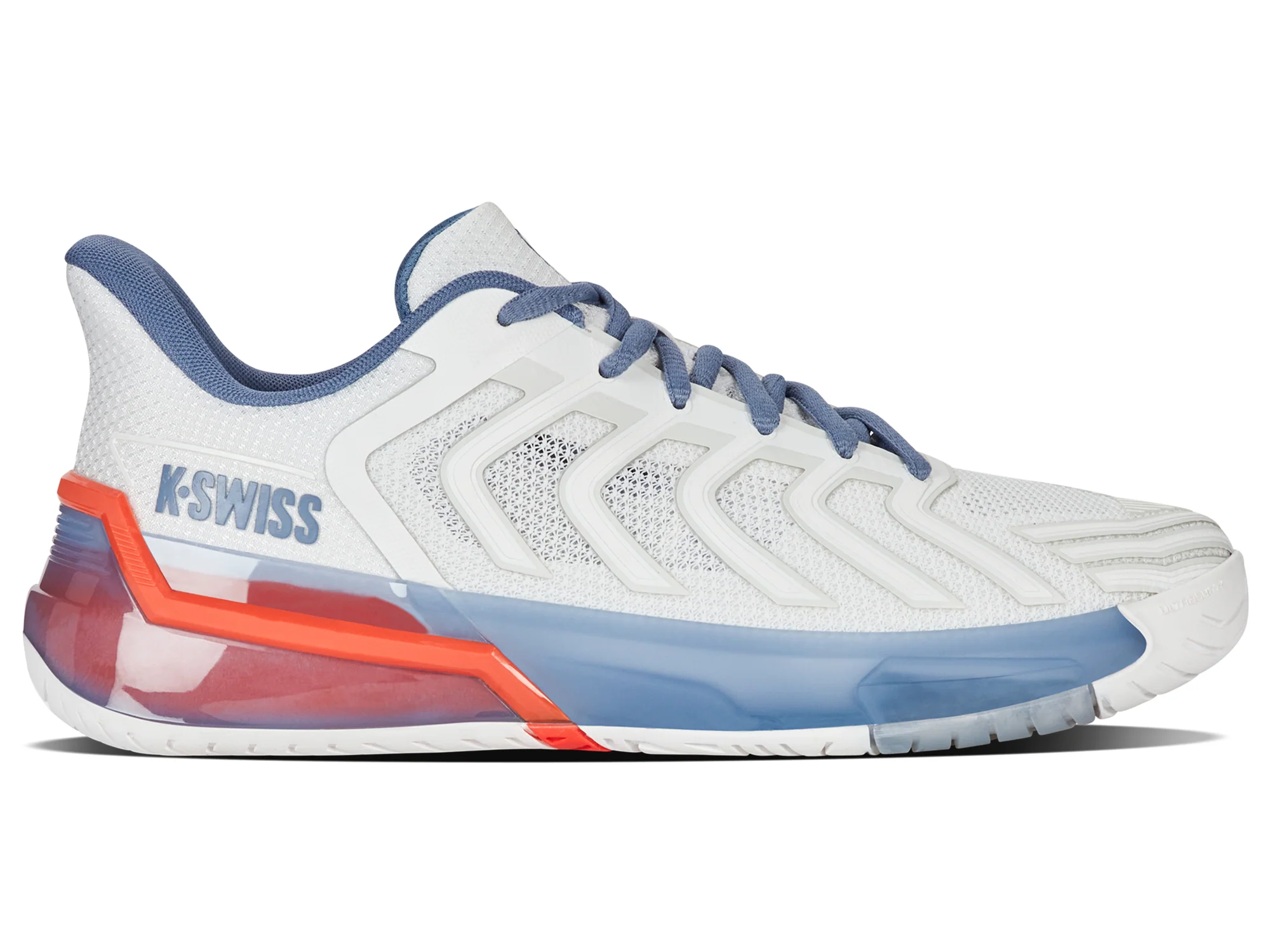
K-Swiss Ultrashot 4
The heavy-duty card — the most reinforced shoe in this guide, with DragGuard 7.0 rubber in the wear zones, a 360 support chassis and a six-month outsole durability guarantee.
Some intermediates do not need a faster shoe; they need a shoe that is still intact in month four. The Ultrashot 4 is K-Swiss’s answer, and its published brief is reinforcement at every layer. The outsole is Aosta 7.0 rubber in a multi-directional herringbone, with DragGuard 7.0 — thicker, more durable rubber — placed in the high-wear regions to extend the sole’s life, and the model carries a six-month outsole durability guarantee. The upper is built from DuraMesh and DuraPrint, with DuraWrap reinforcement in the wear areas — the drag side and toe that an aggressive mover’s game attacks first.
Support matches the sole. A new 360 Plantar Support Chassis runs through the midfoot and heel for the stable foundation K-Swiss describes for push-offs and direction changes, backed by a TPU shank, while cushioning is Surge 7.0 — K-Swiss’s soft, responsive underfoot foam — with a moulded TPU Shock Frame under the heel and a supportive heel cap for the locked-in security the maker describes. Nothing on this card is a lightweight part, and the guide prints the consequence honestly: K-Swiss publishes no weight, and Tennis Warehouse measures 16.2 ounces in a men’s US 10.5 — the heaviest figure in this guide by a wide margin, labelled as a retailer measurement.
That weight is the card’s honest trade, and for the right player it is not a drawback: it is the receipt for the rubber, chassis and reinforcement the shoe carries. The fit helps the case — retailer fit notes describe a generous medium, the roomiest published fit character in this guide, which makes the Ultrashot the step-up card for an intermediate whose feet found standard lasts tight. Choose it if your wear pattern, not your stopwatch, is what killed your first pair.
What we like
- DragGuard 7.0 rubber placed in the wear zones, under a six-month outsole guarantee
- A 360 chassis, TPU shank and Shock Frame: the fullest support stack here
- DuraWrap reinforcement where aggressive movers split uppers
- A generous-medium fit — the roomiest fit character published in this guide
Worth knowing
- The heaviest shoe here — 16.2 oz measured in a men’s US 10.5, and it feels like its brief
- K-Swiss publishes no weight; the figure printed is a retailer’s measurement, labelled
- Ventilation has historically been this line’s compromise, improved but still the warmest build here
As an Amazon Associate we earn from qualifying purchases.
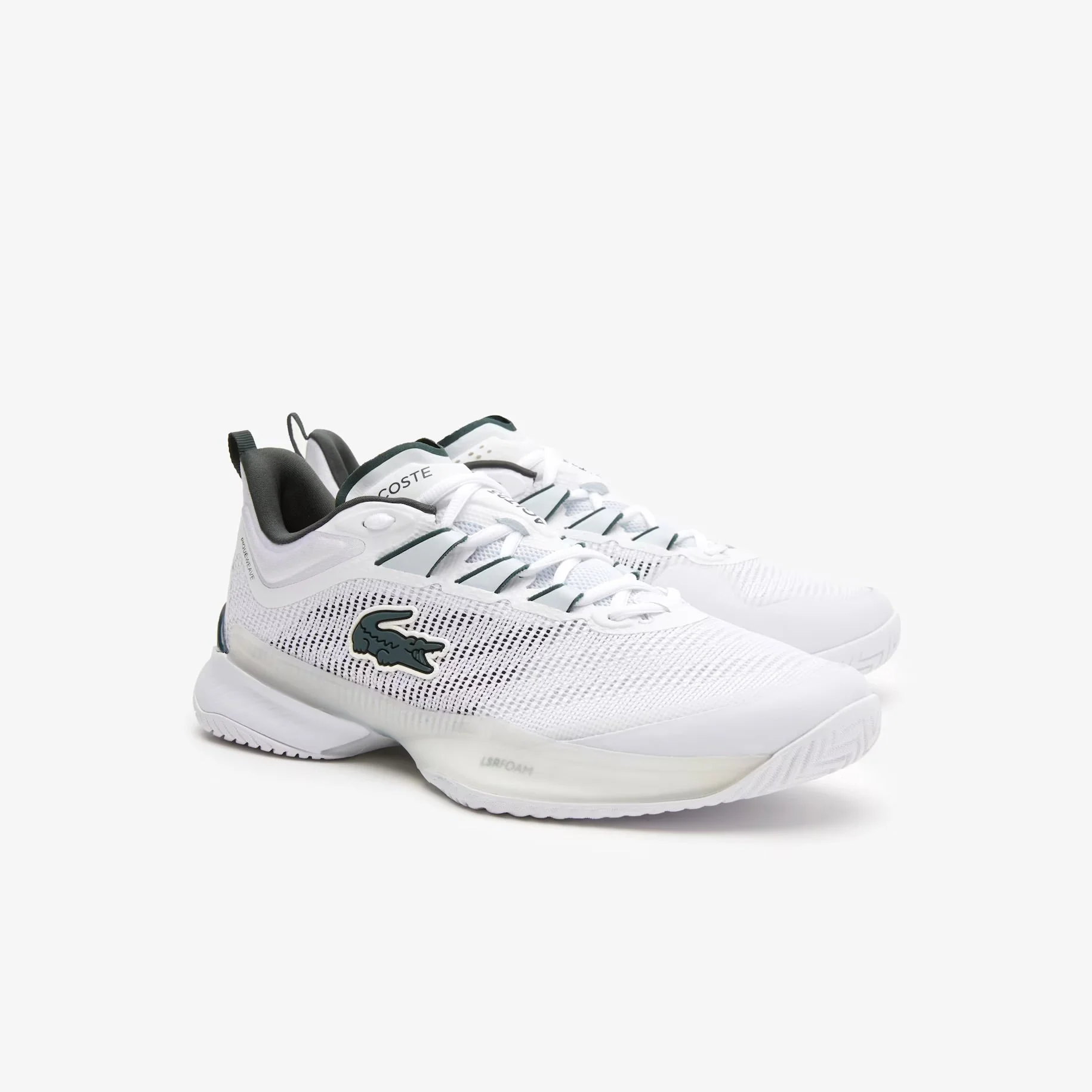
Lacoste AG-LT Ultra
Lacoste’s premium tour build — a Pebax-based LSR foam, a midsole chassis with a heel stabiliser, and a caged leno-weave upper that keeps a fast feel inside a stable shoe.
The AG-LT Ultra closes the guide because it refuses the tier’s usual trade. Most step-up shoes make you choose: the fast ones flex, the stable ones lumber. Lacoste’s published construction splits the difference by design — stability from a midsole chassis, a heel stabiliser and a cage system integrated into the upper, and speed from a lightweight woven upper and a dual midsole construction that cuts mass through the middle of the sole. It is Lacoste’s premium performance shoe, built for powerful movers, and its spec sheet reads like the hybrid brief written out part by part.
The cushioning name is the distinctive one: LSR — Lacoste Super Responsive Foam — a Pebax-based ETPU foam placed under the forefoot, which Lacoste positions for comfort and energy return where the push-off happens. The upper is a leno-weave TPU mesh, a woven construction Lacoste uses for the combination of support, durability and fit, with a moulded rubber toe guard protecting the drag zone. Underneath, a modified herringbone outsole in Lacoste’s Linegrip rubber compound is published for multi-directional traction and durability across court surfaces.
The honest notes are the familiar two. Lacoste publishes no weight for the AG-LT Ultra, so the figure here is Tennis Warehouse’s measured 14.6 ounces in a men’s US 10.5, labelled as a retailer measurement — mid-pack in this guide, consistent with the hybrid brief. And retailer fit notes describe a snug fit with a low toe box: players who need vertical room at the toes should register that before ordering, and the generous-medium K-Swiss card is the alternative shape. Choose the Lacoste if your step-up brief is a shoe that supports like a stability model and moves like a speed model, and you are willing to buy the fit carefully to get both.
What we like
- A genuine hybrid brief: chassis, heel stabiliser and cage for support; woven upper and dual midsole for speed
- LSR Pebax-based foam under the forefoot — a named, premium cushioning material
- Linegrip herringbone and a moulded toe guard cover traction and drag wear
- The most distinctive silhouette in the guide, if the second pair should look like a step up too
Worth knowing
- Lacoste publishes no weight — the figure printed is a retailer’s measurement, labelled
- A snug fit with a low toe box, per retailer notes — not the card for high-volume feet
- No outsole guarantee is published for this model in the listings checked
As an Amazon Associate we earn from qualifying purchases.
Side-by-Side Comparison Table
| Shoe | Best For | Weight (As Stated) | Outsole, As Maker States | Cushioning (Maker-Named) | Fit |
|---|---|---|---|---|---|
| adidas Barricade 13 | Best overall step-up | Not published by adidas | Adiwear 2.0, split herringbone (hard); full herringbone Clay version | Dual-density REPETITOR; Torsion System | Regular fit; men’s & women’s |
| Babolat Propulse Fury 3 AC | Support & durability | 14.4 oz — Tennis Warehouse measured, men’s US 10.5 | Michelin Premium, denser zones in high-wear areas; 6-month guarantee | EVA + KPRS-X heel; OrthoLite insole | Standard fit; men’s & women’s |
| Mizuno Wave Exceed Tour 6 AC | Lightweight step-up | 12.7 oz — Tennis Warehouse measured, men’s US 10.5 | DuRubber, slide-and-stop tread; 6-month outsole warranty (Mizuno) | ENERZY NXT + PoWnCe; Wave plate | Medium; men’s & women’s |
| Yonex Power Cushion Eclipsion 5 | Stability build | 365 g — Yonex published, men’s 26.0 cm | Endurance Rubber II, modified herringbone; Clay variant | Power Cushion+ + Feather Bounce Foam; graphite Drive sheet | Standard width; men’s & women’s |
| ASICS Court FF 3 | Premium all-court | Not published by ASICS | AHARPLUS, three-piece wider-contact design | FLYTEFOAM + forefoot GEL; TWISTRUSS | Standard width; men’s & women’s |
| K-Swiss Ultrashot 4 | Heavy wear | 16.2 oz — Tennis Warehouse measured, men’s US 10.5 | Aosta 7.0 herringbone + DragGuard 7.0; 6-month guarantee | Surge 7.0; Shock Frame; 360 chassis | Generous medium; men’s & women’s |
| Lacoste AG-LT Ultra | Speed–stability hybrid | 14.6 oz — Tennis Warehouse measured, men’s US 10.5 | Modified herringbone, Linegrip compound | LSR Pebax-based foam (forefoot) | Medium, snug toe box; men’s & women’s |
Read the weight column the way the spec section taught: one maker-published figure with its basis (Yonex), three retailer measurements with the retailer and size named, and two honest blanks where the maker publishes nothing. A table that filled those blanks with unsourced numbers would be inventing them — and at this tier, the weight spread between the lightest and heaviest honest figures is wide enough to change a buying decision, which is exactly why the bases matter.
Buying Guide: Matching Your Step-Up to Your Game
1. Buy the version for your main surface — first, before the brand
The single highest-value decision in this guide is not which shoe but which outsole version of it. Hard-court versions (the Barricade 13’s split herringbone, the Propulse Fury 3 AC’s all-court Michelin tread, the Ultrashot’s Aosta 7.0) are cut to grip acrylic and release into a short slide; clay versions (Barricade 13 Clay, Propulse Fury 3 Clay, the Eclipsion 5’s clay variant) run a full herringbone that channels loose material and permits the long slide. A hard-court shoe on clay clogs and catches; a clay shoe on hard acrylic wears its deep tread quickly. If you split surfaces genuinely evenly, the modified-herringbone all-court cards — Mizuno, Yonex, Lacoste — are the published compromises, and our how to play tennis guide’s surface footwork notes will tell you which of your courts asks more of a shoe.
2. Buy durability where YOUR game wears shoes out
Wear is personal, and this tier lets you aim at yours. Toe-draggers — players who drag the trailing foot through groundstrokes — should start with the named drag features: Adituff zones (adidas), Durable Skin thickened in the wear zones (Yonex), PGUARD (ASICS), the Lacoste moulded toe guard, DuraWrap (K-Swiss). Forefoot burners, whose outsoles smooth out under the ball of the foot, should weigh the guarantee cards: Mizuno’s maker-stated six-month outsole warranty, and the six-month guarantees carried by the Babolat and K-Swiss. Heel strikers should read the heel units: KPRS-X (Babolat), the Shock Frame (K-Swiss), Yonex’s Heel Stabilizer, adidas’s Geofit Sensepods. Your first pair’s corpse is the best buying document you own — read it before this table.
3. Read every weight with its basis — and respect “not published”
Only Yonex publishes a full weight with its size basis at this tier: 365 grams in a men’s 26.0 cm. The Babolat, Mizuno, K-Swiss and Lacoste figures printed here are Tennis Warehouse measurements in a men’s US 10.5, labelled as retailer figures wherever they appear. adidas and ASICS publish no weight for the Barricade 13 and Court FF 3 in the listings checked, and no figure is claimed for them. Compare only like with like — the same size basis, the same source type — and treat any listing that attaches a precise gram figure to these models without a basis as a number invented for the listing, not measured for the shoe.
4. Fit at this level: standard lasts, honestly described
The step-up tier is mostly a standard-last market, and this guide will not pretend otherwise. The published fit characters here are: a regular fit (adidas), a standard fit with a generous-medium retailer note (Babolat), a medium with a snug-medium women’s note (Mizuno), a standard width (Yonex, ASICS), a generous medium (K-Swiss — the roomiest character in the guide) and a medium with a snug, low toe box (Lacoste). Players who need a genuinely wide last, published as such, are served by the wide-fit cards in our best tennis shoes for seniors guide and the women’s fit analysis in our best tennis shoes for women guide — this tier’s honest answer is that width is the spec it publishes least, and buying a size up in a standard last is not a substitute for a wide one.
5. Cross-check the model year and version before you buy
Step-up lines update annually and old stock circulates under near-identical names: the Barricade 13 is not the Barricade 12, the Propulse Fury 3 is not the Fury 2, the Wave Exceed Tour 6 is not the Tour 5, and the AG-LT Ultra’s predecessor carried a “23” in its name. Specs in this guide are the current generations’ as checked at build time. Before ordering, confirm the listing’s full model name, its surface version (hard, AC or Clay) and its generation — the three facts that decide whether the shoe that arrives is the shoe this card describes.
Frequently Asked Questions
When does an intermediate player actually need new tennis shoes?
When the first pair stops answering your movement, which shows in three published-spec places: the outsole tread worn smooth in the forefoot (grip and slide control go first), the upper stretched or split on the drag side (lateral hold goes second), and a midfoot that twists under hard plants (a beginner shoe usually has no shank or plate to resist it). Every shoe in this guide publishes a structure against one of those failures — a Torsion System, Wave plate, graphite Drive sheet, 360 chassis or midsole chassis — which is what makes it a step-up rather than a replacement.
Should I buy the hard-court or clay version of these shoes?
Buy for the surface you play most. Hard-court versions — the Barricade 13’s split herringbone, the Propulse Fury 3 AC tread — are cut for acrylic: grip on the plant, a short controlled release. Clay versions of the adidas, Babolat and Yonex cards run a full herringbone that channels loose material and permits the long clay slide. If you genuinely split surfaces, the modified-herringbone all-court outsoles on the Mizuno, Yonex and Lacoste cards are the published compromise. A listing that does not state its version has not answered the question — check before ordering.
What does a six-month outsole durability guarantee actually cover?
As the programmes state it: if the outsole wears through within six months of purchase, the shoe is replaced under the guarantee’s terms. Three cards here carry one — Mizuno states a six-month outsole warranty for the Wave Exceed Tour 6 in its own US catalogue, and the Babolat Propulse Fury 3 and K-Swiss Ultrashot 4 carry six-month guarantees through Tennis Warehouse’s programme. A guarantee is a published commitment, not a promise that a sole lasts six months for every player; heavy hard-court schedules wear rubber fastest, which is precisely the player the guarantee is worth most to. Keep your proof of purchase and read the terms where you buy.
How much do intermediate tennis shoes weigh?
Less uniformly than their listings suggest. Only Yonex publishes a complete figure with its basis here: the Eclipsion 5 at 365 grams in a men’s 26.0 cm (330 grams in a women’s 24.5 cm). Tennis Warehouse measures the Mizuno at 12.7 ounces, the Babolat at 14.4, the Lacoste at 14.6 and the K-Swiss at 16.2, all in a men’s US 10.5 — retailer measurements, labelled as such on the cards. adidas and ASICS publish no weight for the Barricade 13 and Court FF 3 in the listings checked, and none is claimed for them. Step-up shoes are heavier-built than beginner shoes by design; compare figures only at the same size basis.
Are wide-fit options available at the intermediate level?
Honestly, this tier publishes width least. The fit characters stated across these seven cards are standard lasts with different shapes: a generous medium on the K-Swiss Ultrashot 4 (the roomiest here, per retailer fit notes), a generous-medium note on the Babolat, and a snug, low toe box on the Lacoste. None of the seven is published in a separate wide last in the listings checked. If a published wide fitting is your deciding spec, the wide-last cards in our best tennis shoes for seniors guide and the width analysis in our best tennis shoes for women guide cover that decision properly — a size up in a standard last is not a wide fit.
Can I play in the same shoes on hard courts and clay?
You can, and the makers publish the compromise: all-court outsoles with modified herringbone patterns — Mizuno’s DuRubber, Yonex’s Endurance Rubber II, Lacoste’s Linegrip — are designed for multi-surface traction. What you give up is specialisation: a dedicated clay version’s full herringbone slides and clears loose material better on clay, and a hard-court version’s denser wear zones last longer on acrylic. If one surface takes 80% of your hours, buy its version and let the other surface be the compromise.
How does this guide relate to your other tennis shoe guides?
This page owns the intermediate step-up only: the second-pair decision, read on maker-published outsoles, versions, cushioning names, guarantees, weights and fits. The all-player field is covered in our best tennis shoes pillar guide, the first-shoe decision in our best tennis shoes for beginners guide, the women’s fit decision in our best tennis shoes for women guide, and published wide lasts and senior builds in our best tennis shoes for seniors guide. None of their models is re-carded here — all seven shoes in this guide are different models.
The Verdict
Buy the adidas Barricade 13 if you want the benchmark: two published surface versions, Adituff drag protection, a Torsion System and a dual-density REPETITOR midsole — the complete step-up brief in one card. Buy the Babolat Propulse Fury 3 AC if support and outsole life are your filters: a Michelin Premium sole with density mapped to the wear zones, a Power Belt upper and a six-month guarantee. Buy the Mizuno Wave Exceed Tour 6 AC if your game is getting faster: the lightest honest figure here, ENERZY NXT over a Wave plate, and a maker-stated six-month outsole warranty. Buy the Yonex Power Cushion Eclipsion 5 if you want stability with receipts — a graphite Drive sheet, and the only maker-published weight table in the guide. Buy the ASICS Court FF 3 if you want the premium integrated build: MONO-SOCK, TWISTRUSS, FLYTEFOAM and forefoot GEL. Buy the K-Swiss Ultrashot 4 if your first pair died young and you want the receipt in rubber: DragGuard 7.0, a 360 chassis and a six-month guarantee, at an honestly heavy build. Buy the Lacoste AG-LT Ultra if you refuse the speed-versus-stability trade and your feet suit its snug, low toe box. Seven step-up shoes, seven different second-pair decisions: read your first pair’s wear, match it to the card built against it, check the version before you order, and the second pair will last long enough to teach you what the third should be.
Affiliate disclosure: Ali Shuttler is a participant in the Amazon Services LLC Associates Program, an affiliate advertising program designed to provide a means for sites to earn advertising fees by advertising and linking to Amazon.com. Product specifications are taken from manufacturer listings and were checked at the time of writing; manufacturers may update models and specs without notice.