
The step-up decision for players who train daily and play long tournament weekends — purpose-built flagships and the carbon-plated crossovers advanced players actually race in, compared on the specifications the makers publish.
There is a point in a pickleball player’s life when the shoe stops being an accessory and becomes equipment. You know you have reached it when your calendar holds morning drilling sessions and evening open play in the same day, when a tournament weekend means six or eight matches across two days, and when the points you lose are decided by who arrives balanced for the third shot — not by who owns the fancier paddle. At that level, the shoe is the only piece of kit touching the court, and its outsole, cushioning stack and stability hardware either keep up with your movement or quietly tax every rally.
This guide owns that decision and nothing else. Our main best pickleball shoes guide covers the all-rounders most players should start from, the women’s guide cards women-specific fits, the beginners’ guide handles first pairs and the seniors’ guide looks after comfort-first choices. None of those seven-card line-ups repeats here. What follows is the advanced shelf: one purpose-built tournament flagship from the biggest name in pickleball footwear, and the high-end court shoes — several of them tennis flagships with carbon plates — that advanced and tournament players cross over into because their hardware is built for exactly the movements pickleball at 4.5 and above demands.
Every pick below is judged on published specifications: the outsole compound and pattern, the named cushioning system and any plate inside it, the stability hardware a maker lists, the fit options on sale, and the weight — with the size basis and source attached wherever a number exists, and an honest “Not published” wherever a maker stays silent. Where a tennis flagship appears, we say so openly and explain why advanced pickleball players choose it anyway, the same way the crossover picks in our other guides are framed.
Best overall: the Skechers Viper Court Pro 2 — the only shoe on this page designed from the ground up for tournament pickleball, with a Goodyear Gold compound outsole and an Ultra GO foam midsole. Most armoured: the ASICS Gel-Resolution X, the stability flagship with an AHARPLUS outsole and a six-month outsole guarantee through Tennis Warehouse. Most explosive: the K-Swiss Hypercourt Pinnacle and the On The Roger Pro 2, both built around full carbon plates. Most cushioned: the New Balance Coco CG2, the only pick sold in a true wide width. Fastest-feeling: the Nike Vapor Pro 3 and the adidas Adizero Ubersonic 5. Picks are ranked on maker-published specifications — outsole compounds, cushioning systems, plates, stability hardware, stated weights — not on hands-on playtesting, and no prices appear anywhere in this guide.
Quick Picks: The 7 Best Pickleball Shoes for Advanced Players
Skechers Viper Court Pro 2
The purpose-built tournament flagship: Goodyear Gold outsole, Ultra GO foam, Arch Fit insole.
ASICS Gel-Resolution X
Dynawall stability, AHARPLUS rubber and a six-month outsole guarantee at Tennis Warehouse.
On The Roger Pro 2
A 100% carbon Speedboard, molded heel counter and lateral TPU clips in a tennis flagship.
K-Swiss Hypercourt Pinnacle
CRBN carbon plate, dual foams and a lateral chassis — the most explosive spec sheet here.
New Balance Coco CG2
FuelCell foam over an Energy Arc carbon plate, Ndurance guarantee, medium and wide widths.
Nike Vapor Pro 3
Forefoot Zoom Air hex unit, a midfoot lockdown band and Hart rubber where drag wears shoes out.
adidas Adizero Ubersonic 5
Dual Density Lightstrike and a Speedframe chassis — adidas’ lightest stability formula.
What actually changes at advanced level
An intermediate player asks a shoe to be comfortable and grippy. An advanced player asks it to survive — and to return energy, hold a line under a full-speed lateral drive, and still feel precise in the fortieth kitchen exchange of the day. Three things change when you make that step up, and every card in this guide is organised around them.
The kitchen line at full speed
Advanced pickleball is won in the transition zone and at the non-volley line, where the footwork is a constant cycle of split-steps, short explosive shuffles, crossover steps and sudden plants to hit a speedup or counter. That movement pattern punishes two things ordinary court shoes do not always provide: a lockdown system that keeps the foot centred over the midsole when you plant and cut, and an outsole that grips on the plant but releases cleanly when you pivot. It is why the picks below lean so heavily on named hardware — midfoot bands, lacing systems that wrap the midfoot, lateral chassis, heel counters — rather than on soft uppers and plush foam alone. If your current shoes let your foot slide inside them during hard counters, the upgrade that matters is containment, not cushioning.
Tournament hours eat outsoles
Daily drilling plus weekend tournaments puts more abrasive hours through an outsole in a month than recreational play does in a season, and outdoor acrylic — the surface most tournaments are played on — is the most abrasive of all. At this level, the outsole stops being a grip question and becomes an economics question: how long before the tread under the ball of the foot is smooth? That is why this guide weights named rubber compounds so heavily (Goodyear Gold, AHARPLUS, DragGuard 7.0, Ndurance, Adiwear, Hart rubber) and why the two six-month outsole guarantee programmes get called out in the cards: on a daily training schedule, a guarantee is a measurable part of the purchase, not a footnote. Indoor players should read the same section differently — on wood or sport court, tread pattern and grip-versus-release balance matter more than compound hardness, and the lighter speed shoes below come back into play.
Plates and foams are the new arms race
The clearest sign of the advanced tier is what lives inside the midsole. Three of the seven picks below carry full carbon-fibre plates — technology that arrived from top-end tennis — and every pick carries a named, engineered foam rather than generic EVA. A plate does not make you faster by itself, but it changes how the shoe behaves at push-off and how stable the platform feels when you land off-balance, and advanced players who drill daily notice the difference across a long session. The section below explains how to read these claims without swallowing marketing whole.
How to read the specs like a tournament buyer
Spec sheets are written to sell, but they also contain everything you need — if you know which lines are engineering and which are decoration. Here is the advanced buyer’s reading order.
Outsole: compound first, pattern second
The compound name tells you what the rubber is optimised for; the pattern tells you how it moves. Goodyear Gold (Skechers) and AHARPLUS (ASICS) are durability-led compounds built for abrasive outdoor courts. DragGuard 7.0 (K-Swiss) and Adiwear (adidas) are high-abrasion rubbers concentrated where drag wear happens. Ndurance (New Balance) is the compound behind the only maker-backed six-month guarantee on this page. Hart rubber (Nike) is placed on the outsole and also on the toe tip and eyestay — the drag zones. Patterns then split by intent: herringbone variants dominate because they grip in every direction and still allow a controlled pivot; open herringbone (On) trades a little bite for glide; separated outsole designs with dedicated pivot points (ASICS) are built for rotational movement at the kitchen line. Match the compound to your surface first — outdoor acrylic eats soft rubber — and the pattern to your movement second.
Cushioning: names, stacks and plates
Every midsole here has a name, and the name is a promise about behaviour. Energy-return foams (Skechers’ Ultra GO, New Balance’s FuelCell, adidas’ Lightstrike) aim to give back a share of each landing as rebound. Stacked systems split the job: the Gel-Resolution X runs FlyteFoam in the forefoot for response and FlyteFoam Blast Plus Eco at the heel for impact, with GEL cushioning on top; the Hypercourt Pinnacle layers responsive Shock Spring over plush Surgelite. Carbon plates — On’s Speedboard, K-Swiss’s CRBN plate, New Balance’s Energy Arc — add a stiff, springy element that resists twisting and sharpens push-off. Nike takes the other proven route: no plate, but a Zoom Air hex unit placed exactly under the metatarsal head, where the split-step loads. None of these systems is automatically “best”; the card copy tells you which behaviour each one produces, so you can match it to how you play.
Stability hardware beats stability adjectives
“Supportive” is an adjective; a Dynawall, a lateral chassis or a midfoot lockdown band is a part you can point at. Advanced movement loads the outside of the shoe on every hard plant, so look for structures: ASICS extends its Dynawall from the lateral side around the heel and adds a raised medial collar; K-Swiss builds a lateral support chassis and a thermal plastic shank into the Pinnacle; Nike adds a physical band across the midfoot; New Balance uses a saddle gore band that tightens on lateral cuts; adidas wraps the midfoot in a rigid Speedframe. If a shoe’s stability story is only an adjective, it does not belong on this page — and none of the seven below relies on adjectives alone.
Weight: demand the basis
A weight without a size and a source is a rumour. Makers publish inconsistently — On lists 325 g for the Roger Pro 2 with no size basis stated; Skechers and Nike publish no weight for their flagships at all — so this guide prints retailer-measured figures with the retailer and the exact size attached, and prints “Not published” where no honest number exists. Compare like with like: a women’s 8.5 figure and a men’s 10.5 figure describe different shoes, and a lab-measured number is a different thing again. The comparison table keeps every basis visible for exactly this reason.
Fit options are performance options
Only one pick below — the Coco CG2 — is sold in a dedicated wide width, and it is listed in women’s sizing as a signature model; the rest are single-width shoes that run medium or snug-medium, and two of them (the Roger Pro 2, the Ubersonic 5) carry retailer advice to go half a size up if you are between sizes or prefer a standard length. At tournament level, fit is not comfort trivia: a half size of heel slip is a blister by the semi-final and a rolled landing waiting to happen. Read the fit line on each card before the foam line.
The 7 best pickleball shoes for advanced players
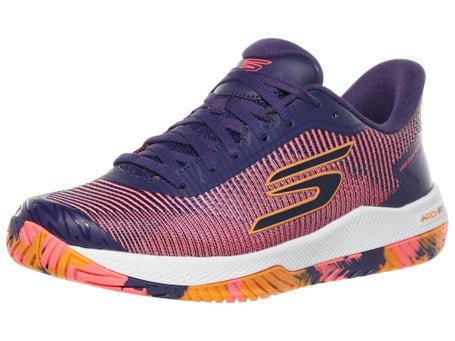
1. Skechers Viper Court Pro 2
The only shoe in this guide designed from a blank sheet for tournament pickleball — second generation, with the outsole compound advanced players kept asking for.
Start with the distinction, because it matters: the Viper Court Pro in our main pillar guide is the first generation of this shoe. The Pro 2 is a genuine redesign, not a colourway update — the Ultra Flight midsole gives way to an Ultra GO foam midsole, the upper is rebuilt in a more breathable mesh with synthetic TPU overlays for longevity, and the outsole moves to Skechers’ Goodyear Gold compound, the part of this spec sheet advanced players will care about most. It is the only shoe here that never has to apologise for being a tennis shoe, because it is not one: it was drawn for pickleball’s movement pattern from the start.
The Ultra GO midsole is a TPU-based foam Skechers describes as ultra-lightweight and responsive, and it pairs with the brand’s Arch Fit insole — the podiatrist-certified insole system that is Skechers’ signature fit feature across its performance lines. The Goodyear Gold outsole is the durability headline: Skechers works with Goodyear on the compound with the stated aim of balancing grip against slip, so the shoe can bite on a hard plant and still release when you pivot at the kitchen line. For players whose week is mostly outdoor acrylic — the surface that chews outsoles fastest — a purpose-built compound from a rubber specialist is exactly the right place for a maker to spend money.
Fit is refreshingly simple: Tennis Warehouse lists the length as true, the width as medium and the break-in as none, which for a tournament shoe is a genuine practical advantage — a pair bought the week of an event does not need a fortnight of gentle wear first. The one honest gap is weight: Skechers publishes none, so the figure printed above is Tennis Warehouse’s measurement of the women’s shoe at size 8.5. Treat it as a labelled retailer figure, not a maker claim.
Who it suits: advanced players who want the tournament shoe actually built for their sport, play mostly outdoors, and value a no-break-in, true-to-size fit. It is the benchmark the crossovers below have to beat.
Pros
- Purpose-built for pickleball — no crossover compromises
- Goodyear Gold compound outsole aimed at durability with grip-versus-slip balance
- Ultra GO foam plus Arch Fit insole is a complete, named cushioning story
- No break-in and true sizing (Tennis Warehouse)
Cons
- Skechers publishes no weight — only a retailer figure exists
- Single medium width; no wide option
- Not the shoe for players who specifically want a carbon plate
2. ASICS Gel-Resolution X
ASICS’ tournament stability flagship: a wall of named hardware, the hardest-wearing outsole story here, and a retail guarantee to match.
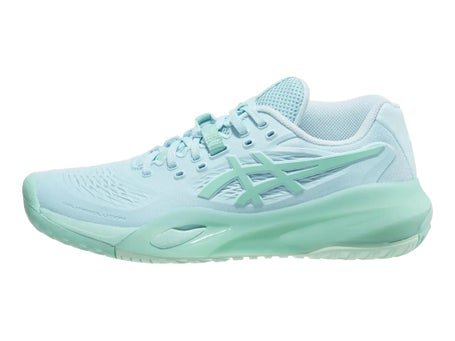
Framed honestly, the Gel-Resolution X is ASICS’ flagship tournament tennis shoe — and it earns its place here the way it earns its place in advanced pickleball bags everywhere: nothing else on this page wraps the foot in as much deliberate stability hardware. The Dynawall stability feature has been reconstructed for this generation and now extends from the lateral side around the heel, resisting the roll that hard lateral plants try to start. The Dynalacing system replaces the old wrap with a lacing arrangement designed to hold the asymmetrical upper — which also carries a higher medial cut — securely through aggressive movement.
Underfoot, the two-piece midsole splits the work the way a tournament shoe should: FlyteFoam in the forefoot for a responsive push-off feel, FlyteFoam Blast Plus Eco at the heel where impact lands, and ASICS’ GEL cushioning in the stack. The outsole is AHARPLUS rubber in a separated design with pivot points — space for the shoe to flex and rotate at the kitchen line — protected at the toe by the PGuard toe protector for players who drag on low balls. It is also the heaviest shoe here on the men’s figures, and ASICS makes no apology for that: this is the durability-and-stability end of the market, and the weight is the receipt.
The guarantee deserves precise wording: the six-month outsole durability guarantee on this model is the Tennis Warehouse retail programme — buy it there, wear through the outsole into the midsole within six months, and the pair is replaced once. On a daily training schedule, that programme converts the shoe’s durability from a hope into a term of purchase, which is why it is weighed so heavily in this ranking. Plan around the break-in, though: Tennis Warehouse lists one as required, and the snug-medium fit means wide feet should look at the Coco CG2 below instead.
Who it suits: powerful movers, heavy lateral loaders and outdoor players who wear shoes out — the pick when the priority is staying planted and not re-buying every season.
Pros
- The most complete stability hardware set in this guide
- AHARPLUS outsole with pivot points and PGuard toe protection
- Six-month outsole guarantee through Tennis Warehouse
- Two-piece midsole tunes forefoot response and heel impact separately
Cons
- Heaviest pick here on the stated figures
- Break-in required; snug-medium fit will not suit wide feet
- A tennis flagship — no pickleball-specific design
3. On The Roger Pro 2
On’s competition flagship, developed with Roger Federer: a full carbon Speedboard, serious lockdown hardware and the cleanest premium build here.
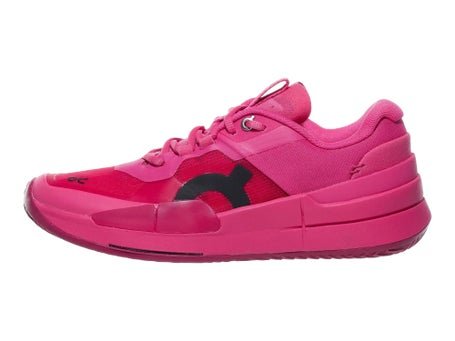
Let us be direct about what this shoe is: On’s flagship competition tennis shoe, built with Roger Federer’s input and worn on the pro tennis tour. It makes an advanced pickleball guide because its hardware list reads like a pickleball wish list. The 100% carbon-fibre Speedboard runs through the midsole to stabilise the platform and return energy at push-off. A molded heel counter and lateral TPU clips lock the rear and outside of the foot down. An internal half-bootie holds the midfoot, a reinforced rubberised toe cap guards the drag zone, and the abrasion-resistant mesh upper with a perforated tongue keeps the whole structure as light and breathable as a shoe this armoured can be.
The open herringbone outsole is the interesting pickleball detail: it is designed to balance traction with the ability to glide into shots rather than sticking dead on every plant, which suits advanced players who move through the transition zone at speed and slide into position for dinks and counters. On also publishes the two numbers most makers hide: a weight of 325.0 g and a 9 mm heel-to-toe drop. The honesty cuts both ways — On states no size basis for that weight, so treat it as indicative; Tennis Warehouse’s own measurement of the men’s shoe is 15.2 oz at size 10.5, which tells you this is a substantial, structured shoe rather than a featherweight, whatever the marketing suggests.
Fit is the caution: the shoe runs snug-medium and short — Tennis Warehouse advises ordering half a size larger on the women’s listing for a standard fit — and the structured upper needs a slight break-in. Players with wide feet should pass; players with standard feet who want the most premium, plate-driven crossover in the sport’s orbit should start here.
Who it suits: advanced players who want carbon-plate response with tour-level lockdown, play a glide-and-counter game, and fit a snug medium last.
Pros
- Full carbon Speedboard plus molded heel counter and lateral TPU clips
- Open herringbone balances grip with controlled glide
- On publishes a weight and a 9 mm drop — rarer transparency than most
- Reinforced toe cap and abrasion-resistant mesh for drag wear
Cons
- On’s 325 g figure carries no size basis; retailer measurement is much heavier
- Snug, short fit — no wide option; half-size-up advice applies
- No outsole durability guarantee
4. K-Swiss Hypercourt Pinnacle
A carbon plate engineered for court movement, dual foams and a lateral chassis — K-Swiss built this one for professional-level push-off.
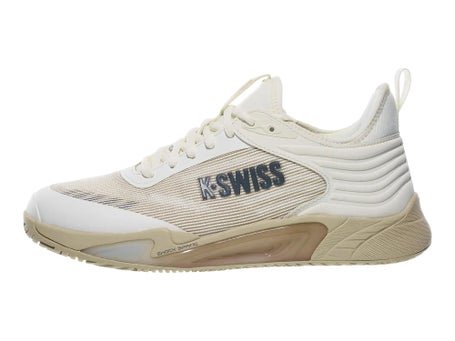
K-Swiss says the Pinnacle was designed to meet the needs of professional players, and the spec sheet backs the ambition. The centrepiece is the CRBN carbon-fibre plate, engineered — in the maker’s own framing — for tennis-specific movements, adding an explosive quality to push-off. In pickleball terms, that is the first step out of the split-step and the drive through a counter: the two moments advanced rallies are built from. Around the plate, the midsole runs two foams with divided labour — Shock Spring on top for response, Surgelite underneath for comfort and plushness — so the shoe feels alive without feeling bare.
The supporting cast is equally deliberate. A lateral support chassis works with the plate to keep the platform stable under aggressive cuts. The bootie-constructed upper delivers the glove-like fit explosive movers need, helped by the X-Cinch Strap worked into the lacing system, and Durawrap X — a molded PU wrap — protects the toe area where drag wear concentrates. Underneath, DragGuard 7.0 rubber in a modified herringbone is K-Swiss’s long-lasting traction compound, rated by the retailer for hard courts first but serviceable across surfaces.
Two honest trade-offs, stated plainly. First, the Pinnacle is a men’s model — there is no women’s version to point you to, which is why the Roger Pro 2 and the CG2 sit either side of it in this guide. Second, unlike the ASICS and the New Balance here, it carries no outsole durability guarantee, so its wear life rests on the DragGuard compound alone. Neither point dents the performance case; both belong in the decision.
Who it suits: explosive movers who play on their toes, attack the transition zone and want the most spring-loaded platform in this guide.
Pros
- CRBN carbon plate engineered for court-specific push-off
- Dual-foam stack splits response (Shock Spring) and comfort (Surgelite)
- Lateral chassis, X-Cinch Strap and bootie fit serious lockdown
- DragGuard 7.0 rubber in a modified herringbone
Cons
- Men’s-only model — no women’s version
- No outsole durability guarantee
- Bootie fit runs committed; not a relaxed medium
5. New Balance Coco CG2
Coco Gauff’s signature shoe pairs the plushest named foam here with a carbon plate — and it is the only pick sold in a true wide width.
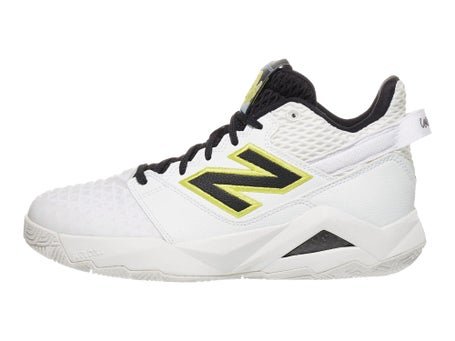
Full disclosure up front, because the name tells you: this is Coco Gauff’s signature tennis shoe, designed with her input and listed in women’s sizing. It belongs in an advanced pickleball guide for three concrete reasons. First, the midsole: FuelCell is New Balance’s lively, cushioned foam, and it is paired with the Energy Arc carbon-fibre plate, so this is the rare shoe that offers plush landings and a plated push-off in the same stack — the combination marathon-session players ask for. Second, the outsole: Ndurance rubber backed by New Balance’s own six-month outsole durability guarantee, the only maker-backed guarantee on this page (the ASICS guarantee above is a retailer programme). Third, the widths: the CG2 is sold in B medium and D wide, which makes it the only genuine wide-fit option among all seven picks.
The stability story is a saddle gore band — an elasticated saddle that tightens its hold when you cut laterally — set into an updated upper of light, breathable materials. Tennis Warehouse lists the fit as true in length, medium in the B width, with a slight break-in. The multi-surface outsole positioning also makes the CG2 the most surface-agnostic pick here: New Balance rates the traction for a variety of court surfaces rather than hard courts alone, which suits advanced players who split their week between outdoor acrylic and indoor venues.
Who should pause? Players who need men’s sizing — check the Pinnacle or the Gel-Resolution X instead — and players who prefer a firm, low ride, because FuelCell is deliberately the plushest feel in this line-up. Everyone else at advanced level who logs long hours, and anyone who needs width, should have this shoe on the shortlist.
Who it suits: high-hour players who want cushioning plus a plate, wide feet (the D width is unique here), and mixed-surface schedules.
Pros
- FuelCell cushioning plus Energy Arc carbon plate in one stack
- Ndurance outsole with New Balance’s own 6-month guarantee
- Only pick sold in a true wide (D) width
- Saddle gore band targets lateral-cut stability directly
Cons
- Listed in women’s sizing as a signature model
- Plushest ride here — firm-court-feel players should look elsewhere
- Slight break-in required
6. Nike Vapor Pro 3
Nike’s speed line, rebuilt for support: a Zoom Air hex unit where the split-step loads, a midfoot band for cuts, and Hart rubber in the drag zones.
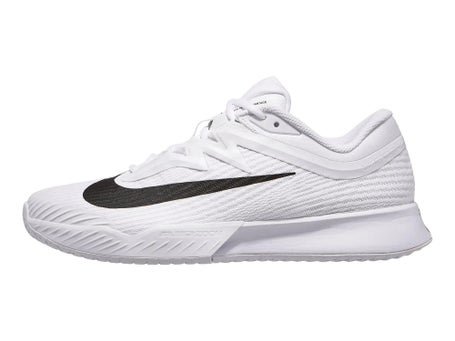
Not the pillar guide’s Nike — that is the Zoom GP Challenge 1, a different shoe entirely. The Vapor Pro 3 is the third generation of Nike’s speed flagship, and this generation’s brief was clearly written by players: keep the Vapor’s low, fast feel, but fix the lockdown. Nike’s answer is a new midfoot band that increases hold and adds support for aggressive lateral cuts — precisely the movement that decides advanced rallies — working with a re-engineered lateral TPU whose deeper flex groove lets the forefoot bend for push-off instead of fighting it.
The cushioning is targeted rather than stacked: a hex-shaped Zoom Air unit sits under the metatarsal head, the highest-impact zone in Nike’s own description and the exact spot a split-step loads first. It gives the forefoot a responsive snap that foam-only speed shoes do not match, while the rest of the shoe stays low and connected to the court. Durability, the historical Vapor weakness, gets the Hart rubber treatment — a harder compound added to the outsole and extended to the toe tip and eyestay, the two drag zones — over a data-informed herringbone tread tuned to grip without stealing the slide.
The honest context: Nike publishes no weight, and Tennis Warehouse’s measurement of 15.0 oz at men’s 10.5 makes this, on paper, one of the heavier shoes here — a reminder that scale weight and on-court feel are different things, and that the Vapor’s reputation has always been about the latter. It also carries no outsole guarantee, so heavy outdoor draggers should weigh the Skechers and ASICS first.
Who it suits: drivers and counter-punchers who live on court feel and forefoot snap, play a lot of transition-zone pickleball, and fit a medium last.
Pros
- Zoom Air hex unit placed exactly where the split-step loads
- New midfoot band directly addresses lateral-cut lockdown
- Hart rubber reinforces outsole, toe tip and eyestay drag zones
- Data-informed herringbone keeps a controlled slide available
Cons
- Nike publishes no weight; retailer figure is mid-pack heavy
- No outsole durability guarantee
- Low, firm ride will not suit cushioning-first players
7. adidas Adizero Ubersonic 5
The fifth generation of adidas’ speed line: Dual Density Lightstrike foam and a rigid Speedframe that keeps a minimalist shoe honest at full stretch.
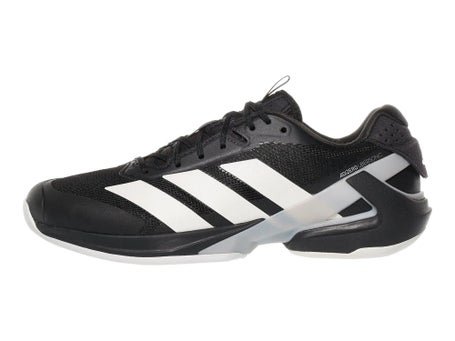
Every advanced line-up needs its speed option, and the Ubersonic 5 is adidas’ — the fifth generation of the Adizero court line, built to maximise foot speed and freedom of movement. The engineering trick is the Speedframe: a stability structure that gives the shoe torsional rigidity without building a heavy shoe around it, so the platform stays honest when you plant at full stretch. Inside, the Dual Density Lightstrike midsole keeps the ride reactive and low, and there is even a ventilation cutout through the midfoot of the outsole — a detail that tells you how seriously adidas chased weight and airflow in this design.
The upper is a minimalist engineered mesh layered over a half-bootie inner sleeve for a glove-like fit, with Adituff protection wrapped over the toe and high-wear areas — the acknowledgement that even a speed shoe gets dragged. The Adiwear outsole runs a modified herringbone for grip across surfaces. The retailer figures make this the lightest men’s option in the guide at 13.7 oz in a 10.5, and the women’s figure of 11.2 oz at 8.5 undercuts everything else here too.
The trade-off is stated by the retailer itself: Tennis Warehouse notes the Ubersonic line will not be the most durable in adidas’ range. That is the honest bargain of every speed shoe, stated rather than hidden — you are trading some outsole and upper life for the lightest, freest platform adidas makes. Daily outdoor draggers on acrylic should make that trade knowingly; indoor players and tournament-weekend specialists will make it gladly.
Who it suits: fast, light movers, indoor players and anyone whose game is built on arriving early — and who accepts the speed shoe’s durability bargain.
Pros
- Lightest stated figures in this guide, men’s and women’s
- Speedframe gives a minimalist shoe real torsional stability
- Dual Density Lightstrike keeps the ride reactive and low
- Half-bootie fit plus Adituff toe protection for drag zones
Cons
- Retailer itself flags durability as the line’s weakness
- Snug fit — half-size-up advice if between sizes
- No outsole durability guarantee
Side-by-side: the 7 advanced picks compared
Stated weights keep their source and size basis attached — the only honest way to compare them. “Not published” means the maker prints no weight for the model.
| Shoe | Best For | Outsole | Cushioning System | Stated Weight & Basis | Fit & Widths |
|---|---|---|---|---|---|
| Skechers Viper Court Pro 2 | Best overall; purpose-built tournament play | Goodyear Gold compound rubber | Ultra GO foam; Arch Fit insole | Not published; 11.2 oz, women’s 8.5 (Tennis Warehouse) | True to size, medium; no break-in |
| ASICS Gel-Resolution X | Stability & durability | AHARPLUS, separated design with pivot points; PGuard toe | FlyteFoam + FlyteFoam Blast Plus Eco; GEL | 15 oz, men’s 9 (tennis.com); 13.5 oz, women’s 8.5 (Tennis Warehouse) | True length, snug medium; break-in required |
| On The Roger Pro 2 | Premium carbon crossover | Open herringbone rubber | 100% carbon Speedboard; high-performance foam | 325 g (On — no size basis); 15.2 oz, men’s 10.5 (Tennis Warehouse) | Snug medium, fits short; half size up advised |
| K-Swiss Hypercourt Pinnacle | Explosive energy return | DragGuard 7.0, modified herringbone | CRBN carbon plate; Shock Spring + Surgelite | 13.9 oz, men’s 9 (tennis.com); 14.9 oz, men’s 10.5 (Tennis Warehouse) | True, medium; men’s model only |
| New Balance Coco CG2 | Cushioned power; wide feet | Ndurance rubber; maker 6-month guarantee | FuelCell foam; Energy Arc carbon plate | 12.5 oz, women’s 8.5 (Tennis Warehouse) | B medium and D wide; women’s sizing |
| Nike Vapor Pro 3 | Court feel & lockdown | Data-informed herringbone with Hart rubber | Forefoot hex Zoom Air unit | Not published; 15.0 oz, men’s 10.5 (Tennis Warehouse) | True, medium; slight break-in |
| adidas Adizero Ubersonic 5 | Featherweight speed | Adiwear rubber, modified herringbone | Dual Density Lightstrike; Speedframe | 13.7 oz, men’s 10.5; 11.2 oz, women’s 8.5 (Tennis Warehouse) | Snug; half size up if between sizes |
Buying guide: choosing your tournament shoe
Seven excellent shoes, one right answer per player. Work through these five checks in order — and if your footwork itself is still developing, pair this guide with our how to play pickleball guide: shoes amplify movement, they do not replace it.
1. Start with your surface
Mostly outdoor acrylic: durability rules — the Skechers’ Goodyear Gold compound, the ASICS’ AHARPLUS with its Tennis Warehouse guarantee, or the CG2’s Ndurance with New Balance’s own guarantee. Mostly indoor wood or sport court: grip-versus-release balance matters more than compound hardness, and the speed shoes (Vapor Pro 3, Ubersonic 5) and the gliding Roger Pro 2 come into their own. Mixed schedule: the CG2’s multi-surface positioning or the Pinnacle’s all-surface DragGuard rating.
2. Match the midsole to your movement
Explosive first step and counter-punching: a plate (Pinnacle, Roger Pro 2, CG2) or the Vapor Pro 3’s Zoom Air forefoot. Long-session landings and high weekly hours: the cushioned stacks — Ultra GO, FuelCell, the Gel-Resolution X’s two-piece build. Court-feel players who hate anything between them and the surface: the Vapor Pro 3 or the Ubersonic 5, and accept the firmer ride.
3. Buy the fit before the foam
Wide feet: the CG2’s D width is the only true wide here. Snug-fit warnings are printed on the Roger Pro 2 and the Ubersonic 5 for a reason — order with the half-size advice in mind. Break-in is real on the Gel-Resolution X; never debut any of these at a tournament without court hours in them first.
4. Treat the guarantee as a spec
At daily training volumes, an outsole guarantee is worth as much as a foam name. Two picks carry one — New Balance’s own on the CG2, Tennis Warehouse’s programme on the Gel-Resolution X — and five carry none. If you historically wear through the ball of the foot in a season, weight that fact properly.
5. Replace on tread, not on looks
Advanced players rotate and retire shoes by the outsole: when the tread under the ball of the foot goes smooth, grip on the plant goes with it, whatever the upper still looks like. Check the wear zone weekly during heavy blocks, and keep a broken-in second pair for tournament weekends so a worn-out shoe never makes the decision for you.
The one-sentence version
Purpose-built and proven: Viper Court Pro 2. Armoured and guaranteed: Gel-Resolution X. Plated and premium: Roger Pro 2 or Hypercourt Pinnacle. Cushioned, plated and wide-capable: Coco CG2. Feel and snap: Vapor Pro 3. Lightest of all: Ubersonic 5.
Advanced pickleball shoe FAQs
What makes a pickleball shoe an “advanced” or tournament shoe?
Hardware, mostly. Advanced shoes carry named outsole compounds built for abrasive courts (Goodyear Gold, AHARPLUS, Ndurance), engineered midsole systems — energy-return foams and, in three picks here, full carbon-fibre plates — and specific stability structures such as lateral walls, chassis, lockdown bands and heel counters. They are built for daily training hours and multi-match days, where standard court shoes start to feel vague in the upper and smooth in the tread.
Are tennis shoes really okay for advanced pickleball?
At this level, often yes — and the crossover is deliberate. Five of the seven picks here are tennis flagships, because top-end tennis shoes are engineered for the same movement family: split-steps, lateral plants, hard cuts and toe drags. What matters is the spec sheet, not the label: a carbon plate, a named abrasion-resistant outsole and real lockdown hardware transfer directly. The one purpose-built pick, the Skechers Viper Court Pro 2, shows what designing for pickleball first looks like.
Which of these shoes lasts longest on outdoor acrylic?
On published evidence, look at the guarantee programmes and compounds. The New Balance Coco CG2’s Ndurance outsole carries New Balance’s own six-month durability guarantee, and the ASICS Gel-Resolution X pairs its AHARPLUS outsole with a six-month guarantee through Tennis Warehouse. The Skechers’ Goodyear Gold compound is the purpose-built durability play. The Roger Pro 2, Pinnacle, Vapor Pro 3 and Ubersonic 5 carry no outsole guarantee — the Ubersonic’s own retailer flags durability as the speed line’s trade-off.
What does a carbon plate actually do in a court shoe?
A carbon-fibre plate — On’s Speedboard, K-Swiss’s CRBN plate, New Balance’s Energy Arc — adds a stiff, springy layer inside the midsole. Makers design it to resist twisting, stabilise the platform under hard lateral loads and sharpen the push-off as you drive out of a split-step. It does not replace footwork, but across the three plated picks here it is consistently paired with the strongest stability hardware, which is the real advanced-tier pattern.
How much do advanced pickleball shoes weigh — and why do the numbers differ so much?
Because the basis differs. On publishes 325 g for the Roger Pro 2 with no size stated; Tennis Warehouse measures the same shoe at 15.2 oz in a men’s 10.5. Skechers and Nike publish no weight for their flagships at all, so this guide prints labelled retailer figures with the size attached, and “Not published” where no honest number exists. Never compare a women’s 8.5 figure with a men’s 10.5 figure — they describe different shoes.
Do any of these advanced shoes come in a wide fit?
One: the New Balance Coco CG2, sold in B (medium) and D (wide) widths — though it is listed in women’s sizing as Coco Gauff’s signature model. The other six picks are single-width shoes running medium or snug-medium, so wide-footed players in men’s sizing may need to prioritise fit over flagship hardware, or start from the wide options in our main pickleball shoes guide.
How should tournament pickleball shoes fit?
Locked at the heel and midfoot, with a thumb’s width in front of the toes for the swelling a long day brings. Retailer notes matter here: the Roger Pro 2 fits short (half a size up is advised), the Ubersonic 5 runs snug (half a size up if between sizes), and the Gel-Resolution X needs a genuine break-in before a tournament weekend. A shoe that slips at the heel during drilling will cost you skin — and a landing — by the semi-final.
The verdict
If you buy one shoe from this page, make it the Skechers Viper Court Pro 2 — the tournament flagship actually designed for this sport, with the Goodyear Gold outsole your outdoor schedule will thank you for. If your game is built on armour and your courts are abrasive, the ASICS Gel-Resolution X is the most complete stability package here, guarantee included. If you want to feel what the carbon era is about, choose between the On The Roger Pro 2‘s premium lockdown and the K-Swiss Hypercourt Pinnacle‘s explosive plate — and if you need width or maximum cushioning with your plate, the New Balance Coco CG2 stands alone. The Nike Vapor Pro 3 and adidas Ubersonic 5 close the guide for the feel players and the speed players respectively. Every one of them beats showing up to a tournament weekend in a shoe that was never specced for it — which is the only upgrade this guide is really selling.
Still earlier in the journey? The all-rounders live in our best pickleball shoes guide, first pairs in the beginners’ guide, and comfort-first options in the seniors’ guide — this page is deliberately only for the players whose calendar already looks like a season.
Affiliate disclosure: Alishuttler is reader-supported. The Amazon buttons in this guide are affiliate links (tag alishuttler00-20): if you buy through them, we may earn a commission at no extra cost to you. Rankings are based on manufacturer-published specifications — outsole compounds, cushioning systems, stability hardware, fit options and stated weights with their sources — and are never bought or influenced by commissions. No prices are printed in this guide because they change; the buttons open live Amazon searches for the exact models named.