Pickleball looks like a friendly mash-up of tennis, badminton and table tennis — and it is — but three ideas make it its own sport: the underhand serve, the two-bounce rule, and a no-volley zone called the kitchen. Learn those, plus how scoring actually works, and you can walk onto a court and play a legal, enjoyable first game today. This guide teaches you in playing order.
⚡ TL;DR — Your First Game in 60 Seconds
Stand behind the baseline and serve underhand, diagonally, so the ball clears the kitchen and lands in the opposite service box. The receiver must let the serve bounce; you must let their return bounce too — after those two bounces, volleys are allowed everywhere except inside the kitchen, the 7-foot zone at the net where the ball must always bounce first. Only the serving side can score points (side-out scoring): win a rally while serving and you score; lose it and the serve moves on. In doubles the score is called as three numbers — your score, their score, and which server you are. First to 11, win by 2. That is genuinely most of the game.
In This Guide
- What You Need to Play
- The Court and the Kitchen
- Grip and Ready Position
- The Serve: Volley Serve and Drop Serve
- The Two-Bounce Rule in Real Play
- Scoring and the Three-Number Call
- The Kitchen in Play
- The Basic Shots
- Your First Game, Step by Step
- Common Beginner Faults
- Etiquette and Finding a Game
- Frequently Asked Questions
What You Need to Play
Pickleball’s barrier to entry is famously low: four items, and only two of them are specific to the sport.
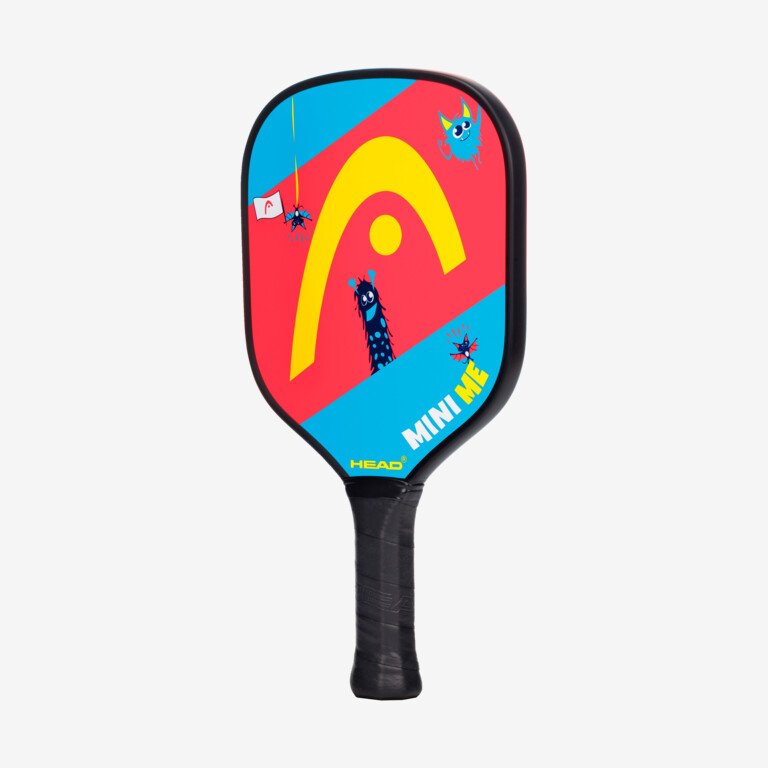
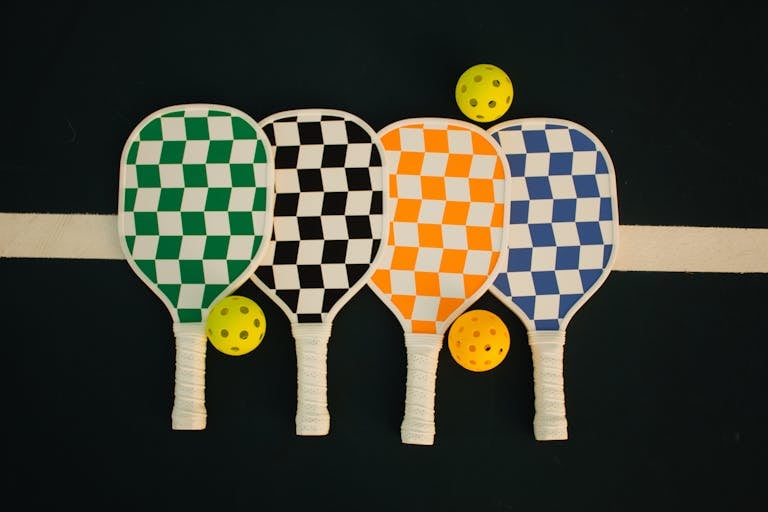
- A paddle. A solid-faced paddle — not strung like a tennis racket — made of wood, fibreglass or carbon fibre. Beginners do not need a premium model, but they do need one with a comfortable grip size, because a paddle that twists in your hand teaches bad habits. Our best pickleball paddles guide is the pillar for choosing one.
- A ball. A hard, perforated plastic ball — think a tougher, heavier wiffle ball. Indoor and outdoor balls are different designs: outdoor balls have smaller, more numerous holes and a harder shell for wind and rough surfaces, indoor balls are softer with larger holes. Our best pickleball balls guide explains the split and picks for both.
- Court shoes. Not running shoes. Pickleball is a game of short lateral shuffles and sudden stops, and a running shoe’s tall, narrow heel is built for straight lines — it is how ankles get rolled. Proper court shoes with lateral support are the single most useful gear upgrade a new player can make; see our best pickleball shoes guide.
- A court and a net. A pickleball court is badminton-sized (below), with a tennis-type net. Many tennis centres stripe pickleball lines onto existing courts, and portable nets turn any flat hard surface into a court.
That is the whole kit. Everything else in this guide is knowledge, not equipment.
The Court and the Kitchen
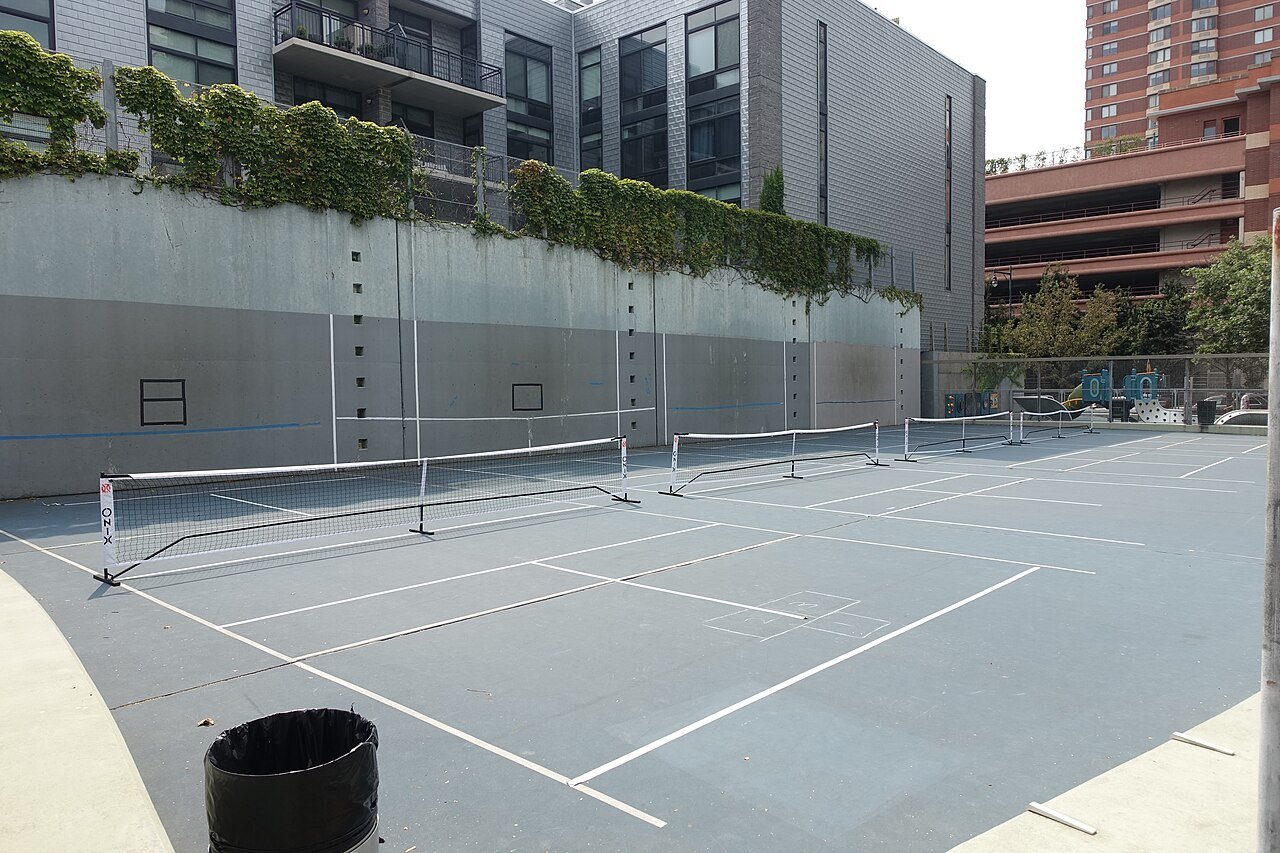
A pickleball court measures 20 feet wide by 44 feet long — the size of a doubles badminton court — and the same court is used for singles and doubles. The net runs across the middle, standing 36 inches high at the sidelines and 34 inches at the centre.
Three markings do most of the work:
- The non-volley zone — the “kitchen”. A band extending 7 feet from the net on both sides, bounded by the kitchen line. This is the sport’s signature rule area: you may not volley a ball while standing in it (covered properly in the Kitchen section below).
- The service courts. Between the kitchen line and the baseline on each side, a centreline splits the area into left and right service boxes. Serves are hit diagonally into the opposite box.
- The baseline. The back line, behind which the server stands.
Lines are part of the court they bound, with one sharp exception: a serve that lands on the kitchen line is short and a fault, while a serve clipping any other line — centreline, sideline or baseline — counts as in.
Grip and Ready Position
Hold the paddle with a continental grip — the “shake hands” grip, as if you were shaking hands with the handle, with the V between your thumb and index finger sitting on the top bevel of the grip. The continental is pickleball’s default because it works identically for forehands and backhands without regripping between shots, and the soft game at the kitchen is played almost entirely with it. Beginners often bring a tennis-style forehand grip and then discover their backhand dink points at the sky; start continental and life is simpler.
Your ready position between shots: feet roughly shoulder-width apart, knees soft, weight on the balls of your feet, paddle up in front of your chest with the tip pointing slightly upward. “Paddle up” is the habit that matters most — at the kitchen line, rallies are won and lost on reaction time, and a paddle hanging by your hip is a shot you have already conceded. Between points, the serving side lines up with the server behind the baseline and their partner usually at the kitchen line; the receiving side mirrors that, with the receiver back and their partner forward.
The Serve: Volley Serve and Drop Serve
Every rally starts with an underhand serve, hit diagonally from behind the baseline into the opposite service box. At the moment you serve, at least one foot must be on the playing surface behind the baseline, and neither foot may touch the court — including the baseline itself — until the ball is struck. The serve must clear the net and the kitchen: a serve landing in the kitchen, or on the kitchen line, is a fault.
The volley serve
The standard serve, struck out of the hand before the ball bounces. USA Pickleball’s rules set three requirements, and all three are checked at the moment of contact:
- Your arm must be moving in an upward arc at contact — low to high.
- The ball must be contacted below your waist.
- The highest point of the paddle head must be below your wrist at contact.
Together they keep the serve genuinely underhand — a starting shot that begins the rally, not a weapon that ends it.
The drop serve
The alternative: hold the ball out and simply let it go — a “dead drop”, with no added force, spin or throwing motion — let it bounce, and then hit it. The drop serve carries none of the volley serve’s motion restrictions: once the ball has bounced, the swing itself is unrestricted. Most beginners find it the easier serve to make consistent, because the bounce gives a predictable contact point; most players keep an underhand swing anyway, since the ball does not bounce high.
The Two-Bounce Rule in Real Play
This is the rule that shapes the entire sport. After the serve:
- The receiver must let the serve bounce before hitting the return.
- The serving team must then let that return bounce before hitting their first shot.
Only after those two bounces may either side volley — hit the ball out of the air. Break it on either shot and it is a fault.
Why it matters tactically: the two-bounce rule deliberately neutralises serve-and-volley. The serving team cannot charge the net behind the serve, because their first shot must be played off a bounce from near the baseline — which is why the classic pickleball point opens with both teams back, and the net is earned during the rally rather than taken at the start. When you watch experienced players, the first four shots are the two-bounce rule playing out: serve deep, return deep, and then the famous “third shot” decision by the serving team — drive it hard or drop it softly into the kitchen — which the shots section introduces below.
Scoring and the Three-Number Call
Pickleball uses side-out scoring, the format set out in the USA Pickleball rulebook: only the serving side can score points. Win a rally while serving and your score goes up by one. Lose a rally while serving and no one scores — instead the serve passes on. This is the single most-misstated rule in the sport, so be clear on it: a rally won by the receiving team earns them the serve, not a point.
First to 11, win by 2
A standard game is won by the first side to reach 11 points with a margin of at least 2. At 10-10 you keep playing until someone leads by two. Some tournaments play games to 15 or 21 with the same win-by-2 rule.
Two servers per side out
In doubles, both partners serve in turn before the serve passes to the opponents — except at the very start of the game, when only the starting server serves (see the 0-0-2 call below).
One server, two numbers
Singles uses the same side-out logic with one server. The score is called as two numbers, and your serving position follows your own score: even points from the right court, odd points from the left.
Reading the three-number call
Before every serve in doubles, the server calls three numbers: our score – their score – which server I am. The third number is 1 or 2, marking the first or second server of that side’s turn.
| The Call | What It Means |
|---|---|
| 0-0-2 | The first call of every game. The opening server is treated as server 2 — the starting-team exception — so when they lose a rally, it is side out immediately rather than passing to their partner. |
| 4-2-1 | The serving team leads 4-2, and this is their first server. Lose the rally and the serve passes to their partner as server 2; score a point and this same server serves again, from the other service court. |
| 4-2-2 | Same score, second server. Lose this rally and it is side out — the other team serves at 2-4-1 from their perspective. |
| 7-5-1 | Serving team ahead 7-5 with a fresh pair of serves: two chances to extend the lead before the opponents get the ball back. |
Two habits make the system painless. First, call the score loudly before every serve — it is the server’s job, and it settles every “what’s the score?” argument before it starts. Second, your court position tells you your score: in doubles, the player who started the game serving from the right-hand court should be standing on the right whenever your team’s score is even, and on the left when it is odd. If you are ever lost, look at where you are standing — the geometry remembers the score for you. When you score a point, the server switches service courts and serves again; partners do not swap sides with each other, they move as a pair as their serving positions dictate.
The rulebook also carries rally scoring as a provisionally approved option some events choose to use — but side-out scoring is the standard format described above, it is what open play and the rulebook’s standard game run on, and it is what this guide teaches. The full formal rules list, including tournament variations, lives in our Pickleball Rules 2026 guide.
The Kitchen in Play
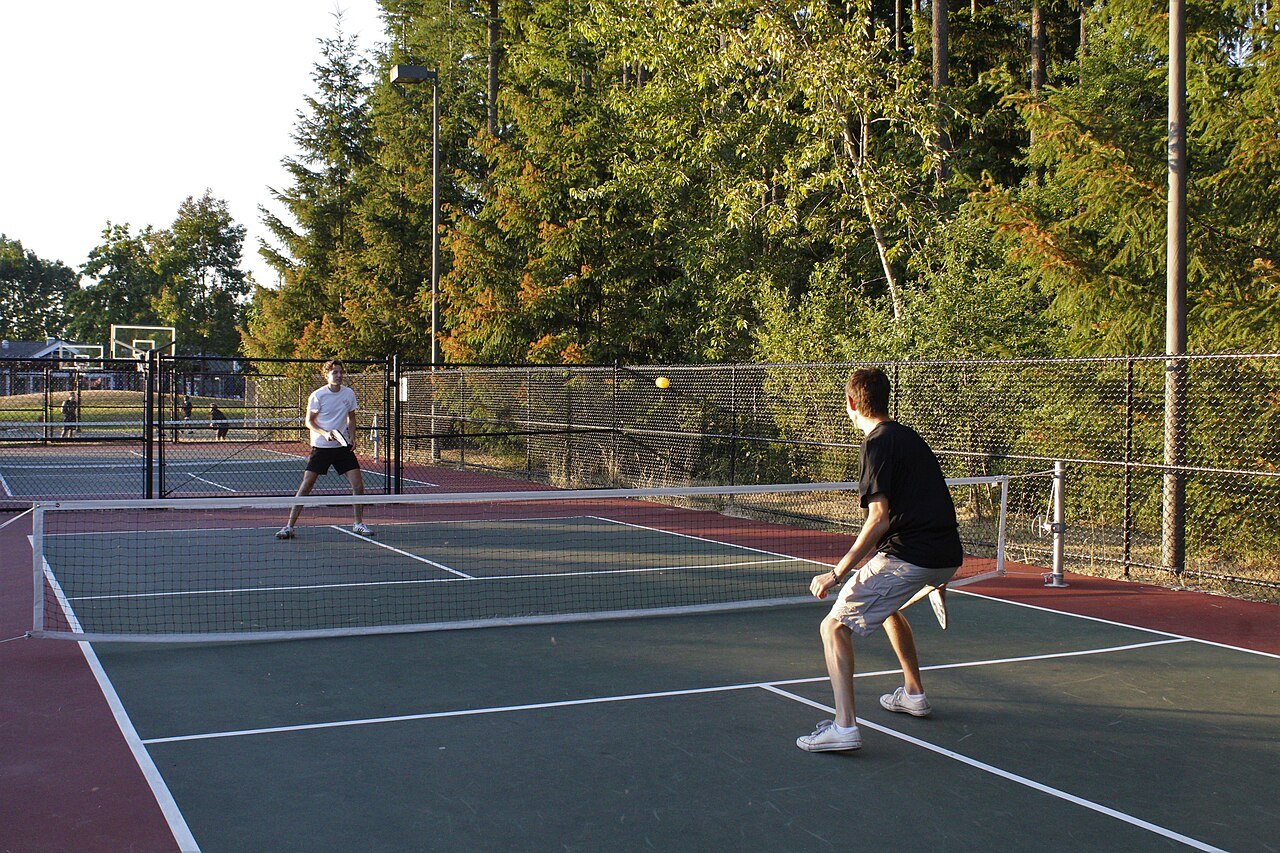
The non-volley zone — the kitchen — is the 7-foot band on each side of the net. Its one rule is easy to say: you may not volley a ball while any part of you is in the kitchen or touching the kitchen line. Everything else about the zone follows from that:
- You may stand in the kitchen whenever you like — as long as you let the ball bounce before hitting it. Most kitchen play happens with players standing just behind the line, stepping in only for balls that have bounced short.
- Momentum counts. Volley from outside the line and then fall or step into the kitchen as part of that same motion — even after the ball is past you — and it is still a fault. Control your body before you reach for a hard volley.
- It applies to everything attached to you. Your paddle tipping into the zone after a volley, your partner steadying you with a hand as you lean in, even your hat falling off into the kitchen mid-volley: all faults, because the rule covers anything connected to the player.
- You may reach over the line — paddle and arm can cross into the airspace above the kitchen freely; it is contact with the ground (or the line) that matters, and a ball that has bounced in the kitchen can be struck from a reach.
Why the rule exists: without it, the tallest player would simply stand at the net and smash every ball downward. The kitchen forces the soft game — the patient, low dinking rallies that are pickleball’s tactical heart — and it is the reason a sport played on a small court rewards touch at least as much as power.
The Basic Shots
Five shots cover a beginner’s whole game. Learn them in this order.
The dink
The signature shot: a soft, arcing groundstroke played from near the kitchen line that clears the net low and lands in the opponents’ kitchen, where it cannot be attacked. Dinking is patience as a skill — you trade soft shots, waiting for a ball that pops up high enough to attack. Play it with an open paddle face, a gentle lift from the shoulder, and no wrist snap.
The volley
Taking the ball out of the air — legal everywhere except the kitchen — using a short blocking motion rather than a swing. Paddle up, contact in front of your body, and punch through the ball slightly rather than swatting at it. Most fast kitchen exchanges are won by the player whose paddle was already up.
The drive
A hard, low groundstroke hit with pace, usually from mid-court or the baseline. Drives keep opponents back and buy your team time to move forward. Aim low over the net — a drive that sails is a drive that gets blocked back at your feet.
The third-shot drop
The shot the two-bounce rule creates. After the serve and the (bounced) return, the serving team is stuck at the baseline while the receivers hold the kitchen line — so instead of driving into their volleys, the serving team plays a soft shot that arcs over the net and drops into the kitchen, letting them advance. You do not need it in your first game, but you will hear about it within your first month; it is the sport’s defining tactic, introduced here at concept level on purpose.
The lob
A high, deep shot over the heads of players crowding the net, landing near the baseline. The lob is your reset button when both opponents are parked at the kitchen line — used sparingly, because a short lob is a smash invitation.
Your First Game, Step by Step
Set up and decide who serves
Flip a paddle or use any fair method to choose the first serving team. In doubles, one player on that team starts as the opening server; their partner positions at the kitchen line, while the receiving team’s receiver stands back near the baseline and their partner is already up at the kitchen.
Call 0-0-2 and serve
The opening server calls “zero, zero, two”, stands behind the baseline in the right-hand service court, and serves underhand diagonally into the opposite box — remembering the starting-team exception: this first server is “server 2”, so a lost rally means an immediate side out.
Play the two bounces
The receiver lets the serve bounce and returns it, deep if they can. The serving team lets the return bounce and plays their first shot — a drive, or an early attempt at a drop. Nobody volleys yet.
Move up — together
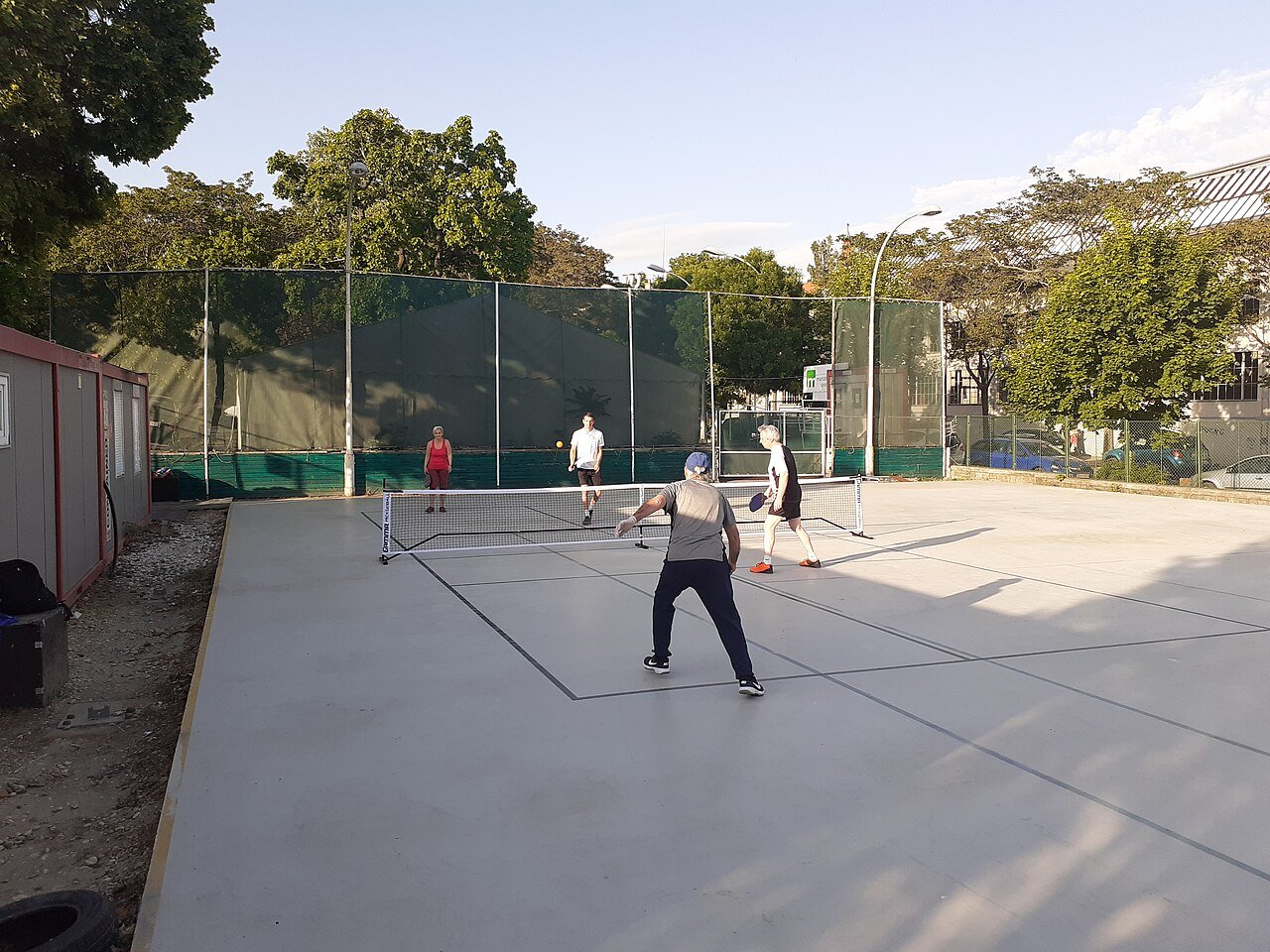
After the two bounces, both teams work toward the kitchen line, which is where points are controlled. Move as a pair in doubles: the biggest beginner gap is one partner at the net and one at the baseline, with the middle of the court undefended.
Rally until a fault
The rally ends when someone hits the net, hits the ball out, lets it bounce twice, volleys from the kitchen, or breaks any other rule. If the serving team won the rally, they score a point, the server switches sides of their court, and serves again. If they lost it, the serve moves to their partner (or, if it was already the second server, across to the opponents).
Play to 11, win by 2
Keep calling the score before every serve. The first team to 11 with a two-point margin wins; shake hands, tap paddles, and rotate in whoever is waiting — that rotation is how open-play pickleball socialises itself.
Common Beginner Faults
| Fault | What Happens | The Fix |
|---|---|---|
| Foot fault on the serve | A foot on or inside the baseline (or outside the imaginary extensions of the sideline and centreline) when the ball is struck | Start a comfortable step behind the line; the serve is not a lunge |
| Serve lands in the kitchen | Serve falls short — including bouncing on the kitchen line | Aim for the back third of the service box; depth beats cleverness |
| Volleying in the kitchen | Volley played with a foot in the zone or on the line, or momentum carries you in afterwards | Set your feet behind the line before the hands battle starts |
| Volleying one of the first two bounces | Returning the serve out of the air, or the serving team volleying the return | Say it in your head on every point: bounce, bounce, then free |
| Hitting the ball out | Ball lands beyond the baseline or outside a sideline without being touched | Swing smaller; on a small court, control is the weapon |
| Letting the ball bounce twice | The rally is over the moment the second bounce happens | Move your feet early; most double bounces are decided two shots earlier |
| Touching the net | Player, paddle or clothing contacts the net or net post during play | Give the net a respectful step of clearance on overheads |
| Serving from the wrong court | Server’s position does not match the score (even = right, odd = left) | Use the position check in the scoring section — your feet know the score |
Etiquette and Finding a Game
Pickleball’s culture is part of its design, and a beginner who knows the etiquette gets invited back:
- Call your own lines honestly. In recreational play, players call lines on their own side, and a ball you cannot clearly see as out is in. Benefit of the doubt always goes to the ball.
- Call the score out loud before serving, every time — and wait until receivers are ready before you serve.
- Tap paddles after the game, thank your partner, and in open play, rotate: winners often split and one pair steps off so waiting players get on. Your local session will have its own rotation system — ask, and follow it.
- Warn about stray balls. A ball rolling onto your court from another game gets a loud “Ball on!” and a held ball returned politely — never kick it back mid-rally.
- Keep hard body shots in perspective. Targeting the body is legal, but drilling a clearly newer player helps nobody’s game; apologise for anything that catches someone high.
Finding a court is the easy part. Many tennis centres now run lined pickleball courts and open-play sessions — if your local tennis court is the venue, our guide to playing pickleball on a tennis court covers how the shared setup works (one line: the court converts, the scoring in this guide does not change). New players over 60 will find the pacing and setup advice in Pickleball for Seniors written specifically for them. And when a friendly argument breaks out about a rule this page summarised, the full formal list is in Pickleball Rules 2026.
Frequently Asked Questions
Can only the serving team score points in pickleball?
Yes — standard pickleball uses side-out scoring, as set out in the USA Pickleball rulebook. If the receiving team wins a rally, no point is scored; they simply earn the serve. Points only ever go to the team that served the rally.
What does 0-0-2 mean in pickleball?
It is the first score call of every doubles game: zero points for the serving team, zero for the receivers, and the opening server counts as server 2. That is the starting-team exception — only the starting server serves on the first turn, so if they lose the opening rally it is an immediate side out rather than a pass to their partner.
What is the kitchen in pickleball?
The kitchen is the non-volley zone: the 7-foot band on each side of the net. You may not volley a ball while standing in it or touching its line, and your momentum may not carry you into it after a volley. You can stand in it freely as long as the ball bounces before you hit it.
What is the two-bounce rule?
After the serve, the receiving team must let the ball bounce before returning it, and the serving team must let that return bounce before playing their first shot. After those two bounces, volleys are allowed anywhere except in the kitchen. It exists to stop the serving team from dominating with serve-and-volley play.
Can you serve overhand in pickleball?
No. The volley serve must be underhand: upward arm motion at contact, ball struck below the waist, and the paddle head below the wrist at contact. The drop serve is the flexible alternative — after a natural bounce from a dead drop, the swing itself has no such restrictions, though most players still swing underhand.
What happens if a serve hits the net?
Modern pickleball has no let serves. If the serve clips the net and lands in the correct service box, it is live and played out. If it clips the net and lands anywhere else — including the kitchen — it is a fault.
How is singles pickleball different?
The court, serve and two-bounce rule are identical; only the scoring routine changes. There is one server, the score is called as two numbers, and your position follows your own score — serve from the right court when your score is even, the left when it is odd. Lose a rally and the serve simply crosses to your opponent.
What paddle should a beginner buy?
A mid-weight paddle with a comfortable grip size and a forgiving face material — fibreglass is the classic starter surface — matters more than any premium specification at this stage. Our best pickleball paddles pillar reviews the current range by player type, and our pickleball balls guide handles the indoor-versus-outdoor ball choice that goes with it.
Ready for Your First Game?
The short version to carry onto court
Serve underhand and diagonal, from behind the baseline. Let the serve bounce, let the return bounce, then play freely — except in the kitchen, where the ball must always bounce first. Only the serving side scores; call all three numbers before every serve; first to 11, win by 2. Move up to the kitchen line with your partner, keep your paddle up, and dink patiently until a ball pops up. Everything beyond that is refinement — the tactics in our rules guide, the gear in our paddles pillar and shoes guide — but none of it is required to play your first legal game this weekend.
How AliShuttler writes its guides: the rules in this article were checked against the current USA Pickleball Official Rulebook summary and USA Pickleball’s published rules guidance at the time of writing. Local clubs and some events occasionally use house variations — if your session plays one, their version governs your game. This page contains no product pricing and no participation statistics; gear recommendations are linked, not sold, from this article.