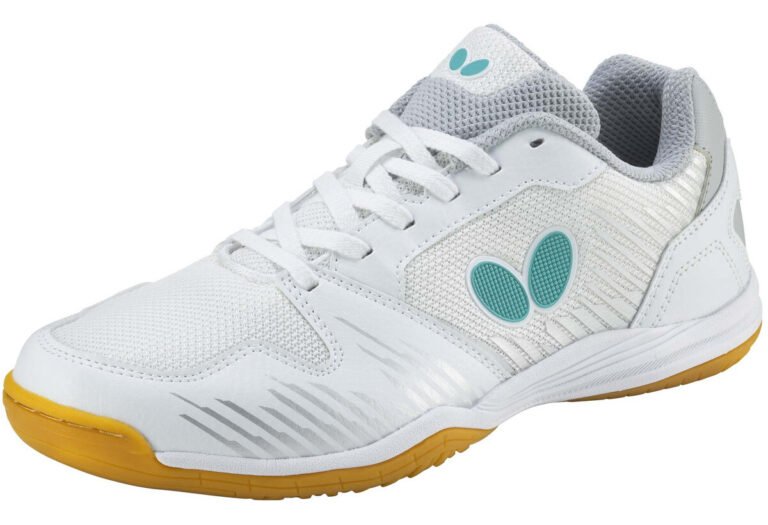

Seven tennis shoes chosen the honest way: only models with a maker-stated wide option or a verifiably roomy last — ASICS, New Balance, Babolat, K-Swiss, Diadora and Fila — compared on exactly what the makers publish: width designations, cushioning systems, outsole patterns and stated weights with their size basis.
Wide feet are not a size problem; they are a last problem. A last is the form the shoe is built around, and when it is too narrow for your foot, everything downstream suffers: the toes press the upper sideways on every plant, the midfoot spills over the edge of the platform on lateral slides, and the heel compensates by moving — which is how heel slip starts. Sizing up a half size does not fix it, because length and width are separate dimensions of the last: a longer shoe in the same narrow last just gives you a narrow shoe with room at the toes. The fix is a wider last or a published wide width — a 2E (or 4E) designation the maker actually sells, or a model the maker builds on a wider last from the start.
This guide owns one decision only — the width/fit purchase. It does not re-rank our segment guides: the all-player flagship selection lives in our best tennis shoes comparison, women players have their own picks in our best tennis shoes for women guide, first purchases belong to our best tennis shoes for beginners guide, and the top-tier purchase is owned by our best tennis shoes for advanced players comparison. Every model below is different from the ones ranked in those guides. If you are learning the movement patterns these shoes are built for — the split step, the open-stance recovery, the slide — our how to play tennis guide covers them. Read those for their jobs; read this one when the width designation on the box is the first thing you check.
One promise before the picks: we card only what verifies. Six of the seven shoes here carry a maker-stated wide option — a 2E or 4E the brand itself sells and prints in its own width tables. The seventh, the Fila Axilus 2 Energized, has no published wide, so it is carded only as a verifiably roomy standard last, and the card says so plainly. Where a maker publishes no weight — and four of the seven brands here publish none — the card says “not published” instead of borrowing a number from a retailer’s spreadsheet. Where a retailer’s figure exists, it is labelled as a retailer’s figure with its size basis. The fit section below teaches you to read those designations before you spend anything.

TL;DR — The Short Version
Buy the ASICS Gel-Resolution 9 Wide (2E) if you want the benchmark wide tennis shoe — DYNAWALL stability, GEL cushioning and an AHARPLUS outsole, in a wide fit ASICS itself sells. Buy the New Balance FuelCell 996v6 if you need the widest published option here: New Balance’s own width guide for the model lists Wide 2E and X-Wide 4E, with full-length FuelCell underfoot. Buy the New Balance Fresh Foam X Lav v2 for plush Fresh Foam X cushioning in a 2E wide. Buy the Babolat SFX3 if you want a shoe built wide from the start — a wider last, not a width variant — with Babolat’s Kompressor cushioning and a Michelin rubber outsole. Buy the K-Swiss Hypercourt Express 3 2E for the everyday wide fit: Surgelite+ cushioning, DuraWrap and a modified herringbone tread. Buy the Diadora Blushield Torneo 2 AG in 2E if you split time between hard courts and clay, for its all-ground herringbone outsole. And buy the Fila Axilus 2 Energized if you want the roomiest standard last here — wide by shape rather than by designation.
Quick Picks
In This Guide
- The width decision: 2E and 4E, exactly as makers state them
- What a wide-foot player should check before buying
- ASICS Gel-Resolution 9 Wide
- New Balance FuelCell 996v6
- New Balance Fresh Foam X Lav v2
- Babolat SFX3
- K-Swiss Hypercourt Express 3 2E
- Diadora Blushield Torneo 2 AG 2E
- Fila Axilus 2 Energized
- Side-by-side comparison
- Wide-fit buying guide: five checks before you pay
- Frequently asked questions
- The verdict
The Width Decision: 2E and 4E, Exactly as Makers State Them
Shoe width is one of the few specs in tennis that is almost entirely standardised — which makes it one of the few specs you can actually trust. For men’s tennis shoes, the maker’s scale runs: B is narrow, D is the standard width, 2E is wide, and 4E is extra wide. For women’s, B is standard, D is wide, and 2E is extra wide. Those letters are printed by the brands themselves — ASICS publishes exactly this scale in its own sizing guidance — and they mean the same thing wherever they appear. A 2E from ASICS and a 2E from New Balance are the same designation. That is why this guide treats a published width as a fact and a “roomy feel” as a claim: the designation is verifiable before you buy, the feeling is not.
The second distinction that matters is between a wide variant and a wide last. A wide variant is the same shoe, rebuilt on a wider form: the Gel-Resolution 9 Wide is the Gel-Resolution 9 on a 2E last, and the Fresh Foam X Lav v2’s 2E option is the same shoe in a wider build. A wide-last shoe was designed wide from the first sketch — the Babolat SFX3, which Babolat builds on a wider last with additional forefoot space as its founding idea. The practical difference: a wide variant keeps the standard model’s ride, structure and lockdown, widened; a wide-last shoe was never narrow, so its proportions — toe-box volume, midfoot wrap, heel shape — were drawn for width from the start. Neither is automatically better. Players who love a specific model’s character but need room should buy its wide variant; players who want the width baked into the design should buy the wide last.
Then there is the third category — the roomy standard last — and it deserves its honesty label. Some shoes are built in a standard D with so much volume that wide-footed players wear them happily: generous toe-box height, a flexible upper that gives rather than presses, a platform with real estate to spare. The Fila Axilus 2 Energized is this guide’s example, and it is carded only on that basis, plainly. The risk of the roomy standard is that volume is not width: a roomy shoe can still let the foot move sideways inside it if the midfoot lockdown is weak, which is why the lockdown checks in the next section matter more for roomy shoes than for true wides. Read each card’s width line as the first filter, then read the lockdown line as the second.
One more naming caution, because the letter system has a quirk worth knowing: a wide variant is not a different model, but it is a different stock-keeping unit, and listings mix them up constantly. The Gel-Resolution 9 Wide carries its own style number (1041A376) distinct from the standard shoe; New Balance’s 2E variants carry their own stock codes (the 996v6’s 2E is MCH996W6E, the Lav v2’s is MCHLAVC2 in its 2E build). When you order, check that the listing’s width field — not the review section, not the headline — says 2E or 4E. If it only says “wide” in the marketing copy and the variant selector shows no width option, you may be looking at the standard shoe with optimistic adjectives.
What a Wide-Foot Player Should Check Before Buying
Width designations: read the variant, not the vibe. A published 2E or 4E is the strongest fit fact a listing can give you, and this guide’s first six cards all carry one. New Balance goes furthest: its own width guide for the FuelCell 996v6 lists Narrow B, Standard D, Wide 2E and X-Wide 4E — the only 4E in this guide, and a genuine option for feet that find 2E snug. ASICS and K-Swiss both sell explicit 2E wide versions of their flagships here; Diadora’s Torneo 2 AG is listed in a 2E wide build by its retailers. Where no designation exists — the Fila card — we say so, and you should treat “roomy” as a direction to confirm in person, not a specification.
Toe-box volume: the wide foot’s first point of contact. Width numbers describe the shoe at its widest point, but the toe box is where width is felt — and volume there has two dimensions, width and height. The Babolat SFX3 earns its place in this guide partly on this: Babolat designs it with additional forefoot space and a pliable mesh upper, so the toes get room in both directions. The Fila Axilus 2 Energized is carded on the same logic from the other direction: its toe box is deep as well as wide, which is why players whose feet run wide toward the toes wear it comfortably in a standard width. If your toes touch the sides of every shoe you try, prioritise the cards whose width is designed in (SFX3) or designated (the 2E options) over the roomy standard.
Midfoot lockdown and heel: width without wandering. A wider shoe that lets the foot move is worse than a snug shoe that holds it — the whole point of width is to remove pressure without removing control. Read the lockdown line on every card as carefully as the width line. ASICS’s DYNAWRAP eyestay is built to apply pressure where support is needed during transitions; New Balance’s Lav v2 carries an external heel counter and an adjustable lace closure; the FuelCell 996v6 was updated with a higher collar and tighter heel lockdown; Diadora’s lacing runs through a structured saddle. The Fila is the honest outlier here: its flexible upper and generous fit mean narrow- and medium-footed playtesters reported sliding inside it, so it belongs to players whose feet genuinely fill it. Whatever you buy, the shop test is the same: lace it fully, plant and cut hard, and confirm the heel stays seated. Width you can read from a table; lockdown you confirm on your foot.
Outsole patterns: match the surface, as the makers state it. Wide feet do not change which outsole you need, but the cards name each pattern so you can match it. Full-length AHARPLUS rubber with a separated heel (ASICS Gel-Resolution 9) is the hard-court benchmark pattern in this guide. The multi-directional tread of New Balance’s NDurance rubber (Lav v2, 996v6) is built for all-court hard-court play. K-Swiss’s Aosta II + DragGuard 7.0 in a modified herringbone is its all-court answer. The Diadora Torneo 2 AG’s modified herringbone is the mixed-surface pick — its all-ground build is the one card here designed to cross between hard courts and clay. The Babolat SFX3’s MICHELIN TENNIS Original rubber is Babolat’s all-court compound, and Babolat also sells the SFX3 in a clay-specific version. Buy the pattern for the surface you actually play on most, not the one you aspire to.
Cushioning systems: learn the makers’ names. Every card names the cushioning exactly as its maker does, because that is the only language in which the specs are comparable. ASICS: DYNAWALL in the midsole plus GEL in the rearfoot and forefoot. New Balance: Fresh Foam X in the Lav v2, full-length FuelCell in the 996v6. Babolat: the Kompressor System under the heel with an OrthoLite insole. K-Swiss: Surgelite+ with its Surge 7.0 cushioning line. Diadora: Blushield midsole technology. Fila: the Energized midsole. A longer name is not a better foam — the K-Swiss and Fila systems are simpler recipes in shoes built for everyday play, and that is a legitimate choice. Read cushioning as character (plush, firm, low, responsive) rather than quality, and match it to how your feet feel at the end of a long hitting session.
The Picks: 7 Wide-Fit Tennis Shoes Compared
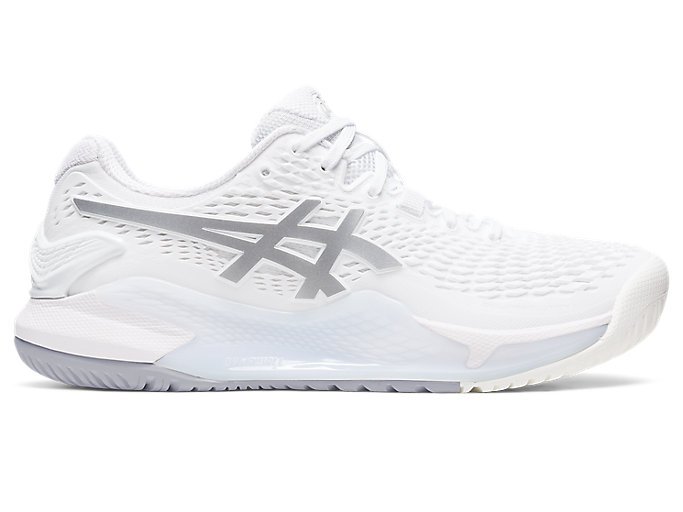
ASICS Gel-Resolution 9 Wide
The benchmark wide tennis shoe: ASICS’s stability flagship, sold in a genuine 2E wide fit with DYNAWALL support, GEL cushioning and an AHARPLUS outsole.
The Gel-Resolution line has been the default answer to “which tennis shoe is the most shoe” for a decade, and the wide version is the same answer for wide feet: not a different shoe, but the flagship rebuilt on a 2E last. ASICS sells it as the GEL-RESOLUTION 9 (HARDCOURT) WIDE — the “Wide fit” designation is printed on the maker’s own listing, with its own style number (1041A376), so there is no ambiguity about what you are ordering. The recipe is the standard Resolution 9’s: DYNAWALL technology in the midsole, extending into the heel for added stability during lateral movements; a DYNAWRAP eyestay redesigned to apply pressure when extra support is needed; and a full-length outsole with a separated heel that ASICS builds in to produce a more stable landing for quicker recoveries between shots.
Underfoot, GEL cushioning sits in the rearfoot and forefoot — the impact-absorption layer that softens the footstrike — over an AHARPLUS rubber outsole, the high-abrasion compound ASICS puts on its durability-first shoes. The upper is engineered mesh over the maker’s standard construction, and ASICS positions the outsole design for all types of court surfaces, mainly hard courts. What ASICS does not publish is a weight, and this card will not invent one: the Resolution 9’s case has never rested on lightness. One honest note for clay-court players: ASICS also sells a clay-court version of the Resolution 9, but the wide fit as listed by the maker is the hardcourt build — buy the wide for the surface the wide is made for. Buy the Gel-Resolution 9 Wide if you want the most complete, most honestly-specified wide tennis shoe on the market: flagship stability, a real 2E designation, and a spec sheet with no adjectives doing the work of facts.
Pros
- Genuine 2E wide fit sold by ASICS itself, with its own style number — no guesswork
- DYNAWALL midsole extending into the heel plus DYNAWRAP eyestay: the full stability recipe
- AHARPLUS rubber outsole on a full-length, separated-heel platform for hard courts
- Rearfoot and forefoot GEL cushioning in the maker’s own terms
Cons
- ASICS publishes no weight for this model — the card cannot give you a number
- The maker’s wide listing is the hardcourt build; clay players should check the surface first
- Maximum-structure shoe: players who want a light, fast ride should look at the New Balance cards
As an Amazon Associate we earn from qualifying purchases.

New Balance FuelCell 996v6
The widest published option in this guide: New Balance’s own width guide for the 996v6 lists Wide 2E and X-Wide 4E, over a full-length FuelCell midsole.
Most “wide” guides stop at 2E. New Balance does not, and the FuelCell 996v6 is the proof: the brand’s own width guide for this model lists four widths — Narrow B, Standard D, Wide 2E and X-Wide 4E — making it the only shoe in this guide with a published extra-wide option. That matters because 2E is a real width but not the widest real foot; players who find 2E snug across the forefoot get a genuine step up here rather than advice to size up. The 2E build carries its own stock code (MCH996W6E), so as with the ASICS card, you can confirm the width in the listing’s variant field before you buy. Everything else about the shoe is New Balance’s speed-first recipe: the 996v6 is geared, in the maker’s own positioning, toward a speedier style of play covering the whole court.
The midsole is full-length FuelCell — New Balance’s propulsive foam, run the whole length of the shoe for a soft, driving ride — over an NDurance rubber outsole in a multi-directional tread pattern built for hard courts. The upper is breathable mesh with New Balance’s NDure technology reinforcing the high-wear zones, and the update adds a higher collar with tighter heel lockdown for stability. On weight, this card models the honesty the guide keeps promising: New Balance publishes no weight for the 996v6. The figure above — 14.7 ounces in a men’s US 10.5 — is a retailer’s listing figure, not the maker’s, and it is labelled that way. Buy the 996v6 if your feet need more than 2E, or if you want the widest-published option from the brand with the deepest width catalogue in tennis.
Pros
- The only 4E (X-Wide) option in this guide, on New Balance’s own width guide
- Full-length FuelCell midsole: the most propulsive cushioning recipe here
- Higher collar and tighter heel lockdown in the maker’s own update notes
- NDurance rubber outsole with NDure upper reinforcement in the wear zones
Cons
- New Balance publishes no weight; the 14.7 oz figure is a retailer’s, on a stated size basis
- A speed-first build — maximum-stability players should compare the ASICS card
- Four width options means four ways to order wrong: confirm the variant code before checkout
As an Amazon Associate we earn from qualifying purchases.

New Balance Fresh Foam X Lav v2
Plush where it counts: Fresh Foam X cushioning, a FitWeave upper and a full-length Ndurance outsole — sold in a 2E wide alongside the standard D.
If the 996v6 is New Balance’s speed answer for wide feet, the Fresh Foam X Lav v2 is its comfort answer — and it is the cushioned wide pick of this guide. The midsole is FRESH FOAMx, New Balance’s precision-cushioning foam, tuned here for the plush, planted ride the Lav line is known for. The upper pairs a synthetic and mesh FitWeave construction with a mesh collar, and New Balance’s NDure upper technology adds structure where the shoe takes abuse; a toe drag tip protects the front of the shoe, and an external heel counter closes the back. The outsole is full-length Ndurance rubber — the same durable compound family as the 996v6’s, run the whole length of the platform for traction that does not thin out under the forefoot.
The width story is clean: the Lav v2 is stocked in D Medium and 2E Wide as separate variants, with the 2E carrying its own size runs, so ordering the wide is a variant choice rather than a hope. One fit note from a retail playtest is worth passing on, attributed: Tennis Warehouse’s playtesters found the standard D fit of the Lav v2 wide enough in the toe box that one 2E-width-footed tester wore it comfortably — which tells you the last runs generous, and that the 2E is genuinely roomy rather than barely wide. New Balance publishes no weight for the Lav v2, and the card prints that plainly. Buy the Lav v2 if your wide-foot priority is cushioning first: the plushest midsole in this guide, in a published wide, on a platform built to last the season.
Pros
- FRESH FOAMx midsole: the plushest cushioning recipe among the wide options here
- 2E Wide stocked as a separate variant alongside D Medium — order the width, not the hope
- Full-length Ndurance outsole with a toe drag tip for the dragging foot
- Generous-running last: the standard D already fits wide in the toe box per retail playtesters
Cons
- New Balance publishes no weight for this model
- Plush is a philosophy: players who want a firm, low court feel should look at the Fila or K-Swiss cards
- A comfort-first build rather than a stability flagship — compare the ASICS card for maximum support
As an Amazon Associate we earn from qualifying purchases.
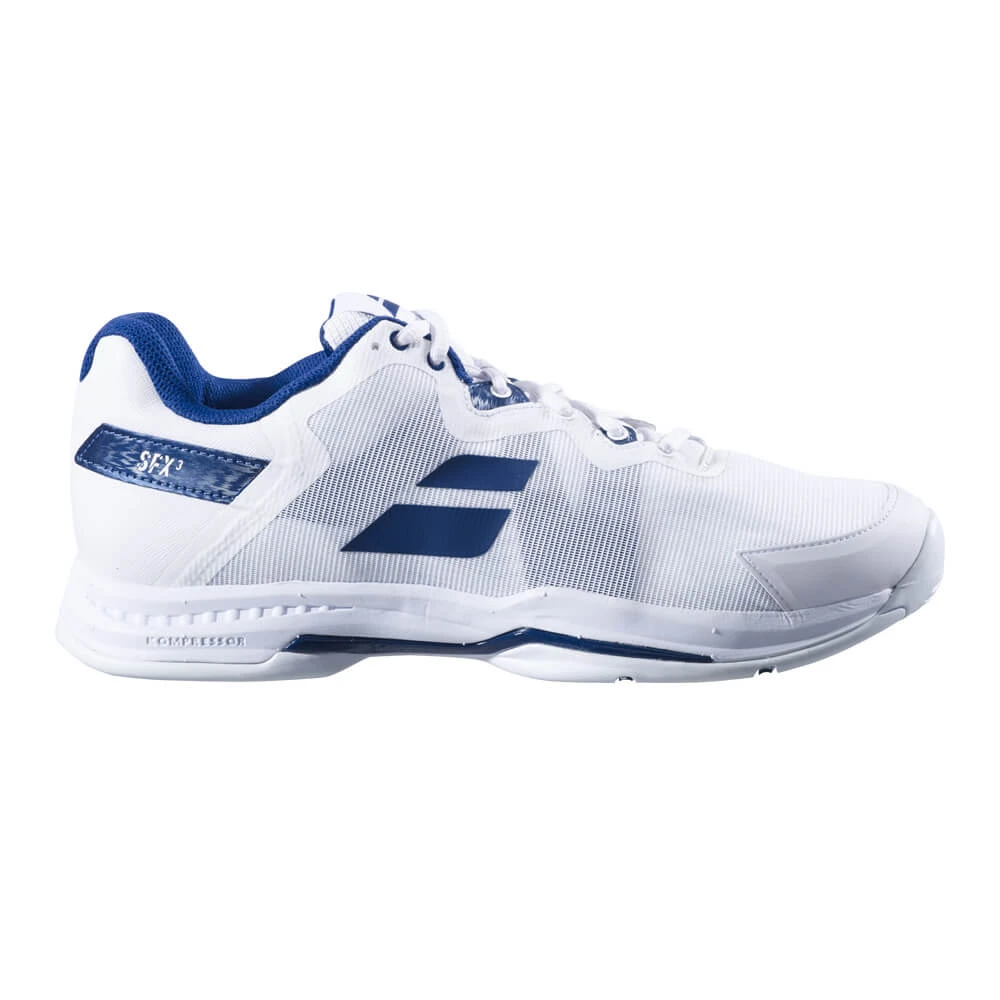
Babolat SFX3
Wide by design, not by variant: Babolat builds the SFX3 on a wider last with additional forefoot space, Kompressor cushioning and a Michelin rubber outsole.
Every other shoe in this guide starts narrow and offers width as an option. The Babolat SFX3 starts wide: it is the comfort flagship of Babolat’s range, designed from the first sketch with additional forefoot space and a wider last, and Babolat’s own positioning lists it for wide feet outright. That changes the character of the fit. A wide variant keeps the standard shoe’s proportions and widens them; the SFX3’s proportions were drawn for width — a pliable single-layer mesh upper with a Matryx piece on the forefoot for lateral support, and room in the toe box in both width and height. Retail playtesters with the widest feet on their teams have repeatedly found their best fit in the SFX line, which is the real-world confirmation of a design decision rather than a size option.
The engineering is pure Babolat. The heel carries the Kompressor System — Babolat’s shock-absorbing cushioning — over an OrthoLite insole moulded to the foot’s contours. The sole uses Babolat’s ACTIVE FLEXION technology, divided across nine pressure points for responsiveness, and the outsole is MICHELIN TENNIS Original rubber: Babolat’s long-running collaboration with Michelin, built for grip and longevity on all court surfaces — and Babolat also sells the SFX3 in a clay-specific version for dedicated clay players. Babolat publishes no weight for the SFX3. One honest trade-off, from a retail playtest and worth knowing: the soft, flexible upper that makes the SFX3 so accommodating means the midfoot needs deliberate lacing — cinch the shoe around the foot so it cannot slide sideways on lateral moves. Buy the SFX3 if you want width as a design philosophy rather than a variant code: the widest-feeling shoe in this guide, from the maker that treats comfort as a discipline.
Pros
- A wider last by design — the only shoe here that starts wide rather than offering it
- Kompressor heel cushioning with an OrthoLite insole: Babolat’s complete comfort recipe
- MICHELIN TENNIS Original rubber outsole, with a clay-specific version also sold
- ACTIVE FLEXION sole and Matryx forefoot piece for responsiveness and lateral support
Cons
- Babolat publishes no weight for this model
- The soft upper needs deliberate lacing — the foot must be cinched in, not just placed in
- A different model from the seniors guide’s SFX 4 — check the generation when ordering
As an Amazon Associate we earn from qualifying purchases.

K-Swiss Hypercourt Express 3 2E
The everyday wide fit, third generation: K-Swiss’s best-seller in a 2E wide, with a Surgelite+ midsole, DuraWrap and a modified herringbone tread.
The Hypercourt Express is K-Swiss’s best-selling tennis shoe, and the third generation keeps the formula that made it so: a lightweight, breathable shoe with a generous fit in the forefoot, sold in a 2E wide as a matter of course — K-Swiss lists the 2E in its own wide collection, and its product copy states plainly that the model is also available in wide width. This is the update of the Hypercourt Express 2 that our pillar guide cards, and it is a different model: the new Surgelite+ midsole is the headline change, which K-Swiss builds in for more comfort and stability with no break-in needed. Around it sit the maker’s named systems: Surge 7.0 Cushioning for the underfoot feel, a 180-degree midfoot stability chassis (the 180 PSC plantar support chassis) for torsional control, and an Aosta II + DragGuard 7.0 outsole — K-Swiss’s durable traction compound with protection where the court wears the shoe hardest.
The upper is a seamless synthetic leather and textile build with DuraWrap for a more flexible shoe that still protects the toe, over an OrthoLite liner for plushness underfoot; the tread is a modified herringbone, the pattern that works across all court surfaces. On weight: K-Swiss publishes none for the Express 3. The 15.1 ounces in a men’s US 10.5 printed above is a retailer’s figure, labelled as such. One caution from K-Swiss’s own review section, worth passing on as a fit note: at least one wide-footed reviewer found the 2E generous to the point of roominess — if you sit between D and 2E, the D of this generous last may serve you. Buy the Express 3 2E if you want the safest everyday wide purchase in tennis: the best-seller’s third generation, in a real 2E, with no break-in and no drama.
Pros
- 2E wide sold in K-Swiss’s own wide collection — a standard option, not a special order
- Surgelite+ midsole with Surge 7.0 cushioning and a 180-degree stability chassis
- Aosta II + DragGuard 7.0 outsole in a modified herringbone for all-court traction
- Seamless upper with DuraWrap and an OrthoLite liner; no break-in per the maker
Cons
- K-Swiss publishes no weight; the 15.1 oz figure is a retailer’s, on a stated size basis
- The 2E runs generous — between-sizes buyers should consider the standard width of this last
- A different model from the pillar guide’s Hypercourt Express 2 — confirm the generation
As an Amazon Associate we earn from qualifying purchases.
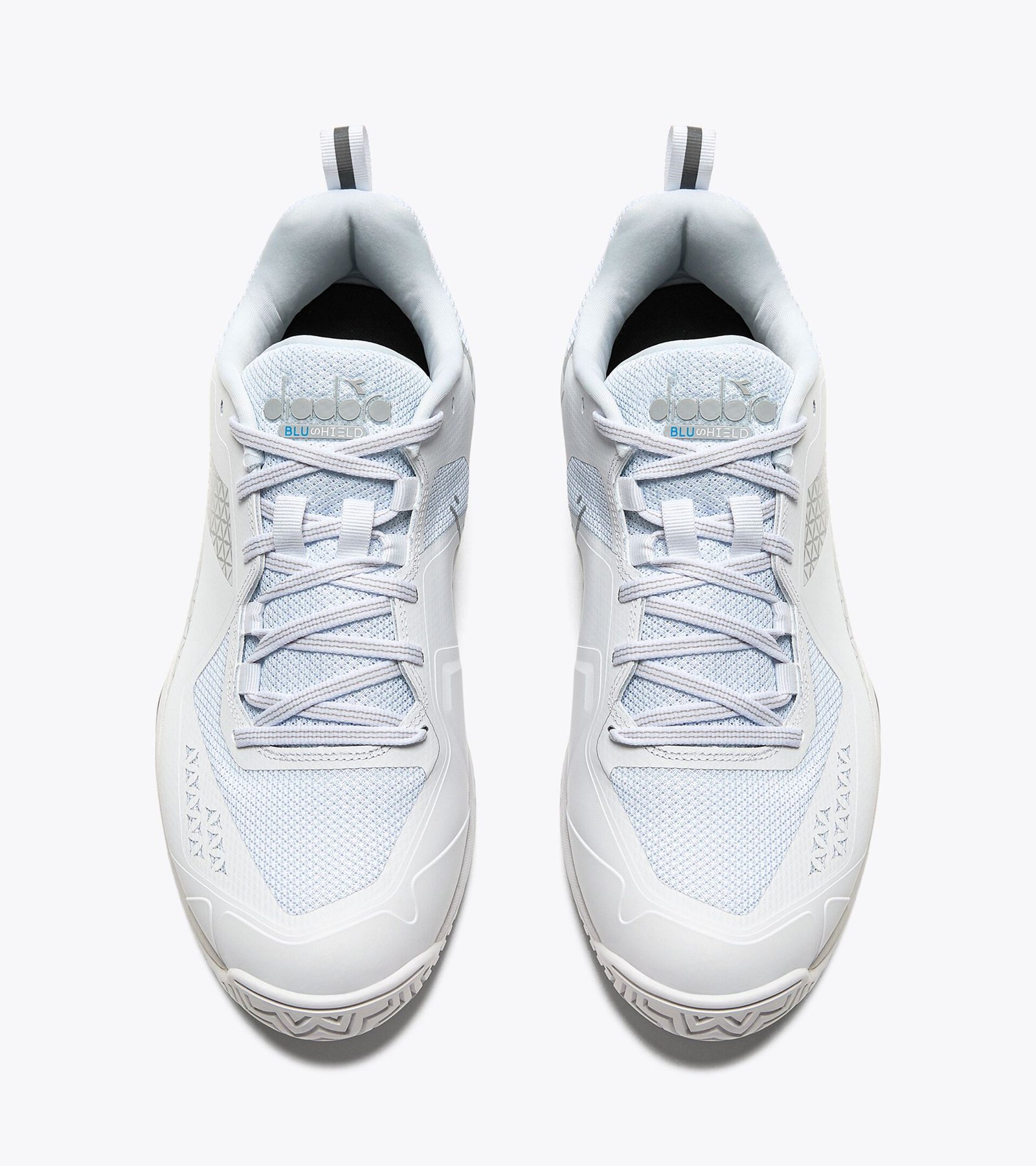
Diadora Blushield Torneo 2 AG
The wide option for players who cross surfaces: Diadora’s Blushield cushioning on an all-ground modified herringbone outsole, listed in a 2E wide.
Most wide tennis shoes are hard-court shoes that happen to come wide. The Diadora Blushield Torneo 2 AG is the card for players whose tennis happens on more than one surface: the AG (all-ground) build pairs Diadora’s Blushield midsole cushioning — the layered cushioning system Diadora builds its comfort reputation on — with a modified herringbone outsole pattern that grips on hard courts and releases on clay. It is listed in a 2E wide build alongside the standard D, with the wide carrying its own listings at specialist tennis retailers. The upper is Diadora’s structured performance build with a secure lacing setup, and the shoe sits in the stable, supportive part of Diadora’s range rather than the featherweight one — this is a shoe for players who plant hard, not for players counting grams.
On weight, the honest line again: Diadora publishes none for the Torneo 2. The 14.1 ounces in a men’s US 10.5 is a retailer’s figure, labelled as such. Two cautions belong on this card. First, the naming: this is the Torneo 2, a different model from the Speed Blushield Torneo 3 carded in our advanced guide — the listings sit close together and the names blur, so check the generation digit before you buy. Second, Diadora’s fit runs with a structured, supportive character; the 2E here is a true wide rather than a generous medium, so it suits feet that genuinely need the designation. Buy the Torneo 2 AG in 2E if your season crosses surfaces: the only wide card here with an all-ground brief, from the maker whose cushioning system is the most layered in the guide.
Pros
- 2E wide build for the player who needs the designation, on an all-ground shoe
- Blushield midsole cushioning — Diadora’s layered comfort system
- Modified herringbone outsole that works on hard courts and clay alike
- Structured, supportive build for players who plant hard
Cons
- Diadora publishes no weight; the 14.1 oz figure is a retailer’s, on a stated size basis
- Not the Torneo 3 from our advanced guide — check the generation digit when ordering
- A true wide rather than a generous medium: between-widths buyers should try before committing
As an Amazon Associate we earn from qualifying purchases.
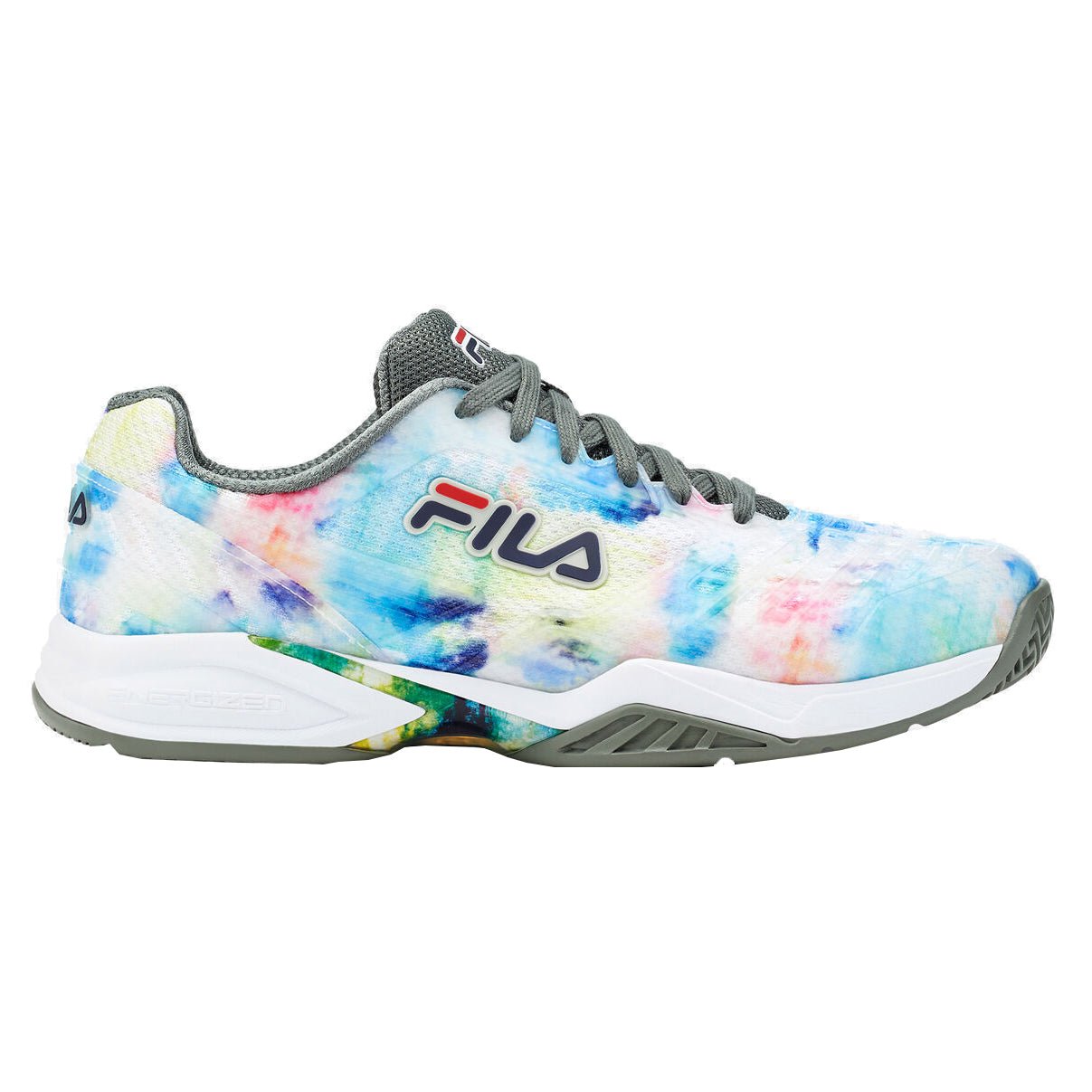
Fila Axilus 2 Energized
Wide by shape, not by designation: no published wide, but a standard last so generous — and so well documented — that it earns the roomy card.
This is the card that proves the guide’s honesty rule. The Fila Axilus 2 Energized has no maker-stated wide option — Fila sells it in a standard width — and this card says so in the chips above rather than dressing it up. What it has, documented by a full retail playtest, is one of the roomiest standard lasts in tennis: the shoe is described as defined by its wide fit and open toe box, wide from toe to heel with a deep toe box, built for players who like their shoes roomy. The midsole is Fila’s Energized cushioning, the mesh upper is reinforced with a flexible plastic that keeps the shoe light, and a TPU shank adds rigidity under the midfoot; the ride is low to the ground, which the playtesters found made directional changes feel safe and easy. The rubber all-court outsole and toe bumper earned strong durability marks across the playtest.
The honest trade-off is the one the playtesters named: the same generosity that fits wide feet lets narrower feet slide inside the shoe, and the support level is lower than the structured flagships in this guide. This is a shoe for feet that genuinely fill it — if your feet swim in standard widths, the 2E cards above are your answer, not this one. Fila publishes no weight; the approximate 11 ounces in a women’s US 8.5 is the retailer’s playtest figure, labelled as such. Buy the Axilus 2 Energized if you want the roomiest standard fit in tennis at the honest end of the market: wide by shape, documented by playtesters, with the designation question answered plainly — there isn’t one, and you don’t need one if the last fits.
Pros
- The roomiest standard last here — wide from toe to heel with a deep toe box, per retail playtest
- Energized midsole with a TPU shank: cushioned yet low to the ground
- Strong outsole and toe-bumper durability marks in playtesting
- The honest budget route to a wide-feeling fit — no wide designation needed
Cons
- No maker-stated wide: this is a roomy standard, not a 2E
- Feet that do not fill the shoe will slide inside it — the playtesters said so plainly
- Lower structured support than the flagship cards; Fila publishes no weight
As an Amazon Associate we earn from qualifying purchases.
Side-by-Side: The Seven Wide-Fit Shoes at a Glance
Every width below is exactly as the maker or listing states it. Weights are printed with the honesty this guide keeps promising — labelled retailer figures with their size basis, or “not published” where the maker publishes none.
| Shoe | Width (as stated) | Cushioning (maker-named) | Outsole | Best for | Weight |
|---|---|---|---|---|---|
| ASICS Gel-Resolution 9 Wide | Wide (2E), sold by ASICS | DYNAWALL + rearfoot & forefoot GEL | AHARPLUS rubber, all-court (mainly hard) | Best overall wide | Not published |
| New Balance FuelCell 996v6 | 2E Wide / 4E X-Wide on NB’s width guide | Full-length FuelCell | NDurance rubber, multi-directional tread | Best 4E option | 14.7 oz, men’s US 10.5 (retailer’s figure) |
| New Balance Fresh Foam X Lav v2 | D Medium / 2E Wide variants | FRESH FOAMx | Full-length Ndurance rubber | Best wide cushioning | Not published |
| Babolat SFX3 | Wider last by design (Babolat’s wide-fit line) | Kompressor System + OrthoLite insole | MICHELIN TENNIS Original rubber (AC) | Best wide last | Not published |
| K-Swiss Hypercourt Express 3 2E | 2E Wide, in K-Swiss’s wide collection | Surgelite+ / Surge 7.0 Cushioning | Aosta II + DragGuard 7.0, modified herringbone | Best wide all-rounder | 15.1 oz, men’s US 10.5 (retailer’s figure) |
| Diadora Blushield Torneo 2 AG 2E | 2E Wide build (retailer-listed) | Blushield midsole | Modified herringbone, all-ground | Best wide, mixed surfaces | 14.1 oz, men’s US 10.5 (retailer’s figure) |
| Fila Axilus 2 Energized | Standard width — verifiably roomy last | Energized midsole | Rubber all-court outsole | Best roomy standard fit | ~11 oz, women’s US 8.5 (retailer’s figure) |
Wide-Fit Buying Guide: Five Checks Before You Pay
1. Confirm the width in the variant field, not the marketing copy. A genuine wide is a separate stock-keeping unit: the Gel-Resolution 9 Wide’s style 1041A376, the 996v6’s 2E stock code, the Lav v2’s 2E size runs, the Express 3’s place in K-Swiss’s wide collection. If the product page has a width selector or a width printed in the specifications, the wide is real. If “wide” appears only in the headline and the variants show sizes alone, you are looking at the standard shoe. The Fila card is the deliberate exception here — its roominess is documented, but it carries no designation, and the card says so.
2. Do not size up to fake width. Length and width are separate dimensions of the last. A half size up in a narrow shoe gives you toe room and the same narrow midfoot — the foot still presses the upper sideways on plants, and the extra length lets the heel move. If the shoe you love has no wide option, the answer is a different shoe with one, not a longer version of the same shoe. This is the single most common wide-fit mistake, and it is free to avoid.
3. Check lockdown the way a third set will. Width removes pressure; lockdown removes movement, and you need both. Lace the shoe fully in the shop — or at home before the return window closes — and plant, cut and brake hard. The heel should stay seated, the midfoot should feel wrapped rather than swimming, and the laces should not need to be at their limit to get there. The DYNAWRAP eyestay, the Lav v2’s external heel counter, the 996v6’s higher collar and the SFX3’s forefoot Matryx piece are all answers to this check; the Fila’s flexible upper is the one card where the check matters most.
4. Match the outsole to your real surface mix. Hard-court players should buy the hard-court patterns: the Resolution 9’s AHARPLUS platform, the New Balance NDurance treads, the Express 3’s Aosta II herringbone. Clay-court players get two honest options: Babolat’s clay-specific SFX3 version, or the Diadora Torneo 2 AG, whose all-ground herringbone is the only card here designed to cross surfaces. Buying a hard-court outsole for a clay season — or a clay pattern for a hard-court league — wastes whichever width advantage you just paid for.
5. Read every weight by its basis — or its absence. No maker in this guide publishes a weight for its shoe here — not ASICS, New Balance, Babolat, K-Swiss, Diadora or Fila. The figures in the table are retailers’ figures, each labelled with its size basis. That is normal, not a warning sign. What should warn you is any listing that prints a precise weight for one of these shoes without saying where the number came from — the makers themselves do not publish one.
Frequently Asked Questions
What does 2E actually mean on a tennis shoe?
It is a width designation on the makers’ own scale. For men’s shoes: B is narrow, D is the standard width, 2E is wide, and 4E is extra wide. For women’s shoes: B is standard, D is wide, and 2E is extra wide. ASICS publishes exactly this scale in its sizing guidance. A 2E from one brand is the same designation as a 2E from another, which is why this guide treats a published width as a verifiable fact rather than a feeling.
Should I just buy a half size up instead of a wide?
No. Length and width are separate dimensions of the last: sizing up gives you toe room but keeps the same narrow midfoot, so the foot still presses the upper sideways on plants while the extra length lets the heel move. The fix for a narrow shoe is a wider last or a published wide width — a 2E or 4E the maker actually sells — not a longer narrow shoe. Six of the seven cards here carry a maker-stated wide option for exactly this reason.
What is the difference between a 2E wide version and a shoe with a wide last?
A 2E wide version is the standard model rebuilt on a wider form — the Gel-Resolution 9 Wide is the Gel-Resolution 9 on a 2E last, keeping the standard shoe’s ride and structure. A wide-last shoe is designed wide from the first sketch — the Babolat SFX3, which Babolat builds with additional forefoot space and a wider last as its founding idea. Buy the wide variant if you love a specific model’s character but need room; buy the wide last if you want width drawn into the design from the start.
Are there wide tennis shoes for clay courts?
Yes. Babolat sells the SFX3 in a clay-specific version alongside the all-court model carded here, and the Diadora Blushield Torneo 2 AG is an all-ground build whose modified herringbone outsole is designed to work on hard courts and clay alike. The ASICS Gel-Resolution 9 Wide as listed by the maker is the hardcourt build — clay players should check the surface version before ordering, not just the width.
Do wide tennis shoes give less lateral support?
Width and support are separate engineering decisions. A wide shoe with proper lockdown — ASICS’s DYNAWRAP eyestay, the Lav v2’s external heel counter, the 996v6’s higher collar, K-Swiss’s 180-degree midfoot chassis — holds the foot as firmly as any standard shoe. The risk is not width but volume without lockdown: the Fila Axilus 2 Energized’s generous fit lets narrower feet slide inside it, which is why it belongs to players whose feet genuinely fill it. Whatever you buy, plant and cut hard before the return window closes and confirm the heel stays seated.
How do I know a wide option is real and not just marketing?
Check the variant field on the product page. A real wide is a separate stock-keeping unit: the Gel-Resolution 9 Wide carries its own style number (1041A376), the 996v6’s 2E has its own stock code, the Lav v2’s 2E runs as separate size variants, and K-Swiss lists the Express 3 2E in its own wide collection. If the specifications or variant selector show 2E or 4E, the wide is real. If “wide” appears only in the headline, treat it as an adjective and keep looking.
Can I wear these tennis shoes for pickleball too?
These are tennis shoes, carded and compared as tennis shoes — the outsoles, cushioning and lockdown here are specified for tennis movement. That said, several of the all-court patterns in this guide (the K-Swiss modified herringbone, the New Balance NDurance tread, the Fila’s rubber all-court outsole) are the same families of tread players use across racket sports on hard courts. If pickleball is your main sport rather than an occasional crossover, buy a shoe specified for it; if tennis is the job, buy the width for tennis.
The Verdict
If one shoe has to answer the wide-foot question completely, it is the ASICS Gel-Resolution 9 Wide — the benchmark stability flagship in a genuine 2E, with the most honestly-specified wide build in tennis. But the honest verdict in a fit guide is that the best shoe is the one that matches your width reality. Feet that need more than 2E get the New Balance FuelCell 996v6 and its 4E option — the widest published designation here. Cushioning-first buyers get the New Balance Fresh Foam X Lav v2 in 2E. Players who want width as a design philosophy get the Babolat SFX3 and its wider last. The everyday answer is the K-Swiss Hypercourt Express 3 2E. Cross-surface players get the Diadora Blushield Torneo 2 AG in 2E. And the roomiest standard fit in the game is the Fila Axilus 2 Energized — carded honestly, without a designation it does not have.
Still weighing the wider field? Our pillar comparison of the best tennis shoes covers the all-player flagships this guide deliberately avoids repeating, the women’s tennis shoes guide owns the women’s lasts, beginners should start with their own guide, and the advanced players guide owns the top-tier purchase. Buy the width that is actually published — 2E or 4E, in the variant field, not the headline — and the shoe wall stops being a wall of hope and becomes seven clear answers.
How we built this guide: every width designation above comes from the maker’s own listing, width guide or product copy, or from a retailer listing that reproduces the maker’s data — and each figure is attributed to its source in the copy. Six of the seven shoes carry a maker-stated wide option (2E, or 2E and 4E for the New Balance 996v6); the Fila Axilus 2 Energized has no published wide and is carded only as a verifiably roomy standard last. No maker in this guide publishes a weight for its shoe here, so every weight figure is labelled as a retailer’s figure with its size basis, or stated as not published. We do not publish prices, we make no durability or medical claims, and nothing here is presented as hands-on testing. Some links on this page are affiliate links: if you buy through them, AliShuttler may earn a commission at no additional cost to you. As an Amazon Associate we earn from qualifying purchases.