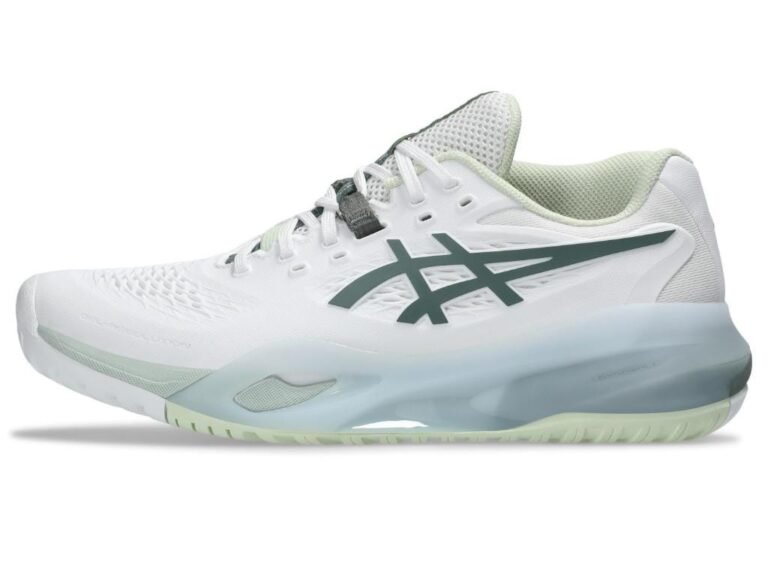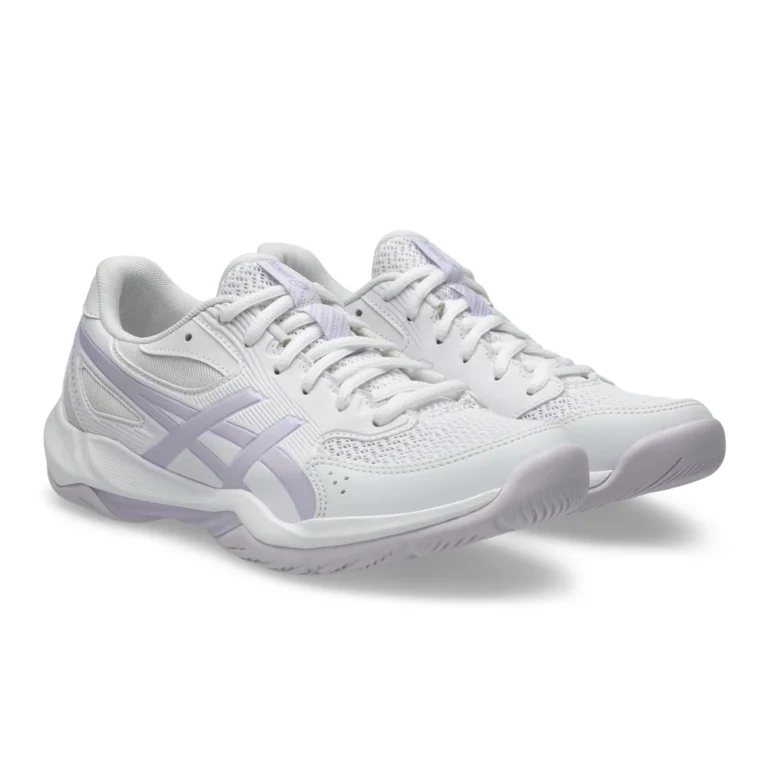

Seven tennis shoes chosen on one honest metric — verified lightness. Every weight below is maker-stated with its size basis, or a clearly-labelled retailer’s figure: Yonex, Mizuno, Head, Babolat and Wilson compared on exactly what the makers publish — weight, upper construction, cushioning systems and outsole durability for hard and clay courts.
Weight is the most honest spec in tennis footwear, and the most abused. A lighter shoe genuinely changes how you move: less mass on the foot means a quicker first step, cheaper direction changes and fresher legs in a third set. But lightness is also the easiest spec to fake in marketing copy — “featherlight feel” means nothing, while “335 grams per 26.0 cm” means everything. The difference between those two sentences is the difference between this guide and most lightweight roundups. Every shoe below earned its place by verifying as genuinely light against published figures, not adjectives. Four of the seven carry maker-stated weights with the size basis named exactly as the maker states it; where the maker publishes no weight, the card prints a clearly-labelled retailer’s figure with its size basis instead of borrowing a number and calling it a fact.
This guide owns one decision only — the weight/speed purchase. It does not re-rank our segment guides: the all-player flagship selection lives in our best tennis shoes comparison, women players have their own picks in our best tennis shoes for women guide, first purchases belong to our best tennis shoes for beginners guide, developing players are covered by our best tennis shoes for intermediate players comparison, and the top-tier purchase is owned by our best tennis shoes for advanced players guide. Every model below is different from the ones ranked in those guides. If you are learning the movement patterns these shoes are built for — the split step, the recovery sprint, the slide — our how to play tennis guide covers them. Read those for their jobs; read this one when grams on the scale are the first thing you check.
One promise before the picks, and it is the spine of this guide: lightness always costs something, and every card names the price honestly. A lighter shoe carries less material — thinner rubber on the outsole, a leaner upper, less foam underfoot. That is physics, not a flaw, but it means the fastest shoe in this guide will not be the longest-lasting, and the longest-lasting will not be the fastest. Each card states the lightweight-versus-durability trade-off for its model in plain terms, so you buy the compromise you actually want instead of discovering it mid-season.
TL;DR — The Short Version
Buy the Yonex Power Cushion Ad-Accel if you want the complete speed package — Yonex’s listed 335 g per 26.0 cm, a carbon plate from midfoot to toes and the ACCEL BOOSTER toe spring. Buy the Mizuno Wave Exceed Light 2 if you want the lightest shoe in this guide — around 300 g in the men’s all-court build, with MIZUNO ENERZY cushioning and an X10 carbon-rubber outsole. Buy the Head Sprint Pro 3.5 for ultra-lightweight speed at the honest end of the market — 340 g in a US 9, TRI-NRG cushioning and a Hybrasion+ outsole. Buy the Babolat Jet Mach 4 if you want the newest speed flagship — Babolat lists 360 g, with a Matryx EVO upper, KPRS-X heel cushioning and a Michelin rubber outsole. Buy the Yonex Power Cushion FusionRev 5 for speed with a glove-like fit — Yonex lists 340 g per 26.0 cm, with POWER CUSHION+ and a bootie construction. Buy the Wilson Kaos Swift 1.5 if you are an aggressive mover who wants soft, flexible speed — 12.2 oz in a US 10.5 with R-DST+ cushioning and a DURALAST outsole. And buy the K-Swiss Express Light 3 if you want the lightest everyday trainer here — 367 g in a US 10.5 with a DuraWrap Flex upper and an Aosta 7.0 outsole.
Quick Picks
In This Guide
- The weight decision: why grams matter and what they cost
- What a speed-first player should check before buying
- Yonex Power Cushion Ad-Accel
- Mizuno Wave Exceed Light 2
- Head Sprint Pro 3.5
- Babolat Jet Mach 4
- Yonex Power Cushion FusionRev 5
- Wilson Kaos Swift 1.5
- K-Swiss Express Light 3
- Side-by-side comparison
- Lightweight buying guide: five checks before you pay
- Frequently asked questions
- The verdict
The Weight Decision: Why Grams Matter and What They Cost
Tennis is a sport of repeated accelerations. A rally is not one sprint but dozens of micro-sprints — the split step, the first step to the ball, the recovery back toward the middle — and the shoe is the weight at the end of the longest lever in that system: your leg. Shaving 50 grams off a shoe does not sound like much until you multiply it by a few hundred direction changes per set. That is the real case for lightweight tennis shoes, and it has nothing to do with how they feel in the shop. It is about how your legs feel in the third set, when every first step costs a little more than it did in the first.
But the physics cuts both ways, and this is the part lightweight roundups usually skip. A shoe gets lighter by carrying less material: less rubber on the outsole, a leaner and more minimal upper, less foam in the midsole. Less rubber means the outsole reaches the end of its tread sooner — the fastest shoes in this guide will not be the ones that survive a full hard-court season of heavy sliding. A leaner upper means less structure wrapping the foot on violent lateral plants. Less foam means less material absorbing the repeated landings of a serve-and-volley game. None of this makes a light shoe a bad shoe. It makes it a specialised shoe, and the specialisation has a price. The honest way to buy is to match the shoe’s lightness to your game: the all-court grinder who slides on every ball needs a different compromise than the serve-and-volleyer who lives on first steps.
There is also a number problem in this category, and this guide exists partly to solve it. Makers publish weights in different formats — per 26.0 cm, per US 9, per US 10.5, sometimes with no size basis at all — and retailers add their own figures on their own size bases, which is why one listing says 11.8 ounces and another says 14.1 for what is recognisably the same shoe. A weight without a size basis is not a specification; it is a rumour. Every card below prints the figure exactly as its source states it, with the basis attached, and says plainly when the maker publishes no weight at all. Read the weight line the way you would read a nutrition label: the number only means something next to its serving size.
Finally, a word on what “light” actually means in tennis. A typical performance tennis shoe sits around 14 to 15 ounces in a men’s US 10.5 — the category needs that mass for lateral stability and outsole rubber. The shoes in this guide sit meaningfully below that: from roughly 300 grams (about 10.6 ounces) to 367 grams (about 12.9 ounces) in men’s builds. Below roughly 13 ounces, you are in genuine speed-shoe territory, and every card here qualifies on published figures. Anything marketed as “lightweight” that weighs in at 14-plus ounces did not make this guide, however fast its name sounds — four such models were checked and replaced during the build for exactly that reason.
What a Speed-First Player Should Check Before Buying
Maker-stated weight: read the basis, not just the number. Yonex is the gold standard here: it lists the FusionRev 5 at 340 g (12 oz) per 26.0 cm shoe and the Ad-Accel at 335 g (11.8 oz) per 26.0 cm — same format, directly comparable, no detective work required. Babolat lists the Jet Mach 4 at 360 g but states no size basis, so the card pairs it with a retailer’s 13.7 oz in a men’s US 10.5 to give you an anchored comparison point. Mizuno, Head, Wilson and K-Swiss publish no weights for their shoes here, so their cards print retailer figures with the size basis each retailer used — 300 g for the men’s Wave Exceed Light 2 AC, 340 g in a US 9 for the Sprint Pro 3.5, 12.2 oz in a US 10.5 for the Kaos Swift 1.5, 367 g in a US 10.5 for the Express Light 3. Never compare a per-26.0-cm figure against a US 10.5 figure as if they were the same thing; a 26.0 cm shoe is roughly a US 8, two full sizes lighter on paper before a single gram of design difference.
Upper construction: this is where the grams go missing. Every maker in this guide describes its upper in its own terms, and the cards keep those terms because they are the only honest vocabulary available. Babolat’s dual-layer Matryx EVO weaves aramid and high-strength polyamide fibres — the same fibre family as bulletproof vests — into a fabric that is strong without being heavy. Yonex’s Durable Skin Light is a polyurethane-based skin over synthetic fibre, built to balance flexibility against the stiffness of plastic. Mizuno’s AIRmesh is exactly what it sounds like: an open mesh for breathability with minimal mass. Head’s fully knitted mesh upper on the Sprint Pro 3.5 goes further toward minimalism, with a half-sock construction and a Deltastrap triangle lacing system doing the structural work that heavier overlays would do elsewhere. The pattern to notice: the lighter the shoe, the more the upper relies on engineered fabric and clever lacing rather than layered material. That is how the weight disappears — and it is also why light shoes ask more of their lacing and fit.
Outsole durability for hard and clay: match the compound to your surface. The outsole is where the lightweight trade-off is most visible, because rubber is heavy and every gram of it is a design decision. Babolat puts Michelin Premium rubber on the Jet Mach 4 — the tyre maker’s compound, built for grip and long wear. Yonex uses its Endurance Rubber (and Endurance Rubber II on the FusionRev 5) in modified herringbone patterns, with dense rubber placed in the high-wear zones and a perpendicular tread on the lateral edge to help with sliding. Mizuno’s X10 is a carbon rubber the maker describes as extremely durable in high-impact areas. Head’s Hybrasion+ is its special rubber compound for traction and durability, in a hybrid tread on the all-court Sprint Pro 3.5 and a pure sharp herringbone on the clay version. Wilson’s DURALAST and K-Swiss’s Aosta 7.0 with DragGuard are their respective answers to the same problem. Four of the seven shoes here are sold in dedicated clay versions — the Ad-Accel, FusionRev 5, Jet Mach 4 and Sprint Pro 3.5 — plus the Express Light 3, and the Wave Exceed Light 2’s CC build. Buy the tread for the surface you actually play on: a hard-court outsole on clay clogs and slides unpredictably, and a clay herringbone on hard courts wears its edges down fast.
Cushioning systems: learn the makers’ names, because “responsive” is not a spec. Every card names the cushioning exactly as its maker does. Yonex: Power Cushion+ in the midsole, with the maker claiming 28% more shock absorption and 62% more repulsion than conventional EVA, plus Hyper msLITE — an ultra-lightweight midsole material — in the Ad-Accel and msLITE X in the FusionRev 5. Mizuno: MIZUNO ENERZY Foam layered with Foam Wave (a U4icX layer and an Enerzy layer), over PoWnCe, the maker’s lightweight midsole material. Babolat: KPRS-X, high-performance EVA beneath the heel, plus an updated rebound EVA midsole and a Starting Bloc Plate for lateral stability. Head: TRI-NRG, a triple-density foam — cushioning in the heel, stiffness through the midfoot, rebound in the forefoot — over a ventilated 3D anti-torsion shank. Wilson: R-DST+ EVA with DF2. K-Swiss: a CMEVA midsole with a responsive foam sock liner. A longer name is not a better foam; the K-Swiss and Wilson systems are simpler recipes in shoes built for everyday play, and that is a legitimate choice. Read cushioning as character — plush, firm, low, springy — and match it to how your feet feel at the end of a long hitting session.
The trade-off, stated once so every card does not have to: in this guide, lightness and longevity pull in opposite directions by design. The shoes with the most aggressive weight figures — the Mizuno at around 300 g, the Yonex Ad-Accel at 335 g per 26.0 cm — achieve them with minimal uppers and lean outsoles, which means less material standing between the court and the end of the shoe’s life. The shoes at the heavier end of this guide — the K-Swiss at 367 g, the Babolat at 360 g per the maker — carry more rubber and more structure, and will outlast the featherweights for a heavy slider. Neither end is wrong. The wrong purchase is the featherweight bought by a player who drags every toe, or the tank bought by a player who needs first-step speed. Each card below states its model’s version of this trade-off plainly, so the compromise you buy is the one you chose.
The Picks: 7 Lightweight Tennis Shoes Compared
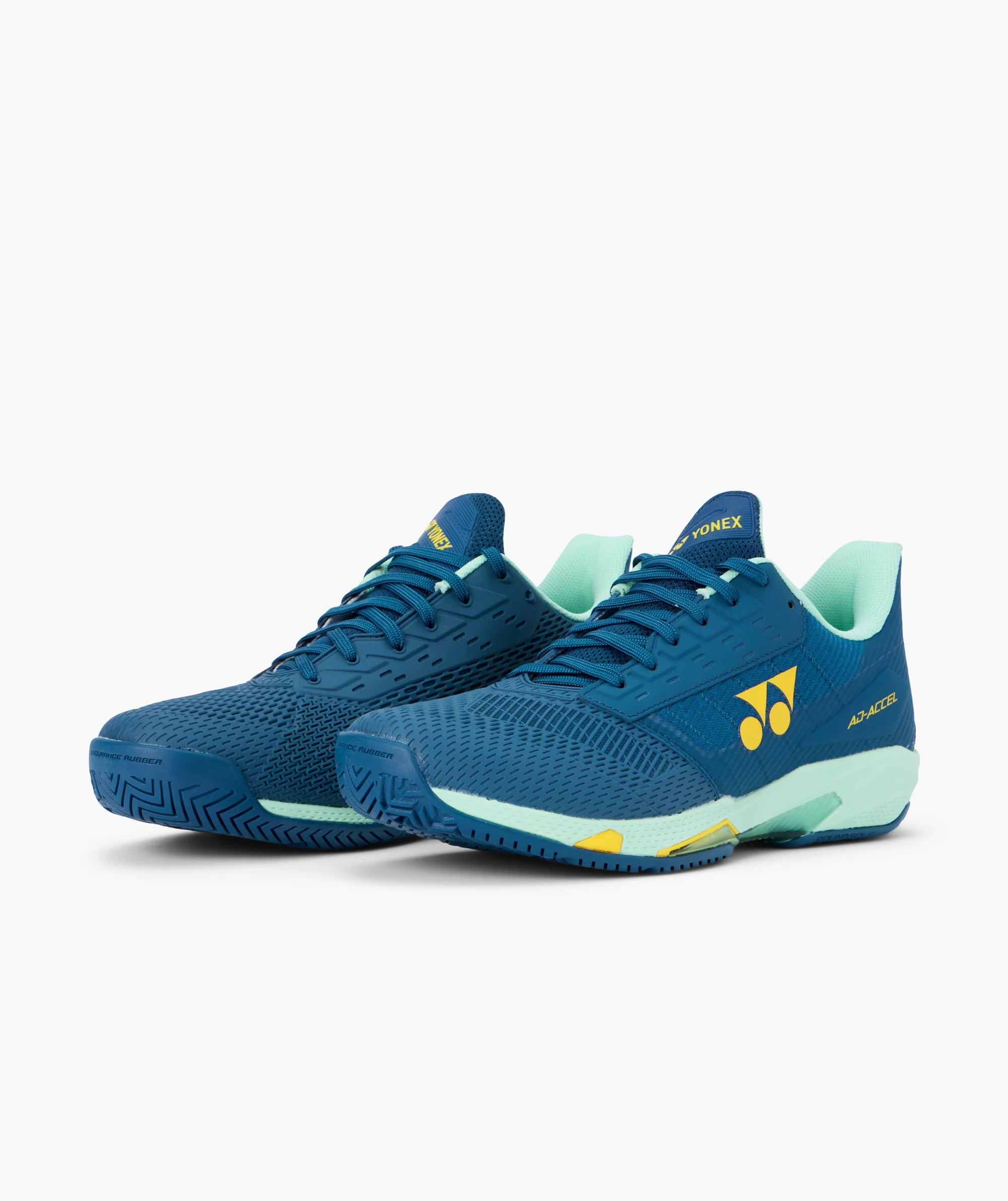
Yonex Power Cushion Ad-Accel
Yonex’s speediest shoe, full stop: a carbon plate, a toe-spring shank and 335 g per 26.0 cm — the most complete speed engineering in this guide.
The Ad-Accel is the shoe Yonex builds when the brief is pure speed, and the spec sheet reads like it. Start with the weight: 335 grams (11.8 ounces) per 26.0 cm shoe, listed in Yonex’s own per-26.0-cm format — the same format it uses for the FusionRev 5, which makes the two directly comparable with no conversion games. Then the technology stack, which is the longest in this guide: the midsole pairs Power Cushion+ — Yonex’s signature material, which the maker claims absorbs 28% more shock and returns 62% more repulsion than conventional EVA — with Hyper msLITE, an ultra-lightweight midsole compound. Above that sits the ACCEL BOOSTER: a TPU shank with a toe spring structure that Yonex designs to add speed to pivots and court coverage, curved and extended for quicker turnarounds. And through the middle runs the Power Graphite Drive Sheet — a carbon plate from the midfoot to the tips of the toes that propels the foot forward on take-off. This is running-shoe thinking applied to a tennis shoe, and it is the reason the Ad-Accel headlines this guide.
The upper is Durable Skin Light: synthetic fibre and synthetic resin with a polyurethane-based skin that Yonex builds to balance the flexibility of rubber against the stiffness of plastic, so the shoe stays quick without feeling restrictive on lateral shifts. A toe assist shape in the forefoot supports natural forward movement and weight transfer. Underneath, the Round Sole design smooths heel-to-toe transitions, and the outsole is Yonex’s Endurance Rubber in a modified herringbone pattern, with dense rubber in the high-wear areas and a perpendicular tread on the lateral edge to help with sliding. Yonex sells the Ad-Accel in all-court and clay versions, so the tread choice is yours to match to your surface.
The honest trade-off: this is the most aggressively engineered shoe here, and aggressive engineering has a wear profile. The Ad-Accel’s speed comes from minimal material doing maximal work — a thin, light package with a carbon plate — which means there is simply less rubber and fabric standing between a heavy slider and the end of the shoe’s life than there is on the Babolat or K-Swiss cards below. Yonex’s Endurance Rubber is a durable compound, but compound quality cannot fully offset quantity when the shoe is this lean. Buy the Ad-Accel if your game is built on first steps and you are willing to trade some lifespan for them; buy the Jet Mach 4 or Express Light 3 if your game is built on slides and you need the rubber to match.
Pros
- 335 g per 26.0 cm in Yonex’s own format — directly comparable, no basis games
- Carbon plate (Power Graphite Drive Sheet) plus ACCEL BOOSTER toe-spring shank: the full speed stack
- Power Cushion+ with Hyper msLITE: the maker’s premium cushioning recipe
- Endurance Rubber outsole in all-court and clay versions — buy the tread for your surface
Cons
- The leanest build here — heavy sliders will wear it faster than the rubber-rich cards below
- Snug medium fit per retailers: between-sizes buyers should check the fit notes first
- Maximum speed engineering means minimal plushness — comfort-first buyers should compare the FusionRev 5
As an Amazon Associate we earn from qualifying purchases.
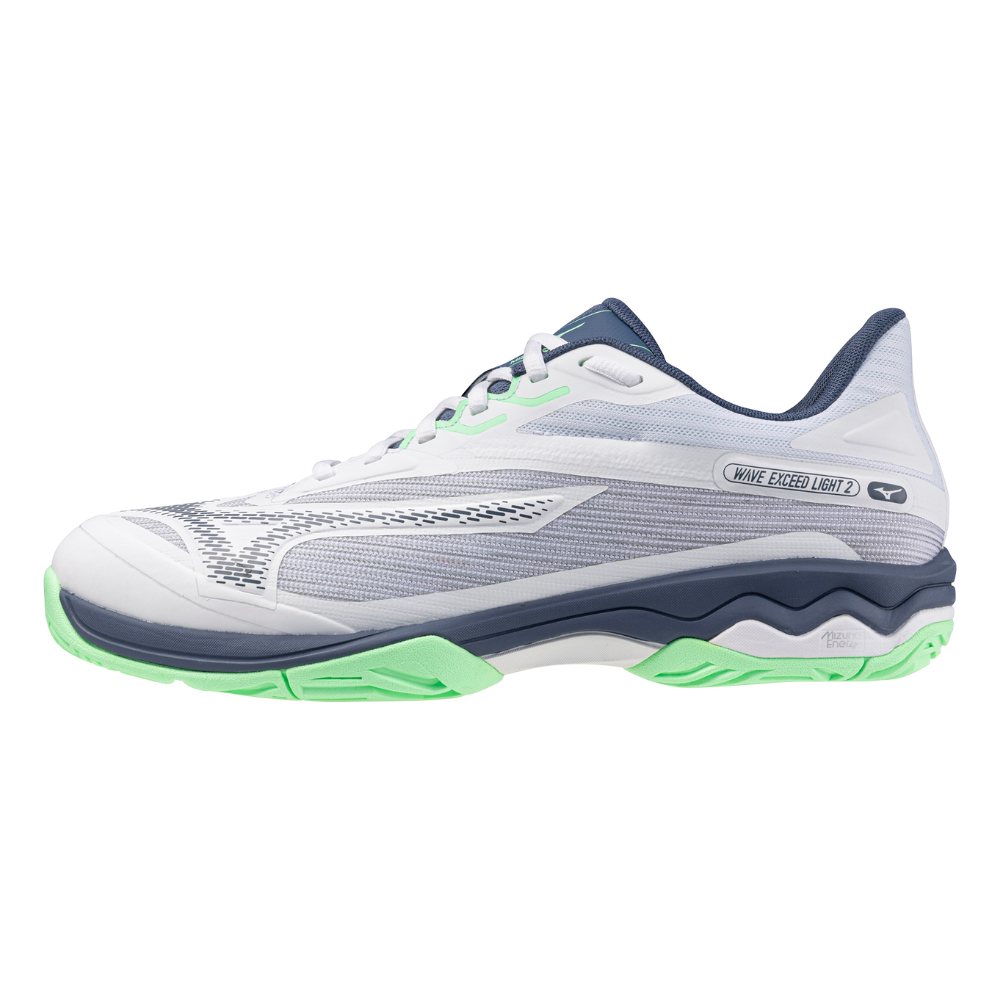
Mizuno Wave Exceed Light 2
The featherweight of this guide: around 300 g in the men’s all-court build, with MIZUNO ENERZY cushioning and an X10 carbon-rubber outsole.
If this guide had a weigh-in, the Wave Exceed Light 2 would take the belt. Retailers list the men’s all-court build at 300 grams and the clay-court CC build at 290 grams — the lightest men’s figures in this guide — with the women’s builds listed at 245 to 260 grams (8.9 ounces in a women’s US 8). One honesty note, as promised: Mizuno publishes no weight for this shoe, and the retailers that print 300 grams state no size basis with it, so treat it as a strong directional figure rather than a laboratory measurement. Even with that caveat, the shoe’s whole identity is lightness — it is in the name, and the construction backs it up: a mesh-based upper for softness and flex, Mizuno’s comfortable last with a spacious toe box, and a midsole built from the maker’s lightweight materials rather than layered bulk.
The cushioning is pure Mizuno vocabulary. MIZUNO ENERZY Foam — the maker’s energy-return material — pairs with Foam Wave, a two-layer wave of foam (U4icX below, Enerzy above) that disperses impact energy across a broader area for a stable platform. Under that sits PoWnCe, Mizuno’s exceedingly lightweight midsole material, and a premium insock for plushness underfoot. The outsole is X10: Mizuno’s durable carbon rubber, which the maker positions as extremely durable in high-impact areas with strong traction at heel strike, cut with D-Flex grooves that transfer body movement in the natural direction to keep the shoe feeling fast. Mizuno sells the shoe in AC (all-court) and CC (clay) builds, so the surface choice is covered.
The honest trade-off: at this weight, structure is the currency being spent. The Wave Exceed Light 2 is a light, breathable, flexible shoe — not a rigid lateral fortress — and players who plant violently on every ball will find less torsional armour here than in the Babolat or Head cards. The X10 outsole is a genuinely durable compound, which offsets some of the lightness penalty, but the upper is minimal mesh doing maximal work. Buy it if your priority is the lightest possible ride with real cushioning tech underfoot; buy the Sprint Pro 3.5 if you want similar weight with more lateral hardware, or the Jet Mach 4 if you want the weight spent on structure instead.
Pros
- The lightest men’s figure in this guide — around 300 g in the all-court build
- MIZUNO ENERZY + Foam Wave + PoWnCe: a full lightweight cushioning stack, not an empty shoe
- X10 carbon rubber outsole with D-Flex grooves for traction and speed
- AC and CC (clay) builds — the tread choice matches your surface
Cons
- Mizuno publishes no weight; the 300 g figure is a retailer’s, with no stated size basis
- Minimal structure compared with the Babolat and Head cards — violent planters should note it
- Lightness-first philosophy: players wanting maximum lateral armour should look at pick 3 or 4
As an Amazon Associate we earn from qualifying purchases.
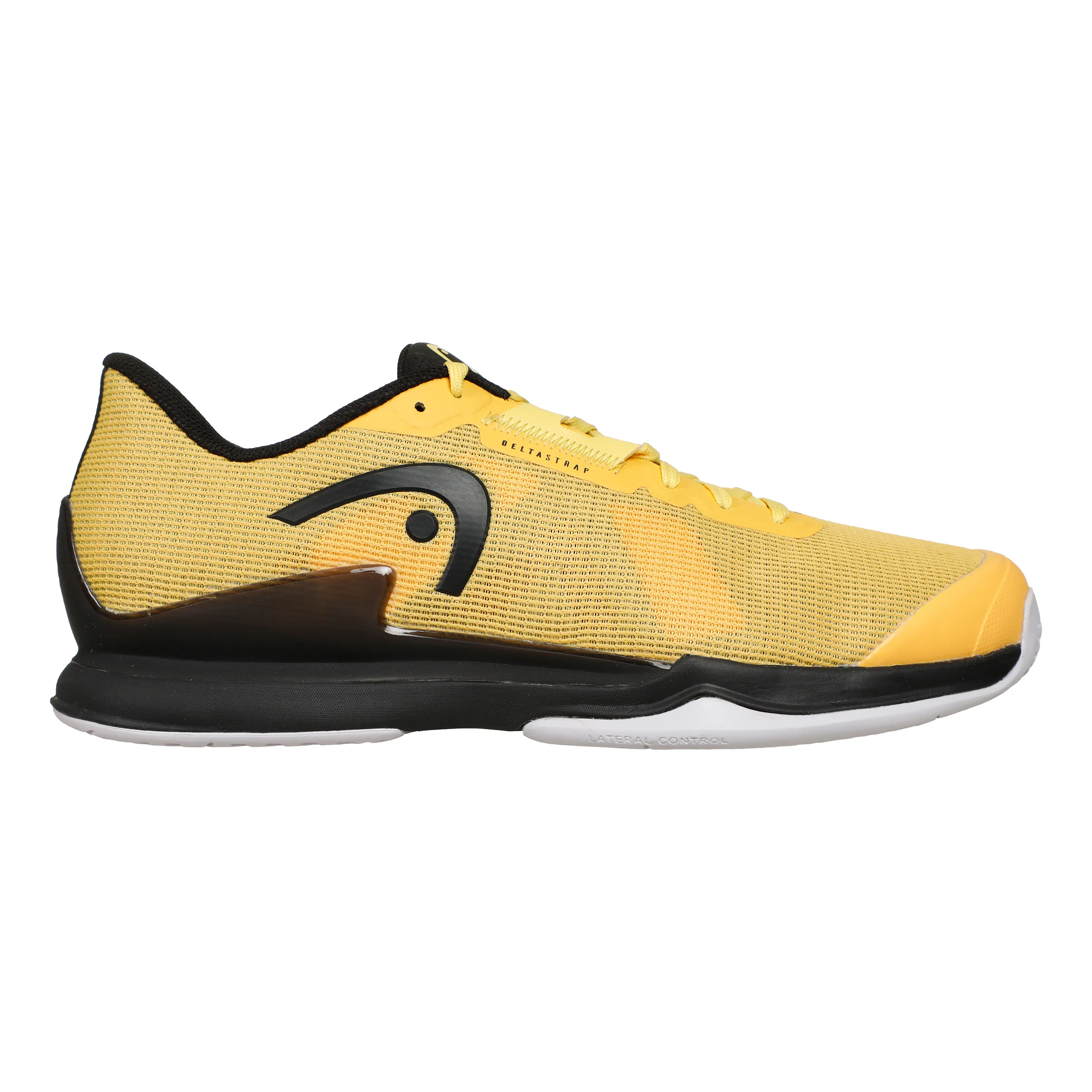
Head Sprint Pro 3.5
Head’s own data sheet calls anything under 350 g ultra-lightweight — the Sprint Pro 3.5 qualifies at 340 g in a US 9, with TRI-NRG cushioning and a Hybrasion+ outsole.
Head does something unusual on the Sprint Pro 3.5’s data sheet: it prints a weight classification. Anything under 350 grams is, in Head’s own taxonomy, ultra-lightweight — and the Sprint Pro 3.5 lands at 340 grams in a men’s US 9 on retailer listings (352 grams in EU 44.5 for the clay build). Head publishes no official weight, so the card labels the figure as the retailer’s, but the classification is the maker’s, and it tells you exactly where this shoe sits in Head’s thinking: the speed end of the range, built for aggressive tournament players who want explosive movement and maximum responsiveness. The data sheet’s other labels point the same way — main benefit: speed; cushioning type: minimal and responsive; drop: a low 8.5 mm for a court-connected ride.
The construction is a masterclass in doing more with less. The upper is a fully knitted breathable mesh in a half-sock construction — minimal material, sock-like fit — with the structural work handed to a triangle Deltastrap lacing system, a sock support system, a TPU heel counter, a heel stabiliser and Drift Defense protection around the toe and medial side. Underfoot, TRI-NRG is Head’s triple-density story: cushioning in the heel, stiffness through the midfoot, rebound in the forefoot for acceleration, over a ventilated 3D anti-torsion shank. A 360-degree Cooling System channels air through the sole and upper, and the Lateral Control stability trigger sits in the lateral outsole to resist rollovers. The all-court build wears a hybrid Hybrasion+ tread for hard courts, clay and artificial grass; the clay build gets a pure sharp herringbone.
The honest trade-off: “minimal and responsive” is Head’s phrase, and it cuts both ways. The TRI-NRG system is engineered for energy return, not plushness — players who want a soft, thick ride underfoot will find this shoe firmer and lower than the Yonex or Mizuno cards. And a fully knitted mesh upper at 340 grams is not going to outlast a heavier, more armoured build for a chronic toe-dragger; Head knows this, which is why it also sells an SF version with SuperFabric reinforcement for players who want the same speed brief with more durability. Buy the standard 3.5 for the purest light-and-fast Head experience; buy the SF if your drag foot eats mesh for breakfast.
Pros
- 340 g (US 9) — inside Head’s own ultra-lightweight classification (<350 g)
- TRI-NRG triple-density foam: heel cushioning, midfoot stiffness, forefoot rebound
- Deltastrap lacing, sock support and Drift Defense — structure without the weight
- Hybrasion+ outsole in hybrid (all-court) and pure herringbone (clay) treads
Cons
- Head publishes no weight; the 340 g figure is a retailer’s, on a US 9 basis
- Minimal, responsive cushioning by design — plush-ride seekers should compare the Yonex cards
- Knitted mesh upper is light, not armoured — heavy draggers should check the SF version
As an Amazon Associate we earn from qualifying purchases.
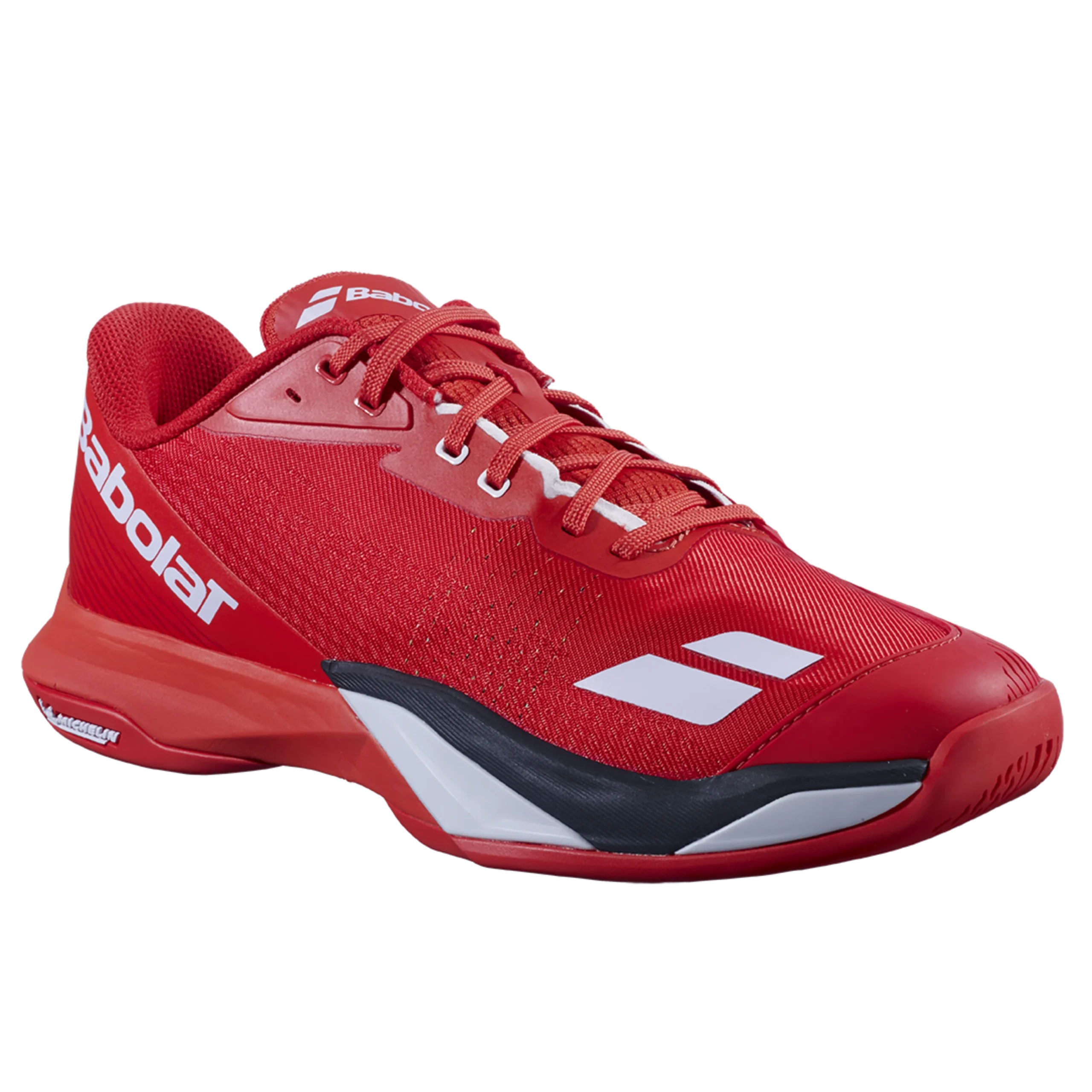
Babolat Jet Mach 4
The fourth generation of Babolat’s speed line: Babolat lists 360 g, with a Matryx EVO upper, KPRS-X heel cushioning and a Michelin rubber outsole.
The Jet Mach is Babolat’s speed franchise, and the fourth edition is the new generation of the line — a different model from the Jet Mach 3, and the one to buy now. Babolat’s own technical characteristics list the weight at 360 grams, though the maker states no size basis with it; retailers list 13.7 ounces in a men’s US 10.5 for the all-court build and 394 grams in a US 10.5 for the clay build, which gives you the anchored comparison this guide insists on. The headline material story is the upper: dual-layer Matryx EVO, a woven fabric of aramid and high-strength polyamide fibres — aramid being the fibre family behind ballistic protection — built for lightweight support that does not quit on lateral cuts. It is the most technically interesting upper in this guide, and it is doing real structural work, not decoration.
Underfoot, the cushioning has been reworked for this generation. KPRS-X — Babolat’s heel system, high-performance EVA beneath the heel — handles shock absorption on landings, while an updated EVA midsole with improved rebound keeps the ride lively. A Starting Bloc Plate adds lateral stability for explosive take-offs, and a heel rocker geometry smooths heel-to-toe transitions. The outsole is Michelin Premium rubber — the tyre maker’s compound, which Babolat uses for grip and long wear — in an all-court build, with a dedicated clay version sold alongside it. The drop is 10 mm, the fit is a standard medium, and the whole package is positioned by Babolat and its retailers as the premium shoe for quick, explosive movements.
The honest trade-off: the Mach 4 is a more substantial shoe than the featherweight Mach 3 it replaces. Babolat spent some of the old model’s minimalism on stability and cushioning — the Starting Bloc Plate, the reworked midsole, the fuller build — and early wearers have noticed the difference. That is not a criticism; it is a design decision, and for most players it is the right one, because the Mach 3’s extreme lightness asked a lot of the foot on hard plants. But if you are buying the Jet Mach name expecting the lightest Babolat ever made, reset that expectation: the 4 is the faster-feeling shoe, not the lighter-weighing one. Buy it for the complete package — Matryx structure, KPRS-X cushioning, Michelin grip — at a weight that still qualifies as genuinely light.
Pros
- Matryx EVO woven upper — aramid and polyamide fibres doing real structural work
- KPRS-X heel cushioning with a rebound EVA midsole and Starting Bloc Plate
- Michelin Premium rubber outsole — the tyre maker’s compound, all-court and clay versions
- The new generation of Babolat’s speed line, with stability the old featherweight lacked
Cons
- Babolat states no size basis for its 360 g figure — the anchored figure is the retailer’s 13.7 oz (US 10.5)
- More substantial than the Mach 3 it replaces — minimalists should know what changed
- The heaviest-feeling speed pick here alongside the K-Swiss — pure weight-chasers should compare picks 1–3
As an Amazon Associate we earn from qualifying purchases.
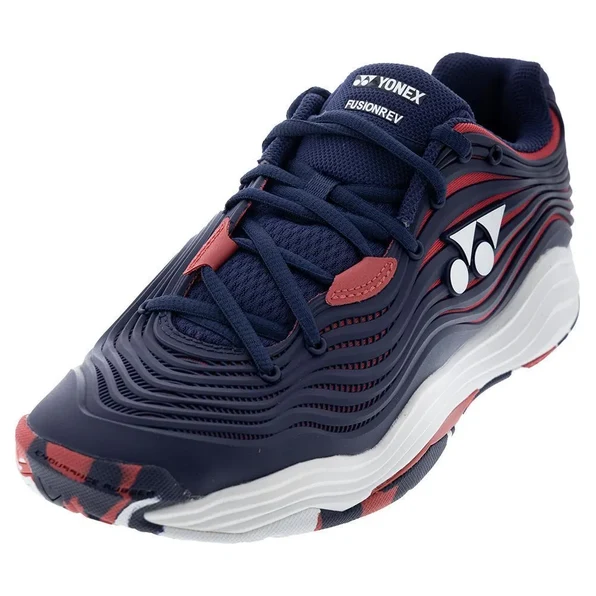
Yonex Power Cushion FusionRev 5
Speed you wear like a glove: Yonex lists 340 g per 26.0 cm, with POWER CUSHION+, a bootie construction and an asymmetrical lacing system.
Where the Ad-Accel is Yonex’s raw-speed weapon, the FusionRev 5 is its fit-and-comfort speed shoe — and the distinction matters. The weight is maker-stated in Yonex’s own format: 340 grams (12 ounces) per 26.0 cm shoe, with the women’s build listed at 320 grams (11.3 ounces) per 24.5 cm. That puts it five grams above its stablemate, which tells you the design priority here is not the absolute lowest number but the best number with a glove-like fit attached. The fit story is the card’s headline: an asymmetrical lacing system and a bootie construction that eliminates the traditional tongue, removing pressure points across the top of the foot, over a flexible Double Raschel mesh with Durable Skin reinforcement. It is the most comfort-engineered upper among the true speed shoes in this guide.
The midsole pairs POWER CUSHION+ — with Yonex’s claimed 28% more shock absorption and 62% more repulsion than conventional EVA — with msLITE X, the lightweight midsole compound, plus a new TPU shank and Yonex’s Fusion Wing for support through direction changes. The outsole is Endurance Rubber II in a semi-one-piece design with a slight midfoot gap, which allows more independent movement between heel and forefoot for a smoother heel-to-toe transition. Yonex sells the FusionRev 5 in all-court and clay versions, and positions the whole FusionRev line for intermediate to advanced players who want natural fit and motion — the comfort silo next to the Eclipsion line’s stability silo.
The honest trade-off: fit-first speed gives up a little of the Ad-Accel’s raw edge. The FusionRev 5 has no carbon plate and no toe-spring shank — its speed comes from low weight, flexible materials and a dialled fit rather than propulsion hardware — so the absolute fastest-feeling ride in the Yonex range remains pick 1. What it gives back is wearability: a shoe that disappears on the foot from the first outing, with cushioning that suits players who want their speed shoe to feel like footwear rather than equipment. Buy the FusionRev 5 if fit is your speed strategy; buy the Ad-Accel if hardware is.
Pros
- 340 g per 26.0 cm in Yonex’s own format — maker-stated, directly comparable
- Bootie construction with asymmetrical lacing — the glove-like fit story, no tongue pressure points
- POWER CUSHION+ with msLITE X, TPU shank and Fusion Wing
- Endurance Rubber II outsole in all-court and clay versions
Cons
- No carbon plate or propulsion shank — the Ad-Accel is the faster-feeling Yonex
- Fit-first philosophy means less rigid support than the Eclipsion-style stability builds
- Five grams heavier than its stablemate — the absolute number crown goes to pick 1
As an Amazon Associate we earn from qualifying purchases.
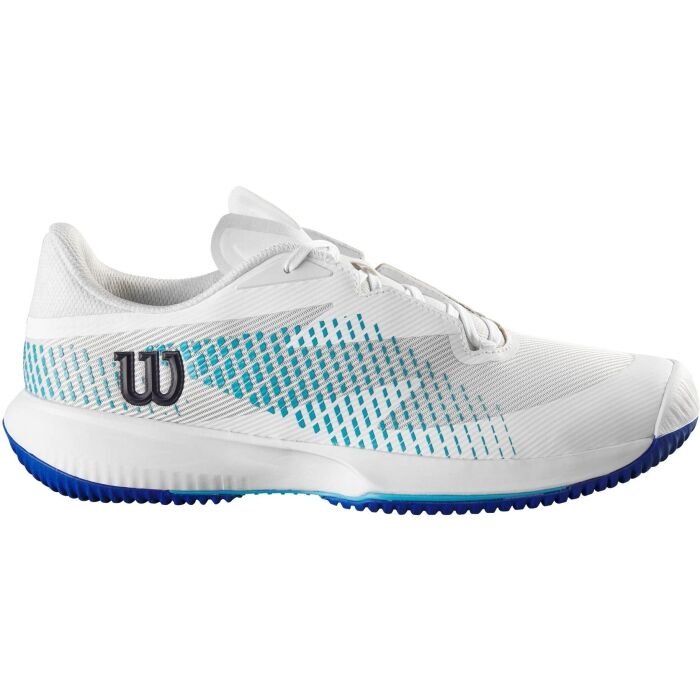
Wilson Kaos Swift 1.5
Soft, flexible and fast: 12.2 oz in a US 10.5 with R-DST+ cushioning and a DURALAST outsole, built for the player who attacks every ball.
The Kaos line has always been Wilson’s answer to the same question this guide asks — how light can a real tennis shoe go — and the Swift 1.5 is the current expression of it. Retailers list 12.2 ounces in a men’s US 10.5 (with 327 to 334 gram listings on the same basis), which plants it firmly in genuine speed-shoe territory; Wilson publishes no weight, so the card labels the figure as the retailer’s, as promised. The shoe’s own description is refreshingly direct: soft, flexible and fast, designed for aggressive players looking for speed and comfort. The upper is a bi-lateral mesh construction — synthetic and textile — built for lightweight support with enhanced flexibility, so the shoe moves with the foot rather than dictating to it. The drop is 9 mm, the profile is low, and the whole package reads as a shoe that wants to be in motion.
Underfoot, the midsole is R-DST+ EVA — Wilson’s cushioning compound — with DF2, and the outsole is DURALAST rubber, Wilson’s durability compound. That pairing is the card’s quiet strength: where some featherweights pair a light build with a light-duty outsole, the Kaos Swift 1.5 puts a named durability rubber under a light, flexible package. Wilson sells the shoe in all-court and clay versions, so the tread matches the surface. The character is distinct from the engineered precision of the Yonex and Babolat cards: this is the soft, flexible, comfortable speed option, the shoe for the player whose game is constant aggressive movement rather than set-piece power.
The honest trade-off: soft and flexible is a philosophy with a cost. The Kaos Swift 1.5 does not have the rigid lateral architecture of the Jet Mach 4’s Starting Bloc Plate or the Sprint Pro 3.5’s anti-torsion shank — its speed comes from low weight and flexibility, not from structural armour. Aggressive movers who plant hard on every change of direction will find less resistance to twisting here than in the more engineered cards. And at 12.2 ounces with a soft build, it sits in the middle of this guide’s weight range rather than at the featherweight end. Buy it if your game is relentless movement and you want that movement to feel easy; buy the Babolat or Head if your movement needs more hardware behind it.
Pros
- 12.2 oz (US 10.5) — firmly in genuine speed-shoe territory
- Soft, flexible, fast: the comfort-first speed character in this guide
- DURALAST rubber outsole — a named durability compound under a light build
- All-court and clay versions sold — the tread matches your surface
Cons
- Wilson publishes no weight; the 12.2 oz figure is a retailer’s, on a US 10.5 basis
- Flexibility-first means less rigid lateral architecture than the Babolat and Head cards
- Mid-pack weight here — the featherweight crown belongs to the Mizuno and Yonex cards
As an Amazon Associate we earn from qualifying purchases.
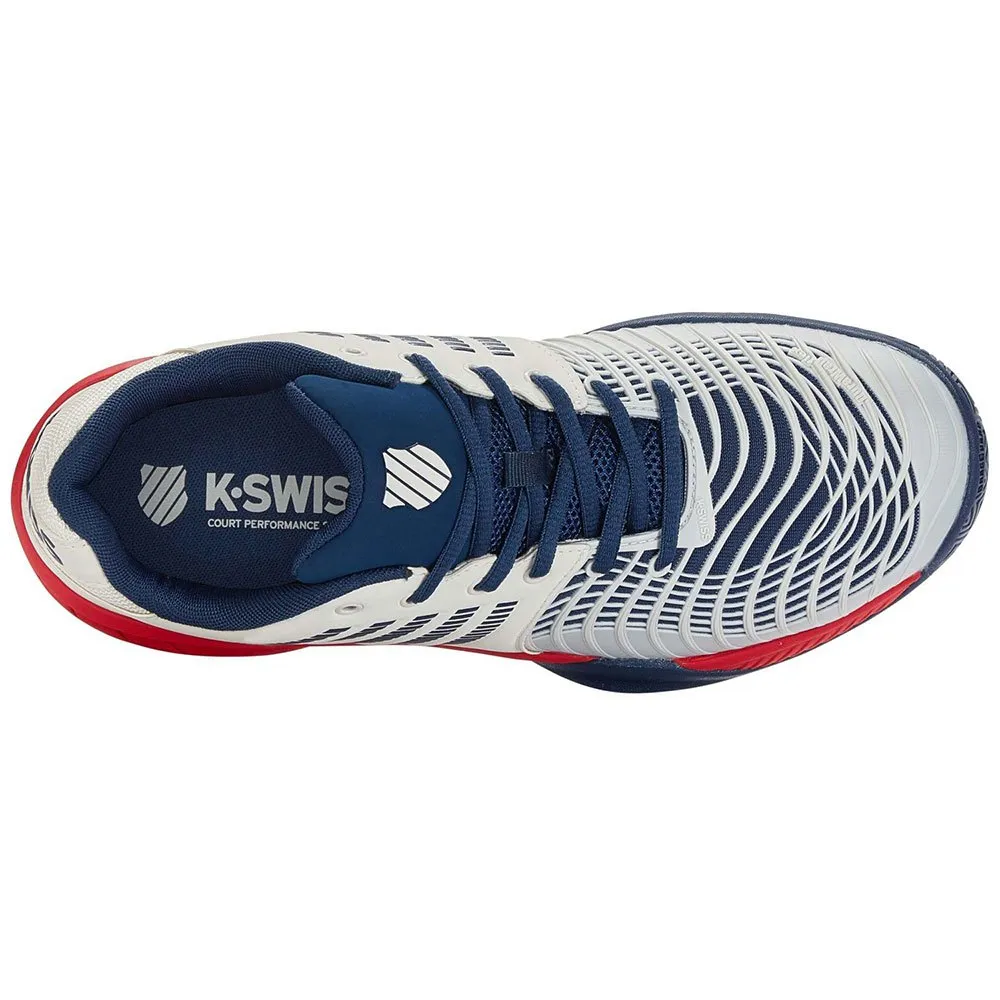
K-Swiss Express Light 3
The lightest everyday trainer in this guide: 367 g in a US 10.5 with a DuraWrap Flex upper and an Aosta 7.0 outsole — light without the race-day edge.
Not every light shoe needs to be a race-day weapon, and the Express Light 3 is the card that proves it. At 367 grams (12.9 ounces) in a men’s US 10.5 on retailer listings — with women’s builds listed at 276 to 308 grams — it is the heaviest shoe in this guide and still comfortably inside genuine lightweight territory. K-Swiss publishes no weight, so the card labels the figure as the retailer’s. The pitch is classic K-Swiss comfort: a flexible DuraWrap Flex upper that enhances stability during quick movements, a cushioned CMEVA midsole with a responsive foam sock liner for lasting comfort, and the generous toe box K-Swiss’s lasts are known for. This is the shoe for the player who wants to feel light and speedy around the court without adopting the minimalist philosophy of the featherweight cards.
The outsole is the Aosta 7.0 rubber compound — K-Swiss’s high-density durability rubber — in a modified herringbone tread on the all-court build, with DragGuard technology in the high-wear areas of the toe and heel for increased abrasion resistance. The clay build gets a full herringbone, and a carpet version exists too, which makes the Express Light 3 the surface-versatility pick of this guide. The cushioning recipe is the simplest here — CMEVA rather than a named energy-return system — and that is a fair reflection of the shoe’s brief: dependable comfort and support for regular play, at a weight that still qualifies as light.
The honest trade-off: this is the comfort end of the lightweight spectrum, and it shows in the spec sheet. There is no carbon plate, no energy-return foam with a trademarked name, no propulsion shank — the Express Light 3 gets its lightness from a clean, simple build rather than from speed engineering. Players chasing the absolute fastest feeling should look at the Yonex Ad-Accel or the Mizuno; players who want a light shoe they can wear for long sessions, week after week, without thinking about their footwear, have found their card. It is also worth noting the flip side of its weight: at 367 grams it carries more rubber and more structure than the featherweights, which is exactly why it will outlast them for a regular player.
Pros
- 367 g (12.9 oz, US 10.5) — light, with the comfort of an everyday trainer
- Aosta 7.0 rubber with DragGuard in the wear zones: the durability-first outsole here
- All-court, clay and carpet versions — the surface-versatility pick of the guide
- DuraWrap Flex upper with a generous toe box — easy, no-drama fit
Cons
- K-Swiss publishes no weight; the 367 g figure is a retailer’s, on a US 10.5 basis
- No speed hardware — no plate, no energy-return system, no propulsion shank
- The heaviest shoe in this guide — weight-chasers should compare picks 1–3
As an Amazon Associate we earn from qualifying purchases.
Side-by-Side: The Seven Lightweight Shoes at a Glance
Every weight below is printed exactly as its source states it — maker-stated with the maker’s size basis, or a clearly-labelled retailer’s figure with its size basis. The trade-off column states each model’s version of the lightness-versus-durability compromise in one line.
| Shoe | Best for | Weight (as stated) | Cushioning (maker-named) | Upper | Outsole | The trade-off |
|---|---|---|---|---|---|---|
| Yonex Power Cushion Ad-Accel | Best overall lightweight | 335 g (11.8 oz) per 26.0 cm — as Yonex lists it | Power Cushion+ + Hyper msLITE | Durable Skin Light, toe assist shape | Endurance Rubber, modified herringbone (AC + clay) | Leanest build here — fastest feeling, shortest-lived for heavy sliders |
| Mizuno Wave Exceed Light 2 | Lightest in this guide | 300 g men’s AC — retailer’s figure; Mizuno publishes none | MIZUNO ENERZY Foam + Foam Wave | AIRmesh, comfortable last | X10 carbon rubber (AC + CC clay) | Featherweight minimalism — less lateral armour than the structured cards |
| Head Sprint Pro 3.5 | Best ultra-light value | 340 g (US 9) — retailer’s figure; Head rates <350 g ultra-lightweight | TRI-NRG triple-density foam | Fully knitted mesh, half-sock, Deltastrap | Hybrasion+ rubber, hybrid (AC) / herringbone (clay) | Minimal and responsive by design — firm, not plush; mesh needs care from draggers |
| Babolat Jet Mach 4 | Best new speed shoe | 360 g — as Babolat lists it (no basis); 13.7 oz (US 10.5) per retailer | KPRS-X heel + rebound EVA, Starting Bloc Plate | Dual-layer Matryx EVO (aramid + polyamide) | Michelin Premium rubber, all-court (clay version sold) | More substantial than the Mach 3 — stability bought with a little weight |
| Yonex Power Cushion FusionRev 5 | Best glove-like speed fit | 340 g (12 oz) per 26.0 cm — as Yonex lists it | POWER CUSHION+ + msLITE X | Durable Skin + Double Raschel mesh, bootie fit | Endurance Rubber II, semi-one-piece (AC + clay) | Fit-first speed — no carbon plate, so the Ad-Accel feels faster |
| Wilson Kaos Swift 1.5 | Best for aggressive movers | 12.2 oz (US 10.5) — retailer’s figure; Wilson publishes none | R-DST+ EVA, DF2 | Bi-lateral mesh, synthetic/textile | DURALAST rubber (AC + clay versions) | Flexibility-first — less rigid lateral architecture than the engineered cards |
| K-Swiss Express Light 3 | Best everyday light pick | 367 g (12.9 oz, US 10.5) — retailer’s figure; K-Swiss publishes none | CMEVA midsole, foam sock liner | DuraWrap Flex, generous toe box | Aosta 7.0 rubber + DragGuard, herringbone | Comfort-first light — no speed hardware, but the most rubber underfoot here |
Lightweight Buying Guide: Five Checks Before You Pay
1. Demand the size basis with every weight. A weight without a basis is a rumour, and this category is full of them. Yonex’s per-26.0-cm format is the cleanest in the business — 335 g for the Ad-Accel and 340 g for the FusionRev 5 are directly comparable. Babolat’s 360 g for the Jet Mach 4 comes with no stated basis, which is why this guide pairs it with a retailer’s 13.7 oz in a US 10.5. When a listing prints a precise weight for the Mizuno, Head, Wilson or K-Swiss here, check whether the maker or the retailer is the source — none of those four makers publish a weight for their shoe in this guide, so any figure you see is a retailer’s, and it only means something next to its size basis. If a listing will not tell you the basis, treat its number as decoration.
2. Decide which end of the trade-off you live on. Before you compare models, compare yourself: are you buying lightness for first-step speed, or are you a slider who needs the shoe to survive the season? The featherweight end of this guide — the Mizuno at around 300 g, the Ad-Accel at 335 g per 26.0 cm — is built for the first buyer, with minimal material and maximum quickness. The structured end — the Jet Mach 4 with its Michelin outsole and Matryx armour, the Express Light 3 with its Aosta rubber and DragGuard — is built for the second, trading a few dozen grams for rubber and structure that last. The wrong answer is not a model; it is a mismatch. A chronic toe-dragger in the Mizuno will be shopping again by mid-season, and a serve-and-volleyer in the K-Swiss will never feel the quickness they paid for.
3. Match the outsole to your real surface mix. Five of the seven shoes here are sold in dedicated clay versions — the Ad-Accel, FusionRev 5, Jet Mach 4, Sprint Pro 3.5 and Express Light 3 — plus the Wave Exceed Light 2’s CC build, and the Express Light 3 even has a carpet version. That is not marketing segmentation; the tread patterns are genuinely different, with the clay builds running fuller herringbones designed to release clay rather than clog with it. Buy the tread for the surface you actually play on most. A hard-court outsole on clay grips unpredictably and wears oddly; a clay herringbone on hard courts rounds its edges down fast. When the listing offers a surface choice, that choice matters more than the colour choice.
4. Read the upper as the weight-reduction plan. The grams had to come from somewhere, and the cards tell you where each maker took them. Babolat replaced layered overlays with a woven Matryx EVO fabric. Head went to a fully knitted mesh with a half-sock construction and handed the structural work to the Deltastrap lacing. Yonex uses Durable Skin Light and a bootie fit with no traditional tongue. Mizuno and Wilson lean on open mesh. The practical question this raises is fit security: a minimal upper relies on lacing and last shape to hold the foot on lateral plants, so the shop test matters more for light shoes than for heavy ones. Lace fully, plant hard, cut hard, and confirm the foot stays put — if the upper gives sideways, the grams you saved are costing you stability.
5. Do not confuse a light name with a light shoe. During this build, four models with speed-suggesting names were checked and rejected because their published weights did not qualify: a 14.7-ounce “speed” shoe is not a lightweight shoe, whatever the marketing says. The test is simple and this guide has already run it for you — every card here sits meaningfully below the 14-to-15-ounce range of a typical performance tennis shoe, on a published figure with a stated basis. Apply the same test to any shoe you consider outside this guide: find the weight, find the basis, and check that the number — not the name — earns the word lightweight.
Frequently Asked Questions
What counts as a lightweight tennis shoe?
There is no official threshold, but the working definition in this guide is a men’s build meaningfully below the 14-to-15-ounce range of a typical performance tennis shoe, on a published figure with a stated size basis. Every shoe here qualifies: from around 300 g (about 10.6 oz) for the Mizuno Wave Exceed Light 2 to 367 g (12.9 oz) for the K-Swiss Express Light 3 in men’s builds. Below roughly 13 ounces you are in genuine speed-shoe territory. A shoe marketed as “lightweight” that weighs 14-plus ounces did not make this guide.
Why do makers state weights on different size bases?
Because there is no standard, and each maker follows its own convention. Yonex lists per 26.0 cm (about a US 8); Babolat lists a gram figure with no stated basis; Mizuno, Head, Wilson and K-Swiss publish no weights at all for their shoes here, leaving retailers to weigh and publish their own figures on bases like US 9 or US 10.5. A weight only means something next to its basis — never compare a per-26.0-cm figure against a US 10.5 figure as if they were the same shoe.
Do lightweight tennis shoes wear out faster?
The honest answer is that lightness and longevity pull in opposite directions by design. A lighter shoe carries less rubber on the outsole, a leaner upper and less foam — less material between the court and the end of the shoe’s life. The featherweight cards here (Mizuno, Yonex Ad-Accel) will not outlast the rubber-rich cards (Babolat Jet Mach 4 with its Michelin outsole, K-Swiss Express Light 3 with Aosta 7.0 and DragGuard) for a heavy slider. Match the shoe to your game: first-step players buy the featherweights, chronic sliders buy the structure.
Which lightweight tennis shoes are best for clay courts?
Buy the clay version, not the all-court version with hope. Five of the seven shoes here are sold in dedicated clay builds: the Yonex Ad-Accel Clay, the Yonex FusionRev 5 Clay, the Babolat Jet Mach 4 Clay, the Head Sprint Pro 3.5 Clay (pure sharp herringbone) and the K-Swiss Express Light 3 Clay (full herringbone), plus the Mizuno Wave Exceed Light 2 CC. The clay treads run fuller herringbone patterns designed to release clay rather than clog. A hard-court outsole on clay grips unpredictably — check the surface version before you check the colour.
What is the difference between the Yonex Ad-Accel and the FusionRev 5?
They are the two speed silos in Yonex’s range, aimed at different buyers. The Ad-Accel (335 g per 26.0 cm) is the raw-speed weapon: carbon plate from midfoot to toes, ACCEL BOOSTER toe-spring shank, Hyper msLITE midsole — hardware for maximum quickness. The FusionRev 5 (340 g per 26.0 cm) is the fit-and-comfort speed shoe: bootie construction with no traditional tongue, asymmetrical lacing, Double Raschel mesh — speed through low weight and a glove-like fit rather than propulsion parts. Buy hardware for the fastest feeling; buy fit for the most wearable speed.
Is the Babolat Jet Mach 4 the same as the Jet Mach 3?
No — it is the new generation of Babolat’s speed line, a different model. The Mach 4 adds stability and cushioning the featherweight Mach 3 lacked: a Starting Bloc Plate, a reworked rebound EVA midsole, KPRS-X heel cushioning and a fuller Matryx EVO build, with a Michelin Premium rubber outsole. Babolat lists 360 g (no stated size basis); retailers list 13.7 oz in a men’s US 10.5. Expect a more substantial, more complete shoe than the old minimalism — faster-feeling, not lighter-weighing.
Should a beginner buy a lightweight tennis shoe?
Usually not as a first shoe. Lightweight shoes trade structure and forgiveness for speed — minimal uppers, firmer rides, less rubber — which suits players whose footwork is already efficient. Beginners are still building the movement patterns (split step, recovery, controlled slide) and generally benefit more from a stable, supportive first shoe. Our best tennis shoes for beginners guide owns that purchase; come back to this guide when your feet are asking for speed rather than support.
The Verdict
If one shoe has to answer the lightweight question completely, it is the Yonex Power Cushion Ad-Accel — 335 g per 26.0 cm in the maker’s own format, a carbon plate, a toe-spring shank and the most complete speed engineering in this guide. But the honest verdict in a weight guide is that the best shoe is the one that matches your version of the trade-off. Featherweight chasers get the Mizuno Wave Exceed Light 2 at around 300 g. Value hunters get the Head Sprint Pro 3.5 at 340 g in a US 9, inside Head’s own ultra-lightweight class. New-tech buyers get the Babolat Jet Mach 4 with its Matryx EVO armour and Michelin grip. Fit-first speed seekers get the Yonex Power Cushion FusionRev 5 and its glove-like bootie. Aggressive movers get the Wilson Kaos Swift 1.5 and its soft, flexible speed. And everyday players get the K-Swiss Express Light 3 — the lightest trainer here that still feels like a trainer.
Still weighing the wider field? Our pillar comparison of the best tennis shoes covers the all-player flagships this guide deliberately avoids repeating, the women’s tennis shoes guide owns the women’s lasts, beginners should start with their own guide, developing players belong to the intermediate players guide, and the advanced players guide owns the top-tier purchase. Buy the weight that is actually published — grams with a size basis, not adjectives — and the shoe wall stops being a wall of hype and becomes seven clear answers.
How we built this guide: every weight above is either maker-stated with the size basis named exactly as the maker states it (Yonex’s per-26.0-cm figures, Babolat’s 360 g), or a clearly-labelled retailer’s figure with its size basis (Mizuno, Head, Wilson, K-Swiss — none of those four makers publish a weight for their shoe here). Four brief-listed candidates were checked and replaced for failing to verify as genuinely light, and five more for appearing in our segment guides, which this guide summarises and links instead of re-ranking. We do not publish prices, we make no durability or medical claims, and nothing here is presented as hands-on testing. Some links on this page are affiliate links: if you buy through them, AliShuttler may earn a commission at no additional cost to you. As an Amazon Associate we earn from qualifying purchases.