
Six badminton shoes chosen the honest way: only models that verify at the lightest end of the category — Yonex, Victor, Li-Ning, Babolat and Mizuno — compared on exactly what the makers publish: weights with their size basis, cushioning systems, outsole compounds and lateral-support builds.
Badminton shoes are light by design — that is the honest starting point. A typical all-round badminton shoe sits around 300 to 360 grams per shoe, and the whole category exists to keep your feet moving fast on an indoor court. So a “lightweight” guide that cards 340-gram shoes and calls them featherweights is padding its list. This guide does the opposite: it cards only the lightest verified end of the category, from 250 grams up to 305 grams per shoe, and it says plainly where each number comes from and on what size it was measured. That is why there are six cards here instead of seven — the brief for this guide allows accuracy over count, and the models that could not verify as genuinely light were dropped rather than dressed up.
This guide owns one decision only — the weight/speed purchase. It does not re-rank our segment guides: the all-player flagship selection lives in our best badminton shoes comparison, women players have their own picks in our best badminton shoes for women guide, first purchases belong to our best badminton shoes for beginners guide, club-level upgrades are covered in our best badminton shoes for intermediate players guide, and the top-tier purchase is owned by our best badminton shoes for advanced players comparison. Every model below is different from the ones ranked in those guides. If you are learning the movement patterns these shoes are built for — the split step, the lunge, the six-point footwork — our how to play badminton guide covers them. Read those for their jobs; read this one when grams are the first thing you check.
One promise before the picks: we card only what verifies. Four of the six shoes here carry a maker-stated weight with its size basis — Yonex at 250 g (26.0 cm), Victor at 250 g (265 mm), Li-Ning at 265 g, Babolat at 280 g (EU 42.5). The fifth, the Mizuno Wave Claw 3, is maker-stated at 305 g. The sixth, the Yonex Aerus X2, has no maker-published weight, so its ~250 g (UK 8) figure is labelled as a retailer’s figure with its size basis. Where a size basis was not stated, the card says so. The method section at the end names every model that was checked and dropped, and why.
TL;DR — The Short Version
Buy the Yonex Power Cushion Aerus Z if you want the lightest verified Yonex — 250 g at 26.0 cm in the maker’s own words, on Feather Bounce Foam with a Radial Blade Sole. Buy the Victor S99 Elite for Victor’s lightest ever — 250 g at 265 mm, on a NitroLite midsole with a Carbon Power anti-torsion plate and a VSR Rubber outsole. Buy the Li-Ning Mirage Pro if you want the lightest Li-Ning here — 265 g maker-stated, with BOOM FIBER technology and a non-marking gum rubber sole. Buy the Babolat Shadow Tour 5 Men for 280 g (EU 42.5) with a Michelin rubber outsole and Power Strap lockdown. Buy the Yonex Power Cushion Aerus X2 for a mid-line speed shoe at roughly 250 g (UK 8, retailer’s figure). Buy the Mizuno Wave Claw 3 for Mizuno’s speed build — 305 g maker-stated, with ENERZY NXT cushioning, a Dyna-Eyelet Wrap fit and an XG Rubber outsole.
Quick Picks
In This Guide
- The weight decision: grams are only honest with a size basis
- What to check before buying a lightweight badminton shoe
- Yonex Power Cushion Aerus Z
- Victor S99 Elite
- Li-Ning Mirage Pro
- Babolat Shadow Tour 5 Men
- Yonex Power Cushion Aerus X2
- Mizuno Wave Claw 3
- Side-by-side comparison
- Lightweight buying guide: five checks before you pay
- Frequently asked questions
- The verdict
The Weight Decision: Grams Are Only Honest With a Size Basis
Shoe weight is the rare spec in badminton that is almost entirely comparable — and the rare spec that is also easy to misuse. A gram figure without a size is not a fact; it is a rumour. Shoe weight scales with size, so 250 grams at 26.0 cm and 250 grams at 265 mm are close but not identical measurements, and a 280-gram figure at EU 42.5 is a different statement from 280 grams with no basis at all. This guide prints every weight with the size basis its source states, and says “size basis not stated” where the source states none. That is the only way to compare a Yonex figure against a Victor figure against a Babolat figure without pretending the numbers were measured the same way.
The second distinction is between a maker-stated weight and a retailer’s figure. Four of the six cards here — the Aerus Z, the S99 Elite, the Mirage Pro and the Shadow Tour 5 Men — carry figures from the makers’ own pages or official product copy. The Aerus X2’s ~250 g (UK 8) is a retailer’s listing figure, because Yonex publishes no weight for it; the card says so plainly. Neither kind of figure is a reason to distrust the shoe, but they are different kinds of evidence, and a guide that mixes them without labels is laundering one into the other. Where a maker’s figure was unavailable and no reliable retailer figure existed with a size basis, the model was dropped from contention — that is part of why this is a six-card guide.
The third thing to know is what “light” actually means in this category. The shoes here run from 250 to 305 grams per shoe. The models we checked and dropped ran from about 315 to 366 grams — the Mizuno Wave Fang 2 at 315 g (a stability build), the Li-Ning Saga II Pro and Blade Pro at 320 g, the Victor P9200II at 333 g and up, the Yonex 65 Z3 at 340 to 360 g, and the Victor A970 NitroLite at 344 to 366 g despite its featherweight-sounding name. Those are fine shoes; they are all-round, stability and cushioning builds, and several of them are carded in our segment guides. They are simply not light, and this guide would be lying to you if it presented them as featherweights. Six honest cards beat seven padded ones.
What to Check Before Buying a Lightweight Badminton Shoe
Weight and size basis: read the number the way it was measured. Yonex states the Aerus Z at 250 g on a 26.0 cm shoe; Victor states the S99 Elite at 250 g on a 265 mm shoe; Babolat states the Shadow Tour 5 Men at 280 g in EU 42.5; Mizuno states the Wave Claw 3 at 305 g; Li-Ning states the Mirage Pro at 265 g without naming a size. The Yonex Aerus X2’s ~250 g comes from retailers on a UK 8. Do not line these up as if they were measured identically — read each card’s weight line as a stated figure on a stated basis, and treat a precise number with no basis as decoration. The buying-guide section below repeats this once more, because it is the single most abused spec in lightweight shoe marketing.
Cushioning systems: learn the makers’ names. Every card names the cushioning exactly as its maker does, because that is the only language in which the specs are comparable. Yonex: POWER CUSHION+ and POWER CUSHION, with Feather Bounce Foam in the Aerus Z’s sole and POWER CUSHION in the Aerus X2. Victor: the NITROLITE nitrogen-foamed midsole with ENERGYMAX V, a Carbon Power plate and Solid EVA. Li-Ning: BOOM FIBER technology with a Li-Ning Cloud midsole and Boom cushion materials. Babolat: a dual-density EVA midsole. Mizuno: MIZUNO ENERZY NXT in the forefoot with an ENERZY insole, over a U4icX and PoWnCe midsole with a Foam Wave plate. A longer name is not a better foam — read cushioning as character (plush, firm, low, responsive) rather than quality, and match it to how your feet feel at the end of a long session.
Outsole and grip: the non-marking rubber question. Badminton is an indoor sport, and the shoes here are indoor court shoes: the makers specify rubber outsoles built for hall floors. Yonex lists a rubber outsole with its Radial Blade Sole pattern on the Aerus Z; Victor names its VSR Rubber on the S99 Elite, with retail copy quoting “21% better grip on dry PU” against standard rubber; Li-Ning’s Mirage Pro is listed with a non-marking gum rubber sole; Babolat fits the Shadow Tour 5 Men with a Michelin rubber outsole — the tyre maker’s badminton compound; Mizuno names its XG Rubber, an extra-grade compound for grip and durability in fast, intense movement. Buy the grip for the floor you play on: polished wood and PU courts reward the compounds above, and none of these shoes is built for outdoor concrete.
Lateral support: light must still hold. A light shoe that lets the foot slide is worse than a heavier shoe that holds it — the whole point of lightness is faster direction changes, and direction changes load the shoe sideways. Read the support line on every card as carefully as the weight line. The S99 Elite carries a 1 mm Carbon Power plate for midfoot anti-torsion; the Shadow Tour 5 Men uses a Power Strap to lock the midfoot; the Wave Claw 3 wraps the foot in Mizuno’s Dyna-Eyelet Wrap; the Aerus Z runs a Power Graphite Drive plate with its Toe Assist Shape and Round Sole; the Mirage Pro reinforces its upper with TPU. Lightness is the headline; lockdown is the purchase.
The trade-off: grams cost structure. Every gram saved has to come from somewhere — thinner uppers, less midsole stack, lighter plates. That is why the lightest shoes in this guide sit in the speed part of their makers’ ranges, and why the stability and cushioning flagships (the 65 Z3, the A970 NitroLite, the P9200II, the Wave Fang 2) weigh 315 to 366 grams: their structure is the weight. If you are a heavier player, or your game is built on deep lunges rather than fast footwork, a 250-gram speed shoe may feel underbuilt — our advanced players guide owns the structured end of the market. Buy lightness for the game you actually play, not the game you aspire to.
The Picks: 6 Genuinely Light Badminton Shoes Compared
Yonex Power Cushion Aerus Z
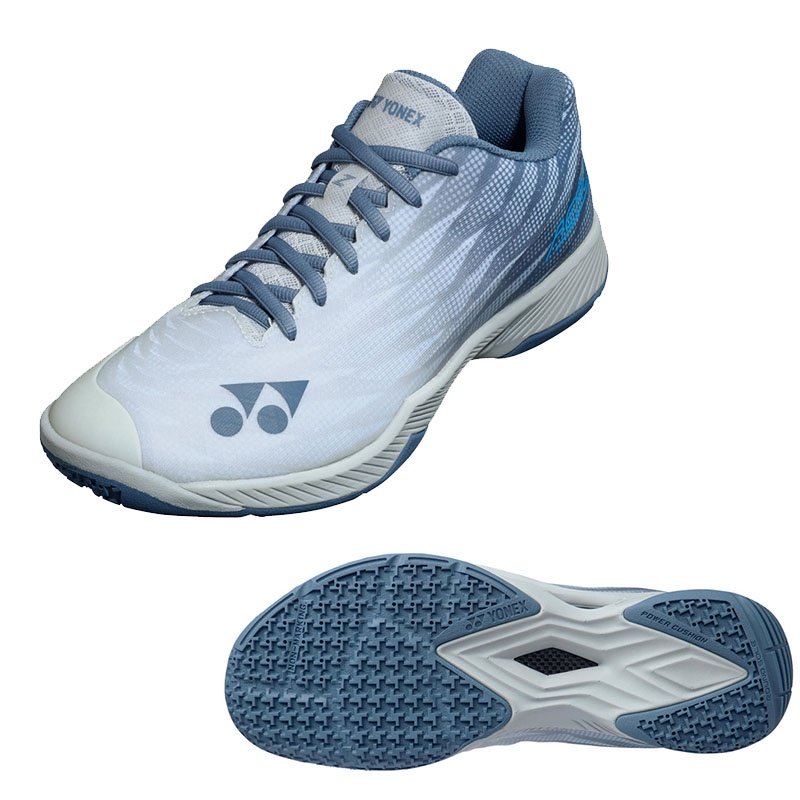
The lightest verified Yonex: 250 g at 26.0 cm in the maker’s own words, on Feather Bounce Foam with a Radial Blade Sole and Power Graphite Drive support.
The Aerus Z is the shoe Yonex itself describes as “Yonex’s lightest shoe at 250g (26cm/ U.S. Size 8) for faster footwork with power and cushioning” — and that sentence is doing the whole job of this guide in miniature: a precise weight, a named size basis, and the design intent in one line. The weight comes from the sole: a Feather Bounce Foam midsole that retail copy describes as 8% lighter than the previous AERUS foam while generating more repulsion, stacked with Yonex’s POWER CUSHION+ and POWER CUSHION layers for the shock absorption the brand is known for. The upper is Double Raschel Mesh with Durable Skin Light — Yonex’s featherweight skin — over a Synchro-Fit Insole, and the item code is SHBAZM.
Lightness here does not mean a floppy shoe. The Power Graphite Drive plate runs through the midfoot for torsional support, the Toe Assist Shape is Yonex’s geometry for quick push-offs, and the Round Sole is built for the smooth footwork transitions badminton demands. The outsole is Yonex’s Radial Blade Sole in rubber — the badminton-specific pattern the brand puts on its indoor court shoes. One honest note: the Aerus Z is the previous generation of the Aerus Z2 carded in our pillar best badminton shoes guide — a different model with a different item code and a different sole compound, and it is carded here on its own verified 250 g figure, not as a substitute. Buy the Aerus Z if you want the lightest maker-verified figure in the Yonex range with the full stability recipe intact.
Pros
- 250 g at 26.0 cm — the lightest maker-stated Yonex figure, with its size basis named
- Feather Bounce Foam sole: 8% lighter than the previous AERUS foam with more repulsion, per retail copy
- Power Graphite Drive plate plus Toe Assist Shape and Round Sole: support and geometry for fast footwork
- Radial Blade Sole rubber outsole — Yonex’s badminton-specific indoor pattern
Cons
- The previous generation of the pillar guide’s Aerus Z2 — confirm the model code (SHBAZM) when ordering
- A speed build: players who want maximum cushioning should compare the Victor and Li-Ning cards
- Light uppers trade some structure — deep lungers should read the support line, not just the weight
As an Amazon Associate we earn from qualifying purchases.
Victor S99 Elite
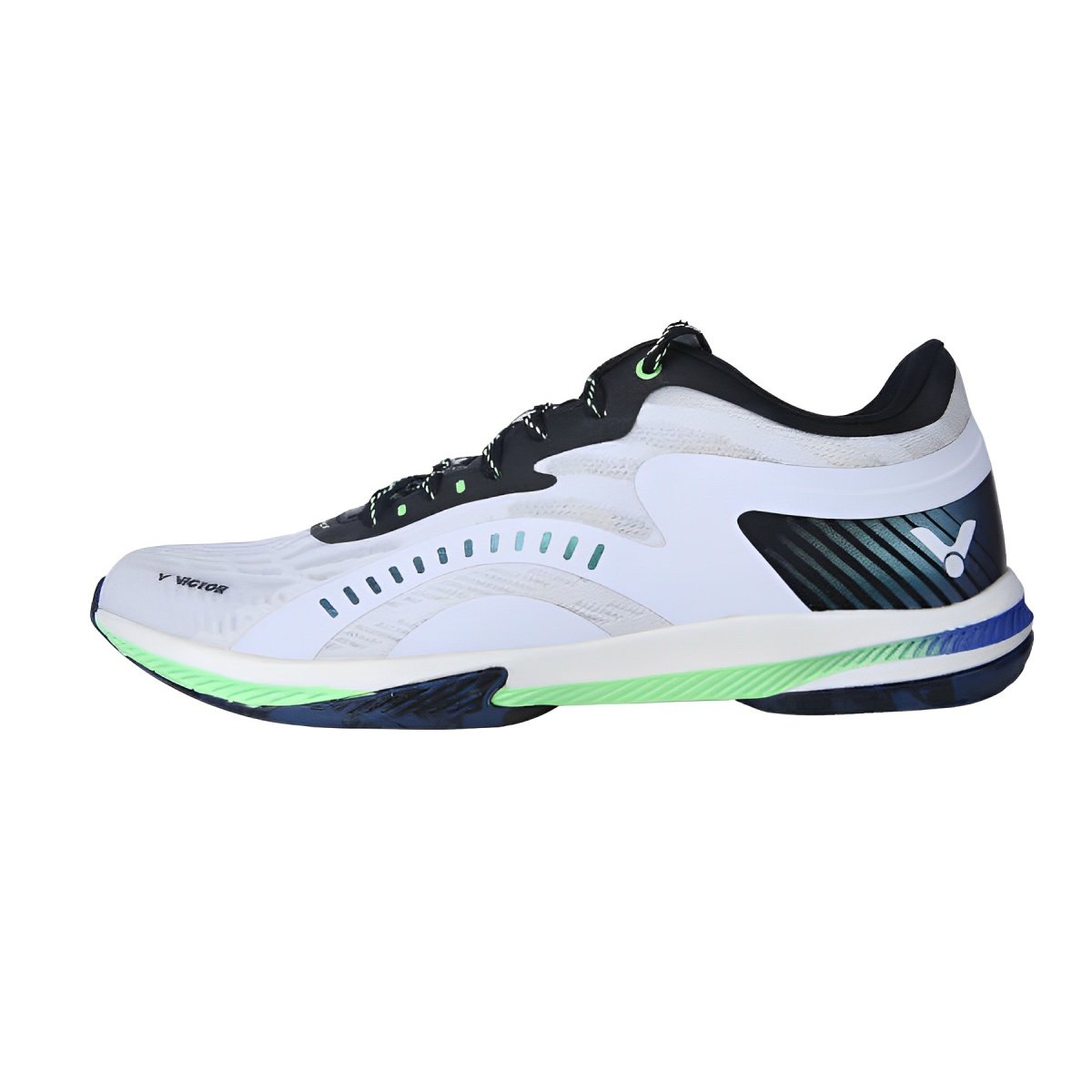
Victor’s lightest ever: 250 g per shoe at 265 mm in the maker’s own words, on a NitroLite nitrogen-foamed midsole with a Carbon Power anti-torsion plate.
Victor’s maker copy for the S99 Elite is unusually direct: “250g per shoe at 265mm — Victor’s lightest shoe ever made.” The weight story is the midsole: NITROLITE, a nitrogen-foamed EVA that Victor developed to cut the midsole’s mass — the midsole being roughly a quarter of a shoe’s total weight — without giving up rebound, paired with ENERGYMAX V, a Carbon Power plate and Solid EVA. The upper is JACQUARD EM, a three-layer interlocked engineering mesh, with V-Durable+ reinforcement in the wear zones. The outsole is Victor’s VSR Rubber, which retail copy describes as delivering “21% better grip on dry PU” against standard rubber — the grip claim is the retailer’s, the compound name is the maker’s.
The S99 Elite is the flagship of Victor’s Speed series, and its engineering answers the light-shoe question directly: the 1 mm Carbon Power plate in the midfoot is twice the standard thickness Victor uses elsewhere, built for anti-torsion resistance in every direction, so the 250-gram figure does not come at the cost of the lateral support lunging demands. One fit note worth knowing: the S99 Elite C variant is built on Victor’s V-Shape 3.0 Wide fit — if the standard last feels narrow, the wide build is a separate variant rather than a hope. Do not confuse this shoe with the Victor A970 NitroLite, which shares the NitroLite midsole name but is a cushioning flagship at roughly 344 to 366 grams — this guide dropped it for exactly that reason. Buy the S99 Elite if you want the lightest figure Victor has ever published, with the support plate to back it up.
Pros
- 250 g per shoe at 265 mm — “Victor’s lightest shoe ever made” in the maker’s own words
- NITROLITE nitrogen-foamed midsole with ENERGYMAX V: the weight is engineered out of the foam
- 1 mm Carbon Power plate — twice standard thickness — for midfoot anti-torsion
- VSR Rubber outsole; a wide C variant exists on the V-Shape 3.0 Wide fit
Cons
- The “21% better grip” figure is retail copy, not the maker’s — the compound name is the verified fact
- A different shoe from the A970 NitroLite — check the model name, not just the foam name
- Speed-series build: maximum-cushioning players should compare the Li-Ning and Mizuno cards
As an Amazon Associate we earn from qualifying purchases.
Li-Ning Mirage Pro
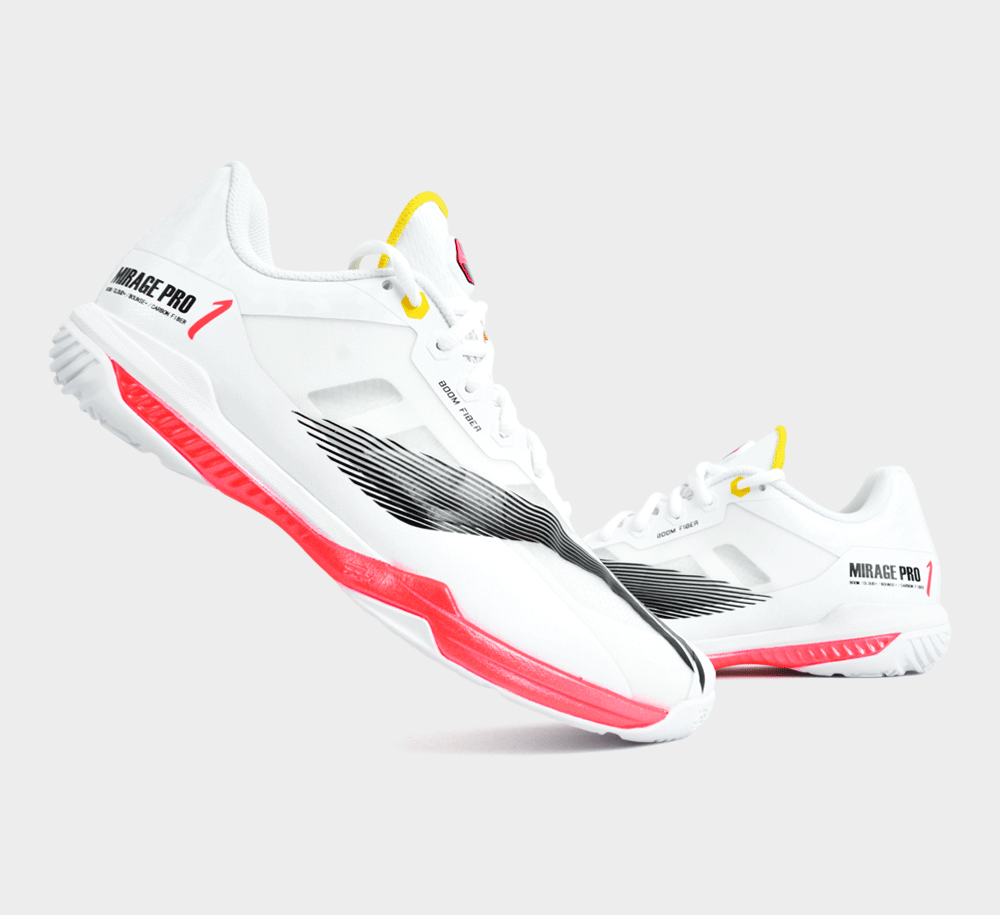
The lightest Li-Ning here: 265 g maker-stated, with BOOM FIBER technology, a Cloud midsole and a non-marking gum rubber sole.
Li-Ning’s own product page for the Mirage Pro states the weight plainly — “Weight: 265 grams” — and describes it as an “ultra-lightweight design at just 265 grams” built around BOOM FIBER technology, the fibre-based midsole system Li-Ning positions for flexibility, durability and swift, precise court movement. Retail copy adds that the midsole pairs Li-Ning Cloud cushioning with the brand’s Boom materials for quick action and cushioning. The upper is synthetic leather, textile and TPU, and the outsole is listed as a non-marking gum rubber sole — the classic indoor badminton compound, stated as such. The style code is AYAT013.
One honesty note on the weight: Li-Ning states the 265 g figure but names no size basis for it, and this card will not invent one — one retailer lists 265 g for one shoe in US 9, but that is the retailer’s figure, not the maker’s. What is verifiable is that 265 g is the lightest maker-stated figure in the Li-Ning range checked for this guide: the Saga II Pro states 320 g and the Blade Pro lists 320 g at retail, both dropped here for failing the light test. The Mirage Pro is Li-Ning’s professional-grade speed answer — the lightest figure the brand publishes — and it is carded on that basis, with the missing size basis disclosed rather than hidden. Buy the Mirage Pro if you want Li-Ning’s featherweight with a genuine gum rubber indoor sole.
Pros
- 265 g maker-stated — the lightest Li-Ning figure verified for this guide
- BOOM FIBER technology with a Li-Ning Cloud midsole and Boom cushion materials
- Non-marking gum rubber sole — the indoor compound, stated as such
- TPU-reinforced synthetic upper for structure at low weight
Cons
- The maker names no size basis for the 265 g figure — the card discloses this rather than hiding it
- Lighter than the Saga II Pro and Blade Pro by 55 g — but those are different, heavier builds, not competitors here
- Speed-first build: cushioning-first players should compare the Mizuno and Babolat cards
As an Amazon Associate we earn from qualifying purchases.

Babolat Shadow Tour 5 Men
280 g in EU 42.5 on babolat.com — the maker’s own figure — with a Michelin rubber outsole, dual-density EVA midsole and Power Strap lockdown.
Babolat’s own page for the Shadow Tour 5 Men states the weight twice, in the same words: “weighs a mere 280g in size 42.5 EU” — and the ultra-light, breathable upper is credited for it. The fifth-generation Shadow Tour is Babolat’s speed shoe, and its recipe is refreshingly simple to state: a dual-density EVA midsole for soft landings and a fast push-off, a Michelin rubber outsole — the tyre maker’s badminton compound, developed for grip on indoor courts — and a Power Strap across the midfoot to lock the foot down. The model code is 30F26356B.
Two cautions belong on this card, both about naming. First, this is the Shadow Tour 5 Men — a different SKU from the Shadow Tour 5 Women carded in our best badminton shoes for women guide, and the 280 g figure above is the men’s listing. Second, at 280 g this is the heaviest card in the guide — it earns its place because 280 g with a stated EU 42.5 basis still sits at the light end of the category, and because it is the only card here with a Michelin outsole and a strap lockdown. Buy the Shadow Tour 5 Men if your priority is grip and lockdown at a genuinely light weight rather than the absolute lowest gram figure.
Pros
- 280 g in EU 42.5 — stated twice on babolat.com, with its size basis named
- Michelin rubber outsole: the tyre maker’s badminton-specific grip compound
- Power Strap midfoot lockdown plus a dual-density EVA midsole
- Ultra-light breathable upper — the weight saving is in the materials, stated by the maker
Cons
- The heaviest card in this guide at 280 g — buy it for grip, not for the lowest figure
- Different SKU from the women’s guide’s Shadow Tour 5 Women — check the listing, not just the model name
- Simpler cushioning recipe than the foam-led cards above — compare the Mizuno card for energy return
As an Amazon Associate we earn from qualifying purchases.
Yonex Power Cushion Aerus X2
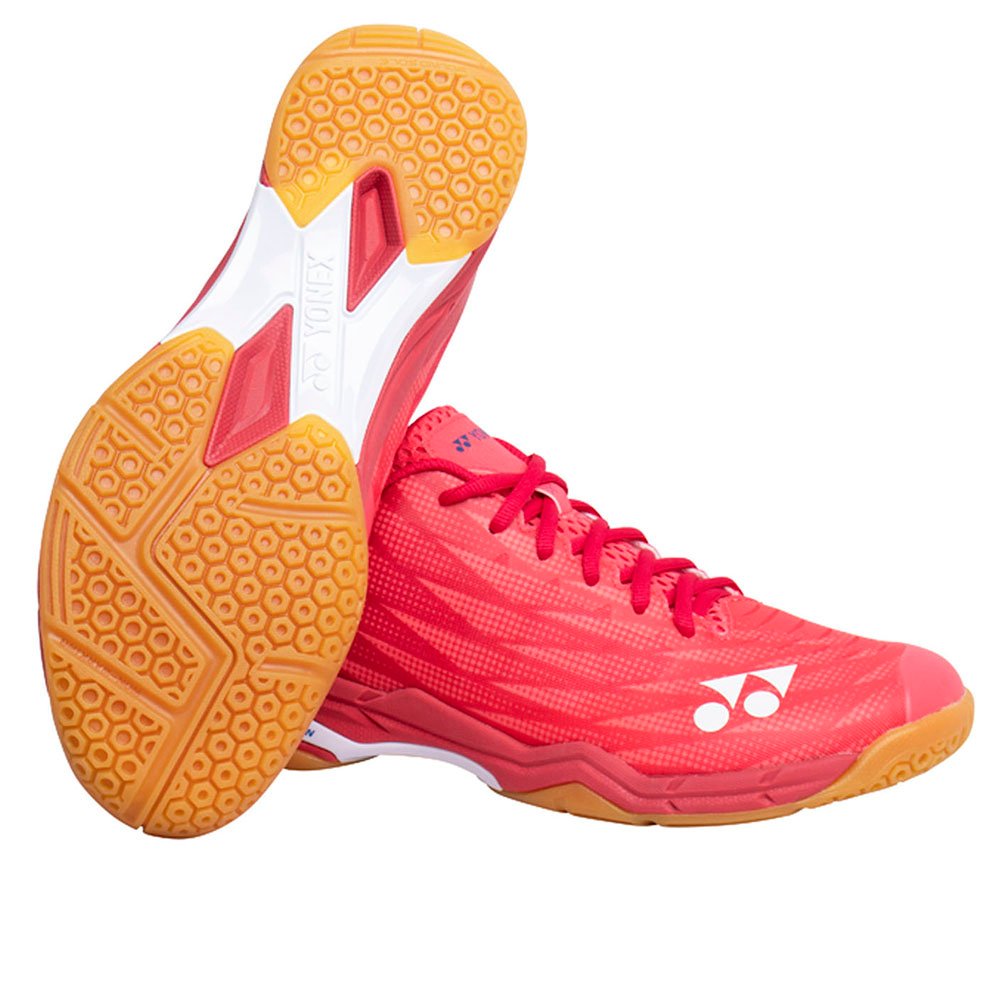
The mid-line Aerus at roughly 250 g (UK 8) — a retailer’s figure with its size basis, since Yonex publishes no weight for this model.
The Aerus X2 is the card that proves this guide’s labelling discipline. It is the mid-range model of Yonex’s Aerus speed series — retail copy positions it as “one of Yonex’s lightest badminton shoes” — and specialist retailers list it at approximately 250 g on a UK 8. That is a genuinely light figure on a stated size basis. But Yonex itself publishes no weight for the Aerus X2, so the card prints the figure exactly for what it is: a retailer’s figure, not the maker’s. The midsole is Yonex’s POWER CUSHION, and the upper is a breathable mesh build aimed at the speed player who wants the Aerus ride without the flagship Z-line’s construction.
Why card it at all, given the missing maker figure? Because the figure that exists is specific, sourced and sized — “approx. 250g (UK 8)” from two independent specialist retailers — and because it is a different model from both the Aerus Z and the pillar guide’s Aerus Z2, not a relabel of either. The honest boundary is drawn in the chips above: the outsole pattern is not detailed in the sources checked, so the card does not name one. Buy the Aerus X2 if you want a mid-line speed shoe at a featherweight figure — and read the weight as a retailer’s number, which is all it claims to be.
Pros
- ~250 g on a UK 8 — a genuinely light figure, labelled as a retailer’s figure with its basis
- The mid-range Aerus: the speed line’s ride without the flagship construction
- POWER CUSHION midsole with a breathable mesh upper
- A different model from the Aerus Z and Z2 — not a relabel, carded on its own figure
Cons
- Yonex publishes no weight — the 250 g figure is the retailer’s, on a stated size basis
- Outsole pattern not detailed in the sources checked — the card names none rather than guessing
- Mid-line build: maximum-structure players should compare the S99 Elite and Shadow Tour 5 cards
As an Amazon Associate we earn from qualifying purchases.

Mizuno Wave Claw 3
Mizuno’s speed build at 305 g maker-stated — ENERZY NXT cushioning, Dyna-Eyelet Wrap fit and an XG Rubber outsole, 10 g lighter than the Claw 2.
Mizuno’s own spec page for the Wave Claw 3 (style 71GA2443) states the weight as 305 g and positions the shoe as the brand’s lightweight badminton answer for speed and explosive play. The cushioning is the most layered recipe in this guide: MIZUNO ENERZY NXT in the forefoot — softer than the standard ENERZY with what the maker calls excellent energy return at a light weight — plus an ENERZY insole, over a U4icX and PoWnCe midsole and the traditional Foam Wave plate for stability and shock absorption on lateral movement and landings. The outsole is XG Rubber, Mizuno’s extra-grade compound for grip and durability in fast, intense movement. The fit is the Dyna-Eyelet Wrap, which Mizuno describes as enveloping the foot for stability in extended matches.
Two honesty notes. First, the maker states the 305 g figure but names no size basis for it — and Mizuno’s own regional pages are not perfectly consistent, with some listing around 315 g, so the card prints the 305 g spec-page figure and discloses the missing basis rather than smoothing it over. Second, the “10 grams lighter than the previous model” line is Mizuno’s own comparison against the Wave Claw 2 — a different model, and a modest but real generational saving. At 305 g this is the heaviest card here, but it is also the only one with a maker-stated weight in the low 300s from a brand whose stability shoes run heavier — our intermediate players guide owns the Wave Fang end of the Mizuno range. Buy the Wave Claw 3 if you want Mizuno’s most cushioned speed build with the energy-return recipe fully named.
Pros
- 305 g maker-stated — the lightest Mizuno figure verified for this guide
- ENERZY NXT forefoot with an ENERZY insole over U4icX and PoWnCe: the most layered cushioning here
- XG Rubber outsole — Mizuno’s extra-grade grip compound for fast, intense movement
- Dyna-Eyelet Wrap fit with a Foam Wave plate: wrap plus stability for lateral play
Cons
- Mizuno names no size basis for the 305 g figure, and regional pages vary around 315 g
- The heaviest card in the guide — buy it for the cushioning recipe, not the lowest figure
- A different model from the beginners guide’s Wave Claw NEO 3 — check the generation when ordering
As an Amazon Associate we earn from qualifying purchases.
Side-by-Side: The Six Lightest Verified Shoes at a Glance
Every weight below is exactly as its source states it — maker-stated with the size basis the maker names, or a labelled retailer’s figure where the maker publishes none. A dash in the basis column means the source stated no basis.
| Shoe | Cushioning (maker-named) | Outsole | Best for | Weight (as stated) |
|---|---|---|---|---|
| Yonex Power Cushion Aerus Z | POWER CUSHION+ / POWER CUSHION, Feather Bounce Foam | Radial Blade Sole, rubber | Best overall lightweight | 250 g, 26.0 cm (maker-stated) |
| Victor S99 Elite | NITROLITE + ENERGYMAX V + Carbon Power + Solid EVA | VSR Rubber | Best Victor featherweight | 250 g, 265 mm (maker-stated) |
| Li-Ning Mirage Pro | BOOM FIBER, Li-Ning Cloud + Boom materials | Non-marking gum rubber | Best Li-Ning featherweight | 265 g, basis not stated (maker-stated) |
| Babolat Shadow Tour 5 Men | Dual-density EVA | Michelin rubber | Best lightweight grip | 280 g, EU 42.5 (maker-stated) |
| Yonex Power Cushion Aerus X2 | POWER CUSHION | Not detailed in sources checked | Lightest mid-line speed | ~250 g, UK 8 (retailer’s figure) |
| Mizuno Wave Claw 3 | ENERZY NXT + ENERZY insole, U4icX + PoWnCe, Foam Wave | XG Rubber | Best Mizuno speed build | 305 g, basis not stated (maker-stated) |
Lightweight Buying Guide: Five Checks Before You Pay
1. Read every weight with its size basis — or ignore it. The table above is the whole method in one place: a gram figure is only comparable when the size it was measured on is named. 250 g at 26.0 cm (Aerus Z), 250 g at 265 mm (S99 Elite), 280 g at EU 42.5 (Shadow Tour 5) and ~250 g at UK 8 (Aerus X2, retailer’s figure) are four different statements. Any listing that prints a precise weight for one of these shoes without saying where the number came from — maker or retailer, and on what size — is asking you to compare rumours. The makers themselves publish fewer figures than the marketing suggests.
2. Buy the cushioning character, not the foam’s name. Light shoes protect you less by construction — that is the trade, and no foam name changes it. The plush end of this guide is the Mizuno card (ENERZY NXT over U4icX and PoWnCe) and the Victor card (NITROLITE with ENERGYMAX V); the firm, low end is the Yonex cards (POWER CUSHION family) and the Babolat card (dual-density EVA). If your sessions run long and your landings run hard, favour the plush end or step out of this guide entirely — our advanced players guide owns the structured, cushioned flagships. If your game is first-step speed and you land light, the firm end is yours.
3. Confirm the lockdown the way a third game will. Lightness multiplies movement — including unwanted movement. Lace the shoe fully and lunge, brake and recover hard before the return window closes: the heel should stay seated and the midfoot should feel wrapped, not swimming. The S99 Elite’s Carbon Power plate, the Shadow Tour 5’s Power Strap, the Wave Claw 3’s Dyna-Eyelet Wrap and the Aerus Z’s Power Graphite Drive are four different answers to this check — read them as engineering, not adjectives. A 250-gram shoe with weak lockdown is slower in practice than a 300-gram shoe that holds.
4. Match the outsole to your hall. All six cards are indoor court shoes, but the compounds differ: Radial Blade rubber (Yonex), VSR Rubber (Victor), gum rubber (Li-Ning), Michelin rubber (Babolat) and XG Rubber (Mizuno). Polished wood and PU courts reward the grip-first compounds; dusty halls punish every outsole equally and no compound fixes a dirty floor. None of these shoes is built for outdoor concrete — lightweight indoor soles wear fast on abrasive surfaces, and that is a materials fact, not a defect.
5. Check the model code, not just the model name. The lightweight end of every brand is crowded with lookalike names: the Aerus Z versus the pillar’s Aerus Z2 (SHBAZM versus SHBAZ2M), the Wave Claw 3 versus the beginners guide’s Wave Claw NEO 3, the Shadow Tour 5 Men versus the women’s guide’s Shadow Tour 5 Women, the S99 Elite versus the cushioning-flagship A970 NitroLite that shares its foam name. Listings mix these up constantly. Confirm the item code or SKU in the specifications before checkout — the weight figure you are buying belongs to a specific code, and the wrong code can weigh 100 grams more.
Frequently Asked Questions
What is considered a lightweight badminton shoe?
There is no official threshold, but the honest end of the category sits at roughly 250 to 305 grams per shoe — the range carded in this guide. Typical all-round badminton shoes run 300 to 360 grams, and the stability and cushioning flagships run 315 to 366 grams. A shoe at 340 grams is a fine shoe, but it is not a lightweight shoe, whatever the marketing says.
Why does every weight need a size basis?
Because shoe weight scales with size. A 250 g figure measured on a 26.0 cm shoe (the Yonex Aerus Z) and a 250 g figure measured on a 265 mm shoe (the Victor S99 Elite) are close but not identical measurements, and a figure with no stated size cannot be compared to either. This guide prints each weight with the basis its source states — and says “not stated” where the source states none — so you can compare like with like.
Are the lightest badminton shoes less supportive?
They are less structured by construction — every gram saved comes from thinner uppers, less midsole stack or lighter plates. But lightness and lockdown are separate engineering decisions: the S99 Elite’s Carbon Power plate, the Shadow Tour 5’s Power Strap, the Wave Claw 3’s Dyna-Eyelet Wrap and the Aerus Z’s Power Graphite Drive all exist to hold the foot in a light shoe. Read the support line on each card, not just the weight line.
What is the difference between the Yonex Aerus Z and the Aerus Z2?
They are different models and different generations: the Aerus Z (item code SHBAZM) is the previous generation, carded here at a maker-stated 250 g (26.0 cm) on a Feather Bounce Foam sole; the Aerus Z2 is the current generation, carded in our pillar best badminton shoes guide at 240 g on a Feather Light X sole. This guide does not re-card the pillar’s models, so it cards the Z — and the item codes are different, so check which one a listing is actually selling.
Do I need a gum rubber outsole for badminton?
Badminton is an indoor sport and all six shoes here are indoor court shoes with rubber outsoles built for hall floors — the Li-Ning Mirage Pro is explicitly listed with a non-marking gum rubber sole. The compounds differ by maker (VSR, Michelin, XG, Radial Blade), and each is built for grip on indoor surfaces. None of these outsoles is built for outdoor concrete, where lightweight indoor soles wear quickly.
Why are there only six shoes in this guide?
Because the brief for this guide allows accuracy over count. Every candidate was checked against maker or retailer listings at build time, and models that could not verify as genuinely light were dropped rather than padded in: the Yonex 65 Z3, Victor A970 NitroLite and P9200II, Mizuno Wave Fang 2, Li-Ning Saga II Pro and Blade Pro, and the adidas Crazyflight and Wucht P8.1 all failed the light test or had no verifiable figure. Six honest cards beat seven padded ones.
Can I wear these shoes for other indoor sports?
These are badminton shoes, carded and compared as badminton shoes — the outsoles, cushioning and lockdown here are specified for badminton movement: lunges, split steps and rapid direction changes. The indoor rubber compounds will grip on any clean hall floor, but a shoe specified for badminton is optimised for badminton’s movement patterns, not for volleyball jumps or squash’s different slide. Buy the shoe for the sport you play most.
The Verdict
If one shoe has to answer the lightweight question completely, it is the Yonex Power Cushion Aerus Z — 250 g at 26.0 cm in the maker’s own words, with the full stability recipe of Power Graphite Drive, Toe Assist Shape and a Radial Blade Sole intact. But the honest verdict in a weight guide is that the best shoe is the one whose figure you can trust and whose build matches your game. Victor loyalists get the S99 Elite — Victor’s lightest ever at 250 g (265 mm), with the NitroLite midsole and the Carbon Power plate doing the structural work. Li-Ning players get the Mirage Pro — 265 g maker-stated with BOOM FIBER and a genuine gum rubber sole. Grip-first buyers get the Babolat Shadow Tour 5 Men — 280 g (EU 42.5) with a Michelin outsole and Power Strap lockdown. Mid-line speed seekers get the Yonex Aerus X2 — roughly 250 g (UK 8) on a retailer’s figure, honestly labelled. And Mizuno players get the Wave Claw 3 — 305 g maker-stated with the most layered cushioning recipe here.
Still weighing the wider field? Our pillar comparison of the best badminton shoes covers the all-player flagships this guide deliberately avoids repeating — including the Aerus Z2, the current generation of our top pick — the women’s badminton shoes guide owns the women’s SKUs, beginners and intermediate players have their own guides, and the advanced players guide owns the structured, top-tier purchase. Buy the weight that is actually published — grams with a size basis, from the maker where one exists — and the shoe wall stops being a wall of adjectives and becomes six clear answers.
How we built this guide: every weight above comes from the maker’s own page or official product copy, or from a retailer listing that is labelled as a retailer’s figure with its size basis — each figure is attributed in the copy, and missing size bases are disclosed, not hidden. This guide cards six shoes, not seven: the brief allows accuracy over count, and the models checked and dropped at build time were the Yonex Power Cushion 65 Z3 (~340-360 g), Victor A970 NitroLite (~344-366 g), Victor P9200II (~333 g and up), Mizuno Wave Fang 2 (315 g), Li-Ning Saga II Pro (320 g), Li-Ning Blade Pro (320 g), adidas Crazyflight (volleyball shoe; vague retailer figure only) and adidas Wucht P8.1 (no published weight) — plus the Yonex Aerus Z2 (240 g), which is carded in our pillar guide and is not re-carded here. No model in this guide is re-carded from our pillar, women’s, beginners, intermediate or advanced guides. We do not publish prices, we make no durability or medical claims, and nothing here is presented as hands-on testing. Some links on this page are affiliate links: if you buy through them, AliShuttler may earn a commission at no additional cost to you. As an Amazon Associate we earn from qualifying purchases.