The senior player’s badminton shoe decision is a specifications decision. Badminton is played in lunges, split-steps and short recoveries on indoor courts, so the shoes that fit it are published with court-shoe construction — a low, stable platform, a gum-rubber outsole patterned for multidirectional grip, and lateral-support features for the lunging movement the makers describe — in the lightest stated weights, with named cushioning systems and, on six of the seven cards here, a wider fit published by the maker. This guide compares seven on exactly what their makers publish: stated weights with their size basis, fit and width options, cushioning by name, and outsole and stability features as the makers state them. No health claims, no promises: just the spec sheets, read properly.
⚡ TL;DR — The Short Answer
For the best all-round senior pick, buy the Mizuno Wave Claw EL 2 — 290 grams as Mizuno states it, in Mizuno’s wide Men’s-E fit, and the lightest model in the Wave Claw series per Mizuno. The lightest published weight of the guide belongs to the Babolat Shadow Tour 5 Men Wide at 280 grams in an EU 42.5, a true wide version of Babolat’s flagship. The Yonex Power Cushion 88 Dial Wide is the dial-closure pick, tightening by a single BOA dial on a wide last. The Victor P8500 TD is the wide support build, on Victor’s U-Shape 3.0 wide last. The Mizuno Wave Fang 2 is the stability platform pick at 315 grams stated, the Yonex Power Cushion Eclipsion Z3 Wide the stability flagship in a published wide version, and the Yonex Power Cushion Cascade Drive 2 the cushioned comfort pick in a standard last.
Quick Picks — Best Badminton Shoes for Seniors at a Glance
290 g as Mizuno states it, in the wide Men’s-E fit — the lightest model in the Wave Claw series, per Mizuno.
280 g in an EU 42.5 as Babolat states it, in a published Wide fit, with Power Straps and a Michelin outsole.
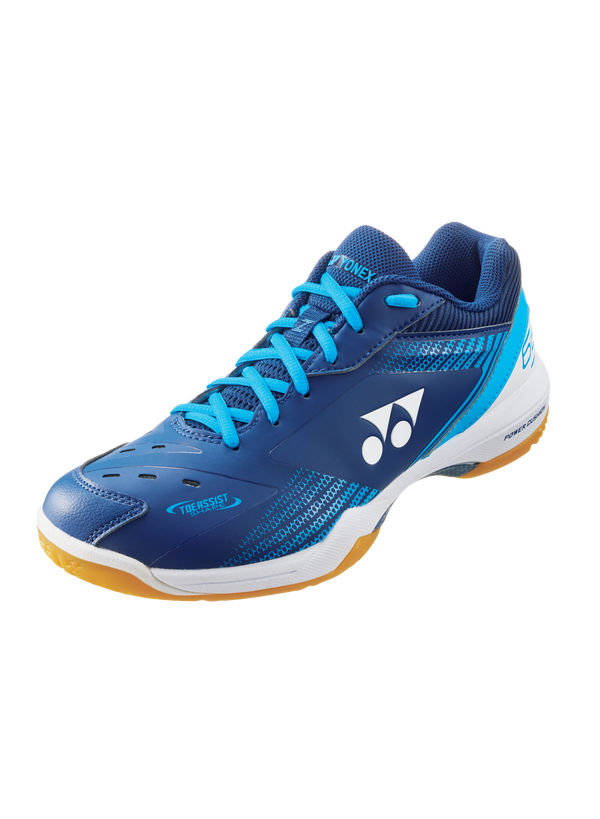
A single BOA dial on the instep and a wide last — fit adjusted in millimetres, with no laces to retie, per Yonex.
Victor’s Support series on the U-Shape 3.0 wide last, with LS-S forefoot reinforcement and a Carbon Power midsole, per Victor’s spec table.
315 g as Mizuno states it, in the wide Men’s-E fit — a full-length Foam Wave platform with an outrigger for flat, stable landings.
Yonex’s stability line in a published wide version, with a Lateral Shell and Power Graphite Sheet, per the model’s spec table.
POWER CUSHION under a Double Raschel Mesh upper with an inner bootie — the comfort build in a standard last, per Yonex’s spec table.
In This Guide
The Senior Decision: Indoor Court Shoes, As Makers Describe Them
Start with the surface, because every maker in this guide builds for the same one. Badminton is an indoor game played on wooden or synthetic court flooring, and its footwear is built accordingly: a gum-rubber outsole that grips a smooth court without marking it, a low platform that keeps the foot close to the floor through the lunge, and reinforcement on the side of the shoe where the lunging step loads it. A running shoe is built for the opposite brief — forward motion on outdoor surfaces, with the grip and the stack height to match. The seven cards below are all published as badminton court shoes by their makers, with the outsole compounds, lateral features and cushioning systems their spec sheets name. That published construction, not the colourway, is what makes a shoe a badminton shoe.
Weight is the second part of the senior decision, and it is a published number, not a feel. Badminton footwork is hundreds of short steps, lunges and recoveries rather than a handful of long strides, so the mass you lift on every step is the mass on the spec sheet. This guide prints every weight exactly as its maker states it, with the size basis attached — Babolat states the Shadow Tour 5 Men Wide at 280 grams in an EU 42.5; Mizuno states the Wave Claw EL 2 at 290 grams and the Wave Fang 2 at 315 grams. Where a maker publishes no weight — Yonex, for three cards here, and Victor, for one — the card says so plainly and prints no substitute figure. Compare like with like, and the cards sort honestly from 280 grams stated to the stability-built end of the guide.
Cushioning is the third part, and here the rule is strict: cushioning systems are reported by the names their makers give them — Mizuno’s MIZUNO ENERZY and PoWnCe, Yonex’s POWER CUSHION and POWER CUSHION+, Victor’s HYPEREVA and ENERGYMAX 3.0 — as construction descriptions, exactly as published. A named foam is a spec you can compare across listings; it is not a health claim, and this guide makes none. The same discipline applies to fit. Wider options are printed as the makers offer them: Mizuno’s Men’s-E wide fit, Babolat’s published Wide version, Yonex’s wide lasts on the 88 Dial Wide and the Eclipsion Z3 Wide, and Victor’s U-Shape 3.0 wide last. Six of the seven cards publish a wide route; the seventh — the Cascade Drive 2 — is carded in its standard last and says so.
One boundary before the picks. This page owns the senior fit, weight and cushioning decision only. The full all-player field belongs to our pillar guide to the best badminton shoes, and the women’s segment has its own guide to the best badminton shoes for women. None of their models is re-carded here. Building the rest of the senior kit? Our guide to the best badminton rackets for seniors owns the racket decision, our how to play badminton guide covers the footwork patterns these outsoles are patterned for, and the cross-sport seniors footwear lane continues in our guide to the best tennis shoes for seniors.
Reading the Spec Sheet: Weight, Widths and Gum-Rubber Grip
Weight first, with its size basis attached. A published weight is meaningless without the size it was weighed in, because the same model gains weight as the size rises. Read the cards the way the makers publish them: Babolat states 280 grams against an EU 42.5; Mizuno states its two figures against its own reference sizing for each model. Then read the honest gaps. Yonex publishes no weight for the 88 Dial Wide, the Eclipsion Z3 Wide or the Cascade Drive 2, and Victor publishes none for the P8500 TD — so those cards print the words “not published” instead of a borrowed number. One card goes further: retailer listings for the Eclipsion Z3 Wide carry weight figures that conflict with each other, so this guide prints none of them. A missing number you can see is worth more than a precise number nobody stands behind.
Widths are published in letters, names and lasts, and they are not interchangeable. Mizuno publishes its wide fit as Men’s-E — the E width in its own sizing system — and builds both of its cards here on it. Babolat publishes a separate Wide version of the Shadow Tour 5 Men, a distinct SKU from the standard shoe, and Yonex does the same with the 88 Dial Wide and the Eclipsion Z3 Wide: wide lasts sold as their own models. Victor publishes width through its last system — the P8500 TD is built on the U-Shape 3.0, the wide last in Victor’s published last range. Four published answers to the same question, and one card — the Cascade Drive 2 — that publishes no wide route at all. If width is your first filter, six cards pass it; the buying guide below maps them to how you play.
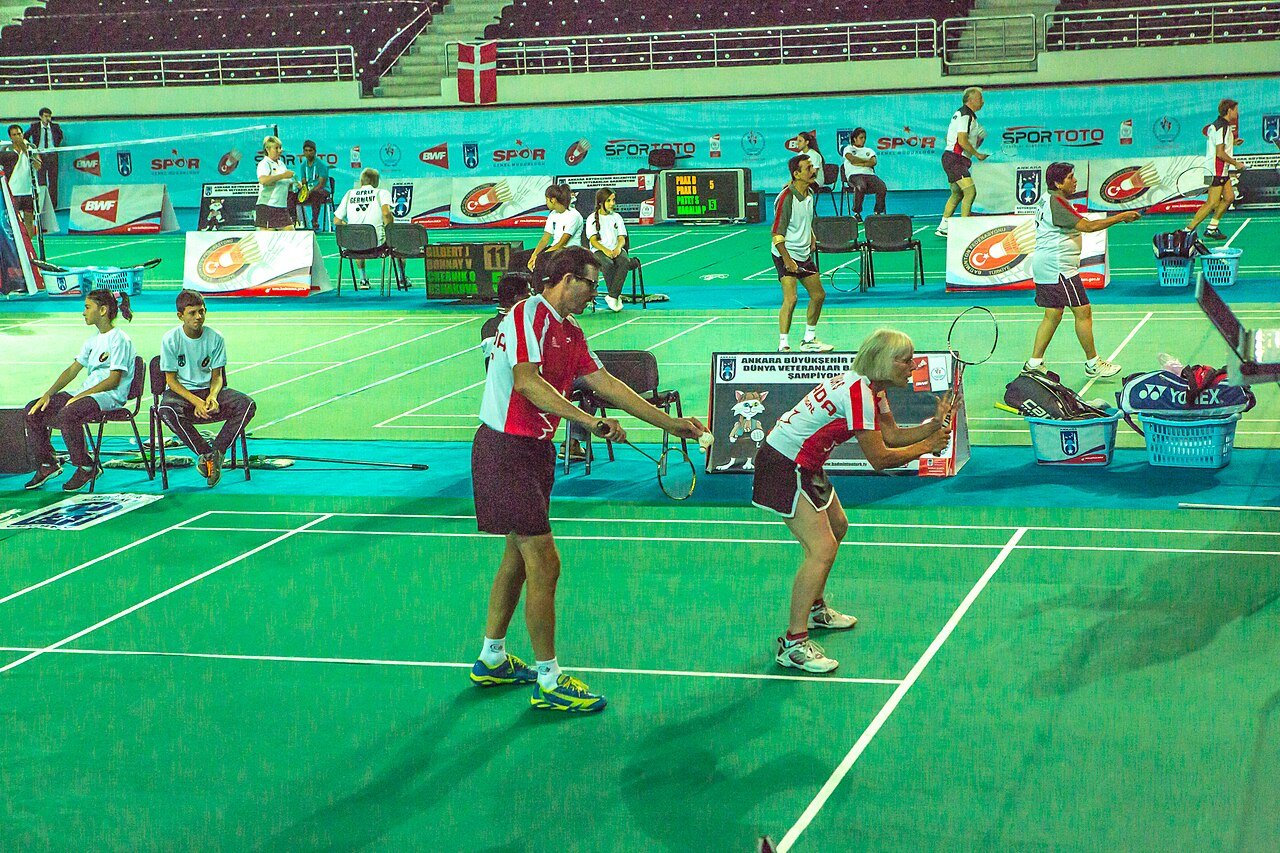
The outsole is a court spec, and the makers state it. Indoor badminton outsoles are gum rubber: soft enough to grip a polished court floor, light in colour so they do not mark it, and patterned for movement in every direction rather than straight lines. Mizuno publishes its XG Rubber compound on both of its cards here. Yonex publishes its Radial Blade Sole on the Eclipsion Z3 Wide and the Cascade Drive 2 — a blade pattern Yonex describes as built for grip in vertical, horizontal and diagonal movement. Victor publishes its VSR Rubber on the P8500 TD, and Babolat fits a Michelin rubber outsole to the Shadow Tour 5 Men Wide. Different compounds, one shared brief, all of it printed on the listings rather than assumed — and all of it indoor-court equipment, not something to wear on outdoor concrete.
The 7 Best Badminton Shoes for Seniors, Compared
Seven court shoes, one shared brief — built for indoor courts as their makers describe them, light as their makers state it, and fitted with the wider options their makers offer. Read the card that matches your feet and your game first.
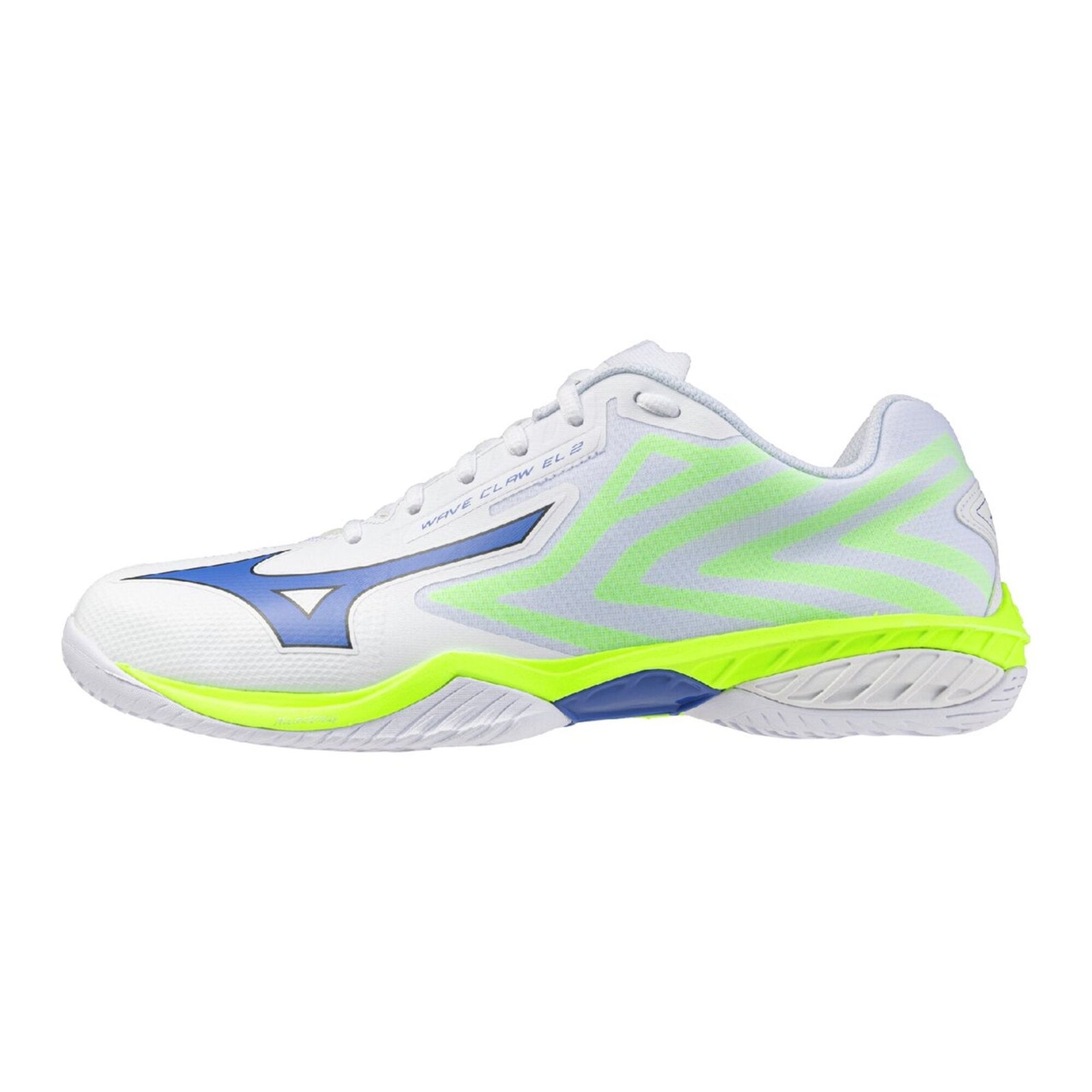
Mizuno Wave Claw EL 2
The complete senior specification in the lightest Wave Claw Mizuno publishes — 290 grams stated, in the wide Men’s-E fit, with the full Mizuno technology stack.
The Wave Claw EL 2 leads this guide because it is the one card where every senior filter is answered on the maker’s own spec sheet at once. The weight first, as Mizuno states it: 290 grams — and Mizuno positions this model as the lightest in the Wave Claw series, its long-running badminton line. The fit is Mizuno’s Men’s-E, the wide width in Mizuno’s published sizing, in a unisex model — so the lightest shoe in the series is also sold in the wide fit, rather than the wide fit being reserved for a heavier shoe. For a senior player whose first two questions are “how light?” and “does it come wide?”, this is the only card that answers both from the top of the range.
The construction underneath is Mizuno’s full badminton stack, as Mizuno publishes it. The midsole pairs the MIZUNO WAVE plate with MIZUNO ENERZY (FOAM) and a PoWnCe core — Mizuno’s named cushioning materials, listed as the model’s cushioning system. The outsole is Mizuno’s XG Rubber, its badminton grip compound, with a D-Flex Groove in the forefoot that Mizuno describes as following the foot’s flexing through the step. An MB-HOLD FIT structure holds the midfoot, per Mizuno’s listing, and the insole board is Mizuno’s U4icX. Nothing on this card needs inference: weight, width, cushioning names and outsole compound are all printed by the maker. That completeness is why it leads.
What we like
- 290 g as Mizuno states it — light, and the lightest in the Wave Claw series per Mizuno
- Published wide fit: Men’s-E, in a unisex model
- The full Mizuno stack on one card: WAVE plate, ENERZY foam, PoWnCe, XG Rubber
- Every key spec is maker-published — nothing on the card is inferred
Worth knowing
- The Men’s-E fit is Mizuno’s wide route, not a multi-width ladder — one wide option, not three
- An indoor-court outsole, as Mizuno publishes it — not an outdoor shoe
As an Amazon Associate we earn from qualifying purchases.
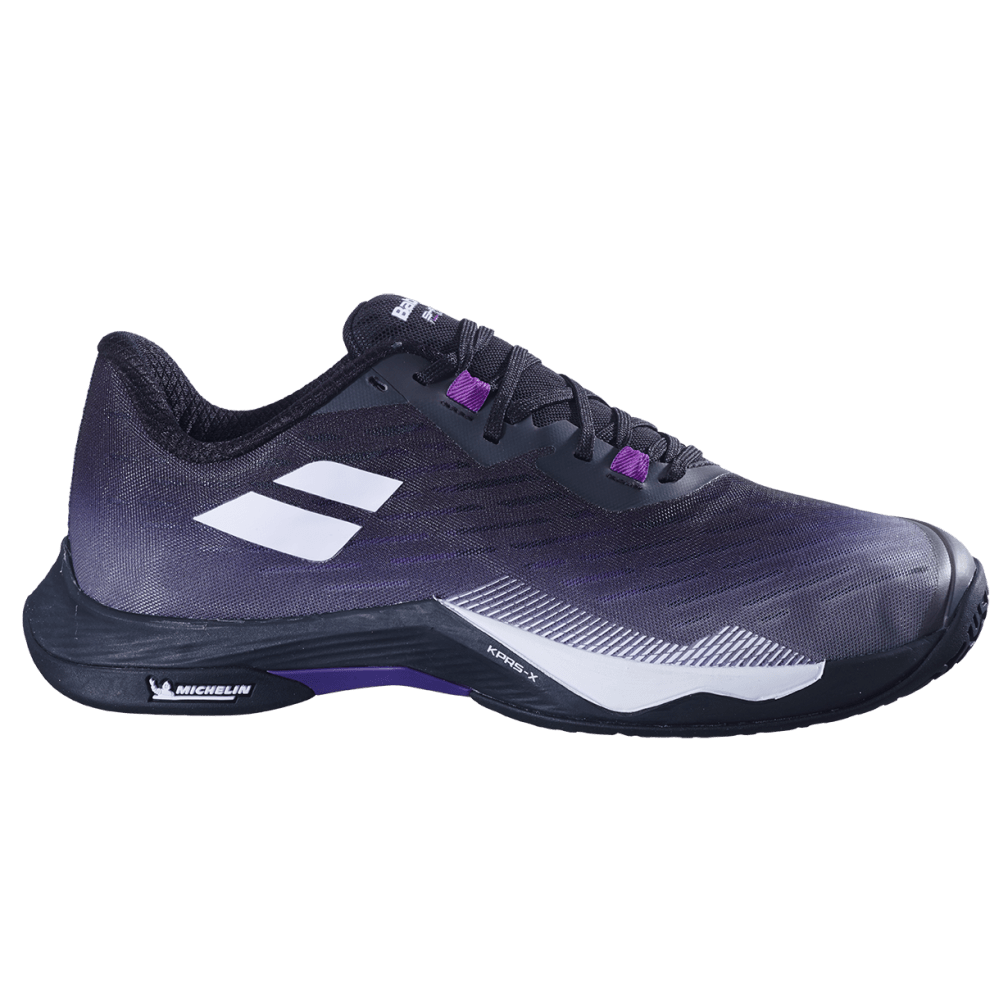
Babolat Shadow Tour 5 Men Wide
The lightest published weight in the guide — 280 grams in an EU 42.5 as Babolat states it, in a true Wide version of Babolat’s flagship badminton shoe.
This card is a deliberate, disclosed near-neighbour: the women’s guide cards the Shadow Tour 5 Women, and this is the Shadow Tour 5 Men Wide — a distinct men’s model that Babolat publishes in its own right, on its own product page, as the Wide version of its flagship badminton shoe. It earns its place on the numbers Babolat states: 280 grams in an EU 42.5, the lightest published weight in this guide, in a shoe sold specifically in the wide fit. A flagship’s wide version that is also the lightest card here is a rare combination, and it is entirely the maker’s own specification.
The published construction is Babolat’s performance package. Power Straps cross the midfoot for the lateral hold Babolat describes, over a double-layer mesh upper. The midsole is dual-density with a rocker shape, per Babolat — two foam densities in one sole unit, shaped to roll the step forward. The outsole is Michelin rubber: Babolat’s long-standing partnership puts the tyre maker’s compound under its court shoes, published on the listing as the grip and durability layer for indoor courts. Judge it against the Mizuno at #1 and the choice is character — Mizuno’s plate-and-foam stack in an E fit, against Babolat’s strap-held flagship in a published Wide, ten grams lighter on the stated figures.
What we like
- 280 g in an EU 42.5 as Babolat states it — the lightest published weight here
- A true Wide version published by Babolat, not a roomy standard shoe
- Power Straps and a Michelin rubber outsole — named components throughout
- Dual-density midsole with a rocker shape, per Babolat’s listing
Worth knowing
- The wide route is this Wide version only — Babolat publishes no width ladder for the model
- The women’s version of this shoe is carded in our women’s guide; this card is the men’s Wide SKU
As an Amazon Associate we earn from qualifying purchases.
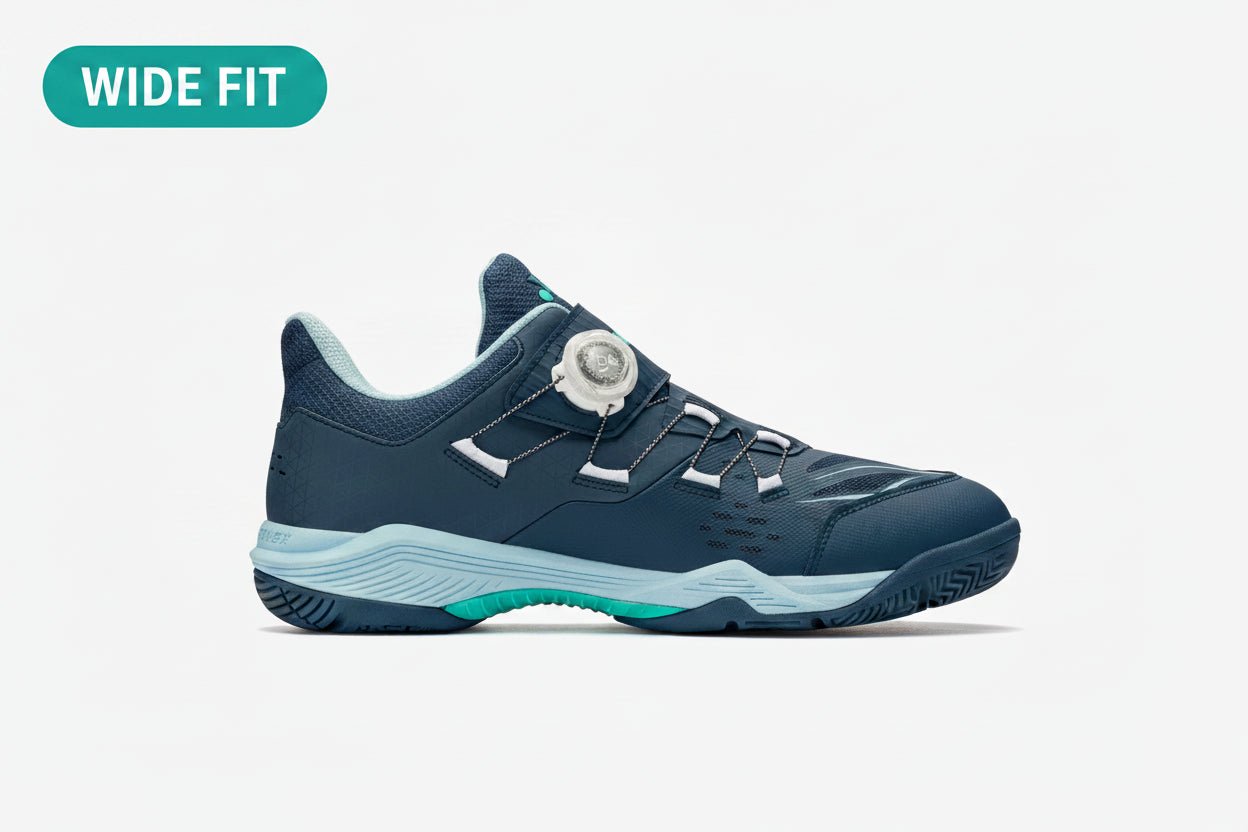
Yonex Power Cushion 88 Dial Wide
The dial-closure pick — a single BOA dial on the instep and a wide last, from the third generation of Yonex’s 88 Dial line, released in 2024.
Some shoe decisions are about the closure, and this is the only card in the guide built around one. The 88 Dial is Yonex’s dial-closure badminton line, and the current model is its third generation, released in 2024 per Yonex’s own announcement. The system is a single BOA dial placed on the instep — Yonex’s published design tightens the shoe in millimetre increments with one hand, and the dial’s placement keeps it clear of the crossing step. This card is the Wide version, the SHB88D3W, built on a wide last: the dial system and the wide fit in the same shoe, which is precisely the combination a senior player who wants easy, exact adjustment shops for. No laces to work loose mid-session and none to retie between games — the adjustment is a turn of the dial, as Yonex publishes it.
The rest of the spec sheet is Yonex’s all-round package, per the model’s published listings. POWER CUSHION+ is the named cushioning, with Feather Bounce Foam in the midsole build on the Wide version’s spec table. A Power Graphite Lite sheet under the foot is Yonex’s published stability layer, the upper is Durable Skin Light over an inner bootie construction, and the Synchro-Fit Insole and Toe Assist Shape complete the fit package. The honest gap is the weight: Yonex publishes no weight for this model, and this card prints none rather than borrowing a figure from an earlier generation of the shoe. Buy it for the closure and the wide last — the two things its spec sheet genuinely leads with.
What we like
- The only dial closure in the guide — one-handed, millimetre adjustment per Yonex
- A published Wide version (SHB88D3W) on a wide last, not just a standard shoe
- POWER CUSHION+, Power Graphite Lite and an inner bootie — Yonex’s full fit package
- Third-generation model, released 2024 per Yonex — current, not old stock
Worth knowing
- Yonex publishes no weight for this model — the card prints none
- The dial is a different ownership proposition from laces — check the listing’s closure details before you buy
As an Amazon Associate we earn from qualifying purchases.
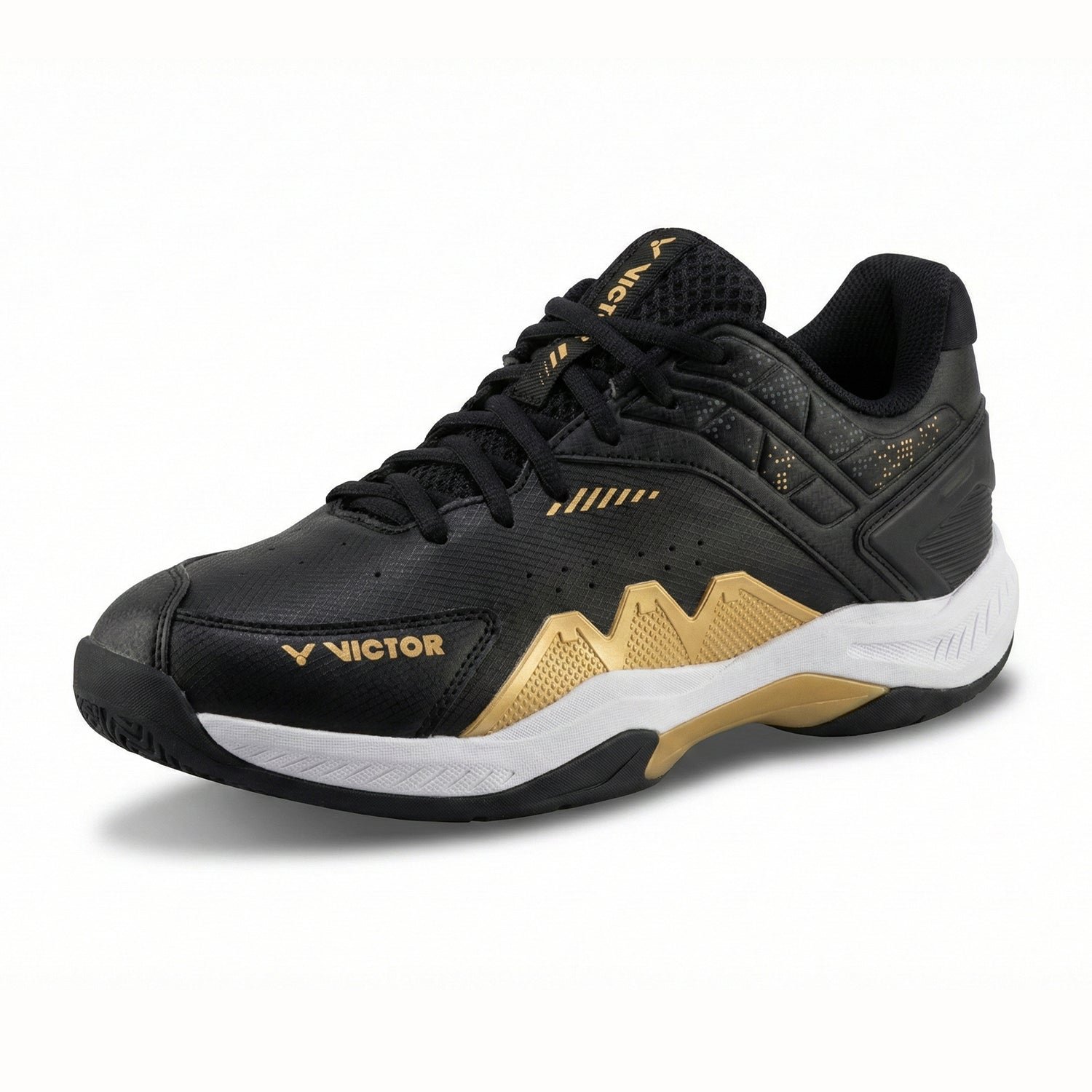
Victor P8500 TD
The wide support build — Victor’s Support series on the U-Shape 3.0 wide last, with LS-S forefoot reinforcement and a Carbon Power midsole layer.
Victor organises its badminton shoes into published series, and the P8500 TD sits in the Support series — the line Victor positions for lateral stability and structure. What makes this the senior card is the last: the model is built on Victor’s U-Shape 3.0, the wide last in Victor’s published last system, so the support build comes in the wide fit rather than the wide fit costing you the support build. The model’s published spec table (carried by Victor’s retailers) lists a unisex shoe with a microfiber PU leather, V-Tough and double mesh upper — a structured upper, in Victor’s materials, over the wide last.
The midsole stack is the fullest published list in this guide: HYPEREVA and ENERGYMAX 3.0 — Victor’s named cushioning materials — with Carbon Power and Solid EVA in the same unit, per the spec table. The lateral package is equally explicit: LS-S, which Victor describes as a high-strength TPU application on the outer forefoot, a 3D Tri-Claw design on the side of the shoe, and a TPU ASYS element in the midsole. The outsole is Victor’s VSR Rubber, which Victor’s published technology notes rate for grip on dry PU court floors. As with the Yonex cards, Victor publishes no weight for this model, and none is printed: this is the card you buy for the last and the support hardware, with the spec table as the whole argument.
What we like
- A published wide last — U-Shape 3.0 — under Victor’s Support-series build
- The fullest named midsole stack here: HYPEREVA, ENERGYMAX 3.0, Carbon Power, Solid EVA
- LS-S forefoot reinforcement and a 3D Tri-Claw, named on the spec table
- A structured microfiber PU and V-Tough upper, per Victor’s published materials
Worth knowing
- Victor publishes no weight for this model — the card prints none
- The structured upper is a firmer brief than the mesh-first cards — a feel preference, decided by the spec
As an Amazon Associate we earn from qualifying purchases.
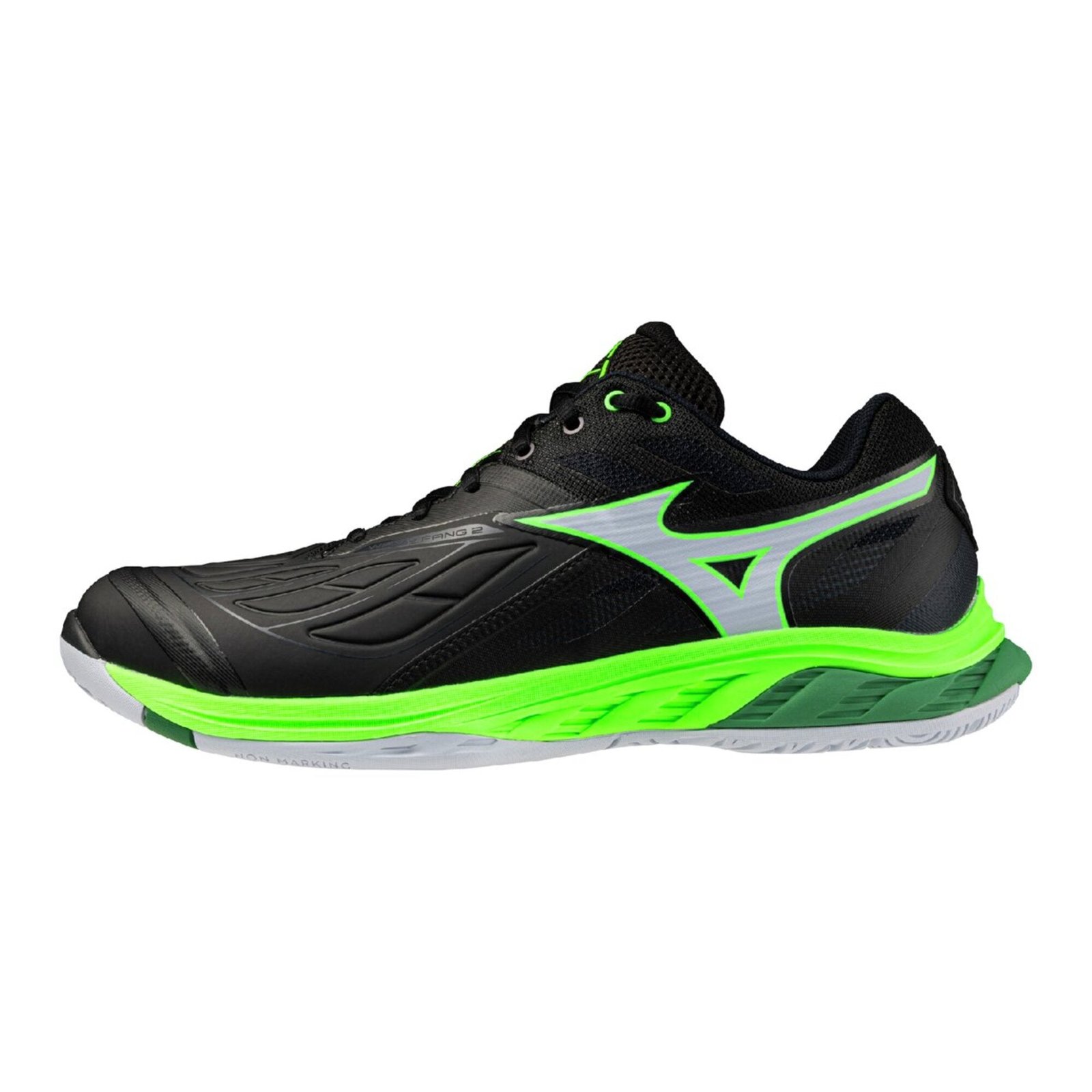
Mizuno Wave Fang 2
The stability platform pick — 315 grams as Mizuno states it, in the wide Men’s-E fit, on a full-length Foam Wave sole with an outrigger.
The second Mizuno card is a different shoe from the first, not a variation of it. Where the Wave Claw EL 2 is built around Mizuno’s Wave plate, the Wave Fang 2 is built around the Foam Wave — a full-length foam platform with no plate in it, which Mizuno publishes as this model’s stability construction. Mizuno describes the sole as flat, with an outrigger on the lateral side: a wide, level base with the edge extended where the lunging step loads it. The stated weight is 315 grams, per Mizuno — twenty-five grams above the EL 2’s figure, spent on the platform rather than the plate. The fit is the same published Men’s-E wide as the #1 card, so the choice between the two Mizunos is purely about the platform you want underfoot.
The cushioning names are Mizuno’s current generation: MIZUNO ENERZY CORE in the forefoot, an MIZUNO ENERZY Insole above it, and PoWnCe in the midsole build, all as Mizuno lists them. The outsole is the same XG Rubber badminton compound as the EL 2, and the upper works through Mizuno’s Dynamotion Fit construction, Mizuno’s published fit system for court movement. Read the two Mizuno cards together and the guide’s logic is plain: the EL 2 is the light, plated shoe; the Fang 2 is the flat, wide-based platform shoe. Senior players who prefer the feel of a level sole with the edge built out will find this card’s spec sheet is the one written for them.
What we like
- A flat Foam Wave platform with an outrigger — a published stability construction, per Mizuno
- 315 g as Mizuno states it, in the wide Men’s-E fit
- ENERZY CORE in the forefoot plus an ENERZY insole — Mizuno’s current cushioning names
- XG Rubber outsole, shared with the #1 card — the same court grip compound
Worth knowing
- 25 g above the EL 2 on Mizuno’s stated figures — the platform costs a little weight
- No Wave Plate in this model — players who want the plated ride should take the EL 2
As an Amazon Associate we earn from qualifying purchases.
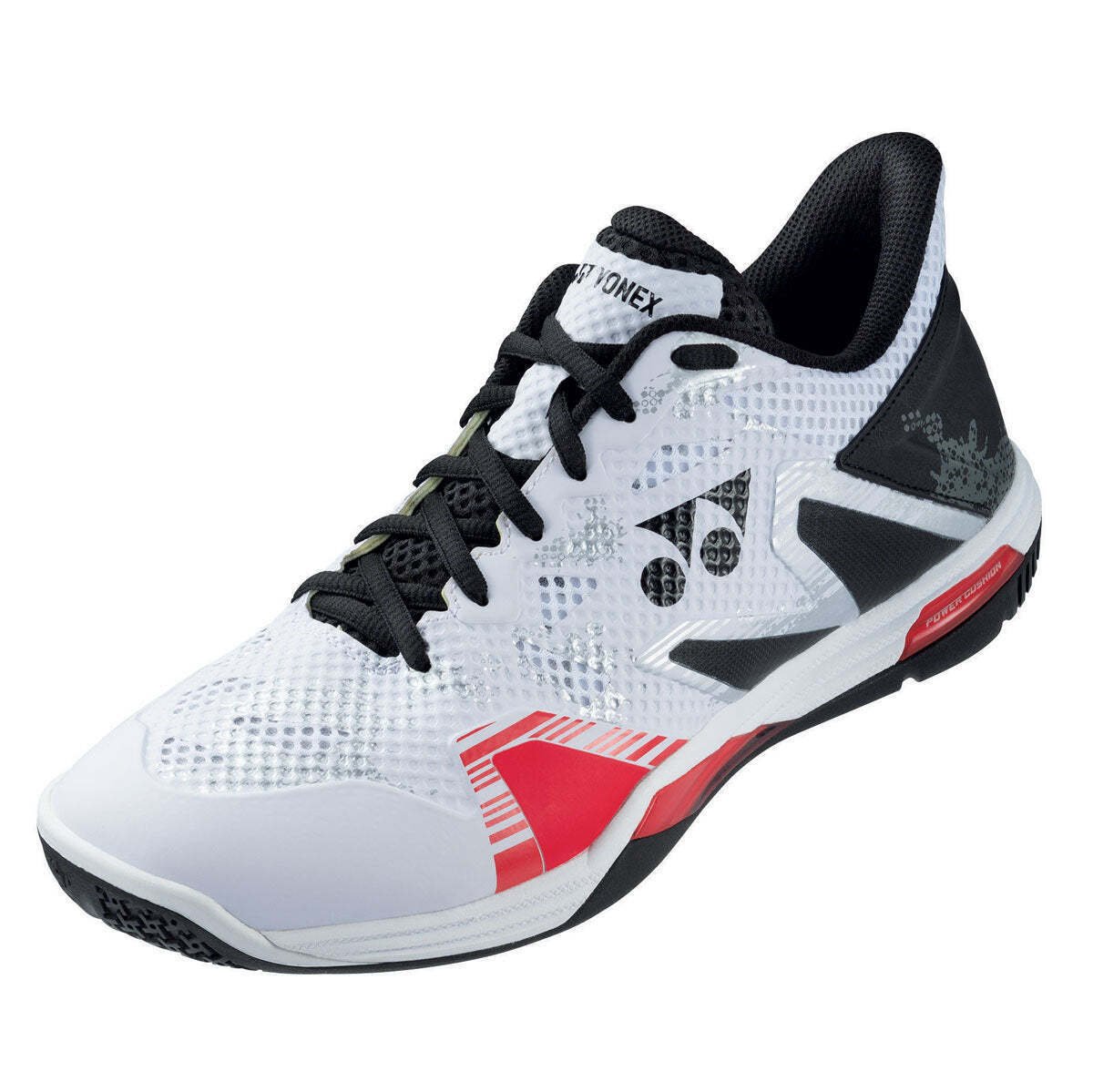
Yonex Power Cushion Eclipsion Z3 Wide
The stability flagship in a wide version — Yonex’s Eclipsion line, with a Lateral Shell, a Power Graphite Sheet and a Semi One-Piece Sole, per the model’s spec table.
The Eclipsion is Yonex’s stability line — the range Yonex builds around lateral support rather than outright lightness — and this card is its published Wide version, the Eclipsion Z3 Wide. The model’s spec table, carried by Yonex’s authorised retailers, reads like a stability checklist: a Lateral Shell reinforcing the outside of the forefoot, a Power Graphite Sheet under the midfoot, and a Semi One-Piece Sole joining the toe and heel rubber into a single piece. For the senior player whose game is built on hard lunging steps and who shops stability first, this is the flagship expression of that brief in this guide — and it comes in the wide fit, which stability flagships do not always offer.
The cushioning stack is Yonex’s deepest published list here: POWER CUSHION+ and POWER CUSHION together, with Feather Bounce Foam in the build, under an upper of Durable Skin Light and Double Raschel Mesh. The outsole is Yonex’s Radial Blade Sole. Now the weight note this guide owes you: Yonex publishes no weight for this model, and retailer listings carry figures that conflict with each other — so this card prints no weight at all rather than choosing one. Every other figure and feature on the card is from the model’s own spec table. Buy the Eclipsion Z3 Wide for the lateral hardware and the wide last; the scale is the one question its listings do not answer consistently.
What we like
- Yonex’s stability flagship in a published wide version
- Lateral Shell, Power Graphite Sheet and Semi One-Piece Sole — named stability hardware
- POWER CUSHION+ and POWER CUSHION with Feather Bounce Foam, per the spec table
- Durable Skin Light over Double Raschel Mesh — structure with ventilation
Worth knowing
- No weight is printed: Yonex publishes none and retailer figures conflict — the card explains why
- The stability build is the firmest brief in the guide — a deliberate trade against the lighter cards
As an Amazon Associate we earn from qualifying purchases.
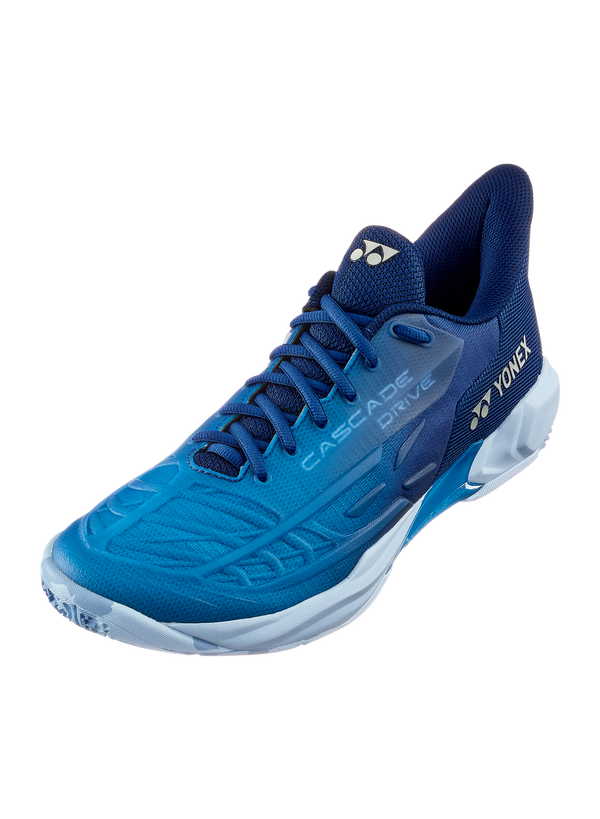
Yonex Power Cushion Cascade Drive 2
The cushioned comfort pick — POWER CUSHION under a breathable Double Raschel Mesh upper with an inner bootie, in Yonex’s standard last.
The Cascade Drive 2 is the comfort end of Yonex’s badminton range, and it is carded here as the deliberate counterweight to six wide-fit cards: this one is a standard last, published with no wide version, and the card says so at the top of its spec list. What it offers instead is Yonex’s comfort construction. The cushioning is POWER CUSHION, Yonex’s long-running named cushioning material. The upper pairs Double Raschel Mesh — Yonex’s open, breathable mesh — with Durable Skin reinforcement, and the fit is finished with an inner bootie and Yonex’s Toe Assist Shape at the forefoot, all per the model’s published spec table.
Underfoot, the outsole combines the Radial Blade Sole with Yonex’s Round Sole — the rounded edge profile Yonex publishes for smooth transitions between steps. The published size range runs from 22.0 cm to 31.0 cm on the model’s listings, one of the widest size runs in this guide, covering smaller and larger feet that the wide-fit cards’ ranges may not reach. And the standing honesty note: Yonex publishes no weight for the Cascade Drive 2, so none is printed. If your feet are a standard width and your priority is the cushioned, breathable build rather than a wide last, this is your card — and if width is your priority, the six cards above it are the honest route.
What we like
- POWER CUSHION with a Double Raschel Mesh upper — Yonex’s comfort build, per its spec table
- Inner bootie and Toe Assist Shape — a finished, sock-like fit construction
- Radial Blade Sole with Round Sole — Yonex’s grip and transition pairing
- A published size run from 22.0 cm to 31.0 cm — the broadest in the guide
Worth knowing
- Standard last only — no wide version is published for this model
- Yonex publishes no weight for this model — the card prints none
As an Amazon Associate we earn from qualifying purchases.
Side-by-Side Comparison Table
Every figure below is printed as its maker or the model’s published spec table states it. “Not published” is a finding, not a gap in our research — it is what the listings say.
| Shoe | Award | Published Weight | Fit / Widths | Cushioning (Maker-Named) | Outsole |
|---|---|---|---|---|---|
| Mizuno Wave Claw EL 2 | Best Overall | 290 g (Mizuno) | Men’s-E (Wide), unisex | MIZUNO ENERZY (FOAM) + PoWnCe, WAVE plate | XG Rubber |
| Babolat Shadow Tour 5 Men Wide | Lightest Published Weight | 280 g, EU 42.5 (Babolat) | Wide — published Wide version | Dual-density midsole, rocker shape | Michelin rubber |
| Yonex Power Cushion 88 Dial Wide | Best Dial Closure | Not published by Yonex | Wide last (SHB88D3W), BOA dial | POWER CUSHION+ + Feather Bounce Foam | Rubber sole (Yonex) |
| Victor P8500 TD | Best Wide Support Build | Not published by Victor | U-Shape 3.0 — wide fit | HYPEREVA + ENERGYMAX 3.0 + Carbon Power | VSR Rubber |
| Mizuno Wave Fang 2 | Best Stability Platform | 315 g (Mizuno) | Men’s-E (Wide) | ENERZY CORE + PoWnCe, Foam Wave platform | XG Rubber |
| Yonex Power Cushion Eclipsion Z3 Wide | Best Stability Flagship | Not printed — listings conflict | Wide — published Wide version | POWER CUSHION+ + POWER CUSHION + Feather Bounce Foam | Radial Blade Sole |
| Yonex Power Cushion Cascade Drive 2 | Best Cushioned Comfort | Not published by Yonex | Standard last, inner bootie | POWER CUSHION | Radial Blade Sole · Round Sole |
Buying Guide: Matching the Spec Sheet to Your Game
1. Start with the fit — and shop published widths, not hopeful ones
Six of the seven cards publish a wide route, in four different systems: Mizuno’s Men’s-E fit on the Wave Claw EL 2 and Wave Fang 2, Babolat’s Wide version of the Shadow Tour 5 Men, Yonex’s wide lasts on the 88 Dial Wide and Eclipsion Z3 Wide, and Victor’s U-Shape 3.0 last on the P8500 TD. Order the wide version by name where one exists — a published wide last is a different shoe from a standard shoe worn loose. The one standard-last card, the Cascade Drive 2, is carded for standard-width feet and says so.
2. Read every weight with its size basis — and respect the unpublished ones
The three published figures — 280 grams (Babolat, EU 42.5), 290 grams and 315 grams (Mizuno) — are only comparable with their size basis attached. The other four cards publish no maker weight, and the Eclipsion Z3 Wide’s retailer figures conflict, so none is printed. If weight is your deciding factor, decide it between the cards whose makers state one; if fit or stability hardware decides it, the unpublished weight is a known unknown, printed as such, rather than a number invented to fill the table.
3. Choose your closure: laces, or the dial
Six cards lace up conventionally. One — the Yonex 88 Dial Wide — replaces the laces with a single BOA dial on the instep that Yonex publishes as tightening in millimetre increments with one hand, on a wide last. If retying and re-tensioning laces between games is the friction in your sessions, the dial card is the published answer; if you prefer the familiar lace-by-lace adjustment, every other card keeps it.
4. Match the stability hardware to how you move
The makers publish their lateral systems by name, and they cluster into three builds. Plate and sheet builds: the Wave Claw EL 2’s WAVE plate and the Eclipsion Z3 Wide’s Power Graphite Sheet with its Lateral Shell. Platform builds: the Wave Fang 2’s flat Foam Wave sole with an outrigger. Reinforcement builds: the P8500 TD’s LS-S forefoot TPU and 3D Tri-Claw, and the Shadow Tour 5 Men Wide’s Power Straps. Heavy lunging players shopping structure first should start with the Eclipsion Z3 Wide and the P8500 TD cards; players shopping lightness first start at the top of the guide.
5. Keep the outsole on its court — and replace on the tread
Every outsole here is an indoor gum-rubber court compound — Mizuno’s XG Rubber, Victor’s VSR Rubber, Yonex’s Radial Blade Sole, Babolat’s Michelin rubber — published for indoor court floors and not for outdoor concrete, which wears a soft court compound quickly. Wipe the soles before sessions to keep the grip the makers publish, play them indoors, and replace the shoe when the outsole pattern smooths out: the grip is the tread, and the tread is a wear item on every card in this guide.
Frequently Asked Questions
What should senior players look for in a badminton shoe?
Shop the published specification, in this order. First, construction: a badminton court shoe, with a gum-rubber indoor outsole and the lateral features the makers publish for the lunging movement. Second, fit: six of the seven shoes in this guide publish a wide route — Mizuno’s Men’s-E fit, Babolat’s Wide version, Yonex’s wide lasts or Victor’s U-Shape 3.0 last. Third, weight, read with its size basis: the published figures here run from 280 grams (Babolat, EU 42.5) to 315 grams (Mizuno). Fourth, cushioning by name — POWER CUSHION, MIZUNO ENERZY, HYPEREVA — compared as the construction descriptions the makers publish, which is all this guide claims for them.
Which of these badminton shoes come in a published wide fit?
Six of the seven. The Mizuno Wave Claw EL 2 and Wave Fang 2 are published in Mizuno’s Men’s-E wide fit. The Babolat Shadow Tour 5 Men Wide is a published Wide version of Babolat’s flagship. The Yonex Power Cushion 88 Dial Wide (SHB88D3W) and the Yonex Power Cushion Eclipsion Z3 Wide are built on wide lasts and sold as their own models. The Victor P8500 TD is built on Victor’s U-Shape 3.0, the wide last in its published last system. The one standard-last card is the Yonex Power Cushion Cascade Drive 2, which publishes no wide version — the card says so.
How much do the shoes in this guide weigh?
Three makers publish figures, and the guide prints them with their basis: the Babolat Shadow Tour 5 Men Wide at 280 grams in an EU 42.5 as Babolat states it, the Mizuno Wave Claw EL 2 at 290 grams and the Mizuno Wave Fang 2 at 315 grams as Mizuno states them. Yonex publishes no weight for the 88 Dial Wide or the Cascade Drive 2, and Victor publishes none for the P8500 TD, so those cards print “not published” instead of a substitute figure. Retailer listings for the Eclipsion Z3 Wide carry conflicting weights, so this guide prints none of them — a visible gap is more honest than a borrowed number.
Why does the Yonex 88 Dial Wide use a dial instead of laces?
Because the model is built around the closure. The 88 Dial is Yonex’s dial-closure badminton line, now in its third generation, released in 2024 per Yonex. Its BOA Fit System uses a single dial placed on the instep — positioned, per Yonex, to keep clear of the crossing step — that tightens the shoe in millimetre increments with one hand. There are no laces to work loose during a session and none to retie between games; the adjustment is a turn of the dial. This guide cards the Wide version, the SHB88D3W, which pairs that closure with a wide last, POWER CUSHION+ cushioning and a Power Graphite Lite stability sheet.
Can I play badminton in running shoes or general trainers?
The makers’ published construction says no, and the difference is the brief each shoe is built to. A running shoe is built for forward motion on outdoor surfaces, with a curved sole that rolls from heel to toe. A badminton shoe is built for indoor courts and lateral movement: a gum-rubber outsole that grips a smooth court floor without marking it, a low and stable platform, and published lateral features — a Lateral Shell, an outrigger, forefoot reinforcement — for the lunging step. Every card in this guide is published by its maker as a badminton court shoe with those features named on its spec sheet. Our how to play badminton guide covers the footwork patterns the outsoles are patterned for.
Mizuno Wave Claw EL 2 or Wave Fang 2 — which one suits me?
They are different platforms in the same wide Men’s-E fit, not two trims of one shoe. The Wave Claw EL 2 is built around Mizuno’s WAVE plate with MIZUNO ENERZY foam and PoWnCe, and Mizuno states it at 290 grams — the lightest model in the Wave Claw series, and this guide’s best overall pick. The Wave Fang 2 replaces the plate with a full-length Foam Wave platform that Mizuno describes as flat, with an outrigger on the lateral side, and states it at 315 grams. Choose the EL 2 for the lighter, plated build; choose the Fang 2 for the flat, wide-based platform feel. Both use Mizuno’s XG Rubber outsole.
How is this guide different from the all-player best badminton shoes guide?
The all-player guide owns the full selection — the performance badminton shoes ranked for every level of player. This guide narrows the same sport to one decision: the court shoes makers publish with the specification senior players shop for — stated weights with their size basis, wider fits as the makers offer them, named cushioning systems, and lateral-support features as the makers describe them. No shoe from the all-player or women’s guides is re-ranked here; read those for their segments, and this page for the senior specification.
The Verdict
Buy the specification, not the story. The Mizuno Wave Claw EL 2 is the complete senior answer — 290 grams as Mizuno states it, a published Men’s-E wide fit, and the lightest build in its series. The Babolat Shadow Tour 5 Men Wide owns the lightest published figure, 280 grams in an EU 42.5, in a true wide flagship. The Yonex Power Cushion 88 Dial Wide owns the closure — one dial, one hand, a wide last. The Victor P8500 TD owns the wide support build, the Mizuno Wave Fang 2 the flat stability platform, the Yonex Power Cushion Eclipsion Z3 Wide the stability flagship in wide, and the Yonex Power Cushion Cascade Drive 2 the cushioned comfort build for standard-width feet. Seven court shoes, four honest decisions — fit, weight, closure and platform — every one of them printed as its maker states it, and the unpublished weights left visibly unpublished.
Affiliate disclosure: AliShuttler is a participant in the Amazon Services LLC Associates Program. Links marked “Check Price on Amazon” are affiliate links — if you buy through them, we may earn a commission at no additional cost to you. Every specification in this guide is taken from the manufacturer’s own published listings, checked at build time in 2026; weights are printed with the size basis and source their listings state them with, and where a maker publishes no weight, the guide says so instead of estimating one.