
Seven wide-fit badminton shoes from Yonex, Victor and Mizuno — every one verified against the maker’s own width designation at build time. Yonex’s Wide W-suffix variants, Victor’s first wide-last shoe, Mizuno’s 3E spec: compared only on the specs the makers themselves publish, from cushioning to the rubber compound under your foot.
A wide foot in a standard badminton shoe is a slow problem, not a loud one. The first session feels snug in a good way. By the third week the forefoot is pressing the sidewalls on every lunge, the toes are riding the edge of the platform on recovery steps, and the player has usually diagnosed the wrong disease — they buy softer socks, loosen the laces, or size up half a size and trade forefoot pressure for a heel that now slips on every plant. The correct diagnosis is simpler and cheaper: the last is the wrong shape. A badminton shoe’s last is the mould the whole shoe is built around, and a standard last is simply narrower than a wide foot. The makers know this, which is why the serious ones publish wide variants — and why this guide cards only shoes whose makers say “wide” themselves, in their own words, on their own listings.
This guide owns one decision only — the width and fit decision. Our main best badminton shoes comparison covers the all-player flagship selection, our best badminton shoes for women comparison owns the women’s segment, and level decisions belong to our beginners and advanced players guides — every model below is different from the ones ranked in all of them. If your footwork fundamentals still need work, our how to play badminton guide walks through the lunges, split-steps and recovery movements every shoe here is built around. Read those guides for their jobs; read this one when the question is not which shoe is best, but which shoe is built on a last shaped like your foot.
One promise before the picks, and it is the whole point of this guide: we only print width claims the maker publishes. Yonex designates its wide models with a W suffix — SHB65Z4W, SHBAZ2W, SHBSG1W, SHBSF1W, SHB37W — and this guide cards five of them, each a distinct wide variant rather than a standard shoe with hopeful marketing. Victor’s P9600 is described on Victor’s own site as its first wide-last badminton shoe, with the fit printed as U Shape 3.0 (Wide). Mizuno prints its widths as E-grades: the Wave Claw Neo 3 Wide carries the 3E (Wide) designation in Mizuno’s own spec table, against the 2E it treats as standard. Where a maker publishes no weight, the card says so instead of borrowing one. That discipline is what makes a wide-fit guide trustworthy — and the section below teaches you to apply it to any listing you ever read.
TL;DR — The Short Version
Buy the Yonex Power Cushion 65 Z4 Wide if you want the default wide-foot answer — Yonex’s all-around flagship on its Wide last, with POWER CUSHION+, Feather Bounce Foam and a graphite sheet. Buy the Victor P9600-BJ if you want the non-Yonex flagship — Victor’s first wide-last shoe, U Shape 3.0 (Wide), with E-TPU, ENERGYMAX V and a Carbon Power sheet on VSR Rubber. Buy the Yonex Power Cushion Subaxia GT Wide if you want the newest tech — the 2026 flagship’s GRPHT THRTTL cushioning in a Wide variant. Buy the Yonex Power Cushion Aerus Z2 Wide if you want the lightest wide shoe — Yonex’s 240 g-per-shoe featherweight platform with a wide last. Buy the Mizuno Wave Claw Neo 3 Wide if you want the maker’s 3E stamp — Mizuno’s own “3E equivalent (Wide)” designation with ENERZY NXT cushioning. Buy the Yonex Power Cushion Strider Flow Wide if you are new to the game and wide — the all-around beginner model on a Wide last. And buy the Yonex Power Cushion 37 Wide if you want the entry price wide fit — Yonex’s soft entry model, explicitly designated Wide.
Quick Picks
In This Guide
- The wide-foot decision: why the last matters more than the size
- What wide-foot players should check on the spec sheet
- Yonex Power Cushion 65 Z4 Wide
- Victor P9600-BJ
- Yonex Power Cushion Subaxia GT Wide
- Yonex Power Cushion Aerus Z2 Wide
- Mizuno Wave Claw Neo 3 Wide
- Yonex Power Cushion Strider Flow Wide
- Yonex Power Cushion 37 Wide
- Side-by-side comparison
- Wide-fit buying guide: five checks before you pay
- Frequently asked questions
- The verdict
The Wide-Foot Decision: Why the Last Matters More Than the Size
Every badminton shoe starts as a last — a foot-shaped mould that decides the shoe’s volume before a single material is cut. Length is the dimension everyone shops; width is the dimension that actually decides comfort, and it is the one most players never check. On a wide foot, a standard last squeezes the forefoot from both sides. The immediate effect is pressure on the outside of the little toe and the inside of the big-toe joint during lunges, when the forefoot spreads under load. The secondary effect is subtler and worse: the foot rides up and over the midsole’s edge instead of sitting inside the platform, so the shoe’s lateral support structures — the very hardware meant to hold you on sideways plants — end up beside your foot instead of under it. A wide player in a narrow shoe does not just get sore feet; they get a shoe whose engineering cannot reach the floor.
The standard player response is to size up — take a 27.5 cm instead of a 27.0, or a US 10 instead of a 9.5 — and it feels like a fix for about a week. It is not. Sizing up adds length, and length alone pushes the heel back while the forefoot gains only a fraction of the width a true wide last adds. The result is the classic wide-foot compromise: toes with room to swim, a heel that lifts on the plant, and the same sidewall pressure moved half a size forward. Yonex’s own authorised retail guidance says it plainly for its Wide models: choose your normal shoe length — do not size up for width. The width has to come from the last, not the length.
That is what the makers’ wide designations actually are: different lasts, not stretched versions of the same mould. Yonex builds its Wide variants — the W-suffix models — on a wider forefoot and toe box while keeping the heel and midfoot secure, which is why a 65 Z4 Wide feels like a 65 Z4 through the heel and a different shoe across the toes. Victor’s P9600 takes the opposite storytelling route and arrives at the same place: Victor calls it its first wide-last shoe outright, widened laterally through the forefoot so the contact patch with the floor grows — a stability argument, not just a comfort one, because a wider platform resists rolling on lateral landings. Mizuno’s system is the most numerical of the three: it grades widths in E-steps, treats 2E as its standard, and stamps the Wave Claw Neo 3 Wide as 3E equivalent. Three makers, three naming systems, one idea — and this guide’s job is to translate all three before you spend anything.
One more distinction the shoe wall will try to blur for you: “roomy” is not “wide”. Plenty of standard shoes run roomy — a generous toe box, a stretchy mesh, an accommodating upper — and reviewers will call them wide. A roomy standard shoe still sits your foot on a standard-width platform; a wide-last shoe rebuilds the platform. This guide cards only the second kind, because only the second kind keeps the cushioning and the lateral structures under a wide foot instead of beside it. When a card below says “Wide”, it means the maker’s own designation is on the listing — a W suffix, a “wide-last” statement, or a 3E stamp — and the verification notes at the top of this file record exactly which one, for each shoe.
What Wide-Foot Players Should Check on the Spec Sheet
Read the width designation first — and demand the maker’s own. The three systems in this guide are Yonex’s W suffix (SHB65Z4W, SHBAZ2W, SHBSG1W, SHBSF1W, SHB37W — the W is the wide designation, printed in the item code itself), Victor’s fit line (the P9600’s listings print “Fit: U Shape 3.0 (Wide)”, and Victor’s own site calls it the brand’s first wide-last shoe), and Mizuno’s E-grade (the Wave Claw Neo 3 Wide’s spec table reads “3E equivalent (Wide)”). If a listing calls a shoe wide but the item code has no W, the fit line says nothing, and the spec table shows 2E — it is not a wide model. Marketing adjectives are free; item codes are not.
Check the toe-box and forefoot volume, not just the width stamp. A wide designation tells you the last is wider; the upper tells you whether the volume is usable. The 65 Z4 Wide pairs its wide last with a seamless synthetic-leather upper and Double Raschel Mesh — fewer seams means fewer pressure ridges across a spreading forefoot. The Strider Flow Wide and 37 Wide use Durable Skin Light and Double Raschel Mesh for the same reason at their tiers. The Wave Claw Neo 3 Wide’s integrated upper design wraps the foot, which matters because a wide foot needs containment as much as space — volume without hold is a sloppy shoe. Read the upper description as the width’s partner, not its decoration.
Check heel lockdown twice as carefully as the forefoot. This is the paradox of wide shoes: the forefoot gains room, so the heel has to work harder to stay seated. Yonex answers it three ways across this guide — the Synchro-Fit Insole that closes the heel gap on the 65 Z4 Wide and Aerus Z2 Wide, the Inner Bootie that wraps the midfoot on the 65 Z4 Wide, and the Ergoshape construction on the Strider Flow Wide that shifts the fit’s centre of gravity toward the big toe. Mizuno answers with MB-HOLD FIT, its system for even contact between foot and shoe. When you try a wide shoe on, the check is one movement: a hard braking lunge, heel planted, toes forward. If the heel lifts, the width is right and the lockdown is wrong — keep looking.
Read the outsole the way a wide foot loads it. Every shoe here is an indoor shoe with a rubber outsole — Yonex prints “Rubber Sole” across its range, Victor prints “VSR Rubber”, Mizuno prints “XG Rubber” on the Claw Neo 3 Wide — and the pattern matters as much as the compound. The Radial Blade Sole appears on four of the five Yonex cards here: Yonex’s windmill-pattern grip designed for vertical, horizontal and diagonal traction, which is exactly the movement set a wide foot stresses when it lands at an angle. Victor’s P9600 pairs VSR Rubber with the widened forefoot platform — more rubber on the floor on lateral landings, which is a grip argument and a stability argument at once. And the house rule still applies to every wide shoe ever made: indoor rubber never goes outdoors; concrete eats the compound your grip depends on.
Read cushioning as the maker names it — and read weight by its absence. The cushioning systems in this guide are POWER CUSHION+ and Feather Bounce Foam (65 Z4 Wide), GRPHT THRTTL’s POWER CUSHION REV + POWER GRAPHITE (Subaxia GT Wide), Feather Bounce Foam with msLITE X (Aerus Z2 Wide), Feather Resilient EVA + E-TPU + ENERGYMAX V (P9600), MIZUNO ENERZY NXT + PoWnCe (Claw Neo 3 Wide), and plain POWER CUSHION on the two entry wides. Those are the makers’ names, printed as the makers print them. On weight, the honest picture: Yonex publishes no weight for the 65 Z4 Wide, Subaxia GT Wide, Strider Flow Wide or 37 Wide; Victor publishes none for the P9600; Mizuno publishes none for the Claw Neo 3 Wide either — the approx. 310 g figure on that card is a retailer’s reported measurement, labelled as such. The single maker-stated weight in this guide is Yonex’s 240 g-per-shoe figure for the Aerus Z2 platform. A missing weight is not a heavy shoe; it is a maker declining to compete on a number that changes with every size.
The Picks: 7 Wide-Fit Badminton Shoes Compared
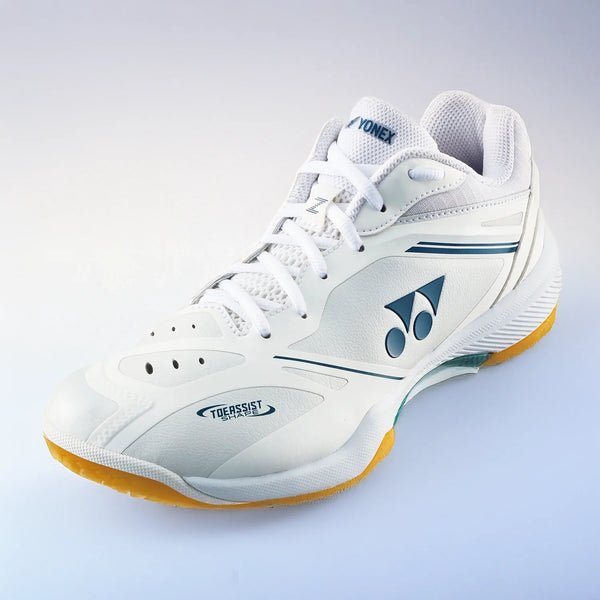
Yonex Power Cushion 65 Z4 Wide
The default wide-foot answer: Yonex’s all-around flagship on its Wide last — POWER CUSHION+, a graphite sheet and the full fit system, with room where a wide foot actually needs it.
If a wide-footed player asks for one shoe and no lecture, this is the shoe. The 65 series is Yonex’s all-around line — the middle of the range where comfort, stability and court feel are balanced rather than maximised — and the Z4 Wide is that shoe built on Yonex’s Wide last. The W in SHB65Z4W is the whole story: the same flagship recipe, a wider forefoot and toe box, and the heel and midfoot kept secure so the extra width does not become extra movement. It is the wide shoe against which every other wide shoe in this guide is implicitly measured, because it is the one that asks the fewest compromises of the player wearing it.
The recipe is the current 65-generation stack, and every name on it is Yonex’s own. POWER CUSHION+ sits in the heel as the specially shaped wedge Yonex designs for badminton footwork, with Feather Bounce Foam — the lightweight, resilient foam Yonex introduced for added bounce — alongside it; Yonex’s figures for the plus compound are a 28% increase in shock absorption and 62% in repulsion against standard EVA, printed here as Yonex’s claims from its own research citations. The Power Graphite Sheet runs under the midfoot to resist twisting, the Lateral Shell braces the outside of the shoe against sideways foot movement, and the fit system is the complete Yonex set: a seamless synthetic-leather upper, an Inner Bootie wrapping the midfoot, the Synchro-Fit Insole closing the heel gap, and the Toe Assist Shape easing pressure at the big toe. The outsole is Yonex’s Rubber Sole in the Radial Blade Sole pattern — the windmill arrangement Yonex designs for grip in vertical, horizontal and diagonal movement. Yonex publishes no weight for this model, and the card will not estimate one. Buy the 65 Z4 Wide if you want the wide fit without changing anything else about the shoe you would otherwise buy.
Pros
- Yonex’s own Wide designation on its all-around flagship — the reference wide shoe
- Complete fit system: Inner Bootie, Synchro-Fit Insole and Toe Assist Shape together
- POWER CUSHION+ with Feather Bounce Foam and a Power Graphite Sheet — cushioning and torsion in one stack
- Radial Blade Sole pattern built for multi-directional grip
Cons
- Yonex publishes no weight for this model
- All-around balance means it maximises nothing — specialists should read on
- The W suffix matters: the standard 65 Z4 without it is a different, narrower shoe
As an Amazon Associate we earn from qualifying purchases.
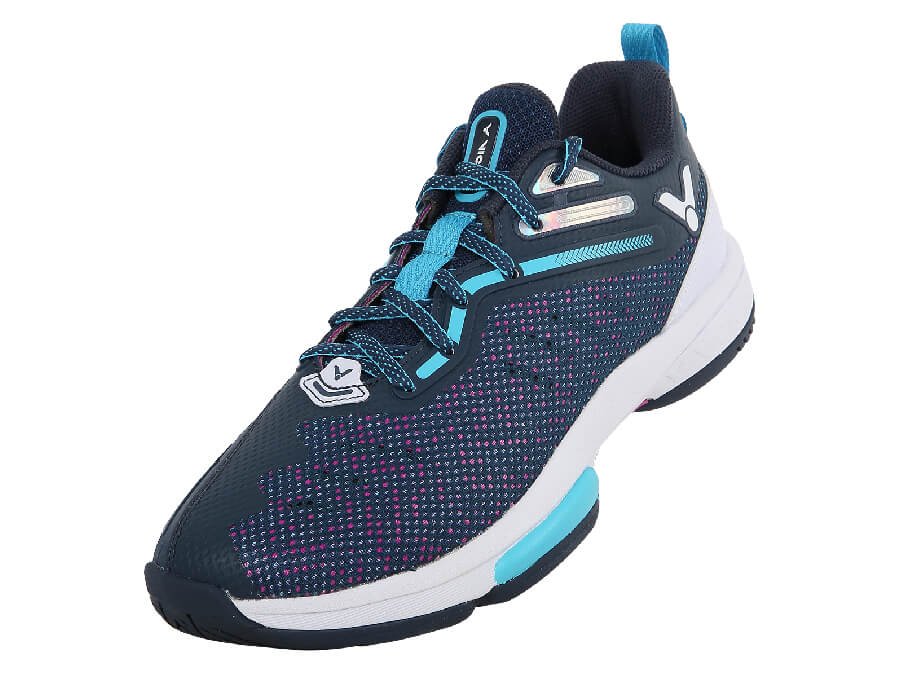
Victor P9600-BJ
The non-Yonex flagship answer: Victor’s first wide-last and thick-soled badminton shoe — U Shape 3.0 (Wide), E-TPU and ENERGYMAX V on VSR Rubber.
This is the most interesting card in the guide, because it is the only one where the maker had to announce the width as news. On its own US and Canada site, Victor introduces the P9600 with a sentence no other Victor shoe gets: it is the brand’s first wide-last and thick-soled badminton shoe. The fit line on the authorised listings prints it as U Shape 3.0 (Wide) — Victor’s last code, with the width stated outright. And Victor frames the width as a performance feature, not a comfort concession: inspired by the widebody design of racing cars, the forefoot is widened laterally to grow the contact patch with the floor and reinforce stability on the lateral side during landing. A wide foot lands wider; Victor built the landing zone wider to match.
The stack underneath is the full Victor performance recipe. The midsole layers Feather Resilient EVA with E-TPU across the whole foot — Victor says its elasticity and pressure resistance are matched to the ENERGYMAX V at the heel — plus a Carbon Power sheet for midsole stability and Solid EVA in the build; the upper is PU V-Tough with double mesh and PU leather, and the outsole is Victor’s VSR Rubber. Victor publishes no weight for the P9600, and the card prints that plainly rather than borrowing a number. Two notes for careful shoppers: the “-BJ” suffix marks this colourway’s edition and the appointed-footwear association in Victor’s retail copy — the wide last is the P9600’s, whichever edition you buy — and this is a unisex shoe, sized in the 230–295 mm range Victor prints. Buy the P9600-BJ if your wide feet have been waiting for Victor to build them a flagship, and you want the width stated by the maker, not inferred by a reviewer.
Pros
- Victor’s own “first wide-last shoe” statement — the clearest wide designation in the guide
- Widened forefoot is a stability feature: more contact patch on lateral landings
- Full performance stack: E-TPU, ENERGYMAX V and a Carbon Power sheet
- VSR Rubber outsole with an armoured PU V-Tough and mesh upper
Cons
- Victor publishes no weight for this model
- Thick-soled by design — low-platform purists should know their camp
- Edition suffixes (-BJ, -A) sit side by side in listings; confirm the model before ordering
As an Amazon Associate we earn from qualifying purchases.
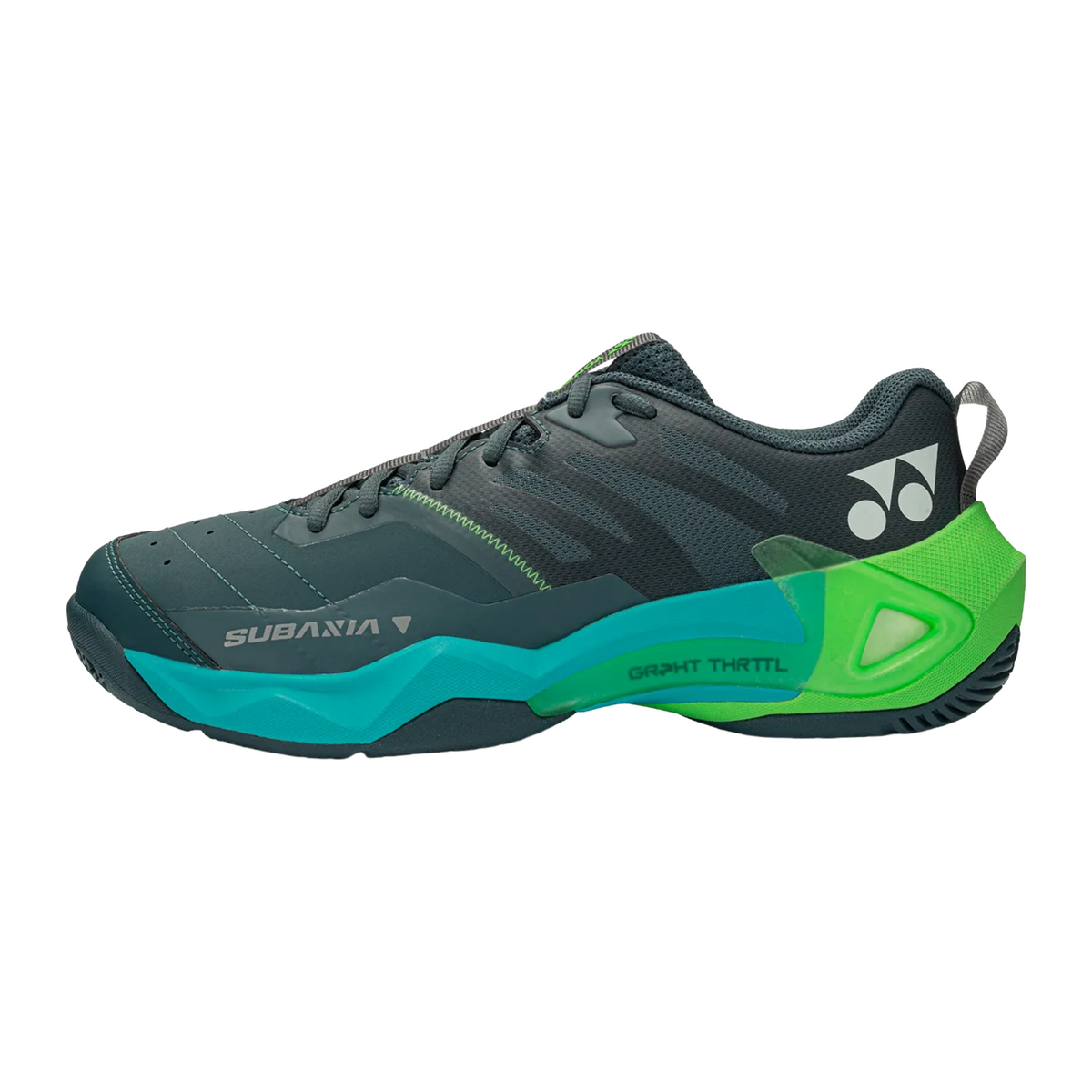
Yonex Power Cushion Subaxia GT Wide
The newest tech on a wide last: Yonex’s 2026 flagship line and its GRPHT THRTTL cushioning system, in the Wide variant — for the wide-footed player who wants the latest midsole in the sport.
Yonex launches new shoe lines the way car makers launch platforms — rarely, and all at once — and the Subaxia is the newest one: a next-generation line standing alongside Aerus, Eclipsion and the 65 series, with a global launch dated 28 January 2026 in Yonex’s own retail copy. The Wide variant, SHBSG1W, brings the whole new platform to a wide last from day one, which is the detail that matters for this guide: wide-footed players are not waiting a generation for the new tech here. The concept is printed on the shoe’s launch materials in Yonex’s own slogan — “the only way is up” — and the engineering is aimed at the vertical game: jump smashes, explosive take-offs, rapid footwork.
The headline is GRPHT THRTTL, Yonex’s name for the structural system that pairs POWER CUSHION REV — the successor compound to POWER CUSHION+ — with POWER GRAPHITE in a single structure. Yonex’s figures for it are a 37% improvement in impact absorption and a 42% increase in repulsion against the lightweight Hyper msLite midsole, printed here as Yonex’s claims from its own launch data. Around it sit 3D heel cushioning, which Yonex designs to cut landing impact on net approaches for faster recovery, and a split midsole that tunes the forefoot and heel separately — repulsion up front, cushioning at the back. The outsole is Yonex’s Rubber Sole in the Radial Blade Sole pattern. Yonex publishes no weight for the Subaxia GT Wide. One honest framing note: this is the newest and therefore the least long-term-proven shoe in the guide — the tech is Yonex’s latest, and the wide variant shares it fully. Buy it if your wide feet want the current edge of Yonex’s midsole engineering rather than the proven middle of it.
Pros
- The 2026 flagship platform in a Wide variant from launch — no waiting a generation
- GRPHT THRTTL: POWER CUSHION REV with POWER GRAPHITE in one structure, in Yonex’s figures
- 3D heel cushioning and a split midsole tuned separately front and back
- Radial Blade Sole pattern for multi-directional grip
Cons
- Yonex publishes no weight for this model
- Newest platform in the guide — the least long-term-proven of the seven
- Vertical-game tuning suits jumpers; flat-court movers may prefer the 65 Z4 Wide
As an Amazon Associate we earn from qualifying purchases.
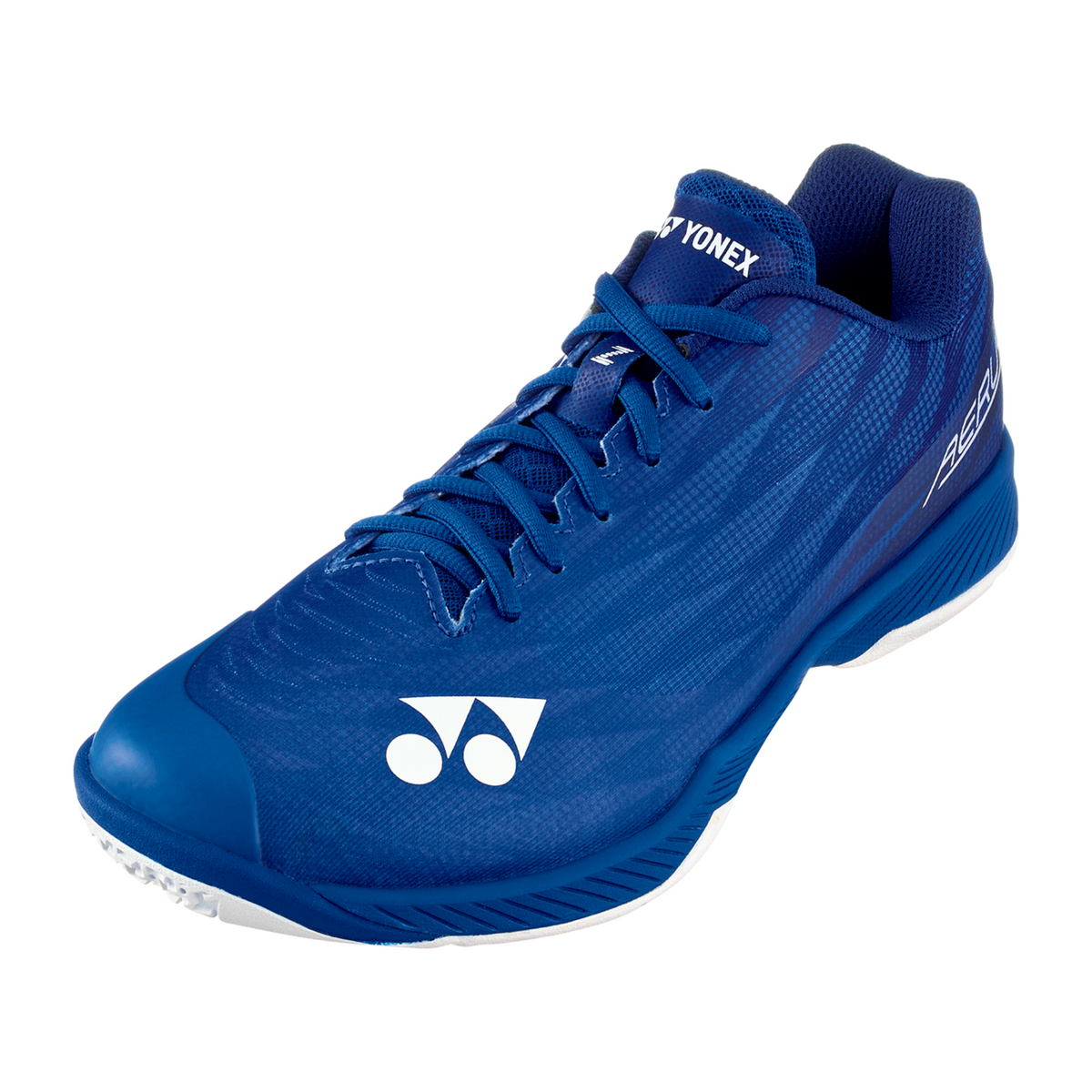
Yonex Power Cushion Aerus Z2 Wide
The lightest wide shoe here: Yonex’s featherweight Aerus platform on a Wide last — 240 g per shoe in Yonex’s own figure — for wide feet that refuse to feel heavy.
The Aerus line has one job — lightness — and the Z2 Wide does it without asking wide feet to pay a weight penalty for their width. Yonex lists the Aerus Z2 platform at 240 g per shoe, its own published figure, and the Wide variant shares the build: the same Feather Bounce Foam sole Yonex introduced for lightweight bounce (about 20% more resilience than its Hyper Feather Light predecessor, in Yonex’s figures), the same msLITE X midsole material, the same Durable Skin Light seamless upper over Double Raschel Mesh. A wide shoe that weighs what the standard featherweight weighs is the entire point of this card — width from the last, not from extra material.
The rest of the spec is the full Aerus Z2 recipe, and it is a serious one for a light shoe. POWER CUSHION+ sits in the heel wedge Yonex shapes for badminton footwork; the 3D Power Graphite sheet runs through the midsole to resist twisting and carry landings; the Toe Assist Shape eases big-toe pressure while supporting the midfoot and heel; the Synchro-Fit Insole closes the heel gap that wide shoes must never allow to open; and the outsole is Yonex’s Rubber Sole in the Radial Blade Sole pattern. One naming caution, because it matters for this site’s readers: this is the Aerus Z2 Wide (SHBAZ2W) — a different model from the standard Aerus Z2 ranked in our pillar best badminton shoes guide. Same platform, different last; if the listing in front of you does not carry the W, it is not this shoe. Buy the Aerus Z2 Wide if your wide feet want speed first and everything else second.
Pros
- The only maker-stated weight in this guide: 240 g per shoe, Yonex’s own figure
- Feather Bounce Foam and msLITE X — the full lightweight recipe, not a diluted wide edition
- 3D Power Graphite sheet keeps a light shoe stable on landings
- Seamless Durable Skin Light upper over breathable Double Raschel Mesh
Cons
- Featherweight build trades some plushness — maximum-cushion seekers should look at the P9600 or 65 Z4 Wide
- Check the W suffix: the standard Aerus Z2 is a different, narrower model
- Light shoes show wear faster; the recipe prioritises grams over armour
As an Amazon Associate we earn from qualifying purchases.
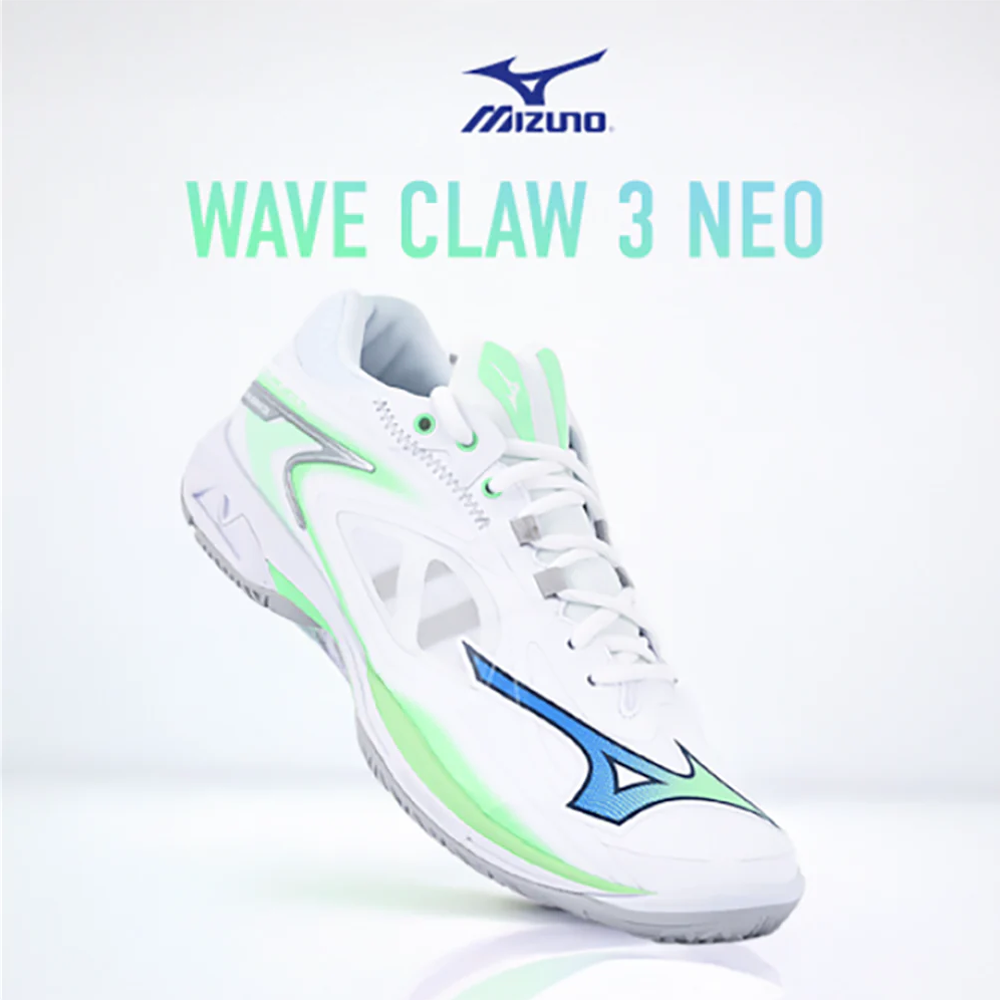
Mizuno Wave Claw Neo 3 Wide
The maker’s 3E stamp: Mizuno’s own “3E equivalent (Wide)” designation on its fast Claw Neo platform — ENERZY NXT cushioning and XG Rubber for the wide-footed attacker.
Mizuno does not do Yonex-style W suffixes; it grades width the Japanese way, in E-steps — and its spec table for this shoe prints the grade plainly: 3E equivalent, Wide, against the 2E the brand treats as standard. That printed grade is this card’s entire authority, and it is the most numerical wide claim in the guide. The shoe itself is the Claw Neo 3, Mizuno’s fast-footwork line: an integrated upper design that wraps the foot for a close, premium hold, built for players whose game is instant starts and acceleration rather than long rallies of attrition.
The cushioning is Mizuno’s current generation: MIZUNO ENERZY NXT — the next-generation compound Mizuno says delivers its cushioning performance in a thinner package — paired with PoWnCe, over the MIZUNO WAVE plate that has always been the brand’s cushioning-and-stability structure, with the U4icX insole board and a MIZUNO ENERZY insole completing the stack. MB-HOLD FIT is Mizuno’s system for even contact between foot and shoe, which matters doubly on a wide last, and the outsole pairs XG Rubber — Mizuno’s extra-grade grip compound — with the D-Flex Groove Mizuno shapes for smooth lateral transitions. On weight, the card follows this guide’s rule: Mizuno publishes no figure, and the approx. 310 g per shoe at 27.0 cm is a retailer’s reported measurement, labelled as such wherever it appears. One distinction for this site’s readers: this is the Wave Claw Neo 3 Wide — a different model from the standard Wave Claw NEO 3 in our beginners guide. Buy it if you want your width in writing, in E-grades, from the maker itself.
Pros
- Mizuno’s own 3E (Wide) spec-table grade — the most explicit wide designation here
- ENERZY NXT with PoWnCe over the Wave plate — Mizuno’s current cushioning generation
- XG Rubber with D-Flex Groove for grip and lateral transitions
- Integrated wrap upper with MB-HOLD FIT contains the wide forefoot
Cons
- Mizuno publishes no weight; the 310 g figure is the retailer’s, not the maker’s
- Fast-shoe tuning suits attackers — defensive grinders may prefer the 65 Z4 Wide
- Not the beginners guide’s standard Neo 3 — confirm the Wide variant when ordering
As an Amazon Associate we earn from qualifying purchases.
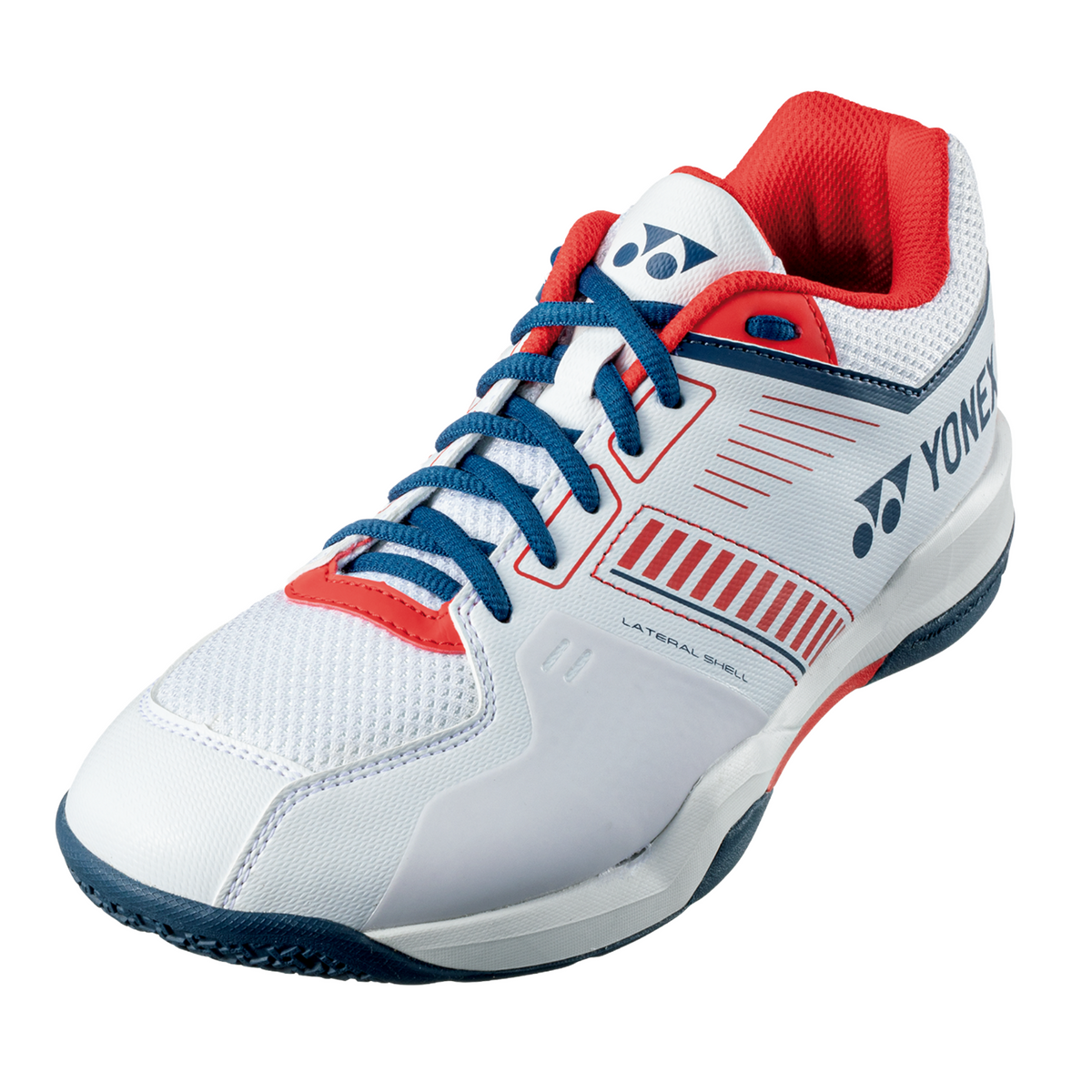
Yonex Power Cushion Strider Flow Wide
The wide start: Yonex’s all-around beginner model on its Wide last — Lateral Shell stability, Ergoshape fit and the Radial Blade Sole, without the flagship complexity.
Most wide-footed beginners never get a proper first shoe — they get a standard beginner shoe that hurts, and conclude that badminton shoes hurt. The Strider Flow Wide exists to prevent exactly that. Yonex’s own retail copy positions the Strider Flow as the all-around model for beginner and indoor shoe users: entry shoes that provide stability while minimising wobbling. The Wide variant, SHBSF1W, puts that brief on a wide last from the start, so a new player’s first impression of the sport is not forefoot pressure. If the footwork itself is still being learned, our how to play badminton guide is the right companion read — the shoe handles the fit, the guide handles the feet.
The tech list is shorter than the flagships’, and honestly so. POWER CUSHION — the standard compound, not the plus grade — handles shock absorption; the Lateral Shell prevents the foot from moving at the edge of the sole, which is the stability feature a beginner’s wobbling footwork needs most; Ergoshape shifts the centre of gravity toward the big toe for a comfortable fit with more speed; and the Round Sole supports quick, smooth footwork with maximum energy transfer. The outsole is a one-piece construction in Yonex’s Rubber Sole with the Radial Blade Sole pattern — the same grip pattern family as the flagships, on a simpler platform. Yonex publishes no weight for this model. Buy the Strider Flow Wide if the player is new, the feet are wide, and the job is to make the first hundred hours comfortable enough that there is a second hundred.
Pros
- Yonex’s own Wide designation on its all-around beginner model — the right first wide shoe
- Lateral Shell directly answers the wobbling footwork beginners actually have
- Ergoshape and Round Sole keep the fit comfortable and the movement smooth
- One-piece outsole with the Radial Blade Sole pattern — flagship grip family, simpler platform
Cons
- Yonex publishes no weight for this model
- Standard POWER CUSHION, not the plus grade — progressing players will outgrow it
- Beginner-tuned: committed competitors should start at the 65 Z4 Wide instead
As an Amazon Associate we earn from qualifying purchases.
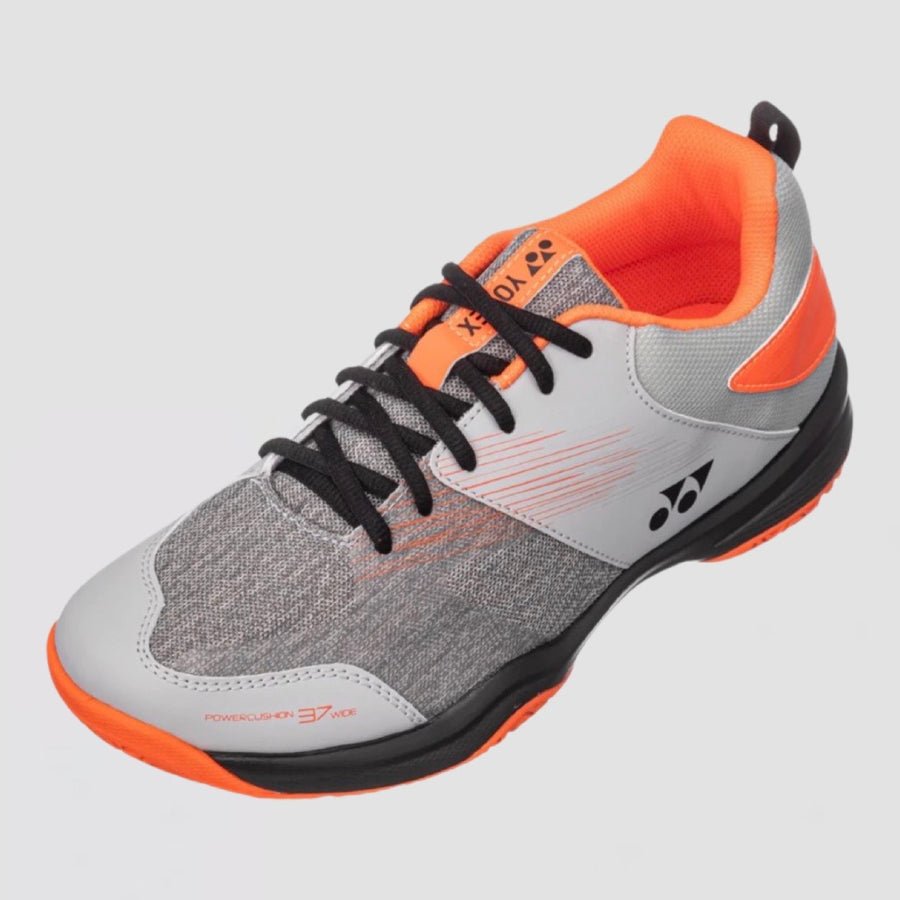
Yonex Power Cushion 37 Wide
The entry wide fit: Yonex’s long-running 37 on its Wide last — “a comfortable soft wide fit” in Yonex’s own retail copy — for the player who needs width first and everything else second.
The 37 is Yonex’s veteran entry shoe — the model that has introduced more players to the brand than any flagship — and the Wide variant carries the line’s simplest possible brief. Yonex’s retail copy for it is one line: “Entry model providing a comfortable soft wide fit.” No graphite sheets, no booties, no plus-grade foams — just the standard POWER CUSHION compound doing the shock absorption, in a shoe whose last is wide from the drawing board. For a casual player, a school player, or anyone whose current shoes are simply too narrow and whose budget is finite, that single line is the whole purchase decision, and it is an honest one.
What the 37 Wide does carry is the entry-level version of Yonex’s fit thinking: Durable Skin Light — the polyurethane-based material Yonex uses for rubber-like flexibility with the hold of a harder film — over Double Raschel Mesh, the fine breathable mesh Yonex rates at eight times the air exchange of ordinary mesh, for a soft, adaptable fit around a wide forefoot. The outsole is Yonex’s Rubber Sole, indoor non-marking rubber as the listings specify. Yonex publishes no weight for this model, and at this tier the card will not pretend the number matters — the 37 Wide is bought on fit and simplicity. One positioning note: this is the bottom of Yonex’s range, not a cut-down flagship, and it behaves like it — players who train several times a week will outgrow its cushioning and should look at the Strider Flow Wide or 65 Z4 Wide instead. Buy the 37 Wide when the brief is width at the entry of the range, and nothing more needs to be true.
Pros
- Yonex’s own Wide designation at the entry of the range — width without the flagship brief
- “Comfortable soft wide fit” is the maker’s own positioning, not a reviewer’s inference
- Durable Skin Light with Double Raschel Mesh — soft, breathable, adaptable
- The simplest decision in the guide: wide feet, first proper shoe, done
Cons
- Yonex publishes no weight for this model
- Standard POWER CUSHION only — no plus grade, no graphite, no bootie
- Frequent trainers will outgrow it; it is an entry shoe, not a workhorse
As an Amazon Associate we earn from qualifying purchases.
Side-by-Side: The Seven Wide-Fit Shoes at a Glance
Every width claim below is the maker’s own designation, and every tech name is the maker’s own term. Weights are printed exactly as honestly as the cards print them — one maker-stated figure, one labelled retailer measurement, and five shoes whose makers publish none.
| Shoe | Best for | Wide designation (maker’s own) | Cushioning (maker-named) | Outsole | Weight |
|---|---|---|---|---|---|
| Yonex 65 Z4 Wide | Best all-around wide | Yonex “Wide” — SHB65Z4W | POWER CUSHION+ + Feather Bounce Foam | Rubber Sole, Radial Blade Sole | Not published |
| Victor P9600-BJ | Victor’s first wide-last shoe | Victor “U Shape 3.0 (Wide)” | Feather Resilient EVA + E-TPU + ENERGYMAX V | VSR Rubber | Not published |
| Yonex Subaxia GT Wide | Best 2026 flagship wide | Yonex “Wide” — SHBSG1W | GRPHT THRTTL: POWER CUSHION REV + POWER GRAPHITE | Rubber Sole, Radial Blade Sole | Not published |
| Yonex Aerus Z2 Wide | Best featherweight wide | Yonex “Wide” — SHBAZ2W | POWER CUSHION+ + Feather Bounce Foam + msLITE X | Rubber Sole, Radial Blade Sole | 240 g per shoe (Yonex’s figure) |
| Mizuno Wave Claw Neo 3 Wide | Best 3E wide | Mizuno “3E equivalent (Wide)” | MIZUNO ENERZY NXT + PoWnCe | XG Rubber, D-Flex Groove | Approx. 310 g at 27.0 cm (retailer’s figure) |
| Yonex Strider Flow Wide | Best wide for new players | Yonex “Wide” — SHBSF1W | POWER CUSHION | Rubber Sole, Radial Blade Sole, one-piece | Not published |
| Yonex 37 Wide | Best budget wide | Yonex “Wide” — SHB37W | POWER CUSHION | Rubber Sole | Not published |
Wide-Fit Buying Guide: Five Checks Before You Pay
1. Buy the width, not the length. The single most expensive mistake a wide-footed player makes is sizing up a standard shoe instead of buying a wide last. Length does not convert to width — it moves the heel back and leaves the forefoot pressing the sidewalls half a size forward, with a heel that now slips. Yonex’s own retail guidance for its Wide models says it directly: choose your normal shoe length, do not size up for width. Start every purchase by confirming the maker’s wide designation — the W suffix, the U Shape 3.0 (Wide) fit line, the 3E stamp — and only then think about size.
2. Confirm the designation on the exact listing in front of you. Wide and standard variants of the same shoe sit side by side in every shop, often in the same colourway. The 65 Z4 and the 65 Z4 Wide, the Aerus Z2 and the Aerus Z2 Wide, the Claw Neo 3 and the Claw Neo 3 Wide — the names differ by one letter or one word, and the standard versions are the ones our other guides rank. Check the item code before you pay: SHB65Z4W, SHBAZ2W, SHBSG1W, SHBSF1W, SHB37W for the Yonex wides; the U Shape 3.0 (Wide) fit line for the Victor; the 3E grade for the Mizuno. If the code in your basket does not match, you are buying a different shoe.
3. Lunge-test the heel, not just the toes. A wide shoe’s forefoot will feel immediately better — that is the easy part. The real test is the braking lunge: heel planted hard, body moving forward over the toes, the movement our how to play badminton guide teaches as the foundation of court coverage. If the heel lifts or the midfoot swims, the width is right and the lockdown is wrong — the Synchro-Fit Insole, the Inner Bootie, the MB-HOLD FIT and the Ergoshape exist precisely for this moment, and they only work if the shoe’s length is correct. Width without lockdown is a roomy shoe, not a fitted one.
4. Match the cushioning tier to your training load, not your ambition. The two entry wides here — the Strider Flow Wide and the 37 Wide — run standard POWER CUSHION, and they are honest about it: they are built for players learning the game or playing casually. Two to three sessions a week of full-intensity play wants the plus-grade compounds and the graphite — the 65 Z4 Wide’s POWER CUSHION+ and Power Graphite Sheet, the Aerus Z2 Wide’s 3D Power Graphite, the P9600’s Carbon Power, the Subaxia GT Wide’s GRPHT THRTTL. Buying a flagship for a casual game wastes the engineering; buying an entry shoe for a serious schedule wears it out from under you. The width decision and the tier decision are separate — make both.
5. Keep the wide shoe on indoor courts, and keep it laced for width. Every outsole here is an indoor rubber compound — Yonex’s Rubber Sole, Victor’s VSR Rubber, Mizuno’s XG Rubber — and concrete or asphalt will destroy the grip pattern that your lateral movements depend on. These shoes live in the kit bag between sessions. And one practical lacing note for wide feet: skip the bottom eyelet row’s crushing tension and use the runner’s-loop top eyelets if the shoe has them, so the forefoot keeps its volume while the heel stays locked. The shoe was built wide; let it stay wide.
Frequently Asked Questions
What does “Wide” actually mean on a Yonex badminton shoe?
It is Yonex’s own designation for a wide-last variant, printed in the item code as a W suffix — SHB65Z4W, SHBAZ2W, SHBSG1W, SHBSF1W and SHB37W are the five in this guide. The Wide variant is built on a wider forefoot and toe box than the standard version of the same shoe, while the heel and midfoot stay secure and the tech recipe — cushioning, graphite, grip pattern — carries over. It is a different last, not a stretched standard shoe, and Yonex’s retail guidance is to choose your normal shoe length rather than sizing up for width.
Are Victor badminton shoes good for wide feet?
Victor’s answer is the P9600: on its own site Victor describes it as the brand’s first wide-last and thick-soled badminton shoe, and the authorised listings print the fit as U Shape 3.0 (Wide). Victor frames the width as a stability feature — the forefoot is widened laterally to grow the contact patch with the floor on lateral landings. The midsole runs Feather Resilient EVA with E-TPU and ENERGYMAX V plus a Carbon Power sheet, on a VSR Rubber outsole. Victor publishes no weight for it.
What is 3E width in badminton shoes?
It is Mizuno’s width grade. Mizuno grades shoe width in E-steps and treats 2E as its standard; the Wave Claw Neo 3 Wide carries “3E equivalent (Wide)” in Mizuno’s own spec table — the maker’s own wide designation, printed as a grade rather than a suffix. In practical terms it is Mizuno’s equivalent of what Yonex calls a Wide variant: a wider last on the same platform, in this case the fast Claw Neo 3 with MIZUNO ENERZY NXT and PoWnCe cushioning over the Wave plate and XG Rubber underfoot.
Should I just size up instead of buying a wide model?
No — and this is the most common wide-fit mistake. Sizing up adds length, and length alone does not widen the platform your foot sits on: the forefoot keeps pressing the sidewalls while the heel gains room to slip on every plant. Yonex’s own retail guidance for its Wide models states it plainly: choose your normal shoe length and do not size up for width. The width has to come from the last — the W suffix, the U Shape 3.0 (Wide) fit, the 3E grade — not from a bigger number on the box.
Do wide badminton shoes lose lateral support?
Not when the width is engineered rather than stretched. The makers in this guide all keep their lateral hardware on the Wide variants: the 65 Z4 Wide and Aerus Z2 Wide keep Yonex’s Lateral Shell and their graphite sheets, the Subaxia GT Wide keeps the GRPHT THRTTL structure, the P9600 pairs its widened forefoot with a Carbon Power sheet and VSR Rubber, and the Wave Claw Neo 3 Wide keeps the Wave plate and D-Flex Groove. Victor even argues the reverse — that its widened forefoot platform adds stability on lateral landings by growing the contact patch. The support structures sit under the foot on a wide last; on a too-narrow standard shoe, the foot rides over their edges.
Yonex 65 Z4 Wide or Aerus Z2 Wide — which one should I buy?
Buy by priority. The 65 Z4 Wide is the all-around answer: POWER CUSHION+, Feather Bounce Foam, a Power Graphite Sheet and the full fit system with Inner Bootie and Synchro-Fit Insole — the balanced wide shoe that asks the fewest compromises. The Aerus Z2 Wide is the speed answer: the same Wide last on Yonex’s featherweight platform at 240 g per shoe in Yonex’s own figure, with Feather Bounce Foam, msLITE X and 3D Power Graphite. All-around game, choose the 65 Z4 Wide; a game built on getting there first, choose the Aerus Z2 Wide. Neither publishes a weight beyond Yonex’s 240 g platform figure for the Aerus.
How do I know if I actually need a wide fit?
The fit signs are consistent: pressure on the sides of the forefoot during lunges that does not ease after break-in, the toes riding the edge of the midsole platform on recovery steps, or a history of sizing up in length just to get width — and then fighting heel slip. If any of those describe your current shoes, the answer is a maker-designated wide last, not a bigger standard size. Start with the 65 Z4 Wide as the reference, the P9600 if you want Victor’s wide-last flagship, or the 37 Wide if the brief is simply width at the entry of the range.
The Verdict
If one wide shoe has to do everything, it is the Yonex Power Cushion 65 Z4 Wide — Yonex’s all-around flagship on its Wide last, the reference the other six are measured against. But the honest verdict in a fit guide is that the best shoe is the one whose width is real and whose brief matches yours. Want Victor’s engineering instead of Yonex’s? The Victor P9600-BJ is the brand’s first wide-last shoe, stated as such by Victor itself. Want the newest midsole in the sport? The Yonex Subaxia GT Wide brings the 2026 GRPHT THRTTL platform to a wide last. Want speed? The Yonex Aerus Z2 Wide is the only maker-weighed shoe here at 240 g per shoe. Want the width in E-grades? The Mizuno Wave Claw Neo 3 Wide carries the 3E stamp. New to the game? The Yonex Strider Flow Wide. And if the brief is simply width at the entry of the range, the Yonex 37 Wide does exactly what its one line of maker copy promises.
Still weighing the wider field? Our pillar comparison of the best badminton shoes covers the all-player flagships this guide deliberately avoids repeating, women players have their own segment in our best badminton shoes for women guide, and the advanced badminton shoes guide owns the top-tier purchase. Buy the width the maker states, in your normal length — and the shoe wall stops being a wall of adjectives and becomes seven lasts shaped like feet.
How we built this guide: every width claim above is the maker’s own published designation — Yonex’s W-suffix Wide variants, Victor’s U Shape 3.0 (Wide) fit line and “first wide-last shoe” statement, Mizuno’s 3E equivalent (Wide) spec-table grade — verified against manufacturer and authorised-retailer listings at build time, and each figure is attributed to its source in the copy. Yonex publishes no weight for the 65 Z4 Wide, Subaxia GT Wide, Strider Flow Wide or 37 Wide; Victor publishes none for the P9600; Mizuno publishes none for the Wave Claw Neo 3 Wide — we print that plainly rather than estimating. The one maker-stated weight (Yonex’s 240 g per shoe for the Aerus Z2 platform) and the one retailer-reported measurement (approx. 310 g per shoe at 27.0 cm for the Mizuno) are labelled as such wherever they appear. We do not publish prices, we make no medical, foot-condition or durability claims, and nothing here is presented as hands-on testing. Some links on this page are affiliate links: if you buy through them, AliShuttler may earn a commission at no additional cost to you. As an Amazon Associate we earn from qualifying purchases.