The step up from a first racket is the most misunderstood purchase in badminton. Beginner frames are built around flexible shafts that generate power for you — and the moment your swing gets longer and faster, that same flex starts arriving late, spraying clears wide and turning your smash into a negotiation. These seven rackets are organised by the step-up decision itself: medium shafts against the flexible shafts you are leaving behind, head-heavy power builds against even-balance all-round builds, in the 4U weight class, with grip sizes stated exactly as the makers state them.
⚡ TL;DR — The Short Answer
For the best all-round intermediate step-up, buy the Yonex Nanoflare Nextage — a head-light 4U frame with a medium flex and a G5 grip, from a line Yonex built specifically for intermediate players. For head-heavy power on the same brief, its sibling the Yonex Astrox Nextage pairs the same medium flex with a head-heavy balance and tungsten in the frame. Control players should look at the even-balance Yonex Arcsaber 7 Pro, players ready for a genuinely stiff shaft at the Victor DriveX 3H R, and attacking players who still want flex to help them at the Victor Thruster K 12 M and the Li-Ning Axforce 10. The Li-Ning 3D Calibar 300B closes the list with a 300 mm balance point, a medium shaft and a G6 grip.
Quick Picks — Best Badminton Rackets for Intermediate Players at a Glance
Head-light, medium flex, 4U with a G5 grip — the step-up Yonex designed for exactly this level.
The head-heavy Nextage sibling: medium flex, tungsten in the frame, power with a softer hitting feel.
Even balance and a medium flex in a 4U frame built around shuttle hold and placement.
Even balance with the stiffest shaft in this guide — the test of whether your swing is ready.
Head-heavy and flexible in 4U, with a tension ceiling under 32 lbs as your game hardens.
Head-heavy, flexible, a 7.0 mm shaft — Li-Ning lists it for intermediate, attacking players.
A 300 mm balance point, a medium shaft and a G6 grip in Li-Ning’s Boost series.
In This Guide
The Step-Up Decision: What Actually Changes
A beginner racket is a power assistance device. Its shaft is flexible because a new player’s swing is short and slow, and the flex stores and returns energy the player’s arm cannot yet produce. That bargain holds for your first season or two. Then your footwork starts putting you behind the shuttle on time, your swing lengthens, your contact point moves in front of your body — and the flexible shaft becomes the problem. It is still bending when the shuttle arrives, so the face angle at contact is less predictable and clears that used to land on the back line start drifting. The intermediate step-up is, before anything else, a shaft decision: move from flexible to medium, and the racket starts keeping time with the swing you have now.
The second decision is balance, and it should follow the game you are actually building. Head-heavy builds — the Astrox Nextage, the Thruster K 12 M, the Axforce 10 and the 300 mm Calibar 300B — put mass toward the head so rear-court clears and smashes carry more momentum. Even-balance builds — the Arcsaber 7 Pro and the DriveX 3H R — donate nothing in either direction and suit all-court players who construct rallies with placement. The head-light Nanoflare Nextage is the third answer: mass kept away from the head for defence, drives and net speed. None of these is a higher level than the others — they are three different intermediate games, and the cards are ranked by how completely each answers its own brief.
Two boundaries before the picks, because this site keeps its decisions separated. If you are still choosing a first racket, that decision belongs to our guide to the best badminton rackets for beginners, and nothing in this post re-ranks it. And if your deciding factor is a lighter overall frame or a slimmer grip for a smaller hand, that decision belongs to our guide to the best badminton rackets for women, which cards the 5U, 6U and ultra-light frames this post deliberately leaves out. This page assumes a grooved basic technique, a full swing, and a beginner frame that has started to feel late — and answers only what you step up to.
Flex, Balance, Weight and Grip — Read as Makers State Them
Shaft flex is the step-up. Every card below quotes the maker’s own wording — medium, flexible, or stiff on Victor’s own scale for the DriveX 3H R — because flex labels are each brand’s internal scale and cannot be converted honestly between brands. What travels across brands is the direction: flexible shafts help shorter, developing swings; medium shafts are the intermediate centre of gravity, bending in time with a full club-level swing; stiff shafts return energy fastest and demand the most, which is why only one card here — the DriveX 3H R — goes there, framed as a test of readiness rather than a default. Step up one flex grade at a time: the player who jumps from a flexible beginner frame straight to an extra-stiff tour frame has not skipped a level; they have bought a season of mishits.
Balance is stated two ways, and both appear below. Makers describe balance as a character — head-light, even balance, head-heavy — and some publish a balance point in millimetres. Where a maker-published figure exists in the verified tables, we card it: 290 mm ±3 on the Astrox Nextage, 300 mm on the Calibar 300B. Where it does not, we card the character only and say so. Weight is graded in U classes — 3U is roughly 85–89 grams, 4U roughly 80–84 grams — and every racket here is carded in its 4U version, because 4U is where the makers concentrate their intermediate lines. Several models are also sold in 3U or 5U; the cards flag the alternatives where listings show them. Grip size is graded in G numbers, where a higher number means a slimmer handle — G5 here, with the Calibar 300B in G6. An overgrip can build a grip up but nothing takes one down, so the listed grade is the one to check before you order.
The 7 Best Badminton Rackets for Intermediate Players, Compared
Seven rackets, one shared brief — a genuine step up from a beginner frame — and three different games being stepped up to. Read the card that matches the player you are becoming first.
Yonex Nanoflare Nextage
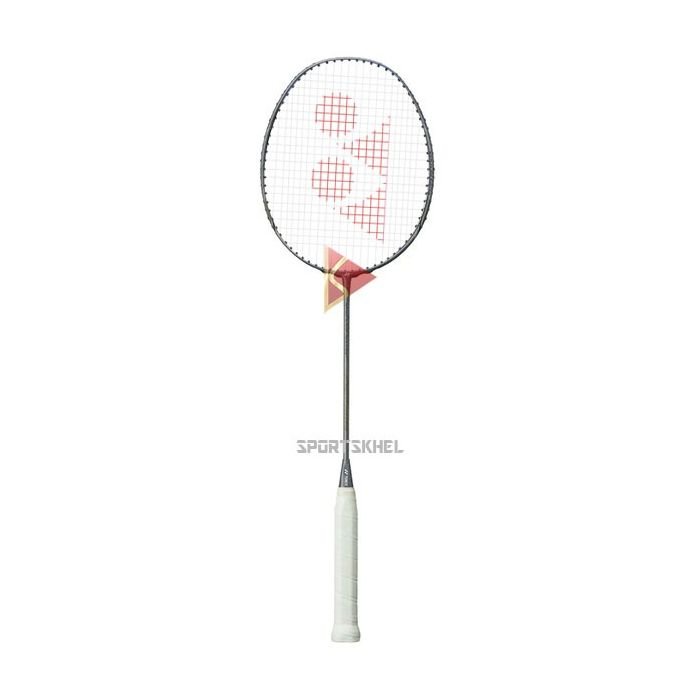
The purpose-built step-up — a head-light 4U frame with a medium flex, from the line Yonex says it created for intermediate players advancing to the next stage.
Most intermediate guides are assembled by reaching up and down other levels — a softened pro frame here, a hardened beginner frame there. The Nextage line exists because Yonex decided the middle deserved its own engineering. Yonex says the NEXTAGE name comes from the series’ support of intermediate players advancing to the next level, and the Nanoflare version is the speed member of the pair: head-light, 4U at an average 83 grams, with a medium flex that is the honest centre of the step-up decision. If your game is built on defence, drives and net pressure, this is the racket that changes the shaft and the materials without changing your game on you.
The specification supports that reading in detail. The frame pairs HT Graphite with NANOCELL NEO, which Yonex describes as a resilient graphite material, and the Sonic Flare System places high-modulus graphite at the frame’s top and bottom — Yonex says it is designed for shuttle acceleration and stability at contact. The length is 10 mm longer than standard for reach at the net and leverage from the back, and the 20–28 lbs stringing range gives real room to experiment: start in the middle while your timing settles, tighten as your contact gets cleaner. Pair it with the right string choice — our guide to the best badminton strings explains how gauge and tension change what a medium-flex frame gives back.
What we like
- Built for this exact level — the maker’s own intermediate line, not a hand-me-down spec
- Medium flex is the correct single step up from flexible beginner shafts
- Head-light 4U build keeps defence and drives fast while technique sharpens
- 20–28 lbs stringing range leaves room to grow into tighter setups
Worth knowing
- Head-light balance adds the least free smash power in this guide
- Rear-court attackers should read the Astrox Nextage card below first
As an Amazon Associate we earn from qualifying purchases.
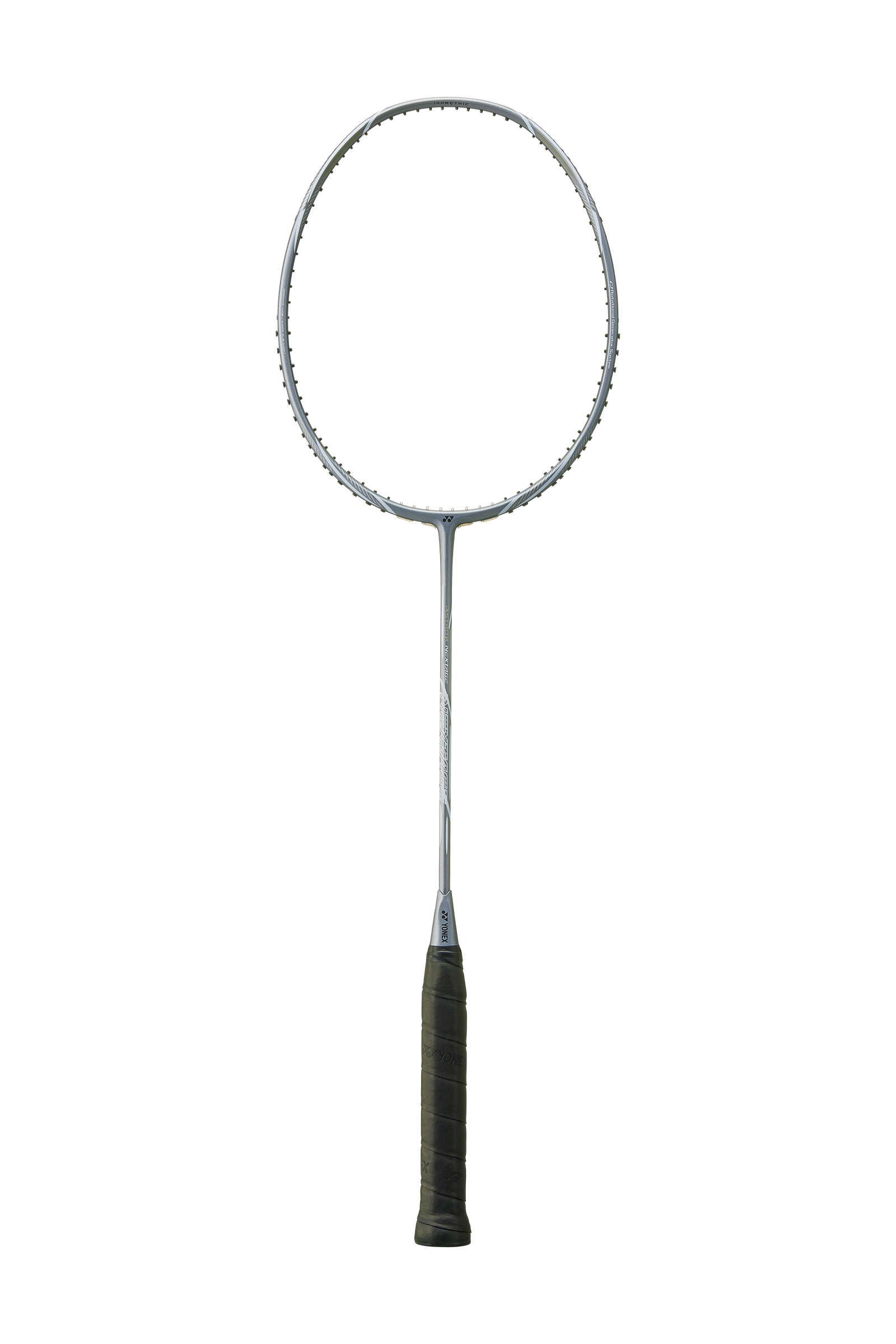
Yonex Astrox Nextage
The head-heavy half of the Nextage decision — medium flex, tungsten in the frame, and a balance point a retailer spec table states at 290 mm ±3.
Every design question the Nanoflare Nextage answers one way, its sibling answers the other — which is why the pair anchors this guide. The Astrox Nextage keeps the intermediate brief intact: the same 4U average 83 grams, G5 grip, medium flex and 20–28 lbs stringing range. What changes is where the mass sits. The balance is head-heavy, stated at 290 mm ±3 in a retailer spec table reproducing Yonex’s figures, with tungsten placed in the frame — the Astrox family’s way of putting weight behind overhead shots. For the player whose rallies are won from the rear court and whose smash is becoming a genuine weapon, this is the step-up that adds momentum without asking for a stiffer shaft before your swing is ready.
The detail that separates this frame from blunter head-heavy options is in the frame recipe: VDM — Vibration Dampening Mesh — is a stretchy mesh material Yonex says is rolled with the carbon to reduce unwanted vibration, and retailer descriptions consistently lead with its softer hitting feel for a power frame. The Rotational Generator System distributes counterweight through the grip end, frame top and joint, which Yonex says enables smooth transitions between shots — a head-heavy racket still has to defend and drive between smashes, especially in doubles. Choose this card over its sibling if your points are built from the back; choose the Nanoflare if they are built at the net. That single balance question is the whole decision between cards #1 and #2.
What we like
- Head-heavy momentum with an intermediate-friendly medium flex — power without the stiff-shaft tax
- VDM in the frame recipe is aimed at a softer hitting feel than most power frames
- Rotational Generator System is designed to keep a head-heavy frame transitioning smoothly
- Shares the Nextage brief: 4U, G5, 20–28 lbs — an easy like-for-like step up
Worth knowing
- Head-heavy frames are the slowest here to recover in flat defensive exchanges
- One retailer lists a variant shaft recipe for this model — check the listing’s spec table against the card above before ordering
As an Amazon Associate we earn from qualifying purchases.
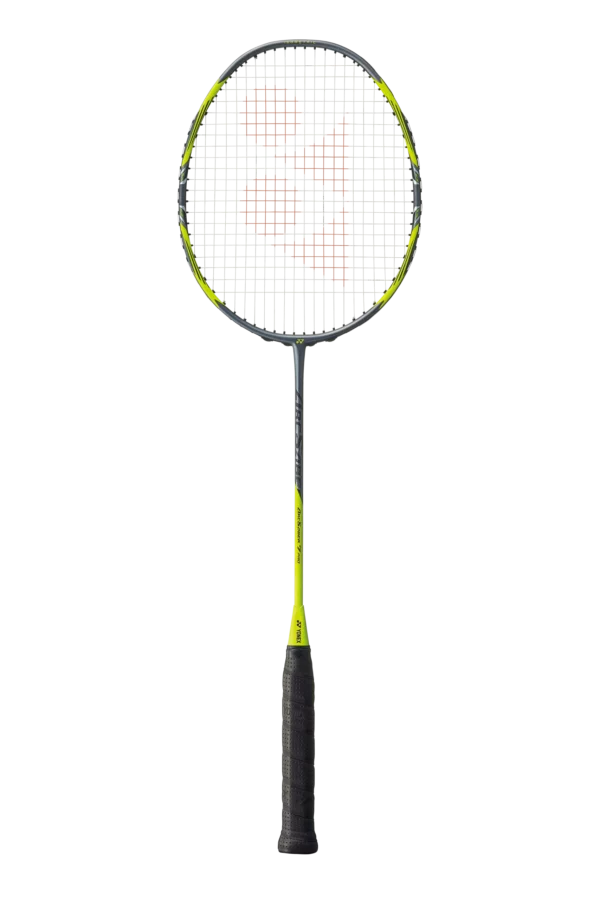
Yonex Arcsaber 7 Pro
The placement player’s step-up — even balance, a medium flex, and a frame family built around holding the shuttle on the strings a fraction longer.
The Arcsaber idea has always been dwell: the frame is designed to flex at impact and hold the shuttle on the string bed briefly, trading a fraction of raw repulsion for placement you can steer. The 7 Pro is where that idea reaches a progressing club player — retailer positioning describes it for intermediate to advanced players seeking control and precision, and the specification is the control brief in full. Even balance, so neither end of the court is favoured. A medium flex, so the shaft still contributes while your swing finishes developing. And a 4U build at an average 83 grams with G5 and G6 grip options in the published tables, so the control frame arrives in the same weight class as everything else here.
Two construction details carry the concept. POCKETING BOOSTER, a rubber-like material in the frame, is described by Yonex as emphasising elasticity in the frame’s flex — part of how the Arcsaber frame achieves its hold. The T-ANCHOR composite in the new built-in T-joint reduces excess torque on off-centre contact, which matters most for a control player: your game is built on shots taken under pressure and slightly out of position, and a frame that stays square on those contacts protects the whole pattern. The stringing advice, 19–27 lbs, sits a touch lower than the Nextage pair’s ceiling — consistent with a frame tuned for hold. Control starts below the hand, though: the lunges and recoveries that put you in position to place the shuttle depend on court grip and lateral support, and our guide to the best badminton shoes covers that half of the equation.
What we like
- Even balance and shuttle-hold design suit placement and rally construction
- Medium flex keeps it a genuine intermediate step, not a pro frame in disguise
- G5 and G6 grip options in the published tables
- T-ANCHOR T-joint is aimed at stability on the off-centre contacts control players live on
Worth knowing
- The 19–27 lbs stringing ceiling is the lowest top end among the Yonex cards here
- Power-first players will find more momentum in the head-heavy cards
As an Amazon Associate we earn from qualifying purchases.
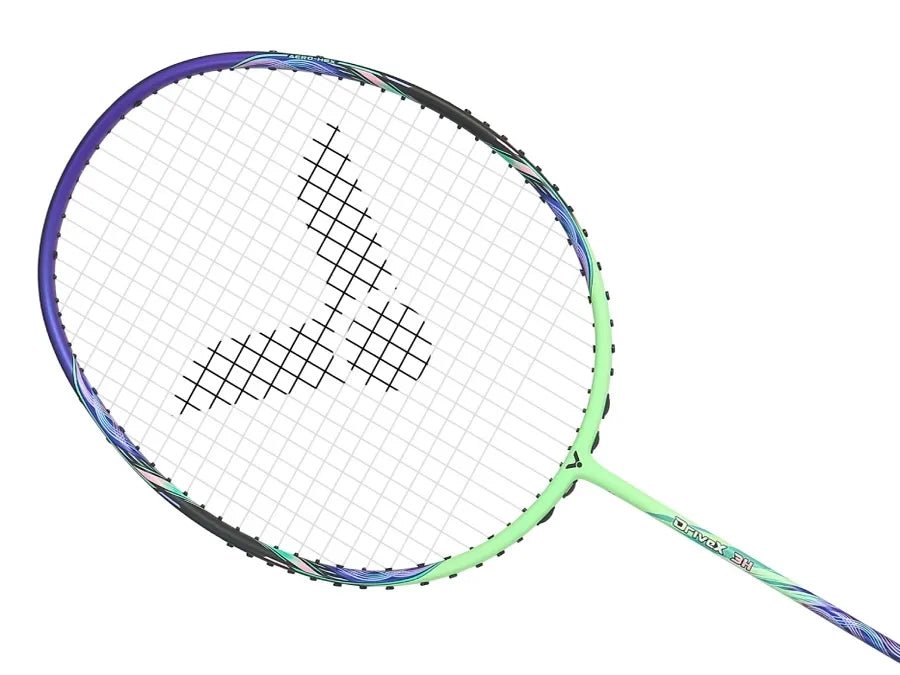
Victor DriveX 3H R
The readiness test — an even-balance 4U all-rounder with the stiffest shaft carded in this guide, listed for intermediate to advanced players.
This is the card that tells you whether your step-up should stop at medium. Victor’s published position on its own stiffness scale puts the DriveX 3H R at the stiff end — the spec table states it as S○●○○○F, one step in from the stiff extreme — paired with an even balance, a 4U weight and a G5 grip. The spec table lists the player level as Intermediate – Advanced, and that hyphen is the whole story: this is an intermediate racket for the top of the band, for the player whose swing is already fast and who has started to feel a medium shaft’s response as a delay rather than a help. If that is not yet you, the honest move is a medium-flex card above and this one next season.
What the stiff shaft buys, when you can use it, is directness: the shuttle leaves on the line your face angle sets, drives stay flat and hard to intercept late, and defensive blocks can be steered rather than merely survived. Victor builds the 3H R in its DriveX all-round series with its FREE CORE handle, which Victor says allows the shaft to move more freely for smoother swings, and an AERO-HEX frame profile in the retailer’s technology list. The 6.8 shaft and a maximum tension of 30 lbs complete a specification that assumes a developed game. Treat this card as the guide’s ceiling marker — a racket you grow into, bought at the moment your technique is ready to meet it.
What we like
- The most direct, precise response in this guide for fast, grooved swings
- Even balance keeps a stiff frame honest in every third of the court
- 30 lbs tension ceiling supports tighter, control-led setups
- FREE CORE handle is designed to keep a stiff brief feeling smooth
Worth knowing
- Stiff shafts offer nothing to a swing that is still developing — be honest about which band you are in
- The least forgiving card here on late or off-centre contact
As an Amazon Associate we earn from qualifying purchases.
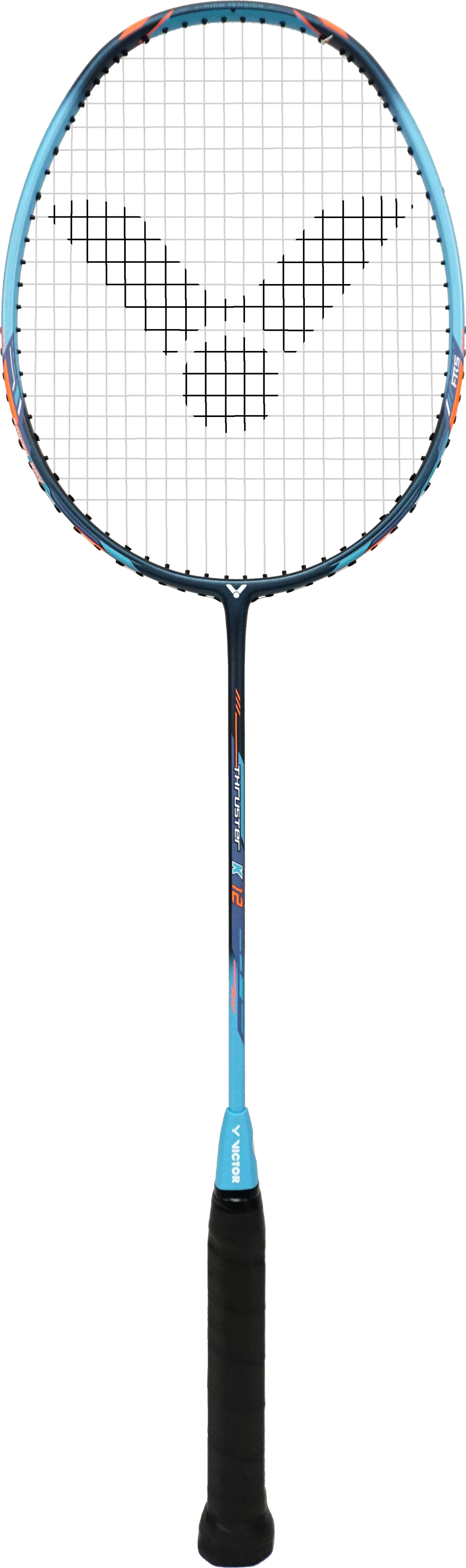
Victor Thruster K 12 M
The exception that proves the flex rule — a head-heavy 4U power frame that deliberately keeps a flexible shaft, listed for intermediate, attacking players.
Not every intermediate player should step up in flex, and this card exists for the ones who should not — yet. The Thruster K 12 M is a head-heavy attacking frame in Victor’s power series, and the spec tables that reproduce Victor’s data list its player level as Intermediate and its style as Attacking while keeping the shaft flexible. Read that combination correctly: the step-up here is not the shaft, it is everything around it. You move to a proper head-heavy power build — mass committed to the head for clears and smashes — in a 4U weight with a G5 grip, while the flexible shaft keeps contributing power where your technique is still catching up with the balance. For a rear-court player whose smash is developing faster than the rest of their game, that is a more honest progression than a medium-stiff shaft and a lecture.
The supporting specification is built for where that player is heading. Victor’s POWER BOX frame design is described by the maker as a box-shaped structure that increases stability and anti-torque and allows the frame to withstand higher string tensions — and the published ceiling here is under 32 lbs, the highest in this guide, so the frame will not cap you when your contact quality earns tighter stringing. The Fibre Reinforced System is described as improving elasticity while offering stable controllability at high tension. One carding note, stated plainly: the gram figures in retailer tables for this model are strung weights, so this card leads with the maker’s 4U grade. If your game is attack-first and your swing is still growing into it, this is your step-up — flex stays, everything else levels up.
What we like
- A genuine power build that does not force a flex jump before your swing is ready
- Under-32 lbs tension ceiling is the highest here — headroom as you progress
- Listed for intermediate, attacking players in the spec tables
- POWER BOX frame is designed for stability at higher tensions
Worth knowing
- Flexible plus head-heavy is the least precise combination here for tight net play
- When your swing outgrows the flex, your next step is a medium-flex card — plan for it
As an Amazon Associate we earn from qualifying purchases.
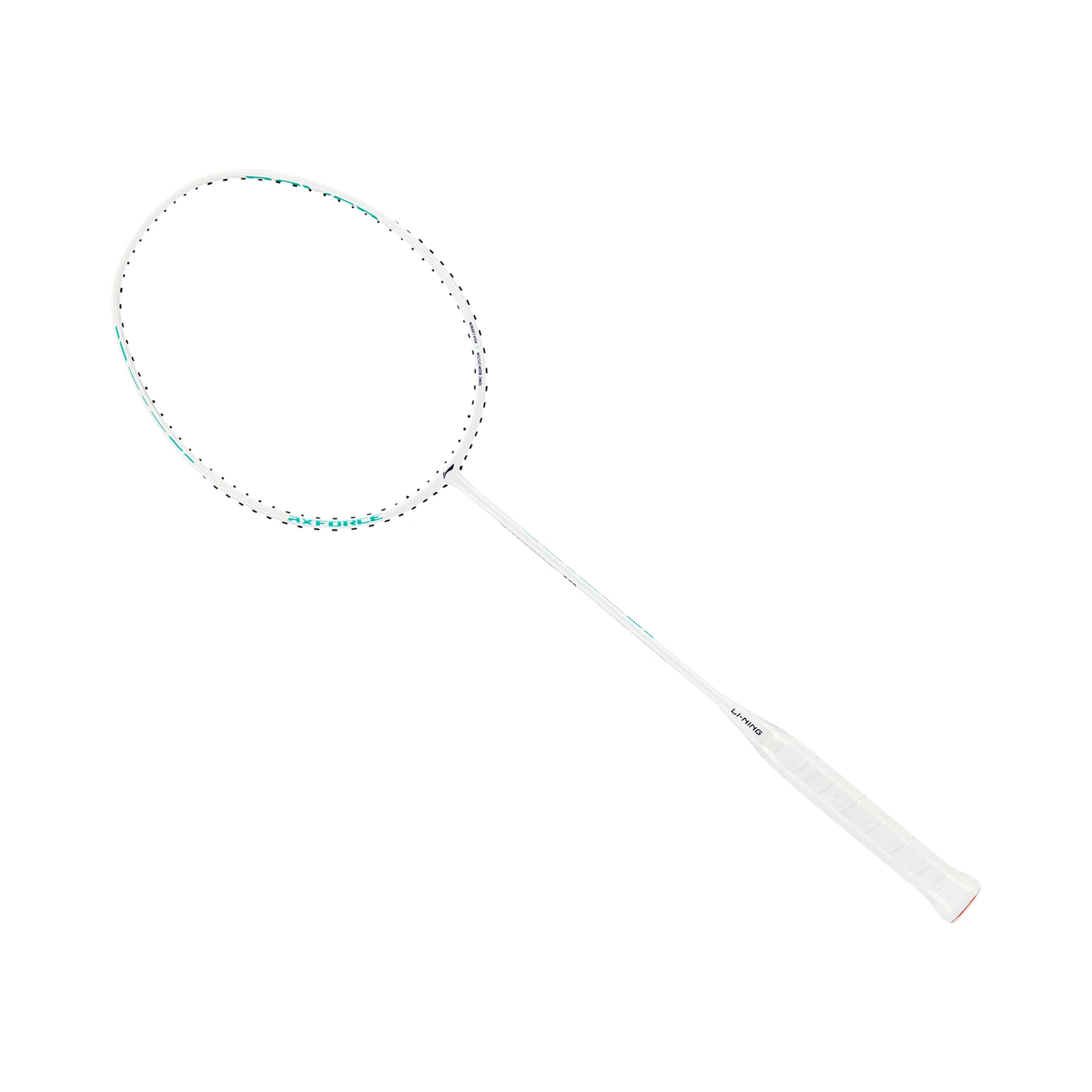
Li-Ning Axforce 10
Li-Ning’s attacking step-up — head-heavy, flexible and carbon fibre throughout, with the maker’s spec format listing it for intermediate players.
The Axforce 10 makes the same argument as the Thruster K 12 M from the other big power family — and the agreement between the two makers is itself the useful signal. Li-Ning’s specification format lists this model with a player type of Attacking and a player level of Intermediate: head-heavy balance, a flexible shaft, a full carbon fibre build, and a 4U weight stated as 80–84 grams with a G5 grip. A 5U version is also listed; the 4U is carded here because it keeps rear-court momentum in the frame. The Li-Ning leans on the shaft and head: a 7.0 mm slim shaft, the Dynamic Optimum Frame shape, and the Sonic Boom System that Li-Ning says enhances the sound and feel of contact.
Who is it for? The intermediate attacker who plays from the back and wants that game in a carbon frame from one of badminton’s three major makers, without stepping up to a stiff shaft at the same time. The flexible shaft is doing the same honest work as on the Victor card: contributing shuttle speed while the swing that drives a head-heavy frame is still being grooved. The maximum tension is carded at 29 lbs, the figure two verified spec tables agree on. Whichever power card you choose, the technique has to arrive with the racket — our guide on how to play badminton covers the overhead mechanics and footwork patterns a head-heavy frame rewards.
What we like
- Maker-format spec lists it plainly: Intermediate level, Attacking type
- Head-heavy carbon build in a proper 4U weight band, stated in grams
- Flexible shaft keeps the power brief playable while the swing develops
- 7.0 mm slim shaft and Dynamic Optimum Frame are the maker’s own attacking recipe
Worth knowing
- Also sold in 5U — confirm the 4U version on the listing before ordering
- Flexible, head-heavy frames ask the most of your defence in fast doubles
As an Amazon Associate we earn from qualifying purchases.
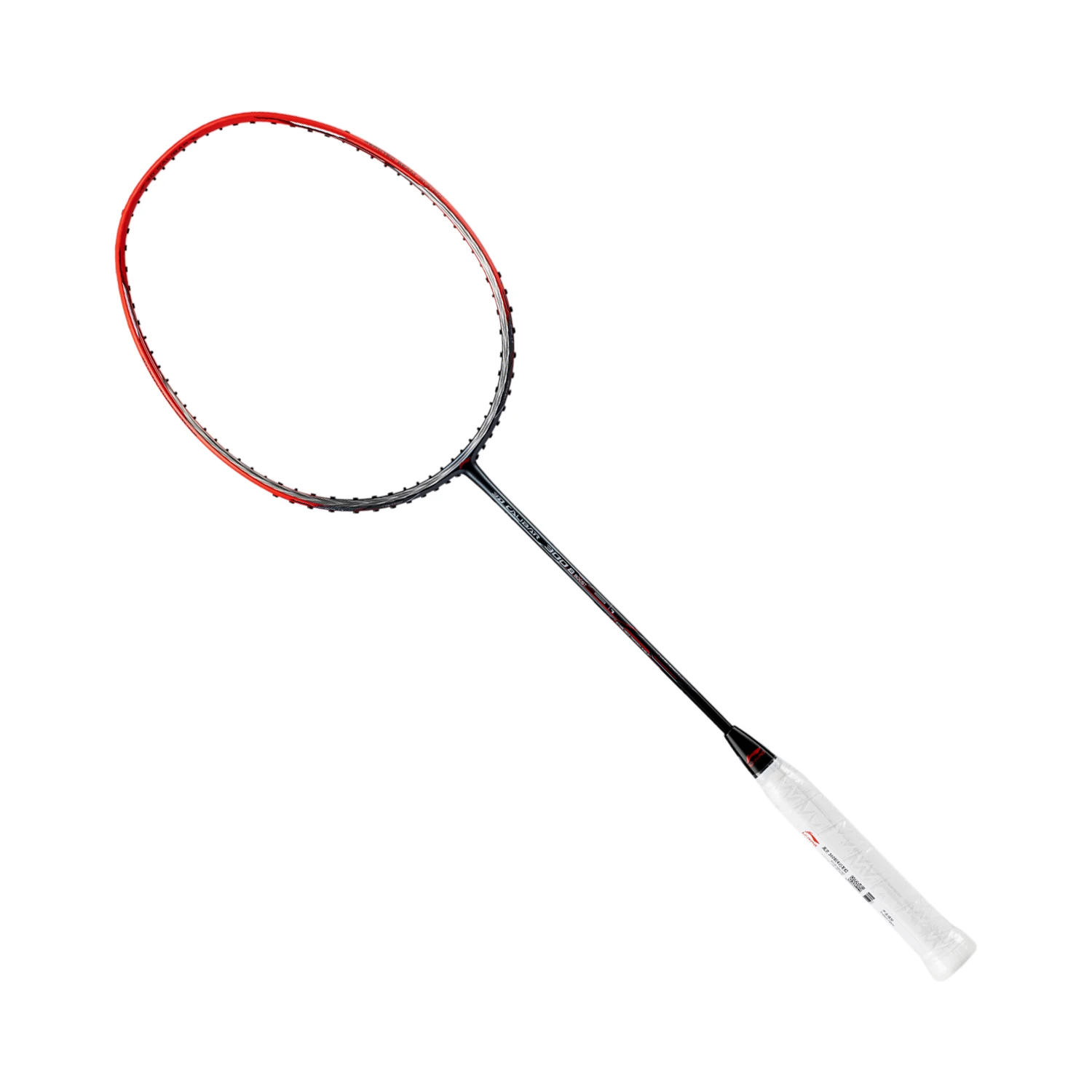
Li-Ning 3D Calibar 300B
The Boost-series all-rounder — a stated 300 mm balance point, a medium shaft, a G6 grip, and Li-Ning’s geometric low-drag frame design.
The 3D Calibar 300B is the card for the intermediate player who wants the numbers on the table. Its verified spec sheet is the most explicit in this guide: a 4U weight stated as 81–84 grams, a balance point stated at 300 mm, a medium flex, a maximum tension of 30 lbs, a full length of 675 mm — and a G6 grip, the slimmest handle carded in this post. The 300 mm figure places the balance on the head-heavy side, which the Boost positioning explains: Li-Ning’s Boost copy, reproduced in the verified listings, describes the series as a moderate weight with a medium shaft for well-rounded, experienced players — an all-round brief with a power lean — and one retailer spec table lists the model’s player level as Intermediate.
The frame concept is the other half of the card. The 3D Calibar series is built on what Li-Ning describes as a high-tech geometric frame design intended to reduce air resistance, alongside its Wing Stabilizer and TB-Nano technologies and a UHB shaft in the published technology list. In plain terms, this is a head-heavy-on-paper racket engineered not to feel cumbersome through the air: rear-court presence for singles length and doubles smashes, without surrendering the flat game. Choose the 300B if you want a medium-flex step-up with a slimmer grip and a published balance point you can compare against your current frame’s — the most measurable upgrade decision in this guide.
What we like
- The most fully stated spec sheet here — weight band, 300 mm balance point, 30 lbs ceiling
- G6 grip is the slimmest handle in this guide
- Medium flex makes it a true flex step-up, unlike the flexible power pair above
- Geometric frame design is aimed at swing speed despite the head-heavy balance point
Worth knowing
- A 300 mm balance point will feel head-heavy to players stepping up from head-light frames
- One retailer table lists this model’s flex as Flexible — the Medium wording carded here is the one three verified tables agree on
As an Amazon Associate we earn from qualifying purchases.
Side-by-Side Comparison Table
| Model | Best For | Weight | Grip | Balance | Shaft Flex (Maker-Stated) |
|---|---|---|---|---|---|
| Yonex Nanoflare Nextage | Best overall | 4U (Avg. 83g) | G5 | Head-light | Medium |
| Yonex Astrox Nextage | Power step-up | 4U (Avg. 83g) | G5 | Head-heavy, 290 mm ±3 | Medium |
| Yonex Arcsaber 7 Pro | Control | 4U (Avg. 83g) | G5 (G6 also listed) | Even balance | Medium |
| Victor DriveX 3H R | Stiff all-rounder | 4U | G5 | Even balance | Stiff (Victor scale) |
| Victor Thruster K 12 M | Flexible power | 4U | G5 | Head-heavy | Flexible |
| Li-Ning Axforce 10 | Attacking step-up | 4U (80–84 grams) | G5 | Head-heavy | Flexible |
| Li-Ning 3D Calibar 300B | G6 all-rounder | 4U (81–84g) | G6 | Head-heavy, 300 mm | Medium |
Buying Guide: Stepping Up Without Overshooting
1. Flex: step up one grade, not three
The single most common intermediate mistake is buying the racket of the player you want to become in three years. Flex is where that mistake bites. If your current frame is flexible — and almost every beginner frame is — your step is to medium: the Nanoflare Nextage, Astrox Nextage, Arcsaber 7 Pro and Calibar 300B all live there, which tells you where the makers themselves put this level. The exceptions prove the rule in both directions. The Thruster K 12 M and Axforce 10 keep a flexible shaft because their step-up is a head-heavy power build, not a shaft change. The DriveX 3H R’s stiff shaft is a readiness test for the top of the band. Match the flex to your typical session’s swing, honestly assessed — not your best one.
2. Balance: follow your court position, not your highlight reel
Ask where your points are actually won. Rear-court players should shortlist the head-heavy cards: Astrox Nextage, Thruster K 12 M, Axforce 10, and the 300 mm Calibar 300B. All-court and placement players should shortlist the even-balance pair, Arcsaber 7 Pro and DriveX 3H R. Defence, drives and net players should start with the head-light Nanoflare Nextage. In doubles, be position-specific: the rear-court partner and the front-court partner in the same pair should usually hold different balances from this table.
3. Weight: 4U is the intermediate centre — stay there unless you have a reason
Every card in this guide is a 4U version, roughly 80–84 grams, because that is where Yonex, Victor and Li-Ning all concentrate the lines they build for this level. A 3U version adds swing weight that helps a strong, settled singles game and taxes everything else; a 5U version — listed for the Axforce 10 — trades rear-court momentum for handling speed. If nothing about your game is screaming for a change, hold the weight class constant and change the flex and balance instead. One variable at a time is how you learn what the new racket actually did.
4. Grip: check the grade on the listing, not just the model name
The cards here are G5, with the Calibar 300B in G6 and the Arcsaber 7 Pro listed in both — so the model name alone does not tell you what will arrive. Confirm the exact weight grade and grip grade on the product page before ordering, every time. Higher G means a slimmer handle, and grades are close rather than identical between brands.
5. Tension: use the published range as a progression, not a target
The stringing figures in this guide — 19–27 lbs at the control end, ceilings of 30 and under 32 lbs at the power end — are the makers’ published limits, and they double as a progression path. String a new intermediate frame in the middle of its range first. Move up only when your contact is consistently central and you can name what you want more of, because tension bought before technique only shrinks the sweet spot you are still learning to find. Never exceed the published ceiling: on a step-up frame, that number is structural, not advisory.
Frequently Asked Questions
When should I move on from a beginner racket to an intermediate one?
When your beginner frame starts arriving late. The clearest signs are clears that used to reach the back line drifting wide or short as your swing gets faster, smashes losing their angle, and a flexible shaft that feels like it is still bending at contact. At that point the flex that used to generate power for you is costing you accuracy, and a medium-flex frame — the centre of this guide — is the correct single step up.
Should an intermediate player choose a medium or stiff shaft?
Medium, for most players, most of the time. A medium shaft bends in time with a full club-level swing and is the honest step up from the flexible shafts of beginner frames. A stiff shaft — like the one on the Victor DriveX 3H R in this guide — rewards a fast, grooved swing with a more direct response, but it offers little help when timing is late. Step up one flex grade at a time.
Is 4U or 3U better for intermediate players?
Every racket in this guide is carded in 4U, because that is where the makers concentrate their intermediate lines: roughly 80–84 grams is light enough for doubles defence and long sessions, and substantial enough for singles length. A 3U version of the same class of frame suits stronger players who prefer a weightier swing. Choose by the game you play and the sessions you play it in, not by strength alone.
Head-heavy or even balance — which suits intermediate doubles?
It depends on where you play in the pair. A rear-court doubles player benefits from a head-heavy build such as the Yonex Astrox Nextage or the Victor Thruster K 12 M, which puts momentum behind clears and smashes. A front-court or all-court player is usually better served by an even-balance frame such as the Yonex Arcsaber 7 Pro or the Victor DriveX 3H R, or by the head-light Yonex Nanoflare Nextage, because recovery speed between shots matters more than single-shot momentum.
What grip size should an intermediate player choose?
Most of the rackets in this guide are listed in G5, the mainstream grip grade, with the Li-Ning 3D Calibar 300B in the slimmer G6. In the G system a higher number means a slimmer handle. Grip grades are each maker’s own and are close rather than identical between brands, and an overgrip only ever adds size — so start from the listed grade that lets your fingers close properly, and build up from there if you need to.
How tightly should an intermediate player string a racket?
Inside the maker’s published range for your frame, and toward the middle of it while your contact is still developing. The ranges in this guide run from 19–27 lbs on the Yonex Arcsaber 7 Pro to a ceiling of under 32 lbs on the Victor Thruster K 12 M. Higher tension gives a crisper response for players who strike the centre of the bed consistently; lower tension is more forgiving and easier on the frame and your arm.
When have I outgrown an intermediate racket?
When the racket, not your technique, becomes the limit you can feel. Typical signs are a medium shaft that starts to feel vague at full swing speed, a stringing ceiling you have reached and want to pass, and shots — usually drives and defensive blocks — that need a more direct response than your frame gives. At that point the step is to a stiff-shaft advanced frame in the same balance family as the intermediate racket you know, not a change of direction.
The Verdict
Step up one decision at a time and the intermediate market stops looking like a wall of model names. The Yonex Nanoflare Nextage is the complete step-up answer — head-light, medium flex, built by its maker for exactly this level. The Yonex Astrox Nextage is its head-heavy power sibling, the Yonex Arcsaber 7 Pro the even-balance control pick, and the Victor DriveX 3H R marks the stiff-shaft ceiling of the band. The Victor Thruster K 12 M and the Li-Ning Axforce 10 prove a power build can be the step-up on its own, flexible shafts and all, and the Li-Ning 3D Calibar 300B closes the list with a stated 300 mm balance point and a G6 grip. Pick by flex first, balance second.
Affiliate disclosure: AliShuttler is reader-supported. When you buy through links on this page we may earn an Amazon commission at no extra cost to you. Specifications are taken from manufacturers’ published product information and were verified at the time of writing; manufacturers revise models, variants and size options between seasons, so confirm the exact weight grade and grip grade on the product page before ordering.