Your first badminton racket should do one thing: help you hit the shuttle cleanly while your technique catches up. These seven beginner rackets — flexible shafts, forgiving heads, honest prices — are the ones worth your money, with every scary spec explained in plain English.
TL;DR — The short answer
Best overall beginner racket: Yonex Nanoray Light 18i. It is a 5U full-graphite racket (about 77g) with a flexible shaft and an isometric head — light, forgiving and fast through the air while you learn. On a tighter budget, the Senston N80 2-pack gives you two full-carbon rackets plus grips and a bag for less than one big-brand racket. Want smash power from day one? The head-heavy Yonex Astrox Smash is the pick. Scroll for the plain-English buying guide, full reviews and comparison table.
Yonex Nanoray Light 18i
5U graphite, flexible shaft, isometric head. The easiest first racket to play well with.
Yonex Astrox Smash
Featherweight 73g frame with a head-heavy balance that does the smashing work for you.
Victor Auraspeed 9
4U, even balance, sword-edge frame. Built for fast drives and quick defence.
Li-Ning G-Force 5800 Superlite
78g carbon fibre, head-heavy. Major-brand attacking play at an entry price.
Yonex GR 303 Combo
Aluminium frame, steel shaft. The school-and-club workhorse that survives beginners.
Senston N80 2-Pack
Two full-carbon 5U rackets, overgrips and a bag. One purchase equips two players.
Yonex Arcsaber 11 Play
4U, even balance, medium flex. A control racket you will not outgrow in six months.
On this page
- The beginner buying guide (plain English)
- 1. Yonex Nanoray Light 18i — Best Overall
- 2. Yonex Astrox Smash — Best for Power
- 3. Victor Auraspeed 9 — Best Speed Frame
- 4. Li-Ning G-Force 5800 Superlite — Best Li-Ning Value
- 5. Yonex GR 303 Combo — Best Durable Starter
- 6. Senston N80 2-Pack — Best Budget Twin-Pack
- 7. Yonex Arcsaber 11 Play — Best to Grow Into
- Comparison table
- What to buy with it
- Your first month: honest expectations
- FAQs
New to badminton? Avoid the two mistakes everyone makes
Almost every beginner buys the wrong first racket, and it is wrong in one of two directions. Mistake one: buying a stiff, pro-spec racket. The rackets the pros on TV use have extra-stiff shafts and strings tensioned like guitar strings. They are precision instruments that only pay off if your swing is already fast and your timing is already clean. In a beginner’s hand they feel dead: no power, tiny sweet spot, and a sore arm by game two. Mistake two: buying the cheapest no-name twin-pack — the kind with a heavy steel frame and strings at toy tension. It survives, but it teaches you nothing, because every shot feels like hitting the shuttle with a frying pan.
The sweet spot sits between those extremes, and it is not expensive: a light racket (4U or 5U) with a flexible or medium-flex shaft, an isometric (squared-off) head for a bigger sweet spot, and factory stringing at sensible tension. That is exactly what the seven rackets below deliver, from real badminton brands — Yonex, Victor and Li-Ning — plus one Amazon budget set that earns its place. If you already play another racquet sport, the adjustment is quicker than you think; our squash vs racquetball comparison shows how differently racquet sports reward gear choices.
The beginner buying guide — every spec in plain English
Yonex Nanoray Light 18i
The easiest first racket to play well with
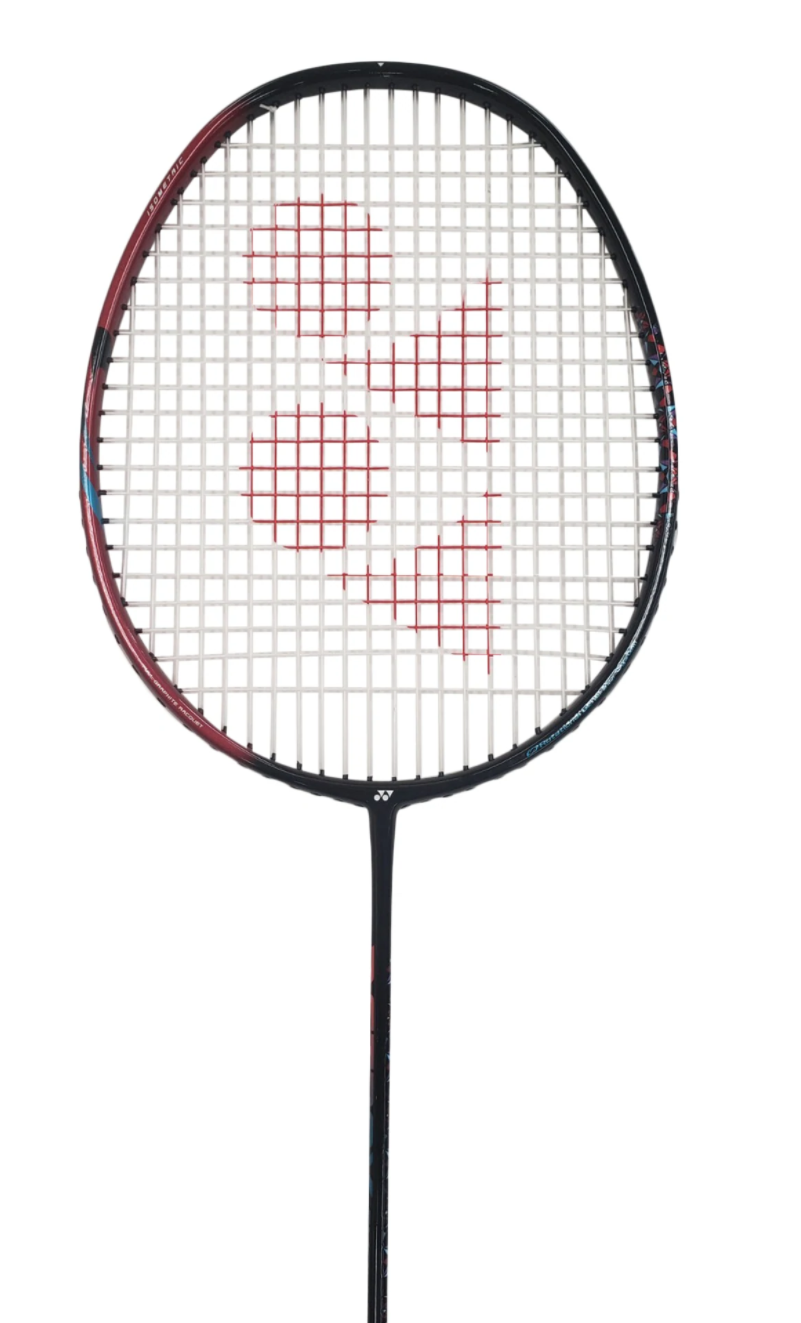
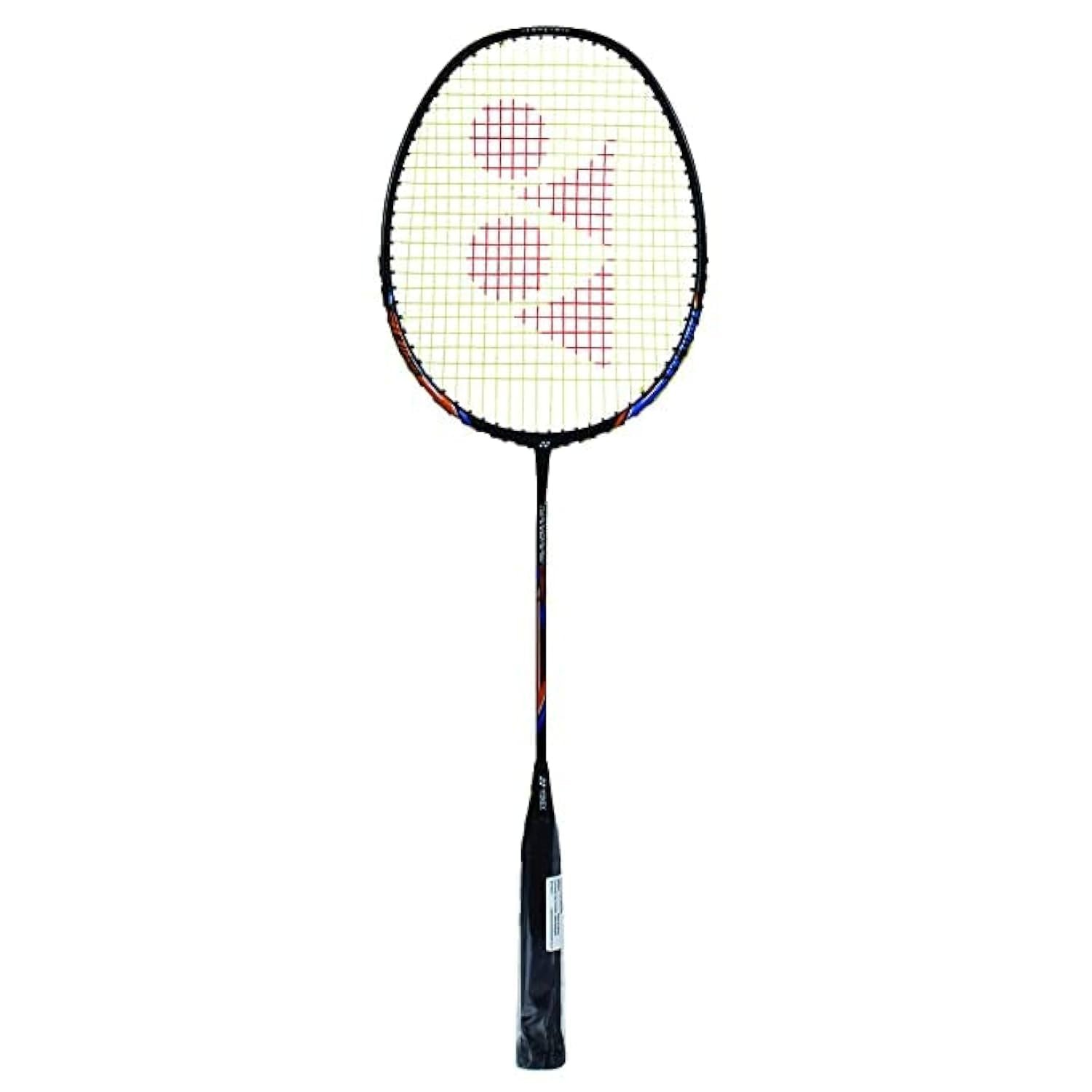
If a coach could hand every new player one racket, it would look like this: a full-graphite Yonex at about 77 grams (5U) with a flexible shaft and an isometric head. The Nanoray Light 18i comes from Yonex’s speed-oriented Nanoray family, and it is built around the two things beginners need most — a light, fast swing and a sweet spot that forgives.
The spec sheet is a beginner checklist done right. The flexible shaft loads on slow, still-developing swings and whips power into clears, so you can reach the back of the court without muscling the shuttle. The isometric head keeps main and cross strings at similar lengths, expanding the sweet spot in every direction — off-centre hits still fly straight instead of dribbling into the net. Yonex’s Aero-Box frame profile slices the top of the head for swing speed, then widens into a box section lower down for stability, and the built-in T-joint keeps the head from twisting on mishits.
Who is it for? Honestly, almost every true beginner: it is light enough for juniors moving to adult rackets, kind enough for casual club players, and good enough that it stays in your bag as a doubles/defence spare long after you upgrade. The only players who should look elsewhere are smash-happy attackers — the head-light balance that makes it so manoeuvrable adds nothing to a smash, and the Astrox Smash below is built for that job. Grip size varies by market (G4 or G5), so check the listing variant before ordering.
Pros
- Featherweight 5U graphite — easy on arm and shoulder
- Flexible shaft generates power on slow swings
- Big isometric sweet spot forgives mishits
- Genuine Yonex build and quality control
Cons
- Head-light balance adds little smash power
- Grip size differs by market — check before buying
As an Amazon Associate we earn from qualifying purchases.
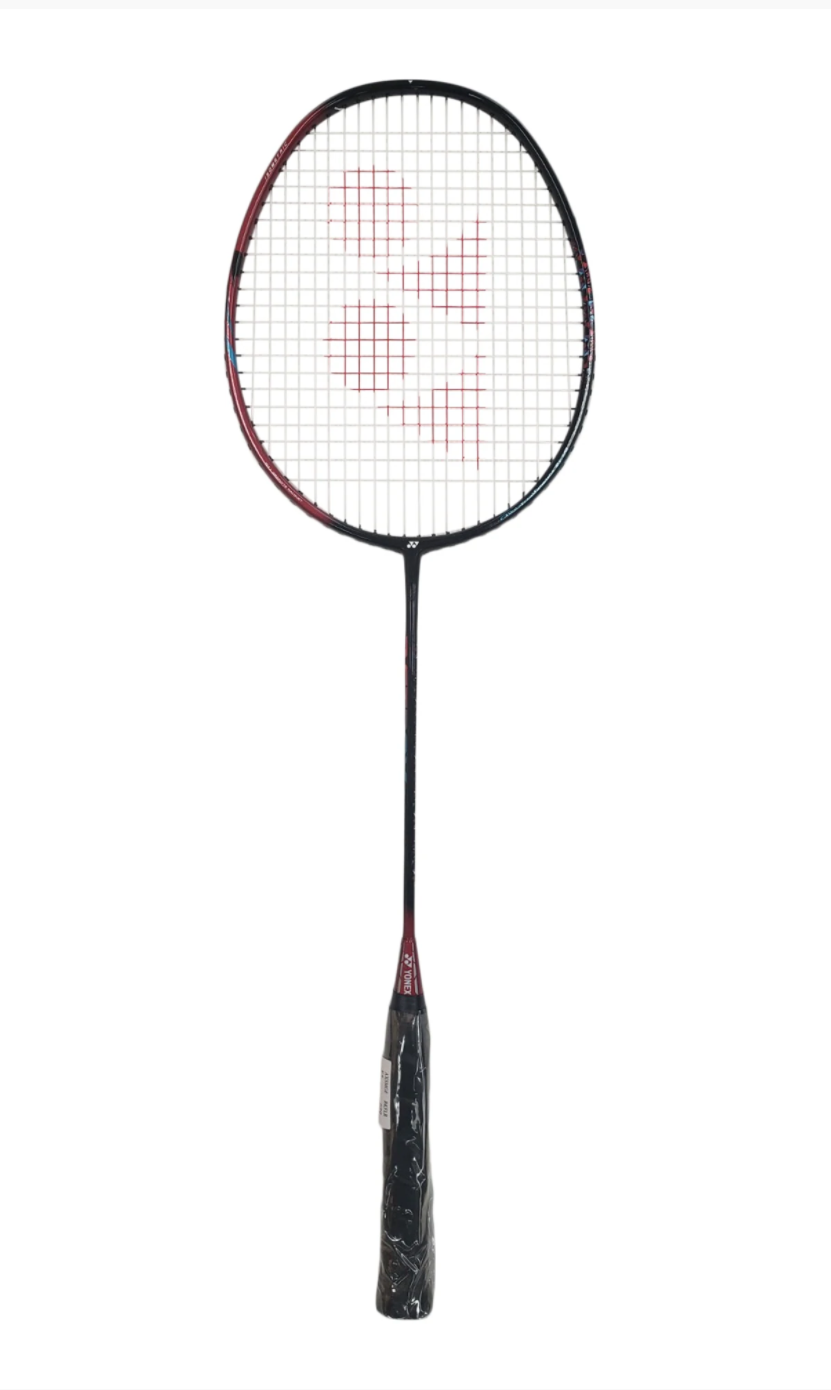
Yonex Astrox Smash
Head-heavy power at a featherweight 73 grams
The Astrox line is Yonex’s attacking family, and the Smash is its friendliest member: a head-heavy balance for real smash momentum in a frame that weighs just 73 grams (Yonex’s “F” class — lighter than 5U). It is the rare beginner racket that lets you play an attacking game from your first month.
Two design choices make it work. First, the weight distribution: Yonex’s Rotational Generator System spreads counterweight through the grip end, the T-joint and the top of the frame, so the head-heavy swing weight stays smooth through shot-to-shot transitions instead of feeling like a hammer. Second, the high-flex shaft with Nanomesh NEO in the graphite — a material that helps the shaft bend further and snap back faster — adds whip to the momentum, so back-court clears and smashes get help from both ends of the swing. The Aero+Box frame and isometric head widen the hitting zone, which matters when attacking shots are exactly the ones beginners mistime.
The trade-off is real and worth knowing: a head-heavy racket is slower to recover in flat, fast defensive exchanges, and in doubles defence the Nanoray or Auraspeed will feel sharper. Buy the Smash if you play from the back of the court, love a steep smash, and want one racket that makes attacking fun while your footwork catches up. It arrives pre-strung inside its 20–28 lbs range with a full cover.
Pros
- Real head-heavy smash momentum at only 73g
- Hi-flex shaft adds whip for developing swings
- Rotational Generator System keeps it smooth
- Pre-strung with full cover included
Cons
- Head-heavy feel is slower in flat defence
- Not the pick for reaction-speed doubles play
As an Amazon Associate we earn from qualifying purchases.
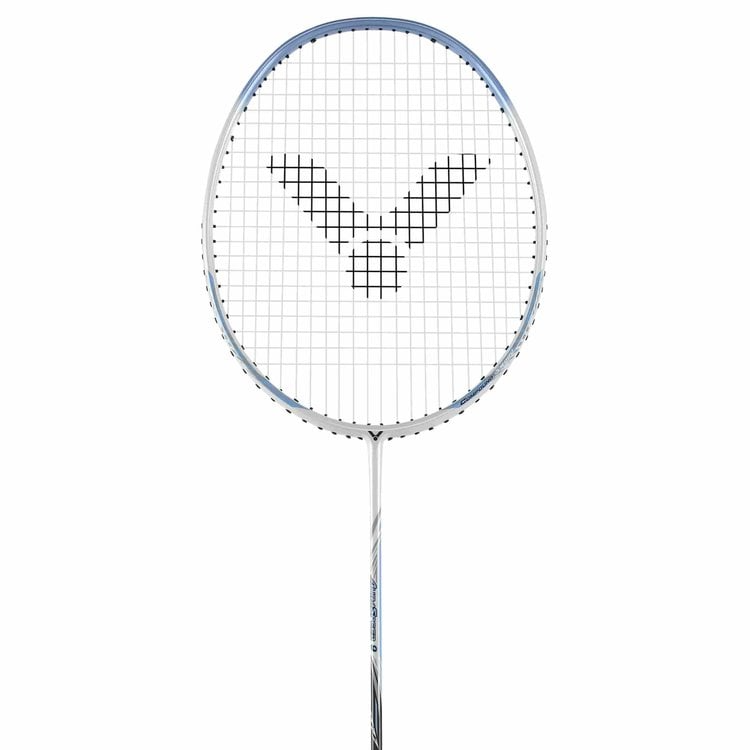
Victor Auraspeed 9
A top-tier brand’s entry to the speed game
Victor is one of badminton’s three giant brands — the name on professional tour rackets worldwide — and the Auraspeed 9 (sold as the ARS-9, badged 9A or 9F depending on market) is the affordable doorway into its speed series. A 4U frame, even balance and flexible shaft make it the connoisseur’s beginner pick for fast, flat games.
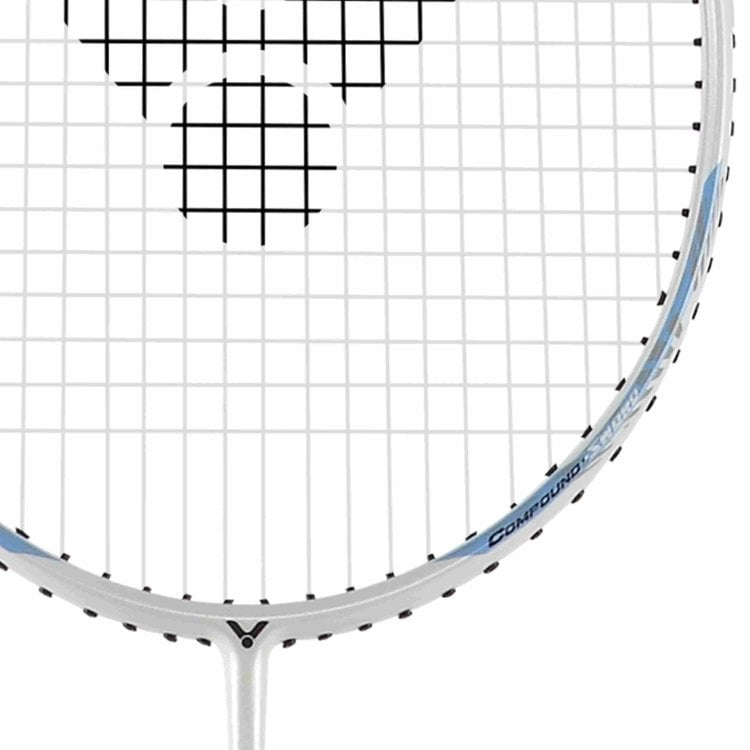
The headline technology is the Compound-Sword frame: Victor segments the head profile to reduce air resistance while keeping the frame stable, so the racket accelerates quickly without wobbling at contact. Combined with the Seven Six 76 grommet system (designed to cut string friction) and an even balance, you get a racket that changes direction almost as fast as you can think — ideal for drives, net kills and the scrambling defence that dominates social and doubles badminton. The flexible shaft quietly tops up your power, so the speed doesn’t cost you depth on clears.
Two honest caveats. First, US stock runs through Victor’s dealer network and can fluctuate between colourways and the 3U/4U variants — the Amazon button will show what is actually available. Second, an even-balance speed frame will never smash like the Astrox Smash; it trades peak power for rally speed. If your game is quick hands and fast feet rather than back-court bombing, this is the most technically interesting racket on this page.
Pros
- Sword-frame aerodynamics for genuinely fast swings
- Even balance suits all-round and doubles play
- Flexible shaft keeps clears effortless
- Tour-brand engineering at an entry price
Cons
- US availability varies by variant and colourway
- Less smash momentum than head-heavy picks
As an Amazon Associate we earn from qualifying purchases.
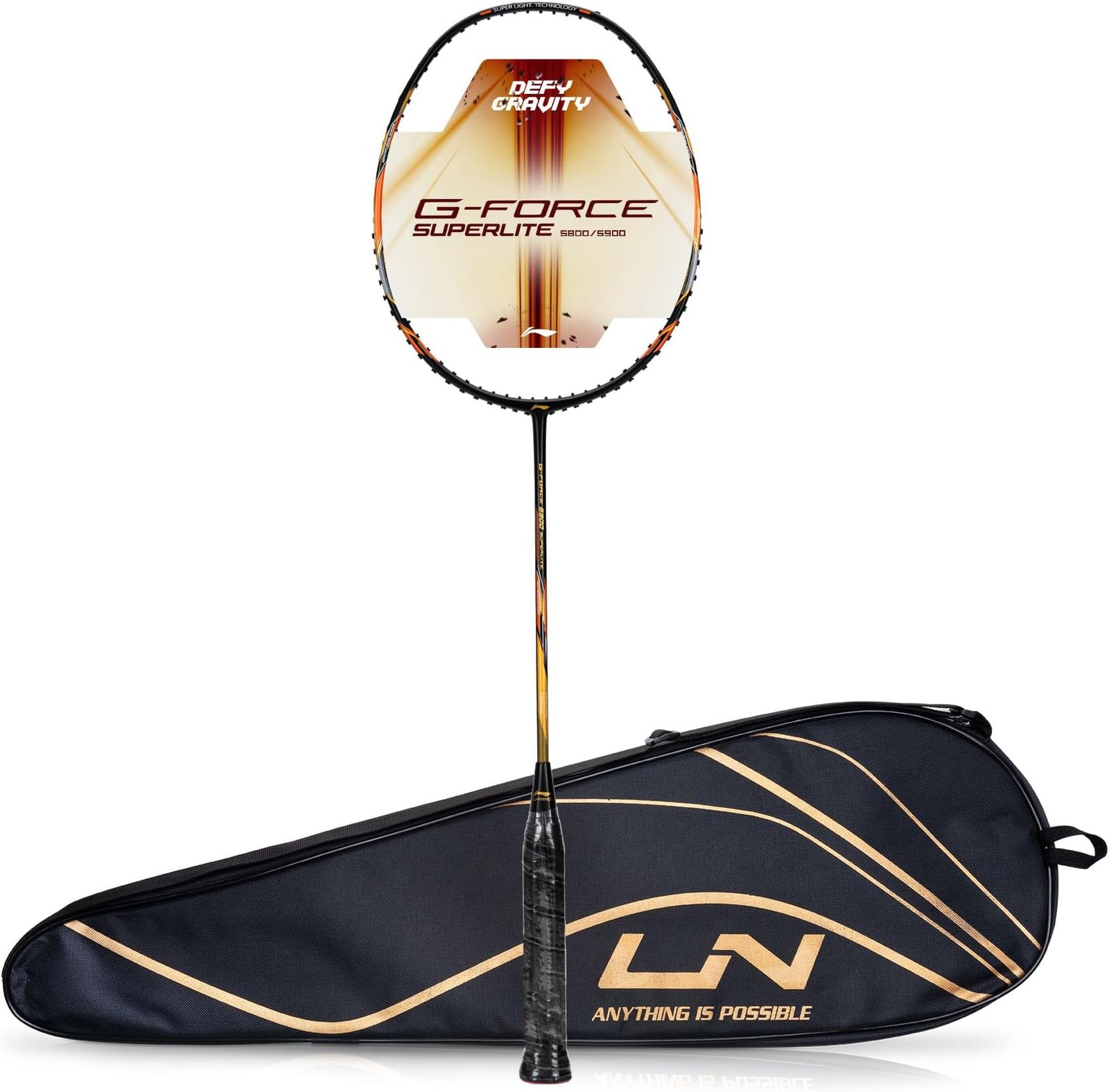
Li-Ning G-Force 5800 Superlite
Major-brand attacking play, entry-level price
Li-Ning is the third giant of world badminton, and its G-Force line is where the brand hides its value: full carbon-fibre construction, a head-heavy attacking balance and a 78-gram frame. The 5800 Superlite is the variant with a long-running Amazon listing, and it gives beginners a genuine attacking racket without a premium invoice.
The recipe mirrors the Astrox Smash — light total weight, weight pushed into the head — executed Li-Ning’s way. The Dynamic Optimum Frame reshapes the head to enlarge the sweet spot and lengthen the effective string bed, which helps attacking beginners in two places: smashes stay on target when contact is slightly high, and clears get extra repulsion from the longer strings. A 30 lbs tension ceiling is unusually generous at this level, so the frame won’t cap you when a stringer eventually asks what tension you play.
Why is it ranked below the Astrox Smash? The Yonex is lighter still (73g vs 78g) and its shaft tech is a step more refined; the G-Force counters with Li-Ning’s typically keener street pricing and a slightly more solid, less twitchy feel that some players prefer. Either way, this is the value pick for the beginner who already knows they want to attack: carbon everywhere that matters, an honest head-heavy punch, and a full cover in the box. (The G-Force Superlite Max 10 is the line’s newer variant — same lightweight attacking formula if you spot it listed.)
Pros
- Full carbon fibre at an entry-level price
- Head-heavy punch in a 78g frame
- Generous 30 lbs tension ceiling to grow into
- Strung with full cover included
Cons
- Slightly heavier than the 73g Astrox Smash
- Variant names in the G-Force line can confuse — check the listing title
As an Amazon Associate we earn from qualifying purchases.
Yonex GR 303 Combo
The aluminium-and-steel workhorse
Not every beginner needs graphite. The GR 303 pairs an aluminium frame with a low-torsion steel shaft — the classic school, club and PE-department construction — and it is sold on Amazon as a single racket or a combo of two with a full cover. It is the racket you buy when survival matters more than feel.
Let’s be clear about the trade you’re making. At 90–95 grams the GR 303 is the heaviest racket on this page, and steel and aluminium cannot match graphite for vibration absorption or touch. What you get instead is a frame that shrugs off the beginner experience: clashed rackets in doubles, drops onto sports-hall floors, being thrown in a kit bag without its cover. The low factory string tension (around 17–19 lbs) is actually well judged — the string bed plays like a trampoline, which flatters slow swings and makes the sweet spot feel generous.
That makes this the right buy for specific people: schools and clubs equipping a class, families who want two rackets in one box, backyard and park players, and anyone whose “court” is a driveway. Serious learners will outgrow it within a season — the weight slows your wrist and the materials cap your touch shots — but as a first, cheapest, hardest-to-kill step into the game with a real brand name on the shaft, it has earned its decades-long production run.
Pros
- Aluminium/steel build survives beginner abuse
- Combo format equips two players in one box
- Low factory tension flatters slow swings
- Cheapest genuine Yonex way into the game
Cons
- Heaviest pick here — slower wrist action
- Metal construction limits feel and touch
As an Amazon Associate we earn from qualifying purchases.
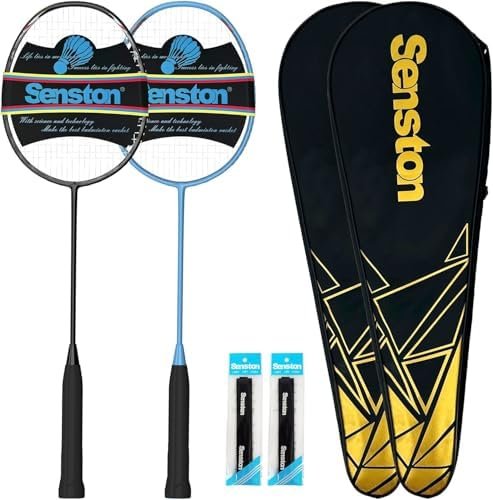
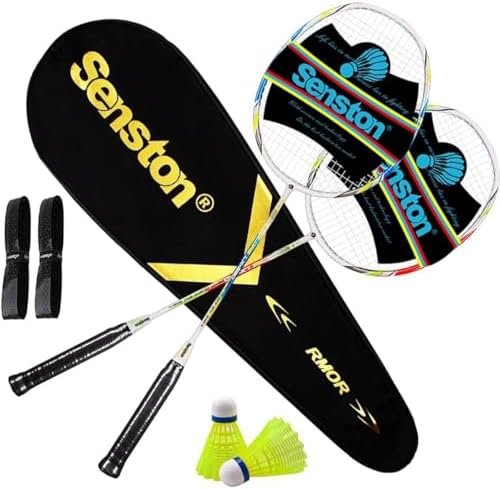
Senston N80 2-Pack
Two full-carbon rackets for less than one big-brand frame
Senston is the name Amazon beginners actually buy, and the N80 2-pack is why: two rackets with full carbon-fibre frames and shafts — not the steel you’d expect at this money — each 5U light, pre-strung around 25 lbs, with two overgrips and a carry bag in the box. It is the reality pick for absolute beginners and families.
The spec sheet embarrasses most budget sets. A one-piece carbon construction with a built-in T-joint at 5U weight is the same recipe as the big brands’ entry graphite — because it is. The even balance point (295mm) keeps the rackets neutral and easy to learn on, the factory tension around 25–26 lbs sits at the top of the beginner-friendly range, and nine colour options across the range mean the two rackets in a family set don’t have to match. For a couple, two siblings, or a parent-and-kid pairing, nothing else on this page gets two people playing for this little.
Set expectations honestly: Senston’s quality control and finish are a tier below Yonex, Victor and Li-Ning, the “professional” wording in its listing title is marketing, and if you fall hard for badminton you will upgrade within a year. But that’s the point of the pick — it de-risks the experiment. Spend twin-pack money now, learn whether badminton is your sport, and let your second purchase be an informed one from the top of this page.
Pros
- Two full-carbon 5U rackets in one box
- Overgrips and carry bag included
- Even balance, sensible factory tension
- The lowest-cost route for two players
Cons
- Finish and QC a tier below the big brands
- Keen improvers will upgrade within a year
As an Amazon Associate we earn from qualifying purchases.
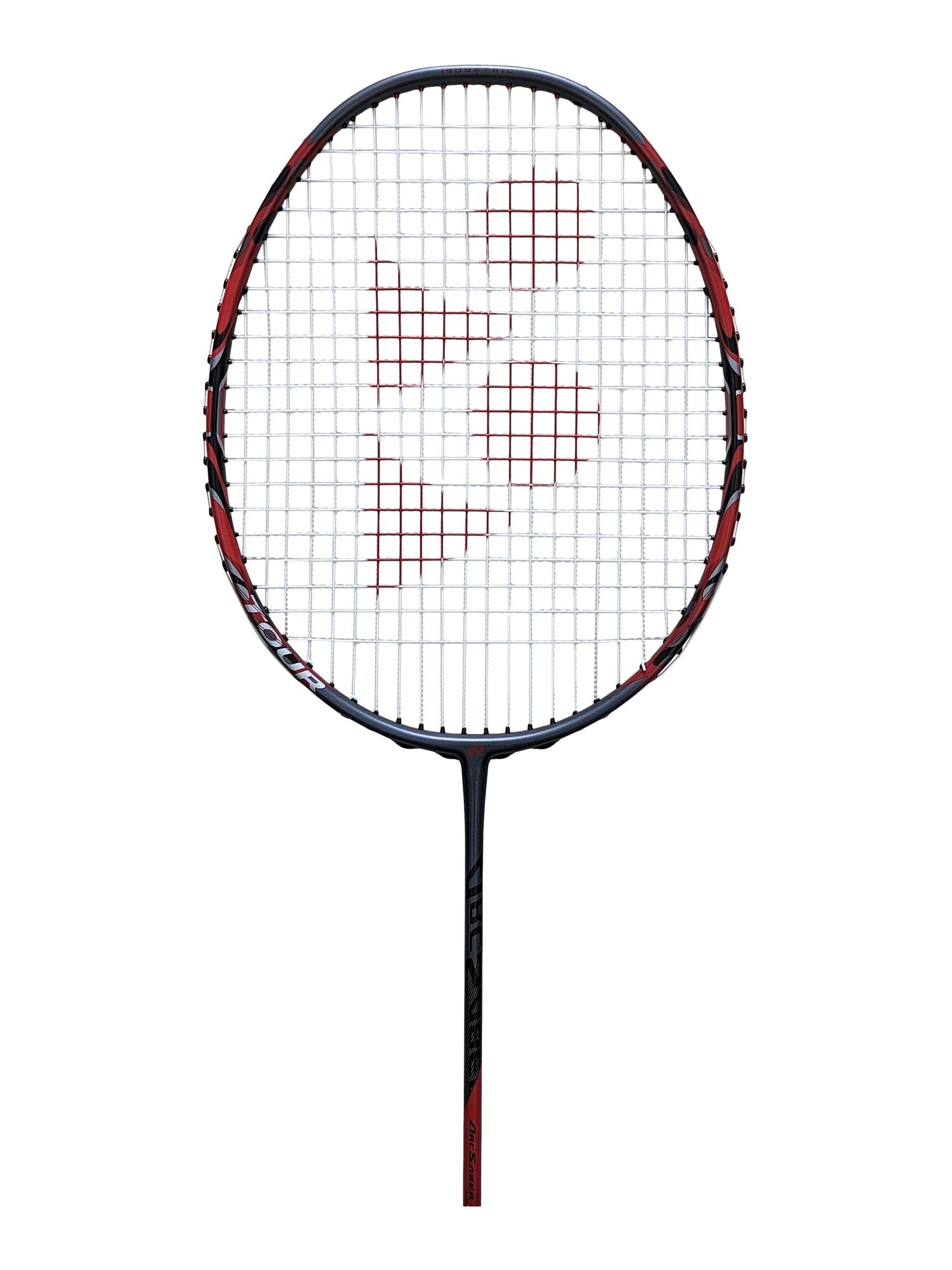
Yonex Arcsaber 11 Play
A famous control frame, priced for beginners
The Arcsaber 11 is one of the most successful control rackets ever made, and the Play version distils it for normal humans: the same even balance and shuttle-holding frame idea, in full graphite at 4U, with a medium-flex shaft instead of the pro’s stiff one. It is the beginner racket least likely to be replaced.
The Arcsaber idea is dwell time: the frame is designed to flex at impact and hold the shuttle on the string bed a fraction longer, which translates into placement — drops that go where you aimed, drives you can steer, defence you can direct instead of just block. The Play supports that with a Control-Assist Bumper that locks the vertical strings for accuracy, a box frame profile for a solid, stable strike, CS Carbon Nanotube in the frame sides for elasticity, and an Ultra PEF shaft that absorbs shock. Retailers rate its level as beginner-to-intermediate, and it is genuinely in stock at US badminton specialists as well as Amazon.
Who should pick it over the Nanoray at the top? The beginner who already swings reasonably well — perhaps crossing over from tennis or squash — and cares more about control than free power. Medium flex asks a little more of your swing than the flexible picks, and in return the racket stays rewarding as your technique sharpens. If your swing is brand new, start with the Nanoray’s flexibility; if it’s merely new to badminton, this is the connoisseur’s first racket.
Pros
- Pro-lineage control frame at a beginner price
- Even balance and medium flex reward improving technique
- Factory strung, full cover, ready to play
- Stocked by US specialists and Amazon alike
Cons
- Medium flex gives less free power than flexible picks
- Priciest single racket on this page
As an Amazon Associate we earn from qualifying purchases.
Beginner badminton rackets compared
| Racket | Weight class | Shaft flex | Balance | Frame / shaft | Best for |
|---|---|---|---|---|---|
| Yonex Nanoray Light 18i | 5U (~77 g) | Flexible | Head-light | Full graphite | Best overall first racket |
| Yonex Astrox Smash | F (~73 g) | Hi-flex | Head-heavy | Graphite + tungsten / Nanomesh NEO | Smash power, back-court play |
| Victor Auraspeed 9 | 4U (~84 g) | Flexible | Even | Graphite + resin | Fast drives, doubles defence |
| Li-Ning G-Force 5800 Superlite | 5U class (~78 g) | Flexible–medium | Head-heavy | Carbon fibre | Li-Ning value attacking play |
| Yonex GR 303 Combo | ~90–95 g strung | Steel shaft | Even (listing) | Aluminium / steel | Schools, clubs, durability |
| Senston N80 2-Pack | 5U (75–79 g) | Flexible | Even (~295 mm) | Full carbon fibre | Two players, tightest budget |
| Yonex Arcsaber 11 Play | 4U (83 g) | Medium | Even | Graphite / Ultra PEF | Control players, growing into |
What to buy with it
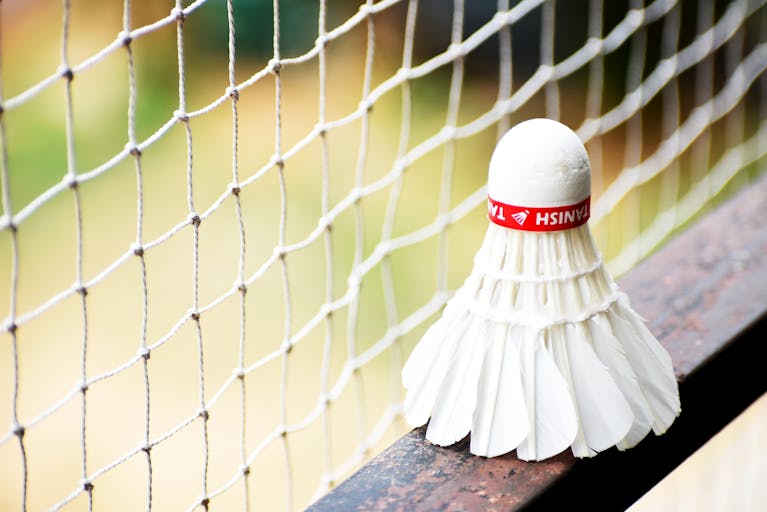
Three small extras complete a beginner setup — and one of them is a decision, not a purchase. Shuttlecocks: buy nylon, not feather, while you learn. Feather shuttles fly beautifully and die quickly — a mistimed smash bends or snaps feathers, and beginners mistime a lot. Nylon shuttles (Yonex’s Mavis range is the benchmark) fly slightly less true but survive weeks of learning, which makes them far cheaper per hour of play. Switch to feathers when your hitting is clean enough not to shred them — most clubs play feathers, so you’ll meet them soon enough. Beyond shuttles, a spare overgrip and a simple case cover the rest.
Yonex Mavis Nylon Shuttlecocks
The durable learner’s shuttle — Mavis 350 is the classic club-practice choice. Buy a tube of six and stop rationing feathers. Check on Amazon →
Overgrip Tape (Multi-Pack)
Builds a small grip up to size, adds cushioning and replaces in minutes when sweaty. The cheapest comfort upgrade in the sport. Check on Amazon →
Racket Case or Cover
Most picks here include a full cover — if yours doesn’t, a padded case stops frame chips and string damage in your kit bag. Check on Amazon →
Your first month: what a beginner racket can and cannot fix
Manage expectations and the racket will delight you. A good beginner racket can fix gear problems: it will give your clears free depth, forgive the off-centre hits you’re still making, and keep your arm fresh through long rallies. It cannot fix technique — and the honest news is that your first month’s errors will be footwork errors. Badminton is won by arriving balanced, not by swinging harder; if your clears are landing short in week three, the answer is almost never a stiffer racket, it’s your split-step and scissor kick. Book one coaching session or follow a structured beginner footwork routine before you blame your equipment.
Two habits from day one will double your racket’s lifespan: never pick a shuttle up off the floor with the frame (scoop it with a string-bed flick or your hand), and never clash rackets celebrating a doubles point — that’s how most beginner frames actually die. Coming from another racquet sport? The gear logic you know transfers: just as table tennis tables reward buying the right level for your stage, badminton rewards matching shaft flex to swing speed, not to ambition. And when you’re ready to stock the rest of the gear shelf, our padel ball guide covers the sister sport’s essentials.
Beginner badminton racket FAQs
What makes a badminton racket good for beginners?
Four things: a light weight class (4U at 80–84g or 5U at 75–79g), a flexible or medium-flex shaft that adds power to slow swings, an even or head-light balance that keeps the racket manoeuvrable, and an isometric head shape for a bigger, more forgiving sweet spot. Every racket on this page ticks those boxes; the differences between them are flavour — power, speed, control or durability — not quality of the basic recipe.
Should a beginner buy a head-heavy or head-light racket?
Most beginners should start head-light or even-balance: the racket changes direction quickly, defending and learning net play is easier, and your arm tires less. Choose head-heavy only if you play an attacking, back-of-court style — and even then, pick a light head-heavy frame like the 73g Yonex Astrox Smash or the 78g Li-Ning G-Force 5800 Superlite, where the total weight stays low enough for a developing arm.
What does shaft flexibility mean, and which do I need?
The shaft bends backwards during your swing and whips forwards at impact. A flexible shaft does more of that whipping for you, which means free power when your swing is slow — exactly the beginner situation. Stiff shafts are more precise but only reward fast, well-timed swings. Beginners need flexible or medium flex; ignore stiff and extra-stiff until you have a year of regular play behind you.
3U vs 4U vs 5U — which weight class for a beginner?
4U (80–84g) is the safest default: light enough for long sessions, substantial enough to learn real technique. 5U (75–79g) suits younger players, smaller frames, or anyone whose shoulder complains — and the lightest frames go further still, like Yonex’s 73g F-class Astrox Smash. Leave 3U (85–89g) until you’re an experienced player who wants the extra stability and momentum; it will slow a beginner’s learning curve.
How much should a beginner spend on a badminton racket?
Less than you fear. The picks on this page run from a budget twin-pack (the Senston N80 gives you two carbon rackets) up to the Yonex Arcsaber 11 Play. A sensible beginner budget is roughly $40–$90 for a single big-brand racket: below that range you’re in twin-pack and metal-frame territory (still fine for starting out), and above it you’re paying for intermediate specifications you can’t use yet.
Can a beginner use a professional racket?
You can hold one, but it will make you worse. Pro rackets pair extra-stiff shafts with high string tensions and small effective sweet spots; they assume a fast, repeatable swing and clean contact. In a beginner’s hands they produce weak, jarring shots and sore arms. The beginner versions of pro lines — like the Arcsaber 11 Play, which keeps the pro frame’s shape but softens the shaft to medium flex — exist precisely to bridge that gap.
Feather or nylon shuttlecocks for learning?
Nylon, without hesitation. Feather shuttles fly truer but a single mishit can bend or break feathers, and beginners mishit constantly — feathers become an expensive habit. Nylon shuttlecocks such as Yonex’s Mavis range fly slightly less perfectly but survive weeks of practice, making them dramatically cheaper per hour while you learn. Switch to feathers once your contact is clean, or when your club’s games demand them.
The verdict
Buy the Yonex Nanoray Light 18i if you want the safest, lightest all-round start in badminton. Buy the Astrox Smash if smashing is why you’re here. Buy the Victor Auraspeed 9 if your game is speed and doubles. Buy the Li-Ning G-Force 5800 Superlite if you want big-brand attacking value. Buy the GR 303 Combo if the rackets must survive a school term. Buy the Senston N80 2-pack if two players are starting on one budget. Buy the Arcsaber 11 Play if you’d rather grow into your racket than out of it. Whatever you choose: light, flexible, isometric — and spend the money you saved on court time and nylon shuttles.
Affiliate disclosure: Alishuttler.com is a participant in the Amazon Services LLC Associates Program. The Amazon buttons on this page use our affiliate tag — if you buy through them, we may earn a commission at no extra cost to you. Prices shown on Amazon are live and may differ from any figures mentioned here.