This is not a list of pink rackets. It is a list built on the two specifications that actually change how a racket feels in a smaller hand: how much the frame weighs, and how slim the grip circumference is underneath your fingers. These seven rackets are organised by that decision — featherweight frames for fast doubles, head-light speed frames, even-balance frames for singles control, and the flexible-shaft lightweights that put head-heavy power into a 72–78 gram package.
⚡ TL;DR — The Short Answer
For the best all-round lightweight pick, buy the Yonex Nanoflare 700 Pro — a head-light 4U frame (also made in 5U) with a medium flex and a G5 grip option. For the slimmest grip in this guide, the Victor AuraSpeed 90F comes in 4U and 5U with a G6 grip and an even balance made for fast, continuous drives. Advanced doubles players who swing fast should look at the stiff, head-light Yonex Nanoflare 800 Pro. The lightest racket here is the Li-Ning Windstorm 72 at a maker-stated 72 grams, the Victor JetSpeed S 12F is the front-court doubles specialist, the Li-Ning G-Force 5800 Superlite pairs 78 grams with a G6 grip and a head-heavy attacking balance, and the Victor DriveX 9X is the even-balance, stiff-shaft control pick for singles.
Quick Picks — Best Badminton Rackets for Women at a Glance
Head-light, medium flex, 4U or 5U with G5/G6 grip options — the easiest high-end light frame to recommend.
A G6 grip in both 4U and 5U, even balance and a 6.8 shaft built for fast, continuous flat play.
Stiff, head-light and 4U — the drive-game specialist for advanced players with grooved technique.
A maker-stated 72 grams with a 315 mm head-heavy balance point — ultra-light without giving up rear-court weight.
Head-light toward even balance, medium-stiff flex and a G5 grip for net kills and fast interceptions.
78 grams, a G6 grip, a flexible shaft and a head-heavy balance — attacking intent in a genuinely light frame.
Even balance, a stiff shaft and a slim 6.6 shaft — precision and continuity for the all-court singles game.
In This Guide
Start With Weight and Grip, Not the Colourway
Most “women’s” racket marketing starts with the paint. Ignore it. What decides whether a racket suits a smaller hand and a lighter swing is written in the specification table, in two lines most buyers skip: the weight grade and the grip grade. A 3U racket at roughly 88–89 grams with a G4 grip asks your wrist and fingers to manage more mass and more circumference on every single shot. A 4U or 5U frame with a G5 or G6 grip removes both loads at once — the racket head arrives faster with the same effort, and your fingers close around the handle instead of stretching around it. That is the entire premise of this guide, and every racket below was chosen because its published specification puts it on the lighter, slimmer side of its maker’s range.
The second decision is balance, and it maps cleanly onto how you play. Head-light frames — the two Nanoflare Pro models and the JetSpeed S 12F — keep mass away from the head so the racket recovers quickly between shots, which is why doubles players who live on drives, blocks and interceptions reach for them. Even-balance frames — the AuraSpeed 90F and the DriveX 9X — split the difference and suit all-court and singles play, where you need rear-court depth as well as front-court speed. And the two Li-Ning lightweights prove a third route exists: a head-heavy balance inside an ultra-light frame, where a 315 mm balance point on the Windstorm 72 puts what little mass there is toward the head, so clears and smashes keep their weight even though the whole racket weighs 72 grams.
One boundary before the picks. If you are choosing a first adult racket across all weights and playing styles, that wider decision belongs to our guide to the best badminton rackets for beginners, which covers the full range of starter and step-up frames for adult players of every hand size. This page deliberately narrows the field: it assumes you have already decided you want a lighter frame and a slimmer grip, and it ranks only the rackets that deliver both. Read the beginners guide for the broad shortlist, then come back here when the question becomes which light frame, which balance, and which grip.
The Four Specs That Actually Decide It
Weight, in U grades. Badminton rackets are graded in U classes: 3U is roughly 85–89 grams, 4U roughly 80–84 grams, and 5U roughly 75–79 grams, with Li-Ning’s lightest Windstorm models going further still and simply stating the gram weight — 72 grams for the Windstorm 72, 78 grams for the G-Force 5800 Superlite. Every racket in this guide is 4U, 5U or a maker-stated gram weight in that same light territory. Lighter is not automatically better — it is better for swing speed, defensive reactions and long sessions, and it asks more of your technique when you need rear-court power, which is exactly why balance matters alongside it.
Grip size, in G grades. In the grading most makers use, a higher G number means a slimmer handle: G6 is slimmer than G5, which is slimmer than G4. Smaller hands generally close more securely around a G5 or G6, and a grip you can close around properly is a grip you do not have to squeeze — which keeps the forearm relaxed and the wrist free. Two cautions, both covered in the buying guide: grip grades are not perfectly standardised between brands, and Li-Ning lists some models in its own S sizing — the Windstorm 72 is listed as S1 on Li-Ning’s own store, and we card it exactly that way rather than converting it. An overgrip also adds circumference, so the slimmest starting grip leaves you room to build up, never the other way round.
Balance tells you where the mass sits. Makers state it as a character — head-light, even balance, head-heavy — and sometimes as a balance point in millimetres, as Li-Ning does with the Windstorm 72’s 315 mm. Head-light suits fast, flat, front-and-mid-court play; even balance suits the all-court game; head-heavy suits attacking play, and in an ultra-light frame it is the trick that keeps clears reaching the back tramlines. Shaft flex is stated exactly as each maker states it on the cards below — medium, stiff, flexible, hi-flex language and all — because flex labels are each brand’s own scale. As a working rule, more flexible shafts help generate power from shorter, developing swings, while stiffer shafts reward full, fast swings with a crisper, more direct response. The buying guide at the end turns all four specs into simple choosing rules.
The 7 Best Badminton Rackets for Women, Compared
Seven rackets, one shared brief — light frames, slim grips — and four different answers to it. The ranking runs from the most universally suitable light frame down to the specialist control pick, not from best to worst: read the card that matches your game first.
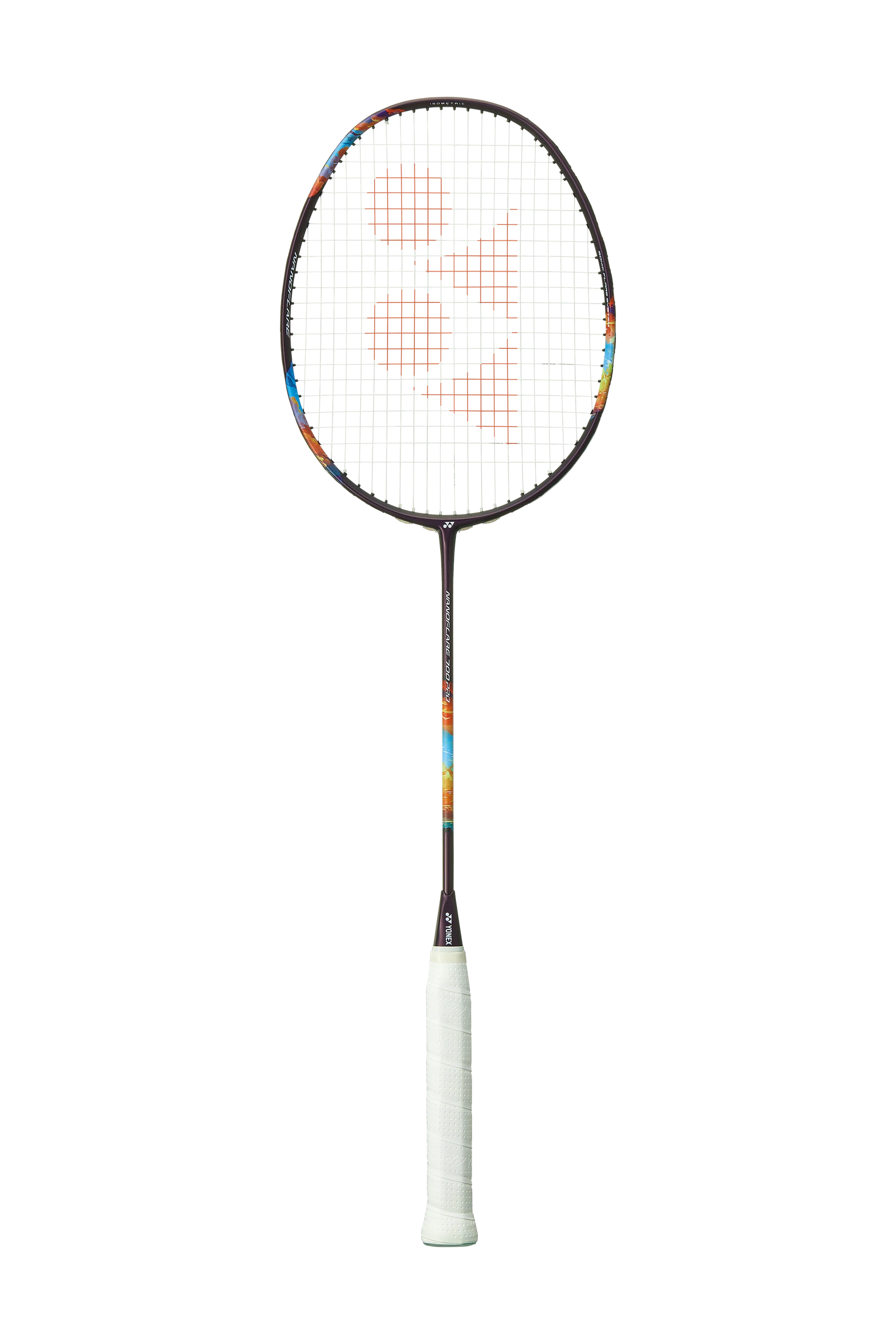
Yonex Nanoflare 700 Pro
The complete lightweight package — head-light speed, a forgiving medium flex, and both 4U and 5U versions with slim grip options.
The Nanoflare 700 Pro is the easiest recommendation on this page because it makes the light-frame decision at two levels. Start with the 4U version at an average 83 grams if you play a full all-court game and want a light racket that still feels substantial on rear-court clears. Step down to the 5U version if your game lives at the front and in the mid-court, where recovery speed between shots is worth more than a few grams of head mass. Both versions are head-light in the Nanoflare manner — Yonex builds this line around a fast, defensive-to-counterattacking head — and both are listed with G5 and, on the 5U, G6 grip options, so the smaller-hand half of the brief is covered without resorting to aftermarket fixes.
The medium flex is the other half of why this frame suits so many players. Yonex rates the shaft as medium, between the forgiving end of its range and the stiff end occupied by the 800 Pro below, and that middle setting is honest equipment for an intermediate-to-advanced player whose swing is quick but not yet tour-fast: the shaft contributes to shuttle speed on drives and clears without demanding perfect timing on every contact. The frame recipe — HM Graphite with NANOMETRIC DR, M40X and EX-HYPER MG — is Yonex’s current high-end speed construction, and Yonex says its Enhanced Sonic Flare System is designed to combine repulsion with stability at contact. The racket is also 10 mm longer than standard, which buys a little reach at the net and leverage from the back — useful compensation when the frame itself is light. If you want one premium light racket and no second-guessing, this is it.
What we like
- Two genuinely light versions — 4U and 5U — so you choose the weight, not just the colour
- G5 and G6 grip options cover smaller hands properly
- Medium flex suits the widest range of swing speeds in this guide
- Head-light balance keeps defence and counter-drives fast
Worth knowing
- Rear-court power players may prefer the head-heavy Li-Ning pair below
- The 10 mm longer length takes a session or two to trust at the net
As an Amazon Associate we earn from qualifying purchases.
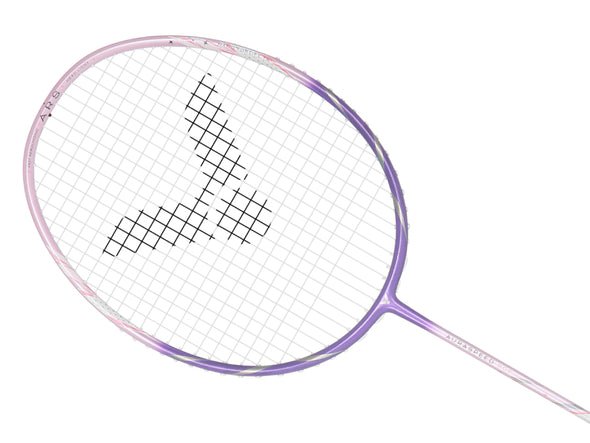
Victor AuraSpeed 90F
The G6 grip pick — an even-balance speed frame in 4U and 5U, built around fast, continuous flat play.
If grip circumference is your deciding factor, the AuraSpeed 90F is where this guide points first. Victor lists it in 4U/G6 and 5U/G6 — that G6 is the slimmest grip grade carded in this roundup, on both weight versions, so you are not forced to choose between the weight you want and the handle you want. For a player whose fingers have spent years wrapping around a G4 or G5 handle that never quite closed, the difference is immediate: finger control on net shots improves, the grip hand relaxes, and quick grip changes between forehand and backhand in flat exchanges stop feeling like wrestling the handle.
The rest of the specification is a coherent speed brief. Victor positions the 90F as the lighter, more agile member of its AuraSpeed speed line, with an even balance that keeps it honest in every third of the court rather than specialising in one. The 6.8 shaft uses PYROFIL carbon fibre, which Victor says is an ultra-light, high-intensity material that adds shock absorption and control, and Victor describes the 90F as pairing a stiffer shaft with its FREE CORE synthetic handle so the shaft can move more freely through the swing — the practical aim being continuity: drives, blocks and counter-drives strung together without the racket ever feeling like it is catching up with you. Choose the 5U/G6 if you play front-court doubles, the 4U/G6 if you rotate to the back and still need your clears to carry.
What we like
- G6 grip on both the 4U and 5U versions — the slimmest handle here
- Even balance keeps it usable from every court position
- FREE CORE handle and PYROFIL shaft are aimed at smooth, continuous flat play
- Two weight options let doubles and all-court players share one model
Worth knowing
- Even balance gives less free rear-court help than the head-heavy picks
- Players who build up grips with thick overgrips will cancel the G6 advantage — wrap thin
As an Amazon Associate we earn from qualifying purchases.
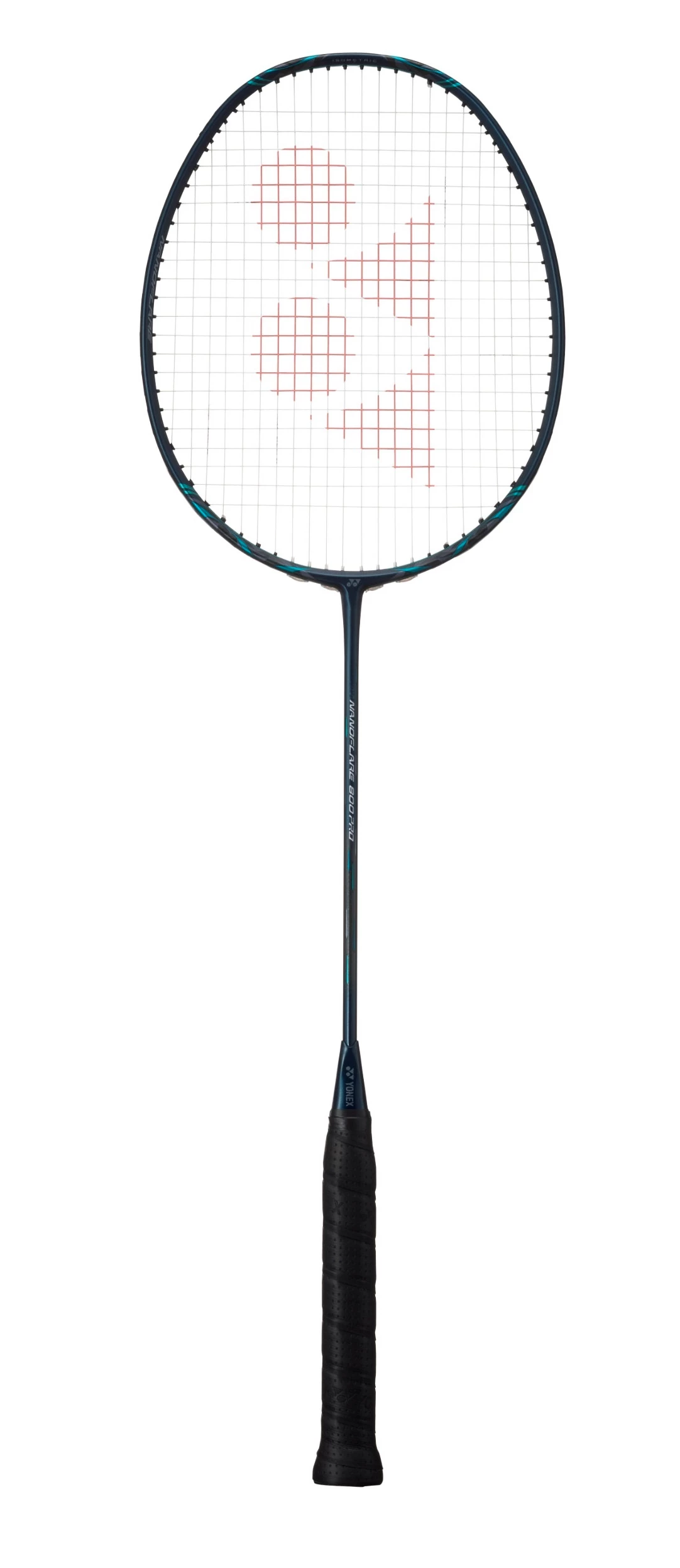
Yonex Nanoflare 800 Pro
The advanced drive-game specialist — stiff, head-light and unapologetically built for the fastest exchanges in doubles.
Where the 700 Pro is the all-rounder, the 800 Pro is the specialist, and the specification tells you so in one word: stiff. Yonex rates this shaft at the firm end of its scale, pairs it with a head-light 4U frame, and aims the whole package at one job — the drive game. Flat, fast exchanges at mid-court, defensive blocks turned into counter-drives, and interceptions taken early are the shots this racket is engineered around. Yonex says the 800 Pro was designed to deliver fast, aggressive drive shots, with copper placed at the bottom of the frame and a wide-profile frame shape intended to keep the head stable when the swing is at full speed.
Be clear-eyed about who that suits. A stiff shaft returns energy quickly and precisely when your swing is fast and your timing is grooved — and it offers very little help when either is missing. Developing players will usually get more from the medium-flex 700 Pro above or the flexible Li-Ning frames below. But if you are an advanced club or tournament doubles player whose game is built on speed at the front and middle of the court, and you want that speed in an 83-gram frame with a G5 grip rather than a heavier tour-standard build, the 800 Pro is the sharpest tool in this guide. The materials underline the intent: M40X and SUPER HMG in both frame and shaft, with ULTRA PE FIBER in the shaft, which Yonex describes as a light fibre used for shock absorption.
What we like
- The fastest, most direct response in this guide for drive-based doubles
- Head-light 4U build keeps the head recovering between exchanges
- Wide-profile frame and copper weighting are aimed at stability at full swing speed
- G5 grip and 83-gram weight keep the advanced spec accessible to smaller hands
Worth knowing
- Stiff shaft punishes late timing — demo it if your swing is still developing
- Only carded here in 4U; there is no softer or lighter sibling in the Pro build
As an Amazon Associate we earn from qualifying purchases.
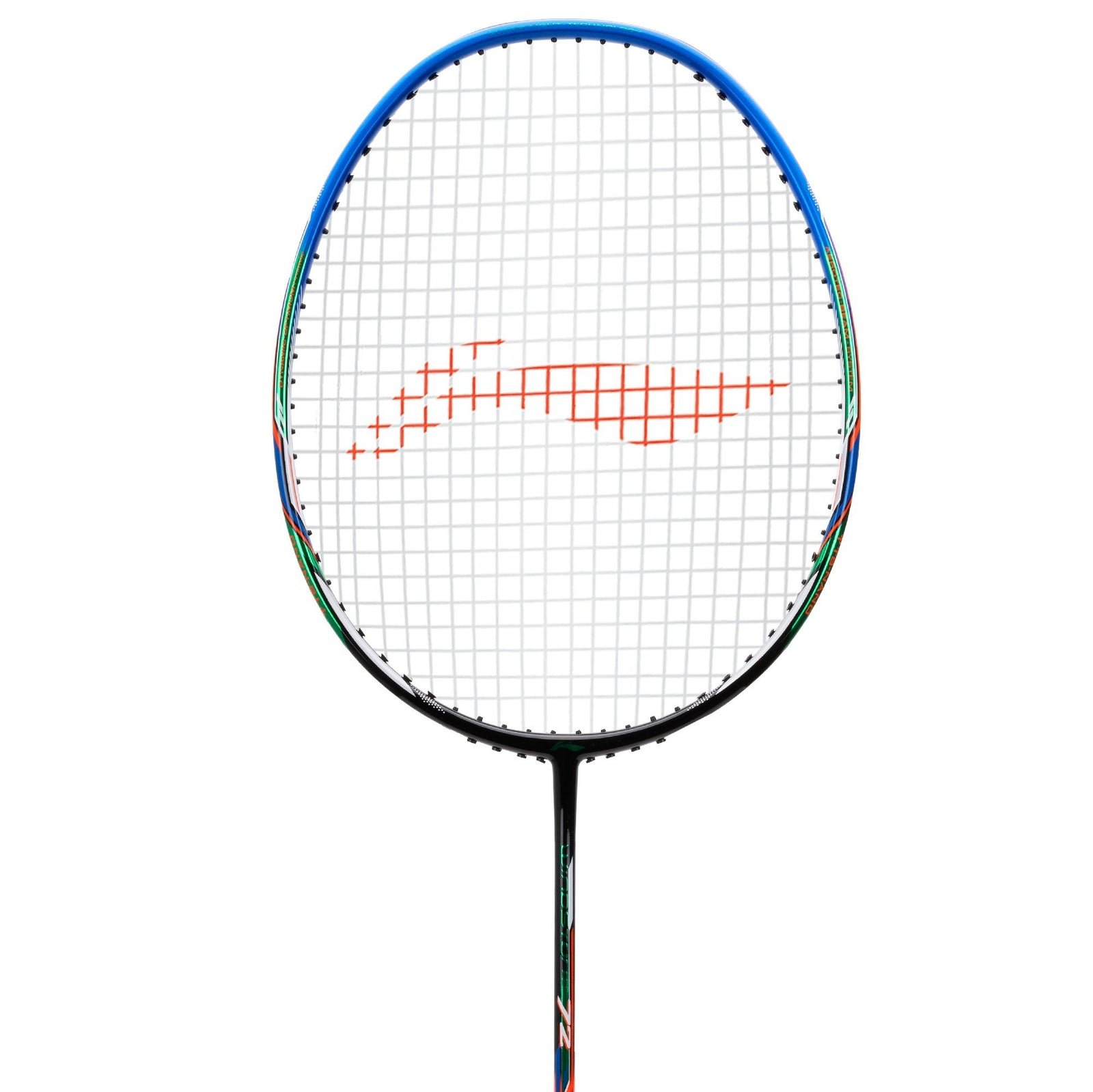
Li-Ning Windstorm 72
Seventy-two grams, stated by the maker — the ultra-light option that keeps a head-heavy 315 mm balance point so the power does not vanish with the weight.
Every other racket in this guide is light. The Windstorm 72 is in a different category of light: Li-Ning’s own store states the weight as 72 grams, full stop — around eleven grams below a standard 4U frame, and the lightest specification carded here. Rackets at this weight live or die on one question: can they still hit a full-length clear? Li-Ning’s answer is in the same specification table. The balance is listed as head-heavy with a balance point of 315 mm, which concentrates a large share of those 72 grams toward the head, so the head carries momentum through the swing even though there is very little total mass behind it. It is the opposite design philosophy to the head-light Nanoflares, arriving at a similar place — a fast racket — by the other road.
The rest of Li-Ning’s published specification supports the fast-attacking brief: a flexible shaft, which helps the racket contribute power on overhead shots when the swing is shorter; a carbon fibre build with Li-Ning’s Dynamic Optimum Frame shape; and a maximum tension of 30 lbs, which is high for a frame this light and lets experienced players string it properly rather than treating it as a casual racket. One sizing note, stated plainly because it matters: Li-Ning lists the grip on its own store as S1, its own size code, rather than a G grade — we have carded it exactly as the maker states it, and the buying guide below explains how to think about grip codes when brands use different systems. Li-Ning lists this model for professional-level, attacking players; read that as a sign of its intended standard, and let the flexible shaft — not the label — tell you how it will actually feel while your technique develops.
What we like
- The lightest maker-stated weight in this guide — 72 grams
- 315 mm head-heavy balance point protects clears and smashes at that weight
- Flexible shaft helps power on shorter, quicker swings
- 30 lbs maximum tension — a serious specification for an ultra-light frame
Worth knowing
- Grip is listed in Li-Ning’s S sizing (S1), not a G grade — check the guide below before comparing
- Ultra-light frames leave timing nowhere to hide on defensive blocks against heavy smashes
As an Amazon Associate we earn from qualifying purchases.
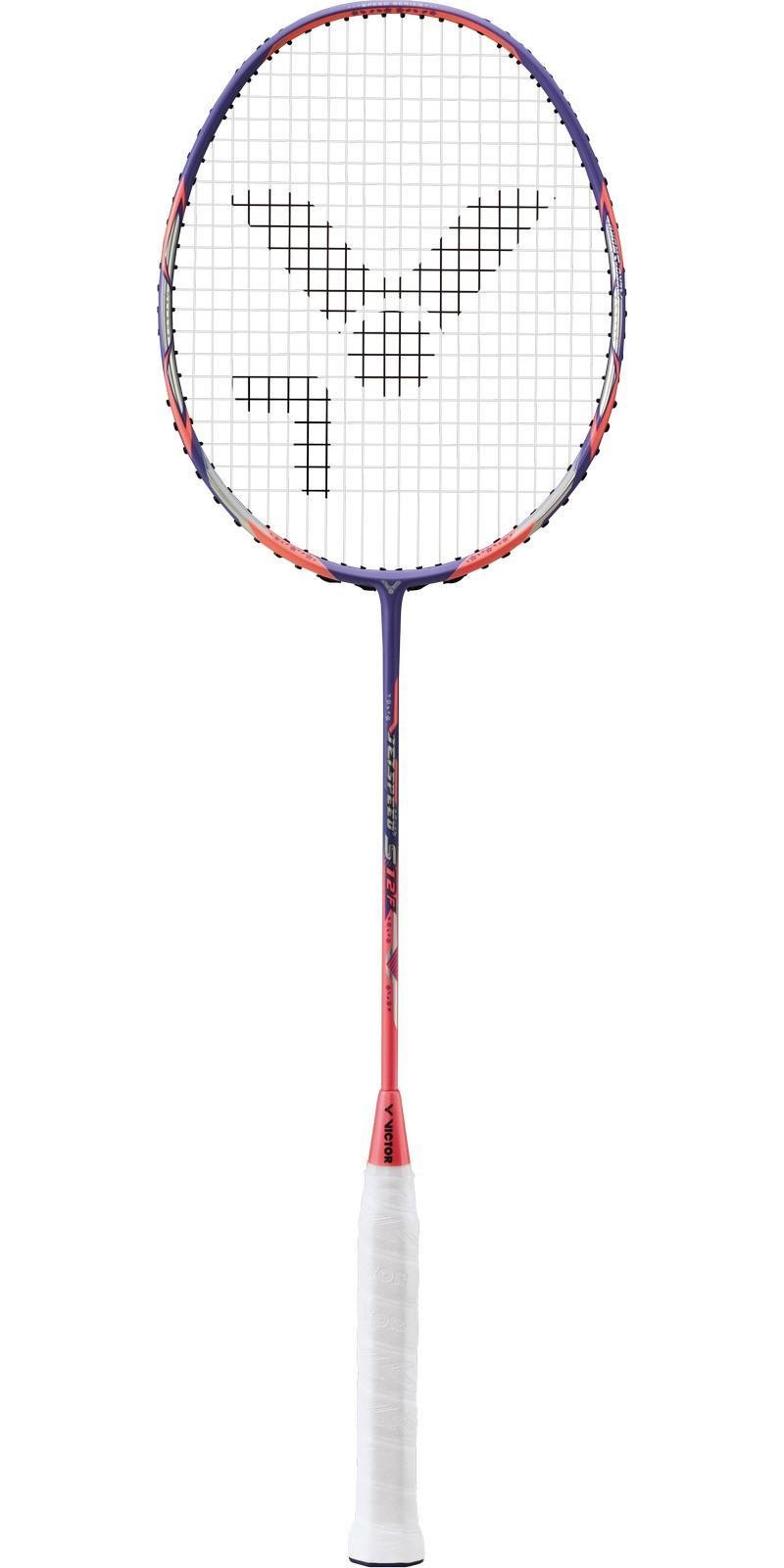
Victor JetSpeed S 12F
The net player’s Victor — head-light toward even balance, a medium-stiff shaft and a G5 grip for interceptions, kills and fast hands.
Front-court doubles is a reaction sport played inside a metre of the net tape, and the JetSpeed S 12F is specified for exactly that territory. Card the 4U/G5 version for this guide’s brief: the balance sits head-light toward even, which keeps the head quick to lift for interceptions and net kills while retaining just enough presence for the drives and pushes that set those kills up. Retailer specification tables that reproduce Victor’s published data list the flex as medium stiff — firmer than the AuraSpeed 90F’s middle setting, softer than the DriveX 9X’s stiff shaft — which is the right neighbourhood for front-court work: direct enough that a block lands where you aimed it, forgiving enough that a rushed contact does not spray.
Victor built the JetSpeed line around its TERS resin system, and the 12F carries TERS in both the frame and the 6.8 shaft alongside PYROFIL; Victor says the design brief was easy controllability at the net combined with fast, solid hitting when the rally opens up. That second clause matters, because a front-court specialist still has to survive rotation to the rear court — and the medium-stiff shaft and near-even end of the head-light range mean this racket does not collapse into a purely defensive tool when you are caught at the back. If your doubles role is built on reading the net, taking the shuttle early and winning the flat exchanges in between, this is the most position-specific pick in the guide. A racket is only half of that game, though: front-court speed starts in the feet, and our guide to the best badminton shoes covers the grip, cushioning and lateral support that fast net play demands.
What we like
- Head-light toward even balance is the front-court sweet spot
- Medium-stiff flex keeps blocks and kills direct without feeling harsh
- 6.8 shaft with PYROFIL and TERS in frame and shaft
- 4U/G5 build fits this guide’s light-frame, slim-grip brief exactly
Worth knowing
- Also sold in 3U — check the weight grade on the listing before you order
- Rear-court specialists will find more free power in the head-heavy Li-Ning pair
As an Amazon Associate we earn from qualifying purchases.
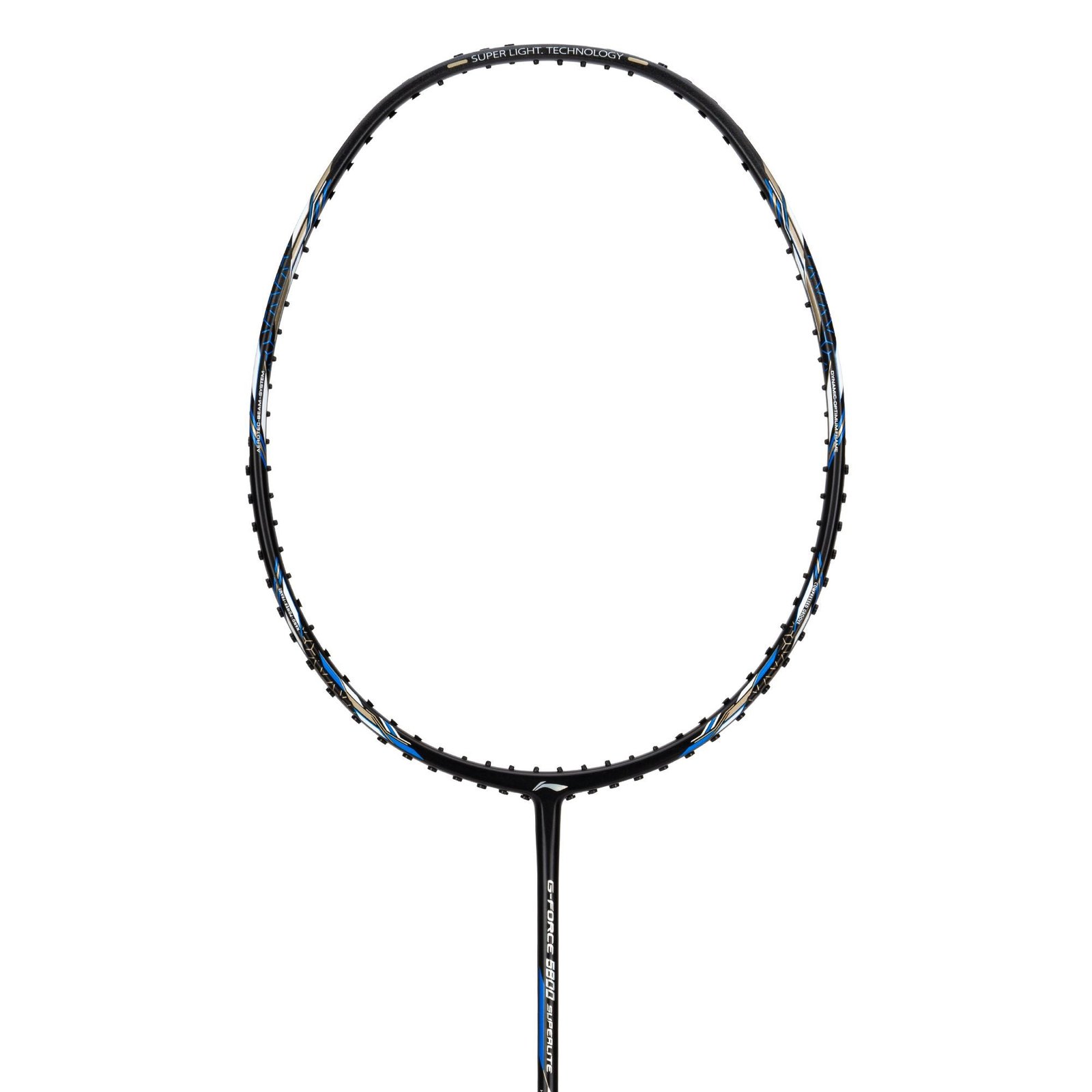
Li-Ning G-Force 5800 Superlite
Attacking intent at 78 grams — a head-heavy balance, a flexible shaft and a proper G6 grip, all verified on Li-Ning’s own store.
The G-Force 5800 Superlite makes the same argument as the Windstorm 72 — light frame, head-heavy balance, flexible shaft — at a slightly more substantial 78 grams and with one specification the Windstorm cannot offer on its maker’s own listing: a grip stated in the familiar G grading, at G6. That combination is why it earns its own card rather than a mention inside its sibling’s. If you like the ultra-light attacking concept but want the slimmest standard grip grade on the handle and a few extra grams of presence through the swing, Li-Ning’s own published specification gives you exactly that: 78 grams, head-heavy, flexible, G6, carbon fibre throughout.
Li-Ning describes the 5800 Superlite on its own store as engineered for aggressive play, with the flexible shaft contributing snap on smashes and the head-heavy balance carrying overhead shots — and it lists the model for intermediate, attacking players, which is a more honest label than most light rackets carry. The flexible shaft is doing real work in this design: at 78 grams there is limited mass to drive the shuttle, so the shaft’s contribution to shuttle speed on clears and smashes is part of the product, not a compromise. The Dynamic Optimum Frame shape and a 30 lbs maximum tension complete a specification that reads like a proper player’s racket scaled down, rather than a recreational racket dressed up. If you are building a full kit around a light attacking frame, our roundup of the best badminton sets covers the racket-and-shuttle combinations worth considering alongside it.
What we like
- G6 grip in G grading — no size-code translation needed
- 78 grams with a head-heavy balance keeps attacking shots honest
- Flexible shaft contributes power that the low weight cannot
- Every specification verified directly on Li-Ning’s own store
Worth knowing
- Flexible, head-heavy feel is the least precise combination here for tight net play
- Front-court doubles players are better served by the JetSpeed S 12F above
As an Amazon Associate we earn from qualifying purchases.
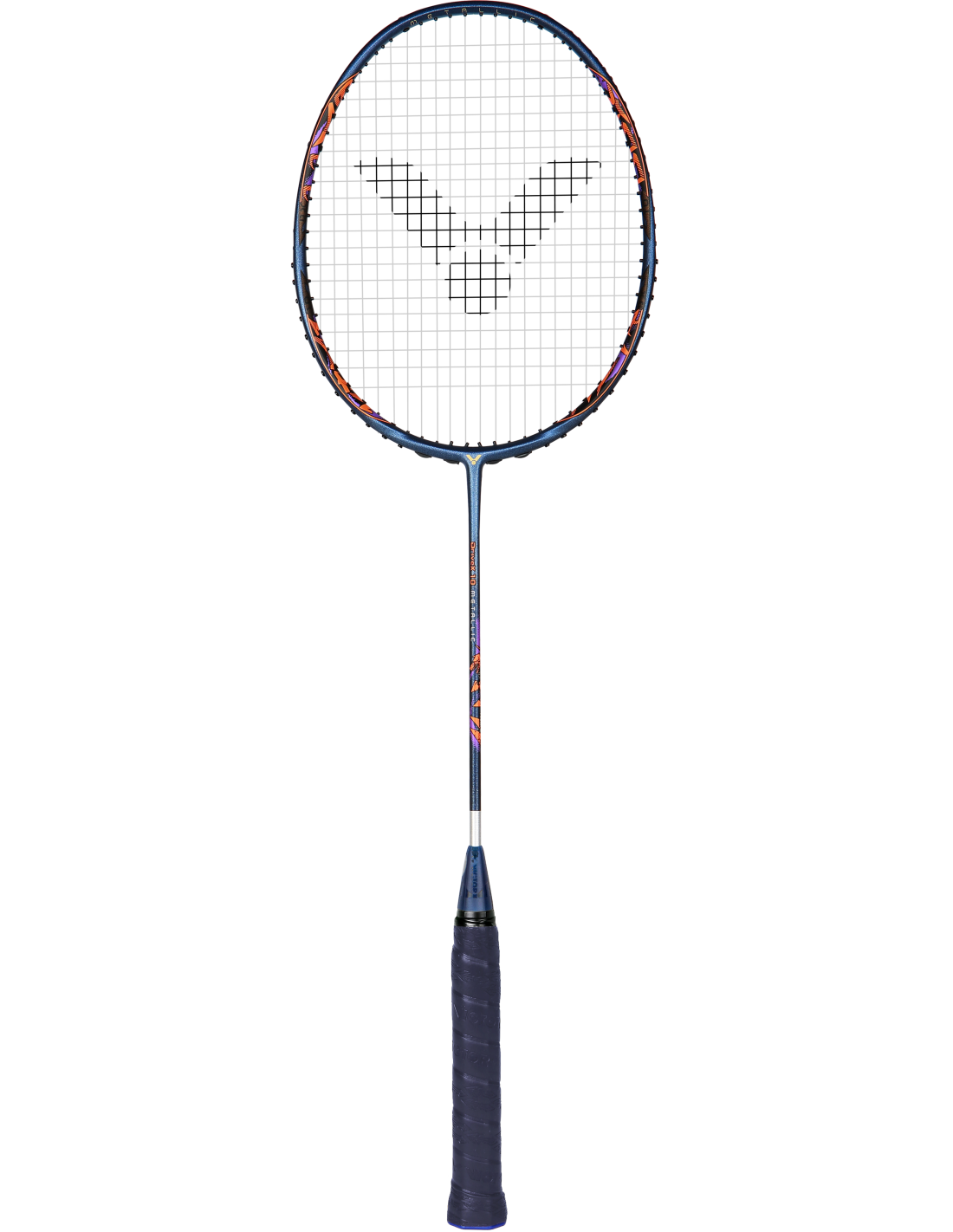
Victor DriveX 9X
The control counterweight — an even-balance 4U frame with Victor’s stiffest brief and a slim 6.6 shaft, for singles players who place the shuttle rather than blast it.
Every guide needs a counterweight, and the DriveX 9X is this one’s. It shares the light-frame half of the brief — a 4U build with a G5 grip — but it answers the balance and flex questions the other way: even balance rather than head-light or head-heavy, and a stiff shaft rather than a flexible one. Victor positions the DriveX line as its all-round series, and retailer specifications reproducing Victor’s data describe the 9X’s shaft as the stiffest in Victor’s range, paired with the FREE CORE handle so the swing stays smooth despite that firmness. For a singles player, that combination is the point: singles is a game of length, patience and placement, and a stiff, even frame answers with a predictable trajectory off the strings and no surprises when you change pace.
The 6.6 shaft — slimmer than the 6.8 shafts on the two Victor speed frames above — is the detail that keeps this control racket inside a lightweight guide rather than a general one. A thinner shaft cuts air resistance and keeps the swing economical across the long rallies singles produces, which matters more in the third game than any single smash. Choose the 9X if you play mostly singles, if your game is built on clears to the back line, drops that die at the tape and net shots you place rather than flick, and if your technique is developed enough to supply your own power to a stiff frame. It is the least forgiving racket here and, for the right player, the most satisfying — and if you are still building the footwork patterns that singles control depends on, start with our guide on how to play badminton and let the racket decision follow your game, not lead it.
What we like
- Even balance and a stiff shaft give the most predictable trajectory here
- Slim 6.6 shaft keeps long singles rallies economical
- 4U/G5 build delivers control without a heavy tour-standard weight
- FREE CORE handle smooths out the stiff shaft’s feel
Worth knowing
- The least forgiving card here — stiff frames reward grooved technique only
- Doubles speed players will find the Nanoflare 800 Pro sharper at the front
As an Amazon Associate we earn from qualifying purchases.
Side-by-Side Comparison Table
| Model | Best For | Weight | Grip | Balance | Shaft Flex (Maker-Stated) |
|---|---|---|---|---|---|
| Yonex Nanoflare 700 Pro | Best overall | 4U (Avg. 83g) / 5U | G5, G6 | Head-light | Medium |
| Victor AuraSpeed 90F | Slim grip / fast drives | 4U / 5U | G6 | Even balance | Medium (Victor scale) |
| Yonex Nanoflare 800 Pro | Fast doubles | 4U (Avg. 83g) | G5 | Head-light | Stiff |
| Li-Ning Windstorm 72 | Lightest pick | 72 g | S1 (Li-Ning sizing) | Head-heavy, 315 mm | Flexible |
| Victor JetSpeed S 12F | Front-court doubles | 4U | G5 | Head-light toward even | Medium stiff |
| Li-Ning G-Force 5800 Superlite | Lightweight attacking | 78 g | G6 | Head-heavy | Flexible |
| Victor DriveX 9X | Singles control | 4U | G5 | Even balance | Stiff |
Buying Guide: U Grades, G Grades, Balance and Flex
1. Weight: choose your U grade by role, not by strength
Do not choose racket weight by how strong you feel — choose it by where you play. 5U and the maker-stated ultra-lights (the 5U versions of the Nanoflare 700 Pro and AuraSpeed 90F, the 72-gram Windstorm 72 and the 78-gram G-Force 5800 Superlite) suit front-court and fast defensive play, where the racket changes direction dozens of times a rally and every gram of head mass is a gram your wrist has to stop and restart. 4U is the all-court centre of this guide — light enough for the same speed brief, substantial enough that rear-court clears do not depend entirely on the balance point doing the work. If you rotate positions in doubles or play singles, 4U is the safer default; if you are a settled front-court player, go lighter and do not look back. Remember that strings and an overgrip add a few grams to any published figure, so judge the finished racket against these bands, not the bare frame alone.
2. Grip size: higher G means slimmer — and brands differ
In the G system most makers use, the number runs opposite to the size: G6 is slimmer than G5, and G5 is slimmer than G4. For smaller hands, G5 is the comfortable mainstream and G6 — carded here on the AuraSpeed 90F and the G-Force 5800 Superlite — is the genuinely slim option. Two rules keep you out of trouble. First, grades are each maker’s own: a G5 from one brand is close to, not identical to, a G5 from another, so treat the grade as a strong guide rather than a universal measurement. Second, some makers use their own codes entirely — Li-Ning lists the Windstorm 72 as S1 on its own store — and when a maker states its own sizing, use that maker’s size chart instead of converting by guesswork. Finally, an overgrip adds circumference to whatever you buy. Start slim and build up if you need to; you cannot make a thick handle thinner.
3. Balance: match the mass to your court position
Head-light frames (both Nanoflare Pro models, and the JetSpeed S 12F at the head-light end toward even) recover fastest and suit doubles defence, drives and front-court play. Even balance (AuraSpeed 90F, DriveX 9X) is the all-court and singles choice — nothing donated, nothing taken away, the shuttle goes where your technique sends it. Head-heavy (Windstorm 72 at a stated 315 mm, G-Force 5800 Superlite) puts mass behind overhead shots, and in this guide it appears only inside ultra-light frames, where it is the mechanism that keeps a 72–78 gram racket hitting full-length clears. If you are torn between two rackets on this page, the balance line in the comparison table is the honest tiebreaker: pick the one that matches the third of the court where you win your points.
4. Shaft flex: stated as makers state it, chosen by swing speed
Flex labels belong to each brand’s own scale, which is why every card in this guide quotes the maker’s wording rather than translating it into a house rating. The working rule travels well across brands, though: flexible shafts (both Li-Ning models) bend and recover in time with shorter, quicker swings and contribute power the frame’s low weight cannot — a good match while technique is developing and for attacking play built on snap rather than a long swing. Medium flex (Nanoflare 700 Pro) is the middle path for intermediate-to-advanced players. Medium stiff to stiff (JetSpeed S 12F, Nanoflare 800 Pro, DriveX 9X) suits fast, grooved swings and returns a crisper, more direct response — at the cost of offering nothing when your timing is late. Match flex to the swing you actually have today; a stiff frame bought for the player you plan to become usually spends a season punishing the player you are.
5. String tension: respect the published ceiling
Every card lists the maker’s maximum or advised tension, and light frames make that number worth respecting: the ceilings here run from 27 lbs on the 5U AuraSpeed 90F to 30 lbs on the Li-Ning pair and the 3U JetSpeed. Higher tension gives a crisper, more controlled response for players who strike the centre of the bed consistently; lower tension is more forgiving and easier on both the frame and your arm. If you are unsure, string in the middle of the maker’s range first — tension is a cheap experiment you can change at the next restring, unlike the frame itself.
Frequently Asked Questions
What weight badminton racket is best for women?
For most adult players who want a lighter frame, 4U (roughly 80–84 grams) is the all-court sweet spot, and 5U (roughly 75–79 grams) suits front-court doubles and fast defensive play. The lightest option in this guide is the Li-Ning Windstorm 72 at a maker-stated 72 grams. Choose by court role rather than strength: lighter for speed and reactions, 4U if you also need rear-court depth.
What grip size should I choose if I have small hands?
Look for G5 as the comfortable mainstream and G6 for a genuinely slim handle — in the G system a higher number means a slimmer grip. The Victor AuraSpeed 90F and the Li-Ning G-Force 5800 Superlite are both carded here in G6. Note that some makers use their own codes: Li-Ning lists the Windstorm 72 as S1 on its own store, so use that maker’s own size chart rather than converting.
Is a head-light or head-heavy racket better?
Neither is better in absolute terms. Head-light frames such as the Yonex Nanoflare 700 Pro and 800 Pro recover faster and suit doubles defence, drives and front-court play. Head-heavy frames put mass behind smashes and clears — and in ultra-light rackets such as the 72-gram Li-Ning Windstorm 72, a head-heavy 315 mm balance point is what keeps clears reaching the back of the court despite the very low total weight.
Should I choose a flexible or stiff shaft?
Match the shaft to your swing speed. Flexible shafts, like those on the Li-Ning Windstorm 72 and G-Force 5800 Superlite, help generate power from shorter, developing swings. Stiff shafts, like those on the Yonex Nanoflare 800 Pro and Victor DriveX 9X, reward fast, grooved swings with a crisper, more direct response but offer little help when timing is late. Flex labels are each maker’s own wording, which is why this guide quotes them exactly as stated.
What is the lightest racket in this guide?
The Li-Ning Windstorm 72, which Li-Ning’s own store states at 72 grams, with a head-heavy balance point of 315 mm, a flexible shaft and a maximum tension of 30 lbs. The next lightest is the Li-Ning G-Force 5800 Superlite at a maker-stated 78 grams, which also adds a G6 grip in standard G grading.
Are these rackets only for women?
No. Nothing in any of these specifications is gender-specific — they are light frames with slim grips, and any player of any gender who wants a 4U or 5U racket, a G5 or G6 handle, or an ultra-light 72–78 gram frame will find the same shortlist relevant. This guide simply organises the choice around the lighter weights and slimmer grips that players with smaller hands most often ask for.
What is the difference between the Nanoflare 700 Pro and 800 Pro?
Both are head-light Yonex speed frames, but they are tuned for different players. The 700 Pro has a medium flex, comes in 4U and 5U with G5 and G6 grip options, and suits the widest range of intermediate-to-advanced players. The 800 Pro has a stiff flex, is carded here in 4U with a G5 grip, and is the specialist for advanced players whose doubles game is built on fast drives.
The Verdict
Buy by weight, grip and balance and the colourway can look after itself. The Yonex Nanoflare 700 Pro is the complete lightweight answer — head-light, medium flex, and made in 4U and 5U with slim grip options. The Victor AuraSpeed 90F owns the slim-grip decision with its G6 handle in both weights, and the Yonex Nanoflare 800 Pro is the stiff, head-light specialist for advanced drive-based doubles. The Li-Ning Windstorm 72 is the lightest racket here at a maker-stated 72 grams, the Victor JetSpeed S 12F is the front-court doubles pick, the Li-Ning G-Force 5800 Superlite pairs 78 grams with a G6 grip and attacking balance, and the Victor DriveX 9X is the even-balance control frame for singles. Seven light rackets, four honest decisions — pick the one that matches your hand, your court position and your swing.
Affiliate disclosure: AliShuttler is reader-supported. When you buy through links on this page we may earn an Amazon commission at no extra cost to you. Specifications are taken from manufacturers’ published product information and were verified at the time of writing; manufacturers revise models, variants and size options between seasons, so confirm the exact weight grade and grip grade on the product page before ordering.
Similar Posts
Badminton Warehouse: Best Rackets & Paddles 2026
“Success is the pursuit where preparation and opportunity engage to meet the power of players.”…
Badminton Alley: Your One-Stop Best Choice for Equipment 2025
A badminton alley is a place specially created for playing badminton indoors, equipped with delineated…
How to Increase Stamina for Badminton: Best Guide for 2026
Stamina for badminton refers to how long a player can sustain fast play without decelerating….
Which Type of Badminton Shoes Are Best for Men in 2026
Badminton shoes are designed for rapid movement and intense traction on court floors. They keep…
Best Mizuno Badminton Racket 2026: Senston Professional Guide✔✔
Discover the top performers in the world of badminton rackets, designed to elevate your game…
Badminton Training: Benefits, Videos, Coaches & Techniques 2026✔✔
Want to take your badminton skills to the next level? Whether you’re a beginner looking…