You have outgrown the beginner frame — the oversize head and featherweight swing that once donated depth now donate balls into the back fence. The step up is a specific one: a midweight racket, a head that shrinks from oversize towards 98–100 sq in, a beam that thins down, and enough mass that the racket starts helping a grooved swing instead of fighting it. These seven frames are that step, organised by the decision in front of you.
⚡ TL;DR — The Short Answer
For most intermediates, buy the HEAD Speed MP — the balanced step-up that does nothing badly. Spin players should take the Yonex VCORE 100, control-leaning players the Babolat Pure Strike 100 16×19, and feel-first players the HEAD Gravity MP with its denser 16×20 bed. The Wilson Clash 100 v3 is the arm-friendly route into this weight class, the HEAD Radical MP is the 98 sq in precision option that still swings fast, and the Yonex EZONE 98 (2025) is the top rung — controllable power at 305 g for the intermediate whose swing is nearly grooved.
Quick Picks — Best Intermediate Tennis Rackets at a Glance
100 sq in, 300 g and a 23 mm beam — the balanced middle of the step-up ladder.
An open 16×19 bed and an aerodynamic, snap-back layup built around topspin.
A thinner 21/23/21 mm beam and a connected response inside a forgiving 100 head.
A 16×20 bed, a 22 mm beam and a teardrop head with a large, high sweet spot.
The standard 295 g Clash — a uniquely flexible layup that stays stable at contact.
98 sq in placement at a fast 300 g, with a variable beam for all-court play.
305 g, an ISOMETRIC 98 head and a plush ride — the ladder’s top rung.
In This Guide
The Step-Up Decision: What Actually Changes
The beginner racket is built to forgive a swing that is still forming: an oversize head, a light frame, a balance that puts mass in the hoop so depth arrives almost free. It does that job well — and then it starts charging you for it. As your strokes lengthen and your racket-head speed climbs, the same light, head-heavy frame twists on off-centre contact, launches the ball higher than you aimed, and gives you nothing back when you try to place a shot rather than simply return it. That frustration is the signal. You are not shopping for a “better” racket; you are shopping for a different set of trade-offs.
The intermediate step-up changes four things at once. The head shrinks — from 105–110 sq in territory down to 100 sq in, or 98 sq in if your contact point is already consistent. The weight rises into the 295–305 g unstrung band, where the frame holds its line against adult pace instead of being pushed around by it. The beam thins — the cards below run from 24.5 mm down to a variable 20/23/21 mm — trading free power for feedback and directional control. And the balance moves head-light, so the extra grams sit where they stabilise contact without slowing the swing you have worked to build.
Where does this page sit in the ladder? Below it, our guide to the best tennis rackets for beginners owns the first-racket decision — lighter, larger, more forgiving frames for players still forming their strokes; if several of the rackets below sound demanding, that is the honest place to start. Across the whole market, our pillar guide to the best tennis rackets compares the all-level power, control and spin picks without a level filter. This page is the rung between them: seven current-generation frames, every specification taken from the manufacturers’ published figures, organised by whether your next gain comes from spin, control, feel, comfort — or simply more racket behind the ball. One topic stays out on purpose: grip size. It is personal and measurement-based, so use our Tennis Racket Grip Size Finder to get yours in one step, then choose the frame.
Long-time readers may also know our older roundup at Best Tennis Racquets. Treat it as background reading on previous generations — several of its models have since been replaced or discontinued, and this ladder, together with the pillar and beginners guides, is the current word on the subject.
The Four Specs That Decide the Step Up
Head size is the forgiveness dial. At 100 sq in you keep a generous sweet spot and useful free power while gaining a noticeably tighter response than an oversize beginner head gives you. At 98 sq in — the Radical MP and EZONE 98 below — the sweet spot shrinks, the launch drops and placement sharpens, and off-centre contact stops being rescued. Neither is a badge of honour; match the head to the consistency of your contact point on an ordinary day, not your best one.
Unstrung weight is where the step-up actually happens. Beginner frames live around 255–280 g; every racket here sits between 295 g and 305 g. That added mass is not there to make you work harder — it is there so the frame absorbs a heavy incoming ball, holds its line on a stretched defensive swing, and puts plough-through behind your own shots. The point where weight starts helping rather than fighting you is personal but recognisable: when your timing is grooved enough that you meet the ball in front, extra grams feel like stability; while you are still catching the ball late, they feel like a tax. The buying guide below turns that into a simple test.
Balance decides where those grams work. The figures on the cards run from the Clash’s very head-light 310 mm to the Gravity MP’s more even 325 mm. Head-light balances keep the head fast through a vertical, spin-oriented swing and quick in volley exchanges; a more even balance puts a little more mass behind baseline shots. String pattern is the control-versus-spin fork in this ladder: open 16×19 beds — five of the seven frames — let the mains move and snap back for topspin and a higher, safer launch, while the Gravity MP’s denser 16×20 pattern flattens the trajectory, tightens placement and extends string life. Beam width sits behind all four: thinner beams flex, dwell and inform; thicker beams return energy. Every card states these figures exactly as its maker publishes them.
The 7 Best Tennis Rackets for Intermediate Players, Compared
Seven frames, one ladder. The order runs from the most universally suitable step-up down to the most demanding top rung — read the card that matches the gain you are chasing first, whether that is spin, control, feel or comfort.
HEAD Speed MP (Current Generation)
The balanced middle of the ladder — controllable power, a fast swing and feel that keeps improving with you.
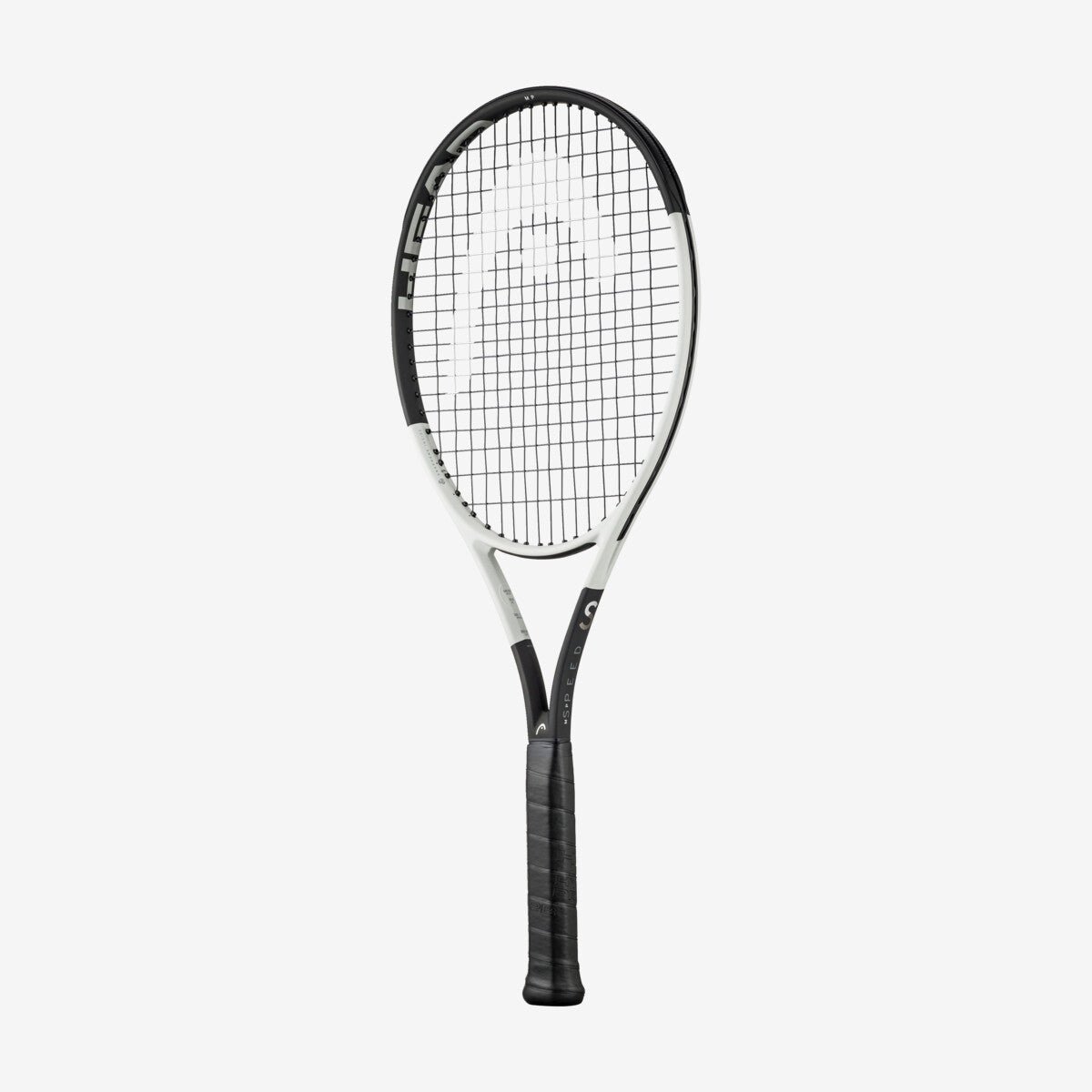
If the step-up had a default answer, this is it. The Speed MP takes the exact platform an improving player needs — a 100 sq in head that still forgives, a full 300 g of adult weight, a head-light 320 mm balance that keeps the swing quick — and tunes it for a fast game rather than a powerful one. HEAD positions the Speed line around control for players who swing quickly, and the MP is the accessible end of that idea: lighter and easier to handle than the Pro above it, but with the same thin-by-modern-standards 23 mm beam, so the feedback at contact is honest in a way a thick-beamed beginner frame never is.
The current generation adds Auxetic 2.0 construction in the yoke and handle alongside Graphene Inside, which HEAD describes as widening and contracting under load to sharpen the connection between player and ball. In buying terms, what matters is the combination: power grommets and directional drilling keep the sweet spot generous for a control-leaning frame, while the 16×19 Speed pattern leaves spin fully available as your swing path steepens. This is the racket on the page with the fewest conditions attached — it asks for a developing full swing and rewards it from every area of the court, which is why it leads the ladder.
What we like
- The most balanced step-up here — no area of the game feels like a compromise
- 300 g and a head-light balance keep a fast swing fast
- 23 mm beam gives genuine feedback without demanding perfect contact
- Forgiving for a control-leaning frame, thanks to the drilling and grommet design
Worth knowing
- Specialists will find a spinnier spin frame and a firmer power frame elsewhere on this page
- Players still catching the ball late should start a rung down, with the beginners guide
As an Amazon Associate we earn from qualifying purchases.
Yonex VCORE 100
The spin step-up — an open bed, an aerodynamic frame and a snap-back layup for the player whose game is going vertical.
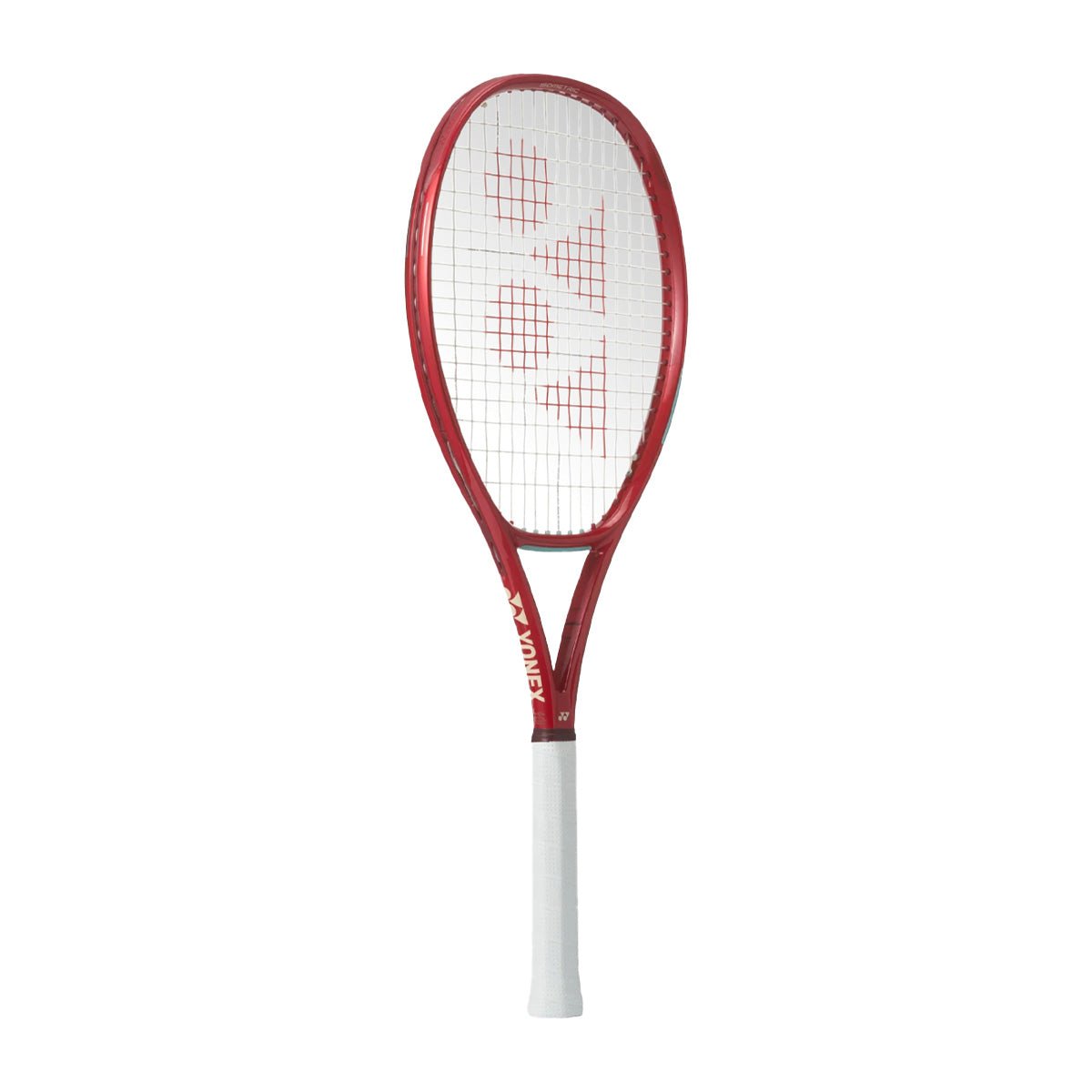
Every ladder needs its spin fork, and the VCORE 100 is this one. Yonex builds the VCORE line around spin production, and the 100 pairs the familiar step-up platform — 100 sq in, 300 g, a head-light 320 mm balance — with the ingredients rotation actually comes from: an open 16×19 bed that lets the mains move, an ISOMETRIC head shape that squares the top of the frame to enlarge the sweet spot, and aerodynamic shaping through the hoop so the head arrives faster on the steep, brushing swing path topspin requires. The 2G-Namd Flex Force graphite in the layup is there, per Yonex, to increase snap-back — the frame flexing and returning in time with the string bed rather than against it.
What makes the VCORE the right spin pick for an intermediate, rather than simply the spinnier frame, is that the power stays usable. The 24/26/23 mm beam gives the ball genuine pace to go with its rotation, and Yonex’s Servo Filter and Vibration Dampening Mesh take the harsh edge off contact. Choose it if your rally ball is developing height, shape and dip — and if you are pairing it with a spin-friendly string setup from our best tennis strings guide, the combination compounds. Flat hitters who drive through the court should look at the Pure Strike or the EZONE 98 instead; this frame’s gifts are aimed up the back of the ball.
What we like
- The heaviest, most accessible topspin in this line-up
- ISOMETRIC head keeps the sweet spot generous for a spin frame
- Usable power behind the spin — the ball penetrates as well as dips
- Dampening package keeps a lively layup comfortable
Worth knowing
- High launch will frustrate players who hit flat and through the court
- Rewards a vertical swing path — compact, linear swings get less from it
As an Amazon Associate we earn from qualifying purchases.
Babolat Pure Strike 100 16×19 (Gen 4)
Control with a safety net — a thin beam and a connected response, kept inside a forgiving 100 sq in head.
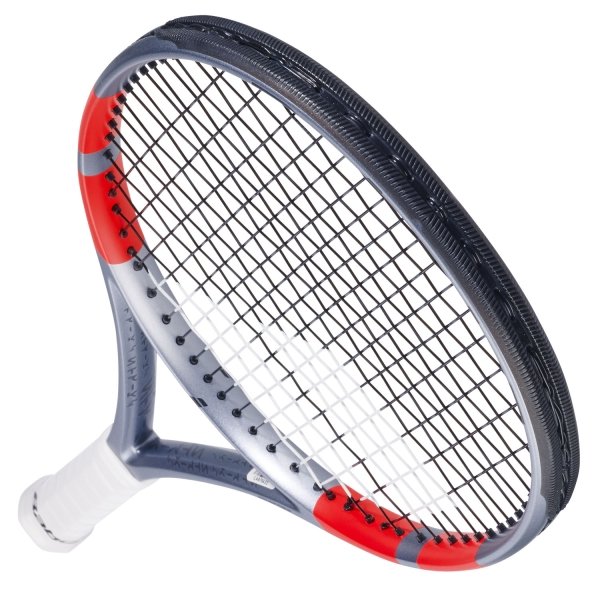
The Pure Strike answers the most common intermediate dilemma: you want the direction and feedback of a control frame, but your contact point is not yet consistent enough for a 98 sq in head. Babolat’s solution is to keep the head at 100 sq in and do the control work with the beam and the layup instead. At 21/23/21 mm, the Strike’s beam is visibly slimmer than the power frames in Babolat’s own range, and Control Frame Technology — which Babolat describes as combining a square beam section for stability with an elliptical section for dynamism — gives contact a direct, connected quality. You feel where the ball is going, and increasingly, it goes there.
The fourth generation softened the Strike’s old reputation for harshness: NF2-Tech flax fibres filter vibration, and the FSI Control string-bed design works with the Woofer system to extend ball-to-string contact for feel. The 16×19 pattern in this 100 model is the spin-friendlier Strike configuration, so the frame does not lock you into flat hitting while you develop. At 300 g with a 7-points-head-light balance it swings quickly enough for all-court play. For the intermediate whose errors are now about direction rather than depth, this is the most instructive racket on the page.
What we like
- Genuine control-frame feedback inside a forgiving 100 sq in head
- Thin beam and head-light balance make it fast and precise at the net
- Gen 4 flax filtering removes the harshness older Strikes were known for
- 16×19 bed keeps spin development open
Worth knowing
- Less free power than the Speed MP — depth must come from your swing
- Firm RA 68 layup: sensitive arms should compare the Gravity MP and Clash first
As an Amazon Associate we earn from qualifying purchases.
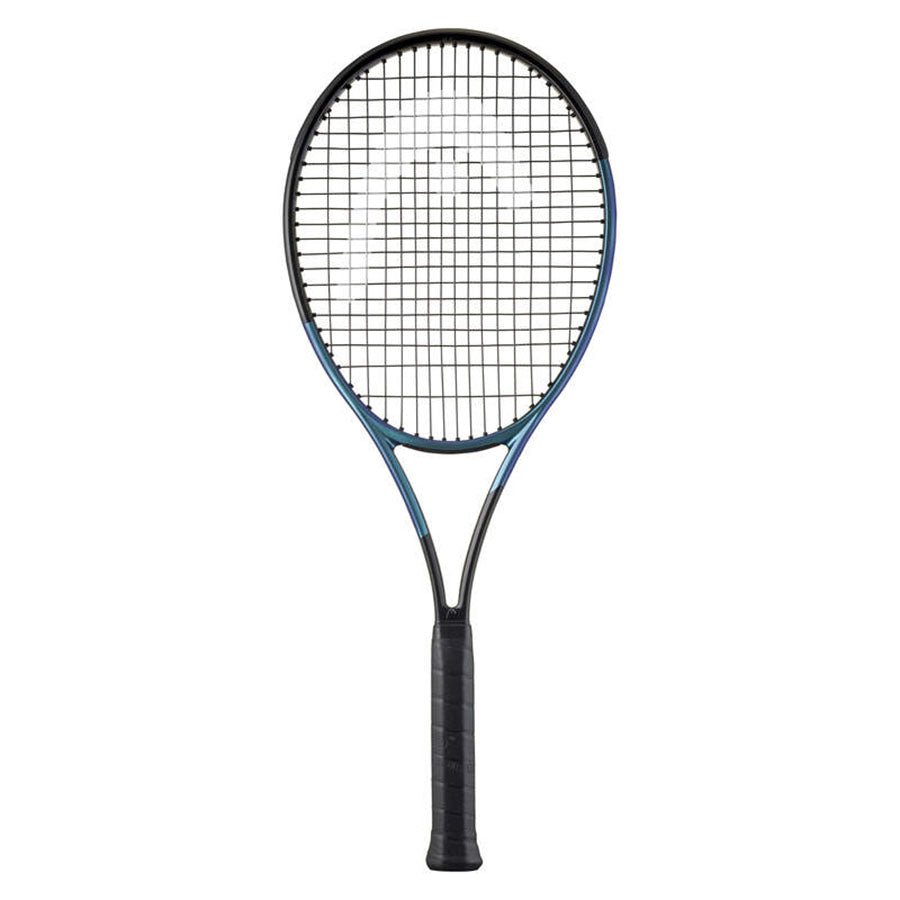
HEAD Gravity MP (2025)
The feel pick — a denser 16×20 bed, a thin 22 mm beam and a teardrop head built around touch and placement.
The Gravity MP is the control-leaning fork of this ladder, and it reaches control by a different route from the Pure Strike. Where the Strike thins the beam, the Gravity densifies the bed: its 16×20 pattern is the only one here with twenty crosses, which flattens the launch, tightens placement and slows string wear — a real consideration once an intermediate swing starts breaking strings. The frame itself is HEAD’s distinctive teardrop shape, which moves the widest part of the head higher and creates the large, high sweet spot HEAD markets the Gravity line on. Contact made a little above centre — where modern swings actually meet the ball — stays alive instead of dying.
At 295 g it is, with the Clash, the lightest frame here, and its 325 mm balance is the most even on the page, putting a touch more mass behind baseline shots without making the racket head-heavy. Auxetic 2.0 and Graphene Inside carry over from HEAD’s other current lines, tuned here towards a softer, more connected response; the Gravity family is HEAD’s feel line, and the MP is its intermediate-weight expression. Choose it if your developing game is built on placement, touch and rally tolerance rather than raw rotation — and if the ball flying long is a more familiar error than the ball landing short.
What we like
- 16×20 bed delivers the tightest placement and lowest launch of the 100 sq in group
- Teardrop head keeps high contact — where modern swings meet the ball — responsive
- Soft, connected feel that touch players and volleyers will appreciate
- 295 g with real stability: the gentlest workload among the control picks
Worth knowing
- Spin ceiling is below the open-bed frames — you shape the ball less
- Denser bed and lower power ask for a fuller swing to reach depth
As an Amazon Associate we earn from qualifying purchases.
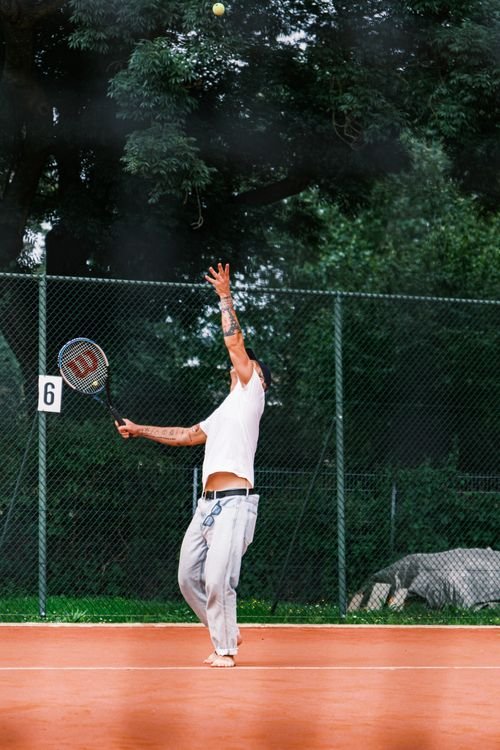
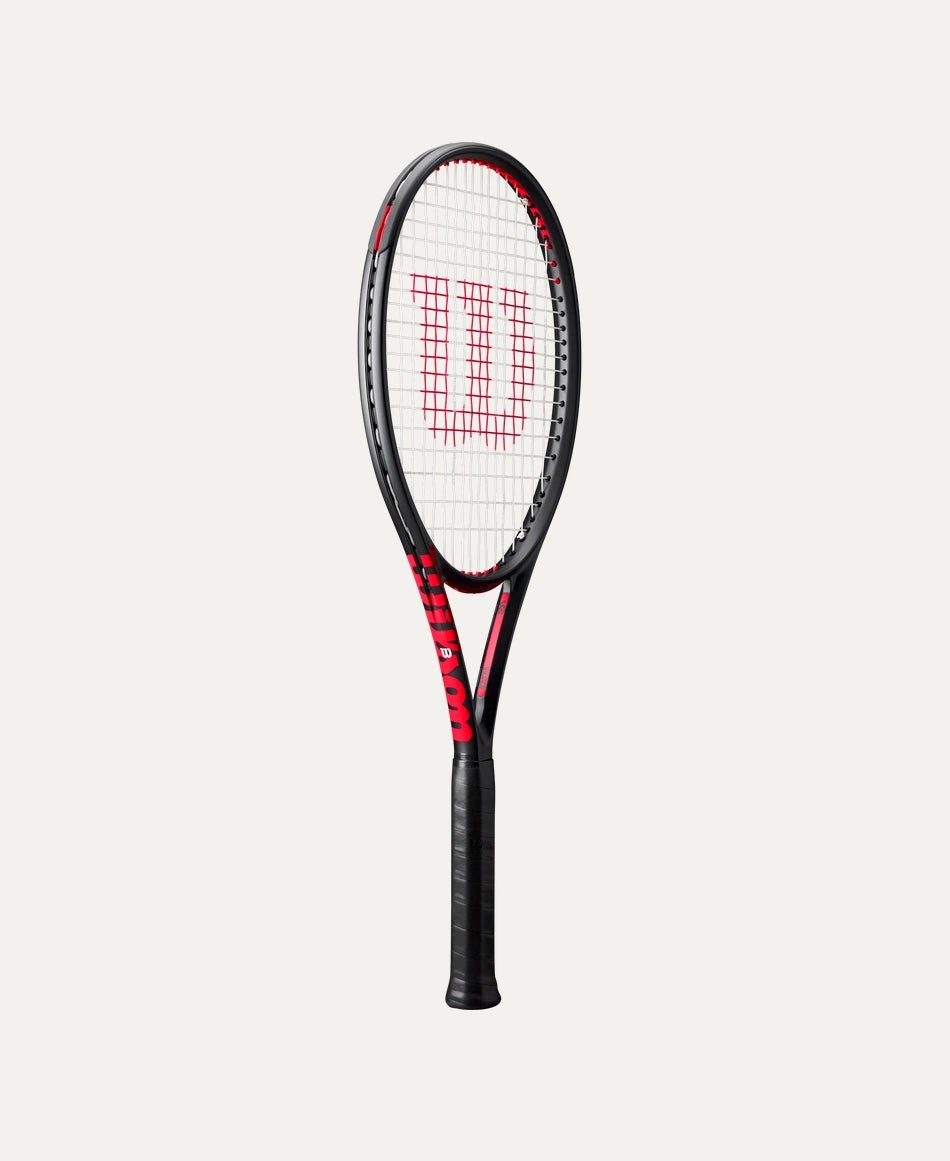
Wilson Clash 100 v3 (Standard 295 g)
The comfort route into this weight class — a flexible layup engineered to bend without wobbling.
First, a naming warning that matters: this is the standard Clash 100 v3 at 295 g — not the lighter Clash 100L, which belongs to the beginners ladder. The standard model is the intermediate frame, and its brief has been unique since the Clash line launched: build a racket that flexes like a comfort frame and holds together like a performance frame. Wilson’s v3 does it with SI3D, a layup that optimises bending in three dimensions for power, spin and control, layered with the FORTYFIVE carbon mapping that increases flexibility and stability together, and a Hit Stabilizer that adds inertia at the 3 and 9 o’clock positions so off-centre contact does not twist the frame out of your hand.
The published balance tells the handling story: at 310 mm unstrung, this is by a distance the most head-light racket here, so despite the full-size head it whips through the swing and changes direction at the net with very little effort. For the intermediate whose limiting factor is not technique but an elbow or shoulder that complains after two sets, the Clash is the step-up that does not ask you to choose between progressing and playing comfortably. Pair it with a softer string setup and court footwear that supports long sessions — our best tennis shoes guide covers the support side of the same equation. Wilson’s wider current range, including the frames above and below this one, is summarised in our best Wilson tennis racquet guide.
What we like
- The most arm-friendly route into a 295 g performance frame
- Very head-light balance makes it the quickest handler here at the net
- Hit Stabilizer keeps a flexible frame honest on off-centre contact
- Click & Go bumper system makes wear parts easy to replace
Worth knowing
- The flexible feel is distinctive — players raised on crisp frames should demo first
- Less inherent plough-through than the 300 g+ frames against heavy hitters
As an Amazon Associate we earn from qualifying purchases.
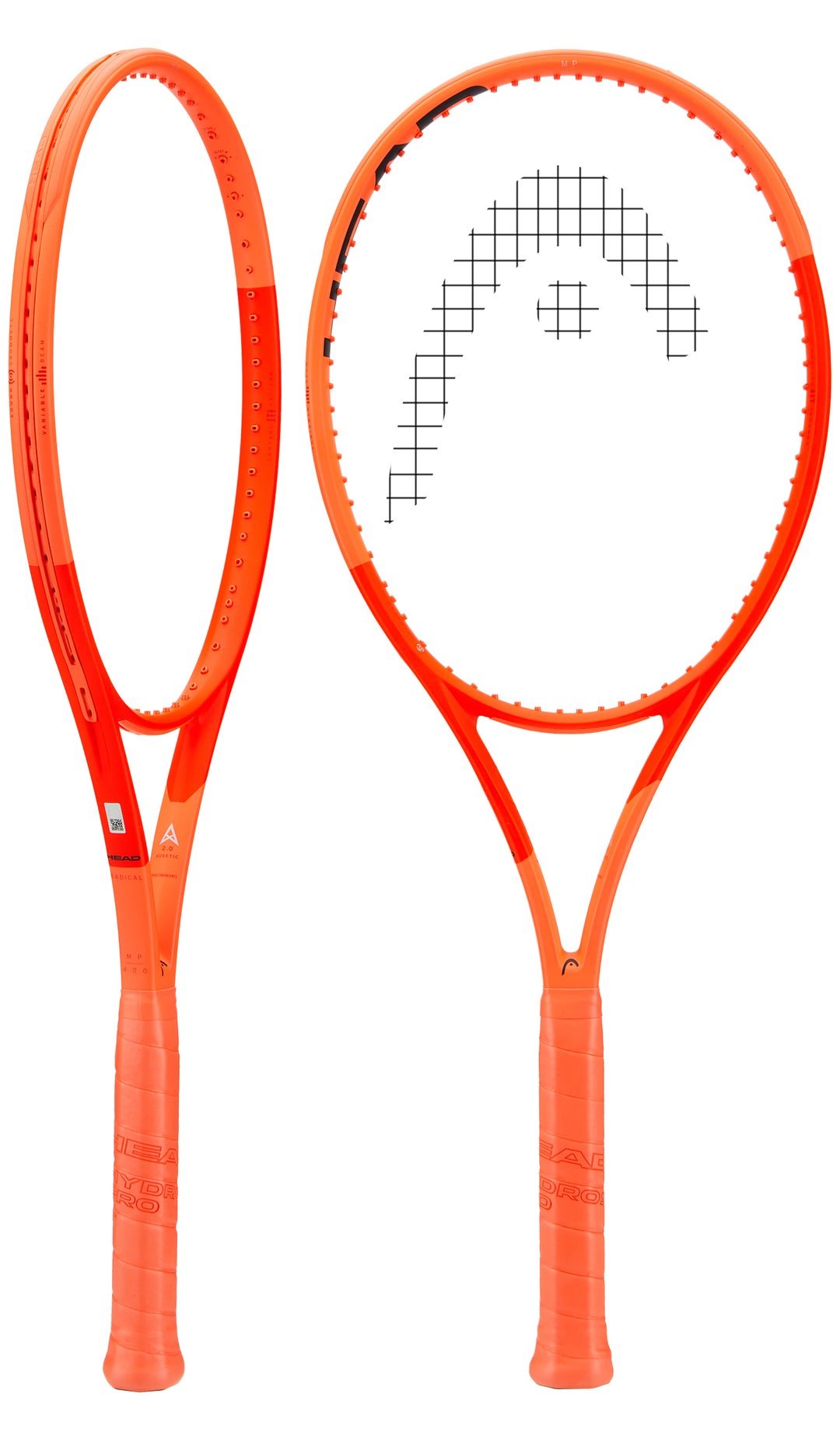
HEAD Radical MP (2025)
The all-court scalpel — 98 sq in placement at a fast, friendly 300 g.
The Radical MP is where this ladder’s head size first drops to 98 sq in — and it is the gentlest possible introduction to that world, because everything else about the frame is tuned for speed. The unstrung weight is 300 g, the balance a head-light 320 mm, and the beam is variable: 20 mm through the shaft and tip for feel and flex, swelling to 23 mm through the middle of the hoop where stability is needed. HEAD calls the Radical its versatile all-court line, and the MP brief shows it — this is a frame designed to be swung fast from the baseline, punched away on volleys and flicked on the run without the mass ever announcing itself.
Auxetic 2.0 and Graphene Inside provide the modern HEAD backbone, and Sound Grommets — which HEAD says allow greater string movement — keep the 16×19 bed livelier than a 98 head usually feels, so spin remains a genuine option rather than an afterthought. Be clear-eyed about the trade the smaller head makes: the sweet spot is the smallest so far on this page, and stretched defensive shots that the 100 sq in frames rescue will land shorter here. In exchange you get the first taste of true placement tennis — targets instead of zones — at a weight that will not punish you while your contact point finishes grooving. For the strong intermediate who plays all-court tennis, this is the connoisseur’s step-up.
What we like
- 98 sq in precision at a fast, undemanding 300 g
- Variable beam puts feel in the shaft and stability in the hoop
- Lively for a 98 — Sound Grommets and a 16×19 bed keep spin in play
- Head-light balance suits all-court and net-rushing games
Worth knowing
- Smallest sweet spot so far — off-centre contact is rescued less
- Low free power: depth is your swing’s job now
As an Amazon Associate we earn from qualifying purchases.
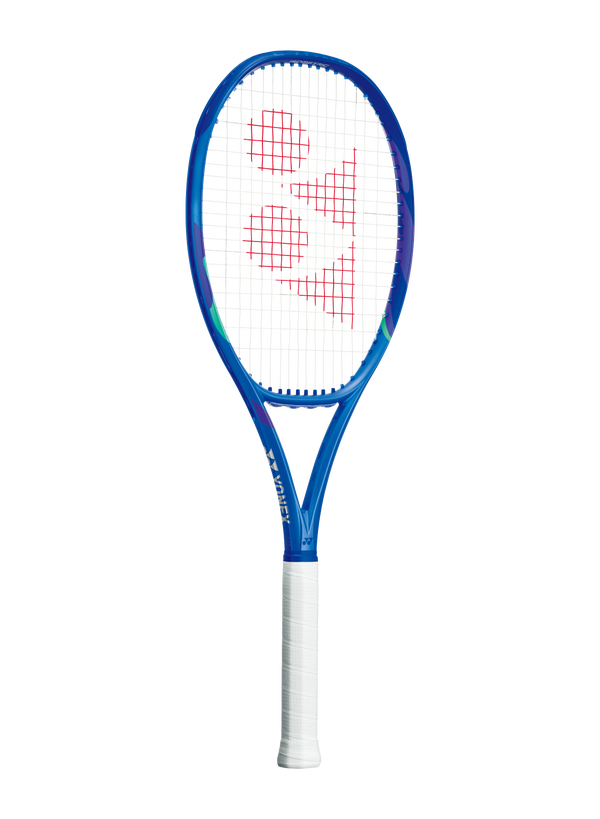
Yonex EZONE 98 (2025)
The top rung — 305 g of controllable power and plush feel for the intermediate whose swing is nearly grooved.
Every ladder should end one rung above comfortable, and the EZONE 98 is this one’s. It is the heaviest frame here at 305 g unstrung and shares the 98 sq in head with the Radical MP, but it plays a different game: where the Radical is built for speed and placement, the EZONE 98 is built for controllable power — a frame that lets an upper-intermediate swing hard, at big targets, with the ball staying in. The ISOMETRIC head shape is the enabling trick: by squaring the top of the frame, Yonex enlarges the sweet spot within the 98 dimensions, and for 2025 the frame top is expanded further and the upper beam widened, which Yonex positions as more power and responsiveness high in the hoop.
The feel is the other half of the appeal. Minolon — fine natural fibres woven into the shaft — joins 2G-Namd Speed graphite and the Vibration Dampening Mesh in the handle to give this generation an unusually plush, quiet contact for a frame with this much output, and the extended tapered inner frame is designed to flex and pocket the ball rather than ping it away. The very head-light 315 mm balance keeps 305 g swinging faster than the number suggests. This is the racket to grow into deliberately: buy it when your contact point is consistent, your swing is full, and the frames below have started to feel like they are holding pace back rather than donating it.
What we like
- The most controllable power here — swing hard at big targets and the ball stays in
- ISOMETRIC head makes a 98 feel more forgiving than its dimensions
- Plush, dampened contact despite the output — the comfort pick among the 98s
- Head-light balance keeps the heaviest frame here swinging quickly
Worth knowing
- 305 g is a real step: players still building swing speed should start lower on this ladder
- Demands consistent contact — the rescue available at 100 sq in is reduced
As an Amazon Associate we earn from qualifying purchases.
Side-by-Side Comparison Table
| Model | Best For | Head | Weight (Unstrung) | Balance | Pattern | Beam |
|---|---|---|---|---|---|---|
| HEAD Speed MP | Overall step-up | 100 sq in | 300 g | 320 mm | 16×19 | 23 mm |
| Yonex VCORE 100 | Spin | 100 sq in | 300 g | 320 mm | 16×19 | 24/26/23 mm |
| Babolat Pure Strike 100 16×19 | Control-leaning 100 | 100 sq in | 300 g | 320 mm | 16×19 | 21/23/21 mm |
| HEAD Gravity MP | Feel & comfort control | 100 sq in | 295 g | 325 mm | 16×20 | 22 mm |
| Wilson Clash 100 v3 | Arm-friendly | 100 sq in | 295 g | 310 mm | 16×19 | 24.5 mm |
| HEAD Radical MP | Precision 98 | 98 sq in | 300 g | 320 mm | 16×19 | 20/23/21 mm |
| Yonex EZONE 98 (2025) | Controllable power 98 | 98 sq in | 305 g | 315 mm | 16×19 | 23.8/24.5/19.5 mm |
Buying Guide: When Weight Starts Helping
1. The weight test: helping or fighting?
Here is the honest test for the 295–305 g band. Rally at full pace for twenty minutes, then play three games where you deliberately hit under pressure — stretched wide, late, on the run. If the racket feels more solid the worse your position gets, the weight is helping: it is absorbing pace and rescuing contact your old light frame would have twisted on. If your swing visibly shortens, your contact drifts later and your shoulder is doing the talking by game three, the weight is fighting you — drop a rung, to the 295 g Gravity MP or Clash here, or to the beginners ladder, and revisit in a season. There is no prize for carrying grams your swing has not earned yet, and the ladder is designed to be climbed in order.
2. Head size: stay at 100 until contact is boringly consistent
The default step-up is 100 sq in — five of these seven frames — because it keeps a rescue margin while tightening everything else. Move to 98 sq in (Radical MP, EZONE 98) when your mishits are already rare and usually framed by inches rather than feet, and when you have started choosing targets — a cross-court corner, a body serve — rather than zones. The smaller head will repay that consistency with a lower launch and sharper placement, and it will tax every lapse. Choose by your ordinary Tuesday contact, not your Saturday best.
3. Pattern: spin-leaning or control-leaning?
This is the ladder’s real fork. An open 16×19 bed — the Speed MP, VCORE, Pure Strike, Clash, Radical and EZONE 98 — lets the mains move and snap back, donating topspin and net clearance; it suits the modern vertical swing and forgives a contact point that varies. The denser 16×20 of the Gravity MP flattens trajectory, tightens direction and lasts longer between restrings; it suits the player whose rally ball already has shape and whose problem is the ball sailing a foot long when they swing out. If you cannot yet say which error is yours, take the 16×19 — it is the more forgiving teacher.
4. Balance and beam: the feel decision
Balance decides how the weight presents itself. The Clash’s 310 mm is the extreme head-light end — maximum manoeuvrability, minimum effort at the net. The Gravity’s 325 mm is the even end, with a little more mass behind baseline contact. Most intermediates should start in the 315–320 mm middle where the rest of this page lives. Beam width then sets the information flow: thin beams (Radical’s 20 mm shaft, Gravity’s 22 mm, Speed’s 23 mm) flex and report; thicker beams (VCORE, Clash) return more energy and hold up better on defence. Arms with a complaint history should weight the Clash and Gravity end of this list first — and remember strings are the other half of comfort, which is why our strings guide is linked from the VCORE card above.
Frequently Asked Questions
When is an intermediate player ready to move up from a beginner racket?
When the beginner frame starts charging you for its help: the ball launches higher than you aimed when you swing fully, the racket twists on off-centre contact against adult pace, and you are placing shots in zones because finer targets feel out of reach. At that point a 295–305 g frame with a 98–100 sq in head — the profile of every racket in this guide — starts helping a grooved swing instead of fighting it.
What weight tennis racket should an intermediate player use?
Most intermediates land between 295 g and 305 g unstrung, which is exactly the band this guide covers. Start at 295 g (HEAD Gravity MP, Wilson Clash 100 v3) if your swing speed or your arm is the limiting factor, take 300 g as the default middle, and consider 305 g (Yonex EZONE 98) only when your contact point is consistent and you keep your racket-head speed up late in matches.
Is a 98 or 100 sq in head better for intermediate players?
For most intermediates, 100 sq in is the right step: it tightens the response versus an oversize beginner head while keeping a real rescue margin on off-centre contact. A 98 sq in head — the HEAD Radical MP and Yonex EZONE 98 here — suits the upper intermediate whose contact is already consistent and who wants a lower launch and sharper placement in exchange for that margin.
16×19 or 16×20 string pattern — which should an intermediate choose?
Choose 16×19 if you are developing topspin and want the mains to move and snap back for spin and net clearance; five of the seven rackets here use it. Choose the denser 16×20 of the HEAD Gravity MP if your ball already has shape and your common error is hitting long when you swing out — the tighter bed flattens the trajectory, improves placement and extends string life.
What is the difference between the Wilson Clash 100 v3 and the Clash 100L?
Weight and audience. The Clash 100 v3 carded here is the standard model at 295 g unstrung with a 310 mm balance — an intermediate performance frame. The Clash 100L v3 is the lighter sibling covered in our beginners guide, aimed at players who need an easier swing while their strokes form. If you are stepping up, the standard 100 is the one you want.
Which intermediate racket is best for a sensitive arm or tennis elbow?
Start with the Wilson Clash 100 v3: its flexible SI3D and FORTYFIVE layup is engineered for comfort, and its very head-light 310 mm balance reduces the effort in every swing. The HEAD Gravity MP, with its thin 22 mm beam and softer, connected response, is the other comfort-first option here. Pair either with a softer string setup, and treat persistent pain as a medical question, not an equipment one.
Speed MP or Pure Strike 100 — which is the better step-up?
Both are 100 sq in, 300 g and 16×19, so the decision is feel and error type. Take the HEAD Speed MP if you want the more forgiving, balanced all-rounder — it donates a little more power and rescues more contact. Take the Babolat Pure Strike 100 if your errors are directional: its thinner 21/23/21 mm beam and connected response reward a player who is starting to aim at targets rather than zones.
The Verdict
Climb the ladder in order and it will not let you fall. Most intermediates should start with the HEAD Speed MP — the balanced 300 g step-up that improves everything at once. Spin players branch to the Yonex VCORE 100, direction-first players to the Babolat Pure Strike 100, and feel-first players to the HEAD Gravity MP and its denser, calmer bed. The Wilson Clash 100 v3 is the arm-friendly on-ramp, the HEAD Radical MP the fast-swinging introduction to 98 sq in precision, and the Yonex EZONE 98 the top rung to grow into. Pick the rung your swing has actually reached — that honesty, not any single frame, is what the step up is really made of.
Affiliate disclosure: AliShuttler is reader-supported. When you buy through links on this page we may earn an Amazon commission at no extra cost to you. Specifications are taken from manufacturers’ published product information and were verified at the time of writing; manufacturers revise models and cosmetics between generations, so confirm the exact specification on the product page before ordering.