
The top of the shoe wall, chosen the honest way: seven advanced badminton shoes from Victor, Yonex, Mizuno, ASICS and Li-Ning, compared only on the specs the makers themselves publish — nitrogen-foamed midsoles, carbon plates, a natural-leather flagship, the thickest cushioning Victor has ever built, and stated weights read with the size basis each brand gives.
By the time a player reaches the advanced tier, the shoe has stopped being equipment and become part of the footwork itself. Rallies at this level are won on the third and fourth change of direction — the jump smash recovered into a net kill, the deep lunge held long enough to play a tumbling spinner, the defensive dive that has to end with your feet already moving again. Every one of those moments loads the shoe harder than anything an intermediate game produces: harder plants, longer lunges, more jump landings, more hours per week on the same pair. The shoe wall knows it, and the top tier is where the makers stop refining the standard recipe and start engineering for load.
This guide owns one decision only — the advanced, tournament-level purchase. Our main best badminton shoes comparison covers the all-player flagship selection, and every model below is different from the ones ranked there. If you are still making the step up from a first pair, our best badminton shoes for intermediate players guide owns that decision; women players have their own segment in our best badminton shoes for women comparison, and first purchases belong to our best badminton shoes for beginners guide. Read those for their jobs; read this one when your game is played at full speed for full sessions and you want to know exactly what the top tier adds — in the makers’ own published terms, not in marketing adjectives.
One promise before the picks, and it matters more at this tier than any other: we only print what the maker publishes. Where a brand declines to publish a weight — and Victor does, on all three of its shoes here, as does ASICS on the Blade FF — the card says “not published” instead of borrowing a number from a retailer’s spreadsheet. Where a figure exists, we print it with its basis: Mizuno states the Wave Fang Pro’s weight outright in its own spec table, and the one retailer average in this guide, on the Li-Ning card, is labelled as a retailer’s figure every time it appears. Learning to read those differences is half of shopping at this tier, and the spec section below teaches it before you spend anything.
TL;DR — The Short Version
Buy the Victor A970 NitroLite if you want the complete advanced package: a nitrogen-foamed NitroLite midsole, E-TPU, a Carbon Power sheet and the LS-S lateral structure in Victor’s tour-proven All-Around flagship. Buy the Yonex Power Cushion 88 Dial 3 if fit is your weapon — one BOA dial, an Inner Bootie and POWER CUSHION+ over a Power Graphite Drive sheet. Buy the Mizuno Wave Fang Pro if you want a natural-leather flagship whose fit moulds to your foot, with the only maker-stated weight in this guide. Buy the Victor C90NLite if landing load is your limiting factor — it is the debut of Victor’s Cushion type, with the thickest midsole Victor publishes. Buy the Victor P8500 II if lateral support decides your game, for its LS-S structure and 3D tri-claw forefoot. Buy the ASICS Blade FF for forward speed — a raised heel drop, TWISTRUSS and X GUIDANCE built for baseline-to-net transitions. And buy the Li-Ning Blade II Pro for a full-length LN CLOUD foam, a BOUNCE+ forefoot and a TPU midfoot shank at the honest end of the top tier.
Quick Picks
In This Guide
- The advanced decision: what the top tier actually adds
- What the top-tier spec sheet really tells you
- Victor A970 NitroLite
- Yonex Power Cushion 88 Dial 3
- Mizuno Wave Fang Pro
- Victor C90NLite
- Victor P8500 II
- ASICS Blade FF
- Li-Ning Blade II Pro
- Side-by-side comparison
- Advanced buying guide: five checks before you pay
- Frequently asked questions
- The verdict
The Advanced Decision: What the Top Tier Actually Adds
Start with what does not change. A tournament-level shoe is still an indoor badminton shoe: a soft rubber outsole that bites wooden hall floors and court mats rather than skating on them, a low platform that keeps your foot close to the floor, and a life lived inside a kit bag — grit and concrete destroy the rubber your grip depends on, so these shoes never go outdoors. If your movement patterns themselves still need work, our how to play badminton guide walks through the lunges, pivots and split-steps every shoe below is built around. The top tier does not reinvent any of that. It reinforces it — against load.
What changes is the engineering aimed at the four things an advanced player does hardest. First, you land more often, from higher, on one foot — so cushioning stops being a foam choice and becomes a structure: supercritical nitrogen-foamed midsoles (Victor’s NitroLite), the thickest midsole Victor has ever published (the C90NLite’s Cushion type), or Mizuno’s AP+ paired with its Wave structure. Second, you change direction at full stretch, so lateral hardware grows teeth — Victor’s LS-S forefoot structure appears on three of the seven shoes here, ASICS answers with TWISTRUSS, and Li-Ning runs a TPU shank the full width of the midfoot. Third, you drag more and harder, so uppers grow engineering: non-stretch panels placed exactly where the forefoot takes stress, abrasion materials with names (V-Durable+, TUFF TIP), and one flagship built from natural leather because leather moulds and synthetics do not. Fourth, your sessions are longer and your weeks are fuller, so fit stops being a size and becomes a system — a dial, a bootie, an insole shaped to the heel — because a shoe that fits at minute one and slips at minute ninety is the wrong shoe at this level.
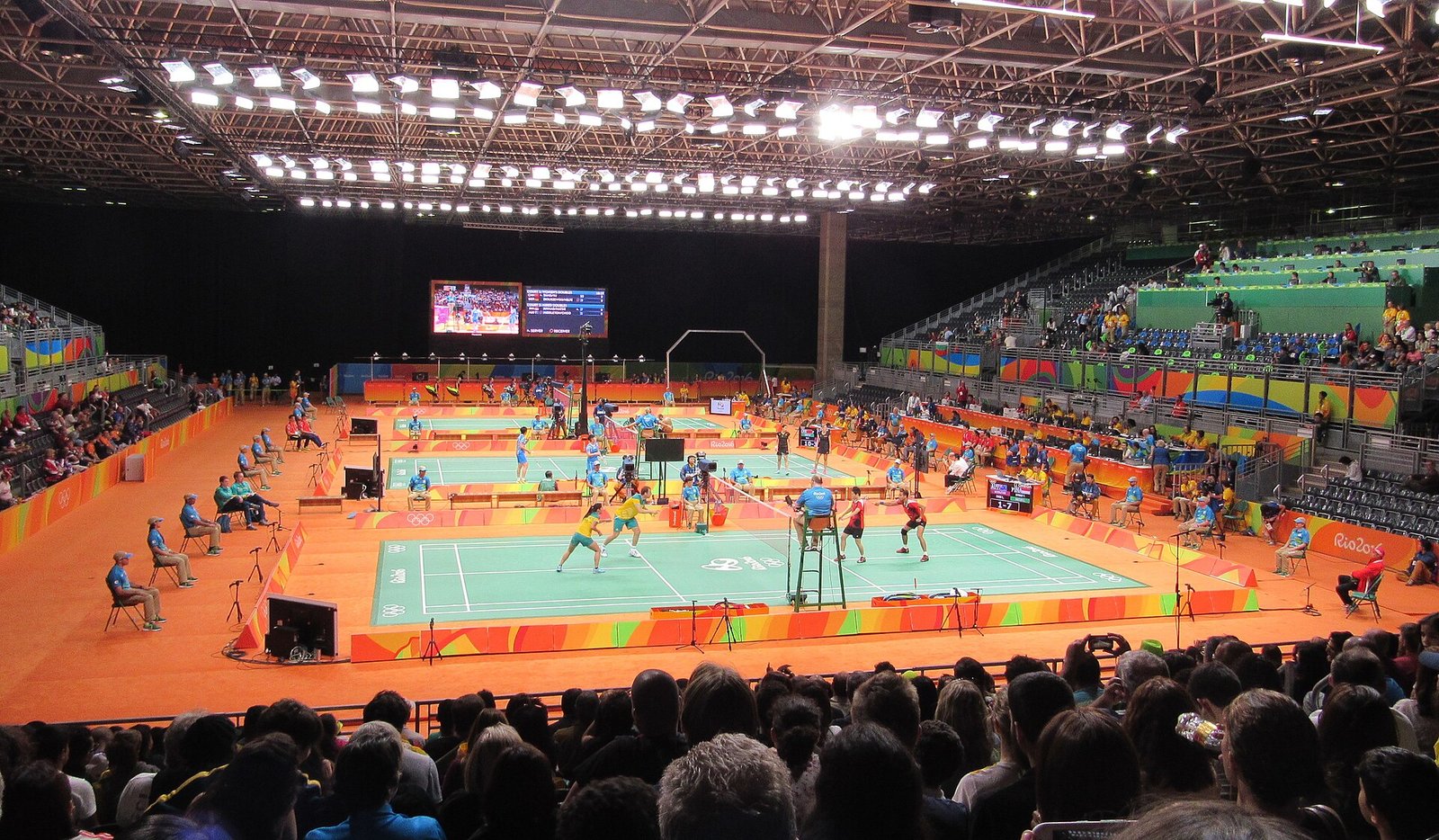
The honest way to shop this tier is to name your limiting factor before you name a shoe. If your landings feel harsh by the third game, your problem is cushioning structure, and the answers are the C90NLite’s thick NitroLite stack or the A970 NitroLite’s foam-plus-E-TPU recipe. If your foot rolls on the plant before a backhand drive, your problem is lateral hardware — the P8500 II’s LS-S and tri-claw, or the Blade FF’s TWISTRUSS. If your heel lifts or your midfoot swims when you brake, your problem is lockdown — the 88 Dial 3’s single-dial system over a bootie, or the Fang Pro’s leather that closes around the foot as it warms. And if your game is built on getting to the net first, your problem is transition geometry — the Blade FF’s raised heel exists for exactly that. Buy the upgrade that matches the limitation; the rest of the spec sheet is supporting cast.
Finally, a word on what the extra money is actually buying, since this guide prints no prices: at the top tier you are paying for processes, not just materials — nitrogen foaming lines, carbon-fibre sheets, dial closures, natural leather, midsole moulds built to a thickness no standard shoe attempts. Those processes are why this tier exists as a separate decision from the step-up one. They are also why the spec sheets get longer and stranger from here on, which is exactly what the next section is for.
What the Top-Tier Spec Sheet Really Tells You
Cushioning becomes a manufacturing process. At entry level the midsole line reads “EVA”. At this tier it reads like a factory tour. Victor’s NitroLite is a supercritical nitrogen-foaming process applied to the midsole — the same N2 technology appears in three shoes here, tuned three ways: as the A970 NitroLite’s all-around recipe with E-TPU, as the C90NLite’s maximum-thickness Cushion build, and nowhere at all in the P8500 II, which stays with HYPEREVA and ENERGYMAX 3.0. Yonex layers POWER CUSHION+ as its plus-grade compound. Mizuno pairs AP+ with the Wave structure — a shape, not just a foam. Li-Ning runs two foams in one sole: LN CLOUD full-length with a BOUNCE+ insert where the forefoot loads. ASICS keeps FLYTEFOAM and spends its engineering on geometry instead. A longer recipe is not automatically a better shoe; it is a more specific one, tuned for a job the card will name.
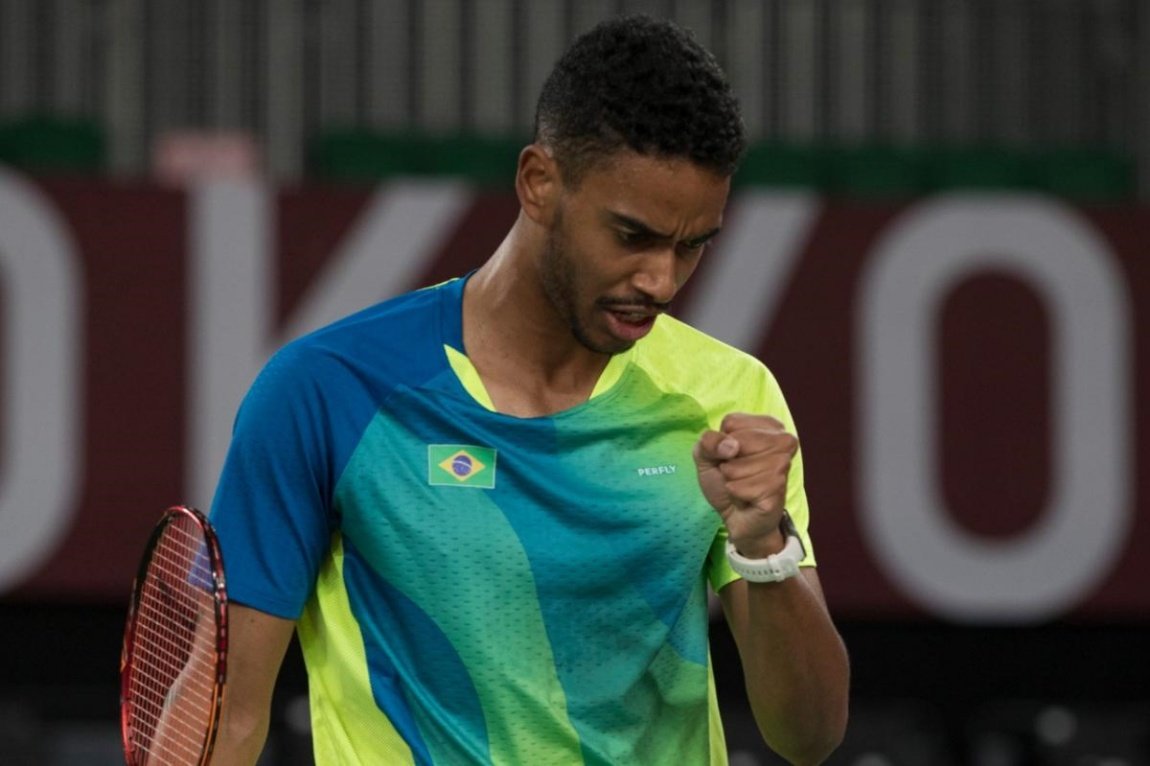
Lateral hardware is the tier’s real arms race. Read the stability line as a structure, not a slogan. Victor’s LS-S is a high-strength TPU structure on the outside of the forefoot; on the C90NLite, Victor says it is the longest it has ever built, extending into the midsole to form an L-shape. The P8500 II adds a 3D tri-claw design at the forefoot. ASICS’s TWISTRUSS is its named system for supporting faster direction changes between a stop and a full sprint. Li-Ning’s ProBar Loc is a TPU shank in the midfoot, there to resist twisting. Yonex answers with a graphite sheet — the Power Graphite Drive — in the midfoot of the 88 Dial 3. Different makers, same job: keeping the shoe’s platform under your foot when the plant is sideways and at full stretch.
Weight, and its basis — the tier’s biggest trap, one last time. Only one of the seven shoes here carries a maker-stated weight: Mizuno’s own spec table prints the Wave Fang Pro at 320 g, in a standard D width — a real, comparable fact. Victor publishes no weight for the A970 NitroLite, C90NLite or P8500 II; Yonex’s listings for the 88 Dial 3 print none; ASICS publishes none for the Blade FF. One retailer lists an average of approximately 365 g for the Li-Ning Blade II Pro — that figure is the retailer’s, not Li-Ning’s, and the card labels it as such. A missing weight is not a heavy shoe. At this tier it usually means the opposite of a secret: the flagship shoes are bought on structure and fit, and several makers simply decline to compete on a number that changes with every size.
Fit becomes a system, and the systems genuinely differ. The 88 Dial 3 replaces laces with a single BOA dial over an Inner Bootie, adjusted by clicks and shaped by Yonex’s Synchro-Fit Insole at the heel. The Wave Fang Pro takes the opposite route: natural leather that softens and moulds, a non-stretch panel where the forefoot stresses, and a reworked heel structure — fit that improves across the first weeks rather than the first fitting. Victor prints its lasts as shape codes — the P8500 II’s standard fit against the wider codes elsewhere in its range — while ASICS changes the geometry itself, raising the Blade FF’s heel drop to pitch the foot toward forward movement. Players who need published wide fits as a starting point rather than an upgrade will find that conversation in our seniors coverage; this tier assumes a standard foot and competes on how completely the shoe can be made to disappear around it.
The Picks: 7 Advanced Badminton Shoes Compared
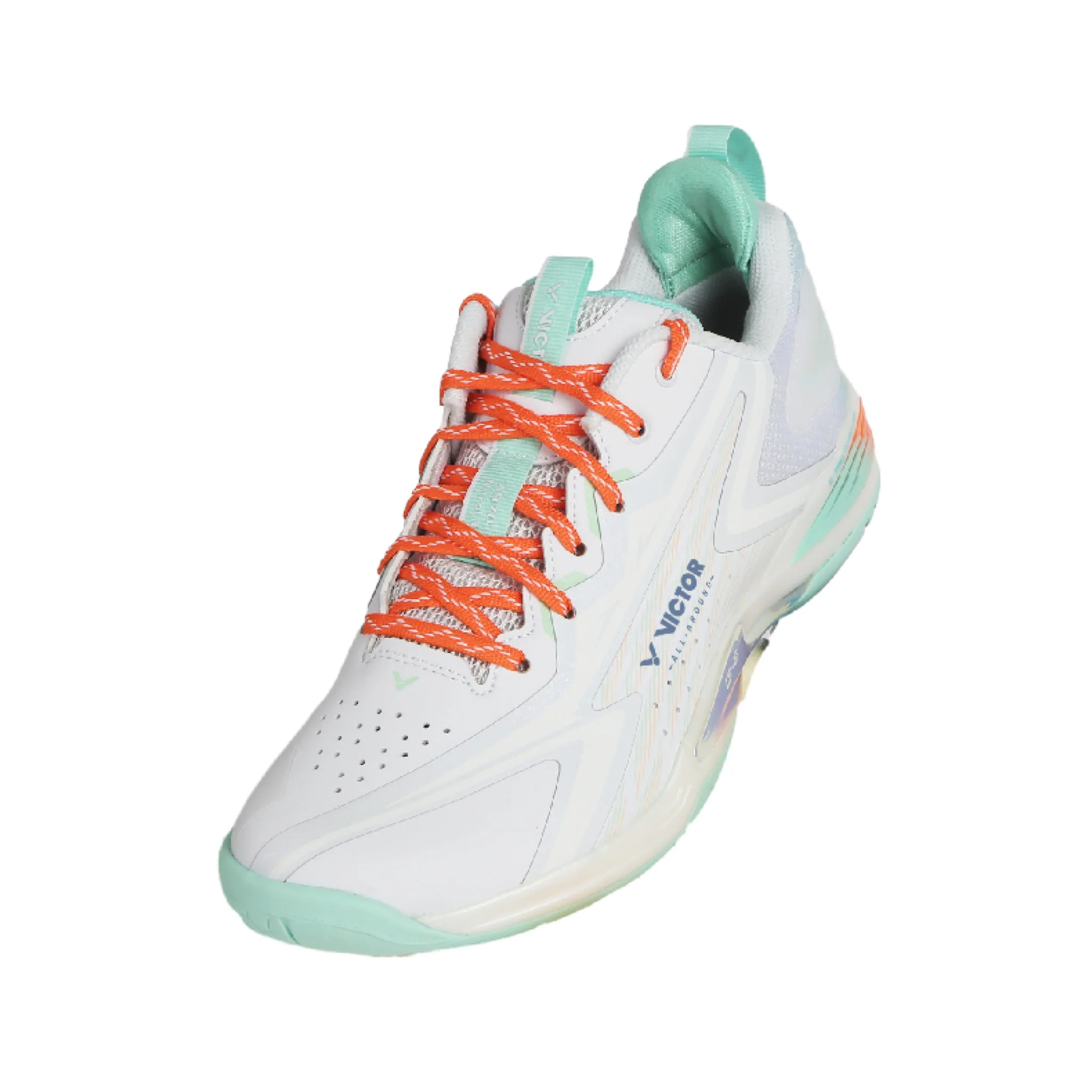
Victor A970 NitroLite
The complete advanced package: a nitrogen-foamed midsole, carbon under the arch, Victor’s LS-S lateral structure — the All-Around flagship its tour players actually wear.
The A970 NitroLite is the shoe Victor builds when it is allowed to use everything at once, and its spec sheet reads like the tier in miniature. The midsole is the headline process: NitroLite, Victor’s supercritical nitrogen-foamed midsole material, paired with an E-TPU heel pad where the jump-smash landing lands. Under the arch sits the Carbon Power sheet, there to keep the midsole stable when the shoe twists; on the outside of the forefoot, the LS-S structure does the same job for the sideways plant. This is the model Victor’s own retail copy identifies as the shoe of Lee Zii Jia and Anders Antonsen — printed here as Victor’s positioning, not as an endorsement of anything, but it tells you where in the range this shoe sits: it is the All-Around flagship, not a special edition of one.
The upper is microfiber PU leather with mesh where the foot needs to breathe, and a 3D heel-support structure closes the back of the shoe. What Victor does not publish is a weight — there is no figure in its listings for this model, and this card will not invent one; the shoe’s case rests on its recipe, and the recipe is the most complete in this guide. One caution on naming, because Victor’s A970 family is crowded: this is the A970 NitroLite. It is a different model from the A970cADV ranked in our pillar guide — that shoe’s dual carbon sheets are its own story — and from the A970TD sold in some markets. If the listing in front of you does not say NitroLite, it is not this shoe. Buy the A970 NitroLite if you want one purchase that answers cushioning, torsion and lateral support together, from the maker whose shoes fill more top-tier feet than anyone else’s in this guide.
Pros
- Full Victor flagship recipe in one shoe: NitroLite foam, E-TPU, Carbon Power and LS-S
- The All-Around flagship its tour players wear, per Victor’s own retail copy
- 3D heel-support structure closes the fit at the back of the shoe
- Microfiber PU and mesh upper balances structure with ventilation
Cons
- Victor publishes no weight for this model — the card cannot give you a number
- The A970 family naming is crowded (cADV, TD, ACE editions) — check the exact model before ordering
- Maximum-recipe shoe: players who want one simple job done may be better served below
As an Amazon Associate we earn from qualifying purchases.
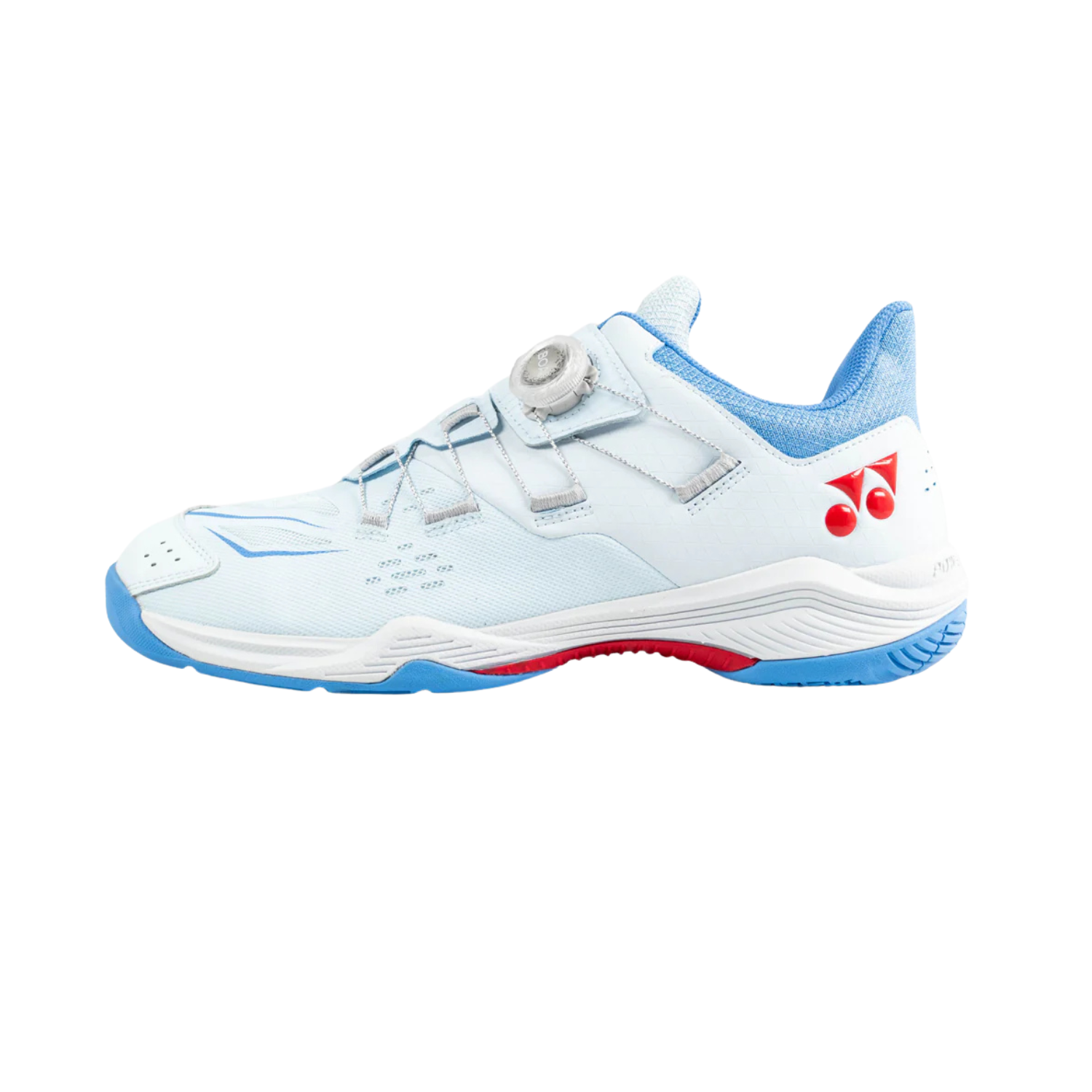
Yonex Power Cushion 88 Dial 3
Fit as a weapon: one BOA dial over an Inner Bootie, POWER CUSHION+ underfoot and a graphite drive sheet — Yonex’s lockdown flagship, in its third generation.
The 88 Dial 3 is built around a single idea: at advanced level, the fit you start the match with is not the fit you finish with, so the fit has to be adjustable at the speed of a change of ends. One BOA dial tensions the whole closure — a click tighter before a big rally, a click released between games — over an Inner Bootie that replaces the conventional tongue and wraps the midfoot without a pressure ridge. Yonex’s Synchro-Fit Insole is shaped to close the gap between foot and shoe at the heel, which is where the foot slides forward from when you brake hard at the net, and its Toe Assist shaping contours the front of the shoe at the forefoot, midfoot and heel. The upper is Durable Skin Light, the material Yonex uses where a shoe needs to flex like rubber and hold like a harder skin.
Underfoot, POWER CUSHION+ — the plus grade of Yonex’s cushioning — sits over a Power Graphite Drive sheet in the midfoot, which Yonex builds in to resist twisting and carry the step forward. The outsole carries the Radial Blade Sole pattern; Yonex attributes an improvement of approximately 3% in grip to that pattern — that is Yonex’s own figure, printed here as a maker claim, not a measurement of ours. Yonex’s listings for this model print no weight, and the card says so rather than estimating one. One naming caution: this is the standard-width third-generation 88 Dial (SHB88D3). It is a different model from the 88 Dial Wide covered in our seniors guide — if width is your starting requirement, that guide is the right one; if micro-adjustable lockdown is, this is the most complete fit system in the guide.
Pros
- Single-dial closure adjusts the whole fit in seconds, mid-match, without re-lacing
- Inner Bootie plus Synchro-Fit Insole is the strongest anti-slide package here
- POWER CUSHION+ over a Power Graphite Drive sheet — cushioning and torsion in one stack
- Radial Blade Sole pattern shaped for vertical, horizontal and diagonal grip
Cons
- Yonex publishes no weight for this model in the listings checked
- A dial is the most complex closure here; a snapped lace is a simpler courtside fix
- Standard width only in this generation — wide feet are served by a different model
As an Amazon Associate we earn from qualifying purchases.
Mizuno Wave Fang Pro
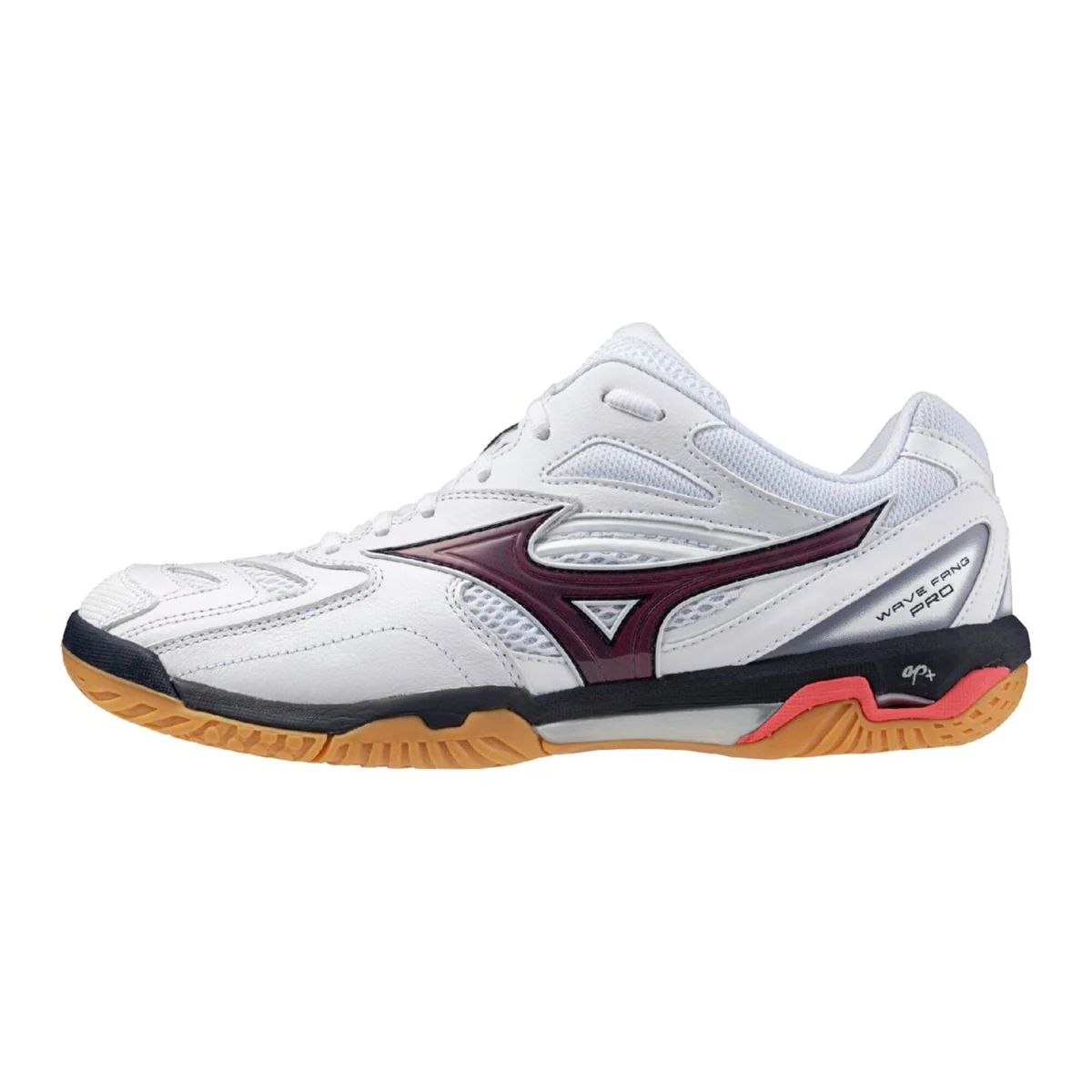
The leather flagship: Mizuno’s top model in natural leather that moulds to your foot, on its flat Fang sole — and the only maker-stated weight in this guide.
Every other shoe in this guide is an argument for newer materials. The Wave Fang Pro is Mizuno’s argument that the oldest one still wins on fit. Its own store describes it plainly: the flagship model made with natural leather, back with an even better fit. The spec table breaks the upper down as 60% synthetic, 20% leather and 20% textile — the leather sits where the foot needs the shoe to envelop it, and leather does the one thing synthetics cannot: it softens and moulds across the first weeks of play, so the fit at month two is closer than the fit at day one. A non-stretch material is placed outside the forefoot, where Mizuno says the upper takes major stress when the foot hits the ground, so the moulding never becomes sloppiness, and a new heel structure — Mizuno reworked how the heel sponge is inserted — closes the back of the shoe.
Underfoot is the proven flat Fang sole: MIZUNO WAVE for the cushioning-and-stability structure, AP+ as the midsole material Mizuno rates for cushioning and energy return, the U4ic X insole board, MB-HOLD FIT for the uniform foot-to-shoe hold, and XG Rubber — Mizuno’s extra-grade grip compound — on the floor. And the Fang Pro carries this guide’s rarest spec: a weight Mizuno actually prints. Its table states 320 g, in a standard D width, unisex — one honest number, on a stated basis, from the maker itself. If your advanced purchase is really a fit purchase, and you distrust every synthetic promise in this guide, the leather flagship is the traditional answer, engineered properly.
Pros
- Natural leather upper moulds to the foot across the first weeks — fit that improves with play
- The only maker-stated weight in this guide: 320 g, printed by Mizuno with its D width
- Non-stretch forefoot panel keeps the moulded fit from becoming movement
- Flat Fang sole with Wave, AP+ and XG Rubber is Mizuno’s proven top-tier platform
Cons
- Leather needs the break-in the synthetics do not — judge it after weeks, not minutes
- At 320 g it is the substantial build in this guide, not the flighty one
- Standard D width only in Mizuno’s table — no published wide option for this model
As an Amazon Associate we earn from qualifying purchases.
Victor C90NLite
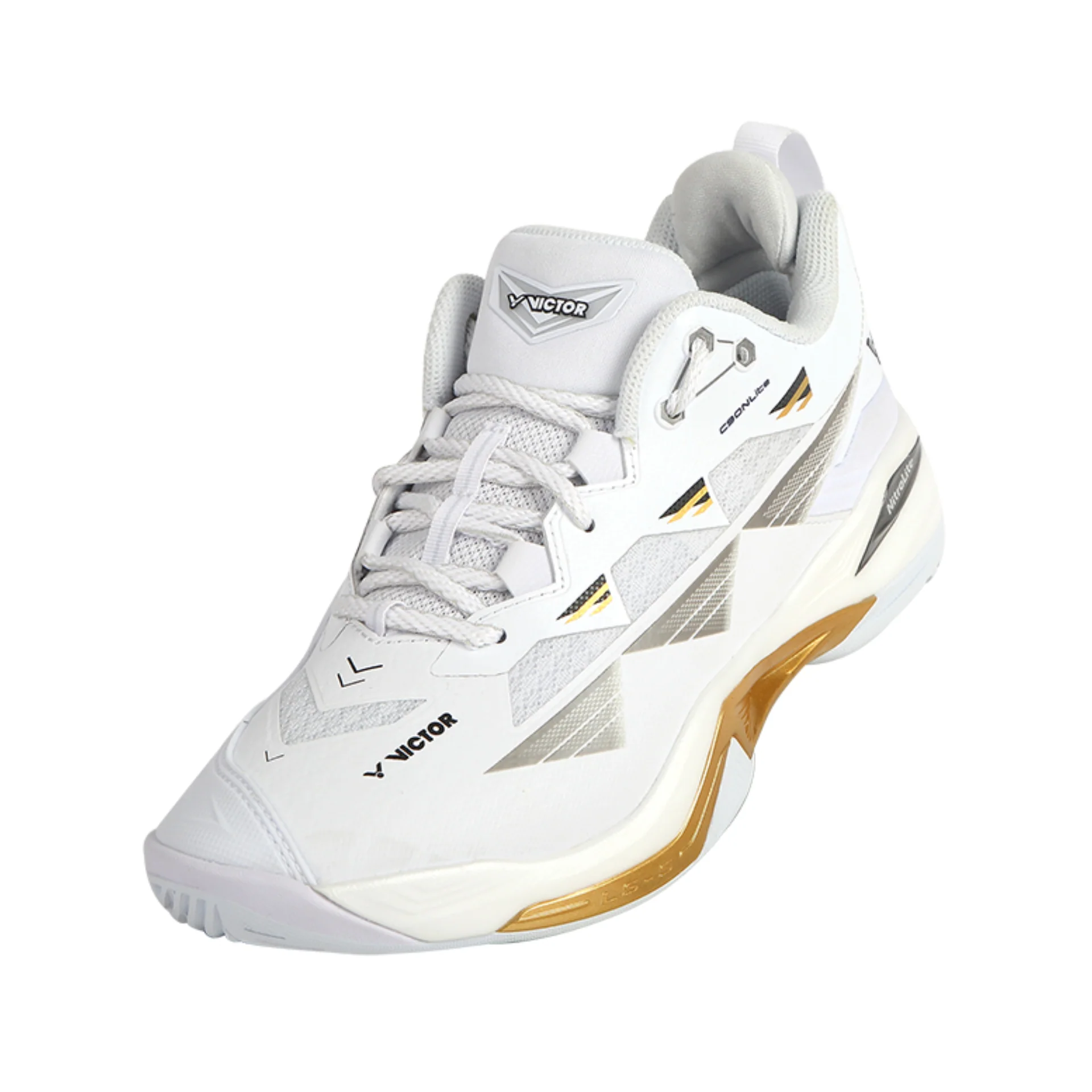
The debut of Victor’s Cushion type: the thickest NitroLite midsole Victor has ever published, with its longest-ever LS-S structure reaching into the sole.
Victor organises its shoes the way Mizuno organises its Waves — by type — and the C90NLite is the launch of an entirely new one: CUSHION, the first shoe Victor has built for the player whose limiting factor is landing load. The numbers are Victor’s own, from its launch article: a NitroLite midsole measuring 12 mm at the forefoot and 23 mm at the heel, against the 5 mm and 17 mm Victor cites as the standard its shoes are usually built to. More than double the forefoot thickness is not a tuning change; it is a different philosophy of what a badminton midsole is for — absorbing the repeated jump landings of a full tournament day without asking the player to ration their aggression. Victor says the shoe’s shock absorption was tested by the Sport Technology Lab at National Taiwan Normal University; that testing claim is Victor’s, attributed here as the maker prints it, and we make no claim of our own about it.
The engineering does not stop at thickness, and this is where the shoe earns its place in an advanced guide rather than a comfort list. Victor’s LS-S — the high-strength TPU structure that braces the outside of the forefoot — is, in Victor’s own words, the longest it has ever made, moulded with a 3D triangle inlay and extending into the midsole itself to form an L-shaped structure, so the cushioning platform stays stable when the plant is sideways. It is the shoe of Indonesia’s Apriyani Rahayu in Victor’s launch copy — a top-flight doubles player whose game is built on exactly the jump-and-recover cycle this shoe is engineered for. Victor publishes no weight for it, and the card prints that plainly. If your advanced game is being limited by how your legs feel in the third match of the day, this is the only shoe here whose entire architecture is the answer.
Pros
- The thickest midsole Victor publishes: 12 mm / 23 mm of NitroLite, maker’s own figures
- Longest-ever LS-S structure keeps the thick platform stable on sideways plants
- The debut of a whole Victor shoe type — CUSHION — built for landing load
- Shock-absorption testing by a named university lab, as Victor reports it
Cons
- Victor publishes no weight for this model
- A maximum-cushion build is the opposite philosophy from the flat, low Fang and Aerus-style shoes — know which camp you are in
- Victor’s launch copy does not name its outsole compound; the card cannot either
As an Amazon Associate we earn from qualifying purchases.
Victor P8500 II
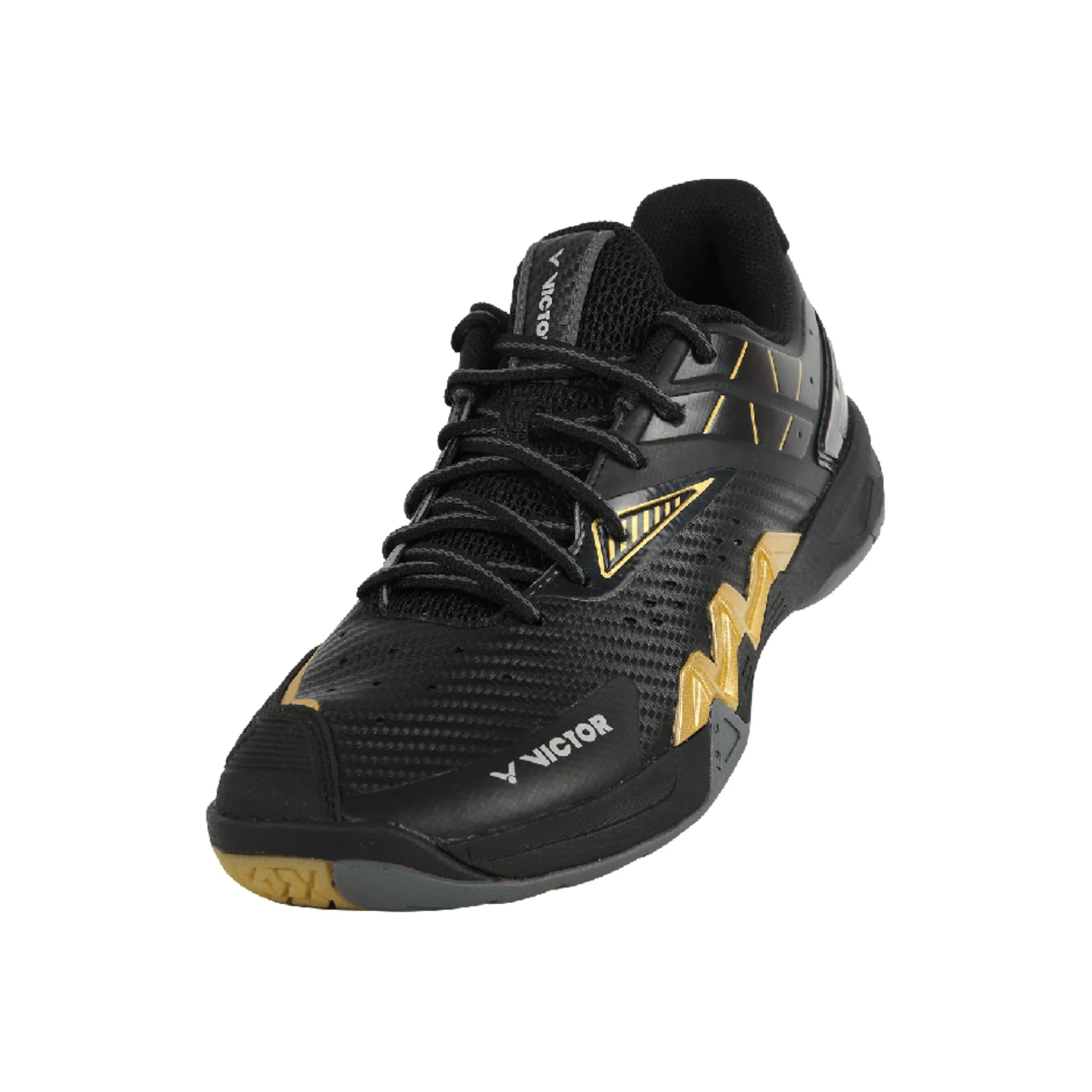
The Support flagship: LS-S lateral structure and a 3D tri-claw forefoot on Victor’s firmest stack — the defensive wall shoes, worn by Ahsan and Setiawan.
Where the C90NLite is Victor’s Cushion manifesto, the P8500 II is its Support one — the second generation of the P8500 line, and the shoe Victor’s retail copy associates with Mohammad Ahsan and Hendra Setiawan, the defensive masters whose game is a masterclass in never being off balance. The architecture is layered for exactly that: an LS-S lateral stability structure of high-strength TPU on the outside of the forefoot, a 3D tri-claw design at the front of the shoe, and Carbon Power in the midsole stack alongside HYPEREVA and ENERGYMAX 3.0 — Victor’s firmer, more responsive cushioning recipe rather than the plush NitroLite route. An enhanced fit around the ankle area, per Victor’s listing, closes the top of the shoe where a defender’s heel works hardest through a rally.
The upper is PU leather with double mesh — a more traditional, more armoured construction than the featherlight skins elsewhere in this guide, and the outsole is Victor’s VSR Rubber, non-marking indoor rubber as its listings specify. Victor publishes no weight for the P8500 II. One distinction worth making carefully, because it confuses real buyers: this is not the P8500 TD that appears in our seniors guide — the TD is a different, gentler model in the same family tree, the way the Wave Fang ST differs from the Wave Fang 2. The II is the full Support flagship. Buy it if your advanced game is built on defence, drives and impossible retrievals — the rallies where the shoe’s job is to arrive under you, sideways, at full stretch, and simply refuse to roll.
Pros
- The most lateral hardware in one shoe here: LS-S, tri-claw forefoot and a carbon sheet
- Firmer ENERGYMAX 3.0 + HYPEREVA stack suits players who dislike a plush ride
- Armoured PU leather and mesh upper, with an enhanced ankle-area fit
- The second generation of a proven flagship line, not an experiment
Cons
- Victor publishes no weight for this model
- Maximum-support shoes feel the least “free” on easy footwork — it is a deliberate trade
- Do not confuse it with the gentler P8500 TD when ordering; the listings sit side by side
As an Amazon Associate we earn from qualifying purchases.
ASICS Blade FF
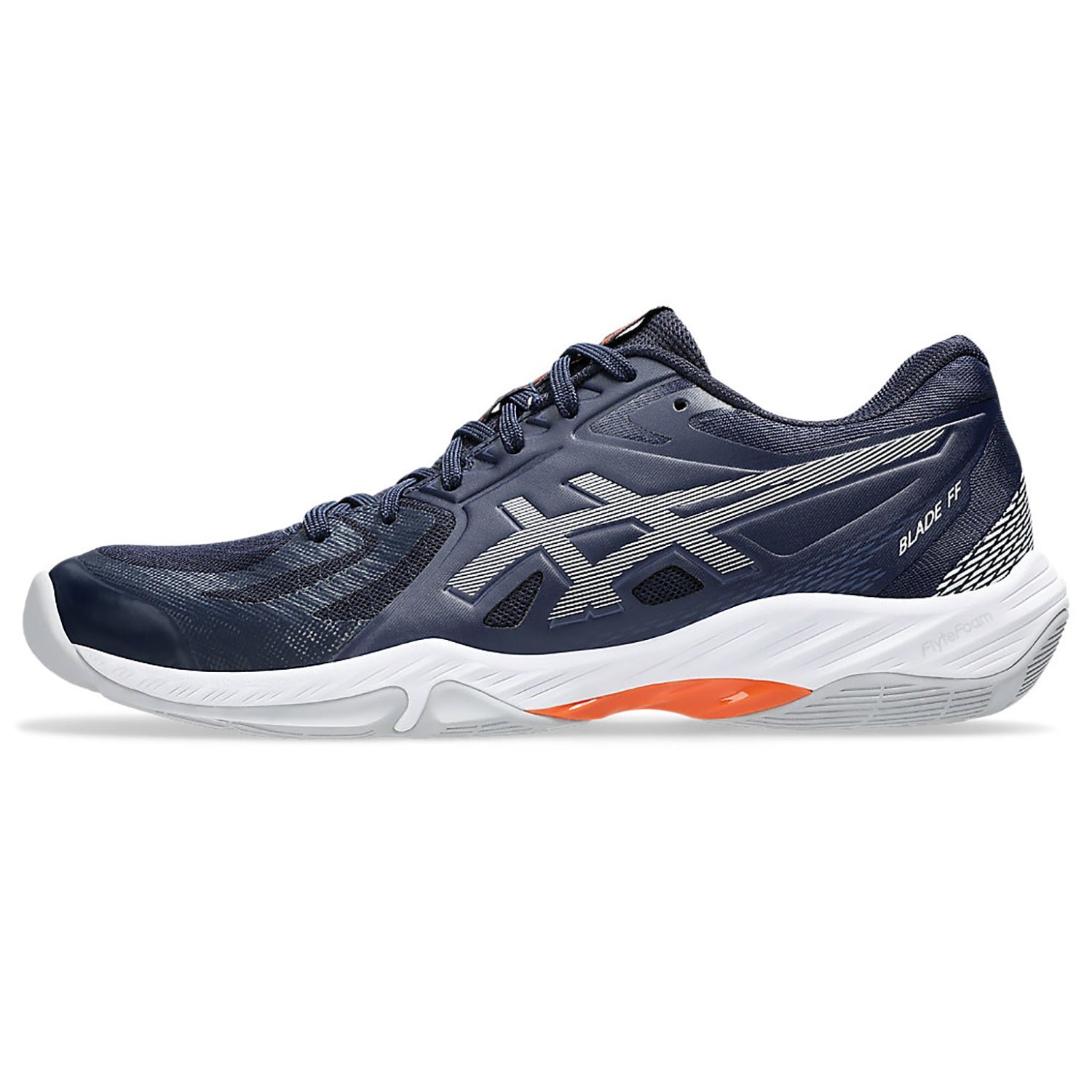
Geometry as a weapon: a raised heel drop that pitches you toward the net, TWISTRUSS for the turn and X GUIDANCE for the court — ASICS’s transition shoe.
Every other shoe in this guide answers a load. The Blade FF answers a direction. ASICS builds it for squash and badminton players whose sport is multi-directional movement, and its defining decision is geometric: a raised heel drop that positions the foot, in ASICS’s own description, for faster forward transitions — the baseline-to-net sprint that decides who owns the front court. Around that geometry sit two named systems: TWISTRUSS, which ASICS designs to support faster changes of direction between a stop and a full sprint, and X GUIDANCE, its technology for flexibility and court coverage as the foot travels. FLYTEFOAM — ASICS’s lightweight midsole foam — keeps the stack simple so the geometry can do the talking.
The upper is the modern minimal route: a reconstructed design with no-sew overlays that ASICS notes are lighter than traditional reinforcements, and a raised heel collar closing the back of the shoe. Two honesty notes belong on this card. First, ASICS publishes no weight for the Blade FF — its own product copy gives none, and the card will not borrow one from a retail listing. Second, ASICS sells this shoe to squash players as well as badminton players; it is an indoor-court shoe in the fullest sense, which for the advanced player who cross-trains on both courts is a feature, and for the purist who wants a badminton-only last is worth knowing. Buy the Blade FF if your game is a forward game — taking the net early, intercepting, finishing — and you want the shoe itself leaning the same way.
Pros
- Raised heel drop is a genuinely different engineering answer — built for the net rush
- TWISTRUSS and X GUIDANCE: ASICS’s named systems for direction changes and coverage
- No-sew minimal upper and raised heel collar — modern, light construction
- ASICS sells it for squash and badminton — one shoe for both courts
Cons
- ASICS publishes no weight for this model
- A forward-pitched geometry is a preference, not a universal good — flat-sole players should know their camp
- A cross-court shoe rather than a badminton-only last
As an Amazon Associate we earn from qualifying purchases.
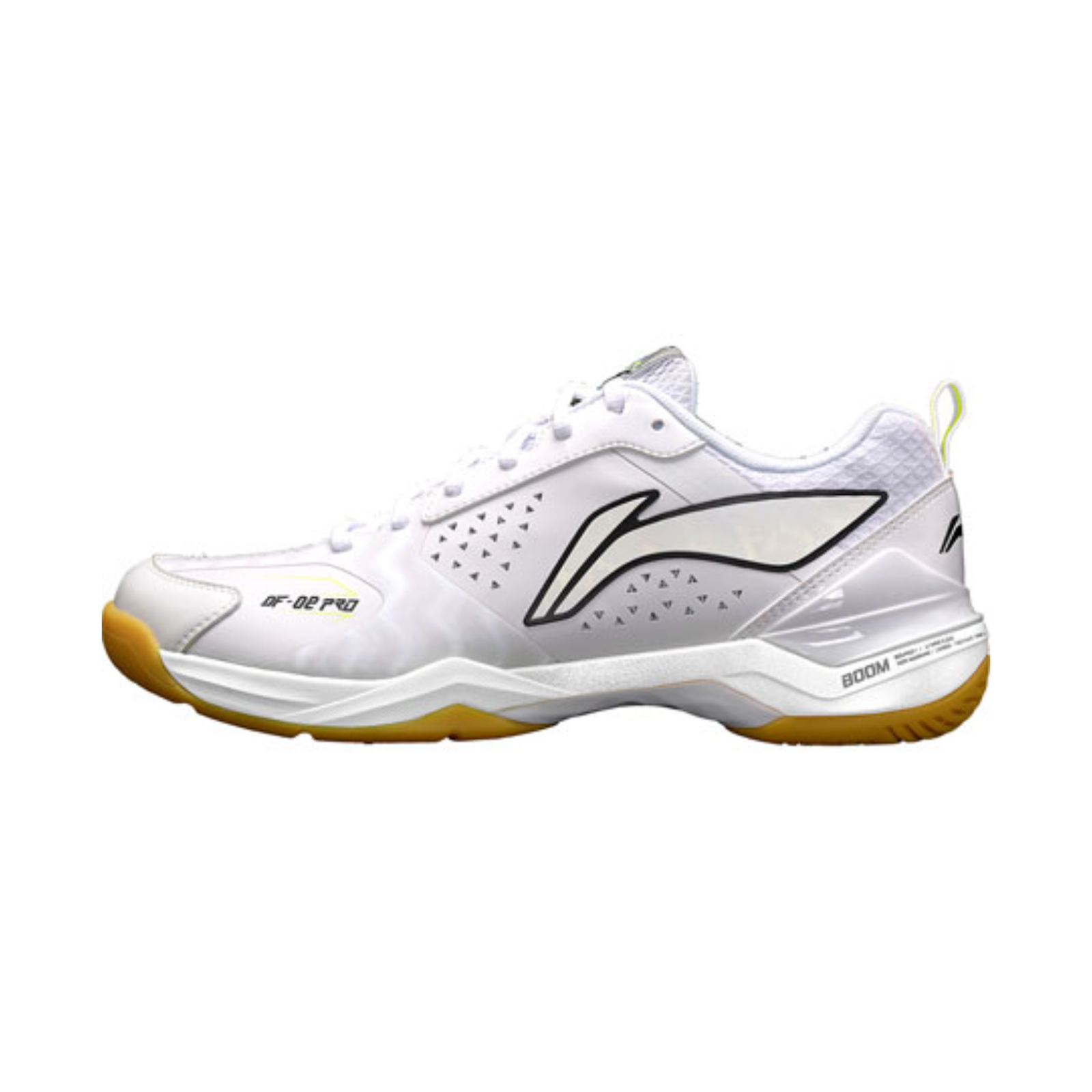
Li-Ning Blade II Pro
The engineer’s pick: full-length LN CLOUD foam, a BOUNCE+ forefoot and a full TPU ProBar Loc shank — Li-Ning’s complete stability recipe, unisex.
Li-Ning’s Blade line is its stability line — the name refers to the shank, not the styling — and the Blade II Pro (model code AYZV001) is the complete version of the idea. The midsole runs two foams with two jobs: LN CLOUD, Li-Ning’s full-length foam, carries the shoe’s cushioning, while a BOUNCE+ insert in the forefoot adds the vertical elasticity a pushoff needs — the same division of labour the flagship foams elsewhere in this guide perform, stated in Li-Ning’s own product data. The defining part is underneath: the ProBar Loc, a TPU shank integrated into the midfoot whose job, as Li-Ning describes it, is to prevent excessive twisting and secure the arch through rapid changes of direction. It is the most explicit anti-torsion statement on any card here — a shank, named, shaped and aimed at the midfoot.
The rest of the spec is equally matter-of-fact. The upper is synthetic leather, textile and TPU, engineered for airflow through long sessions; the inner toe carries TUFF TIP, Li-Ning’s abrasion material placed exactly where the dragging non-racket foot wears first; and the TUFF RB outsole is the maker’s non-marking rubber, built for grip on indoor courts. On weight, this card models the honesty this guide keeps promising: Li-Ning publishes no weight for the Blade II Pro. The figure in the chips above — an average of approximately 365 g — is the authorised retail channel’s own listing figure, not Li-Ning’s, and it is labelled that way wherever it appears here. One retailer sizing note, also from that channel: Li-Ning’s US sizes are listed as running about half a size smaller than Yonex or Victor US sizes, so cross-brand shoppers should order accordingly. Buy the Blade II Pro if midfoot stability is your limiting factor and you want the most completely specified shoe in this guide for the job.
Pros
- ProBar Loc TPU shank is the most explicit anti-twist engineering here
- Two-foam midsole: LN CLOUD full-length with a BOUNCE+ forefoot for pushoff
- TUFF TIP toe armour and a TUFF RB outsole — the full Li-Ning durability recipe, in the maker’s terms
- Unisex build with the most completely published spec list of the seven
Cons
- Li-Ning publishes no weight; the 365 g figure is the retailer’s average, not the maker’s
- Li-Ning US sizing runs about half a size smaller than Yonex/Victor per the retail channel — order carefully
- Colourways rotate seasonally in Li-Ning’s range — availability of a given colour varies
As an Amazon Associate we earn from qualifying purchases.
Side-by-Side: The Seven Advanced Shoes at a Glance
Every figure below is the maker’s own published specification. Weights are printed exactly as honestly as the cards print them — one maker-stated figure, one labelled retailer average, and five shoes whose makers publish none.
| Shoe | Best for | Cushioning (maker-named) | Outsole | Fit | Weight |
|---|---|---|---|---|---|
| Victor A970 NitroLite | Best overall advanced | NitroLite midsole + E-TPU heel pad | VSR Rubber | Unisex | Not published |
| Yonex Power Cushion 88 Dial 3 | Best dial fit | POWER CUSHION+ | Rubber sole, Radial Blade Sole pattern | Unisex, single BOA dial | Not published |
| Mizuno Wave Fang Pro | Best leather fit | AP+ with MIZUNO WAVE | XG Rubber | Unisex, D standard width, leather upper | 320 g (Mizuno’s figure) |
| Victor C90NLite | Best cushioning | NitroLite, 12 mm forefoot / 23 mm heel (Victor’s figures) | Rubber outsole | Unisex | Not published |
| Victor P8500 II | Best lateral support | HYPEREVA + ENERGYMAX 3.0 | VSR Rubber | Unisex | Not published |
| ASICS Blade FF | Best forward speed | FLYTEFOAM | Indoor court outsole | Raised heel drop geometry | Not published |
| Li-Ning Blade II Pro | Best shank stability | LN CLOUD + BOUNCE+ forefoot insert | TUFF RB non-marking rubber | Unisex | Approx. 365 g average (retailer’s figure) |
Advanced Buying Guide: Five Checks Before You Pay Top-Tier Money
1. Name your limiting factor first. The top tier is seven different answers, not one ranking. Landing load points to the C90NLite; sideways plants point to the P8500 II or the A970 NitroLite; heel slip points to the 88 Dial 3 or the Fang Pro; a net-first game points to the Blade FF; midfoot twist points to the Blade II Pro’s shank. If you cannot name the limitation, the all-around flagship — the A970 NitroLite — is the honest default.
2. Read every weight by its basis — or its absence. This guide contains exactly one maker-stated weight (Mizuno’s 320 g), one labelled retailer average (Li-Ning’s approx. 365 g) and five shoes with no published weight at all. That is normal at this tier, not a warning sign. What should warn you is any listing, anywhere, that prints a precise weight for a Victor or ASICS flagship without saying where the number came from — the makers themselves do not publish one.
3. Check the lockdown the way a fifth game will. Fit failures at this level happen late, on tired feet. Dial users should confirm the closure adjusts across the whole midfoot, not just the top eyelet row; leather buyers should expect the Fang Pro’s fit to be a few weeks in the making; everyone should confirm the heel stays seated through a hard braking lunge in the shop, because that is the movement that finds a loose heel first.
4. Match the stability structure to your game, not your brand loyalty. LS-S, TWISTRUSS, ProBar Loc and Power Graphite Drive all resist the same forces with different hardware. A defender lives sideways and wants the P8500 II’s stack of structures; a midfoot-twister wants Li-Ning’s full shank; a graphite sheet under a cushioned Yonex ride is the balanced answer. The structures are comparable even where the foams are not — read them first.
5. Cross-check sizing between brands before you order. Li-Ning’s US sizes are listed by its retail channel as running about half a size smaller than Yonex or Victor US sizes. The 88 Dial 3 is standard width only — players who need a published wide fit are served by the wide variants covered in our seniors guide, not by sizing up here. And the Fang Pro’s D width is Mizuno’s standard: wider-footed Mizuno players should confirm the fit in person before committing to the flagship.
Frequently Asked Questions
What makes a badminton shoe “advanced” rather than intermediate?
Engineering aimed at load. Advanced shoes add performance midsole processes such as Victor’s nitrogen-foamed NitroLite, carbon sheets and TPU shanks under the midfoot, named lateral structures (Victor’s LS-S, ASICS’s TWISTRUSS, Li-Ning’s ProBar Loc) and fit systems such as a BOA dial or a natural-leather upper. The step-up decision — plates, shanks and lockdown arriving for the first time — belongs to our intermediate guide; the advanced tier assumes those ideas and reinforces them for harder plants, longer lunges, more jump landings and longer sessions.
Why do so many top badminton shoes have no published weight?
Because the makers choose not to print one. Victor publishes no weight for the A970 NitroLite, C90NLite or P8500 II; ASICS publishes none for the Blade FF; Yonex’s listings for the 88 Dial 3 print none; Li-Ning publishes none for the Blade II Pro. Of the seven shoes here, only Mizuno states a weight in its own spec table — 320 g for the Wave Fang Pro. Weights vary with size, and at this tier the makers compete on structure and fit instead. Treat any precise figure for the unpublished models as a retailer’s figure, not the maker’s.
Is the Yonex 88 Dial 3 the same shoe as the 88 Dial Wide in your seniors guide?
No. This guide cards the standard-width third-generation 88 Dial (model SHB88D3): a single BOA dial over an Inner Bootie, with POWER CUSHION+, a Power Graphite Drive sheet and the Radial Blade Sole. The seniors guide covers the 88 Dial Wide, a different model built on a wide fit for senior players. If a published wide fit is your starting requirement, the seniors guide is the right comparison; if micro-adjustable lockdown on a standard fit is, this is the shoe.
Victor C90NLite or A970 NitroLite — which one should I buy?
Buy by limiting factor. The C90NLite is the debut of Victor’s Cushion type: a NitroLite midsole measuring 12 mm at the forefoot and 23 mm at the heel in Victor’s own figures — the maximum-cushioning answer for players whose landings limit their game. The A970 NitroLite is the All-Around flagship: NitroLite with an E-TPU heel pad, a Carbon Power sheet and the LS-S structure in one complete package. Neither publishes a weight. Cushioning first, choose the C90NLite; everything at once, choose the A970 NitroLite.
Can I play squash in the ASICS Blade FF?
ASICS sells the Blade FF for both squash and badminton — its own copy describes it as a shoe for squash and badminton players in multi-directional movement, with TWISTRUSS technology for faster direction changes and a raised heel drop for forward transitions. It is an indoor-court shoe: keep it on indoor courts, and note that ASICS publishes no weight for the model.
Do Li-Ning badminton shoes run small?
According to Li-Ning’s authorised retail channel, yes: its guidance is that Li-Ning US sizes typically run about half a size smaller than Yonex or Victor US sizes — its example is that a player wearing US 7 in those brands should take a US 7.5 in Li-Ning. That is the retailer’s sizing guidance rather than a Li-Ning measurement, but it is the right starting point when switching brands to the Blade II Pro.
How will I know when my advanced shoes need replacing?
No maker in this guide publishes a lifespan, and we will not invent one. The honest checks are the ones you can make yourself: whether the outsole still bites on a clean court the way it did when new, whether the midsole still feels like the foam you bought, and whether the upper still holds your foot without the laces or dial at their limit. When any of those answers changes, the shoe’s engineering is no longer reaching the floor — and at advanced level, that is the replacement signal.
The Verdict
If one shoe has to do everything an advanced game asks, it is the Victor A970 NitroLite — the most complete recipe in this guide, from the maker whose flagship line the tour itself wears. But the honest verdict at this tier is that the best shoe is the one that removes your specific limitation. Legs gone by the third match? The Victor C90NLite and its 12/23 mm NitroLite stack. Foot rolling on the defensive plant? The Victor P8500 II. Fit that will not stay fitted? The Yonex 88 Dial 3‘s dial, or the Mizuno Wave Fang Pro‘s leather — the shoe that also gives you the only maker-stated weight here. A game built on reaching the net first? The ASICS Blade FF. Midfoot twist? The Li-Ning Blade II Pro and its ProBar Loc shank.
Still weighing the wider field? Our pillar comparison of the best badminton shoes covers the all-player flagships this guide deliberately avoids repeating, and the intermediate badminton shoes guide owns the step-up purchase. Buy this tier for the limitation you actually have, read the maker’s own spec sheet before any listing’s summary of it — and the top of the shoe wall stops being a wall of adjectives and becomes seven clear answers.
How we built this guide: every specification above comes from the maker’s own published listing, spec table or launch copy, or from an authorised retailer listing that reproduces the maker’s data — and each figure is attributed to its source in the copy. Victor publishes no weight for its three shoes here, ASICS publishes none for the Blade FF, and Yonex’s listings print none for the 88 Dial 3; we print that plainly rather than estimating. The one retailer figure used (the Li-Ning weight average) is labelled as a retailer’s figure wherever it appears. We do not publish prices, we make no durability or medical claims, and nothing here is presented as hands-on testing. Some links on this page are affiliate links: if you buy through them, AliShuttler may earn a commission at no additional cost to you. As an Amazon Associate we earn from qualifying purchases.
Similar Posts
What is a Drop in Badminton: Mastering Techniques & Strategies 2026✔✔
Ever wondered what is a drop in badminton? Picture this: a strategic move where the…
Women’s Singles Badminton Rankings 2026: BWF Best Players
Ready for some exciting betting action? Look no further than women’s singles badminton, a popular sport…
Indonesia Badminton: Rise of Champions and 2026 Open IC
Indonesia badminton is one of the most popular sports in the country, known for its…
Best Badminton Grips 2026: Senston, Yonex & More Reviewed✔✔
Discover the ultimate best badminton grips that promise enhanced performance, superior comfort, unrivaled control, and…
Drop Shot Mastery: Expert Tips and Techniques for 2026
Drop shot mastery translates to expert-level control of the drop shot in tennis, badminton, and…
ASICS Badminton Shoes: Best Guide in 2025
Asics badminton shoes are some of the best you can get if you play badminton…