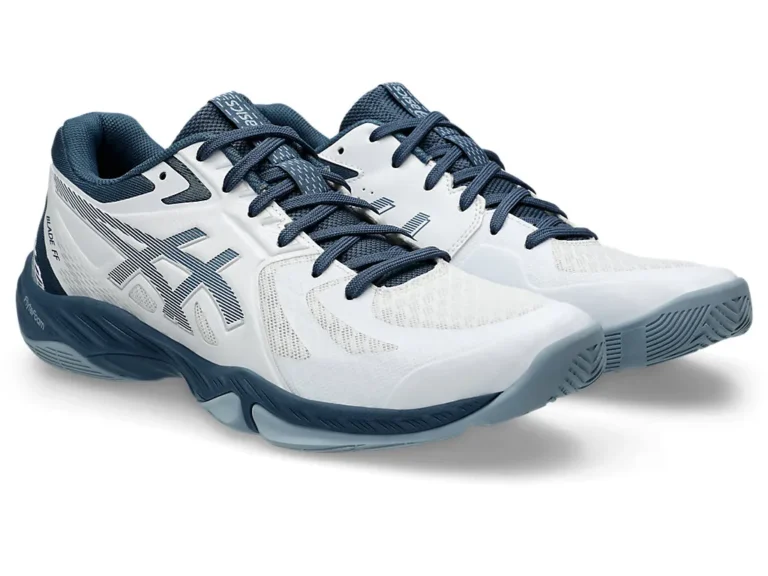

Seven squash shoes with maker-stated wide options or verifiably roomy lasts, compared the honest way: gum-rubber indoor grip as the makers state it, cushioning systems by their maker names, midfoot support as the makers describe it, and heel lockdown that survives ghosting and lunging.
Wide feet change the squash shoe purchase from a preference into a specification. In most sports a snug shoe is a comfort issue; in squash it is a footwork issue. The game asks your feet to lunge deep into the front corners, to ghost from the T to the back wall on repeat, to plant sideways and push off on wooden floors that forgive nothing. A shoe that is right everywhere except across the forefoot will show it on the first deep lunge — the foot slides forward, the toes jam, and the player either shortens the movement or buys a bigger size and inherits a heel that swims. This guide exists because that second mistake is the common one: sizing up a standard last is not the same as buying a wide last, and the seven shoes below are the ones whose makers or retailers actually say the words — 2E, wide fit, wider forefoot space, wide toe box — rather than leaving you to guess from a product photo.
This guide owns one decision only — width and fit. Our main best squash shoes comparison owns the all-player flagship selection, and every model below is different from the ones ranked there; women players have their own segment in our best squash shoes for women comparison, first purchases belong to our best squash shoes for beginners guide, and the top-tier choice is our best squash shoes for advanced players guide. Read those for their jobs; read this one when your forefoot needs room and you want to know exactly which shoes are built for it, in the makers’ own published terms.
One promise before the picks, and it matters more on this page than on any other in the cluster: we only print what the maker or an authorised retailer publishes. Where a brand declines to publish a weight — and four of the seven makers here do — the card says “not published” instead of borrowing a number from a retailer’s spreadsheet. Where a figure exists, we print it with its basis and label whose figure it is. Where a width is maker-stated, we name it exactly as the maker does — 2E, Wide, Wide Toe Box, EE — and where it is retailer-stated, we say so. Learning to read those differences is half of shopping for a wide fit, and the fit section below teaches it before you spend anything.
TL;DR — The Short Version
Buy the New Balance 1006v1 in 2E if you want the only published 2E width in this guide — a true wide designation from the maker, with a REVlite midsole and a non-marking NDurance outsole. Buy the Babolat SFX 3 All Court if you want a maker-stated “Wide” fit with more forefoot space, Kompressor heel cushioning and a Michelin rubber sole. Buy the Wilson Rush Pro 4.5 Wide Toe Box if your forefoot is the wide part and your heel is not — a wide-toe version of Wilson’s stable franchise with a 4D Support Chassis. Buy the Prince T22 for the legendary wide, roomy toe box with ShockEraser cushioning and a RASH toe cap. Buy the HEAD Sprint Pro 3.5 for a roomy, no-break-in fit in a light, low-profile speed shoe. Buy the Python Deluxe Wide (EE) for the squash-first wide answer — EE is in the product name, with a gum-rubber sole built for indoor courts. And buy the ASICS Powerbreak FF for a wider sole platform under a STABLETRUSS sidewall and FLYTEFOAM cushioning.
Quick Picks
In This Guide
- The wide-fit decision: what a wide foot really needs from a squash shoe
- What the wide-fit spec sheet really tells you
- New Balance 1006v1
- Babolat SFX 3 All Court
- Wilson Rush Pro 4.5 Wide Toe Box
- Prince T22
- HEAD Sprint Pro 3.5
- Python Deluxe Wide (EE) Indoor Mid
- ASICS Powerbreak FF
- Side-by-side comparison
- Wide-fit buying guide: five checks before you pay
- Frequently asked questions
- The verdict
The Wide-Fit Decision: What a Wide Foot Really Needs From a Squash Shoe
Start with the mistake this guide is built to prevent. A wide-footed player buys a standard squash shoe, feels the forefoot pinch, and orders the next size up. The pinch disappears — and a new problem arrives: the heel, which was never wide, now floats. On a squash court that floating heel is not a comfort detail. Ghosting drills load the heel on every braking step; the deep lunge drives the foot forward inside the shoe; the recovery back to the T pushes off a heel that is no longer seated. A shoe that is a size too long but a width too narrow trades one fit failure for another, and in a sport built on hard stops and starts, the second failure is the more dangerous one. The correct answer is a shoe that is wide where the foot is wide and standard where the foot is standard — which is exactly what a published wide width is engineered to be.
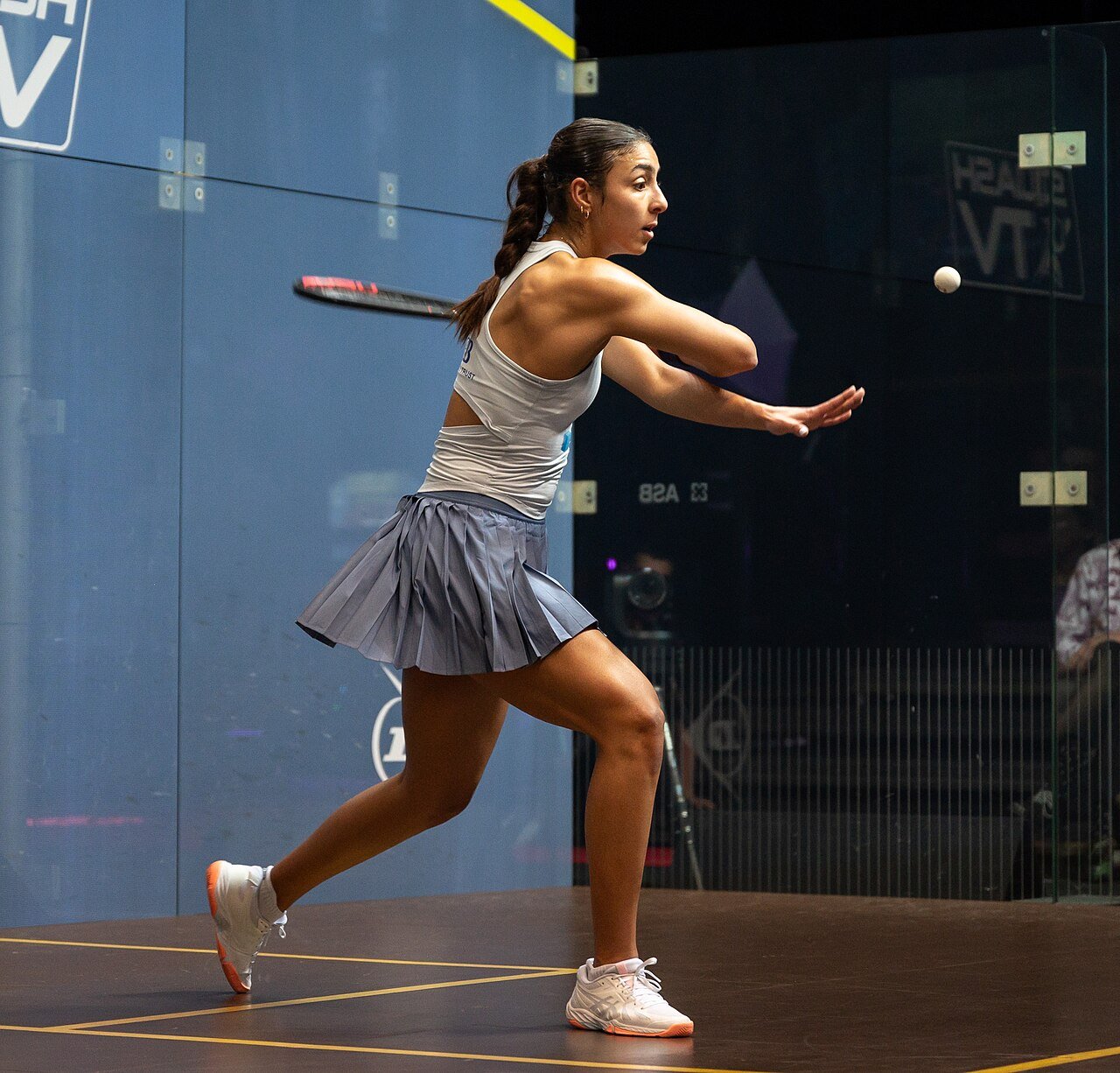
That is the first thing a wide last buys you: heel lockdown that does not depend on the forefoot. The second thing is toe-box volume, and here the vocabulary matters. “Wide” on a spec table usually describes the shoe at its widest point, across the ball of the foot; “roomy toe box” describes volume in front of the toes, which is what keeps the nails off the front of the shoe on the braking lunge. A squash shoe can be wide and still shallow, or roomy and still narrow across the midfoot. The cards below name which kind of width each shoe offers, in the maker’s or retailer’s own words — 2E for the New Balance, “Wide” with more forefoot space for the Babolat, a Wide Toe Box version for the Wilson, a roomy toe box for the Prince and the HEAD, EE in the name for the Python, and a wider sole platform for the ASICS. Different words, different engineering, and the fit section teaches you to read them.
The third thing is the non-negotiable that every crossover shoe in this guide has to clear: the outsole. Squash is played on wooden and laminate indoor courts, and clubs require non-marking soles. Several of the strongest wide answers in court sports are tennis shoes — tennis is simply the sport where wide widths are published most honestly — and a tennis shoe is only a squash shoe if its outsole is non-marking and suited to indoor floors. Every shoe carded here clears that bar in the maker’s or retailer’s own listing: the New Balance’s NDurance non-marking rubber, the Python’s non-marking gum rubber sole, the ASICS’s NC Rubber outsole built for indoor traction. If the listing in front of you does not say non-marking, it is not one of the shoes below, whatever the width code says. If your movement patterns themselves still need work, our how to play squash guide walks through the lunges, ghosting patterns and recovery steps every shoe below is built around.
Finally, a word on what the extra thought buys you beyond comfort. A wide foot in a standard shoe does not just hurt; it changes how the player moves — shorter lunges, cautious plants, a reluctance to drive through the front corners. The right width restores the movement the game is built on. That is why this guide treats width as performance equipment rather than a sizing footnote, and why every card below leads with the fit evidence before the foam.
What the Wide-Fit Spec Sheet Really Tells You
Last and width designations: read the exact words. New Balance publishes the 1006v1 in 2E — a genuine wide width designation, printed on the model code (MC1006BW-2E). Babolat’s own spec table lists the SFX 3 All Court as Fit: Wide, and its product copy says the model is designed with more forefoot space, particularly for wider feet. Wilson sells the Rush Pro 4.5 in a Wide Toe Box version — a variant name, not a guess. Python Racquetball puts the width in the product name itself: “Wide (EE) Width”. The Prince T22 and HEAD Sprint Pro 3.5 carry no letter designation, but their retailer and review listings consistently describe a wide, roomy toe box and a spacious fit; the ASICS Powerbreak FF’s maker copy describes a wider sole construction. A 2E is a measurement standard; “roomy” is a description. Both can be true and both are carded here — but only the cards can tell you which kind you are looking at, so read the chips, not the headline.
Toe-box volume versus midfoot width: know which one you need. Most wide-footed squash players are wide across the forefoot and standard at the heel — which is why the Wilson’s Wide Toe Box variant and the Babolat’s extra forefoot space matter more than a whole-shoe wide would. The Prince T22 is the classic of this shape: a wide, roomy toe box over a midfoot locked down by TPU forefoot straps and a Wishbone shank. The HEAD Sprint Pro 3.5 takes the same shape in a lighter, lower shoe — a spacious fit up front, a lacing layout built to hold the midfoot. If your foot is wide through the whole shoe, the New Balance 2E and the Python EE are the honest answers, because their width runs the full length of the last rather than living in the toe box alone.
Gum rubber, non-marking compounds — the squash line. Indoor courts decide this line, not the brands. The Python’s non-marking gum rubber sole is stated outright — gum rubber is the traditional squash-court compound, and its presence here is the clearest “built for this floor” signal in the guide. The New Balance runs NDurance, its non-marking rubber compound, in a modified herringbone tread. The ASICS uses its NC Rubber outsole, built for indoor traction, on a wide-gauge pattern. The Babolat works with Michelin on a rubber formulation per court surface, and its All Court version is the indoor-appropriate one. Herringbone appears on three of the seven shoes here — it is the tread shape that bites and releases on indoor floors without grabbing, and its repeated appearance is not a coincidence.
Cushioning, named by the makers. Wide feet carry more contact area, not necessarily more impact, so the cushioning story here is about even distribution rather than maximum stack. New Balance’s REVlite is its responsive foam compound; Babolat’s Kompressor is a TPR tube compression system under the heel; Wilson pairs R-DST+ with Energy Cell; Prince layers a ShockEraser heel insert over a SoftSpring PU forefoot insert; HEAD’s Tri-NRG absorbs shock in a low-profile midsole; Python relies on die-cut Artholite insoles over its midsole; ASICS runs FLYTEFOAM. None of these is presented as better than the others — they are different recipes for the same job, and the cards name the job each one is tuned for.
Torsional and midfoot support, and toe-drag protection. A wider platform still has to resist twisting, and the makers name their answers: Wilson’s 4D Support Chassis 2.0, HEAD’s 3D anti-torsion shank, Prince’s Wishbone shank, ASICS’s STABLETRUSS sidewall. Toe drag — the squash-specific wear pattern where the non-racket foot drags on the lunge — gets maker-named protection too: the New Balance’s toe drag tip in the high-wear areas, the Babolat’s rubber forefoot protection over the inner forefoot and toes, the Prince’s RASH toe cap, the Wilson’s enlarged lateral drag pad, the HEAD’s rubber toe cap. If you drag, read this line of the chips first; it is the line that decides how many months the shoe’s first month lasts.
Weight, and its basis — the honest table. Three of the seven shoes here carry a figure, all of them retailers’ figures with a stated size basis: the Wilson at 14.5 oz in size 10.5, the Python at 11.6 oz in size 10.5, the ASICS at 13.5 oz in size 10.5. New Balance, Babolat, Prince and HEAD publish no weight for these models, and the cards say so plainly. A missing weight is not a heavy shoe — several makers simply decline to compete on a number that changes with every size. What should warn you is any listing that prints a precise weight for one of the unpublished models without saying where the number came from.
The Picks: 7 Wide-Fit Squash Shoes Compared

New Balance 1006v1
The only published 2E width in this guide: a genuine wide designation from the maker, with a REVlite midsole and a non-marking NDurance outsole that clears the squash-court bar.
The 1006v1 is the reason this guide can lead with a measurement rather than an adjective. New Balance publishes the shoe in 2E — a wide width with its own model code (MC1006BW-2E) — which means the width is engineered into the last, not stretched into existence by a generous standard fit. That distinction is the whole argument of this guide: a 2E last is wider at the heel and midfoot as well as the forefoot, so the wide-footed player gets room everywhere instead of room in front and a loose heel behind. For the player whose foot is wide through its full length, this is the most literally honest answer on the page, and the only one whose width you can verify on the box before you open it.
The rest of the spec is a proper indoor-court recipe. The midsole is REVlite, New Balance’s responsive foam compound. The outsole is NDurance — the maker’s non-marking rubber compound — in a modified herringbone tread, the pattern that bites wooden and laminate indoor floors without grabbing them. A toe drag tip sits in the high-wear areas where the dragging foot wears first, the upper is synthetic and mesh, the insole is removable, and the drop is approximately 12 mm per New Balance’s own figures. What New Balance does not publish is a weight, and the card says so rather than estimating one. Buy the 1006v1 in 2E if you want the width decision made by the maker’s own designation — the widest whole-foot answer here, on a non-marking outsole your club will accept.
Pros
- A published 2E width — the only letter-designated wide in this guide
- NDurance non-marking rubber outsole with a herringbone tread for indoor floors
- Toe drag tip placed where the squash drag wears first
- Removable insole and synthetic/mesh upper — a complete, honest court recipe
Cons
- New Balance publishes no weight for this model
- A full-length 2E is roomier at the heel too — players wide only in the forefoot should compare the Wilson or Babolat below
- Tennis-court styling: it reads as a tennis shoe, because that is the sport it was built for
As an Amazon Associate we earn from qualifying purchases.
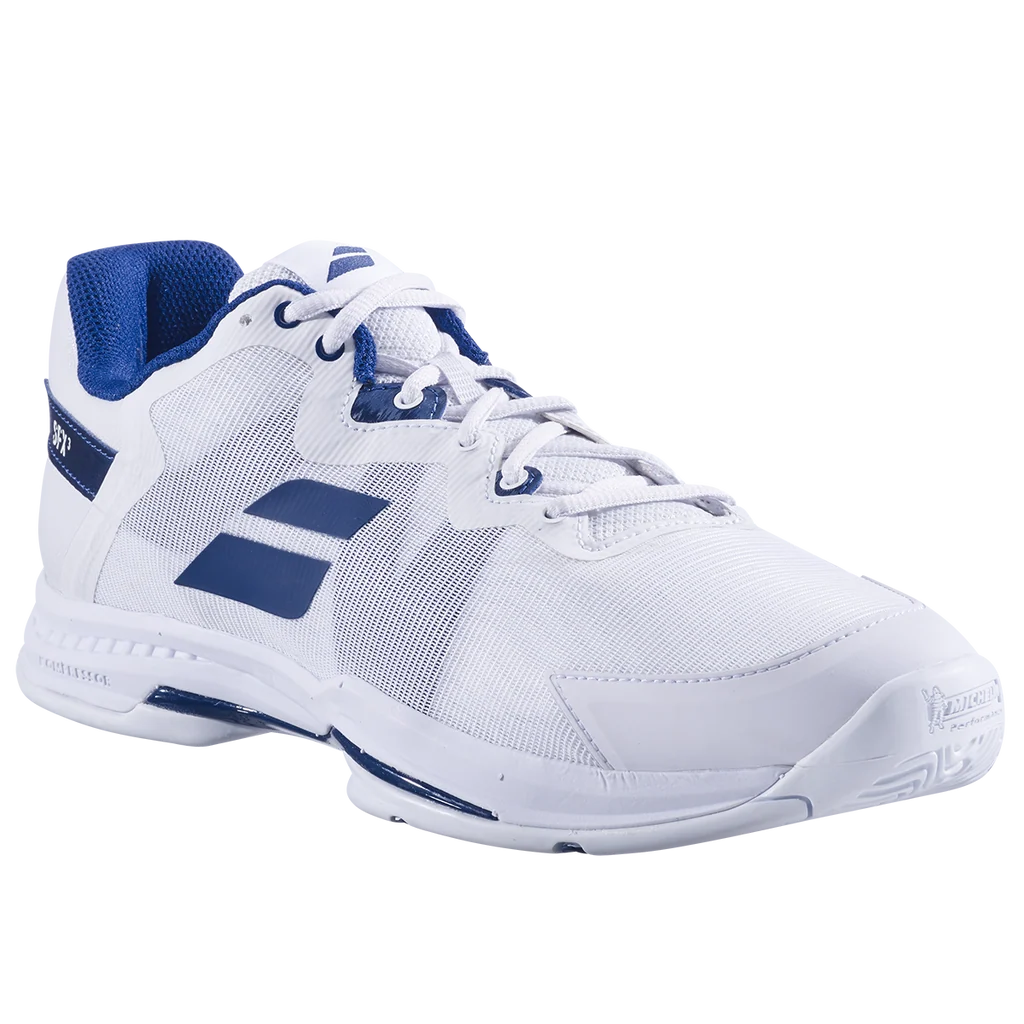
Babolat SFX 3 All Court
Babolat’s own spec table says Fit: Wide. More forefoot space for wider feet, Kompressor heel cushioning, and a Michelin rubber sole — the comfort flagship’s wide answer.
The SFX 3 is Babolat’s comfort flagship, and its wide story is told in the maker’s own words twice over: the spec table on Babolat’s own regional store lists Fit: Wide, and the product copy describes a model designed with more forefoot space for all players, particularly those with wider feet. That second phrase is the important one for squash — “more forefoot space” is the forefoot-shaped answer, wide where the lunge loads and standard where the heel needs holding. Babolat’s 10 mm drop and All Court surface designation complete the fit picture: this is the version of the shoe built for indoor-appropriate all-court play.
Underfoot, the cushioning is the Kompressor system — a TPR (thermo plastic rubber) tube compression system positioned under the heel for shock absorption — over an OrthoLite molded insole shaped to the foot. The sole is the Michelin collaboration rubber, with Babolat and Michelin developing a dedicated rubber formulation per court surface; the All Court version is the one for this job. A Matryx piece on the forefoot supports lateral movements, Active Flexion segments the sole at nine pressure points for responsiveness, and a hard-wearing rubber forefoot protection covers the inner forefoot down to the toes — the toe-drag answer, named and placed. Babolat publishes no weight, and the card prints that plainly. Buy the SFX 3 All Court if you want the maker’s own “Wide” on the spec sheet, with the most complete cushioning recipe in this guide.
Pros
- “Fit: Wide” in Babolat’s own spec table, with more forefoot space in the product copy
- Kompressor heel cushioning plus a molded OrthoLite insole — the plushest stack here
- Michelin rubber sole in the All Court, indoor-appropriate version
- Rubber forefoot protection and a Matryx lateral piece — drag and sideways covered
Cons
- Babolat publishes no weight for this model
- The comfort-first build is the opposite philosophy from the low, flat speed shoes — know which camp you are in
- Check the listing says All Court: Babolat makes surface-specific versions of this line
As an Amazon Associate we earn from qualifying purchases.
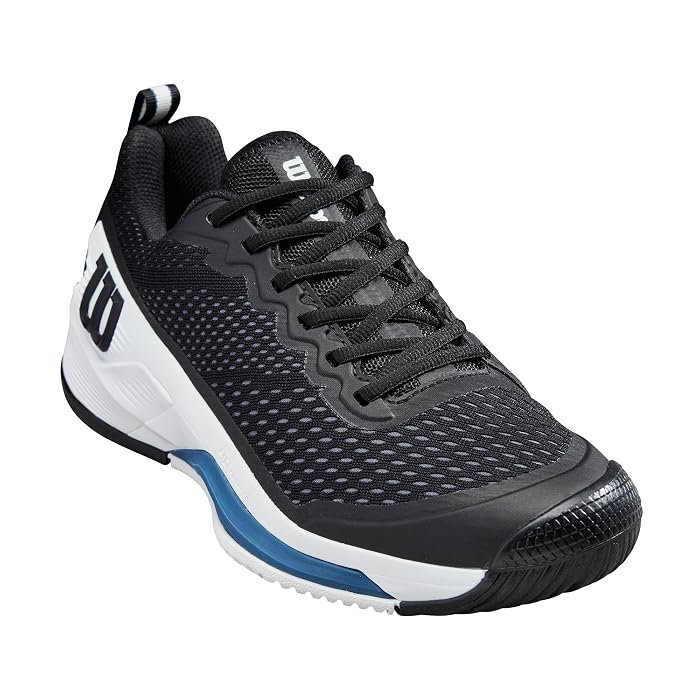
Wilson Rush Pro 4.5 Wide Toe Box
Wilson’s wide-toe-box version of its stable franchise: extra forefoot room over a 4D Support Chassis, with R-DST+ cushioning and a Duralast outsole.
The Rush Pro 4.5 is Wilson’s best-selling court franchise, and the version carded here is the one with the width in its name: the Wide Toe Box version, which retailers describe as a wider toe fit than previous versions of the model. This is the forefoot-shaped answer at its most precise — extra room across the ball of the foot and toes, where the wide-footed squash player needs it, without widening the whole last. For the player whose heel fits standard shoes fine and whose forefoot does not, this is the most targeted geometry in the guide: width exactly where the lunge loads, lockdown everywhere else.
The platform under that forefoot is the serious part of the card. The 4D Support Chassis 2.0 runs from heel to toes for lateral stability and forward propulsion, the midsole pairs R-DST+ with Energy Cell for responsive cushioning, and the Endofit full inner-sock construction wraps the midfoot for the glove-like fit that keeps the heel seated when the forefoot is given room. The outsole is Wilson’s Duralast rubber, and an enlarged rubber drag pad on the lateral side resists the abrasion the squash drag inflicts. The one honest figure here is the retailer’s: 14.5 oz in a size 10.5 — labelled as the retailer’s figure, since Wilson publishes none itself. One caution that matters: confirm the listing says “Wide Toe Box” before ordering, because the standard Rush Pro 4.5 is a different, narrower fit. Buy this version if your width lives in the forefoot and your game lives on lateral stability.
Pros
- A named Wide Toe Box version — the most targeted forefoot geometry here
- 4D Support Chassis 2.0 plus Endofit: stability and heel lockdown in one system
- Enlarged lateral drag pad for the squash wear pattern
- The retailer’s 14.5 oz figure is printed with its size basis, honestly labelled
Cons
- Wilson publishes no weight itself — the figure is the retailer’s
- The standard Rush Pro 4.5 fits narrower: the listing must say Wide Toe Box
- At the substantial end of this guide — speed-first players should compare the HEAD below
As an Amazon Associate we earn from qualifying purchases.
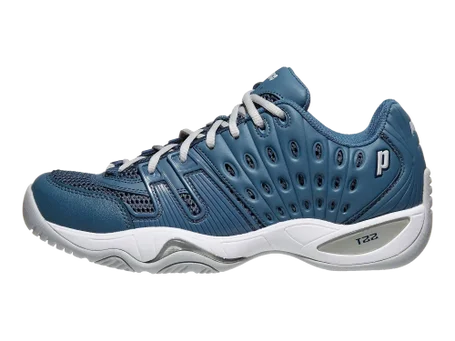
Prince T22
The wide-foot classic: a wide, roomy toe box stated across retailer listings, ShockEraser cushioning, and a RASH toe cap that has outlasted generations of draggers.
Every wide-fit conversation in court sports eventually reaches the T22, and for good reason: across retailer listings and years of player feedback, its wide, roomy toe box is the single most consistently stated fit fact in this guide. Players describe a toe box with genuine volume in front of the toes — the shape that keeps the nails off the front of the shoe on the braking lunge — over a midfoot that the shoe refuses to let go of. That combination is the T22’s whole philosophy: room where the foot spreads, structure where the foot works.
The structure is old-school and proud of it. The midsole is EVA with a ShockEraser insert at the heel absorbing impact and a SoftSpring PU insert at the forefoot dispersing it — two inserts, two jobs, named separately. Midfoot stability comes from the Wishbone shank locking the middle of the shoe and TPU forefoot straps delivering what Prince calls a custom lockdown over the forefoot. The outsole is the PRC 1000 durable compound in a herringbone tread, and the toe carries the RASH toe cap — Prince’s abrasion protection, placed exactly where the squash drag attacks. Prince publishes no weight, and the card says so. Buy the T22 if you want the proven wide-toe-box shape with the longest track record on this page — the shoe wide-footed players kept rebuying long before “wide fit” was a marketing category.
Pros
- The most consistently stated wide, roomy toe box in this guide
- Two named cushioning inserts — ShockEraser at the heel, SoftSpring at the forefoot
- Wishbone shank plus TPU forefoot straps: midfoot lockdown around a roomy toe
- RASH toe cap and PRC 1000 outsole — the drag and the floor, both answered
Cons
- Prince publishes no weight for this model
- A substantial, traditional build — not the light, low speed shape
- No letter width designation: the roominess is stated, not measured
As an Amazon Associate we earn from qualifying purchases.
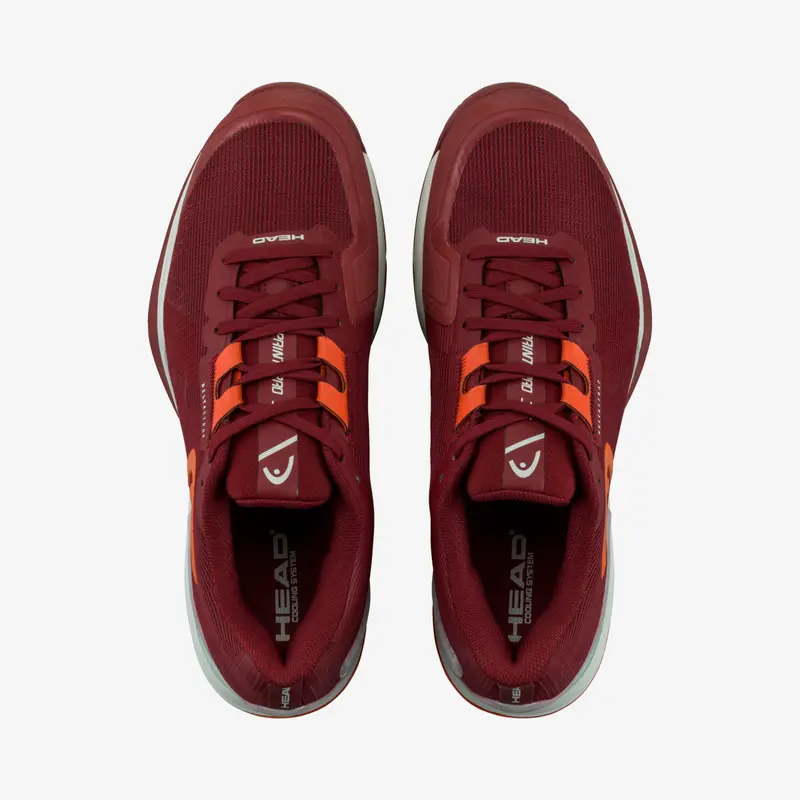
HEAD Sprint Pro 3.5
Roomy without the break-in: a spacious fit stated across review and retailer listings, in HEAD’s light, low-profile speed shoe with a 3D anti-torsion shank.
The Sprint Pro 3.5 is HEAD’s light, fast court shoe — and its fit story is told by the people who wear it: review and retailer listings describe a roomy, spacious fit with effectively no break-in, comfortable from the first session, with room to move the toes. For the wide-footed player that “no break-in” detail matters more than it sounds — it means the width is in the last as built, not stretched into the shoe over weeks of suffering. This is the speed answer to the wide question: the lightest, lowest shoe in this guide that still gives the forefoot somewhere to go.
The engineering is built for movement, not mass. The midsole runs Tri-NRG, HEAD’s shock-absorbing cushioning, in a low-profile design with a minimal heel-to-toe offset that keeps the foot close to the floor — the court feel squash players prize. A ventilated 3D anti-torsion shank stabilises the midfoot against twisting, the knitted mesh upper breathes, a TPU heel counter holds the back of the shoe, and a rubber toe cap takes the drag. The outsole is HyBrasion+, HEAD’s abrasion-resistant rubber. HEAD publishes no weight, and the card says so. One honest boundary, because fit reviews say it plainly: this is the light, quick shoe, not the maximum-support one — wide-footed players who want the most structure should compare the Wilson or the ASICS. And one housekeeping note: this card is the men’s/unisex shoe; the women’s version is carded in our best squash shoes for women guide, not re-carded here. Buy the Sprint Pro 3.5 if your wide fit needs to be fast.
Pros
- Roomy, spacious fit with no break-in — width in the last, not the stretching
- The lightest, lowest-profile ride in this guide: Tri-NRG over a minimal offset
- 3D anti-torsion shank plus TPU heel counter — the light shoe still locks down
- HyBrasion+ rubber outsole and a rubber toe cap for the drag
Cons
- HEAD publishes no weight for this model
- Speed-first means support-second: maximum-structure seekers should look at the Wilson or ASICS
- No letter width designation — the roominess is stated by reviewers and retailers, not measured by HEAD
As an Amazon Associate we earn from qualifying purchases.
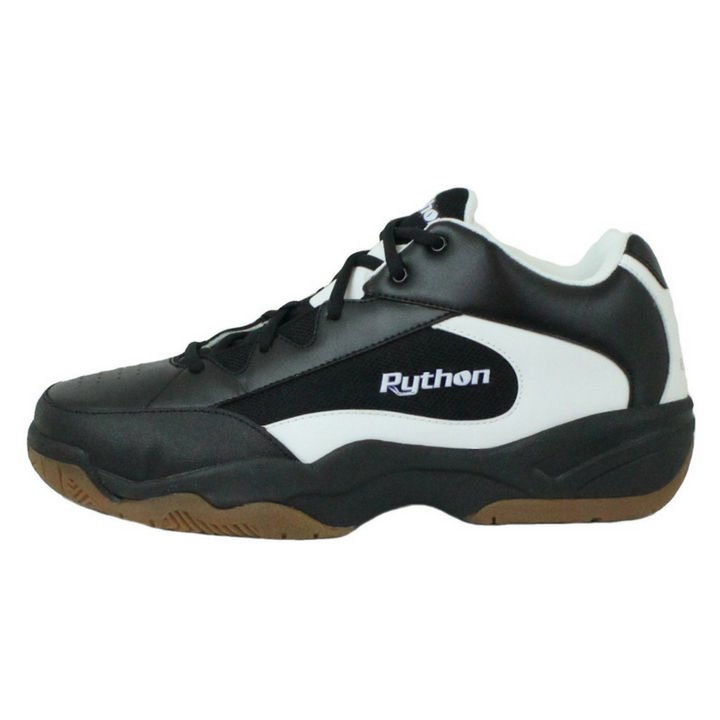
Python Deluxe Wide (EE) Indoor Mid
The width is in the product name: EE, marketed for squash, on a non-marking gum rubber sole with shock-absorbing Artholite insoles.
Python Racquetball does something no other maker in this guide does: it puts the width in the product name. “Python Wide (EE) Width Indoor Mid” is the full name, and the marketing names squash directly alongside racquetball, badminton, indoor pickleball and volleyball. This is not a tennis shoe adapted to the squash court — it is an indoor court shoe built for this floor, in a width designation, by a brand whose whole business is indoor racquet sports. Retailers describe the EE as fitting like a 4E — printed here as the retailers’ description, not the maker’s measurement — which makes it the widest-stated fit on this page.
The spec is straightforward and squash-appropriate. The outsole is a non-marking gum rubber sole — gum rubber stated outright, the traditional squash-court compound, delivering the traction indoor courts are built for. Cushioning comes from die-cut Artholite insoles, which the listings credit with shock absorption, over the shoe’s midsole. The upper is synthetic leather with open mesh inserts for breathability, and the listed weight is 11.6 oz in a size 10.5 — the retailer’s figure, labelled as such, since Python Racquetball publishes none itself. The honest trade is visible in the same listings: this is a specialist indoor shoe, not a flagship from a global footwear lab, and its technology names are shorter than the ones above it. What it offers instead is the thing this guide values most: a width you can read on the box, on a sole built for your court. Buy the Python if squash is the sport and wide is the requirement — no translation needed.
Pros
- EE width in the product name — the most explicit wide designation here
- Marketed for squash directly, on a non-marking gum rubber sole
- Shock-absorbing Artholite insoles over a breathable synthetic/mesh upper
- 11.6 oz in size 10.5 — light for a dedicated wide shoe, retailer’s figure labelled
Cons
- Python Racquetball publishes no weight itself — the figure is the retailer’s
- A specialist brand, not a global footwear lab — the tech list is shorter than the flagships’
- “Fits like a 4E” is the retailers’ description, not a maker measurement
As an Amazon Associate we earn from qualifying purchases.
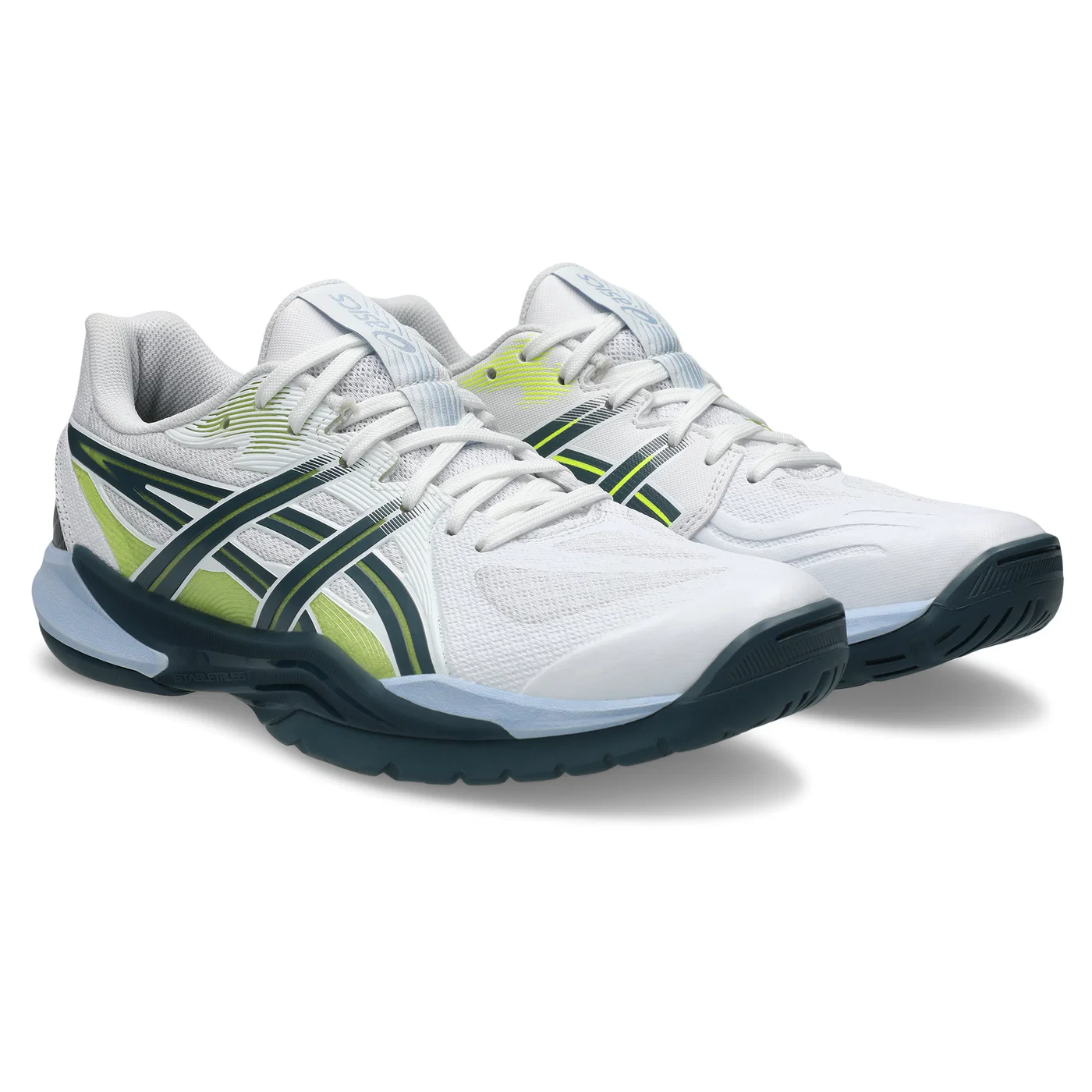
ASICS Powerbreak FF
Width as a platform, not a size: ASICS’s own copy describes a wider sole construction, under a STABLETRUSS sidewall and FLYTEFOAM cushioning.
The Powerbreak FF takes a different route to the wide answer: instead of widening the last’s letter designation, ASICS widens the platform the foot stands on. Its own product copy describes a wider sole construction that gives a more stable base for confident landings — width as engineering, aimed at the squash player’s hardest moment, the loaded landing after a stretch. Around that platform sits STABLETRUSS technology, placed in the sidewall of the shoe to improve stability in the rearfoot and forefoot, extending onto the midfoot of the upper for support. The upper itself is engineered mesh, updated with materials ASICS describes as more flexible and supportive, adapting to the shape of the foot.
Cushioning is FLYTEFOAM — ASICS’s lightweight foam — keeping the shoe light while the platform does the stabilising. The outsole is ASICS’s NC Rubber on a wide gauge pattern built for traction on indoor court surfaces, and retailer listings reproducing ASICS’s data note the outsole is optimised for wooden or smooth laminate surfaces — the exact floors squash is played on. The listed weight is 13.5 oz in a size 10.5, the retailer’s figure, labelled as such since ASICS publishes none. Buy the Powerbreak FF if your wide need is really a stability need — the widest platform in this guide, from the maker with the longest indoor-court engineering list on the page.
Pros
- Wider sole construction in ASICS’s own copy — width as a stability platform
- STABLETRUSS sidewall plus FLYTEFOAM: named stability and cushioning together
- NC Rubber outsole on a wide gauge, optimised for wooden and laminate indoor floors
- Style 1071A101 — a current, findable model, not a discontinued oddity
Cons
- ASICS publishes no weight itself — the 13.5 oz figure is the retailer’s
- A wider sole is not a 2E last: whole-foot wide players should compare the New Balance or Python
- The stability-first build is the heaviest philosophy in this guide
As an Amazon Associate we earn from qualifying purchases.
Side-by-Side: The Seven Wide-Fit Squash Shoes at a Glance
Every width claim below is stated exactly as its source states it — maker where the maker says it, retailer where the retailer says it. Weights are printed exactly as honestly as the cards print them: three labelled retailer figures and four shoes whose makers publish none.
| Shoe | Best for | Width (as stated) | Cushioning (maker-named) | Outsole | Weight |
|---|---|---|---|---|---|
| New Balance 1006v1 | Best true wide (2E) | 2E (Wide) — maker-published | REVlite midsole | NDurance non-marking rubber, herringbone | Not published |
| Babolat SFX 3 All Court | Best maker-stated wide fit | Fit: Wide — Babolat’s spec table | Kompressor (TPR tube) + OrthoLite insole | Michelin tennis rubber, All Court | Not published |
| Wilson Rush Pro 4.5 Wide Toe Box | Best wide toe box | Wide Toe Box version — retailer-stated | R-DST+ and Energy Cell | Duralast rubber | 14.5 oz, size 10.5 (retailer’s figure) |
| Prince T22 | Best roomy toe box | Wide, roomy toe box — retailer-stated | ShockEraser heel + SoftSpring forefoot | PRC 1000 compound, herringbone | Not published |
| HEAD Sprint Pro 3.5 | Best roomy speed fit | Roomy, spacious fit — review/retailer-stated | Tri-NRG midsole | HyBrasion+ rubber | Not published |
| Python Deluxe Wide (EE) | Best squash-first wide | EE — in the product name | Artholite insoles | Non-marking gum rubber | 11.6 oz, size 10.5 (retailer’s figure) |
| ASICS Powerbreak FF | Best wide sole platform | Wider sole construction — ASICS’s copy | FLYTEFOAM | ASICS NC Rubber, wide gauge | 13.5 oz, size 10.5 (retailer’s figure) |
Wide-Fit Buying Guide: Five Checks Before You Pay
1. Decide which kind of wide you are before you name a shoe. Wide across the whole foot points to a letter designation — the New Balance 2E or the Python EE — because those lasts are wider at the heel and midfoot too. Wide only across the forefoot, with a standard heel, points to the forefoot-shaped answers: the Wilson’s Wide Toe Box version, the Babolat’s extra forefoot space, the Prince’s roomy toe box. Buying a whole-foot wide when only the forefoot is wide gives you the floating-heel problem this guide opened with; buying a forefoot-wide when the whole foot is wide gives you the pinch back. The cards name which kind each shoe is — match the kind to your foot.
2. Read every width by its source, and every weight by its basis. This guide contains exactly one maker-published letter width (New Balance’s 2E), one maker-spec-table “Wide” (Babolat), one product-name EE (Python), one maker-copy wider sole (ASICS), and three retailer-stated roomy fits (Wilson’s Wide Toe Box version, the Prince, the HEAD). That mix is normal in the wide market — it is not a warning sign. What should warn you is any listing that upgrades “roomy” to “2E” without saying so, or prints a precise weight for the New Balance, Babolat, Prince or HEAD without naming its source. The makers publish no weight for those four; the three figures in this guide are retailers’ figures with a stated size, and they are labelled that way every time.
3. Check the heel lockdown the way a ghosting drill will. Fit failures in squash happen on the brake, not the stand. Whatever width you choose, the heel has to stay seated through a hard braking lunge — that is the movement that finds a loose heel first, and it is the reason sizing up a standard last fails. The lockdown systems here genuinely differ: the New Balance holds a full 2E last, the Wilson wraps the midfoot in an Endofit inner sock, the Prince straps the forefoot with TPU over a Wishbone shank, the HEAD counters the heel in TPU, and the Babolat moulds an OrthoLite insole to the foot’s shape. Confirm the heel in the shop, on a lunge, not standing still.
4. Match the outsole wording to your club’s floor rule. Squash clubs require non-marking soles, and the wording in the listing is the proof: “non-marking” appears in the New Balance and Python listings outright, the ASICS’s NC Rubber outsole is built for indoor traction on wooden and laminate floors, and the Babolat’s All Court version is the indoor-appropriate one. A herringbone tread — on the New Balance, the Prince, and implied across the indoor designs — is the pattern that bites and releases on indoor floors. If the listing you are about to buy from does not say non-marking, stop: whatever the width code says, that listing is not one of the shoes on this page.
5. Read the toe-drag line if you drag, and the platform line if you land hard. The squash drag wears the inner forefoot and toes — the New Balance’s toe drag tip, the Babolat’s rubber forefoot protection, the Prince’s RASH toe cap, the Wilson’s enlarged lateral drag pad and the HEAD’s rubber toe cap are the maker-named answers, and they are not interchangeable: a toe cap protects the front, a lateral pad protects the side, so match the protection to where your shoe actually wears. If your limiting factor is the landing rather than the drag, the platform answers are the ASICS’s wider sole construction and the Python’s gum-rubber base. Buy the protection that matches your wear pattern, and the width that matches your foot.
Frequently Asked Questions
What does “2E” mean on a court shoe?
It is a width designation from the standard letter scale, where D is the standard men’s width and 2E is a wide step above it. In this guide the New Balance 1006v1 is the only shoe with a maker-published 2E option — it appears on the model code itself (MC1006BW-2E). A letter width means the last is engineered wider along its full length, unlike a “roomy toe box” description, which usually refers to volume in the forefoot. The Python’s EE is another letter designation, stated in its product name.
Should I just buy a bigger size instead of a wide shoe?
No — and this guide exists to make that case. Sizing up a standard last adds length everywhere, including at the heel, which is rarely the wide part of the foot. On a squash court the result is a heel that floats during braking lunges and ghosting recoveries, which is the fit failure that actually changes how you move. A published wide width — 2E, Wide, Wide Toe Box, EE — adds room where the foot is wide while keeping the heel seated. Buy the width, not the length.
Are tennis shoes acceptable for squash if they fit wider?
They can be, provided the outsole clears the squash bar: it must be non-marking and suited to indoor wooden or laminate floors, as your club requires. Every tennis-derived shoe in this guide clears it in its listing — the New Balance’s non-marking NDurance rubber, the Babolat’s All Court Michelin sole, the Wilson’s Duralast rubber, the Prince’s PRC 1000 compound, the HEAD’s HyBrasion+ rubber. Tennis is simply the sport where wide widths are published most honestly, which is why the wide answers cluster there. If a listing does not say non-marking, it is not squash-appropriate regardless of width.
New Balance 1006v1 or Babolat SFX 3 — which wide shoe should I buy?
Buy by the shape of your width. The New Balance in 2E is the whole-foot answer: a letter-designated wide last, wider at heel, midfoot and forefoot, with a REVlite midsole and a non-marking NDurance outsole. The Babolat SFX 3 All Court is the forefoot answer: Babolat’s own spec table lists Fit: Wide with more forefoot space, over Kompressor heel cushioning and a Michelin sole — plusher, and shaped for players whose heel fits standard shoes. Whole foot wide, choose the New Balance; forefoot wide, choose the Babolat.
Does the Python Wide really fit like a 4E?
That description comes from the shoe’s retailers, not from Python Racquetball: retailer listings describe the EE width as fitting like a 4E. What the maker itself states is the width in the product name — “Wide (EE) Width” — and that the shoe is marketed for squash, racquetball, badminton, indoor pickleball and volleyball on a non-marking gum rubber sole. Treat “fits like a 4E” as the retailers’ characterisation of a genuinely generous EE, and the product name as the verified fact.
What should wide-footed players check for heel lockdown?
The braking lunge, because that is the movement that finds a loose heel first. The lockdown systems in this guide differ: an Endofit inner-sock wrap on the Wilson, TPU forefoot straps over a Wishbone shank on the Prince, a TPU heel counter on the HEAD, a molded OrthoLite insole on the Babolat, and full-length 2E and EE lasts on the New Balance and Python. Whatever you choose, confirm the heel stays seated on a hard stop in the shop — a wide forefoot is only half the fit if the heel swims behind it.
How will I know when my wide squash shoes need replacing?
No maker in this guide publishes a lifespan, and we will not invent one. The honest checks are the ones you can make yourself: whether the outsole still bites on a clean indoor court the way it did when new, whether the midsole still feels like the cushioning you bought, whether the toe-drag protection has worn through to the upper, and whether the width still holds your foot without the laces at their limit. When any of those answers changes, the shoe’s engineering is no longer reaching the floor — and in squash, that is the replacement signal.
The Verdict
If one shoe has to answer the wide question most literally, it is the New Balance 1006v1 in 2E — the only published letter width in this guide, on a non-marking outsole your club will accept. But the honest verdict on this page is that the best wide shoe is the one that matches the shape of your width. Forefoot wide, heel standard? The Wilson Rush Pro 4.5 Wide Toe Box or the Babolat SFX 3 All Court — targeted geometry, with the Babolat the plusher of the two. A wide, roomy toe box with old-school structure? The Prince T22. Wide and fast? The HEAD Sprint Pro 3.5. Squash first, width in the name? The Python Deluxe Wide (EE) on its gum-rubber sole. Width as a stability platform? The ASICS Powerbreak FF and its wider sole construction.
Still weighing the wider field? Our pillar comparison of the best squash shoes covers the all-player flagships this guide deliberately avoids repeating, and the advanced squash shoes guide owns the top-tier purchase. Buy this page for the width your foot actually has, read the maker’s own width wording before any listing’s summary of it — and the fit decision stops being a gamble and becomes seven clear answers.
How we built this guide: every width claim above is verified against the maker’s own published listing or spec table, or against a retailer listing that reproduces the maker’s data — and each figure is attributed to its source in the copy. New Balance publishes the 1006v1 in 2E; Babolat’s own spec table lists the SFX 3 All Court as Fit: Wide; Wilson’s Wide Toe Box version, the Prince T22’s roomy toe box and the HEAD Sprint Pro 3.5’s spacious fit are stated in retailer and review listings; Python Racquetball puts EE in the product name; ASICS’s own copy describes the Powerbreak FF’s wider sole construction. The three weight figures used (Wilson, Python, ASICS) are retailers’ figures with a stated size basis, labelled as such wherever they appear; New Balance, Babolat, Prince and HEAD publish no weight for these models. We do not publish prices, we make no durability or medical claims, and nothing here is presented as hands-on testing. Some links on this page are affiliate links: if you buy through them, AliShuttler may earn a commission at no additional cost to you. As an Amazon Associate we earn from qualifying purchases.