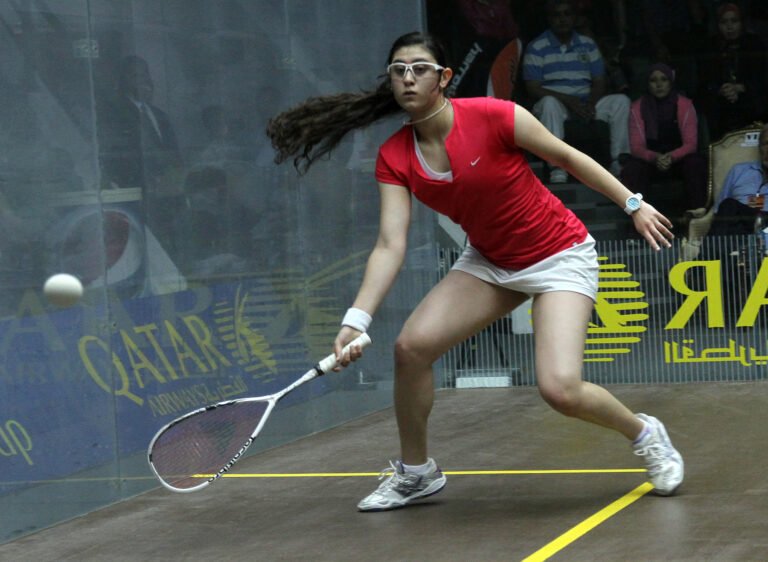
A squash ball is small, hard and fast, and it changes direction off all four walls. The right eyeguard is the one that is certified for the job, stays on your face through a long rally — and does not fog up at 4–4 in the fifth. Here are the seven pairs worth your money.
⚡ TL;DR — The Short Answer
Buy the Black Knight Stiletto if you want the safe all-round choice: a certified polycarbonate lens, anti-fog coating with flow-through venting, and both temple arms and a strap so it stays where you put it. Fog fighters should look at the vented Tecnifibre Squash Goggles. Glasses wearers need the i-Mask visor, which is built to sit over everyday spectacles. On a budget, the Unique Sports Super Specs carry the same ASTM F803 certification as pairs costing far more. Whatever you choose, choose certified: look for ASTM F803 / F3164, BS 7930.1 or AS 4066 on the spec sheet — an uncertified fashion frame is not eye protection.
Quick Picks — Best Squash Goggles at a Glance
ASTM F803-03 certified, anti-fog coating plus flow-through venting, bayonet arms and a strap. The default recommendation.
Vented lenses with anti-fog and anti-scratch treatments, certified to ASTM F803 and BS 7930.1. For hot, humid courts.
A full-face polycarbonate visor designed to wear over prescription glasses, with an unrestricted field of view.
Contoured peripheral-vision lens, stabilizing strap and non-slip nose piece in Dunlop’s accessible eyewear line.
A 180° wrapped lens that meets ASTM F803, with flow-through venting and a silicone nose piece. Simple and effective.
Junior-sized nylon frame, polycarbonate lens and a neoprene headband that stays put on smaller heads.
In This Guide
Why Squash Eyewear Earns Its Place in Your Bag
Squash is the one racket sport where your opponent spends half the match behind you. The ball rebounds off the side walls and the glass back, your partner in doubles is never more than a few feet away, and a mishit boast can arrive from an angle nobody intended. You cannot watch every threat — which is precisely why the protection has to be on your face before the rally starts, not a decision you make after a close call.
There is also a rules dimension. Protective eyewear is mandatory for juniors and for every doubles player under World Squash Federation rules — if either of those is you, a certified pair is not optional kit, it is part of the uniform. We keep the full mandate breakdown in our How to Play Squash guide and the doubles detail in our Squash Doubles Rules guide; this page is about which pair to buy once you know you need one.
The honest obstacle is not cost — certified eyewear is some of the cheapest gear in squash. The obstacle is fog. A lens that mists over in the second game gets pushed up onto the forehead, and eyewear on your forehead protects nothing. That is why this roundup weighs anti-fog coatings and ventilation as heavily as certification: the best squash goggles are the ones that stay clear, stay on, and disappear from your attention for five games.
The Certification to Look For (and Why It Matters)
Eye protection only means something if it has been tested to a recognised standard. In racket sports, that standard is published by ASTM International. For many years the racket-sports requirements sat inside ASTM F803, the eye-protector specification for selected sports. In 2020 ASTM published ASTM F3164-19, a dedicated specification for eye protectors for racket sports — racquetball, squash and tennis — which superseded the racket-sports provisions previously carried in F803.
In practice, most goggles on sale today still cite F803 (often as F803-03), and that is fine: it is the certification the established squash eyewear brands — Black Knight, Unique Sports, Tecnifibre, HEAD — publish against their models, and it is the mark your club, school or federation will recognise at the door. Depending on where you play you may also see the British BS 7930.1 (cited by Tecnifibre) or the Australian AS 4066. The practical rule is simple: buy a pair that names a racket-sports standard on its spec sheet, from a recognised squash or racket-sports brand. If a listing cannot name its standard, it is eyewear-shaped, not certified protection.
One more distinction worth knowing: the certification covers the complete protector — lens and frame tested together. Swapping in non-original lenses, or wearing everyday glasses and calling them protection, takes you outside the tested configuration. Ordinary spectacles were never designed or certified to stop a squash ball; they are a vision aid, not a guard.
Who Must Wear Goggles — and Who Simply Should
Juniors. Under WSF rules, junior players must wear protective eyewear on court. If your child is starting squash, the eyeguard goes on the shopping list with the racket and the shoes — and a junior-sized model will fit and stay on far better than a small adult pair.
Doubles players. Eyewear is mandatory for all doubles play, including the warm-up — four players, one enclosed court, a faster ball and cross-court traffic make it non-negotiable. Our Squash Doubles Rules guide covers how the format works.
Beginners. New players have the least court awareness and the least predictable positioning — their partners’ too. A certified pair from day one builds the habit before the first let-call argument ends with someone looking the wrong way at the wrong moment.
Adult singles players. In most adult singles competition eyewear remains a personal choice rather than a mandate — but the geometry of the game does not change just because the rulebook relaxes. Plenty of experienced players treat a lightweight, clear pair as standard kit, the same way they treat non-marking shoes. If you are setting up a beginner with their first full kit, our guides to the best squash rackets for beginners and the best squash shoes cover the other two essentials.
The 7 Best Squash Goggles, Compared
Every pick below is a current model from a recognised racket-sports brand, with specifications taken from the manufacturer’s own published copy. They differ in how they manage fog, how they stay on your face, and who they fit — which is where your decision actually lives.
Black Knight Stiletto
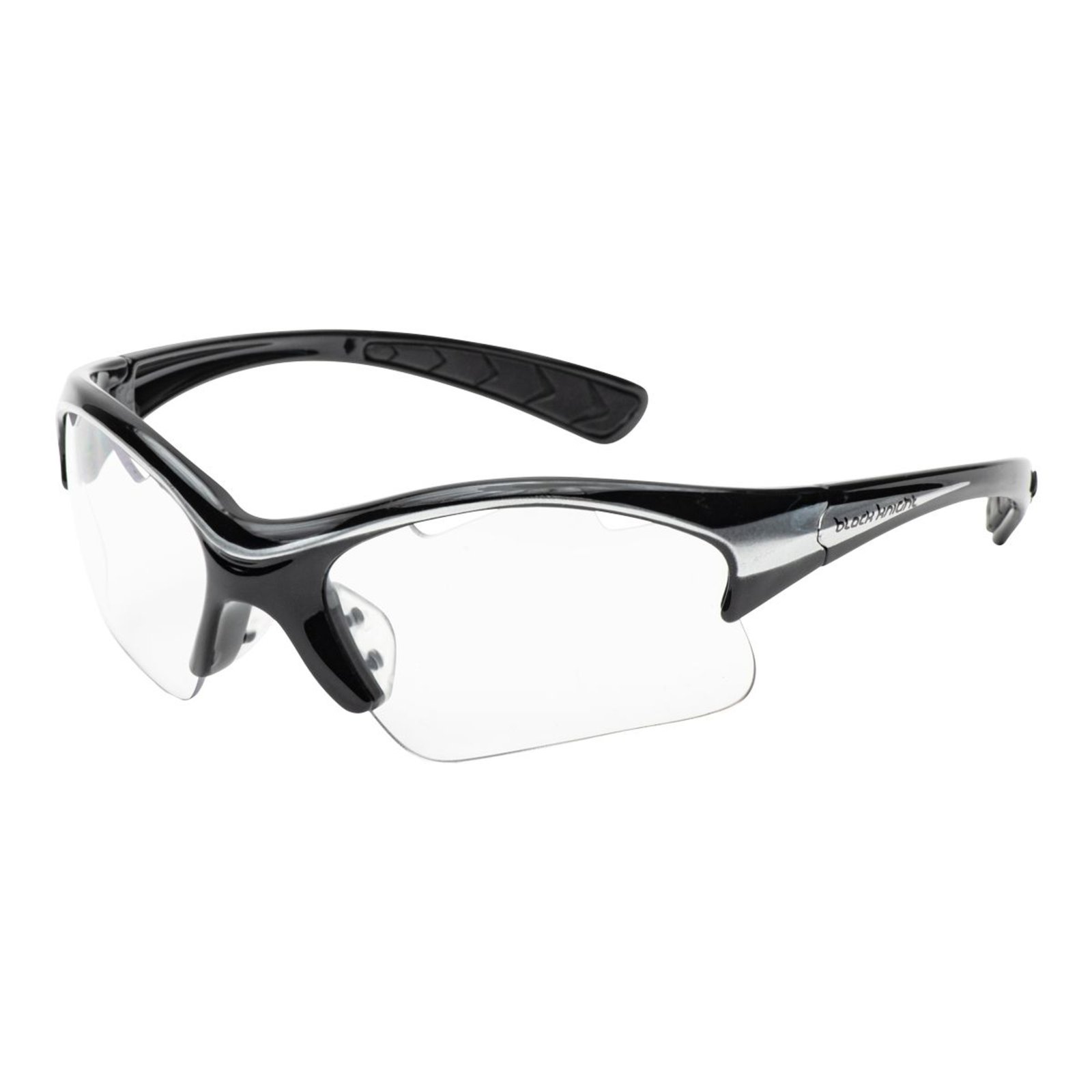
The certified all-rounder — anti-fog coating, flow-through venting and two ways to keep it on.
Black Knight has been making squash eyewear for decades, and the Stiletto is the pair that covers every base a club player needs. The lens is high-impact polycarbonate and optically correct — Black Knight’s term for a lens ground so it does not distort, which matters when the ball is crossing your peripheral vision at speed and your brain is judging depth off what your eyes report.
Fog control comes from two directions at once: an anti-fog coating on the lens, and a flow-through ventilation design that lets moving air carry moisture away instead of letting it condense. Retention is equally belt-and-braces — bayonet temple arms grip for normal play, and an adjustable strap is included for players who want the eyeguard locked down for doubles or hard-hitting matches. Black Knight confirms the Stiletto meets the ASTM F803-03 standard for badminton and squash, so it satisfies junior and doubles mandates. Players with smaller faces should note the small-size sibling, the Black Knight Turbo, which carries the same lens, ventilation and arm design in a narrower fit.
What we like
- Certified to ASTM F803-03 for squash — mandate-proof for juniors and doubles
- Anti-fog coating and flow-through venting attack fog from both sides
- Temple arms plus an included strap: choose your retention level
- Optically correct lens keeps depth perception honest
Worth knowing
- Temple-arm design rather than a sealed goggle — minimalists will love it, some players prefer a full strap frame
- Coating needs gentle care: rinse and use the pouch, do not wipe it dry with a shirt
As an Amazon Associate we earn from qualifying purchases.
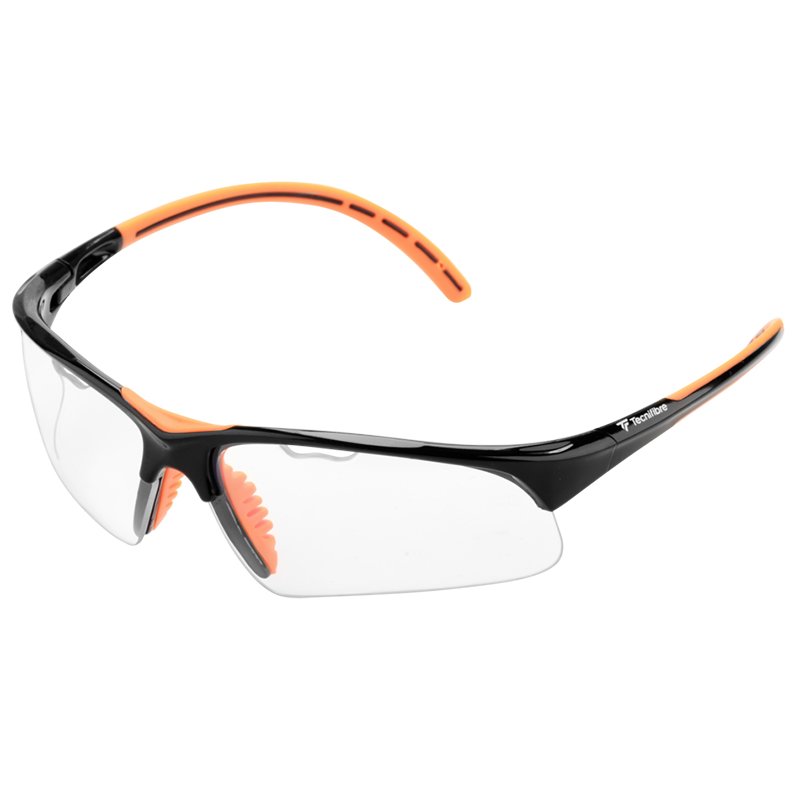
Tecnifibre Squash Goggles
Vented, dual-certified eyewear from a pure squash brand — built for hot courts and heavy sweaters.
If fog is the reason your current eyewear ends up on your forehead, start here. Tecnifibre builds its goggle around vented lenses treated against both fogging and scratches, and the brand is one of the few to certify against two standards at once: the American ASTM F803 and the British BS 7930.1 — useful if you play or compete in the UK, and a sign of how seriously the design brief was taken.
The fit story is thoughtful too. Tecnifibre shapes the lenses ergonomically so they follow the face rather than sitting flat against it, and adds gripping pads to keep the frame stable through lunges and quick direction changes without cranking a strap tight. One size covers adults and older juniors, and a soft pouch case is included for the kit bag. Tecnifibre is a squash-first brand — its rackets and strings are tour staples — and the eyewear follows the same no-gimmicks formula: certified protection, clear vision, stays on.
What we like
- Dual certification (ASTM F803 and BS 7930.1) — recognised on both sides of the Atlantic
- Vented lens design is the strongest anti-fog answer in this roundup
- Gripping pads stabilise the frame without over-tightening
- One size spans adults and juniors — handy for families and clubs
Worth knowing
- Frame styling is bold sportswear — some players prefer the Stiletto’s lower profile
- Check your league accepts BS/ASTM certification wording if you compete formally
As an Amazon Associate we earn from qualifying purchases.
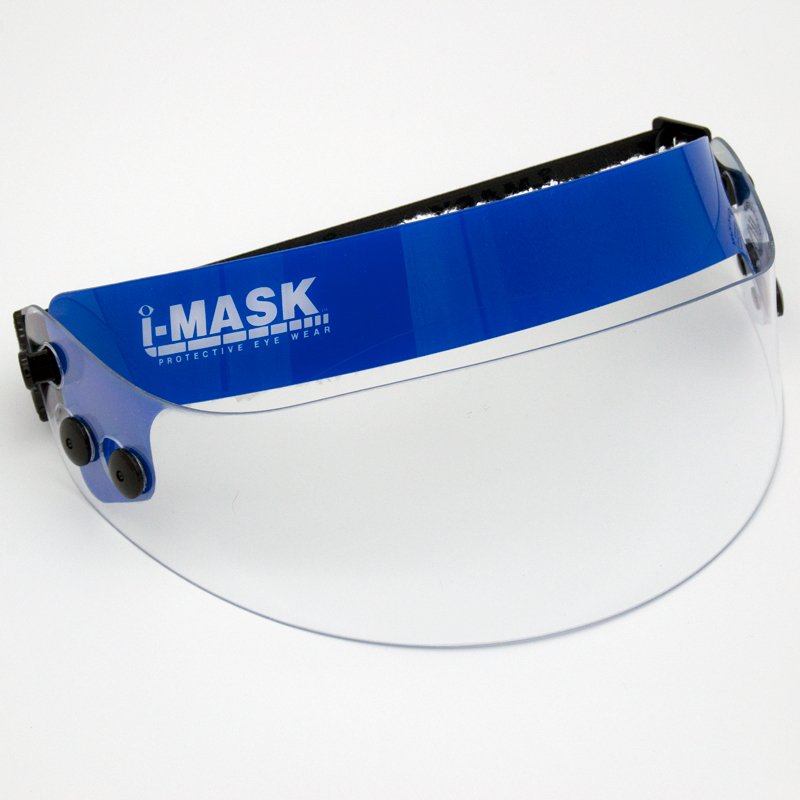
i-Mask
The full-face visor for glasses wearers — no frame in your sightline, and it fits over your spectacles.
The i-Mask solves the problem no ordinary goggle can: what does a player who wears prescription glasses do? Squeezing a standard eyeguard over spectacles is uncomfortable, pushes both frames out of position, and protects neither properly. The i-Mask instead puts a single clear polycarbonate visor across the whole face, worn over your glasses, with nothing in your field of view — no frame edges, no nose bridge in your sightline, full peripheral vision for tracking balls off the side walls.
It is a recognised solution, not a novelty: Squash Canada’s eye guard policy lists I-Mask models among its Type Three plano goggle-type protectors that may be worn over street-wear spectacles. The design is modular — every part is individually replaceable, so a scratched visor or worn strap does not mean replacing the whole unit — and the fixing points carry a two-year warranty. There is a junior size 11% smaller than the adult for players aged roughly 7–10 or very small adults. If you wear glasses and play squash, this is the category’s specialist answer.
What we like
- The only design here genuinely built to wear over everyday spectacles
- Frameless sightline — nothing interrupts peripheral vision
- Replaceable parts extend its working life well beyond a single-piece goggle
- Recognised in national federation eye-guard policies
Worth knowing
- A visor feels different from glasses — expect an adjustment session or two
- Larger on the face than a minimal eyeguard; try your glasses’ width against it
As an Amazon Associate we earn from qualifying purchases.
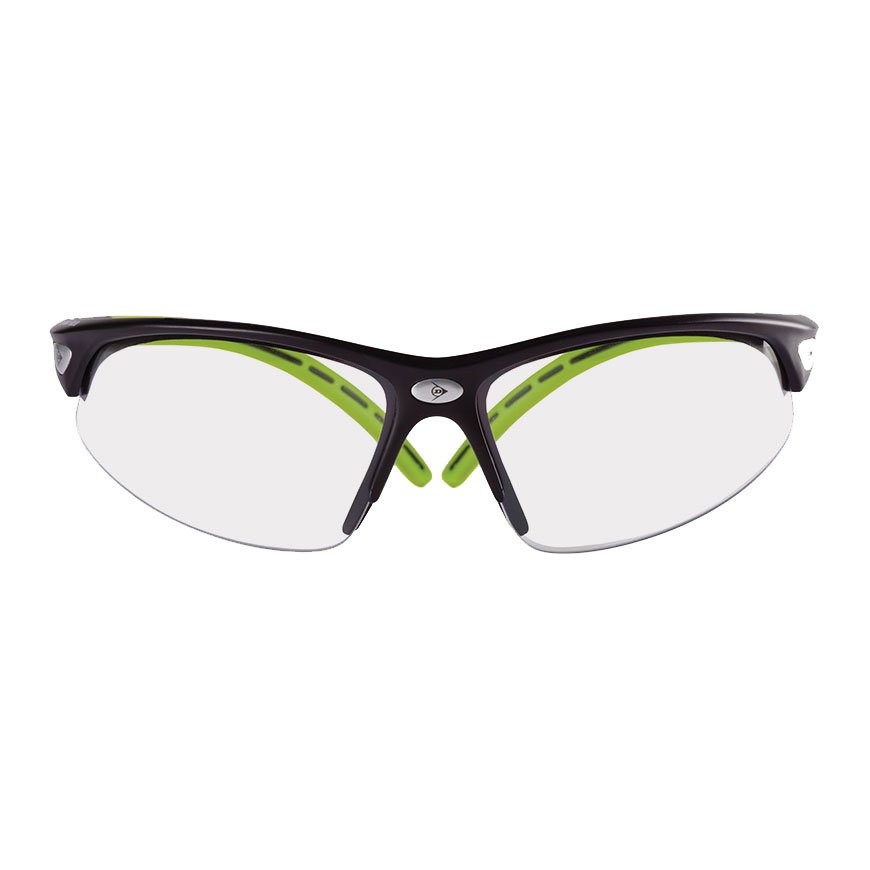
Dunlop I-Armor
Dunlop’s workhorse eyeguard — contoured lens for peripheral vision, strap stability, sensible money.
Dunlop’s I-Armor takes the features that matter for a weekly club player and skips the trimmings. The frame’s ergonomic profile is shaped to sit stable on the face, the lens is contoured to open up peripheral vision — the part of your sightline that picks up a boast early — and a stabilizing strap works with the arms so the guard does not migrate during a hard rally. A non-slip nose piece handles the sweat factor, and polycarbonate lenses with anti-fog treatment cover the clarity brief.
It is the eyeguard equivalent of Dunlop’s club rackets: a big-brand design at an accessible point in the range, with a storage pouch included so it survives life in a kit bag. Players who keep everything in one bag — racket, shoes, eyewear — will find our best squash bags guide a useful companion read. One buying note: Dunlop’s own product copy for the I-Armor does not headline a named test standard the way Black Knight and Tecnifibre do, so if your junior programme or doubles league checks certification wording at the door, confirm this model against their accepted list — or choose a pick above that publishes its standard.
What we like
- Contoured lens genuinely helps you pick up wide balls earlier
- Strap plus non-slip nose piece: secure through long, sweaty matches
- Big-brand design at the accessible end of the range
- Storage pouch included — small thing, saves scratched lenses
Worth knowing
- Dunlop does not headline a named standard for this model in its product copy — verify acceptance if your league checks
- Fewer venting features than the Tecnifibre for very hot courts
As an Amazon Associate we earn from qualifying purchases.
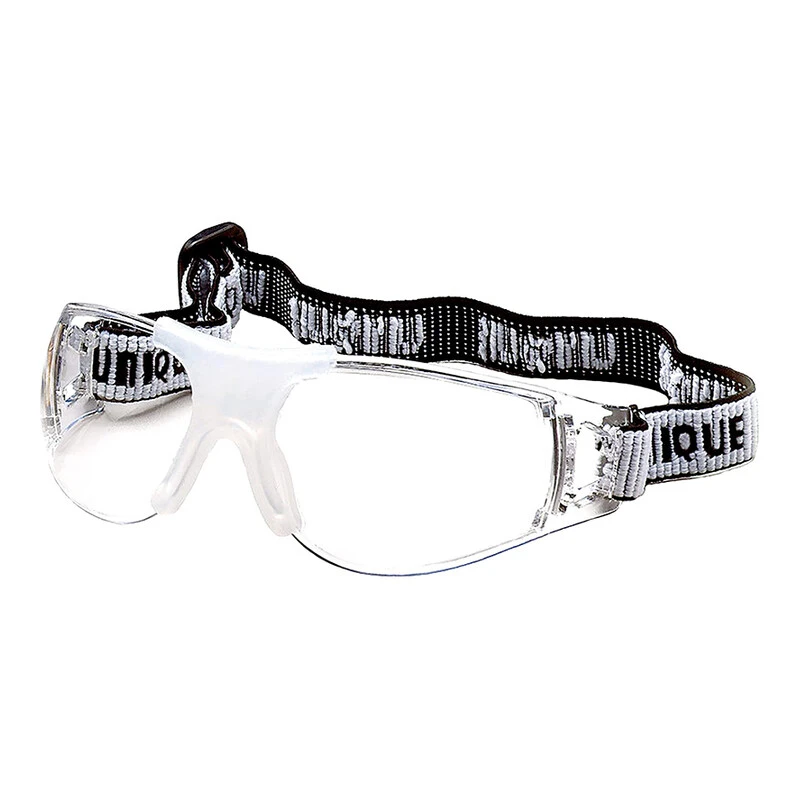
Unique Sports Super Specs
A 180° wrapped lens that meets ASTM F803 — proof that certified protection need not cost much.
The Super Specs are the quiet achiever of racket-sports eyewear: a single wrapped polycarbonate lens that curves through a full 180 degrees, so there is no frame edge interrupting your view of the side walls at all. Unique Sports builds the lens shatterproof and distortion-free, coats it against scratches and fog, and vents it with a flow-through design so air movement keeps the inside of the lens clear. Crucially, the Super Specs meet ASTM F803 — the same certification as the premium pairs in this list — at the budget end of the category.
Fit is handled by an adjustable strap and a soft silicone nose piece that spreads pressure instead of digging in. At 5 7/8 inches across, this is a wide fit that suits broader faces best; smaller or junior players will be better served by the dedicated junior pick below. For clubs, schools and team programmes buying protection in multiples — or any player who wants certification first and branding second — this is the value benchmark of the roundup.
What we like
- ASTM F803 certified at a budget-friendly point in the range
- 180° wrapped lens: the widest unobstructed view here
- Flow-through venting plus anti-fog coating for clear lenses
- Silicone nose piece and strap make long sessions comfortable
Worth knowing
- Generous width — narrow faces may find it loose even strapped
- Utilitarian styling; it is function-first equipment
As an Amazon Associate we earn from qualifying purchases.
HEAD Raptor
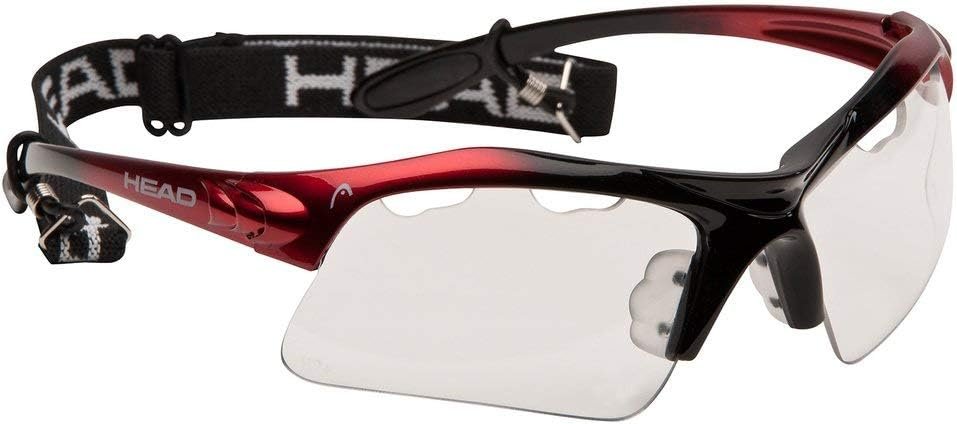
Three lenses for three lighting conditions, certified to ASTM F803 — from HEAD’s racket-sports eyewear line.
Squash courts are not all lit alike. A bright show court, a dingy club court and an outdoor-adjacent glass box ask different things of your eyes — and the Raptor is the one pick here that answers with hardware: three distortion-free polycarbonate lenses in the box. Clear for standard indoor play, amber to lift contrast in darker conditions, and smoked for bright light. All three carry HEAD’s anti-fog and scratch-resistant treatment.
Retention is a proper adjustable elastic strap with a non-slip nosepiece, the setup that stays put through explosive movement. On certification, HEAD states the Raptor complies with ASTM F803 and ANSI Z87.1. One honest framing note: HEAD sells the Raptor primarily through its racquetball line — racquetball and squash share the same ASTM eye-protector standard, which is why it earns its place here, but if your squash league keeps an approved-eyewear list, a ten-second check against that list is time well spent before a tournament.
What we like
- Three lenses cover bright, standard and dark courts — real versatility
- Published compliance with ASTM F803 and ANSI Z87.1
- Full strap retention for fast, physical games
- Amber lens genuinely helps on poorly lit club courts
Worth knowing
- Sold mainly as racquetball eyewear — check your league’s approved list if you compete
- Swapping lenses adds a step players who want grab-and-go simplicity may skip
As an Amazon Associate we earn from qualifying purchases.
Dunlop Junior Squash Goggles
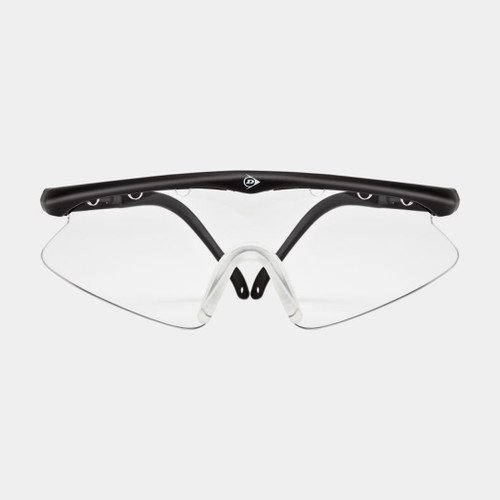
Purpose-built junior sizing with a neoprene headband — because the mandate starts with the youngest players.
Juniors are the one group for whom eyewear is unconditionally mandatory in squash — so it is a shame how often they end up in a shrunken adult afterthought. Dunlop’s junior goggles are built for the job from the start: a nylon frame sized for young faces, a polycarbonate lens for impact resistance and clear visibility, a rubber nose pad, and a headband made largely of neoprene that grips comfortably and stays in place through the constant movement of a junior session.
The fit point matters more than any other here. An adult eyeguard on a nine-year-old slides, distracts and gets taken off — a junior model that fits is the one that stays on for the whole session, which is the entire point of the mandate. A microfiber pouch is included for cleaning and storage. Size up honestly: if your junior is on the cusp of adult sizing, the Tecnifibre above — one size spanning adults and juniors — is the natural next step.
What we like
- Genuine junior sizing — fits young faces instead of approximating them
- Neoprene headband stays put through energetic sessions
- Polycarbonate lens and robust nylon frame suit the junior game
- Pouch included for school-bag storage
Worth knowing
- They will outgrow it — that is the deal with all junior kit
- Dunlop’s copy for this model does not headline a named standard; confirm against your junior programme’s accepted list
As an Amazon Associate we earn from qualifying purchases.
Side-by-Side Comparison Table
| Model | Best For | Standard Published | Anti-Fog Approach | Retention |
|---|---|---|---|---|
| Black Knight Stiletto | Best overall | ASTM F803-03 | Coating + flow-through venting | Bayonet arms + strap |
| Tecnifibre Squash Goggles | Anti-fog / hot courts | ASTM F803 + BS 7930.1 | Vented lenses + treatment | Frame + gripping pads |
| i-Mask | Over prescription glasses | Listed in federation policies (Type Three, over spectacles) | Open visor design | Headband system |
| Dunlop I-Armor | Value all-rounder | Not headlined in Dunlop copy | Anti-fog lenses | Arms + stabilizing strap |
| Unique Sports Super Specs | Widest view / budget | ASTM F803 | Coating + flow-through venting | Adjustable strap |
| HEAD Raptor | Multi-lens versatility | ASTM F803 + ANSI Z87.1 | Anti-fog treatment | Elastic strap |
| Dunlop Junior Goggles | Juniors | Not headlined in Dunlop copy | Standard polycarbonate lens | Neoprene headband |
Buying Guide: Fog, Fit, Retention and Lens Clarity
1. Certification comes first — everything else is comfort
Start every eyewear decision with the standard. A named racket-sports certification — ASTM F803 or F3164 in North America, BS 7930.1 in the UK, AS 4066 in Australia — means the complete protector has passed impact testing as a unit. Everything after that point is about which certified pair you will actually keep on your face, because an unworn guard protects nobody.
2. Beating the fog
Fog is warm, moist air from your face condensing on a cooler lens, and hard squash produces a lot of both. Manufacturers fight it three ways: anti-fog coatings that stop moisture beading (Stiletto, Super Specs, Raptor), ventilation that keeps air moving across the lens (the flow-through designs of the Stiletto and Super Specs, the vented Tecnifibre lenses), and open designs (the i-Mask visor, where there is no enclosed space to trap humid air at all). Heavy sweaters and hot-climate players should weight venting heaviest. Help whichever system you choose: put the eyewear on before you warm up so lens and face reach the same temperature, store it in its pouch rather than loose in a damp bag, and clean coatings with water and the microfiber cloth only — solvents and rough wiping strip anti-fog treatments.
3. Strap, temple arms — or both
Temple arms (the Stiletto’s bayonet design) wear like glasses: quick on, minimal, comfortable with a headband or sweatband. Straps (Super Specs, Raptor, the junior Dunlop’s neoprene band) lock the guard down for doubles, juniors and physical matches where a stray racket or a dive can shift eyewear. Several picks offer both — arms for training, strap added for matches. Choose by your game’s chaos level, and for juniors, always choose the strap.
4. Prescription players: know your three routes
If you wear glasses, you have three honest options. The i-Mask route: a visor worn over your everyday spectacles — simplest, and the one with federation recognition. Contact lenses plus a standard certified eyeguard: the setup most glasses-wearing club players land on. Or prescription sports eyewear made to the standard — the premium route, arranged through an optician rather than a sports shop. What is not an option is playing in ordinary glasses alone and calling it protection.
5. Check clarity the way you will use it
“Optically correct” and “distortion-free” are the phrases to look for: a cheap lens can bend light at its edges, and in a sport judged in centimetres that distortion costs you depth perception. When a new pair arrives, look through the lens edges at a straight line — the court’s lines are perfect for this — and move your head. The line should stay straight and steady across the whole lens.
Frequently Asked Questions
Are squash goggles mandatory?
For two groups, yes: World Squash Federation rules require protective eyewear for all junior players and for all doubles play, including warm-ups. For adult singles, most competitions leave eyewear as a personal choice — though many experienced players wear it regardless. The full rules picture is in our How to Play Squash guide.
What certification should squash goggles have?
Look for a named racket-sports eye-protector standard on the spec sheet: ASTM F803 (or the newer dedicated racket-sports standard ASTM F3164) in North America, BS 7930.1 in the UK, or AS 4066 in Australia. If a product cannot name its standard, treat it as uncertified fashion eyewear, not protection.
Why do my squash goggles fog up, and how do I stop it?
Fog is moisture from your skin condensing on a cooler lens. Choose eyewear with an anti-fog coating, ventilation (flow-through or vented lens designs), or an open visor design like the i-Mask. Put the eyewear on before warming up so temperatures equalise, and clean coatings only with water and a microfiber cloth — wiping a dry, coated lens with a shirt damages the treatment.
Can I wear squash goggles over prescription glasses?
Standard eyeguards are not designed to sit over spectacles. The purpose-built solution is a visor like the i-Mask, which is made to wear over everyday glasses and is recognised in federation eye-guard policies. The alternatives are contact lenses under a certified eyeguard, or prescription sports eyewear built to the standard.
Are my normal glasses enough protection for squash?
No. Everyday spectacles are a vision aid, not a certified eye protector — they are not impact-tested as a unit to the racket-sports standards, and they can be driven into the face by an impact. Wear certified eyewear; if you need vision correction, use one of the routes in the question above.
Strap or temple arms — which stays on better?
Straps stay on best in chaotic play: doubles, junior matches and physical games. Temple arms (like the Black Knight Stiletto’s bayonet design) are quicker and more comfortable for training and steady singles — and the Stiletto includes a strap as well, so you can add security on match day.
When should I replace my squash goggles?
Replace them after any significant impact — the lens has done its job and may be weakened invisibly — and whenever scratches, a degraded anti-fog coating or a loose fit start costing you clear vision. Modular designs like the i-Mask let you replace individual parts instead of the whole unit.
The Verdict
Squash eyewear is the rare purchase where the safest choice is also the straightforward one. The Black Knight Stiletto is our best overall pick: published ASTM F803-03 certification, a fog system that works from two directions, and both arms and a strap so it stays on your face for five games. The Tecnifibre is the fog-fighter’s choice with dual-standard certification, the i-Mask is the only real answer for glasses wearers, and the Unique Sports Super Specs prove certification does not have to cost much. Add the pair that matches your face and your game to the bag with your racket and shoes — and then forget it is there, which is exactly what good eye protection should let you do.
Affiliate disclosure: AliShuttler is reader-supported. When you buy through links on this page we may earn an Amazon commission at no extra cost to you. Specifications are taken from manufacturers’ published product information; standards designations (ASTM F803 / F3164, BS 7930.1, AS 4066) were verified against the standards bodies’ and manufacturers’ published material at the time of writing. Always confirm your league or junior programme accepts the model you choose — approved-eyewear lists are set by each federation and event.