Four players, one bigger court, and a rulebook of its own. How the doubles court, serving order, scoring and interference rules really work in the international softball game — and how the North American hardball code differs.
Squash doubles takes the game you know — one ball, four walls, a shared box — and doubles the traffic. Two teams of two share a wider court, the serve rotates through all four players in a fixed order, and the interference rules have to cope with the fact that there is almost always somebody standing where the ball wants to go. It is not simply singles with extra people: the World Squash Federation (WSF) publishes a separate World Squash Doubles Rules document — the current edition took effect on 1 January 2022 — and doubles differs from singles in ways that catch experienced singles players out in their very first match.
This guide covers those differences, checked against that official rulebook: the bigger court, how the serving order works, why 10-all in doubles does not mean “win by two”, how lets and strokes are judged when four players are sharing the T, and the one equipment rule that is stricter in doubles than anywhere else in the sport. It also separates out the North American hardball doubles code — a genuinely different game, played on a longer court with a harder ball under its own WSF-approved rules — because the two are casually confused all the time.
One boundary before we start: this page assumes you already know how a singles rally works. If you are brand new to squash, start with our how to play squash guide, which teaches the singles rulebook end to end — the serve, PAR scoring, lets and strokes. Everything here builds on that foundation and covers only what changes when two more players walk through the door.
Doubles on one card
Two teams of two play on a court the same length as singles (9.75 m) but wider — 7.62 m across instead of 6.4 m. Before the match, each team declares a fixed serving order and nominates which partner receives serve on the right side and which on the left. There is still one serve only, and every rally scores a point (PAR): games are to 11, and at 10-all the next point wins — no two-clear-points rule. After every shot, both players on the striker’s team must clear to give the opponents direct access, swing room and a free path to the front wall. And unlike singles, protective eyewear is compulsory for everyone, at all times — warm-up included.
Same length, wider box
9.75 m long like singles, but 7.62 m wide — and 8.42 m wide with a lowered tin at World Championship and Commonwealth Games level.
A fixed order of four
Both teams declare their serving order before the match. First servers serve until their team loses a rally, then the second servers take their turn in the same rotation.
To 11 — and 10-all is sudden death
PAR scoring, best of five games. At 10-all the next point wins the game; there is no “win by two” as there is in singles.
Clear — and wear eyewear
Four players means double the interference. Clearing is a team job, and eye protection is mandatory for every player, every rally.
In this guide
- Doubles in 30 seconds
- The doubles court: same length, wider box
- Teams, sides and the serving order
- The serve in doubles
- Scoring: PAR to 11, and the 10-all twist
- The rally with four players: positioning basics
- Lets, strokes and no lets in a crowded court
- Safety first: eyewear is not optional
- Softball vs hardball doubles: two codes, one name
- Your first doubles session
- FAQs
Doubles in 30 seconds
Strip doubles down and the skeleton is familiar. The server starts each rally by hitting the ball onto the front wall; from there the two teams alternate returns, each return needing to reach the front wall above the tin before the ball has bounced twice on the floor — exactly as in singles, and a volley is just as legal. Win the rally and your team scores a point. What changes is everything around that skeleton: who serves and in what order, who is allowed to receive, how much court there is, and what happens when — not if — somebody is standing in the way.
The single most useful mental adjustment for a singles player is this: in doubles, your partner is part of the rules. Your partner can play any ball you cannot reach. Your partner can also lose you a rally without touching the ball — by blocking an opponent’s path, by standing in the swing, or by being hit by a ball that was on its way to the front wall. Good doubles teams are not two singles players sharing a court; they are one unit that happens to hold two rackets, and the rulebook is written for exactly that unit.
The doubles court: same length, wider box
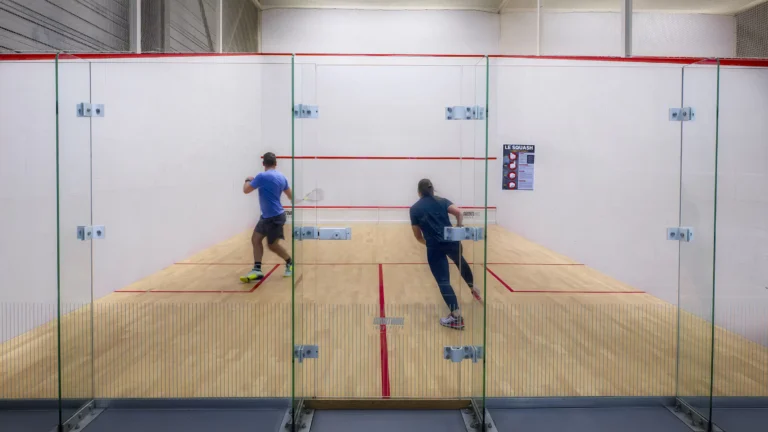
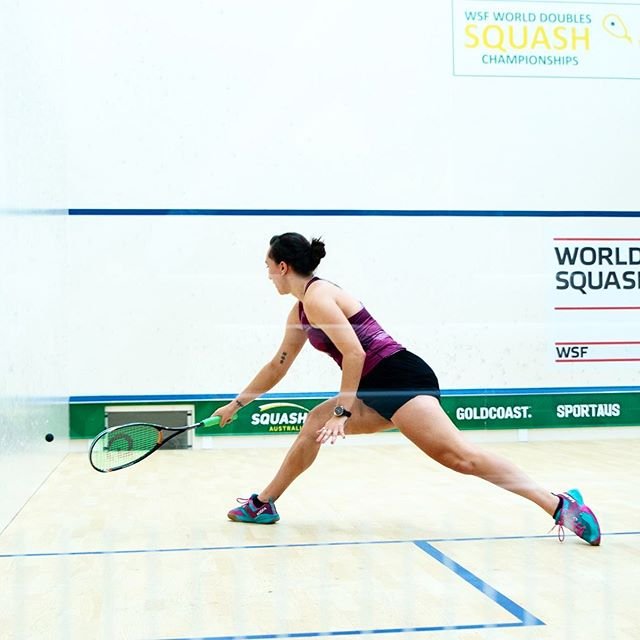
A proper doubles court is a singles court stretched sideways. The length is identical — 9.75 m (32 ft) between the front and back walls — but the standard width grows from 6.4 m to 7.62 m (25 ft). That extra 1.22 m is what makes room for a second player on each side: each half of a doubles court is wide enough to defend without living in your partner’s pocket, and the angles open up enough that the side walls become genuine attacking weapons rather than last resorts.
Almost everything else on the court will look familiar. The front-wall line sits at the same 4.57 m, the service line at 1.78 m, the short line 4.26 m from the back wall, and the service boxes remain 1.6 m squares — the geometry of the serve is unchanged, which is deliberate: a doubles serve is struck to the same targets as a singles serve, just with a partner standing beside you and two opponents waiting instead of one. The standard tin height is 480 mm, as on a singles court.
At the top of the game the court grows again. For WSF-recognised World and Regional events and the Commonwealth Games, the WSF specification widens the court to 8.42 m and lowers the tin to 330 mm — a bigger box and a more punishing target, reflecting the standard of the players using it. If you watch televised doubles from the World Doubles Championships or the Commonwealth Games and the court looks enormous compared with your club’s, that is because it is.
The three courts at a glance
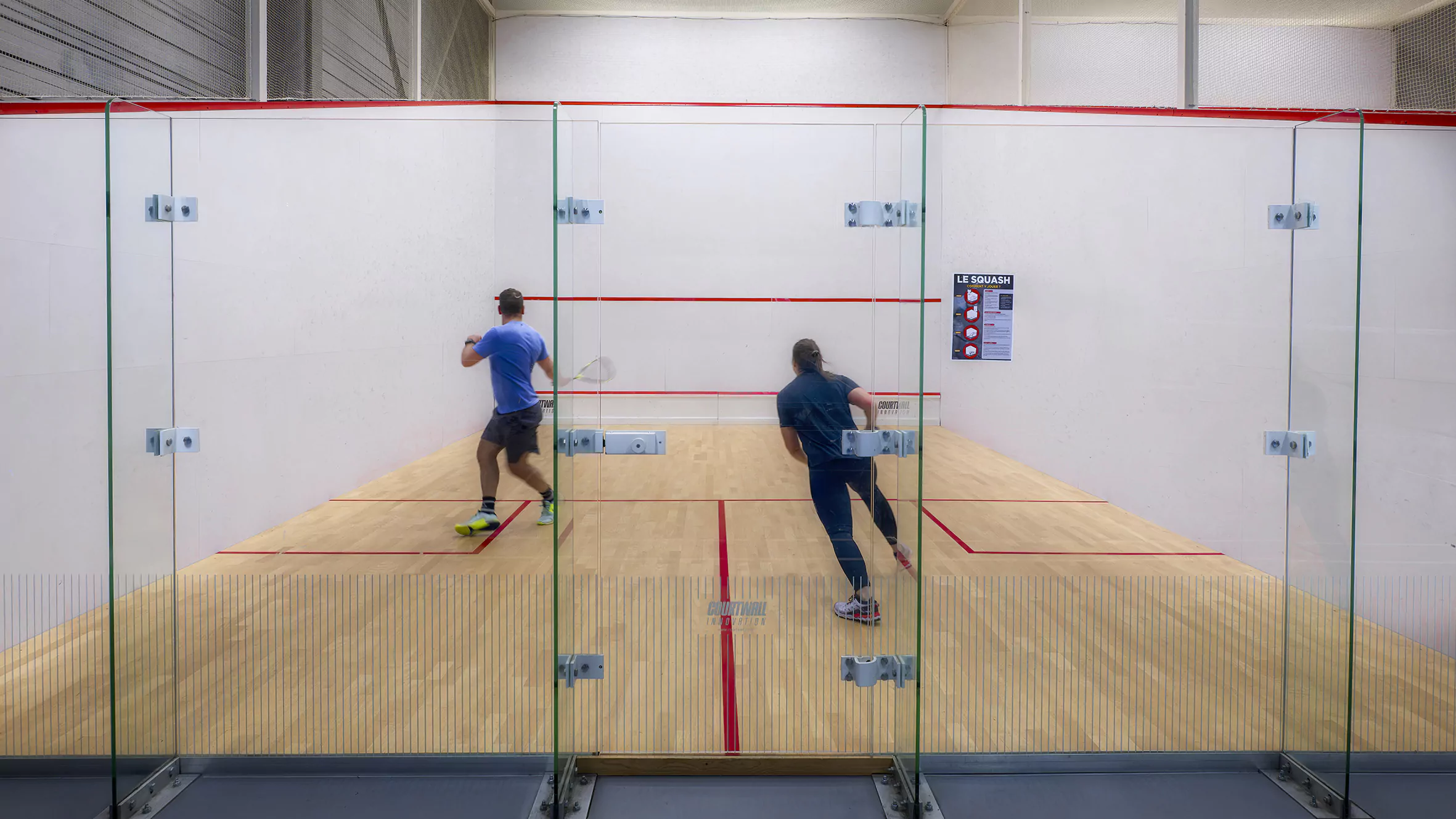
Because the hardball code described later in this guide uses a different court again, here is the full picture in one table. This is the fastest way to see that “doubles” is not one game but two, played in different boxes.
| Singles (for reference) | International doubles (softball) | Hardball doubles (North America) | |
|---|---|---|---|
| Court length | 9.75 m (32 ft) | 9.75 m (32 ft) | 13.72 m (45 ft) |
| Court width | 6.4 m (21 ft) | 7.62 m (25 ft); 8.42 m at world/Commonwealth level | 7.62 m (25 ft) |
| Tin / tell-tale height | 480 mm (430 mm at pro events) | 480 mm; 330 mm at world/Commonwealth level | 432 mm (17 in) |
| Scoring | PAR to 11, win by 2 from 10-all | PAR to 11, next point wins at 10-all | PAR to 15 |
| Serves per turn | 1 — a fault loses the rally | 1 — a fault loses the rally | 2 — a second fault loses the point |
| Match format | Best of 5 games | Best of 5 (may be best of 3) | First to 3 games |
| Eye protection | Recommended for adults | Mandatory for all players | Mandatory for all players |
| Governing rules | WSF Singles Rules 2025 | WSF Doubles Rules 2022 | WSF-approved Hardball Doubles Rules 2024 (US Squash / Squash Canada) |
The ball
There is no separate “doubles ball” to buy your way into trouble with. The ball must meet the WSF specification — the rules book’s ball appendix sets out the standard yellow-dot specification (40.0 mm diameter, 24.0 g, the familiar super-slow ball family), and the slowest balls of that family, the ones intended for elite and championship use, are the ones identified by a double yellow dot. In practice that means top-level doubles is played with the double yellow, the same ball as elite singles, warmed up properly before it will bounce honestly. At club level, teams simply agree on a ball of a speed that suits the players and the court temperature, exactly as singles players do — our best squash balls guide explains the full dot system and how to pick the right speed for your level.
Teams, sides and the serving order
Before a doubles match can start, both teams have two pieces of admin to declare — and unlike singles, these declarations shape the whole match. Get them right and you never think about them again; get them wrong and every hand-out becomes an argument.
The serving order is fixed for the match
At the start of the match, both teams must indicate their order of serving, and it must remain the same throughout the match (Rule 5.2). One of you is your team’s first server; the other is the second server. The team that wins the spin of a racket serves first, and its nominated first server opens the match, serving from alternate service boxes for as long as the team keeps winning rallies.
When that team finally loses a rally, the service passes to the opponents — whose first server now serves until their team loses a rally. Only then does the rotation move on: the process repeats with the second servers of each team taking their turns in the same pattern, and the cycle continues — first servers, then second servers — for the rest of the match. The Marker tracks the order as part of the job, but smart teams simply remember whose turn it is; the player who served your team’s last hand is never the player who serves its next one.
Two more details complete the picture. At the start of the second and every later game, the team that won the previous game serves first (Rule 5.6), picking up the serving order where the rotation left it. And whenever a new server steps in — at the start of a game or after a change of server — that server chooses which box to serve from, then alternates boxes for as long as they hold the serve (Rule 5.7), exactly as a singles server does.
Receiving sides are nominated — and locked for the game
Serving is only half the declaration. At the beginning of the match, each team nominates one partner to receive service from the right-hand side of the court and the other to receive from the left — the team receiving first nominates first (Rule 5.8). From then on, throughout that game, every serve to your team’s right side must be taken by your nominated right-side receiver, and every serve to the left by your left-side receiver. There is no drifting across to take a serve that suits you better, and no swapping mid-game because a particular serve is troubling one of you.
You are not locked forever. Partners may change receiving sides at the start of a new game, provided both the Referee and the opposing team are informed of the change (Rule 5.10) — a small tactical lever: if their server has been dismantling your right-side receiver’s backhand all game, the break between games is your one legal chance to rearrange the furniture.
The serve in doubles
The mechanics of a legal serve are carried over from singles untouched, because the front wall and the boxes are the same. A good doubles serve (Rule 5.15) has the server striking the ball before it touches anything else, with one foot in contact with the floor inside the service box, no part of that foot touching any boundary of the box. The ball must be hit directly to the front wall, between the service line and the out line — without clipping the front and side walls at the same time — and, unless the receiver volleys it, it must bounce first in the opposite quarter-court without touching any line. A serve that touches the service line, the short line, the half-court line or any other line is a fault, full stop.
And a fault is expensive, because the singles rule carries over too: there is no second serve in softball doubles. A serve that fails any part of the test is a fault, the receiving team wins the rally, scores the point, and the service moves on (Rule 5.16). Four players’ worth of rotation turns on every serve, so the premium is on a serve you can land ten times out of ten, not on the hardest one you own.
Two doubles-specific courtesies sit around the serve. The receiver who is not ready gets a let if they make no attempt to return — but if the serve was a fault, the fault stands and the rally is lost anyway (Rule 5.18). And once the ball has been served, the opponents must not deliberately block the server or the server’s partner from moving around the court (Rule 5.9) — the serving pair is entitled to flow into their defensive shape without being shepherded into a corner. If a rally ends in a let, the same server serves again from the same box (Rule 5.11); if anyone is unsure which box is correct, the Marker must say so before the serve is hit (Rule 5.12).
Scoring: PAR to 11, and the 10-all twist
Scoring in doubles is point-a-rally — PAR — the same engine as modern singles. The team that wins a rally scores a point. If the serving team wins the rally, the same server keeps the serve (alternating boxes); if the receiving team wins it, they score the point and the service changes hands, moving through the serving rotation described above. There is no “hand-in, hand-out” scoring where only the server can score — every rally moves the scoreboard (Rule 2.1).
Games are played to 11 points. Matches are normally the best of five games, though the rules allow the best of three (Rule 2.3). Warming up and resting follow a tight clock too: each team gets 2 minutes to warm up on the match court before play, with the spin of a racket deciding which team warms up first (Rule 4), and a maximum of 2 minutes is allowed between the warm-up and the start of play and between games (Rule 7.1).
One alternative you may meet in older club formats: the rulebook’s appendix permits a PAR-to-15 scoring system (normally over the best of three games), which some leagues and social competitions still use on the standard court. If your competition uses it, everything else in this guide — the serving order, the receiving sides, the interference framework — applies unchanged; only the target number moves. When in doubt, ask the organiser before the first serve, not at 10-all.
The rally with four players: positioning basics
Once the serve is away, the teams alternate shots — and here is the first thing to unlearn from singles: nothing in the rules says partners must take turns hitting the ball. Either player on a team may play any ball; what alternates is the team. In practice, of course, you cannot both chase everything, and the whole craft of doubles positioning is dividing the court so that the right partner is always the obvious striker.
The left-wall / right-wall split
The standard doubles shape mirrors your receiving nominations: one partner owns the left side of the court, the other owns the right, each defending their corridor from just in front of the T back to their back corner. Balls down your side are yours; balls down your partner’s side are theirs; balls threaded through the middle belong, by convention, to the player whose side the ball is passing into — and good pairs settle that convention, out loud, before the match starts. The non-striker’s job is just as defined: stay out of your partner’s swing and path, keep an eye on where the opponents are shaping to hit, and be ready to cover the crosscourt when your partner is dragged out of position.
That shape explains the two shots that run doubles. The straight drive is the premium rally ball: hit tight along your side wall, it stays in your corridor, comes back to your corridor, and never crosses your partner’s territory or the opponents’ swing. The boast — off the side wall and into the opposite front corner — earns its keep because the wider court gives it room to work and because it drags an opponent the full diagonal of the box, out of their corridor and into chaos. Shot execution itself does not change in doubles, so this guide will not re-teach it: our squash shots for beginners guide covers the drive, boast, drop and the rest, stroke by stroke. What changes is when each shot is safe to play — and that is an interference question, answered in the next section.
Traffic at the T
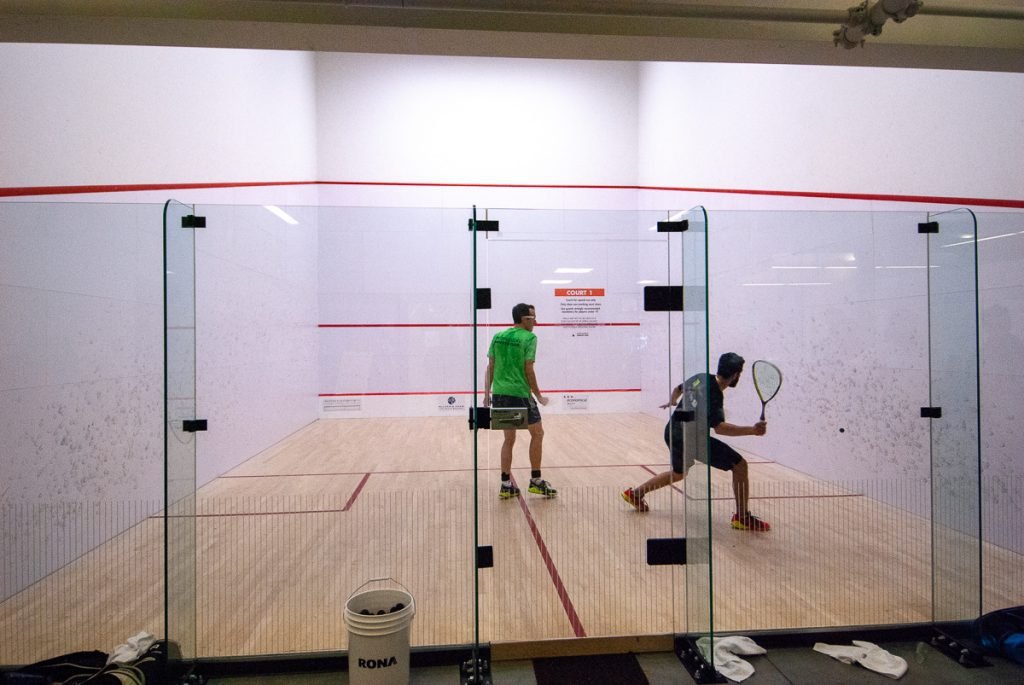
Four players rotating around one T produces a kind of congestion singles never reaches. The classic doubles tangle goes like this: the striker plays from the middle, their partner holds position a step away, and both opponents converge on the same few square metres to cover the next shot. Everyone is legally entitled to be somewhere near the T; nobody is entitled to stand still in it once the shot is played. The rulebook’s answer is a duty that falls on the whole striking team, not just the striker — and it is strict enough to deserve its own section.
Lets, strokes and no lets in a crowded court
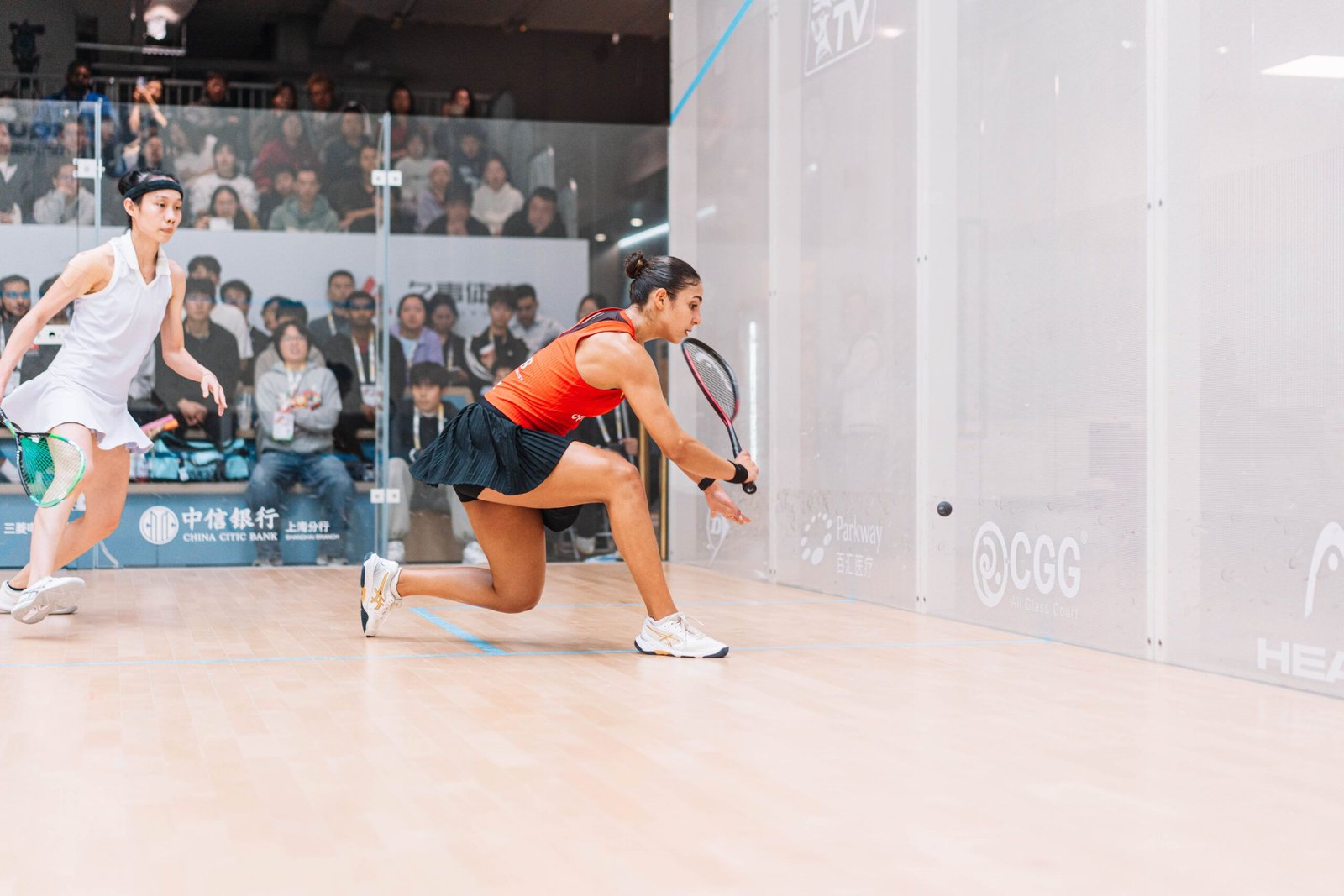
If you know the singles framework — let, stroke, no let — you know the shape of the doubles version too; the decisions are simply made against a more crowded picture. After the striker has completed a reasonable follow-through, both players on the striker’s team must make every reasonable effort to clear, so that both opponents have three things (Rule 8.1): direct access to the ball, the space to make a reasonable swing, and the freedom to strike the ball to any part of the front wall. Fail to provide any one of the three and interference has occurred; what follows depends on the usual questions — could the striker have made a good return, and was anybody actually trying to get out of the way?
The outcomes map onto singles logic, with doubles fingerprints all over them:
- Stroke to the striker’s team when the interference prevented a winning return, or when the opponents were simply not making every reasonable effort to avoid it — the doubles rulebook repeats that effort test constantly, for the striker and their partner (Rule 8.6.6, 8.6.8).
- A let when the opponents were genuinely making every reasonable effort to clear and the striker could have made a good return — the rally is replayed (Rule 8.6.7).
- No let when there was no real interference, when the interference was minimal, when neither striker could have made a good return anyway, when the striker played on past the interference before asking — or when an excessive swing manufactured the problem (Rules 8.6.1–8.6.5, 8.9.1).
The three doubles-only wrinkles
1. Your partner can cost you the let. If the interference was caused solely by the striker’s own team — your partner drifting into the opponent’s path, or standing in the very space you needed — the rules call it same-team obstruction, and no let is allowed (Rule 8.6.4). Interference is judged against the opponents’ duties; your own team’s clutter is your own problem. The flip side is fair-minded: if the previous striker’s partner had no time to get out of the way but was making every reasonable effort, the striker gets a let rather than a stroke decision against them (Rules 8.7.5, 8.8.3, 8.10.3).
2. Either partner may ask — and the better answer wins. In doubles, both players on the striking team sometimes experience the same interference from different angles, and both may request a let. If the Referee’s decisions on the two requests would differ, the decision giving the greater reward to the striking team stands — stroke beats let, let beats no let (Rule 8.6.9). As in singles, you ask by stopping and saying “Let, please”, and you must ask without undue delay: play on and then complain, and you have waived it.
3. The ball hitting a player is judged differently. In singles, a ball struck directly towards the front wall that hits the non-striker on the way is a stroke to the striker. In doubles, if the ball on its way to the front wall hits a non-striker and the return would have been good, the result is a let — in all circumstances (Rule 9.1.2). If the return would not have been good, the non-striker’s team wins the rally (Rule 9.1.1). And guard your own partner: a ball that hits the striker’s partner on its way to the front wall earns no let at all — the opposing team wins the rally (Rule 9.2). Balls coming back off the front wall that hit a player before the striker has had a chance to play them generally hand the rally to the striker’s team, with a let if the player hit was standing directly behind the striker (Rule 9.3).
Safety first: eyewear is not optional
The doubles rulebook opens with two principles — safety first, and fair play — and it puts its money where its mouth is in Rule 1: all doubles players must wear protective eyewear, manufactured to an appropriate national standard and worn properly over the eyes, at all times during play, including the warm-up, whether the match is social, league or tournament. The appendix goes further still: players are advised not to take part in doubles at all unless every player on court is wearing it, and officials are advised to refuse to officiate at a doubles match where any player is not.
Contrast singles, where the WSF recommends eyewear for adults but mandates it only for juniors and for doubles. The reason for the stricter doubles line is arithmetic, not bureaucracy: four rackets instead of two, a ball crossing the court through more bodies, a partner standing a metre away whose follow-through you cannot watch while you are watching the ball. The most common doubles injury scenario needs no bad luck at all — just a turned ball, a partner in the swing arc, and eyes looking the wrong way at the wrong moment.
Build the habits that go with the eyewear. Keep your swing compact — an excessive swing that creates interference earns no let, and one that connects with a person is far worse. Call early and clearly: if you are not taking a ball, say so before your partner commits to it. Hold the shot when the picture is wrong: the rules give you a let when you refrain from striking because of a reasonable fear of injuring an opponent, and the Referee’s safety powers back you up. And treat the warm-up with the same respect as the match — eyewear on from the first hit, because the rules demand it and because cold balls and cold eyes are exactly when accidents happen.
Softball vs hardball doubles: two codes, one name
Everything above describes the international softball doubles game — the version governed directly by the WSF, played with the standard soft squash ball on the 7.62 m court, and the version you will meet almost everywhere in the world, including at the World Doubles Championships and the Commonwealth Games. North America, though, has its own doubles tradition, older than the international game and proudly different: hardball doubles, played with a harder, faster ball that comes off the walls at pace, under the International Hardball Doubles Rules — maintained by US Squash and Squash Canada and approved by the World Squash Federation (current edition effective 1 January 2024), with its own professional circuit, the SDA Pro Tour.
Never blur the two. They are separate codes, and the differences are not cosmetic:
- The court is far longer. A hardball doubles court measures 13.72 m (45 ft) long by 7.62 m (25 ft) wide — the same width as the softball doubles court, but a full 4 metres longer, with a 432 mm (17 in) tell-tale (the hardball word for the tin) and a much higher front wall. The extra length turns the game into a test of deep, hard driving that the shorter softball court never asks for.
- Scoring runs to 15. Hardball doubles uses point-a-rally scoring, but a game is won by the first side to 15 points, and a match by the first side to win three games.
- There are two serves. Where the softball server gets one chance, the hardball server whose first service is a fault serves again from the same side; only a second consecutive fault loses the point.
- The serving turns work differently. Partners serve in succession: the first server keeps the serve until the side loses a point, then the partner serves until the side loses another, and only then is the side “out”. Quirk worth knowing: on the first serve of every game, the side is declared out after losing one point only, so just one partner serves in the opening hand of each game.
- The shared DNA is real, too. Receivers are designated per game for the right-hand and left-hand service courts, exactly as in softball, and approved eye guards must be worn properly at all times during play — both codes agree that four players means mandatory eye protection.
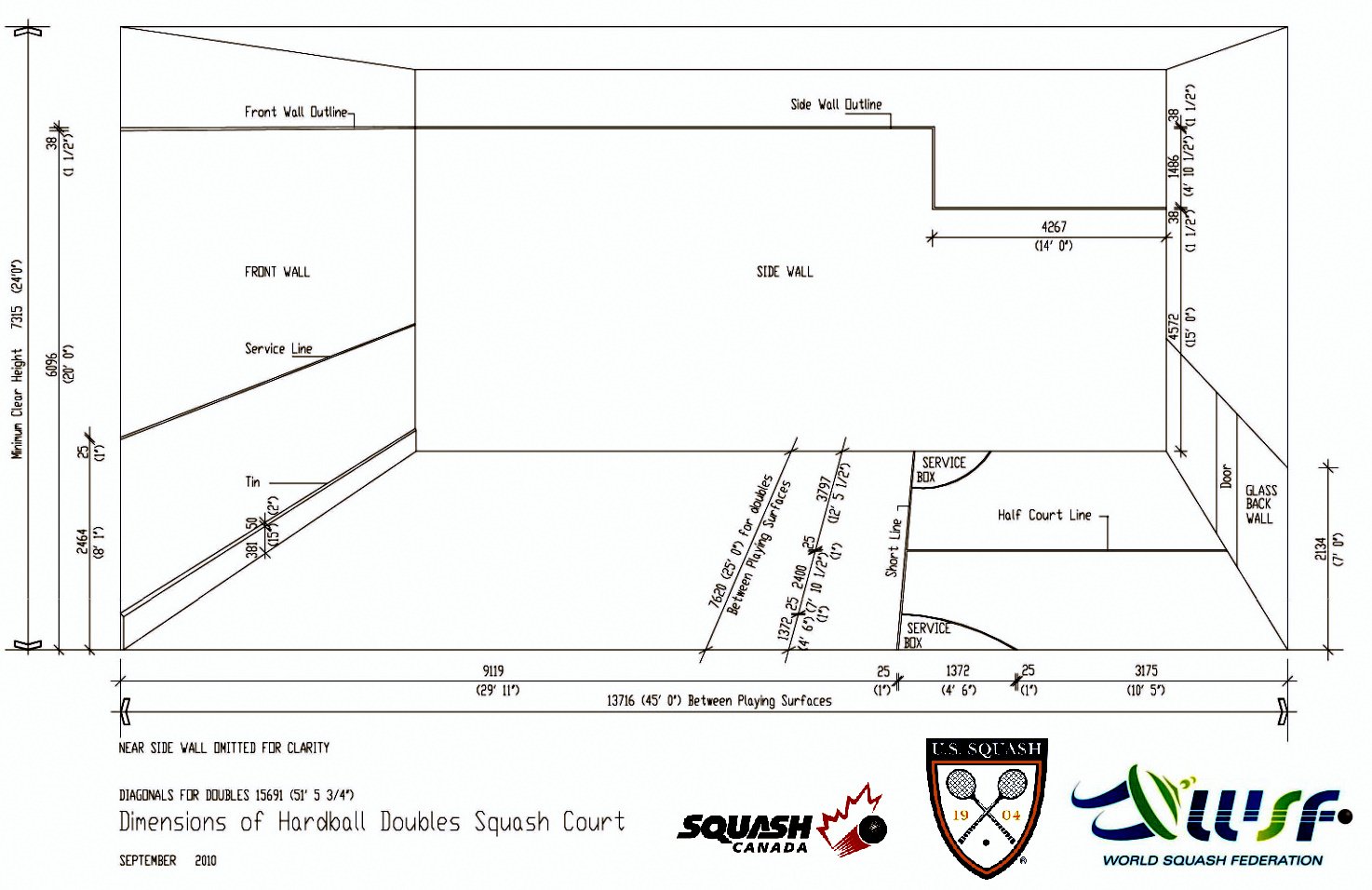
If you are invited to a hardball game in New York, Toronto or Philadelphia, go — it is a thrilling, distinct sport with a century of its own history. Just do not pack your softball assumptions: the court is longer, the ball is harder and livelier, the target score is 15, and you get a second serve. This guide’s rule-by-rule detail belongs to the international softball code unless it says otherwise.
Your first doubles session
Doubles is a fixture of the sport’s biggest stages — it has its own WSF World Doubles Championships and a long-standing place at the Commonwealth Games, in the same sport whose singles stars headline the PSA World Championship — but it is also the most sociable way to play club squash: four friends, one court, and rallies that rarely die young. Here is how to make your first session a good one.
First-session checklist
1. Eyewear on, before the warm-up. Non-negotiable under the rules, for every player. If your club pair of rackets is overdue an upgrade for the wider game, our best squash rackets for beginners guide is the place to start.
2. Agree the declarations before the first serve. Spin for serve, announce each team’s serving order, and nominate right-side and left-side receivers. Thirty seconds of admin saves a match of confusion.
3. Warm up properly. Each team has 2 minutes on court under the rules; use them to warm the ball up as much as yourselves — a cold double yellow in a wide court makes for very short rallies.
4. Play your corridor. Left-wall player, right-wall player, middle balls settled by the convention you agreed. Chase your partner’s balls only when they are genuinely beaten.
5. Clear like you mean it — both of you. After your team’s shot, both players move. Ask for lets early and audibly, and hold any swing you cannot see a safe path for.
6. Remember 10-all. Next point wins the game. Play it like a match ball, because it is one — for both teams.
Above all, enjoy the thing doubles does better than any other version of squash: it makes the sport a team game. The conversations between rallies — whose ball, which corridor, when to boast — are half the fun, and the pairs who talk are, almost without exception, the pairs who win.
The short version
- The court: singles length (9.75 m), doubles width (7.62 m; 8.42 m at world level) — the extra width is the game.
- The order: serving order and receiving sides are declared before the match and locked in — the rotation runs first servers, then second servers.
- The score: PAR to 11, best of five — and at 10-all the next point wins the game outright.
- The rally: either partner may play any ball; both partners must clear; your own team’s obstruction earns you nothing.
- The safety rule: eyewear is compulsory for all four players, at all times. No eyewear, no doubles.
- The other code: hardball doubles is North America’s separate game — longer court, harder ball, games to 15, two serves. Same name, different sport.
Squash doubles rules — FAQs
What is the difference between squash singles and doubles?
Doubles is played by two teams of two on a wider court — 7.62 m wide instead of 6.4 m, at the same 9.75 m length. Teams declare a fixed serving order and nominated receiving sides before the match, either partner may play any ball during a rally, and both players on a team must clear after their side’s shot. Games are PAR to 11, but at 10-all the next point wins, unlike singles where you must win by two. Protective eyewear is also mandatory for all doubles players, where singles only recommends it for adults.
How big is a squash doubles court?
A standard international doubles court is 9.75 m (32 ft) long and 7.62 m (25 ft) wide, with a 480 mm tin. For WSF World and Regional events and the Commonwealth Games, the court is widened to 8.42 m and the tin lowered to 330 mm. The North American hardball doubles court is much longer: 13.72 m (45 ft) by 7.62 m (25 ft).
How does serving work in squash doubles?
Before the match, each team declares a serving order that stays fixed all match. The first server serves from alternate boxes until their team loses a rally; the opponents’ first server then does the same, and the rotation moves on to the second servers of each team. The team that won the previous game serves first in the next game. There is only one serve: a fault loses the rally. Each team also nominates which partner receives serves on the right side and which on the left, fixed for the whole game.
How is squash doubles scored?
Point-a-rally (PAR): the team that wins a rally scores a point, and the server keeps the serve if the serving team wins. Games are played to 11 points and matches are normally the best of five games. At 10-all there is no win-by-two rule — the next point wins the game 11–10. Some competitions use the rulebook’s alternative PAR-to-15 system instead.
Can both partners hit the ball in the same rally?
Yes. The teams must alternate shots, but within a team either partner may play any ball — there is no rule that partners take turns. In practice pairs divide the court into left and right corridors so the right player takes each ball, but a partner who is beaten can always be covered by the other.
Is eye protection mandatory in squash doubles?
Yes. Under the WSF doubles rules, every player must wear protective eyewear made to an appropriate national standard, properly over the eyes, at all times during play including the warm-up — in social, league and tournament matches alike. Officials are advised to refuse to officiate if any player is not wearing it. Hardball doubles has the same requirement for approved eye guards.
What ball is used for squash doubles?
The ball must meet the WSF specification — the standard yellow-dot ball specification set out in the rules (40.0 mm diameter, 24.0 g). The slowest balls in that family, intended for elite and championship play, are identified by a double yellow dot, and top-level doubles uses that ball. Club teams simply agree on a dot speed that suits the players and court temperature.
What is the difference between softball and hardball doubles?
Softball doubles is the international game: a 9.75 m by 7.62 m court, the standard soft ball, PAR scoring to 11 and one serve. Hardball doubles is the North American code, played with a harder, faster ball on a court 13.72 m (45 ft) long by 7.62 m (25 ft) wide, with games to 15 points, two serves (a second fault loses the point), and partners serving in succession. Both codes make eye protection mandatory.
About this guide: The rules summarised here follow the World Squash Federation’s World Squash Doubles Rules, effective 1 January 2022, and the WSF-approved International Hardball Doubles Rules 2024 maintained by US Squash and Squash Canada; where your club or league uses local conventions (scoring system, court, ball grade), those take precedence on the day. This page links only to guides on Alishuttler.com — any affiliate relationships are disclosed on the pages concerned.