The shuttle is the cheapest thing on a badminton court and the one that decides how the game actually feels. Feather for match flight, nylon for training mileage, hybrid for the middle path — here are the seven shuttlecocks worth buying, and how to pick the right speed.
⚡ TL;DR — The Short Answer
For matches, buy feathers: the Yonex Aerosensa 50 is the tournament benchmark, the Aerosensa 30 is the club-night sweet spot, and the RSL Classic Tourney is the BWF-approved alternative to the Yonex ladder. For training volume, buy nylon: the Yonex Mavis 350 is the club standard and the Mavis 2000 is its faster-recovering flagship. The middle path is real: the Babolat Hybrid Challenge puts real feathers on a synthetic base, and the Victor NCS Pro replaces feathers with engineered foam and carbon — the design already trusted as an official shuttle at junior continental championships. Then match the speed grade to your hall: 76 for hot halls, 77 for typical warm halls, 78 for cold ones.
Quick Picks — Best Badminton Shuttlecocks at a Glance
The official shuttle of the world’s leading international tournaments. Premium goose feather, solid cork, benchmark flight.
Goose feather and solid natural cork a step down the ladder — match feel for weekly club play.
BWF-approved tournament feather from the non-Yonex camp, with a double quality check on every tube.
Foam feathers on carbon-fibre stems with a composite cork — the new-generation synthetic, championship approved.
Wing Rib skirt for rapid shape recovery and the closest nylon flight to feather, per Yonex.
Real feathers set into a nylon base with a cork head — feather feel, engineered durability.
In This Guide
- Three Families of Shuttle: Feather, Nylon, Hybrid
- What a Legal Shuttle Actually Is (BWF Law 2)
- Speed Grades 75–78: Matching the Shuttle to Your Hall
- The 7 Best Badminton Shuttlecocks, Compared
- Side-by-Side Comparison Table
- Buying Guide: Corks, Cost per Session and Care
- Frequently Asked Questions
- The Verdict
Three Families of Shuttle: Feather, Nylon, Hybrid
Every shuttlecock you will ever buy belongs to one of three families, and the families exist because of one tension: feathers fly best and wear out fastest; synthetics last and fly differently. Feather shuttles — real goose or duck feathers in a cork base — decelerate, spin and sound the way the sport was built around, which is why every serious competition on earth is played with them. Nylon shuttles mould the skirt from plastic: they shrug off mishits that would snap a feather, and modern designs fly far better than the school-hall cones of memory, but the flight character is still measurably different. Hybrids split the difference — real feathers on an engineered base, or feather-like synthetic vanes on carbon stems.
This guide is the shopping list. The deeper theory already lives on the site: our guide to choosing the best shuttlecock walks through the decision framework, the birdie comparison breaks down feather versus synthetic flight in detail, and if your games happen outdoors, the wind changes everything — see the best outdoor badminton shuttlecocks. Here, we keep it practical: seven tubes, what each is made of, and who each is for.
What a Legal Shuttle Actually Is (BWF Law 2)
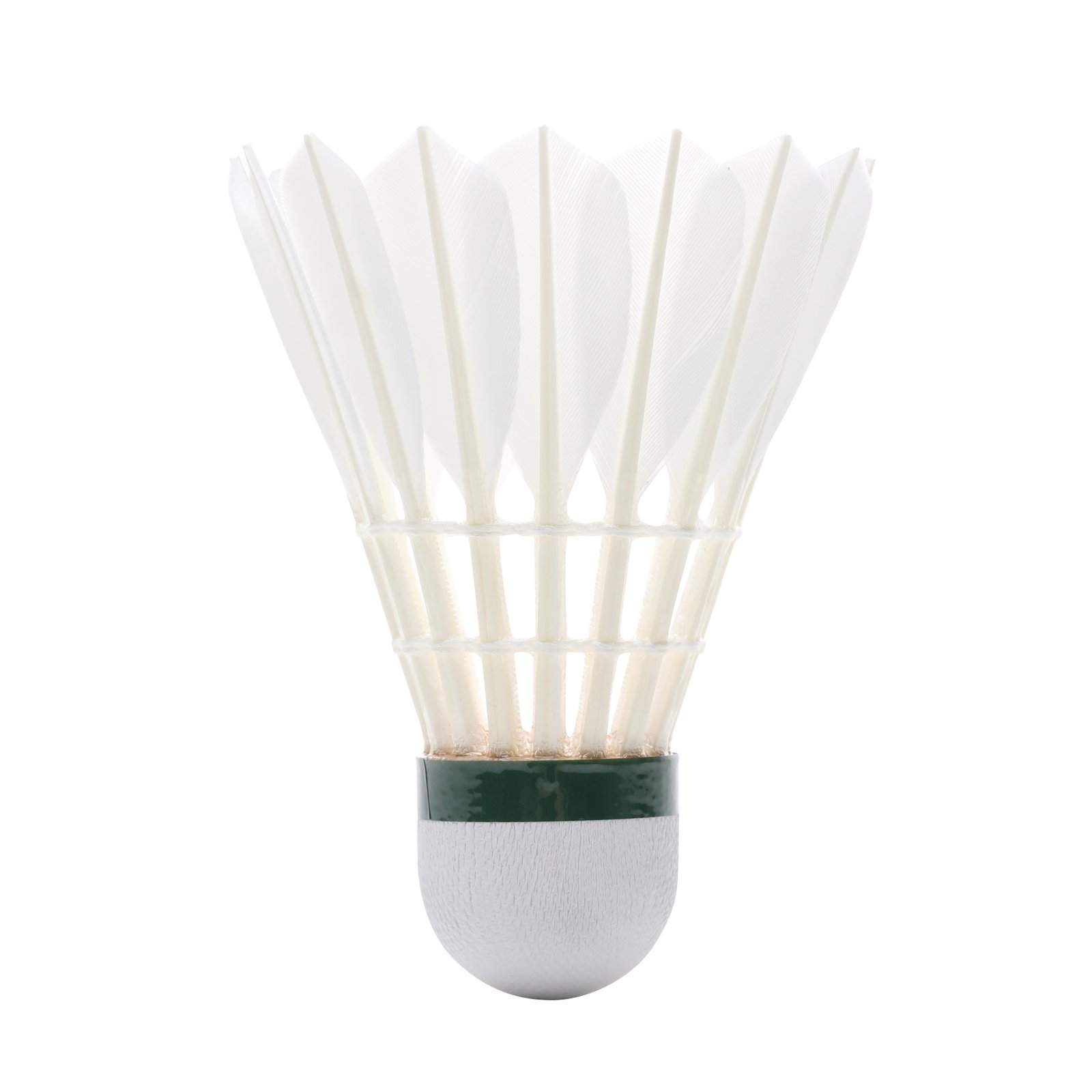
The BWF Laws of Badminton define the shuttle precisely, and every serious product in this guide is built to that definition. Law 2 specifies that a feathered shuttle has 16 feathers fixed into the base; the feathers are uniform in length between 62 and 70 mm, measured from tip to the top of the base; the feather tips lie on a circle 58 to 68 mm in diameter; the base is 25 to 28 mm in diameter and rounded underneath; and the whole shuttle weighs between 4.74 and 5.50 grams. Synthetic shuttles are held to the same design, dimensions and weight, with a variation of up to 10% accepted because of the different material.
Why should a buyer care about a law book? Because those numbers are the reason a tournament feather and a bargain tube fly differently even at the same speed grade: feather length, skirt diameter and total weight decide how the shuttle decelerates and how stable it is in flight. When a brand publishes its construction — goose feather, solid cork, regulation weight — it is telling you it built to the law. When it does not, you are buying a mystery.
Speed Grades 75–78: Matching the Shuttle to Your Hall
The most common buying mistake in badminton is not the brand — it is the speed. A shuttle’s speed grade describes how far it flies on a standard stroke, and the grade you need is set by your hall’s temperature and altitude, because both change how much the air resists the shuttle. Hot air (and thin, high-altitude air) resists less, so the shuttle flies further and faster; cold, dense air slows it down.
Manufacturer guidance — RSL’s published chart is the clearest — maps it like this: speed 76 for hot halls above roughly 27 °C, 77 for warm halls between about 18–27 °C, 78 for cool halls between 8–17 °C, and 79 for genuinely cold halls. Speed 75 exists for extreme heat or altitude. Yonex’s nylon range expresses the same idea in cap colours instead of numbers: a green band is Slow (for 22–33 °C), blue is Medium (12–23 °C), and red is Fast (0–13 °C).
The practical test is the one players have always used: hit a full-length underarm clear from the back line. A correctly speeded shuttle lands in the zone short of the opposite back boundary line. If your shuttles keep sailing long in a air-conditioned hall, drop a grade; if they die before the back tramlines in a cold sports hall in January, go up one. Buy one tube at the grade you think you need before you buy a dozen.
The 7 Best Badminton Shuttlecocks, Compared
Three feathers for matches, three synthetics for mileage, one true hybrid between them. Specifications are the manufacturers’ own published figures — and where a durability number appears, it is the manufacturer’s published rating, labelled as such.
Yonex Aerosensa 50 (AS-50)
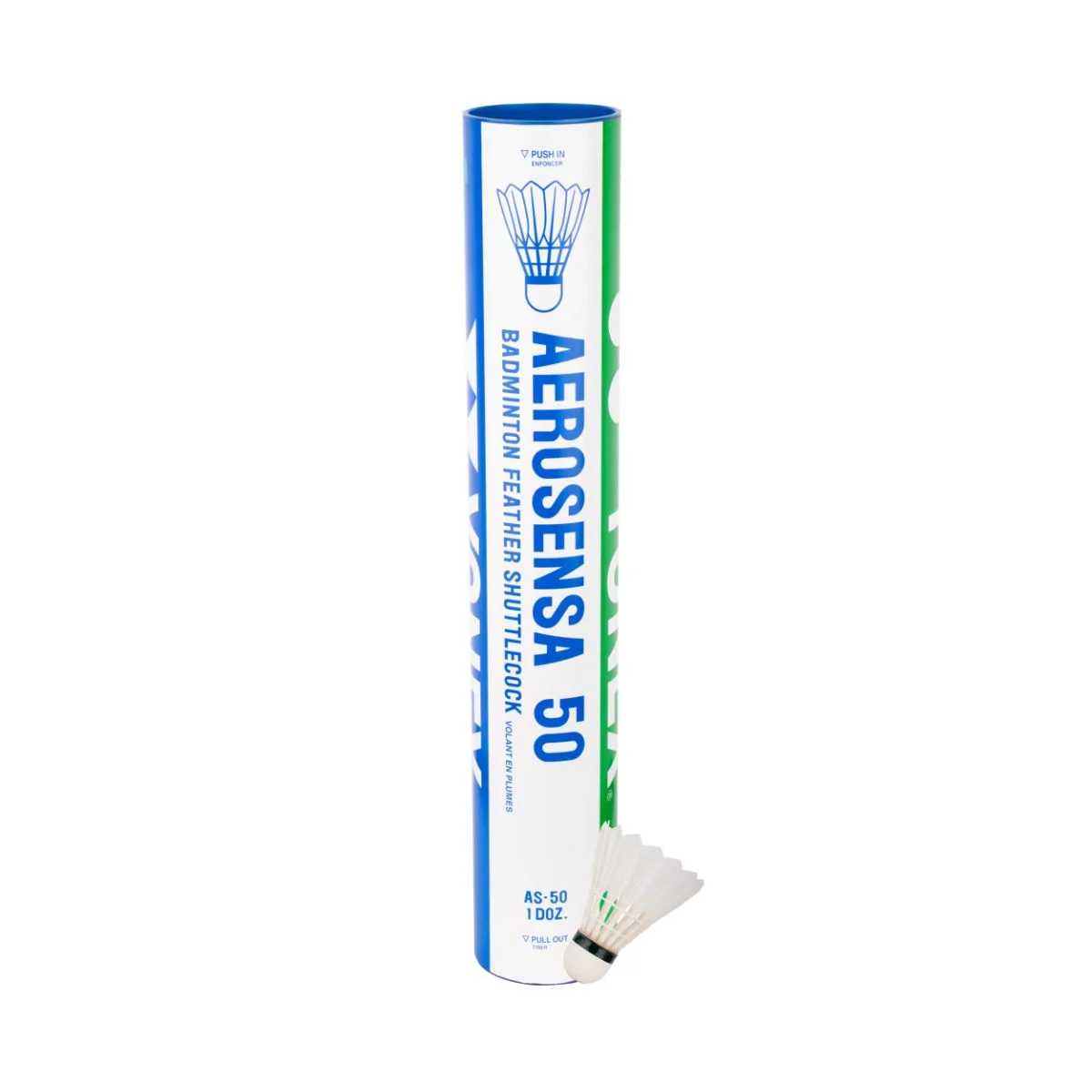
The benchmark. Premium goose feather on solid cork — the shuttle the biggest events in the sport are played with.
Yonex describes the Aerosensa as the official shuttlecock for the world’s leading international tournaments, and the AS-50 sits at the top of that range — the grade associated with major international events up to Olympic level in Yonex’s own product ladder. The construction is the classic done without compromise: premium goose feathers selected for consistency, set into a 100% solid cork base. Solid natural cork is the detail to notice — it gives the crisp, dense impact feel and consistent weight distribution that composite bases approximate.
Who should pay for it? Players in graded competition, clubs that host league fixtures, and anyone who wants their practice flight to be identical to match flight. For a casual Tuesday club night it is more shuttle than the occasion demands — the AS-30 below exists for exactly that reason. But as the reference point against which every other feather in this guide is judged, the AS-50 has no equal in the catalogue.
What we like
- The tournament reference standard — flight consistency tube after tube
- Premium goose feather with 100% solid cork base
- The exact shuttle character serious competition is played with
Worth knowing
- Top of the price ladder — overkill for casual club nights
- Feathers are consumables: budget for breakage at hard-hitting levels
As an Amazon Associate we earn from qualifying purchases.
Yonex Aerosensa 30 (AS-30)
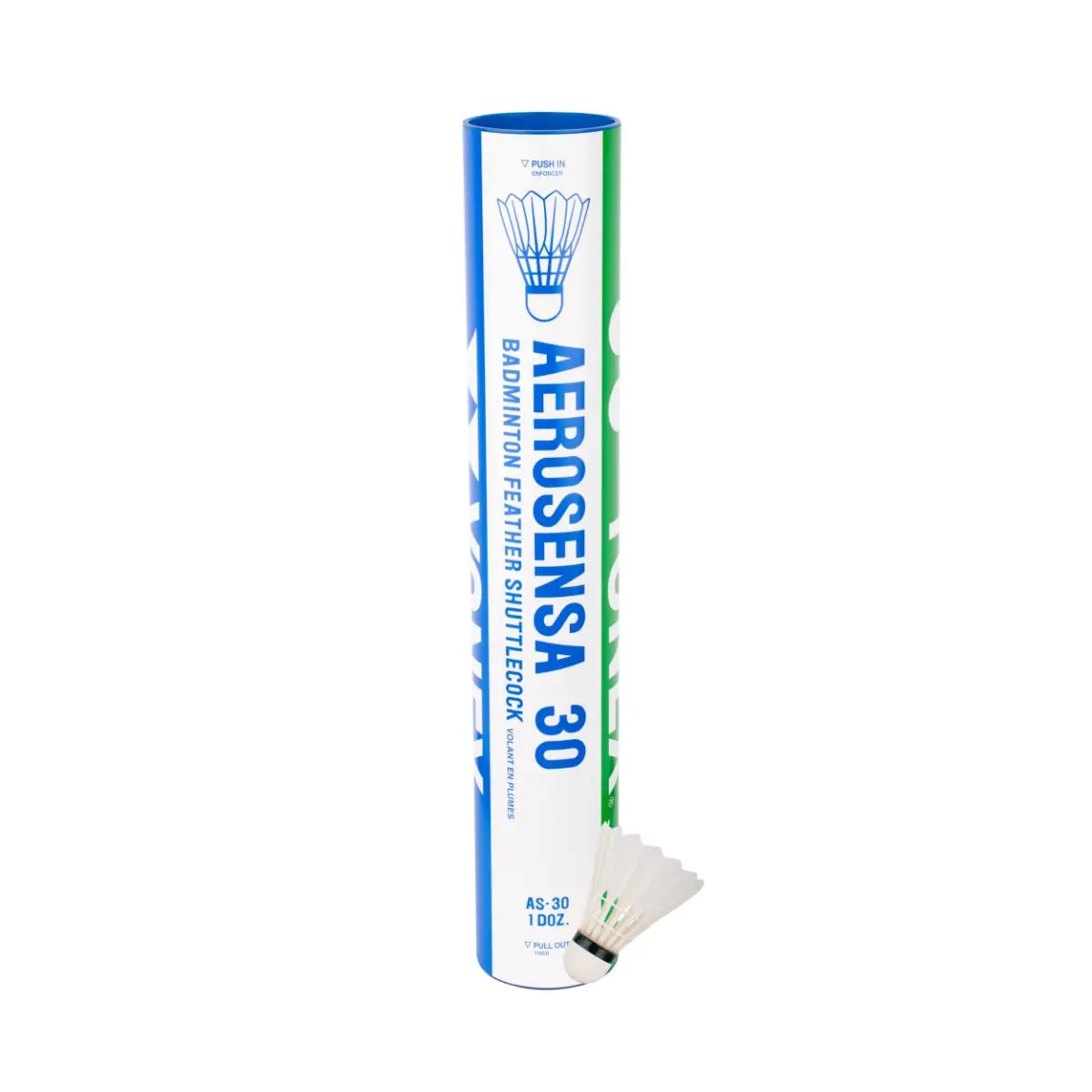
The club-night sweet spot — goose feather and solid natural cork a sensible step below the flagship.
The Aerosensa ladder exists so you can match the shuttle to the occasion, and the AS-30 is where most serious club players should live. It keeps the two construction details that matter most — goose feathers and a 100% solid natural cork base — at the grade Yonex positions for high-quality club and local tournament play, below the AS-40 and AS-50’s international brief.
In practical terms: the flight character is the same family as the flagship, the cork feel is the same solid hit, and the per-tube cost stops stinging when a feather snaps — as feathers do. If your club plays feathers for matches and league fixtures, the AS-30 is the tube to standardise on; save the AS-50 for finals night. Newer players still building their game will get more value from the nylon picks below, but once a group commits to feathers, this is the sensible default.
What we like
- Solid natural cork and goose feather without flagship pricing
- Same flight family as the AS-50 — easy step up for big matches
- The right level for league and local tournament play
Worth knowing
- Still a consumable feather shuttle — hard hitters will work through tubes
- Speed variants differ by market: check the grade printed on the tube
As an Amazon Associate we earn from qualifying purchases.
RSL Classic Tourney (No.1 Tourney)
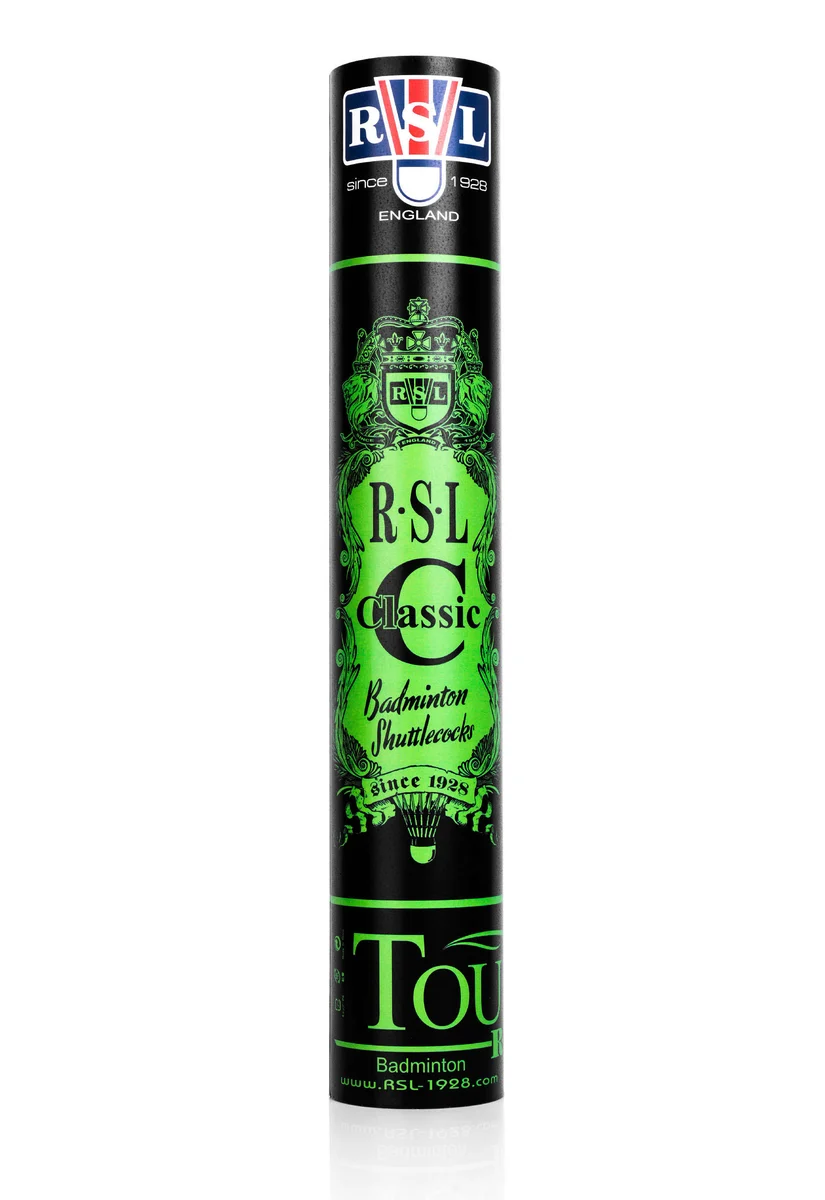
The connoisseur’s alternative — BWF-approved tournament feathers from the brand that only makes shuttles.
RSL is the shuttlecock specialist in this guide — a brand whose entire reputation rests on feathers — and the Classic Tourney, sold in many markets as the No.1 Tourney, is its flagship. It is built from premium goose feather and carries BWF approval for tournament use, which puts it in the small group of non-Yonex feathers trusted for formal competition. RSL also runs a double quality check on the range: each shuttle is inspected for flight and consistency before it is tubed.
Why choose it over the Aerosensa line? Players who find RSL’s flight character suits their game, clubs buying in bulk outside the Yonex supply chain, and anyone whose local market prices RSL kindly. One honest specification note: retailer listings differ on whether the base is natural or composite cork, so if that detail matters to you, confirm it on the tube in your market — the flight approval, not the cork footnote, is the reason to buy it.
What we like
- BWF-approved for tournament use — genuine competition credentials
- Premium goose feather from a shuttle-only specialist brand
- Double quality check per RSL’s own production process
Worth knowing
- Cork composition is listed inconsistently across markets — check your tube
- Availability varies by region more than the Yonex range
As an Amazon Associate we earn from qualifying purchases.
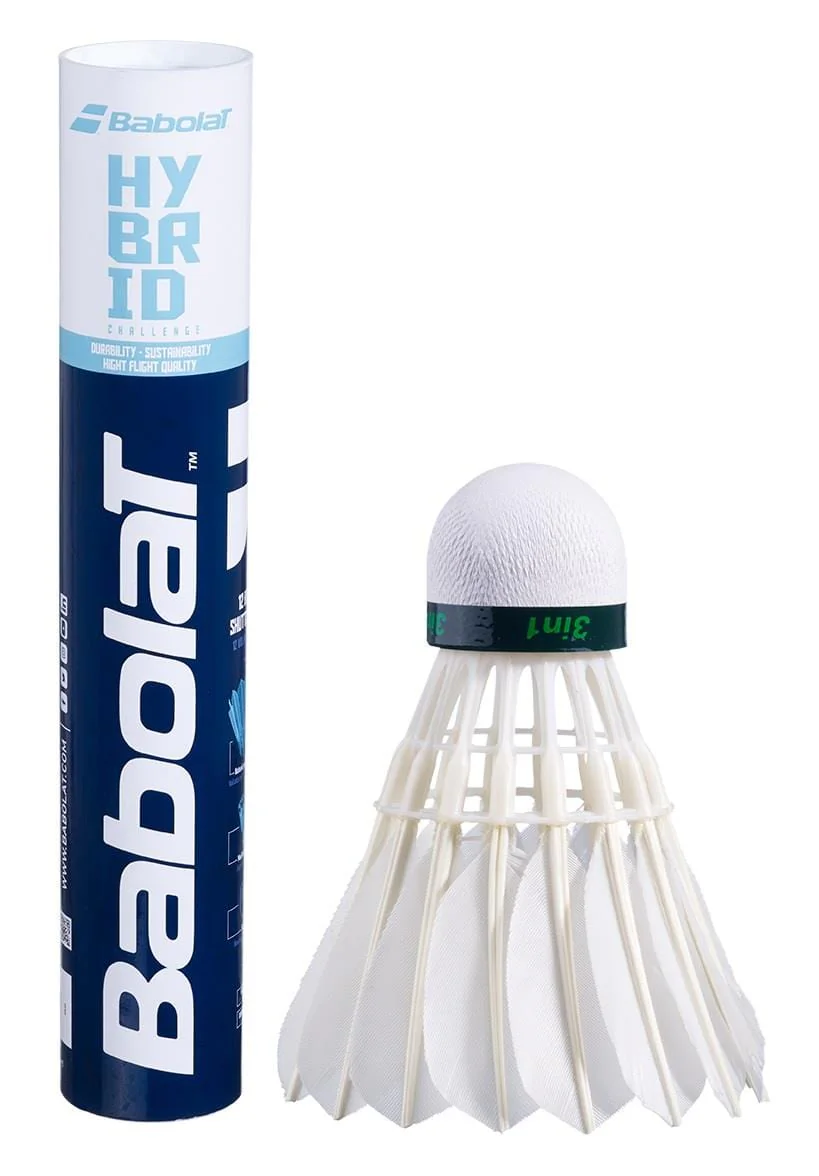
Babolat Hybrid Challenge
Real feathers, engineered base — Babolat’s Hybridtouch answer to the feather-versus-nylon dilemma.
The hybrid idea, executed properly: the Hybrid Challenge is built in three parts — a cork head, a synthetic nylon base, and real feathers inserted into that base. The logic is sound. The cork preserves the impact feel your racket expects, the feathers preserve the aerodynamic character that makes a shuttle fly like a shuttle, and the engineered base replaces the part of a traditional build most prone to inconsistency, so shuttle after shuttle behaves the same way.
Babolat positions the Hybrid Challenge on stability, precision and durability — the training-room argument for hybrids in one line. It will not be the shuttle your league final is played with, and it is not trying to be. It is for clubs and coaching sessions that want feather-family flight behaviour without burning a tube of match feathers every night, and for players who find full nylon’s flight a step too far from the real thing. If you are equipping a whole training group, pair this with the right beginner rackets and you have a club starter kit that behaves properly.
What we like
- Real feathers and a cork head keep the flight and feel in the feather family
- Engineered base targets consistency from shuttle to shuttle
- A genuine middle path for clubs torn between feather cost and nylon flight
Worth knowing
- Not a competition feather — check your event’s shuttle rules
- Hybrid flight is close to feather, not identical — purists will notice
As an Amazon Associate we earn from qualifying purchases.
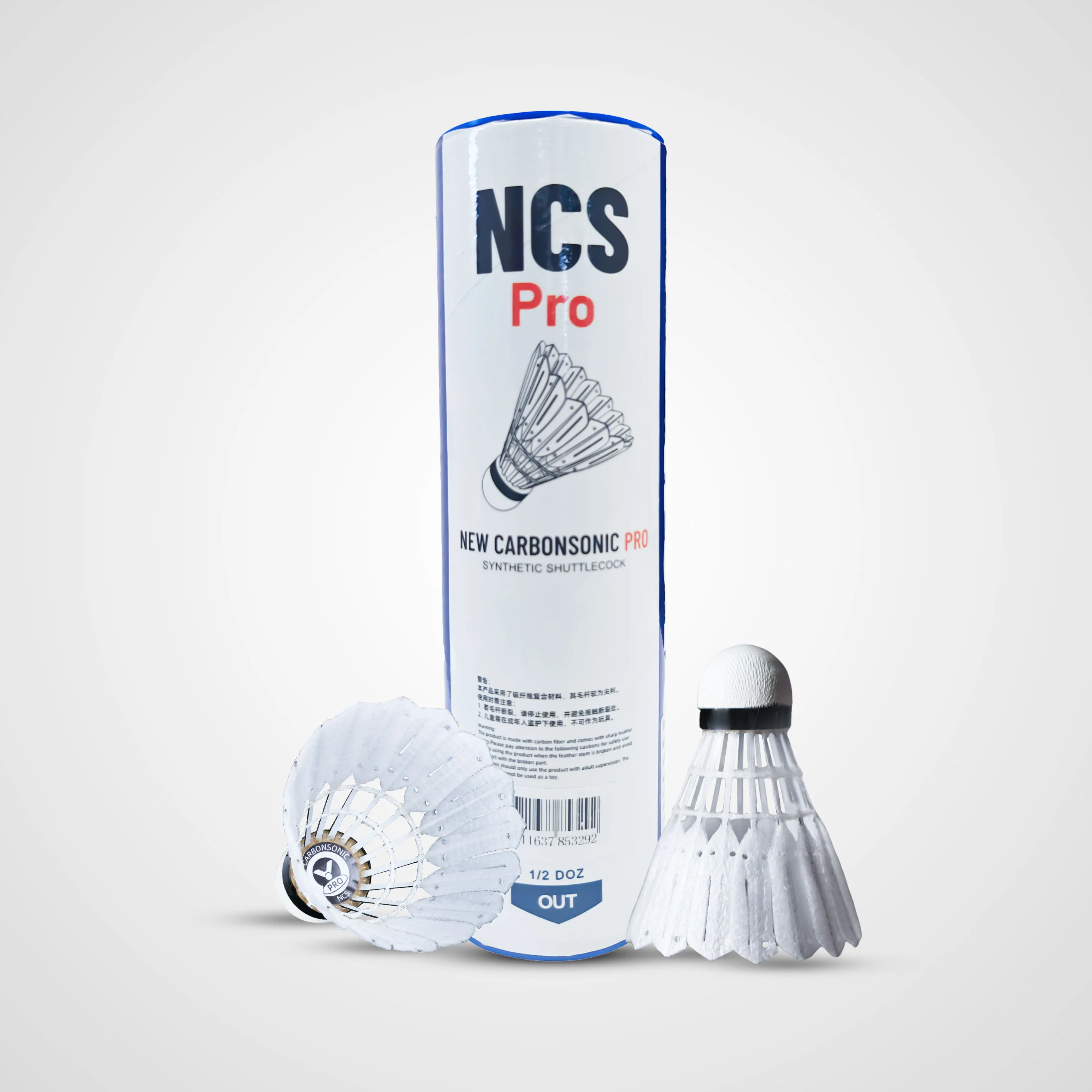
Victor NCS Pro (New CarbonSonic Pro)
Foam feathers on carbon stems — the synthetic shuttle that a continental championship already trusts.
The NCS Pro is what the post-nylon era looks like. Instead of a moulded plastic cone, Victor builds individual synthetic “feathers” from LDPE foam — pierced with tiny holes that Victor uses to tune stability and spin — and mounts them on carbon fibre composite stems that snap back to shape instead of deforming. The base is a hybrid composite cork, and the finished shuttle weighs about 5 grams, inside the BWF’s regulation band.
The credential that matters: the NCS Pro served as an official shuttlecock at the 2025 Asia Junior Championships — a first-rank sanctioned event putting a synthetic in the role feathers have always owned. On durability, Victor’s own specification rates the shuttle for 100+ rallies; that is the manufacturer’s published rating rather than an independent test, but the direction of travel is clear, and the economics are compelling for clubs whose feather bill keeps climbing. If your group plays where synthetic shuttles are permitted and you want the closest engineered alternative to feather flight, this is the current state of the art.
What we like
- Official-shuttle status at the 2025 Asia Junior Championships
- Carbon stems and perforated foam vanes target feather-like flight and spin
- Manufacturer rates durability far beyond feather norms — training economics
- Cruelty-free construction as feather supply tightens
Worth knowing
- Acceptance varies by competition — confirm synthetic shuttles are permitted in yours
- Six per tube rather than twelve: compare cost per shuttle, not per tube
As an Amazon Associate we earn from qualifying purchases.
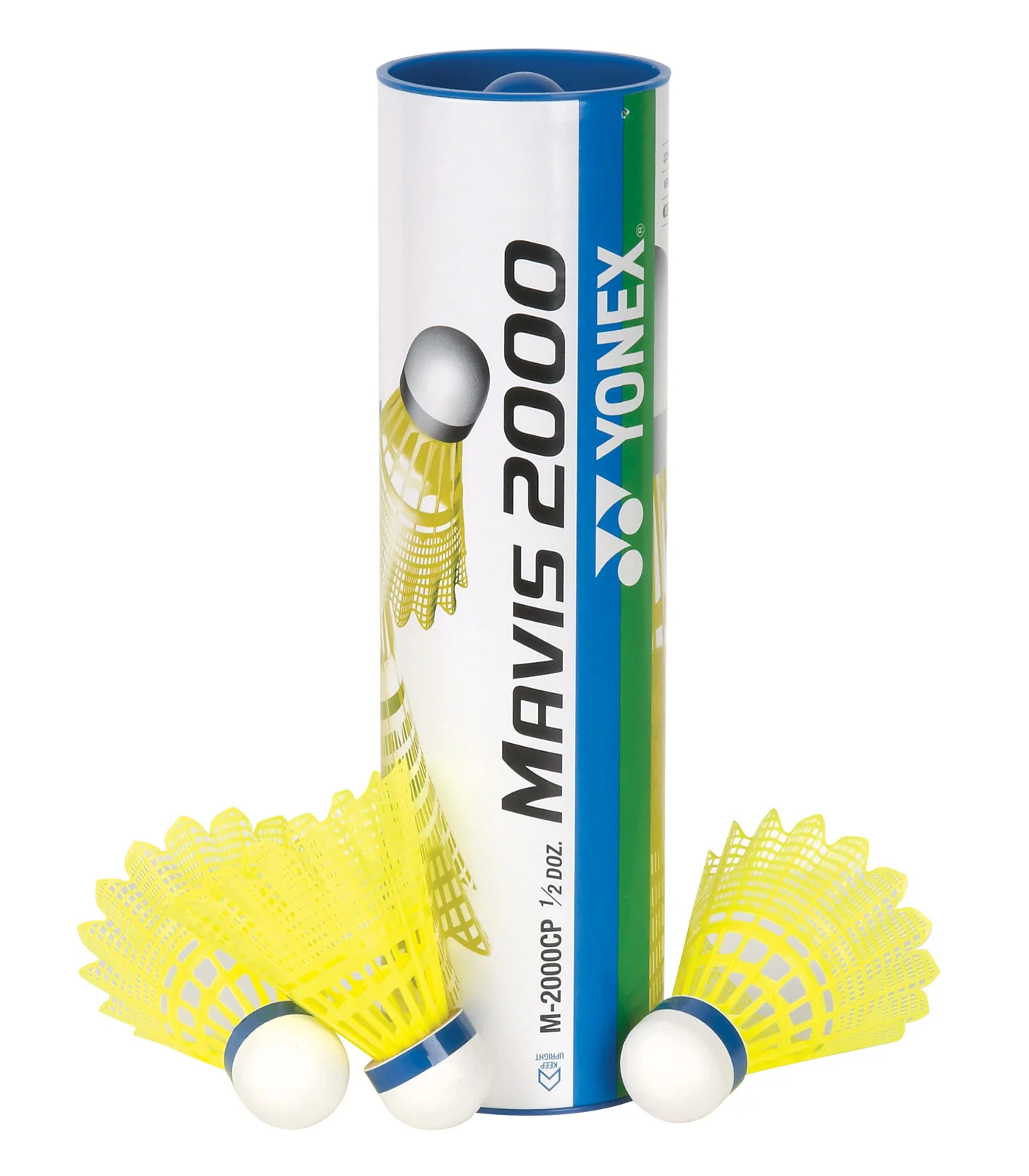
Yonex Mavis 2000
The flagship nylon — Wing Rib skirt for instant shape recovery after every smash.
Yonex calls the Mavis 2000 the ultimate practice and tournament nylon for club players, and the engineering story is the Wing Rib skirt: the ribbed structure is designed to recover its shape almost instantly after a smash deforms it, so the next shot flies true instead of wobbling. Yonex positions its flight precision as the closest in the nylon family to a feather shuttle, and publishes a durability claim for the Mavis series of four to five times an ordinary nylon shuttlecock — the manufacturer’s figure, offered here as their claim rather than a test result.
This is the nylon for groups who train hard and play games that matter to them: schools with competitive teams, clubs whose social nights are anything but gentle, and coaches who are tired of both feather bills and wobbly bargain shuttles. One specification note: listings in different markets describe the base as natural or composite cork, so check the tube in your market if that detail matters to you. New players learning the game itself should start with our How to Play Badminton guide — and this shuttle in the bag.
What we like
- Wing Rib skirt recovers shape fast — consistent flight across a hard session
- The most feather-like flight in the classic nylon family
- Yonex rates the series at 4–5× ordinary nylon durability
Worth knowing
- Premium end of nylon pricing
- Cork description varies by market — verify on the tube if it matters to you
As an Amazon Associate we earn from qualifying purchases.
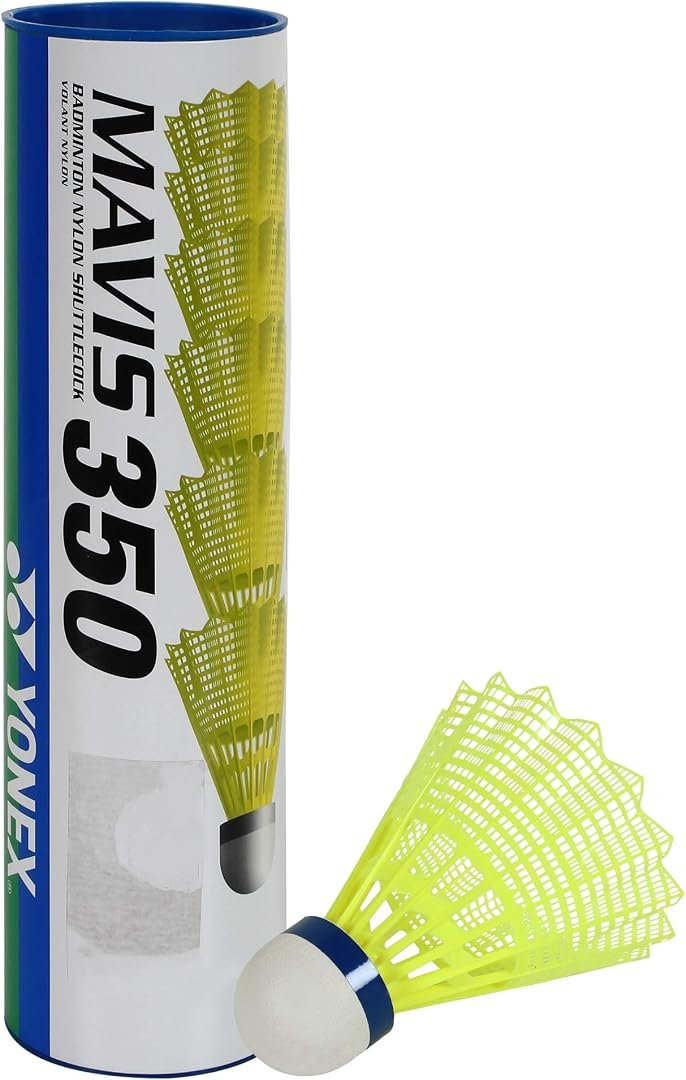
Yonex Mavis 350
The world’s club standard — natural cork, colour-coded speeds, and a price that lets you buy in bulk.
If you have played club badminton anywhere in the last two decades, you have played with a Mavis 350. Yonex’s own product page keeps the formula simple: a nylon skirt on a natural cork base, in white or yellow, with the speed told by the cap band — green for Slow, blue for Medium, red for Fast — matched to hall temperatures from 22–33 °C down to 0–13 °C. It also carries the Wing Rib skirt design, with Yonex citing a recovery time measured in hundredths of a second after a smash.
The Mavis 350 is not the connoisseur’s shuttle; it is the workhorse that school programmes, leisure centres and social clubs buy by the box because it flies predictably, survives beginners’ mishits, and costs little enough that nobody rations it. For most recreational groups it is simply the correct answer, and the cap-band system makes it the easiest shuttle in the world to buy at the right speed. Pair it with sensible string choices and a group can equip itself for a season without drama.
What we like
- The proven club standard — predictable flight, session after session
- Cap-band colour system makes buying the right speed foolproof
- Natural cork base at a nylon-shuttle price point
- White or yellow for different hall backgrounds
Worth knowing
- Flight is good nylon, not feather — competitive groups will outgrow it
- Six per tube: bulk buyers should compare per-shuttle cost
As an Amazon Associate we earn from qualifying purchases.
Side-by-Side Comparison Table
| Model | Type | Flight Material | Base / Cork | Pack | Best For |
|---|---|---|---|---|---|
| Yonex Aerosensa 50 | Feather | Premium goose feather | 100% solid cork | 12 | Tournaments |
| Yonex Aerosensa 30 | Feather | Goose feather | 100% solid natural cork | 12 | Club matches & league |
| RSL Classic Tourney | Feather | Premium goose feather | Cork base | 12 | BWF-approved alternative |
| Babolat Hybrid Challenge | Hybrid | Real feathers | Cork head + nylon base | — | Feather-feel training |
| Victor NCS Pro | Synthetic | LDPE foam vanes, carbon stems | Hybrid composite cork | 6 | Modern synthetic play |
| Yonex Mavis 2000 | Nylon | Wing Rib nylon skirt | Cork (varies by market) | 6 | Serious training |
| Yonex Mavis 350 | Nylon | Wing Rib nylon skirt | Natural cork | 6 | Clubs, schools, social play |
Buying Guide: Corks, Cost per Session and Care
Cork: the small part that changes the hit
The base is where your racket actually meets the shuttle, and its construction sets the feel. Solid natural cork (the Aerosensa 50 and 30) is the premium standard: dense, consistent, crisp off the strings. Composite cork — cork material bonded with synthetic layers — trades a little of that feel for consistency of manufacture and cost, and appears across synthetic and value lines. PU/synthetic cork sits at the training end. None of this makes a shuttle “wrong”; it tells you where its maker spent the money. Match players should weight solid cork heavily; training groups should weight the skirt, because that is what survives the session.
Think in cost per session, not cost per tube
A tube of feathers costs more than a tube of nylon and contains twice as many shuttles — and neither number tells you the real cost, which is how many sessions a shuttle survives in your group’s hands. Feather costs concentrate at hard-hitting, high-level play; nylon and synthetic costs spread thin across months of training. The standard club solution is a mixed armoury: feathers (AS-30 class) for matches and league nights, nylon or hybrid (Mavis, Hybrid Challenge, NCS Pro) for drills and social volume. Your per-session spend drops, and match night still feels like match night.
Care: make feathers last longer
Feathers are keratin — they dry out, and dry feathers snap. Players have humidified feather shuttles before play for generations (a few seconds of steam or a humidifier cap on the tube the night before) to keep the vanes supple; store tubes away from heat and direct sun, cap down, and never leave them in a hot car. Nylon needs less ceremony: keep tubes out of heat, and retire a shuttle when the skirt stays visibly deformed after a rally — that is its flight telling you it is done.
Frequently Asked Questions
Which shuttlecock speed should I buy — 75, 76, 77 or 78?
Match the grade to your hall’s temperature. Manufacturer guidance puts speed 76 in hot halls (above about 27 °C), 77 in warm halls (18–27 °C), 78 in cool halls (8–17 °C) and 79 in cold halls; 75 is for extreme heat or altitude. Yonex nylon uses cap colours instead: green Slow (22–33 °C), blue Medium (12–23 °C), red Fast (0–13 °C). If in doubt, buy one tube of 77 — the most common indoor grade — and adjust from how your clears land.
Feather or nylon — which is better for club play?
They solve different problems. Feathers fly the way competition badminton is meant to feel — deceleration, spin and sound — but wear out quickly under hard hitting. Nylon survives training volume at a fraction of the per-session cost, with a slightly different flight. Most clubs run both: feathers for matches, nylon for drills and social nights. Hybrids like the Babolat Hybrid Challenge and Victor NCS Pro sit between the two.
How long does a feather shuttlecock last?
There is no honest single number: it depends on hitting power, shot quality and how the feathers are cared for. A snapped or bent feather ends a shuttle’s match life immediately, and hard-hitting games consume feathers far faster than controlled rallies. Humidifying feathers before play and storing tubes away from heat keeps them supple and extends their useful life; feather shuttles are best budgeted as a consumable, not equipment.
Can nylon or synthetic shuttles be used in tournaments?
It depends on the event. Traditional competition is played with feather shuttles, and many leagues specify them. But the synthetic era is arriving: Victor’s NCS Pro was an official shuttlecock at the 2025 Asia Junior Championships, and the BWF Laws allow synthetic shuttles built to the same dimensions and weight (with up to 10% variation). Always check your specific competition’s shuttle rules.
What does the cork type change?
The cork is what your strings strike. Solid natural cork (as in the Yonex Aerosensa 50 and 30) gives the crispest, most consistent impact feel and is the tournament standard. Composite and synthetic corks reduce cost and can improve manufacturing consistency, with slightly different feel. For training shuttles the skirt matters more than the cork; for match feathers, solid cork is worth having.
What is a hybrid shuttlecock?
A hybrid combines natural and synthetic construction. Babolat’s Hybrid Challenge sets real feathers into a synthetic nylon base with a cork head; Victor’s NCS Pro replaces the feathers themselves with LDPE foam vanes on carbon fibre stems over a composite cork. The aim is the same: flight closer to feather than a moulded nylon cone, with durability and consistency closer to a synthetic.
White or yellow nylon shuttles — does the colour matter?
Only for visibility. Yellow shows up better against pale walls, ceilings and bright backgrounds, which is why many halls and leisure centres standardise on it; white is the traditional look and reads well in darker halls. The flight is identical — choose for your hall’s background, and pick one colour for the group so eyes adjust once.
The Verdict
Buy for the session, not the slogan. Matches deserve feathers: the Aerosensa 50 when the occasion is serious, the Aerosensa 30 as the club standard, the RSL Classic Tourney when you want the approved alternative. Training deserves mileage: Mavis 350 for value, Mavis 2000 for the best classic nylon flight, and the Victor NCS Pro or Babolat Hybrid Challenge if you want to close the gap between the two worlds. Whichever tubes you choose, get the speed right for your hall — 77 for most warm indoor courts — and the shuttle will stop being the thing your group argues about, and go back to being the thing you play with.
Affiliate disclosure: AliShuttler is reader-supported. When you buy through links on this page we may earn an Amazon commission at no extra cost to you. Specifications are taken from manufacturers’ published product information; BWF shuttle dimensions are from the Laws of Badminton (Law 2). Durability figures, where quoted, are the manufacturers’ own published ratings and are labelled as such — shuttle life in play depends on level, hitting power and care.