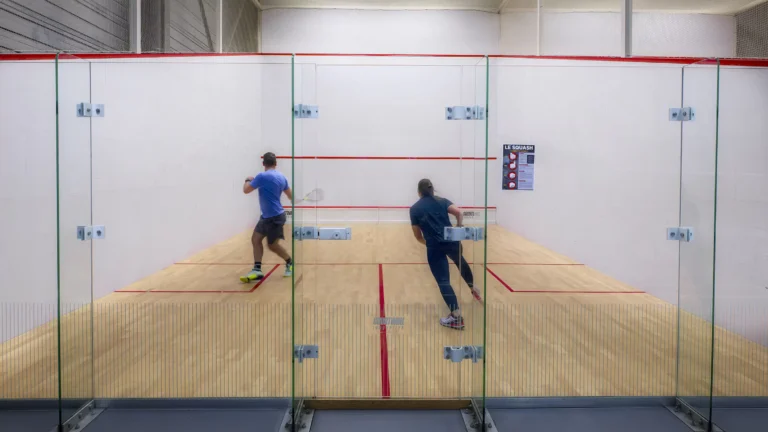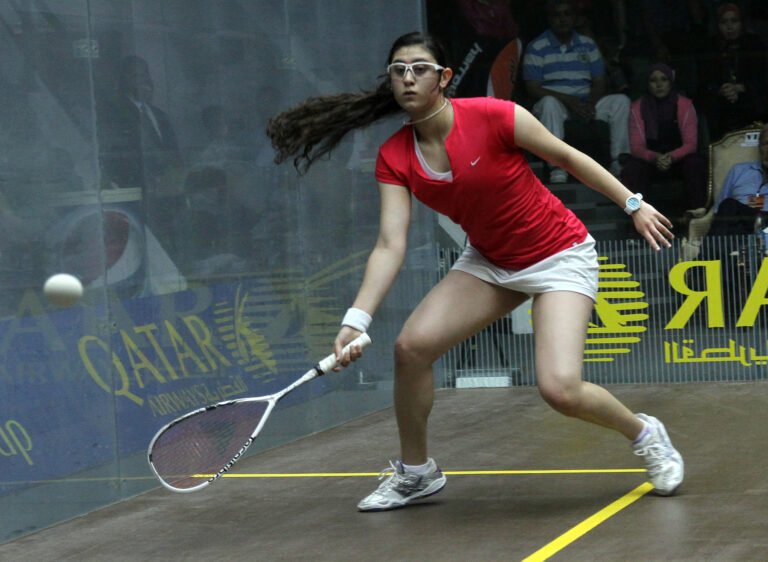

At advanced level, a shoe stops being footwear and becomes part of your movement system — what decides the step up is construction you can verify on paper: full-length plates, named stability systems, flagship foams and the few honest weights the makers actually publish. These are the seven shoes that clear that bar.
⚡ The Short Version
Buy the Mizuno Wave Claw Neo 2 if you want the most complete advanced package — a bootie upper on Mizuno’s Wave plate with an Enerzy forefoot and a diagonal groove cut for the pivot at the T. Buy the ASICS Gel-Fastball 3 if your game is built on speed; it is the tour-proven, low-to-the-floor option, provided you can still find a pair. Buy the Yonex Power Cushion 65 Z3 in its standard width if cushioning is the priority, and the Mizuno Wave Stealth Neo 2 if you want the most support and the most underfoot material in the set. The full reasoning, the honest weight picture and the specs sit in the cards below — and if you are still weighing the basics, start with our main guide to the best squash shoes before spending at this tier.
Quick PicksThe Seven, on One Screen
Short on time? Match your game to a shoe. Every pick below is argued in full further down, and our wider squash shoe pillar guide covers the tier beneath this one.
Bootie lockdown, Wave plate, Enerzy forefoot — the complete advanced build.
Read the card ↓The tour-worn, low-profile option for players who live on the volley.
Read the card ↓A full-length Wave plate and the deepest cushioning stack in this set.
Read the card ↓Power Cushion+ on a graphite sheet — the standard-width version.
Read the card ↓Boost in a chassis-built flagship — adidas’s indoor top tier, openly carded.
Read the card ↓The stripped-back Viper: air mesh, hexagon grip, Salming’s torsion system.
Read the card ↓Energy Lock upper over a truss unit — carded openly as a volleyball flagship.
Read the card ↓📑 In This Guide
The DecisionWhat “Advanced” Actually Buys You
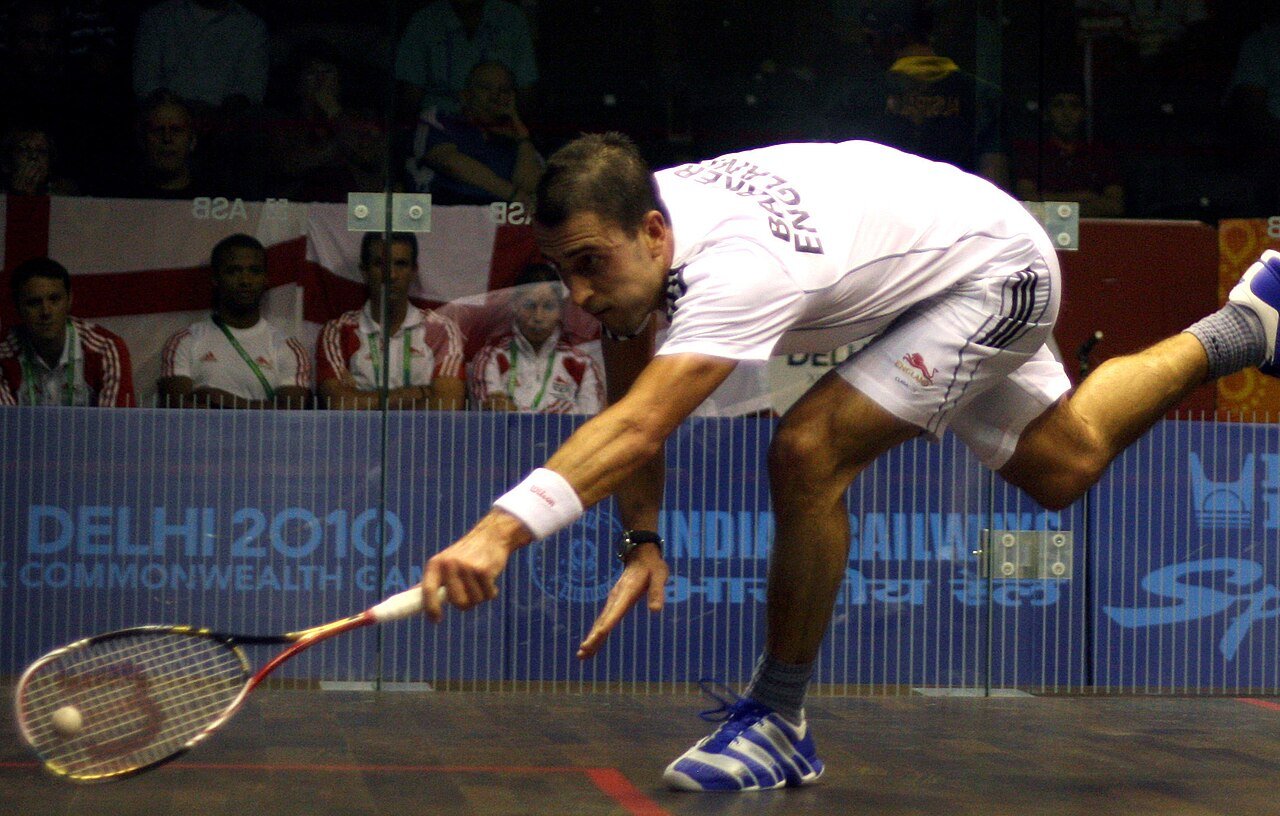
An advanced player’s week looks nothing like a beginner’s. The rallies are longer, the split-steps come in the hundreds rather than the dozens, the lunges are deeper and lower, and the shoe is asked to do all of it several sessions a week without the movement quality dropping in the fifth game. That workload is why the step up at this tier is not about colourways or cushioning adjectives — it is about construction: whether the shoe has a real stability structure under the midfoot, whether the cushioning is a named system with a published architecture behind it, and whether the upper is engineered to hold a foot that is being thrown around the court at full commitment.
That is also why this guide is judged the way it is. Every card below is built from the maker’s own published specification for that model — the plate, the foam, the outsole compound, the upper system — and where a maker publishes no weight, the card says so instead of borrowing a number from somewhere less accountable. You will find three kinds of advanced brief in the line-up. There is the speed brief: low, light, minimal between you and the floor, built for the player whose game is anticipation and first steps. There is the platform brief: a full stability structure and the deepest cushioning the maker offers, for the player whose game is built on volume, retrieval and long tournament days. And there is the lockdown brief: shoes whose headline act is an upper and chassis engineered so the foot cannot travel inside the shoe when the direction changes. Decide which brief is yours first — the buying guide at the end walks through it — and the shortlist narrows itself.
One honest framing note before the cards. The seven shoes here come from the flagship indoor lines of their brands — and at this tier, those lines are labelled badminton, handball and volleyball as often as squash, because the five squash shoe guides already live on this site have between them carded the squash-named models: the pillar’s seven, the women’s guide, the beginners’ guide and the seniors’ guide. What qualifies a flagship for this page is not the sport printed on its box; it is a gum-family indoor outsole, a published stability structure and a cushioning system with a name and an architecture. Each card states its model’s home line openly. If you would rather stay inside squash-labelled models only, our best squash shoes pillar is the guide to use — and if your movement is still being built rather than refined, work on how to play squash will do more for your results than any shoe on this page.
Reading the SpecsHow to Read an Advanced Shoe’s Spec Sheet
Start with the structure, not the foam. The single biggest difference between an intermediate shoe and an advanced one is what sits under the midfoot. At this tier you should be able to point at a named structure and a job it does: Mizuno’s Wave plate, which spreads load along the length of the shoe; ASICS’s Trusstic and RISETRUSS units, which stiffen the midfoot transition; Yonex’s Power Graphite Sheet; adidas’s chassis tooling. A shoe whose stability story is a paragraph of adjectives rather than a component is a shoe from the tier below wearing a flagship’s price — and it will not be found in this guide.
Then read the cushioning as a system. Advanced shoes stack named components — a foam, an insert, sometimes a plate above both — and the maker’s page will tell you the architecture: Mizuno pairs Enerzy NXT with an Enerzy insole in the Stealth Neo 2; Yonex layers Power Cushion+ over a Feather Bounce Foam in the 65 Z3; adidas drops a Boost insert into the Stabil 16. What that layering buys is not softness for its own sake. It is the same landing behaviour in the fifth game as the first, across the hundreds of split-step landings an advanced session contains — judged here on the published architecture, because that is the part of the claim you can verify before you buy.
Check the outsole compound before the tread photo. Squash is played on sprung timber, and the shoes that belong on it run gum-family rubber: Mizuno’s XG Rubber, ASICS’s NC Rubber, Yonex’s rubber sole with its Radial Blade pattern, Salming’s hexagon grip. Where a maker does not name its compound at all — the Sky Elite FF 3’s ASICS listing is the honest example in this set — the card says so, and that gap is a legitimate reason to rank a shoe lower for squash specifically. Tread photography flatters every shoe; a named compound is a commitment.
Treat every weight as guilty until labelled. This tier is where published weights quietly disappear: of the seven shoes below, only Mizuno prints a figure for its flagship — and even that figure arrives without a stated size or a single-shoe basis, so this guide prints it exactly as published and compares nothing against it. Everything else here is either a retailer figure with its source named in the card, or an honest “Not published.” A comparison site that shows you seven precise weights for these seven shoes has sourced at least five of them from somewhere it is not telling you. Hold this page to the same standard: every number below carries its source with it.
Finally, read the fit system as a spec, because it is one. At advanced intensity the upper is a performance component: bootie constructions (Mizuno’s Next Bootie Structure and DynamotionFit), ASICS’s Energy Lock mesh, Salming’s moulded TPU heel counter, Yonex’s seamless synthetic leather. They trade against each other — booties lock the midfoot but fit fewer foot shapes; traditional lacing adjusts more and holds less absolutely — and the right answer depends on your foot, which is why every card below states its fit system in its chips rather than leaving it to the photography.
Mizuno Wave Claw Neo 2
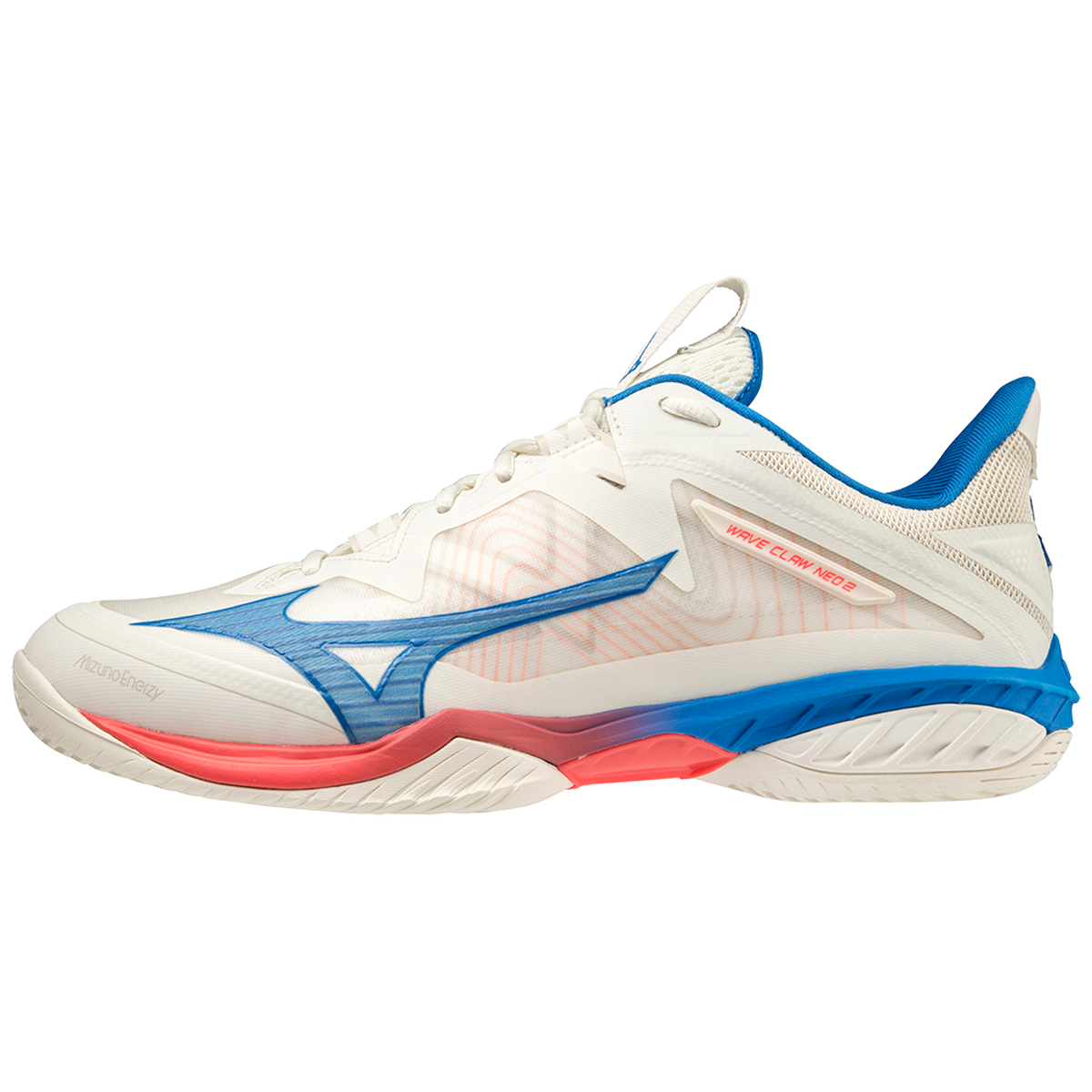
- Outsole: XG Rubber
- Stability: Mizuno Wave plate with D-Flex Groove
- Cushioning: Mizuno Enerzy forefoot foam
- Weight: 570 g as printed by Mizuno Europe — no size or single/pair basis stated
The Wave Claw Neo 2 is the most complete advanced package in this guide because every layer of it is a named, published component doing a specific job. The foundation is Mizuno’s Wave plate, the company’s long-running stability structure, paired in the forefoot with Mizuno Enerzy foam. Between them sits the detail that earns this shoe its ranking for squash specifically: the D-Flex Groove, a diagonal groove cut across the midfoot that Mizuno designs to allow smooth twisting movement. Squash is a game of pivoting out of the lunge and re-setting at the T hundreds of times a session, and a midfoot that is engineered to twist in a controlled way — rather than simply resisting twist — is the closest thing a spec sheet offers to a squash-specific movement feature. The outsole is XG Rubber, Mizuno’s high-grip indoor compound, which puts it squarely in the gum family a sprung timber court asks for.
The upper is the other half of the argument. Mizuno builds the Neo 2 around its Next Bootie Structure — a one-piece, sock-style construction that wraps the midfoot without seams crossing the flex zones — and pairs it with updated shoelace parts and a monofilament mesh upper with synthetic overlays. For an advanced player, that combination is the lockdown brief executed properly: the foot is held by the structure of the shoe rather than by lacing tension alone, and the mesh keeps the build breathable through long sessions. Mizuno’s own positioning for the model is unambiguous — its European product page presents it “for all advanced badminton players” and recommends it for the badminton court, and this guide cards it openly on that basis: it is a badminton flagship whose outsole compound, plate and bootie happen to answer a squash player’s questions unusually completely. It shares nothing but a surname with the seniors guide’s Wave Claw 3 or the intermediate guide’s Wave Claw EL 2 — different generation, different construction, different tier.
The one blemish is the weight, and it is a documentation blemish rather than a shoe blemish. Mizuno Europe’s page prints “Weight: 570 g” for this model with no size stated and no indication of whether the figure covers one shoe or the pair — and no other Mizuno source publishes a per-shoe figure to settle it. This guide prints the number exactly as published, in the chips above and the comparison table, and draws no comparison from it: set against shoes whose makers publish nothing, a basis-less figure cannot honestly win or lose a weight argument. Judge the Neo 2 on its construction — which is published in full — and on the bootie fit, which either suits your foot shape or does not. If it does, this is the shoe the rest of the page is measured against.
✓ Strengths
- Wave plate plus Enerzy forefoot: a fully published stability-and-cushioning architecture
- D-Flex Groove is designed for controlled twisting — the pivot movement squash repeats most
- Next Bootie Structure locks the midfoot without seam pressure
- XG Rubber is a named high-grip indoor compound, stated by the maker
✗ Trade-offs
- Mizuno’s printed 570 g arrives with no size or single/pair basis — unusable for comparison
- Bootie construction fits fewer foot shapes than a traditionally laced upper
- Carded openly as a badminton flagship, not a squash-named model
Affiliate link — we may earn a commission at no extra cost to you.
ASICS Gel-Fastball 3
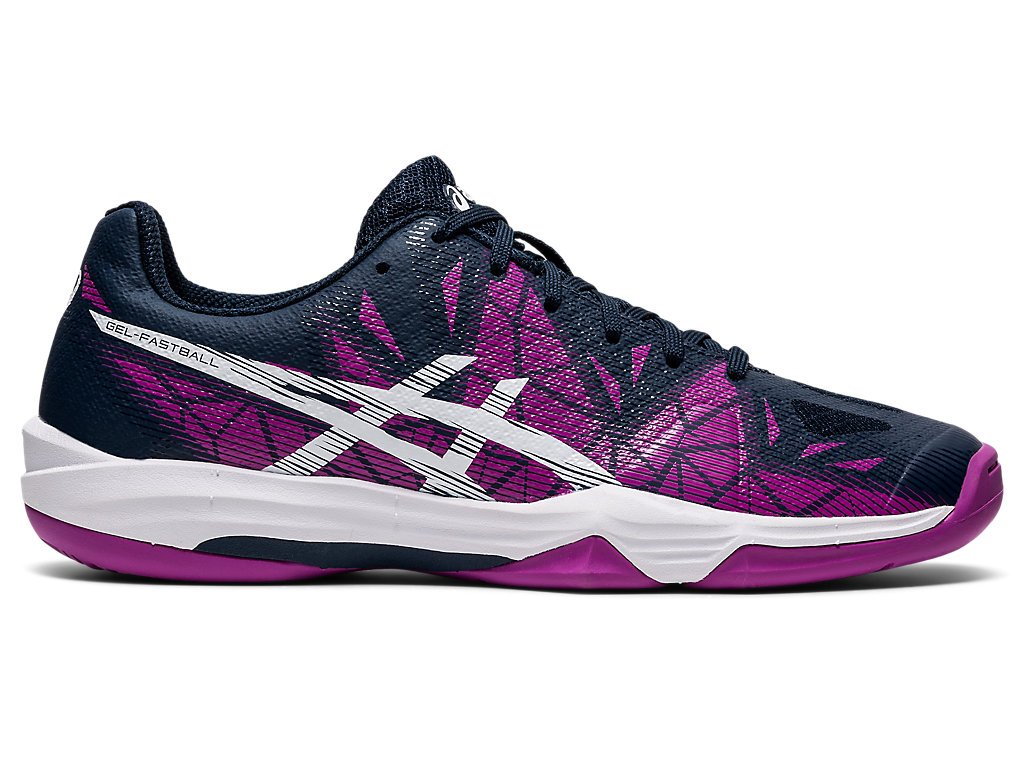
- Outsole: NC Rubber with Wet Grip Rubber
- Stability: Guidance Trusstic System
- Cushioning: Rearfoot & forefoot GEL with SpEVA midsole
- Weight: Not published by ASICS
Every generation of squash players has a shoe the quick ones wear, and for years that shoe has been the Gel-Fastball. Specialist squash retailer Squash Gear Reviews reports the Fastball 3 on the feet of tour players including Mohamed and Marwan ElShorbagy, Camille Serme and Joelle King — and while endorsement is not a specification, in this case it points at exactly the quality the spec sheet confirms: this is a shoe built low, light and minimal for players whose game is won on the first step and the volley. ASICS’s own published figure for the shoe puts the heel drop at 10 mm, the lowest in this guide, and the construction under that low ride is a proper advanced stack rather than a stripped one: rearfoot and forefoot GEL units, a SpEVA midsole, Solyte lasting and the Guidance Trusstic System carrying the midfoot.
The outsole pairing is the other half of the speed brief. The NC Rubber compound — ASICS’s higher-natural-rubber court compound — is combined with its Wet Grip Rubber, and the sole carries ASICS’s Magic Sole venting. On a clean timber court that adds up to a shoe that grips without grabbing: it releases when you pivot instead of holding you a half-beat too long, which is precisely the behaviour a front-court player is buying. The upper continues the theme — an open mesh construction with an asymmetric lacing system that follows the shape of the foot, RhynoSkin abrasion material where the shoe drags, and ASICS’s P.H.F. heel fit system. Nothing in the build is decorative; every named component is there to keep the shoe light on the foot and low to the floor while still behaving like a flagship when the rally gets physical.
Two honest limits belong in the open. First, ASICS publishes no weight for the Fastball 3. The specialist reviewer who weighed a pair put them at roughly 300 grams — a review measurement, printed here only to show the class this shoe sits in, never as a specification. Second, availability: the Fastball 3 is an older flagship, and remaining stock is exactly that — remaining. The reviewer’s sizing notes also flag a roomier fit than ASICS’s other court shoes, with a half size down suiting some players. None of that changes what the shoe is: the purest expression of the speed brief in this guide, and the card to measure every “lightweight” claim against. If your game is built on cushioning volume and support structures instead, this is not your shoe — the two Mizuno cards are. If it is built on being first to the ball, it is.
✓ Strengths
- 10 mm heel drop — ASICS’s published figure, the lowest in this guide — for a true low-to-the-floor ride
- NC Rubber with Wet Grip Rubber grips, then releases cleanly on the pivot
- Full advanced stack despite the minimal brief: GEL front and rear, SpEVA, Trusstic
- Tour-proven at the highest level, as reported by specialist squash media
✗ Trade-offs
- ASICS publishes no weight — the ~300 g figure in circulation is a reviewer’s measurement
- An older flagship: remaining sizes get harder to find
- Reviewer-reported roomy fit may mean sizing down for some players
- The least cushioned ride here — heavy heel-strikers should look at the platform cards
Affiliate link — we may earn a commission at no extra cost to you.
Mizuno Wave Stealth Neo 2
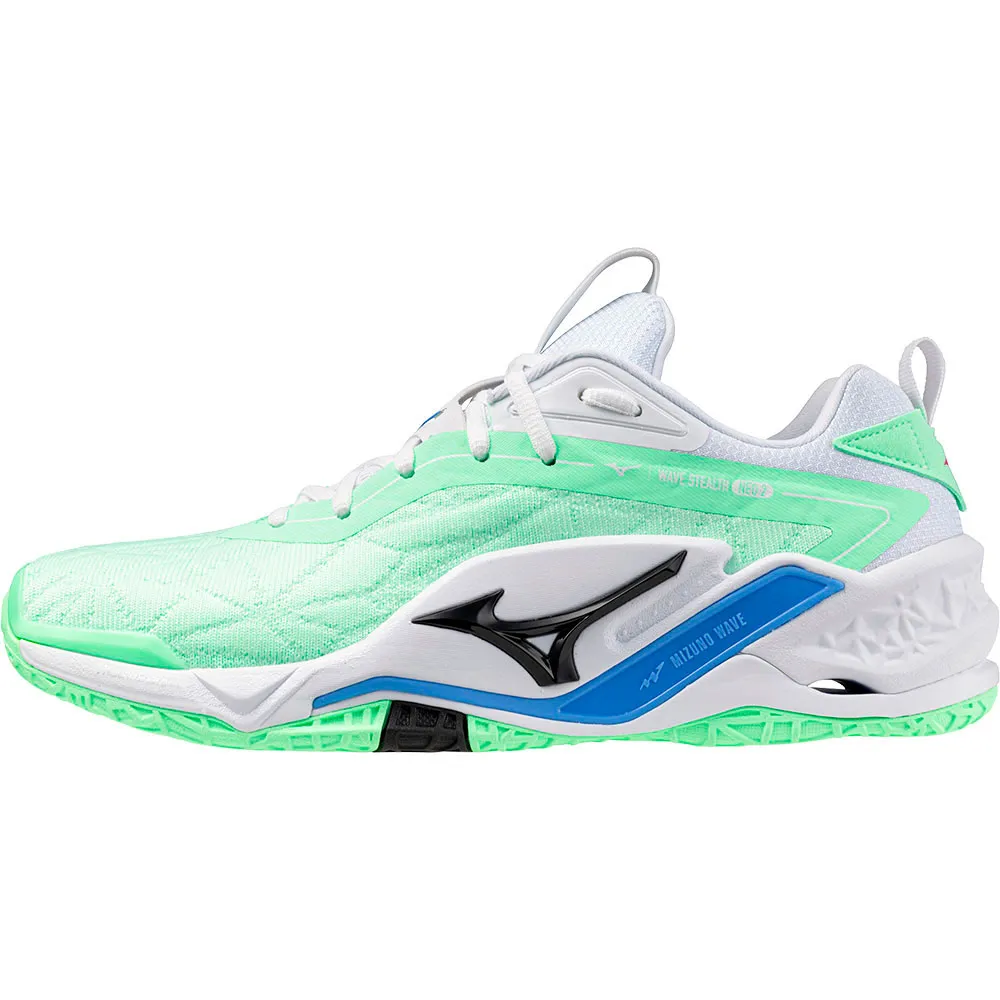
- Outsole: XG Rubber
- Stability: Full-length Mizuno Wave plate
- Cushioning: Mizuno Enerzy NXT with Mizuno Enerzy insole
- Weight: Not published by Mizuno
If the Claw Neo 2 is Mizuno’s precision instrument, the Wave Stealth Neo 2 is its heavy armour — and for the advanced player whose game is built on volume, it may be the more honest recommendation. The headline is the full-length Mizuno Wave plate: where most shoes run a midfoot shank, the Stealth Neo 2 carries its stability structure the entire length of the shoe, and layers its cushioning on top of it in two published components — Mizuno Enerzy NXT foam in the midsole and a Mizuno Enerzy insole underfoot. That is the deepest, most structured underfoot build in this guide, arrived at not by adding generic padding but by stacking the maker’s two named energy foams over a full-length plate. For the player logging long sessions and tournament days, this is the platform brief at its most complete.
The rest of the build reads like a checklist written by someone who watches how court shoes actually fail. Dura Shield protection guards the toe area — the zone every squash player drags through the lunge. The upper is a DynamotionFit bootie in a smooth knit, holding the midfoot the way the Claw’s bootie does but in a softer, more accommodating material. Underneath construction layers include Mizuno’s PoWnCe midsole material and a U4icX strobel board, and the outsole is the same XG Rubber as the Claw Neo 2 — the named, high-grip indoor compound this guide asks for. Retailer tradeinn lists squash among this model’s primary sports alongside handball, volleyball and netball, and Mizuno’s own line positions it as a flagship indoor shoe; it is carded here, openly, as Mizuno’s handball-line flagship rather than a squash-named model.
The trade-offs are the honest price of the platform. A full-length plate and a double Enerzy stack put more material between you and the court than anything else in this set, and players who buy shoes for floor feel — the Fastball 3’s constituency — will find this ride the least connected here. Mizuno also publishes no weight for the Neo 2: a figure circulates for its successor, the 2.1, but it belongs to a different model and this guide does not borrow it. What you can verify is the architecture, and the architecture is the argument: if your advanced game asks a shoe for maximum structure and maximum cushioning at once, no other card in this guide publishes a build that matches it.
✓ Strengths
- Full-length Wave plate — the most complete stability structure published in this set
- Enerzy NXT midsole plus Enerzy insole: two named cushioning layers, both stated by Mizuno
- Dura Shield toe protection answers the lunge-drag zone directly
- XG Rubber outsole, and squash is named among the model’s sports by its retailers
✗ Trade-offs
- The highest, most cushioned ride here — the least floor feel in the guide
- Mizuno publishes no weight for the Neo 2; figures quoted elsewhere belong to the 2.1
- Knit bootie fit will not suit every foot shape, and cannot be adjusted like lacing
Affiliate link — we may earn a commission at no extra cost to you.
Yonex Power Cushion 65 Z3
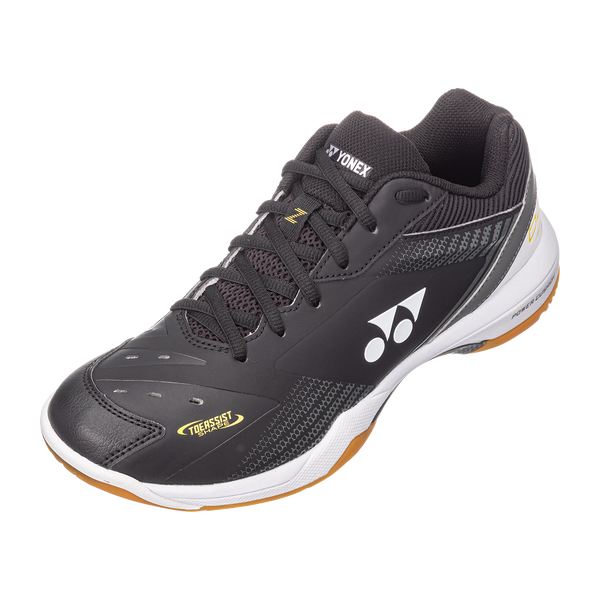
- Outsole: Rubber sole with Radial Blade pattern
- Stability: Power Graphite Sheet
- Cushioning: Power Cushion+ & Power Cushion with Feather Bounce Foam
- Weight: Not published by Yonex
One clarification before anything else, because this site has been here before: our seniors guide cards the Power Cushion 65 Z3 Wide — the broad 4E variant. The shoe in this card is the standard-width 65 Z3 (Yonex item SHB65Z3M), the regular last the model is built around, carded here for the advanced player whose feet are not wide and whose priority is the most developed cushioning platform Yonex publishes. Same model family, different last, different reader — and the distinction matters, because a wide shoe on a standard foot is its own kind of instability.
The platform itself is a three-part published system. The midsole runs Yonex’s Power Cushion+ alongside its standard Power Cushion material; a Feather Bounce Foam layer adds the responsive element — Yonex’s own comparison for that foam, against the previous model’s, is 8% lighter with 20% more repulsion, printed here as the maker’s attributed claim about its own material and nothing more. Under the midfoot sits the Power Graphite Sheet, Yonex’s lightweight stability plate, doing the torsional work this guide demands of every card. The outsole is a rubber sole carrying Yonex’s Radial Blade pattern — angled blade elements arranged to grip across the directions a court player actually moves — and the upper is a seamless synthetic leather construction with Double Raschel Mesh panels, the most structured, least stretch-prone upper in this set.
That upper is the card’s honest trade-off, in both directions. Synthetic leather holds its shape and supports the foot through a long session in a way pure mesh cannot — and it breathes less while doing it, which players in warm halls will notice by the fourth game. The second limit is documentary: Yonex publishes no weight for the 65 Z3, and the third-party figures in circulation disagree with each other by enough — roughly 310 to 360 grams depending on the source — that printing any of them as a specification would be inventing precision. What is verifiable is the system: if your advanced game is built on repeated maximal landings — the deep lunge held at full stretch, the fifth game of a tournament day — this is the cushioning platform with the most published engineering behind it, in the standard width this tier of player usually needs.
✓ Strengths
- Power Cushion+ layered with Feather Bounce Foam — Yonex’s most developed published cushioning stack
- Power Graphite Sheet gives the platform a real midfoot structure, not just foam
- Radial Blade rubber sole is patterned for multi-directional court movement
- Standard-width last — the correct 65 Z3 for non-wide feet (the Wide sits in our seniors guide)
✗ Trade-offs
- Yonex publishes no weight, and third-party figures disagree too widely to print
- Seamless synthetic leather upper breathes less than the mesh flagships here
- Wide feet should not force this last — the 65 Z3 Wide exists for a reason
Affiliate link — we may earn a commission at no extra cost to you.
adidas Stabil 16
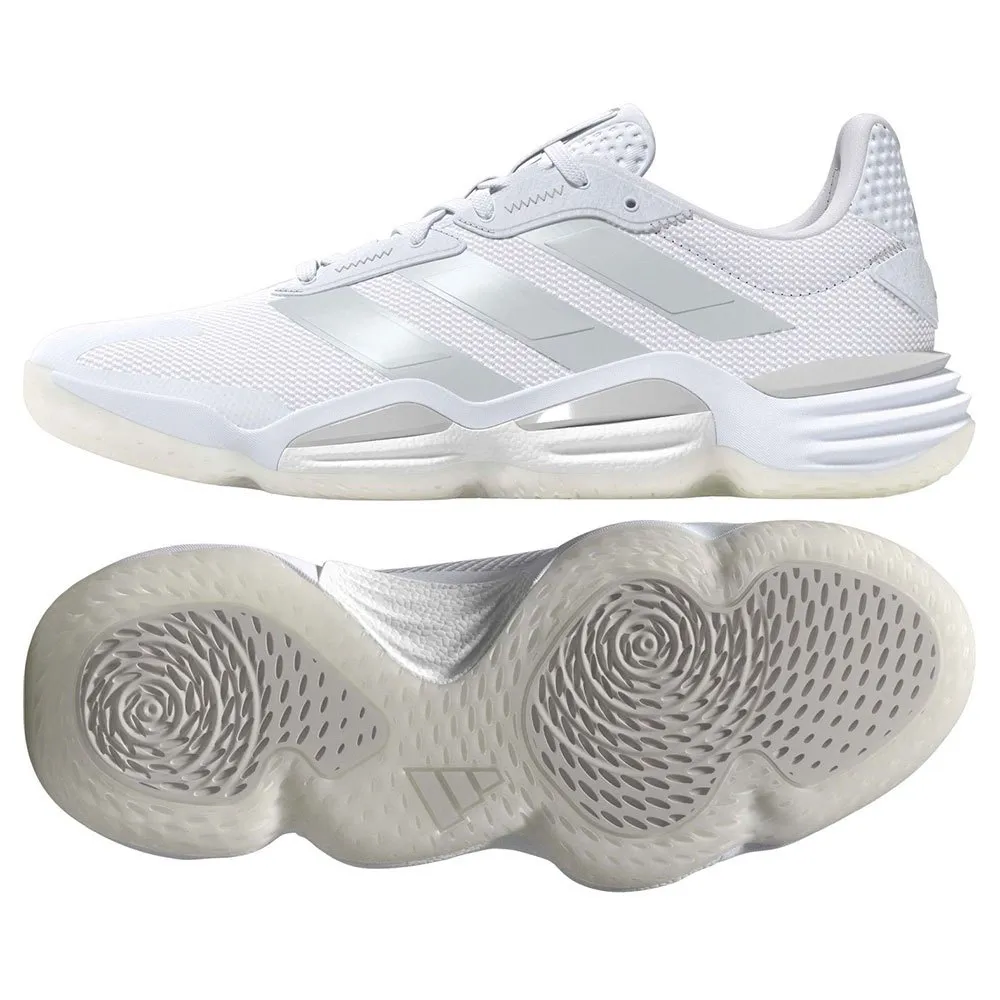
- Outsole: Rubber outsole — 360-degree grip pattern, as retailer copy states
- Stability: Chassis tooling construction
- Cushioning: adidas Boost midsole insert
- Weight: Not published by adidas
The Stabil is adidas’s indoor flagship line, and the Stabil 16 — released in 2024 — is its current top tier. Two naming points deserve daylight. First, this is a different model from the Stabil Next Gen carded in our best squash shoes pillar: a newer generation built on a different construction. Second, it is carded here entirely openly as adidas’s handball-line flagship — and the reason it earns a squash card anyway is that specialist squash media reached the same conclusion independently: Squash Gear Reviews reviewed the Stabil 16 as a squash shoe on its 2024 release. What qualifies it on paper is the construction: a chassis tooling build, in which the shoe is engineered around a structural frame rather than a conventional lasted upper, with a Boost midsole insert — adidas’s best-known energy foam — set into that frame.
Around the chassis, adidas’s published details are the ones a squash player would order: a mesh upper with a tongue harness fit system that ties the midfoot into the lacing, a reinforced toe for the drag zone, and a rubber outsole that adidas’s retailer copy describes as carrying a 360-degree grip pattern and a non-marking compound — the property that matters on timber, stated at retailer level and labelled as such here. The fit is a regular last, the most conventional in this guide, and adidas’s copy also lists at least 20% recycled content in the build. The combined effect the spec sheet describes is the lockdown brief delivered by structure rather than by bootie: a frame that holds the foot’s position, a harness that keeps the midfoot in the frame, and a foam insert doing the landing work inside it.
The documentary gap is the weight. adidas publishes no weight for the Stabil 16; one retailer’s specification table lists 384.7 grams with no size basis stated, and this guide prints that figure exactly once, labelled as exactly what it is — a retailer table entry, not an adidas specification — because a chassis shoe’s real weight question can only be settled on a scale, not borrowed from a table. The playing trade-off is feel: a framed construction is the opposite philosophy from the Fastball 3’s minimalism, and players who want the floor close and the shoe invisible should rank this card lower than players who want to feel the shoe working when they plant and drive. For the second group, this is the most structurally serious adidas indoor shoe of its generation.
✓ Strengths
- Chassis tooling construction — stability delivered by a frame, the most structural build here
- Boost midsole insert brings adidas’s flagship foam into an indoor shoe
- Tongue harness fit system ties the midfoot directly into the lacing
- Reinforced toe and a regular, conventional last that fits predictably
✗ Trade-offs
- adidas publishes no weight; the one retailer figure (384.7 g) states no size basis
- A framed build is the least minimal feel in the guide — the anti-Fastball
- Carded openly as adidas’s handball flagship, not a squash-named model
Affiliate link — we may earn a commission at no extra cost to you.
Salming Viper SL
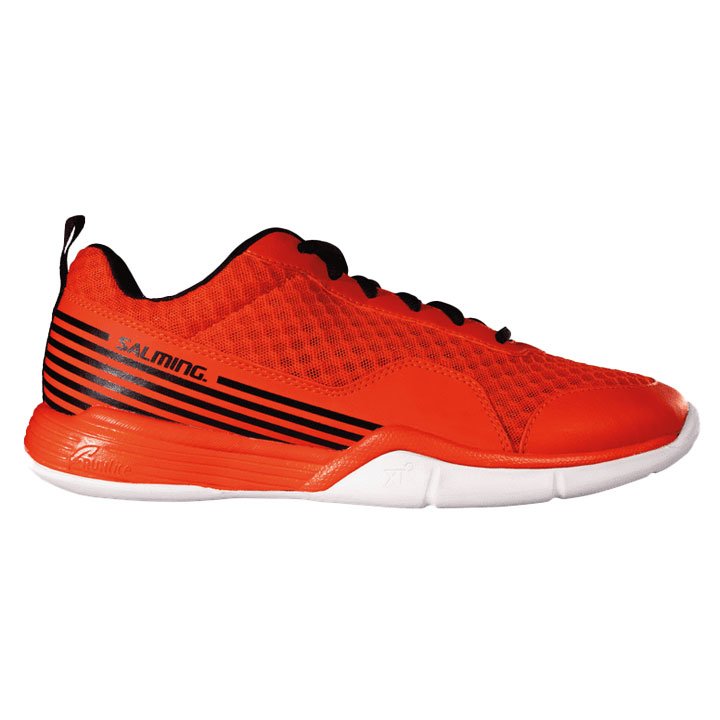
- Outsole: Hexagon grip pattern
- Stability: LMS Torsion unit with LMS 11° flare
- Cushioning: RunLite2 midsole
- Weight: 10.6 oz men’s — Racquetworld retailer figure, no size basis stated
Salming’s Viper line is the Swedish brand’s speed family, and the letters on this one are the brief: the Viper SL is, in Salming’s own description as syndicated by its retailers, a lighter, more flexible and more breathable version of the Viper — a model line this site has now carded three ways without ever repeating a shoe, the pillar taking the Viper 5 and the intermediate guide the Viper Pro. The SL earns its advanced card because stripping a shoe back is an engineering decision, not an absence of one: what Salming removed was weight and stiffness, and what it kept is the entire stability system. The LMS Torsion unit still works the midfoot, the LMS 11° flare still shapes the lateral side for the roll-through of a lunge recovery, the RollBar is still in the outsole’s edge geometry, and the TGS 62/75 system still divides the sole into its flex and stability zones in Salming’s published proportions.
What changed is everything above and below that skeleton. The upper is an air mesh construction with a new tongue design — the most breathable build in this guide, and the one that makes the SL the warm-hall, summer-league card. A moulded TPU heel counter and traditional lacing keep the fit adjustable in a way the bootie shoes here cannot match, the insole is a removable EVA unit, and the outsole runs Salming’s hexagon grip pattern over a RunLite2 midsole — the lighter of Salming’s midsole foams, chosen for response over volume. The whole shoe is an argument that at advanced level, “lightweight” should mean a complete stability system carrying less mass, not a lesser shoe.
The honesty notes are two. Salming publishes no weight for the Viper SL; retailer Racquetworld lists the men’s shoe at 10.6 oz with no size basis stated on the listing, and that is how the figure is printed here — a labelled retailer number, useful for class, useless for false precision. And the air-mesh upper that makes the SL the breathable pick is also the least armoured upper in the set: there is no Dura Shield-style toe guard and no synthetic leather shell, so a player who drags a toe through every lunge is asking the softest upper here to do the hardest job in squash footwear. For the fast, clean-moving player in a hot hall, that trade is the entire point of the shoe. For the dragger, it is a reason to take the Mizuno cards instead.
✓ Strengths
- The full Salming stability system — LMS Torsion, LMS 11°, RollBar, TGS 62/75 — survives the weight cut
- Air mesh upper is the most breathable build in this guide
- Traditional lacing plus a moulded TPU heel counter: adjustable fit, held heel
- Hexagon grip pattern and RunLite2 midsole keep the response quick and low
✗ Trade-offs
- Salming publishes no weight — the 10.6 oz figure is a retailer listing with no stated basis
- Air mesh is the least armoured upper here for habitual toe-draggers
- RunLite2 is Salming’s lighter foam — less landing volume than the platform cards
Affiliate link — we may earn a commission at no extra cost to you.
ASICS Sky Elite FF 3
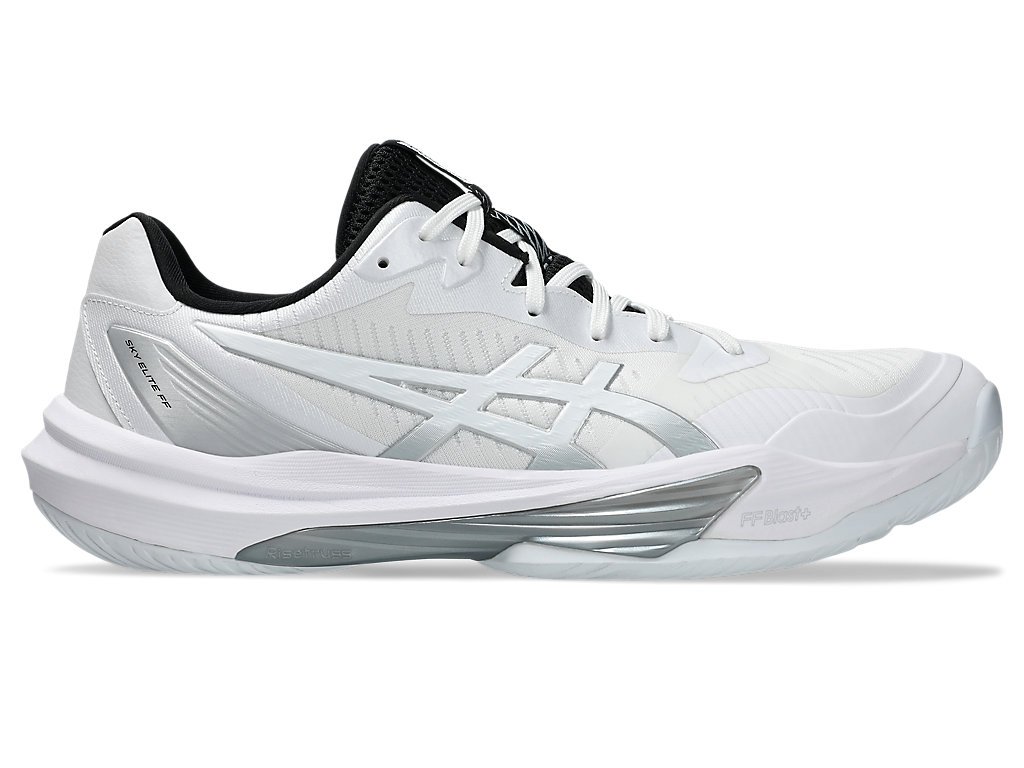
- Outsole: Indoor rubber — ASICS’s listing names no compound
- Stability: RISETRUSS technology unit
- Cushioning: FF BLAST PLUS foam
- Weight: Not published by ASICS
This is the most openly-framed card in the guide: the Sky Elite FF 3 is ASICS’s volleyball flagship, designed around the jump, and it is here because one component of it answers a squash problem better than almost anything else in this set — the upper. ASICS builds the shoe around its Energy Lock System, an upper construction designed to keep the foot locked in from take-off to landing, with a support structure intended to improve fit and force efficiency through the movement. Translate that from volleyball to squash and the job description barely changes: the split-step, the drive out of the lunge and the recovery all fail the same way when a foot travels inside its shoe, and an upper engineered as a lockdown system rather than a covering is the direct answer. Advanced players whose recurring complaint is heel slip or midfoot movement — rather than cushioning or grip — are this card’s reader.
Under the upper, the published build is a genuine flagship’s. The midsole is FF BLAST PLUS foam — ASICS states that around 24% of the foam’s content is bio-based material from renewable sources — and the midfoot carries the RISETRUSS unit, ASICS’s truss structure, which its copy describes as converting horizontal power into vertical on the jump; in squash terms, it is the named midfoot stability component this guide requires of every card, doing its work in the transition from landing to drive. A curved heel shape is designed to let the athlete cut in more smoothly. Set beside its stablemate in this guide, the contrast is instructive: the Fastball 3 is ASICS’s answer when the question is speed, the Sky Elite FF 3 when the question is containment — two flagships, two opposite briefs, both honestly labelled with the sports they were designed for.
The gaps in this card are documentation gaps, and they are printed rather than smoothed over. ASICS publishes no weight for the Sky Elite FF 3, and — the only card in this guide where this happens — its product listing names no outsole compound, so there is no maker-stated gum compound to set against Mizuno’s XG or ASICS’s own NC Rubber. On a clean club timber court the shoe’s indoor rubber sole is in its element; on an unfamiliar or dusty surface, it is the card here with the least published evidence to lean on. Its geometry is also the least squash-specific in the set, shaped around the jump rather than the lunge. Rank it seventh for squash as a whole — and first, by a distance, if lockdown is the single quality your game keeps asking for.
✓ Strengths
- Energy Lock System upper — the most deliberate lockdown construction in this guide
- RISETRUSS unit gives the midfoot a named, published stability structure
- FF BLAST PLUS is a current flagship foam, with ASICS-stated bio-based content
- Curved heel shape is designed for smooth cut-ins and direction changes
✗ Trade-offs
- ASICS publishes no weight for the model
- Its listing names no outsole compound — the least documented grip story here
- Carded openly as a volleyball flagship; its geometry is jump-first, not lunge-first
Affiliate link — we may earn a commission at no extra cost to you.
Side by SideAdvanced Squash Shoes Compared
Every figure below is stated the way its source states it. “Not published” is the honest entry wherever the maker prints no weight — this table does not fill gaps with other people’s numbers.
| Shoe | Weight | Outsole, As Maker States | Stability Tech | Cushioning | Fit, As Maker/Retailer Describes |
|---|---|---|---|---|---|
| Mizuno Wave Claw Neo 2 | 570 g as printed by Mizuno Europe (size / single-or-pair basis not stated) | XG Rubber | Mizuno Wave plate with D-Flex Groove | Mizuno Enerzy forefoot foam | Next Bootie Structure with updated lace parts; monofilament mesh upper |
| ASICS Gel-Fastball 3 | Not published | NC Rubber with Wet Grip Rubber | Guidance Trusstic System | Rearfoot & forefoot GEL with SpEVA midsole | Open mesh upper, asymmetric lacing, P.H.F. heel fit; reviewer notes a roomy fit |
| Mizuno Wave Stealth Neo 2 | Not published | XG Rubber | Full-length Mizuno Wave plate | Mizuno Enerzy NXT with Mizuno Enerzy insole | DynamotionFit bootie in smooth knit; Dura Shield toe protection |
| Yonex Power Cushion 65 Z3 | Not published | Rubber sole with Radial Blade pattern | Power Graphite Sheet | Power Cushion+ & Power Cushion with Feather Bounce Foam | Standard width (the Wide version sits in our seniors guide); seamless synthetic leather upper |
| adidas Stabil 16 | Not published (one retailer table lists 384.7 g, basis not stated) | Rubber outsole; 360-degree grip pattern per retailer copy | Chassis tooling construction | adidas Boost midsole insert | Regular fit; mesh upper with tongue harness fit system, reinforced toe |
| Salming Viper SL | 10.6 oz men’s (Racquetworld retailer figure, basis not stated) | Hexagon grip pattern | LMS Torsion unit with LMS 11° flare | RunLite2 midsole | Air mesh upper, traditional lacing, moulded TPU heel counter |
| ASICS Sky Elite FF 3 | Not published | Indoor rubber outsole (compound not named in ASICS’s listing) | RISETRUSS technology unit | FF BLAST PLUS foam | Energy Lock System upper; curved heel shape |
Read the weight column as this guide’s honesty policy in miniature. One maker-printed figure arrives without a basis, one retailer figure is labelled with its shop, one retailer table entry is marked as such — and four of the seven flagships publish nothing at all. That is the real state of advanced-tier documentation, and any source showing you seven tidy, comparable weights for these seven shoes has quietly sourced most of them from places it is not naming. What the table can compare cleanly is construction — and on construction the pattern is clear: the two Mizunos and the Yonex publish the deepest stability-and-cushioning architectures, the Fastball 3 publishes the most purposeful minimal one, and the Stabil 16 and Sky Elite FF 3 publish upper-and-chassis systems that no squash-named shoe in the tier below can match. Still comparing across tiers? The pillar guide to the best squash shoes puts the mainstream options through the same discipline.
Buying GuideChoosing at Advanced Level, in Five Moves
The cards above are the evidence; these five moves turn it into a decision — the same sequence whether you end up in a bootie, a chassis or a tour shoe. Newer players should start a tier down with our beginners’ squash shoe guide and this page will still be here when the movement volume arrives.
1. Name your brief before you name a shoe
Advanced players do not have a generic game, so they should not buy a generic flagship. If your squash is anticipation, volleys and first steps, you are shopping the speed brief — the Fastball 3, the Viper SL. If it is retrieval, long rallies and tournament volume, you are shopping the platform brief — the Stealth Neo 2, the 65 Z3, the Claw Neo 2. If your recurring failure is the foot moving inside the shoe, you are shopping the lockdown brief — the Sky Elite FF 3’s upper, the Stabil 16’s chassis, the Mizuno booties. A shoe that is wrong for your brief is wrong at any level of quality, and no card in this guide can rescue a mismatched brief.
2. Treat fit as the first specification, not the last
At this tier the fit systems genuinely differ in kind: two bootie constructions (Mizuno’s Next Bootie Structure and DynamotionFit knit), a chassis with a harness tongue (Stabil 16), an energy-lock mesh (Sky Elite FF 3), traditional lacing over a moulded heel counter (Viper SL), a seamless synthetic leather shell (65 Z3) and an asymmetric-laced mesh (Fastball 3). Booties hold hardest and forgive least; laced systems adjust most and hold least absolutely. And mind the last, not just the length: the 65 Z3 in this guide is the standard width — if your feet are broad, the correct version of that shoe is the Wide in our seniors guide, not a size up in the standard. Fit the shoe in the evening, in your playing socks, and judge the heel hold before the toe room.
3. Read the outsole compound before the foam
Foam gets the marketing; the outsole decides whether the shoe belongs on your court at all. The compounds you want named are all here — Mizuno’s XG Rubber, ASICS’s NC Rubber, Yonex’s rubber sole, Salming’s hexagon grip — and the one card whose maker names no compound, the Sky Elite FF 3, is flagged for exactly that reason. If your home court is dusty, older or shared with other sports, weight that flag more heavily; a named gum-family compound is published evidence, and an unnamed one is a question you will have to answer with your own first session. While you are under the shoe, check the pattern suits your movement: radial blades and hexagons are built for multi-directional work, not straight lines.
4. Demand a basis for every weight you are shown
This guide’s weight column is deliberately uncomfortable reading: one basis-less maker figure, two labelled retailer figures and four honest blanks. Learn to read every other source the same way. A weight without a size, without a single-shoe or pair basis, and without a source is not information — it is decoration. Where it matters to your brief, weigh your current shoes at home so you at least know your own baseline, and treat a maker’s silence as what it is: a reason to judge the shoe on its published construction, never a gap to be filled by a confident-sounding number from a listings page.
5. Plan the rotation, not just the purchase
Advanced volume — several sessions a week, plus ghosting and solo drills — asks more of a midsole than any single pair can give indefinitely, and the honest cues for replacement are inspectable ones: the outsole’s grip pattern worn smooth at the forefoot, the midsole’s creasing deepening and its response flattening, the heel counter softening so the hold you bought the shoe for is no longer there. Many advanced players rotate two pairs — often one from each of two briefs, a speed shoe for match play and a platform for training volume — which spreads the load and lets each pair recover between sessions. However you structure it, replace on those cues rather than on a calendar promise, including any promise implied by a guide like this one: none is made.
A Note on Cross-Sport Flagships at the Top Tier
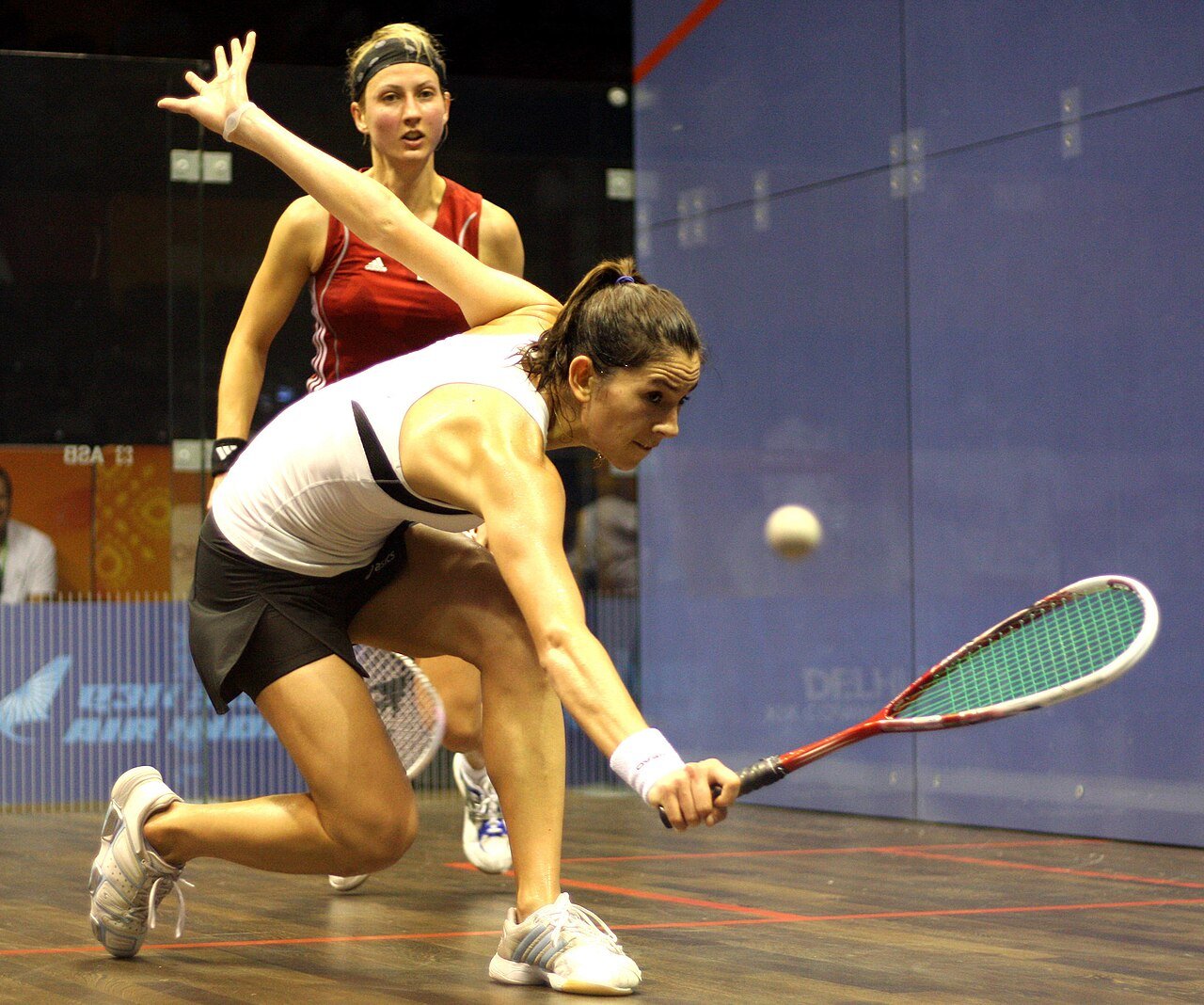
Three of the seven shoes above come from handball lines, two from badminton lines and one from a volleyball line — and the guide has labelled every one of them rather than letting a “court shoes” blur do quiet work. This is the honest shape of the advanced market once the squash-named models are carded elsewhere: the flagship indoor engineering in 2026 sits in the big indoor lines, and the squash test is not the word on the box but the outsole compound, the stability structure and the cushioning architecture the maker will publish and stand behind. Every card here passes that test on its maker’s own paper. If you would rather stay strictly inside squash-labelled models, the pillar guide is built for exactly that preference — different tier, same standard of evidence.
QuestionsAdvanced Squash Shoe FAQs
What makes a squash shoe “advanced” rather than intermediate?
Construction you can verify. An advanced shoe publishes a named stability structure — a plate, a truss or a chassis, such as Mizuno’s Wave, ASICS’s Trusstic and RISETRUSS units, Yonex’s Power Graphite Sheet or adidas’s chassis tooling — layered with named cushioning systems rather than generic foam, and an upper engineered as part of the performance (booties, lockdown meshes, structured shells). It is built for the movement volume of advanced play: hundreds of split-steps and deep lunges per session, several sessions a week. If a shoe’s stability story is adjectives rather than components, it belongs to the tier below, whatever its name suggests.
Are badminton, handball and volleyball shoes really suitable for advanced squash?
They can be, and at the flagship tier they are often where the best indoor engineering sits — which is why three sporting lines appear in this guide, each labelled openly in its card. The squash test is not the sport on the box; it is whether the maker publishes a gum-family indoor outsole (Mizuno’s XG Rubber, ASICS’s NC Rubber), a real midfoot stability structure and a cushioning system with a stated architecture. Every shoe here passes that test on its maker’s own specifications. Where a shoe falls short of it — the Sky Elite FF 3’s listing, for example, names no outsole compound — the card says so and ranks accordingly.
Why do so many advanced models publish no weight?
Because at this tier the makers increasingly treat weight as a retailer-level detail rather than a specification — and the result, in this guide alone, is four of seven flagships with no maker-published figure at all. Where numbers do exist they often arrive unusable: Mizuno Europe prints 570 g for the Wave Claw Neo 2 with no size or single/pair basis stated, so this guide prints it exactly as published and compares nothing against it. Treat any precise weight shown for these models elsewhere with suspicion unless it names its source, its size and its basis — and never let a borrowed number decide a purchase that construction should decide.
How does the Yonex 65 Z3 here differ from the one in the seniors guide?
Only in the last — which is to say, in the thing that decides fit. The seniors guide cards the Power Cushion 65 Z3 Wide, the broad 4E variant chosen there for the room and stability it offers mature feet. This guide cards the standard-width 65 Z3 (item SHB65Z3M), the regular last, for advanced players with standard-width feet who want the same Power Cushion+ platform and Power Graphite Sheet. Same model family, different width. If your feet are wide, buy the Wide deliberately rather than sizing up in the standard — a longer shoe is not a wider one.
How should advanced squash shoes fit?
Locked at the heel and midfoot, with a small margin — roughly a thumbnail’s width — ahead of the longest toe for the forward slide of the lunge. The fit systems in this guide achieve the lock differently: Mizuno’s bootie constructions hold by structure, the Stabil 16 by its chassis and harness tongue, the Sky Elite FF 3 by its Energy Lock upper, and the Viper SL and Fastball 3 by lacing over shaped uppers. Fit them in the evening, in playing socks, and test the heel hold with a hard split-step and a deep lunge before judging toe room — at advanced intensity, a shoe that fits “comfortably” standing still can move exactly when it must not.
How often should an advanced player replace squash shoes?
On inspectable cues, not on a calendar. Replace when the outsole’s grip pattern is worn smooth at the forefoot, when the midsole’s response has flattened and its creasing deepened, or when the heel counter has softened enough that the lockdown you bought is no longer there. Heavy weekly volume reaches those cues faster, which is why many advanced players rotate two pairs — often a speed shoe for matches and a cushioned platform for training — spreading the load across both. No honest guide can promise you a lifespan in months, and this one does not: the shoes above are compared on published construction, and your own inspection is the replacement schedule.
Can I use these shoes for other indoor court sports?
In most cases yes — several of them started there. The Stealth Neo 2 and Stabil 16 are handball-line flagships, the Claw Neo 2 and 65 Z3 are badminton-line shoes, and the Sky Elite FF 3 is a volleyball flagship; all seven are indoor court shoes on gum-family rubber, and the movement demands of the indoor sports overlap heavily. The limits are the same ones this guide applies in reverse: an outdoor or outdoor-hard-court surface will destroy a gum outsole designed for timber, and a shoe bought for squash’s lunge-heavy movement should be judged for another sport on the same published construction — outsole, structure, cushioning — rather than on the label.
The Verdict
For most advanced players, the Mizuno Wave Claw Neo 2 is the buy: a bootie upper on a Wave plate, an Enerzy forefoot, a groove cut for the pivot, and a fully published spec sheet behind all of it. If your game is speed, the ASICS Gel-Fastball 3 remains the tour’s own answer — low, minimal and increasingly hard to find, so move when your size appears. If your game is volume, take the Mizuno Wave Stealth Neo 2 for maximum structure or the standard-width Yonex Power Cushion 65 Z3 for the deepest cushioning platform, and if your complaint is a foot that moves inside its shoe, the adidas Stabil 16 and ASICS Sky Elite FF 3 are the lockdown cards — with the Salming Viper SL the lightweight, breathable alternative for fast players in warm halls.
Whichever brief is yours, hold every seller to the standard this page holds itself to: named construction, sourced weights, and nothing promised that the spec sheet cannot prove. Then go back to the squash shoe pillar if you want the tier below for training rotation, and put the saved time into the movement work in how to play squash — at advanced level, that is still where the matches are won.
Ali Shuttler is a participant in the Amazon Associates Program. Product cards on this page link to Amazon searches for the named model and carry our affiliate tag; if you buy through them we may earn a commission at no extra cost to you. Specifications are quoted from the manufacturers’ published product material and, where marked, from named retailers or specialist reviewers — we do not publish prices, and we never present a retailer’s or reviewer’s figure as a manufacturer’s specification.