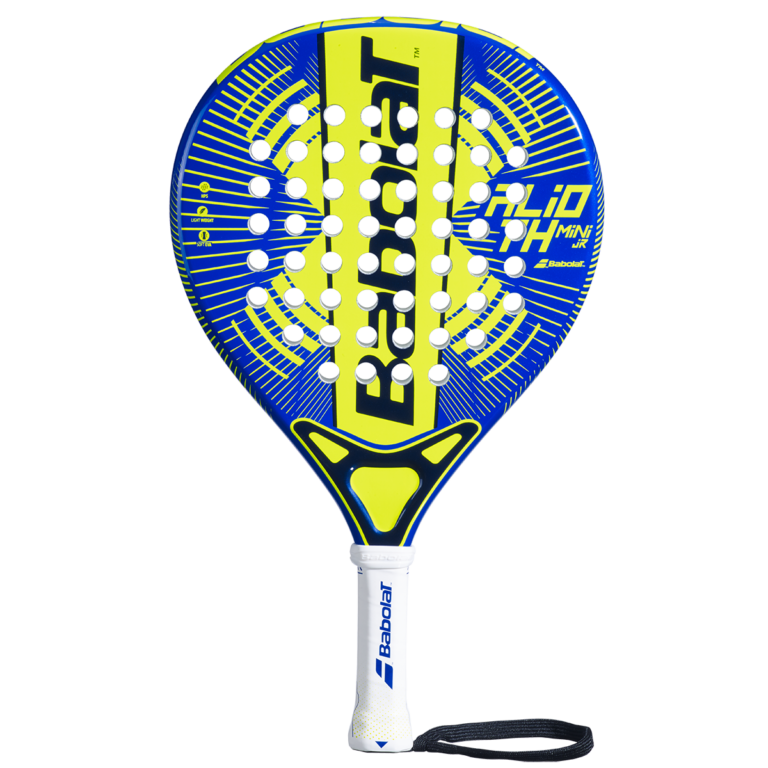
Round, teardrop or diamond — the outline of a padel racket decides where its sweet spot sits, where its weight lives, and how much it forgives your worst contact of the rally. This guide explains all three shapes in plain terms, so you can pick the one that matches your game instead of guessing from a product photo.
TL;DR — The short answer
Round rackets put the sweet spot in the centre of the face and the balance in the handle: maximum control and forgiveness, minimum free power — the right first shape for most beginners. Teardrop (hybrid) rackets move the sweet spot up and split the difference: the all-rounder shape for players who defend and attack in the same rally. Diamond rackets push weight into the head for the biggest overhead power, with the smallest, highest sweet spot — rewarding for advanced attackers, punishing while your technique is still forming. Match the shape to your level first; worry about brand and materials second.
Kuikma PR Control
Round head, low balance, soft fiberglass feel. Control-first, beginner-friendly.
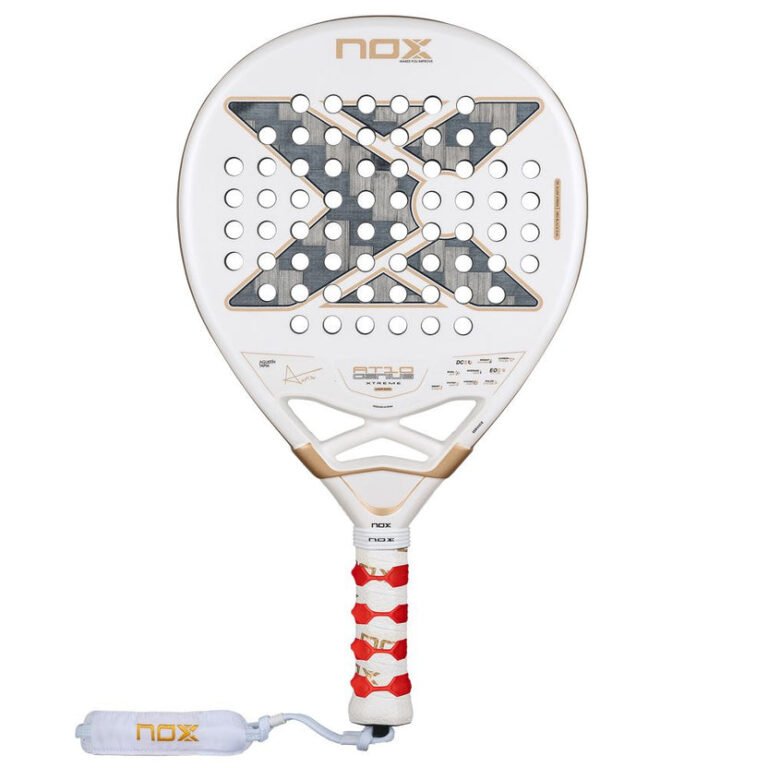
Nox AT10 Genius 12K
Teardrop head, 12K carbon face. The balanced all-court template.
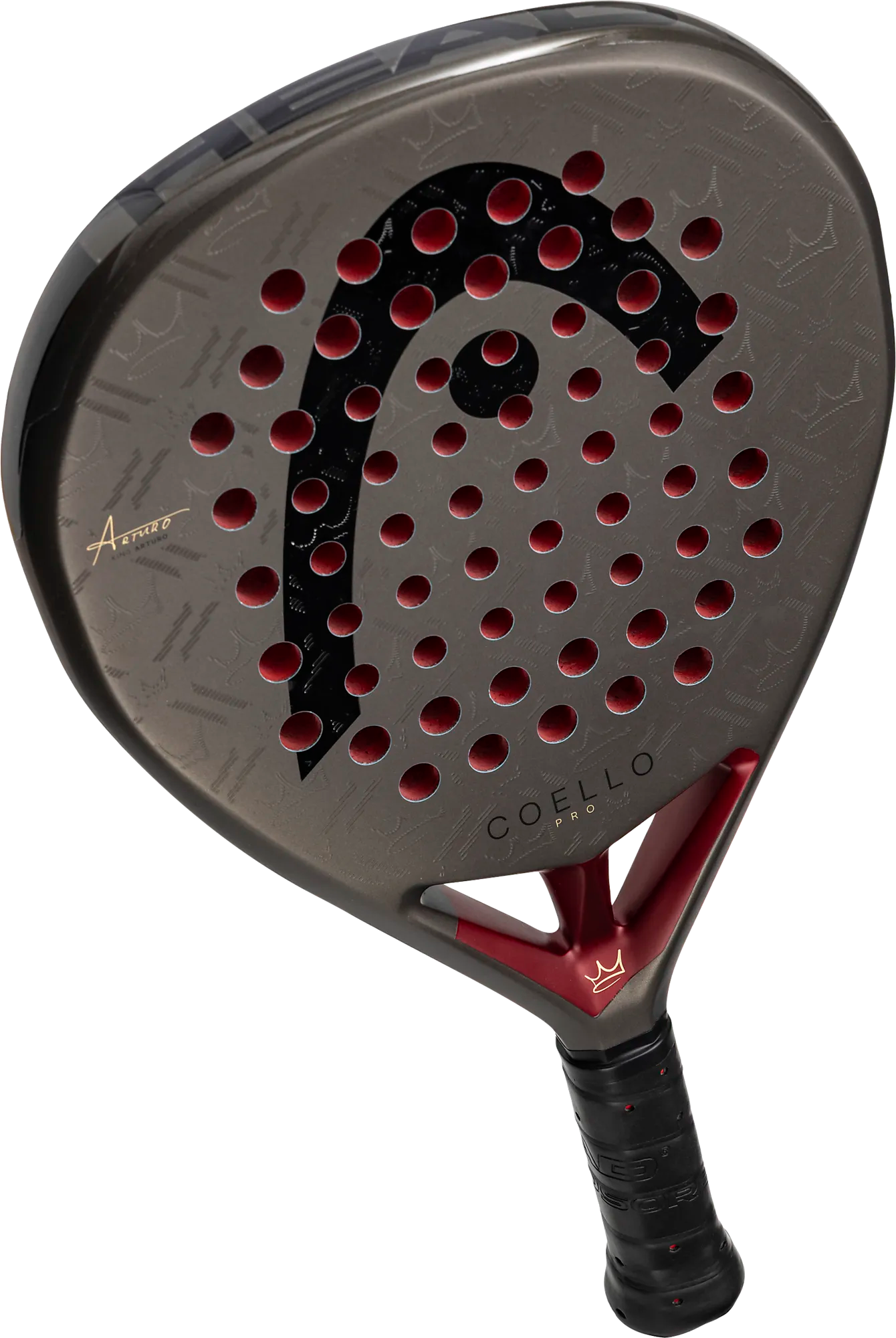
Head Coello Pro
Diamond head, head-heavy balance. Built for overhead power.
On this page
Why shape matters more than brand for beginners
Walk into any padel shop and the wall confronts you with dozens of rackets that all claim to be powerful, precise and perfect for your game. Strip away the marketing and every one of those rackets is built on one of three outlines: round, teardrop or diamond. That outline is not a styling choice. It is the single decision that determines how the racket behaves on every shot you play — more than the brand name on the throat, more than the carbon weave on the face, more than the professional whose signature is printed near the grip.
Here is why. A padel racket is a short lever with a perforated hitting surface, and physics does not negotiate. Move the widest part of the head further from your hand and two things happen at once: the balance point climbs toward the top of the racket, and the zone that returns the ball cleanly — the sweet spot — climbs with it and gets smaller. Keep the head round and compact and the opposite happens: weight stays near your hand, the sweet spot sits in the middle of the face, and off-centre contact still produces a usable shot. Same player, same swing, completely different outcome — decided entirely by the silhouette.
This is why experienced coaches ask new players one question before anything else: not “what is your budget?” and not “which brand do you like?”, but “how long have you been playing?” Your honest answer to that question points almost directly at a shape. Beginners mishit more often, defend more than they attack, and need a racket that keeps the ball in play while technique catches up. Advanced players strike the ball cleanly enough to exploit a demanding shape — and need the extra leverage it offers to finish points at the net. The shape that helps one group actively holds back the other.
Two terms will carry this whole guide, so let us pin them down now. The sweet spot is the area of the face where contact feels clean and the ball leaves with the pace and direction you intended; stray outside it and the shot loses power, twists the racket in your hand, or both. The balance point is where the racket balances on a finger, measured from the butt of the handle: roughly speaking, a balance under about 260 mm feels head-light and manoeuvrable, while a balance above about 270 mm feels head-heavy and powerful through the swing. Shape drives both numbers, which is why shape comes first in every sensible buying decision — including the picks in our best padel rackets guide, where you will notice the beginner choices are round and the expert choices are diamond, not by coincidence but by geometry.
The three shapes at a glance
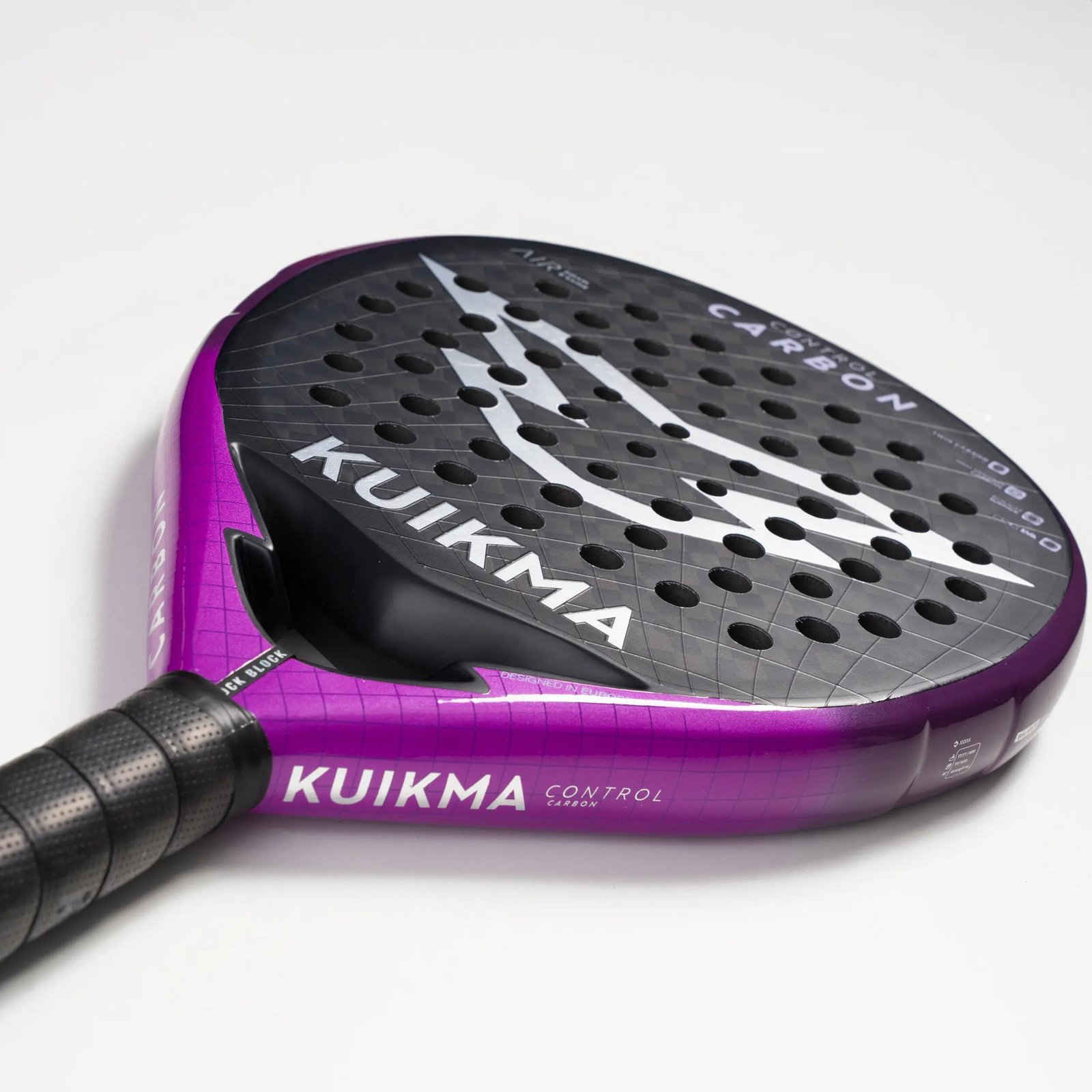
Before the deep dives, here is the whole guide on one screen. The gold dot on each silhouette marks where the sweet spot typically sits — watch it climb the face, and shrink, as the shape moves from round to diamond.
Round
Sweet spot in the centre of the face. Balance low, near the handle. The control and comfort shape.
ControlTeardrop
Sweet spot above centre. Balance in the middle. Power and control in one frame — the hybrid.
BalancedDiamond
Sweet spot high and small, near the top. Balance in the head. Maximum leverage, maximum demand.
PowerNotice what the diagram is really telling you: the three shapes are not three different rackets so much as three different answers to one question — where do you want the help? Round puts the help where beginners actually strike the ball. Diamond puts it where advanced players strike the ball when they attack. Teardrop splits the difference for everyone in between. Keep that picture in mind as we take each shape in turn.
Round: the control shape
A round racket is exactly what it sounds like: a circular head, widest at its middle, with no extended top section. Because the mass of the head is distributed evenly around its centre, the balance point stays low — the racket feels light in the hand even when its scale weight matches a head-heavy model gram for gram. That low balance is the source of almost everything players love about the shape: quick reactions at the net, easy handling in fast exchanges, and far less strain on the wrist and elbow across a long session.
The sweet spot tells the same story. On a round racket it sits in the centre of the face and it is generous — the largest of the three shapes. Contact a few centimetres off centre still produces a usable shot: the ball comes off the perforated face with most of its intended pace and direction, and the frame barely twists in your grip. For a player still grooving the basic strokes — the forehand drive, the backhand, the first bandejas off the glass — that forgiveness is not a luxury. It is the difference between rallies that last long enough to learn from and points that end on your third mishit.
The trade-off is written into the geometry. With no mass concentrated at the top of the head, a round racket gives you little free leverage on overheads. Your smashes will be honest — exactly as powerful as your technique makes them, no more. Players who finish points with flat smashes and aggressive viboras will feel the ceiling quickly. But here is the context that matters: at beginner and lower-intermediate level, points are overwhelmingly lost on errors, not won on winners. A shape that cuts your error count does more for your results than one that adds pace to a smash you cannot yet control. Round is also the natural home of defensive players at any level — the ones who win with lobs, placement and patience from the back of the court, where control is the whole game and raw power rarely decides anything.
Choose round if: you are in your first year of padel, you play a defensive or placement-based game, you have a sensitive wrist or elbow, or you simply value keeping the ball in play over hitting through your opponent. It is also the shape to buy when the racket is for someone new whose commitment is unproven — forgiving and comfortable beats impressive and demanding. If budget shapes are your hunting ground, our best budget padel rackets guide sorts its picks by exactly these three shapes.
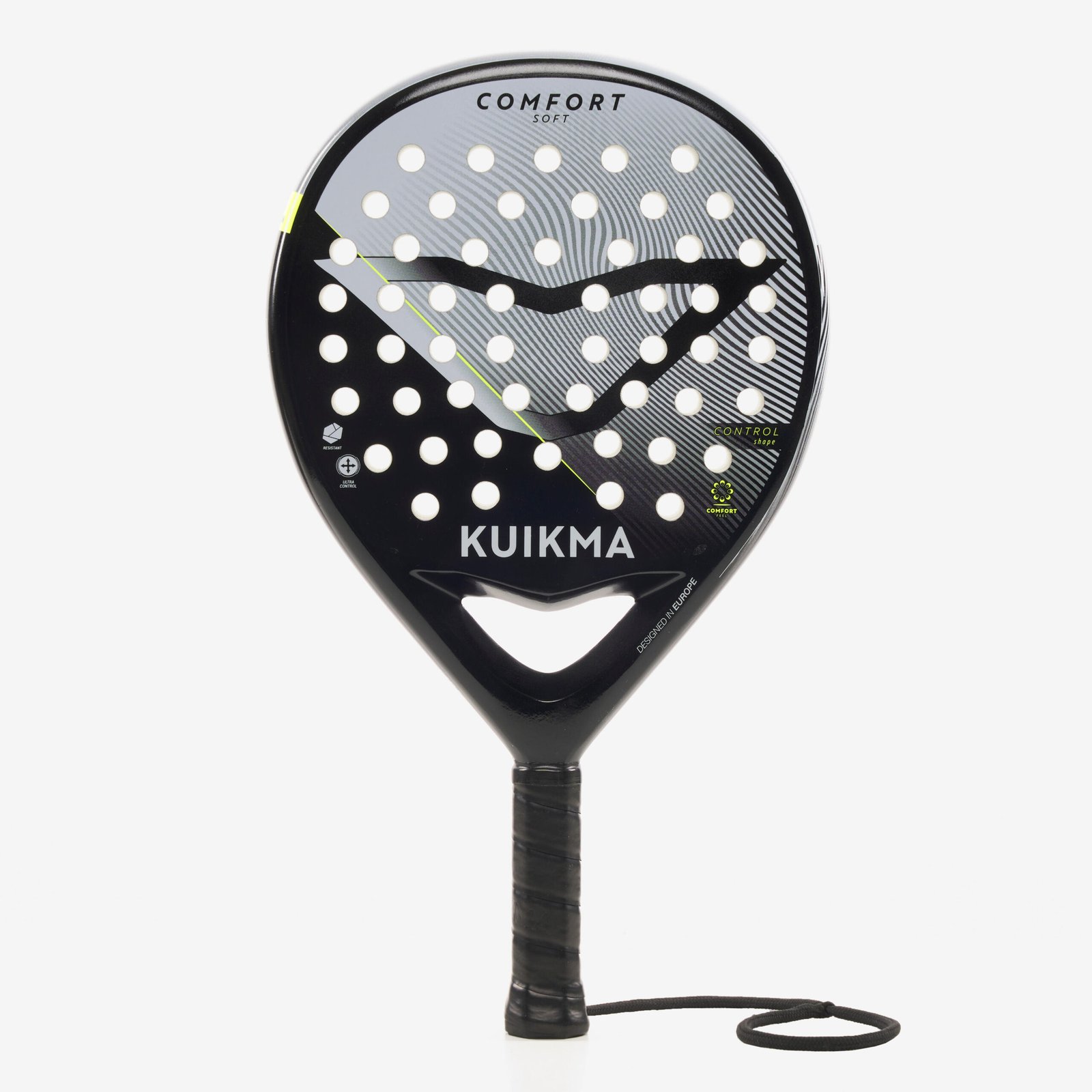
Kuikma PR Control
What a round shape looks like in a real racket
Decathlon’s Kuikma line is the value benchmark in padel, and the PR Control is its round-shape expression: a circular head, low balance and a soft, comfortable face built for placement over power. It shows exactly what this section describes — the sweet spot where a developing player actually makes contact, and handling that never fights you at the net. We break down the whole range in our Kuikma padel rackets review.
Why it fits the shape
- Central sweet spot forgives developing technique
- Head-light handling for fast net reactions
- Soft face feel, gentle on wrist and elbow
The shape’s limits
- Little free power on smashes
- Attacking players will outgrow the ceiling
As an Amazon Associate we earn from qualifying purchases.
Teardrop: the balanced shape
The teardrop — also sold as the hybrid shape — stretches the head upward into a soft point, like a round racket pulled gently toward the sky. That small change in outline moves everything up a notch: the balance point rises toward even or slightly head-heavy, and the sweet spot migrates above the centre of the face and stays respectably large. What you get is the genuine middle of padel racket design, and for a huge share of regular players it is the smartest place to live.
On court, a teardrop racket defends almost like a round one and attacks noticeably better. Blocks, chiquitas and lobs from the back keep their control because the sweet spot is still within reach of a normal contact point. Step forward to volley and hit overheads, though, and the extra mass toward the top of the head starts paying rent: bandejas come off with more weight behind them, viboras bite harder, and flat smashes carry real threat without demanding the precision a diamond does. This is why the teardrop is the default recommendation for the sport’s biggest population — improving intermediates whose game has both halves in it, defence and attack in the same rally, sometimes in the same point.
The honest caveat is that “balanced” can also mean “master of neither.” A teardrop will not forgive a beginner’s wild contact the way a round racket does, because the sweet spot has already started its climb up the face. And a dedicated power player will find its overheads good rather than devastating. The shape rewards a player whose contact point is becoming consistent — typically after the first year or so of regular play, when mishits still happen but clean contact is now the majority. If that description sounds like you, teardrop is not a compromise; it is the fit. Players who compete in mixed styles, play both sides of the court across different partnerships, or simply want one racket that never feels wrong in any situation will find the hybrid shape the easiest long-term answer.
Choose teardrop if: you rally consistently and are building an attacking game, you play an all-court style, or you are buying your second racket and want one frame that grows with you in both directions. It is the most versatile shape in padel — and the one most players should end up on.
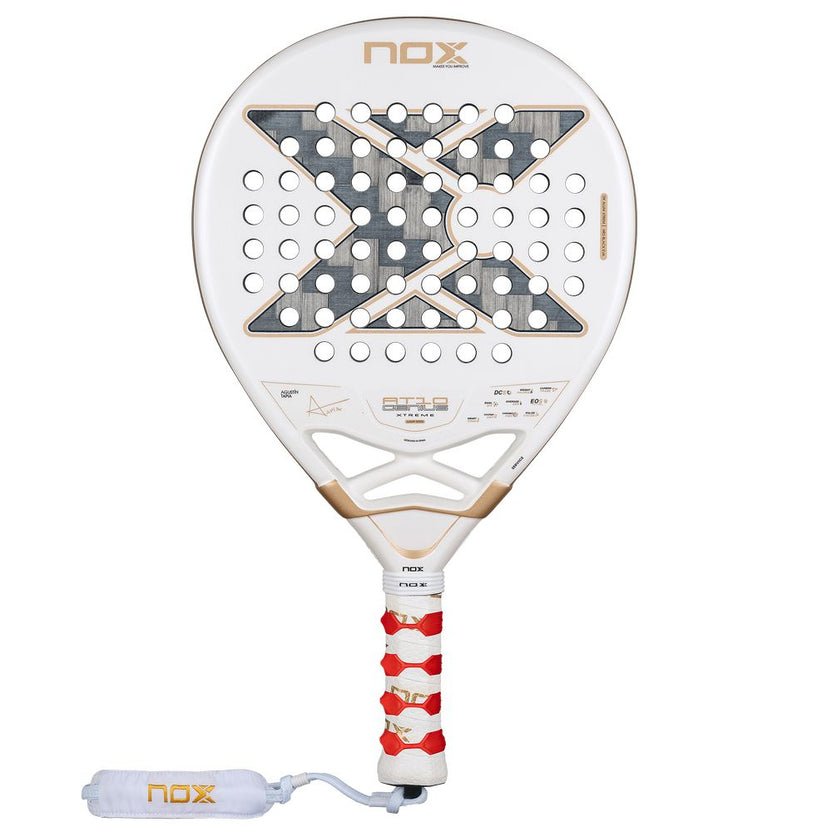
Nox AT10 Genius 12K
The all-court template, in teardrop form
The AT10 line is the racket family associated with Agustín Tapia, and its teardrop outline is a textbook hybrid: sweet spot above centre, even-to-head-heavy balance, a 12K carbon face for a crisper response than fiberglass. It demonstrates what the middle shape feels like at a high level — controlled from the back, dangerous at the net, demanding only that your contact is reasonably consistent.
Why it fits the shape
- Defends with control, attacks with real weight
- Sweet spot still reachable on normal contact
- One frame for both sides of the court
The shape’s limits
- Less forgiving than round for raw beginners
- Less overhead leverage than a true diamond
As an Amazon Associate we earn from qualifying purchases.
Diamond: the power shape
The diamond pushes the teardrop’s logic to its limit. The head narrows toward the throat and flares wide and flat at the top, concentrating the racket’s mass as far from your hand as the rules allow. The balance point climbs to the top of the range, and the sweet spot shrinks to a compact zone high on the face — close to where an advanced player deliberately strikes overheads. Everything about the shape is a wager: give up forgiveness everywhere else in exchange for maximum leverage on the shots that end points.
When the wager pays, it pays visibly. A head-heavy diamond swung with a full, technically sound motion produces the heaviest smashes in padel — the flat winners that clear the back glass, the viboras that skid off the side wall before a defender can set. Volleys punch through with less effort because the mass is already where the work happens. This is the shape of the professional game’s biggest hitters, and of advanced amateurs who play an attacking, net-dominant style and have the footwork to get into position to use it.
But the costs are just as structural as the benefits. Defence suffers first: from the back of the court, under pressure, contact drifts toward the middle and lower face — precisely where a diamond has nothing to give you. Blocks come off dead or twisted, lobs fall short, and the head-heavy balance makes fast defensive reactions slower and more tiring across three sets. The smaller margin also punishes tired technique late in a match. And there is a physical bill: head-heavy rackets load the wrist, elbow and shoulder more on every swing, which is why diamond frames are a poor idea for players with any arm sensitivity, whatever their ambitions. A diamond in unprepared hands does not make a player powerful; it makes a consistent player inconsistent. The honest rule is that diamonds are earned — by clean, repeatable contact and a game plan built around the net.
Choose diamond if: you are an advanced player with grooved technique, your game is built on smashes and aggressive volleys, and your arm is healthy. Everyone else will score more points with a shape that helps them on the shots they actually play most.
Head Coello Pro
Diamond geometry at full commitment
The signature line of Arturo Coello — one of the hardest hitters in professional padel — is built on an uncompromising diamond outline: mass high, sweet spot high and compact, everything pointed at overhead power. As an example of the shape it is perfect precisely because it hides nothing: this is what a diamond asks of your technique, and what it returns when your technique answers.
Why it fits the shape
- Maximum leverage on smashes and viboras
- Punchy volleys with less swing effort
- Built for players who finish points at the net
The shape’s limits
- Small sweet spot punishes defensive contact
- Head-heavy load on wrist, elbow and shoulder
As an Amazon Associate we earn from qualifying purchases.
All three shapes compared
| Trait | Round | Teardrop | Diamond |
|---|---|---|---|
| Sweet spot | Centre of face, largest | Above centre, medium-large | High on face, smallest |
| Balance | Low (head-light) | Even to slightly head-heavy | High (head-heavy) |
| Power | Lowest — technique-supplied | Balanced | Highest on overheads |
| Control | Highest | Balanced | Lowest — precision demanded |
| Forgiveness | Highest on mishits | Moderate | Lowest on mishits |
| Manoeuvrability | Quickest at the net | Good | Slowest, heaviest swing |
| Suits | Beginners, defenders | All-court intermediates | Advanced attackers |
Shape × level matrix
This is the table to screenshot. Rows are your honest level today — not the level you plan to reach by summer — and columns are the shapes. Where your row and a green cell meet is where your next racket lives.
| Your level | Round | Teardrop | Diamond |
|---|---|---|---|
| Beginner (first year, building strokes) | Best fit — forgiveness while technique forms | Workable if light and soft-cored | Avoid — sweet spot too high and small |
| Intermediate (consistent rallies, learning overheads) | Great for defensive styles | Best fit — grows in both directions | Only for strong, clean hitters |
| Advanced (tactical game, reliable bandeja/vibora) | Niche — elite defenders only | Excellent all-court option | Best fit for attacking styles |
Two patterns stand out. First, the diagonal — round for beginners, teardrop for intermediates, diamond for advanced attackers — is the sport’s default progression for a reason: it mirrors how a player’s contact point and confidence actually develop. Second, teardrop never gets a bad cell. If you are torn between two shapes at any level, the hybrid is the tiebreaker that rarely disappoints. New to the sport altogether? Learn the scoring and the glass rules in our complete padel rules guide — shape choice makes more sense once you know how points are actually built.
Shape, weight and balance: how they interact
Shape sets the blueprint, but two rackets with the same outline can still feel different — because weight and balance fine-tune what the shape started. Understanding the interplay stops a common mistake: choosing the right shape in the wrong specification.
Weight amplifies the shape. A round racket at the lighter end of the adult range (around 350 g) is the most forgiving, easiest-handling combination in padel. The same round outline at 375 g gains stability and plough-through on blocks but loses some of its quickness. On a diamond, extra weight compounds the head-heavy effect — more power potential, more load on the arm, slower reactions. This is why shape and weight should be decided together: the lighter you go, the more shape you can handle; the heavier you go, the more conservative your shape choice should be.
Balance can bend a shape’s character — within limits. Manufacturers adjust balance with weight placement in the frame, so you will find relatively head-light teardrops that behave almost like round rackets, and firmly head-heavy teardrops leaning toward diamond behaviour. Use this when you sit between shapes: a control-leaning player moving up should look for a lower-balance teardrop; an attacker not quite ready for diamond should look for a higher-balance one. But balance cannot repeal geometry — no amount of tuning puts a diamond’s sweet spot in the centre of the face, and no tuning gives a round racket a head-heavy smash. Shape remains the primary decision; balance is the adjustment dial, typically worth about half a step between shapes.
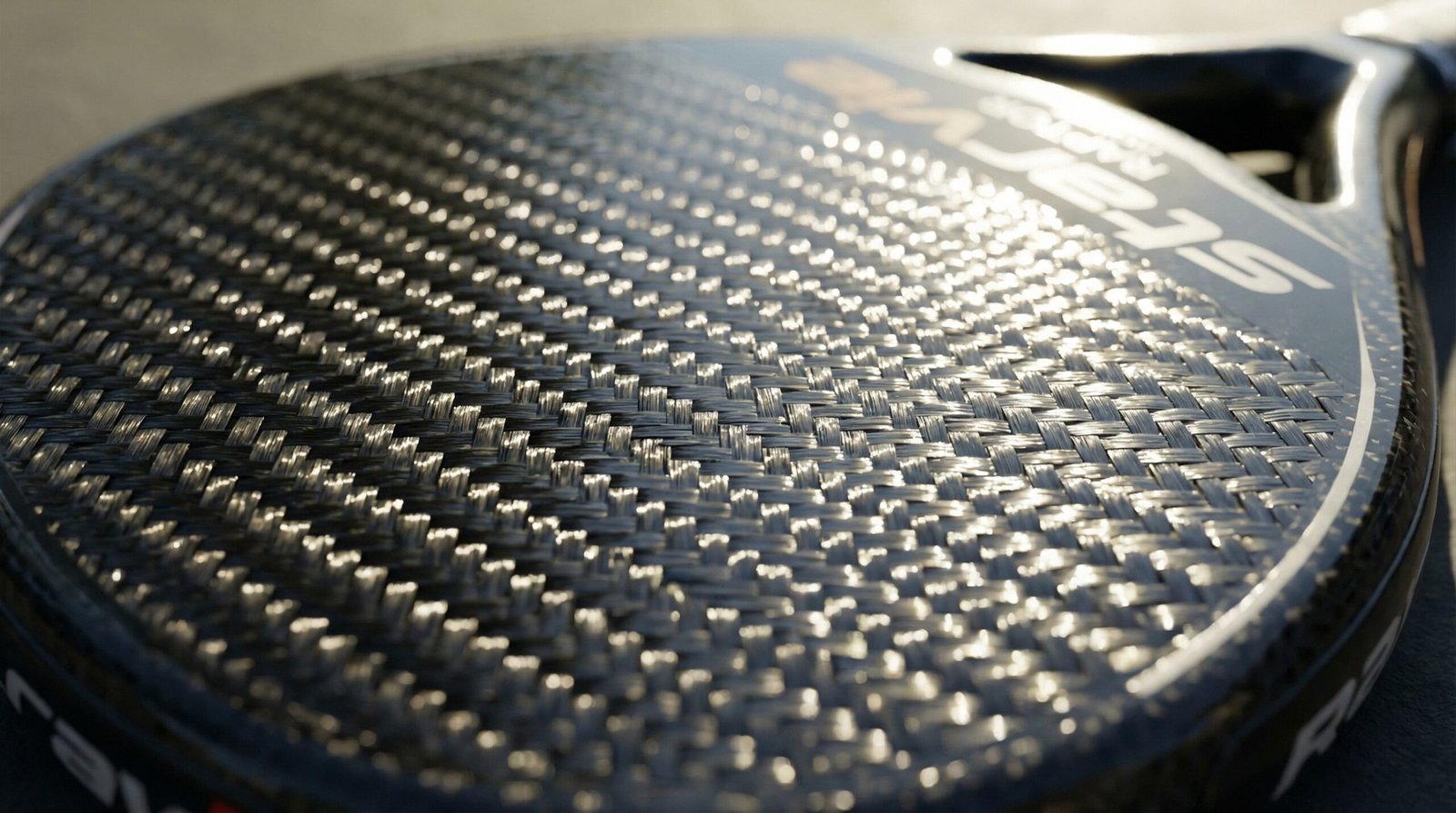
Core and face materials sit underneath both. Softer EVA cores add comfort and a touch of forgiveness to any outline; harder cores sharpen response and raise the demand on contact quality. Fiberglass faces flex and soften impact; carbon faces respond crisper and punish sloppier contact slightly more. As a rule, the more demanding your shape, the more you should let the materials lean soft to compensate — one reason so many diamond frames aimed at strong amateurs pair the aggressive outline with a softer core.
How to choose your shape in 60 seconds
Step 1 — Grade your level honestly (15 seconds)
Not your best day — your average one. Still learning the basic strokes and the glass? You are a beginner for racket purposes, whatever your tennis or squash background. Rallying consistently and starting to use the bandeja? Intermediate. Choosing shots tactically and hitting overheads with intent? Advanced. When in doubt, grade down: a forgiving racket never embarrasses anyone, and an over-demanding one flatters nobody.
Step 2 — Name your style (15 seconds)
Where do your points come from? If you win by outlasting — lobs, placement, defending the glass — you are a control player. If you win by finishing — stepping in, volleying, smashing — you are an attacker. If you genuinely do both within the same match, you are all-court. Be honest about the player you are now, not the highlight reel you are building toward.
Step 3 — Read off your shape (15 seconds)
Beginner, any style → round. Intermediate control or all-court → teardrop; intermediate and strongly attacking with clean contact → high-balance teardrop, diamond only with caution. Advanced defender → round or teardrop; advanced all-court → teardrop; advanced attacker → diamond. That is the whole flow — it is also exactly the matrix above, compressed.
Step 4 — Set weight and balance inside the shape (15 seconds)
Within your shape, start at the lighter, lower-balance end if you are new to the shape, have any arm sensitivity, or play long sessions. Move heavier and higher-balance only when the current specification feels like it is holding your power back — a problem you will recognise clearly when it is real, and should never pre-emptively solve.
That is genuinely all there is to it. Shape first, specification second, brand last. If you want to see the flow applied across full product ranges — with the flagship tier included — our best padel rackets guide tags every pick with its shape, and the budget rackets guide does the same at friendlier prices.
Padel racket shape FAQs
Which padel racket shape is best for beginners?
Round. Its sweet spot sits in the centre of the face and is the largest of the three shapes, its balance stays low and head-light, and off-centre contact still produces a usable shot. That forgiveness matters more than any other trait while strokes are forming. Move to teardrop once you rally consistently and want more from your overheads.
Is a diamond padel racket harder to play with?
Yes — structurally, not just by reputation. A diamond concentrates mass at the top of the head, which lifts the balance point and shrinks the sweet spot into a small zone high on the face. Clean, advanced contact is rewarded with the biggest overhead power in padel, but defensive and off-centre contact is punished, and the head-heavy swing loads the wrist, elbow and shoulder more.
Does racket shape affect the sweet spot?
Directly — shape is the main thing that does. Round rackets centre the sweet spot in the middle of the face and make it large. Teardrop rackets move it above centre and keep it medium-large. Diamond rackets push it high toward the top of the face and make it the smallest. Where the sweet spot sits relative to your normal contact point decides how forgiving a racket feels.
Can an intermediate player use a diamond racket?
Some can — strong intermediates with clean, repeatable contact and an attacking style can handle one, especially in a lighter specification. Most intermediates, though, score better with a teardrop: it keeps a reachable sweet spot for defence while still adding real weight to overheads. If your mishits still decide matches, a diamond will cost you more points than its smashes win.
Round vs teardrop for defensive players?
Round, for as long as defence is your identity. Its low balance reacts fastest at the net and under pressure at the back, and its central sweet spot bails out the stretched, off-balance contact that defensive points are full of. A lower-balance teardrop is the step up when your defence is solid and you want your lobs and counter-attacks to carry more weight — without giving up much control.
Does racket shape matter more than weight?
Yes. Shape decides where the sweet spot and balance point live — the racket’s fundamental behaviour. Weight then amplifies or softens that behaviour: heavier makes any shape more stable and more demanding, lighter makes it quicker and more forgiving. Choose shape first, then tune weight inside it. A heavy round racket still plays like a control racket; a light diamond still plays like a power racket.
What is the difference between teardrop and hybrid rackets?
None — they are two names for the same outline. “Teardrop” describes what the head looks like; “hybrid” describes what it does, blending round’s control with diamond’s power. Brands use the terms interchangeably, so a racket listed as hybrid and one listed as teardrop should be judged by the same expectations: sweet spot above centre, even-to-head-heavy balance, all-court behaviour.
The verdict
Buy round if you are learning the game, defend more than you attack, or your arm asks for kindness — the Kuikma PR Control shows the shape at its most honest. Buy teardrop if you play all-court padel and want one racket that never feels wrong — the Nox AT10 Genius 12K is the template. Buy diamond if your technique is grooved, your arm is healthy and points end on your overheads — the Head Coello Pro is the full-commitment version. Whatever you choose, choose the shape before the brand: geometry decides how a racket plays long after the logo is forgotten.
Affiliate disclosure: Alishuttler.com is a participant in the Amazon Services LLC Associates Program. The Amazon buttons on this page use our affiliate tag — if you buy through them, we may earn a commission at no extra cost to you. Prices shown on Amazon are live and may differ from any figures mentioned here.