An adult tennis racket is 27 inches long. A five-year-old is barely twice that tall. Junior rackets close that gap properly: five length bands — 19, 21, 23, 25 and 26 inches — each matched by its maker to a height and age range, in weights a child can actually swing. This guide compares the junior rackets the major makers publish, states every size exactly as the maker states it, and shows the ladder from a first 19-inch frame to the 26-inch bridge into adult tennis.
⚡ TL;DR — The Short Answer
Size by length first, brand second. For the youngest starters, the Babolat Nadal Junior 19 (19 in, 179 g, aluminium) is Babolat’s pick for players 90–105 cm tall. At 21 inches, Wilson’s guidance puts the Wilson Roger Federer 21 with ages 5–6. The first graphite step is the HEAD Speed Junior 23 (215 g composite, HEAD ages 6–8). At 25 inches, choose your material: the big-headed aluminium Wilson US Open 25 (106 sq in) or the graphite hybrid Yonex EZONE Junior 25 (230 g, Yonex ages 9–10). At 26 inches, the HEAD Speed Junior 26 (250 g, ages 9–11) and Yonex EZONE Junior 26 (240 g, ages 10–11) are the last junior step before a 27-inch adult frame.
Quick Picks — Best Tennis Rackets for Kids at a Glance
19 in and 179 g in aluminium — Babolat sizes it for players 90–105 cm tall.
195 g strung, 90 sq in head; Wilson recommends the 21 for ages 5–6.
215 g graphite composite — HEAD positions the 23 for kids aged 6 to 8.
106 sq in aluminium at 220 g — the largest head here, ages 9–10 in Wilson’s guidance.
230 g graphite hybrid, 100 sq in head; Yonex: 9–10 yrs / 130–140 cm.
250 g graphite composite at full junior length — HEAD: ages 9 to 11.
240 g graphite hybrid, one inch short of adult length — Yonex: 10–11 yrs / 135–145 cm.
In This Guide
Why Kids Need Their Own Racket Sizes
Tennis equipment is openly sized to the player. An adult frame is 27 inches long, and junior frames step down from there in two-inch bands — 26, 25, 23, 21, 19 — because a racket that is too long changes what a child can do with it: contact happens further from the body, the swing has to be muscled around instead of swung, and adult leverage works against a player still learning where the ball is. Every major maker publishes its junior line as a sizing system for this reason, and every card in this guide is one rung of it.
This guide owns the junior decision only. It does not re-rank adult rackets: our best tennis rackets pillar owns adult selection, and when a junior graduates, that is where the ladder leads. What this page does is lay the junior rungs out in the order a parent climbs them — shortest and lightest first, one bridge pick at the top — using each maker’s own published dimensions and guidance for that model. Where two makers size the same length differently (they do), the copy reports both positions rather than averaging them into a standard nobody published.
One practical consequence before the cards: buy the rung your child is on now. A 23-inch racket bought “to grow into” for a child who measures for a 19 is four inches of extra leverage on every swing for a season or more. Junior rackets are priced to be outgrown in sequence — and learning the game on the right length, with the right ball for the stage, is covered in our guide to how to play tennis.
The Junior Sizing System: Length, Weight, Grip, Materials
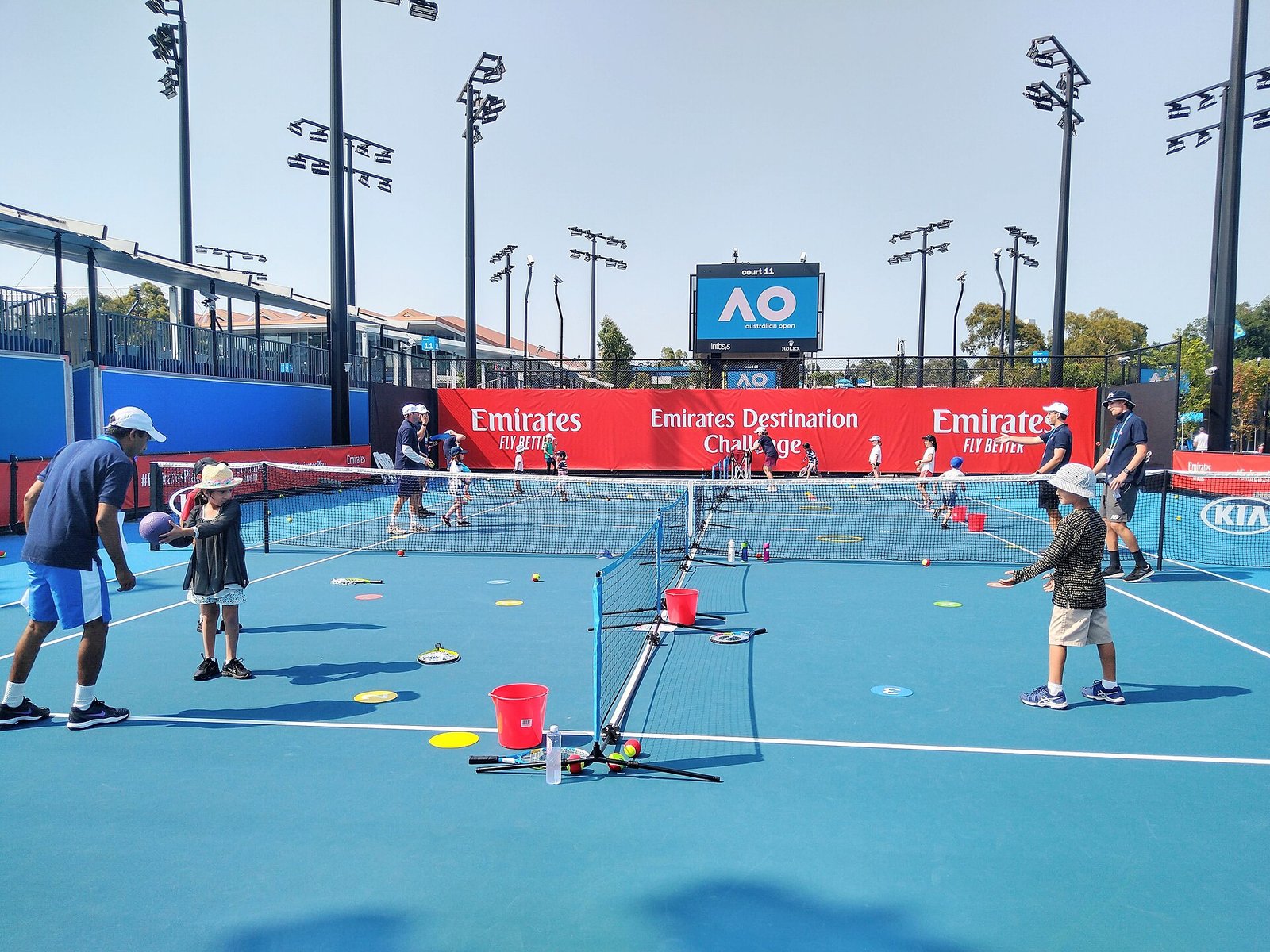
Length is the sizing system. The five bands, with the guidance their makers publish for them: at 19 inches, Babolat sizes its Nadal Junior 19 for players 90–105 cm tall. At 21 inches, Wilson recommends its Roger Federer 21 for ages 5–6. At 23 inches, HEAD positions its Speed Junior 23 for kids aged 6 to 8. At 25 inches, Wilson’s guidance for the US Open 25 is ages 9–10 (height 50–55 inches), while Yonex sizes its EZONE Junior 25 for 9–10 years old and 130–140 cm. At 26 inches, HEAD positions the Speed Junior 26 for ages 9 to 11, and Yonex the EZONE Junior 26 for ages 10 to 11 and 135–145 cm. Notice the overlaps: the bands are consistent, the exact cut-offs are each maker’s own — which is why this guide attributes every band to the maker that published it.
Weight climbs with length. Across the seven cards below, published weights run from 179 g at 19 inches to 250 g at 26 inches. A child should be able to hold the racket out in one hand and swing it in a controlled arc; if the head drags the arm down or the whole body has to turn to bring it around, the racket is a band too big regardless of age. Height is the more reliable measure — makers who publish both anchor the band to it — because two eight-year-olds can be a full band apart.
Grip sizes are small, and stated differently by each maker. Babolat lists the Nadal Junior 19 with a 3 5/8-inch grip; Wilson lists the US Open 25 at 3 7/8 inches; Yonex lists its EZONE juniors in its own G02 code. There is no single junior grip standard, so check the figure for the specific model — and for measuring a hand for any racket, our tennis racket grip size finder walks through the method. The hand test is the same at every age: fingers wrapped with a small gap to the palm is right; fingertips digging in means too small, fingers unable to close means too large.
Materials split the ladder in two. The shorter bands are aluminium: Babolat describes its Nadal Junior aluminium construction as bringing lightness, handling and strength, and Wilson builds its junior lines in AirLite Alloy for the same reasons — light, simple frames for the years when rackets get dropped, dragged and outgrown quickly. The step up is graphite, as the makers describe it: HEAD builds its Speed Junior 23 and 26 in a lightweight graphite composite with Innegra and DampPlus, and Yonex builds the EZONE juniors as graphite hybrids with its Isometric head shape. Graphite arrives where a junior is playing full-court tennis with formed strokes — 23 inches in HEAD’s line, 25 in Yonex’s — and it is a progression to buy when the player reaches it, not an upgrade to skip to. When to move up a length: when your child measures into the next band on the maker’s chart — height first, age as the cross-check. Move one band at a time; the system is built in two-inch steps for a reason.
The 7 Best Tennis Rackets for Kids, Compared
The order is the ladder itself: 19 inches first, climbing band by band to the two 26-inch bridge picks. Where two rackets share a length — the two 25s and the two 26s — the pairing is deliberate: aluminium against graphite at 25, and two makers’ graphite answers at 26, so you can see what the material step buys at the same size. Every specification is the maker’s published figure; every age or height statement is attributed to the maker that publishes it.
Babolat Nadal Junior 19
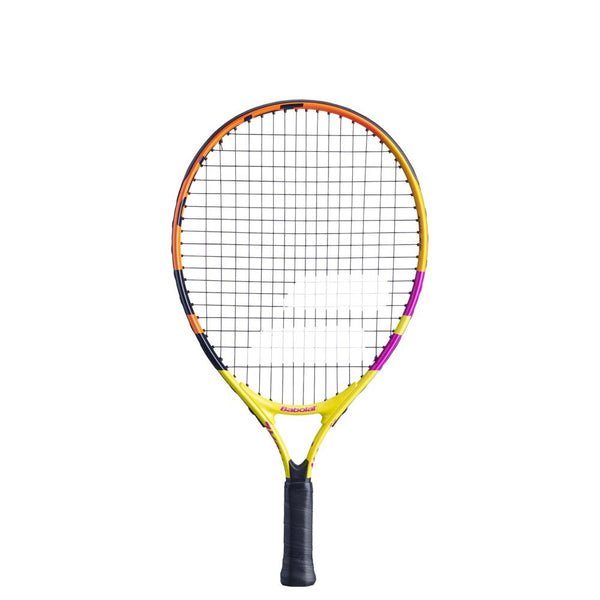
The first rung: 19 inches, 179 g of aluminium, in the colours of the racket its namesake made famous.
Every ladder needs a bottom rung that is genuinely small, and this is it. At 19 inches the Nadal Junior 19 is eight inches shorter than an adult frame, and at 179 g unstrung it is the lightest racket in this guide. Babolat sizes this model for young players measuring 90 to 105 cm tall — Babolat’s own positioning, and the number to buy by: measure the player, not the birthday. The frame is aluminium, which Babolat describes as bringing lightness, handling and strength to its junior range, with a head kept generous for a beginner’s contact.
The Nadal name does real work here: the racket is styled after Rafael Nadal’s own frame, so a small child walks on court carrying the same colours as their idol — often the difference between a racket that gets picked up and one that stays in the cupboard. It arrives pre-strung, as every racket in this guide does. Buy it for the child who measures into Babolat’s 90–105 cm band; past 105 cm, the next rung is the 21-inch card below, not a jump to 23.
What we like
- Lightest (179 g) and shortest (19 in) racket in this guide
- Maker-stated sizing: Babolat positions it for players 90–105 cm tall
- Aluminium frame — the simple, light build the youngest band calls for
- Nadal styling a young fan will actually want to carry
Worth knowing
- The smallest band is outgrown first — that is its job in the system
- Aluminium feel is basic next to the graphite cards further up the ladder
As an Amazon Associate we earn from qualifying purchases.
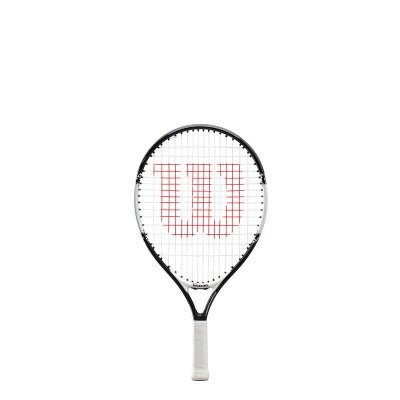
Wilson Roger Federer 21
Wilson’s 21-inch answer: 195 g strung, a 90 sq in head, and Pro Staff styling for the next band up.
This is the one card in the guide verified directly on the maker’s own website, and Wilson’s page is a model of how junior sizing should be published: the specification table gives the 21-inch length, the 90 sq in head, the 195 g strung weight and the head-light unstrung balance — and Wilson states its recommendation plainly, for ages 5–6. The construction is Wilson’s AirLite Alloy, its aluminium junior frame material, which Wilson describes as creating a lightweight frame with power and durability, and the frame carries a bumper guard along the top edge — a small detail that matters on the racket a child is most likely to scrape along the court.
The design lineage is the selling point a parent will hear about: Wilson styles the Federer junior line after its Pro Staff franchise, scaled honestly — two inches longer and 16 g heavier than the 19-inch rung, no more. It suits the child who has outgrown the 90–105 cm band and is starting to rally rather than just make contact. Babolat’s own 21 sits in the same band at a similar aluminium specification; the Federer 21 gets this card because Wilson publishes the fullest spec-and-age statement for the size, on its own site.
What we like
- Full spec verified on Wilson’s own site, age guidance included (ages 5–6)
- 195 g strung — a measured step up from the 19-inch rung, not a leap
- Bumper guard protects the frame edge juniors scrape most
- Pro Staff styling in a true junior scale
Worth knowing
- 90 sq in head is the smallest here — contact needs to be a little tidier
- Still aluminium: the graphite step is the next card, at 23 inches
As an Amazon Associate we earn from qualifying purchases.
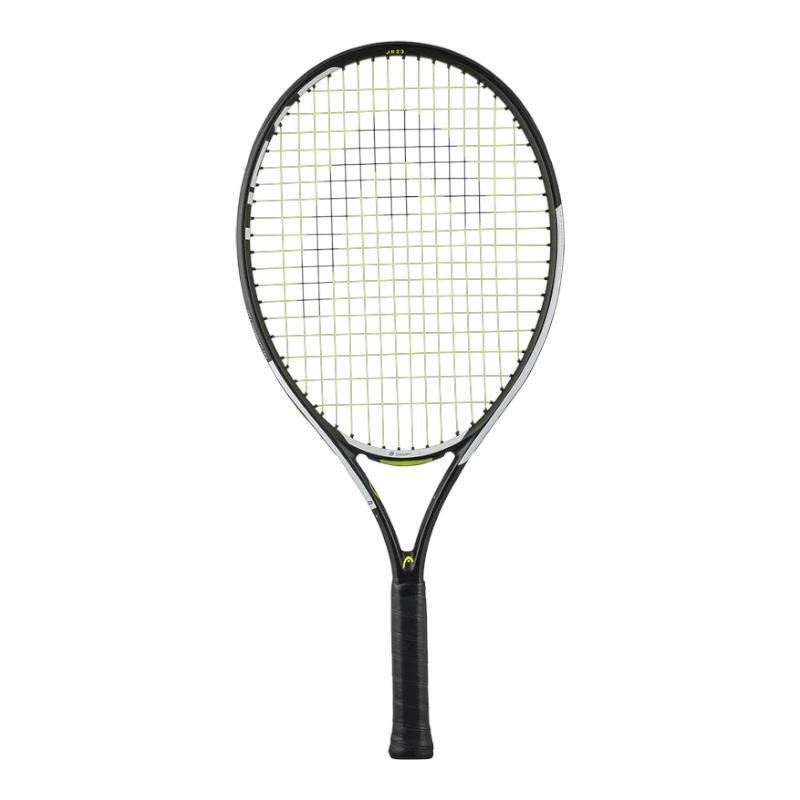
HEAD Speed Junior 23
Where graphite enters the ladder: a 215 g composite frame with HEAD’s Innegra and DampPlus, at 23 inches.
HEAD’s junior Speed line is where this guide’s material story turns. The Speed Junior 23 is built in a lightweight graphite composite — HEAD’s own description of the line — rather than aluminium, and it carries two technologies from HEAD’s adult range: Innegra, the fibre HEAD integrates for stability and shock absorption, and DampPlus, an insert that isolates impact vibration from the handle. HEAD positions the model for kids aged 6 to 8: 215 g unstrung, a 95 sq in head, and a head-light 275 mm balance that keeps the longer frame easy to bring around.
Why a graphite racket at 23 inches, when aluminium 23s exist from every maker? Because this is the band where a child who is staying in the game — lessons, squads, first competitions — starts to feel the difference a composite frame makes in how the racket responds. A beginner at 23 inches is still perfectly served by aluminium; this card is for the junior the length fits and whose game has arrived at the material. Size by HEAD’s 6-to-8 positioning and your child’s height, in that order.
What we like
- First graphite frame on the ladder — composite response at 23 inches
- Innegra and DampPlus carried down from HEAD’s adult range
- Head-light 275 mm balance keeps the longer frame manageable
- Maker-stated band: HEAD positions the 23 for ages 6 to 8
Worth knowing
- A graphite step a day-one beginner at this length does not need yet
- 95 sq in head asks for cleaner contact than the 106 sq in card below
As an Amazon Associate we earn from qualifying purchases.
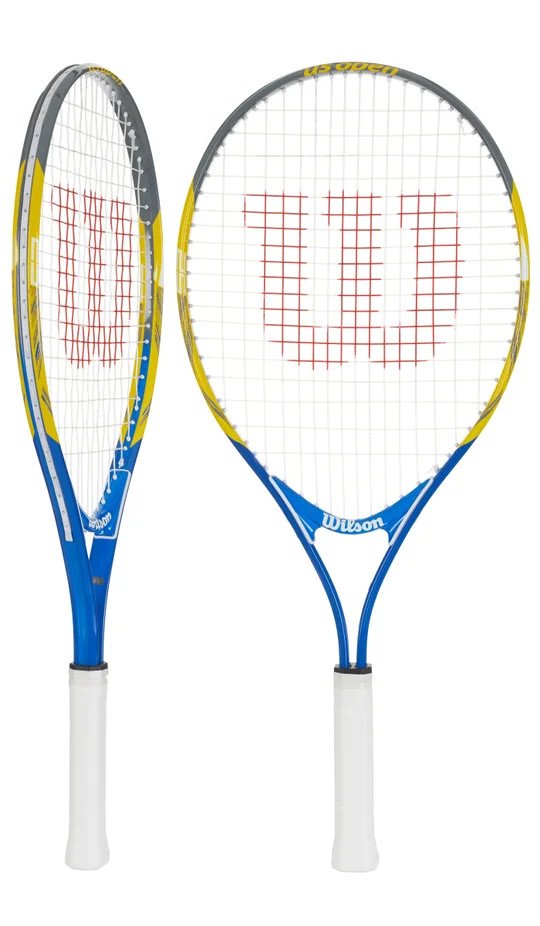
Wilson US Open 25
The forgiving 25: a 106 sq in aluminium head at 220 g, wearing the colours of the season’s last Slam.
At 25 inches the ladder forks, and this card is the aluminium fork — chosen for one specification above the rest: 106 sq in. That is the largest head in this guide, six square inches bigger than the graphite 25 on the next card, on a frame that weighs less (220 g). For a junior whose length says 25 inches but whose contact is still developing — the classic 25-inch beginner, starting the size fresh — head size is the specification that forgives, and the US Open 25 maximises it while keeping the aluminium build and pre-strung brief of the junior lines below it. Wilson’s guidance for the model, as its retailers publish it, is ages 9–10 for players 50–55 inches tall.
The US Open branding is the other half of the card: this is the junior tie-in of the US Open, and Wilson’s description notes it is used at junior events to introduce kids to the game. Treat it as what it is — a recreational junior racket with a famous name, a big head and an honest aluminium spec — and it is exactly the right buy for its player. The player it is not for is the one already competing at 25 inches; that player is the next card.
What we like
- 106 sq in — the largest, most forgiving head in this guide
- 220 g aluminium build keeps the big frame easy to swing
- Full Wilson spec published, grip size (3 7/8 in) included
- Maker guidance stated by height as well as age: 50–55 in, ages 9–10
Worth knowing
- Aluminium feel caps out for juniors already competing at this size
- The oversize head trades a little precision for its forgiveness
As an Amazon Associate we earn from qualifying purchases.
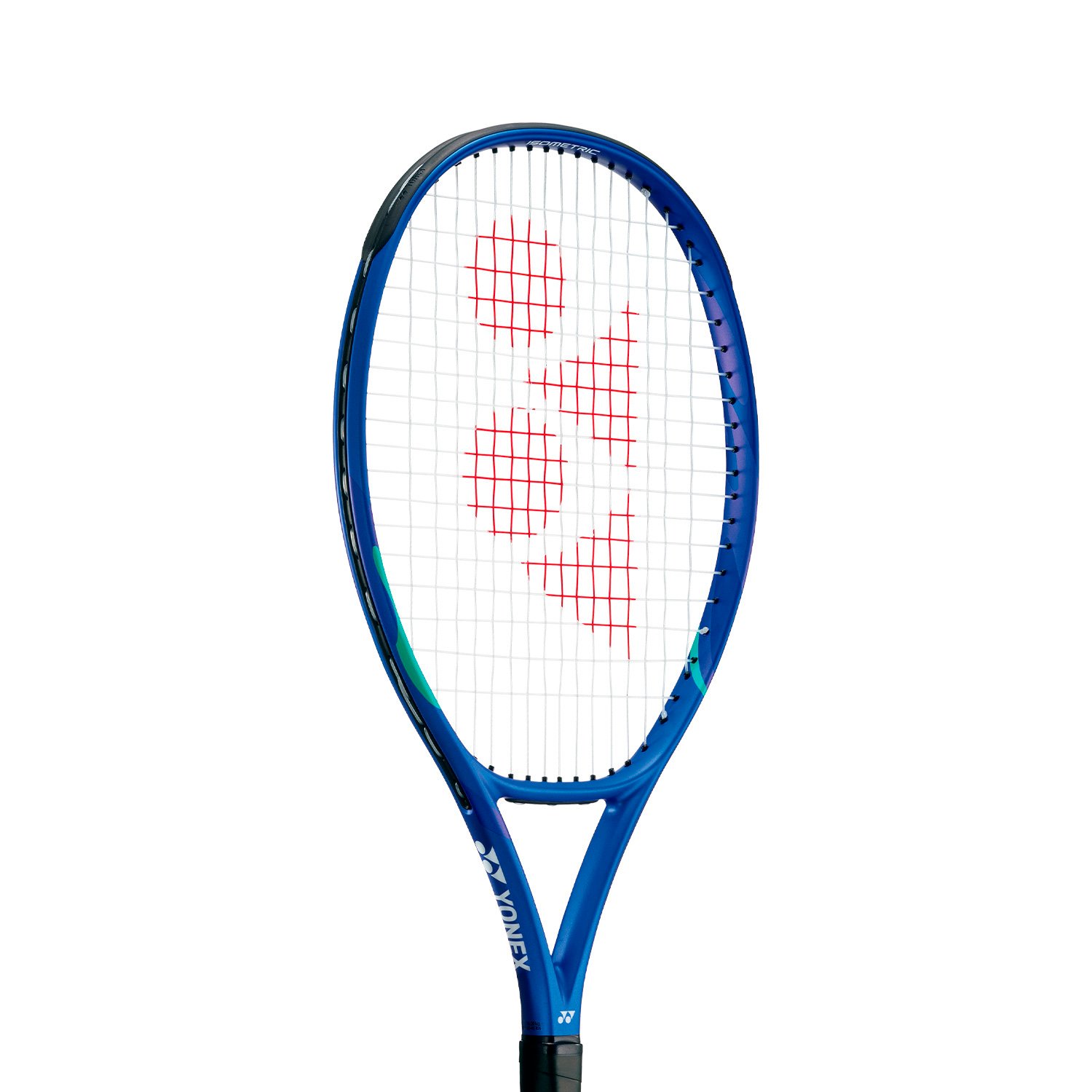
Yonex EZONE Junior 25
The graphite fork at 25 inches: a 230 g hybrid frame with Yonex’s Isometric head, verified on Yonex’s own site.
Same length as the card above, different racket entirely — and the comparison is the lesson of the 25-inch band. Yonex’s own product page lists the EZONE Junior 25 as a graphite hybrid model, positioned for players 9–10 years old and 130–140 cm tall. The specification is a serious junior frame: 230 g, a 100 sq in head in Yonex’s squared Isometric shape, a 315 mm balance, and Vibration Dampening Mesh in the handle — the same VDM technology family Yonex uses in its adult EZONE range. This is the second card verified directly on the maker’s own site, spec for spec.
Choose between this card and the US Open 25 by the player, not the price tag. The beginner at 25 inches gets more from six extra square inches of aluminium head; the junior who rallies, trains and is starting to shape the ball gets more from the graphite hybrid’s response and the Isometric head’s consistency. Yonex’s height band (130–140 cm) is also the tightest published guidance at this length: measure, and if your junior is in the band and playing regularly, this is the 25 to buy.
What we like
- Graphite hybrid response at 25 inches, verified on Yonex’s own site
- Isometric head shape and VDM carried from the adult EZONE line
- The tightest maker sizing at this length: 9–10 yrs / 130–140 cm
- 230 g — a real step up in frame, still a junior weight
Worth knowing
- 100 sq in head forgives less than the 106 sq in aluminium option
- More racket than a first-season player at this length needs
As an Amazon Associate we earn from qualifying purchases.
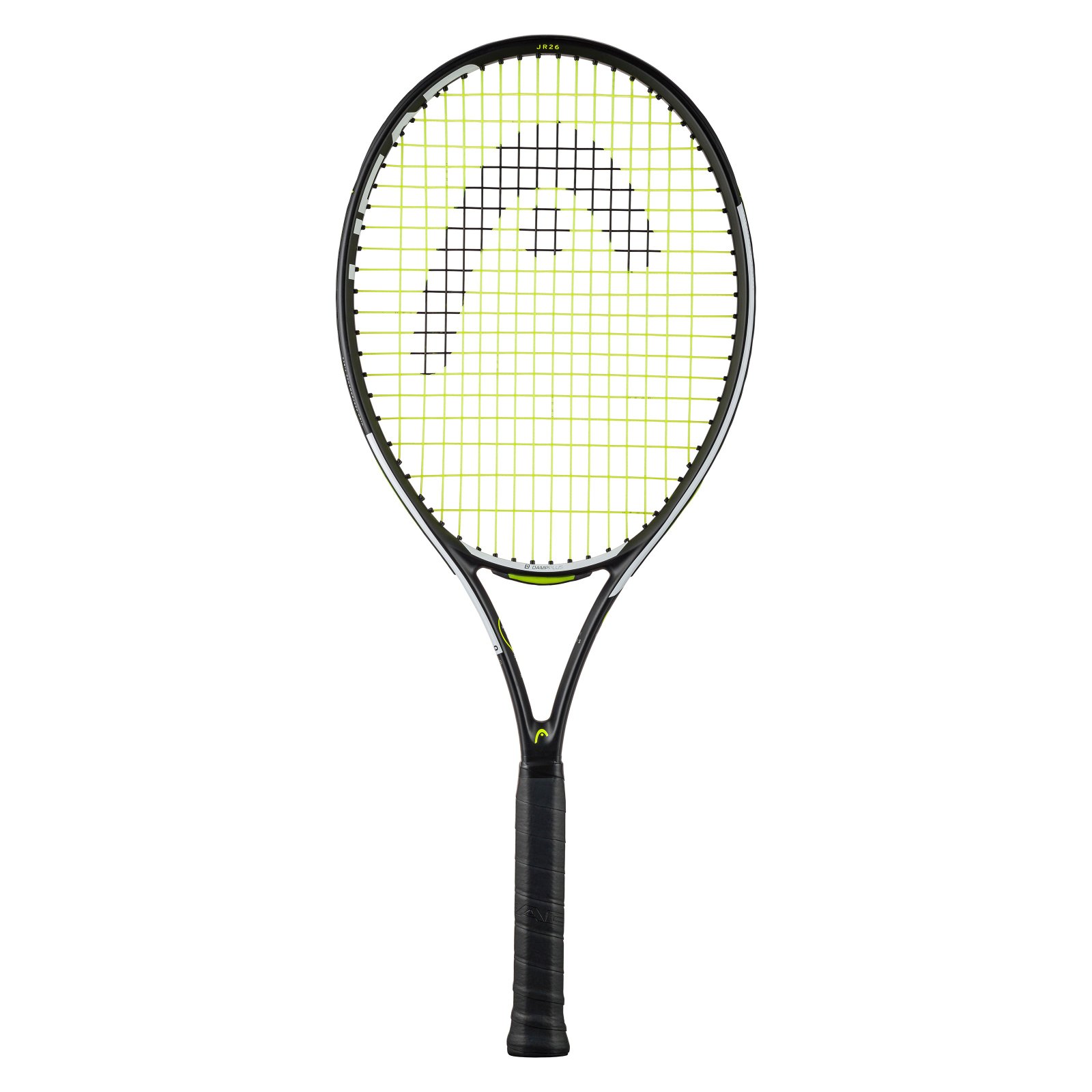
HEAD Speed Junior 26
The full-length junior in HEAD’s graphite line: 250 g, a 100 sq in head, and the Speed brief at junior scale.
Twenty-six inches is the last junior length — one inch short of an adult frame — and HEAD’s Speed Junior 26 is built like it knows it. The graphite composite construction of the 23 continues, with Innegra and DampPlus, but everything scales to the top of the junior game: 250 g unstrung (the heaviest published weight in this guide), a full 100 sq in head, a 310 mm balance and a 22 mm beam. HEAD positions the model for juniors aged 9 to 11 who play with speed and control — the Speed family’s adult identity, stated by HEAD for the junior version too.
This is the card for the junior who has climbed the ladder properly: measured into the longest band, playing full-court tennis, and ready for a frame whose weight and balance start to resemble the adult game. It is also the honest alternative to jumping early to a light adult racket — a route our best tennis rackets for beginners guide covers for adult starters. Between the two 26-inch cards, the choice is character: HEAD’s is the control-leaning composite with the widest age band at this length (9–11); the Yonex on the next card is the power-leaning hybrid with the tighter, taller height band.
What we like
- Full junior spec at the top length: 250 g, 100 sq in, 22 mm beam
- Graphite composite with Innegra and DampPlus, as the 23 — a line to grow within
- Widest maker band at 26 inches: HEAD positions it for ages 9 to 11
- The closest junior step to adult-frame weight and balance
Worth knowing
- 250 g is too much racket for a junior who measures for the 25 band
- Control-leaning brief — power chasers should read the next card first
As an Amazon Associate we earn from qualifying purchases.
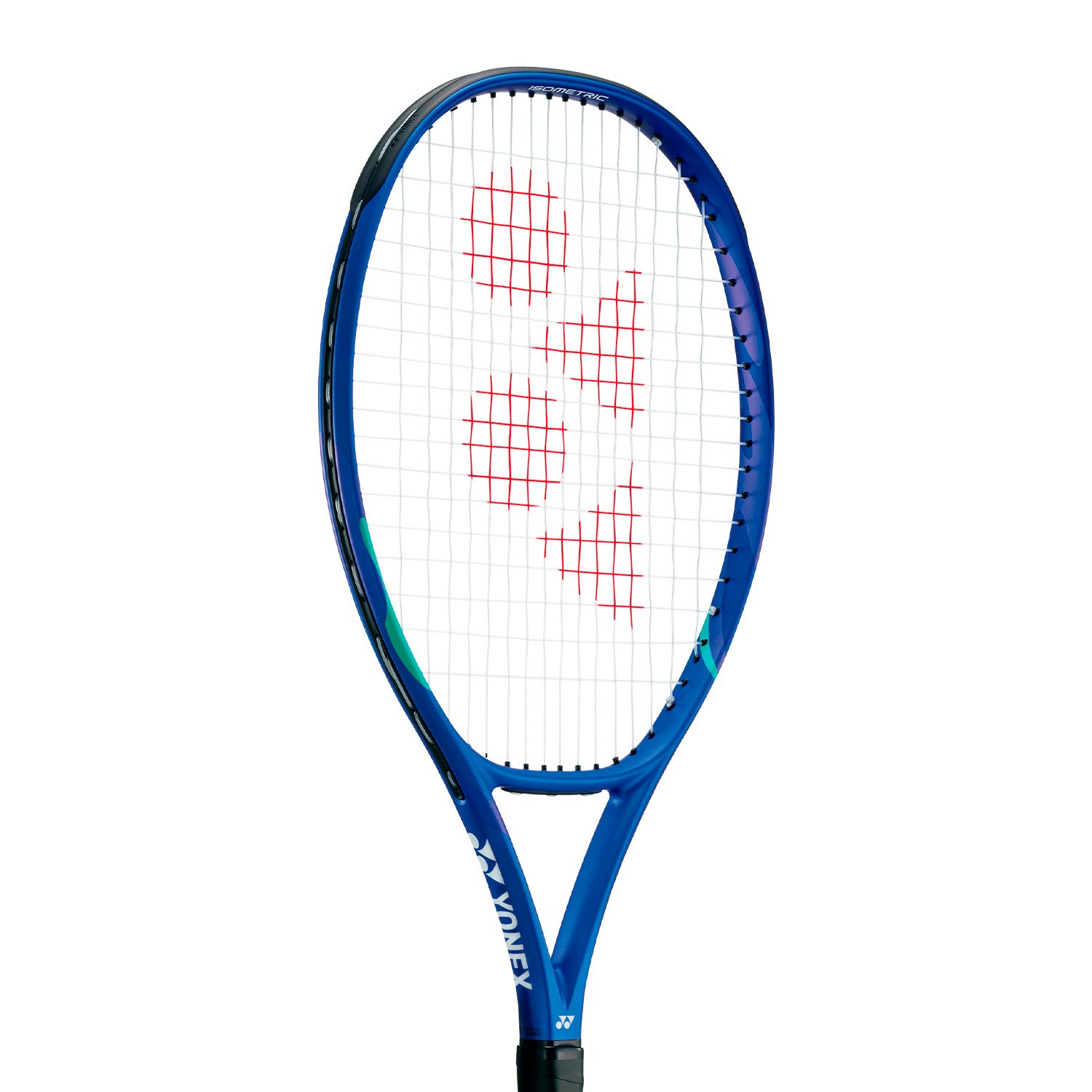
Yonex EZONE Junior 26
One inch from adult tennis: a 240 g graphite hybrid with the adult EZONE’s technologies, at junior length.
The top rung of the junior ladder, and the racket designed to be the last junior racket a player owns. Yonex positions the EZONE Junior 26 for players aged 10 to 11 and 135–145 cm tall — the tallest band in this guide — and specifies it like a scaled adult EZONE: graphite hybrid construction, the Isometric head at 100 sq in, Vibration Dampening Mesh in the handle, a G02 grip, and a 320 mm balance, the closest to adult-frame balance of any card here. At 240 g it is 10 g lighter than the HEAD 26 — a combination for the junior whose game is built on timing the ball rather than muscling it.
What makes this the bridge card is what happens next: a player who outgrows it does not buy another junior racket, but their first 27-inch adult frame — a step owned by the adult guides linked in the verdict, including our best tennis rackets for women for the many junior girls graduating into the women’s game. Buy the EZONE 26 when your junior measures into Yonex’s 135–145 cm band and plays the full court as their normal game; short of the band, the HEAD 26 or a season at 25 inches is the honest rung.
What we like
- Adult EZONE technologies — Isometric head, VDM — at junior length
- 320 mm balance: the closest to an adult frame in this guide
- Tallest maker band here (135–145 cm) makes it the true final junior step
- 240 g keeps the longest graphite-hybrid frame swingable
Worth knowing
- Yonex’s band starts at 135 cm — shorter 26-inch candidates fit the HEAD better
- It is the last junior racket, not a first: no rung above it in junior sizes
As an Amazon Associate we earn from qualifying purchases.
Side-by-Side Comparison Table
| Model | Best For | Length | Weight | Head Size | Material | Maker’s Guidance |
|---|---|---|---|---|---|---|
| Babolat Nadal Junior 19 | Youngest players | 19 in | 179 g | 535 cm² | Aluminium | 90–105 cm tall (Babolat) |
| Wilson Roger Federer 21 | 21-inch band | 21 in | 195 g strung | 90 sq in | AirLite Alloy | Ages 5–6 (Wilson) |
| HEAD Speed Junior 23 | Graphite step · 23″ | 23 in | 215 g | 95 sq in | Graphite composite | Ages 6 to 8 (HEAD) |
| Wilson US Open 25 | Big-head beginner · 25″ | 25 in | 220 g | 106 sq in | Aluminium | Ages 9–10 · 50–55 in tall (Wilson) |
| Yonex EZONE Junior 25 | Graphite pick · 25″ | 25 in | 230 g | 100 sq in | Graphite Hybrid | 9–10 yrs · 130–140 cm (Yonex) |
| HEAD Speed Junior 26 | 26-inch composite | 26 in | 250 g | 100 sq in | Graphite composite | Ages 9 to 11 (HEAD) |
| Yonex EZONE Junior 26 | Bridge to adult | 26 in | 240 g | 100 sq in | Graphite Hybrid | 10–11 yrs · 135–145 cm (Yonex) |
The last column is the one to buy by, copied from the makers rather than standardised by us. Read it as seven individual sizings, not one chart: HEAD’s 26 starts at age 9 where Yonex’s starts at 135 cm, and both are correct for their own racket. Measure your child, find their band on the chart of the racket you are considering, and the ladder does the rest.
Buying Guide: Choosing by the Maker’s Chart
1. Measure height before you shop
Every sizing decision here starts with a tape measure, because the makers anchor their bands to height even when they headline an age. Babolat sizes the 19 at 90–105 cm; Yonex sizes its 25 at 130–140 cm and its 26 at 135–145 cm; Wilson gives the US Open 25 a 50–55 inch height band alongside its age band. A tall eight-year-old and a small ten-year-old can legitimately need rackets two bands apart. Measure, find the band, and only then choose within it — aluminium for the starter at the length, graphite for the junior already playing the full court.
2. Buy the current band, one rung at a time
The two-inch steps are the system working as designed. A racket bought a band ahead is not a bargain; it is a season played with the wrong tool, and junior rackets are priced as consumables of a growth process precisely so each rung is affordable in turn. The one legitimate exception is the child who measures within a centimetre or two of the next band at the start of a season — coaches make that call at the top of a band, and the maker’s chart is still the reference. Everywhere else on the ladder, current band, current material, no skipping.
3. Check the grip in the hand
Junior grips run small and are labelled inconsistently — inches from Babolat and Wilson, a G02 code from Yonex — so the physical test matters more than the printed figure: fingers wrapped, small gap to the palm. Our grip size finder covers the measuring method for the whole family, which matters sooner than you think: the junior who graduates from the 26-inch cards above will be choosing an adult grip within a season or two, and parents buying their own racket for family sessions use the same method.
4. Match the rest of the kit to the stage
A racket is one line of the junior kit. The ball matters as much as the frame at the youngest bands — junior programmes play the early rungs with slower, lower-compression balls on smaller courts, a progression covered in our how to play tennis guide. Court shoes that fit and a cover for the racket complete the list. And if your family splits its racket-sport time with padel, the same sizing discipline applies there: our best padel rackets for kids guide runs the junior padel ladder with the same makers’-numbers-only rule.
Frequently Asked Questions
What size tennis racket should my child use?
Match the length to your child’s height using the maker’s own chart for the racket you are buying. As the makers in this guide publish them: 19 inches for players around 90–105 cm tall (Babolat’s Nadal Junior 19), 21 inches for ages 5–6 (Wilson’s Roger Federer 21), 23 inches for ages 6 to 8 (HEAD’s Speed Junior 23), 25 inches for ages 9–10 (Wilson’s US Open 25 and Yonex’s EZONE Junior 25, which Yonex sizes at 130–140 cm), and 26 inches for ages 9 to 11 (HEAD) or 10 to 11 at 135–145 cm (Yonex). Height is the more reliable measure, because children of the same age can be a full band apart.
How do I know when to move my child up a racket size?
Move up when your child measures into the next band on the maker’s chart — height first, age as the cross-check — and the current racket is visibly costing reach on wide balls and on the serve. Move one band at a time: the junior system is built in two-inch steps (19, 21, 23, 25, 26), and skipping a band puts more extra length into a child’s swing than the system ever intends. If your child sits between bands, the shorter racket is the safer buy while they grow into the longer one.
Aluminium or graphite — which is better for a kids’ tennis racket?
Neither is better in the abstract; they belong to different rungs. The shorter junior bands are aluminium — Babolat and Wilson build their 19 to 25 inch starter lines in aluminium and AirLite Alloy for lightness and simplicity. Graphite arrives where the makers place it: HEAD builds its Speed Junior 23 and 26 in graphite composite, and Yonex builds the EZONE Junior 25 and 26 as graphite hybrids, for juniors whose strokes and court coverage have developed. Buy the material of the rung your child’s length and level put them on.
What grip size do junior tennis rackets come in?
Junior grips are small, and each maker states them its own way: Babolat lists the Nadal Junior 19 at 3 5/8 inches, Wilson lists the US Open 25 at 3 7/8 inches, and Yonex lists its EZONE juniors as G02. There is no single junior grip standard, so check the figure for the specific model. The fit test is simple: your child wraps their fingers around the handle and a small gap should remain between the fingertips and the palm — fingertips digging in means too small, and fingers that cannot close around it means too large.
Can my child start with a 26-inch racket to save buying twice?
Only if they already measure for it. A 26-inch racket is sized by its makers for juniors around 135 cm and taller (Yonex: 135–145 cm; HEAD: ages 9 to 11). For a child who measures for a 19, 21 or 23, a 26 adds inches of leverage their swing has to muscle around on every shot, for the whole time it takes to grow into it. The bands exist so each stage is played with the right tool — the junior ladder is climbed one rung at a time, and every racket on it is built to be outgrown.
When should a junior move to an adult tennis racket?
When the 26-inch junior band is outgrown — your child is past the top of the makers’ junior height charts (above roughly 145 cm on Yonex’s junior guidance) and junior grips and weights feel small rather than right. The next step is a full 27-inch adult frame, chosen from the adult ranges rather than the junior ladder: our best tennis rackets pillar covers adult selection, and adult beginners have their own dedicated guide. Do not skip the 26-inch rung to get there early; it is the bridge the makers build for exactly this transition.
Do these junior rackets come pre-strung?
Yes — every racket in this guide is sold pre-strung, which is standard across the makers’ junior lines (Wilson states it in the Roger Federer line’s features, and Babolat, HEAD and Yonex supply their junior models strung, with a cover on the lines that include one). A junior can play with the racket the day it arrives. Restringing is an adult-game concern; a junior racket is normally outgrown before its factory strings become the limiting factor in a child’s game.
The Verdict
Measure the player, then buy the rung. The Babolat Nadal Junior 19 starts the ladder for the smallest players, on Babolat’s own 90–105 cm sizing. The Wilson Roger Federer 21 takes the next band on Wilson’s own ages 5–6 guidance, and the HEAD Speed Junior 23 introduces graphite where HEAD places it, at ages 6 to 8. At 25 inches the ladder forks honestly: the Wilson US Open 25 and its 106 sq in aluminium head for the beginner at the length, the Yonex EZONE Junior 25 graphite hybrid for the junior already playing the full court. The 26-inch pair — HEAD Speed Junior 26 and Yonex EZONE Junior 26 — finish the junior game, and beyond them the step is a 27-inch adult frame from our best tennis rackets pillar, via the beginner and women’s guides that own those selections. Size honestly, by the makers’ numbers, one rung at a time — a child swinging the right length learns tennis; a child swinging the wrong one learns to cope with it.
Affiliate disclosure: AliShuttler is reader-supported. When you buy through links on this page we may earn an Amazon commission at no extra cost to you. Specifications and sizing positions are taken from manufacturers’ published product information and were verified at the time of writing; manufacturers revise models between seasons, so confirm the exact specification on the product page before ordering.