You have outgrown your first racket — not because it broke, but because your rallies got longer, your volleys got deliberate, and the frame that forgave everything is now hiding how cleanly you actually strike the ball. This guide is the step up: seven mid-weight frames, 120 to 135 grams, that sit between the light beginner builds and the pro tier, organised by the decisions an improving player actually faces — head-heavy power or head-light manoeuvrability, teardrop or traditional bridged heads, and factory strings good enough to keep or basic enough to plan around.
⚡ TL;DR — The Short Answer
For the best all-round step up, buy the HEAD Radical 135 X — a 135 g, 490 cm² head-heavy frame HEAD positions for intermediate-to-advanced players. For manoeuvrability and volleying, the head-light Dunlop Blackstorm Titanium pairs 125 g with the joint-biggest head here at 500 cm². Head-heavy power comes from the Tecnifibre Dynergy APX 130 (365 mm balance) and, at the extreme, the Wilson Hyper Hammer 120 (380 mm balance on a 120 g frame). Traditionalists should read the bridged Tecnifibre Suprem 130 CurV, compact-head precision players the Prince Vortex Pro 650 2.0 and the Karakal T Pro 120.
Quick Picks — Best Squash Rackets for Intermediate Players at a Glance
135 g, 490 cm², head-heavy — the complete intermediate-to-advanced package in HEAD’s Radical line.
Head-light and 125 g with a full 500 cm² PowerMax head — built for volleys and quick hands.
A 365 mm head-heavy balance, a Jumbo Shaft and a premium X-One Biphase factory string.
The bridged Storm Bridge head at 130 g and a neutral 355 mm — control with a longer main string.
The smallest head here (464.5 cm²), a Power Ring throat and a 366 mm strung balance, verified on Prince’s own store.
120 g unstrung with the mass parked at a 380 mm balance point — hammer power in a light frame.
A 470 cm² head, a 360 mm balance and Karakal’s braided factory string in a one-piece graphite build.
In This Guide
The Step Up: Where This Tier Sits
Every racket tier exists because the tier below it starts costing you shots. A beginner racket is engineered to forgive: the biggest heads, the most helpful balances, frames chosen so that a developing swing still produces a playable ball. That forgiveness is exactly right for a first season — and it is the subject of our guide to the best squash rackets for beginners, which owns first-racket selection outright. But forgiveness has a ceiling. When your drives are reaching the back wall on technique rather than on the racket’s trampoline, when you are volleying on purpose instead of by accident, and when your errors are placement errors rather than contact errors, the beginner brief starts blurring the feedback you need to keep improving. That is the moment this page is for.
The intermediate tier answers with specification, not marketing. Frame weights settle into a mid-weight band — 120 to 135 grams in this guide — below the heavy starter builds and level with, or just above, the lightest tour frames, because an improving player needs a racket that is stable at full swing without slowing the hand at the front of the court. Head sizes stay large by pro standards — 464.5 to 500 cm² here — but the string patterns, balances and head shapes start to specialise: you are no longer buying the most forgiving racket, you are buying the racket whose compromises match your game. And the tier has a ceiling of its own. The frames in our pro squash rackets guide — lighter, stiffer, smaller-headed precision tools built for grooved tour swings — own the advanced end; this page stops deliberately short of them.
One more boundary, because it is the one readers most often blur. Price is not a tier. A discounted flagship and a mid-range frame can sit in the same basket for entirely different reasons, and the budget decision — what a given amount of money buys — belongs to our guide to the best squash rackets under $100, which ranks that band on its own terms. Nothing on this page is ranked by price, and no prices are printed: these seven are ranked by where their published specifications sit in the step-up decision. Read the beginners guide if you are buying a first racket, the budget guide if the spend is the decision, and this guide if the question is which mid-tier specification your improving game has grown into.
The Four Specs That Decide the Step Up
Frame weight — and which weight you are being quoted. The seven frames here run from 120 g to 135 g, and every card states the figure the way its maker states it: frame weight for most, unstrung weight where the maker or its spec tables say unstrung. Strings and a grip typically add roughly 15–25 g to a bare frame, so a 120 g unstrung racket and a 135 g frame-weight racket are closer on court than the numbers suggest — but they are not the same racket, because where the grams sit matters as much as how many there are. As a working map of this guide: 120 g frames (Wilson, Karakal) trade stability for speed and lean on head-heavy balances to keep their power; 125–130 g is the all-round centre (Dunlop, Prince, both Tecnifibres); 135 g (the HEAD) is the stability end of the intermediate band.
Balance — the decision this tier is really about. Makers state balance as a character, a point in millimetres, or both, and this guide cards both forms exactly as published. Head-light — the Dunlop Blackstorm Titanium — keeps mass toward the handle, so the head changes direction quickly: the volleyer’s and counter-hitter’s choice. Head-heavy builds park mass behind the ball, and this guide has them at every weight: the Dynergy APX 130 at 365 mm, the Prince Vortex Pro 650 2.0 at a strung 366 mm, the Karakal T Pro 120 at 360 mm, and the Wilson Hyper Hammer 120 at a full 380 mm, the most head-heavy specification carded here. Between them sits the Suprem 130 CurV at a neutral 355 mm. Neither end is better — they are answers to different games, and the buying guide below turns them into choosing rules.
Head shape — teardrop, bridged, and Prince’s third way. Most of this tier is teardrop: an open throat lengthens the main strings, which lengthens the hitting zone and adds power — the Dunlop’s open throat and PowerMax fan pattern are the clearest example. The traditional bridged shape, carded here by the Suprem 130 CurV, closes the throat with a bridge; Tecnifibre’s Storm Bridge design is its modern take, which Tecnifibre says lengthens the main strings for power while keeping the traditional frame’s stability and precision. Prince’s Power Ring — an inverted ring in the throat of the Vortex Pro 650 2.0 — is the third route: Prince says it produces longer mains of uniform length for power across the string bed. At buying-decision level the rule is simple: teardrop for power and hitting-zone length, bridged for a stiffer, more predictable response, Power Ring for Prince’s version of both.
Factory strings — the upgrade trigger built into this tier. Read the factory string line on each card, because at this level it splits the field. Two cards arrive wearing their maker’s premium performance strings: the Dynergy APX 130 comes strung with Tecnifibre X-One Biphase, and the Suprem 130 CurV with Tecnifibre 305, the string Tecnifibre describes as its flagship squash string. Others arrive on honest basic synthetics — Prince fits the Vortex Pro 650 2.0 with SynGut and even names its recommended upgrade (Prince Lightning) on its own product page, and Dunlop fits the Blackstorm Titanium with its X-Life string. A basic factory string is not a defect; it is a planned first upgrade, and the moment it frays, notches or goes dead is the moment a restring transforms the racket — our guide to the best squash strings covers the upgrade options in full.
The 7 Best Squash Rackets for Intermediate Players, Compared
Seven frames, one shared brief — mid-weight step-up specifications — and four different answers to it. The ranking runs from the most complete all-round step up to the compact-head specialists, not from best to worst: read the card that matches your game first.
HEAD Radical 135 X
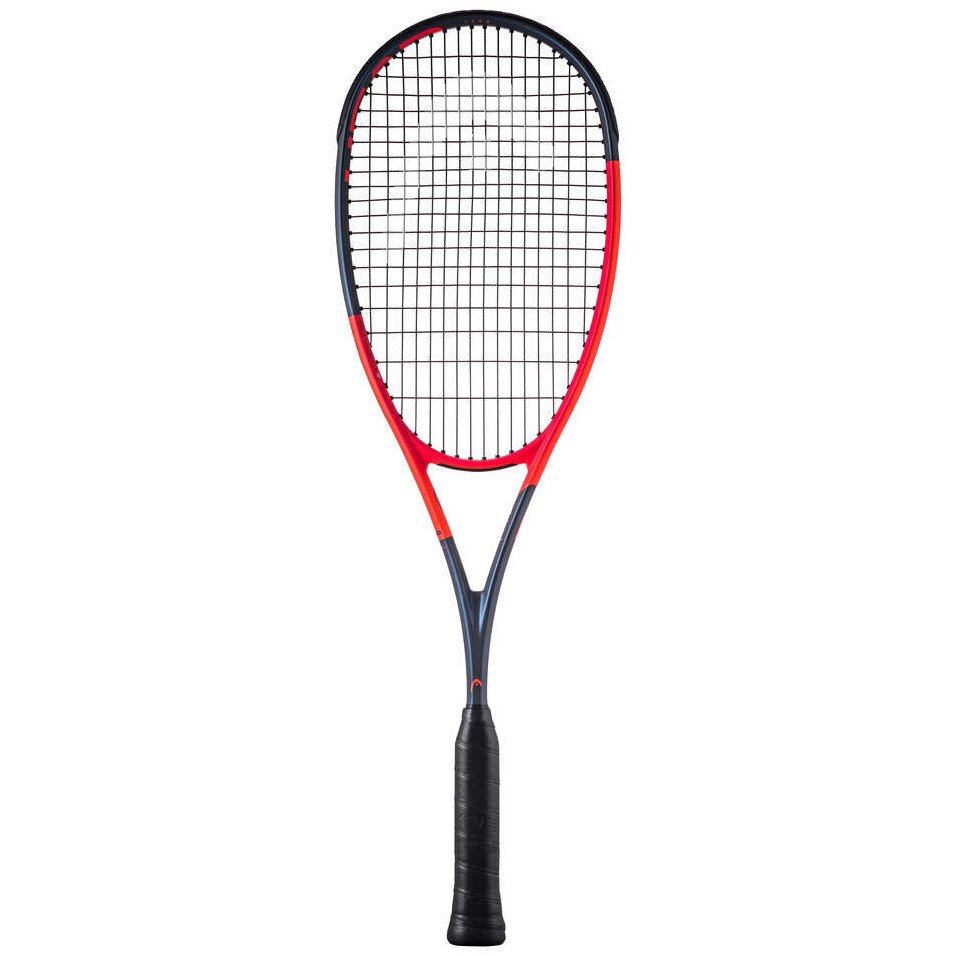
The complete step-up package — the heaviest frame here, an oversized 490 cm² head, and a head-heavy balance HEAD aims squarely at intermediate-to-advanced players.
The Radical 135 X earns the top card because its published specification is the most complete intermediate brief in this guide, starting with its positioning: HEAD’s spec, as its retailers carry it, describes a racket made with intermediate-to-advanced players in mind — the exact reader of this page. The recipe is stability with intent. At 135 g it is the heaviest frame carded here, the head is what HEAD calls oversized at 490 cm², and the balance is head heavy, so the racket carries momentum through drives and volleys instead of asking your wrist to manufacture it. For a player whose swing has become full and committed but whose contact is still spreading across the string bed, that combination — mass, head size, head weight — is the forgiving end of the serious-racket spectrum.
The construction is HEAD’s current flagship recipe one tier down: Graphene Inside, which HEAD says strengthens the frame and optimises energy transfer, with Auxetic 2.0 in the build, which HEAD says delivers a solid impact feel and enhanced feedback — the feedback being the point of a step-up racket, because it tells you where on the bed you actually struck the ball. HEAD describes this model as one for front-court tournament players seeking power under control, and the 16×19 pattern is the control half of that sentence: denser than the open patterns on the Dunlop and Wilson below, so the ball holds its line when you take it early. It arrives strung with HEAD’s own Reflex 18. Two spec-sheet notes, printed openly: HEAD does not publish a balance point in millimetres for this model, so none is claimed here — head heavy is the maker’s word — and if the 135 g end of the band sounds like a lot, it is the deliberate trade this card makes: stability now, with the lighter frames below waiting if your hands are quicker than your swing is long.
What we like
- Maker positioning matches this guide’s reader exactly: intermediate to advanced
- 135 g and a head-heavy balance give the most stable hit in this guide
- 490 cm² head keeps a step-up margin for error
- Auxetic 2.0 and Graphene Inside — HEAD’s current frame technologies, not leftovers
Worth knowing
- The heaviest frame here — quick-handed volleyers may prefer the Dunlop
- HEAD publishes no balance point in mm for this model; head heavy is the stated figure
As an Amazon Associate we earn from qualifying purchases.
Dunlop Blackstorm Titanium
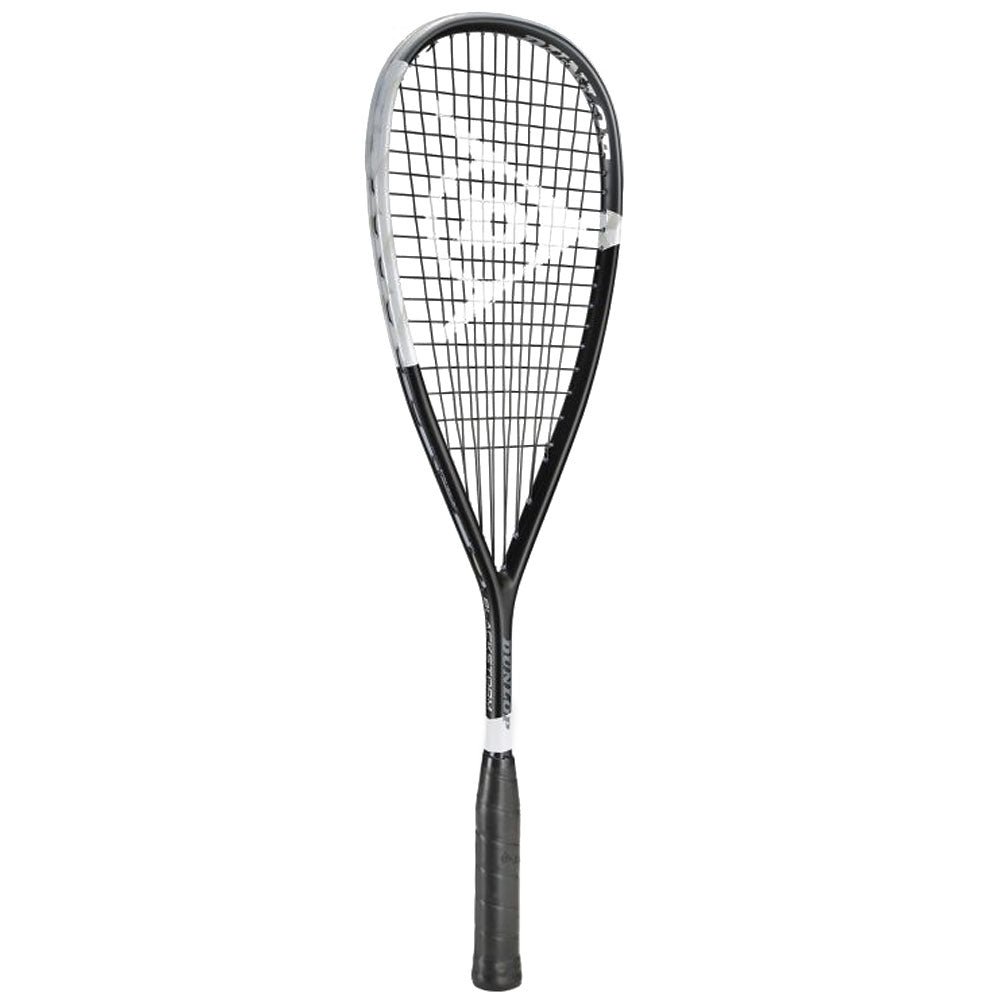
The head-light counterpoint — 125 g, the joint-biggest head in this guide, and an open-throat PowerMax design Dunlop positions for intermediate players.
If the Radical is this guide’s stability answer, the Blackstorm Titanium is its speed answer, and the specification makes the contrast cleanly. The balance is head light — the only head-light card here — on a 125 g carbon fibre frame, which is the combination that changes direction fastest at the front of the court. Dunlop positions the model for intermediate players and describes the design brief around aggressive volley play: a head that gets into position early, recovers quickly, and does not drag on the second and third volley of an exchange. For the improving player whose game is moving forward — taking balls earlier, volleying more, counter-hitting under pressure — this is the specification that rewards the change.
The power half of the brief comes from geometry rather than mass. The head is the full 500 cm², the largest the sport sees in practice, strung in Dunlop’s 14×18 PowerMax pattern, which fans the main strings through the open throat so they run longer and move more at impact; Dunlop says that design produces a larger sweet spot, and on a head-light frame it is what keeps drives reaching the back wall without head weight to help them. The factory string is Dunlop’s X-Life, which Dunlop describes as built for playability and durability — an honest club string, and the card’s one planned upgrade: when it dulls, a performance multifilament is the single biggest improvement you can make to this racket. One naming caution before you order: the Blackstorm Titanium name has covered earlier 135 g generations, so check the listing against the current spec on this card — 125 g, head light, 500 cm².
What we like
- The only head-light card — the fastest handling in this guide
- 500 cm² PowerMax head keeps power and forgiveness on a light frame
- Maker positioning is explicitly intermediate
- Open-throat teardrop suits the volleying, front-court game
Worth knowing
- Rear-court power comes from your swing, not from head mass
- Earlier Blackstorm Titanium generations were 135 g — verify the listing’s spec before ordering
As an Amazon Associate we earn from qualifying purchases.
Tecnifibre Dynergy APX 130
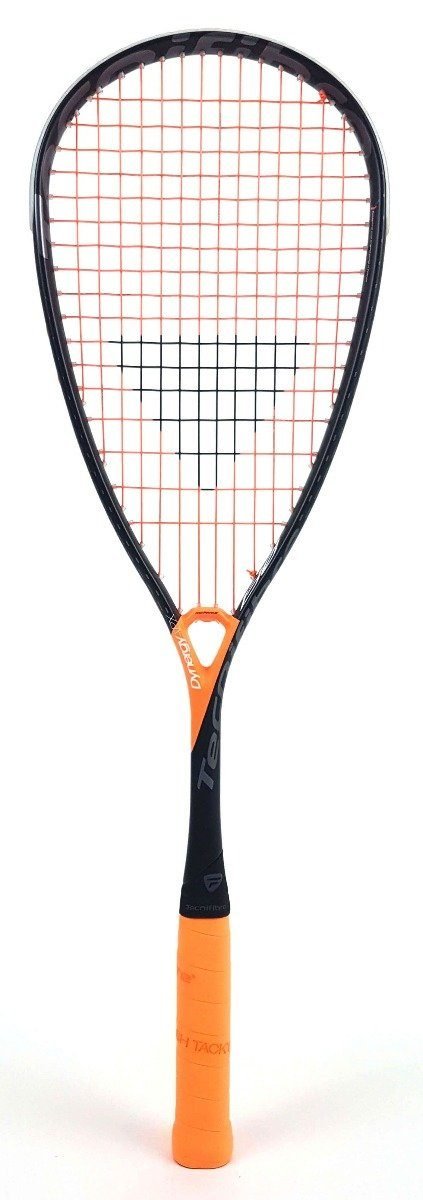
Tecnifibre’s power family at step-up weight — a 365 mm head-heavy balance, a Jumbo Shaft, and a premium multifilament already in the frame.
Tecnifibre organises its range by playing intent, and Dynergy is the power family — the line below the Carboflex flagship tier, recommended by Tecnifibre’s retailers for offensive players who prefer to strike with power. The APX 130 is that family’s step-up specification: 130 g, a 490 cm² head, and a balance point of 365 mm (364 mm in some Tecnifibre tables) that puts it firmly in head-heavy territory without reaching the Wilson’s extreme below. Tecnifibre rebuilt the range around its Arch Power X throat geometry and a Jumbo Shaft, and its own copy for the APX generation records the telling change: the string pattern moved from the old 16×16 to 14×17, which Tecnifibre says trades a measure of raw power for touch and control. That is precisely the intermediate bargain — power, with the edges filed toward control.
The detail that lifts this card above a standard mid-tier listing is in the string bed. The Dynergy APX 130 leaves the factory strung with Tecnifibre X-One Biphase — a premium multifilament that most makers reserve for their flagship frames or sell as an upgrade — so the string-quality half of the step-up decision is already made for you: there is no planned first restring, and the racket you demo is the racket you keep. The Superlight Bumper trims weight at the top of the head where bumper strips usually add it, keeping the 365 mm balance honest rather than padded. Choose this card if your improving game is built from the back — hard drives, length first, pressure by pace — and you want the head-heavy help without stepping to a tour frame’s smaller head.
What we like
- 365 mm head-heavy balance is real drive power at a mid-band 130 g
- Premium X-One Biphase factory string — no planned first upgrade
- APX redesign deliberately rebalanced the power brief toward control (14×17)
- 490 cm² head keeps the power usable while contact is still developing
Worth knowing
- Head-heavy frames are slower to recover in frantic front-court exchanges
- One retailer table prints the old 16×16 pattern — the APX spec is 14×17
As an Amazon Associate we earn from qualifying purchases.
Tecnifibre Suprem 130 CurV
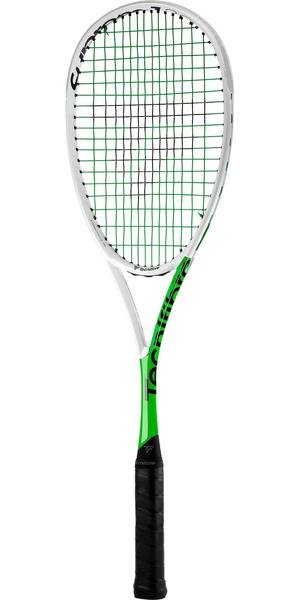
The traditionalist’s step up — a bridged Storm Bridge head, a neutral 355 mm balance, and Tecnifibre’s flagship 305 string as standard.
Suprem is Tecnifibre’s traditional family — the bridged-head line that has run alongside the teardrop Carboflex range for decades — and the 130 CurV is its intermediate-weight expression: retailer listings carrying Tecnifibre’s positioning describe the model for intermediate-to-expert players, which makes it the natural top rung of this guide rather than a detour into the pro tier. The specification is the control counterweight to the Dynergy above. The frame weight is the same 130 g, but the balance sits at a neutral 355 mm, the head is a full 500 cm², and the shape is the traditional bridged form: a bridge across the throat that stiffens the frame’s response and makes the ball’s exit more predictable for players whose game is length, width and patience rather than pace.
Tecnifibre’s modern twist on the old shape is the Storm Bridge, its redesigned yoke which Tecnifibre says lengthens the central main strings for more power than a classic bridge allows — an attempt, in the maker’s own design language, to keep the bridged frame’s precision while closing its traditional power gap. The CurV construction is Tecnifibre’s carbon layup for the head, which it says adds stability and precision. And like its Dynergy sibling, the Suprem arrives on a premium factory string: Tecnifibre 305 in 1.20 mm, the string Tecnifibre built its string reputation on. One generation check matters here: earlier Suprem 130 models carried a smaller 466 cm² head — the CurV generation carded here is the 500 cm² version, and that is the spec to match on a listing.
What we like
- The bridged/traditional option, with positioning stated as intermediate to expert
- Neutral 355 mm balance — neither end of the court is favoured
- Storm Bridge is Tecnifibre’s answer to the classic bridge’s power gap
- Flagship Tecnifibre 305 factory string, like the Dynergy above
Worth knowing
- Older Suprem 130 generations had a 466 cm² head — match the CurV spec when ordering
- Players who want head-heavy drive help should take the Dynergy instead
As an Amazon Associate we earn from qualifying purchases.
Prince Vortex Pro 650 2.0
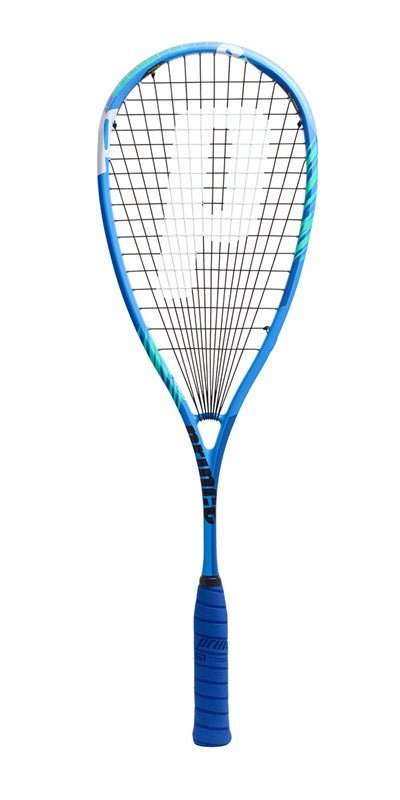
The precision step up, verified on Prince’s own store — the smallest head in this guide, a Power Ring throat, and the maker’s own upgrade path printed on the box.
This is the one card in the guide verified directly on the maker’s own storefront, and Prince’s published specification is unusually complete — which suits a racket that asks more of its player than any other here. The head is 464.5 cm², the smallest in this guide by a clear margin, and that is the point of the card: a compact head is the intermediate tier’s precision instrument, rewarding centred contact with a cleaner, flatter response and punishing the lazy contact a 500 cm² head would have rescued. Step to it when your contact point has genuinely tightened — when you are hitting the middle of a big head often enough that its forgiveness has stopped teaching you anything.
The rest of Prince’s spec balances the demand. The frame is 125 g in 100% graphite reinforced with TeXtreme Gen Z, which Prince says improves hoop strength and impact resistance; the strung balance is 366 mm, head-heavy enough to keep drives honest; and the Power Ring throat — Prince’s inverted ring, which it says creates longer main strings of uniform length — works to keep power available across a bed that would otherwise be all control. The Air Handle’s air quadrants are there, Prince says, to damp vibration before it reaches your arm. The factory string is the honest-basic end of this guide’s string split — Prince SynGut — and Prince itself names the upgrade on the same page: its recommended string is Prince Lightning, at a recommended tension of 25 ± 5 lbs. Two generation warnings, both from Prince’s own listings: this card is the 2025 2.0; the original Vortex Pro 650 was a different specification (330 mm balance, 74.5 sq in head), so match the 2.0 spec — 125 g, 464.5 cm², 366 mm strung — when you order.
What we like
- Full specification verified on Prince’s own store, including the strung balance
- 464.5 cm² head is this tier’s genuine precision option
- Power Ring throat keeps power available across a control-sized bed
- Prince names its own recommended string upgrade and tension on the product page
Worth knowing
- The smallest sweet spot here — contact needs to be honestly grooved first
- Basic SynGut factory string; budget the Lightning restring Prince recommends
As an Amazon Associate we earn from qualifying purchases.
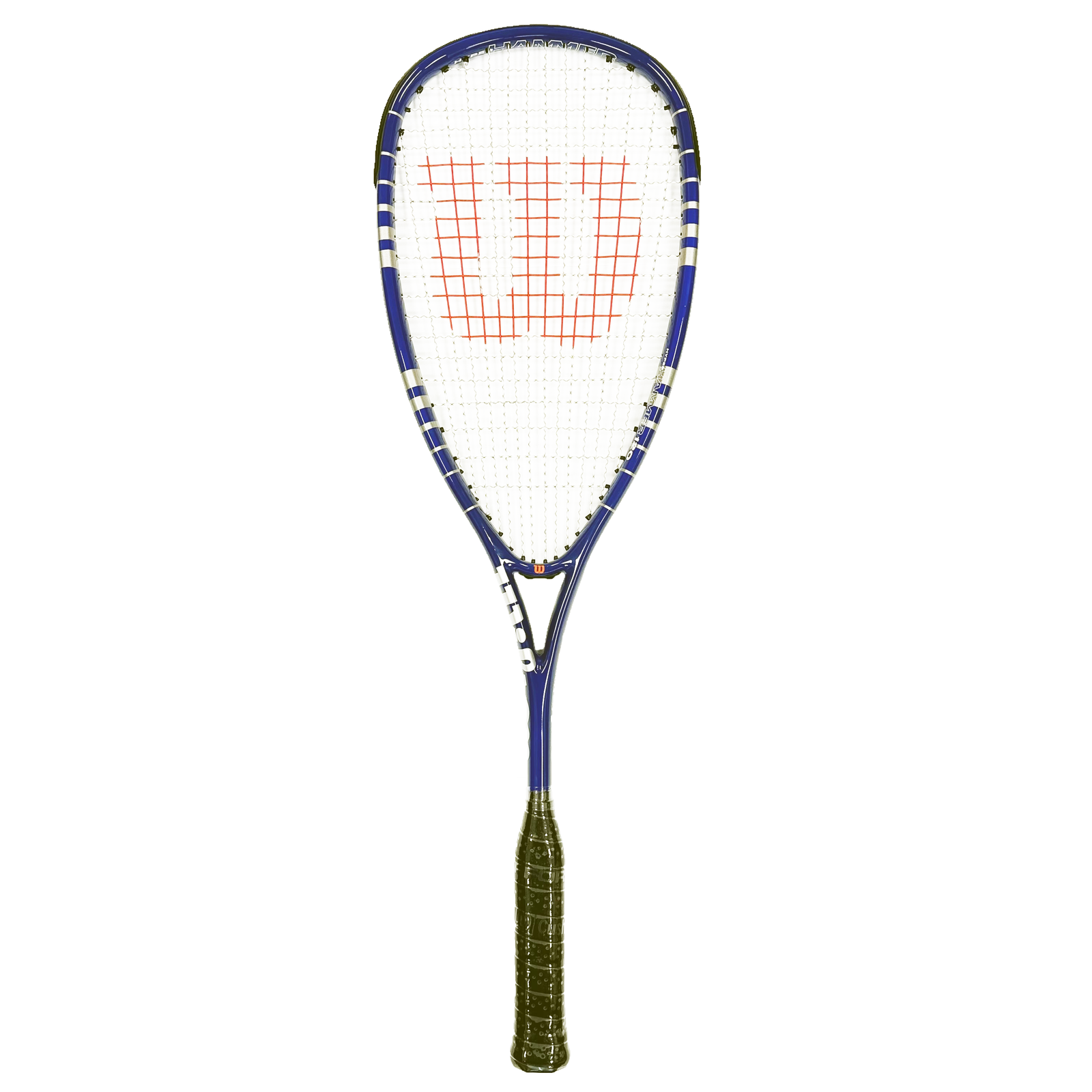
Wilson Hyper Hammer 120
The hammer concept taken seriously — 120 g unstrung, the most head-heavy balance in this guide at 380 mm, and a dense 14×21 pattern to keep it honest.
Wilson’s Hammer idea is the oldest design argument in this guide, and the specification still makes it better than most newer frames argue anything: take a light frame — 120 g unstrung, the joint-lightest card here — and put an unusual share of its mass in the head, at a balance point of 380 mm, the highest published figure in this guide. The result, in Wilson’s design language, is a racket that swings light between shots and lands heavy on the ball: the head’s momentum does the work on drives and volleys that a 120 g even-balance frame would leave to your arm. Specialist retailers carrying Wilson’s specification tag this model explicitly at intermediate level, and it remains a current Wilson line model — this is not a vintage curiosity, it is a living alternative philosophy at the light end of the tier.
Two features stop the hammer from being a blunt instrument. The string pattern is a dense 14×21 — the tightest in this guide — which holds the ball flatter and straighter off the bed, the control counterweight to all that head mass. And Wilson’s Power Holes, enlarged grommet openings at three points of the frame, let the strings move more freely at contact, which Wilson says enlarges the effective hitting zone on a 497 cm² head that is already near the maximum. The honest trade-offs are the mirror of the Dunlop’s: a 380 mm balance is slow to reposition in frantic front-court scrambles, and players with a wristy, flick-based game will feel the head arriving late. Buy it if your intermediate game is built on drives, volleys taken with a short swing, and power you would rather borrow from a balance point than build in the gym.
What we like
- 380 mm balance — the most head-heavy specification here, on a 120 g frame
- Dense 14×21 pattern counters the head mass with control
- 497 cm² head keeps the hitting zone generous
- Retailer spec tables carrying Wilson’s data tag it at intermediate level
Worth knowing
- The head-heavy extreme is slow in front-court scrambles
- One retailer table prints 135 g for this model code — the agreed unstrung figure is 120 g
As an Amazon Associate we earn from qualifying purchases.
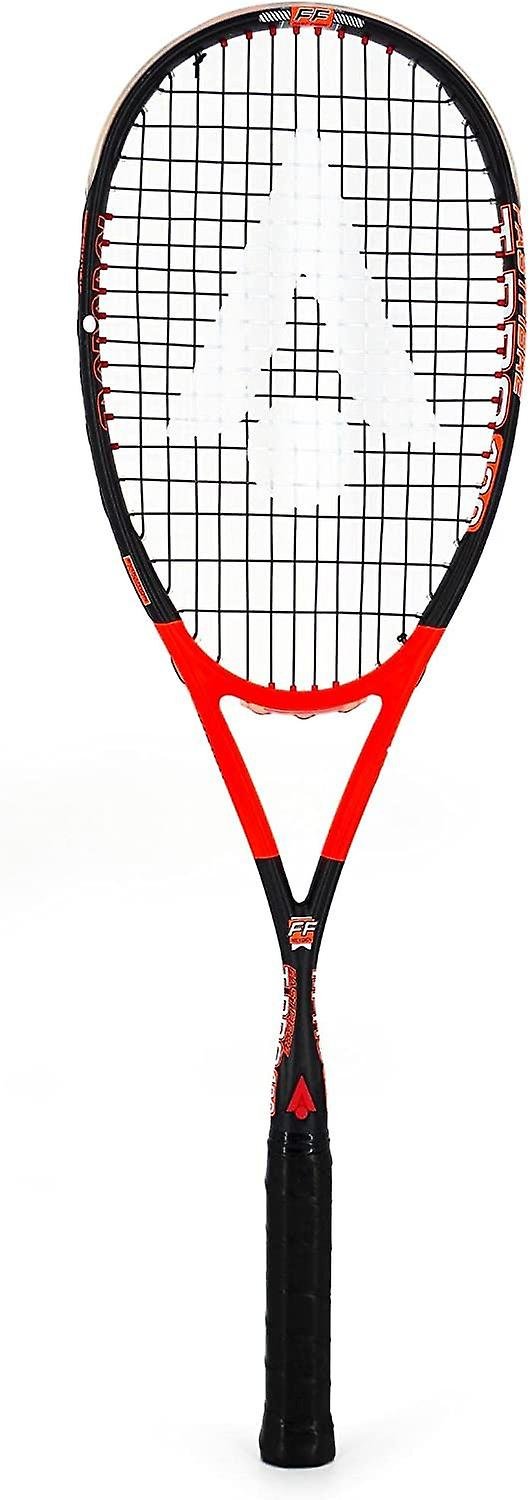
Karakal T Pro 120
Karakal’s fusion frame — a Tec Pro balance point and a T120 weight in one 120 g build, with a compact 470 cm² head and a braided performance factory string.
Karakal describes the T Pro 120 as a deliberate fusion: the balance point taken from its Tec Pro frame at 360 mm, the weight taken from its T120 at 120 g — and that pairing is exactly the intermediate recipe for a player who wants a head-heavy feel without a heavy racket. It closes this guide as the second compact-head option: at 470 cm² it sits between the Prince’s 464.5 cm² precision head and the 490–500 cm² mainstream, close enough to the big heads to stay playable on an off day, small enough to sharpen the feedback the step up is for. The construction is Karakal’s Nexgen Fast Fibre Graphite in a one-piece build, which Karakal says returns to shape faster after ball strike — the maker’s claim, stated as the maker states it.
Karakal loads the T series with its named systems, and the card lists them as the maker describes them rather than as tested facts: an Inner Muscle System and four Nano Graphite Nodes which Karakal says smooth vibration and increase stiffness, an ‘A’ Power Shaft with Power Wings for stability, a built-in frame anti-vibration dampener, and a Muscle Tec string system Karakal says enlarges the sweet spot. The factory string continues the premium pattern set by the Tecnifibre pair: Karakal’s Hot Zone Braided, a braided performance string rather than a placeholder synthetic, fitted with Karakal’s PU Super Grip. Choose the T Pro 120 if you want the compact-head step up with head-heavy assistance, from the brand whose entire catalogue is built around light frames with the mass where it counts.
What we like
- Maker-stated design brief is the intermediate recipe in one line: 360 mm balance at 120 g
- 470 cm² head sharpens feedback without shrinking to the Prince’s extreme
- Braided performance factory string, not a basic synthetic
- Full published spec — beam, balance point and pattern all stated by the maker
Worth knowing
- Compact head plus head-heavy balance is a demanding pairing for a loose swing
- Karakal’s system names describe design intent; the spec numbers are the verifiable part
As an Amazon Associate we earn from qualifying purchases.
Side-by-Side Comparison Table
| Model | Best For | Frame Weight | Head Size | Balance (Maker-Stated) | String Pattern |
|---|---|---|---|---|---|
| HEAD Radical 135 X | Best overall | 135 g | 490 cm² | Head heavy | 16×19 |
| Dunlop Blackstorm Titanium | Manoeuvrability / volleys | 125 g | 500 cm² | Head light | 14×18 PowerMax |
| Tecnifibre Dynergy APX 130 | Head-heavy power | 130 g | 490 cm² | 365 mm, head heavy | 14×17 |
| Tecnifibre Suprem 130 CurV | Traditional / bridged control | 130 g | 500 cm² | 355 mm | 14×18 |
| Prince Vortex Pro 650 2.0 | Compact-head control | 125 g | 464.5 cm² | 366 mm (strung) | 16×17 |
| Wilson Hyper Hammer 120 | Lightweight head-heavy | 120 g (unstrung) | 497 cm² | 380 mm, head heavy | 14×21 |
| Karakal T Pro 120 | Compact precision | 120 g (unstrung) | 470 cm² | 360 mm | 14×18 |
Read the balance column as this tier’s map. One head-light frame, one neutral frame, and five balances from 355 mm to 380 mm that lean toward the head — because the intermediate step up, as the makers themselves specify it, is mostly about deciding how much head mass your improving swing can use. The weight column needs the same care the cards give it: two of these figures are stated unstrung, one balance is stated strung, and the comparison only works if you compare like with like — which is why every card prints its maker’s basis rather than a converted number.
Buying Guide: Weight, Balance, Shape and Strings
1. Weight: read the maker’s basis before you compare
The 120–135 g band on this page is a frame-weight band, and the first buying skill at this tier is refusing to compare unlike numbers. A frame weight is the bare racket; an unstrung weight is the same idea stated Wilson’s and Karakal’s way; a strung, gripped racket typically plays 15–25 g heavier than either. Prince even states the Vortex Pro 650 2.0’s balance strung — 366 mm — while the others state theirs unstrung, and strung balances read higher. Within the band, choose by role: 120 g (Wilson, Karakal) if your game is quick hands and you accept a head-heavy balance doing the power work; 125–130 g (Dunlop, Prince, both Tecnifibres) for the all-round centre of the tier; 135 g (the HEAD) if stability at full swing is what your current racket lacks.
2. Balance: pick your end of the court
Head-light — the Blackstorm Titanium is this guide’s one example — suits the player moving forward: volleys, interceptions, counter-hitting, and quick recovery between front-court shots. Head-heavy suits the player building pressure from the back: drives that hold their pace to the back wall, volleys punched with a short swing, and a head that stays stable when you are stretched. The scale inside this guide is honest and usable — 355 mm neutral (Suprem), 360 mm (Karakal), 365–366 mm (Dynergy, Prince), 380 mm at the extreme (Wilson) — and the further up it you go, the more the racket hits for you and the slower it changes direction. If you are torn between two cards, the balance line in the comparison table is the tiebreaker that matches how you actually win points.
3. Head shape: teardrop for length, bridged for predictability, Power Ring between
Shape is the third decision, and at buying level it is a simple three-way. Teardrop heads with an open throat (Dunlop, Dynergy, HEAD) lengthen the main strings and the hitting zone — more power, more margin high on the bed. Traditional bridged heads (the Suprem 130 CurV) stiffen the throat’s response and send the ball where the face points, which is why control players stay loyal to the shape; Tecnifibre’s Storm Bridge is the modern attempt to add main-string length back into it. Prince’s Power Ring (Vortex Pro 650 2.0) inverts the throat ring to lengthen the mains uniformly — Prince’s route to power across a deliberately small head. Head size interacts with shape: the two compact heads here (464.5 and 470 cm²) are precision instruments for grooved contact, while the 490–500 cm² heads keep a step-up margin for error. Buy the smallest head your contact honestly earns.
4. Factory strings: the upgrade trigger, planned or prepaid
At this tier the factory string is a deliberate part of the purchase, in one of two ways. On the Dynergy APX 130 (X-One Biphase), the Suprem 130 CurV (Tecnifibre 305) and the Karakal T Pro 120 (Hot Zone Braided), the maker has prepaid the upgrade: the string in the frame is a performance string, and your first restring is a like-for-like replacement when it wears. On the Prince Vortex Pro 650 2.0 (SynGut) and the Dunlop Blackstorm Titanium (X-Life), the factory string is a competent placeholder and the upgrade is planned: play it until it frays, notches or loses its response, then restring with a performance multifilament — Prince even names its own recommendation, Lightning at 25 ± 5 lbs. Either way, the trigger is the string’s condition, not the calendar: a dead string bed is the most common reason an intermediate racket gets wrongly blamed and replaced.
5. Know when you have outgrown this tier, too
The step-up logic does not stop here. You have outgrown the intermediate tier when the 490–500 cm² heads start feeling vague at full pace, when you are choosing tensions and patterns deliberately rather than by default, and when your errors are tactical rather than technical — at that point the lighter, stiffer, smaller-headed frames in the pro tier become the honest next read, and the skills to use them are the ones built by the footwork and rally patterns in our guide to how to play squash. Until then, a mid-tier frame matched to your balance and shape is not a compromise purchase; it is the racket your current game can actually exploit, which is the only definition of the right racket that survives contact with a real rally.
Frequently Asked Questions
What weight squash racket is best for intermediate players?
Most intermediate players land in the 120–135 g frame-weight band carded in this guide. Choose 120 g if you want quick hands and are happy for a head-heavy balance to supply the power, 125–130 g for the all-round centre of the tier, and 135 g — the HEAD Radical 135 X — if stability at full swing is what your current racket lacks. Remember that strings and a grip add roughly 15–25 g to any frame figure.
Should I choose a head-heavy or head-light squash racket?
Choose head-light if your game is moving forward — volleys, interceptions and counter-hitting, where the head has to change direction quickly; the Dunlop Blackstorm Titanium is this guide’s head-light card. Choose head-heavy if you build pressure from the back with drives and short-swing volleys: the balances here run from 355 mm on the neutral Tecnifibre Suprem 130 CurV to 380 mm on the Wilson Hyper Hammer 120. Neither is better in absolute terms; they answer different games.
What is the difference between a teardrop head and a traditional bridged head?
A teardrop head has an open throat, which lengthens the main strings and the hitting zone for more power and margin — the Dunlop Blackstorm Titanium and Tecnifibre Dynergy APX 130 are this guide’s examples. A traditional bridged head closes the throat with a bridge for a stiffer, more predictable response, as on the Tecnifibre Suprem 130 CurV, whose Storm Bridge design is intended to lengthen the mains for added power. Prince’s Power Ring, on the Vortex Pro 650 2.0, is a third route to longer, uniform main strings.
When should I upgrade from a beginner squash racket?
Upgrade when the beginner brief starts hiding your contact quality: when your drives reach the back wall on technique, when you volley deliberately rather than by accident, and when your errors are placement errors instead of contact errors. At that point a mid-weight frame with a specialised balance and head shape gives you feedback a forgiving beginner racket cannot. Our beginners guide owns first-racket selection; this guide owns the step up from it.
Are factory strings on intermediate rackets good enough?
It depends on the model, and the cards in this guide flag which is which. The Tecnifibre Dynergy APX 130 (X-One Biphase), Suprem 130 CurV (Tecnifibre 305) and Karakal T Pro 120 (Hot Zone Braided) arrive on performance strings you can play until they wear. The Prince Vortex Pro 650 2.0 (SynGut) and Dunlop Blackstorm Titanium (X-Life) arrive on competent basic strings, and a performance restring when they fray, notch or go dead is a planned first upgrade — Prince itself recommends its Lightning string for the Vortex.
What is the difference between intermediate and pro squash rackets?
Pro-tier rackets are generally lighter in the hand, stiffer, and smaller-headed, with denser string patterns — precision tools that assume a grooved, full-speed swing and offer little forgiveness for off-centre contact. Intermediate rackets keep larger heads (464.5–500 cm² in this guide), mid-band frame weights of 120–135 g, and balances and shapes specialised by playing style rather than by maximum control. The pro tier is a destination, not a shortcut: its rackets reward technique that is already finished.
Which of these seven rackets is right for my game?
Match the card to the game. All-round step up: HEAD Radical 135 X. Volleys and quick hands: Dunlop Blackstorm Titanium. Drive-based power: Tecnifibre Dynergy APX 130, or the Wilson Hyper Hammer 120 for the most head-heavy version of it. Traditional control and a neutral balance: Tecnifibre Suprem 130 CurV. Compact-head precision: Prince Vortex Pro 650 2.0 for the smallest head, Karakal T Pro 120 for the compact head with head-heavy assistance.
The Verdict
The intermediate step up is not a price rise — it is a specification change, and these seven frames make it four different ways. The HEAD Radical 135 X is the complete answer: the stability end of the band, a 490 cm² head and a maker brief written for exactly this player. The Dunlop Blackstorm Titanium owns manoeuvrability as the guide’s one head-light frame, and the Tecnifibre Dynergy APX 130 owns power with a 365 mm balance and a premium string already fitted. The Tecnifibre Suprem 130 CurV is the traditionalist’s bridged control frame, the Prince Vortex Pro 650 2.0 the compact-head precision step, the Wilson Hyper Hammer 120 the head-heavy philosophy at its lightest and most extreme, and the Karakal T Pro 120 the compact head with a head-heavy helping hand. Pick the balance and shape that match the game you are actually building — the tier will do the rest.
Affiliate disclosure: AliShuttler is reader-supported. When you buy through links on this page we may earn an Amazon commission at no extra cost to you. Specifications are taken from manufacturers’ published product information and were verified at the time of writing; manufacturers revise models and generations between seasons, so confirm the exact specification — frame weight, balance and head size — on the product page before ordering.