Your first proper badminton shoes, chosen the honest way: seven beginner-friendly court shoes from Yonex, ASICS, Victor, Babolat and Mizuno, compared only on the specs the makers themselves publish — gum-rubber grip, low platforms, real fit options, and stated weights read with the size basis each brand gives.
Here is the thing nobody tells you before your first badminton session: the shoes matter more than the racket. A borrowed racket still hits a shuttle. The wrong shoes — usually the running shoes or gym trainers most beginners walk in wearing — slide on a wooden hall floor, sit tall and soft at the edges, and turn every sideways lunge into a negotiation with gravity. Badminton is a game of lunges, pivots and sudden stops played on indoor courts, and it has its own footwear for a reason. A proper badminton shoe grips the floor with gum rubber, keeps your foot low and close to the court, and holds your heel and midfoot steady while your forefoot does the reaching.
This guide is written for one reader: the adult beginner buying a first pair. Every shoe below is a current, beginner-appropriate court shoe, and every one is different from the models in our main best badminton shoes comparison, which is built around flagship and advanced models — the 65 Z3, the Aerus Z2, the Wave Claw 3 and their peers. Those are excellent shoes, but a first pair has a different job: forgive your footwork while you learn it, fit your actual feet, and make the basics — grip, lockdown, a low stable platform — easy to get right. If you are shopping for a woman player specifically, our best badminton shoes for women guide covers the women-specific lasts, and older players have their own best badminton shoes for seniors comparison.
One promise before the picks: we only print what the maker publishes. Where Yonex or ASICS declines to publish a weight — and both do, on some of the most popular beginner shoes in the world — the card says “not published” instead of borrowing a number from a retailer’s spreadsheet. A weight is only useful when you know the size it was measured at, and this guide will teach you to read those figures properly before you spend anything.
TL;DR — The Short Version
Buy the Yonex Power Cushion 65 X3 if you want one safe, all-round first pair: full-length POWER CUSHION, a Hexagrip rubber sole, a leather upper that shrugs off toe drag, and a forefoot shape with room to move. Buy the Mizuno Wave Claw NEO 3 if your feet are wide — it is built on a genuine wide (Men’s-E) last with a bootie fit and the fullest published spec sheet here. Buy the Victor SH-A362 if your feet are narrow — Victor describes its fit as slimmer, and its gum-rubber sole and published weight make it the tidy, honest value pick of the seven. On a tighter budget, the ASICS Upcourt 6 is the simplest well-made start; for lateral support hardware, look at the ASICS Gel-Task 4; for a flat, flexible court feel, the Mizuno Cyclone Speed 5; and for breathable comfort with a maker-stated weight, the Babolat Shadow Spirit 2.
Quick Picks
In This Guide
- How to choose your first badminton shoes
- What the spec sheet really tells you
- Yonex Power Cushion 65 X3
- ASICS Upcourt 6
- Victor SH-A362
- Babolat Shadow Spirit 2
- Mizuno Wave Claw NEO 3
- Mizuno Cyclone Speed 5
- ASICS Gel-Task 4
- Side-by-side comparison
- Beginner’s buying guide: five checks before you pay
- Frequently asked questions
- The verdict
How to Choose Your First Badminton Shoes
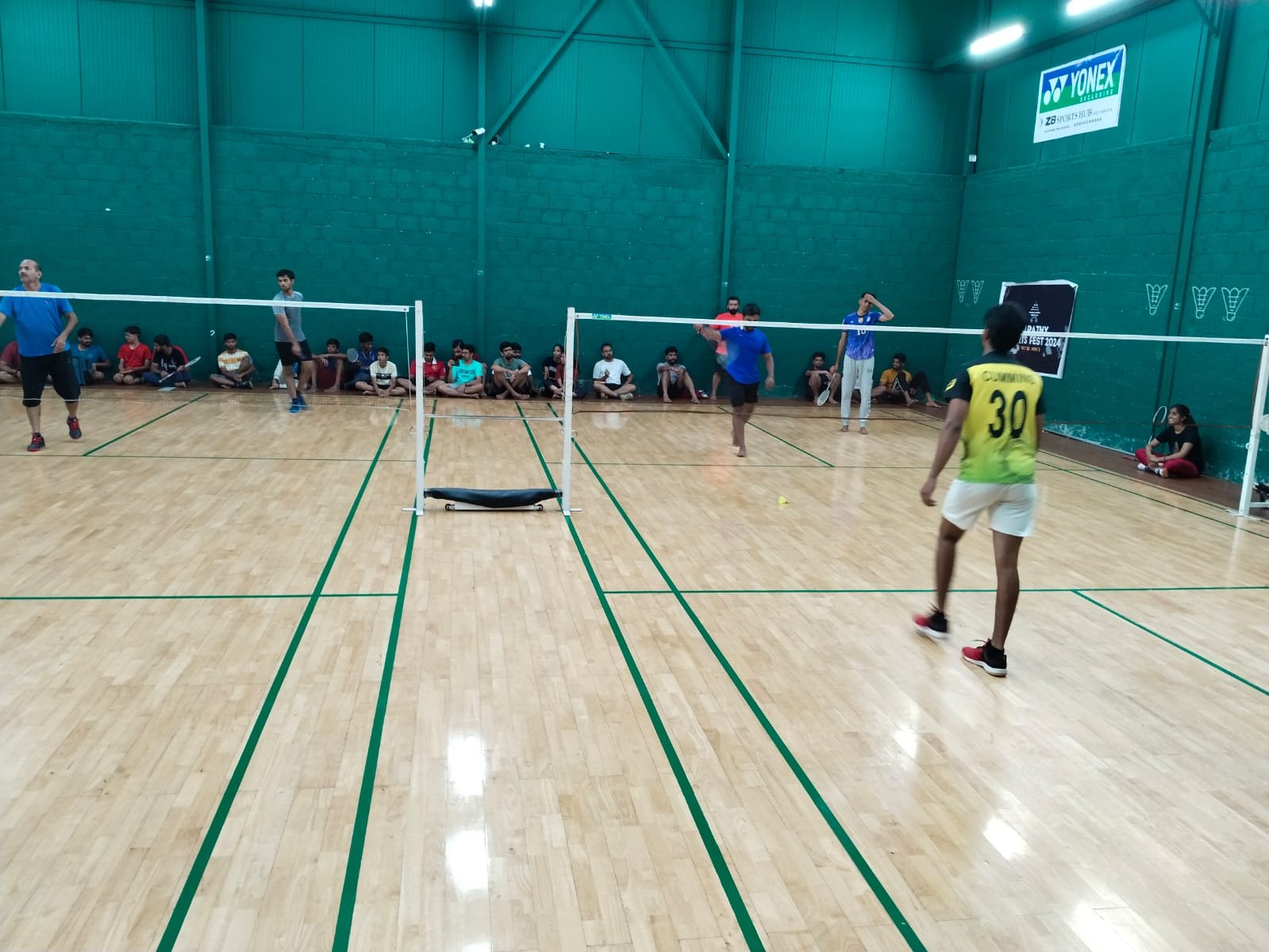
Start with the floor, not the shoe. Badminton is played indoors, on wooden sports-hall floors or synthetic court mats, and both surfaces reward the same thing: a soft, gum-rubber outsole that bites rather than skates. Every shoe in this guide has one. Running shoes, by contrast, use harder, segmented rubber built for tarmac, and trail-style trainers are worse still. If a shoe’s product page does not say its sole is made for indoor courts, it does not belong on a badminton court — which is also why these shoes should live in your kit bag and never be worn outdoors, where grit and concrete chew the gum rubber that your grip depends on.
Second, think about height. A badminton shoe’s platform is deliberately low. Your foot sits close to the floor so that when you plant the outside of your foot mid-lunge, there is no tall stack of soft foam to roll over. Compare any shoe here with a cushioned running shoe and the difference is visible: court shoes look flat because they are. As a beginner your footwork will be enthusiastic and untidy — everyone starts that way — and a low platform is the single biggest favour a first pair can do you. If you are still learning how the game itself works, our how to play badminton guide walks through the footwork patterns these shoes are built around.
Third, fit beats features. A first pair should lock your heel and midfoot so the foot does not slide forward when you brake, while leaving roughly a thumb’s width in front of your longest toe for the lunge, when your foot presses toward the front of the shoe. Width matters as much as length: a wide foot squeezed into a slim shoe will ache within a set, and a narrow foot swimming in a wide shoe will slide exactly when it should not. That is why this guide makes a point of telling you each model’s fit character — Victor’s A362 is a deliberately slimmer shoe, Mizuno’s Wave Claw NEO 3 is built on a wide last, and the rest sit in between. Measure both feet in the evening, when they are at their largest, and size to the bigger foot.
Fourth, decide how much shoe your week actually needs. One social session a week in a sports hall asks less of cushioning and upper durability than three club nights. Beginners who drag a toe during the forehand lunge — and most do while learning — will wear through a soft mesh toe quickly, which is why leather and guarded uppers appear on several cards below. Heavier players and players on hard hall floors will feel thin midsoles sooner. None of this requires the flagship models; it simply means matching the card to your court time, which is exactly how the picks below are organised.
Finally, pair the shoes with the rest of a sensible first kit rather than overspending in one place. A balanced starter setup — the shoes here, a forgiving racket from our best badminton rackets for beginners guide, and a pair of proper court socks — will take you further than a flagship shoe and a borrowed everything-else. Get the foundation right first; upgrade later with a season of footwork behind you.
What the Spec Sheet Really Tells You
Outsole compound and pattern. “Gum rubber” or “non-marking rubber” is the line that qualifies a shoe for hall floors — it grips wood and court mats and will not leave black streaks the hall charges you for. Pattern matters second: Yonex’s Hexagrip uses hexagonal lugs it says are lighter than a standard sole pattern, Victor’s Radiation pattern arranges its tread around a central pivot point for the constant turning badminton demands, and Mizuno’s XG Rubber is its extra-grade grip compound. You do not need to memorise brand names — you need the words “gum” or “non-marking” and a tread that covers the whole sole, including the outer forefoot edge you plant in a lunge.
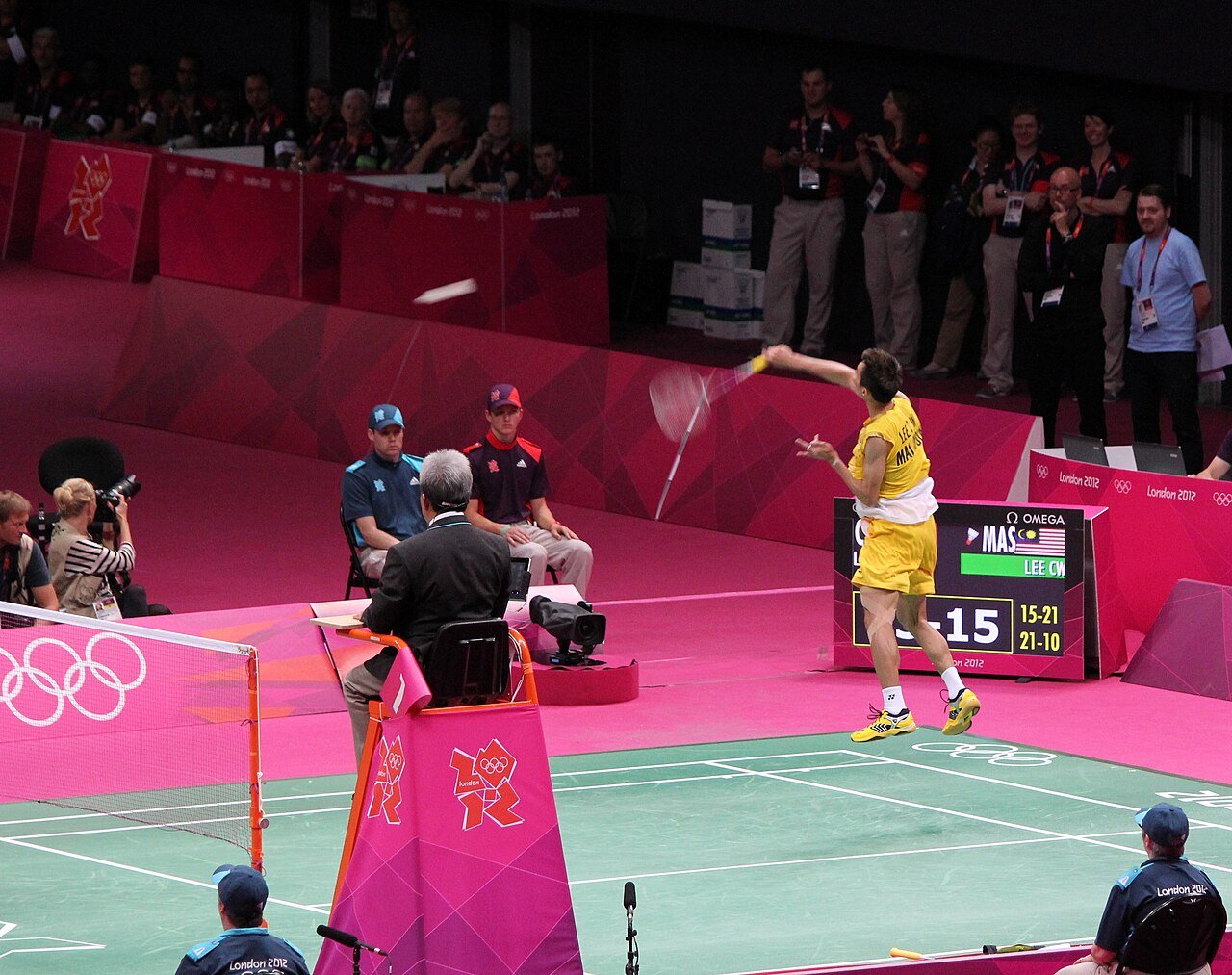
Cushioning names. Each maker names its system: Yonex’s POWER CUSHION, Mizuno’s MIZUNO ENERZY foams and Wave plate, Victor’s ENERGYMAX core, ASICS’s GEL, Babolat’s EVA midsole with its rocker sole shape. The honest beginner translation is simple — cushioning decides how the shoe feels when you land and how fresh your legs feel in the third game, and any named system from a major maker is adequate for learning the game. What you should distrust is not the technology but the adjectives: “maximum”, “ultimate” and percentage claims with no stated test behind them. This guide repeats maker claims only where the maker states the basis, and flags where it does not.
Weight, and its basis. This is the spec sheet’s biggest trap. Mizuno states the Cyclone Speed 5 at about 275 grams for a 27.0 cm shoe, and lists the Wave Claw NEO 3 at 310 grams without stating the size on the same line. Babolat states 295 grams for the Shadow Spirit 2 in EU 42.5. Victor’s A362 listing says approximately 281 grams with no size stated at all. Yonex and ASICS publish no weight at all for the 65 X3, Upcourt 6 and Gel-Task 4. A gram figure without a size is only half a fact, because a size 13 shoe obviously outweighs a size 7 of the same model — so compare weights only between shoes whose makers state the same kind of basis, treat unstated-basis figures as rough orientation, and never let a missing figure put you off a shoe: some of the most proven beginner models here simply do not publish one.
Fit language. Learn the vocabulary before you shop: “slim” or “snug” (the A362; the 65 X3 is also described as snug-fitting), “standard” (most ASICS and Babolat models here), and named wide lasts (Mizuno’s E width on the Wave Claw NEO 3). A shoe that comes in men’s and women’s versions is usually built on two different lasts, which is a genuine fit feature, not a colour option. And “unisex” sizing, as on the Yonex and Mizuno cards, means one last for everyone — fine if it matches your foot shape, which is why the try-on checks in the buying guide below matter more than any size chart.
The Picks: 7 Beginner Badminton Shoes Compared
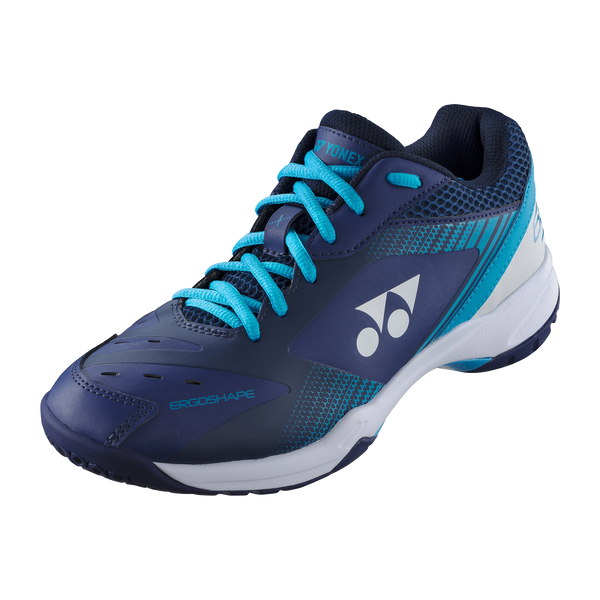
Yonex Power Cushion 65 X3
The safe first pair: full-length POWER CUSHION, a leather upper that survives beginner toe drag, and Yonex’s all-round court geometry.
The 65 X3 is the sensible centre of Yonex’s enormous shoe range: below the flagship Z-series shoes that anchor our main best badminton shoes guide, above the bare-bones entry models, and built around the same cushioning technology as both. Yonex’s published spec table keeps the construction classic — a synthetic leather upper, a synthetic resin midsole and a rubber outsole — and then adds the details that make it a genuine badminton shoe rather than a generic trainer. POWER CUSHION runs through the sole as the shock-absorbing layer, and the outsole carries Yonex’s Hexagrip pattern, an arrangement of hexagonal lugs the maker says grips harder while weighing less than a standard sole pattern. The Round Sole shaping supports the smooth, rolling footwork badminton footwork drills will teach you in your first month.
Two features matter most for a beginner. The Lateral Shell is a support structure on the outside of the forefoot that resists your foot sliding over the edge of the sole when you lunge sideways — precisely the movement a new player performs worst and most often. And the Ergoshape design contours the forefoot and toe area with more room than Yonex’s racier shapes, which makes the 65 X3 friendlier to average-width feet than the brand’s snug performance models; Yonex also builds the upper with its Double Raschel Mesh sections for airflow alongside the leather. Sizing is unisex, running from 23.0 to 31.0 cm, so women and men order from the same size run. Yonex does not publish a weight for this shoe — the card says so rather than guessing — but nothing in its leather-and-resin construction suggests a heavy shoe, and beginners will notice the cushioning and the grip long before they would notice grams.
Pros
- Full-length POWER CUSHION in a mid-range, beginner-priced position in Yonex’s line
- Lateral Shell supports the outside of the forefoot during sideways lunges
- Ergoshape forefoot gives toes more room than Yonex’s snug racing shapes
- Synthetic leather upper stands up to beginner toe drag better than full mesh
Cons
- Yonex publishes no weight for the model, so cross-brand gram comparisons are impossible
- Leather upper breathes less than the full-mesh shoes in this guide
- Standard width only — genuinely wide feet should look at the Wave Claw NEO 3
As an Amazon Associate we earn from qualifying purchases.
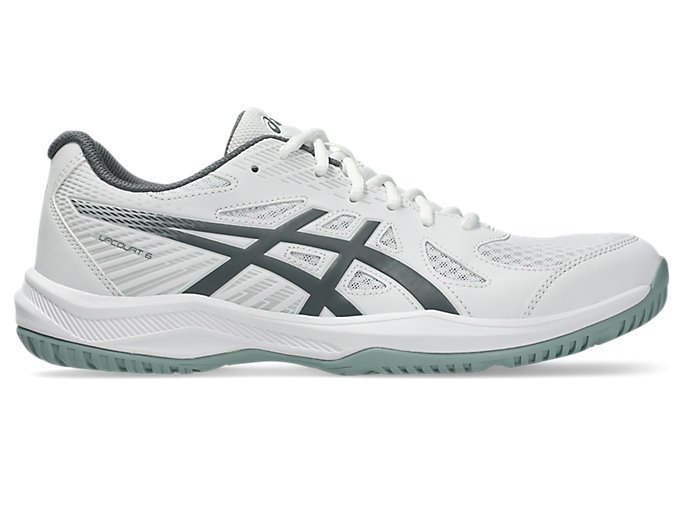
ASICS Upcourt 6
The simplest well-made start: a lightweight mesh shoe with reinforced toe and heel, from the brand that outfits half the sports halls in the world.
ASICS describes the Upcourt 6 in deliberately plain language: a lightweight design, built to be versatile across indoor court sports, with breathable mesh underlays so your feet do not overheat through a long session. For a first pair, plain is a virtue. There is no exotic plate, no dial, no acronym stack to decode — just a light mesh court shoe with the reinforcement placed where beginners actually wear shoes out. Supportive overlays wrap the midfoot to hold the foot steady when you change direction, and ASICS reinforces both the toe and the heel counter, the two zones that take the drag of the lunge and the strike of the landing.
The details reward a closer look. The sockliner is solution-dyed, a process ASICS states uses roughly 33% less water and produces roughly 45% fewer carbon emissions than conventional dyeing — a rare case of a maker publishing its basis, and the kind of claim this guide is happy to repeat. Flex grooves in the outsole let the shoe bend with your foot through the split-step and push-off rather than fighting it. ASICS sells men’s and women’s versions on their respective lasts, which is a real fit advantage at this end of the market, and like the 65 X3 above, the Upcourt 6 carries no maker-published weight: ASICS simply does not state one, and any gram figure you meet elsewhere is a retailer’s own measurement. Judge it by its job — an uncomplicated, breathable first court shoe — and it does that job cleanly.
Pros
- Lightweight mesh design that feels familiar from the first session
- Reinforced toe and heel counter where beginners wear shoes hardest
- Supportive midfoot overlays for direction changes
- Separate men’s and women’s versions on different lasts
Cons
- ASICS publishes no weight for the model
- No named cushioning technology — the midsole is a simple foam
- Standard width only, with no wide option in the range
As an Amazon Associate we earn from qualifying purchases.
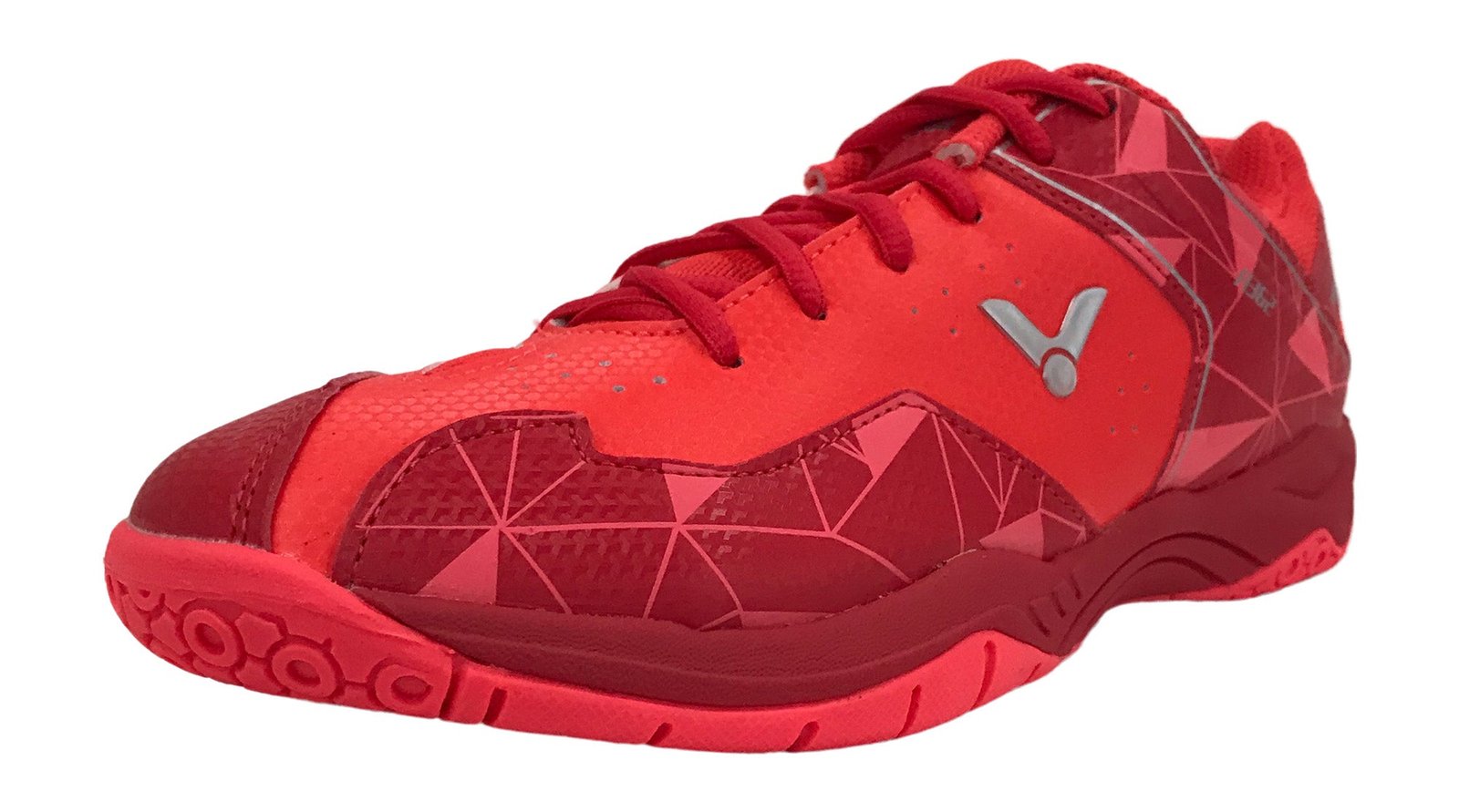
Victor SH-A362
The tidy value pick with a slimmer fit, a true gum-rubber sole and heel stability built in — from badminton’s second-biggest shoe brand.
Victor is the brand beginners most often overlook and club players most often recommend, and the SH-A362 is its long-running entry shoe. Its published specification reads like a checklist of what a first pair needs. The outsole is gum rubber — the traditional hall-floor compound — laid out in Victor’s Radiation pattern, which arranges the tread around a central zone so the shoe can pivot without breaking grip. The midsole pairs EVA with a nylon sheet for structure, and Victor places its ENERGYMAX foam core in the rear of the shoe, where your heel lands after every overhead shot. Around the heel, its BRACE TEK technology adds the stability a new player’s ankles-down footwork needs while the basics are still being learned.
Fit is this shoe’s headline, and Victor states it openly: the A362 has a slimmer fit. If your feet are narrow, or you have always found standard court shoes sloppy around the midfoot, that is precisely the profile to shortlist — a close fit means the foot brakes with the shoe instead of inside it. The upper mixes PU leather with mesh, so the toe box keeps the drag resistance of leather while the midfoot breathes. Victor’s listing gives a weight of approximately 281 grams — usefully published, though the listing does not state the shoe size it was measured at, so treat it as orientation rather than a laboratory figure. Unisex sizing keeps ordering simple. Among seven good shoes, this is the one that does the basics with the least fuss and the clearest spec sheet.
Pros
- True gum-rubber outsole with a pivot-friendly Radiation tread pattern
- BRACE TEK heel stability and an ENERGYMAX core where landings land
- Slimmer fit suits narrow feet that swim in standard court shoes
- Weight is published — approximately 281 g on Victor’s listing
Cons
- The listing does not state the size basis for its weight figure
- Slim fit will squeeze wide feet — those readers should take the Wave Claw NEO 3
- Availability outside specialist badminton retailers can be patchy
As an Amazon Associate we earn from qualifying purchases.
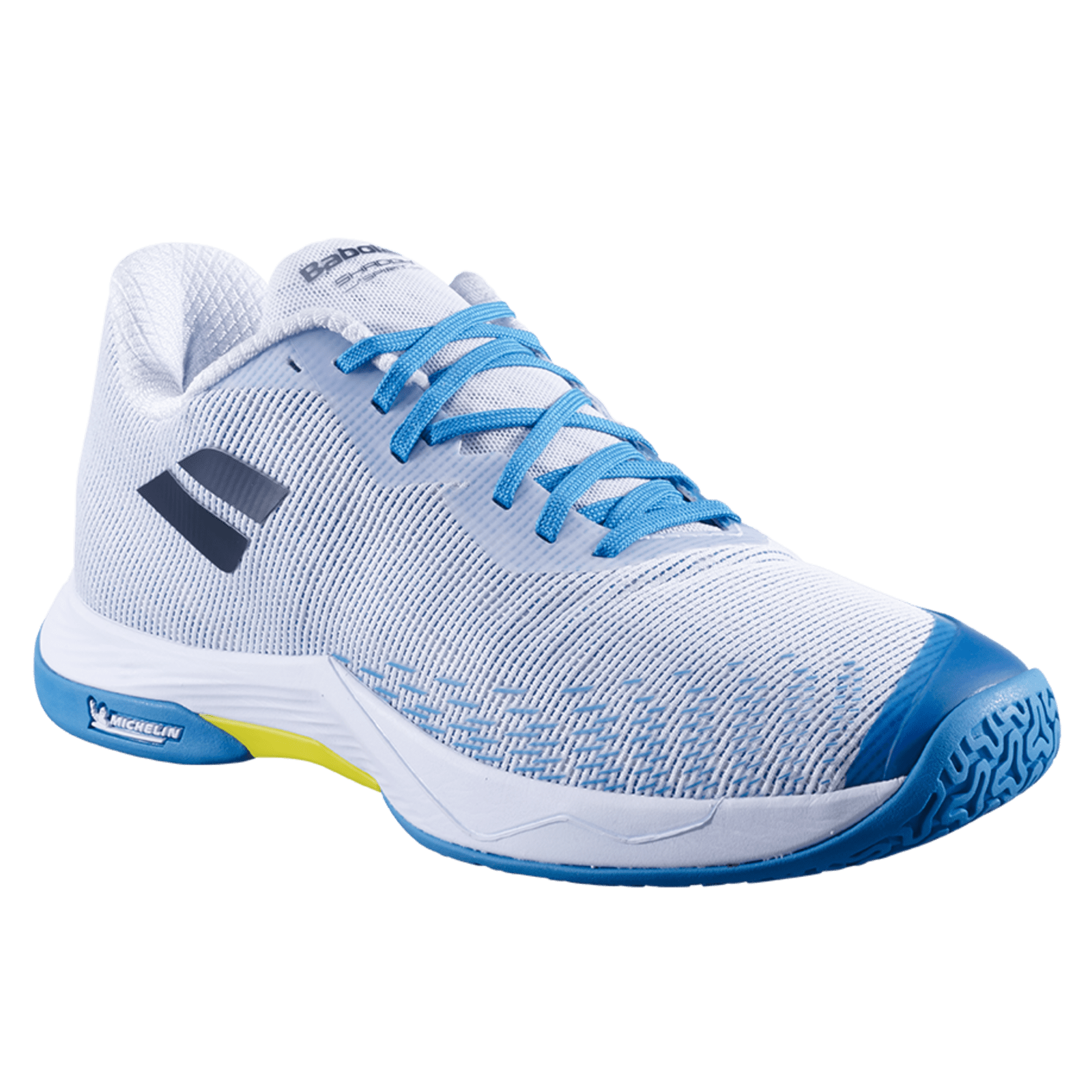
Babolat Shadow Spirit 2
The comfort-first mesh shoe with a Michelin rubber sole and a stated weight — from the French brand that builds badminton shoes with a tyre company.
Babolat approaches badminton footwear the way it approaches rackets: comfort first, then engineering. The Shadow Spirit 2’s upper is a lightweight, supple mesh that Babolat says adapts to the shape of the foot, and that softness is the point — where the leather shoes in this guide feel structured from the first wear, the Spirit 2 feels broken-in early, which matters when your feet are still adjusting to court movement. Underneath, an EVA midsole does the cushioning, and the sole is shaped with a rocker profile that Babolat designs to move you from a defensive position to an attacking one without a flat-footed pause in between. Beginners will not consciously notice the rocker; they will notice that shuffling back to base feels smooth rather than staccato.
The outsole is where the Babolat story gets distinctive. Its long partnership with Michelin produces the rubber compound and stud pattern, developed specifically for badminton’s indoor courts, and Babolat is explicit that the goal is the balance beginners need most: grip that does not slip, in a sole light enough not to drag. A heavy-duty rubber guard wraps the inner forefoot up to the toes, armoring exactly the area your lunge drags across the floor. Babolat also sets the standard for weight honesty in this guide: it publishes 295 grams for an EU 42.5 shoe — figure and basis together, exactly as it should be done. Men’s and women’s versions are both offered. If your priority is a cool, soft, forgiving shoe for long learning sessions, this is the card to read twice.
Pros
- Weight published with its basis: 295 g in EU size 42.5, per Babolat
- Michelin rubber outsole developed specifically for badminton courts
- Breathable mesh upper is comfortable from the first session
- Rubber guard over the inner forefoot resists lunge drag
Cons
- Soft mesh upper offers less structure than the leather shoes here
- Rocker sole shape feels different if you prefer a completely flat platform
- Babolat’s badminton range is stocked by fewer general sports retailers
As an Amazon Associate we earn from qualifying purchases.
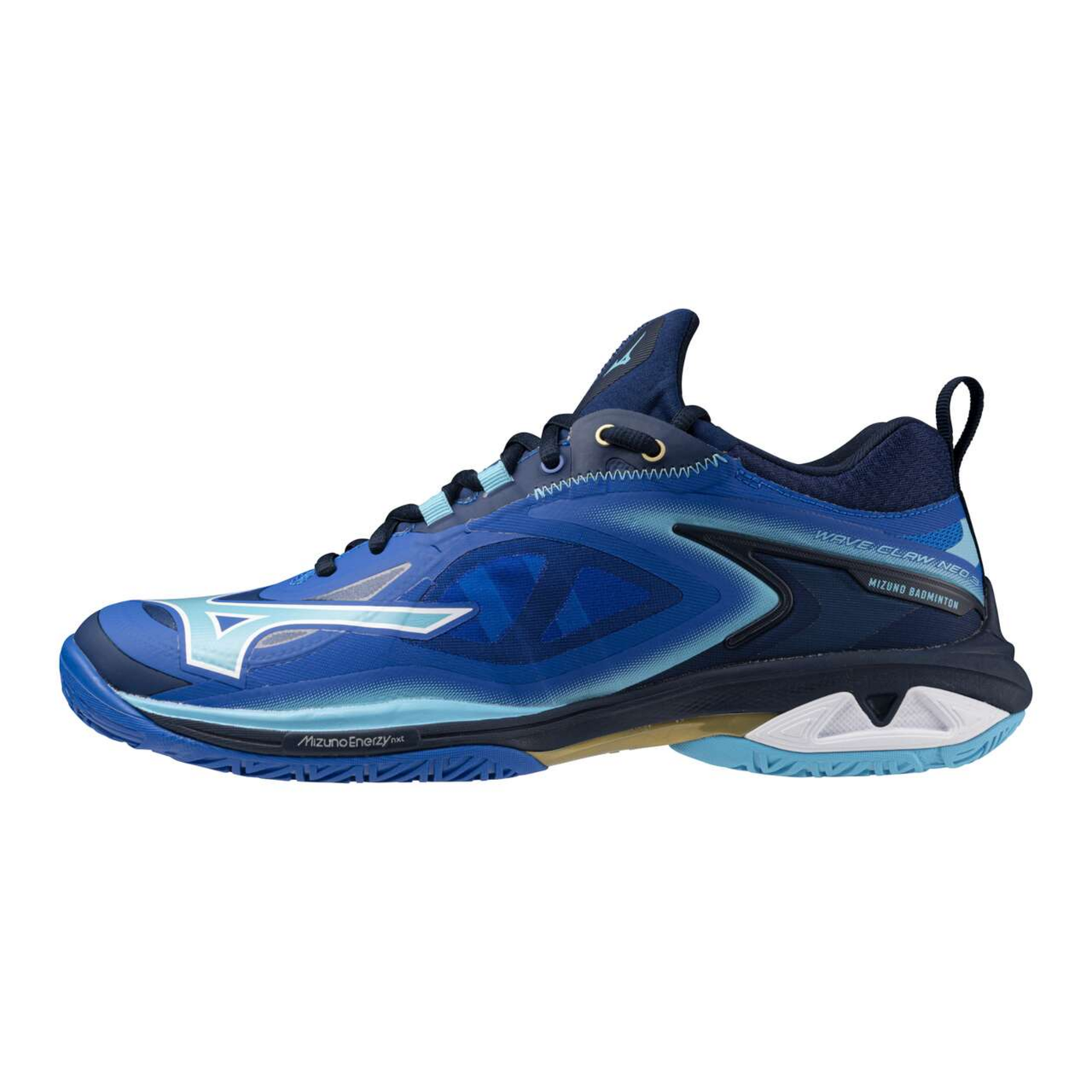
Mizuno Wave Claw NEO 3
The wide-fit flagship of this guide: a genuine E-width last, a bootie fit, and the most complete published spec sheet of the seven.
Wide feet are the most underserved fit in beginner badminton: most entry shoes come in one standard last, and wide-footed beginners end up sizing up in length to buy width, then sliding inside the extra room. Mizuno solves the problem properly. Its published specification for the Wave Claw NEO 3 lists the width plainly — Men’s-E (Wide) — on a unisex shoe, so wide-footed players get room across the forefoot at their correct length. Inside that last sits a bootie structure that envelops the foot for a fitted, sock-like hold, which is how a wide shoe avoids the sloppy feel: the width is in the last, and the lockdown is in the bootie.
The rest of the spec sheet is the fullest Mizuno publishes. MIZUNO ENERZY NXT foam in the forefoot gives soft cushioning with energy return for push-offs; the MIZUNO WAVE plate in the sole combines cushioning with stability; PoWnCe midsole material keeps weight down; and the XG Rubber outsole is Mizuno’s extra-grade grip compound, cut with a D-flex Groove that supports the natural flex of the foot. A protruding heel structure supports the deep lunge position, the move beginners practise most. Mizuno lists the weight at 310 grams — the heaviest card here, and worth saying plainly, though it does not state the measurement size on the same line. Mizuno positions this model toward top-to-mid-level players, and honesty requires noting that: it is more shoe than a first pair strictly needs. But if your feet are wide, it is the only card in this guide built on a true wide last, and fit outranks hierarchy every time.
Pros
- Built on a genuine wide (Men’s-E) last — the only true wide option here
- Bootie construction locks the foot down inside the wider fit
- Protruding heel structure supports the lunge position
- Complete maker spec sheet: weight, width, materials and technologies all published
Cons
- Heaviest shoe carded at 310 g on Mizuno’s figure
- Mizuno positions it for top-to-mid-level players, so beginners pay for headroom they may not use
- Bootie fit takes a moment longer to pull on than a conventional tongue
As an Amazon Associate we earn from qualifying purchases.
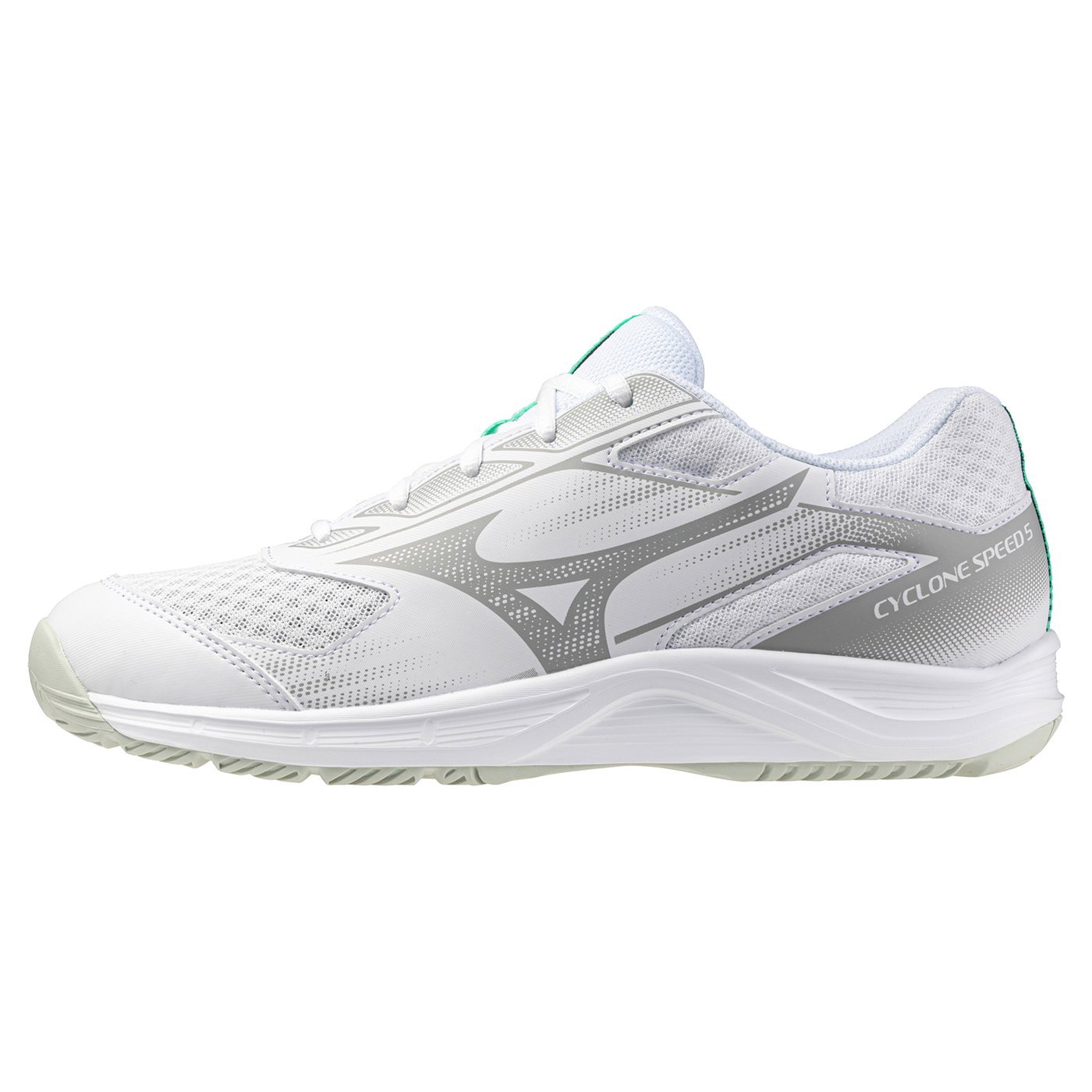
Mizuno Cyclone Speed 5
Mizuno’s beginner shoe in its own words: a flat, flexible sole that lets new players feel the court while they learn to move on it.
Most shoe descriptions in this guide come from what makers imply; Mizuno states the Cyclone Speed 5’s purpose outright. It is the company’s entry-level indoor court shoe, designed for beginner players, and its design brief is the opposite of the flagship formula: instead of plates and stiffeners, Mizuno gives it a flat sole that is highly flexible and bends easily, so developing players can feel the court through the whole foot and learn balance honestly. That court feel is a genuine teaching tool. Split-steps, lunges and recovery steps all give feedback through a thin, flat sole that a thick, rigid shoe would mute, and beginners building footwork from zero benefit from every bit of it.
The supporting details are equally beginner-minded. Mizuno builds the shoe on a last intended to fit comfortably across a wide range of foot shapes — useful when you do not yet know whether your feet run narrow or wide in court shoes — and fits a removable cup insole shaped to the foot, which can be swapped if you later want an insole of your own. Synthetic overlays protect the upper, the EVA midsole handles cushioning, and the non-marking XG Rubber outsole supplies hall-floor grip. Mizuno states the weight with its basis attached: the 27.0 cm size weighs about 275 grams, with the maker’s own note that final weight may vary — the lightest fully-documented figure in this guide. One transparency note: Mizuno markets the Cyclone Speed across indoor court sports rather than badminton alone, so it carries no lunge-specific heel or badminton-only tread. What it offers instead is the simplest route into proper indoor footwear that exists from a major maker.
Pros
- Designed by Mizuno explicitly for beginner and entry-level players
- Flat, flexible sole builds court feel while footwork is learned
- Weight published with its size basis: about 275 g at 27.0 cm
- Last fits a wide range of foot shapes; removable cup insole included
Cons
- An all-indoor-courts design rather than a badminton-specific shoe
- Flexible sole offers less structure than the Wave Claw NEO 3
- No lunge-specific heel geometry or drag guard
As an Amazon Associate we earn from qualifying purchases.
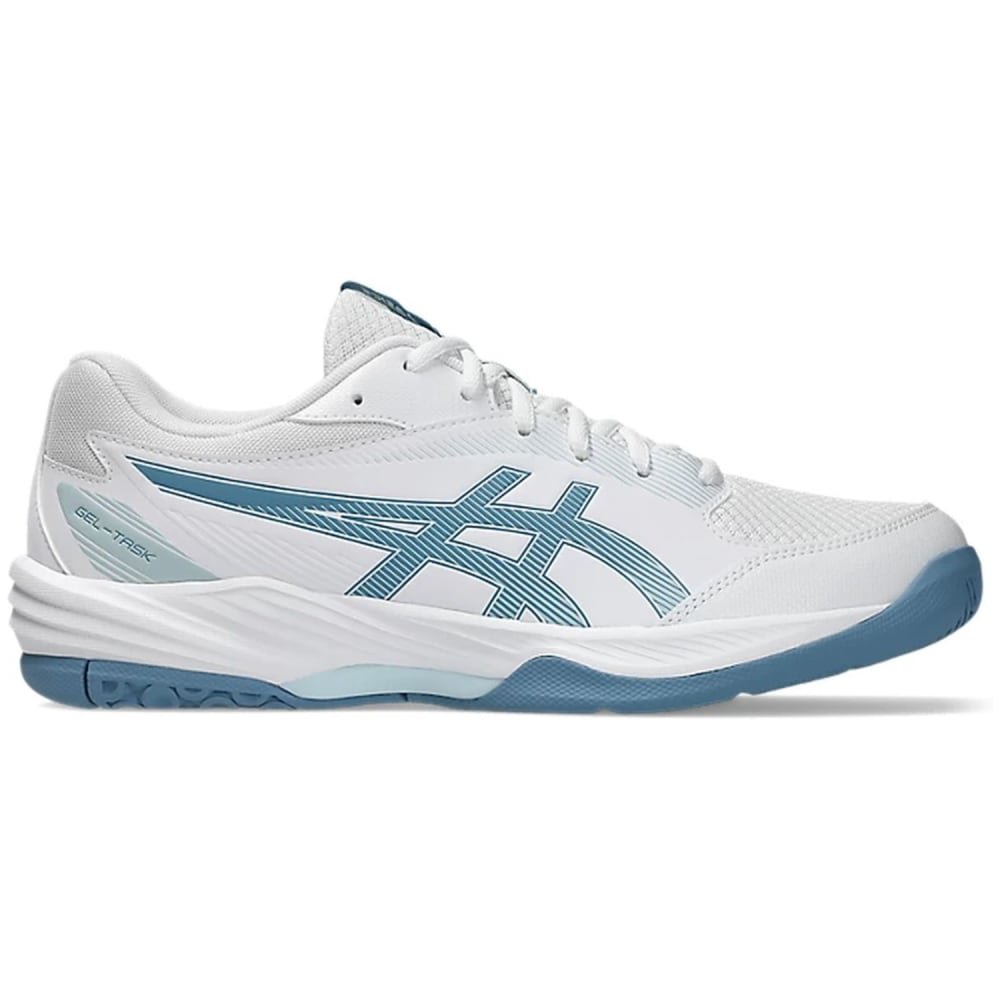
ASICS Gel-Task 4
The support-hardware pick: a wrap-up outsole, an outrigger for sideways moves, and TRUSSTIC stability under the midfoot.
If the Upcourt 6 is ASICS’s simple shoe, the Gel-Task 4 is its engineered one — the beginner model for players who can feel a plain shoe giving way when they move sideways. Start underneath: the outsole wraps up at the heel and carries an outrigger, a widened section on the outer side of the forefoot, and ASICS is clear about why — both are functional support components for side-to-side movement, the exact direction badminton’s lunges and defensive blocks take you. Flexion grooves cut into the outsole keep it bending freely despite that structure, so support never becomes stiffness.
In the midsole, a TPU TRUSSTIC application resists over-twisting and steadies the shoe during quick transitions — the split-second direction changes that fill a beginner’s rally as positioning gets learned the hard way. GEL cushioning handles impact absorption and gives the shoe its softer feeling at footstrike, a contrast with the Upcourt 6’s plain foam. The upper is a flexible, breathable construction, and ASICS sells men’s and women’s versions. As with the Upcourt 6, ASICS publishes no weight for the Gel-Task 4, and this card will not invent one; retailer figures vary by size anyway, which is the whole problem this guide keeps pointing at. What can be stated is the shoe’s character: of the two ASICS cards, this is the one to choose if your ankles and knees prefer a shoe that actively holds its shape when you plant and push sideways — and if you split your week between badminton and other indoor court games, its support hardware travels well.
Pros
- Wrap-up outsole and outrigger are purpose-built for side-to-side movement
- TPU TRUSSTIC midsole resists twisting during quick transitions
- GEL cushioning softens footstrike compared with plain foam shoes
- Men’s and women’s versions on separate lasts
Cons
- ASICS publishes no weight for the model
- Stability hardware makes the ride firmer than the Upcourt 6
- Support features are wasted if your game is gentle social doubles only
As an Amazon Associate we earn from qualifying purchases.
Side-by-Side: The Seven at a Glance
| Shoe | Cushioning (maker’s system) | Outsole | Fit | Published weight |
|---|---|---|---|---|
| Yonex Power Cushion 65 X3 | POWER CUSHION | Rubber, Hexagrip pattern | Unisex, standard width | Not published by Yonex |
| ASICS Upcourt 6 | Lightweight foam midsole | Rubber with flex grooves | Standard; men’s & women’s | Not published by ASICS |
| Victor SH-A362 | ENERGYMAX core + EVA | Gum rubber, Radiation pattern | Slimmer fit, unisex | Approx. 281 g (listing figure; size basis not stated) |
| Babolat Shadow Spirit 2 | EVA midsole, rocker sole shape | Michelin rubber | Standard; men’s & women’s | 295 g (EU 42.5, per Babolat) |
| Mizuno Wave Claw NEO 3 | MIZUNO ENERZY NXT + Wave plate | XG Rubber | Wide (Men’s-E), unisex | 310 g (per Mizuno; size basis not stated) |
| Mizuno Cyclone Speed 5 | EVA midsole | XG Rubber, non-marking | Generous last, unisex | Approx. 275 g at 27.0 cm (per Mizuno) |
| ASICS Gel-Task 4 | GEL + TRUSSTIC midsole | Wrap-up rubber, flexion grooves | Standard; men’s & women’s | Not published by ASICS |
Read the weight column the way this guide has taught you: only two figures come with their size basis attached (Babolat’s and the Cyclone Speed 5’s), two are maker figures without a stated basis, one is a listing approximation, and two of the world’s biggest shoe brands publish nothing at all. That spread is normal in court footwear — and it is exactly why fit, grip and platform should drive your decision, with weight as a tiebreaker rather than a headline.
Beginner’s Buying Guide: Five Checks Before You Pay
1. Confirm the sole is indoor gum or non-marking rubber
Before anything else, read the outsole line of the spec sheet. You want the words gum rubber, non-marking rubber, or a named indoor compound such as Mizuno’s XG Rubber or Babolat’s Michelin badminton rubber. If the product page talks about trails, tarmac or all surfaces, close the tab — that shoe is not for a badminton hall, whatever its marketing photos show. Check, too, that the tread reaches the outer edge of the forefoot: that edge is your lunge platform.
2. Fit the shoe to your bigger foot, in the evening
Feet swell through the day, and court sessions usually happen after work, so try shoes on in the evening wearing your court socks. Stand, lunge forward in the shop or on your hallway floor, and check three things: a thumb’s width of space ahead of your longest toe, a heel that does not lift when you rise onto your toes, and no pinching across the widest part of the forefoot. If the forefoot pinches in a standard shoe, do not simply buy a size up — buy the wide model. In this guide that is the Mizuno Wave Claw NEO 3; the equivalent discipline applies across our women’s shoe guide and seniors’ shoe guide too.
3. Match the upper to how you actually play
Watch a more experienced player’s shoes and you will see the inner forefoot worn pale: the lunge drags that panel across the floor thousands of times. If you already drag a toe — ask your playing partners, they will know — favour the leather upper of the 65 X3, the leather-and-mesh A362, or the rubber-guarded Shadow Spirit 2. If you play in hot halls and your feet run warm, the full-mesh Upcourt 6 and Shadow Spirit 2 breathe best. There is no universal winner here, only a match between your habits and the shoe’s construction.
4. Read every weight with its basis — or ignore it
When a maker states a weight, look for the size attached to it before you compare. Babolat’s 295 grams is for an EU 42.5; Mizuno’s 275 grams is for a 27.0 cm Cyclone Speed 5; both are honest figures. A bare “281 g” with no size, or a gram count on a retailer’s page with no source, tells you far less. And when a brand publishes no weight — as Yonex and ASICS do for three shoes in this guide — treat that as a missing detail, not a disqualification. Nobody’s first season was ever decided by thirty grams.
5. Buy once, for the courts you actually play on
Your first pair will live on wood or court mats, indoors, for one to three sessions a week — buy for exactly that. Keep the shoes indoor-only, in your kit bag, and the gum rubber will keep its grip far longer than if they double as your walk-to-the-hall shoes. When the tread smooths out at the forefoot or the midsole starts to feel dead under the heel, that is the honest retirement signal, whatever the calendar says. By then you will know your feet, your hall and your game well enough that your second pair — perhaps from our main best badminton shoes comparison — chooses itself.
Frequently Asked Questions
Can beginners play badminton in running shoes?
They can stand on court in them, but they should not play in them. Running shoes are built to move in one direction: forward. Their tall, soft foam stack and narrow, rounded sole are designed for straight-line heel strikes on tarmac, and on a badminton court that geometry works against you — the high platform is easier to roll an ankle on during a sideways lunge, and the outsole rubber is too hard and too segmented to grip a polished hall floor. Every shoe in this guide exists because the movement patterns are different: badminton shoes keep your foot low, wrap support around the sides, and use soft gum or non-marking rubber across the whole sole. If budget is the obstacle, an entry-level indoor court shoe such as the ASICS Upcourt 6 or Mizuno Cyclone Speed 5 solves the problem properly for less than most running shoes cost.
What size badminton shoes should a beginner buy?
Buy for your bigger foot, measured in the evening, with roughly a thumb’s width of space in front of your longest toe while standing. Badminton’s lunge drives the foot forward inside the shoe, so toes that touch the end standing still will jam against it in play. Your heel should stay seated when you rise onto your toes, and the midfoot should feel held rather than clamped. Sizing differs by brand and last: Yonex and Mizuno list their unisex shoes in centimetres, Victor’s A362 runs slimmer than standard, and Mizuno’s Wave Claw NEO 3 is built on a wide Men’s-E last, so read each card’s fit line before ordering rather than assuming your usual number transfers.
Are expensive badminton shoes worth it for a beginner?
Usually not yet. The flagship shoes — the models in our main best badminton shoes comparison — add stiffer plates, lighter uppers and more aggressive cushioning systems tuned for advanced footwork speeds. A beginner’s limiting factors are fit, grip and a low, stable platform, and all three are fully present in the mid-range shoes in this guide. The one exception is fit itself: if your feet are genuinely wide, a shoe like the Wave Claw NEO 3, positioned by Mizuno for higher-level players, is worth its price simply because it is built on a true wide last. Spend on the shoe that fits your foot, not the shoe that fits a professional’s.
How long do beginner badminton shoes last?
There is no honest single number, because life depends on court time and surface — but there are two reliable wear signals. The first is the outsole: when the forefoot tread smooths out and the shoe starts to skate on a hall floor you know it grips when new, the gum rubber’s job is done. The second is the midsole: when landings start to feel flat and dead under the heel compared with how the shoe felt early on, the foam has compressed. Playing once or twice a week, indoors only, a pair from this guide should serve a full first season and beyond; wearing the same shoes outdoors to travel to the hall will shorten that life noticeably, because grit and concrete abrade the soft outsole compound.
Do badminton shoes need to be non-marking?
Yes, for almost every indoor hall you will play in. Non-marking (or gum) rubber is formulated so it does not leave black streaks on wooden or synthetic sports-hall floors, and many halls will turn away shoes that mark. All seven shoes in this guide use indoor court outsoles — gum rubber on the Victor, XG Rubber on the Mizunos, Hexagrip rubber on the Yonex, Michelin rubber on the Babolat and ASICS’s court rubber compounds — so any of them satisfies a hall’s rules. The shoes to avoid are dark-soled outdoor trainers, whose carbon-black rubber is exactly what leaves the marks halls object to.
Should beginners choose leather or mesh badminton shoes?
Choose by habit, not by fashion. If you drag your non-racket foot’s toe during the forehand lunge — most beginners do while learning — leather or leather-and-mesh uppers such as the Yonex 65 X3’s and Victor A362’s will outlast a soft mesh, and Babolat adds a rubber guard over the Shadow Spirit 2’s inner forefoot for the same reason. If you play in warm halls and rarely drag a toe, full mesh uppers like the Upcourt 6’s breathe better and feel lighter from the first session. Neither choice is wrong; a mismatch between your habits and the upper is the only real mistake.
Can I wear badminton shoes for other sports?
For other indoor court sports, generally yes — the Cyclone Speed 5 is designed by Mizuno across indoor court sports, and the Upcourt 6 and Gel-Task 4 are versatile hall shoes whose grip and low platforms suit volleyball, squash or five-a-side on indoor surfaces. For outdoor sports, no: badminton outsoles are soft indoor compounds, and tarmac or concrete will wear them quickly while offering poor grip in the wet. Keep your court shoes in your kit bag for the hall, and they will repay you with a full first season of grip.
The Verdict: Your First Pair, Decided
There is no wrong door among these seven — only the right one for your feet, your hall and your week. For most beginners the decision is the Yonex Power Cushion 65 X3: POWER CUSHION underfoot, Hexagrip grip, a leather upper forgiving of beginner toe drag, and a forefoot shape that welcomes average feet. Wide feet go straight to the Mizuno Wave Claw NEO 3 and its true E-width last; narrow feet to the slimmer Victor SH-A362 and its gum-rubber Radiation sole. The ASICS Upcourt 6 is the simplest well-made start, the ASICS Gel-Task 4 adds real lateral-support hardware, the Mizuno Cyclone Speed 5 teaches court feel on a flat, flexible sole, and the Babolat Shadow Spirit 2 pairs breathable comfort with the most honestly published weight in the guide.
Whichever pair you choose, choose it by the checks that matter: indoor gum or non-marking rubber, a low platform, a fit measured to your bigger foot, and a weight figure you read with its basis attached — or politely ignored when the maker never published one. Get those right and your first season of badminton starts on solid ground. If you want the wider picture once your footwork settles, the flagship models in our best badminton shoes comparison and the dedicated beginner racket guide are the natural next reads.
Affiliate disclosure: Some links in this guide are affiliate links. If you buy through them, Ali Shuttler may earn a commission at no additional cost to you. Our picks are based on manufacturer specifications and fit characteristics — never on commission rates.