A standard badminton racket is 675 mm long — nearly as tall as the young child expected to swing it. Junior rackets fix that mismatch: short-shaft frames from 533 mm for the youngest starters, mid-length learning rackets in between, and standard-length light frames with small grips for older children. This guide compares the seven junior rackets worth buying, using only the specifications their makers publish — and it is honest about the age guidance makers do, and mostly do not, provide.
⚡ TL;DR — The Short Answer
Start by length, not by brand. For the youngest starters: the Yonex Muscle Power 2 Junior (533 mm) and Babolat Minibad (540 mm). For a child learning grips and technique, the Talbot Torro ELI Junior (580 mm) is a purpose-built learning racket — the one model here whose maker publishes an age position, about 6 to 8 years old. The Victor GJ-7500 Junior (620 mm, 76 g, full graphite) is the mid-length step up. Older children get the Babolat Explorer Junior (662 mm), the Yonex Nanoflare Junior (665 mm, 83 g, G7 grip — our best overall pick), and finally the full-length Babolat Prime Junior (675 mm, 85 g carbon).
Quick Picks — Best Badminton Rackets for Kids at a Glance
665 mm of proper graphite Nanoflare, at 83 g with a small G7 grip made for junior hands.
The shortest racket here at 533 mm — aluminium head, steel shaft, small G5 grip.
540 mm and 84 g in aluminium and steel, with a power head shape for first rallies.
580 mm with a learning grip and colour-marked faces; Talbot Torro positions it for about 6–8 years.
620 mm and only about 76 g in 100% Hi-Modulus Graphite — the light mid-ladder step.
662 mm with Babolat’s shorter-shaft beginner design in steel and aluminium.
A full 675 mm carbon frame at 85 g — standard length, junior weight and brief.
In This Guide
Why Junior Rackets Are Their Own Category
Badminton is unusually honest about its standard size: an adult racket is 675 mm long — reach and leverage for an adult, but for a small child a problem measured in misses, with the head arriving after the shuttle has passed. Junior rackets are the equipment answer, and they come in two genuinely different forms — which is the decision this whole guide is organised around.
The first form is the short-shaft junior frame: the overall length is cut, mostly from the shaft, so the head sits closer to the hand and the swing a child can actually make connects with the shuttle. In this guide that family runs from 533 mm to 620 mm. The second form is the standard-length light frame: the length stays at or near 675 mm, but the weight drops, the shaft flexes more, and — critically — the grip shrinks, so an older, taller child gets a real racket proportioned to a smaller hand. That family runs from 662 mm to the full 675 mm here. Neither form is a “cheaper adult racket”; they solve different problems for different children, and buying the wrong form is the most common junior racket mistake.
One boundary, stated up front: this guide owns junior sizing only. When a child has genuinely outgrown both forms — full length, adult grip, adult weight — the next purchase belongs to our best badminton rackets for beginners guide, which owns the adult step-up lineup. And a child who is brand new to the sport will get more from our how to play badminton guide than from any racket on this page: the racket is the second purchase, after the first few rallies.
The Junior Sizing Decision: Length, Weight, Grip, Materials
Length is the first number, and the ladder in this guide is the whole story: 533 mm and 540 mm at the youngest end, 580 mm and 620 mm in the learning middle, then 662 mm, 665 mm and a full 675 mm at the top. The shorter the child, the shorter the racket — a short shaft brings the striking zone closer to the body, which is exactly what Babolat says its Explorer’s shorter shaft is for. When a short frame starts costing reach, the next rung — not a leap to an adult racket — is the answer.
Weight is the second number, and it does not run in the direction parents expect. The lightest racket in this guide is not the shortest one: the mid-length Victor GJ-7500 weighs about 76 g because it is built entirely from Hi-Modulus Graphite, while the short steel-and-aluminium starters weigh 83–97 g. That is the materials decision in one sentence. At the short end, makers build in steel and aluminium — all three short starters here pair an aluminium head with a steel shaft. Graphite and carbon arrive as children grow: full graphite at 620 mm, graphite at 665 mm, carbon at the full 675 mm. Judge by length and grip first and material second; a light racket that is too long is still too long.
Grip size is the third number, and the least standardised. Where makers publish one, it is small by design: a G5 on the Muscle Power 2 Junior, a notably small G7 on the Nanoflare Junior, a G2 in Victor’s own sizing on the GJ-7500. Those numbers are not comparable across brands, so the practical test is the hand itself: fingers wrapped, thumb able to sit flat for a backhand grip. An overgrip only ever makes a grip bigger, so between two sizes, choose the smaller. Finally, age guidance: with one exception in this guide, these makers publish no age band at all — so the cards size by the numbers instead, because an invented age chart would be a guess dressed as advice.
The 7 Best Badminton Rackets for Kids, Compared
The order is deliberate: our best overall pick first, then the ladder from the shortest frame to the full-length bridge into the adult game. Every specification is the maker’s published figure as verified at build; every card states where its information comes from.
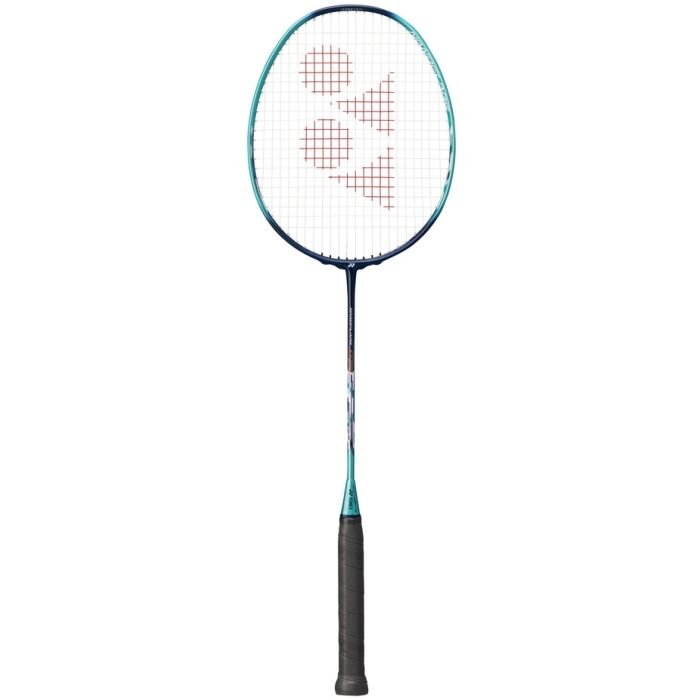
Yonex Nanoflare Junior
The proper junior performance racket — a real graphite Nanoflare at near-standard length, with the grip shrunk to G7 for junior hands.
The Nanoflare Junior earns the top spot because it is the point where “junior racket” stops meaning a scaled-down toy and starts meaning a scaled-down performance racket. Yonex takes the Nanoflare brief — its head-light speed family — and builds the junior version in full graphite: a frame of Graphite, Nanocell NEO and H.M. Graphite over a graphite shaft, with the family’s Sonic Flare System, an Isometric head, a Super Slim Shaft and a Built-in T-Joint. At 665 mm it is only 10 mm short of a full-length adult racket, which is precisely its role: this is the racket for the older child who has the reach for near-standard length and needs the rest of the racket — weight, flex and grip — to stay junior.
Those junior details are the specification that matters. The weight is 4U, averaging 83 g; the flex is Hi-Flex, so the shaft helps a developing swing generate shuttle speed; and the grip is a G7 — smaller than Yonex’s adult grips, published so smaller hands can hold the racket correctly. One honesty note: Yonex publishes no age band for the Nanoflare Junior in the sources checked, so this guide will not invent one. Size it by what is published — 665 mm, 83 g, G7 grip — and it fits the child those numbers describe: too tall for the short-shaft frames, not yet ready for an adult grip. Pair it with the right badminton shuttlecocks and it is a club-ready junior setup, not a starter toy.
What we like
- Full graphite Nanoflare construction — a real performance frame, junior-scaled
- G7 grip is genuinely small, published for junior hands
- Hi-Flex shaft and head-light balance suit developing swing speed
- 665 mm length bridges junior and adult sizes without an adult grip
Worth knowing
- Too long for young starters — the short-shaft cards below exist for them
- Yonex publishes no age band for it; size by length, weight and grip
As an Amazon Associate we earn from qualifying purchases.
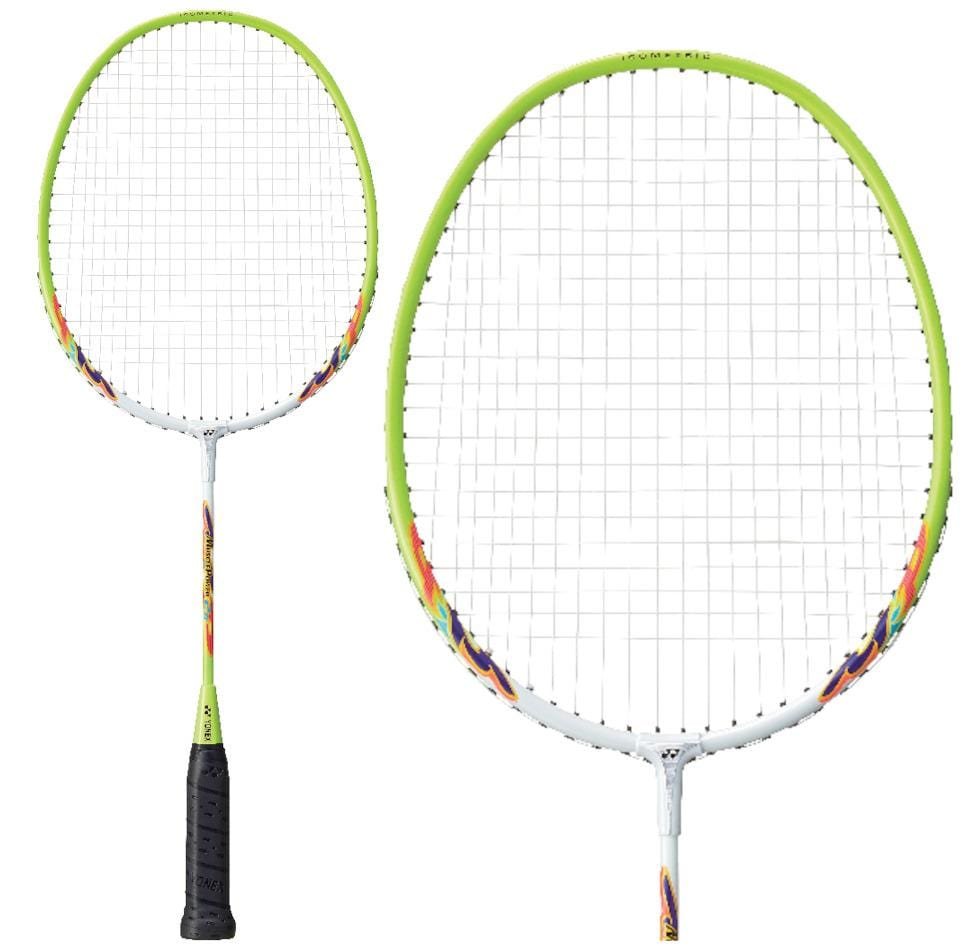
Yonex Muscle Power 2 Junior
The shortest racket in this guide — 533 mm of aluminium and steel, built by Yonex for a child’s very first rallies.
At 533 mm — 21 inches — the Muscle Power 2 Junior is 142 mm shorter than a standard racket, and that single number is the whole product. A child starting badminton does not need reach; they need the head of the racket to be where their hand already thinks it is, close enough that a natural swing meets the shuttle. Yonex builds that brief in the classic junior materials: an aluminium head on a steel shaft, at 83 g, with a small G5 grip. The head is Isometric — Yonex’s square head shape — and the Muscle Power frame seats the string on rounded archways, a design Yonex describes as keeping string and frame in closer, tighter contact.
The rest of the specification is calmly sensible for a first racket: even balance, medium flex, and a factory stringing in Yonex BG3 (retailers list the stringing advice as 14–18 lbs), so it arrives ready to play. Two sourcing notes belong here. The specification is Yonex’s, as reproduced identically by two specialist retailers (Badminton HQ and Direct Badminton). And while one retailer adds its own “aged 5 to 7” label, that is the retailer’s label, not guidance Yonex publishes — so this guide sizes the racket by its 533 mm length and small grip. For the youngest end of the game, it is the default recommendation. The matching footwear end of the junior kit is covered in our best badminton shoes for kids guide.
What we like
- Shortest frame here (533 mm) — the striking zone sits close to a small child’s hand
- Aluminium head and steel shaft: the classic first-racket build
- Small G5 grip, even balance and medium flex
- Factory strung with Yonex BG3, ready to play
Worth knowing
- A growing child will outgrow 533 mm — that is the job of a first racket
- No maker-published age band; the 5–7 label seen at retailers is the retailer’s, not Yonex’s
As an Amazon Associate we earn from qualifying purchases.
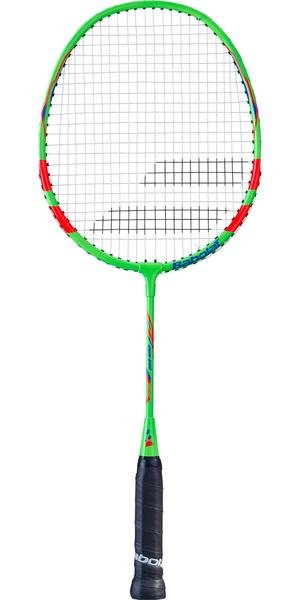
Babolat Minibad
Babolat’s smallest junior — 540 mm and 84 g in aluminium and steel, with a power head shape for first contact.
The Minibad sits one rung — seven millimetres — above the Muscle Power 2 Junior, and it earns its own card as the alternative at the very start of the ladder: Babolat’s smallest junior racket, at 540 mm and 84 g, in the same aluminium-and-steel construction as its Yonex rival. Where the two differ is the head: Direct Badminton’s description of the Minibad highlights its power head shape, which it describes as enlarging the responsive area of the string bed — a sensible priority for a child whose first achievement is simply connecting cleanly, rally after rally, in the garden or the school hall.
Choosing between this card and the Yonex above it is a close call, and either serves a young starter well: the Yonex brings its Isometric head and BG3 factory string, the Babolat its power head shape and a marginally longer frame. The same sourcing discipline applies — a retailer headline suggests an age range, but Babolat does not publish an age band for the Minibad in the sources checked, so none is claimed here. Families buying for more than one child at once may also want to compare the complete kits in our best badminton sets guide before buying singles.
What we like
- 540 mm and 84 g — squarely at the youngest end of the ladder
- Aluminium and steel construction from a first-rank racket maker
- Power head shape is designed to widen the responsive string area
- A real alternative to the Yonex at the same rung, not a copy of it
Worth knowing
- Babolat publishes no age band or grip size for it in the sources checked
- Like every 54 cm racket, it is a starting point, not a long-term frame
As an Amazon Associate we earn from qualifying purchases.
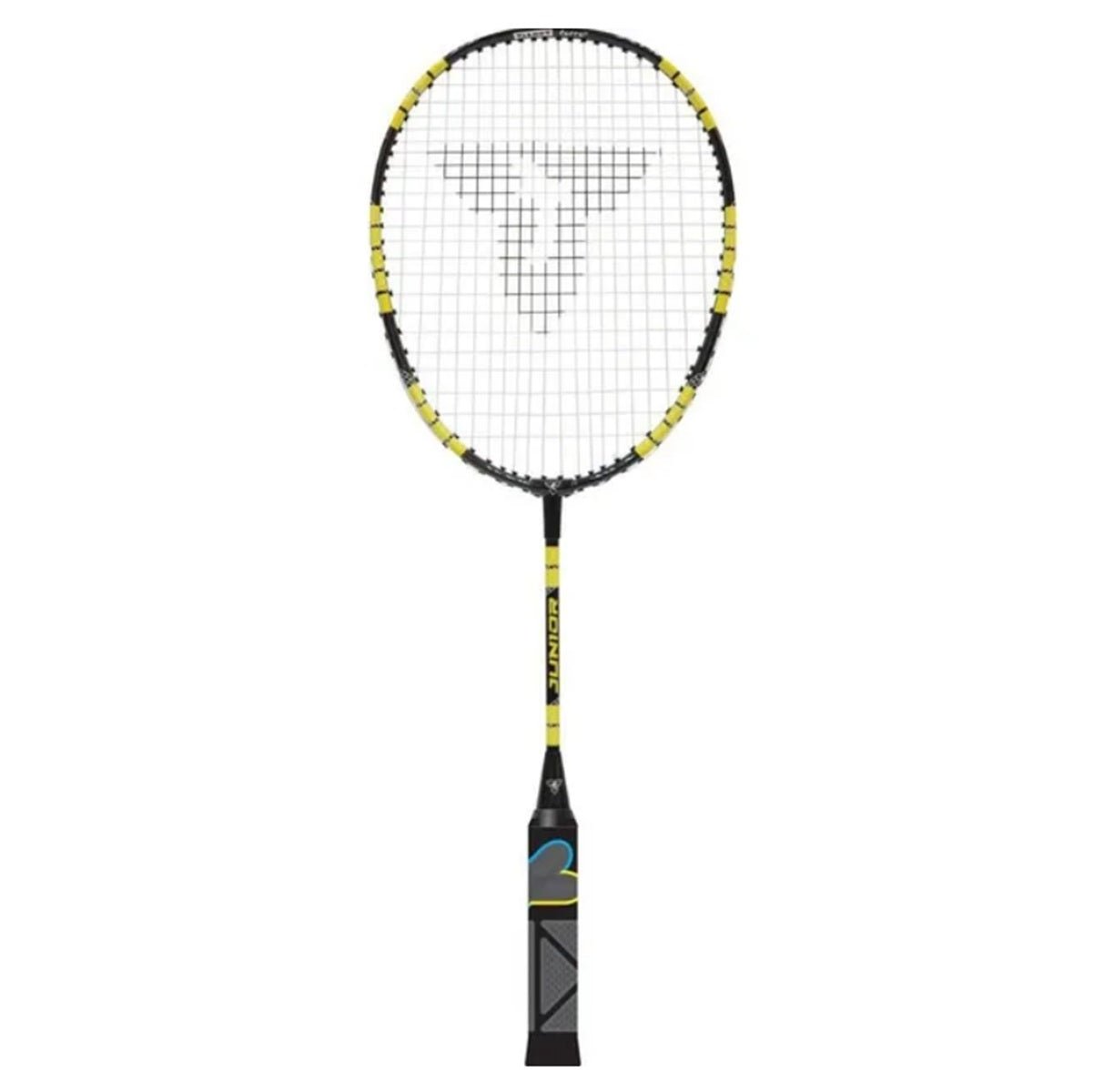
Talbot Torro ELI Junior
A racket designed as a teaching tool — 580 mm, a learning grip with colour-marked finger positions, and colour-coded faces.
Every other racket in this guide is equipment. The ELI Junior is a curriculum. It is the middle racket of Talbot Torro’s ELI (Easy Learning Initiative) series, and its design starts from how children actually learn the grip: the handle is oval rather than round — Talbot Torro’s concept description explains that the oval shape makes the wrong, “frying pan” grip feel wrong in the hand — and the grip band carries colour markings showing the correct finger position for forehand and backhand, so the child can check their own hand. The two faces of the head are coloured differently (the yellow side for backhand, blue for forehand, per the maker’s listings), which lets a coach or parent see the racket’s orientation from across the court.
The frame underneath the teaching aids is a mid-ladder junior: 580 mm, about 97 g strung, light aluminium head on a hardened steel shaft. The head is teardrop-shaped, which Talbot Torro says shifts the sweet spot toward the top of the head — its reasoning, in the ELI concept copy, is that young players tend to react a fraction late and meet the shuttle high and off-centre, so the responsive area moves to where their contact happens. This card also carries the guide’s only age guidance, because Talbot Torro itself publishes it: the ELI concept positions this racket for players from about 6 to 8 years old.
What we like
- The only true learning racket here — grip markings and colour-coded faces
- Oval learning handle discourages the frying-pan grip by feel
- Teardrop head moves the sweet spot to where late contact happens
- The one maker-published age position in this guide (about 6–8, per Talbot Torro)
Worth knowing
- At about 97 g strung it is the heaviest card here — length, not weight, is its junior feature
- Its teaching design matters most with a coach, teacher or parent using it
As an Amazon Associate we earn from qualifying purchases.
Victor GJ-7500 Junior
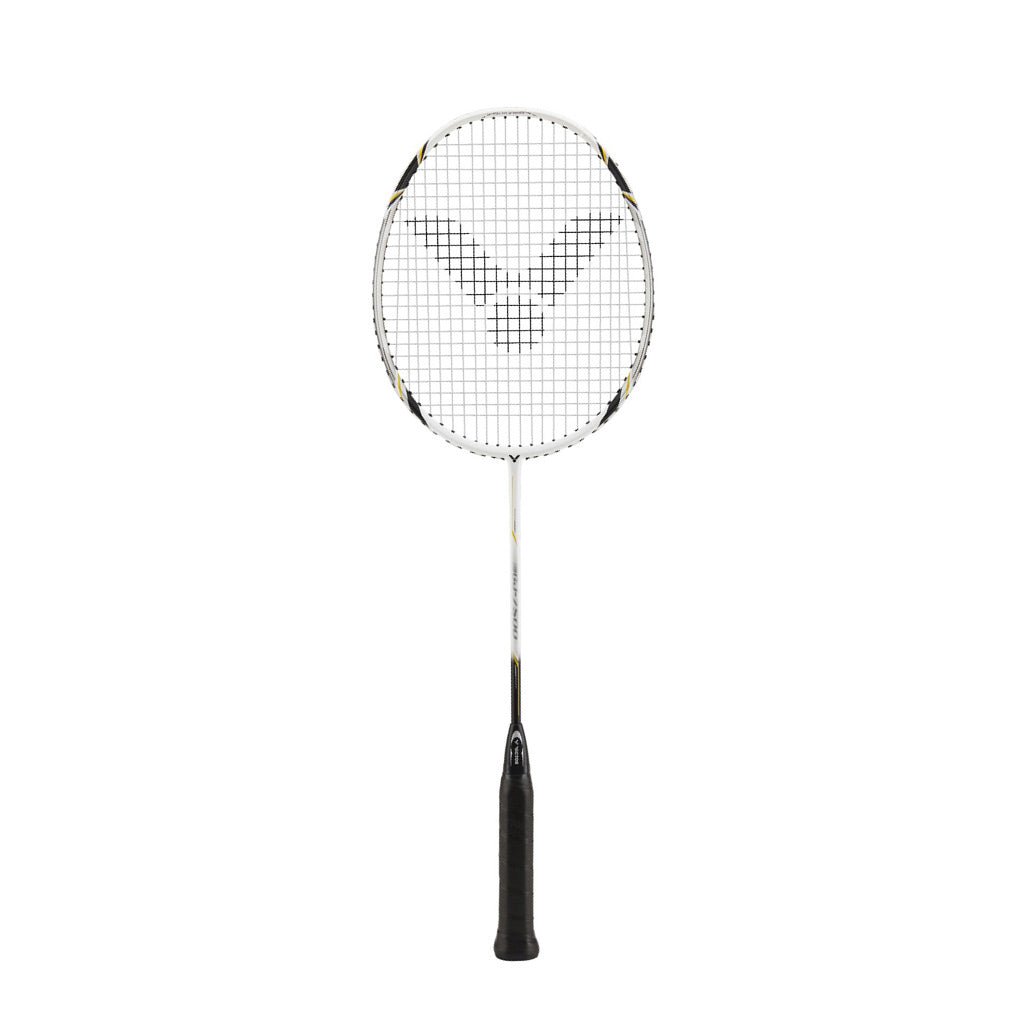
The graphite step at mid-length — 620 mm and about 76 g, the lightest racket in this guide, with a short shaft and smaller grip.
The GJ-7500 is where the ladder changes material. At 620 mm it is still a short-shaft junior — Victor’s own product description, as carried by its retailers, describes a shorter shaft and a smaller grip size to help younger players train and develop — but it is built from 100% Hi-Modulus Graphite, the same class of material as Victor’s adult frames, and that shows in the second number on its spec sheet: about 76 g, the lightest weight in this guide by a clear margin. For a child who has outgrown the 54–58 cm starters but is not yet tall enough for the 66 cm frames, this is the rung that keeps the racket light while the length grows.
The rest of the specification supports that role: an Isometric head, Victor’s Inner Waves frame structure (which Victor describes as extending the sweet spot), and a maximum stringing tension of about 10 kg. One verification flag belongs here, in the open: most specialist sources agree on 620 mm and a G2 grip, but one retailer lists this model at 645 mm with a G5 grip. This card follows the 620 mm consensus shared by Malta Sports, erakiety and Tennisnuts — check the length on the exact listing before ordering. Victor publishes no age band for the GJ-7500 in the sources checked, so this guide sizes it by length and weight instead.
What we like
- Lightest racket here (about 76 g) thanks to full Hi-Modulus Graphite
- 620 mm fills the gap between the starters and the 66 cm frames
- Short shaft and smaller grip keep it a true junior, not a cut-down adult
- Inner Waves frame structure from Victor’s adult technology set
Worth knowing
- Retailer listings conflict on this model (one lists 645 mm / G5) — verify the exact listing
- No maker-published age or height guidance; size by the 620 mm length
As an Amazon Associate we earn from qualifying purchases.
Babolat Explorer Junior
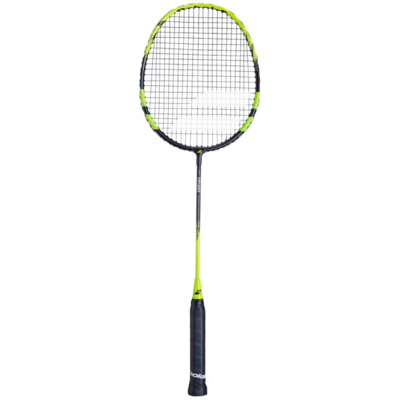
The long steel step-up — 662 mm with Babolat’s own shorter-shaft beginner design, in steel and aluminium.
The Explorer Junior is the steel-and-aluminium family’s answer to a growing child: at 662 mm it is within 13 mm of a full-length racket, yet still designed as a junior beginner’s frame. That positioning is Babolat’s own — on its official product page, Babolat describes the Explorer as perfect for beginners thanks to a shorter shaft that makes it easier to hit shuttlecocks, in a steel and aluminium design. “Shorter” is relative at this end of the ladder: shorter than the 675 mm standard, long enough that a taller child keeps their reach while the swing stays manageable.
Tennisnuts’ listing for the same Babolat product code adds the playing specification: even balance and medium flex, supplied strung. What this card will not give you is a weight, and the reason is worth the sentence it takes: no consistent weight for the current Explorer Junior listing could be verified across the maker’s page and its retailers (a 100 g figure circulates for the Explorer II listing, a different listing), so the number is left out rather than borrowed. Judge this racket on what is verified — its 662 mm length, its steel-and-aluminium build, and Babolat’s stated beginner brief — and it is the natural step for the older child who still wants the steel family’s straightforward feel before moving to graphite or carbon. Babolat publishes no age band for it in the sources checked.
What we like
- 662 mm — near-standard reach in a junior beginner’s design
- Babolat’s own shorter-shaft beginner brief, confirmed on its product page
- Even balance and medium flex: a calm, all-round specification
- Steel and aluminium construction keeps the junior build simple
Worth knowing
- No verifiable published weight for the current listing — check the retailer page
- Children ready for graphite should compare the Nanoflare Junior above
As an Amazon Associate we earn from qualifying purchases.
Babolat Prime Junior
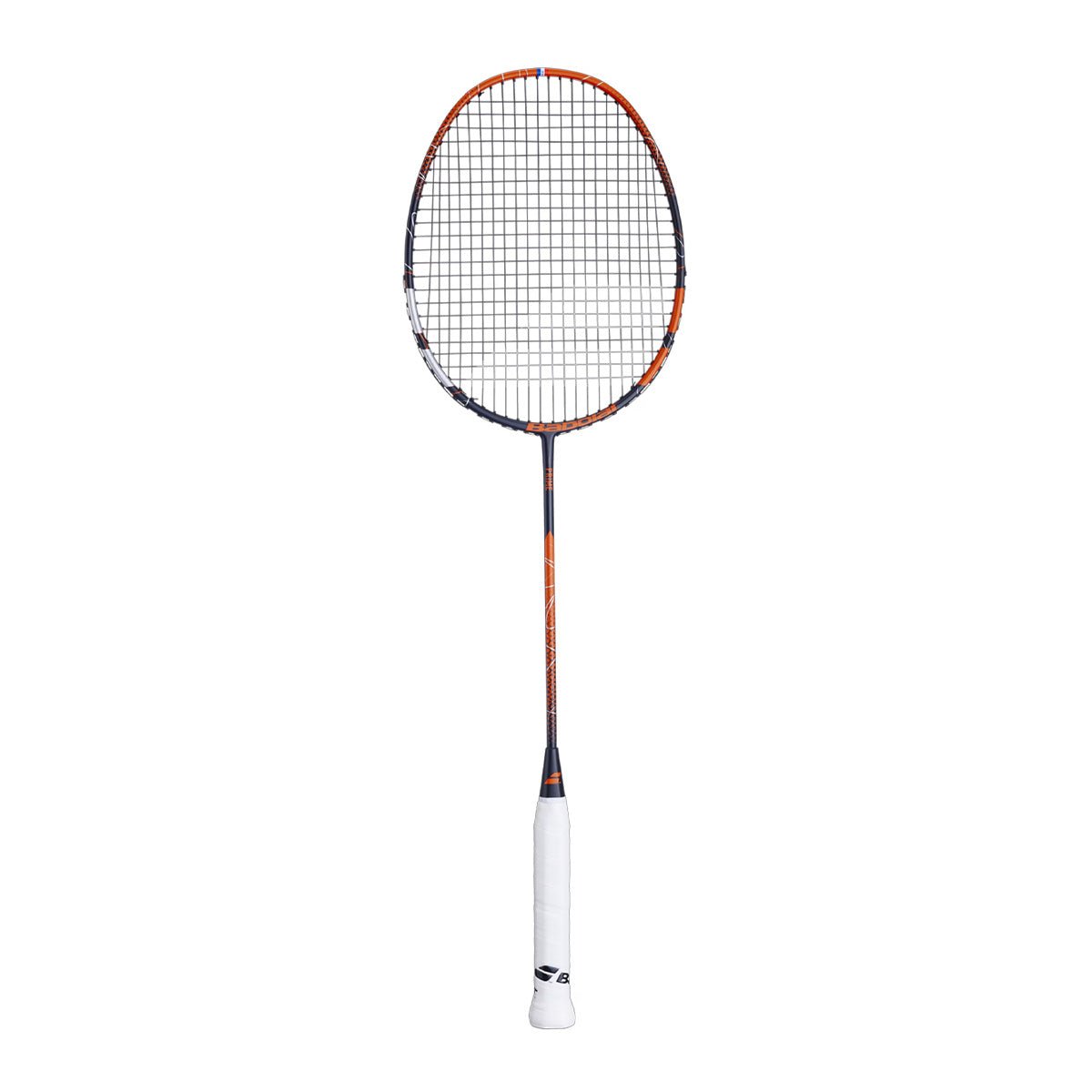
The top of the junior ladder — a full standard-length 675 mm carbon frame, kept junior by its 85 g weight and all-round brief.
Every ladder needs a top rung, and the Prime Junior’s is defined by a single contrast: the length is adult, everything else is junior. At 675 mm it is exactly the standard badminton length — no shortening at all — but the frame is carbon and weighs 85 g (±3 g), with an even balance at 290 mm (±5 mm) and a medium flex, a combination no adult racket in the beginners guide is built around. This is the racket for the older child whose height now demands full length, whose game is still developing, and who would be handed too much racket by an adult frame’s weight and grip.
Sweatband’s full specification table fills in the playing details: an Isometric head, Babolat’s Shot Optimiser technology (described as widening the sweet spot), a wood handle under the grip, and factory stringing in Babolat synthetic string at 18–22 lbs. From here, the next step genuinely is the adult game — when this racket’s length feels right but its junior brief starts to feel limiting, the adult lineup in our beginners guide linked earlier is the correct next page. Babolat publishes no age band for the Prime Junior in the source checked, so the decision is made on the published numbers: full length, light weight, even balance.
What we like
- Full 675 mm standard length — no reach compromise for taller juniors
- Carbon frame at 85 g keeps a full-length racket swingable
- Even balance, medium flex and Isometric head: a forgiving all-round spec
- The clean bridge between junior rackets and the adult beginners range
Worth knowing
- Full length rules it out for younger, shorter players — climb the ladder first
- No maker-published age band; size by height and the published numbers
As an Amazon Associate we earn from qualifying purchases.
Side-by-Side Comparison Table
| Model | Best For | Length | Weight | Construction | Grip (as published) | Maker’s Age Guidance |
|---|---|---|---|---|---|---|
| Yonex Nanoflare Junior | Best overall junior | 665 mm | 83 g (4U) | Graphite / Nanocell NEO / H.M. Graphite | G7 | None published |
| Yonex Muscle Power 2 Junior | Youngest starters | 533 mm | 83 g | Aluminium head, steel shaft | G5 (small) | None published |
| Babolat Minibad | Small starter alternative | 540 mm | 84 g | Aluminium & steel | Not published | None published |
| Talbot Torro ELI Junior | Learning racket | 580 mm | Approx. 97 g strung | Aluminium head, hardened steel shaft | Oval learning grip | About 6–8 years (Talbot Torro) |
| Victor GJ-7500 Junior | Mid-length graphite | 620 mm | Approx. 76 g | 100% Hi-Modulus Graphite | G2 (retailer specs) | None published |
| Babolat Explorer Junior | Steel step-up | 662 mm | Not consistently published | Steel & aluminium | Not published | None published |
| Babolat Prime Junior | Full-length junior | 675 mm | 85 g (±3 g) | Carbon frame, wood handle | Not published | None published |
The last column is the one most kids’ racket guides invent. Here it is copied from the makers: only Talbot Torro publishes an age position, for its ELI learning racket. Every other model on this page is sized by its published length, weight and grip — which is the honest way to choose them, and the way the buying guide below works through it.
Buying Guide: Climbing the Length Ladder Honestly
1. Buy the length your child is, not the one they will grow into
The ladder in this guide is the buying guide. Youngest starters begin at 533–540 mm (Muscle Power 2 Junior, Minibad). A child learning grips and first technique sits at 580 mm with the ELI Junior — the rung Talbot Torro positions for about 6 to 8 year olds. The mid-length graphite step is 620 mm (GJ-7500). Older, taller children move to 662–665 mm (Explorer Junior, Nanoflare Junior), and full standard length arrives only at the top, with the 675 mm Prime Junior. Skipping rungs is the classic mistake: a racket bought “to grow into” gives a child a season of late swings first.
2. Check the grip in the hand, and distrust cross-brand grip numbers
Grip sizes are published in each maker’s own scale — a Yonex G7, a Yonex G5 and a Victor G2 cannot be compared as numbers, only as intentions: all three are the small end of their own ranges, made for smaller hands. So test physically where you can: the fingers should wrap the handle with the thumb able to lie flat along the bevel for a backhand grip, without the fingertips digging into the palm. The ELI Junior sidesteps the question entirely with its oval learning grip and colour-marked finger positions. And remember the asymmetry: an overgrip can make a small grip bigger, but nothing makes a big grip smaller — between two options, choose the smaller grip.
3. Steel and aluminium first, graphite when the length grows
Parents comparing spec sheets sometimes read “steel shaft, aluminium head” as the cheap option next to graphite. In junior rackets it is simply the published build for the short end of the ladder: every short-shaft starter here uses it. Graphite’s real junior advantage appears at mid-length, where the GJ-7500’s full graphite build is what makes a 620 mm racket weigh about 76 g, and carbon completes the pattern at full length in the 85 g Prime Junior. Match the material to the rung: a steel racket at the right length will teach better badminton than a graphite one a size too big.
4. Verify the exact listing — junior information lives at retail
A frustration parents deserve warning about: junior racket information is thinner and less consistent than adult information, and this guide’s research found it first-hand. One Victor model is listed at two different lengths by different retailers; one Babolat model’s weight could not be verified consistently, so this guide left it out; and Decathlon’s own page for its junior racket publishes no length or weight, which is why that model is not carded here. The habit that protects you is simple: before ordering, confirm the length, weight and grip on the exact listing in front of you against the comparison table above, and treat any listing that publishes none of them as a listing to skip.
Frequently Asked Questions
What size badminton racket should a child use?
Size by length first. The junior ladder in this guide runs from 533 mm for the youngest starters (Yonex Muscle Power 2 Junior) and 540 mm (Babolat Minibad), through 580 mm learning rackets and the 620 mm Victor GJ-7500, up to near-standard lengths of 662–665 mm and the full 675 mm Babolat Prime Junior for older, taller children. Choose the length that matches the child now: the head should sit close enough that a natural swing meets the shuttle, without the racket feeling like it is pulling the arm long.
What is a short-shaft junior badminton racket?
It is a junior racket whose overall length has been cut, mostly from the shaft, so the head sits closer to the hand. Babolat describes its Explorer’s shorter shaft as making it easier to hit shuttlecocks, and Talbot Torro’s ELI Junior uses its shortened 580 mm length the same way. In this guide the short-shaft family runs from 533 mm to 620 mm; above that, rackets keep a near-standard length and do their junior scaling through weight, flex and grip size instead.
At what age should a child use each racket size?
Mostly, the makers do not say — and this guide will not invent it. Only one maker in this guide publishes an age position: Talbot Torro positions its ELI Junior learning racket for players from about 6 to 8 years old. Yonex, Victor and Babolat publish no age band for the junior models carded here, so size those rackets by their published length, weight and grip against your child’s height and hand, using the ladder in the buying guide.
Steel or graphite — which is better for a kids’ badminton racket?
Neither is better in the abstract; they belong to different rungs. The short-shaft starters in this guide (Yonex Muscle Power 2 Junior, Babolat Minibad, Talbot Torro ELI Junior) are published with aluminium heads and steel shafts. Graphite appears at mid-length, where the Victor GJ-7500’s full Hi-Modulus Graphite build makes a 620 mm racket weigh about 76 g, and carbon appears at full length in the Babolat Prime Junior. Choose by length and grip first; the material follows the rung.
What grip size does a child need on a badminton racket?
A small one — but read the number in its own maker’s scale. Yonex publishes a G5 grip on the Muscle Power 2 Junior and a G7 on the Nanoflare Junior; Victor’s GJ-7500 listings carry a G2 in Victor’s sizing. Those numbers are not comparable across brands. The physical test is the same everywhere: fingers wrap the handle, the thumb can lie flat for a backhand grip, and the fingertips do not dig into the palm. Between two sizes, choose the smaller — an overgrip can add size, but nothing removes it.
When should a child move up to a standard-length racket?
When the short frame starts costing them the game: clears that no longer reach, net shots stretched for, and a swing that has clearly outgrown the shorter length. The move is a rung, not a leap — from the short-shaft frames to a 662–665 mm junior (Babolat Explorer Junior, Yonex Nanoflare Junior), then to a full-length junior like the 675 mm Babolat Prime Junior, which keeps an 85 g junior weight at adult length. Adult rackets themselves are the step after that, covered by our adult beginners guide.
Can a child just use an adult badminton racket?
An older, taller child who has outgrown the full-length junior rung can — that is exactly the step-up path this guide links to its adult beginners guide for. For a younger or smaller child, an adult racket gives them 675 mm of length, an adult grip and an adult weight all at once, which is why junior rackets exist in two forms: short-shaft frames for the youngest, and standard-length light frames with small grips for older children. Match the form to the child and the adult racket can wait its turn.
The Verdict
Buy by length, and the rest falls into place. Youngest starters: the Yonex Muscle Power 2 Junior (533 mm) or Babolat Minibad (540 mm). A child learning the game properly deserves the Talbot Torro ELI Junior, the one racket here designed as a teaching tool, with Talbot Torro’s own age position of about 6 to 8 years. The Victor GJ-7500 Junior is the light graphite step at 620 mm, the Babolat Explorer Junior the long steel step-up at 662 mm, and the Yonex Nanoflare Junior — 665 mm, 83 g, G7 grip, full graphite — is the best overall junior racket here. The Babolat Prime Junior closes the ladder at a full 675 mm, after which the adult game takes over. Climb one rung at a time, and verify the exact listing before you buy.
Affiliate disclosure: AliShuttler is reader-supported. When you buy through links on this page we may earn an Amazon commission at no extra cost to you. Specifications are taken from manufacturers’ published product information as verified at the time of writing; where a model’s information comes from specialist retailers reproducing the maker’s specification, the card and the build notes say so, including any conflicting listing found. Manufacturers and retailers revise listings, so confirm the exact specification before ordering.