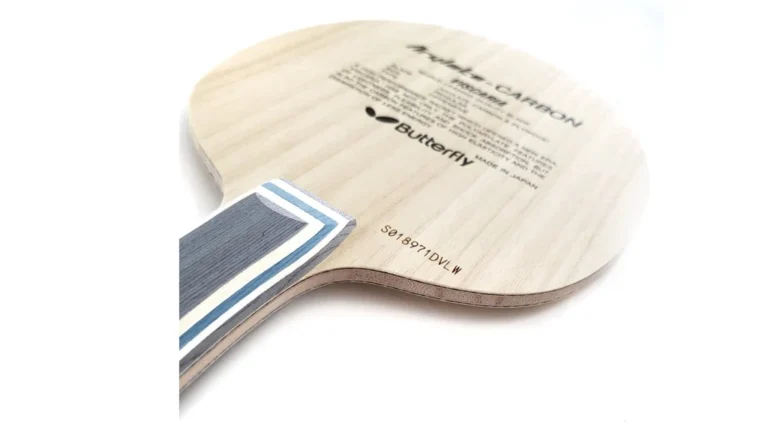
Most table tennis bats are built for an adult hand: a full-size head on a full-width flared handle, at a weight a grown player swings without thinking. A child gets the same bat and has to choke up the handle and muscle the head around. Junior bats fix that honestly — smaller heads, thinner and shorter handles, and lighter builds, in the exact figures their makers publish. This guide compares the junior models the major makers actually list, and is upfront about the models whose makers publish no age or weight guidance at all.
⚡ TL;DR — The Short Answer
Buy on the handle and the weight, not the artwork. The most completely maker-documented junior bat here is the JOOLA Team Junior: JOOLA itself lists a smaller blade, an extra-small handle and 1.7 mm ITTF-approved VIZON rubbers, and its retailer Kuebler positions it for ages 6–12 at 170 g. Butterfly makes the smaller-head alternative in the Harimoto Tomokazu 1800 Kids (5-ply, Addoy rubber, 1.5 mm sponge) and the teen-hands step in the Butterfly Junior. The STIGA Hobby Instinct is the honest standard-size card for older juniors — STIGA aims it at kids and beginners but publishes no junior sizing for it. When a junior is ready to choose rubbers, three junior blades wait: Donic’s Waldner Youngstar for control and Persson Youngstar for attack (both under 80 g, extra-narrow handles, verified on Donic’s own site), and the Victas Award Allround Light (approx. 80 g, slightly smaller handle) as the step-up build.
Quick Picks — Best Table Tennis Bats for Kids at a Glance
Smaller blade and extra-small handle per JOOLA; Kuebler positions it for ages 6–12 at 170 g.
5-ply wood with Addoy rubber and 1.5 mm sponge — a smaller head and handle, plus two balls in the set.
Butterfly says this one is adjusted to teen hands: smaller blade, lighter weight, Addoy at 1.5 mm.
STIGA’s kids-and-beginners hobby bat: 5-ply, 1-star rubber, control rated 100 — no junior sizing claimed.
Blade only, under 80 g: an extra-narrow concave handle and Donic’s high-control allround brief.
Blade only, under 80 g: the offensive Youngstar, ALL+/OFF−, for juniors who already hit through the ball.
Blade only, approx. 80 g with a slightly smaller flared handle — Speed 82, Control 97 per Victas.
In This Guide
Why Kids Need a Junior-Sized Bat
Table tennis looks forgiving about equipment — the bat is small, the ball weighs almost nothing — and that is exactly why the junior decision gets skipped. But a standard pre-assembled bat is proportioned for an adult: full-size head, full-width flared handle, and a complete weight far above the junior models in this guide. A young player holding one either grips halfway up the handle, changing the balance the maker built in, or swings a head their wrist is still growing into. The makers who publish junior models solve it the straightforward way — they shrink the bat itself.
This guide owns the junior decision only. It does not re-rank adult beginner bats: our best table tennis bats for beginners guide owns that selection, and its seven carded models — the Palio, Butterfly, Killerspin, STIGA, Cornilleau and JOOLA adult beginner picks — are deliberately not re-carded here. When a junior outgrows the bats below, that guide is the step-up path. Nor does this page re-teach component depth: our best table tennis blades guide owns blades as components, and the three blade-only cards here are included only because each is a junior-specific blade a maker publishes for children — the point where a junior’s first custom build begins.
What this page does is lay out the junior market in the order a parent meets it: genuinely junior-sized ready-made bats first, then the one standard-size hobby bat a maker positions for kids (labelled as standard-size, because it is), then the junior blades for a first custom build. Every weight, handle and sponge figure is the maker’s published figure, paraphrased from the maker’s own listing or a retailer listing that reproduces it. Where a maker publishes age guidance, it is attributed to that maker or retailer. Where a maker publishes none — several do not — the card says so plainly rather than placing the bat in an age band by guesswork.
The Junior Decision: Handle, Head, Weight, Grip Style
The handle is the first junior specification. A flared shakehand handle is shaped for an adult palm, and a child’s fingers either cannot close around it or close with the index finger pushed high up the blade. The junior models address this in the maker’s own words: JOOLA fits the Team Junior with a thinner, extra-small handle; Butterfly describes the Harimoto 1800 Kids handle as smaller and narrower; Donic builds both Youngstar blades with an extra-narrow concave handle; Victas makes the Award Allround Light’s handle slightly smaller. These are descriptions, not measurements — no maker in this guide publishes a numeric junior handle dimension, so none is printed here. Where a maker makes no junior handle claim at all — STIGA, for the Hobby Instinct — the card says that too.
Head size is the second. A smaller head removes wood from the far end of the bat, where its weight does the most work against a small wrist. JOOLA states a smaller blade for the Team Junior, Butterfly states a smaller head for the Harimoto Kids and a smaller blade for the Butterfly Junior, and Donic states a slightly smaller blade face for both Youngstar blades. The makers publish the reduction, not a head dimension to compare across brands — so this guide compares the claim as published, model by model, rather than inventing a junior standard that does not exist.
Weight is where the published numbers finally appear — and they split the guide in two. For the ready-made bats, hard figures are scarce: Kuebler lists the JOOLA Team Junior at 170 g, while Butterfly publishes no bat-only weight for either junior model (retailer figures conflict, and conflicting figures are not printed here as fact). For the blade-only cards, the makers are precise: Donic lists both Youngstar blades at under 80 g before rubbers, and Victas lists the Award Allround Light at approximately 80 g. A blade weight is not a finished-bat weight — two rubber sheets go on top of it, so a finished Youngstar build outweighs the 170 g Team Junior even though its blade is half that figure. Compare blade to blade and bat to bat, never across the two.
Rubber and sponge decide what a ready-made bat teaches. The four ready-made cards all sit in the same sensible junior band: 1-star rubber with 1.5 mm sponge on the STIGA, Addoy rubber with 1.5 mm sponge on both Butterfly models, and 1.7 mm ITTF-approved rubber on the JOOLA. Thin-to-mid sponge and control-first rubber is the combination the makers themselves choose for these models — the ratings make it plainest on the STIGA, where STIGA publishes Control 100 against Speed 31. A junior learning strokes needs the ball to stay on the table while technique forms; outright speed is what the step-up guides are for.
Grip style: shakehand is what the junior market actually offers. Every verified junior model in this guide is a shakehand bat — flared on the JOOLA, both Butterfly models and the Victas, concave (Donic’s term for its flared profile) on the Youngstar blades and the STIGA. None of the makers above publishes a penhold variant — Chinese or Japanese — of its junior model in the listings verified for this guide. So no junior penhold bat is carded here, because none could be verified. A young penhold learner’s honest route today is a standard penhold beginner bat chosen from the adult beginner guide linked above, held with a coach’s guidance on grip — not a junior penhold model this guide would have to invent. And the pre-assembled versus custom line: cards #1–#4 arrive ready to play, rubbers fitted; cards #5–#7 are blades only, and the rubbers are chosen, bought and fitted separately — that is not a drawback, it is the definition of the step those cards represent, and it is why they sit last.
The 7 Best Table Tennis Bats for Kids, Compared
The order runs the way a family climbs it: the most completely junior-documented ready-made bat first, the smaller-head and teen-hands alternatives next, the standard-size hobby bat after them, and the three junior blades — control, attack, step-up — closing the guide. Four cards are ready to play out of the packaging; three are blades for a first custom build, and each of those cards says so in its first specification chip. Every age statement is attributed to the source that publishes it; every model without published guidance is labelled as such on its card.
JOOLA Team Junior
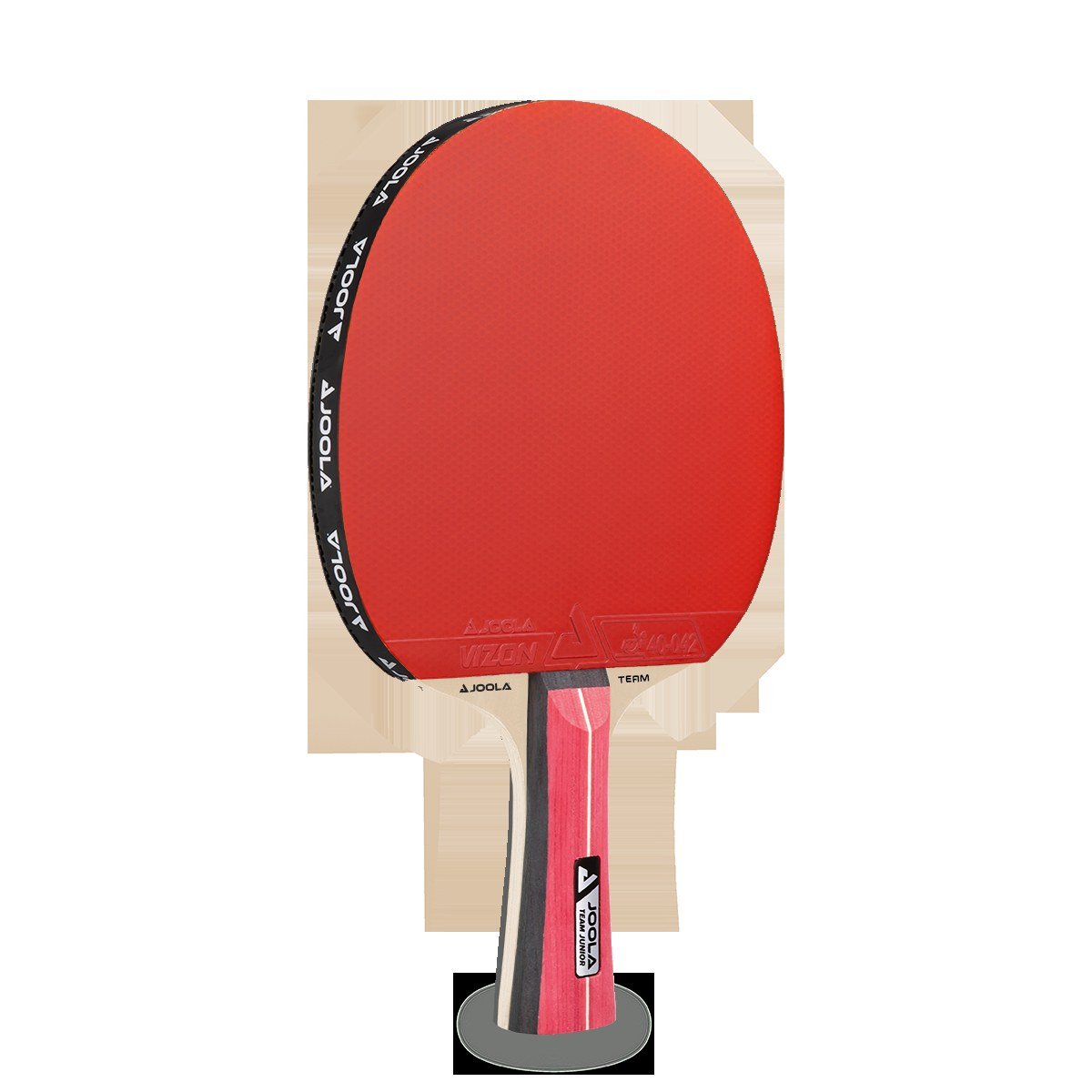
The junior bat with the fullest paper trail: a smaller blade and an extra-small handle, documented on JOOLA’s own shop.
Start with what JOOLA itself publishes, because JOOLA publishes more about this bat than any other maker here says about its junior model. On its own shop, JOOLA describes the Team Junior as a 3-star bat built for young players, with ITTF-approved VIZON rubbers at 1.7 mm, a reduced blade size and a slim, extra-small handle shaped — JOOLA says — to sit securely in a child’s hand. Two named technologies sit underneath: ERGO GRIP shaping on the handle, and CENTRO BALANCE, which JOOLA describes as weight distribution optimised toward the centre of the blade rather than the head. A complete junior brief — head, handle, rubber, balance — stated by the maker, for this specific model.
The figures JOOLA does not publish, its retailers supply, and this card attributes them accordingly. Kuebler Sport’s JOOLA listing positions the Team Junior for children aged 6 to 12 and lists the bat at 170 g, with ratings of Speed 65, Control 91 and Spin 75 — the control-first profile the rubber choice suggests. One record-keeping note: older retailer listings for this model name the 1.7 mm rubber TRAMP rather than VIZON; JOOLA’s current own listing says VIZON, so VIZON is what this card prints. For a first bat that a parent can size from published information instead of guesswork — an age band from the retail channel, a weight, a handle claim from the maker — this is the strongest-documented starting point in the junior market.
What we like
- Full junior brief verified on JOOLA’s own shop: smaller blade, extra-small handle, 1.7 mm ITTF rubbers
- Retailer-published age guidance (ages 6–12, Kuebler) and a published 170 g weight
- Control-led ratings (Control 91 against Speed 65) for the stroke-learning years
- CENTRO BALANCE and ERGO GRIP shaping, as JOOLA describes them
Worth knowing
- JOOLA’s own page publishes no numeric weight or age band — both figures here are Kuebler’s
- Older listings name the rubber TRAMP; current JOOLA listings say VIZON — check the product page when ordering
As an Amazon Associate we earn from qualifying purchases.

Butterfly Harimoto Tomokazu 1800 Kids
Butterfly’s named kids’ model in its own catalog: a smaller head and a smaller, narrower handle on a 5-ply Addoy build.
Butterfly lists this model in its own equipment catalog as the Harimoto 1800 Kids, with Addoy rubber on a 5-ply wood construction — the kids’ entry in its Japan Series line. Butterfly’s US distributor listings, carried by Megaspin and by Target’s Bowmar Sports store, fill in the junior specifics: the head is smaller and the handle is smaller and narrower, flared with a concave centre, which Megaspin describes as making the racket lighter and easier to manoeuvre for kids or any player who needs a smaller handle. Addoy rubber with a 1.5 mm sponge sits on both sides, the set includes two 40+ training balls, and the rubbers carry ITTF and USA Table Tennis approval, so the bat is legal for tournament play as supplied.
Two honesty notes belong on this card. Butterfly publishes no age band for the Harimoto Kids — “kids” is in the model name and the positioning, and no birthday range is claimed here. And Butterfly publishes no clean bat-only weight: retailer listings conflict, with one listing an item weight of 0.2 kg and another a shipping weight of 1.6 lb for the packaged set, so this guide prints neither as the bat’s weight. What can be stated is the construction behind the lighter feel Megaspin describes — less head, less handle, 1.5 mm sponge.
What we like
- A named kids’ model in Butterfly’s own catalog — not an adult bat re-labelled
- Smaller head and smaller, narrower handle, stated in the distributor’s specification
- Addoy rubber at a learning-friendly 1.5 mm sponge, ITTF and USATT approved
- Two 40+ training balls included — playable straight out of the box
Worth knowing
- Butterfly publishes no age band and no bat-only weight for this model
- Like most recreational Butterfly rackets, the rubber is fitted to stay — upgrading rubbers means a new bat or a blade below
As an Amazon Associate we earn from qualifying purchases.
Butterfly Junior
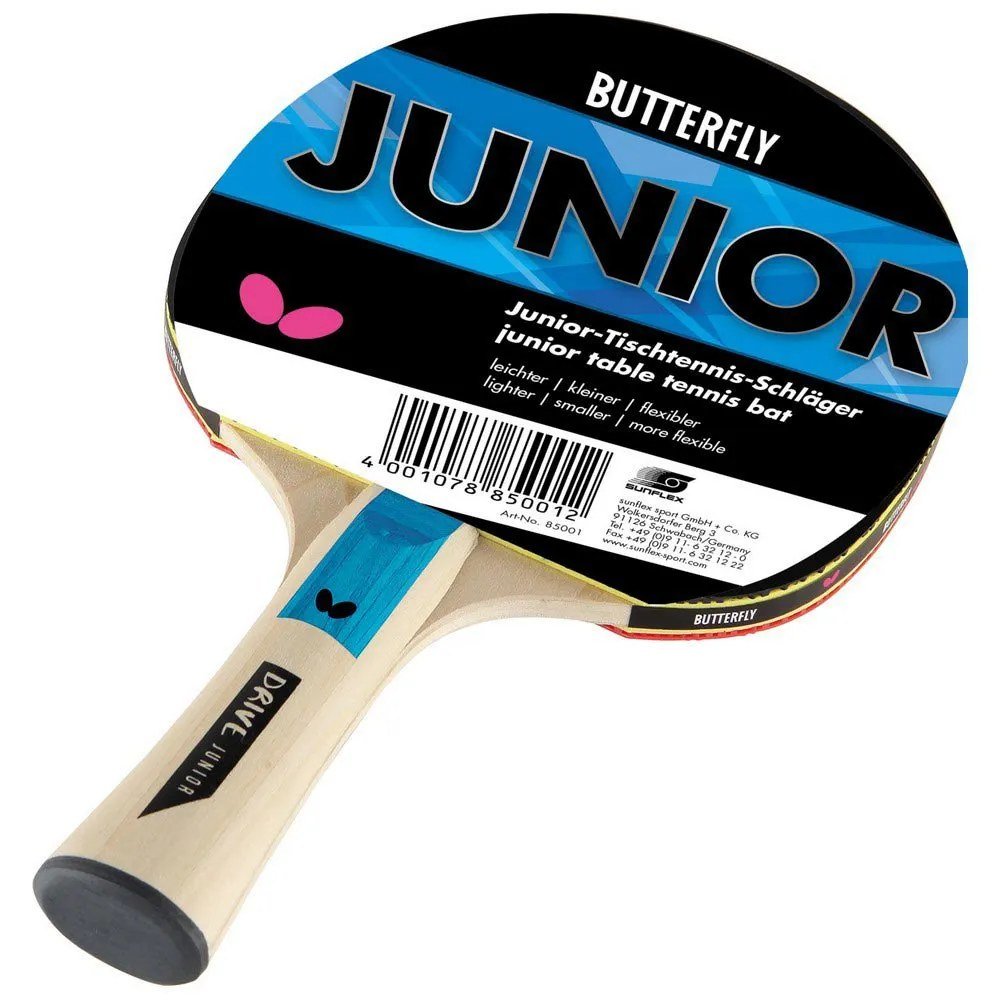
Butterfly’s European junior bat — and the one model in this guide whose maker aims it at teenagers, not children.
The junior market mostly stops at childhood, which leaves the 13-to-16-year-old beginner in an awkward gap: too big for a children’s bat, still learning strokes an adult power bat would punish. Butterfly’s Junior is the model that addresses that gap by name. In Butterfly’s published description, reproduced by its retailers Tradeinn and BigaMart, the bat is adjusted to teen hands, with a smaller blade and a lighter weight than a standard bat, fitted with Addoy rubber over a 1.5 mm sponge for what Butterfly calls good playing quality — and the rubber is ITTF approved. It is, in effect, the Harimoto card’s formula re-aimed one age group up: the same control-first Addoy and sponge recipe, on proportions Butterfly pitches between its kids’ model and its adult ready-made range.
The specification is also the thinnest in this guide, and the card does not dress that up. Butterfly publishes no numeric weight for the Junior — “lighter” is the maker’s word, not a measurement — no ply count in the description its retailers carry, and no age band beyond the teen positioning itself. Buy it on what is verified: the teen-hands brief, the smaller blade, and a proven beginner rubber at a learning thickness. A younger child belongs on cards #1 or #2, where the documentation is fuller; an older junior who has outgrown children’s bats but is still building strokes is exactly the player this model exists for.
What we like
- The only maker brief in this guide aimed at teen hands rather than children
- Smaller blade and lighter build, as Butterfly describes them
- Addoy rubber at 1.5 mm — the same control-first recipe as the Harimoto Kids
- ITTF-approved rubber, so club and school competition play is covered
Worth knowing
- Butterfly publishes no numeric weight, ply count or age band for this model
- The published specification is the briefest here — the brief is the buy, not a spec sheet
As an Amazon Associate we earn from qualifying purchases.
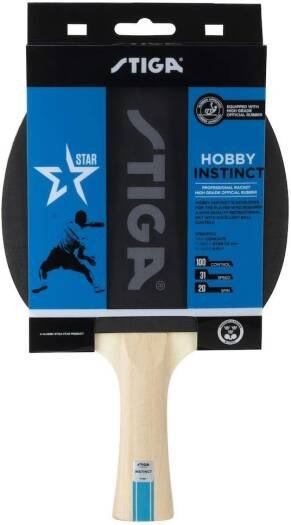
STIGA Hobby Instinct
STIGA positions this 1-star hobby bat for kids and beginners — and publishes no junior sizing for it. Both facts are on the card, because both matter.
Read this card as the guide’s control case. STIGA’s published description, carried by its retailers, presents the Hobby Instinct plainly: a 1-star table tennis bat for kids and beginners, built for recreational games, on a 5-ply blade with 1-star rubber over a 1.5 mm sponge and a concave handle. STIGA’s own ratings tell the design story without embellishment — Control 100, Spin 20, Speed 31. This is the slowest, most control-weighted specification in the guide, and for a first bat at home, school or a holiday club, that profile is a feature: rallies last, strokes form, and nobody is fighting a fast bat while learning where the table ends.
What STIGA does not publish is any junior sizing: no smaller handle, no smaller head, no weight figure, no age band. The handle is a standard concave handle. So this card is placed deliberately — it is the standard-size option for the older or bigger junior whose hands have already outgrown the extra-small handles above, and for families who want STIGA’s control-first hobby brief at the starter end of the market. It is not a junior-sized bat and this guide does not present it as one. The player it is not for is the small-handed beginner: cards #1 and #2 exist precisely for that hand, with the maker’s junior proportions published.
What we like
- The most control-weighted published ratings here (Control 100, Speed 31)
- Complete STIGA specification: ply, rubber grade, sponge and model number
- A standard concave handle for juniors whose hands are past junior sizes
- STIGA’s kids-and-beginners positioning, stated as the maker states it
Worth knowing
- STIGA publishes no junior sizing, weight or age guidance for this model
- Spin 20 is a learning profile — a junior already looping will outgrow the rubber’s brief
As an Amazon Associate we earn from qualifying purchases.
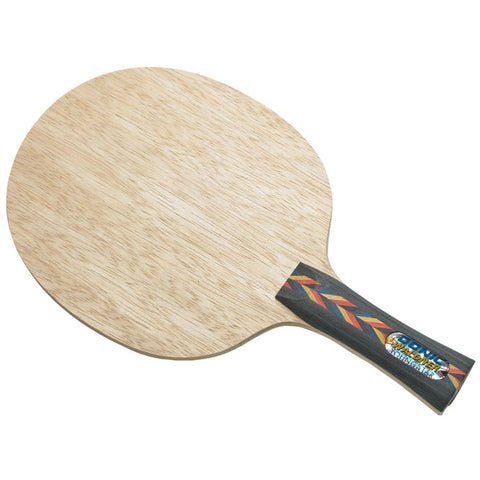
Donic Waldner Youngstar
Blade only: Donic’s control Youngstar — under 80 g, extra-narrow handle, smaller face, and the first build a junior chooses rubbers for.
This is the card to read if you want to see how a junior blade should be documented. On its own site, Donic sets out the Youngstar brief it applies to both blades in this guide: children and young people have smaller hands and less strength than adults, so Donic builds the range with an extra-narrow concave handle, a slightly smaller blade face and specially selected lighter veneers. The Waldner Youngstar is the control half of that pair. Donic positions it for kids and young people who want to place their shots reliably and precisely, publishes its construction in full — five veneers of ayous at the core, koto as the intermediate plies and limba outside — and rates its control as high with controlled speed, at a weight under 80 g before rubbers. Retailer tables reproducing Donic’s data put the typical example at approximately 75 g with a 5.7 mm total thickness.
Two things this card will not do: it will not give the Waldner an age band, because Donic publishes none, and it will not pretend a blade is a bat. The Youngstar arrives as a bare blade; two rubber sheets are chosen and fitted separately — many retailers offer a make-up service, and our best table tennis blades guide covers how blade choice works once a player is building setups. That extra step is the point of this card. A junior who has come through a ready-made bat, plays club or school table tennis weekly and has opinions about forehand and backhand is ready for exactly this: a junior-proportioned blade, control-first, around which their first chosen rubbers go.
What we like
- Full junior brief and veneer construction verified on Donic’s own site
- Under 80 g blade weight published by the maker — approx. 75 g in retailer tables
- Control rated “high” by Donic; the placement-first half of the Youngstar pair
- Extra-narrow concave handle and smaller face, as Donic specifies them
Worth knowing
- Blade only — rubbers are a separate choice and purchase
- Donic publishes no age band for this blade
As an Amazon Associate we earn from qualifying purchases.
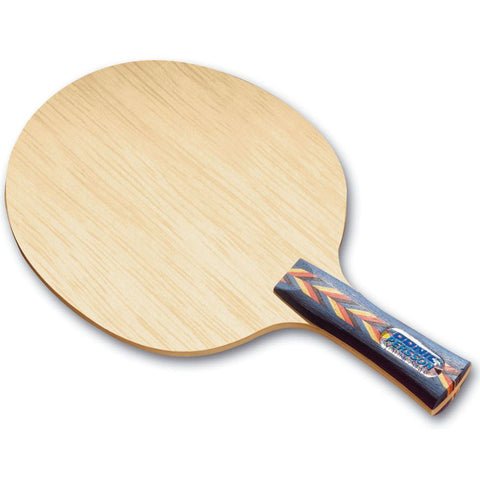
Donic Persson Youngstar
Blade only: the offensive Youngstar — same junior proportions as the Waldner, an ALL+/OFF− brief for juniors who hit through the ball.
Donic built two Youngstar blades because young players split early: some win points by placing the ball, others by hitting it past people. The Persson Youngstar is the second kind. Donic positions it — again, on its own site — for kids and young people with an inclination toward offensive play, and publishes the specification to match: five veneers with an ayous core and limba throughout the intermediate and outer plies, a characteristics rating of ALL+ to OFF−, elastic behaviour, and the same under-80 g weight, extra-narrow concave handle and slightly smaller blade face as its Waldner sibling. Retailer tables put the total ply thickness at 6.1 mm — half a millimetre thicker than the Waldner, which is the physical difference between the pair’s two briefs.
One source conflict is recorded rather than smoothed over: a Singapore retailer lists this blade at approximately 85 g, against Donic’s own published figure of under 80 g. This card uses the maker’s figure, as this guide does throughout, and flags the retailer’s as the outlier. Donic publishes no age band for the Persson either. The buying decision between cards #5 and #6 is not about quality — the construction standard is the same — it is about honesty regarding the player: a junior still blocking and placing belongs on the Waldner; a junior whose natural game is to attack, and whose coach is already shaping topspin strokes, is the player Donic built the Persson for. Either way, a junior carrier keeps the finished build protected — see our best table tennis bags guide once the first custom bat exists.
What we like
- Offensive junior brief verified on Donic’s own site: ALL+/OFF−, elastic, under 80 g
- Same published junior proportions as the Waldner — the pair splits by playing style, not size
- Full veneer construction published by the maker (ayous core, limba outers)
- 6.1 mm ply thickness in retailer tables — a measurably firmer build than the Waldner
Worth knowing
- Blade only — rubbers are a separate choice and purchase
- One retailer lists approx. 85 g against Donic’s under-80 g; the card uses Donic’s figure
- Donic publishes no age band for this blade
As an Amazon Associate we earn from qualifying purchases.
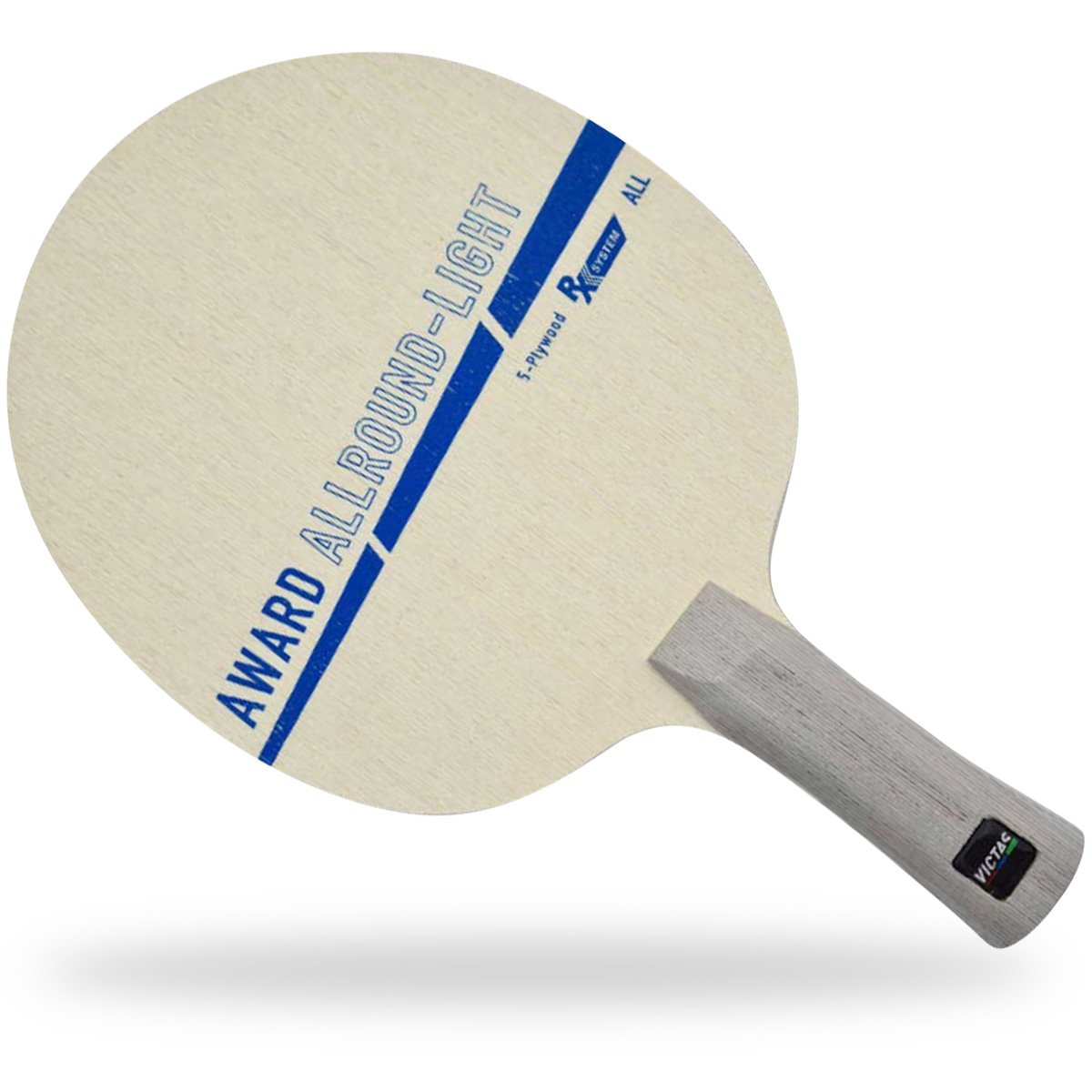
Victas Award Allround Light
Blade only: the last junior stop before adult blades — a slightly smaller handle on an approx. 80 g allround build with published speed and control figures.
Victas takes a different route into the junior market: instead of shrinking a whole bat, it publishes an allround blade whose handle is — in Victas’s own positioning, carried by its retailers — slightly smaller, which Victas says makes it the choice for children and young people. The Award Allround Light is a five-veneer flared blade at approximately 80 g, with characteristics Victas rates AR/OF, a Speed figure of 82 and a Control figure of 97, and half Reflex dampening layers built into the grip, which Victas credits for the blade’s control in blocking and topspin play alike. PingPongDepot’s Victas listing sells the same blade explicitly in an FL-Small handle variant at the same approximate weight — retailer confirmation that the smaller handle is a real variant, not a marketing phrase.
Place this card where it belongs: at the top of the junior ladder. At approximately 80 g the blade is no lighter than Donic’s pair, and its published figures are quicker — a blade for the older junior close to adult equipment, playing an allround game of blocks and topspins, who wants one junior concession only: a handle their hand still fits better than a full-size flared. Victas publishes no age band for it, so none is claimed. When this blade feels small, the next step is a standard adult blade, chosen with the help of the blades guide linked on card #5.
What we like
- Published Victas figures throughout: approx. 80 g, Speed 82, Control 97, AR/OF
- Slightly smaller flared handle — sold explicitly as an FL-Small variant by retailers
- Reflex dampening layers in the grip, as Victas describes them
- The natural bridge blade between junior proportions and adult equipment
Worth knowing
- Blade only — rubbers are a separate choice and purchase
- Victas publishes no age band for this blade
- Quicker published profile than the Donic pair — not a first-ever bat for a small child
As an Amazon Associate we earn from qualifying purchases.
Side-by-Side Comparison Table
| Model | Best For | Type | Rubber / Sponge | Weight | Handle | Maker’s Guidance |
|---|---|---|---|---|---|---|
| JOOLA Team Junior | Best overall junior bat | Pre-assembled | VIZON · 1.7 mm | 170 g (Kuebler) | Extra-small, thinner | Ages 6–12 (Kuebler) |
| Butterfly Harimoto Tomokazu 1800 Kids | Smaller-head pick | Pre-assembled | Addoy · 1.5 mm | None published (Butterfly) | Small, narrower flared | None published (Butterfly) |
| Butterfly Junior | Teen hands | Pre-assembled | Addoy · 1.5 mm | Lighter, no figure (Butterfly) | Standard flared, teen brief | Teen hands (Butterfly) |
| STIGA Hobby Instinct | Standard-size starter | Pre-assembled | 1-star · 1.5 mm | None published (STIGA) | Concave, standard size | Kids & beginners (STIGA) |
| Donic Waldner Youngstar | Custom blade · control | Blade only | Chosen separately | Under 80 g blade (Donic) | Extra-narrow concave | None published (Donic) |
| Donic Persson Youngstar | Custom blade · attack | Blade only | Chosen separately | Under 80 g blade (Donic) | Extra-narrow concave | None published (Donic) |
| Victas Award Allround Light | Step-up custom blade | Blade only | Chosen separately | Approx. 80 g blade (Victas) | Flared, slightly smaller | None published (Victas) |
The last column is the one this guide refuses to tidy up. Only one retailer — Kuebler, for the JOOLA — publishes a numeric age band anywhere in this guide, and only one maker, Butterfly, publishes an age-group positioning (teen hands) without a number. The “none published” entries are not gaps in our research; they are the makers’ actual published positions, printed as found. Where guidance exists, buy by it. Where it does not, buy by the published dimensions and build: handle claim first, then head size, then the weight the player can swing freely — and never compare a blade-only weight against a ready-made bat’s weight, because the two numbers measure different things.
Buying Guide: Choosing on the Maker’s Numbers
1. Start with the hand — it is the junior decision
Every other specification is secondary to getting a handle a child’s hand can actually close around. The published junior options run from JOOLA’s extra-small Team Junior handle and Donic’s extra-narrow Youngstar handles, through Butterfly’s smaller-and-narrower Harimoto handle and Victas’s slightly smaller flared handle, up to the standard concave handle on the STIGA. There is no junior handle standard to consult: each maker describes its own reduction, and only the in-hand test settles it. Fingers wrapped with the index finger resting naturally on the blade’s back is right; a grip the player has to choke halfway up the handle to control is the wrong bat, whatever its other numbers say.
2. Match the format to the stage: ready-made first, blade-only when rubbers become a choice
Cards #1–#4 are complete bats — buy one, open it, play. Cards #5–#7 are blades, and they only make sense once choosing rubbers is a real activity: a coach’s recommendation, a playing style forming, a worn ready-made bat whose owner wants to keep the handle they know. Buying a blade for a child who has never held a bat skips the learning stage the ready-made cards are built for, and buying another ready-made bat for a club junior who is already discussing sponge thickness wastes the stage they have reached. The format line in this guide is drawn by the makers themselves — Donic and Victas publish these as junior blades, not as junior bats.
3. Read weight claims literally — and never across formats
Junior weight information is the least complete part of the published record, so read it literally. A figure exists where a source publishes one: 170 g for the complete JOOLA bat (Kuebler), under 80 g for each Donic blade and approximately 80 g for the Victas blade (the makers). No figure exists for either Butterfly model or the STIGA, and “lighter” in Butterfly’s description is a description, not a number. And keep the formats separate in your head: add two rubber sheets to an 80 g blade and the finished bat will outweigh the 170 g ready-made JOOLA — which is normal, expected, and exactly why this guide never ranks blade weights against bat weights.
4. Grip style, balls and the rest of the junior kit
All seven cards are shakehand bats, because shakehand is what the makers publish for juniors — if your child is learning penhold, read the grip-style note in the system section above before ordering anything, and start from the adult beginner guide’s penhold options with a coach’s input. Beyond the bat, the details are small but real: the Harimoto Kids includes two 40+ training balls, and every other card needs balls bought alongside — our best table tennis balls guide covers the 40+ sizes and star ratings. Learning the strokes themselves is covered in our guide to how to play table tennis, and a bat case stops a junior blade’s edges — the most fragile part of any bat — from taking the knocks a school bag delivers.
Frequently Asked Questions
What size table tennis bat should my child use?
A junior-sized bat with a smaller handle and head than a standard adult bat. The makers in this guide publish exactly that: JOOLA fits the Team Junior with an extra-small handle and a smaller blade, Butterfly makes the Harimoto 1800 Kids with a smaller head and a smaller, narrower handle, and Donic builds its Youngstar blades with extra-narrow concave handles and slightly smaller blade faces. Only one source publishes a numeric age band — Kuebler positions the JOOLA Team Junior for children aged 6 to 12 — and Butterfly positions its Junior model for teen hands. Where a maker publishes no guidance, choose by the handle: if the player has to grip halfway up a standard handle to control the bat, it is too big.
When should a junior move from a ready-made bat to a custom blade?
When the player is choosing rubbers, not just using them — typically once a junior is playing club or school table tennis regularly, has a forming style, and a coach or the player is discussing sponge and rubber choices. That is the point of the blade-only cards in this guide: Donic’s Waldner Youngstar for control and Persson Youngstar for attack, and the Victas Award Allround Light as the step-up build. A first-ever bat should be ready-made: the JOOLA Team Junior, Butterfly Harimoto 1800 Kids, Butterfly Junior and STIGA Hobby Instinct all arrive fitted and ready to play.
How much should a kids’ table tennis bat weigh?
There is no published junior weight standard, so go by the figures the makers publish for each model. The one complete ready-made weight in this guide is the JOOLA Team Junior at 170 g, listed by Kuebler. The blade-only models publish blade weights: under 80 g for both Donic Youngstar blades and approximately 80 g for the Victas Award Allround Light — before rubbers, so a finished custom bat weighs more than its blade figure. Butterfly and STIGA publish no weight for their junior models in this guide, and this guide prints none for them rather than estimating one.
Do junior table tennis bats have smaller handles?
The junior-specific models do, each stated in its maker’s own terms. JOOLA describes the Team Junior handle as thinner and extra-small; Butterfly describes the Harimoto 1800 Kids handle as smaller and narrower, and flared; Donic specifies an extra-narrow concave handle on both Youngstar blades; Victas makes the Award Allround Light handle slightly smaller and sells it in an FL-Small variant. The STIGA Hobby Instinct is the exception: STIGA positions it for kids and beginners but fits a standard concave handle and publishes no junior sizing. No maker in this guide publishes a numeric handle dimension, so check the specific model’s claim and test the grip in the player’s hand.
Are there junior penhold table tennis bats?
None that this guide could verify. Every junior model carded here is a shakehand bat — flared or concave — and none of the makers (JOOLA, Butterfly, Donic, STIGA or Victas) publishes a penhold variant of its junior model in the listings checked at build. A young penhold learner’s current route is a standard penhold beginner bat from the adult beginner ranges, chosen with a coach’s guidance on grip, until a maker publishes a junior penhold model that can be verified like the shakehand models here.
Which makers publish age guidance for their junior table tennis bats?
Very few, and this guide attributes each statement to its source. Kuebler Sport’s listing positions the JOOLA Team Junior for children aged 6 to 12 — a retailer figure, since JOOLA’s own page publishes no age band. Butterfly positions its Junior model for teen hands, again without a numeric band, and publishes no age guidance for the Harimoto 1800 Kids. STIGA positions the Hobby Instinct for kids and beginners without an age band. Donic and Victas publish no age guidance for the junior blades carded here. Every other age claim you see for these models elsewhere is not the maker’s.
Do these junior bats come ready to play?
The four pre-assembled cards do: the JOOLA Team Junior, Butterfly Harimoto Tomokazu 1800 Kids, Butterfly Junior and STIGA Hobby Instinct all arrive with rubbers fitted — the Harimoto set even includes two 40+ training balls. The three blade-only cards do not: the Donic Waldner Youngstar, Donic Persson Youngstar and Victas Award Allround Light are bare blades, and two rubber sheets must be chosen and fitted before play. Retailers commonly offer a make-up service for blades; a junior’s first bat should be one of the ready-made cards.
The Verdict
Buy the bat that matches the hand and the stage in front of you, on the maker’s numbers. The JOOLA Team Junior is the most completely documented junior bat here — smaller blade, extra-small handle and a retailer-published ages 6–12 band at 170 g. The Butterfly Harimoto Tomokazu 1800 Kids is the smaller-head alternative with balls in the box, the Butterfly Junior covers the teen hands the children’s models miss, and the STIGA Hobby Instinct is the standard-size, control-first starter for older juniors — labelled standard-size because STIGA publishes no junior sizing for it. Past ready-made, the custom ladder is short and honest: Donic’s Waldner Youngstar for control, the Persson Youngstar for attack, and the Victas Award Allround Light as the step-up build. Beyond them sits adult equipment: our best table tennis bats for beginners guide owns that first adult choice. Size by the handle first — a child swinging the right proportions learns table tennis; a child swinging an adult bat learns to cope with one.
Affiliate disclosure: AliShuttler is reader-supported. When you buy through links on this page we may earn an Amazon commission at no extra cost to you. Specifications and sizing positions are taken from manufacturers’ published product information and were verified at the time of writing; manufacturers revise models between seasons, so confirm the exact specification on the product page before ordering.