
At tournament level the shoe stops being footwear and becomes equipment. The advanced player’s week is heavier — more hours, harder stops, full-speed direction changes, slides that start at the service line and end at the doubles alley — and it exposes exactly where a step-up shoe stops: the outsole that survived club rallies smooths out under daily hard-court volume, the upper that held at rally pace rolls at match pace, and the cushioning that felt responsive in hour one feels flat in the third set. This guide compares seven pro-tier shoes on exactly what their makers publish — the outsole pattern and version as each maker states it, the cushioning and energy-return system by the name each maker gives it, the stability structure part by part, the durability features and outsole guarantees as each maker or programme states them, the overall weight exactly as stated (or an honest note where a maker publishes none), and the fit as each maker labels it — and nothing else. No prices, no health claims, no invented numbers: just the spec sheets, read the way a tournament player needs them.
⚡ TL;DR — The Short Answer
For the best all-round pro pick, buy the ON The Roger Pro 2 — the only full carbon-fibre plate in this guide, a 100% carbon Speedboard under a high-performance foam midsole, with a half-bootie lockdown build and separate hard-court and Clay versions. The Wilson Rush Pro 4.5 is the stability-and-support pick: a 4D Support Chassis 2.0, a Propulsion Plate, R-DST+ cushioning and a six-month outsole durability guarantee. The Mizuno Wave Enforce Tour 2 is the heavy-hours durability pick — ENERZY NXT over a Wave plate, a DuRubber outsole with a lateral outrigger, and a six-month outsole guarantee. The adidas Adizero Cybersonic 2 is the explosive-speed pick, with an Energy Rod propulsion element and dual-density Lightstrike in the lightest honestly-figured build here. The Nike Zoom Vapor 12 is the match-day court-feel pick — a heel Zoom Air unit, a full-length Footframe and a low 22 mm / 10 mm stack. The Diadora Speed Blushield Torneo 3 is the cushioned-stability pick, the heaviest and most padded build here, also with a six-month guarantee. And the K-Swiss Hypercourt Supreme 2 is the all-round tournament grind pick — dual-density Surgelite and Shock Spring foams, DuraWrap X drag protection and a bootie collar fit.
Quick Picks — Best Tennis Shoes for Advanced Players at a Glance
A full carbon-fibre Speedboard, high-performance foam and a half-bootie lockdown build, in hard-court and Clay versions.
A 4D Support Chassis 2.0 plus a Propulsion Plate, R-DST+ cushioning and a six-month outsole guarantee.
ENERZY NXT over a Wave plate, a DuRubber outsole with a lateral outrigger, and a six-month outsole guarantee.
An Energy Rod propulsion element and dual-density Lightstrike — the lightest retailer-measured build in this guide.
A heel Zoom Air unit, a full-length Footframe and a low 22 mm / 10 mm stack built for aggressive movers.
Blushield cushioning, a CCB medial stabiliser and a Duratech 5000 outsole — the most padded build here, with a six-month guarantee.
Dual-density Surgelite and Shock Spring foams, DuraWrap X drag protection and a secure bootie collar.
In This Guide
- The Advanced Decision: Why Your Step-Up Shoe Stops Being Enough
- How to Read a Pro-Tier Spec Sheet: Plates, Guarantees and Honest Weights
- The 7 Best Tennis Shoes for Advanced Players, Compared
- Side-by-Side Comparison Table
- Buying Guide: Matching Your Pro Pick to Your Tournament Game
- Frequently Asked Questions
- The Verdict
The Advanced Decision: Why Your Step-Up Shoe Stops Being Enough
Start with what has actually changed, because it is not your strokes — it is your volume and your violence of movement. An advanced player trains and competes at an intensity an intermediate shoe was never briefed for: daily or near-daily court hours, defensive slides at full stretch, open-stance recoveries that load the lateral side of the shoe with the whole body’s momentum, and third sets played on legs that no longer absorb what the shoe used to. Three parts of a step-up shoe run out first under that load. The outsole wears through at the forefoot and toe, because the rubber volume that survives two club sessions a week is spent in a fortnight of tournament training. The midfoot starts to feel vague at full speed: a shoe whose torsional structure was adequate for rally pace twists under a full-speed plant-and-drive, which is why this tier publishes plates — a carbon Speedboard, a Propulsion Plate, a Wave plate, a full-length Footframe — rather than simple shanks. And the upper stretches and rolls on the lateral side, where the advanced game loads it hardest, which is why every card below names its lockdown system: a half-bootie, an inner sleeve, a fit band, a chassis that wraps the foot rather than sitting under it.
The second part of the advanced decision is the rotation reality. At this level most players stop asking one shoe to do everything and start reading spec sheets the way they read draws: a durability build for training volume, a speed build for match day, and a surface version bought deliberately rather than by accident. The makers publish for exactly that reading. Three cards below publish separate clay versions with full herringbone treads (the ON, the Wilson and the Nike), three carry six-month outsole durability guarantees (the Wilson, the Mizuno and the Diadora), and two are openly speed-first builds whose spec sheets trade rubber volume for response (the adidas and the Nike). The cards state each shoe’s brief in its maker’s own terms so you can build a rotation deliberately — or pick the one shoe whose published brief matches the week you actually play.
One boundary before the picks. This page owns the advanced, tournament-level decision only. The full all-player field belongs to our pillar guide to the best tennis shoes, the step-up decision to our guide to the best tennis shoes for intermediate players, the first-shoe decision to our guide to the best tennis shoes for beginners, the women’s fit decision to our best tennis shoes for women, and players shopping on published wide lasts and senior-specific builds are served by our guide to the best tennis shoes for seniors. None of their models is re-carded here — every shoe below is a different model, chosen because its maker publishes a pro-tier specification a tournament player can act on. And if your movement itself is the project, our how to play tennis guide covers the footwork patterns these outsoles and plates are built around.
How to Read a Pro-Tier Spec Sheet: Plates, Guarantees and Honest Weights
The plate line is this tier’s defining line, and it is read by material and coverage. A step-up shoe resists twisting with a shank; a pro-tier shoe publishes a plate or frame with a stated job. ON’s Speedboard is 100% carbon fibre, described by ON as keeping the player stable and returning energy. Wilson splits the work: a 4D Support Chassis 2.0 for lateral support and a Propulsion Plate for torsional stability and forefoot rebound. Mizuno’s Wave plate pairs with its ENERZY NXT foam. Nike runs a full-length TPU Footframe with a midfoot shank set between a two-piece split outsole. Diadora uses a CCB medial stabiliser rather than a plate. Read the coverage — full-length, midfoot, medial only — because that, not the material headline, is what decides how the shoe behaves under a full-speed plant.
The guarantee line is printed as each source states it, and it matters more at this volume. Three of the seven shoes here carry a six-month outsole durability guarantee: if the outsole wears through within six months, the pair is replaced under the programme’s terms. The Wilson Rush Pro 4.5, Mizuno Wave Enforce Tour 2 and Diadora Blushield Torneo 3 are all sold with that guarantee through Tennis Warehouse’s programme, and the cards attribute it that way. A guarantee is not a durability measurement, but at advanced hours — where a forefoot can go smooth in weeks — it is a published commitment that changes the real cost of a season, and it is a line the two speed-first cards here openly do not carry. Read the terms on the listing you buy from; guarantees are honoured by the seller or maker who states them, not by this guide.
Weight is still the honesty test, and this tier’s answers are more interesting than a single number. ON is the one maker here that publishes a weight for its flagship: 400 grams, printed with a 9 mm heel-to-toe drop — though the retail listings checked do not state the size that figure is measured at, and Tennis Warehouse’s own measurement of the same shoe is 15.2 ounces in a men’s US 10.5. Both figures are printed on the card, labelled, because that gap is exactly what an honest spec sheet looks like. Wilson’s syndicated figures conflict between versions and carry no size basis, so no maker weight is claimed for the Wilson; adidas, Nike and K-Swiss publish no weight for these models at all. Where this guide prints a weight for those shoes, it prints a retailer-measured figure with the retailer and the size named. The honest spread across this guide runs from a retailer-measured 13.8 ounces to a retailer-measured 15.4 ounces in the same men’s size — a spread wide enough to change a buying decision, which is why the bases matter.
Cushioning is read by name, and at this tier the names come with a stated mechanism. Step-up shoes publish systems; pro-tier shoes publish systems with an energy story — ON’s Speedboard returning energy over a high-performance foam, Wilson’s Energy Cell forefoot foam for quicker transfer over an R-DST+ midsole, Mizuno’s ENERZY NXT rebound, adidas’s Energy Rod working with dual-density Lightstrike, Nike’s heel Zoom Air unit, Diadora’s Blushield forefoot cushioning, K-Swiss’s dual-density Surgelite and Shock Spring pairing. A named system is a comparable spec with a maker’s description behind it; the cards describe each one the way its maker describes it, and nothing here claims a cushioning system prevents anything.
The 7 Best Tennis Shoes for Advanced Players, Compared
Seven pro-tier shoes, one shared brief — built for tournament volume and full-speed movement, published with named plates, cushioning systems, surface versions and the durability features an advanced player’s wear patterns demand. Read the card that matches your surface, your hours and your wear pattern first.
ON The Roger Pro 2
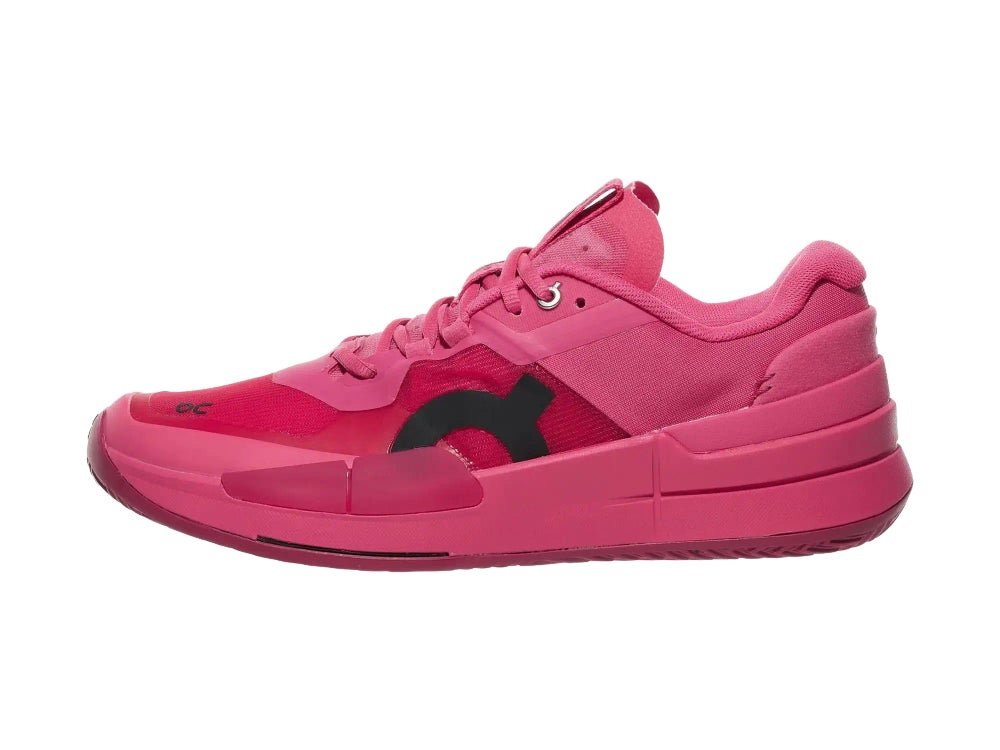
The carbon-plate flagship — a 100% carbon fibre Speedboard, a high-performance foam midsole and a half-bootie lockdown build, developed with Roger Federer’s input and sold in hard-court and Clay versions.
The Roger Pro 2 takes the #1 card because it is the only shoe here built around a full carbon plate, and its published spec sheet reads like the advanced brief answered line by line. The Speedboard — ON’s plate technology, here in 100% carbon fibre — runs through the midfoot, and ON describes it as keeping the player stable and returning energy through the stride; a high-performance foam midsole sits over it for the shock absorption ON publishes. Where most pro-tier shoes publish a shank or a partial frame, this card publishes a plate with a material, a coverage and a stated job, and that is the construction the rest of the guide is measured against.
The lockdown system is equally specific. An internal half-bootie construction holds the forefoot, a moulded heel counter locks the rear of the foot, and lateral TPU clips add support and structure on the side the advanced game loads hardest. The upper is an ultra-light, abrasion-resistant mesh with a perforated tongue, and a rubberised toe cap reinforces the drag zone. Underneath, the hard-court version runs an open herringbone tread, which ON’s retail copy describes as optimising traction while still allowing the hard-court slide; clay players buy the Roger Pro 2 Clay, whose full herringbone is published for maximum traction on clay. Two versions, stated plainly — the surface decision made deliberately, as this tier should make it.
The weight line is printed the way this guide always prints a two-source figure. ON publishes 400 grams for the shoe (with a 9 mm heel-to-toe drop), but the listings checked do not state the size that figure is measured at — and Tennis Warehouse measures 15.2 ounces in a men’s US 10.5, labelled as a retailer measurement. Read together, the honest summary is: a substantial, structured build whose on-paper figures disagree by source, in a snug-medium fit per retailer notes. No outsole guarantee is published for this model in the listings checked. Choose the Roger Pro 2 if your advanced brief is a plate-first shoe — maximum published structure, with the carbon receipt to show for it.
What we like
- The only full carbon-fibre plate here — 100% carbon Speedboard with a stated stability and energy job
- Half-bootie, moulded heel counter and lateral TPU clips: lockdown described part by part
- Two published versions — open herringbone for hard courts, full herringbone Clay
- On publishes a weight and a drop for its flagship — rarer transparency than most of this tier
Worth knowing
- On’s 400 g carries no stated size basis in the listings checked, and a retailer’s scale reads heavier — compare with care
- A snug-medium fit, per retailer notes — not the card for wide feet
- No outsole durability guarantee is published for this model in the listings checked
As an Amazon Associate we earn from qualifying purchases.
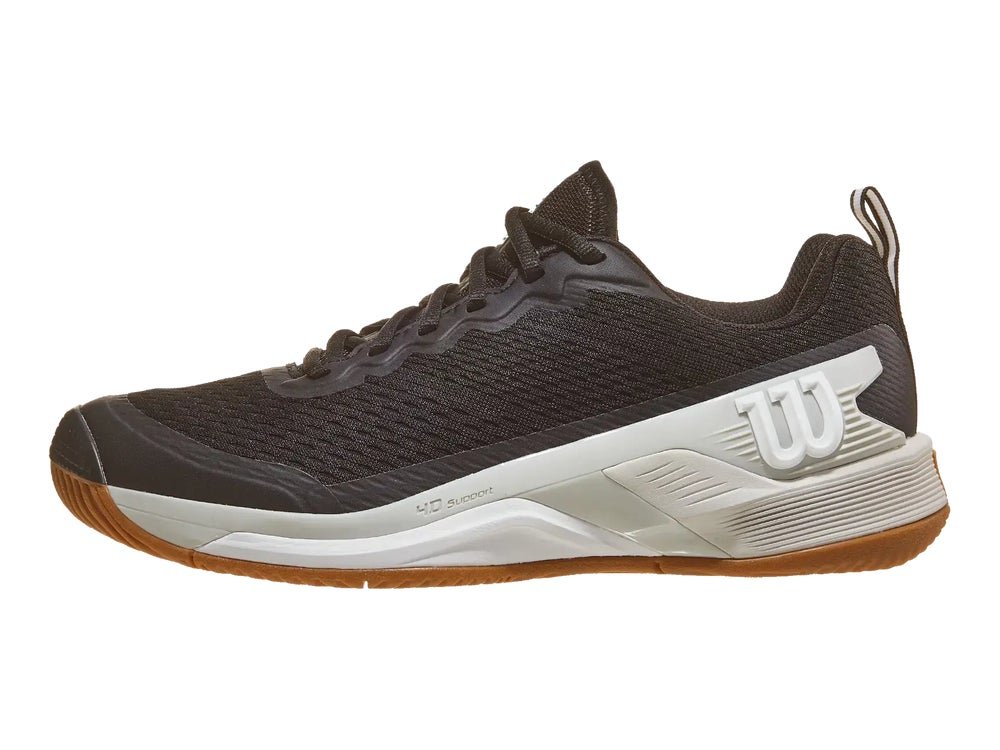
Wilson Rush Pro 4.5
Wilson’s support flagship — a split 4D Support Chassis 2.0, a Propulsion Plate, R-DST+ cushioning and a Duralast outsole, backed by a six-month outsole durability guarantee.
The Rush Pro line is Wilson’s answer for the powerful mover, and the 4.5 publishes the fullest support stack in this guide. The headline is the 4D Support Chassis 2.0: a split chassis that extends under the foot, with one piece published for support and forward propulsion and a lateral piece for stability and control through direction changes. Under it sits a Propulsion Plate, which Wilson’s retail copy credits with torsional stability and forefoot energy rebound. Two named structures, two stated jobs — the support brief written out the way a tournament player needs to read it, for the plants and cuts where a lesser midfoot starts to twist.
Cushioning pairs two foams with two stated roles: R-DST+, Wilson’s midsole foam, published as its best combination of cushioning and rebound, and an Energy Cell of lightweight EVA in the forefoot for a softer feel and quicker energy transfer into acceleration, over an OrthoLite insole. The upper is a Sensifeel 2.0 ripstop engineered mesh — minimally layered, per Wilson, for breathability, feel and durability — over an EndoFit full inner sleeve for the sock-like fit, with a medial mudguard and an articulated forefoot drag pad placed where draggers wear a shoe first. Underneath, the Duralast high-density rubber outsole runs a tread designed for lateral control that still lets hard-court sliders decelerate under control, and the model is sold with a six-month outsole durability guarantee through Tennis Warehouse; a full-herringbone Clay version covers the clay season.
The weight line carries this guide’s usual discipline. Wilson’s syndicated figures for this model conflict between versions and state no size basis, so no maker weight is claimed here; the figure printed is Tennis Warehouse’s measured 14.3 ounces in a men’s US 10.5, labelled as a retailer measurement — mid-pack in this guide, exactly where a support flagship with this much chassis should sit. Choose the Rush Pro 4.5 if your advanced brief is support first: the fullest named stability stack here, a drag-protected upper, and a guarantee standing behind the sole.
What we like
- A split 4D Support Chassis 2.0 plus a Propulsion Plate — two named structures with two stated jobs
- R-DST+ and Energy Cell: cushioning and transfer described separately, by name
- Medial mudguard and articulated drag pad where advanced drag wear lands
- A six-month outsole guarantee, and a full-herringbone Clay version of the same shoe
Worth knowing
- Wilson’s own weight figures conflict and state no basis — the figure printed is a retailer’s measurement, labelled
- A support-first build: players chasing the lightest pro pick should read the adidas card
- Slight break-in, per retailer fit notes
As an Amazon Associate we earn from qualifying purchases.
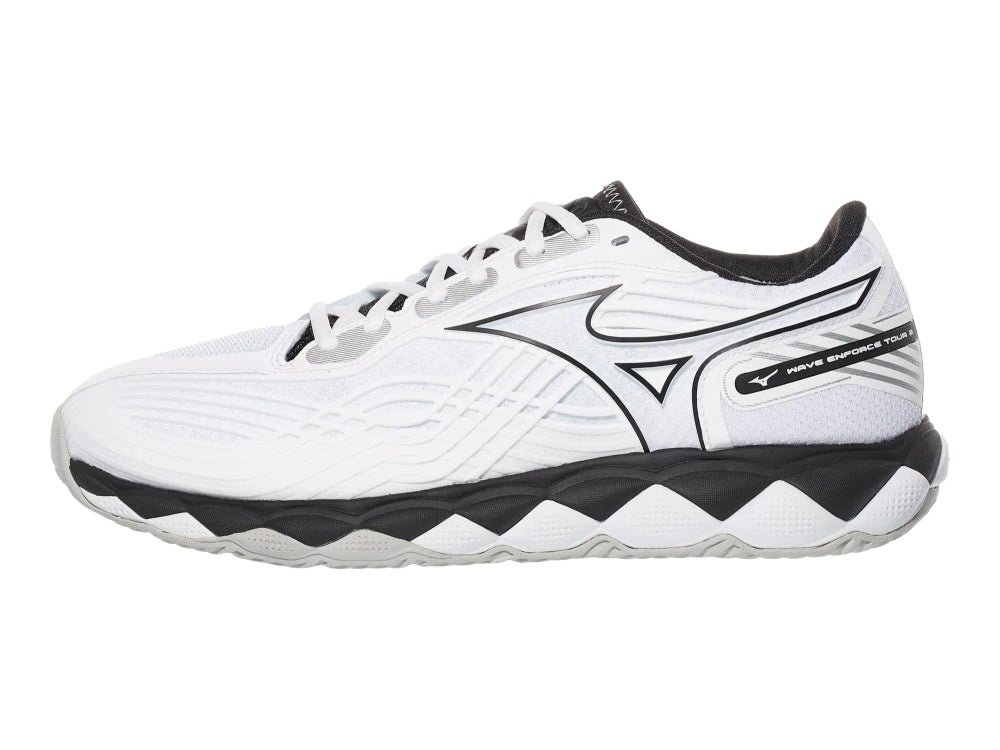
Mizuno Wave Enforce Tour 2
Mizuno’s durability flagship — ENERZY NXT cushioning over a Wave plate, a DuRubber outsole with a lateral outrigger, and a six-month outsole durability guarantee.
Where the intermediate guide’s Mizuno was the speed card, the Enforce Tour 2 is Mizuno’s other answer: the shoe built for the player whose week is measured in court hours. The construction brief is durability with stability, and it starts underneath. The DuRubber outsole — Mizuno’s durable rubber, concentrated in the high-impact areas — runs a modified herringbone for traction across court surfaces, and a lateral outrigger, a flared section on the outside of the forefoot, widens the base for the powerful, stable platform Mizuno describes for aggressive cuts. The model carries a six-month outsole durability guarantee — the published commitment that makes this the card for training volume, where the guarantee’s clock and the training schedule run against each other.
The midsole pairs Mizuno’s two named technologies the way the step-up card did, one tier up: MIZUNO ENERZY NXT, the lightest and most responsive ENERZY material in Mizuno’s line, works with the Wave plate for the cushioning-and-rebound combination Mizuno publishes, with a lightweight ENERZY insole adding rebound over the top. The upper is a bootie construction — lighter than the previous generation, per Mizuno’s retail copy, while staying supportive — with a Dyna-Heel-Lock system holding the heel, built for the locked-in fit a heavy-hours player needs in the third session of the day as much as the first.
The honest notes are the familiar ones, handled the familiar way. Mizuno publishes no settled weight for this model in the listings checked, so the figure here is Tennis Warehouse’s measured 14.6 ounces in a men’s US 10.5, labelled as a retailer measurement. The fit earns a line of its own: retailer fit notes describe a generous medium — the roomiest published fit character in this guide alongside the Diadora — which makes the Enforce Tour 2 the advanced card for players whose feet found the snug pro-tier lasts tight. Choose it if your brief is hours: a guaranteed sole, a wide stable base, and the roomiest fit here.
What we like
- A six-month outsole guarantee behind a DuRubber sole built for high-impact zones
- A lateral outrigger widens the base for aggressive cuts — stability you can see in the mould
- ENERZY NXT with a Wave plate: Mizuno’s named cushioning and stability pairing, one tier up
- A generous-medium fit — the roomiest published character in this guide
Worth knowing
- No settled maker weight — the figure printed is a retailer’s measurement, labelled as such
- A durability brief: pure speed shoppers should read the adidas and Nike cards
- The women’s version runs slightly snug in length per retailer notes — check the fit notes for your version
As an Amazon Associate we earn from qualifying purchases.
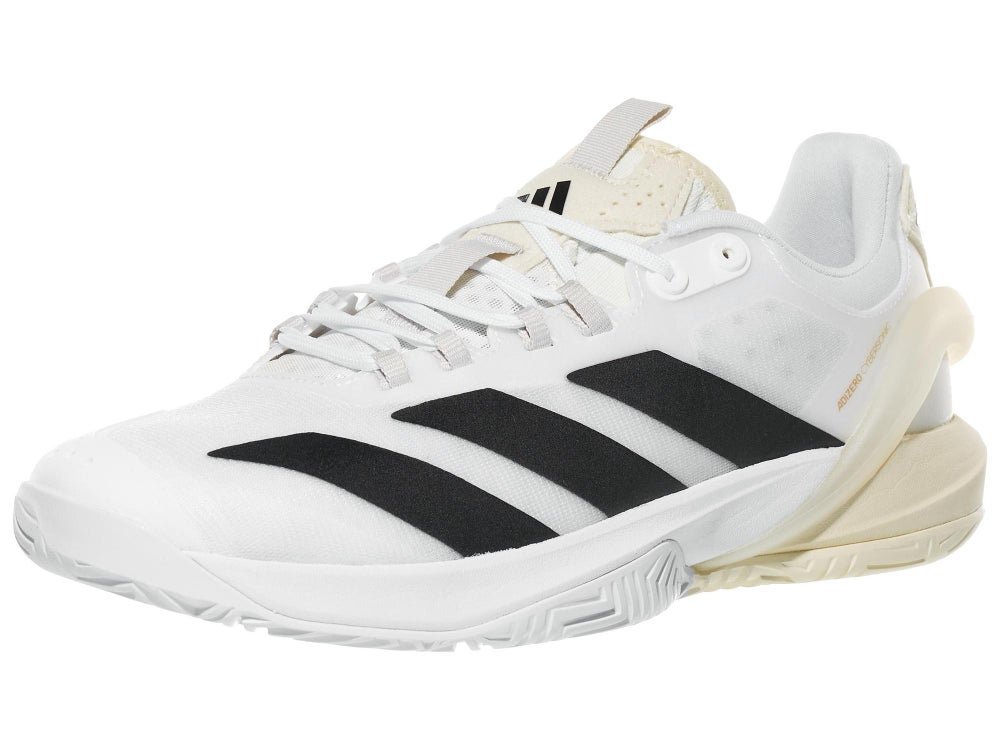
adidas Adizero Cybersonic 2
The speed flagship — an Energy Rod propulsion element, dual-density Lightstrike cushioning and Adituff drag protection, in the lightest honestly-figured build in this guide.
Every pro-tier guide needs the card for the player whose game is built on the first step, and adidas builds it around a part no other card here has: the Energy Rod, a propulsion element carried over from adidas’s racing-shoe technology, which adidas positions for lightweight propulsion out of direction changes. Around it, the midsole is a dual-density Lightstrike foam — adidas’s lightweight cushioning, tuned in two densities to blend comfort, shock absorption and the responsive reactivity its copy describes. The result, on the figures that can be printed honestly, is the lightest build in this guide: Tennis Warehouse measures 13.8 ounces in a men’s US 10.5. adidas publishes no weight for the model, and none is claimed for it — the retailer measurement, with its basis, is the comparable number.
The speed brief usually costs durability, and this card’s honesty is that adidas spends its protection budget visibly rather than pretending otherwise. The outsole is Adiwear rubber — adidas’s abrasion-resistant compound — in a multi-directional herringbone published for a variety of court surfaces, and the upper’s wear zones are covered in RPU Adituff, adidas’s abrasion material, across the toe and the medial side where draggers strip a speed shoe first. The fit system is a half-bootie inner sleeve under an engineered-mesh outer, which adidas describes as a glove-like fit — and retailer fit notes add the necessary caution: a snug length in a medium width, so this is a card to size carefully.
What the card does not carry is equally plain: no outsole durability guarantee is published for this model in the listings checked, and a speed build’s rubber volume is spent by design on response rather than on months. That is not a flaw in the shoe; it is the rotation logic of this whole guide stated on one card. Choose the Cybersonic 2 as the match-day weapon — the explosive pick for the advanced mover whose training hours are logged in a durability shoe from another card.
What we like
- An Energy Rod propulsion element — a named part with a stated job, unique in this guide
- The lightest retailer-measured build here: 13.8 oz in a men’s US 10.5
- Adituff RPU covers the toe and medial drag zones — protection spent where speed shoes die
- Dual-density Lightstrike: two densities, two stated roles, in one midsole
Worth knowing
- adidas publishes no weight for this model — the figure printed is a retailer’s measurement, labelled
- No outsole guarantee is published in the listings checked — a speed brief, priced in rubber
- A snug length per retailer notes — size carefully, especially between sizes
As an Amazon Associate we earn from qualifying purchases.
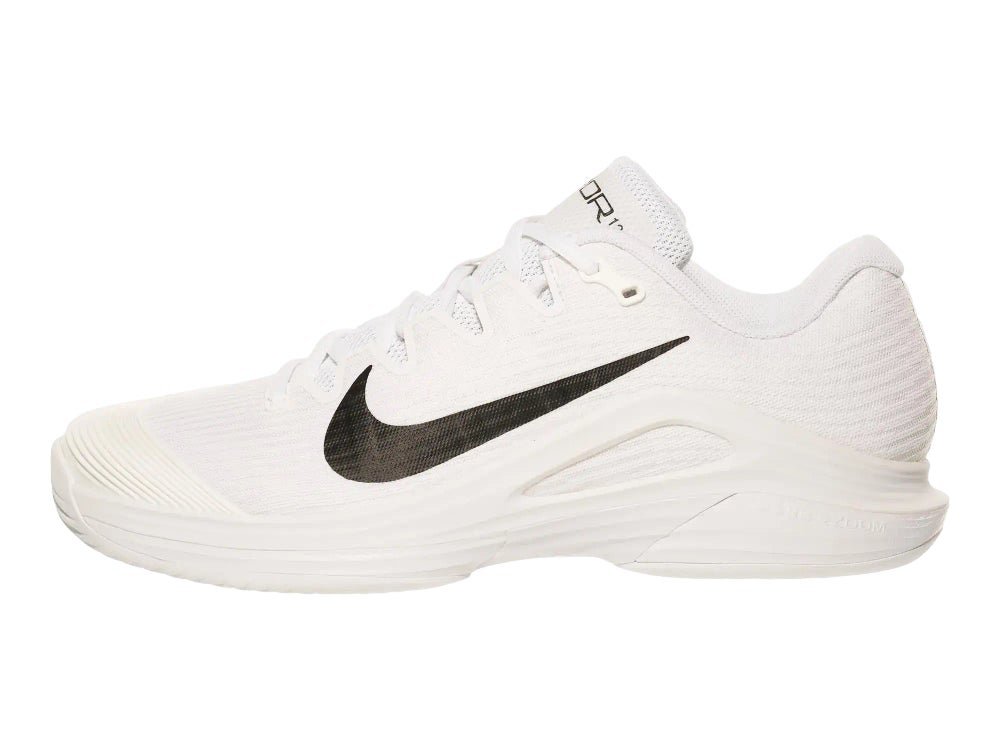
Nike Zoom Vapor 12
Nike’s premier match shoe — a heel Zoom Air unit, a full-length Footframe and a low 22 mm / 10 mm stack, engineered, in Nike’s words, for the most aggressive movers.
A note on identity first, because this site’s pillar guide cards a Nike too: that shoe is the Vapor Pro 3, an older and different model. The Vapor 12 carded here is Nike’s current flagship Vapor — the premier match-day line, rebuilt, in Nike’s published description, from data taken from the worn shoes of one of the most explosive movers on the pro tour, and from design concepts drawn from the Vapor Pro, Vapor X and Vapor 9/9.5 generations. It opens with the lowest published stack in this guide: 22 mm at the heel and 10 mm at the forefoot, Nike’s own figures — a low-to-the-court brief for players who read a shoe through court feel rather than cushioning height.
The cushioning is a Zoom Air unit in the heel, Nike’s pressurised-air cushioning, published for shock absorption on hard landings. Stability is structural in a distinctively Nike way: a full-length TPU Footframe runs heel to toe for lightweight stability, and a midfoot shank sits between the two pieces of a split outsole — a design Nike’s copy credits with cutting weight while keeping torsional rigidity. The upper is a high-denier engineered mesh with cast PU protecting the high-wear zones at the toe tip and medial toe box, a midfoot fit band increasing lockdown for side-to-side cuts, and the adaptive lacing system returned from earlier Vapors. Underneath, Hart rubber — Nike’s durable compound — runs a herringbone for hard courts, and the Vapor 12 Clay swaps in a full-length Claybreaker herringbone for clay.
The honest notes are two. Nike publishes no weight for the Vapor 12, so the figure here is Tennis Warehouse’s measured 14.6 ounces in a men’s US 10.5, labelled as a retailer measurement — mid-pack on paper, in a shoe whose brief is feel rather than mass. And Tennis Warehouse lists no durability guarantee for this model: like the adidas, this is a match-day card, and its rubber is spent on grip and response. Retailer fit notes add a snug-medium width. Choose the Vapor 12 if your advanced brief is the lowest, most connected ride here — and log your training hours in another card.
What we like
- The lowest published stack here — 22 mm / 10 mm, Nike’s own figures — for genuine court feel
- A full-length Footframe plus a shank in a split outsole: stability engineered around weight, not with it
- Cast PU placed at the toe tip and medial box — the slider’s wear zones, named
- A Claybreaker full-herringbone Clay version of the same shoe
Worth knowing
- Nike publishes no weight — the figure printed is a retailer’s measurement, labelled as such
- No durability guarantee is listed for this model — a match-day brief, like the adidas
- A snug-medium fit per retailer notes, with a low arch character
As an Amazon Associate we earn from qualifying purchases.
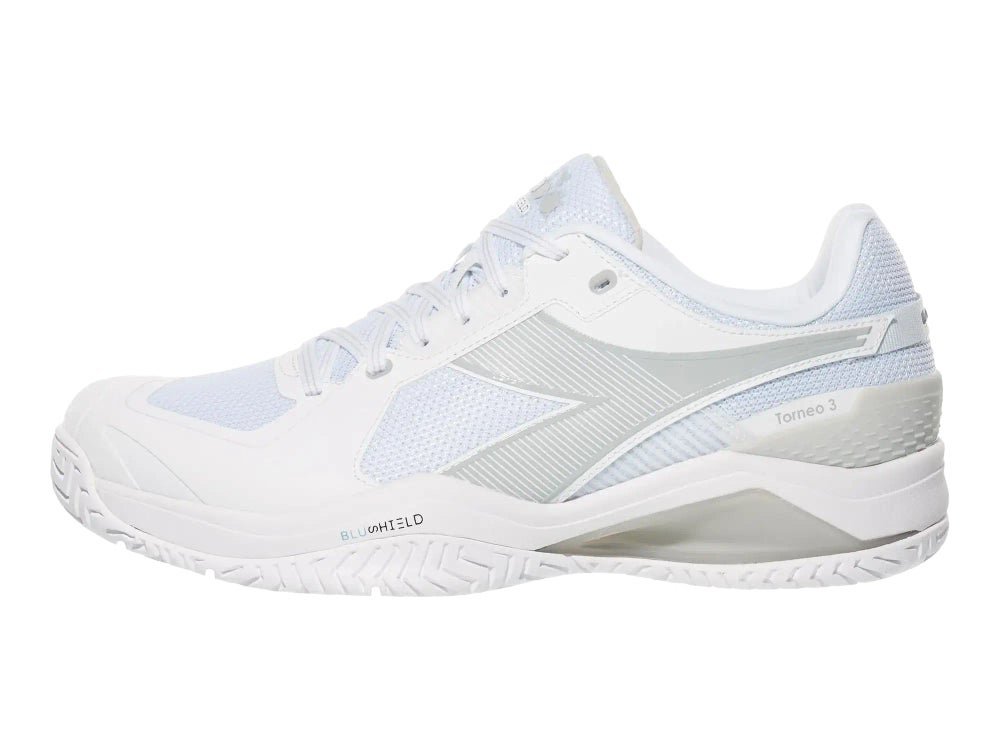
Diadora Speed Blushield Torneo 3
Diadora’s stability flagship — Blushield forefoot cushioning over EVA, a CCB medial stabiliser and a Duratech 5000 outsole, backed by a six-month outsole durability guarantee.
The Torneo 3 is Diadora’s premium stability shoe, and it is the card for the advanced player whose brief is cushioning with structure — the most padded build in this guide, and honest about it. The midsole pairs Blushield, Diadora’s cushioning technology, in the forefoot — published for cushioning and responsiveness where the push-off loads — over an EVA midsole for the plush underfoot feel Diadora describes. Stability comes from a CCB medial stabiliser, a torsional control element on the inner side of the midsole, which Diadora’s retail copy credits with helping resist twisting during lateral movement: not a plate, and not presented as one — a stabiliser with a stated side and a stated job.
The outsole is the durability half of the brief: Duratech 5000, Diadora’s rubber compound with wear-resistant additives, in a modified herringbone reinforced in the high-wear regions, published for the grind of gritty hard courts while performing across surfaces. The model is sold with a six-month outsole durability guarantee through Tennis Warehouse. The upper combines Suprelltech, air mesh and D-skin — Diadora’s overlay material — for the lightweight comfort, support and breathability its copy describes, with a heel collar published for locking the foot in.
The honest line on this card is the weight, and the guide prints it without flinching: Diadora publishes no weight for the Torneo 3 in the listings checked, and Tennis Warehouse measures 15.4 ounces in a men’s US 10.5 — the heaviest figure in this guide, labelled as a retailer measurement. That mass is the receipt for the cushioning stack, the stabiliser and the reinforced sole, and for the player whose advanced brief is a padded, stable ride that is still intact in month three, it is the trade the card exists to make. Retailer fit notes describe a true length with a slight break-in. Choose the Torneo 3 if your tournament week is long, your courts are gritty, and you want the cushioning brief answered at full volume.
What we like
- Blushield forefoot cushioning over EVA — the fullest cushioning stack described in this guide
- A CCB medial stabiliser with a stated side and job, not a vague stability claim
- Duratech 5000 reinforced in the wear regions, under a six-month outsole guarantee
- A D-skin and Suprelltech upper with a locking heel collar
Worth knowing
- The heaviest shoe here — 15.4 oz measured in a men’s US 10.5, and it plays to that brief
- Diadora publishes no weight; the figure printed is a retailer’s measurement, labelled
- A slight break-in, per retailer fit notes
As an Amazon Associate we earn from qualifying purchases.
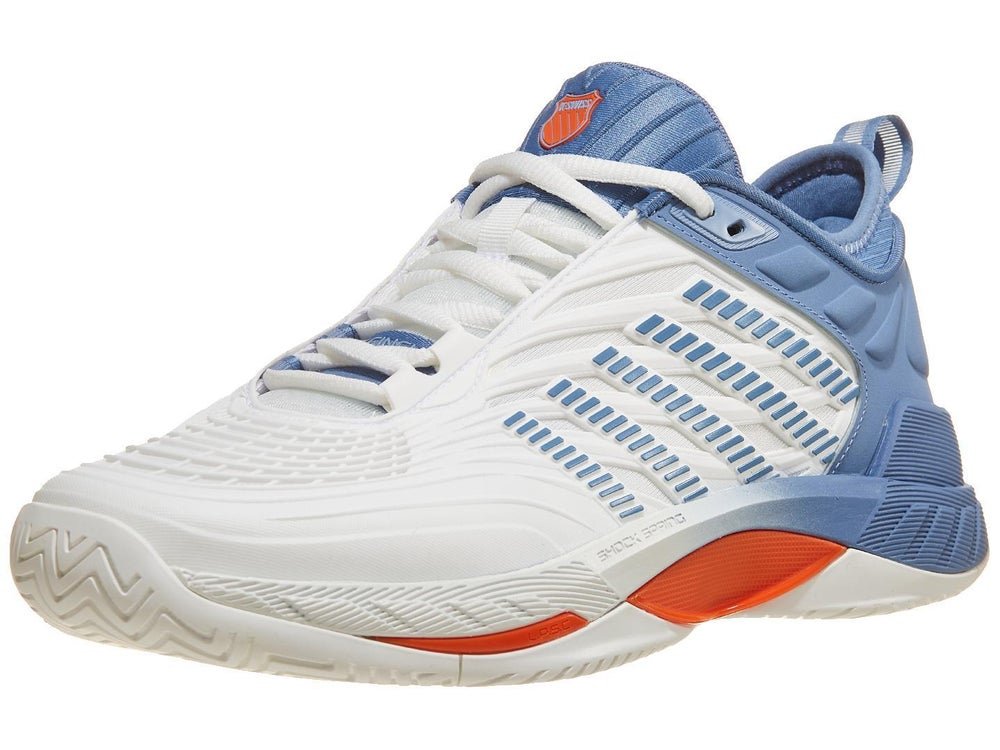
K-Swiss Hypercourt Supreme 2
The tournament-grind all-rounder — dual-density Surgelite and Shock Spring foams, DuraWrap X drag protection and a bootie collar, refined from the original Supreme with a snugger, more secure fit.
The Supreme 2 closes the guide as the all-rounder — the K-Swiss performance shoe refined, in the maker’s published brief, for the tournament player built for the grind. This generation’s stated updates are fit and durability: a bootie collar around the ankle on a moulded EVA sock liner for a more secure, locked-in fit than the original, and DuraWrap X — K-Swiss’s protective upper material — hugging the foot and protecting the drag zones, over a seamless mesh-and-TPU construction published for comfort and breathability. It is the intermediate guide’s Ultrashot brief translated one tier up: protection spent visibly, in named materials, where advanced movers actually wear a shoe.
The midsole is a dual-density pairing with two stated roles: Surgelite foam for comfort and padding, and Shock Spring foam for quick energy bursts — K-Swiss’s own division of labour, printed as stated — over a midfoot shank for stability against unwanted twisting. Underneath, the outsole is Aosta 7.0 rubber in a modified herringbone, with DragGuard 7.0 — K-Swiss’s beefed-up rubber compound — added in the high-wear regions for the aggressive mover. No single part of this card is the guide’s extreme at anything, and that is precisely its published position: every brief answered at a high level, in one shoe.
The honest notes close the guide the way they opened it. K-Swiss publishes no weight for the Hypercourt Supreme 2, so the figure here is Tennis Warehouse’s measured 14.8 ounces in a men’s US 10.5, labelled as a retailer measurement — substantial, consistent with the protection it carries. And no outsole guarantee is listed for this model in the listings checked, so none is claimed; the durability case rests on the DragGuard rubber and DuraWrap X upper as K-Swiss publishes them. Choose the Supreme 2 if your advanced brief is one shoe for the whole tournament week — training, matches and the third set on Sunday — with no weak line on its spec sheet.
What we like
- Two foams with two stated jobs: Surgelite for padding, Shock Spring for energy bursts
- DuraWrap X plus DragGuard 7.0 — drag protection on the upper and the sole alike
- A re-engineered bootie collar for the secure fit this generation was published to fix
- No weak line: every advanced brief answered at a high level in one shoe
Worth knowing
- K-Swiss publishes no weight — the figure printed is a retailer’s measurement, labelled
- No outsole guarantee is listed for this model in the listings checked
- A slight break-in, per retailer fit notes
As an Amazon Associate we earn from qualifying purchases.
Side-by-Side Comparison Table
| Shoe | Best For | Weight (As Stated) | Outsole, As Maker States | Cushioning (Maker-Named) | Fit |
|---|---|---|---|---|---|
| ON The Roger Pro 2 | Best overall pro pick | 400 g published by On (size basis not stated) · 15.2 oz — Tennis Warehouse measured, men’s US 10.5 | Open herringbone (hard); full herringbone Clay version | High-performance foam; 100% carbon Speedboard | Snug medium; men’s & women’s |
| Wilson Rush Pro 4.5 | Stability & support | 14.3 oz — Tennis Warehouse measured, men’s US 10.5 | Duralast, lateral-control tread; Clay version; 6-month guarantee | R-DST+ + Energy Cell; 4D Chassis 2.0; Propulsion Plate | Medium; men’s & women’s |
| Mizuno Wave Enforce Tour 2 | Heavy weekly hours | 14.6 oz — Tennis Warehouse measured, men’s US 10.5 | DuRubber modified herringbone + lateral outrigger; 6-month guarantee | ENERZY NXT; Wave plate | Generous medium; men’s & women’s |
| adidas Adizero Cybersonic 2 | Explosive speed | 13.8 oz — Tennis Warehouse measured, men’s US 10.5 | Adiwear, multi-directional herringbone | Dual-density Lightstrike; Energy Rod | Medium, snug length; men’s & women’s |
| Nike Zoom Vapor 12 | Match-day court feel | 14.6 oz — Tennis Warehouse measured, men’s US 10.5 | Hart rubber herringbone (hard); Claybreaker Clay version | Heel Zoom Air; full-length Footframe; 22/10 mm stack | Snug medium; men’s & women’s |
| Diadora Speed Blushield Torneo 3 | Cushioned stability | 15.4 oz — Tennis Warehouse measured, men’s US 10.5 | Duratech 5000 modified herringbone, reinforced wear zones; 6-month guarantee | Blushield (forefoot) + EVA; CCB medial stabiliser | Medium; men’s & women’s |
| K-Swiss Hypercourt Supreme 2 | All-round tournament grind | 14.8 oz — Tennis Warehouse measured, men’s US 10.5 | Aosta 7.0 modified herringbone + DragGuard 7.0 | Surgelite + Shock Spring dual density; midfoot shank | Medium; men’s & women’s |
Read the weight column the way the spec section taught: one maker-published figure whose own retailer measurement disagrees with it (the ON, printed both ways), five retailer measurements with the retailer and size named, and the maker blanks — adidas, Nike, K-Swiss and the unsettled Wilson and Mizuno figures — handled by printing the measurement instead of inventing a maker number. A table that filled those blanks with unsourced grams would be fabricating them, and at this tier the honest spread between the lightest and heaviest figures is wide enough to change a buying decision, which is exactly why the bases matter.
Buying Guide: Matching Your Pro Pick to Your Tournament Game
1. Decide the rotation first: one shoe, or a training shoe plus a match shoe
The highest-value decision in this guide is structural, not branded. Advanced hours destroy outsoles on a schedule, and the seven cards split cleanly by published brief: durability builds with guarantees for volume (the Wilson, the Mizuno, the Diadora), speed and feel builds for match day (the adidas, the Nike), and complete all-rounders that can carry a whole week alone (the ON, the K-Swiss). If you train four-plus times a week and compete on weekends, the published-spec answer is a rotation — a guaranteed durability shoe absorbing the training wear, a match shoe kept fresh for the points that count. If your week is two hard sessions and a match, buy one all-rounder and spend the savings on a second pair of the same shoe mid-season.
2. Buy the version for your main surface — and your tournament surface
Three cards publish dedicated clay versions with full herringbone treads: the Roger Pro 2 Clay, the Rush Pro 4.5 Clay and the Vapor 12 Clay with its Claybreaker outsole. Their hard-court versions run open or modified herringbone cut for acrylic — grip on the plant, a controlled release into the slide. A hard-court shoe on clay clogs and catches; a clay shoe on hard acrylic spends its deep tread quickly. If your season crosses surfaces — spring clay, summer hard — the version question outranks the brand question, and the modified-herringbone all-court cards (the Mizuno, the Diadora, the K-Swiss) are the published compromises. Our how to play tennis guide’s surface footwork notes will tell you which of your courts asks more of a shoe.
3. Buy durability where YOUR game wears shoes out
Wear is personal, and this tier lets you aim at yours with named parts. Toe-draggers should start with the drag features: the ON’s rubberised toe cap, Wilson’s medial mudguard and articulated drag pad, adidas’s RPU Adituff across the toe and medial side, Nike’s cast PU at the toe tip and medial box, K-Swiss’s DuraWrap X. Forefoot burners, whose outsoles smooth under the ball of the foot, should weigh the guarantee cards — Wilson, Mizuno and Diadora all carry six-month outsole guarantees through Tennis Warehouse’s programme. Lateral rollers, who split uppers on the outside of the forefoot, should read the lockdown systems: half-booties, inner sleeves, fit bands, chassis wraps. Your current pair’s corpse is the best buying document you own — read it before this table.
4. Read every weight with its basis — and respect “not published”
Only ON publishes a weight for its flagship here — 400 grams, with no size basis stated in the listings checked — and Tennis Warehouse’s scale reads the same shoe at 15.2 ounces in a men’s US 10.5. The Wilson, Mizuno, Diadora and K-Swiss figures printed here, and the adidas and Nike figures, are Tennis Warehouse measurements in a men’s US 10.5, labelled as retailer figures wherever they appear; Wilson’s syndicated gram figures conflict and state no basis, so none is claimed. Compare only like with like — the same size basis, the same source type — and treat any listing that attaches a precise gram figure to these models without a basis as a number invented for the listing, not measured for the shoe.
5. Fit at this level: snug lasts, honestly described — and a separate answer for width
The pro tier is a snug-last market, and this guide will not pretend otherwise. The published fit characters here are: snug medium (the ON and the Nike), a medium with slight break-in (the Wilson, the Diadora, the K-Swiss), a snug length (the adidas), and one generous medium (the Mizuno — the roomiest character in the guide). None of the seven is published in a separate wide last in the listings checked. Players who need a genuinely wide last, published as such, are served by the wide-fit cards in our best tennis shoes for seniors guide and the width analysis in our best tennis shoes for women guide — at this tier, buying a size up in a standard last is not a substitute for a wide one.
Frequently Asked Questions
When does an advanced player need a different shoe from an intermediate one?
When the volume and intensity of your week outgrow the step-up brief, which shows in three published-spec places: the outsole wearing through in weeks rather than months under daily hard-court hours, the midfoot twisting under full-speed plants (a step-up shank resists club pace, not match pace), and the upper stretching on the lateral side under full-stretch defensive loads. Every shoe in this guide publishes a structure against one of those failures — a carbon Speedboard, a 4D Support Chassis, a Wave plate, a Footframe, a CCB stabiliser — which is what makes it a pro-tier shoe rather than a replacement step-up.
Should I rotate a training shoe and a match shoe?
At advanced hours, the spec sheets argue yes. Durability builds with six-month outsole guarantees — the Wilson Rush Pro 4.5, Mizuno Wave Enforce Tour 2 and Diadora Blushield Torneo 3 — are published for volume, while the adidas Cybersonic 2 and Nike Vapor 12 are published for speed and court feel and carry no guarantee. Rotating a guaranteed training shoe with a fresh match shoe keeps both inside their briefs. If your week is lighter, the complete all-rounders here — the ON Roger Pro 2 and the K-Swiss Hypercourt Supreme 2 — are the one-shoe answers.
Should I buy the hard-court or clay version of these shoes?
Buy for the surface you compete on most. Three cards publish dedicated clay versions with full herringbone treads — the Roger Pro 2 Clay, the Rush Pro 4.5 Clay and the Vapor 12 Clay with its Claybreaker outsole — while their hard-court versions run open or modified herringbone cut for acrylic. If your season genuinely splits, the modified-herringbone all-court outsoles on the Mizuno, Diadora and K-Swiss cards are the published compromise. A listing that does not state its version has not answered the question — check before ordering.
What does a six-month outsole durability guarantee actually cover?
As the programmes state it: if the outsole wears through within six months of purchase, the shoe is replaced under the guarantee’s terms. Three cards here carry one through Tennis Warehouse’s programme — the Wilson Rush Pro 4.5, the Mizuno Wave Enforce Tour 2 and the Diadora Blushield Torneo 3. A guarantee is a published commitment, not a promise that a sole lasts six months for every player; advanced training volume wears rubber fastest, which is precisely the player the guarantee is worth most to. Keep your proof of purchase and read the terms where you buy.
How much do advanced tennis shoes weigh?
Less uniformly than their listings suggest. ON publishes 400 grams for the Roger Pro 2 without a stated size basis in the listings checked, and Tennis Warehouse measures the same shoe at 15.2 ounces in a men’s US 10.5. Tennis Warehouse measures the adidas at 13.8 ounces, the Wilson at 14.3, the Mizuno and Nike at 14.6, the K-Swiss at 14.8 and the Diadora at 15.4, all in a men’s US 10.5 — retailer measurements, labelled as such on the cards. adidas, Nike and K-Swiss publish no weight for these models, and none is claimed for them. Pro-tier shoes are heavily built by design; compare figures only at the same size basis.
Are wide-fit options available at the pro tier?
Honestly, this tier publishes width least. The fit characters stated across these seven cards are snug-to-standard lasts with different shapes: a generous medium on the Mizuno Wave Enforce Tour 2 (the roomiest here, per retailer fit notes), snug-medium fits on the ON and the Nike, and standard mediums elsewhere. None of the seven is published in a separate wide last in the listings checked. If a published wide fitting is your deciding spec, the wide-last cards in our best tennis shoes for seniors guide and the width analysis in our best tennis shoes for women guide cover that decision properly — a size up in a standard last is not a wide fit.
How does this guide relate to your other tennis shoe guides?
This page owns the advanced, tournament-level decision only: pro-tier plates, versions, guarantees, weights and fits, read on maker-published specs. The all-player field is covered in our best tennis shoes pillar guide, the step-up decision in our best tennis shoes for intermediate players guide, the first-shoe decision in our best tennis shoes for beginners guide, the women’s fit decision in our best tennis shoes for women guide, and published wide lasts and senior builds in our best tennis shoes for seniors guide. None of their models is re-carded here — all seven shoes in this guide are different models.
The Verdict
Buy the ON The Roger Pro 2 if you want the plate-first flagship: the only full carbon-fibre plate here, a half-bootie lockdown build and two published surface versions. Buy the Wilson Rush Pro 4.5 if support is your filter: a split 4D Support Chassis 2.0, a Propulsion Plate, drag protection and a six-month guarantee. Buy the Mizuno Wave Enforce Tour 2 if your week is measured in court hours: a guaranteed DuRubber sole, a lateral outrigger and the roomiest fit in this guide. Buy the adidas Adizero Cybersonic 2 if your game is the first step: an Energy Rod, dual-density Lightstrike and the lightest honest figure here. Buy the Nike Zoom Vapor 12 if you want the lowest, most connected ride: a 22 mm / 10 mm stack, a heel Zoom Air unit and a full-length Footframe. Buy the Diadora Speed Blushield Torneo 3 if you want cushioning at full volume with a stabiliser and a guarantee, at an honestly heavy build. Buy the K-Swiss Hypercourt Supreme 2 if you want one shoe with no weak line for the whole tournament week. Seven pro-tier shoes, seven different advanced decisions: read your current pair’s wear, match it to the card built against it, check the version before you order, and buy the rotation your week actually demands.
Affiliate disclosure: Ali Shuttler is a participant in the Amazon Services LLC Associates Program, an affiliate advertising program designed to provide a means for sites to earn advertising fees by advertising and linking to Amazon.com. Product specifications are taken from manufacturer listings and were checked at the time of writing; manufacturers may update models and specs without notice.