
The wide-foot decision, settled the honest way: seven pickleball shoes from FitVille, New Balance, K-Swiss, Babolat, Tyrol and SQAIRZ, compared only on what the makers themselves publish — genuine 2E and 4E stocked widths, roomy lasts, named cushioning, named outsoles, and stated weights read with the size basis each listing gives.
Pickleball has the widest genuine wide range of any court-shoe category we cover — and it is also the category where the labels lie to you the most. “Relaxed Fit” on a box is not a width. A roomy toe box is not a 2E. And sizing up half a size to buy width buys you length you did not ask for, which is how a wide-footed player ends up with a heel that lifts on every kitchen-line shuffle while the forefoot still pinches. This guide owns one decision only — the width/fit purchase — and it refuses to blur the two things that actually solve it.
The first thing is a verified stocked width: the maker builds the shoe in 2E (wide) or 4E (extra wide) and sells it as that width, so the whole shoe — the upper, the midsole, the outsole platform — is wider, not just stretched. Five of the seven cards below are exactly that, verified against the maker’s own listings on build day. The second thing is a roomy standard last: no width code, but a maker-verified generous or square toe box that gives a wide foot real room in the forefoot. Two cards below are exactly that — and they are labelled as roomy lasts, not as wide widths, because the distinction matters when your money is on the line. Nothing in this guide re-ranks the other pickleball segments: our pillar best pickleball shoes comparison owns the all-player flagship decision, and every model below is different from the ones ranked there. Women players have their own segment in our best pickleball shoes for women comparison, first purchases belong to our best pickleball shoes for beginners guide, and the top-speed decision is owned by our best pickleball shoes for advanced players guide. Read those for their jobs; read this one when the question is simply how wide, and how honest the label is.
One promise before the picks, and it matters more in this segment than any other: we only print what the maker publishes. Where a maker declines to publish a weight — FitVille, K-Swiss and Babolat all do on the shoes here — the card says “not published” instead of borrowing a number from a reviewer’s scale. Where a figure exists, we print it with its basis: New Balance’s retail channel lists the 1007’s weight in a stated size, and the one third-party figure in this guide, on the FitVille card, is labelled as a third-party figure every time it appears. Learning to read those differences is half of shopping wide shoes, and the spec section below teaches it before you spend anything.
TL;DR — The Short Version
Buy the FitVille Court Tennis Amadeus V1 if you need the widest stocked fit in pickleball — it is the only shoe here the maker sells in both 2E and 4E, with an Anti-Torsion TPU shank and an Ortholite insole. Buy the New Balance Fresh Foam X 1007 if you want maximum Fresh Foam X cushioning in D, 2E or 4E over an NDurance hard-court outsole. Buy the K-Swiss Express Light Pickleball 2 (Wide) if you want the shoe designed specifically for pickleball in a stocked 2E, with K-EVA, a 180-degree Plantar Support Chassis and DragGuard. Buy the Babolat Jet Mach 4 All Court Wide if you want a lightweight speed shoe on a genuinely wide last — Matryx EVO, Michelin Premium rubber and a 10 mm drop. Buy the Tyrol Drive V if you play outdoors on acrylic — a maker-stated 2E forefoot under a Vibram X Abrade outsole built for silica-grit courts. Buy the Babolat SFX4 if you want the roomiest standard last: no width code, but a generous toe box with Kompressor cushioning and a Michelin outsole. And buy the SQAIRZ XRZ if you want the widest toe box of any standard-width shoe here — SQAIRZ’s patented roomier box with a TPU heel counter and Smart Traction.
Quick Picks
In This Guide
- The wide-fit decision: 2E/4E versus roomy lasts
- What wide-foot players should check before buying
- FitVille Court Tennis Amadeus V1
- New Balance Fresh Foam X 1007
- K-Swiss Express Light Pickleball 2 (Wide)
- Babolat Jet Mach 4 All Court Wide
- Tyrol Drive V
- Babolat SFX4 All Court
- SQAIRZ XRZ
- Side-by-side comparison
- Wide-fit buying guide: five checks before you pay
- Frequently asked questions
- The verdict
The Wide-Fit Decision: 2E/4E Versus Roomy Lasts
Start with the label, because the label is where the money gets lost. A stocked width — 2E for wide, 4E for extra wide — is a measurement claim: the shoe is built on a wider last, and the maker sells it under that width code, in your size, alongside the standard. When you buy a 2E, the whole platform under your foot is wider. A “wide toe box” or a “relaxed fit”, on the other hand, is a shape claim: the front of the shoe gives your toes more room, but the width code on the box is still the standard one, and the midsole and heel may be no wider than the regular shoe. Both can solve a wide foot’s problem. They solve different versions of it, and buying the shape when you needed the measurement — or paying the width price when the shape would have done — is the most common mistake in this segment.
Pickleball is unusually generous with the real thing, which is why this guide leads with it. Five of the seven shoes below carry a maker-published width code: FitVille sells the Amadeus V1 in 2E and 4E on its own product page; New Balance’s 1007 line is stocked in D, 2E and 4E as separate retail SKUs; K-Swiss sells the Express Light Pickleball 2 in 2E; Babolat publishes the Jet Mach 4 All Court Wide with Fit: Wide in its own technical characteristics; and Tyrol’s own FAQ says its shoes start with a 2E width in the forefoot. That is the verified-width group — cards 1 through 5 — and each card names exactly where the width claim was verified.
The other two cards — the Babolat SFX4 and the SQAIRZ XRZ — are the roomy-last group, and the honesty of this guide depends on them being labelled exactly that. Neither carries a stocked wide-width code. Babolat builds the SFX4 on what its product data calls a generous, wider toe box; SQAIRZ goes further and says it outright on its own site — its shoes are standard width, and the room comes from a patented roomier toe box, which its retail channel measures at 110 mm across. If your foot is wide at the ball but standard at the heel, a roomy last can fit better than a 2E, because the whole shoe doesn’t get wider where you don’t need it. If your foot is wide everywhere, buy the width code. The spec section teaches you how to tell which foot you have before you order.
One more thing this decision is not: it is not the rest of pickleball buying. If you are learning the game itself — the kitchen line, the dink, the third-shot drop — our how to play pickleball guide walks through the movement patterns every shoe below is built around. The fit decision sits on top of that game; it does not replace it. And if your width need is modest enough that the all-player flagships might already fit you, the pillar comparison is the place to check — five of its seven shoes are not here, and its job is ranking the whole wall rather than interrogating the label.
What Wide-Foot Players Should Check Before Buying
Width designations: read the code, not the adjective. The codes that mean something are D (standard), 2E (wide) and 4E (extra wide), and they mean something only when the maker sells the shoe under that code. “Relaxed Fit”, “roomy”, “generous” and “comfort fit” are descriptions of the last’s shape, not a stocked width — useful, but not interchangeable. Note also that a width code is a forefoot measurement; some wide-footed players are wide at the heel too, and only a stocked 2E or 4E widens the whole shoe. When a card in this guide says the width is verified, it means the maker or an authorised retailer sells that model under that width code — and the verification note at the top of this page says exactly where.
Toe-box volume: the shape half of the equation. Two measurements matter here and they are different: how wide the toe box is, and how tall it is. Tyrol is unusually explicit — its FAQ says its 2E forefoot width comes with extra height, or girth, in the toe box, which is why its shoes fit large enough that Tyrol recommends going down half a size. SQAIRZ publishes its own number the other way: a 110 mm toe box on a standard-width shoe. FitVille names its Wide Toe Box as a component, and Babolat’s SFX4 product data calls its toe box wider and generous. Height matters because a low toe box presses down on the toes even when the width is right; depth is what lets the toes spread and brace on a hard stop at the kitchen line.
Heel lockdown: where wide shoes most often fail. A wider forefoot is only half a fit; the heel still has to stay seated through the braking lunge and the lateral shuffle. Read the lockdown line as a system, not a slogan. K-Swiss names its Heel Grip Lining — interlocking fibres that grip the sock — over an Ortholite X40 sock liner. FitVille lists a TPU Heel Ring as a separate component. Tyrol builds a sculpted heel with an exterior heel counter and tells you plainly that the snug heel is deliberate, to prevent slippage at the back. SQAIRZ pairs a TPU heel counter with its patented Sta-Put laces. Babolat’s SFX4 adds internal straps and a bucket-style forefoot to lock the midfoot on a wide platform. If the heel cup is generous too, the shoe fits a fully wide foot; if it is standard, it fits the wide-forefoot foot better — and that is a feature, not a flaw, as long as you know which foot you have.
Outsole: compound first, because the surface is the variable. Outdoor acrylic over asphalt or concrete is abrasive — it eats soft indoor rubber — so read the compound the way the maker names it. Tyrol’s Vibram X Abrade is formulated, in Tyrol’s own account of the partnership, specifically for painted silica-grit pickleball courts, and Tyrol positions the Drive V for indoor and outdoor play. New Balance’s NDurance is a hard-court rubber in a hard-court tread pattern, which the retail channel lists for hard courts and other surfaces; New Balance backs it with a 6-month outsole durability coverage. Babolat’s Michelin Premium rubber is, in Babolat’s own words, its most durable composition; the SFX4’s Michelin Performance outsole is its all-surface sibling. K-Swiss names Aosta rubber with DragGuard reinforcement for its Express Light 2, listed for all courts. SQAIRZ’s Smart Traction rubber is herringbone-textured with forefoot pivot points, and SQAIRZ designs the XRZ for all court types. FitVille names its outsole only as Non-Slip Rubber — no surface claim — so indoor and smooth-court players are its natural home; the card says so instead of guessing.
Cushioning: maker-named systems, and what each one is for. New Balance’s Fresh Foam X is the maximum-cushioning foam in this guide — the plushest ride under a wide foot. Babolat splits the job two ways: the Jet Mach 4’s Blast Pad is a high-performance forefoot foam for explosiveness, while the SFX4’s Kompressor is a heel cushioning system, and its midsole adds Extra Cush foam with an 8 mm Ortholite insole. K-Swiss names K-EVA as its midsole formula. SQAIRZ’s NRG Foam is an EVA midsole with a Blumaka Non-Slip Performance Footbed — SQAIRZ’s own claim is 14% more energy return and 17% more cushioning against standard insoles, printed here as the maker’s claim. Tyrol runs a phylon and EVA midsole compound over a removable Polyurethane insole with a Nylex top. FitVille lists a Cushioning EVA Midsole with a Premium Ortholite insole. A thicker recipe is not automatically better — it is a choice between plush (1007, SFX4), responsive (Jet Mach 4, XRZ) and firm (Tyrol) — and the cards name which is which.
The Picks: 7 Wide-Fit Pickleball Shoes Compared
Cards 1–5: verified 2E/4E — stocked wide widths the maker publishes
These five are the verified group. Each one is sold by its maker under a published width code — 2E, or 2E and 4E — and each card names the listing where that was verified on build day. If your foot measures wide, start here.
FitVille Court Tennis Amadeus V1
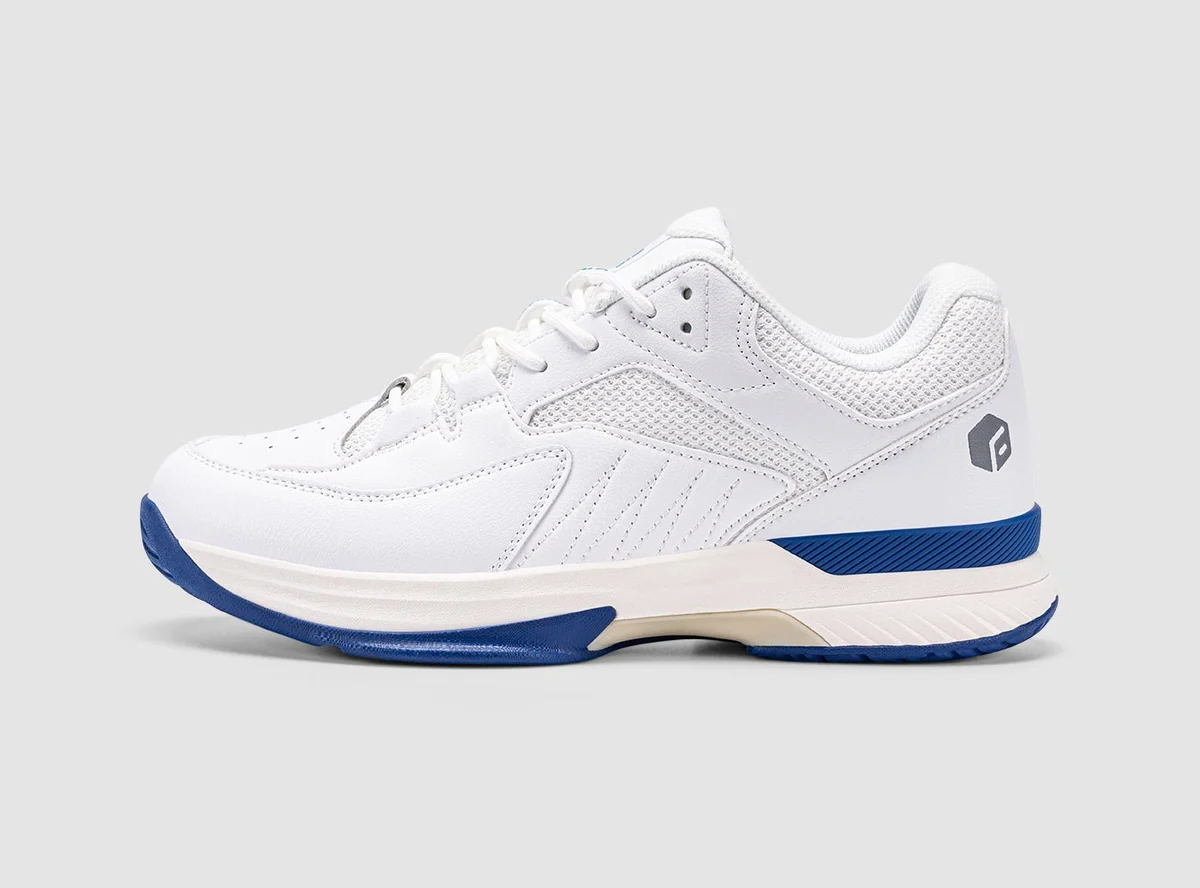
The only shoe in this guide the maker sells in both 2E and 4E: FitVille’s own product page lists Wide/2E and Extra Wide/4E variants as available, with a TPU shank, a heel ring and an Ortholite insole in the package.
The Amadeus V1 exists for one reason: players whose feet are wider than the 2E ceiling the big brands stop at. FitVille’s own product page sells it in two width codes — Wide/2E and Extra Wide/4E — and the variant grid showed both as available on build day, which makes this the single verified 4E option in the entire guide. It is the card to start with if you have ever looked at a “wide” shoe and found it still narrow, because the 4E code is a full step beyond what anyone else here stocks. FitVille describes the shoe as its Court Tennis Amadeus for tennis and pickleball, and the component list is unusually transparent for the price tier: a premium microfiber upper, a named Wide Toe Box, a Premium Ortholite insole, a TPU Heel Ring, a Cushioning EVA Midsole, an Anti-Torsion TPU Shank and a Non-Slip Rubber Outsole, each listed as its own line item rather than folded into a paragraph of adjectives.
The engineering is the sensible kind rather than the exotic kind. PropelCore is FitVille’s name for the five-component package underneath: a dual-density sole, anti-skid rubber, the heel ring, removable insoles and a shock-absorbing pad — printed here as FitVille’s own description of its system. The Anti-Torsion TPU Shank is the lateral hardware, there to resist twisting through direction changes, and the TPU Heel Ring closes the back of the shoe where a wide heel needs the fit to stay put. Two honesty notes belong on this card. First, FitVille publishes no weight for the Amadeus V1 — one independent review lists roughly 335 g, and that is the reviewer’s figure, not FitVille’s, so the chips above say “not published” rather than borrowing it. Second, FitVille names its outsole only as a Non-Slip Rubber Outsole with no surface claim — no silica-grit formulation, no hard-court compound name — so the natural home for this shoe is indoor courts and smooth surfaces, and outdoor-acrylic players should weigh that against the Tyrol below. Buy the Amadeus V1 if the width code is the whole decision: nothing else here goes to 4E, and nothing else here is built, from the maker’s own page down, around the widest foot in the room.
Pros
- The only verified 4E in this guide — a full step beyond every 2E here
- Maker’s own page lists both 2E and 4E variants as available on build day
- Real lateral hardware: Anti-Torsion TPU Shank plus a TPU Heel Ring
- Removable insoles with an Ortholite insole as standard
Cons
- FitVille publishes no weight — the ~335 g figure is a third-party review’s, not the maker’s
- No named outsole compound or surface claim — outdoor-acrylic players should compare the Tyrol
- Comfort-first build, not a speed shoe — aggressive movers want the Babolat cards
As an Amazon Associate we earn from qualifying purchases.
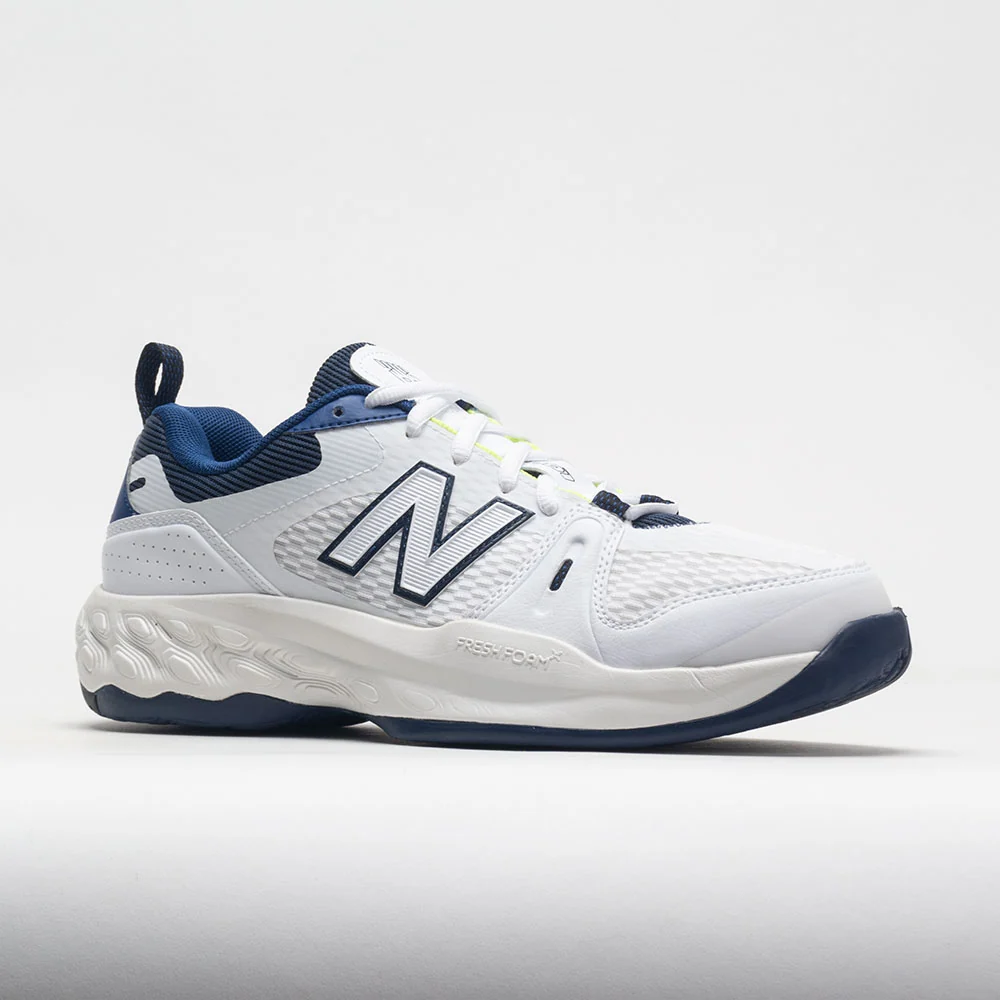
New Balance Fresh Foam X 1007
The plushest ride in a stocked wide: New Balance’s 1000-series court shoe in D, 2E and 4E, with Fresh Foam X underfoot and an NDurance hard-court outsole.
New Balance is the width leader of the mainstream brands — D, 2E and 4E as separate stocked SKUs, with the 4E carrying its own stock number — and the Fresh Foam X 1007 is the shoe that puts that whole width range under the softest midsole in this guide. The retail channel describes the 1007 as carrying on the 1000-series legacy of comfort, cushioning and breathability, and the update that matters is the one in the name: Fresh Foam X in the midsole, which New Balance’s own product data rates as maximum cushioning with energy return. The upper is synthetic materials combined with mesh for lightweight support and breathability, with added protection around the toes where court shoes wear first, and the fit is plush around the heel and ankle — a comfort-first construction rather than a locked-down racer.
Underneath is where the 1007 earns its place for the outdoor player too: a non-marking NDurance rubber outsole in a hard-court tread pattern, which the listing specifies for hard courts and other surfaces, and New Balance backs the NDurance outsole with a 6-month outsole durability coverage. That is the maker’s program, stated in the retailer’s listing — useful context for anyone playing daily on abrasive acrylic, though it is a coverage term, not a claim about how long any one pair lasts. On weight, this card follows the guide’s rule: 15.6 ounces in a size 10.5 is the retail listing’s figure, printed with its basis, not New Balance’s own spec-table number. The honest trade is the one the spec sheet shows: this is the maximum-cushioning shoe in the guide, not the maximum-support one — there is no named lateral chassis here, so players whose limiting factor is the sideways plant at the kitchen line should read the K-Swiss and Babolat cards. But if your wide foot wants the softest landing available in a stocked 4E, this is the only card that gives you both at once.
Pros
- Full D / 2E / 4E range as separate stocked SKUs — the mainstream width leader
- Fresh Foam X maximum cushioning — the plushest midsole in this guide
- NDurance non-marking hard-court outsole with a 6-month outsole durability coverage
- Stated weight with its basis: 15.6 oz in size 10.5 (retailer’s listing figure)
Cons
- No named lateral stability system — sideways movers should compare the K-Swiss and Babolat cards
- Comfort-first build; not the speed answer in a wide size
- The weight figure is the retailer’s listing number, not New Balance’s own published weight
As an Amazon Associate we earn from qualifying purchases.
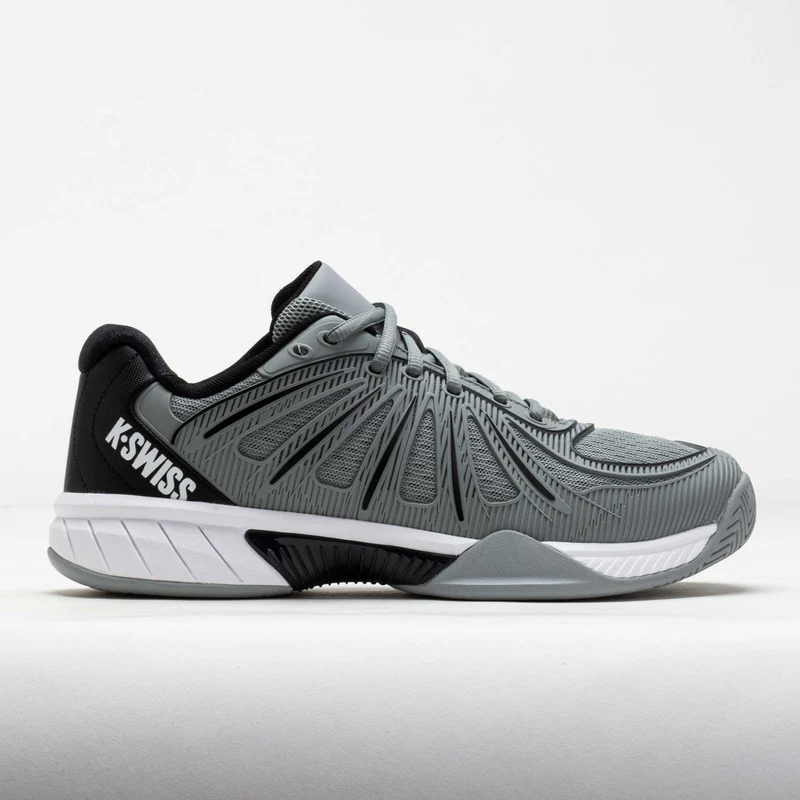
K-Swiss Express Light Pickleball 2 (Wide)
The shoe built for this sport, in a stocked wide: the second-generation Express Light Pickleball in 2E, with K-EVA, a 180-degree Plantar Support Chassis and DragGuard.
This is the specialist’s card. The Express Light line was the first shoe designed specifically for pickleball rather than borrowed from tennis, and the second generation — the Express Light Pickleball 2 — is the one K-Swiss currently sells in a 2E width, with its own 2E product page on K-Swiss’s site and the 2E listed as sold separately in current comparisons. A naming caution, because it matters to the no-re-card rule this guide keeps: our pillar guide cards the first-generation K-Swiss Express Light Pickleball Wide. This is the second generation — a different model, with an updated upper and the current spec recipe — and it is carded here as that model, not as a repeat. K-Swiss’s own copy for the line is admirably plain: a K-EVA midsole for cushioning and support, a 180-degree Plantar Support Chassis for midfoot stability, and an Aosta rubber outsole with DragGuard for durability — the three named systems, in K-Swiss’s own words.
The retail spec list fills in the rest: a synthetic leather upper with a textile collar lining, an Ortholite X40 die-cut sock liner for underfoot comfort, Heel Grip Lining — interlocking fibres that grip the sock to minimise heel slippage — and a TPU shank working with the Plantar Support Chassis against unwanted twisting. The outsole’s modified herringbone is the all-court pattern K-Swiss lists for all courts, and the DragGuard reinforcement sits at the toe and heel where aggressive movers wear through first. On weight, K-Swiss publishes none for a stated size — the card says so; Tennis Warehouse lists 10.9 oz in a men’s US 9, which is the retailer’s figure, labelled as such. Buy this one if you want the width inside a shoe whose every system was designed for pickleball movement: the kitchen-line shuffle, the dink-step recovery, the hard stop on acrylic. It is the only card here that is both a stocked 2E and a pickleball-native design.
Pros
- A stocked 2E in a shoe designed specifically for pickleball — the only card that is both
- Named lateral hardware: 180-degree Plantar Support Chassis plus a TPU shank
- Heel Grip Lining over an Ortholite X40 sock liner for heel lockdown
- Aosta rubber with DragGuard at the toe and heel wear zones
Cons
- K-Swiss publishes no weight for a stated size — the 10.9 oz figure is the retailer’s, not the maker’s
- 2E only — players who need 4E belong on the FitVille or New Balance cards
- Check the generation when ordering: this is the “2”, a different model from the pillar’s first-generation card
As an Amazon Associate we earn from qualifying purchases.
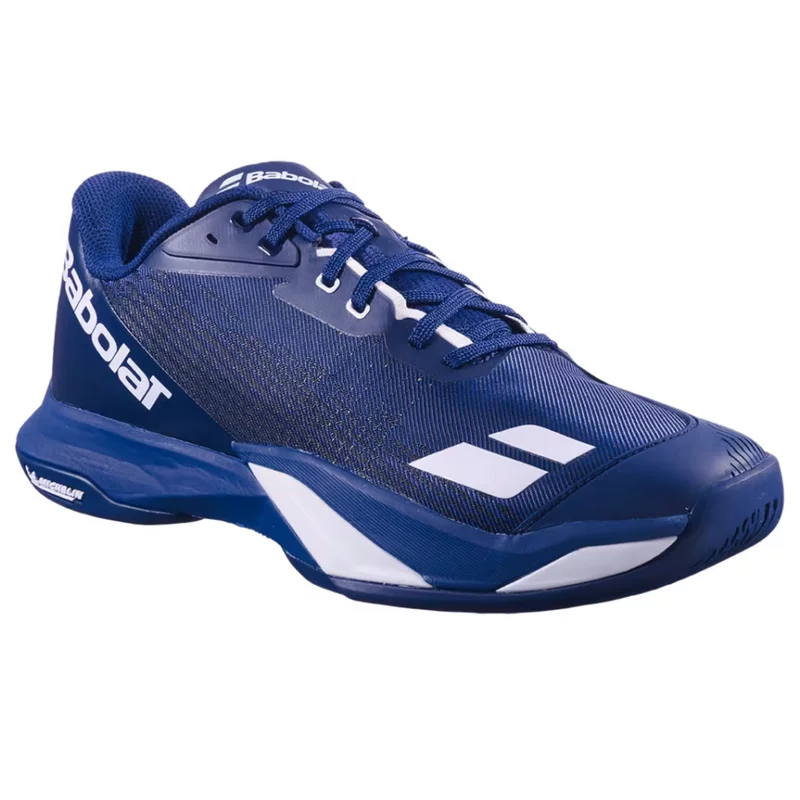
Babolat Jet Mach 4 All Court Wide
The speed shoe that comes in wide: Babolat’s own technical characteristics print Fit: Wide, with Matryx EVO, Michelin Premium rubber and a 10 mm drop.
Wide feet and fast feet are usually a choice; the Jet Mach 4 All Court Wide is Babolat’s argument that they don’t have to be. This is the rare speed shoe sold under a published wide fit — Babolat’s own product page for the Wide model prints Fit: Wide in its technical characteristics, alongside a 10 mm drop and an All Court surface type. That verification matters because the Jet Mach line is Babolat’s lightweight, explosive-movement franchise, and wide versions of speed shoes are the first thing to disappear from a range. The upper is Matryx EVO, Babolat’s patented fabric developed with Chamatex: ultra-resistant Aramid and Polyamide fibres in a dual-layer weave on this model, which is how the shoe stays light and supportive at once — comfort, responsiveness and support from the fibre rather than from bulk.
Underfoot, the recipe is pure speed with the wide last underneath it. Blast Pad is Babolat’s name for the high-performance foam in the forefoot that releases energy on every step; KPRS-X is the heel cushioning system the retail listings name. The Starting Bloc Plate adds lateral forefoot stability for explosive takeoffs — the kitchen-line lateral hardware, named — and the outsole is Michelin Premium rubber, which Babolat calls its most durable composition, in an all-court tread the retail channel finds best on hard courts. The Ortholite HybridPlus-Recycled molded insole (50% recycled materials, per Babolat) finishes the stack. On weight: 13.7 ounces in a size 10.5 is the retail listing’s figure, printed with its basis — Babolat’s regional page prints 360 g for the standard fit, which is a different model and is not this card’s number. Buy the Jet Mach 4 Wide if your wide foot also wants to move fast: it is the lightest-feeling wide option in this guide, and the only one whose entire engineering brief is speed.
Pros
- Fit: Wide printed in Babolat’s own technical characteristics — a verified wide speed shoe
- Matryx EVO dual-layer upper: aramid + polyamide support without bulk
- Starting Bloc Plate for lateral forefoot stability on explosive takeoffs
- Michelin Premium rubber — Babolat’s most durable composition, in its own words
Cons
- A speed shoe’s cushioning is responsive, not plush — maximum-comfort buyers belong on the 1007 or SFX4
- The 13.7 oz figure is the retailer’s listing number, not Babolat’s own published weight for the Wide
- Wide, not 2E/4E-coded — players who need a full 4E should start with cards 1–2
As an Amazon Associate we earn from qualifying purchases.
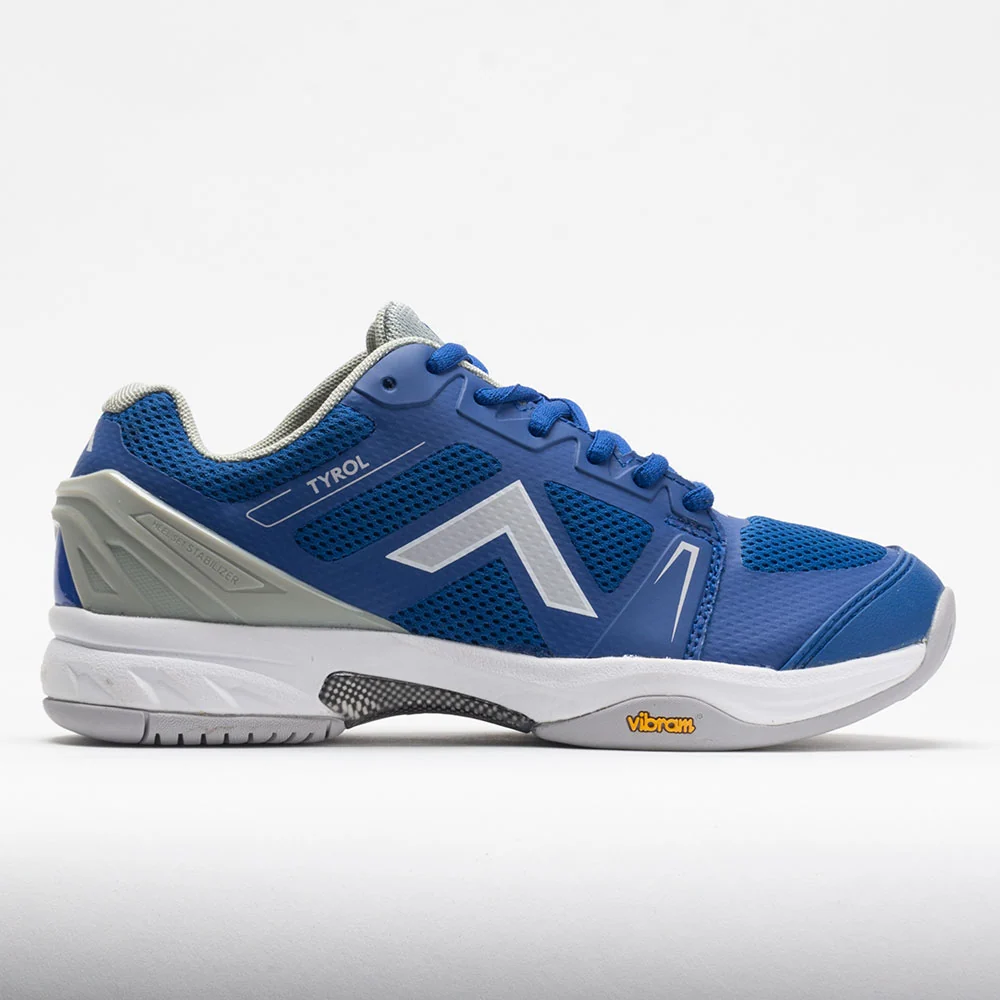
Tyrol Drive V
The outdoor-acrylic answer in a maker-stated 2E forefoot: Tyrol’s own FAQ says its shoes start with a 2E width in the forefoot, under a Vibram X Abrade outsole built for silica-grit courts.
Most wide shoes are designed for the court in the abstract; the Drive V is designed for the court outside your door. Tyrol’s own FAQ is unusually direct about fit: its shoes “start with a generous wide fit due to our 2E width in the forefoot and extra height or girth in the toe box”, and it tells you plainly that it offers no 4E or 6E — a maker stating both what it is and what it isn’t, which is exactly the honesty this guide rewards. The 2E forefoot comes with extra toe-box height, and Tyrol says its shoes fit large enough that it generally recommends going down half a size from other athletic brands — read that before you order, because a wide shoe bought long is a heel-slip shoe. The platform is built for pickleball movement specifically: a wide, deep toe box for the forward stop at the kitchen line, and a sculpted heel with an exterior heel counter that Tyrol keeps snug deliberately, to prevent slippage at the back.
The outsole is the card’s headline for outdoor players. Vibram — the rubber specialist — partnered with Tyrol on an X Abrade compound formulated specifically for painted silica-grit pickleball courts, which is the surface most outdoor acrylic courts are. That is a surface-specific compound in a segment where most outsoles claim “all court” and mean it loosely; Tyrol positions the Drive V for indoor and outdoor play, and the chevron tread is the outdoor pattern. Around it: a torsion control shank for lateral stability, a medial Power Clip for push-off support, a phylon and EVA midsole compound, a removable Polyurethane insole with a Nylex top that is orthotic-friendly, an open-weave mesh nylon upper, and a flow-through cooling system that ventilates from insole to outsole. Weight is 14.7 ounces in a size 10 — the retail listing’s figure, with its basis, since Tyrol’s own materials don’t print one. Buy the Drive V if your pickleball happens outdoors on acrylic: it is the only verified-wide shoe here whose outsole was compounded for that exact surface.
Pros
- Maker-stated 2E forefoot width — Tyrol’s own FAQ, which also states plainly there is no 4E/6E
- Vibram X Abrade outsole compounded specifically for silica-grit pickleball courts
- Full lateral package: torsion control shank, Power Clip, exterior heel counter
- Removable orthotic-friendly insole and a flow-through cooling system for long outdoor sessions
Cons
- No 4E option — Tyrol says so itself; 4E feet belong on cards 1–2
- Tyrol’s own sizing guidance: shoes fit large, consider half a size down
- The 14.7 oz figure is a retailer’s listing number, not Tyrol’s published weight
As an Amazon Associate we earn from qualifying purchases.
Cards 6–7: roomy standard lasts — generous toe boxes, no width code
These two are the roomy-last group, and the label above each card says so. Neither is sold under a stocked 2E or 4E code — both are standard-width shoes whose makers build a genuinely generous forefoot. If your foot is wide at the ball but standard at the heel, start here: the whole shoe doesn’t get wider where you don’t need it.
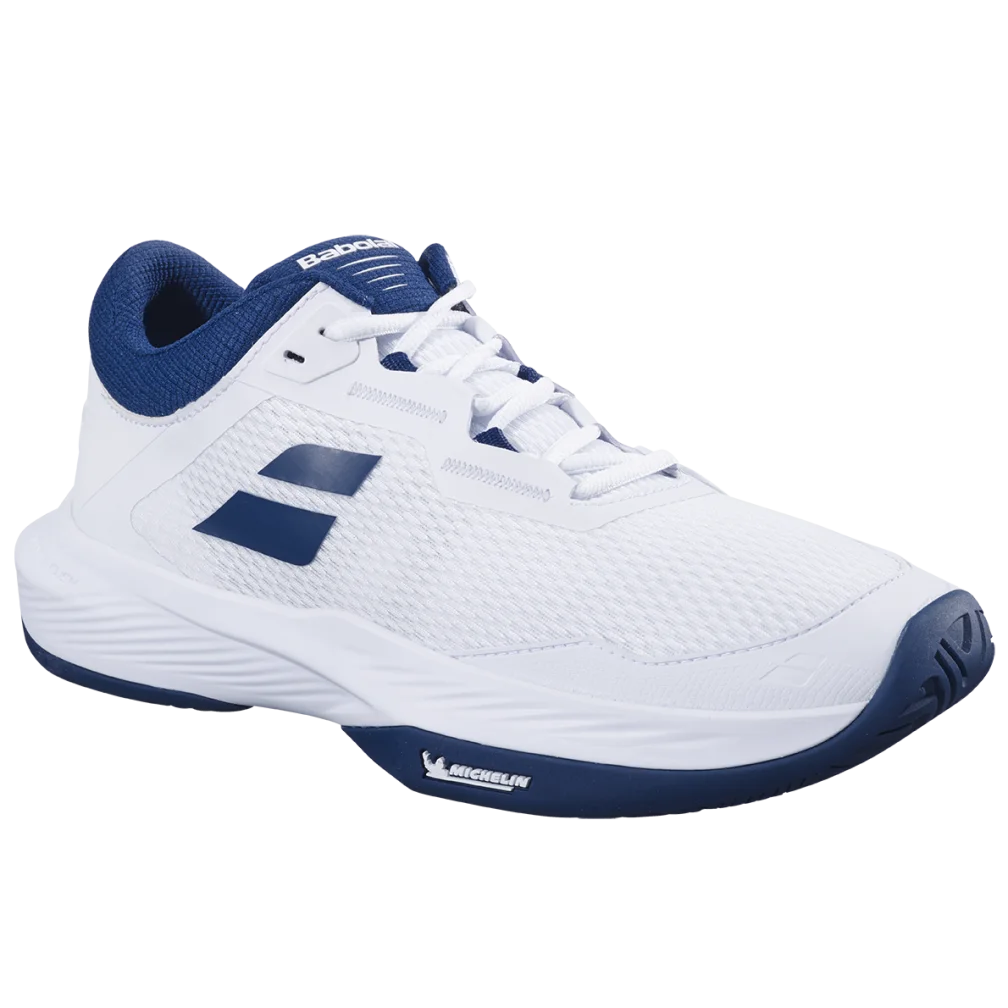
Babolat SFX4 All Court
The comfort flagship on a generous last: no width code, but Babolat’s product data builds the SFX4 on a wider, generous toe box with Kompressor cushioning and a Michelin outsole.
The SFX line has always been Babolat’s answer for players who find standard tennis shoes too narrow, and the SFX4 continues it on a last Babolat’s product data describes as generously wide in the toe box — without ever claiming a stocked width code. That is exactly why it leads the roomy-last group: it is the most comfortable wide-feeling shoe here for the player whose foot is wide at the ball but not a full 2E everywhere. The fit comments from the retail channel are worth reading before ordering: width is rated generous, length runs about half a size long, and the recommendation is to order half a size down from your typical size — a roomy last bought long is the classic way to lose the heel. The upper is a synthetic grill mesh with Babolat’s Side Wall construction for lightweight comfort, breathability and durability, and a toe-box shield adds the abrasion protection where the mesh meets the court.
Cushioning is the SFX4’s whole personality. The Kompressor System is Babolat’s high-performance heel cushioning, built to protect the foot on ground contact; the midsole adds Extra Cush foam for a pillowy feel; and the insole is an 8 mm Ortholite — thicker than standard — for plushness underfoot. Stability on the wide platform comes from a TPU shank plate between the two-piece outsole, the Side Wall construction, and internal straps that wrap the midfoot to keep the foot stable during lateral movements — the retail channel’s playtesters called the shoe laterally stable with a wide base to plant on. The outsole is Michelin Performance rubber in a modified herringbone, which the listings rate for traction and durability on all court surfaces. Babolat publishes no weight for the men’s model, and the card says so. Buy the SFX4 if your foot wants room without a width code: it is the comfort answer for the wide-forefoot, standard-heel foot, and the easiest fit in this guide to get right on the first order — provided you read the half-size-long note first.
Pros
- The most generous standard last here — wide feeling without a width code
- Full comfort stack: Kompressor heel, Extra Cush foam, 8 mm Ortholite insole
- TPU shank plate, Side Wall construction and internal straps stabilise the wide platform
- Michelin Performance outsole rated for all court surfaces
Cons
- No stocked 2E/4E code — fully wide feet belong on cards 1–2
- Runs about half a size long — the retail fit comment says order half a size down
- Babolat publishes no weight for the men’s model
As an Amazon Associate we earn from qualifying purchases.
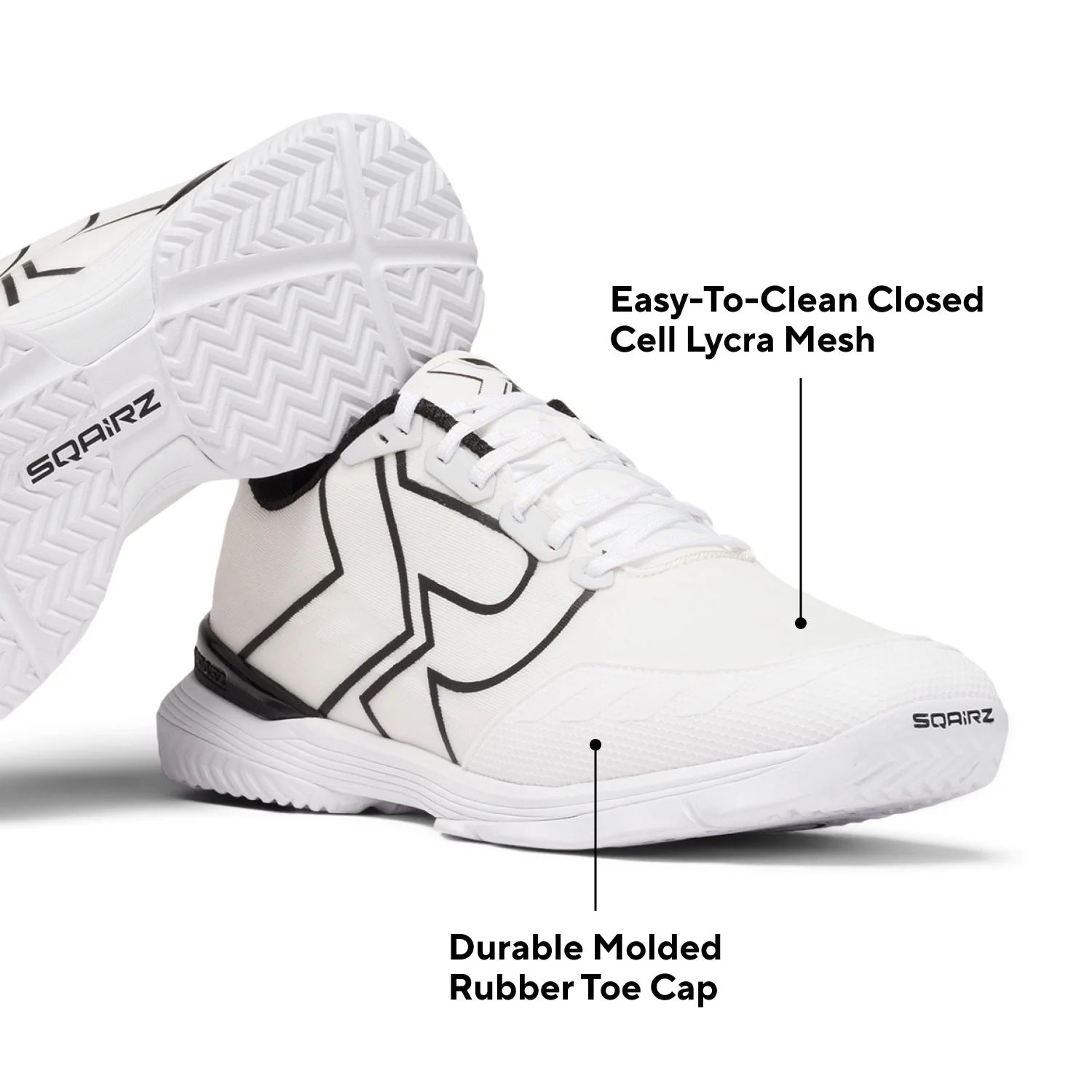
SQAIRZ XRZ
The patented-roomier-toe-box answer: SQAIRZ says it outright — standard width, with a 110 mm signature toe box, a TPU heel counter and Smart Traction built for pickleball.
The XRZ is the most honest shoe in the roomy-last group because its maker refuses the width label entirely. SQAIRZ’s own site answers the question directly — “Does SQAIRZ offer wide sizes? SQAIRZ offers standard width shoes, but the patented roomier toe box provides meaningful extra space in the forefoot” — and its retail channel puts a number on the signature toe box: 110 mm across, against the 88 mm heel and 53 mm midsole the same listing prints. That is the shape solution stated as a shape solution: the toes spread naturally and the base under the ball of the foot is stable, while the heel and midfoot stay standard-width so the fit doesn’t get sloppy where you don’t need room. The shoe is co-created with pickleball pros and built for the sport’s movement — quick cuts, explosive pivots, the relentless pace of the kitchen line — rather than adapted from a tennis last.
The technology list is all SQAIRZ’s own naming, and it is a long one. The Smart Traction rubber outsole carries a multi-directional herringbone tread with forefoot pivot points for rotation, flex grooves in the forefoot and heel, and four lateral outriggers on the forefoot to prevent rollover during slides and push-offs — the lateral hardware, named and placed. The TPU heel counter gives anti-torsion support from heel to forefoot; the patented Sta-Put laces and silicone-encased eyelets keep the fit secure; the NRG Foam midsole is SQAIRZ’s EVA cushioning; the Blumaka Non-Slip Performance Footbed is SQAIRZ’s claim of 14% more energy return and 17% more cushioning against standard insoles — printed here as the maker’s claim; and the reinforced silicone toe cap extends up the medial side against toe drag. The closed-cell Lycra mesh upper is breathable and easy to clean, and SQAIRZ designs the XRZ for all court types. Weight is 13.3 ounces — the retailer’s listing figure, with no maker-published number to compare it against. Buy the XRZ if your foot is wide where the toes are and standard everywhere else: it is the widest toe box on a standard width in this guide, from the maker that states the distinction most clearly.
Pros
- 110 mm signature toe box on a standard width — the widest toe box per width code here
- Maker states the distinction outright: standard width, patented roomier toe box
- Real lateral hardware: TPU heel counter, 4 forefoot outriggers, Sta-Put laces
- Smart Traction outsole designed for all court types, with forefoot pivot points
Cons
- No stocked wide width — fully wide feet belong on the verified 2E/4E cards
- The 13.3 oz figure is the retailer’s listing number, not SQAIRZ’s published weight
- The footbed’s 14%/17% figures are SQAIRZ’s claim against standard insoles, not an independent measure
As an Amazon Associate we earn from qualifying purchases.
Side-by-Side: The Seven Wide-Fit Shoes at a Glance
Every figure below is the maker’s own published specification or a retail listing’s figure labelled as such. Widths are printed exactly as honestly as the cards print them — five verified stocked widths, two roomy standard lasts, and no blurring between the two.
| Shoe | Fit designation | Best for | Cushioning (maker-named) | Outsole | Weight |
|---|---|---|---|---|---|
| FitVille Court Tennis Amadeus V1 | 2E + 4E (FitVille’s listing) | Widest stocked fit | Cushioning EVA midsole + Ortholite insole | Non-Slip Rubber Outsole | Not published |
| New Balance Fresh Foam X 1007 | D, 2E, 4E (stocked SKUs) | Maximum cushioning in wide | Fresh Foam X (maximum) | NDurance non-marking rubber, hard-court tread | 15.6 oz, size 10.5 (retailer’s figure) |
| K-Swiss Express Light Pickleball 2 (Wide) | Standard + 2E (2E sold separately) | Pickleball-designed wide | K-EVA + Ortholite X40 sock liner | Aosta rubber with DragGuard | Not published |
| Babolat Jet Mach 4 All Court Wide | Wide (Babolat’s tech characteristics) | Speed in wide | Blast Pad forefoot foam + KPRS-X heel | Michelin Premium rubber, All Court | 13.7 oz, size 10.5 (retailer’s figure) |
| Tyrol Drive V | 2E forefoot (Tyrol’s FAQ; no 4E/6E) | Outdoor acrylic | Phylon + EVA midsole, Polyurethane insole | Vibram X Abrade, silica-grit courts | 14.7 oz, size 10 (retailer’s figure) |
| Babolat SFX4 All Court | Standard width, generous toe box (no 2E code) | Roomiest comfort last | Kompressor heel + Extra Cush foam, 8 mm Ortholite | Michelin Performance, all surfaces | Not published |
| SQAIRZ XRZ | Standard width, 110 mm roomier toe box (no 2E code) | Widest toe box, standard width | NRG Foam EVA + Blumaka footbed | Smart Traction rubber, herringbone | 13.3 oz (retailer’s figure) |
Wide-Fit Buying Guide: Five Checks Before You Pay
1. Decide whether you need the width code or the shape. Stand on the shoe’s question honestly: is your foot wide everywhere, or wide at the ball with a standard heel? Wide everywhere buys the width code — the 4E Amadeus V1, the 4E 1007, the 2E Express Light 2, the Wide Jet Mach 4, or the 2E-forefoot Tyrol. Wide at the ball with a standard heel buys the shape — the SFX4’s generous last or the XRZ’s 110 mm toe box — because a full 2E will swim at your heel while a roomy last won’t. If you cannot answer the question, the 1007 in 2E is the honest middle: a stocked wide that is also the most forgiving fit here.
2. Read every weight by its basis — or its absence. This guide contains three retail-listing weights (the 1007’s 15.6 oz in size 10.5, the Jet Mach 4 Wide’s 13.7 oz in size 10.5, the Drive V’s 14.7 oz in size 10, the XRZ’s 13.3 oz) and three shoes with no published weight at all (FitVille, K-Swiss and Babolat publish none for the Amadeus V1, Express Light 2 and SFX4). That is normal in this segment, not a warning sign. What should warn you is any listing, anywhere, that prints a precise weight for one of the unpublished models without saying where the number came from — the makers themselves do not publish one, and this guide’s one third-party figure, the ~335 g on the FitVille card, is labelled as a third-party figure wherever it appears.
3. Match the outsole to your actual surface. Outdoor acrylic on a silica-grit base is the surface that eats shoes, and the makers name their answers: Tyrol’s Vibram X Abrade is compounded for exactly that court; Babolat’s Michelin Premium is its most durable composition; New Balance’s NDurance is a hard-court rubber with a 6-month outsole durability coverage behind it. Indoor and smooth-court players have the easier choice — the FitVille’s Non-Slip Rubber, the SFX4’s Michelin Performance and the XRZ’s Smart Traction all live happily there. Don’t buy an indoor-optimised outsole for a daily outdoor game and expect the compound to forgive you.
4. Check the lateral hardware against your kitchen-line game. The kitchen line is a sideways game — shuffles, split-steps, the hard plant before a backhand dink — and wide feet punish a shoe that rolls. Read the stability line as hardware: K-Swiss’s 180-degree Plantar Support Chassis plus TPU shank, Tyrol’s torsion control shank with Power Clip and exterior heel counter, Babolat’s Starting Bloc Plate in the Jet Mach 4, the SFX4’s TPU shank plate with Side Wall construction and internal straps, SQAIRZ’s TPU heel counter with four lateral outriggers, FitVille’s Anti-Torsion TPU Shank with its heel ring. The 1007 is the one card without a named lateral system — it is the comfort answer, and it is honest about being that. Match the hardware to how hard you move sideways, not to how the shoe looks.
5. Read the maker’s own sizing note before you order — wide shoes have quirks. Tyrol’s own FAQ says its shoes fit large and recommends going down half a size; the SFX4’s retail fit comment says it runs about half a size long and recommends ordering down; Babolat’s standard Jet Mach 4 runs true while the Wide adds forefoot room on the same length. And never buy width by sizing up in length: a longer shoe is a heel-slip shoe, and heel slip on a wide foot is how blisters happen. Buy the width code in your measured size, check the heel in the first session the way the spec section describes, and use the retailer’s fit comments — the ones this guide quotes — as your ordering map.
Frequently Asked Questions
What is the difference between a 2E width and a roomy standard last?
A 2E (wide) or 4E (extra wide) is a stocked width code: the maker builds the whole shoe — upper, midsole and outsole platform — on a wider last and sells it under that code, so the shoe is wider everywhere. A roomy standard last is a shape: the maker gives the forefoot a generous or square toe box while the width code stays standard, so the heel and midfoot don’t get wider. This guide keeps them separate — cards 1–5 are verified stocked widths, cards 6–7 are roomy lasts — because they solve different feet.
Which pickleball shoes actually come in 4E?
Two in this guide: the FitVille Court Tennis Amadeus V1, which FitVille’s own product page sells in Wide/2E and Extra Wide/4E, and the New Balance Fresh Foam X 1007, which is stocked in D, 2E and 4E as separate retail SKUs. Tyrol states plainly in its own FAQ that it offers no 4E or 6E — its widest is the 2E forefoot of the Drive V. If you need a full 4E, the Amadeus V1 and the 1007 are the verified answers here.
Can I just size up half a size instead of buying a wide shoe?
It is the most common workaround and the most common mistake. Sizing up buys length, not width — the forefoot may still pinch while the heel gets longer, and a longer heel is a heel that lifts on every kitchen-line shuffle. A stocked 2E or 4E widens the shoe without lengthening it. The makers’ own sizing notes point the same way: Tyrol recommends going down half a size because its wide shoe fits large, and the SFX4’s fit comment says it runs half a size long — both assume you buy your measured size and let the width do the widening.
Do wide pickleball shoes hold up on outdoor acrylic courts?
It depends on the compound, not the width. Tyrol’s Vibram X Abrade outsole is formulated specifically for painted silica-grit pickleball courts — the surface most outdoor acrylic courts are — and Tyrol positions the Drive V for indoor and outdoor play. New Balance’s NDurance is a hard-court rubber the listing specifies for hard courts and other surfaces, backed by a 6-month outsole durability coverage. Babolat’s Michelin Premium and Michelin Performance rubbers and K-Swiss’s Aosta rubber with DragGuard are the other named compounds here. FitVille names its outsole only as Non-Slip Rubber with no surface claim, so indoor and smooth courts are its natural home.
What should wide-foot players look for in lateral support at the kitchen line?
Named hardware, not adjectives. The kitchen line is a sideways game — shuffles, split-steps and hard plants — and the makers name their answers: K-Swiss’s 180-degree Plantar Support Chassis with a TPU shank, Tyrol’s torsion control shank with a Power Clip and exterior heel counter, Babolat’s Starting Bloc Plate for lateral forefoot stability in the Jet Mach 4, the SFX4’s TPU shank plate with Side Wall construction and internal straps, SQAIRZ’s TPU heel counter with four lateral forefoot outriggers, and FitVille’s Anti-Torsion TPU Shank with a TPU Heel Ring. The New Balance 1007 is the comfort card here — it carries no named lateral system, and the guide says so plainly.
I’m between a standard and a 2E — are the roomy-last shoes a safe pick?
That in-between foot is exactly what the roomy-last group is for. The Babolat SFX4 is built on a generous, wider toe box with no width code — the comfort answer for a wide forefoot on a standard heel — and its retail fit comment says it runs about half a size long, so order down. The SQAIRZ XRZ is standard width with a patented 110 mm roomier toe box, stated as such by SQAIRZ itself. If your heel is standard width too, a roomy last fits better than a 2E that would swim at the back; if your whole foot measures wide, buy the width code instead.
How should a wide pickleball shoe fit at the heel?
Snug and seated, with no lift on the braking lunge — the heel is where wide shoes most often fail, because a wider forefoot can tempt you into a longer size. Read the lockdown systems: K-Swiss’s Heel Grip Lining over an Ortholite X40 sock liner, FitVille’s TPU Heel Ring, Tyrol’s sculpted heel with an exterior heel counter (kept snug deliberately, per Tyrol), SQAIRZ’s TPU heel counter with Sta-Put laces, and the SFX4’s internal straps. Check it in the first session the way the spec section describes: a hard braking lunge in the shop finds a loose heel before the court does.
The Verdict
If one shoe has to solve the widest foot, it is the FitVille Court Tennis Amadeus V1 — the only verified 4E in this guide, sold in 2E and 4E on FitVille’s own page. But the honest verdict in this segment is that the best shoe is the one that matches your width honestly. Want the softest landing in a stocked wide? The New Balance Fresh Foam X 1007 in 2E or 4E. Want the shoe designed for pickleball in a 2E? The K-Swiss Express Light Pickleball 2 (Wide). Want speed on a wide last? The Babolat Jet Mach 4 All Court Wide. Play outdoors on acrylic? The Tyrol Drive V and its Vibram X Abrade compound. Wide at the ball with a standard heel? The Babolat SFX4 or the SQAIRZ XRZ — the roomy lasts, labelled as such.
Still weighing the wider field? Our pillar comparison of the best pickleball shoes ranks the all-player flagships this guide deliberately avoids repeating, and the advanced pickleball shoes guide owns the top-speed purchase. Buy this segment for the width you actually need, read the maker’s own width code before any listing’s summary of it — and the wide end of the shoe wall stops being a wall of adjectives and becomes seven clear answers.
How we built this guide: every width claim above was verified on build day against the maker’s own listing or an authorised retailer listing that reproduces the maker’s data — and each claim is attributed to its source in the copy. Cards 1–5 are stocked wide widths (2E, or 2E and 4E); cards 6–7 are standard-width shoes with maker-verified generous toe boxes, labelled as roomy lasts rather than wide widths. FitVille, K-Swiss and Babolat publish no weight for the Amadeus V1, Express Light Pickleball 2 and SFX4; the weights printed for the other four models are retail-listing figures with their size basis, and the one third-party figure used (the Amadeus V1’s ~335 g) is labelled as a third-party figure wherever it appears. We do not publish prices, we make no durability, medical or foot-condition claims, and nothing here is presented as hands-on testing. Some links on this page are affiliate links: if you buy through them, AliShuttler may earn a commission at no additional cost to you. As an Amazon Associate we earn from qualifying purchases.