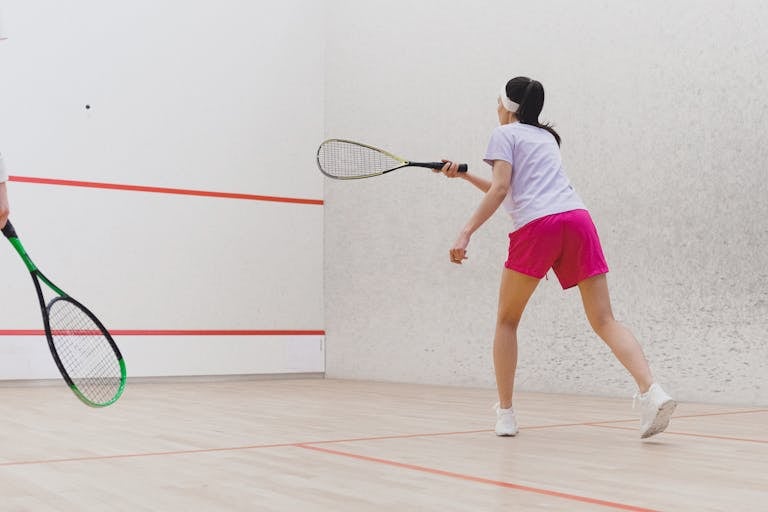
Everything a first-time player actually needs: what the lines mean, how to serve legally, how the scoring works, what a let and a stroke really are, the handful of shots that run every rally — and how to behave in your first session so the player sharing the court with you stays safe and wants a rematch.
Squash looks complicated from the viewing gallery. Two players, one small black ball, a blur of movement inside a white box — and every so often both players stop, look at each other, and have a short negotiation about something called a “let”. From inside the court, though, the game runs on a surprisingly small set of rules, and almost everything else is etiquette layered on top of two principles the rulebook puts first: safety and fair play.
This guide teaches you the game the way a good club player would before your first session — the official version, checked against the current WSF (World Squash Federation) Singles Rules, effective 1 September 2025, but explained in plain language with the examples that make the tricky parts stick. By the end you will know how to start a rally legally, how to keep one alive, how points are won and lost, and — the part beginners find most mysterious — what to do when you and your opponent end up in each other’s way.
One boundary before we start: if you are still deciding whether squash is your game, our squash vs racquetball breakdown covers that choice. This page assumes you have picked squash and want to play it properly from day one.
The whole game on one card
Hit the ball to the front wall, above the tin and below the top out line — via any other wall you like, but never after it has bounced on the floor. Your opponent must return it before it bounces twice, and volleying is legal. You get one serve only: from inside a service box, onto the front wall above the service line, landing in the opposite back quarter. Every rally scores a point (this is called PAR scoring); games are played to 11, matches are normally the best of 5 games. After you play your shot, you must clear out of your opponent’s way — if your body genuinely stops them playing a shot they could have hit, you replay the rally (a let) or lose it outright (a stroke against you, which is a point to them). That is squash. Everything below is the detail that makes those sentences work on a real court.
Front wall, above the tin
Every legal shot ends at the front wall between the tin and the out line. Side and back walls are fair game on the way there.
One chance, no second serve
A fault serve loses the rally immediately. Foot inside the box, ball above the service line, first bounce in the far quarter.
Every rally is a point
Win the rally, win a point and serve the next one. Games to 11; at 10-all you must lead by two clear points.
Clear, don’t block
You share one court. After your shot, your job is to give your opponent a fair view, a path to the ball and room to swing.
In this guide
Squash in 30 seconds
Strip squash down and it is a turn-taking game played against a wall. The server starts the rally by hitting the ball onto the front wall. From there, the players alternate: each return must reach the front wall above the tin before the ball has bounced twice on the floor. A rally ends when somebody fails to do that — hits the tin, hits it out, lets it bounce twice, or cannot reach it at all — and the winner of the rally scores a point and serves the next one.
Three ideas do most of the work in those two sentences, and they are worth defining properly, because officials use these exact words on court:
Notice what is not in the definition of a good return: any rule about which walls you may use, how high you must hit, or where the ball must bounce afterwards. Once your shot leaves the front wall it can land anywhere in the court. That freedom is the whole tactical game — you are trying to make the ball finish somewhere your opponent cannot comfortably reach, while they do the same to you, in a space you are both standing in. Which is why squash also needs its sharing rules, covered in detail in the interference section below.
The court: a tour of the lines
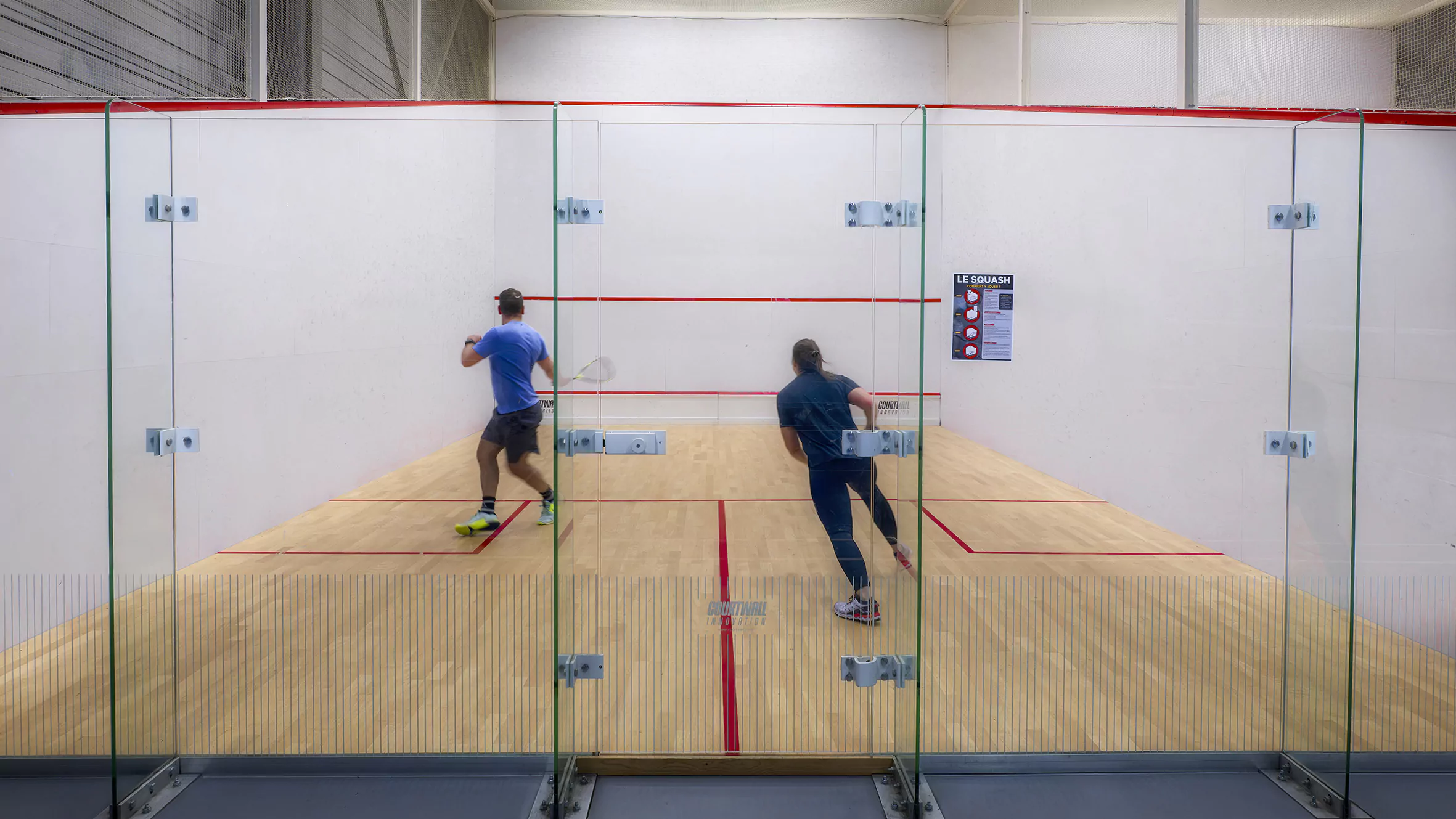
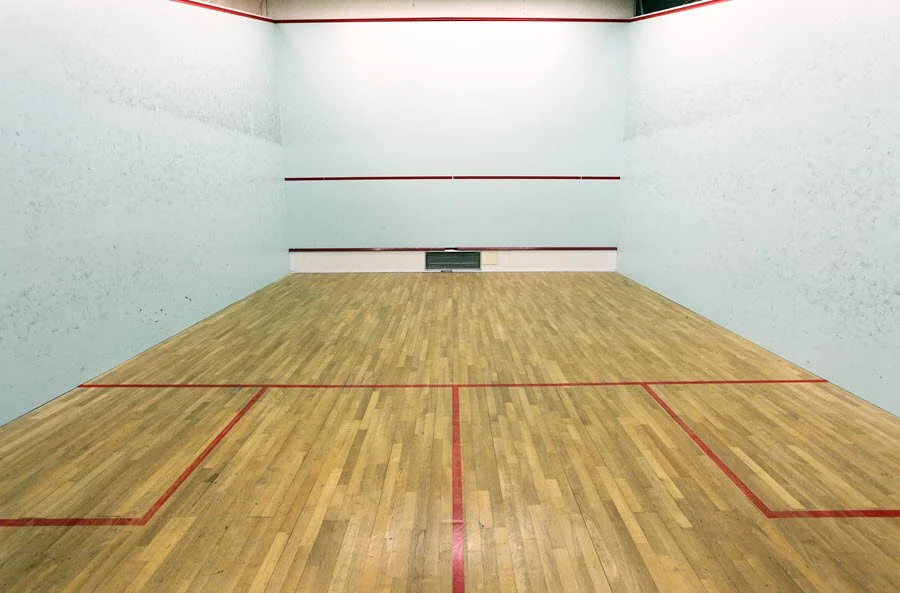
A squash court is a rectangular box measuring 9.75 metres long by 6.4 metres wide (32 × 21 feet) under the WSF court specification, with four walls of different heights and a set of red lines that divide it into legal and illegal territory. Walk the lines once in your head and you will never be confused about a call again.
The front wall: three horizontal zones
Everything is decided on the front wall, and it has three bands. At the bottom sits the tin — a metal strip just 19 inches (483mm) high running the width of the wall. The tin is squash’s net: any ball that hits it, or the line at its top edge, is down. (Professional tour events lower the tin to 17 inches, which is one reason the pros can play shots that would clang on your club court — for your game, 19 inches is the number.)
Above the tin, the next landmark is the service line, 1.78 metres up. It matters for exactly one shot: the serve, which must land on the front wall above this line. In open play it means nothing — a rally shot can hit anywhere above the tin.
The top band is closed off by the front wall line (the out line), 4.57 metres above the floor. Hit it or above it and the ball is out. From the ends of this line, out lines rake down the side walls to the back wall line, 2.13 metres up. The whole sloping boundary works the same way on every wall: line and above is out.
The floor: quarters and boxes
The floor markings exist almost entirely to organise the serve. The short line runs across the court 4.26 metres in front of the back wall, splitting the court into a large front area and a smaller back strip. The half-court line runs from the short line to the back wall, dividing that back strip into two quarter courts, left and right. Where the short line and half-court line meet is the point players call the T — the crossroads of the court, and the spot you will spend the whole match trying to own.
In each quarter court sits a service box: a square 1.6 metres across, formed by the short line, the side wall and two short lines marked on the floor. The server stands in one to serve; the serve must then land in the quarter court diagonally opposite — the quarter on the other side of the half-court line and behind the short line. Stand on court once and trace it: box, front wall above the service line, opposite quarter. That triangle is the serve.
| Marking | WSF specification | What it decides |
|---|---|---|
| Court size | 9.75m × 6.4m | The playing box itself |
| Tin | 19in (483mm) high | Hit it (or its top line) and the shot is down |
| Service line | 1.78m up the front wall | Serves must land above it; irrelevant in rallies |
| Front wall line (out line) | 4.57m up the front wall | On or above it, on any wall, is out |
| Back wall line | 2.13m up the back wall | End of the sloping out-line boundary |
| Short line | 4.26m from the back wall | Front edge of the quarter courts; serves must land behind it |
| Service boxes | 1.6m × 1.6m | Where the server must stand |
The warm-up: how the knock-up works
A squash ball is not ready when you are. Cold from the bag, it barely bounces — a beginner’s first dead drop shot is usually just an unwarmed ball. Squash therefore builds the warm-up into the rules. At the start of a match the players go on court together and warm up the ball for a maximum of 4 minutes, changing sides after 2 minutes so both players hit on both sides of the court (Rule 4.1). Hitting the ball repeatedly firms it up and makes it livelier; you will feel it come alive over those few minutes.
Two parts of the warm-up rule matter socially as much as physically. First, both players must get equal opportunities to strike the ball — hogging the knock-up, hammering every ball back at your opponent’s feet so they never get a clean hit, is officially “warming up unfairly” and a conduct matter (Rule 4.2). The normal pattern is cooperative: hit a few to yourself, feed a few loose ones across for your opponent, move around the court. Second, the clock is real in formal play — after the warm-up there is a maximum of 1 minute before the first serve, and 2 minutes between games (Rule 7.1).
In a friendly booking there is no referee with a stopwatch, but keep the shape of it: arrive, knock up for three or four minutes, share the ball generously, swap sides halfway, and start. It warms your body as well as the ball — and cold muscles plus a cold ball is how first sessions end early. Between games, keep it brief and keep moving; squash is meant to be continuous.
The serve, step by step
The serve is the only shot in squash you take standing still, with the ball exactly where you want it — and it is still the easiest rally to lose before it starts, because squash gives you no second serve. A fault serve loses the rally on the spot (Rule 5.8). So learn the sequence until it is automatic.
How a legal serve works
Step 1 — Win the right to serve. The first server of a match is decided by the spin of a racket: one player spins it, the other calls which way the logo on the butt cap lands. After that, the server is simply whoever won the last rally — win a rally on your opponent’s serve and the serve passes to you. That changeover is called a hand-out.
Step 2 — Choose your box. At the start of each game, and every time you win the serve back, you may serve from either service box. While you keep winning rallies, you must then alternate boxes — right, left, right, left — for as long as the run lasts (Rule 5.2). If a rally ends in a replayed let, you serve again from the same box (Rule 5.3).
Step 3 — Set your foot. At the moment you strike the ball, one foot must be entirely on the floor inside your service box, with no part of that foot touching any line of the box (Rule 5.7.2). Your other foot can be anywhere. This is the squash equivalent of a foot-fault, and beginners breach it constantly by standing half out of the small square — the box is only 1.6 metres wide, so plant the foot first, then think about the shot.
Step 4 — Release and strike. Drop or throw the ball from your hand (or off the racket) and strike it before it touches anything else (Rule 5.7.1). If you release the ball and make no attempt to hit it, there is no penalty — just pick it up and start again (Rule 5.9). You do not have to let the ball bounce; most players drop it low and strike it on the fall, or toss it gently and hit it on the rise.
Step 5 — Clear the service line. The serve must hit the front wall between the service line and the out line — above the service line, in other words, but not so high it clips the top line or hits the front and side wall simultaneously (Rule 5.7.3).
Step 6 — Land in the opposite quarter. Unless your opponent volleys it, the serve’s first bounce must be in the quarter court opposite your box — across the half-court line, behind the short line, and touching no line on the way down (Rule 5.7.4). A serve that clips the service line, the short line or the half-court line is a fault, however close it looks (Rule 5.8 note).
One courtesy the rules protect: the server must not serve before the receiver is ready, and if a serve arrives while the receiver clearly is not ready and makes no attempt at it, a let is played — the serve is retaken rather than lost (Rule 5.10). But if that serve was itself a fault, the fault stands and the server loses the rally. As the receiver, the lesson is simple: get set early, racket up, and if you genuinely are not ready, don’t swing at it.
And a beginner’s aiming point while all this settles: forget pace. A slow, high serve that lands deep in the quarter, close to the side wall and the back, is far harder to return than a fast one that sits up at mid-court. Accuracy is the serve’s whole job — it starts the rally on your terms or hands your opponent a loose ball at the T.
The rally: keeping the ball alive
Once the serve is away, the rally obeys one loop: front wall above the tin, before the second bounce, taking turns. Everything else is freedom. Your shot may strike the side walls or the back wall on its way to the front — that is not a fault, it is half the game — but it must not touch the floor before the front wall, and it must land on the front wall above the tin and below the out line. You may also volley: strike the ball before it bounces at all, which is legal at any point, serve included.
Because the ball can come off the back wall, “out of reach” arrives later than newcomers expect. A ball that has passed you is not dead — if it rebounds off the glass or back wall you can still play it, as long as it has not bounced twice. Beginners lose points by giving up on balls that were coming back to them; experienced players turn and take those balls off the back wall as a matter of routine.
The rally ends in one of five ways:
Down. Somebody hits the tin, or the ball bounces on the floor before reaching the front wall. Out. Somebody puts the ball on or above the out line on any wall. Not up. Somebody strikes the ball after its second bounce, double-hits it, or carries it on the strings. Unreachable. Somebody simply cannot get to a good shot — the honest way most rallies end, usually because the ball died tight against a wall or rolled out of the nick, the join where the side wall meets the floor, where a well-struck ball squirts along the floor instead of bouncing up. And interference, the one that needs its own section: a player stops because their opponent is in the way, and the let/stroke machinery below decides what happens.
Scoring: how games and matches are won
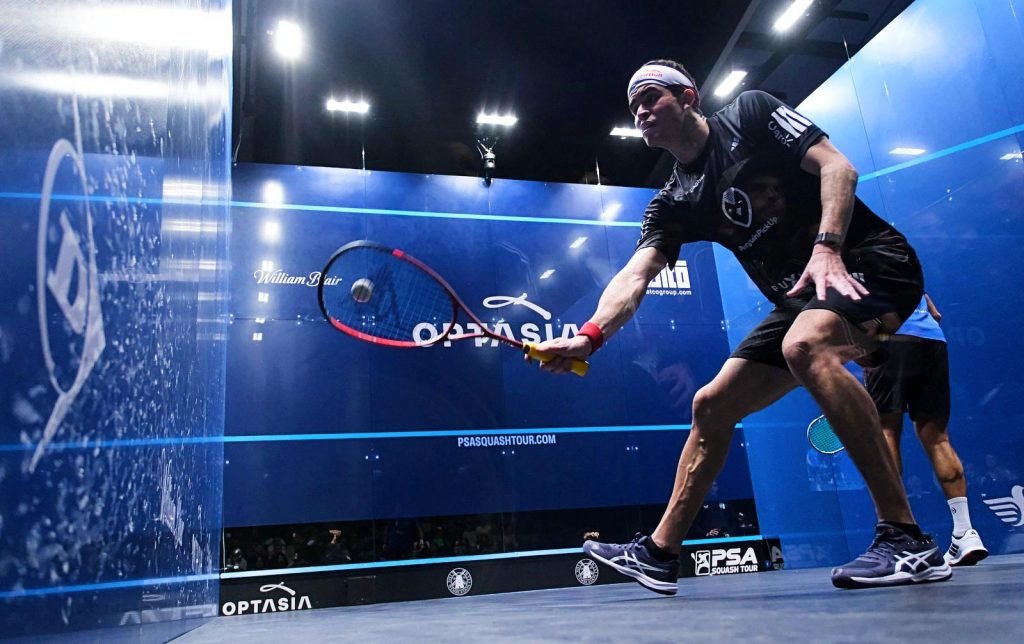
Squash uses point-a-rally scoring — PAR — and it is beautifully simple: the winner of every rally scores 1 point and serves the next rally (Rule 2.1). There is no “you can only score on your own serve”; that older system is gone from the standard game. Win a rally as receiver and you gain the point and the serve.
Each game is played to 11 points. The one wrinkle: if the score reaches 10-all, the game continues until one player leads by 2 clear points — 12-10, 13-11, however long it takes (Rule 2.2). A match is normally the best of 5 games, though best of 3 is an accepted format and common in club ladders and shorter bookings (Rule 2.3). In a friendly game with a court timer ticking, best of 3 — or even “most games when the booking ends” — is a perfectly respectable arrangement; agree it before the first serve and nobody can dispute the result afterwards.
Keeping score without officials is part of the game too. Call the score before you serve, server’s score first (“7-5”), and say “hand-out” when the serve changes sides. It feels ceremonial for about one game; after that it is just how you both stay certain of where the match stands — and certainty about the score prevents more arguments than any other habit on this page.
Interference: lets, strokes and no lets
Here is the problem squash’s rules exist to solve: after your shot, the ball rebounds from the front wall towards a court that you are still standing in. Your opponent has to reach it, see it, and swing at it — with you in the building. So the rulebook places the duty on the player who just hit the ball. After completing a reasonable follow-through, you must make every effort to clear, so that your opponent has all four of these (Rule 8.1):
A fair view of the ball as it comes off the front wall. Access — a genuine path to get to the ball. Room for a reasonable swing — backswing, strike and follow-through. And the freedom to strike the ball to any part of the front wall — not just the part of the wall that happens to dodge your body. Fail to provide any one of them and you have caused interference. What happens next depends on how much the interference mattered, and the player who was blocked decides whether to raise it: you stop, and ask — the wording every player uses is “Let, please” (Rule 8.2). A request for a let automatically includes a request for a stroke, so you only ever have to say the one phrase.
The three outcomes, in plain language
Stroke — you win the rally. The strongest outcome, awarded when the interference robbed you of something real. The classic cases: your opponent was not making every effort to get out of your way; the interference stopped you hitting what would have been a winning return; your swing was actually prevented by their position; or you held your shot because the ball, travelling directly to the front wall, would have hit your opponent standing in its path (Rules 8.6.5, 8.6.7, 8.9.2, 8.11.1). A stroke is simply a point to you — play stops and you score.
Let — replay the rally. The middle outcome: genuine interference happened, you could have made a good return, but your opponent was making every effort to clear and the collision was honest (Rule 8.6.6). Your swing was affected — not prevented — despite their best effort. You were wrong-footed, recovered, and ran into them on the way to a playable ball. The serve arrives while you are clearly not ready. Nobody scores; the same server serves the rally again from the same box.
No let — play stands, no replay. The refusal, and beginners meet it most often. You get no let if there was no interference at all, or it was minimal — it never actually stopped you seeing, reaching or swinging at the ball (Rule 8.6.4). No let if you could not have made a good return anyway (8.6.2). No let if you played on past the interference and only asked when the shot went wrong (8.6.3). And no let if you caused it — by taking a path into your opponent instead of to the ball, or with an exaggerated, windmilling swing no reasonable player needs (Rules 8.8.2, 8.10.1). In a friendly game, “no let” is what your partner is telling you when the contact was a brush, not a block.
| Situation on court | Usual call | Why |
|---|---|---|
| Opponent loiters in front of you and your swing is blocked completely | Stroke to you | Your swing was prevented (8.9.2) |
| You hold a straight drive because your opponent is standing directly between you and the front wall | Stroke to you | The ball’s direct path to the front wall would have hit them (8.11.1) |
| Opponent barely clears, clips you as you move in, but was clearly trying to get out of the way — and your shot was on | Let | Interference despite every effort to avoid it (8.6.6) |
| You are wrong-footed, recover well, and meet your opponent on the way to a ball you could have played | Let | Wrong-footed, then interfered with (8.8.3) |
| Your shot would have gone via the side wall and struck your opponent before the front wall | Let | Side-wall-first path into the non-striker (8.11.2) |
| Light shoulder brush; you still saw the ball, reached it and swung freely | No let | Minimal interference (8.6.4) |
| You played the shot, it hit the tin, and only then you ask | No let | You continued play beyond the interference (8.6.3) |
| The ball was dying in the back corner and nobody could have returned it, blocked or not | No let | No good return was possible anyway (8.6.2) |
When the ball actually hits a player
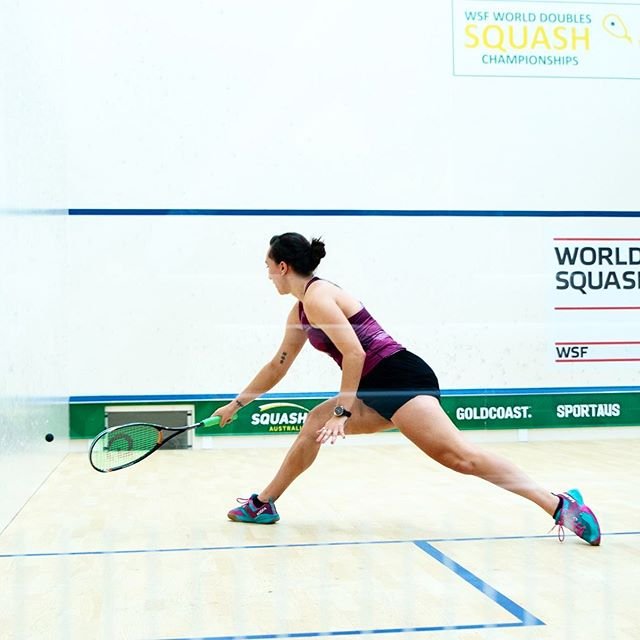
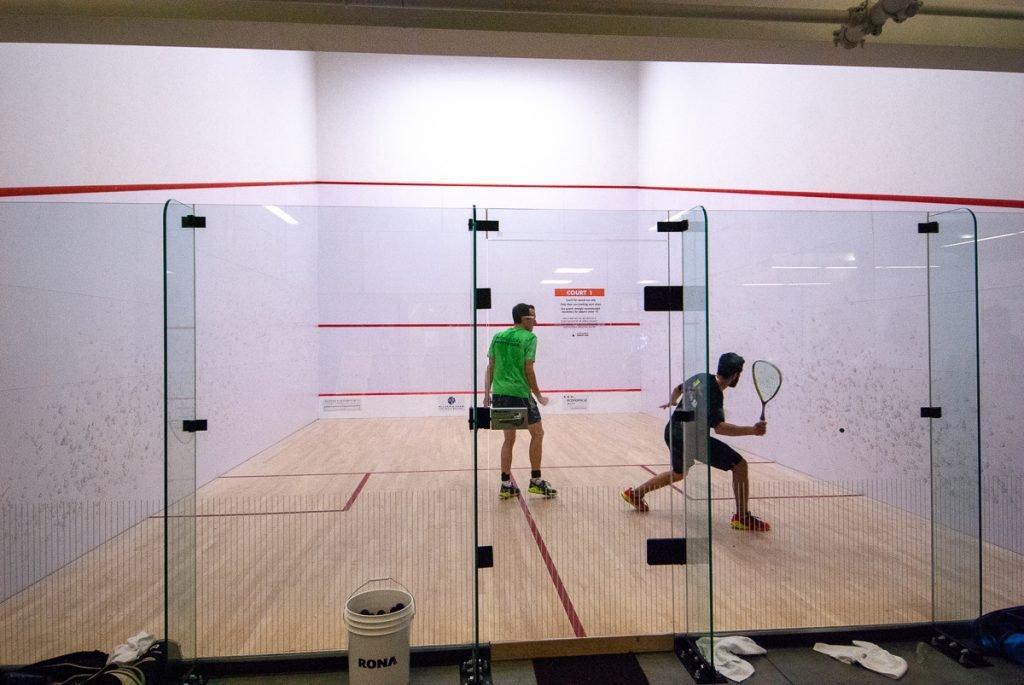
Sometimes the stop isn’t about movement — the ball strikes somebody. Play stops immediately whenever it does (Rule 9), and the basic outcomes are worth knowing. If your shot, on its way to the front wall, hits your opponent and was travelling directly to the front wall on your first attempt, it is a stroke to you — they were standing in the shot’s road (9.1.2). If the shot would have clipped a side wall first, it is a let, unless it was a winning return, which upgrades it to a stroke (9.1.3). If the ball comes off the front wall and hits a player before bouncing twice, the rally is decided by who was hit and whether the striker had already tried to play it — if it hits your opponent before you have attempted your shot, the rally is generally yours; if it hits you, the striker, it is generally theirs (9.2). And if a ball ever hits you because your opponent fired it at you deliberately or dangerously, that is conduct territory — the referee’s problem, and in a friendly game a hard line never to cross: the moment hitting your opponent looks possible, you hold the swing and ask for the let instead. That instinct — hold the shot, don’t hope — is the single most valuable habit a beginner can build.
The basic shots and rally basics
You now know what is legal. The rest of learning squash is learning what is wise — and beginner wisdom starts with geography. The T, where the short line meets the half-court line, is the court’s control room: from there you are one or two steps from almost every ball, and your opponent has to hit around you or past you. So the basic shape of every rally is the same: hit a shot that pushes your opponent away from the T, then recover to the T yourself, watch the ball over your shoulder, and be moving as they strike. Players say it as a loop — hit, recover, watch — and it matters more than any individual shot below.
The drive (the “rail”). The foundation shot: struck from anywhere, aimed to travel close along the side wall to the back of the court, ideally dying in the back corner where the wall and floor meet. Tight to the wall, it cannot be volleyed; deep, it cannot be attacked. Eighty percent of good squash is good length drives, and your first month should be mostly this shot, forehand and backhand.
The crosscourt. The drive’s diagonal sibling: across the court to the far back corner, used to switch the pressure from one side to the other — or to pass an opponent who is crowding the wall your rail is heading down. Hit it a little higher and wider so it clears the middle without offering a volley.
The boast. Your escape and your ambush: the ball is hit into the side wall first (a two-wall boast) or side wall then back wall (three-wall), rebounding onto the front wall at an angle that drags your opponent forwards and across. It is how you get out of the back corners when you are under pressure — and how you punish an opponent standing too deep.
The drop. Played from the front and middle: a soft shot that just clears the tin and dies near the front wall. The drop only works because the drive exists — your opponent, braced for another ball to the back, has to sprint forwards and dig it out before the second bounce.
The lob. High, slow and floating to the back corners, giving you time to recover and pushing your opponent onto the back wall under a falling ball. The defensive reset button — less glamorous than a drop, used far more often by players who win.
The volley. Taking the ball before it bounces: not a separate shot so much as a decision to play any of the above early. Volleys steal your opponent’s recovery time, which is why fights for the T are really fights to volley from it.
Two habits bind the shots together. Watch the ball onto your strings and through your opponent’s swing — after your own shot, turn and track it; being surprised by a ball in a 6.4-metre-wide room is a choice, and a painful one. And finish every shot moving back to the T, balanced, racket up, on the balls of your feet. Do those two things and your length improves, your lets are honest, and the shots above start appearing on their own.
Your first session: etiquette and safety
You can play a legal game of squash with everything above. Playing a good one — the kind where a stranger becomes a regular partner — needs the layer the rulebook assumes and club culture enforces.
Call lets early, and hold shots you doubt. New players under-call interference because asking feels like accusing. It isn’t. “Let, please” is a normal sentence in squash, said several times a match at every level, and saying it before you swing is always safer than swinging and hoping. The mirror-image duty is yours after you hit: clear immediately, follow the ball’s likely path out of your opponent’s road, and never stand admiring your shot.
Protect your eyes — the WSF is explicit about this. The rulebook’s Appendix 4 recommends that all squash players wear protective eyewear, made to an appropriate national standard, at all times during play, including the warm-up — in social games as much as tournaments. For all WSF-sanctioned doubles and junior events, eyewear is mandatory, not a recommendation. A squash ball is small, fast and precisely eye-sized; beginners, who watch the ball less reliably and turn their heads into its path more often, are the players with most reason to wear it from session one.
Wear shoes that don’t mark and can’t slip. Squash is played in non-marking indoor court shoes with gum-rubber soles — grip for the lunges, and no black streaks left on the floor for the next booking. Running shoes are the common beginner mistake twice over: their thick, raised heel rolls ankles in side-to-side movement, and their tread is built for straight lines on tarmac, not for stopping dead on varnished wood.
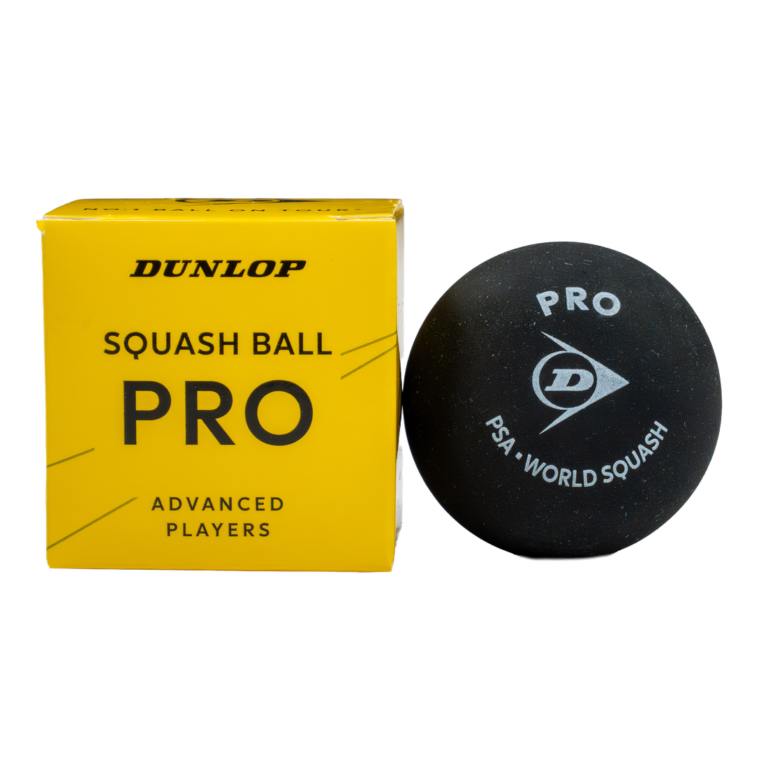
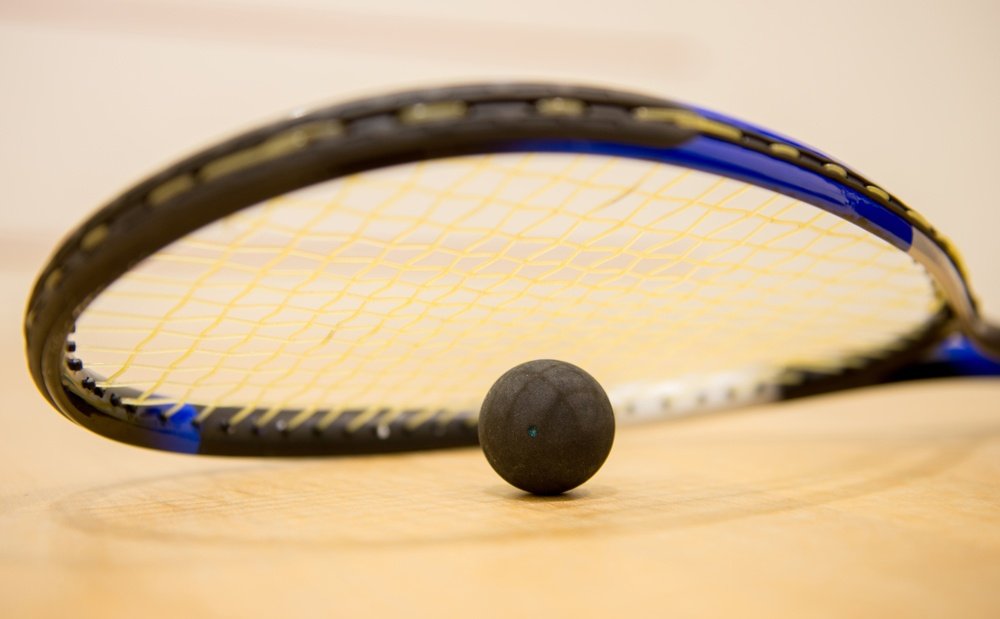
Pick a ball you can actually rally with. Squash balls are graded by their dots: the standard club ball carries a single yellow dot, and slower, bouncier balls exist for good reason — a cold, dead ball kills rallies and teaches cramped, forcing swings. Many coaches start beginners on a bouncier progress ball so rallies last long enough to learn from. Whichever ball you use, the warm-up rule applies doubly: knock up until it is lively before you start scoring.
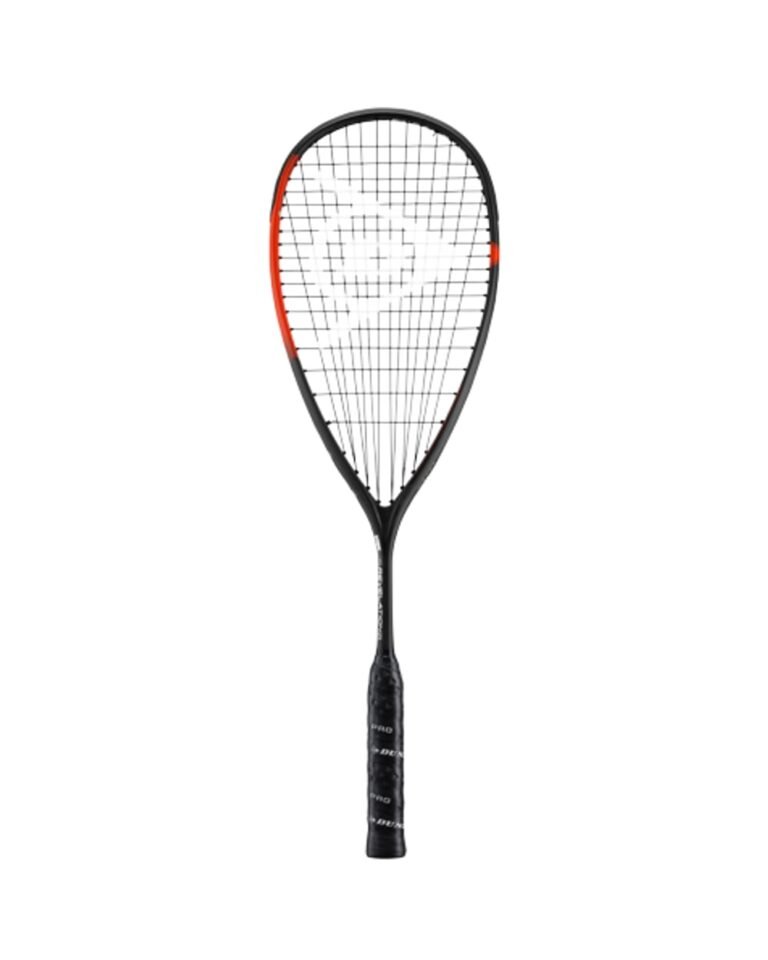
Bring the right racket — and leave the right one at home. A heavy, head-heavy frame built for a county player will not make you one faster; it will mostly make your shoulder sore. Beginner rackets are lighter, more forgiving on off-centre hits and strung to give you time. If you have not bought yours yet, our guide to the best squash rackets for beginners walks through the weights, head sizes and string patterns that suit a first season.
Mind the small courtesies. Arrive changed and ready so your court time is playing time. Keep between-game breaks near the official two minutes. Acknowledge your opponent’s good shots — a brief “good shot” costs nothing and keeps games friendly. And when the match ends, shake hands at the T before you leave the court, win or lose, especially if a let went against you in the last rally. It is the oldest ritual in the game and it works.
The beginner’s checklist
Pin this version to the inside of your head for your first month:
- Serve: foot inside the box, front wall above the service line, first bounce in the far quarter — one serve only, so make it accurate, not fast.
- Rally: front wall above the tin, before the second bounce, volleys allowed, walls are your friends.
- Score: every rally is a point; games to 11; two clear points from 10-all; call the score before you serve.
- Sharing: after your shot, clear — fair view, clear path, swing room, open front wall. Blocked honestly? Say “Let, please” before you swing, never after you miss.
- Safety: hold any shot that might hit your opponent, don’t turn on the ball in your first months, and wear the eyewear the WSF recommends for every player.
- Shape: long drives first, back to the T after every shot, watch the ball through their swing. The rest of the game grows out of that loop.
How to play squash — FAQs
How many points is a squash game played to?
Games are played to 11 points under PAR (point-a-rally) scoring, where the winner of every rally scores a point and serves the next rally. If the score reaches 10-all, the game continues until one player leads by two clear points. A match is normally the best of 5 games, with best of 3 an accepted format (WSF Rules, Rule 2).
Can the ball hit the side walls in squash?
Yes — side walls and the back wall are all in play. A return may hit any other wall or walls on its way to the front wall. The conditions are that the ball must not bounce on the floor first, and it must land on the front wall above the tin and below the out line (Rule 6.2).
How many bounces are allowed in squash?
One. You must strike the ball before it bounces for the second time — a ball that bounces twice is “not up” and the rally is over. You may also volley the ball before it bounces at all, which is legal on every shot including the serve return.
How many serves do you get in squash?
One. There is no second serve: a serve that breaks the serving rules — foot outside the box, front wall below the service line, first bounce outside the opposite quarter, or any contact with a line — is a fault, and a fault loses the rally (Rule 5.7–5.8).
What is the difference between a let and a stroke?
A let replays the rally with nobody scoring: it is given when interference genuinely stopped you playing a shot you could have made, even though your opponent was making every effort to clear. A stroke awards you the rally (and the point): it is given when the interference was more costly — your opponent failed to make every effort to clear, your swing was prevented, you were stopped from hitting a winning return, or the ball’s direct path to the front wall would have hit your opponent (Rule 8).
What do “down”, “out” and “not up” mean?
Down: the shot hit the tin or below its top line, or bounced on the floor before reaching the front wall. Out: the ball touched the out line or the wall above it, on any wall. Not up: the ball was not struck correctly — it bounced twice first, was double-hit, or was carried on the strings. In squash, a ball that touches any line is down or out, never in.
Do I need to wear eye protection for squash?
The WSF recommends that all players wear protective eyewear, made to an appropriate national standard, at all times during play including the warm-up — in social games as well as competition (WSF Rules, Appendix 4). Eyewear is mandatory for all WSF-sanctioned doubles and junior events. Beginners face the same ball at the same speed as everyone else, so it is a sensible first purchase.
What racket and ball should a beginner start with?
A light, even-balanced or head-light racket with a generous head is the forgiving choice while technique forms — heavier, head-heavy frames reward swings beginners have not built yet. For the ball, a bouncier beginner/progress ball keeps rallies alive longer than the standard single-yellow-dot club ball while you learn. Our guide to the best squash rackets for beginners covers the current models, weights and head sizes worth shortlisting.
About this guide: The rules summarised here follow the World Squash Federation’s World Squash Singles Rules, effective 1 September 2025, and the WSF court specifications; where your club or league uses local conventions (tin height, match format, ball grade), those take precedence on the day. This page links only to guides on Alishuttler.com — any affiliate relationships are disclosed on the pages concerned.